EP1172785A2 - Tissu pour un drapeau ou analogue et méthode de fabrication - Google Patents
Tissu pour un drapeau ou analogue et méthode de fabrication Download PDFInfo
- Publication number
- EP1172785A2 EP1172785A2 EP01202738A EP01202738A EP1172785A2 EP 1172785 A2 EP1172785 A2 EP 1172785A2 EP 01202738 A EP01202738 A EP 01202738A EP 01202738 A EP01202738 A EP 01202738A EP 1172785 A2 EP1172785 A2 EP 1172785A2
- Authority
- EP
- European Patent Office
- Prior art keywords
- cloth
- knitted
- strip
- pattern
- edge
- Prior art date
- Legal status (The legal status is an assumption and is not a legal conclusion. Google has not performed a legal analysis and makes no representation as to the accuracy of the status listed.)
- Withdrawn
Links
Images


Classifications
-
- D—TEXTILES; PAPER
- D04—BRAIDING; LACE-MAKING; KNITTING; TRIMMINGS; NON-WOVEN FABRICS
- D04B—KNITTING
- D04B21/00—Warp knitting processes for the production of fabrics or articles not dependent on the use of particular machines; Fabrics or articles defined by such processes
- D04B21/10—Open-work fabrics
-
- G—PHYSICS
- G09—EDUCATION; CRYPTOGRAPHY; DISPLAY; ADVERTISING; SEALS
- G09F—DISPLAYING; ADVERTISING; SIGNS; LABELS OR NAME-PLATES; SEALS
- G09F17/00—Flags; Banners; Mountings therefor
Definitions
- the invention relates to a cloth for a flag or the like, which cloth is made of a knitted or woven fabric or the like.
- EP-A-0 198 101 discloses a woven fabric, which is characterized by alternating reinforced zones of increased fabric weight and air permeable zones of a lighter material weight. This was considered to be an improvement over a cloth comprising an air permeable pattern in its entirety. Nevertheless, both cloth types have the drawback that the open pattern of the fabric has a negative effect on the appearance of the cloth, and in particular of the print that is present thereon.
- the object of the present invention is to provide a cloth which constitutes an improvement in particular as regards this point.
- the cloth is characterized in that the cloth comprises an at least substantially uniformly dense pattern over its entire surface area, and that only at least one edge thereof comprises an integrally woven or knitted strip of a different, in particular a more open pattern.
- the cloth Since the different, in particular more open pattern is provided only in an edge strip of the cloth, the appearance of the cloth and of the print that is present thereon is hardly affected, if at all. Nevertheless the cloth is properly resistant to fraying, since the most vulnerable area of the cloth, that is the edge, comprises the special pattern that prevents the cloth from fraying. If the pattern is more open at the edge, the wind will have less grip on the cloth at that location, and consequently the forces and the load being exerted on the cloth will be reduced. Instead of using a more open pattern, it is also possible to form the edge of a strip which has been woven or knitted from stronger yarns, which likewise leads to a stronger edge. Furthermore it is possible to form the edge strip with a more elastic pattern.
- edge strip is woven or knitted integrally with the rest of the cloth, no separate operations are required for strengthening the edge zone of the cloth, whereas this is necessary with DE-A-196 26 932, for example.
- said strip is only present at one edge of the cloth.
- said strip will form the free edge (the flapping side). This is the edge of the cloth which is loaded most heavily and which will generally become frayed.
- the cloth can be formed as a continuous woven, knitted or woven/knitted fabric, which is subsequently divided into pieces in transverse direction for the purpose of forming separate flags or the like.
- a plurality of inlaid yarns of greater strength than the other yarns is provided in a direction at least substantially transversely to the aforesaid strip.
- Said additional yarns which are preferably distributed over the entire area, provide additional resistance against ripping or tearing of the edge strip, in particular because the wind energy that is exerted on the strip is transmitted to the rest of the cloth.
- the invention furthermore relates to a method for forming a cloth to be used for flags or the like, wherein said cloth is knitted or woven, which method is characterized in that said weaving or knitting is carried out in an at least substantially uniformly dense pattern over the entire surface area, with the exception of at least one edge, where a strip comprising a different, in particular a more open pattern is integrally woven or knitted.
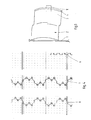
- Fig. 1 is a schematic side elevational view of a flag which has been manufactured in accordance with the present invention.
- Fig. 2 is a larger-scale view of the detail II in Fig. 1.
- Fig. 3 shows a computer-generated pattern of a part of the detail of Fig. 2.
- Fig. 4 shows the path of a wale and of a course in the pattern of Fig. 3.
- Fig. 1 shows a flag 2 on a flagpole 1, which flag has been manufactured in accordance with the invention.
- flag should be broadly interpreted, and it includes also pennants, advertising banners and all kinds of other banners that are hung in the open air.
- Flag 2 has been formed of a cloth consisting of a woven or knitted fabric, a knitted fabric in the present embodiment.
- Said knitted fabric comprises a first, at least substantially uniform, dense pattern 3 and a second, more open pattern 4.
- First pattern 3 extends over substantially the entire surface area of flag 2, whilst only a strip at the free edge of the flag comprises said second, more open pattern 4.
- Fig. 2 shows the detail II of the flag of Fig. 1 on a larger scale, which makes it possible to discern that the first pattern 3 is densely knitted, whilst the second pattern 4 in the edge strip is more open, with clearly distinguishable holes 5.
- the pattern is more dense around said holes, due to the concentration of yarns.
- the edge strip is more permeable to air and also more elastic than the cloth portion that comprises the first pattern 3, as a result of which the flag is better protected against fraying at the free edge thereof than a cloth comprising said first pattern, whilst the flag can nevertheless be readily provided with a print and, due to the integration of the edge strip, no additional manufacturing steps for the edge strip are required.
- Figs. 3 and 4 show on an even larger scale a computer-generated representation of patterns 3 and 4, wherein Fig. 3 shows the entire knit of the various yarns, whilst Fig. 4 shows the path of the various kinds of yarn.
- the illustrated knitted fabric has been formed on a warp-knitting machine in this embodiment, whereby it should be considered that the invention can also be used with Raschel machines, circular knitting machines and flat-bed knitting machines.
- the warp-knitting machine used for the illustrated knitted fabric comprises three warp beams and a number of stump bars.
- the pattern 4 shows a yarn 6 which forms part of the wales in the warp direction of the fabric, whilst yarns 7 and 8 form part of the courses in the weft direction, that is, in the transverse direction of the knitted fabric, and that at the location of second pattern 4.
- the yarns of the courses are diverted round holes 5, as it were, as a result of which yarns of the wales 6 are locally unconnected, which leads to holes 5 being formed.
- the pattern thus formed exhibits a honeycomb-like woven or knitted structure comprising numerous elevated and deepened portions (50 - 80 per cm 2 ).
- holes 5 have a slot-like shape, which becomes more open after knitting and upon stretching of the cloth on a tenter, which shape is retained during the drying and fixing stage, as can be seen in Fig. 2.
- a cloth having an open pattern 4 at both longitudinal edges will be knitted, after which said continuous cloth is divided into two halves in the longitudinal direction. Said two halves are then divided into pieces, wherein each piece is formed into a flag or the like, at the free end of which said strip comprising the open pattern 4 is present.
- edge strips instead of using a more open pattern comprising holes, it is also possible, according to an alternative embodiment of the invention, to form the edge strips with a pattern 4 of stronger yarns, so that a greater resistance against fraying is thus provided in the edge strip.
- the edge strip may be knitted or woven more elastically so as to increase the resistance against fraying.
- Another additional aspect of the invention is to knit or weave a number of additional inlaid yarns into the fabric, which yarns are distributed over the entire area of the flag and which extend transversely to the strip comprising the second pattern 4 (i.e., generally from the flagpole to the flapping side).
- the inlaid yarns will extend in the weft direction, and one inlaid yarn, for example, may be incorporated in each course (the structure will comprise three warp yarns and one weft yarn in that case).
- Said inlaid yarns may be thicker or thinner than the other yarns, but in any case they will generally be stronger than the yarns in the first pattern 3.
- Said additional inlaid yarns strengthen the entire woven or knitted fabric and provide additional protection against ripping of the edge strip, or against said strip being torn off the rest of the flag.
- polyester for example, as the material for the cloth according to the invention, because polyester is strong and environmentally friendly, absorbs little moisture and does not yellow. Also all kinds of other materials are conceivable, of course. It is possible to select polyester of different grades for the various patterns and any additional inlaid yarns.
- the invention provides a cloth which is remarkable for its resistance to the influences of the wind and its simplicity of manufacture.
- the cloth may also be a woven/knitted fabric or a knitted/woven fabric (Magazinschuß).
Landscapes
- Engineering & Computer Science (AREA)
- Textile Engineering (AREA)
- Physics & Mathematics (AREA)
- General Physics & Mathematics (AREA)
- Theoretical Computer Science (AREA)
- Knitting Of Fabric (AREA)
- Laminated Bodies (AREA)
- Woven Fabrics (AREA)
Applications Claiming Priority (2)
| Application Number | Priority Date | Filing Date | Title |
|---|---|---|---|
| NL1015685 | 2000-07-12 | ||
| NL1015685A NL1015685C2 (nl) | 2000-07-12 | 2000-07-12 | Doek voor een vlag of dergelijke, alsmede werkwijze voor vervaardiging hiervan. |
Publications (2)
| Publication Number | Publication Date |
|---|---|
| EP1172785A2 true EP1172785A2 (fr) | 2002-01-16 |
| EP1172785A3 EP1172785A3 (fr) | 2002-07-24 |
Family
ID=19771720
Family Applications (1)
| Application Number | Title | Priority Date | Filing Date |
|---|---|---|---|
| EP01202738A Withdrawn EP1172785A3 (fr) | 2000-07-12 | 2001-07-09 | Tissu pour un drapeau ou analogue et méthode de fabrication |
Country Status (2)
| Country | Link |
|---|---|
| EP (1) | EP1172785A3 (fr) |
| NL (1) | NL1015685C2 (fr) |
Cited By (5)
| Publication number | Priority date | Publication date | Assignee | Title |
|---|---|---|---|---|
| EP1348789A1 (fr) * | 2002-03-28 | 2003-10-01 | Berliner Stoffdruckerei GmbH | Drapeau d'une structure textile |
| EP2918714A1 (fr) * | 2014-03-12 | 2015-09-16 | Gebr. Aurich GmbH | Tricot à mailles jetées enfilé toute la surface destiné à fabriquer des tissus résistants aux intempéries et procédé pour son obtention |
| WO2017214620A1 (fr) * | 2016-06-10 | 2017-12-14 | Duke University | Tissu tricoté chaîne pour applications textiles et médicales et ses procédés de fabrication |
| US11351022B2 (en) | 2014-09-04 | 2022-06-07 | Duke University | Implantable mesh and method of use |
| CN119411298A (zh) * | 2024-09-27 | 2025-02-11 | 绍兴市怡泸纺织科技有限公司 | 一种透气凉感经编面料及其织造工艺 |
Family Cites Families (3)
| Publication number | Priority date | Publication date | Assignee | Title |
|---|---|---|---|---|
| EP0198101B1 (fr) * | 1985-04-16 | 1990-01-31 | FahnenFleck M. Fleck & Sohn | Tissu pour drapeaux, flammes, bannières et similaires |
| DE4425308C1 (de) * | 1994-07-18 | 1995-09-21 | Aurich Gmbh Geb | Vollflächiges Gewirke zur Herstellung von witterungsbeständigen Stoffen für Fahnen, Werbeflächen od. dgl. |
| EP0798688B1 (fr) * | 1996-03-23 | 1998-06-03 | Mattes & Ammann GmbH & Co. KG | Tricot à mailles jetées ajouré pour drapeaux, flammes, bannières et similaires |
-
2000
- 2000-07-12 NL NL1015685A patent/NL1015685C2/nl not_active IP Right Cessation
-
2001
- 2001-07-09 EP EP01202738A patent/EP1172785A3/fr not_active Withdrawn
Cited By (12)
| Publication number | Priority date | Publication date | Assignee | Title |
|---|---|---|---|---|
| EP1348789A1 (fr) * | 2002-03-28 | 2003-10-01 | Berliner Stoffdruckerei GmbH | Drapeau d'une structure textile |
| EP2918714A1 (fr) * | 2014-03-12 | 2015-09-16 | Gebr. Aurich GmbH | Tricot à mailles jetées enfilé toute la surface destiné à fabriquer des tissus résistants aux intempéries et procédé pour son obtention |
| US11351022B2 (en) | 2014-09-04 | 2022-06-07 | Duke University | Implantable mesh and method of use |
| US11426267B2 (en) | 2014-09-04 | 2022-08-30 | Duke University | Implantable mesh and method of use |
| US11872118B2 (en) | 2014-09-04 | 2024-01-16 | Duke University | Implantable mesh and method of use |
| US12376954B2 (en) | 2014-09-04 | 2025-08-05 | Duke University | Implantable mesh and method of use |
| WO2017214620A1 (fr) * | 2016-06-10 | 2017-12-14 | Duke University | Tissu tricoté chaîne pour applications textiles et médicales et ses procédés de fabrication |
| CN109477262A (zh) * | 2016-06-10 | 2019-03-15 | 杜克大学 | 用于纺织品和医疗应用的经编织物及其制备方法 |
| US11001948B2 (en) | 2016-06-10 | 2021-05-11 | Duke University | Warp knit fabric for textile and medical applications and methods of manufacturing the same |
| AU2017278300B2 (en) * | 2016-06-10 | 2022-10-20 | Duke University | Warp knit fabric for textile and medical applications and methods of manufacturing the same |
| US12018414B2 (en) | 2016-06-10 | 2024-06-25 | Duke University | Warp knit fabric for textile and medical applications and methods of manufacturing the same |
| CN119411298A (zh) * | 2024-09-27 | 2025-02-11 | 绍兴市怡泸纺织科技有限公司 | 一种透气凉感经编面料及其织造工艺 |
Also Published As
| Publication number | Publication date |
|---|---|
| EP1172785A3 (fr) | 2002-07-24 |
| NL1015685C2 (nl) | 2002-01-23 |
Similar Documents
| Publication | Publication Date | Title |
|---|---|---|
| US3570482A (en) | Elastic surgical bandage | |
| MY125137A (en) | Warp-tied composite forming fabric | |
| WO2004059076A3 (fr) | Tissus a fils interchangeants par paires presentant un dessin d'armure discontinu | |
| ATE298380T1 (de) | Formiergewebe mit tripletkette | |
| CA2483167A1 (fr) | Tissu eponge lisse avec fils synthetiques continus ne transportant pas l'humidite | |
| JP2007505232A5 (fr) | ||
| JPS59187655A (ja) | オ−プンワ−ク編成構造およびその製造方法 | |
| WO2008073301A3 (fr) | Dessin de tissage de couche côté machine pour fabrication de tissus composites | |
| ATE372404T1 (de) | Technisches gewebe mit garnverbänden | |
| WO2000026453A3 (fr) | Textile tisse a fils de chaine en feuille plate et appareil pour le former | |
| EP1172785A2 (fr) | Tissu pour un drapeau ou analogue et méthode de fabrication | |
| RU2007129378A (ru) | Трехслойные ткани, содержащие многочисленные контурные связующие элементы | |
| JP6593767B2 (ja) | 高強度経編メッシュシート | |
| US11198960B2 (en) | Warp knitted fabric and manufacturing method thereof | |
| ZA991317B (en) | A textile support for reinforcing an item of clothing or pieces of clothing, a method of manufacturing such a textile support and applications thereof. | |
| PL355847A1 (en) | Textile material in sheet form for technical uses | |
| ATE315674T1 (de) | Verwobenes riemengewebe | |
| KR101931347B1 (ko) | 재귀반사원사 및 그 제조방법 | |
| JP2012224964A (ja) | 炭素繊維補強織物 | |
| JP4746206B2 (ja) | 経編地 | |
| US5868009A (en) | Process for making reinforcing fabric used in automotive radiator hoses | |
| KR200210258Y1 (ko) | 올풀림현상을 방지한 심레스 위편직물 | |
| US20020132542A1 (en) | Fabric | |
| CN210652154U (zh) | 一种便于穿绳的弹性腰口织带 | |
| JP2026500110A (ja) | 空気タイヤ用の繊維製アンチスキッド装置及び当該装置の生産方法 |
Legal Events
| Date | Code | Title | Description |
|---|---|---|---|
| PUAI | Public reference made under article 153(3) epc to a published international application that has entered the european phase |
Free format text: ORIGINAL CODE: 0009012 |
|
| AK | Designated contracting states |
Kind code of ref document: A2 Designated state(s): AT BE CH CY DE DK ES FI FR GB GR IE IT LI LU MC NL PT SE TR |
|
| AX | Request for extension of the european patent |
Free format text: AL;LT;LV;MK;RO;SI |
|
| PUAL | Search report despatched |
Free format text: ORIGINAL CODE: 0009013 |
|
| AK | Designated contracting states |
Kind code of ref document: A3 Designated state(s): AT BE CH CY DE DK ES FI FR GB GR IE IT LI LU MC NL PT SE TR |
|
| AX | Request for extension of the european patent |
Free format text: AL;LT;LV;MK;RO;SI |
|
| 17P | Request for examination filed |
Effective date: 20021023 |
|
| AKX | Designation fees paid |
Designated state(s): AT BE CH CY DE DK ES FI FR GB GR IE IT LI LU MC NL PT SE TR |
|
| 17Q | First examination report despatched |
Effective date: 20030327 |
|
| GRAP | Despatch of communication of intention to grant a patent |
Free format text: ORIGINAL CODE: EPIDOSNIGR1 |
|
| STAA | Information on the status of an ep patent application or granted ep patent |
Free format text: STATUS: THE APPLICATION IS DEEMED TO BE WITHDRAWN |
|
| 18D | Application deemed to be withdrawn |
Effective date: 20040709 |