EP1173256B1 - Verfahren zur herstellung von op-detoxifizierenden schwämmen - Google Patents
Verfahren zur herstellung von op-detoxifizierenden schwämmen Download PDFInfo
- Publication number
- EP1173256B1 EP1173256B1 EP00931947A EP00931947A EP1173256B1 EP 1173256 B1 EP1173256 B1 EP 1173256B1 EP 00931947 A EP00931947 A EP 00931947A EP 00931947 A EP00931947 A EP 00931947A EP 1173256 B1 EP1173256 B1 EP 1173256B1
- Authority
- EP
- European Patent Office
- Prior art keywords
- sponge
- enzymes
- foam
- enzyme
- immobilized
- Prior art date
- Legal status (The legal status is an assumption and is not a legal conclusion. Google has not performed a legal analysis and makes no representation as to the accuracy of the status listed.)
- Expired - Lifetime
Links
Images









Classifications
-
- A—HUMAN NECESSITIES
- A62—LIFE-SAVING; FIRE-FIGHTING
- A62D—CHEMICAL MEANS FOR EXTINGUISHING FIRES OR FOR COMBATING OR PROTECTING AGAINST HARMFUL CHEMICAL AGENTS; CHEMICAL MATERIALS FOR USE IN BREATHING APPARATUS
- A62D3/00—Processes for making harmful chemical substances harmless or less harmful, by effecting a chemical change in the substances
-
- A—HUMAN NECESSITIES
- A61—MEDICAL OR VETERINARY SCIENCE; HYGIENE
- A61L—METHODS OR APPARATUS FOR STERILISING MATERIALS OR OBJECTS IN GENERAL; DISINFECTION, STERILISATION OR DEODORISATION OF AIR; CHEMICAL ASPECTS OF BANDAGES, DRESSINGS, ABSORBENT PADS OR SURGICAL ARTICLES; MATERIALS FOR BANDAGES, DRESSINGS, ABSORBENT PADS OR SURGICAL ARTICLES
- A61L2/00—Disinfection or sterilisation of materials or objects, in general; Accessories therefor
- A61L2/16—Disinfection or sterilisation of materials or objects, in general; Accessories therefor using chemical substances
-
- A—HUMAN NECESSITIES
- A61—MEDICAL OR VETERINARY SCIENCE; HYGIENE
- A61L—METHODS OR APPARATUS FOR STERILISING MATERIALS OR OBJECTS IN GENERAL; DISINFECTION, STERILISATION OR DEODORISATION OF AIR; CHEMICAL ASPECTS OF BANDAGES, DRESSINGS, ABSORBENT PADS OR SURGICAL ARTICLES; MATERIALS FOR BANDAGES, DRESSINGS, ABSORBENT PADS OR SURGICAL ARTICLES
- A61L2/00—Disinfection or sterilisation of materials or objects, in general; Accessories therefor
- A61L2/16—Disinfection or sterilisation of materials or objects, in general; Accessories therefor using chemical substances
- A61L2/23—Solid materials, e.g. granules, powders, blocks or tablets
- A61L2/235—Solid materials, e.g. granules, powders, blocks or tablets cellular, porous or foamed
-
- A—HUMAN NECESSITIES
- A62—LIFE-SAVING; FIRE-FIGHTING
- A62D—CHEMICAL MEANS FOR EXTINGUISHING FIRES OR FOR COMBATING OR PROTECTING AGAINST HARMFUL CHEMICAL AGENTS; CHEMICAL MATERIALS FOR USE IN BREATHING APPARATUS
- A62D3/00—Processes for making harmful chemical substances harmless or less harmful, by effecting a chemical change in the substances
- A62D3/02—Processes for making harmful chemical substances harmless or less harmful, by effecting a chemical change in the substances by biological methods, i.e. processes using enzymes or microorganisms
-
- C—CHEMISTRY; METALLURGY
- C08—ORGANIC MACROMOLECULAR COMPOUNDS; THEIR PREPARATION OR CHEMICAL WORKING-UP; COMPOSITIONS BASED THEREON
- C08G—MACROMOLECULAR COMPOUNDS OBTAINED OTHERWISE THAN BY REACTIONS ONLY INVOLVING UNSATURATED CARBON-TO-CARBON BONDS
- C08G18/00—Polymeric products of isocyanates or isothiocyanates
- C08G18/06—Polymeric products of isocyanates or isothiocyanates with compounds having active hydrogen
- C08G18/08—Processes
- C08G18/10—Prepolymer processes involving reaction of isocyanates or isothiocyanates with compounds having active hydrogen in a first reaction step
-
- C—CHEMISTRY; METALLURGY
- C12—BIOCHEMISTRY; BEER; SPIRITS; WINE; VINEGAR; MICROBIOLOGY; ENZYMOLOGY; MUTATION OR GENETIC ENGINEERING
- C12N—MICROORGANISMS OR ENZYMES; COMPOSITIONS THEREOF; PROPAGATING, PRESERVING, OR MAINTAINING MICROORGANISMS; MUTATION OR GENETIC ENGINEERING; CULTURE MEDIA
- C12N11/00—Carrier-bound or immobilised enzymes; Carrier-bound or immobilised microbial cells; Preparation thereof
- C12N11/02—Enzymes or microbial cells immobilised on or in an organic carrier
- C12N11/04—Enzymes or microbial cells immobilised on or in an organic carrier entrapped within the carrier, e.g. gel or hollow fibres
-
- C—CHEMISTRY; METALLURGY
- C12—BIOCHEMISTRY; BEER; SPIRITS; WINE; VINEGAR; MICROBIOLOGY; ENZYMOLOGY; MUTATION OR GENETIC ENGINEERING
- C12N—MICROORGANISMS OR ENZYMES; COMPOSITIONS THEREOF; PROPAGATING, PRESERVING, OR MAINTAINING MICROORGANISMS; MUTATION OR GENETIC ENGINEERING; CULTURE MEDIA
- C12N11/00—Carrier-bound or immobilised enzymes; Carrier-bound or immobilised microbial cells; Preparation thereof
- C12N11/18—Multi-enzyme systems
-
- A—HUMAN NECESSITIES
- A62—LIFE-SAVING; FIRE-FIGHTING
- A62D—CHEMICAL MEANS FOR EXTINGUISHING FIRES OR FOR COMBATING OR PROTECTING AGAINST HARMFUL CHEMICAL AGENTS; CHEMICAL MATERIALS FOR USE IN BREATHING APPARATUS
- A62D2101/00—Harmful chemical substances made harmless, or less harmful, by effecting chemical change
- A62D2101/02—Chemical warfare substances, e.g. cholinesterase inhibitors
-
- A—HUMAN NECESSITIES
- A62—LIFE-SAVING; FIRE-FIGHTING
- A62D—CHEMICAL MEANS FOR EXTINGUISHING FIRES OR FOR COMBATING OR PROTECTING AGAINST HARMFUL CHEMICAL AGENTS; CHEMICAL MATERIALS FOR USE IN BREATHING APPARATUS
- A62D2101/00—Harmful chemical substances made harmless, or less harmful, by effecting chemical change
- A62D2101/20—Organic substances
- A62D2101/26—Organic substances containing nitrogen or phosphorus
-
- A—HUMAN NECESSITIES
- A62—LIFE-SAVING; FIRE-FIGHTING
- A62D—CHEMICAL MEANS FOR EXTINGUISHING FIRES OR FOR COMBATING OR PROTECTING AGAINST HARMFUL CHEMICAL AGENTS; CHEMICAL MATERIALS FOR USE IN BREATHING APPARATUS
- A62D2101/00—Harmful chemical substances made harmless, or less harmful, by effecting chemical change
- A62D2101/20—Organic substances
- A62D2101/28—Organic substances containing oxygen, sulfur, selenium or tellurium, i.e. chalcogen
-
- C—CHEMISTRY; METALLURGY
- C08—ORGANIC MACROMOLECULAR COMPOUNDS; THEIR PREPARATION OR CHEMICAL WORKING-UP; COMPOSITIONS BASED THEREON
- C08G—MACROMOLECULAR COMPOUNDS OBTAINED OTHERWISE THAN BY REACTIONS ONLY INVOLVING UNSATURATED CARBON-TO-CARBON BONDS
- C08G2110/00—Foam properties
- C08G2110/0083—Foam properties prepared using water as the sole blowing agent
Definitions
- This invention relates to a method for making materials and methods for using these materials for neutralizing, detoxifying or decontaminating equipment and/or personnel exposed to organophosphorous and organosulfur compounds.
- organophosphorous and organosulfur refers to both compounds, herbicides and insecticides.
- OP refers to both
- the compositions and devices utilized in the prior art methods have undesirable properties, such as corrosiveness, flammability, toxicity, difficulty in making and storing, and limited shelf-life.
- DS2 a standard decontamination agent, comprises 70% diethylenetriamine, 28% ethylene glycol monomethyl ether, and 2% NaOH by weight. Although DS2 is effective, it is corrosive upon exposure to air. DS2 and any matter resulting from its use is classified and regulated as hazardous material. After an application, the DS2 must stand for 30 minutes before rinsing the treated area with water. Additionally, DS2 comprises a teratogen.
- Some decontamination methods employ hypochlorite formulations which are corrosive and toxic and injure humans and sensitive tissues such as eyes.
- Other methods comprise incinerating the contaminated material and utilizing carbon filters to absorb the residual chemicals.
- Yet other methods utilize polymer beads or microemulsions which absorb the chemical and must be rinsed away. These methods are inherently dangerous, expensive and generate hazardous waste.
- these compositions and compounds utilized degrade upon exposure to water and carbon dioxide, these compositions and compounds must be used the same day they are made.
- Some in vivo methods employ cholinesterases in the presence of nucleophilic oximes to detoxify OP compounds.
- This enzyme bioscavenger approach is effective against a variety of OP compounds in rodents and nonhuman primates.
- pretreatment of rhesus monkeys with fetal bovine serum acetylcholinesterase (FBS-AChE) or horse serum butyrylcholinesterase (Eq-BChE) confers protection against up to 5 LD 50 of soman, a highly toxic OP nerve agent.
- FBS-AChE fetal bovine serum acetylcholinesterase
- Eq-BChE horse serum butyrylcholinesterase
- OP/enzyme stoichiometry is increased by combining enzyme pretreatment with oxime reactivation so that the catalytic activity of OP inhibited FBS-AChE is rapidly and continuously restored, and the OP compound is detoxified.
- the present invention provides methods of making materials and methods for using these materials for neutralizing, detoxifying or decontaminating equipment and/or personnel exposed to OP compounds.
- the material may comprise a mixture of enzymes and substrates for the removal, decontamination and neutralization of OP compounds including those directed against humans.
- the mixture of enzymes utilized comprises cholinesterases (ChEs) and/or OP hydrolases and reactivators, such as oximes which includes mono-disquarternary oximes.
- the material comprises a flexible or rigid porous support which is a polyurethane matrix or equivalent.
- the porous support may be a flexible sponge-like substance or like material, wherein the enzymes are secured by immobilization.
- porous supports of varying degrees of flexibility and porosity may be obtained.
- the porous support may be formed into various shapes, sizes and densities, depending on need and the shape of the mold.
- the porous support may be formed into a typical household sponge or a towelette.
- the referred dimensions of the sponge are 25.4 x 50.8 x 203.2 mm (1" x 2" x 8") to 50.8 x 101.6 x 203.2 mm 2" x 4" x 8").
- the preferred dimensions of the towelette are 101.6 x 101.6 x 6.4 mm (4" x 4" x 0.25") to 101.6 x 101.6 x 0.8 mm (4" x 4" x 0.03125”) to 355.6 x 355.6 x 1.6mm (14" x 14" x 0.0625").
- the dimensions of the initial immobilized enzyme product might be large. For example, approximately 1.22 m by 2.44 m (4 feet by 8 feet) rolls could be produced and sized as appropriate and described above.
- the sponge-like support would be preferable for use on surfaces, including natural, synthetic and biological surfaces such as equipment, laboratory hardware, devices, skin and other delicate membranes, where decontamination of a rough or irregular surface is desired or where the prior art decontamination materials are incompatible with human tissue.
- the materials may be used to clean and decontaminate wounds as it is non-toxic and the immobilized enzymes will not leach into a wound. Therefore, the sponges could be used to decontaminate civilians contaminated by a terrorist attack at a public event.
- an object and/or area to be neutralized or decontaminated comprises cracks, crevices, porous or uneven surfaces
- a foam-like support is suitable.
- Application of small quantities may be done with a spray-bottle or spray can with an appropriate nozzle.
- foam may be selected so that it can be dispensed into the opening of sensitive equipment or an orifice of a subject, such as the ear canal. If a large area is contaminated, an apparatus that dispenses a large quantity of foam may be utilized.
- the foam-like support may dissipate after a period of time like shaving cream or it may cure into a stable and flexible sponge-like support.
- the dissipating foam may be applied on living subjects.
- the foam, which cures, may be applied around an object and contain the contamination within the foam. Once the foam cures, the object may be handled and moved without further exposure to the hazardous chemical.
- the material may also comprise a rigid and porous support.
- the rigid material can be ground into a powder and added to lotions, soaps and other liquids for application.
- the flexible material supra, may be appropriately treated to render it suitable for use in lotions, soaps and other liquids.
- the material may also be in the form of a filter for neutralizing, detoxifying or decontaminating gases such as air. Additionally, the material may be in a form suitable for use as clothing or linings of clothing. Furthermore, the material may be used to decontaminate water by placing the material in water and then removing it from the water.
- the material can be color-coded according to the specific substance it may neutralize, detoxify or decontaminate.
- the color or color scheme could be selected to indicate enzymatic concentration, activity and/or remaining shelf-life or range thereof.
- OP compounds may be appropriately combined with carbon for further absorption of OP compounds.
- the carbon may be embedded or incorporated within the porous support of the material or the carbon may be a layer, filter or other to be used in conjunction with the material.
- a slow release form such as a dry capsule, pellet, liposome or other, of a reactivating compound and OP reacting compounds such as certain oximes like HI-6 and mono-bisquaternary oximes such as pralidoxime chloride (2-PAM) may be embedded or incorporated within the porous support of the material.
- a preferred embodiment of the invention comprises making a material wherein AChE and/or BChE are simultaneously immobilized with OP hydrolases on or within the porous support during synthesis of the material.
- the enzymes are immobilized through covalent linkages.
- the enzymes may be of prokaryotic or eukaryotic origin.
- the enzymes may be contained within the cell or cell free.
- the enzymes may be of recombinant origin.
- Other enzymes capable of hydrolyzing hazardous chemicals such as OP compounds may be employed, for example laccase.
- other OP hydrolyzing enzymes would ensure rapid and complete destruction of any toxic intermediate (for example, phosphoryloximes) that might be generated during the decontaminaiton process.
- enzymes such as triesterase may be used for the decontamination of pesticides in a similar manner as herein described.
- Preferred enzymes are those that may be reactivated.
- the materials may be placed in containers to complete decontamination the OP compounds on the materials.
- the invention relates to the process of making a material, for the removal, decontamination or neutralization of hazardous chemicals such as OP compounds, comprising a mixture of enzymes immobilized on a porous support.
- a mixture of enzymes and a prepolymer are gently and evenly mixed together with minimal degradation of the biotype component so that the resulting immobilized enzyme may effectively decontaminate, neutralize or detoxify an amount of an OP compound.
- the device utilized folds the components into one another. This is a low shear process.
- the enzymes utilized are subjected to fluid forces or shear stress.
- a device that gently folds the components into one another greatly reduces these fluid forces or shear stress, and is the preferred device for enzymes, specifically enzymes that are sensitive to the high shear forces of the drill mixing device.
- enzymes specifically enzymes that are sensitive to the high shear forces of the drill mixing device.
- additives such as surface-acting polymers, e.g. P-65, or low concentrations of glycerol protects against enzyme denaturation induced by shear forces, and modifies the final properties of the sponge to obtain the desired porosity and absorbent qualities.
- a two chamber apparatus is utilized. See Figure 11 A and B.
- One chamber contains a mixture of enzymes and the other chamber contains the prepolymer.
- the mixture of enzymes and the prepolymer are simultaneously extruded at a 1:1 ratio and mixed.
- the mixture of enzymes and the prepolymer are rapidly and evenly extruded through a static mixing stator which gently and evenly mixes the enzymes and prepolymer.
- a preferred low shear device is a double chamber syringe and a static mixing stator typically used to mix viscous polyurethanes or epoxy glues.
- the size of the apparatus may vary depending on need. It may be pocketsize for use in the field by soldiers.
- the apparatus may be suitable for large-scale production and/or decontamination of a large objects or area.
- the low shear mixing device more than doubles the resultant AChE or BChE immobilized enzyme activity when compared to an identical mixture prepared with the high shear device.
- the invention further relates to various methods for reactivating the enzymatic activity of the material. These methods will allow a person to use the decontamination material of the invention for several separate uses and/or for a single and continuous use, which would normally require several decontamination materials but for reactivation of the enzymatic activity of the immobilized enzymes. Additionally, these methods allow for complete decontamination and/or neutralization of excess OP compounds absorbed by the porous support but did not react with the immobilized enzymes. These methods and reactivation materials employ substrates and/or oximes, to reactivate the catalytic activity of the OP inhibited and immobilized enzymes.
- additives may be added to aid in the removal and decontamination of organophosphate from surfaces such as cracks, crevices, porous or uneven surfaces such as clothes and biological surfaces that readily absorb the organophosphates or pesticides such as skin.
- the additives are used in conjunction with the sponge material and may be incorporated within the porous support of the material.
- the additives may be in a dry or liquid form, and may be organophosphate solubilizing compounds such as triacetin or tetraglyme, or oximes, which both aid in decontaminating and reactivating enzymes.
- kits may include materials which would facilitate or be deemed necessary for the decontamination process.
- Kits may also include polymeric materials and enzymes if the foam is transient in nature, e.g. the prepolymer, a stable enzyme mixture and a low shear apparatus for making an organophosphorous and/or organosulfur decontamination foam.
- the kits may contain items to facilitate the use of the device, e.g. instructions, containers, test tubes, etc.
- Enzymes have been incorporated in hypo-based urethane foam during polymer synthesis. See U.S. Patent No. 4,342,834. Hypoprepolymer is synthesized from a reaction of polyether (or polyester) polyol with isocyanates in the presence of cross-linking agents. See Havens, P.L., et al., Ind Eng Chem Res (1993) 32:2254-2258; U.S. Patent No. 4,137,200; LeJeune, K.E., et al., Biotechnology and Bioengineering (1999) 20;62(6):659-665. Synthesis is initiated by bringing water molecules into contact with isocyanate groups present within the polyurethane prepolymer.
- polyether prepolymer derived from tolyl diisocyanate reacts most favorably with free aliphatic amines such as lysine and arginine present on the surface of the ChEs (or any protein) to become a permanent cross-linked part of the material
- computer aided molecular modeling of the enzymes was performed to highlight the available amino groups on the surface of each enzyme, and to determine whether the coupling of these groups to a porous support would interfere with enzymatic function. This may be performed on every enzyme for which its crystal structure is known, or enzymes which may be modeled by homology.
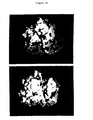
- Figure 1 A illustrates the modeled surfaces of acetylcholinesterase, butyrycholinesterase and phosphotriesterase and shows the lysine and arginine residues on the surface of the ChEs which are available for coupling to the prepolymer.
- the top row shows a view of the front of the enzymes with the lip of the active site gorge outlined with a dotted line in the center.
- the bottom row shows the backside of the enzymes (180° rotation).
- the Lysine and Arginine residues on the surface, which are potential coupling sites to the polymer, are shaded dark in both the top and bottom row. This was generated was generated was generated was generated was generated by Insight II, molecular modeling software, by Biosym Technologies.
- a typical synthesis of the material comprises mixing enzymes in phosphate buffer containing 1% (final concentration) surfactant with prepolymer.
- Polyether prepolymer derived from tolyl diisocyanate (TDI), Hypol prepolymer TDI 3000 (Hampshire Chemical, Lexington, MA), and Pluronic P-65 surfactant (BASF Specialty Chemicals, Parsippany, NJ) were used.
- the 2-phase system is mixed and placed into a suitable mold and left to cure.
- Figure 2 shows a cured material which comprises a sponge-like support.
- Figure 3 schematically illustrates the specific reaction of the enzymes with prepolymer. Synthesis begins when H 2 O molecules react with the isocyanate groups present within the polyurethane prepolymer. Isocyanate reacts with the water to form an unstable carbonic acid, which degrades to an amine yielding CO 2 . The CO 2 causes the polymer to rise and become porous, and simultaneously the amines readily react with the isocyanate groups leading to urea linkages. While the amino groups are the preferred reaction site between the enzyme(s) and the prepolymer, hydroxyl (OH) groups are also available to interact within the reaction buffer, e.g. H 2 O and on the enzyme(s).
- ChE contains amines that are on the surface and available to react with the isocyanate groups, they can become an integral part of the polyurethane support during synthesis. There is no significant entrapment of the enzyme in the material as found with cyclodextrins, or physical adsorption of the enzymes, as observed with activated carbon.
- a surfactant such as Pluronic P-65 at about 1% final concentration controls the final structure and absorption potential of the material.
- a material comprising a porous polyurethane support approximately 30 mL of 50 mM phosphate buffer, pH 8.0, containing P-65 surfactant buffer, was placed in a 600 mL plastic beaker. 3 to 5 mL of either purified FBS-AChE (7500 units) or purified Eq-BChE (5000 units) was added, followed by approximately 40 gm of Hypo 3000 prepolymer (tolyl diisocyanate). The two-phase system was mixed and the material was allowed to expand for 10 min, extruded from the container. The material was washed thoroughly with 50 mM phosphate buffer, pH 8.0, dried and stored in a zippered bag at 4°C for future use.
- the enzymes can be attached at multiple points, they become a part of the cross-linked polymer support.
- the cross-linked polymer support imparts considerable stability to the bound enzymes.
- a large quantity of enzyme can be incorporated into a small polyurethane support, thereby rendering the cross-linked polymer support a highly effective material for decontamination.
- the material was washed with either 50 mM phosphate buffer, distilled water, or 10 mM ammonium bicarbonate without affecting substrate hydrolysis. Therefore, the mixing of prepolymer, surfactant, and enzyme in situ at 22°C yields a useful and effective material retaining about 50% of the original activity of soluble ChE.
- the material has a significantly higher loading capacity for ChEs such as BChE or AChE.
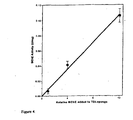
- the final activity of the BChE immobilized in the material could be increased by adding larger quantities of enzyme during synthesis.
- a linear correlation was observed between the amount of BChE added to the prepolymer during synthesis and the amount of BChE activity observed in the final sponge. See Fig. 4.
- nonspecific protein bovine serum albumin, BSA
- BSA bovine serum albumin
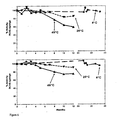
- the immobilized ChE and OP hydrolase maintained enzymatic stability for more than 12 months at 25°C and 45°C, respectively. If the material is frozen in liquid nitrogen, most of the original activity remains. TDI imparts remarkable stability to the immobilized ChE; about 50% of the original activity of the immobilized AChE and 20% of the activity of the immobilized BChE remained after 16 hours at 80°C, conditions under which the soluble enzymes would exhibit no activity.
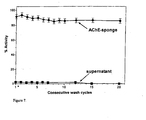
- the ChE materials can be exhaustively dried under vacuum at 22°C and then rehydrated without loss of enzyme activity. When AChE or BChE materials were exhaustively washed and assayed for activity, the wash and assay cycle repeated more than twenty times over three days, no decrease in activity occurred. See Fig. 7. This indicates that the material may be used repeatedly.
- the number of active sites of either the immobilized or soluble ChEs was determined by titration with the organophosphorous compound MEPQ, 7-(methylethoxyphosphinyloxy)-1-methylquinolinium iodide.
- the bimolecular rate constants for the inhibition of AChE material and BChE material and the respective soluble enzymes by MEPQ at 25°C showed that there was no significant difference between the soluble and covalently bound enzymes. Table 1.
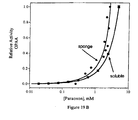
- immobilized cholinesterases or OP hydrolyzing enzymes exhibit between the same to 10 fold greater K m values than the corresponding soluble enzymes.
- OPH derived from Pseudomonas diminuta, figure 19A
- OPAA derived from Alteromonas, Figure 19B
- K m for the substrate paraoxon.
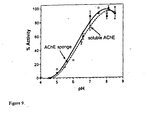
- the pH profiles of immobilized and soluble AChE are identical and the enzymes exhibit activity throughout the broad pH range of 7-8.5. See Fig. 9. Since the pH profiles of soluble cholinesterases and OP hydrolases have optimal activities in this same pH range, the materials may be optimized and diversified by employing a plurality of these multiple enzymes immobilized on or within a porous support.
- ChEs were co-immobilized with bacterial OP hydrolase (OPH B ) and/or rabbit serum OP hydrolase (OPH R ). There was no reduction in the enzymatic activities of AChE or BChE co-immobilized with OPH as compared to the enzymatic activities of each of these enzymes individually immobilized. See Fig. 10. Additionally, there was no reduction in the enzymatic activity of co-immobilized OPH. Therefore, a plurality of enzymes, which each enzyme differentially reacts with various OP compounds, may be selected and utilized in a material to create a decontamination material effective against a wide range of OP compounds.
- Figure 11A shows a version of a manual mixing gun
- Figure 11B shows a disposable mixing stator.
- Complete mixing of the enzyme in a aqueous solution and the viscous prepolymer is accomplished in the stator.
- the product shown here for illustrative purposes is green, while the two starting components are yellow and blue.
- the enzyme is not in an organic buffer as required in some immobilization techniques. This results in less air-induced shearing, thereby maintaining enzymatic activity.
- This method is also simple to conduct, rapid and reproducible.
- the low shear mixing device more than doubles the resultant AChE and/or BChE immobilized enzyme activity when compared to an identical mixture prepared with the high shear device such as a mixing drill. See Table 3.
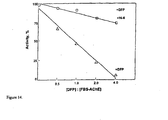
- the inhibition of FBS-AChE activity by DFP was proportional to the stoichiometric amount of DFP added to the foam suspended in buffer.
- the presence of 1 mM HI-6 nearly completely prevented enzyme inhibition by DFP. This indicates that immobilized FBS-AChE may be repeatedly reused after reactivating the enzyme with an oxime solution such as HI-6.
- Figure 12 illustrates how oximes may reactivate alkylphosphorylated ChE activity.
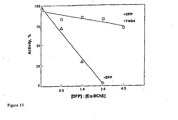
- TMB4 was used as a reactivator instead of HI-6, since TMB4 is a more efficient reactivator of inhibited Eq-BChE than is HI-6. These results are shown in Figure 15. As in Example 6, the foam-bound Eq-BChE may be repeatedly reused after reactivating the enzyme with an oxime solution such as TMB4.
- the protective ratio is the ratio of the LD 50 of the sponge containing an additive to the LD 50 of soman in the absence of sponge.
- the sponge was compared to the M291 kit (available from Truetech, Inc.), the currently used decontamination kit fielded by the US Army. As shown in the table, the sponges provide 4 to 5-fold better protection than the M291 kit.
- Figure 17A shows the protection afforded by tetraglyme
- Figure 17 B the protection afforded by HI-6
- Figure 17C the protection afforded by 2-PAM.
- the number on the top of each bar shows the number of guinea pigs evaluated at the indicated dose of soman (GD).
- GD soman
- the LD 50 of soman on guinea pigs without any effort to decontaminate is shown by the label "GP”
- M291 kit is shown by "M291 ".
- Other additives to the sponge such as triacetin also afforded some additional protection compared to the M291 kit.
Landscapes
- Health & Medical Sciences (AREA)
- Chemical & Material Sciences (AREA)
- Life Sciences & Earth Sciences (AREA)
- General Health & Medical Sciences (AREA)
- Organic Chemistry (AREA)
- Chemical Kinetics & Catalysis (AREA)
- Engineering & Computer Science (AREA)
- General Chemical & Material Sciences (AREA)
- Zoology (AREA)
- Wood Science & Technology (AREA)
- Genetics & Genomics (AREA)
- Bioinformatics & Cheminformatics (AREA)
- Microbiology (AREA)
- Biomedical Technology (AREA)
- Biochemistry (AREA)
- Biotechnology (AREA)
- Public Health (AREA)
- General Engineering & Computer Science (AREA)
- Toxicology (AREA)
- Business, Economics & Management (AREA)
- Emergency Management (AREA)
- Epidemiology (AREA)
- Veterinary Medicine (AREA)
- Animal Behavior & Ethology (AREA)
- Medicinal Chemistry (AREA)
- Polymers & Plastics (AREA)
- Dispersion Chemistry (AREA)
- Molecular Biology (AREA)
- Immobilizing And Processing Of Enzymes And Microorganisms (AREA)
- Manufacture Of Porous Articles, And Recovery And Treatment Of Waste Products (AREA)
- Enzymes And Modification Thereof (AREA)
- Organic Low-Molecular-Weight Compounds And Preparation Thereof (AREA)
- Fire-Extinguishing Compositions (AREA)
- Polyurethanes Or Polyureas (AREA)
Claims (14)
- Ein Verfahren zur Herstellung eines enzymatisch aktiven, wiederverwendbaren polymeren Schwamms oder Schaums, der mit Oximen regeneriert werden kann, zur Entgiftung einer gefährlichen Verbindung, wobei das Verfahren das Immobilisieren einer Mehrzahl von Enzymen auf oder innerhalb des Schwamms oder Schaums durch Mischen der Mehrzahl von Enzymen mit einem Polyurethanvorpolymer in einer Vorrichtung, die einen statischen Mischstator aufweist, der sowohl mit einer ersten Kammer als auch mit einer zweiten Kammer verbunden ist, umfasst, wobei die erste Kammer ein Gemisch aus der Mehrzahl von Enzymen und die zweite Kammer das Polyurethanvorpolymer enthält und gleiche Teile des Gemischs aus der Mehrzahl von Enzymen und des Polyurethanvorpolymers von der ersten und der zweiten Kammer in den statischen Mischstator transportiert werden, wo die Enzyme und das Vorpolymer unter Bedingungen mit geringer Scherung gemischt werden, während sie schnell und gleichmäßig durch den statischen Mischstator zur Bildung des Schwamms oder Schaums extrudiert werden, wobei die Mehrzahl von Enzymen Organophosphor- und/oder Organoschwefelverbindungen entgiften kann, wobei die Mehrzahl von Enzymen mindestens ein Enzym umfasst, das aus der Gruppe bestehend aus Acetylcholinesterase (AchE), Butyrylcholinesterase (BchE), Triesterase, Pseudocholinesterase, Organophosphathydrolase (OPH), Phosphotriesterase, Paraoxonase und Organophosphor- und Organoschwefel- (OP-) -hydrolysierenden Enzymen ausgewählt ist.
- Verfahren nach Anspruch 1, bei dem das Polyurethanvorpolymer ein Diisocyanat umfasst.
- Verfahren nach Anspruch 2, bei dem das Diisocyanat Tolyldiisocyanat ist.
- Verfahren nach Anspruch 1, bei dem eine Reaktivierungsverbindung, ein Reaktivierungsmaterial oder eine Reaktivierungsvorrichtung in dem polymeren Schwamm oder Schaum eingebettet ist, darauf oder darin integriert ist oder daran angebracht ist.
- Verfahren nach Anspruch 4, bei dem die Reaktivierungsverbindung, das Reaktivierungsmaterial oder die Reaktivierungsvorrichtung HI-6, TMB4 oder mono-bisquarternäre Oxime umfasst.
- Ein Verfahren zur Reaktivierung eines polymeren Schwamms oder Schaums, der mit dem Verfahren nach einem der Ansprüche 1 bis 3 hergestellt worden ist, wobei das Verfahren das In-Kontakt-Bringen des polymeren Schwamms oder Schaums mit mindestens einer Verbindung umfasst, die aus der Gruppe bestehend aus HI-6, TMB4 und monobisquarternären Oximen ausgewählt ist.
- Ein Verfahren zur Behandlung einer kontaminierten Oberfläche, welches das In-Kontakt-Bringen der Oberfläche mit dem Schwamm, der mit dem Verfahren nach einem der Ansprüche 1 bis 3 hergestellt worden ist, zum Entgiften von Organophosphor- und/oder Organoschwefelverbindungen, die auf der Oberfläche vorliegen, umfasst, mit der Maßgabe, dass das Verfahren kein Verfahren zur Behandlung des menschlichen oder tierischen Körpers durch Chirurgie oder eine Therapie, oder kein diagnostisches Verfahren, das mit dem menschlichen oder tierischen Körper durchgeführt wird, ist.
- Verfahren nach Anspruch 7, das ferner das In-Kontakt-Bringen des Schwamms mit einem Oxim umfasst.
- Verfahren nach Anspruch 8, bei dem das Oxim HI-6 oder 2-PAM ist.
- Verfahren nach Anspruch 7, bei dem der Schwamm zusätzlich Aktivkohle und/oder ein Harz enthält.
- Verfahren nach Anspruch 10, bei dem der Schwamm Aktivkohle enthält.
- Verwendung eines Schwamms, der mit dem Verfahren nach einem der Ansprüche 1 bis 3 hergestellt ist, bei der Herstellung eines Medikaments zur Behandlung einer kontaminierten Oberfläche in vivo zur Entgiftung von Organophosphor- und/oder Organoschwefelverbindungen, die auf der Oberfläche vorliegen.
- Verwendung nach Anspruch 12, bei der die Behandlung ferner das In-Kontakt-Bringen des Schwamms mit einem Oxim umfasst.
- Verwendung nach Anspruch 13, bei der das Oxim HI-6 oder 2-PAM ist.
Applications Claiming Priority (3)
| Application Number | Priority Date | Filing Date | Title |
|---|---|---|---|
| US13098799P | 1999-04-26 | 1999-04-26 | |
| US130987P | 1999-04-26 | ||
| PCT/US2000/011070 WO2000064539A1 (en) | 1999-04-26 | 2000-04-26 | Method to make op detoxifying sponges |
Publications (2)
| Publication Number | Publication Date |
|---|---|
| EP1173256A1 EP1173256A1 (de) | 2002-01-23 |
| EP1173256B1 true EP1173256B1 (de) | 2006-01-11 |
Family
ID=22447355
Family Applications (1)
| Application Number | Title | Priority Date | Filing Date |
|---|---|---|---|
| EP00931947A Expired - Lifetime EP1173256B1 (de) | 1999-04-26 | 2000-04-26 | Verfahren zur herstellung von op-detoxifizierenden schwämmen |
Country Status (8)
| Country | Link |
|---|---|
| US (2) | US6642037B2 (de) |
| EP (1) | EP1173256B1 (de) |
| JP (1) | JP2002541997A (de) |
| AT (1) | ATE315426T1 (de) |
| AU (1) | AU4975100A (de) |
| DE (1) | DE60025485T2 (de) |
| IL (2) | IL146201A0 (de) |
| WO (1) | WO2000064539A1 (de) |
Families Citing this family (37)
| Publication number | Priority date | Publication date | Assignee | Title |
|---|---|---|---|---|
| US6642037B2 (en) * | 1999-04-26 | 2003-11-04 | The United States Of America As Represented By The Secretary Of The Army | Preparation of enzymatically active sponges or foams for detoxification of hazardous compounds |
| IL146192A0 (en) * | 1999-04-26 | 2002-07-25 | Us Army Med Res Mat Command | Differentially acting op detoxifying sponges |
| CA2397075A1 (en) * | 2000-02-01 | 2001-08-09 | Arthur D. Little, Inc. | Chemical and/or biological decontamination system |
| AUPR502301A0 (en) | 2001-05-15 | 2001-06-07 | Commonwealth Scientific And Industrial Research Organisation | Phosphotriesterase from Agrobacterium radiobacter P230 |
| US7335400B2 (en) | 2001-07-24 | 2008-02-26 | University Of Pittsburgh | Irreversible immobilization of enzymes into polyurethane coatings |
| DE20201298U1 (de) * | 2002-01-28 | 2002-08-08 | Kern & Grosskinsky | Dekontaminationstuch |
| CA2475095A1 (en) | 2002-02-06 | 2003-08-14 | Commonwealth Scientific And Industrial Research Organisation | Degradation of hydrophobic ester pesticides and toxins |
| US6762213B2 (en) * | 2002-08-08 | 2004-07-13 | Agentase, Llc | Buffer polymers, co-immobile buffer and enzyme polymers and methods of synthesis thereof |
| US20100210745A1 (en) * | 2002-09-09 | 2010-08-19 | Reactive Surfaces, Ltd. | Molecular Healing of Polymeric Materials, Coatings, Plastics, Elastomers, Composites, Laminates, Adhesives, and Sealants by Active Enzymes |
| US20100233146A1 (en) * | 2002-09-09 | 2010-09-16 | Reactive Surfaces, Ltd. | Coatings and Surface Treatments Having Active Enzymes and Peptides |
| US20040109853A1 (en) | 2002-09-09 | 2004-06-10 | Reactive Surfaces, Ltd. | Biological active coating components, coatings, and coated surfaces |
| US20090238811A1 (en) * | 2002-09-09 | 2009-09-24 | Mcdaniel C Steven | Enzymatic Antimicrobial and Antifouling Coatings and Polymeric Materials |
| WO2005000195A2 (en) * | 2002-11-13 | 2005-01-06 | Rosenberg Yvonne J | A pretreatment or post exposure treatment for exposure to a toxic substance by pulmonary delivery (inhaler) of a bioscavenger |
| US8618066B1 (en) | 2003-07-03 | 2013-12-31 | Reactive Surfaces, Ltd., Llp | Coating compositions having peptidic antimicrobial additives and antimicrobial additives of other configurations |
| RU2261911C1 (ru) * | 2004-03-18 | 2005-10-10 | Ефременко Елена Николаевна | Способ получения биокатализатора и биокатализатор для детоксикации фосфорорганических соединений |
| US7598199B2 (en) * | 2005-05-10 | 2009-10-06 | Massachusetts Institute Of Technology | Catalytic nanoparticles for nerve-agent destruction |
| US20060286006A1 (en) * | 2005-06-21 | 2006-12-21 | Mcdaniel C S | Method and apparatus for the treatment of fluid waste streams |
| WO2008073935A1 (en) * | 2006-12-13 | 2008-06-19 | Dow Global Technologies Inc. | Method and composition for removal of mercaptans from gas streams |
| RU2330717C1 (ru) * | 2007-01-22 | 2008-08-10 | Елена Николаевна Ефременко | Фильтрующе-сорбирующий самодегазирующийся материал для средств индивидуальной защиты от воздействия фосфорорганических соединений |
| US8278063B2 (en) | 2007-06-29 | 2012-10-02 | Commonwealth Scientific And Industrial Research Organisation | Methods for degrading toxic compounds |
| US8388904B1 (en) | 2008-12-22 | 2013-03-05 | Reactive Surfaces, Ltd., Llp | Equipment decontamination system and method |
| IT1392815B1 (it) * | 2009-02-13 | 2012-03-23 | Martini Spa | Spugna comprendente carbone attivo e relativo processo di fabbricazione |
| WO2011034931A2 (en) * | 2009-09-15 | 2011-03-24 | Reactive Surface, Ltd. | Anti-fouling paints and coatings |
| EP2478093A2 (de) | 2009-09-17 | 2012-07-25 | Yeda Research and Development Co. Ltd. | Isolierte pon1-polypeptide, polynucleotide zu deren codierung und verwendung davon bei der behandlung oder vorbeugung von schäden im zusammenhang mit organophosphataussetzung |
| US8735124B2 (en) | 2009-09-17 | 2014-05-27 | Yeda Research And Development Co. Ltd. | Isolated PON1 polypeptides, polynucleotides encoding same and uses thereof in treating or preventing organophosphate exposure associated damage |
| US8507256B2 (en) * | 2009-11-24 | 2013-08-13 | Foster-Miller, Inc. | Sorption reinforced catalytic coating system and method for the degradation of threat agents |
| WO2013010225A1 (en) | 2011-07-20 | 2013-01-24 | Commonwealth Scientific And Industrial Research Organisation | Enzymes for degrading organophosphates |
| WO2013040501A1 (en) | 2011-09-16 | 2013-03-21 | Pharmathene, Inc. | Compositions and combinations of organophosphorus bioscavengers and hyaluronan-degrading enzymes, and uses thereof |
| CN110241106A (zh) * | 2011-11-11 | 2019-09-17 | 吉尔德联合有限公司 | 一种可生物降解的固定化酶及其制备方法 |
| DE102011122154A1 (de) * | 2011-12-23 | 2013-06-27 | Owr Gmbh | Entgiftungsmittel zur Neutralisierung von chemischen und/oder biologischen Kampfstoffen auf Oberflächen |
| WO2014117230A1 (en) * | 2013-01-31 | 2014-08-07 | DA COSTA GOMES, Marcos Roberto | Enzymatic and bacterial bioremediation and substrate |
| WO2015051326A1 (en) * | 2013-10-03 | 2015-04-09 | Carnegie Mellon University | Polymer enguneered regenerating bioscavengers |
| WO2016092555A2 (en) | 2014-12-11 | 2016-06-16 | Yeda Research And Development Co. Ltd. | Isolated phosphotriesterase polypeptides, polynucleotides encoding same and uses thereof in treating or preventing organophosphate exposure associated damage |
| EP3538651A1 (de) | 2016-11-10 | 2019-09-18 | Yeda Research and Development Co., Ltd. | Phosphotriesterasen zur behandlung oder prävention von schäden im zusammenhang mit organophosphatbelastung |
| US11866743B1 (en) | 2017-05-31 | 2024-01-09 | Teledyne Flir Detection, Inc. | Pharmaceutical formulations, methods for treating chemical warfare agent exposure, and modified biomolecules |
| US11472894B2 (en) | 2018-07-23 | 2022-10-18 | Carnegie Mellon University | Enzyme-assisted ATRP procedures |
| US12053529B2 (en) | 2018-08-01 | 2024-08-06 | Carnegie Mellon University | Amino-reactive positively charged ATRP initiators that maintain their positive charge during synthesis of biomacro-initiators |
Family Cites Families (9)
| Publication number | Priority date | Publication date | Assignee | Title |
|---|---|---|---|---|
| US4324858A (en) | 1980-06-16 | 1982-04-13 | Midwest Research Institute | Stabilization of cholinesterase, detector kit using stabilized cholinesterase, and methods of making and using the same |
| US4411989A (en) | 1981-08-13 | 1983-10-25 | Midwest Research Institute | Processes and devices for detection of substances such as enzyme inhibitors |
| DE3443900C2 (de) | 1984-12-01 | 1997-03-06 | Bluecher Hubert | Schutzmaterial, Verfahren zu seiner Herstellung und seine Verwendung |
| DK353285D0 (da) | 1985-08-02 | 1985-08-02 | Willi Gottlieb | Beskyttelses- og/eller sloeringsmateriale |
| US5192507A (en) | 1987-06-05 | 1993-03-09 | Arthur D. Little, Inc. | Receptor-based biosensors |
| US5001048A (en) | 1987-06-05 | 1991-03-19 | Aurthur D. Little, Inc. | Electrical biosensor containing a biological receptor immobilized and stabilized in a protein film |
| FR2656459A1 (fr) * | 1989-12-22 | 1991-06-28 | Boye Sa Manuf Vetements Paul | Materiau pour la realisation d'equipements de protection a l'encontre des agressions nucleaires, biologiques et chimiques. |
| IL146192A0 (en) * | 1999-04-26 | 2002-07-25 | Us Army Med Res Mat Command | Differentially acting op detoxifying sponges |
| US6642037B2 (en) * | 1999-04-26 | 2003-11-04 | The United States Of America As Represented By The Secretary Of The Army | Preparation of enzymatically active sponges or foams for detoxification of hazardous compounds |
-
2000
- 2000-04-26 US US09/558,512 patent/US6642037B2/en not_active Expired - Lifetime
- 2000-04-26 JP JP2000613526A patent/JP2002541997A/ja active Pending
- 2000-04-26 DE DE60025485T patent/DE60025485T2/de not_active Expired - Lifetime
- 2000-04-26 EP EP00931947A patent/EP1173256B1/de not_active Expired - Lifetime
- 2000-04-26 IL IL14620100A patent/IL146201A0/xx unknown
- 2000-04-26 AT AT00931947T patent/ATE315426T1/de not_active IP Right Cessation
- 2000-04-26 AU AU49751/00A patent/AU4975100A/en not_active Abandoned
- 2000-04-26 WO PCT/US2000/011070 patent/WO2000064539A1/en not_active Ceased
-
2001
- 2001-10-28 IL IL146201A patent/IL146201A/en not_active IP Right Cessation
-
2003
- 2003-07-02 US US10/610,742 patent/US20040005681A1/en not_active Abandoned
Also Published As
| Publication number | Publication date |
|---|---|
| DE60025485D1 (de) | 2006-04-06 |
| JP2002541997A (ja) | 2002-12-10 |
| DE60025485T2 (de) | 2006-09-21 |
| US20030113902A1 (en) | 2003-06-19 |
| EP1173256A1 (de) | 2002-01-23 |
| AU4975100A (en) | 2000-11-10 |
| US6642037B2 (en) | 2003-11-04 |
| ATE315426T1 (de) | 2006-02-15 |
| IL146201A (en) | 2010-11-30 |
| WO2000064539A1 (en) | 2000-11-02 |
| IL146201A0 (en) | 2002-07-25 |
| US20040005681A1 (en) | 2004-01-08 |
Similar Documents
| Publication | Publication Date | Title |
|---|---|---|
| EP1173256B1 (de) | Verfahren zur herstellung von op-detoxifizierenden schwämmen | |
| Ghanem et al. | Detoxification of organophosphate nerve agents by bacterial phosphotriesterase | |
| Gordon et al. | Organophosphate skin decontamination using immobilized enzymes | |
| Havens et al. | Reusable immobilized enzyme/polyurethane sponge for removal and detoxification of localized organophosphate pesticide spills | |
| CA2370314C (en) | Differentially acting op detoxifying sponges | |
| EP1543051B1 (de) | Pufferpolymere, polymere mit immbobilisiertem puffer und immobilisiertem enzym und syntheseverfahren dafür | |
| Drevon | Enzyme immobilization into polymers and coatings | |
| RU2261911C1 (ru) | Способ получения биокатализатора и биокатализатор для детоксикации фосфорорганических соединений | |
| US9452237B2 (en) | Smart, self-decontaminating polymer and method for inhibiting the growth of a bacteria and fungus | |
| Zboray et al. | Functional gels containing hydroxamic acid degrade organophosphates in aqueous solutions | |
| RU2330717C1 (ru) | Фильтрующе-сорбирующий самодегазирующийся материал для средств индивидуальной защиты от воздействия фосфорорганических соединений | |
| KR102092141B1 (ko) | 자가제독 물질 | |
| LeJeune | Employing enzymes in the detoxification of nerve agent chemical weapons | |
| ASHANI | RICHARD K. GORDON¹, DONALD M. MAXWELL² and | |
| ASHANI | BHUPENDRA P. DOCTOR¹, ASHIMA SAXENA', RICHARD K. GORDON¹, DONALD M. MAXWELL² and | |
| Gordon et al. | DECONTAMINATION AND DETOXIFICATION WITH SPONGES | |
| Doctor et al. | 6 New Approaches to |
Legal Events
| Date | Code | Title | Description |
|---|---|---|---|
| PUAI | Public reference made under article 153(3) epc to a published international application that has entered the european phase |
Free format text: ORIGINAL CODE: 0009012 |
|
| 17P | Request for examination filed |
Effective date: 20011127 |
|
| AK | Designated contracting states |
Kind code of ref document: A1 Designated state(s): AT BE CH CY DE DK ES FI FR GB GR IE IT LI LU MC NL PT SE |
|
| AX | Request for extension of the european patent |
Free format text: AL;LT;LV;MK;RO;SI |
|
| 17Q | First examination report despatched |
Effective date: 20020528 |
|
| R17P | Request for examination filed (corrected) |
Effective date: 20011126 |
|
| GRAP | Despatch of communication of intention to grant a patent |
Free format text: ORIGINAL CODE: EPIDOSNIGR1 |
|
| RTI1 | Title (correction) |
Free format text: METHOD OF MAKING OP DETOXIFYING SPONGES |
|
| GRAS | Grant fee paid |
Free format text: ORIGINAL CODE: EPIDOSNIGR3 |
|
| GRAA | (expected) grant |
Free format text: ORIGINAL CODE: 0009210 |
|
| AK | Designated contracting states |
Kind code of ref document: B1 Designated state(s): AT BE CH CY DE DK ES FI FR GB GR IE IT LI LU MC NL PT SE |
|
| PG25 | Lapsed in a contracting state [announced via postgrant information from national office to epo] |
Ref country code: IT Free format text: LAPSE BECAUSE OF FAILURE TO SUBMIT A TRANSLATION OF THE DESCRIPTION OR TO PAY THE FEE WITHIN THE PRE;WARNING: LAPSES OF ITALIAN PATENTS WITH EFFECTIVE DATE BEFORE 2007 MAY HAVE OCCURRED AT ANY TIME BEFORE 2007. THE CORRECT EFFECTIVE DATE MAY BE DIFFERENT FROM THE ONE RECORDED.SCRIBED TIME-LIMIT Effective date: 20060111 Ref country code: CH Free format text: LAPSE BECAUSE OF FAILURE TO SUBMIT A TRANSLATION OF THE DESCRIPTION OR TO PAY THE FEE WITHIN THE PRESCRIBED TIME-LIMIT Effective date: 20060111 Ref country code: FI Free format text: LAPSE BECAUSE OF FAILURE TO SUBMIT A TRANSLATION OF THE DESCRIPTION OR TO PAY THE FEE WITHIN THE PRESCRIBED TIME-LIMIT Effective date: 20060111 Ref country code: AT Free format text: LAPSE BECAUSE OF FAILURE TO SUBMIT A TRANSLATION OF THE DESCRIPTION OR TO PAY THE FEE WITHIN THE PRESCRIBED TIME-LIMIT Effective date: 20060111 Ref country code: NL Free format text: LAPSE BECAUSE OF FAILURE TO SUBMIT A TRANSLATION OF THE DESCRIPTION OR TO PAY THE FEE WITHIN THE PRESCRIBED TIME-LIMIT Effective date: 20060111 Ref country code: BE Free format text: LAPSE BECAUSE OF FAILURE TO SUBMIT A TRANSLATION OF THE DESCRIPTION OR TO PAY THE FEE WITHIN THE PRESCRIBED TIME-LIMIT Effective date: 20060111 Ref country code: LI Free format text: LAPSE BECAUSE OF FAILURE TO SUBMIT A TRANSLATION OF THE DESCRIPTION OR TO PAY THE FEE WITHIN THE PRESCRIBED TIME-LIMIT Effective date: 20060111 |
|
| REG | Reference to a national code |
Ref country code: CH Ref legal event code: EP |
|
| REG | Reference to a national code |
Ref country code: IE Ref legal event code: FG4D |
|
| REF | Corresponds to: |
Ref document number: 60025485 Country of ref document: DE Date of ref document: 20060406 Kind code of ref document: P |
|
| PG25 | Lapsed in a contracting state [announced via postgrant information from national office to epo] |
Ref country code: DK Free format text: LAPSE BECAUSE OF FAILURE TO SUBMIT A TRANSLATION OF THE DESCRIPTION OR TO PAY THE FEE WITHIN THE PRESCRIBED TIME-LIMIT Effective date: 20060411 Ref country code: SE Free format text: LAPSE BECAUSE OF FAILURE TO SUBMIT A TRANSLATION OF THE DESCRIPTION OR TO PAY THE FEE WITHIN THE PRESCRIBED TIME-LIMIT Effective date: 20060411 |
|
| PG25 | Lapsed in a contracting state [announced via postgrant information from national office to epo] |
Ref country code: ES Free format text: LAPSE BECAUSE OF FAILURE TO SUBMIT A TRANSLATION OF THE DESCRIPTION OR TO PAY THE FEE WITHIN THE PRESCRIBED TIME-LIMIT Effective date: 20060422 |
|
| PG25 | Lapsed in a contracting state [announced via postgrant information from national office to epo] |
Ref country code: MC Free format text: LAPSE BECAUSE OF NON-PAYMENT OF DUE FEES Effective date: 20060430 |
|
| PG25 | Lapsed in a contracting state [announced via postgrant information from national office to epo] |
Ref country code: PT Free format text: LAPSE BECAUSE OF FAILURE TO SUBMIT A TRANSLATION OF THE DESCRIPTION OR TO PAY THE FEE WITHIN THE PRESCRIBED TIME-LIMIT Effective date: 20060612 |
|
| NLV1 | Nl: lapsed or annulled due to failure to fulfill the requirements of art. 29p and 29m of the patents act | ||
| REG | Reference to a national code |
Ref country code: CH Ref legal event code: PL |
|
| PLBE | No opposition filed within time limit |
Free format text: ORIGINAL CODE: 0009261 |
|
| STAA | Information on the status of an ep patent application or granted ep patent |
Free format text: STATUS: NO OPPOSITION FILED WITHIN TIME LIMIT |
|
| 26N | No opposition filed |
Effective date: 20061012 |
|
| EN | Fr: translation not filed | ||
| PG25 | Lapsed in a contracting state [announced via postgrant information from national office to epo] |
Ref country code: GR Free format text: LAPSE BECAUSE OF FAILURE TO SUBMIT A TRANSLATION OF THE DESCRIPTION OR TO PAY THE FEE WITHIN THE PRESCRIBED TIME-LIMIT Effective date: 20060412 Ref country code: FR Free format text: LAPSE BECAUSE OF FAILURE TO SUBMIT A TRANSLATION OF THE DESCRIPTION OR TO PAY THE FEE WITHIN THE PRESCRIBED TIME-LIMIT Effective date: 20070302 |
|
| PG25 | Lapsed in a contracting state [announced via postgrant information from national office to epo] |
Ref country code: LU Free format text: LAPSE BECAUSE OF NON-PAYMENT OF DUE FEES Effective date: 20060426 |
|
| PG25 | Lapsed in a contracting state [announced via postgrant information from national office to epo] |
Ref country code: FR Free format text: LAPSE BECAUSE OF FAILURE TO SUBMIT A TRANSLATION OF THE DESCRIPTION OR TO PAY THE FEE WITHIN THE PRESCRIBED TIME-LIMIT Effective date: 20060430 |
|
| PG25 | Lapsed in a contracting state [announced via postgrant information from national office to epo] |
Ref country code: CY Free format text: LAPSE BECAUSE OF FAILURE TO SUBMIT A TRANSLATION OF THE DESCRIPTION OR TO PAY THE FEE WITHIN THE PRESCRIBED TIME-LIMIT Effective date: 20060111 Ref country code: FR Free format text: LAPSE BECAUSE OF FAILURE TO SUBMIT A TRANSLATION OF THE DESCRIPTION OR TO PAY THE FEE WITHIN THE PRESCRIBED TIME-LIMIT Effective date: 20060111 |
|
| PGFP | Annual fee paid to national office [announced via postgrant information from national office to epo] |
Ref country code: DE Payment date: 20120502 Year of fee payment: 13 Ref country code: IE Payment date: 20120510 Year of fee payment: 13 |
|
| REG | Reference to a national code |
Ref country code: IE Ref legal event code: MM4A |
|
| PG25 | Lapsed in a contracting state [announced via postgrant information from national office to epo] |
Ref country code: DE Free format text: LAPSE BECAUSE OF NON-PAYMENT OF DUE FEES Effective date: 20131101 |
|
| REG | Reference to a national code |
Ref country code: DE Ref legal event code: R119 Ref document number: 60025485 Country of ref document: DE Effective date: 20131101 |
|
| PG25 | Lapsed in a contracting state [announced via postgrant information from national office to epo] |
Ref country code: IE Free format text: LAPSE BECAUSE OF NON-PAYMENT OF DUE FEES Effective date: 20130426 |
|
| PGFP | Annual fee paid to national office [announced via postgrant information from national office to epo] |
Ref country code: GB Payment date: 20170428 Year of fee payment: 18 |
|
| GBPC | Gb: european patent ceased through non-payment of renewal fee |
Effective date: 20180426 |
|
| PG25 | Lapsed in a contracting state [announced via postgrant information from national office to epo] |
Ref country code: GB Free format text: LAPSE BECAUSE OF NON-PAYMENT OF DUE FEES Effective date: 20180426 |