EP1174497A1 - ZellKulturzimmer und Bioreaktor für tierische extracorporelle Zellenkultur - Google Patents
ZellKulturzimmer und Bioreaktor für tierische extracorporelle Zellenkultur Download PDFInfo
- Publication number
- EP1174497A1 EP1174497A1 EP00115568A EP00115568A EP1174497A1 EP 1174497 A1 EP1174497 A1 EP 1174497A1 EP 00115568 A EP00115568 A EP 00115568A EP 00115568 A EP00115568 A EP 00115568A EP 1174497 A1 EP1174497 A1 EP 1174497A1
- Authority
- EP
- European Patent Office
- Prior art keywords
- culture chamber
- culture
- medium
- cells
- dynamic liquid
- Prior art date
- Legal status (The legal status is an assumption and is not a legal conclusion. Google has not performed a legal analysis and makes no representation as to the accuracy of the status listed.)
- Granted
Links
- 239000007788 liquid Substances 0.000 claims abstract description 92
- 239000012528 membrane Substances 0.000 claims abstract description 77
- 238000004113 cell culture Methods 0.000 claims abstract description 27
- 238000001914 filtration Methods 0.000 claims abstract description 18
- 210000004102 animal cell Anatomy 0.000 claims abstract description 14
- 239000002609 medium Substances 0.000 claims description 120
- 210000004027 cell Anatomy 0.000 claims description 89
- 238000009826 distribution Methods 0.000 claims description 32
- 239000003102 growth factor Substances 0.000 claims description 29
- 108090000623 proteins and genes Proteins 0.000 claims description 27
- 238000012546 transfer Methods 0.000 claims description 21
- 230000006870 function Effects 0.000 claims description 17
- 235000015097 nutrients Nutrition 0.000 claims description 16
- 239000002699 waste material Substances 0.000 claims description 13
- 238000011084 recovery Methods 0.000 claims description 11
- 239000013598 vector Substances 0.000 claims description 10
- 210000004748 cultured cell Anatomy 0.000 claims description 9
- 230000002401 inhibitory effect Effects 0.000 claims description 9
- QVGXLLKOCUKJST-UHFFFAOYSA-N atomic oxygen Chemical compound [O] QVGXLLKOCUKJST-UHFFFAOYSA-N 0.000 claims description 8
- 230000033228 biological regulation Effects 0.000 claims description 8
- 229910052760 oxygen Inorganic materials 0.000 claims description 8
- 239000001301 oxygen Substances 0.000 claims description 8
- 235000014653 Carica parviflora Nutrition 0.000 claims description 6
- 241000243321 Cnidaria Species 0.000 claims description 6
- 238000011081 inoculation Methods 0.000 claims description 6
- 239000012526 feed medium Substances 0.000 claims description 5
- 239000000463 material Substances 0.000 claims description 5
- 230000003750 conditioning effect Effects 0.000 claims description 4
- 238000011161 development Methods 0.000 claims description 4
- 229910052500 inorganic mineral Inorganic materials 0.000 claims description 4
- 239000011707 mineral Substances 0.000 claims description 4
- 230000000050 nutritive effect Effects 0.000 claims description 4
- 239000004952 Polyamide Substances 0.000 claims description 3
- 238000010868 cell confinement Methods 0.000 claims description 3
- 230000008030 elimination Effects 0.000 claims description 3
- 238000003379 elimination reaction Methods 0.000 claims description 3
- 235000008935 nutritious Nutrition 0.000 claims description 3
- 229920002647 polyamide Polymers 0.000 claims description 3
- 230000001737 promoting effect Effects 0.000 claims description 3
- RTAQQCXQSZGOHL-UHFFFAOYSA-N Titanium Chemical compound [Ti] RTAQQCXQSZGOHL-UHFFFAOYSA-N 0.000 claims description 2
- 238000005276 aerator Methods 0.000 claims description 2
- 239000000956 alloy Substances 0.000 claims description 2
- 229910045601 alloy Inorganic materials 0.000 claims description 2
- 239000012530 fluid Substances 0.000 claims description 2
- 238000010926 purge Methods 0.000 claims description 2
- 239000010936 titanium Substances 0.000 claims description 2
- 229910052719 titanium Inorganic materials 0.000 claims description 2
- 239000006143 cell culture medium Substances 0.000 claims 2
- 238000000502 dialysis Methods 0.000 claims 1
- 239000007769 metal material Substances 0.000 claims 1
- 238000000108 ultra-filtration Methods 0.000 claims 1
- 239000001963 growth medium Substances 0.000 description 12
- 210000003958 hematopoietic stem cell Anatomy 0.000 description 12
- 102000004169 proteins and genes Human genes 0.000 description 10
- 230000012010 growth Effects 0.000 description 9
- 238000004519 manufacturing process Methods 0.000 description 7
- 102000004127 Cytokines Human genes 0.000 description 6
- 108090000695 Cytokines Proteins 0.000 description 6
- 241000700605 Viruses Species 0.000 description 6
- 210000004369 blood Anatomy 0.000 description 6
- 239000008280 blood Substances 0.000 description 6
- 230000001413 cellular effect Effects 0.000 description 5
- 230000003394 haemopoietic effect Effects 0.000 description 5
- 239000002245 particle Substances 0.000 description 5
- 239000011573 trace mineral Substances 0.000 description 5
- 235000013619 trace mineral Nutrition 0.000 description 5
- 238000011282 treatment Methods 0.000 description 5
- WQZGKKKJIJFFOK-GASJEMHNSA-N Glucose Natural products OC[C@H]1OC(O)[C@H](O)[C@@H](O)[C@@H]1O WQZGKKKJIJFFOK-GASJEMHNSA-N 0.000 description 4
- 230000001174 ascending effect Effects 0.000 description 4
- 210000001185 bone marrow Anatomy 0.000 description 4
- 239000008103 glucose Substances 0.000 description 4
- 230000013632 homeostatic process Effects 0.000 description 4
- 210000005229 liver cell Anatomy 0.000 description 4
- 238000000034 method Methods 0.000 description 4
- 230000001225 therapeutic effect Effects 0.000 description 4
- XLYOFNOQVPJJNP-UHFFFAOYSA-N water Substances O XLYOFNOQVPJJNP-UHFFFAOYSA-N 0.000 description 4
- 206010002961 Aplasia Diseases 0.000 description 3
- 210000000601 blood cell Anatomy 0.000 description 3
- 230000003833 cell viability Effects 0.000 description 3
- 238000001784 detoxification Methods 0.000 description 3
- 230000004069 differentiation Effects 0.000 description 3
- 230000036512 infertility Effects 0.000 description 3
- 235000010755 mineral Nutrition 0.000 description 3
- 230000036961 partial effect Effects 0.000 description 3
- 230000008569 process Effects 0.000 description 3
- 238000004064 recycling Methods 0.000 description 3
- 230000001105 regulatory effect Effects 0.000 description 3
- 238000004659 sterilization and disinfection Methods 0.000 description 3
- 210000001519 tissue Anatomy 0.000 description 3
- 239000002028 Biomass Substances 0.000 description 2
- VEXZGXHMUGYJMC-UHFFFAOYSA-N Hydrochloric acid Chemical compound Cl VEXZGXHMUGYJMC-UHFFFAOYSA-N 0.000 description 2
- XEEYBQQBJWHFJM-UHFFFAOYSA-N Iron Chemical compound [Fe] XEEYBQQBJWHFJM-UHFFFAOYSA-N 0.000 description 2
- JVTAAEKCZFNVCJ-UHFFFAOYSA-M Lactate Chemical compound CC(O)C([O-])=O JVTAAEKCZFNVCJ-UHFFFAOYSA-M 0.000 description 2
- 239000000853 adhesive Substances 0.000 description 2
- 230000001070 adhesive effect Effects 0.000 description 2
- 230000004888 barrier function Effects 0.000 description 2
- 229920000249 biocompatible polymer Polymers 0.000 description 2
- 210000000988 bone and bone Anatomy 0.000 description 2
- 230000010261 cell growth Effects 0.000 description 2
- 230000008859 change Effects 0.000 description 2
- 230000007812 deficiency Effects 0.000 description 2
- 230000018109 developmental process Effects 0.000 description 2
- 239000006185 dispersion Substances 0.000 description 2
- 239000000975 dye Substances 0.000 description 2
- 235000021183 entrée Nutrition 0.000 description 2
- 230000002255 enzymatic effect Effects 0.000 description 2
- 210000003527 eukaryotic cell Anatomy 0.000 description 2
- 238000011010 flushing procedure Methods 0.000 description 2
- 230000004907 flux Effects 0.000 description 2
- 230000002068 genetic effect Effects 0.000 description 2
- 230000011132 hemopoiesis Effects 0.000 description 2
- 210000003494 hepatocyte Anatomy 0.000 description 2
- 238000011534 incubation Methods 0.000 description 2
- 239000003112 inhibitor Substances 0.000 description 2
- 229920002521 macromolecule Polymers 0.000 description 2
- 235000016709 nutrition Nutrition 0.000 description 2
- 230000035790 physiological processes and functions Effects 0.000 description 2
- 230000001172 regenerating effect Effects 0.000 description 2
- 230000029219 regulation of pH Effects 0.000 description 2
- 230000002441 reversible effect Effects 0.000 description 2
- 230000001954 sterilising effect Effects 0.000 description 2
- 239000000126 substance Substances 0.000 description 2
- 238000002054 transplantation Methods 0.000 description 2
- 239000011782 vitamin Substances 0.000 description 2
- 235000013343 vitamin Nutrition 0.000 description 2
- 229940088594 vitamin Drugs 0.000 description 2
- 229930003231 vitamin Natural products 0.000 description 2
- UZOVYGYOLBIAJR-UHFFFAOYSA-N 4-isocyanato-4'-methyldiphenylmethane Chemical compound C1=CC(C)=CC=C1CC1=CC=C(N=C=O)C=C1 UZOVYGYOLBIAJR-UHFFFAOYSA-N 0.000 description 1
- 208000007788 Acute Liver Failure Diseases 0.000 description 1
- 206010000804 Acute hepatic failure Diseases 0.000 description 1
- 102000009027 Albumins Human genes 0.000 description 1
- 108010088751 Albumins Proteins 0.000 description 1
- 241000894006 Bacteria Species 0.000 description 1
- 241001550868 Cocculus carolinus Species 0.000 description 1
- 102000029816 Collagenase Human genes 0.000 description 1
- 108060005980 Collagenase Proteins 0.000 description 1
- 241000206602 Eukaryota Species 0.000 description 1
- 102000010834 Extracellular Matrix Proteins Human genes 0.000 description 1
- 108010037362 Extracellular Matrix Proteins Proteins 0.000 description 1
- 229920002971 Heparan sulfate Polymers 0.000 description 1
- 206010025327 Lymphopenia Diseases 0.000 description 1
- 241001465754 Metazoa Species 0.000 description 1
- 206010033661 Pancytopenia Diseases 0.000 description 1
- 239000012980 RPMI-1640 medium Substances 0.000 description 1
- BUGBHKTXTAQXES-UHFFFAOYSA-N Selenium Chemical compound [Se] BUGBHKTXTAQXES-UHFFFAOYSA-N 0.000 description 1
- 102000004338 Transferrin Human genes 0.000 description 1
- 108090000901 Transferrin Proteins 0.000 description 1
- 102000004887 Transforming Growth Factor beta Human genes 0.000 description 1
- 108090001012 Transforming Growth Factor beta Proteins 0.000 description 1
- 108060008682 Tumor Necrosis Factor Proteins 0.000 description 1
- 102000000852 Tumor Necrosis Factor-alpha Human genes 0.000 description 1
- 231100000836 acute liver failure Toxicity 0.000 description 1
- 238000013019 agitation Methods 0.000 description 1
- 238000004873 anchoring Methods 0.000 description 1
- 238000011394 anticancer treatment Methods 0.000 description 1
- 239000007864 aqueous solution Substances 0.000 description 1
- 238000012550 audit Methods 0.000 description 1
- 230000008901 benefit Effects 0.000 description 1
- 239000000560 biocompatible material Substances 0.000 description 1
- 239000000872 buffer Substances 0.000 description 1
- 230000011712 cell development Effects 0.000 description 1
- 230000004663 cell proliferation Effects 0.000 description 1
- 239000001913 cellulose Substances 0.000 description 1
- 229920002678 cellulose Polymers 0.000 description 1
- 229960002424 collagenase Drugs 0.000 description 1
- 238000011109 contamination Methods 0.000 description 1
- 230000001276 controlling effect Effects 0.000 description 1
- 210000002858 crystal cell Anatomy 0.000 description 1
- 230000007423 decrease Effects 0.000 description 1
- 230000002950 deficient Effects 0.000 description 1
- 238000010586 diagram Methods 0.000 description 1
- 230000029087 digestion Effects 0.000 description 1
- 238000010790 dilution Methods 0.000 description 1
- 239000012895 dilution Substances 0.000 description 1
- 230000003467 diminishing effect Effects 0.000 description 1
- 238000004090 dissolution Methods 0.000 description 1
- 239000012636 effector Substances 0.000 description 1
- 230000000694 effects Effects 0.000 description 1
- 210000002744 extracellular matrix Anatomy 0.000 description 1
- 230000002349 favourable effect Effects 0.000 description 1
- -1 for example Polymers 0.000 description 1
- 239000007789 gas Substances 0.000 description 1
- 238000003306 harvesting Methods 0.000 description 1
- 230000002489 hematologic effect Effects 0.000 description 1
- 230000000004 hemodynamic effect Effects 0.000 description 1
- 230000002440 hepatic effect Effects 0.000 description 1
- 238000002329 infrared spectrum Methods 0.000 description 1
- 238000002347 injection Methods 0.000 description 1
- 239000007924 injection Substances 0.000 description 1
- 230000005865 ionizing radiation Effects 0.000 description 1
- 229910052742 iron Inorganic materials 0.000 description 1
- 210000002510 keratinocyte Anatomy 0.000 description 1
- 238000002372 labelling Methods 0.000 description 1
- 239000002502 liposome Substances 0.000 description 1
- 210000004185 liver Anatomy 0.000 description 1
- 230000003908 liver function Effects 0.000 description 1
- 231100001023 lymphopenia Toxicity 0.000 description 1
- 238000012423 maintenance Methods 0.000 description 1
- 210000004962 mammalian cell Anatomy 0.000 description 1
- 238000005259 measurement Methods 0.000 description 1
- 230000034217 membrane fusion Effects 0.000 description 1
- 230000007102 metabolic function Effects 0.000 description 1
- 239000011325 microbead Substances 0.000 description 1
- 230000002969 morbid Effects 0.000 description 1
- 210000005036 nerve Anatomy 0.000 description 1
- 208000004235 neutropenia Diseases 0.000 description 1
- 229920001778 nylon Polymers 0.000 description 1
- 238000005457 optimization Methods 0.000 description 1
- 210000000056 organ Anatomy 0.000 description 1
- 229920000620 organic polymer Polymers 0.000 description 1
- 210000000963 osteoblast Anatomy 0.000 description 1
- 230000020477 pH reduction Effects 0.000 description 1
- 230000010412 perfusion Effects 0.000 description 1
- 230000035699 permeability Effects 0.000 description 1
- 239000012466 permeate Substances 0.000 description 1
- 239000013612 plasmid Substances 0.000 description 1
- 229920002492 poly(sulfone) Polymers 0.000 description 1
- 229920000728 polyester Polymers 0.000 description 1
- 229920000642 polymer Polymers 0.000 description 1
- 239000002861 polymer material Substances 0.000 description 1
- 229920000098 polyolefin Polymers 0.000 description 1
- 239000002243 precursor Substances 0.000 description 1
- 230000003439 radiotherapeutic effect Effects 0.000 description 1
- 239000012492 regenerant Substances 0.000 description 1
- 230000000717 retained effect Effects 0.000 description 1
- 230000000630 rising effect Effects 0.000 description 1
- 239000000523 sample Substances 0.000 description 1
- 238000007789 sealing Methods 0.000 description 1
- 229910052711 selenium Inorganic materials 0.000 description 1
- 239000011669 selenium Substances 0.000 description 1
- 238000005245 sintering Methods 0.000 description 1
- 210000004927 skin cell Anatomy 0.000 description 1
- 239000007787 solid Substances 0.000 description 1
- 239000000243 solution Substances 0.000 description 1
- 238000001228 spectrum Methods 0.000 description 1
- 239000010935 stainless steel Substances 0.000 description 1
- 229910001220 stainless steel Inorganic materials 0.000 description 1
- 210000000130 stem cell Anatomy 0.000 description 1
- 230000004936 stimulating effect Effects 0.000 description 1
- 230000000638 stimulation Effects 0.000 description 1
- 210000002536 stromal cell Anatomy 0.000 description 1
- 230000008093 supporting effect Effects 0.000 description 1
- 238000001356 surgical procedure Methods 0.000 description 1
- 239000000725 suspension Substances 0.000 description 1
- ZRKFYGHZFMAOKI-QMGMOQQFSA-N tgfbeta Chemical compound C([C@H](NC(=O)[C@H](C(C)C)NC(=O)CNC(=O)[C@H](CCC(O)=O)NC(=O)[C@H](CCCNC(N)=N)NC(=O)[C@H](CC(N)=O)NC(=O)[C@H](CC(C)C)NC(=O)[C@H]([C@@H](C)O)NC(=O)[C@H](CCC(O)=O)NC(=O)[C@H]([C@@H](C)O)NC(=O)[C@H](CC(C)C)NC(=O)CNC(=O)[C@H](C)NC(=O)[C@H](CO)NC(=O)[C@H](CCC(N)=O)NC(=O)[C@@H](NC(=O)[C@H](C)NC(=O)[C@H](C)NC(=O)[C@@H](NC(=O)[C@H](CC(C)C)NC(=O)[C@@H](N)CCSC)C(C)C)[C@@H](C)CC)C(=O)N[C@@H]([C@@H](C)O)C(=O)N[C@@H](C(C)C)C(=O)N[C@@H](CC=1C=CC=CC=1)C(=O)N[C@@H](C)C(=O)N1[C@@H](CCC1)C(=O)N[C@@H]([C@@H](C)O)C(=O)N[C@@H](CC(N)=O)C(=O)N[C@@H](CCC(O)=O)C(=O)N[C@@H](C)C(=O)N[C@@H](CC=1C=CC=CC=1)C(=O)N[C@@H](CCCNC(N)=N)C(=O)N[C@@H](C)C(=O)N[C@@H](CC(C)C)C(=O)N1[C@@H](CCC1)C(=O)N1[C@@H](CCC1)C(=O)N[C@@H](CCCNC(N)=N)C(=O)N[C@@H](CCC(O)=O)C(=O)N[C@@H](CCCNC(N)=N)C(=O)N[C@@H](CO)C(=O)N[C@@H](CCCNC(N)=N)C(=O)N[C@@H](CC(C)C)C(=O)N[C@@H](CC(C)C)C(O)=O)C1=CC=C(O)C=C1 ZRKFYGHZFMAOKI-QMGMOQQFSA-N 0.000 description 1
- 206010043554 thrombocytopenia Diseases 0.000 description 1
- 238000013334 tissue model Methods 0.000 description 1
- 239000012581 transferrin Substances 0.000 description 1
- 230000001052 transient effect Effects 0.000 description 1
- 230000001810 trypsinlike Effects 0.000 description 1
- 241000701161 unidentified adenovirus Species 0.000 description 1
- 241001430294 unidentified retrovirus Species 0.000 description 1
- 238000009423 ventilation Methods 0.000 description 1
- 238000013022 venting Methods 0.000 description 1
- 230000003612 virological effect Effects 0.000 description 1
- 235000012773 waffles Nutrition 0.000 description 1
Images


Classifications
-
- C—CHEMISTRY; METALLURGY
- C12—BIOCHEMISTRY; BEER; SPIRITS; WINE; VINEGAR; MICROBIOLOGY; ENZYMOLOGY; MUTATION OR GENETIC ENGINEERING
- C12M—APPARATUS FOR ENZYMOLOGY OR MICROBIOLOGY; APPARATUS FOR CULTURING MICROORGANISMS FOR PRODUCING BIOMASS, FOR GROWING CELLS OR FOR OBTAINING FERMENTATION OR METABOLIC PRODUCTS, i.e. BIOREACTORS OR FERMENTERS
- C12M35/00—Means for application of stress for stimulating the growth of microorganisms or the generation of fermentation or metabolic products; Means for electroporation or cell fusion
- C12M35/08—Chemical, biochemical or biological means, e.g. plasma jet, co-culture
-
- C—CHEMISTRY; METALLURGY
- C12—BIOCHEMISTRY; BEER; SPIRITS; WINE; VINEGAR; MICROBIOLOGY; ENZYMOLOGY; MUTATION OR GENETIC ENGINEERING
- C12M—APPARATUS FOR ENZYMOLOGY OR MICROBIOLOGY; APPARATUS FOR CULTURING MICROORGANISMS FOR PRODUCING BIOMASS, FOR GROWING CELLS OR FOR OBTAINING FERMENTATION OR METABOLIC PRODUCTS, i.e. BIOREACTORS OR FERMENTERS
- C12M25/00—Means for supporting, enclosing or fixing the microorganisms, e.g. immunocoatings
- C12M25/16—Particles; Beads; Granular material; Encapsulation
-
- C—CHEMISTRY; METALLURGY
- C12—BIOCHEMISTRY; BEER; SPIRITS; WINE; VINEGAR; MICROBIOLOGY; ENZYMOLOGY; MUTATION OR GENETIC ENGINEERING
- C12M—APPARATUS FOR ENZYMOLOGY OR MICROBIOLOGY; APPARATUS FOR CULTURING MICROORGANISMS FOR PRODUCING BIOMASS, FOR GROWING CELLS OR FOR OBTAINING FERMENTATION OR METABOLIC PRODUCTS, i.e. BIOREACTORS OR FERMENTERS
- C12M29/00—Means for introduction, extraction or recirculation of materials, e.g. pumps
- C12M29/04—Filters; Permeable or porous membranes or plates, e.g. dialysis
Definitions
- the present invention relates to a culture chamber cell and a bioreactor containing it for culture extracorporeal of animal cells.
- the invention relates more particularly to a cell culture chamber with at least two membranes filtering plates with different cutoff threshold by an envelope with axis of symmetry and a bioreactor which allows the cultivation of animal cells in said chamber culture while regulating and controlling the environment in which the cells are grown.
- the cell culture chamber and the bioreactor of the invention for extracorporeal cell culture allow the cultivation of animal cells in sterile conditions.
- the invention applies to the production of cells animals such as hematopoietic cells, liver cells, skin cells (called keratinocytes), pancreatic cells, cells nerves organized or not in tissue structure in a therapeutic goal.
- cells animals such as hematopoietic cells, liver cells, skin cells (called keratinocytes), pancreatic cells, cells nerves organized or not in tissue structure in a therapeutic goal.
- Organ, tissue or cell transplantation representing a medical technological advance considerable, a lively economic interest was therefore developed for the production of bioreactors intended for the culture of animal cells for a purpose therapeutic either by grafting said cells or by using them in interfaced external devices with the patient as a palliative for a deficiency organic.
- a major drawback of current bioreactors intended for the cultivation of eukaryotic cells lies in mass transfer, i.e. mass transfer nutrients and dissolved oxygen to the cells eukaryotes, because these cells are fragile and that they are destroyed by the mechanical stress generated by the agitation of the medium to aerate it.
- U.S. Patent No. 6,048,721 describes a bioreactor for ex vivo growth and maintenance of mammalian cells.
- the discoidal culture is bounded by a planar bed of cells and a gas permeable and impermeable membrane to the liquid.
- the feed medium infused into the bioreactor lower compartment diffuses radially and the air blown into the compartment higher oxygen the medium.
- the environment responsible for wastes generated by cell culture share in taste.
- the recovery of cells after culture is made according to an enzymatic treatment.
- the thickness of the culture chamber risks to induce a partial pressure gradient in oxygen which is poorly suited to good cell viability.
- bioreactors known in the art anterior and intended for the culture of eukaryotic cells lies in the fact that these bioreactors operate in continuous perfusion of their culture chamber, the flow of nutrient medium is not recovered and is directly discharged into the sewer significantly increasing the price of culture.
- a nourishing flow rich in growth is essential to allow the multiplication and differentiation of said cells.
- Said growth factors being extremely expensive, the operation of a bioreactor does not allow recycling these factors represents a financial cost considerable, incompatible in the perspective of a clinical operation.
- the object of the present invention is to remedy all these disadvantages.
- the purpose of the present invention is to create a culture chamber and a bioreactor for culture extracorporeal of animal cells, allowing keep the homeostasis of the environment surrounding the cells cultivated and thus allow them to proliferate in best possible conditions.
- the invention develops the objectives set out below.
- An object of the invention is to maintain good cell viability within said culture chamber and the bioreactor, and this by providing on the one hand culture medium cells a nutritional contribution in sufficient quantity and on the other hand evacuating wastes and inhibitors generated to allow a cell population growth.
- Another object of the invention is to be able to recycle the growth factors of the environment while evacuating culture medium enough cell waste and thus achieve economic optimization of culture cells.
- Another object of the invention is to be able perform targeted gene transfer on cells cultivated.
- Another object of the invention is to maintain the physico-chemical properties of the culture medium despite the disruption induced by the cell growth.
- Another object of the present invention is to guarantee sterility, aseptic culture chamber and the bioreactor, and in particular during the whole duration of cell culture.
- Another object of the invention is to recover the cells cultured within the culture chamber and the bioreactor of the invention.
- the present invention is based on observation a culture chamber and a bioreactor for extracorporeal culture of animal cells could remedy the various drawbacks mentioned above if they allowed both to maintain good cell viability of cultured cells while recycling the growth factors of the environment, ensuring thus a good level of cell proliferation.
- the invention relates to a culture chamber cell with axis of symmetry, containing both cells and the culture medium, in which a bed of biocompatible macrosupports is confined between two flat filter membranes with different cutoff threshold, said chamber being delimited by an envelope with axis of symmetry formed by an external side wall and two end walls.
- this culture chamber cell has at least two flat membranes filters with different cutoff threshold and biocompatible macrosupports which allow adhesion of cells in cultivation which are located between two said membranes with different cutoff threshold.
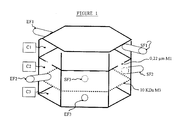
- a first planar filtering membrane with threshold cut-off in the range of 0.12 ⁇ m to 0.44 ⁇ m allows biochemical exchanges within the culture chamber in allowing the passage of molecules from the nourishing medium such as proteins and macromolecules but achieving cell confinement preventing cells grown to leave the homeostasis area and. preventing also the passage of contaminating particles into serving in particular as a barrier to bacteria which can contaminate said chamber.
- Another flat filtering membrane with cut-off threshold maximum of 15 KiloDalton (KDa) authorizes the molecular confinement of all molecules with a molecular mass greater than 15 KDa.
- KDa KiloDalton
- the presence of this planar filtering membrane within the culture makes it possible to define a containment space for culture cells. Therefore, the plane membrane filter with cutoff threshold of at most 15 KDa confines the cells in culture in the culture chamber, as well as growth factors and large proteins.
- At least one of the membranes has a cut-off threshold included preferably between 0.18 ⁇ m and 0.26 ⁇ m and the other one cutoff threshold preferably between 10 and 12 KDa.
- the number of membranes present in the culture chamber can be greater than two.
- the additional membranes have thresholds cutoff adapted to those of the two aforementioned membranes.
- the flat filter membranes with different cutoff threshold within the cell culture are arranged perpendicularly by relative to the axis of symmetry of said culture chamber.
- the two flat membranes filters with different cutoff threshold can be mineral or organic membranes.
- membranes made of organic polymer biocompatible, cellulose or polysulfone can be mineral or organic membranes.
- these two flat filter membranes are distant from each other by a maximum of 400 ⁇ m, which distance proves favorable for good cell development since they are almost always in contact with sources of nutrients and oxygen.
- a bed of macrosupports biocompatible including the larger particles which may have the shape of a sphere must not exceed 400 ⁇ m in diametric equivalent.
- This macrosupport bed made up of particles of various sizes which can be possibly agglomerated in a continuous block by sintering granular elements, must not have a thickness greater than 400 ⁇ m.
- the said macrosupport bed plays on a plays a role in supporting cells in cultivation and on the other hand a mechanical role of maintaining the space of cell confinement arranged between the two membranes filtering planes with different cutoff threshold.
- the type of cells grown within the culture of the invention, the type of macrosupports biocompatible will be selected appropriately and adequate size.
- the macrosupports implemented between the two culture chamber membranes may have a shape cylindrical or spherical or polyhedral such as solid machined blocks with a thickness of at most 400 ⁇ m.
- the macrosupports can be of mineral origin (such as, for example, coral) or metallic (such as titanium and its alloys for example) or formed from biocompatible polymers.
- macrosupports can be coral microbeads with a diameter of at most 400 ⁇ m. Indeed, coral beads of desired particle size prove to be suitable macrosupports for applications mentioned above due in particular to their ability to be colonized by progenitors hematopoietic. In the case of bone precursors, the coral balls would also be metabolized, which would encourage their use in surgery Reconstructive.
- the most suitable macrosupports can be nylon® balls (polyamides) having a diameter less than 400 ⁇ m.
- the presence of macrosupports between the said membranes and the fact that the planar filter membrane at cutoff threshold of at most 15 KDa does not authorize the passage of cells in culture as well as that of growth factors, allow the containment of cells in culture, which adhere to said macrosupports biocompatible, in this cell containment space located between the two cut-off membranes different.
- the supply in dynamic liquid media of the culture chamber is produced homogeneously due to the fact of the distribution and distribution of said media in within said chamber through entrances and exits of these judiciously placed environments.
- the cell culture chamber as before mentioned has an envelope with an axis of symmetry formed an external side wall and two walls ends that can be compared to two flat bottoms located at each end of said side wall.
- This envelope with axis of symmetry can be made for example of a polymer material biocompatible or stainless steel.
- biocompatible polymers for example, polyolefins, polyamides or polyesters and others.
- the two end walls of the envelope with axis of symmetry are provided with distribution streaks allowing the culture chamber to be supplied with two of the three dynamic liquid media.
- These streaks of distribution constitute a main network of streaks say main.
- This main network of streaks located on the face of each of the two end walls, facing cell culture space, may be divergent to from the inlet pipe arranged in said wall.
- the main network of streaks say main, also called distribution network allows a homogeneous distribution of the two liquid media dynamics, which are routed to the culture chamber via biocompatible conduits, the or the ends are plugged into the walls end.
- the number of distribution streaks located on the opposite side of the cell culture space of each of the two end walls is defined so to obtain good dispersion of the dynamic liquid medium in the culture chamber and will be determined according to the shape of the envelope with axis of symmetry
- Said main network is supplemented by a network secondary, formed of so-called secondary streaks, minus deep and substantially orthogonal in direction by report to the main network in order to favor the circulation between the distribution areas delimited by the main network. So the secondary streaks of the secondary network are substantially perpendicular to main network streaks. This secondary network can see its spacing will vary so that the streaks are closer and more numerous in side opposite the entry of the medium flow to facilitate drainage and evacuation of said medium.
- Two adjacent streaks in the main network constitute a distribution zone and two streaks adjacent to the main network intersected by two streaks adjacent to the secondary network constitute a cell of distribution.
- Primary and secondary networks form an end "gridded" network of propagation of liquid media dynamic. All of these two networks can by example forming a waffle-shaped network.
- the main network being located on the opposite face of cell culture space, has some height and a certain width that the skilled person is fully able to define, knowing that the network of streaks must be integral with the flat membrane filtering to ensure the cohesion of the whole.
- the volume provided by the entire network of streaks and the membrane forms the grid of distribution of the liquid flow which can represent approximately 50% of the surface of the membrane.
- the main network can consist of main streaks having a depth of at most 5 mm and a width of at most 2 mm, the pitch between two adjacent streaks of said main network which may be not more than 2 mm.
- the secondary network can be consisting of secondary streaks having a depth of at least plus 2 mm and a width of at most 2 mm, not including between two adjacent streaks of said diminishing network gradually from the input side of the medium flow towards the outlet of said medium flow. Therefore, in its distal part - i.e. on the side of the exit of the middle - the pitch of the secondary network will be at most 2 mm.
- the main network in end walls can in practice have a depth of 1 mm and a width of 500 ⁇ m with a pitch of 500 ⁇ m and the secondary network can for example have a depth of 500 ⁇ m and a width of 500 ⁇ m with a minimum pitch of 500 ⁇ m.
- the end walls can be envisaged as producing a fine pattern of cells of the type waffle on which the cut-off membranes different come to rest or are glued by a biocompatible adhesive of polymer adhesive type.
- the envelope with axis of symmetry can be presented under the shape of two half-envelopes such as for example two half-cylinders, each consisting of a wall external side and an end wall, which are tightly connected to each other by means of seals.
- the shape of the envelope with axis of symmetry of the culture chamber according to the invention can be chosen from suitable way to facilitate for example stacking of several culture chambers on a support.
- the man of the trade will once again be able to choose the form of the envelope with axis of symmetry of said chamber culture according to the use that will be made of it.
- the number of main streaks distribution of each of the two end walls can be at least seven, this number can be a lot most important.
- a stack of rooms of culture with elementary patterns can be made provided that the said patterns have the same shape for obtain a stable stack of these patterns on a support adequate.
- a form for example hexagonal can facilitate the successive stacking of several rooms on an appropriate base having by example six columns.
- the six columns of the base acting as a support for the stacking of basic patterned rooms can also be used for example supply and discharge conduits dynamic liquid media.
- a first dynamic liquid medium noted F1 entering and exiting through biocompatible tubing inserted at the level of one of the end walls of the axis casing symmetry (for example the upper end wall) feeds the culture medium in nutritious medium (again called rich nourishing medium), this medium being rich in growth factors.
- This first liquid medium dynamic is composed of elements necessary for culture cells such as, for example, proteins, trace elements, glucose, water and growth factors, and feeds the culture medium in a nutritional medium fresh.
- a second dynamic liquid medium noted F2 entering and coming out at the level of the external side wall of the envelope with axis of symmetry of the culture chamber can present three distinct functions according to the uses that will be made of it.
- this second medium dynamic liquid entering through biocompatible tubing plugged into the side wall of the chamber culture, serves to introduce into said chamber the cells for cultivation and recovery said cells grown within the chamber after their culture (hematopoietic cells or cells liver, for example).
- this second medium dynamic liquid can play the role of transfer of Genoa. Indeed, during the introduction of the cells of culture suspended in the culture chamber by the intermediary of this second dynamic liquid medium, viral particles contained in said liquid medium can attach to cells in suspension at their membranes and thus allow gene transfer longed for.
- This second flow of medium can allow to obtain the desired culture cells, genetically modified, that we want to cultivate.
- this medium carries the transfer vectors gene and allows them to come into contact with cells in order to establish a membrane fusion between the cell target and gene transfer vector.
- These vectors of gene transfer are of any kind. As illustration, we can cite viruses like for example adenoviruses, retroviruses, liposomes, plasmid complexes.
- Such labeling of cells can accurately target tissue to genetically modify.
- This virus characterized in that the genes coding for the envelope and those who convey the genetic information itself is separated, is unable to reproduce inside cells after transferring the desired genetic information.
- the risks of genesis of a recombinant virus to from the synthetic virus used and from a wild virus that may be present in the patient are limited.
- this second medium dynamic liquid can act as flushing flow inhibitory macromolecules present in cell containment space.
- the cells cultures may have been stressed before their harvest or during their pre-inocular treatment or still during their inoculation in the chamber of culture. This stress can induce production (by said cells) of proteins which will inhibit their ability to multiply by passing them through a dormant state, called quiescent state. During this state, said cells are no longer in a physiological state of respond to the stimulation produced by the factors of growth, multiplying.
- hematopoietic cells In the case of hematopoietic cells, one can cite the "radio-induced” stress that is caused by a exposure to ionizing radiation (volunteers to radiotherapeutic or accidental use) and results later by stress. This type of stress causes the production of inhibitors such as for example "Transforming Growth Factor-beta” or “Tumor Necrosis Factor-alpha ". These inhibitory molecules being cytokines as well as growth factors provided for the culture of hematopoietic cells, they are therefore confined by the threshold membranes different cut of the culture chamber.
- the second dynamic liquid medium in its third function serves therefore rinse the cell containment area to eliminating said inhibitory molecules.
- This basic nutrient medium is a nourishing environment totally devoid of growth.
- Such a basic medium is composed by therefore glucose, water, trace elements such as for example vitamins and minerals, dyes to assess the pH of the medium and of type proteins albumin.
- this culture chamber intended to be supplied by the three liquid media system distinct dynamics has for feature three pairs of inputs and outputs of said media. Two of these couples are connected to end walls to feed the streaks of distribution. The third couple is connected to the wall lateral lateral at a level between the two flat filter membranes with different cutoff threshold.
- the triple flow system inlet and outlet pipes are therefore appropriately distributed over the envelope with axis of symmetry of the culture chamber.
- the biocompatible tubing input of the first flow marked EF1 is plugged in at level of the upper end wall of the envelope of the culture chamber, while the outlet tubing noted SF1 of the first stream is also plugged into the same end wall but opposite the inlet tubing.
- the biocompatible inlet tubing of the third flow noted EF3 is plugged into the wall lower end of said envelope so that this tubing is plugged in at an angle of about 120 ° to the inlet manifold of the first flow (EF1) feeder rich in growth factors, for allow a good distribution of said media within the culture room.
- the tubing biocompatible output of this third flow denoted SF3 is also plugged into the same end wall but at the opposite of the inlet tubing of said flow (EF3).
- the biocompatible tubing of entry of the second dynamic liquid medium noted EF2 is inserted between the two flat filter membranes denoted M1 and M3, which respectively have a threshold of 0.22 ⁇ m and 10 KDa cut-off at the wall external lateral of the envelope at an angle of approximately 60 ° to the inlet manifold of the first flow (EF1).
- Biocompatible outlet tubing rated SF2 as to it is plugged opposite the inlet manifold said flow on the side wall.
- the three pairs of inputs and exits from dynamic liquid media are placed in three vertical planes passing through the axis of symmetry of the envelope, these planes being offset by an angle of approximately 60 ° between the first entry and the second entry, and at an angle of approximately 120 ° between the first and the third entry of dynamic liquid media, exits from said liquid media being in the same angular arrangements.
- the present invention also relates to a bioreactor comprising the cell culture chamber previously described.
- This culture chamber by means of these three pairs of media inputs and outputs dynamic liquids is connected by connecting conduits to supply tanks and / or tanks evacuation of said chamber.
- the bioreactor according to the invention further comprises means for regulating the culture conditions and mass transfer control said dynamic liquid media, connected to the block of regulation-control of said bioreactor.
- This bioreactor includes in addition to the culture chamber "A regulation block also called control block” which allows the control and regulation of pH, oxygen concentration and medium temperature of culture.
- the “regulation-command block” can manage in automatic full operation of the bioreactor. This regulation is of the P.I.D. type. Digital (regulation proportional, integral and derivative) and data returned by the different probes can be recorded and analyzed by computer.
- the bioreactor of the invention containing the culture room mentioned above is organized in interchangeable functional unit modules sized for a certain transfer value of mass or energy (such as, for example, modules ventilation, heat exchangers), constituting a modular set resizable by juxtaposition identical functional units in series and / or in parallel, and has a regulation-control block programmable.
- a certain transfer value of mass or energy such as, for example, modules ventilation, heat exchangers
- the regulation-control block receives all of the information relating to dynamic liquid media F1, F2, F3, by means of control and regulation, as well that the information relating to the various tanks, pumps, valves and pressures prevailing in zones C1, C2, C3 of the culture chamber, manages them and issues orders required for operation.
- the regulation assembly can also have a infrared spectrum measurement crystal cell, which allows by deconvolution of the retransmission spectrum of measure the concentration of certain solutes in the culture centre. It is then possible to follow “en line “and” real-time “glucose concentrations and lactate.
- the temperature of the culture medium can be fixed at a set value between 30 and 38 ° C.
- the pH of the culture medium can be fixed at a set value between 6.5 and 7.7.
- the regulation-control block also makes it possible to regulate the air flow and the CO 2 rate which by its dissolution gives the HCO 3 amphoteric - which buffers the medium and contributes to the stability of the pH and is the effector of the pH regulation.
- the inlet and outlet pipes (of the chamber) of the first dynamic liquid medium F1 are connected by connecting pipes to a tank R1 of nourishing environment rich in growth factors according to a closed loop circuit allowing recycling of growth factors necessary for the development of cells in culture.
- This R1 tank can play the role of expansion tank.
- said connecting conduit between the inlet tubing of the first rich nourishing medium F1 of the chamber and said tank noted R1 of this medium is equipped with a pump P1 to control and adjust volume and flow F1 medium circulating in a closed circuit in the culture.
- the closed loop carrying the rich feed stream F1 has an air vent located on the vase expansion R1, this venting is provided with a 0.22 ⁇ m cut-off threshold ensuring aseptic middle. Likewise, this loop is provided with a solenoid valve. V1 controlled by the regulation-control block programmable allowing pressure balancing with the atmospheric pressure on demand.
- the expansion tank R1 is also fitted with high level sensors and low level of liquid medium used to trigger reversing the circulation of fluids.
- the inlet pipe of the third medium basic feeder (EF3) of the culture chamber is connected by a connecting conduit to a tank marked R3 of this medium, and the outlet tubing (SF3) is connected by a sewer pipe (recovery compartment for waste).
- the connecting conduit connected to the inlet pipe of the third dynamic liquid medium EF3 mentioned above is equipped with a P3 pump then that the conduit connected to the outlet pipe of said flow is fitted with a V3 valve, possibly controlled by the regulation-command block, the assembly allowing adjust and control the volume and flow of said third medium F3 circulating in open circuit in the culture chamber.
- a device for aerating the medium rich F1 feeder and a middle aerator basic feeder F3 are provided on both two circuits in closed and open loops placed respectively between the inputs of said liquid media F1 and F3 dynamics in the cell culture chamber and tanks R1 and R3.
- a medium heat exchanger rich feeder F1 and a middle heat exchanger basic feeder F3 are provided on each of the two circuits at the inputs of said dynamic liquid media F1 and F3 in the cell culture chamber.
- These devices maintain homeostasis of the culture chamber by preconditioning the flow of environments that enter it so as not to enter the culture chamber a medium volume element of culture which can induce a brutal disturbance of its physico-chemical parameters.
- the inlet manifold of the second medium dynamic liquid EF2 of the culture chamber located at level of the side wall of the envelope, is connected by a connection conduit to a tank denoted R2 containing the second dynamic liquid medium chosen according to the role assigned to it, namely either feeding the cell culture chamber for cultivation and to discharge said chamber after culture, either perform a gene transfer, or have a role in rinsing flow intended to discharge the culture chamber inhibitory molecules for cells to be cultured.
- one or more functional modules medium exchangers can be added to purify the F1 feed medium at the outlet of the culture chamber.
- This or these medium exchanger functional modules are located outside the culture chamber, mounted in series on the circuit output link conduit in closed loop of the first F1 medium rich in growth factors and crossed against the current by the basic feeding medium F3 in open loop.
- two cutoff thresholds can be used different from, for example, 10 KDa and 30 KDa.
- 10 KDa module into the module of 30 KDa, and by recovering the permeate -that is to say the liquid fraction which has crossed the threshold membrane 30 KDa- cut-out to reinject it into the F1 loop, wind up the middle proteins between 10 and 30 KDa which corresponds to the size of the growth.
- Such additional functional modules can be useful when, for example, growth are produced by support cells in a first adjoining culture chamber, and which one desires condition this environment (i.e. recover the growth factors produced, without recovering cellular waste generated by these support cells) to be able to reuse it in the F1 loop in order to stimulate so-called therapeutic cells present in the main grow room.
- stromal can be modified genetically so as to produce human cytokines to levels of expression such as they can provide for part of the cytokine needs of the culture.
- the envelope with axis of symmetry making it possible to obtain a homogeneous distribution of nutrients with a optimal dispersion has the advantage of being sterile at the same title that all elements of the bioreactor in contact with cells and culture medium.
- the sterilization of the bioreactor is carried out by autoclaving at 121 ° C for 20 minutes of the whole device as well as tank bottles.
- the conduits connection, tanks and other sealing elements are made of biocompatible materials which can endure without damage ten cycles of sterilization when used in laboratory.
- the whole culture chamber, connecting pipes, media tanks and others will constitute a disposable culture kit in the case of use in human clinic.
- the reconditioning of the bioreactor after cell culture is done by digestion protein with Molar hydrochloric acid solution followed by ultra pure rinsing, re-sterilization.
- the medium rich feeder F1 is introduced at the level of the wall upper end of the envelope in the noted area C1 (compartment C1) of the culture chamber included between said wall and the flat threshold filter membrane cut-off in the range of 0.12 ⁇ m to 0.44 ⁇ m, by the opening of the pump P1 located on the link connecting the culture chamber to tank R1 containing said medium F1 while the pump P3 located on the connecting conduit connecting the culture chamber to reservoir R3 containing the basic nourishing medium F3 is stopped.
- the pressure p3 prevailing in the area denoted C3 (compartment C3) of the culture chamber located between the lower end wall of the enclosure and the flat filter membrane with cutoff threshold of at most 15 KDa is regulated by the noted back pressure valve V3 located on the conduit connecting the culture chamber to the sewer so that the pressure p1 prevailing in the C1 zone of the culture chamber is greater than the pressure p3 and that the pressure p2 prevailing in the zone denoted C2 is between p1 and p3 according to a gradient of pressure.
- the growth factors of the nutrient medium pass into zone denoted C1 and at across said membrane with cut-off threshold of the order 0.12 ⁇ m to 0.44 ⁇ m from the culture chamber, but are retained by the flat filtering membrane with cut-off threshold at most 15 KDa, which acts as a barrier for the passage of growth factors and large proteins.
- growth factors can migrate on either side of the flat filter membrane to cut-off threshold of the order of 0.12 ⁇ m to 0.44 ⁇ m ensuring their role in stimulating growth and / or differentiation control for living cells culture confined between the two flat membranes of the culture chamber defining the area denoted C2 (compartment C2) of said chamber.
- the flat filtering membrane M3 with a cutoff threshold of at most 15 KDa confines the growth factors and the large proteins of the fresh nutritive medium F1 in zones C1 and C2 of the culture chamber.
- the trace elements of said nutritive medium F1 and the waste of small sizes (such as, for example, NO, NH 4 + , lactate and others) generated by the culture of the cells confined in the zone C2 of said chamber, are drained to zone C3 where they are taken to the sewer.
- the overall transmembrane flow is therefore oriented from zone C1 towards zone C3 of the culture chamber (see FIG. 2).
- the regulation-control block of the bioreactor programmed according to a sequence particular reverses the flow circulation.
- the pump P1 which was running goes to stop and the pump P3 to the stop starts.
- the open valve V3 is then closed.
- the growth factors due to the closed-loop circulation of the rich nourishing medium F1 that is to say the first dynamic liquid medium of which they are a part, are confined in the closed loop and in the compartments C1 and C2. , and their concentration oscillates between a concentration C 0 and C 0 +/- ⁇ C.
- the rich culture medium is therefore recycled and the use of growth factors optimized thanks to the culture chamber and the bioreactor of the invention.
- This flow reversal system within the chamber of culture allows the creation of transmembrane flows with low hydrodynamic constraints compatible with the fragility of the cultured cells. We thus obtains a “laminar” slow flow system.
- This reversal of flows can also prevent the clogging of filter membranes including pressure drop transmembrane (index measuring the permeability of the membrane) can be controlled in real time by electronic pressure gauges placed on each of the flow dynamic liquid media.
- the second incoming dynamic liquid medium and exiting at the external side wall, between the two flat filter membranes of the culture circulates within said chamber according to a open loop or closed loop circuit depending on the function assigned to it, pumps P1 and P3 being stopped, and its input and output configuration is set by the function we want to assign to it.
- the second dynamic liquid medium F2 in its first function when used to inoculate the cells to be cultured in the culture chamber and to discharge them after culture, it works in an open loop just like when it is used in its third function to rinse the chamber to remove inhibitory molecules.
- the dynamic liquid medium F2 has a role gene transfer it works in a closed loop the time of inoculation and incubation.
- the second dynamic liquid medium F2 containing the cells to be cultured is inoculated into area C2 of the culture chamber by syringe through a septum biocompatible positioned on one of the three branches of the inlet manifold EF2 (from the outer side wall) with the solenoid valve V2E1 open, the solenoid valves V2E2 and V2E3 being closed.
- the three solenoid valves V2S1, V2S2 and V2S3 located on the three branches of the SF2 outlet tubing opposite the inlet manifold EF2 are closed.
- the two solenoid valves V2E2 and V2E3 of the tubing input EF2 are closed, the solenoid valve V2S1 located on one of the three branches of the outlet pipe SF2 connected to a connection pipe to the tank recovery of cultured cells, is open while the solenoid valves V2S2 and V2S3 of the two other branches of the outlet pipe SF2 are closed.
- the basic medium regenerant is then pumped by starting the pump P2 from tank R2 and is used to purge the contents of the compartment C2 (between the two threshold membranes different cutoff) in the collection pocket cellular.
- Trypsin-like enzymatic treatment and / or collagenase and / or DNAse may be used to destructuring the extracellular matrix produced by cells during culture to facilitate their anchoring.
- the solenoid valves V2E1 and V2E2 When introducing the rinse medium F2 into zone C2 of the culture chamber at one of the three branches of the EF2 inlet tubing (from the wall lateral external) with the solenoid valve V2E3 open, the solenoid valves V2E1 and V2E2 being closed.
- the two solenoid valves V2S1, V2S2 located on the two branches of the outlet pipe SF2 are closed, the solenoid valve V2S3, located on the other branch of the outlet pipe SF2 being open, the flushing flow circulating continuously in open loop.
- the exit of the solenoid valve V2S3 can be connected to a tube leading to the sewer.
- the sewer being made up of a tank of sterilized medium at the same time as all of the tubing of the bioreactor, its tanks, its functional modules and the culture chamber, which guarantees the sterility of the flow.
- Two filters 0.22 ⁇ m can be added to this while draining in order to increase security and guarantee sterility, especially when it is necessary to change the tank "hot" sewer after an overflow.
- the second dynamic liquid medium F2 containing the gene transfer vectors is introduced into the area C2 of the culture chamber by the opening of the solenoid valve V2E2 located on one of the three branches of the inlet manifold EF2, the solenoid valves V2E1 and V2E3 being closed.
- the two solenoid valves V2S1, V2S3 located on two branches of the outlet pipe SF2 are closed.
- This middle F2 containing the gene transfer vectors circulating in closed loop circuit the time required for inoculation and incubation.
- the F2 loop returns to rinse as described above, in order to rinse the possible residual vectors. Then, the rinsing being finished, the culture continues according to the alternation of the phases "ascending" and "descending" of flows F1 and F3.
- the culture chamber and the bioreactor according to the invention can be used for cultivation extracorporeal of animal cells and, as such, the invention relates to the medical field.
- the culture chamber and the bioreactor according to the invention can be applied to the production of hematopoietic cells or liver cells.
- Hematopoiesis is the physiological process that allows to renew all the figured elements of blood (mature blood cells with a lifespan limited) by multiplication and differentiation of an original multipotent primitive cell (called stem cell) capable of generating all types cellular, blood cells also called elements figured in blood. This process is under the control of hematopoietic growth factors, also called cytokines.
- Transplantation of immature hematopoietic cells, called hematopoietic progenitors, in a patient subjected to an aplasia accidentally or following a anticancer treatment is a way to be able to revive activity of the injured bone marrow to initiate a resumption of hematopoiesis.
- This process involves only progenitors - cells at an early stage of development - be taken from the patient by cytapheresis or directly by puncture of bone marrow, and be reinjected after culture to that these cells can replenish the blood system and immune of the patient (in the case of aplasia complete) or compensate for the morbid period of pancytopenia transient (neutropenia phase, lymphopenia and thrombocytopenia) to allow hematological recovery endogenous to the aplasia victim (in the case of a accidental irradiation).
- the culture chamber and the bioreactor described above can allow the sufficient liver cell production to get effective treatment and speed of detoxification compatible with constraints hemodynamics posed by the extracorporeal circulation of the patient's blood.
- a bioreactor with a useful volume which can vary from 50 to 100 ml allows a extracorporeal culture of animal cells on a period of ten days as part of the production of cellular biomass for transplant use and / or as a palliative for a deficiency.
- the cultivation times authorized by the bioreactor can reach several months.
- hematopoietic cells For a bone marrow type cell transplant (hematopoietic cells), it is necessary that 10 6 to 10 7 CFU (type of immature cells) / kg of the patient's weight come from the culture.
- This clinical threshold which partly determines the success of the transplant, makes it possible to estimate at 10 10 the number of cells from hematopoietic culture necessary for the transplant.
- the culture chamber or chambers as well as the bioreactor as described can be sized for this type of application.
- the nourishing environment is a synthetic medium consisting of ultra-purified proteins or synthesized and trace elements (such as iron, selenium, transferrin, vitamins and others) and a vital dye.
- This nourishing environment is enriched by growth factors which are cytokines whose concentration can vary from 10 to 100 ng / ml depending on the needs. In addition, cytokines can be stabilized in a biologically active state with the presence heparan.
- the basic nourishing environment - regenerating - is marketed under trade names following, it can be MEM-alpha or RPMI1640 or still from IMDM.
Landscapes
- Health & Medical Sciences (AREA)
- Life Sciences & Earth Sciences (AREA)
- Engineering & Computer Science (AREA)
- Chemical & Material Sciences (AREA)
- Wood Science & Technology (AREA)
- Organic Chemistry (AREA)
- Bioinformatics & Cheminformatics (AREA)
- Zoology (AREA)
- Genetics & Genomics (AREA)
- Biotechnology (AREA)
- Biomedical Technology (AREA)
- Microbiology (AREA)
- Biochemistry (AREA)
- General Engineering & Computer Science (AREA)
- General Health & Medical Sciences (AREA)
- Sustainable Development (AREA)
- Immunology (AREA)
- General Chemical & Material Sciences (AREA)
- Molecular Biology (AREA)
- Physiology (AREA)
- Cell Biology (AREA)
- Apparatus Associated With Microorganisms And Enzymes (AREA)
- Micro-Organisms Or Cultivation Processes Thereof (AREA)
Priority Applications (10)
| Application Number | Priority Date | Filing Date | Title |
|---|---|---|---|
| DE60013585T DE60013585T2 (de) | 2000-07-19 | 2000-07-19 | Kulturraum und Bioreaktor zur ausserkörperlichen Tierzellenkultur |
| EP00115568A EP1174497B1 (de) | 2000-07-19 | 2000-07-19 | Kulturraum und Bioreaktor zur ausserkörperlichen Tierzellenkultur |
| AT00115568T ATE275625T1 (de) | 2000-07-19 | 2000-07-19 | Kulturraum und bioreaktor zur ausserkörperlichen tierzellenkultur |
| CA002416301A CA2416301A1 (fr) | 2000-07-19 | 2001-07-19 | Chambre de culture cellulaire et bioreacteur pour la culture extracorporelle de cellules animales |
| JP2002512335A JP2004504023A (ja) | 2000-07-19 | 2001-07-19 | 動物細胞の体外培養用細胞培養室およびバイオリアクタ |
| EP01956613A EP1301586A1 (de) | 2000-07-19 | 2001-07-19 | Zellkulturzimmer und bioreaktor für tierische extracorporelle zellenkultur |
| PCT/FR2001/002358 WO2002006441A1 (fr) | 2000-07-19 | 2001-07-19 | Chambre de culture cellulaire et bioreacteur pour la culture extracorporelle de cellules animales |
| US10/333,377 US20040132175A1 (en) | 2000-07-19 | 2001-07-19 | Cell culture chamber and bioreactor for extracorporeal culture of animal cells |
| AU2001278542A AU2001278542A1 (en) | 2000-07-19 | 2001-07-19 | Cell culture chamber and bioreactor for extracorporeal culture of animal cells |
| CN01815907.9A CN1258588C (zh) | 2000-07-19 | 2001-07-19 | 细胞培养室与动物细胞体外培养用生物反应器 |
Applications Claiming Priority (1)
| Application Number | Priority Date | Filing Date | Title |
|---|---|---|---|
| EP00115568A EP1174497B1 (de) | 2000-07-19 | 2000-07-19 | Kulturraum und Bioreaktor zur ausserkörperlichen Tierzellenkultur |
Publications (2)
| Publication Number | Publication Date |
|---|---|
| EP1174497A1 true EP1174497A1 (de) | 2002-01-23 |
| EP1174497B1 EP1174497B1 (de) | 2004-09-08 |
Family
ID=8169299
Family Applications (2)
| Application Number | Title | Priority Date | Filing Date |
|---|---|---|---|
| EP00115568A Expired - Lifetime EP1174497B1 (de) | 2000-07-19 | 2000-07-19 | Kulturraum und Bioreaktor zur ausserkörperlichen Tierzellenkultur |
| EP01956613A Withdrawn EP1301586A1 (de) | 2000-07-19 | 2001-07-19 | Zellkulturzimmer und bioreaktor für tierische extracorporelle zellenkultur |
Family Applications After (1)
| Application Number | Title | Priority Date | Filing Date |
|---|---|---|---|
| EP01956613A Withdrawn EP1301586A1 (de) | 2000-07-19 | 2001-07-19 | Zellkulturzimmer und bioreaktor für tierische extracorporelle zellenkultur |
Country Status (9)
| Country | Link |
|---|---|
| US (1) | US20040132175A1 (de) |
| EP (2) | EP1174497B1 (de) |
| JP (1) | JP2004504023A (de) |
| CN (1) | CN1258588C (de) |
| AT (1) | ATE275625T1 (de) |
| AU (1) | AU2001278542A1 (de) |
| CA (1) | CA2416301A1 (de) |
| DE (1) | DE60013585T2 (de) |
| WO (1) | WO2002006441A1 (de) |
Cited By (2)
| Publication number | Priority date | Publication date | Assignee | Title |
|---|---|---|---|---|
| EP1702052A4 (de) * | 2003-12-19 | 2009-02-18 | Univ Waterloo | Kultivierte zelle sowie verfahren und vorrichtung zur zellkultur |
| WO2010000486A3 (de) * | 2008-07-04 | 2010-08-05 | Kaltenhaeuser Bernd | Bioreaktor in flachbauweise |
Families Citing this family (56)
| Publication number | Priority date | Publication date | Assignee | Title |
|---|---|---|---|---|
| WO2003087292A2 (en) * | 2002-04-08 | 2003-10-23 | Millenium Biologix Inc. | Automated tissue engineering system |
| CN1300297C (zh) * | 2002-09-20 | 2007-02-14 | 华东理工大学 | 一种用于动物细胞扩大接种的消化反应器 |
| US20050233448A1 (en) * | 2003-06-18 | 2005-10-20 | Oh Steve K W | Materials and methods to produce stem cells |
| JP2005034069A (ja) * | 2003-07-16 | 2005-02-10 | Fuji Photo Film Co Ltd | バイオリアクター及びそれを用いた細胞培養方法 |
| WO2005047466A2 (en) * | 2003-11-04 | 2005-05-26 | Case Western Reserve University | Apparatus and method for tissue engineering |
| US20050287670A1 (en) * | 2004-06-29 | 2005-12-29 | Gulliver Eric A | Cell culturing systems, methods and apparatus |
| WO2006105329A2 (en) * | 2005-03-31 | 2006-10-05 | Ha Cell Technologies, Inc. | Device for evaluating in vitro cell migration under flow conditions, and methods of use thereof |
| US9354156B2 (en) | 2007-02-08 | 2016-05-31 | Emd Millipore Corporation | Microfluidic particle analysis method, device and system |
| US8257964B2 (en) | 2006-01-04 | 2012-09-04 | Cell ASIC | Microwell cell-culture device and fabrication method |
| US9388374B2 (en) | 2005-07-07 | 2016-07-12 | Emd Millipore Corporation | Microfluidic cell culture systems |
| US9637715B2 (en) | 2005-07-07 | 2017-05-02 | Emd Millipore Corporation | Cell culture and invasion assay method and system |
| US9376658B2 (en) | 2008-01-03 | 2016-06-28 | Emd Millipore Corporation | Cell culture array system for automated assays and methods of operation and manufacture thereof |
| WO2007008609A2 (en) | 2005-07-07 | 2007-01-18 | The Regents Of The University Of California | Methods and apparatus for cell culture array |
| US7855070B2 (en) * | 2005-07-08 | 2010-12-21 | Georgia Tech Research Corporation | Centimeter-scale, integrated diagnostics incubator for biological culturing |
| US7745209B2 (en) | 2005-07-26 | 2010-06-29 | Corning Incorporated | Multilayered cell culture apparatus |
| WO2007021919A1 (en) | 2005-08-12 | 2007-02-22 | Clemson University | Co-culture bioreactor system |
| US7745210B2 (en) * | 2006-06-30 | 2010-06-29 | Corning Incorporated | Fluid flow diverter for cell culture vessel |
| WO2008005998A2 (en) * | 2006-07-07 | 2008-01-10 | Georgia Tech Research Corporation | Centimeter-scale, integrated diagnostics incubator for biological culturing |
| US20100151571A1 (en) * | 2006-07-07 | 2010-06-17 | Georgia Tech Research Corporation | Centimeter-scale, integrated diagnostics incubator for biological culturing |
| US7897379B2 (en) * | 2007-02-26 | 2011-03-01 | Corning Incorporated | Device and method for reducing bubble formation in cell culture |
| EP2118263A2 (de) * | 2007-03-14 | 2009-11-18 | CaridianBCT, Inc. | Zellexpansionsgerät mit plattenbioreaktor |
| US9309491B2 (en) * | 2007-05-29 | 2016-04-12 | Corning Incorporated | Cell culture apparatus for co-culture of cells |
| US20090035745A1 (en) * | 2007-08-03 | 2009-02-05 | Shear Jason B | Site-Specific Dosing of Cellular Cultures |
| US20090215176A1 (en) * | 2008-02-25 | 2009-08-27 | Clemson University | Differential Pressure Pump System |
| CN101724556A (zh) * | 2008-10-22 | 2010-06-09 | 深圳市猎鑫科技发展有限公司 | 一种用于提取胰岛细胞的系统及其制作流程 |
| US9228579B2 (en) | 2008-12-19 | 2016-01-05 | Stobbe Tech A/S | Method and device for industrial biolayer cultivation |
| US8981265B2 (en) | 2008-12-30 | 2015-03-17 | Ppg Industries Ohio, Inc. | Electric circuit and sensor for detecting arcing and a transparency having the circuit and sensor |
| US8778669B2 (en) * | 2009-07-22 | 2014-07-15 | Corning Incorporated | Multilayer tissue culture vessel |
| KR101136015B1 (ko) * | 2009-12-10 | 2012-04-18 | 주식회사 이시스 | 미생물 배양기의 원격제어 시스템 |
| US9353342B2 (en) | 2010-01-21 | 2016-05-31 | Emd Millipore Corporation | Cell culture and gradient migration assay methods and devices |
| CN101837152B (zh) * | 2010-03-19 | 2012-05-23 | 南方医科大学珠江医院 | 辐射式流向生物反应器控制系统和方法 |
| WO2013048546A1 (en) * | 2011-03-29 | 2013-04-04 | Yongxin Zhang | Multifunctional bioreactor system and methods for cell sorting and culturing |
| US10526572B2 (en) | 2011-04-01 | 2020-01-07 | EMD Millipore Corporaticn | Cell culture and invasion assay method and system |
| JP6232383B2 (ja) | 2011-12-03 | 2017-11-15 | イー・エム・デイー・ミリポア・コーポレイシヨン | マイクロ流体の細胞培養のためのマイクロインキュベーションシステムおよび方法 |
| US20130260364A1 (en) * | 2012-03-30 | 2013-10-03 | Yongxin Zhang | Multifunctional Bioreactor system and methods for cell sorting and culturing |
| KR101422345B1 (ko) * | 2012-10-19 | 2014-07-22 | 한국생명공학연구원 | 이중구조 세포배양용기 |
| US9005550B2 (en) | 2012-10-29 | 2015-04-14 | Corning Incorporated | Multi-layered cell culture vessel with manifold grips |
| EP3041926B1 (de) * | 2013-09-05 | 2020-03-04 | Universität Bern | Vorrichtung für in-vitro-modellierung von in-vivo-geweben von organen |
| CN103614296B (zh) * | 2013-11-15 | 2015-05-20 | 汪洋 | 一种双腔三维灌注生物反应器系统 |
| WO2015159333A1 (ja) * | 2014-04-14 | 2015-10-22 | 株式会社島津製作所 | 細胞培養用デバイス、細胞培養用システム及び細胞培養方法 |
| CN105296350A (zh) * | 2015-11-30 | 2016-02-03 | 苏州钧隆塑胶有限公司 | 一种多层活动瓶底养菌瓶 |
| US10408821B2 (en) * | 2016-04-14 | 2019-09-10 | Triad National Security, Llc | Microfluidic aspirator and methods of making and using the same |
| US11287358B1 (en) | 2016-04-14 | 2022-03-29 | Triad National Security, Llc | Microfluidic aspirator and multi-purpose flow sensor and methods of making and using the same |
| SG11201900674XA (en) * | 2016-07-25 | 2019-02-27 | Ube Industries | Cell culture module |
| CN109563476B (zh) * | 2016-07-25 | 2023-02-28 | Ube 株式会社 | 细胞的培养方法、悬浮的细胞的除去方法及杀灭悬浮的细胞的方法 |
| AU2017316545B2 (en) | 2016-08-21 | 2022-12-08 | Adva Biotechnology Ltd. | Bioreactor and methods of use thereof |
| WO2018044699A1 (en) | 2016-08-27 | 2018-03-08 | 3D Biotek, Llc | Bioreactor |
| US10982181B2 (en) * | 2016-09-07 | 2021-04-20 | Triad National Security, Llc | Devices for cell culture and methods of making and using the same |
| JP7083144B2 (ja) * | 2017-12-12 | 2022-06-10 | 国立研究開発法人農業・食品産業技術総合研究機構 | 吸引管付き細胞封入用デバイス及びその使用 |
| WO2020195646A1 (ja) * | 2019-03-26 | 2020-10-01 | 株式会社村田製作所 | 微生物培養キット |
| US20230008576A1 (en) * | 2019-11-26 | 2023-01-12 | Merck Sharp & Dohme Llc | A host-microbe co-culture perfusion bioreactor for discovery of secreted products and novel interactions at the human-microbiota interface |
| CN111658827A (zh) * | 2019-12-22 | 2020-09-15 | 西安定华电子股份有限公司 | 器官支架制备装置和器官支架制备方法 |
| US11732232B2 (en) | 2020-08-14 | 2023-08-22 | Korea Research Institute Of Bioscience And Biotechnology | Biomimetic cell culture apparatus and cell culture system comprising the same |
| CN113174312A (zh) * | 2021-05-08 | 2021-07-27 | 苏州珀罗汀生物技术有限公司 | 一种蛋白生产装置及方法 |
| US12252678B2 (en) | 2021-12-01 | 2025-03-18 | Microfluidx Ltd | Systems and methods for bioprocessing |
| CA3244919A1 (en) * | 2022-02-21 | 2023-08-24 | Ronawk, Inc. | BIOLOGICAL CARTRIDGE AND CELL CULTURE PROCESSES USING IT |
Citations (7)
| Publication number | Priority date | Publication date | Assignee | Title |
|---|---|---|---|---|
| EP0155237A2 (de) * | 1984-03-15 | 1985-09-18 | MBR Bio Reactor AG | Verfahren und Vorrichtung zum Kultivieren von humanen, tierischen, pflanzlichen sowie hybriden Zellen und Mikroorganismen |
| WO1990001981A1 (en) * | 1988-08-22 | 1990-03-08 | Kopf Henry B | Filter plate, filter plate element and filter comprising same |
| EP0363262A1 (de) * | 1988-09-30 | 1990-04-11 | Terumo Kabushiki Kaisha | Zell-Brutschrank |
| WO1993018133A1 (de) * | 1992-03-03 | 1993-09-16 | Augustinus Bader | Vorrichtung zur behandlung von zellkulturen |
| US5599688A (en) * | 1993-10-18 | 1997-02-04 | Precision Instrument Design | Device and method for circulating fluid over a membrane |
| US5605835A (en) * | 1988-05-23 | 1997-02-25 | Regents Of The University Of Minnesota | Bioreactor device with application as a bioartificial liver |
| WO1998030308A1 (en) * | 1997-01-13 | 1998-07-16 | Kopf, Henry, B. | Filtration cassette article and filter comprising same |
Family Cites Families (12)
| Publication number | Priority date | Publication date | Assignee | Title |
|---|---|---|---|---|
| DE2726313C3 (de) * | 1977-06-10 | 1980-02-07 | Battelle-Institut E.V., 6000 Frankfurt | Verfahren zur in-vitro-Biosynthese von Hormonen, insbesondere von Insulin |
| US5478730A (en) * | 1988-12-21 | 1995-12-26 | Institute Of Protein Research | Method of preparing polypeptides in cell-free translation system |
| US5763266A (en) * | 1989-06-15 | 1998-06-09 | The Regents Of The University Of Michigan | Methods, compositions and devices for maintaining and growing human stem and/or hematopoietics cells |
| US4937196A (en) * | 1989-08-18 | 1990-06-26 | Brunswick Corporation | Membrane bioreactor system |
| US5151366A (en) * | 1991-05-24 | 1992-09-29 | Invitro Scientific Products, Inc. | Cell culture flask |
| FR2679250B1 (fr) * | 1991-07-19 | 1995-07-13 | Inoteb | Utilisation de carbonate de calcium poreux comme materiau support de culture in vitro de cellules eucaryotes. |
| US5955343A (en) * | 1992-12-28 | 1999-09-21 | Massachusetts Institute Of Technology | Stable macroscopic membranes formed by self-assembly of amphiphilic peptides and uses therefor |
| US5763194A (en) * | 1993-10-29 | 1998-06-09 | Unisearch Limited | Cell separation device |
| US5792603A (en) * | 1995-04-27 | 1998-08-11 | Advanced Tissue Sciences, Inc. | Apparatus and method for sterilizing, seeding, culturing, storing, shipping and testing tissue, synthetic or native, vascular grafts |
| US5688687A (en) * | 1995-06-07 | 1997-11-18 | Aastrom Biosciences, Inc. | Bioreactor for mammalian cell growth and maintenance |
| US5998202A (en) * | 1997-02-26 | 1999-12-07 | Synthecon, Inc. | Multiple chamber diffusion vessel |
| EP1030652B1 (de) * | 1997-11-14 | 2012-04-25 | Pacira Pharmaceuticals, Inc. | Herstellung von multivesikulären liposomen |
-
2000
- 2000-07-19 DE DE60013585T patent/DE60013585T2/de not_active Expired - Fee Related
- 2000-07-19 AT AT00115568T patent/ATE275625T1/de not_active IP Right Cessation
- 2000-07-19 EP EP00115568A patent/EP1174497B1/de not_active Expired - Lifetime
-
2001
- 2001-07-19 EP EP01956613A patent/EP1301586A1/de not_active Withdrawn
- 2001-07-19 US US10/333,377 patent/US20040132175A1/en not_active Abandoned
- 2001-07-19 CA CA002416301A patent/CA2416301A1/fr not_active Abandoned
- 2001-07-19 CN CN01815907.9A patent/CN1258588C/zh not_active Expired - Fee Related
- 2001-07-19 WO PCT/FR2001/002358 patent/WO2002006441A1/fr not_active Ceased
- 2001-07-19 AU AU2001278542A patent/AU2001278542A1/en not_active Abandoned
- 2001-07-19 JP JP2002512335A patent/JP2004504023A/ja not_active Withdrawn
Patent Citations (7)
| Publication number | Priority date | Publication date | Assignee | Title |
|---|---|---|---|---|
| EP0155237A2 (de) * | 1984-03-15 | 1985-09-18 | MBR Bio Reactor AG | Verfahren und Vorrichtung zum Kultivieren von humanen, tierischen, pflanzlichen sowie hybriden Zellen und Mikroorganismen |
| US5605835A (en) * | 1988-05-23 | 1997-02-25 | Regents Of The University Of Minnesota | Bioreactor device with application as a bioartificial liver |
| WO1990001981A1 (en) * | 1988-08-22 | 1990-03-08 | Kopf Henry B | Filter plate, filter plate element and filter comprising same |
| EP0363262A1 (de) * | 1988-09-30 | 1990-04-11 | Terumo Kabushiki Kaisha | Zell-Brutschrank |
| WO1993018133A1 (de) * | 1992-03-03 | 1993-09-16 | Augustinus Bader | Vorrichtung zur behandlung von zellkulturen |
| US5599688A (en) * | 1993-10-18 | 1997-02-04 | Precision Instrument Design | Device and method for circulating fluid over a membrane |
| WO1998030308A1 (en) * | 1997-01-13 | 1998-07-16 | Kopf, Henry, B. | Filtration cassette article and filter comprising same |
Cited By (3)
| Publication number | Priority date | Publication date | Assignee | Title |
|---|---|---|---|---|
| EP1702052A4 (de) * | 2003-12-19 | 2009-02-18 | Univ Waterloo | Kultivierte zelle sowie verfahren und vorrichtung zur zellkultur |
| US7919319B2 (en) | 2003-12-19 | 2011-04-05 | University Of Waterloo | Cultured cell and method and apparatus for cell culture |
| WO2010000486A3 (de) * | 2008-07-04 | 2010-08-05 | Kaltenhaeuser Bernd | Bioreaktor in flachbauweise |
Also Published As
| Publication number | Publication date |
|---|---|
| CN1258588C (zh) | 2006-06-07 |
| US20040132175A1 (en) | 2004-07-08 |
| CA2416301A1 (fr) | 2002-01-24 |
| EP1301586A1 (de) | 2003-04-16 |
| WO2002006441A1 (fr) | 2002-01-24 |
| EP1174497B1 (de) | 2004-09-08 |
| CN1460122A (zh) | 2003-12-03 |
| JP2004504023A (ja) | 2004-02-12 |
| DE60013585T2 (de) | 2005-09-15 |
| ATE275625T1 (de) | 2004-09-15 |
| AU2001278542A1 (en) | 2002-01-30 |
| DE60013585D1 (de) | 2004-10-14 |
Similar Documents
| Publication | Publication Date | Title |
|---|---|---|
| EP1174497B1 (de) | Kulturraum und Bioreaktor zur ausserkörperlichen Tierzellenkultur | |
| US10851340B2 (en) | Unitary 3D culture device | |
| JP5524824B2 (ja) | 改良されたバイオリアクタ表面 | |
| US6218182B1 (en) | Method for culturing three-dimensional tissue in diffusion gradient bioreactor and use thereof | |
| CN101123984B (zh) | 可植入装置 | |
| KR20000005485A (ko) | 세포 현탁 및 삼차원 조직 배양의 대규모 성장 및 패키지용 장치 | |
| JPH08173139A (ja) | 微細藻類の大量培養システム | |
| CA1170596A (fr) | Systeme de culture d'algues a fibres dialysantes | |
| EP1180134B1 (de) | Zellkulturvorrichtung und -verfahren mit mehrfachanwendungen | |
| US20050084951A1 (en) | Microcapillary bioreactor for growth of biological tissues | |
| CN113817605A (zh) | 一种细胞动态培养装置及单种细胞培养器 | |
| TWI286158B (en) | Siphon bioreactor | |
| JP3072368B2 (ja) | 肝細胞の高密度培養法及びその装置 |
Legal Events
| Date | Code | Title | Description |
|---|---|---|---|
| PUAI | Public reference made under article 153(3) epc to a published international application that has entered the european phase |
Free format text: ORIGINAL CODE: 0009012 |
|
| AK | Designated contracting states |
Kind code of ref document: A1 Designated state(s): AT BE CH CY DE DK ES FI FR GB GR IE IT LI LU MC NL PT SE |
|
| AX | Request for extension of the european patent |
Free format text: AL;LT;LV;MK;RO;SI |
|
| 17P | Request for examination filed |
Effective date: 20020712 |
|
| AKX | Designation fees paid |
Free format text: AT BE CH CY DE DK ES FI FR GB GR IE IT LI LU MC NL PT SE |
|
| RTI1 | Title (correction) |
Free format text: CULTURE CHAMBER AND BIOREACTOR FOR THE EXTRACORPOREAL CULTURE OF ANIMAL CELLS |
|
| GRAP | Despatch of communication of intention to grant a patent |
Free format text: ORIGINAL CODE: EPIDOSNIGR1 |
|
| GRAS | Grant fee paid |
Free format text: ORIGINAL CODE: EPIDOSNIGR3 |
|
| GRAA | (expected) grant |
Free format text: ORIGINAL CODE: 0009210 |
|
| AK | Designated contracting states |
Kind code of ref document: B1 Designated state(s): AT BE CH CY DE DK ES FI FR GB GR IE IT LI LU MC NL PT SE |
|
| PG25 | Lapsed in a contracting state [announced via postgrant information from national office to epo] |
Ref country code: IT Free format text: LAPSE BECAUSE OF FAILURE TO SUBMIT A TRANSLATION OF THE DESCRIPTION OR TO PAY THE FEE WITHIN THE PRE;WARNING: LAPSES OF ITALIAN PATENTS WITH EFFECTIVE DATE BEFORE 2007 MAY HAVE OCCURRED AT ANY TIME BEFORE 2007. THE CORRECT EFFECTIVE DATE MAY BE DIFFERENT FROM THE ONE RECORDED.SCRIBED TIME-LIMIT Effective date: 20040908 Ref country code: FI Free format text: LAPSE BECAUSE OF FAILURE TO SUBMIT A TRANSLATION OF THE DESCRIPTION OR TO PAY THE FEE WITHIN THE PRESCRIBED TIME-LIMIT Effective date: 20040908 Ref country code: IE Free format text: LAPSE BECAUSE OF FAILURE TO SUBMIT A TRANSLATION OF THE DESCRIPTION OR TO PAY THE FEE WITHIN THE PRESCRIBED TIME-LIMIT Effective date: 20040908 Ref country code: AT Free format text: LAPSE BECAUSE OF FAILURE TO SUBMIT A TRANSLATION OF THE DESCRIPTION OR TO PAY THE FEE WITHIN THE PRESCRIBED TIME-LIMIT Effective date: 20040908 Ref country code: NL Free format text: LAPSE BECAUSE OF FAILURE TO SUBMIT A TRANSLATION OF THE DESCRIPTION OR TO PAY THE FEE WITHIN THE PRESCRIBED TIME-LIMIT Effective date: 20040908 |
|
| REG | Reference to a national code |
Ref country code: GB Ref legal event code: FG4D Free format text: NOT ENGLISH |
|
| REG | Reference to a national code |
Ref country code: CH Ref legal event code: EP |
|
| REG | Reference to a national code |
Ref country code: IE Ref legal event code: FG4D Free format text: FRENCH |
|
| REF | Corresponds to: |
Ref document number: 60013585 Country of ref document: DE Date of ref document: 20041014 Kind code of ref document: P |
|
| PG25 | Lapsed in a contracting state [announced via postgrant information from national office to epo] |
Ref country code: DK Free format text: LAPSE BECAUSE OF FAILURE TO SUBMIT A TRANSLATION OF THE DESCRIPTION OR TO PAY THE FEE WITHIN THE PRESCRIBED TIME-LIMIT Effective date: 20041208 Ref country code: SE Free format text: LAPSE BECAUSE OF FAILURE TO SUBMIT A TRANSLATION OF THE DESCRIPTION OR TO PAY THE FEE WITHIN THE PRESCRIBED TIME-LIMIT Effective date: 20041208 Ref country code: GR Free format text: LAPSE BECAUSE OF FAILURE TO SUBMIT A TRANSLATION OF THE DESCRIPTION OR TO PAY THE FEE WITHIN THE PRESCRIBED TIME-LIMIT Effective date: 20041208 |
|
| PG25 | Lapsed in a contracting state [announced via postgrant information from national office to epo] |
Ref country code: ES Free format text: LAPSE BECAUSE OF FAILURE TO SUBMIT A TRANSLATION OF THE DESCRIPTION OR TO PAY THE FEE WITHIN THE PRESCRIBED TIME-LIMIT Effective date: 20041219 |
|
| NLV1 | Nl: lapsed or annulled due to failure to fulfill the requirements of art. 29p and 29m of the patents act | ||
| REG | Reference to a national code |
Ref country code: IE Ref legal event code: FD4D |
|
| PLBE | No opposition filed within time limit |
Free format text: ORIGINAL CODE: 0009261 |
|
| STAA | Information on the status of an ep patent application or granted ep patent |
Free format text: STATUS: NO OPPOSITION FILED WITHIN TIME LIMIT |
|
| PG25 | Lapsed in a contracting state [announced via postgrant information from national office to epo] |
Ref country code: CY Free format text: LAPSE BECAUSE OF FAILURE TO SUBMIT A TRANSLATION OF THE DESCRIPTION OR TO PAY THE FEE WITHIN THE PRESCRIBED TIME-LIMIT Effective date: 20050719 Ref country code: LU Free format text: LAPSE BECAUSE OF NON-PAYMENT OF DUE FEES Effective date: 20050719 |
|
| PG25 | Lapsed in a contracting state [announced via postgrant information from national office to epo] |
Ref country code: CH Free format text: LAPSE BECAUSE OF NON-PAYMENT OF DUE FEES Effective date: 20050731 Ref country code: BE Free format text: LAPSE BECAUSE OF NON-PAYMENT OF DUE FEES Effective date: 20050731 Ref country code: LI Free format text: LAPSE BECAUSE OF NON-PAYMENT OF DUE FEES Effective date: 20050731 Ref country code: MC Free format text: LAPSE BECAUSE OF NON-PAYMENT OF DUE FEES Effective date: 20050731 |
|
| 26N | No opposition filed |
Effective date: 20050609 |
|
| REG | Reference to a national code |
Ref country code: CH Ref legal event code: PL |
|
| PG25 | Lapsed in a contracting state [announced via postgrant information from national office to epo] |
Ref country code: FR Free format text: LAPSE BECAUSE OF NON-PAYMENT OF DUE FEES Effective date: 20060331 |
|
| REG | Reference to a national code |
Ref country code: FR Ref legal event code: ST Effective date: 20060331 |
|
| PGFP | Annual fee paid to national office [announced via postgrant information from national office to epo] |
Ref country code: DE Payment date: 20070704 Year of fee payment: 8 |
|
| PGFP | Annual fee paid to national office [announced via postgrant information from national office to epo] |
Ref country code: GB Payment date: 20070627 Year of fee payment: 8 |
|
| BERE | Be: lapsed |
Owner name: *TECHNODOP LTD (SOCIETE DE DROIT IRLANDAIS) Effective date: 20050731 |
|
| PG25 | Lapsed in a contracting state [announced via postgrant information from national office to epo] |
Ref country code: PT Free format text: LAPSE BECAUSE OF NON-PAYMENT OF DUE FEES Effective date: 20050208 |
|
| GBPC | Gb: european patent ceased through non-payment of renewal fee |
Effective date: 20080719 |
|
| PG25 | Lapsed in a contracting state [announced via postgrant information from national office to epo] |
Ref country code: DE Free format text: LAPSE BECAUSE OF NON-PAYMENT OF DUE FEES Effective date: 20090203 |
|
| PG25 | Lapsed in a contracting state [announced via postgrant information from national office to epo] |
Ref country code: GB Free format text: LAPSE BECAUSE OF NON-PAYMENT OF DUE FEES Effective date: 20080719 |