EP1174513B1 - Verfahren zur Herstellung einer genetisch-verändereten Pflanze - Google Patents
Verfahren zur Herstellung einer genetisch-verändereten Pflanze Download PDFInfo
- Publication number
- EP1174513B1 EP1174513B1 EP00870230A EP00870230A EP1174513B1 EP 1174513 B1 EP1174513 B1 EP 1174513B1 EP 00870230 A EP00870230 A EP 00870230A EP 00870230 A EP00870230 A EP 00870230A EP 1174513 B1 EP1174513 B1 EP 1174513B1
- Authority
- EP
- European Patent Office
- Prior art keywords
- plant
- protoplasts
- cells
- dna
- sequence
- Prior art date
- Legal status (The legal status is an assumption and is not a legal conclusion. Google has not performed a legal analysis and makes no representation as to the accuracy of the status listed.)
- Expired - Lifetime
Links
- 238000000034 method Methods 0.000 title claims abstract description 40
- 210000004027 cell Anatomy 0.000 claims abstract description 45
- 210000001938 protoplast Anatomy 0.000 claims abstract description 43
- 239000002773 nucleotide Substances 0.000 claims abstract description 20
- 125000003729 nucleotide group Chemical group 0.000 claims abstract description 20
- 108091028043 Nucleic acid sequence Proteins 0.000 claims abstract description 14
- 239000000463 material Substances 0.000 claims abstract description 14
- 230000001131 transforming effect Effects 0.000 claims abstract description 8
- 238000006243 chemical reaction Methods 0.000 claims abstract description 6
- 230000001172 regenerating effect Effects 0.000 claims abstract description 3
- 241000196324 Embryophyta Species 0.000 claims description 77
- 108020004414 DNA Proteins 0.000 claims description 36
- 241000219310 Beta vulgaris subsp. vulgaris Species 0.000 claims description 13
- 230000002068 genetic effect Effects 0.000 claims description 11
- 241000335053 Beta vulgaris Species 0.000 claims description 8
- 235000021536 Sugar beet Nutrition 0.000 claims description 8
- 210000001519 tissue Anatomy 0.000 claims description 8
- 230000003321 amplification Effects 0.000 claims description 6
- 238000003199 nucleic acid amplification method Methods 0.000 claims description 6
- 235000021533 Beta vulgaris Nutrition 0.000 claims description 5
- 108091093088 Amplicon Proteins 0.000 claims description 3
- 241000238631 Hexapoda Species 0.000 claims description 3
- 241000244206 Nematoda Species 0.000 claims description 3
- 241000700605 Viruses Species 0.000 claims description 3
- 150000001720 carbohydrates Chemical class 0.000 claims description 3
- 235000014633 carbohydrates Nutrition 0.000 claims description 3
- 210000002421 cell wall Anatomy 0.000 claims description 3
- 210000002615 epidermis Anatomy 0.000 claims description 3
- 239000004009 herbicide Substances 0.000 claims description 3
- 239000002917 insecticide Substances 0.000 claims description 3
- 244000045947 parasite Species 0.000 claims description 3
- IAJOBQBIJHVGMQ-UHFFFAOYSA-N 2-amino-4-[hydroxy(methyl)phosphoryl]butanoic acid Chemical compound CP(O)(=O)CCC(N)C(O)=O IAJOBQBIJHVGMQ-UHFFFAOYSA-N 0.000 claims description 2
- 241001429251 Beet necrotic yellow vein virus Species 0.000 claims description 2
- 241000233866 Fungi Species 0.000 claims description 2
- 239000005561 Glufosinate Substances 0.000 claims description 2
- 239000005562 Glyphosate Substances 0.000 claims description 2
- 230000006862 enzymatic digestion Effects 0.000 claims description 2
- 239000000417 fungicide Substances 0.000 claims description 2
- XDDAORKBJWWYJS-UHFFFAOYSA-N glyphosate Chemical compound OC(=O)CNCP(O)(O)=O XDDAORKBJWWYJS-UHFFFAOYSA-N 0.000 claims description 2
- 229940097068 glyphosate Drugs 0.000 claims description 2
- 230000004060 metabolic process Effects 0.000 claims description 2
- 230000009466 transformation Effects 0.000 description 24
- 239000012634 fragment Substances 0.000 description 22
- 239000000523 sample Substances 0.000 description 13
- 108090000623 proteins and genes Proteins 0.000 description 11
- 239000002609 medium Substances 0.000 description 10
- 239000013612 plasmid Substances 0.000 description 10
- 238000002474 experimental method Methods 0.000 description 8
- 101150007973 patr-1 gene Proteins 0.000 description 7
- 239000000725 suspension Substances 0.000 description 6
- 238000000844 transformation Methods 0.000 description 6
- 230000009261 transgenic effect Effects 0.000 description 6
- 230000003115 biocidal effect Effects 0.000 description 5
- 230000014509 gene expression Effects 0.000 description 5
- 230000008929 regeneration Effects 0.000 description 5
- 238000011069 regeneration method Methods 0.000 description 5
- 238000010186 staining Methods 0.000 description 5
- DHMQDGOQFOQNFH-UHFFFAOYSA-N Glycine Chemical compound NCC(O)=O DHMQDGOQFOQNFH-UHFFFAOYSA-N 0.000 description 4
- 101150113864 pat gene Proteins 0.000 description 4
- 229920001223 polyethylene glycol Polymers 0.000 description 4
- FHVDTGUDJYJELY-UHFFFAOYSA-N 6-{[2-carboxy-4,5-dihydroxy-6-(phosphanyloxy)oxan-3-yl]oxy}-4,5-dihydroxy-3-phosphanyloxane-2-carboxylic acid Chemical compound O1C(C(O)=O)C(P)C(O)C(O)C1OC1C(C(O)=O)OC(OP)C(O)C1O FHVDTGUDJYJELY-UHFFFAOYSA-N 0.000 description 3
- 108700019146 Transgenes Proteins 0.000 description 3
- 238000013019 agitation Methods 0.000 description 3
- 229940072056 alginate Drugs 0.000 description 3
- 229920000615 alginic acid Polymers 0.000 description 3
- 235000010443 alginic acid Nutrition 0.000 description 3
- 230000001580 bacterial effect Effects 0.000 description 3
- 238000002955 isolation Methods 0.000 description 3
- 230000001404 mediated effect Effects 0.000 description 3
- 238000002156 mixing Methods 0.000 description 3
- 230000001105 regulatory effect Effects 0.000 description 3
- 238000011160 research Methods 0.000 description 3
- 238000012546 transfer Methods 0.000 description 3
- 229920001817 Agar Polymers 0.000 description 2
- 108060002716 Exonuclease Proteins 0.000 description 2
- 239000004471 Glycine Substances 0.000 description 2
- 206010020649 Hyperkeratosis Diseases 0.000 description 2
- 239000004677 Nylon Substances 0.000 description 2
- 238000002105 Southern blotting Methods 0.000 description 2
- 239000008272 agar Substances 0.000 description 2
- 238000000137 annealing Methods 0.000 description 2
- 239000003242 anti bacterial agent Substances 0.000 description 2
- GINJFDRNADDBIN-FXQIFTODSA-N bilanafos Chemical compound OC(=O)[C@H](C)NC(=O)[C@H](C)NC(=O)[C@@H](N)CCP(C)(O)=O GINJFDRNADDBIN-FXQIFTODSA-N 0.000 description 2
- 230000001488 breeding effect Effects 0.000 description 2
- 238000005119 centrifugation Methods 0.000 description 2
- 238000004925 denaturation Methods 0.000 description 2
- 230000036425 denaturation Effects 0.000 description 2
- 230000029087 digestion Effects 0.000 description 2
- 208000037265 diseases, disorders, signs and symptoms Diseases 0.000 description 2
- 102000013165 exonuclease Human genes 0.000 description 2
- 239000012526 feed medium Substances 0.000 description 2
- 101150054900 gus gene Proteins 0.000 description 2
- 230000010354 integration Effects 0.000 description 2
- 239000003550 marker Substances 0.000 description 2
- 229920001778 nylon Polymers 0.000 description 2
- 238000002360 preparation method Methods 0.000 description 2
- 239000000047 product Substances 0.000 description 2
- 241000894007 species Species 0.000 description 2
- 239000000126 substance Substances 0.000 description 2
- 239000006228 supernatant Substances 0.000 description 2
- 239000008399 tap water Substances 0.000 description 2
- 235000020679 tap water Nutrition 0.000 description 2
- ZFTFOHBYVDOAMH-XNOIKFDKSA-N (2r,3s,4s,5r)-5-[[(2r,3s,4s,5r)-5-[[(2r,3s,4s,5r)-3,4-dihydroxy-2,5-bis(hydroxymethyl)oxolan-2-yl]oxymethyl]-3,4-dihydroxy-2-(hydroxymethyl)oxolan-2-yl]oxymethyl]-2-(hydroxymethyl)oxolane-2,3,4-triol Chemical class O[C@H]1[C@H](O)[C@@H](CO)O[C@@]1(CO)OC[C@@H]1[C@@H](O)[C@H](O)[C@](CO)(OC[C@@H]2[C@H]([C@H](O)[C@@](O)(CO)O2)O)O1 ZFTFOHBYVDOAMH-XNOIKFDKSA-N 0.000 description 1
- CAAMSDWKXXPUJR-UHFFFAOYSA-N 3,5-dihydro-4H-imidazol-4-one Chemical compound O=C1CNC=N1 CAAMSDWKXXPUJR-UHFFFAOYSA-N 0.000 description 1
- 229920000936 Agarose Polymers 0.000 description 1
- 241000589158 Agrobacterium Species 0.000 description 1
- 241000894006 Bacteria Species 0.000 description 1
- 235000021537 Beetroot Nutrition 0.000 description 1
- 235000016068 Berberis vulgaris Nutrition 0.000 description 1
- UXVMQQNJUSDDNG-UHFFFAOYSA-L Calcium chloride Chemical compound [Cl-].[Cl-].[Ca+2] UXVMQQNJUSDDNG-UHFFFAOYSA-L 0.000 description 1
- 108010059892 Cellulase Proteins 0.000 description 1
- 235000021538 Chard Nutrition 0.000 description 1
- FBPFZTCFMRRESA-KVTDHHQDSA-N D-Mannitol Chemical compound OC[C@@H](O)[C@@H](O)[C@H](O)[C@H](O)CO FBPFZTCFMRRESA-KVTDHHQDSA-N 0.000 description 1
- 230000004544 DNA amplification Effects 0.000 description 1
- 238000007399 DNA isolation Methods 0.000 description 1
- 241000588724 Escherichia coli Species 0.000 description 1
- 229920002670 Fructan Polymers 0.000 description 1
- 229930091371 Fructose Natural products 0.000 description 1
- 239000005715 Fructose Substances 0.000 description 1
- RFSUNEUAIZKAJO-ARQDHWQXSA-N Fructose Chemical compound OC[C@H]1O[C@](O)(CO)[C@@H](O)[C@@H]1O RFSUNEUAIZKAJO-ARQDHWQXSA-N 0.000 description 1
- WQZGKKKJIJFFOK-GASJEMHNSA-N Glucose Natural products OC[C@H]1OC(O)[C@H](O)[C@@H](O)[C@@H]1O WQZGKKKJIJFFOK-GASJEMHNSA-N 0.000 description 1
- 240000005979 Hordeum vulgare Species 0.000 description 1
- 235000007340 Hordeum vulgare Nutrition 0.000 description 1
- 235000003332 Ilex aquifolium Nutrition 0.000 description 1
- 241000209027 Ilex aquifolium Species 0.000 description 1
- 229930195725 Mannitol Natural products 0.000 description 1
- 101710163270 Nuclease Proteins 0.000 description 1
- 108700026244 Open Reading Frames Proteins 0.000 description 1
- 240000007594 Oryza sativa Species 0.000 description 1
- 235000007164 Oryza sativa Nutrition 0.000 description 1
- 239000008118 PEG 6000 Substances 0.000 description 1
- 229920002584 Polyethylene Glycol 6000 Polymers 0.000 description 1
- 101800005141 Somatostatin-34 Proteins 0.000 description 1
- 229920002472 Starch Polymers 0.000 description 1
- 229930006000 Sucrose Natural products 0.000 description 1
- CZMRCDWAGMRECN-UGDNZRGBSA-N Sucrose Chemical compound O[C@H]1[C@H](O)[C@@H](CO)O[C@@]1(CO)O[C@@H]1[C@H](O)[C@@H](O)[C@H](O)[C@@H](CO)O1 CZMRCDWAGMRECN-UGDNZRGBSA-N 0.000 description 1
- 101150103518 bar gene Proteins 0.000 description 1
- WQZGKKKJIJFFOK-VFUOTHLCSA-N beta-D-glucose Chemical compound OC[C@H]1O[C@@H](O)[C@H](O)[C@@H](O)[C@@H]1O WQZGKKKJIJFFOK-VFUOTHLCSA-N 0.000 description 1
- 238000009395 breeding Methods 0.000 description 1
- 239000001110 calcium chloride Substances 0.000 description 1
- 229910001628 calcium chloride Inorganic materials 0.000 description 1
- 229940106157 cellulase Drugs 0.000 description 1
- 239000012141 concentrate Substances 0.000 description 1
- 238000010276 construction Methods 0.000 description 1
- 238000002716 delivery method Methods 0.000 description 1
- 201000010099 disease Diseases 0.000 description 1
- 235000021186 dishes Nutrition 0.000 description 1
- 235000013399 edible fruits Nutrition 0.000 description 1
- 230000000694 effects Effects 0.000 description 1
- 238000004520 electroporation Methods 0.000 description 1
- 210000002257 embryonic structure Anatomy 0.000 description 1
- 239000000706 filtrate Substances 0.000 description 1
- 238000001502 gel electrophoresis Methods 0.000 description 1
- 239000008103 glucose Substances 0.000 description 1
- 150000004676 glycans Chemical class 0.000 description 1
- 230000002779 inactivation Effects 0.000 description 1
- 239000007788 liquid Substances 0.000 description 1
- 239000000594 mannitol Substances 0.000 description 1
- 235000010355 mannitol Nutrition 0.000 description 1
- 238000004519 manufacturing process Methods 0.000 description 1
- 239000002184 metal Substances 0.000 description 1
- 238000000520 microinjection Methods 0.000 description 1
- 150000002772 monosaccharides Chemical class 0.000 description 1
- 229920001542 oligosaccharide Polymers 0.000 description 1
- 150000002482 oligosaccharides Chemical class 0.000 description 1
- 239000008188 pellet Substances 0.000 description 1
- 229920001184 polypeptide Polymers 0.000 description 1
- 229920001282 polysaccharide Polymers 0.000 description 1
- 239000005017 polysaccharide Substances 0.000 description 1
- 238000011533 pre-incubation Methods 0.000 description 1
- 238000001556 precipitation Methods 0.000 description 1
- 108090000765 processed proteins & peptides Proteins 0.000 description 1
- 102000004196 processed proteins & peptides Human genes 0.000 description 1
- 238000000746 purification Methods 0.000 description 1
- 230000008707 rearrangement Effects 0.000 description 1
- 230000010076 replication Effects 0.000 description 1
- 108091008146 restriction endonucleases Proteins 0.000 description 1
- 235000009566 rice Nutrition 0.000 description 1
- 239000002689 soil Substances 0.000 description 1
- 230000000392 somatic effect Effects 0.000 description 1
- 230000030118 somatic embryogenesis Effects 0.000 description 1
- 238000010561 standard procedure Methods 0.000 description 1
- 235000019698 starch Nutrition 0.000 description 1
- 239000008107 starch Substances 0.000 description 1
- 239000008223 sterile water Substances 0.000 description 1
- 239000005720 sucrose Substances 0.000 description 1
- XLYOFNOQVPJJNP-UHFFFAOYSA-N water Chemical compound O XLYOFNOQVPJJNP-UHFFFAOYSA-N 0.000 description 1
- 235000020138 yakult Nutrition 0.000 description 1
Images

Classifications
-
- C—CHEMISTRY; METALLURGY
- C12—BIOCHEMISTRY; BEER; SPIRITS; WINE; VINEGAR; MICROBIOLOGY; ENZYMOLOGY; MUTATION OR GENETIC ENGINEERING
- C12N—MICROORGANISMS OR ENZYMES; COMPOSITIONS THEREOF; PROPAGATING, PRESERVING, OR MAINTAINING MICROORGANISMS; MUTATION OR GENETIC ENGINEERING; CULTURE MEDIA
- C12N15/00—Mutation or genetic engineering; DNA or RNA concerning genetic engineering, vectors, e.g. plasmids, or their isolation, preparation or purification; Use of hosts therefor
- C12N15/09—Recombinant DNA-technology
- C12N15/63—Introduction of foreign genetic material using vectors; Vectors; Use of hosts therefor; Regulation of expression
- C12N15/79—Vectors or expression systems specially adapted for eukaryotic hosts
- C12N15/82—Vectors or expression systems specially adapted for eukaryotic hosts for plant cells, e.g. plant artificial chromosomes (PACs)
- C12N15/8201—Methods for introducing genetic material into plant cells, e.g. DNA, RNA, stable or transient incorporation, tissue culture methods adapted for transformation
- C12N15/8206—Methods for introducing genetic material into plant cells, e.g. DNA, RNA, stable or transient incorporation, tissue culture methods adapted for transformation by physical or chemical, i.e. non-biological, means, e.g. electroporation, PEG mediated
-
- C—CHEMISTRY; METALLURGY
- C12—BIOCHEMISTRY; BEER; SPIRITS; WINE; VINEGAR; MICROBIOLOGY; ENZYMOLOGY; MUTATION OR GENETIC ENGINEERING
- C12N—MICROORGANISMS OR ENZYMES; COMPOSITIONS THEREOF; PROPAGATING, PRESERVING, OR MAINTAINING MICROORGANISMS; MUTATION OR GENETIC ENGINEERING; CULTURE MEDIA
- C12N15/00—Mutation or genetic engineering; DNA or RNA concerning genetic engineering, vectors, e.g. plasmids, or their isolation, preparation or purification; Use of hosts therefor
- C12N15/09—Recombinant DNA-technology
- C12N15/63—Introduction of foreign genetic material using vectors; Vectors; Use of hosts therefor; Regulation of expression
- C12N15/79—Vectors or expression systems specially adapted for eukaryotic hosts
- C12N15/82—Vectors or expression systems specially adapted for eukaryotic hosts for plant cells, e.g. plant artificial chromosomes (PACs)
- C12N15/8201—Methods for introducing genetic material into plant cells, e.g. DNA, RNA, stable or transient incorporation, tissue culture methods adapted for transformation
Definitions
- This invention is related to a method for obtaining a genetically modified plant. More particularly, the invention is related to a method for the genetic transformation of plant cells, the regeneration of whole plants from such transformed plant cells.
- the invention is related to a method for obtaining genetically modified plant of Beta vulgaris type.
- This invention is related to new genetically modified plants, preferably obtained by said method.
- Plants are susceptible to different diseases caused by organisms such as viruses, parasites, insects, nematodes or by chemical products. This susceptibility has great economical consequences with estimated losses of several billions of dollars each year.
- plant genetic transformation techniques have been proposed to overcome this problem.
- the final goal of these techniques is to obtain genetically transformed plants.
- the gene of interest has to be transferred into plant cells.
- Stable transformed plant cells i.e. plant cells having integrated said gene of interest into their genome, have then to be selected and have to be used for regeneration of whole plants.
- the transformation techniques can be classified into physical DNA delivery methods such as electroporation, PEG-mediated DNA uptake, biolistics and methods based on Agrobacterium-mediated DNA transfer.
- the international patent application WO 95/10178 describes a method for the genetic transformation of a plant by introducing a DNA construct including a selectable marker gene into a stomatal cell of the plant, said stomatal cell being converted to a protoplast prior to regeneration.
- the transformation is conducted on a cell population containing guard cells.
- the hereditary material is a plasmid DNA produced in E. coli, purified and used in its entirety.
- any region or all of the plasmid DNA may become stably integrated into the plant genome.
- the selectable marker and target transgenes which are part or all of the bacterial plasmid sequence (containing bacterial antibiotic selectable markers such as nptIII) may be cointegrated or even separately integrated in a different genomic site.
- the borders of the gene of interest to be integrated into the genome of the plant can be submitted to the action of exonucleases.
- the present invention aims to provide a method for genetic transformation of plant cells with a genetic sequence of interest and for regeneration of whole plants from transformed cells thus obtained, which is simple to be used and which does not present the drawbacks of the state of the art.
- the present invention aims to provide such a method for genetic transformation of plant cells using techniques which result in a genetically modified plant which is free or substantially free from prokaryotic or plasmidic nucleotide sequences (especially selectable markers which allow an antibiotic resistance).
- the present invention is related to a method for obtaining a genetically modified plant comprising the steps of
- cassette nucleotide sequence a sequence consisting of only a nucleotide sequence of interest to be inserted in the genome of said plant, associated with one or more promotor(s) and terminal nucleotide sequence(s) and possibly regulatory sequences sufficient to obtain an efficient expression of said sequence of interest into the plant.
- said cassette nucleotide sequence is obtained by classical amplification techniques using nucleotide sequences as templates to start off genetic amplification.
- said amplification technique is selected from the group consisting of PCR, RTPCR, LCR, CPT, NASBA, ICR or avalanche DNA amplification techniques well known by the person skilled in the art.
- said templates are deleted before the transformation of said protoplasts by using specific known genetic tools such as nuclease or restriction enzymes and the resulting nucleotide cassette is free or essentially free from other nucleotide sequences (from bacterial or from other origin) than the sequences of interest.
- genome of a plant being free or substantially free from other prokaryotic or plasmidic nucleotide sequences, especially selectable markers encoding antibiotic resistance, the fact that said genome of the plant does not comprise a regulatory or encoding nucleotide sequence of heterologous origin than the cassette sequence to be inserted into the genome of the plant and except few portions of nucleotide sequences of prokaryotes which have not been completely deleted from the cassette nucleotide sequence after amplification.
- Said portions of nucleotide sequences comprise less than 50 nucleotides, preferably less than 20 nucleotides, more preferably less than 10 nucleotides, which do not comprise prokaryotic polypeptides or do not comprise promoter/operated sequences of prokaryotic origin.
- the method according to the present invention preferably comprises also (as preliminary steps) the steps of providing an intact tissue of said plant containing stomatal cells and converting said stomatal cells into protoplasts by enzymatic digestion of the cell walls, said steps being performed before the step of transforming said protoplasts, said plant tissue being preferably senescent leaf tissue or leaf epidermis.
- the stomatal cells correspond to a cell population containing guard cells or to a cell population enriched in guard cells and the step of transforming said protoplasts is advantageously conducted on a suspension of protoplasts.
- the step of transforming said protoplasts corresponds to the known PEG-mediated genetic transformation technique (Krens et al., Nature 296, 72-74 (1982)) and comprises mixing said suspension of protoplasts and the hereditary material, preferably an amplicon at a concentration of higher than 1 ⁇ g preferably between about 10 and about 100 ⁇ g DNA /1x 10 6 protoplasts, as described in the example 10 of the document WO 95/10178 incorporated herein by reference.
- Beta vulgaris which is known to be a species transformable at very low frequency.
- Beta vulgaris includes sugar beet, fodder beet, table beet and Swiss chard.
- the nucleotide sequence of interest being inserted into the plant or plant cell is preferably selected from the group consisting of genes involved into a resistance to plant viruses (especially BNYVV resistance in sugar beet), resistance to plant parasites (nematodes, fungi or insects), resistance to herbicides (preferably glyphosate, imidazolinone such as glufosinate and/or acetochloride resistance), insecticides or fungicides, or involved in the metabolism of carbohydrates (improved production of carbohydrates, polysaccharides, oligosaccharides or monosaccharides such as starch, fructans, glucose, fructose,).
- Another aspect of the present invention is related to a plant or a plant cell, preferably a sugar beet ( Beta vulgaris plant or plant cell) comprising into their genome an hereditary material consisting only of a cassette nucleotide sequence, said cassette nucleotide sequence having a nucleotide sequence of interest to be inserted into the plant associated with one or more promoters and terminal nucleotide sequences and possibly regulatory sequence(s) sufficient to obtain an efficient expression of said sequence of interest into the plant; said plant or plant cell being free or substantially free from other heterologous prokaryotic or plasmidic nucleotide sequences, especially selectable markers encoding antibiotic resistance.
- a plant or a plant cell preferably a sugar beet ( Beta vulgaris plant or plant cell) comprising into their genome an hereditary material consisting only of a cassette nucleotide sequence, said cassette nucleotide sequence having a nucleotide sequence of interest to be inserted into the plant associated with one or more promoters and terminal nu
- said plant or plant cell preferably a sugar beet ( Beta vulgaris plant or plant cell) is obtained by the method according to the invention.
- a last aspect of the invention concerns a transgenic plant tissues of said plant, which are preferably selected from the group consisting of fruits, stems, roots, tubers or seeds.
- the clean epidermal fragments were collected on a 297 ⁇ m nylon mesh ( Nybolt, Zurich, Switzerland) and washed with 200ml sterile tap water before transferring to a 9 cm Petri dish containing 10 ml preincubation medium (Krens et al., 1990) for 1 h. To recover the epidermis fraction, the suspension was centrifuged for 1 min at 55 x g and the supernatant discarded.
- Transformations were performed in 12 ml centrifuge tubes, each containing about 1 x 10 6 protoplasts suspended in 0.75 ml 9M medium. PCR DNA or plasmid DNA (50 ⁇ g) was added and immediately after mixing, 0.75 ml PEG medium (40% PEG 6000 dissolved in F medium (Krens et al.,1982, to complete ) was added dropwise. After gentle but thorough mixing, the suspension was incubated at room temperature for 30 min with intermittant agitation. Subsequently, to remove the PEG, at 5 min intervals, 4 x 2 ml aliquots of F medium were added.
- PEG medium 50% PEG 6000 dissolved in F medium (Krens et al.,1982, to complete .
- the alginate discs were cut into 3 mm strips and transferred to PG1B medium (de Greef and Jacobs, 1979, containing 2 mg/l glycine and 1 ⁇ M BAP) supplemented with 250 ⁇ g/l bialaphos and solidified with 0.9% agarose (Seaplaque, Duchefa, Haarlem, the Netherlands). Two weeks later the resistant calli had grown out from the alginate to form colonies ⁇ 1 mm in diameter. These were transferred to fresh selection plates and cultured for an additional 2 weeks.
- Somatic embryos were transferred to De Greef and Jacobs medium supplemented with 0.25 mg/l BAP and 0.5% S1000 agar (B&V. Gattatico, Italy) on which they developed into plants for rooting and transfer to soil.
- Initial transformations were performed using control plasmid DNA produced by the standard method and DNA produced via PCR.
- the PCR fragments used for the protoplast transformations were prepared with standard PCR techniques using a range of possible PCR primers.
- Four different primers (2 forward and 2 reverse) were designed for the plasmid pPG 5 ( 7347 bp) to make the 4 possible fragments all of which contained the whole gene cassette for both PAT and GUS genes irrespective of F/R primer combination.
- the first forward primer corresponds to a sequence close to the start of the 35S promoter of the PAT gene (f1), starting at position 7277 bp with the sequence 5'- GGCTCGTATGTTGTGTGGAA.
- the second forward primer starts an extra 200bp before the promoter (f2) at position 7092 bp and has the sequence 5'-GAGTCAGTGAGCGAGGAAGC.
- the first reverse primer corresponds to a sequence adjacent to the terminator of the GUS gene (r1) and starts at position 4788 bp and has the sequence 5'-CTGCAAGGCGATTAAGTTGG.
- the second reverse primer has an extra 200 bp on the terminator side (r2), and starts at position 4913 bp with the sequence 5'-GCACAGATGCGTAAGGAGAA.
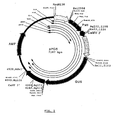
- the locations and directions of the primers are shown in Fig 1.With these primers four fragments could be made namely: f1/r1, f1/r2, f2/r1 and f2/r2.
- Reactions were performed using 35 cycles of 1 min denaturation at 94°C, 1 min annealing at 60°C, 5 min extension at 72°C with a final extra extension period of 5 min.
- the DNA was concentrated by precipitation and redissolving in a small volume of sterile water. The DNA concentration was determined by measuring the OD 260nm and the fragment size was checked by gel electrophoresis. All four DNA fragments were then used separately for protoplast transformations.
- PCR fragments containing only the PAT gene cassette were made using the primer f2 and one of two reverse primers, r3 or r4 both of which are close to the end of the CaMV terminator of the PAT gene (Fig 1).
- Primer r3 starts at position 1232 bp with the sequence 5'-GCGAAACCCTATAAGAACCC; primer r4 starts at position 1340 bp with the sequence 5'-AGCTCGGTACCCACTGGATT.
- PCR reactions were performed using 35 cycles of 1 min denaturation at 94°C, 1 min annealing at 65°C, 2 min extension at 72°C with an extension period of 5 min. Further preparation of the DNA was as described above.
- border sequences the extra +/- 200 bp sequence before and / or after the promoter / terminator
- Amount of DNA molecules used in protoplasts transformation with PEG-medium Fragment Length in bp 34 ⁇ g fragment/ 1 10 6 protoplasts 50 ⁇ g fragment/ 1 10 6 protoplasts Ppg5 7347 6.4 10 12 R1/f2 4983 6.4 10 12 9.5 10 12 R1/f3 5170 9.2 10 12 R4/f2 4858 9.7 10 12 R4/f3 5043 9.4 10 12 Patr1/f2 1410 33.6 10 12 Patr2/f2 1302 36.4 10 12 Table 2a No.
- Fig. 2 is the map of pS63, a plasmid that was obtained by removing 3 regions from pIGPD7.
- RB right border region (about 220 bp, covering the real right border).
- ORI origin of replication of the plasmid.
- Bin19 right border sequence (25 bp, GGTTTACCCGCCAATATATCCTGTC
- Bin19 left border sequence (24 bp,
- T DNA borders can be used. Preferably one is used but both can be employed. We most frequently employ the right border sequence of T DNA (about 25 base pairs) though the left appears equally as useful.
- T DNA border sequences which is not necessarily place in any specific location though the ends are often employed for these border regions.
- Fig. 1 the PatR1 and the PatR2 short fragments that include the entire pat gene and promoter are shown.
- the data is shown in Tables 2a and 2b.
- Tables 2c through 8 show the results of the Southern blot data in tabular form.
Landscapes
- Health & Medical Sciences (AREA)
- Life Sciences & Earth Sciences (AREA)
- Genetics & Genomics (AREA)
- Engineering & Computer Science (AREA)
- Biomedical Technology (AREA)
- Biotechnology (AREA)
- General Engineering & Computer Science (AREA)
- Organic Chemistry (AREA)
- Chemical & Material Sciences (AREA)
- Zoology (AREA)
- Wood Science & Technology (AREA)
- Bioinformatics & Cheminformatics (AREA)
- Molecular Biology (AREA)
- Plant Pathology (AREA)
- Microbiology (AREA)
- Biophysics (AREA)
- Physics & Mathematics (AREA)
- Biochemistry (AREA)
- General Health & Medical Sciences (AREA)
- Cell Biology (AREA)
- Breeding Of Plants And Reproduction By Means Of Culturing (AREA)
- Micro-Organisms Or Cultivation Processes Thereof (AREA)
- Preparation Of Compounds By Using Micro-Organisms (AREA)
Claims (11)
- Verfahren für das Erhalten einer genetisch veränderten Pflanze, umfassend die Schritte der:(i) Transformation von Protoplasten in Gegenwart von PEG-Medium, durch Einführung eines vererbbaren Materials in die Protoplasten von der Pflanze, um Transformanten zu erhalten, die mindestens eine Kopie von dem vererbbaren Material pro Protoplast enthalten,(ii) Selektion eines stabilen Transformanten und(iii) Neubildung von Pflanzenzellen oder einer ganzen Pflanze aus dem Transformanten,dadurch gekennzeichnet, dass das vererbbare Material eine Nukleotidsequenz-Kassette ist, die in das Genom von der Pflanze eingefügt werden muss und frei ist oder im Wesentlichen frei ist von anderen prokaryotischen oder Plasmid-basierten Nukleotidsequenzen.
- Verfahren nach Anspruch 1, dadurch gekennzeichnet, dass die Kassetten-Sequenz eine genetische Sequenz umfasst, die ausgewählt ist aus der Gruppe bestehend aus genetischen Sequenzen involviert in die Resistenz gegenüber Pflanzenviren (insbesondere BNYVV), Resistenz gegenüber Pflanzenparasiten (Nematoden, Pilze oder Insekten), Resistenz gegenüber Herbiziden (vorzugsweise Glyphosat, Glufosinat, Imathezethat und / oder Acetochlorid-Resistenz), Insektiziden oder Fungiziden, oder involviert in den verbesserten Metabolismus von Kohlehydraten.
- Verfahren nach irgendeinem der vorhergehenden Ansprüche, dadurch gekennzeichnet, dass die Protoplasten aus der Umwandlung von stomatalen Zellen erhalten wurden.
- Verfahren nach Anspruch 3, dadurch gekennzeichnet, dass die stomatalen Zellen Schließzellen sind.
- Verfahren nach irgendeinem der vorhergehenden Ansprüche, dadurch gekennzeichnet, dass die Nukleotidsequenz-Kassette ein Amplikon ist, das aus genetischen Vervielfältigungsschritten resultiert.
- Verfahren nach irgendeinem der vorhergehenden Ansprüche, dadurch gekennzeichnet, dass der Schritt der Transformation der Protoplasten der Pflanze, durch die Einführung eines vererbbaren Materials in die Protoplasten, mit Amplikons erhalten wird, die bei einer Konzentration von mehr als 10 µg DNA /1 x 106 Protoplasten vorliegen.
- Verfahren nach irgendeinem der vorhergehenden Ansprüche, dadurch gekennzeichnet, dass es den Schritt der Bereitstellung eines intakten Gewebes von der Pflanze umfasst, das stomatale Zellen enthält und der Umwandlung der stomatalen Zellen in Protoplasten durch enzymatische Verdauung der Zellwände, wobei der Schritt vor der Transformationsschritt der Protoplasten durchgeführt wird.
- Verfahren nach Anspruch 7, dadurch gekennzeichnet, dass das Pflanzengewebe ruhendes Blattgewebe oder Blattepidermis ist.
- Verfahren nach irgendeinem der vorhergehenden Ansprüche, dadurch gekennzeichnet, dass die Pflanze eine Zuckerrübe (Beta vulgaris) ist.
- Genetisch veränderte Zuckerrüben-Pflanze (Beta vulgaris) oder Zuckerrüben-Pflanzenzelle, erhältlich durch ein Verfahren nach irgendeinem der Ansprüche 2 bis 9.
- Zuckerrüben-Pflanze oder Zuckerrüben-Pflanzenzelle nach Anspruch 10, wobei die einzufügende Nukleotidsequenz-Kassette eine oder mehrere T-DNA Randsequenzen einschließt.
Applications Claiming Priority (2)
| Application Number | Priority Date | Filing Date | Title |
|---|---|---|---|
| US61765900A | 2000-07-17 | 2000-07-17 | |
| US617659 | 2000-07-17 |
Publications (3)
| Publication Number | Publication Date |
|---|---|
| EP1174513A2 EP1174513A2 (de) | 2002-01-23 |
| EP1174513A3 EP1174513A3 (de) | 2002-09-25 |
| EP1174513B1 true EP1174513B1 (de) | 2007-02-21 |
Family
ID=24474496
Family Applications (1)
| Application Number | Title | Priority Date | Filing Date |
|---|---|---|---|
| EP00870230A Expired - Lifetime EP1174513B1 (de) | 2000-07-17 | 2000-10-12 | Verfahren zur Herstellung einer genetisch-verändereten Pflanze |
Country Status (4)
| Country | Link |
|---|---|
| EP (1) | EP1174513B1 (de) |
| AT (1) | ATE354664T1 (de) |
| DE (1) | DE60033512T2 (de) |
| ES (1) | ES2281338T3 (de) |
Families Citing this family (2)
| Publication number | Priority date | Publication date | Assignee | Title |
|---|---|---|---|---|
| US6846970B1 (en) * | 1999-07-19 | 2005-01-25 | Plant Bioscience Limited | Transformation method and transgenic plants produced thereby |
| EP1645622A1 (de) * | 1999-07-19 | 2006-04-12 | Plant Bioscience Limited | Transformationsverfahren und dadurch hergestellte Pflanzen |
Family Cites Families (2)
| Publication number | Priority date | Publication date | Assignee | Title |
|---|---|---|---|---|
| GB9321183D0 (en) * | 1993-10-14 | 1993-12-01 | Zeneca Ltd | A method of plant transformation |
| US6846970B1 (en) * | 1999-07-19 | 2005-01-25 | Plant Bioscience Limited | Transformation method and transgenic plants produced thereby |
-
2000
- 2000-10-12 AT AT00870230T patent/ATE354664T1/de not_active IP Right Cessation
- 2000-10-12 DE DE60033512T patent/DE60033512T2/de not_active Expired - Lifetime
- 2000-10-12 EP EP00870230A patent/EP1174513B1/de not_active Expired - Lifetime
- 2000-10-12 ES ES00870230T patent/ES2281338T3/es not_active Expired - Lifetime
Also Published As
| Publication number | Publication date |
|---|---|
| EP1174513A2 (de) | 2002-01-23 |
| DE60033512T2 (de) | 2007-10-31 |
| DE60033512D1 (de) | 2007-04-05 |
| ES2281338T3 (es) | 2007-10-01 |
| ATE354664T1 (de) | 2007-03-15 |
| EP1174513A3 (de) | 2002-09-25 |
Similar Documents
| Publication | Publication Date | Title |
|---|---|---|
| JP2555280B2 (ja) | 植物遺伝子の発現 | |
| DE69929073T2 (de) | Verfahren und Zusammensetzungen für die Transformation von Pflanzen | |
| US6833449B1 (en) | Expression of the toxic portion of Cry1A in plants | |
| US20120192318A1 (en) | Transformation system for Camelina sativa | |
| de Jong et al. | Stable expression of the GUS reporter gene in chrysanthemum depends on binary plasmid T-DNA | |
| US20090151023A1 (en) | Transformation system for Camelina sativa | |
| EP2562261B1 (de) | Verbessertes Mutageneseverfahren unter Verwendung von polyethylenglycolvermittelter Einführung von mutagenen Nukleobasen in Pflanzenprotoplasten | |
| CN113801891B (zh) | 甜菜BvCENH3基因单倍体诱导系的构建方法与应用 | |
| Mlynárová et al. | High efficiency Agrobacterium-mediated gene transfer to flax | |
| DE10101276A1 (de) | Verfahren und Vektoren zur Transformation von Plastiden | |
| JP2000300098A (ja) | Cucumismelo(マスクメロン)種に属する遺伝子導入植物 | |
| CN116716317B (zh) | Psk3基因在促进紫花苜蓿遗传转化效率上的应用 | |
| CN112689678B (zh) | 用于在植物体的基因组中无需插入复制子即可编辑基因组的基于病毒的复制子及其用途 | |
| EP0436007B1 (de) | Verfahren zur ortsspezifischen integration von dna ins pflanzliche genom | |
| EP1174513B1 (de) | Verfahren zur Herstellung einer genetisch-verändereten Pflanze | |
| US20250098609A1 (en) | Maize wox2a over-expression induces somatic embryo formation | |
| US6878818B1 (en) | Modified ubiquitin regulatory system | |
| US7238853B2 (en) | Molecular mechanisms for gene containment in plants | |
| Gahan et al. | Evidence that direct DNA uptake through cut shoots leads to genetic transformation of Solanum aviculare Forst | |
| AU2010253552B2 (en) | A DNA cassette, binary vector, and strain of A. tumefaciens and a method of producing cereal plant of increased productivity and/or root mass | |
| WO1999010514A1 (en) | Fumonosin resistance | |
| DE10047286B4 (de) | Isomalt produzierende transgene Pflanze | |
| WO2001073084A2 (de) | Verfahren zur raschen herstellung von transgenen, einkeimblättrigen pflanzen | |
| KR20230033830A (ko) | 환경 스트레스에 대한 저항성을 조절하는 up 유전자 및 이의 용도 | |
| JP4403605B2 (ja) | 再分化効率を上昇させた植物への遺伝子導入用ベクター |
Legal Events
| Date | Code | Title | Description |
|---|---|---|---|
| PUAI | Public reference made under article 153(3) epc to a published international application that has entered the european phase |
Free format text: ORIGINAL CODE: 0009012 |
|
| AK | Designated contracting states |
Kind code of ref document: A2 Designated state(s): AT BE CH CY DE DK ES FI FR GB GR IE IT LI LU MC NL PT SE |
|
| AX | Request for extension of the european patent |
Free format text: AL;LT;LV;MK;RO;SI |
|
| PUAL | Search report despatched |
Free format text: ORIGINAL CODE: 0009013 |
|
| AK | Designated contracting states |
Kind code of ref document: A3 Designated state(s): AT BE CH CY DE DK ES FI FR GB GR IE IT LI LU MC NL PT SE |
|
| AX | Request for extension of the european patent |
Free format text: AL;LT;LV;MK;RO;SI |
|
| 17P | Request for examination filed |
Effective date: 20030207 |
|
| AKX | Designation fees paid |
Designated state(s): AT BE CH CY DE DK ES FI FR GB GR IE IT LI LU MC NL PT SE |
|
| 17Q | First examination report despatched |
Effective date: 20031125 |
|
| GRAP | Despatch of communication of intention to grant a patent |
Free format text: ORIGINAL CODE: EPIDOSNIGR1 |
|
| GRAS | Grant fee paid |
Free format text: ORIGINAL CODE: EPIDOSNIGR3 |
|
| GRAA | (expected) grant |
Free format text: ORIGINAL CODE: 0009210 |
|
| AK | Designated contracting states |
Kind code of ref document: B1 Designated state(s): AT BE CH CY DE DK ES FI FR GB GR IE IT LI LU MC NL PT SE |
|
| PG25 | Lapsed in a contracting state [announced via postgrant information from national office to epo] |
Ref country code: AT Free format text: LAPSE BECAUSE OF FAILURE TO SUBMIT A TRANSLATION OF THE DESCRIPTION OR TO PAY THE FEE WITHIN THE PRESCRIBED TIME-LIMIT Effective date: 20070221 Ref country code: FI Free format text: LAPSE BECAUSE OF FAILURE TO SUBMIT A TRANSLATION OF THE DESCRIPTION OR TO PAY THE FEE WITHIN THE PRESCRIBED TIME-LIMIT Effective date: 20070221 Ref country code: DK Free format text: LAPSE BECAUSE OF FAILURE TO SUBMIT A TRANSLATION OF THE DESCRIPTION OR TO PAY THE FEE WITHIN THE PRESCRIBED TIME-LIMIT Effective date: 20070221 Ref country code: LI Free format text: LAPSE BECAUSE OF FAILURE TO SUBMIT A TRANSLATION OF THE DESCRIPTION OR TO PAY THE FEE WITHIN THE PRESCRIBED TIME-LIMIT Effective date: 20070221 Ref country code: CH Free format text: LAPSE BECAUSE OF FAILURE TO SUBMIT A TRANSLATION OF THE DESCRIPTION OR TO PAY THE FEE WITHIN THE PRESCRIBED TIME-LIMIT Effective date: 20070221 Ref country code: NL Free format text: LAPSE BECAUSE OF FAILURE TO SUBMIT A TRANSLATION OF THE DESCRIPTION OR TO PAY THE FEE WITHIN THE PRESCRIBED TIME-LIMIT Effective date: 20070221 |
|
| REG | Reference to a national code |
Ref country code: GB Ref legal event code: FG4D |
|
| REG | Reference to a national code |
Ref country code: CH Ref legal event code: EP |
|
| REF | Corresponds to: |
Ref document number: 60033512 Country of ref document: DE Date of ref document: 20070405 Kind code of ref document: P |
|
| REG | Reference to a national code |
Ref country code: IE Ref legal event code: FG4D |
|
| PG25 | Lapsed in a contracting state [announced via postgrant information from national office to epo] |
Ref country code: SE Free format text: LAPSE BECAUSE OF FAILURE TO SUBMIT A TRANSLATION OF THE DESCRIPTION OR TO PAY THE FEE WITHIN THE PRESCRIBED TIME-LIMIT Effective date: 20070521 |
|
| PG25 | Lapsed in a contracting state [announced via postgrant information from national office to epo] |
Ref country code: PT Free format text: LAPSE BECAUSE OF FAILURE TO SUBMIT A TRANSLATION OF THE DESCRIPTION OR TO PAY THE FEE WITHIN THE PRESCRIBED TIME-LIMIT Effective date: 20070723 |
|
| NLV1 | Nl: lapsed or annulled due to failure to fulfill the requirements of art. 29p and 29m of the patents act | ||
| REG | Reference to a national code |
Ref country code: CH Ref legal event code: PL |
|
| REG | Reference to a national code |
Ref country code: ES Ref legal event code: FG2A Ref document number: 2281338 Country of ref document: ES Kind code of ref document: T3 |
|
| PLBE | No opposition filed within time limit |
Free format text: ORIGINAL CODE: 0009261 |
|
| STAA | Information on the status of an ep patent application or granted ep patent |
Free format text: STATUS: NO OPPOSITION FILED WITHIN TIME LIMIT |
|
| 26N | No opposition filed |
Effective date: 20071122 |
|
| PG25 | Lapsed in a contracting state [announced via postgrant information from national office to epo] |
Ref country code: IT Free format text: LAPSE BECAUSE OF FAILURE TO SUBMIT A TRANSLATION OF THE DESCRIPTION OR TO PAY THE FEE WITHIN THE PRESCRIBED TIME-LIMIT Effective date: 20070221 Ref country code: GR Free format text: LAPSE BECAUSE OF FAILURE TO SUBMIT A TRANSLATION OF THE DESCRIPTION OR TO PAY THE FEE WITHIN THE PRESCRIBED TIME-LIMIT Effective date: 20070522 |
|
| PG25 | Lapsed in a contracting state [announced via postgrant information from national office to epo] |
Ref country code: MC Free format text: LAPSE BECAUSE OF NON-PAYMENT OF DUE FEES Effective date: 20071031 |
|
| PG25 | Lapsed in a contracting state [announced via postgrant information from national office to epo] |
Ref country code: IE Free format text: LAPSE BECAUSE OF NON-PAYMENT OF DUE FEES Effective date: 20071012 |
|
| PG25 | Lapsed in a contracting state [announced via postgrant information from national office to epo] |
Ref country code: CY Free format text: LAPSE BECAUSE OF FAILURE TO SUBMIT A TRANSLATION OF THE DESCRIPTION OR TO PAY THE FEE WITHIN THE PRESCRIBED TIME-LIMIT Effective date: 20070221 |
|
| PG25 | Lapsed in a contracting state [announced via postgrant information from national office to epo] |
Ref country code: LU Free format text: LAPSE BECAUSE OF NON-PAYMENT OF DUE FEES Effective date: 20071012 |
|
| REG | Reference to a national code |
Ref country code: FR Ref legal event code: PLFP Year of fee payment: 17 |
|
| REG | Reference to a national code |
Ref country code: FR Ref legal event code: PLFP Year of fee payment: 18 |
|
| PGFP | Annual fee paid to national office [announced via postgrant information from national office to epo] |
Ref country code: FR Payment date: 20170921 Year of fee payment: 18 Ref country code: GB Payment date: 20170925 Year of fee payment: 18 |
|
| PGFP | Annual fee paid to national office [announced via postgrant information from national office to epo] |
Ref country code: ES Payment date: 20171103 Year of fee payment: 18 |
|
| PGFP | Annual fee paid to national office [announced via postgrant information from national office to epo] |
Ref country code: BE Payment date: 20180921 Year of fee payment: 19 |
|
| PGFP | Annual fee paid to national office [announced via postgrant information from national office to epo] |
Ref country code: DE Payment date: 20180819 Year of fee payment: 19 |
|
| GBPC | Gb: european patent ceased through non-payment of renewal fee |
Effective date: 20181012 |
|
| PG25 | Lapsed in a contracting state [announced via postgrant information from national office to epo] |
Ref country code: FR Free format text: LAPSE BECAUSE OF NON-PAYMENT OF DUE FEES Effective date: 20181031 |
|
| PG25 | Lapsed in a contracting state [announced via postgrant information from national office to epo] |
Ref country code: GB Free format text: LAPSE BECAUSE OF NON-PAYMENT OF DUE FEES Effective date: 20181012 |
|
| REG | Reference to a national code |
Ref country code: ES Ref legal event code: FD2A Effective date: 20191202 |
|
| PG25 | Lapsed in a contracting state [announced via postgrant information from national office to epo] |
Ref country code: ES Free format text: LAPSE BECAUSE OF NON-PAYMENT OF DUE FEES Effective date: 20181013 |
|
| REG | Reference to a national code |
Ref country code: DE Ref legal event code: R119 Ref document number: 60033512 Country of ref document: DE |
|
| PG25 | Lapsed in a contracting state [announced via postgrant information from national office to epo] |
Ref country code: DE Free format text: LAPSE BECAUSE OF NON-PAYMENT OF DUE FEES Effective date: 20200501 |
|
| REG | Reference to a national code |
Ref country code: BE Ref legal event code: MM Effective date: 20191031 |
|
| PG25 | Lapsed in a contracting state [announced via postgrant information from national office to epo] |
Ref country code: BE Free format text: LAPSE BECAUSE OF NON-PAYMENT OF DUE FEES Effective date: 20191031 |