EP1176249A2 - Toile de formage pour papéterie - Google Patents
Toile de formage pour papéterie Download PDFInfo
- Publication number
- EP1176249A2 EP1176249A2 EP01118176A EP01118176A EP1176249A2 EP 1176249 A2 EP1176249 A2 EP 1176249A2 EP 01118176 A EP01118176 A EP 01118176A EP 01118176 A EP01118176 A EP 01118176A EP 1176249 A2 EP1176249 A2 EP 1176249A2
- Authority
- EP
- European Patent Office
- Prior art keywords
- machine direction
- yarns
- direction yarns
- yarn
- cross machine
- Prior art date
- Legal status (The legal status is an assumption and is not a legal conclusion. Google has not performed a legal analysis and makes no representation as to the accuracy of the status listed.)
- Withdrawn
Links
Images





Classifications
-
- D—TEXTILES; PAPER
- D21—PAPER-MAKING; PRODUCTION OF CELLULOSE
- D21F—PAPER-MAKING MACHINES; METHODS OF PRODUCING PAPER THEREON
- D21F1/00—Wet end of machines for making continuous webs of paper
- D21F1/0027—Screen-cloths
- D21F1/0036—Multi-layer screen-cloths
- D21F1/0045—Triple layer fabrics
Definitions
- This invention relates generally to woven fabrics, and relates more specifically to woven fabrics for papermakers.
- a water slurry, or suspension, of cellulosic fibers (known as the paper "stock") is fed onto the top of the upper run of an endless belt (or between two endless belts) of woven wire and/or synthetic material that travels between two or more rollers.
- the belt often referred to as a "forming fabric” provides a papermaking surface on the upper surface of its upper run which operates as a filter to separate the cellulosic fibers of the paper stock from the aqueous medium, thereby forming a wet paper web.
- the aqueous medium drains through mesh openings of the forming fabric, known as drainage holes, by gravity alone or with assistance from one or more suction boxes located on the lower surface ( i.e. , the "machine side") of the upper run of the fabric.
- the paper web After leaving the forming section, the paper web is transferred to a press section of the paper machine, in which it is passed through the nips of one or more pairs of pressure rollers covered with another fabric, typically referred to as a "press felt.” Pressure from the rollers removes additional moisture from the web; the moisture removal is often enhanced by the presence of a "batt" layer on the press felt.
- the paper is then conveyed to a dryer section for further moisture removal. After drying, the paper is ready for secondary processing and packaging.
- papermaker's fabrics are manufactured as endless belts by one of two basic weaving techniques.
- fabrics are flat woven by a flat weaving process, with their ends being joined to form an endless belt by any one of a number of well-known joining methods, such as dismantling and reweaving the ends together (commonly known as splicing), or sewing a pin-seamable flap on each end or a special foldback, then reweaving these into pin-seamable loops.
- splicing commonly known as splicing
- sewing a pin-seamable flap on each end or a special foldback then reweaving these into pin-seamable loops.
- the warp yarns extend in the machine direction and the filling yarns extend in the cross machine direction.
- fabrics are woven directly in the form of a continuous belt with an endless weaving process.
- the warp yarns extend in the cross machine direction and the filling yarns extend in the machine direction.
- machine direction MD
- CMD cross machine direction
- Both weaving methods described hereinabove are well known in the art, and the term “endless belt” as used herein refers to belts made by either method.
- Wire marking is particularly problematic in the formation of fine paper grades, as it can affect a host of paper properties, such as sheet mark, porosity, "see-through” and pin holing. Wire marking is typically the result of individual cellulosic fibers being oriented within the paper web such that their ends reside within gaps between the individual threads or yarns of the forming fabric. This problem is generally addressed by providing a permeable fabric structure with a coplanar surface that allows paper fibers to bridge adjacent yarns of the fabric rather than penetrate the gaps between yarns.
- coplanar means that the upper extremities of the yarns defining the paper-forming surface are at substantially the same elevation, such that at that level there is presented a substantially “planar” surface. Accordingly, fine paper grades intended for use in quality printing, carbonizing, cigarettes, electrical condensers, and like grades of fine paper have typically heretofore been formed on very finely woven or fine wire mesh forming fabrics.
- such finely woven fabrics include at least some relatively small diameter machine direction or cross machine direction yarns.
- such yarns tend to be delicate, leading to a short surface life for the fabric.
- the use of smaller yarns can also adversely effect the mechanical stability of the fabric (especially in terms of skew resistance, narrowing propensity and stiffness), which may negatively impact both the service life and the performance of the fabric.
- multi-layer forming fabrics have been developed with fine-mesh yarns on the paper forming surface to facilitate paper formation and coarser-mesh yarns on the machine contact side to provide strength and durability.
- fabrics have been constructed which employ one set of machine direction yarns which interweave with two sets of cross machine direction yarns to form a fabric having a fine paper forming surface and a more durable machine side surface. These fabrics form part of a class of fabrics which are generally referred to as "double layer" fabrics.
- fabrics have been constructed which include two sets of machine direction yams and two sets of cross machine direction yarns that form a fine mesh paper side fabric layer and a separate, coarser machine side fabric layer.
- triple layer fabrics In these fabrics, which are part of a class of fabrics generally referred to as "triple layer” fabrics, the two fabric layers are typically bound together by separate stitching yarns.
- double and triple layer fabrics include additional sets of yarn as compared to single layer fabrics, these fabrics typically have a higher "caliper" (i.e., they are thicker than) comparable single layer fabrics.
- An illustrative double layer fabric is shown in U.S. Patent No. 4,423,755 to Thompson, and illustrative triple layer fabrics are shown in U.S. Patent No. 4,501,303 to Osterberg, U.S. Patent No. 5,152,326 to Vohringer, and U.S. Patent No. 5,437,315 to Ward.
- the coarser CMD yarns used in the bottom layer of the fabric typically have long "floats" (segments that span multiple adjacent MD yams in the weave pattern) that contact the papermaking machine.
- This arrangement is desirable, as the MD yarns (which are subjected to most of the tensile load of the fabric during operation) are protected to a large degree from wear; however, the long CMD floats are susceptible to wear over time.
- the floats are somewhat asymmetric; i.e. , the MD yarns that pass above the float apply forces of varying magnitudes at asymmetric points across the float.
- the floats can be somewhat asymmetric in shape, thereby protruding toward the papermaking machine in a non-uniform manner. The locations on the floats that protrude the most tend to receive the most wear during operation.
- the present invention includes a papermaker's fabric that can improve fiber support, wear resistance, caliper, and other papermaking properties.
- the fabric includes: a first set of machine direction yarns; a top set of cross machine direction yarns interwoven with the first set of machine direction yarns; and a bottom set of cross machine direction yarns interwoven with the first set of machine direction yams.
- the first set of machine direction yarns, the top set of cross machine direction yarns, and the bottom set of cross machine direction yarns are interwoven in a repeat pattern in which each of the machine direction yarns passes below at least two nonadjacent bottom cross machine direction yarns, in which each adjacent pair of machine direction yarns passes below a common bottom cross machine direction yarn to form side-by side bottom knuckles, and in which machine direction yarns adjacent to and sandwiching the adjacent pair of machine direction yarns forming the side-by-side bottom knuckles pass over a top cross machine direction yarn positioned substantially directly above the bottom cross machine direction yarn under which the bottom knuckles are formed such that a phantom float is formed on that top cross machine direction yarn.
- such a configuration in a double layer fabric can enable the phantom float to participate more fully in the fiber support of the fabric and, as such, improve fiber support in locations between long CMD floats on the papermaking surface ( i.e. , the locations of the phantom floats). Also, this configuration can improve wear resistance by providing a more symmetric bottom side CMD float as a contact point with the papermaking machine.
- the present invention is directed to a triple layer papermaker's fabric that comprises: a set of top machine direction yarns; a set of bottom machine direction yarns; a set of top cross machine direction yarns interwoven with the top machine direction yarns to form a top fabric layer; a set of bottom machine direction yarns; a bottom set of cross machine direction yarns interwoven with the bottom machine direction yarns to form a bottom fabric layer; and a plurality of cross machine direction stitching yarns interweaving with the top and bottom machine direction yarns to interconnect the top and bottom fabric layers.
- the bottom machine direction yarns and the bottom cross machine direction yarns are interwoven in a repeat pattern in which each of the bottom machine direction yarns passes below at least two nonadjacent bottom cross machine direction yarns, thereby forming bottom side machine direction knuckles, and wherein each adjacent pair of machine direction yarns passes below a common bottom cross machine direction yarn to form side-by-side bottom knuckles.
- the bottom layer may have improved wear resistance, higher air permeability, and other performance benefits compared to other triple layer fabrics with shorter bottom layer floats.
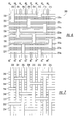
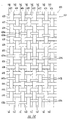
- Figure 1 is a top view of a double layer papermaker's forming fabric of the present invention.
- Figure 2 is a partial top view of the fabric of Figure 1 with the top CMD yarns removed.
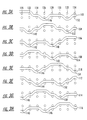
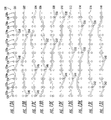
- Figures 3A-3H are section views taken along lines 3A-3A through 3H-3H of Figure 1.
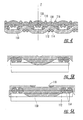
- Figure 4 is a section view of a top CMD yarn and a bottom CMD yarn taken along line 4-4 of Figure 1.
- Figure 5A is a greatly enlarged inset of Figure 4 showing the wear surface of a bottom CMD yarn.
- Figure 5B is a greatly enlarged section view of a prior art fabric showing the difference in wear surface provided by a bottom CMD yarn.
- Figure 6 is a top view of an alternative embodiment of a double layer papermaker's forming fabric of the present invention.
- Figure 7 is a partial top view of the fabric of Figure 6 with the top CMD yarns and fiber support yarns removed.
- Figures 8A-8H are section views taken along, respectively, lines 8A-8A through 8H-8H of Figure 6.
- Figure 9 is a top view of an alternative embodiment of a double layer papermaker's forming fabric of the present invention.
- Figure 10 is a partial top view of the fabric of Figure 9 with the top CMD yarns and fiber support yarns removed.
- Figure 11A-11G are section views taken along, respectively, lines 11A-11A through 11G-11G of Figure 9.
- Figures 12A-12I are section views of consecutive machine direction yarns of a nine harness embodiment of a double layer papermaker's forming fabric of the present invention.
- Figures 13A-13J are section views of consecutive machine direction yarns of a ten harness embodiment of a double layer papermaker's forming fabric of the present invention.
- Figure 14 is a top view of a triple layer papermaker's forming fabric of the present invention.
- Figure 15 is a top section view of the bottom layer of the fabric of Figure 14.
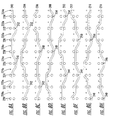
- Figures 16A-16H are section views taken along, respectively, lines 16A-16A through 16H-16H of Figure 14.
- the fabric 100 includes eight consecutive machine direction yarns 102, 104, 106, 108, 110, 112, 114 and 116, which are interwoven with a set of eight top CMD yarns 120, 122, 124, 126, 128, 130, 132, and 134 and with a set of eight bottom CMD yarns 140, 142, 144, 146, 148, 150, 152 and 154.
- each bottom CMD yarn is located substantially directly below a corresponding top CMD yam.
- the section of fabric illustrated in Figures 1-4 constitutes a single repeat unit of a larger fabric comprising multiple repeat units; of course, the repeat unit can begin at any point within this pattern so long as the pattern is maintained.
- each MD yarn interweaves with the top CMD yarns such that it passes over two adjacent top CMD yarns, then passes below six consecutive top CMD yarns.
- MD yarn 102 passes over top CMD yarns 120 and 122, then passes below top CMD yarns 124, 126, 128, 130, 132 and 134. While passing below the top CMD yarns, each MD yarn passes below two bottom CMD yarns that sandwich two other bottom CMD yarns.
- MD yarn 102 after passing above top CMD yarns 120 and 122, passes above bottom CMD yarn 144, below bottom CMD yarn 146, above bottom CMD yarns 148 and 150, below bottom CMD yarn 152, and above bottom CMD yarn 154.
- each MD yarn travels along the following path: above two top CMD yarns, between the next pair of top and bottom CMD yarns, below the next bottom CMD yarn, between the next two pair of top and bottom CMD yarns, below the next bottom CMD yarn, and between the next pair of top and bottom CMD yarns.
- Adjacent MD yarns following this interweaving pattern or sequence are offset from one another in the machine direction by three bottom CMD yarns. This can be illustrated by examination of MD yarns 106 and 108 (seen best in Figures 3C and 3D .). MD yarn 106 ( Figure 3C) passes below bottom CMD yarns 142 and 148. Adjacent MD yarn 108 ( Figure 3D) passes below bottom CMD yarns 148 and 154. A similar three CMD yarn offset is followed by all of the MD yarns as they pass over top CMD yarns.
- adjacent MD yarns form a machine direction "knuckle" (i.e. , a location where an MD yarn passes below one CMD yarn only, while passing above the adjacent CMD yarns) below the same bottom CMD yarn (e.g. , both of MD yarns 106 and 108 form a knuckle below bottom CMD yarn 148, as described above).
- knuckle a machine direction "knuckle”
- both of MD yarns 106 and 108 form a knuckle below bottom CMD yarn 148, as described above.
- phantom float means a short CMD float (i.e. , a portion of a CMD yarn passing over more than one MD yarn) on the papermaking surface that is supported by an adjacent and corresponding bottom CMD yarn such that it is elevated to participate more fully in fiber support.
- This phantom float supplements the longer floats of top CMD yarn 130 located on either side of the phantom float which are largely responsible for support of fibers in paper stock during the formation of paper.
- the presence of the phantom knuckle can help to increase coplanarity of the papermaking surface in the locations between the long floats of the top CMD yarns, which can positively impact the surface of paper produced thereon.
- the bottom float formed on the bottom CMD yarn is relatively symmetric and flat (see Figures 5A and 5B for comparison of the present fabric 20 to a prior art fabric).
- the relative symmetry and flatness of the bottom side CMD float can induce more surface area of this float to be in contact with the paper machine than is true for prior art fabrics. Accordingly, there is more surface provided by each bottom CMD yarn to endure wear on the fabric, which can result in higher wear resistance for the overall fabric.
- FIG. 1-5 a repeat unit of a double layer fabric with additional fiber support yarns, designated broadly at 200, is illustrated in Figures 6-8.
- the fabric 200 includes eight MD yarns 202, 204, 206, 208, 210, 212, 214 and 216, which are interwoven with eight top CMD yarns 220, 222, 224, 226, 228, 230, 232, and 234 and with eight bottom CMD yarns 240, 242, 244, 246, 248, 250, 252, and 254 in the same manner as the MD, top CMD and bottom CMD yarns of the fabric 100 described above.
- the fabric 200 also includes in its repeat unit eight fiber support "picks" 220a, 222a, 224a, 226a, 228a, 230a, 232a and 234a.
- Each pick is located between two adjacent top CMD yarns and is interwoven with the MD yarns such that it passes over seven adjacent MD yarns and below an eighth MD yarn.
- pick 220a passes below MD yarn 202 and above MD yarns 204, 206, 208, 210, 212, 214 and 216.
- Adjacent picks are offset from one another in their weaving sequences by three MD yarns; thus, pick 220a passes below MD yarn 202, while pick 222a passes below MD yarn 208.
- each MD yarn passes over only the pick located between the two CMD yarns that MD yarn also passes over; for example, MD yarn 202 passes over top CMD yarns 220 and 222, but also passes over pick 220a only and below all other picks.
- the weave pattern of fabric 200 maintains the adjacent bottom surface MD knuckles illustrated in fabric 100.
- the "phantom float" effect described for the fabric 100 is also present for the fabric 200, as is the relatively symmetric bottom CMD yarn for increased wear resistance.
- the potential for reduced caliper, reduced void volume, increased stability, and decreased permeability is also present.
- a repeat unit of a double layer fabric designated broadly at 300, includes in its repeat unit seven MD yarns 302, 304, 306, 308, 310, 312, and 314 interwoven with seven top CMD yarns 320, 322, 324, 326, 328, 330, and 332, seven bottom CMD yarns 340, 342, 344, 346, 348, 350, and 352, and seven fiber support picks 320a, 322a, 324a, 326a, 328a, 330a and 332a.
- each MD yarn passes above two top CMD yarns and the pick sandwiched therebetween and passes below all other top CMD yarns and picks.
- Each MD yam also passes below two bottom CMD yarns that are separated by one bottom CMD yarn.
- MD yarn 302 passes above top CMD yarns 320 and 322 as well as pick 320a, then passes below pick 322a, between top CMD yarn 324 and bottom CMD yarn 344, below bottom CMD yarn 346, between bottom CMD yarn 348 and top CMD yarn 328, below bottom CMD yarn 350, and between top CMD yarn 322 and bottom CMD yarn 352.
- Adjacent MD yarns are offset from one another in weaving sequence by two top CMD yarns; thus, MD yarn 302 passes above top CMD yarn 320 and 322, which adjacent MD yarn 304 passes above top CMD yarns 324 and 326.
- adjacent MD yarns form the distinctive side-by-side single float bottom layer knuckles seen in the fabrics 100 and 200 described above, and can provide the same performance advantages.
- Figures 12A-12I illustrate nine MD yams 402, 404, 406, 408, 410, 412, 414, 416 and 418 of the repeat unit of a double layer fabric 400 as these MD yarns interweave with nine top CMD yarns 420, 422, 424, 426, 428, 430, 432, 434 and 436, nine bottom CMD yarns 440, 442, 444, 446, 448, 450, 452, 454 and 456, and nine fiber support picks 420a, 422a, 424a, 426a, 428a, 430a, 432a, 434a and 436a .
- each MD yarn passes over two top CMD yarns and the pick sandwiched therebetween, between the adjacent set of top and bottom CMD yarns, below the next bottom CMD yarn, between the next set of top and bottom CMD yarns, below the following bottom CMD yarn, and between the next three sets of top and bottom CMD yarns.
- MD yarn 402 passes above top CMD yarns 420 and 422 as well as pick 420a, passes below pick 422a and between top and bottom CMD yarns 424, 444, passes below bottom CMD yam 446 , passes between top and bottom CMD yarns 428, 448, passes below bottom CMD yarn 450, and passes between top and bottom CMD yarn sets 432, 452, 434, 454, and 436, 456 (and under pick 436a ).
- Adjacent MD yarns are offset in weaving sequence by two top CMD yarns, so while MD yarn 402 passes above top CMD yarns 420 and 422, adjacent MD yarn 404 passes above top CMD yarns 424 and 426 (see Figures 9A and 9B ). As a result, the adjacent bottom layer MD knuckles found in the previously described fabrics are present here.
- the double layer fabric 500 includes ten MD yarns 501, 502, 504, 506, 508, 510, 512, 514 , 516 and 518 that interweave with ten top CMD yarns 520, 522, 524, 526, 528, 530, 532, 534, 536 and 538, ten fiber support picks 520a, 522a, 524a, 526a, 528a , 530a, 532a, 534a, 536a and 538a , and ten bottom CMD yarns 540, 542, 544, 546, 548, 550, 552, 554, 556 and 558.
- each MD yarn passes over two top CMD yarns and the pick sandwiched therebetween, between the next two sets of top and bottom CMD yarns, below the next bottom CMD yarn, between the next two sets of bottom and top CMD yarns, below the following bottom CMD yarn, and between the next two sets of top and bottom CMD yarns.
- MD yarn 501 passes above top CMD yarns 520 and 522 as well as pick 520a, below pick 522a, between sets of top and bottom CMD yarns 524, 544 and 526, 546, below bottom CMD yarn 548, between sets of top and bottom CMD yarns 530, 550 and 532, 552, below bottom CMD yarn 554, and between sets of top and bottom CMD yarns 536, 556 and 538, 558.
- Adjacent MD yams are offset by three top CMD yarns; thus, as MD yarn 501 passes above top CMD yarns 520 and 522, adjacent MD yarn 502 passes above top CMD yarns 526 and 528.
- the adjacent bottom layer MD knuckles found in the previously described fabrics are present here; accordingly, this fabric can also exhibit the performance advantages described above.
- the principles of the present invention may also be applied to other double layer fabrics, whether they include fiber support picks or not.
- the fabrics may include different numbers of yarns in the repeat unit (for example, eleven or twelve MD yarns), and the MD yarns may follow a different pattern as they pass over the top CMD yarns; as an example, the top layer have follow a pattern such as those illustrated in U.S. Patent No. 5,937,914 and co-pending and co-assigned U.S. Patent Application Serial No. 09/501,753, filed February 10, 2000, the disclosures of each of which are hereby incorporated herein by reference in their entireties.
- the concept of the present invention can also be applied to triple layer fabrics.
- a 16 harness triple layer fabric a repeat unit of which is designated broadly at 600, is illustrated in Figures 14-16.
- the fabric 600 includes a top fabric layer 601 and a bottom fabric layer 651.
- the top fabric layer 601 includes eight top MD yams 602, 604, 606, 608, 610, 612, 614, 616 interwoven with twelve top CMD yarns 620, 622, 624, 628, 630, 632, 636, 638, 640, 644, 646, 648 and four pairs of stitching yarn 626a, 626b, 634a, 634b, 642a, 642b, 650a, 650b.
- top MD yams and top CMD yarns are interwoven in a plain weave pattern, with the stitching yarns positioned between sets of three adjacent top CMD yams and also interweaving with the top MD yarns in a plain weave pattern.
- the manner in which a plain weave surface is formed on the top layer via a combination of top MD yarns, top CMD yarns and stitching yarns is described in U.S. Patent No. 4,501,113 to Osterberg and U.S. Patent No. 5,967,195 to Ward, the disclosures of each of which are hereby incorporated by reference in their entireties.
- the bottom fabric layer 651 comprises eight bottom MD yarns 652, 653, 654, 655, 656, 657, 658, 659 that are interwoven with eight bottom CMD yarns 660, 661, 662, 663, 664, 665, 666, 667.
- the weaving pattern of the bottom fabric layer 651 is such that each bottom MD yarn passes above four adjacent bottom CMD yarns, below a bottom CMD yarn, above two adjacent bottom CMD yarns, and below another bottom CMD yarn. Adjacent bottom MD yarns are offset from one another by three bottom CMD yarns. As a result, adjacent MD yams pass below a common bottom CMD yarn to form adjacent bottom knuckles.
- bottom MD yarn 652 passes below bottom CMD yarns 663 and 666, while adjacent bottom MD yarns 653 passes below bottom CMD yarns 661 and 666.
- performance advantages ascribed to this configuration for previously described fabrics may also present for the bottom fabric layer 651; in particular, for triple layer fabrics life potential and air permeability may be markedly improved over prior art triple layer fabrics.
- each stitching yarn of each stitching yarn pair passes below one bottom MD yarn as part of the repeat unit.
- stitching yarns 626a, 626b pass below, respectively, bottom MD yarns 655, 659.
- the next stitching yarn pair passes below a bottom MD yarn that is offset by two bottom MD yarns, so, for example, stitching yarns 634a, 634b pass below, respectively, bottom MD yarns 653, 657.
- there are twice as many top CMD yarns (assuming that each stitching yarn pair serves as one top CMD yarn for the purposes of this calculation) as bottom CMD yarns, and that each bottom CMD yarn is positioned below a corresponding top CMD yarn.
- triple layer fabrics of the present invention may be woven in different repeat patterns than those illustrated herein.
- a triple layer fabric may be woven on 24 harnesses, wherein the bottom fabric layer includes 12 bottom MD yarns and twelve bottom CMD yarns, with each bottom CMD yarn following an "over 6/under 1/over 4/under 1" pattern relative to the bottom CMD yarns, and with adjacent MD yarns being offset from one another by five CMD yams.
- a triple layer fabric of the present invention may be woven on 20 harnesses, wherein the bottom fabric layer includes ten bottom MD yarns and ten bottom CMD yarns, with each bottom CMD yam following an "over 5/under 1/over 3/under 1" pattern relative to the bottom CMD yarns, and with adjacent MD yarns being offset from one another by four CMD yams.
- Other triple layer fabrics can be contemplated that utilize 18, 28 or 30 harnesses.
- top surface of the triple layer fabrics of the present invention may take other patterns on the top surface (such as other plain weave patterns, twills, broken twills, satins, and the like).
- stitching yarns may contribute to the weave pattern as illustrated in the embodiment of Figures 14 through 16 , may contribute to a greater degree to the top surface (such as is illustrated in U.S. Patent No. 5,967,195 to Ward), or may not contribute to the weave (as illustrated in U.S. Patent No. 5,238,536 to Danby, U.S. Patent Nos. 4,987,929 and 5,518,042 to Wilson, 4,989,647 to Marchand, U.S. Patent No. 5,052,448 to Givin, U.S. Patent No. 5,437,315 to Ward, U.S. Patent No. 5,564,475 to Wright, U.S. Patent No. 5,152,326 to Vohringer, and U.S. Patent No. 4,501,303 to Osterberg).
- the form of the yarns utilized in the fabrics of the present invention can vary, depending upon the desired properties of the final papermaker's' fabric.
- the yarns may be multifilament yarns, monofilament yarns, twisted multifilament or monofilament yarns, spun yarns, or any combination thereof.
- the materials comprising yarns employed in the fabric of the present invention may be those commonly used in papermaker's' fabric.
- the yams may be formed of polypropylene, polyester, polyester alloys and copolymers, nylon, nylon alloys and copolymers, or the like. The skilled artisan should select a yarn material according to the particular application of the final fabric. In particular, round monofilament yarns formed of polyester or nylon are preferred.
- Yarn sizes should be selected according to the desired performance of the fabric.
- MD yarns should have a diameter of between about 0.12mm to 0.40mm
- top CMD yarns should have a diameter of between about 0.10mm and 0.50mm
- bottom CMD yarns should have a diameter of between about 0.16mm and 0.70mm. If fiber support picks are included, they should have a diameter of between about 0.10mm and 0.30mm, as should top CMD yarns used with fiber support picks.
- top MD yarns should have a diameter of between about 0.12mm to 0.30mm
- top CMD yarns should have a diameter of between about 0.12mm and 0.30mm
- bottom MD yarns should have a diameter of between about 0.20mm and 0.30mm
- bottom CMD yarns should have a diameter of between about 0.20mm and 0.70mm
- stitching yarns should have a diameter of between about 0.10mm and 0.30mm.
- double layer fabric configurations suitable for use with the present invention are set forth in Table 1 below. Harnesses Fiber Support Picks MD Yarn Diameter (mm) Top CMD Yarn Diameter (mm) Bottom CMD Yarn Diameter (mm) Pick Diameter (mm) 7 yes 0.17 0.20 0.25 0.13 8 no 0.17 0.18 0.18 none 8 yes 0.17 0.20 0.25 0.13 9 yes 0.17 0.20 0.25 0.13 10 yes 0.17 0.20 0.25 0.13
- Exemplary triple layer fabrics configurations suitable for use are set forth in Table 2 below. Harnesses Top MD Yarn Diameter (mm) Top CMD yarn Diameter (mm) Bottom MD yarn Diameter (mm) Bottom CMD Yarn Diameter (mm) Stitching Yarn Diameter (mm) 16 0.22 0.22 0.22 0.50 0.20 20 0.22 0.22 0.22 0.50 0.20 24 0.22 0.22 0.22 0.50 0.20
Landscapes
- Paper (AREA)
- Woven Fabrics (AREA)
Applications Claiming Priority (2)
| Application Number | Priority Date | Filing Date | Title |
|---|---|---|---|
| US628668 | 2000-07-28 | ||
| US09/628,668 US6253796B1 (en) | 2000-07-28 | 2000-07-28 | Papermaker's forming fabric |
Publications (2)
| Publication Number | Publication Date |
|---|---|
| EP1176249A2 true EP1176249A2 (fr) | 2002-01-30 |
| EP1176249A3 EP1176249A3 (fr) | 2002-12-04 |
Family
ID=24519829
Family Applications (1)
| Application Number | Title | Priority Date | Filing Date |
|---|---|---|---|
| EP01118176A Withdrawn EP1176249A3 (fr) | 2000-07-28 | 2001-07-26 | Toile de formage pour papéterie |
Country Status (8)
| Country | Link |
|---|---|
| US (1) | US6253796B1 (fr) |
| EP (1) | EP1176249A3 (fr) |
| JP (1) | JP2002088674A (fr) |
| AR (1) | AR030070A1 (fr) |
| AU (1) | AU5769601A (fr) |
| BR (1) | BR0103061A (fr) |
| CA (1) | CA2353217A1 (fr) |
| MX (1) | MXPA01007724A (fr) |
Cited By (1)
| Publication number | Priority date | Publication date | Assignee | Title |
|---|---|---|---|---|
| WO2004067833A3 (fr) * | 2003-01-30 | 2005-03-24 | Weavexx Corp | Tissu de fabrication de papier |
Families Citing this family (36)
| Publication number | Priority date | Publication date | Assignee | Title |
|---|---|---|---|---|
| US6413377B1 (en) * | 1999-11-09 | 2002-07-02 | Astenjohnson, Inc. | Double layer papermaking forming fabric |
| GB0005344D0 (en) * | 2000-03-06 | 2000-04-26 | Stone Richard | Forming fabric with machine side layer weft binder yarns |
| DE10039736A1 (de) * | 2000-08-16 | 2002-03-07 | Kufferath Andreas Gmbh | Verbundgewebe |
| US6745797B2 (en) | 2001-06-21 | 2004-06-08 | Weavexx Corporation | Papermaker's forming fabric |
| US6834684B2 (en) * | 2002-10-24 | 2004-12-28 | Albany International Corp. | Paired warp triple layer forming fabrics with optimum sheet building characteristics |
| US7048012B2 (en) * | 2002-10-24 | 2006-05-23 | Albany International Corp. | Paired warp triple layer forming fabrics with optimum sheet building characteristics |
| US6837277B2 (en) | 2003-01-30 | 2005-01-04 | Weavexx Corporation | Papermaker's forming fabric |
| US7059357B2 (en) | 2003-03-19 | 2006-06-13 | Weavexx Corporation | Warp-stitched multilayer papermaker's fabrics |
| US6896009B2 (en) * | 2003-03-19 | 2005-05-24 | Weavexx Corporation | Machine direction yarn stitched triple layer papermaker's forming fabrics |
| US20080105323A1 (en) * | 2003-08-13 | 2008-05-08 | Stewart Lister Hay | Fabrics Employing Binder/Top Interchanging Yarn Pairs |
| US7300554B2 (en) * | 2003-09-11 | 2007-11-27 | Albany International Corp. | Textured surface of a tissue forming fabric to generate bulk, cross directional tensile, absorbency, and softness in a sheet of paper |
| US7243687B2 (en) * | 2004-06-07 | 2007-07-17 | Weavexx Corporation | Papermaker's forming fabric with twice as many bottom MD yarns as top MD yarns |
| US7198067B2 (en) * | 2004-08-04 | 2007-04-03 | Albany International Corp. | Warp-runner triple layer fabric with paired intrinsic warp binders |
| US7195040B2 (en) * | 2005-02-18 | 2007-03-27 | Weavexx Corporation | Papermaker's forming fabric with machine direction stitching yarns that form machine side knuckles |
| US7484538B2 (en) * | 2005-09-22 | 2009-02-03 | Weavexx Corporation | Papermaker's triple layer forming fabric with non-uniform top CMD floats |
| KR100830573B1 (ko) | 2005-09-27 | 2008-05-21 | 웨벡스 코포레이션 | 기계측 너클을 형성하는 기계방향 접결사를 가진 제지기용성형 직물 |
| US7219701B2 (en) * | 2005-09-27 | 2007-05-22 | Weavexx Corporation | Papermaker's forming fabric with machine direction stitching yarns that form machine side knuckles |
| US7275566B2 (en) | 2006-02-27 | 2007-10-02 | Weavexx Corporation | Warped stitched papermaker's forming fabric with fewer effective top MD yarns than bottom MD yarns |
| DE102006016660C5 (de) * | 2006-04-08 | 2009-09-03 | Andreas Kufferath Gmbh & Co Kg | Oberseite, insbesondere Papierseite, sowie Papiermaschinensieb |
| US7580229B2 (en) | 2006-04-27 | 2009-08-25 | Hitachi Global Storage Technologies Netherlands B.V. | Current-perpendicular-to-the-plane (CPP) magnetoresistive sensor with antiparallel-free layer structure and low current-induced noise |
| US7581567B2 (en) * | 2006-04-28 | 2009-09-01 | Weavexx Corporation | Papermaker's forming fabric with cross-direction yarn stitching and ratio of top machine direction yarns to bottom machine direction yarns of 2:3 |
| US7487805B2 (en) * | 2007-01-31 | 2009-02-10 | Weavexx Corporation | Papermaker's forming fabric with cross-direction yarn stitching and ratio of top machined direction yarns to bottom machine direction yarns of less than 1 |
| US20080196784A1 (en) * | 2007-02-15 | 2008-08-21 | Scott Quigley | Wear side weave pattern of a composite forming fabric |
| US7624766B2 (en) * | 2007-03-16 | 2009-12-01 | Weavexx Corporation | Warped stitched papermaker's forming fabric |
| DE102007020071A1 (de) * | 2007-04-28 | 2008-10-30 | Voith Patent Gmbh | Formiersieb |
| US7959764B2 (en) * | 2007-06-13 | 2011-06-14 | Voith Patent Gmbh | Forming fabrics for fiber webs |
| WO2009018274A1 (fr) * | 2007-07-30 | 2009-02-05 | Astenjohnson, Inc. | Toile de formation nouée par chaîne avec une commande sélective des paires de chaînes |
| US20090183795A1 (en) * | 2008-01-23 | 2009-07-23 | Kevin John Ward | Multi-Layer Papermaker's Forming Fabric With Long Machine Side MD Floats |
| US7766053B2 (en) * | 2008-10-31 | 2010-08-03 | Weavexx Corporation | Multi-layer papermaker's forming fabric with alternating paired and single top CMD yarns |
| US8251103B2 (en) * | 2009-11-04 | 2012-08-28 | Weavexx Corporation | Papermaker's forming fabric with engineered drainage channels |
| DE102010017055A1 (de) * | 2010-05-21 | 2011-11-24 | Andritz Technology And Asset Management Gmbh | Blattbildungssieb |
| US8267125B2 (en) * | 2010-12-13 | 2012-09-18 | Huyck Licensco Inc. | Papermaking forming fabric with long bottom CMD yarn floats |
| DE102013108399B3 (de) | 2013-08-05 | 2014-11-27 | ANDRITZ KUFFERATH GmbH | Papiermaschinensieb, dessen laufseite querfäden mit unterschiedlicher flottierungslänge aufweist |
| MX2020005004A (es) * | 2018-02-12 | 2020-11-09 | Huyck Licensco Inc | Tela formadora para fabricacion de papel multicapa con hilos en direccion de la maquina (md) inferiores auxiliares. |
| IT202000000637A1 (it) * | 2020-01-15 | 2021-07-15 | Feltri Marone S P A | Tessuto triplo di fabbricazione della carta |
| US12188178B2 (en) * | 2022-12-07 | 2025-01-07 | Voith Patent Gmbh | Structured fabric with discrete elements |
Family Cites Families (102)
| Publication number | Priority date | Publication date | Assignee | Title |
|---|---|---|---|---|
| DE454092C (de) | 1927-12-29 | H G Waldhelm Filztuchfabrik | Gewebter Entwaesserungsfilz bei Papiermaschinen | |
| US2172430A (en) | 1937-10-14 | 1939-09-12 | Lawrence Duck Company | Single ply drier felt with asbestos facing |
| US2554034A (en) | 1948-08-18 | 1951-05-22 | Orr Felt & Blanket Company | Papermaker's felt |
| US3094149A (en) | 1960-11-14 | 1963-06-18 | Orr Felt & Blanket Company | Paper makers felt |
| US3325909A (en) | 1966-01-27 | 1967-06-20 | Huyck Corp | Fabric for pumping fluids |
| US4093512A (en) | 1975-04-23 | 1978-06-06 | Huyck Corporation | Papermakers belts having ultra-high modulus load bearing yarns |
| US4529013A (en) | 1975-10-30 | 1985-07-16 | Scapa-Porritt Limited | Papermakers fabrics |
| US4289173A (en) | 1975-10-30 | 1981-09-15 | Scapa-Porritt Limited | Papermakers fabrics |
| GB1572905A (en) | 1976-08-10 | 1980-08-06 | Scapa Porritt Ltd | Papermakers fabrics |
| DE2736796C3 (de) | 1977-08-16 | 1981-08-27 | Hermann Wangner Gmbh & Co Kg, 7410 Reutlingen | Papiermaschinensieb und Verfahren zu dessen Herstellung |
| US4290209A (en) | 1978-05-17 | 1981-09-22 | Jwi Ltd. | Dryer fabric |
| SE420852B (sv) | 1978-06-12 | 1981-11-02 | Nordiskafilt Ab | Formeringsvira |
| USRE33195E (en) | 1978-08-04 | 1990-04-10 | Asten Group, Inc. | Fabrics for papermaking machines |
| US4244543A (en) | 1979-01-08 | 1981-01-13 | Exxon Research & Engineering Co. | Support roller or rocker for hot expanding pipe lines |
| US4453573A (en) | 1980-02-11 | 1984-06-12 | Huyck Corporation | Papermakers forming fabric |
| DE3036409C2 (de) | 1980-09-26 | 1983-01-20 | Hermann Wangner Gmbh & Co Kg, 7410 Reutlingen | Doppellagiges Sieb für den Siebteil einer Papiermaschine |
| US4394673A (en) | 1980-09-29 | 1983-07-19 | International Business Machines Corporation | Rare earth silicide Schottky barriers |
| US4438788A (en) | 1980-09-30 | 1984-03-27 | Scapa Inc. | Papermakers belt formed from warp yarns of non-circular cross section |
| SE430425C (sv) | 1981-06-23 | 1986-09-19 | Nordiskafilt Ab | Formeringsvira for pappers-, cellulosa- eller liknande maskiner |
| US4633596A (en) | 1981-09-01 | 1987-01-06 | Albany International Corp. | Paper machine clothing |
| DE3146385C2 (de) | 1981-11-23 | 1985-10-31 | Hermann Wangner Gmbh & Co Kg, 7410 Reutlingen | Doppellagiges Gewebe als Bespannung für Papiermaschinen |
| SE441016B (sv) | 1982-04-26 | 1985-09-02 | Nordiskafilt Ab | Formeringsvira for pappers-, cellulosa- eller liknande maskiner |
| US4414263A (en) | 1982-07-09 | 1983-11-08 | Atlanta Felt Company, Inc. | Press felt |
| DE3301810C2 (de) | 1983-01-20 | 1986-01-09 | Hermann Wangner Gmbh & Co Kg, 7410 Reutlingen | Verbund-Gewebe als Bespannung für den Blattbildungsteil einer Papiermaschine |
| SE435739B (sv) | 1983-02-23 | 1984-10-15 | Nordiskafilt Ab | Formeringsvira av dubbelvevnadstyp |
| DE3307144A1 (de) | 1983-03-01 | 1984-09-13 | Hermann Wangner Gmbh & Co Kg, 7410 Reutlingen | Papiermaschinenbespannung in einer gewebebindung, die keine in laengsrichtung verlaufenden symmetrieachse aufweist |
| DE3329740C2 (de) | 1983-08-17 | 1986-07-03 | Hermann Wangner Gmbh & Co Kg, 7410 Reutlingen | Zwei- oder mehrlagiges Gewebe als Bespannung für den Blattbildungsteil einer Papiermaschine |
| DE3329739C1 (de) | 1983-08-17 | 1985-01-10 | Hermann Wangner Gmbh & Co Kg, 7410 Reutlingen | Mehrlagige Bespannung fuer Papiermaschinen |
| FR2560242B1 (fr) | 1984-02-29 | 1986-07-04 | Asten Fabriques Feutres Papete | Toile destinee en particulier aux machines a papier, et son procede de preparation |
| FI844125A7 (fi) | 1984-03-26 | 1985-09-27 | Huyck Corp | Kulutusta kestäviä lankoja käsittävä paperikonekangas. |
| GB2157328A (en) | 1984-04-12 | 1985-10-23 | Jwi Ltd | Improved multilayer forming fabric |
| US4755420A (en) | 1984-05-01 | 1988-07-05 | Jwi Ltd. | Dryer fabric having warp strands made of melt-extrudable polyphenylene sulphide |
| US4731281A (en) | 1984-10-29 | 1988-03-15 | Huyck Corporation | Papermakers fabric with encapsulated monofilament yarns |
| DE3445367C1 (de) | 1984-12-12 | 1986-08-14 | F. Oberdorfer, 7920 Heidenheim | Verbundgewebe als Papiermaschinensieb |
| US4642261A (en) | 1984-12-21 | 1987-02-10 | Unaform Inc. | Papermakers fabric having a tight bottom weft geometry |
| US4636426A (en) | 1985-01-04 | 1987-01-13 | Huyck Corporation | Papermaker's fabric with yarns having multiple parallel monofilament strands |
| FR2597123B1 (fr) | 1986-04-10 | 1988-12-02 | Thuasne & Cie | Tissu elastique de contention |
| EP0224276B1 (fr) | 1986-05-06 | 1990-03-28 | Hermann Wangner GmbH & Co. KG | Toile pour la partie humide d'une machine à papier |
| DE3615304A1 (de) | 1986-05-06 | 1987-11-12 | Wangner Gmbh Co Kg Hermann | Bespannung fuer den blattbildungsteil einer papiermaschine |
| US4709732A (en) | 1986-05-13 | 1987-12-01 | Huyck Corporation | Fourteen harness dual layer weave |
| DE3634649A1 (de) | 1986-10-10 | 1988-04-14 | Wangner Gmbh Co Kg Hermann | Bespannung fuer den blattbildungsteil einer papiermaschine mit zusaetzlichen, flottierenden querfaeden groesserer rapportlaenge |
| US4676278A (en) | 1986-10-10 | 1987-06-30 | Albany International Corp. | Forming fabric |
| DE3635000A1 (de) | 1986-10-14 | 1988-04-21 | Oberdorfer Fa F | Doppellagiges papiermaschinensieb mit grob strukturierter laufseite und fein strukturierter papierseite |
| DE3635632A1 (de) | 1986-10-20 | 1988-04-21 | Wangner Gmbh Co Kg Hermann | Bespannung fuer den blattbildungsteil einer papiermaschine |
| US4759975A (en) | 1986-11-06 | 1988-07-26 | Asten Group, Inc. | Papermaker's wet press felt having multi-layered base fabric |
| CA1277209C (fr) | 1986-11-28 | 1990-12-04 | Dale B. Johnson | Faconnage d'un tissu composite |
| US4705601A (en) | 1987-02-05 | 1987-11-10 | B.I. Industries, Inc. | Multi-ply paper forming fabric with ovate warp yarns in lowermost ply |
| FI78329B (fi) | 1987-02-10 | 1989-03-31 | Tamfelt Oy Ab | Pappersmaskinduk. |
| DE3705345A1 (de) | 1987-02-19 | 1988-09-01 | Oberdorfer Fa F | Verbundgewebe als bespannung fuer den blattbildungsteil einer papiermaschine |
| GB8706552D0 (en) | 1987-03-19 | 1987-04-23 | Scapa Porrtitt Ltd | Papermachine &c clothing |
| SE460125B (sv) | 1987-03-24 | 1989-09-11 | Nordiskafilt Ab | Flerlagrat avvattningsband foer formering av pappersark |
| DE3713510A1 (de) | 1987-04-22 | 1988-11-10 | Oberdorfer Fa F | Papiermaschinensieb aus einem doppellagigen gewebe |
| AT395441B (de) * | 1987-08-12 | 1992-12-28 | Hutter & Schrantz Ag | Doppellagiges gewebe zur bespannung fuer papiermaschinen |
| DE3801051A1 (de) | 1988-01-15 | 1989-07-27 | Wangner Gmbh Co Kg Hermann | Doppellagige bespannung fuer den blattbildungsbereich einer papiermaschine |
| US4989647A (en) | 1988-04-08 | 1991-02-05 | Huyck Corporaiton | Dual warp forming fabric with a diagonal knuckle pattern |
| CA1320410C (fr) | 1988-06-27 | 1993-07-20 | Takuo Tate | Toile double epaisseur de papeterie |
| JP2558153B2 (ja) | 1988-08-30 | 1996-11-27 | 日本フイルコン株式会社 | ワイヤマークを改善した単織製紙用織物 |
| JP2558155B2 (ja) | 1988-08-31 | 1996-11-27 | 日本フイルコン株式会社 | 製紙面に補助緯糸の水平面を形成した製紙用一重織物 |
| US4909284A (en) | 1988-09-23 | 1990-03-20 | Albany International Corp. | Double layered papermaker's fabric |
| US5052448A (en) | 1989-02-10 | 1991-10-01 | Huyck Corporation | Self stitching multilayer papermaking fabric |
| DE3909534A1 (de) | 1989-03-22 | 1990-09-27 | Oberdorfer Fa F | Formiersieb fuer die nasspartie einer papiermaschine |
| JP2799729B2 (ja) | 1989-04-18 | 1998-09-21 | 日本フイルコン株式会社 | 無端状織物及び無端状製紙用織物 |
| US4942077A (en) | 1989-05-23 | 1990-07-17 | Kimberly-Clark Corporation | Tissue webs having a regular pattern of densified areas |
| US4967805A (en) | 1989-05-23 | 1990-11-06 | B.I. Industries, Inc. | Multi-ply forming fabric providing varying widths of machine direction drainage channels |
| DE3923938A1 (de) | 1989-07-19 | 1991-01-31 | Oberdorfer Fa F | Formiergewebe fuer die nasspartie einer papiermaschine |
| US4987929A (en) | 1989-08-25 | 1991-01-29 | Huyck Corporation | Forming fabric with interposing cross machine direction yarns |
| DE3938159A1 (de) | 1989-11-16 | 1991-05-23 | Oberdorfer Fa F | Verbundgewebe fuer papiermaschinensiebe |
| JP2558169B2 (ja) | 1990-03-27 | 1996-11-27 | 日本フイルコン株式会社 | 製紙面に補助緯糸の水平面を形成した製紙用一重織物 |
| US5025839A (en) | 1990-03-29 | 1991-06-25 | Asten Group, Inc. | Two-ply papermakers forming fabric with zig-zagging MD yarns |
| AT393521B (de) | 1990-05-08 | 1991-11-11 | Hutter & Schrantz Ag | Gewebe aus kunststoff-monofilamenten fuer den einsatz als entwaesserungssieb einer papiermaschine |
| US5199467A (en) | 1990-06-06 | 1993-04-06 | Asten Group, Inc. | Papermakers fabric with stacked machine direction yarns |
| FI85605C (fi) | 1990-06-15 | 1994-06-28 | Tamfelt Oy Ab | Tvaoskiktad pappersmaskinsduk |
| US5116478A (en) | 1990-11-05 | 1992-05-26 | Nippon Filcon Co., Ltd. | Extendable and heat shrinkable polyester mono-filament for endless fabric |
| US5101866A (en) | 1991-01-15 | 1992-04-07 | Niagara Lockport Industries Inc. | Double layer papermakers fabric having extra support yarns |
| ES2121023T3 (es) * | 1991-11-21 | 1998-11-16 | Weavexx Corp | Fieltros multicapas. |
| US5360518A (en) * | 1991-12-18 | 1994-11-01 | Albany International Corp. | Press fabrics for paper machines |
| US5219004A (en) | 1992-02-06 | 1993-06-15 | Lindsay Wire, Inc. | Multi-ply papermaking fabric with binder warps |
| US5228482A (en) | 1992-07-06 | 1993-07-20 | Wangner Systems Corporation | Papermaking fabric with diagonally arranged pockets |
| DE4302031C1 (de) | 1993-01-26 | 1993-12-16 | Heimbach Gmbh Thomas Josef | Trockensieb sowie Verfahren zu dessen Herstellung |
| JP3076703B2 (ja) | 1993-09-06 | 2000-08-14 | 日本フイルコン株式会社 | 製紙用経糸一重緯糸二重織物 |
| US5421374A (en) | 1993-10-08 | 1995-06-06 | Asten Group, Inc. | Two-ply forming fabric with three or more times as many CMD yarns in the top ply than in the bottom ply |
| US5421375A (en) | 1994-02-28 | 1995-06-06 | Wangner Systems Corporation | Eight harness double layer forming fabric with uniform drainage |
| JP3444373B2 (ja) | 1994-03-18 | 2003-09-08 | 日本フイルコン株式会社 | 製紙面側織物に補助緯糸を配置した経糸2重緯糸2重製紙用織物 |
| US5429686A (en) | 1994-04-12 | 1995-07-04 | Lindsay Wire, Inc. | Apparatus for making soft tissue products |
| US5454405A (en) | 1994-06-02 | 1995-10-03 | Albany International Corp. | Triple layer papermaking fabric including top and bottom weft yarns interwoven with a warp yarn system |
| US5542455A (en) | 1994-08-01 | 1996-08-06 | Wangner Systems Corp. | Papermaking fabric having diagonal rows of pockets separated by diagonal rows of strips having a co-planar surface |
| US5456293A (en) | 1994-08-01 | 1995-10-10 | Wangner Systems Corporation | Woven papermaking fabric with diagonally arranged pockets and troughs |
| US5518042A (en) | 1994-09-16 | 1996-05-21 | Huyck Licensco, Inc. | Papermaker's forming fabric with additional cross machine direction locator and fiber supporting yarns |
| US5709250A (en) | 1994-09-16 | 1998-01-20 | Weavexx Corporation | Papermakers' forming fabric having additional fiber support yarns |
| US5482567A (en) | 1994-12-06 | 1996-01-09 | Huyck Licensco, Inc. | Multilayer forming fabric |
| US5520225A (en) | 1995-01-23 | 1996-05-28 | Wangner Systems Corp. | Pocket arrangement in the support surface of a woven papermaking fabric |
| US5746257A (en) | 1995-07-06 | 1998-05-05 | Asten, Inc. | Corrugator belt seam |
| US5555917A (en) | 1995-08-11 | 1996-09-17 | Wangner Systems Corporation | Sixteen harness multi-layer forming fabric |
| US5641001A (en) | 1995-08-16 | 1997-06-24 | Huyck Licensco, Inc. | Papermaker's fabric with additional cross machine direction yarns positioned in saddles |
| JP3474042B2 (ja) * | 1995-10-05 | 2003-12-08 | 日本フイルコン株式会社 | 製紙面側織物に補助緯糸を配置した製紙用2層織物 |
| US5651394A (en) | 1996-02-02 | 1997-07-29 | Huyck Licensco, Inc. | Papermakers fabric having cabled monofilament oval-shaped yarns |
| GB9604602D0 (en) | 1996-03-04 | 1996-05-01 | Jwi Ltd | Composite papermaking fabric with paired weft binder yarns |
| CN2277848Y (zh) | 1996-06-18 | 1998-04-08 | 刘青林 | 双向摆动自动点焊钳组 |
| US5937914A (en) | 1997-02-20 | 1999-08-17 | Weavexx Corporation | Papermaker's fabric with auxiliary yarns |
| US5857498A (en) * | 1997-06-04 | 1999-01-12 | Weavexx Corporation | Papermaker's double layer forming fabric |
| US5881764A (en) | 1997-08-01 | 1999-03-16 | Weavexx Corporation | Multi-layer forming fabric with stitching yarn pairs integrated into papermaking surface |
| US6148869A (en) * | 1998-12-17 | 2000-11-21 | Wangner Systems Corporation | Dual layer papermaking fabric formed in a balanced weave |
-
2000
- 2000-07-28 US US09/628,668 patent/US6253796B1/en not_active Expired - Fee Related
-
2001
- 2001-07-18 CA CA002353217A patent/CA2353217A1/fr not_active Abandoned
- 2001-07-26 EP EP01118176A patent/EP1176249A3/fr not_active Withdrawn
- 2001-07-27 AU AU57696/01A patent/AU5769601A/en not_active Abandoned
- 2001-07-27 MX MXPA01007724A patent/MXPA01007724A/es not_active Application Discontinuation
- 2001-07-27 AR ARP010103611A patent/AR030070A1/es unknown
- 2001-07-27 BR BR0103061-2A patent/BR0103061A/pt not_active Application Discontinuation
- 2001-07-30 JP JP2001229959A patent/JP2002088674A/ja active Pending
Cited By (1)
| Publication number | Priority date | Publication date | Assignee | Title |
|---|---|---|---|---|
| WO2004067833A3 (fr) * | 2003-01-30 | 2005-03-24 | Weavexx Corp | Tissu de fabrication de papier |
Also Published As
| Publication number | Publication date |
|---|---|
| US6253796B1 (en) | 2001-07-03 |
| JP2002088674A (ja) | 2002-03-27 |
| EP1176249A3 (fr) | 2002-12-04 |
| AR030070A1 (es) | 2003-08-13 |
| MXPA01007724A (es) | 2004-07-30 |
| CA2353217A1 (fr) | 2002-01-28 |
| BR0103061A (pt) | 2004-08-17 |
| AU5769601A (en) | 2002-01-31 |
Similar Documents
| Publication | Publication Date | Title |
|---|---|---|
| US6253796B1 (en) | Papermaker's forming fabric | |
| US7243687B2 (en) | Papermaker's forming fabric with twice as many bottom MD yarns as top MD yarns | |
| USRE40066E1 (en) | Multi-layer forming fabric with stitching yarn pairs integrated into papermaking surface | |
| US6745797B2 (en) | Papermaker's forming fabric | |
| US6244306B1 (en) | Papermaker's forming fabric | |
| US6179013B1 (en) | Low caliper multi-layer forming fabrics with machine side cross machine direction yarns having a flattened cross section | |
| US7766053B2 (en) | Multi-layer papermaker's forming fabric with alternating paired and single top CMD yarns | |
| US8196613B2 (en) | Multi-layer papermaker's forming fabric with paired MD binding yarns | |
| EP1849912B1 (fr) | Formation de tissu pour papetier avec tissage de fils dans le sens travers et un rapport de fils supérieurs dans le sens machine sur fils inférieurs dans le sens machine de 2:3 | |
| US7931051B2 (en) | Multi-layer papermaker's forming fabric with long machine side MD floats | |
| US20040182464A1 (en) | Machine direction yarn stitched triple layer papermaker's forming fabrics | |
| US11214923B2 (en) | Multi-layer papermaker's forming fabric with auxiliary bottom MD yarns | |
| US20040149343A1 (en) | Papermaker's forming fabric | |
| US7484538B2 (en) | Papermaker's triple layer forming fabric with non-uniform top CMD floats | |
| US6860969B2 (en) | Papermaker's forming fabric | |
| US7275566B2 (en) | Warped stitched papermaker's forming fabric with fewer effective top MD yarns than bottom MD yarns | |
| US7195040B2 (en) | Papermaker's forming fabric with machine direction stitching yarns that form machine side knuckles | |
| US7487805B2 (en) | Papermaker's forming fabric with cross-direction yarn stitching and ratio of top machined direction yarns to bottom machine direction yarns of less than 1 |
Legal Events
| Date | Code | Title | Description |
|---|---|---|---|
| PUAI | Public reference made under article 153(3) epc to a published international application that has entered the european phase |
Free format text: ORIGINAL CODE: 0009012 |
|
| AK | Designated contracting states |
Kind code of ref document: A2 Designated state(s): AT BE CH CY DE DK ES FI FR GB GR IE IT LI LU MC NL PT SE TR |
|
| AX | Request for extension of the european patent |
Free format text: AL;LT;LV;MK;RO;SI |
|
| PUAL | Search report despatched |
Free format text: ORIGINAL CODE: 0009013 |
|
| AK | Designated contracting states |
Kind code of ref document: A3 Designated state(s): AT BE CH CY DE DK ES FI FR GB GR IE IT LI LU MC NL PT SE TR |
|
| AX | Request for extension of the european patent |
Free format text: AL;LT;LV;MK;RO;SI |
|
| 17P | Request for examination filed |
Effective date: 20021113 |
|
| AKX | Designation fees paid | ||
| REG | Reference to a national code |
Ref country code: DE Ref legal event code: 8566 |
|
| STAA | Information on the status of an ep patent application or granted ep patent |
Free format text: STATUS: THE APPLICATION IS DEEMED TO BE WITHDRAWN |
|
| 18D | Application deemed to be withdrawn |
Effective date: 20030605 |