EP1176565A2 - Système et méthode pour le stockage de produits avec un système d'étiquettes électroniques de prix - Google Patents
Système et méthode pour le stockage de produits avec un système d'étiquettes électroniques de prix Download PDFInfo
- Publication number
- EP1176565A2 EP1176565A2 EP01305929A EP01305929A EP1176565A2 EP 1176565 A2 EP1176565 A2 EP 1176565A2 EP 01305929 A EP01305929 A EP 01305929A EP 01305929 A EP01305929 A EP 01305929A EP 1176565 A2 EP1176565 A2 EP 1176565A2
- Authority
- EP
- European Patent Office
- Prior art keywords
- electronic price
- stock
- epl
- actuated
- product
- Prior art date
- Legal status (The legal status is an assumption and is not a legal conclusion. Google has not performed a legal analysis and makes no representation as to the accuracy of the status listed.)
- Withdrawn
Links
Images



Classifications
-
- G—PHYSICS
- G06—COMPUTING OR CALCULATING; COUNTING
- G06Q—INFORMATION AND COMMUNICATION TECHNOLOGY [ICT] SPECIALLY ADAPTED FOR ADMINISTRATIVE, COMMERCIAL, FINANCIAL, MANAGERIAL OR SUPERVISORY PURPOSES; SYSTEMS OR METHODS SPECIALLY ADAPTED FOR ADMINISTRATIVE, COMMERCIAL, FINANCIAL, MANAGERIAL OR SUPERVISORY PURPOSES, NOT OTHERWISE PROVIDED FOR
- G06Q30/00—Commerce
- G06Q30/06—Buying, selling or leasing transactions
Definitions
- the present invention relates to electronic price label (EPL) systems, and more specifically to a system and method for stocking products with an EPL system.
- EPL electronic price label
- Point-of-sale (POS) transaction processing systems typically include a price look-up (PLU) file which contains item identification information and item price information.
- PLU price look-up
- EPL systems typically include a plurality of EPLs for merchandise items in a store.
- EPLs display the price of corresponding merchandise items on store shelves and are typically attached to a rail along the leading edge of the shelves.
- a store may contain thousands of EPLs to display the prices of the merchandise items.
- the EPLs are coupled, through a cable or wireless signal connection, to a central server from where information about the EPLs is typically maintained in an EPL data file. Price information displayed by the EPLs is obtained from the PLU file.
- EPLs generally have included a limited memory capacity, spread across a plurality of data registers.
- Such EPLs have been used by retailers to display minimal information, such as regular (retail) price and price per unit.
- retailers wish to use EPLs to display ever-increasing amounts of alternate information (i.e., other than regular price and unit price), and to perform more and more functions in-aisle.
- a traditional approach to the management of shelf stock is for individual store employees to tour the store in order to identify any out-of-stock items.
- such employees have carried hand-held computer terminals to enter such information as the identity of a particular out-of-stock item, the specific location of such item on the selling floor, the quantity of such item that must be brought out from the stock room, and the like.
- hand-held computer terminals typically cost on the order of US $3,000 each, and anywhere from approximately 15 to 45 such terminals may be required for a single store.
- these expensive hand-held devices are susceptible to being misplaced or damaged.
- a computerized system and method for stocking products with an EPL system is provided.
- the system includes a computer system coupled to a plurality of electronic price labels, comprising:
- the computerized method for stocking products with an electronic price label system includes the steps of:
- a computerized method for stocking products with an electronic price label system comprising the steps of:
- a computerized system for stocking products with an electronic price label system comprising:
- transaction system 10 primarily includes host computer system 12, point-of-sale (POS) system 14, and EPL system 16.
- components 12 and 14 are shown as separate components that are networked together, but they may also form a single component.
- host computer system 12 may be a POS terminal which doubles as a host computer for a network of other POS terminals.
- POS system 14 includes bar code reader 18 and POS terminal 20.
- EPL system 16 primarily includes EPLs 22, host EPL computer 24, and EPL storage medium 26.
- EPLs 22 display price and, optionally, other information about specific merchandise items.
- EPLs 22 are capable of being actuated in the event that the shelf stock of a corresponding product has been depleted, or upon restocking of the product.
- EPL computer 24 executes EPL software 30 and stock management program 34.
- EPL computer 24 may include a built-in time keeping device 36, commonly referred to as a system clock. Timer 36 is synchronized with current time, so that EPL computer 24 may automatically execute certain tasks at their scheduled times, as well as track the dates and times at which certain tasks actually are performed.
- EPL communication software 30 schedules and carries out the transmission of data to and from EPLs 22.
- One function of EPL software 30 is to schedule and transmit price data from EPL data file 32 to EPLs 22.
- EPL software 30 obtains prices in PLU data file 46 as these are entered in input device 40 (immediate processing) or after these have been stored within price look-up (PLU) data file 46 (batch processing).
- EPL software 30 also updates EPL data file 32 with the information transmitted to, and now being displayed by, the applicable EPL 22.
- EPL software 30 Another function of EPL software 30 is to transmit polling signals to one or more EPLs 22. In order to respond to the poll, an EPL 22 "reflects" the polling signal back to EPL computer 24 within a predetermined time interval of receiving the polling signal.
- stock management program 34 In response to a user request entered via input device 40, or at scheduled times, stock management program 34 generates various messages to carry out the method of the present invention.
- the purpose of one such message is to place the EPLs 22 in "determine shelf stock level" mode. In this mode, an EPL 22 is set to display a special icon or symbol if actuated when the shelf stock of a corresponding product has been depleted, or to turn off the special icon if actuated when the shelf has been restocked.
- the purpose of another such message is to poll EPLs 22 to determine if any EPL has been actuated due to depletion or restocking of shelf inventory, as the case may be.
- the purpose of another such message is to identify, and store information about, products that need to be restocked, so that the information can be viewed by the personnel responsible for restocking.
- the purpose of yet another such message is to keep track of all identified products which, accordingly, have been picked from stock room inventory.
- Stock management program 34 passes each of these messages to EPL software 30 for transmission to and from the applicable EPLs 22.
- EPL storage medium 26 stores EPL data file 32.
- EPL storage medium 26 is preferably a fixed disk drive.
- EPL data file 32 contains EPL identification and price checksum information, corresponding to the information currently being displayed by EPLs 22.
- Price checksum information is calculated from price information in PLU data file 46.
- Input device 40 is preferably a keyboard.
- Host computer system 12 includes PLU storage medium 44 and transaction server 42.
- Transaction server 42 handles price requests from POS terminal 20.
- POS terminal 20 sends item identification information to transaction server 42 and transaction server 42 returns the corresponding price from PLU data file 46.
- PLU storage medium 44 stores PLU data file 46.
- PLU data file 46 is available for distribution to POS terminal 20. Provision may be made for direct access to PLU data file 46 by bar code reader 18.
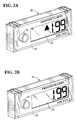
- the front surface 56 of the EPL housing includes display 23 and push-button switch 50.
- display 23 simply shows the price of the item.
- the shelf stock of the item needs to be replenished.
- display 23 shows a triangular "restock” icon, in addition to the price of the item.
- This "restock” icon which alternatively may be any other convenient shape or symbol, is a visual cue to the responsible personnel that the shelf stock of the item is depleted and has not yet been replenished.
- Push-button switch 50 is a preferred means for actuating EPL 22.
- Button 50 is intended to be pushed, by either a store employee or a customer, when the shelf stock of the corresponding merchandise item has been depleted.
- EPL 22 is in "restock” mode and displays the price plus the "restock” icon, as shown in Fig. 2B.
- Button 50 is intended to be pushed, once again, by store personnel, when the store shelves have been restocked with the item. Upon such further actuation, EPL 22 once again displays the price without the "restock” icon, as shown in Fig. 2A.
- Fig. 3 depicts a set 60 of data registers, comprising the memory of an EPL 22.
- a first register 62 (“Register 1”) contains the product price plus "restock” icon, corresponding to the display in Fig. 2B.
- a second register 64 (“Register 2”) contains the product price without "restock” icon, corresponding to the display in Fig. 2A.
- an EPL 22 normally displays the contents of Register 2. Actuation of the EPL, for example, by pushing button 50, causes the EPL to "back up” so as to display the contents of Register 1.
- the switching between Register 1 and Register 2 upon actuation of EPL 22 can be effected using a button counter.
- Additional data registers 66 are available to store other information for display by EPL 22 and, if desired, may be accessed upon actuation of EPL 22.
- Fig. 4 shows the contents of back office "tote board" 70 which, based on information supplied by the system, lists merchandise items to be restocked.
- EPL computer 24 polls EPLs 22 to determine whether any EPLs 22 are in "restock” mode. The system then identifies each product corresponding to an EPL that is in "restock” mode (for example, by cross-referencing with EPL data file 32), and compiles a list of such products.
- the list is ordered from the "most critical" to the "least critical" merchandise item. That is, the product that brings the most value to the store (and which, if out of stock, would generate the greatest opportunity cost to the store) appears first in the list.
- out-of-stock products are ranked in order of their respective value to the store, and are listed in the same order. It is anticipated that the list will be updated as various products in the list are restocked, and as additional products are identified as being out of stock. Thus, the specific merchandise items in the list, as well as the order in which these are listed, will change regularly.
- Tote board 70 provides a convenient means for the responsible personnel to view the list of items in need of restocking, and to build a cart of such items to bring out to the selling floor.
- Tote board 70 is essentially an electronic "bulletin board,” which may be made up of an array of EPLs 22.
- tote board 70 can be implemented as a standard LED display or on a computer screen.
- Entry “ITEM ID” may include, for example, the name of the out-of-stock item, the Universal Product Code (UPC) associated with the item, or both.
- Entry “Location” specifies the depleted shelf location out on the selling floor.
- the data provided in the "Location" entry may conform with the "Plan-o-gram” system of mapping merchandise locations throughout the store.
- Entry “Quantity” indicates the quantity of the applicable item to be pulled from inventory.
- entry “Bin” indicates exactly where the stock of the particular item is located in the store's back room. It will be apparent that it is also within the scope of the invention to generate printed reports containing all of the above information.
- the present invention contemplates the use of display indicia, such as EPLs, directly on individual stock room bins.
- display indicia such as EPLs
- Such indicia display information supplied by the system, including information corresponding to one or more of the entries "ITEM ID,” “Location” and “Quantity” described above, and thereby notify the responsible personnel to select the appropriate quantity of the appropriate item from the particular stock room bin bearing such display.
- the restocking system includes means for actuating the tote board after a particular item has been pulled from inventory and/or placed on the restocking cart.
- tote board 70 includes a plurality of buttons or switches (not shown in Fig. 4), each button or switch corresponding to a particular merchandise item in the list.
- tote board 70 would include n buttons or switches, each such button or switch being disposed so as to correspond, respectively, to each row, 1 through n, of EPLs 22.
- the applicable button or switch is pushed by a store employee to indicate that the particular item has been retrieved from its stock room bin.
- a comparable button or switch arrangement could be utilized in conjunction with display indicia located directly on each individual stock room bin, as described above.
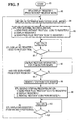
- a method for stocking products with an EPL system begins with START 80.
- step 82 stock management program 34 sends a message to each EPL 22 in the system, whereby: (1) the price of the applicable merchandise item, without the "restock” icon, is sent to Register 1 of each EPL, and (2) the EPLs display the contents of Register 1.
- step 84 in response to an operator request (or, as will be described below, in response to information received from polling the EPLs), the program sets a particular EPL in "Determine Shelf Stock Level" mode.
- step 86 the EPL that was set in step 84 now undergoes a first internal reconfiguration.
- the program sends a message to the applicable EPL, whereby: (1) the price of the applicable merchandise item, without the "restock” icon, is sent to Register 2; (2) the EPL displays the contents of Register 2; and (3) the price of the merchandise item, plus the "restock” icon, is sent to Register 1.
- the EPL 22 now is set for actuation. In the event that the shelf stock of the corresponding product has been depleted, either a store employee or a customer can actuate EPL 22 by pushing button 50, which causes the EPL to display the contents of Register 1 (price of item, plus the "restock” icon).
- step 88 EPL computer 24 polls all EPLs 22 in the system.
- step 90 the program determines whether any EPLs 22 are displaying the contents of Register 1, indicative of "restock" mode. If no EPL is displaying Register 1, operation returns to step 88. If an EPL is displaying Register 1, operation proceeds to step 92.
- step 92 the program identifies the out-of-stock item corresponding to the EPL that is displaying Register 1. This information can be determined, for example, by reading the appropriate line entry in EPL data file 32. Either EPL data file 32 or an additional data file may contain the "Location,” "Quantity” and "Bin” information for the product, as described above. The program then transmits this information for display on tote board 70. At some point after this information appears on tote board 70, a store employee will pull the appropriate quantity of the item from the stock room bin, and will actuate tote board 70 (for example, by pushing the appropriate button thereon) to indicate that the item has been picked.
- step 94 the program determines whether tote board 70 has been actuated, and thus whether the out-of-stock item has been picked from the stock room bin. If the item has not yet been picked, operation returns to step 92. If the item has been picked, operation proceeds to step 96.
- step 96 the item is removed from tote board 70. Operation then proceeds to step 98.
- step 98 the program sets the applicable EPL 22 in "autopull compliance" mode.
- the EPL which in step 90 was determined to be in "restock” mode, now undergoes a second internal reconfiguration.
- the program sends a message to the EPL, whereby: (1) the price of the applicable merchandise item, plus the "restock” icon, is sent to Register 2; (2) the EPL displays the contents of Register 2; and (3) the price of the merchandise item, without the "restock” icon, is sent to Register 1.
- step 98 occurs almost simultaneously with step 96.
- the EPL 22 now is set for actuation by a store employee, upon replenishing the shelf stock of the item. At such time, the store employee will push button 50, which will cause the EPL to display the contents of Register 1 (price of item, without the "restock” icon).
- step 100 EPL computer 24 polls the applicable EPL 22.
- step 102 the program determines whether EPL 22 is now displaying the contents of Register 1, indicating that the applicable item has been restocked on the selling floor. If the EPL is not displaying Register 1, operation returns to step 100. If the EPL is displaying Register 1, operation returns to step 84.
- a valuable benefit provided by the present invention is that it gives the retailer the ability to track the productivity of key stocking functions in a particular store, or to compare such productivity across a plurality of stores. For example, utilizing timer 36, all significant inventory events can be "time-stamped.”
- Stock management program 34 accordingly can track the exact time (“Time A") that a particular EPL was actuated and thereby placed into “restock” mode.
- the program also can track the exact time (“Time B”) that tote board 70 was actuated (indicating that the corresponding product was pulled from back room inventory) and that the applicable EPL was set in "autopull compliance” mode.
- the program also can track the exact time (“Time C”) that the EPL was again actuated (indicating that the shelf stock of the product has been replenished).
- the program can calculate how long it took to restock the item on the selling floor after the initial out-of-stock notification (specifically, Time C minus Time A).
- the program also can make separate calculations for the constituent activities: (1) how long it took to pick the item from back room inventory after the initial out-of-stock notification (specifically, Time B minus Time A), and (2) how long it took to restock the item on the selling floor after picking the item from back room inventory (specifically, Time C minus Time B).
- any of these times can be compared, for example, between two different products in the same store, two or more different employees in the same store, the same product in two or more different stores, and the like. It is also within the present invention to calculate average times for all employees within a single store, and to compare these averages with similar averages calculated for other stores.
Landscapes
- Business, Economics & Management (AREA)
- Accounting & Taxation (AREA)
- Finance (AREA)
- Strategic Management (AREA)
- Economics (AREA)
- Marketing (AREA)
- Development Economics (AREA)
- Physics & Mathematics (AREA)
- General Business, Economics & Management (AREA)
- General Physics & Mathematics (AREA)
- Engineering & Computer Science (AREA)
- Theoretical Computer Science (AREA)
- Management, Administration, Business Operations System, And Electronic Commerce (AREA)
- Cash Registers Or Receiving Machines (AREA)
Applications Claiming Priority (2)
| Application Number | Priority Date | Filing Date | Title |
|---|---|---|---|
| US62473700A | 2000-07-25 | 2000-07-25 | |
| US624737 | 2000-07-25 |
Publications (2)
| Publication Number | Publication Date |
|---|---|
| EP1176565A2 true EP1176565A2 (fr) | 2002-01-30 |
| EP1176565A3 EP1176565A3 (fr) | 2003-03-19 |
Family
ID=24503132
Family Applications (1)
| Application Number | Title | Priority Date | Filing Date |
|---|---|---|---|
| EP01305929A Withdrawn EP1176565A3 (fr) | 2000-07-25 | 2001-07-10 | Système et méthode pour le stockage de produits avec un système d'étiquettes électroniques de prix |
Country Status (3)
| Country | Link |
|---|---|
| EP (1) | EP1176565A3 (fr) |
| JP (1) | JP2002133523A (fr) |
| CA (1) | CA2350291A1 (fr) |
Cited By (5)
| Publication number | Priority date | Publication date | Assignee | Title |
|---|---|---|---|---|
| EP1248229A3 (fr) * | 2001-04-02 | 2003-07-16 | Ncr International Inc. | Système et procédé relatif à la gestion de stock |
| WO2005041080A1 (fr) * | 2003-10-22 | 2005-05-06 | Nicola Pellegrini | Dispositif de gestion de stocks en rayon pour grands magasins |
| WO2016189191A1 (fr) * | 2015-05-27 | 2016-12-01 | Mariella Labels Oy | Système de prix électronique, de gestion d'inventaire et d'étiquette |
| US10013698B2 (en) * | 2016-11-29 | 2018-07-03 | Mariella Labels Oy | Electronic price label and electronic price label system |
| US10282743B2 (en) | 2015-05-27 | 2019-05-07 | Walmart Apollo, Llc | Customer-triggered store management |
Families Citing this family (3)
| Publication number | Priority date | Publication date | Assignee | Title |
|---|---|---|---|---|
| JP6319669B2 (ja) * | 2016-01-20 | 2018-05-09 | パナソニックIpマネジメント株式会社 | 商品モニタリング装置、商品モニタリングシステムおよび商品モニタリング方法 |
| JP6341388B2 (ja) * | 2016-01-20 | 2018-06-13 | パナソニックIpマネジメント株式会社 | 商品モニタリング装置、商品モニタリングシステムおよび商品モニタリング方法 |
| CN112598096B (zh) * | 2020-12-15 | 2021-07-20 | 广州若羽臣科技股份有限公司 | 一种基于商品大数据的电子价签更新方法及系统 |
Family Cites Families (3)
| Publication number | Priority date | Publication date | Assignee | Title |
|---|---|---|---|---|
| US4879756A (en) * | 1986-09-22 | 1989-11-07 | Stevens John K | Radio broadcast communication systems |
| DK52091D0 (da) * | 1991-03-22 | 1991-03-22 | Esel Krabbe Systems As | Informationssystem |
| US5671362A (en) * | 1995-04-04 | 1997-09-23 | Cowe; Alan B. | Materials monitoring systems, materials management systems and related methods |
-
2001
- 2001-06-13 CA CA 2350291 patent/CA2350291A1/fr not_active Abandoned
- 2001-07-10 EP EP01305929A patent/EP1176565A3/fr not_active Withdrawn
- 2001-07-25 JP JP2001224459A patent/JP2002133523A/ja active Pending
Cited By (7)
| Publication number | Priority date | Publication date | Assignee | Title |
|---|---|---|---|---|
| EP1248229A3 (fr) * | 2001-04-02 | 2003-07-16 | Ncr International Inc. | Système et procédé relatif à la gestion de stock |
| US6961709B2 (en) | 2001-04-02 | 2005-11-01 | Ncr Corporation | System and method of managing inventory |
| WO2005041080A1 (fr) * | 2003-10-22 | 2005-05-06 | Nicola Pellegrini | Dispositif de gestion de stocks en rayon pour grands magasins |
| WO2016189191A1 (fr) * | 2015-05-27 | 2016-12-01 | Mariella Labels Oy | Système de prix électronique, de gestion d'inventaire et d'étiquette |
| US10282743B2 (en) | 2015-05-27 | 2019-05-07 | Walmart Apollo, Llc | Customer-triggered store management |
| RU2707403C2 (ru) * | 2015-05-27 | 2019-11-26 | Мариелла Лэйблз Ой | Электронная система управления ценами, товарообеспечением и ценниками |
| US10013698B2 (en) * | 2016-11-29 | 2018-07-03 | Mariella Labels Oy | Electronic price label and electronic price label system |
Also Published As
| Publication number | Publication date |
|---|---|
| EP1176565A3 (fr) | 2003-03-19 |
| JP2002133523A (ja) | 2002-05-10 |
| CA2350291A1 (fr) | 2002-01-25 |
Similar Documents
| Publication | Publication Date | Title |
|---|---|---|
| EP0608252B1 (fr) | Appareil indicateur de changements de prix, y compris imprimante et dispositif d'affichage | |
| US7237713B2 (en) | System and method of managing time-sensitive items | |
| US5878401A (en) | Sales and inventory method and apparatus | |
| US6179206B1 (en) | Electronic shopping system having self-scanning price check and purchasing terminal | |
| US8800869B2 (en) | Inventory control using electronic shelf label systems | |
| EP0984379A2 (fr) | Système et méthode pour modifier les conditions de transactions selon le niveau de l'inventaire | |
| JP2003044562A (ja) | 在庫管理システム及び方法 | |
| JP2009176193A (ja) | 商品販売システム | |
| TW200825972A (en) | Shelf management system and method | |
| EP1249804B1 (fr) | Système et procédé pour l'affichage d'informations d'articles par étiquettes électroniques | |
| EP0992925A2 (fr) | Système et méthode pour la transmission de messages à un groupe d'étiquettes électroniques | |
| JP3960684B2 (ja) | 価格表示装置 | |
| US6427138B1 (en) | Methods and apparatus for providing an electronic price label countdown timer | |
| CA2350291A1 (fr) | Systeme et methode de stockage de produits pour systeme electronique d'etiquetage des prix | |
| EP1164528A2 (fr) | Système et méthode pour utiliser un interface de données externes perfectionné pour afficher des données dans des systèmes d'étiquettes de prix électroniques | |
| EP1006434A1 (fr) | Procédé pour l'affichage d'informations temporaires par étiquettes électroniques de prix | |
| EP1006473A2 (fr) | Système et méthode pour commander une étiquette électronique de prix | |
| JP4590837B2 (ja) | 商品陳列棚システムおよび欠品商品情報表示プログラム | |
| JP4621131B2 (ja) | 商品情報表示システム | |
| KR20170079517A (ko) | 전자가격표시 시스템 | |
| EP0834854A2 (fr) | Méthode pour afficher un message d'information de produit sur une étiquette électronique de prix | |
| US20070005379A1 (en) | Scale with auto identification of frequently weighed items | |
| EP0874324A2 (fr) | Système et procédé de traitement de données destinées à l'affichage sur une étiquette de prix électronique | |
| JP2001019126A (ja) | 在庫管理装置 | |
| JP7315759B2 (ja) | 管理サーバ及び管理システム |
Legal Events
| Date | Code | Title | Description |
|---|---|---|---|
| PUAI | Public reference made under article 153(3) epc to a published international application that has entered the european phase |
Free format text: ORIGINAL CODE: 0009012 |
|
| AK | Designated contracting states |
Kind code of ref document: A2 Designated state(s): AT BE CH CY DE DK ES FI FR GB GR IE IT LI LU MC NL PT SE TR |
|
| AX | Request for extension of the european patent |
Free format text: AL;LT;LV;MK;RO;SI |
|
| PUAL | Search report despatched |
Free format text: ORIGINAL CODE: 0009013 |
|
| AK | Designated contracting states |
Kind code of ref document: A3 Designated state(s): AT BE CH CY DE DK ES FI FR GB GR IE IT LI LU MC NL PT SE TR Designated state(s): AT BE CH CY DE DK ES FI FR GB GR IE IT LI LU MC NL PT SE TR |
|
| AX | Request for extension of the european patent |
Extension state: AL LT LV MK RO SI |
|
| RIC1 | Information provided on ipc code assigned before grant |
Ipc: 7G 07G 1/14 B Ipc: 7G 06F 17/60 A |
|
| AKX | Designation fees paid | ||
| REG | Reference to a national code |
Ref country code: DE Ref legal event code: 8566 |
|
| STAA | Information on the status of an ep patent application or granted ep patent |
Free format text: STATUS: THE APPLICATION IS DEEMED TO BE WITHDRAWN |
|
| 18D | Application deemed to be withdrawn |
Effective date: 20030920 |