EP1178049B1 - Verfahren zur Herstellung von Cephalosporin-Verbindungen und Zwischenprodukte für die Synthese dieser Verbindungen - Google Patents
Verfahren zur Herstellung von Cephalosporin-Verbindungen und Zwischenprodukte für die Synthese dieser Verbindungen Download PDFInfo
- Publication number
- EP1178049B1 EP1178049B1 EP01306325A EP01306325A EP1178049B1 EP 1178049 B1 EP1178049 B1 EP 1178049B1 EP 01306325 A EP01306325 A EP 01306325A EP 01306325 A EP01306325 A EP 01306325A EP 1178049 B1 EP1178049 B1 EP 1178049B1
- Authority
- EP
- European Patent Office
- Prior art keywords
- formula
- compound
- iii
- group
- process according
- Prior art date
- Legal status (The legal status is an assumption and is not a legal conclusion. Google has not performed a legal analysis and makes no representation as to the accuracy of the status listed.)
- Expired - Lifetime
Links
- 0 C[C@]1*C(C)=C*1 Chemical compound C[C@]1*C(C)=C*1 0.000 description 7
Classifications
-
- C—CHEMISTRY; METALLURGY
- C07—ORGANIC CHEMISTRY
- C07D—HETEROCYCLIC COMPOUNDS
- C07D501/00—Heterocyclic compounds containing 5-thia-1-azabicyclo [4.2.0] octane ring systems, i.e. compounds containing a ring system of the formula:, e.g. cephalosporins; Such ring systems being further condensed, e.g. 2,3-condensed with an oxygen-, nitrogen- or sulfur-containing hetero ring
-
- A—HUMAN NECESSITIES
- A61—MEDICAL OR VETERINARY SCIENCE; HYGIENE
- A61P—SPECIFIC THERAPEUTIC ACTIVITY OF CHEMICAL COMPOUNDS OR MEDICINAL PREPARATIONS
- A61P31/00—Antiinfectives, i.e. antibiotics, antiseptics, chemotherapeutics
- A61P31/04—Antibacterial agents
-
- Y—GENERAL TAGGING OF NEW TECHNOLOGICAL DEVELOPMENTS; GENERAL TAGGING OF CROSS-SECTIONAL TECHNOLOGIES SPANNING OVER SEVERAL SECTIONS OF THE IPC; TECHNICAL SUBJECTS COVERED BY FORMER USPC CROSS-REFERENCE ART COLLECTIONS [XRACs] AND DIGESTS
- Y02—TECHNOLOGIES OR APPLICATIONS FOR MITIGATION OR ADAPTATION AGAINST CLIMATE CHANGE
- Y02P—CLIMATE CHANGE MITIGATION TECHNOLOGIES IN THE PRODUCTION OR PROCESSING OF GOODS
- Y02P20/00—Technologies relating to chemical industry
- Y02P20/50—Improvements relating to the production of bulk chemicals
- Y02P20/55—Design of synthesis routes, e.g. reducing the use of auxiliary or protecting groups
Definitions
- the bonding carbon atom of the cyclic ether moiety which links the ring to the cephalosporin nucleus is asymmetric.
- the present invention includes either stereoisomer, as well as mixtures of both isomers.
- Suitable readily removable carboxy protecting groups for the group R 3 include groups forming ester derivatives of the carboxylic acid, including in vivo hydrolysable esters.
- the derivative is preferably one which may readily be cleaved in vivo .
- processes for the preparation of acid addition salts of any amino group or substituted amino group that may be present as optional substituents in compounds of formula (II) or (IIa).
- heterocyclyl' and 'heterocyclic' as used herein include aromatic and non-aromatic, single and fused, rings suitably containing up to four hetero-atoms in each ring selected from oxygen, nitrogen and sulphur, which rings may be unsubstituted or substituted by, for example, up to three groups selected from halogen, (C 1-6 )alkyl, (C 1-6 )alkoxy, halo(C 1-6 )alkyl, hydroxy, carboxy, carboxy salts, carboxy esters such as (C 1-6 )alkoxycarbonyl, (C 1-6 )alkoxycarbonyl(C 1-6 )alkyl, aryl, and oxo groups.
- alkyl' alkenyl, alkynyl and 'alkoxy' include straight and branched chain groups containing from 1 to 6 carbon atoms, such as methyl, ethyl, propyl and butyl.
- a particular alkyl group is methyl.
- Suitable acyl groups R 2 include those of formulae (a) - (f): A 2 CO- A 2 -X 3 -(CH 2 ) p -CO- wherein p is 0, 1 or 2; m is 0, 1 or 2; A 1 is (C 1-6 ) alkyl, substituted (C 1-6 ) alkyl, (C 3-6 ) cycloalkyl, cyclohexenyl, cyclohexadienyl, an aromatic (including heteroaromatic) group, such as phenyl, substituted phenyl, thienyl, pyridyl, or an optionally substituted thiazolyl group, a (C 1-6 ) akylthio group or (C 1-6 ) alkyloxy; X 1 is a hydrogen or halogen atom, a carboxylic acid, carboxylic ester, sulphonic acid, azido, tetrazolyl, hydroxy, acyloxy, amino,
- R 2 is a group (a)
- a 1 is (C 1-6 ) alkyl, (C 3-6 ) cycloalkyl, cyclohexenyl, cyclohexadienyl, phenyl, substituted phenyl such as hydroxyphenyl, thienyl or pyridyl
- X 1 is a hydrogen or halogen atom, or a carboxy, carboxylic ester, azido, tetrazolyl, hydroxy, acyloxy, optionally protected amino, ureido, guanidino or acylureido group.
- R 2 is a group of formula (d)
- a 2 is phenyl
- X 3 is oxygen
- p is O.
- Preferred groups for A 3 include phenyl, 2-aminothiazol-4-yl, fur-2-yl, thien-2-yl, 2-(2-chloroacetamido)thiazol-4-yl, 2-tritylamino-thiazol-4-yl, 5-amino-1,2,4-thiadiazol-3-yl and 4-aminopyrimid-2-yl.
- R 2 is a group of formula (e) (or (f)) can exist as syn and anti (or E and Z ) isomers or mixtures thereof. Both isomers are encompassed within the scope of this invention.
- R 2 is a group of formula (f)
- the group A 4 is preferably cis to the amide linkage, i.e. when group (f) is 2-amino-thiazol-4-yl, the Z -configuration is preferred.
- the cyclisation reaction of the process of the invention may suitably be carried out by treatment of the compounds (III) with an acid catalyst, for example an inorganic acid such as hydrochloric acid or an organic acid, such as an organic sulphonic acid such as an arylsulphonic acid, eg toluene-4-sulphonic acid.
- an acid catalyst for example an inorganic acid such as hydrochloric acid or an organic acid, such as an organic sulphonic acid such as an arylsulphonic acid, eg toluene-4-sulphonic acid.
- an acylating agent such as an acid anhydride, for example trifluoromethane sulphonic anhydride, in the presence of a base such as triethylamine or lutidine.
- Compounds (III) exist as two diastereoisomers, and these may be cyclised stereospecifically by the use of an acylating agent as described above.
- the reaction may be suitably carried out in an organic solvent, such as a halogenated hydrocarbon, eg dichloromethane, which is preferably pre-dried.
- a halogenated hydrocarbon eg dichloromethane
- the reaction is carried out at reduced temperature, eg below 0°C, such as below -20°C, eg at around -70°C.
- the mixture may be worked up and the product compound isolated by conventional methods.
- Compounds (IV) may be converted to compounds (III) in a number of ways.
- the compound (IV) may be treated with a Grignard reagent of formula (V): where R 4 and m are as defined with respect to formula (III) above, and X and X 1 are the same or different halogen, for example X being chlorine and X 1 being bromine.
- reaction from compounds (VII) to (V) may be carried out in situ .
- the compound (IV) may first be converted to a compound (VIII): where R 1 , R 2 , R 3 , R 4 m and X are as defined with respect to formula (III).
- R 1 , R 2 , R 3 , R 4 m and X are as defined with respect to formula (III).
- (VIII A) is preferred as leading to a preferred configuration of the 3-position cyclic ether ring in formula (II) above.
- the compound (VIII) may then be hydroxylated to form corresponding compounds (III) having the terminal hydroxyl group.
- this may be achieved by treatment of compounds (VIII) with borane-tetrahydrofuran complex, followed by treatment with water or dilute aqueous alkali metal hydroxide solution, and hydrogen peroxide.
- Compounds of formula (IV) may be formed into compounds (VIII) by reaction with an organometallic reagent.
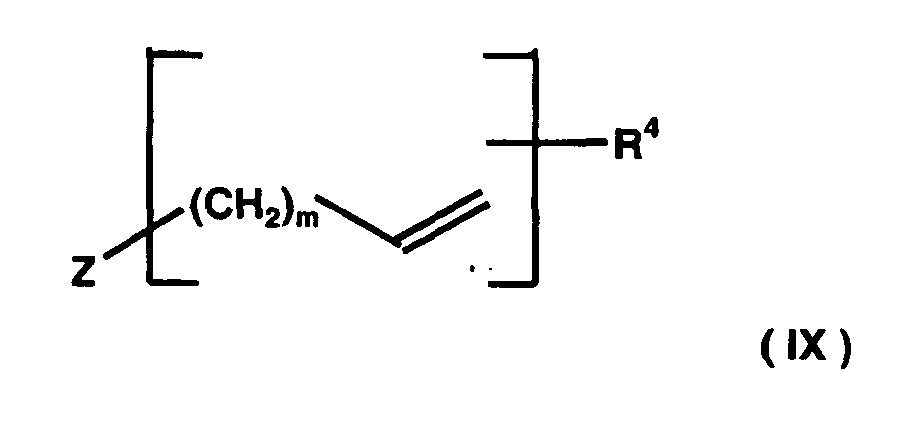
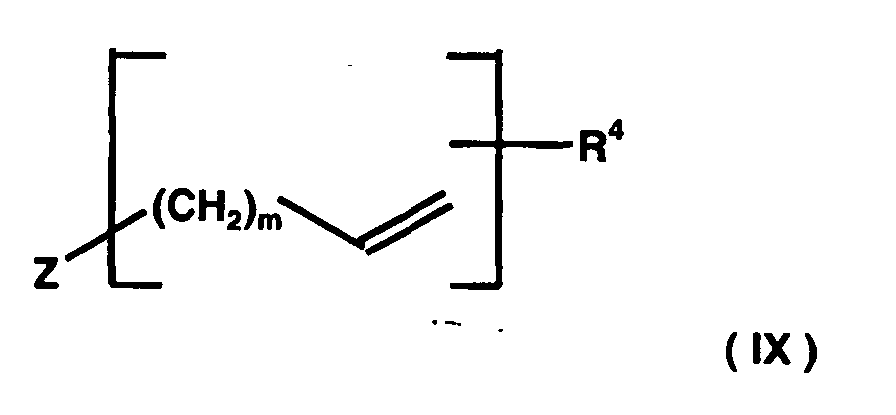
- the compound (IV) may be reacted with the Grignard reagent (IX): where m and R 4 are as defined in formula (VIII).
- Z may be YMg where Y is a halogen such as chlorine or bromine, and the reaction may be carried out in an organic solvent such as THF, suitably at a reduced temperature, eg around -70°C, suitably in the presence of lithium chloride.
- group (X) is a tartrate boronate group wherein R a is alkylcarboxylate, R b is hydrogen, R c is alkylcarboxylate and R d is hydrogen.
- boronates may be prepared by a known (JACS (1985), 107 , 8186-8190) reaction in which known Grignard reagents of formula (IX) in which Z is halogen are reacted with (CH 3 O) 3 B and a dialkyl tartrate ester.
- Compounds (VIII) prepared by this stereospecific route may then be hydroxylated as described above, the stereochemistry of the hydroxyl group shown in (VIII) being preserved in the resultant compounds (III) so formed, and the stereospecific compound (III) may then be stereospecifically cyclised by the use of an acylating agent as described above.
- the compound (IV) is converted into a 2-cephem compound of formula (III), ie of formula (III A): which is converted during the cyclisation process of the invention into a 2-cephem compound of formula (II), ie of formula (II B): where R 1 , R 2 , R 3 , R 4 , X and m are as defined in formulae (II) and (ITI) above.
- R 2 and R 3 may be the above-described amino- and carboxy- protecting groups.
- the 2-cephem compound (II B) produced by this embodiment may be converted to a 3-cephem compound of formula (II).
- conversion of 2-cephems to 3-cephems may be carried out by the generally known method of oxidising the sulphur to form the corresponding 1-oxide, followed by reduction. Oxidation may be performed by using a peroxy acid, for example m-chloroperbenzoic acid.
- the following reduction process may be carried out using a phosphorus (III) compound, such as phosphorus trichloride in a suitable solvent such as dimethyl formamide or dichloromethane.
- R 2 and R 3 are respectively amino- and carboxy-protecting groups, these may be removed and replaced by respectively an acyl group of an antibacterially active cephalosporin, and a salt forming cation or pharmaceutically acceptable in-vivo hydrolysable ester group.
- An amino-protecting group R 2 may be removed from the compound of formula (II) by the known Delft procedure, eg using phosphorus pentachloride in the presence of N-methylmorpholine.
- the resulting 6-amino compound of formula (II) having R 2 as hydrogen may then be converted in an acylation reaction to a compound of formula (II) in which R 2 is the acyl group of an antibacterially active cephalosporin by reaction of this amino compound with an N-acylating derivative of an acid of formula R 2 OH.
- Suitable reagents and conditions for this acylating reaction are described in WO 92/01696.
- Salts and esters of the free acid so formed may be prepared by methods well known in cephalosporin chemistry.
- salts of formula (II) may be formed by reaction with a basic compound of a salt-forming cation, for example aqueous trisodium citrate to form sodium salts. Such a reaction may for example be carried out in aqueous conditions.
- Esters of formula (II), such as pharmaceutically acceptable in-vivo hydrolysable esters may also be made by methods well known in cephalosporin chemistry.
- esters may be formed by reaction of an alkali metal salt of formula (II) with a compound of formula R 3 X where X is a halogen such as iodine and R 3 is the ester-forming group, for example acetoxymethyl or pivaloyloxy methyl.
- a reaction may be carried out in an organic solvent such as toluene or N-methylpyrrolidone.
- mixtures of isomers may be formed.
- the process of the invention includes the preparation of such isomeric mixtures Isomers produced in the course of these reactions may be separated by conventional techniques such as chromatography.
- the first fraction contained the less polar diastereomer P1 of the title compound which was obtained as an amorphous solid (167mg), 8ppm [(CD 3 ) 2 CO] 1.45-1.82 (4H, m), 3.47-3.53 (2H, m), 3.60-3.73 (3H, m), 4.25-4.35 (1H, m), 4.42 (1H, d, J 4.6Hz), 5.12 (1H, d, J 1.2Hz), 5.22 (1H, d, 4.0Hz), 5.56 (1H, dd, J 8.3 and 4.0Hz), 6.49 (1H, d, J 1.2Hz), 6.89 (1H, s), 7.21-7.50 (15H, m), 8.07 (1H, d, J 8.3Hz).
- the second fraction contained an approximately 2:3 mixture of the diastereomers P1 and P2 of the title compound which was obtained as an amorphous solid (122mg).
- the third fraction contained the more polar diastereomer P2 of the title compound which was obtained as an amorphous solid (284mg), d ppm [(CD 3 ) 2 CO] 1.30-1.72 (4H, m), 3.48-3.50 (2H, m), 3.60-3.72 (3H, m), 4.13-4.20 (1H, m), 4.29 (1H, d, J 5.2Hz), 5.17 (1H, d J 3.9Hz), 5.20 (1H, d, J 1.2Hz), 5.53 (1H, dd, J 8.3 and 3.9Hz), 6.44 (1H, br s), 6.86 (1H, s), 7.21-7.48 (15H, m), 8.06 (1H, d, J 8.3Hz).
- Example 2 Diphenylmethyl (4R, 6R, 7R)-7-phenylacetamido-3-[( S )-tetrahydrofuran-2-yl]ceph-2-em-4-carboxylate .
- Trifluoromethanesulphonic anhydride (0.14ml of a solution containing 0.12ml/ml in dry dichloromethane) was added to a solution of the less polar diastereomer P1 of the diol from Example 1 (40mg) and triethylamine (28mg) in dry dichloromethane (1ml) at -76°C.
- Example 3 Diphenylmethyl (4R, 6R, 7R)-7-phenylacetamido-3-[( R )-tetrahydrofuran-2-yl]ceph-2-em-4-carboxylate.
- Example 5 Diphenylmethyl (6 R , 7R)-7-phenylacetamido-3-[( S )-tetrahydrofuran-2-yl]ceph-3-em-4-carboxylate-1-oxide.
- the ceph-2-em from Example 2 (59mg) was dissolved in dichloromethane (2ml), cooled in an ice bath, and treated with a solution of m-chloroperbenzoic acid (22mg of 85%) in dichloromethane (0.5ml). After 15 minutes at ice bath temperature the mixture was treated with m-chloroperbenzoic acid (2mg).
- Example 7 Sodium (6R, 7R)-7-phenylacetamido-3-[( S )-tetrahydrofuran-2-yl]ceph-3-em-4-carboxylate.
- a solution of the cephem ester from Example 6 (45mg) in dry dichloromethane (1ml) was added to a stirred solution of aluminium chloride (27mg) in a mixture of anisole (1.5ml) and dry dichloromethane (0.5ml) at - 40°C. After 15 minutes at -40°C the cooling bath was removed and the mixture was treated with trisodium citrate (3.5ml of a 0.5M aqueous solution).
- Example 9 4-Methoxybenzyl (4R, 6R, 7R)-7-phenylacetamido-3-[( S )-tetrahydrofuran-2-yl]ceph-2-em-4-carboxylate.
- a solution of isomer a from Example 8 (194mg) and 2,6-lutidine (0.170ml) in dry dichloromethane (5ml) was cooled to -78°C and treated with trifluoromethanesulphonic anhydride. After 15 minutes a further portion of trifluoromethanesulphonic anhydride (0.04ml) was added.
- Example 10 4-Methoxybenzyl (4R, 6R, 7R)-7-phenylacetamido-3-[(R)-tetrahydrofuran-2-yl]ceph-2-em-4-carboxylate.
- a solution of isomer b from Example 8 (160mg) and 2,6-lutidine (0.140ml) in dry dichloromethane (5ml) was cooled to -78°C and trifluoromethanesulphonic anhydride (0.10ml) was added. After stirring at the same temperature for 15 minutes the mixture was diluted with dichloromethane and washed successively with citric acid solution, water, sodium bicarbonate solution, water and brine. The solution was dried over magnesium sulphate and evaporated.
- Example 11 4-Methoxybenzyl (6R, 7R)-7-phenylacetamido-3-[( R )-tetrahydrofuran-2-yl]ceph-3-em-4-carboxylate.
- Example 13 Diphenylmethyl (4R, 6R, 7R)-3-(1,4-dihydroxybut-1-yl)-7-phenylacetamidoceph-2-em-4-carboxylate.
- Borane-tetrahydrofuran complex (1M in tetrahydrofuran, 1.0ml, 1.0mmol) was added to diphenylmethyl (4R, 6R, 7R)-3-(1-hydroxybut-3-en-1-yl)-7-phenylacetamidoceph-2-em-4-carboxylate ( S -diastereomer, 100mg, 0.18mmol) in tetrahydrofuran (2ml) at 20°C.
Landscapes
- Chemical & Material Sciences (AREA)
- Organic Chemistry (AREA)
- Health & Medical Sciences (AREA)
- Communicable Diseases (AREA)
- Oncology (AREA)
- Chemical Kinetics & Catalysis (AREA)
- General Chemical & Material Sciences (AREA)
- Medicinal Chemistry (AREA)
- Nuclear Medicine, Radiotherapy & Molecular Imaging (AREA)
- Pharmacology & Pharmacy (AREA)
- Life Sciences & Earth Sciences (AREA)
- Animal Behavior & Ethology (AREA)
- General Health & Medical Sciences (AREA)
- Public Health (AREA)
- Veterinary Medicine (AREA)
- Cephalosporin Compounds (AREA)
- Saccharide Compounds (AREA)
- Transition And Organic Metals Composition Catalysts For Addition Polymerization (AREA)
- Catalysts (AREA)
Claims (20)
- Verfahren zur Herstellung einer Verbindung der Formel (II) :welches den Schritt des Cyclisierens einer Verbindung der Formel (III):
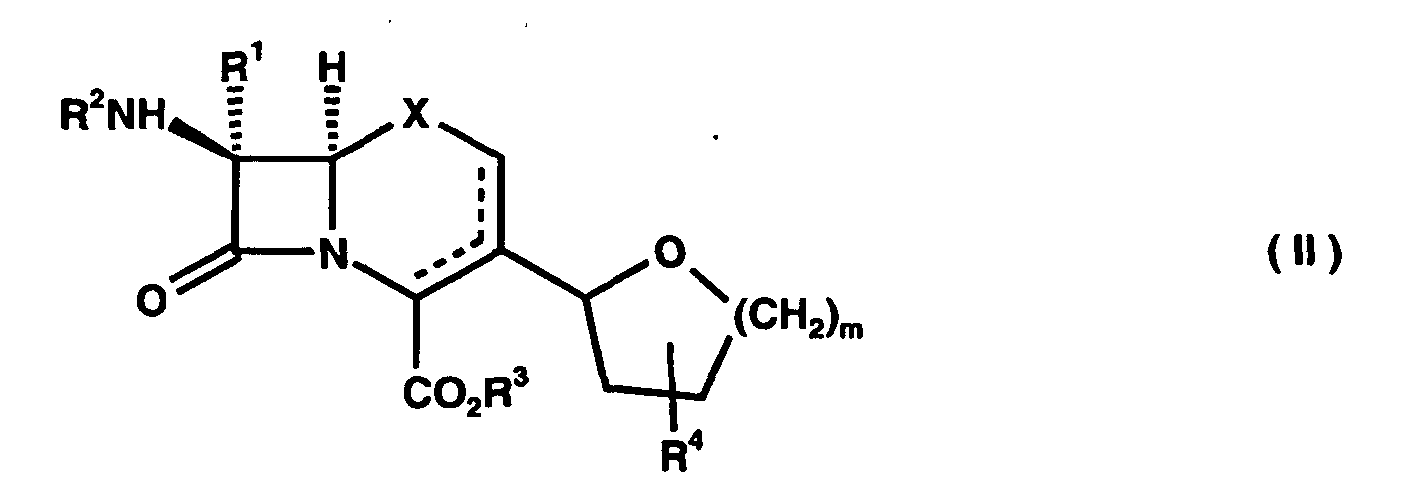 enthält, wobei in den Formeln (II) und (III)
- R1
- gleich Wasserstoff, Methoxy oder Formamido ist;
- R2
- eine Acylgruppe ist;
- CO2R3
- eine Carboxygruppe oder ein Carboxylat-anion ist oder R3 eine leicht entfernbare Carboxy-Schutzgruppe ist;
- R4
- Wasserstoff darstellt oder bis zu 4 Substituenten, ausgewählt aus Alkyl, Alkenyl, Alkinyl, Alkoxy, Hydroxy, Halogen, Amino, Alkylamino, Acylamino, Dialkylamino, CO2R, CONR2, SO2NR2 (wobei R gleich Wasserstoff oder C1-6-Alkyl ist), Aryl und Heterocyclyl, darstellt, welche gleich oder verschieden sein können;
- X
- gleich S, SO, SO2, O oder CH2 ist; und
- m
- gleich 1 oder 2 ist; und
und wobei die Bezeichnungen "Alkyl", "Alkenyl", "Alkinyl" und "Alkoxy" geradkettige Gruppen und verzweigte Gruppen umfassend 1 bis 6 Kohlenstoffatome bedeuten;
die Bezeichnung "Aryl" Phenyl und Naphthyl bedeutet, jeweils optional mit bis zu fünf Gruppen substituiert, ausgewählt aus Halogen, Mercapto, (C1-6)-Alkyl, Phenyl, C1-6-Alkoxy, Hydroxy-(C1-6)-Alkyl, Mercapto-(C1-6)-Alkyl, Halogen-(C1-6)-Alkyl, Hydroxy, Amino, Nitro, Carboxy, (C1-6)-Alkylcarbonyloxy, Alkoxycarbonyl, Formyl oder (C1-6)-Alkylcarbonylgruppen;
die Bezeichnung "Heterocyclyl" aromatische und nicht-aromatische, einfache und kondensierte Ringe bedeutet, mit bis zu vier Heteroatomen in jedem Ring, ausgewählt aus Sauerstoff, Stickstoff, Schwefel, wobei die Ringe unsubstituiert sein können oder mit bis zu drei Gruppen, ausgewählt aus Halogen, (C1-6) -Alkyl, (C1-6) -Alkoxy, Halogen- (C1-6) - Alkyl, Hydroxy, Carboxy, Carboxysalzen, Carboxyestern, Aryl und Oxogruppen substituiert sein können, wobei jeder heterocyclische Ring 4 bis 7 Ringatome aufweist. - Verfahren gemäss Anspruch 1, wobei die Verbindung der Formel (II) ein 3-Cephem der Formel (IIA) oder ein pharmazeutisch akzeptables Salz davon oder ein pharmazeutisch akzeptabler in vivo hydrolysierbarer Ester davon ist:wobei R1, R2, R4, m und X in Bezug auf Formel (II) definiert werden und die CO2R5-Gruppe gleich CO2R3 ist, wobei CO2R3 eine Carboxygruppe oder ein Carboxylat-anion ist.
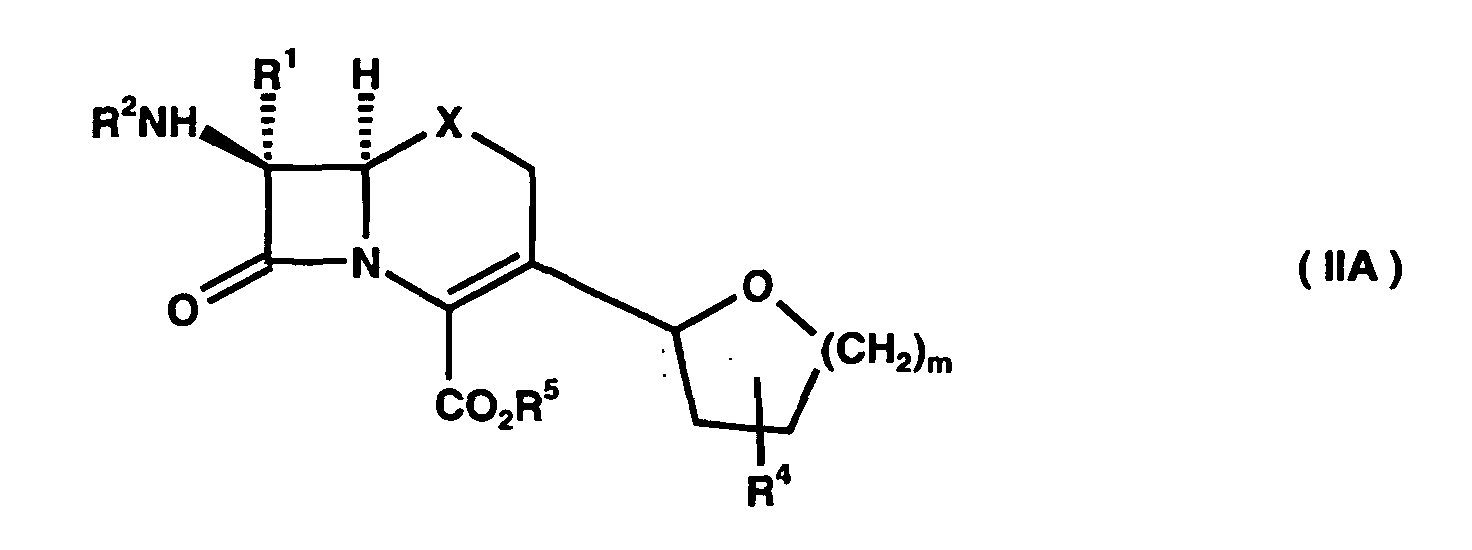
- Verfahren gemäss Anspruch 1 oder 2, wobei X gleich S, O oder CH2 ist.
- Verfahren gemäss einem der Ansprüche 1, 2 oder 3, wobei der cyclische Ether in der 3-Position des Cephalosporinkerns in den Formeln (II) bzw. (IIA) unsubstituiert ist.
- Verfahren gemäss einem der Ansprüche 1 bis 4, wobei m gleich 1 ist, so dass der cyclische Ether in der 3-Position in den Formeln (II) bzw. (IIA) ein Tetrahydrofuranyl-System ist.
- Verfahren gemäss Anspruch 5, wobei der cyclische Ether in der 3-Position in den Formeln (II) bzw. (IIA) ein (S)- Tetrahydrofuran-2-yl-Ringsystem ist.
- Verfahren gemäss einem der vorhergehenden Ansprüche, wobei in Formel (III) - wenn m gleich 1 ist - die 1,4-Dihydroxyl-but-1-yl-Seitenkette die weniger polare diastereomere Form ist.
- Verfahren gemäss einem der vorhergehenden Ansprüche, wobei die Cyclisierungsreaktion des Verfahrens der Erfindung durch Behandlung der Verbindungen (III) mit einem Säurekatalysator durchgeführt wird.
- Verfahren gemäss einem der Ansprüche 1 bis 7, wobei die Cyclisierungsreaktion durch Behandlung der Verbindungen (III) mit einem Acylierungsmittel durchgeführt wird.
- Verfahren gemäss einem der vorhergehenden Ansprüche, wobei die Verbindung der Formel (III) durch Umsetzen einer Verbindung der Formel (IV):mit einer Verbindung der Formel (V):
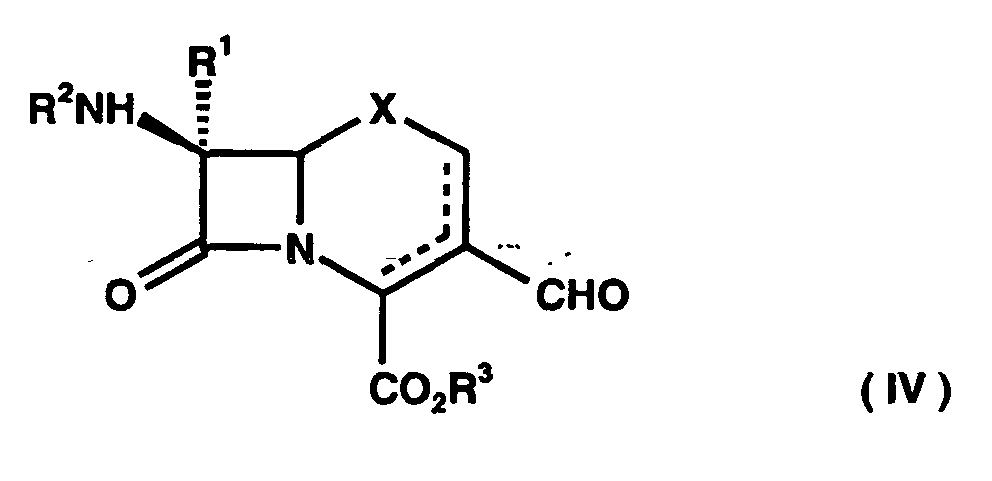 hergestellt wird, wobei
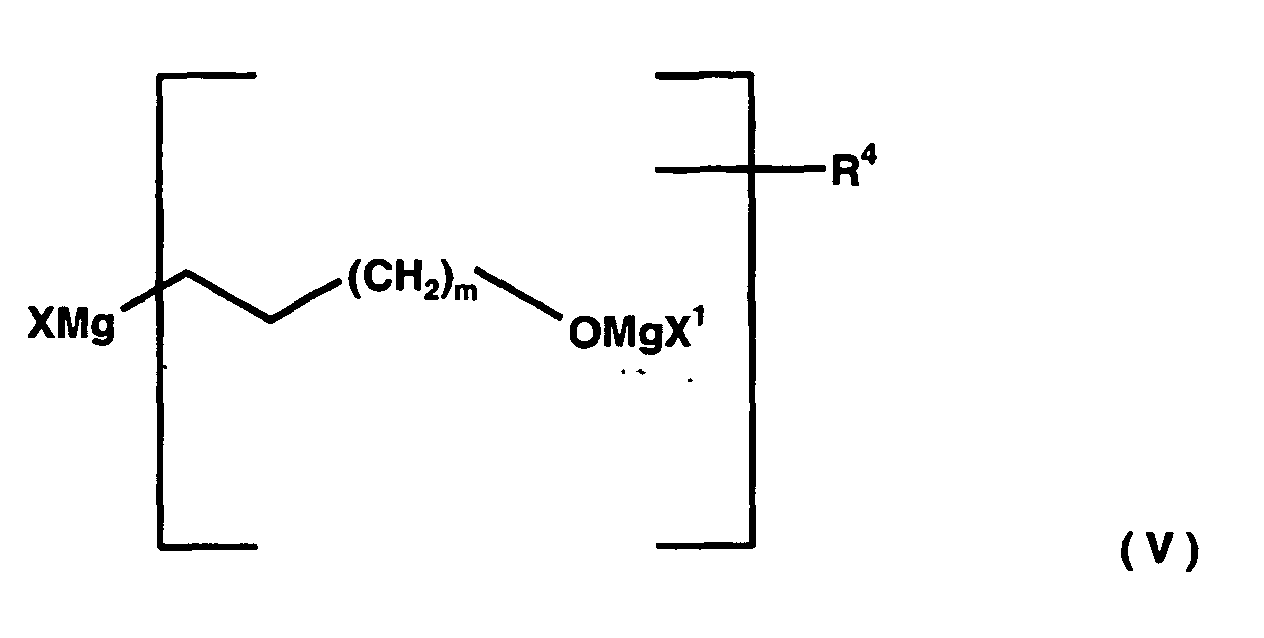 R4 und m in Bezug auf Formel (III) definiert werden, undX und X1 dasselbe Halogen darstellen oder unterschiedliche Halogene darstellen,und die Strichlinie in Formel (IV) anzeigt, dass die Verbindung (IV) ein 2- oder 3-Cephem-System sein kann.
 - Verfahren gemäss einem der Ansprüche 1 bis 10, wobei die Verbindung der Formel (III) durch Umwandeln einer Verbindung der Formel (IV) (wie in Anspruch 10 definiert) in eine Verbindung der Formel (VIII):hergestellt wird, wobei R1, R2, R3, R4, m und X in Bezug auf Formel (III) definiert werden.

- Verfahren gemäss Anspruch 11, wobei die Verbindung der Formel (VIII) eine Hydroxylgruppen-Konfiguration (VIIIA) aufweist:

- Verfahren gemäss Anspruch 11 oder 12, wobei die Verbindung der Formel (IV) durch Umsetzung mit einem metallorganischen Reagenz in eine Verbindung der Formel (VIII) gebildet wird.
- Verfahren gemäss Anspruch 13, wobei das metallorganische Reagenz eine Verbindung der Formel (IX):ist, wobei m und R4 wie in Formel (VIII) definiert werden, und Z gleich YMg ist, wobei Y ein Halogen ist.
- Verfahren gemäss Anspruch 11 oder 12, wobei die Verbindung der Formel (VIII) aus einer Verbindung der Formel (IV) durch die Verwendung einer Verbindung (IX) :stereospezifisch hergestellt wird, wobei Z eine ein Chiralitätszentrum einführende Gruppe ist, welche zu einer bevorzugten Bildung einer erwünschten Konfiguration der Hydroxylgruppe in der Verbindung (VIII) führt.
- Verfahren gemäss Anspruch 15, wobei Z die Boronatgruppe (X) :darstellt, wobei Ra, Rb, Rc und Rd unabhängig voneinander ausgewählt werden aus Wasserstoff, Alkyl und geschütztem Carboxy.
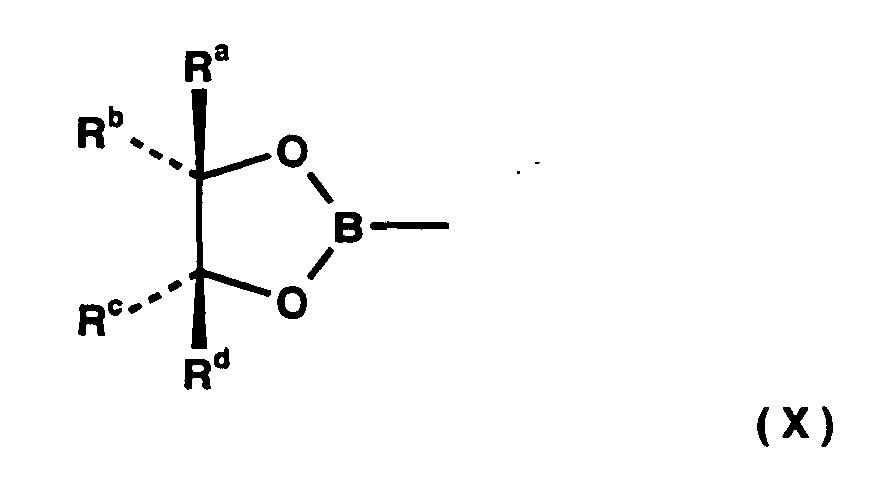
- Verfahren gemäss Anspruch 16, wobei die Gruppe (X) eine Pinakol-boronatgruppe oder eine Tartratboronatgruppe darstellt, wobei
Ra gleich Alkylcarboxylat ist, Rb gleich Wasserstoff ist, Rc gleich Alkylcarboxylat ist und Rd gleich Wasserstoff ist. - Verfahren gemäss einem der vorhergehenden Ansprüche 10 bis 17, wobei die Verbindung (IV) in eine 2-Cephem-Verbindung der Formel (IIIA):umgewandelt wird, welche während des Cyclisierungs-Verfahrens der Erfindung in eine 2-Cephem-Verbindung der Formel (II B):
 umgewandelt wird, wobei R1, R2, R3, R4, X und m definiert werden wie in den Formeln (II) und (III) oben, und die 2-Cephem-Verbindung (IIB) danach in eine 3-Cephem-Verbindung umgewandelt wird.
- Verbindung der Formel (III), (III A) oder (VIII), wie in einem der vorhergehenden Ansprüche definiert.
- Verbindung der Formel (II B) wie in Anspruch 18 definiert, unter Ausschluss der folgenden Verbindung:

Applications Claiming Priority (2)
| Application Number | Priority Date | Filing Date | Title |
|---|---|---|---|
| GBGB0019124.7A GB0019124D0 (en) | 2000-08-03 | 2000-08-03 | Novel process |
| GB0019124 | 2000-08-03 |
Publications (2)
| Publication Number | Publication Date |
|---|---|
| EP1178049A1 EP1178049A1 (de) | 2002-02-06 |
| EP1178049B1 true EP1178049B1 (de) | 2005-12-28 |
Family
ID=9896954
Family Applications (1)
| Application Number | Title | Priority Date | Filing Date |
|---|---|---|---|
| EP01306325A Expired - Lifetime EP1178049B1 (de) | 2000-08-03 | 2001-07-23 | Verfahren zur Herstellung von Cephalosporin-Verbindungen und Zwischenprodukte für die Synthese dieser Verbindungen |
Country Status (7)
| Country | Link |
|---|---|
| US (2) | US6825344B2 (de) |
| EP (1) | EP1178049B1 (de) |
| JP (1) | JP3850692B2 (de) |
| AT (1) | ATE314377T1 (de) |
| DE (1) | DE60116201T2 (de) |
| ES (1) | ES2252158T3 (de) |
| GB (1) | GB0019124D0 (de) |
Cited By (1)
| Publication number | Priority date | Publication date | Assignee | Title |
|---|---|---|---|---|
| US9422323B2 (en) | 2012-05-25 | 2016-08-23 | Janssen Sciences Ireland Uc | Uracyl spirooxetane nucleosides |
Families Citing this family (8)
| Publication number | Priority date | Publication date | Assignee | Title |
|---|---|---|---|---|
| GB0019124D0 (en) * | 2000-08-03 | 2000-09-27 | Pfizer | Novel process |
| CN1243755C (zh) * | 2000-12-04 | 2006-03-01 | 辉瑞产品公司 | 用于制备头孢菌素的偶合方法和中间体 |
| US7378408B2 (en) | 2001-11-30 | 2008-05-27 | Pfizer Inc. | Methods of treatment and formulations of cephalosporin |
| EP1725568A1 (de) * | 2004-03-09 | 2006-11-29 | Pfizer Products Inc. | Verfahren zur herstellung von cephalosporin-zwischenprodukten unter verwendung von alpha-iod-1-azetidinessigsäureestern und trialkylphosphiten |
| GB0713598D0 (en) * | 2007-07-13 | 2007-08-22 | Ici Ltd | Cyclic ethers |
| GEP201706757B (en) | 2012-12-21 | 2017-10-25 | Alios Biopharma Inc | Substituted nucleosides, nucleotides and analogs thereof |
| CN105254648B (zh) * | 2015-11-13 | 2018-04-03 | 广东温氏大华农生物科技有限公司 | 一种头孢维星及其钠盐的合成方法 |
| GB2575261B (en) | 2018-07-02 | 2022-03-09 | Norbrook Lab Ltd | Intermediates in the synthesis of C3-substituted cephalosporins |
Family Cites Families (9)
| Publication number | Priority date | Publication date | Assignee | Title |
|---|---|---|---|---|
| US4012380A (en) * | 1974-12-10 | 1977-03-15 | Eli Lilly And Company | 7-Acylamino-3-acyl-2(or 3)cephems |
| GB8411954D0 (en) * | 1984-05-10 | 1984-06-13 | Glaxo Group Ltd | Cephalosporin antibiotics |
| DE3587500T2 (de) * | 1984-12-04 | 1993-12-16 | Lilly Co Eli | Tumorbehandlung bei Säugetieren. |
| MY106399A (en) * | 1990-07-24 | 1995-05-30 | Pfizer | Cephalosporins and homologeus, preparation and pharmaceutical composition |
| IT1250692B (it) * | 1991-07-23 | 1995-04-21 | Procedimento per la preparazione di demetilepipodofillotossina- beta-d-glucosidi. | |
| GB9212609D0 (en) * | 1992-06-13 | 1992-07-29 | Smithkline Beecham Plc | Novel compounds |
| GB9213567D0 (en) * | 1992-06-26 | 1992-08-12 | Smithkline Beecham Plc | Novel compounds |
| GB9424847D0 (en) * | 1994-12-09 | 1995-02-08 | Smithkline Beecham Plc | Novel process |
| GB0019124D0 (en) * | 2000-08-03 | 2000-09-27 | Pfizer | Novel process |
-
2000
- 2000-08-03 GB GBGB0019124.7A patent/GB0019124D0/en not_active Ceased
-
2001
- 2001-07-23 ES ES01306325T patent/ES2252158T3/es not_active Expired - Lifetime
- 2001-07-23 EP EP01306325A patent/EP1178049B1/de not_active Expired - Lifetime
- 2001-07-23 DE DE60116201T patent/DE60116201T2/de not_active Expired - Fee Related
- 2001-07-23 AT AT01306325T patent/ATE314377T1/de not_active IP Right Cessation
- 2001-07-30 US US09/918,152 patent/US6825344B2/en not_active Expired - Lifetime
- 2001-08-01 JP JP2001233551A patent/JP3850692B2/ja not_active Expired - Fee Related
-
2004
- 2004-11-22 US US10/994,983 patent/US7355040B2/en not_active Expired - Lifetime
Cited By (1)
| Publication number | Priority date | Publication date | Assignee | Title |
|---|---|---|---|---|
| US9422323B2 (en) | 2012-05-25 | 2016-08-23 | Janssen Sciences Ireland Uc | Uracyl spirooxetane nucleosides |
Also Published As
| Publication number | Publication date |
|---|---|
| US7355040B2 (en) | 2008-04-08 |
| ES2252158T3 (es) | 2006-05-16 |
| GB0019124D0 (en) | 2000-09-27 |
| JP2002105083A (ja) | 2002-04-10 |
| EP1178049A1 (de) | 2002-02-06 |
| DE60116201T2 (de) | 2006-08-17 |
| DE60116201D1 (de) | 2006-02-02 |
| ATE314377T1 (de) | 2006-01-15 |
| US20020058806A1 (en) | 2002-05-16 |
| JP3850692B2 (ja) | 2006-11-29 |
| US6825344B2 (en) | 2004-11-30 |
| US20050165229A1 (en) | 2005-07-28 |
Similar Documents
| Publication | Publication Date | Title |
|---|---|---|
| JP2851428B2 (ja) | セファロスポリンおよび同族体、製法および医薬組成物 | |
| US5246926A (en) | Cephalosporin derivatives | |
| US6825344B2 (en) | Process for the preparation of cephalosporin compounds and synthetic intermediates | |
| US5064649A (en) | Cephalosporin derivatives | |
| US5578591A (en) | 2-isocephem and oxacephem derivatives, and use as antibacterial agents | |
| US6077952A (en) | Cephaloporins and homologues | |
| US5158946A (en) | Cephalosporin derivatives and pharmaceutical compositions | |
| US5716948A (en) | 3-substituted carbacephems | |
| JP2851429B2 (ja) | セファロスポリン誘導体およびそれらの同族体 | |
| US6080855A (en) | 2-isocephem and oxacephem derivatives and use as antibacterial agents | |
| EP0287734A1 (de) | 2-Beta-substituiertes-methyl-penamderivate | |
| EP0625984B1 (de) | Cephalosporinverbindungen | |
| JP2834578B2 (ja) | アルファロスポリンおよび1−カルバ−1−デチアセファロスポリン | |
| JPH0225914B2 (de) | ||
| US5578592A (en) | Cephalosporin derivatives | |
| AP199A (en) | Novel B-Lactam and a novel class cephalosporins. | |
| WO1994002489A1 (en) | Cephalosporins and 1-carba-1-dethia cephalosporins | |
| IE904401A1 (en) | Novel compounds | |
| WO1992021682A1 (en) | Processes for the preparation of cephalosporins and of pharmaceutical composition containing them |
Legal Events
| Date | Code | Title | Description |
|---|---|---|---|
| PUAI | Public reference made under article 153(3) epc to a published international application that has entered the european phase |
Free format text: ORIGINAL CODE: 0009012 |
|
| 17P | Request for examination filed |
Effective date: 20010804 |
|
| AK | Designated contracting states |
Kind code of ref document: A1 Designated state(s): AT BE CH CY DE DK ES FI FR GB GR IE IT LI LU MC NL PT SE TR |
|
| AX | Request for extension of the european patent |
Free format text: AL;LT;LV;MK;RO;SI |
|
| AKX | Designation fees paid |
Free format text: AT BE CH CY DE DK ES FI FR GB GR IE IT LI LU MC NL PT SE TR |
|
| 17Q | First examination report despatched |
Effective date: 20030924 |
|
| GRAP | Despatch of communication of intention to grant a patent |
Free format text: ORIGINAL CODE: EPIDOSNIGR1 |
|
| GRAS | Grant fee paid |
Free format text: ORIGINAL CODE: EPIDOSNIGR3 |
|
| GRAA | (expected) grant |
Free format text: ORIGINAL CODE: 0009210 |
|
| AK | Designated contracting states |
Kind code of ref document: B1 Designated state(s): AT BE CH CY DE DK ES FI FR GB GR IE IT LI LU MC NL PT SE TR |
|
| PG25 | Lapsed in a contracting state [announced via postgrant information from national office to epo] |
Ref country code: CH Free format text: LAPSE BECAUSE OF FAILURE TO SUBMIT A TRANSLATION OF THE DESCRIPTION OR TO PAY THE FEE WITHIN THE PRESCRIBED TIME-LIMIT Effective date: 20051228 Ref country code: NL Free format text: LAPSE BECAUSE OF FAILURE TO SUBMIT A TRANSLATION OF THE DESCRIPTION OR TO PAY THE FEE WITHIN THE PRESCRIBED TIME-LIMIT Effective date: 20051228 Ref country code: AT Free format text: LAPSE BECAUSE OF FAILURE TO SUBMIT A TRANSLATION OF THE DESCRIPTION OR TO PAY THE FEE WITHIN THE PRESCRIBED TIME-LIMIT Effective date: 20051228 Ref country code: FI Free format text: LAPSE BECAUSE OF FAILURE TO SUBMIT A TRANSLATION OF THE DESCRIPTION OR TO PAY THE FEE WITHIN THE PRESCRIBED TIME-LIMIT Effective date: 20051228 Ref country code: LI Free format text: LAPSE BECAUSE OF FAILURE TO SUBMIT A TRANSLATION OF THE DESCRIPTION OR TO PAY THE FEE WITHIN THE PRESCRIBED TIME-LIMIT Effective date: 20051228 Ref country code: BE Free format text: LAPSE BECAUSE OF FAILURE TO SUBMIT A TRANSLATION OF THE DESCRIPTION OR TO PAY THE FEE WITHIN THE PRESCRIBED TIME-LIMIT Effective date: 20051228 |
|
| REG | Reference to a national code |
Ref country code: GB Ref legal event code: FG4D |
|
| REG | Reference to a national code |
Ref country code: CH Ref legal event code: EP |
|
| REG | Reference to a national code |
Ref country code: IE Ref legal event code: FG4D |
|
| REF | Corresponds to: |
Ref document number: 60116201 Country of ref document: DE Date of ref document: 20060202 Kind code of ref document: P |
|
| PG25 | Lapsed in a contracting state [announced via postgrant information from national office to epo] |
Ref country code: SE Free format text: LAPSE BECAUSE OF FAILURE TO SUBMIT A TRANSLATION OF THE DESCRIPTION OR TO PAY THE FEE WITHIN THE PRESCRIBED TIME-LIMIT Effective date: 20060328 Ref country code: GR Free format text: LAPSE BECAUSE OF FAILURE TO SUBMIT A TRANSLATION OF THE DESCRIPTION OR TO PAY THE FEE WITHIN THE PRESCRIBED TIME-LIMIT Effective date: 20060328 Ref country code: DK Free format text: LAPSE BECAUSE OF FAILURE TO SUBMIT A TRANSLATION OF THE DESCRIPTION OR TO PAY THE FEE WITHIN THE PRESCRIBED TIME-LIMIT Effective date: 20060328 |
|
| REG | Reference to a national code |
Ref country code: ES Ref legal event code: FG2A Ref document number: 2252158 Country of ref document: ES Kind code of ref document: T3 |
|
| PG25 | Lapsed in a contracting state [announced via postgrant information from national office to epo] |
Ref country code: PT Free format text: LAPSE BECAUSE OF FAILURE TO SUBMIT A TRANSLATION OF THE DESCRIPTION OR TO PAY THE FEE WITHIN THE PRESCRIBED TIME-LIMIT Effective date: 20060529 |
|
| NLV1 | Nl: lapsed or annulled due to failure to fulfill the requirements of art. 29p and 29m of the patents act | ||
| REG | Reference to a national code |
Ref country code: CH Ref legal event code: PL |
|
| ET | Fr: translation filed | ||
| PG25 | Lapsed in a contracting state [announced via postgrant information from national office to epo] |
Ref country code: MC Free format text: LAPSE BECAUSE OF NON-PAYMENT OF DUE FEES Effective date: 20060731 |
|
| PLBE | No opposition filed within time limit |
Free format text: ORIGINAL CODE: 0009261 |
|
| STAA | Information on the status of an ep patent application or granted ep patent |
Free format text: STATUS: NO OPPOSITION FILED WITHIN TIME LIMIT |
|
| 26N | No opposition filed |
Effective date: 20060929 |
|
| PG25 | Lapsed in a contracting state [announced via postgrant information from national office to epo] |
Ref country code: TR Free format text: LAPSE BECAUSE OF FAILURE TO SUBMIT A TRANSLATION OF THE DESCRIPTION OR TO PAY THE FEE WITHIN THE PRESCRIBED TIME-LIMIT Effective date: 20051228 Ref country code: LU Free format text: LAPSE BECAUSE OF NON-PAYMENT OF DUE FEES Effective date: 20060723 |
|
| PGFP | Annual fee paid to national office [announced via postgrant information from national office to epo] |
Ref country code: DE Payment date: 20080731 Year of fee payment: 8 Ref country code: ES Payment date: 20080708 Year of fee payment: 8 |
|
| PG25 | Lapsed in a contracting state [announced via postgrant information from national office to epo] |
Ref country code: CY Free format text: LAPSE BECAUSE OF FAILURE TO SUBMIT A TRANSLATION OF THE DESCRIPTION OR TO PAY THE FEE WITHIN THE PRESCRIBED TIME-LIMIT Effective date: 20051228 |
|
| PGFP | Annual fee paid to national office [announced via postgrant information from national office to epo] |
Ref country code: FR Payment date: 20080707 Year of fee payment: 8 Ref country code: IT Payment date: 20080723 Year of fee payment: 8 Ref country code: IE Payment date: 20080718 Year of fee payment: 8 |
|
| PGFP | Annual fee paid to national office [announced via postgrant information from national office to epo] |
Ref country code: GB Payment date: 20080616 Year of fee payment: 8 |
|
| GBPC | Gb: european patent ceased through non-payment of renewal fee |
Effective date: 20090723 |
|
| REG | Reference to a national code |
Ref country code: FR Ref legal event code: ST Effective date: 20100331 |
|
| PG25 | Lapsed in a contracting state [announced via postgrant information from national office to epo] |
Ref country code: FR Free format text: LAPSE BECAUSE OF NON-PAYMENT OF DUE FEES Effective date: 20090731 |
|
| PG25 | Lapsed in a contracting state [announced via postgrant information from national office to epo] |
Ref country code: GB Free format text: LAPSE BECAUSE OF NON-PAYMENT OF DUE FEES Effective date: 20090723 |
|
| PG25 | Lapsed in a contracting state [announced via postgrant information from national office to epo] |
Ref country code: DE Free format text: LAPSE BECAUSE OF NON-PAYMENT OF DUE FEES Effective date: 20100202 |
|
| PG25 | Lapsed in a contracting state [announced via postgrant information from national office to epo] |
Ref country code: IE Free format text: LAPSE BECAUSE OF NON-PAYMENT OF DUE FEES Effective date: 20090723 |
|
| REG | Reference to a national code |
Ref country code: ES Ref legal event code: FD2A Effective date: 20090724 |
|
| PG25 | Lapsed in a contracting state [announced via postgrant information from national office to epo] |
Ref country code: ES Free format text: LAPSE BECAUSE OF NON-PAYMENT OF DUE FEES Effective date: 20090724 |
|
| PG25 | Lapsed in a contracting state [announced via postgrant information from national office to epo] |
Ref country code: IT Free format text: LAPSE BECAUSE OF NON-PAYMENT OF DUE FEES Effective date: 20090723 |