EP1178307A1 - Ionenmobilitätsspektrometer - Google Patents
Ionenmobilitätsspektrometer Download PDFInfo
- Publication number
- EP1178307A1 EP1178307A1 EP01306530A EP01306530A EP1178307A1 EP 1178307 A1 EP1178307 A1 EP 1178307A1 EP 01306530 A EP01306530 A EP 01306530A EP 01306530 A EP01306530 A EP 01306530A EP 1178307 A1 EP1178307 A1 EP 1178307A1
- Authority
- EP
- European Patent Office
- Prior art keywords
- ions
- reaction chamber
- ion
- drift
- molecules
- Prior art date
- Legal status (The legal status is an assumption and is not a legal conclusion. Google has not performed a legal analysis and makes no representation as to the accuracy of the status listed.)
- Granted
Links
- 150000002500 ions Chemical class 0.000 claims abstract description 69
- 238000006243 chemical reaction Methods 0.000 claims abstract description 41
- 238000005040 ion trap Methods 0.000 claims abstract description 20
- 238000000034 method Methods 0.000 claims description 8
- 238000010351 charge transfer process Methods 0.000 claims description 5
- 238000005070 sampling Methods 0.000 claims description 5
- 210000002381 plasma Anatomy 0.000 claims 4
- 239000013077 target material Substances 0.000 abstract description 4
- 150000001793 charged compounds Chemical class 0.000 abstract description 3
- 238000013459 approach Methods 0.000 abstract description 2
- 238000012544 monitoring process Methods 0.000 abstract 1
- 239000007789 gas Substances 0.000 description 11
- 239000000523 sample Substances 0.000 description 10
- 239000012159 carrier gas Substances 0.000 description 9
- ZPUCINDJVBIVPJ-LJISPDSOSA-N cocaine Chemical compound O([C@H]1C[C@@H]2CC[C@@H](N2C)[C@H]1C(=O)OC)C(=O)C1=CC=CC=C1 ZPUCINDJVBIVPJ-LJISPDSOSA-N 0.000 description 5
- 239000002019 doping agent Substances 0.000 description 5
- QGZKDVFQNNGYKY-UHFFFAOYSA-N Ammonia Chemical compound N QGZKDVFQNNGYKY-UHFFFAOYSA-N 0.000 description 4
- 230000009471 action Effects 0.000 description 3
- 229930013930 alkaloid Natural products 0.000 description 3
- 229960003920 cocaine Drugs 0.000 description 3
- 150000001875 compounds Chemical class 0.000 description 3
- 230000003993 interaction Effects 0.000 description 3
- 239000001301 oxygen Substances 0.000 description 3
- 229910052760 oxygen Inorganic materials 0.000 description 3
- 239000012857 radioactive material Substances 0.000 description 3
- IJGRMHOSHXDMSA-UHFFFAOYSA-N Atomic nitrogen Chemical compound N#N IJGRMHOSHXDMSA-UHFFFAOYSA-N 0.000 description 2
- DFPAKSUCGFBDDF-UHFFFAOYSA-N Nicotinamide Chemical compound NC(=O)C1=CC=CN=C1 DFPAKSUCGFBDDF-UHFFFAOYSA-N 0.000 description 2
- 229910021529 ammonia Inorganic materials 0.000 description 2
- QVGXLLKOCUKJST-UHFFFAOYSA-N atomic oxygen Chemical compound [O] QVGXLLKOCUKJST-UHFFFAOYSA-N 0.000 description 2
- 239000002173 cutting fluid Substances 0.000 description 2
- 230000009977 dual effect Effects 0.000 description 2
- 230000005684 electric field Effects 0.000 description 2
- 239000002360 explosive Substances 0.000 description 2
- 239000000463 material Substances 0.000 description 2
- 239000004081 narcotic agent Substances 0.000 description 2
- -1 oxygen ions Chemical class 0.000 description 2
- 239000002245 particle Substances 0.000 description 2
- 230000008569 process Effects 0.000 description 2
- 230000002285 radioactive effect Effects 0.000 description 2
- YZCKVEUIGOORGS-NJFSPNSNSA-N Tritium Chemical compound [3H] YZCKVEUIGOORGS-NJFSPNSNSA-N 0.000 description 1
- 230000004888 barrier function Effects 0.000 description 1
- 230000015572 biosynthetic process Effects 0.000 description 1
- 239000003990 capacitor Substances 0.000 description 1
- 230000001276 controlling effect Effects 0.000 description 1
- 238000010586 diagram Methods 0.000 description 1
- 229940079593 drug Drugs 0.000 description 1
- 239000003814 drug Substances 0.000 description 1
- 230000002631 hypothermal effect Effects 0.000 description 1
- 239000011261 inert gas Substances 0.000 description 1
- 230000002452 interceptive effect Effects 0.000 description 1
- 230000037427 ion transport Effects 0.000 description 1
- 238000000752 ionisation method Methods 0.000 description 1
- 239000000203 mixture Substances 0.000 description 1
- PXHVJJICTQNCMI-RNFDNDRNSA-N nickel-63 Chemical compound [63Ni] PXHVJJICTQNCMI-RNFDNDRNSA-N 0.000 description 1
- 229960003966 nicotinamide Drugs 0.000 description 1
- 235000005152 nicotinamide Nutrition 0.000 description 1
- 239000011570 nicotinamide Substances 0.000 description 1
- 229910052757 nitrogen Inorganic materials 0.000 description 1
- 239000004745 nonwoven fabric Substances 0.000 description 1
- 230000009467 reduction Effects 0.000 description 1
- 230000001105 regulatory effect Effects 0.000 description 1
- 230000035945 sensitivity Effects 0.000 description 1
- 238000001228 spectrum Methods 0.000 description 1
- 229910052722 tritium Inorganic materials 0.000 description 1
- 239000002759 woven fabric Substances 0.000 description 1
Images

Classifications
-
- H—ELECTRICITY
- H01—ELECTRIC ELEMENTS
- H01J—ELECTRIC DISCHARGE TUBES OR DISCHARGE LAMPS
- H01J49/00—Particle spectrometers or separator tubes
- H01J49/02—Details
- H01J49/10—Ion sources; Ion guns
- H01J49/12—Ion sources; Ion guns using an arc discharge, e.g. of the duoplasmatron type
Definitions
- the present invention relates to ion mobility spectrometers, and particularly to the method of generating ions and the sampling of the ionic population at different intervals as the ion molecule reactions proceed to equilibrium.
- Ion mobility spectrometers have been used for many years to determine whether molecules of interest are present in a stream of gas.
- the prior art ion mobility spectrometers function by acquiring a sample that is to be tested for the presence of the molecules of interest. Some prior art ion mobility spectrometers acquire the sample by wiping a woven or non-woven fabric trap across a surface that is to be tested for molecules of interest. Other prior art ion mobility spectrometers create a stream of gas adjacent the surface to be tested for the molecules of interest or rely upon an existing stream of gas. The sample is transported on a stream of inert gas to an ionization chamber. The prior art ion mobility spectrometer exposes the sample to a radio active material in the ionization chamber. The radio active material, such as nickel 63 or tritium bombards the sample stream with ⁇ -particles and creates ions.
- the radio active material such as nickel 63 or tritium bombards the sample stream with ⁇ -particles
- the prior art ion mobility spectrometer further includes a drift chamber in proximity to the ionization chamber.
- the drift chamber is characterized by a plurality of field-defining electrodes and a collector electrode at the end of the drift chamber opposite the ionization chamber. Ions created in the ionization chamber are permitted to drift through the drift chamber and toward the collector electrode.
- the collector electrode detects and analyzes the spectra of the collected ions and provides an appropriate indication if molecules of interest are detected.
- Ion mobility spectrometers have many applications, including security applications where the ion mobility spectrometer is used to search for and identify explosives, narcotics and other contraband. Examples of ion mobility spectrometers are shown in U.S. Patent No. 3,699,333 and U.S. Patent No. 5,027,643.
- ion trap mobility spectrometers Improvements to the above-described early ion mobility spectrometer have been developed by Ion Track Instruments, Inc. and are referred to as ion trap mobility spectrometers.
- the ion trap mobility spectrometer provides greater sensitivity and reliability over the above-described ion mobility spectrometer.
- An example of an ion trap mobility spectrometer is described in U.S. Patent No. 5,200,614 which issued to Anthony Jenkins. This prior art ion trap mobility spectrometer achieves improved operation by increasing ionization efficiency in the reactor and ion transport efficiency from the reactor to the collector electrode.
- the ionization chamber of the ion trap mobility spectrometer is a field-free region where the ion population of both electrons and positive ions is allowed to build up by the action of the ⁇ -particles on the carrier gas.
- the high density of ions produces a very high probability of ionization of the molecules of interest, and hence an extremely high ionization efficiency.
- U.S. Patent No. 5,491,337 shows still further improvements to ion trap mobility spectrometers. More particularly, U.S. Patent No. 5,491,337 discloses an ion trap mobility spectrometer with enhanced efficiency to detect the presence of alkaloids, such as narcotics.
- the present invention is directed to an ion trap mobility spectrometer that replaces the radioactive ionization source with a source of ions produced by high voltage electronic pulses.
- Ions are formed periodically in a reaction chamber and are allowed to maximize their population and thermalize in a field-free environment and then react with molecular species in the gas phase in the reaction chamber.
- the ions are pulsed into the drift section of an ion trap mobility spectrometer, such as the drift section of the ion trap mobility spectrometer disclosed in U.S. Patent No. 5,200,614.
- the reaction period may be varied to sample the ion population at different intervals. This enables the ion-molecule reactions to be monitored as the ion population approaches equilibrium. Results then can be analyzed to determine differences between reacting species because the molecular ion population varies at different time points approaching equilibrium. Thus, there is an improved identification of targets.
- ITMS ion trap mobility spectrometer
- the ITMS 10 includes a cylindrical detector 12 having a gas inlet 14 at one end for receiving sample air of interest.
- the sample air of interest may be transported by a carrier gas.
- This carrier typically is a clean and dry air that contains a small concentration of a dopant material, such as ammonia, nicotinamide or other such dopant, as disclosed in U.S. Patent No. 5,491,337.
- a dopant material such as ammonia, nicotinamide or other such dopant, as disclosed in U.S. Patent No. 5,491,337.
- Vapor samples from target materials are carried into the detector 10 on this gas stream from a suitable inlet system, such as the system described in U.S. Patent No. 5,491,337.
- a grid electrode E 1 is provided at the opposite end of the reaction chamber 16 from the inlet 14. The grid electrode E 1 normally is maintained at the same potential as the inlet end and the walls of the reaction chamber 16. The creation of ions within the reaction chamber 16 will be described in greater detail below.
- the carrier gas passes through the reaction chamber 16, exhausts around the metallic cylindrical cup 18 and exits the detector through the gas outlet 24.
- a drift section 26 is defined in the detector 10 downstream from the grid electrode E 1 .
- the drift section 26 comprises a plurality of annular electrodes E 2 -E N .
- Clean drift gas is arranged to flow down the detector 10 through the drift region 26 in the direction indicated by the arrows D in the FIG. 1.
- the drift gas joins the carrier gas at the point at which the carrier gas leaves the reactor chamber 16, and both the drift gas and the carrier gas are exhausted from the detector through the outlet 24.
- the electrical potentials on the metallic cylindrical cup 18, both pins 20, 22 and the grid E 1 are identical, thus defining the reaction chamber 16 as a field-free space.
- a high voltage pulse is applied across the two pin electrodes 20, 22.
- the carrier gas is ionized by positive and negative corona discharge within the area of the reaction chamber 16 between the two pin electrodes 20.
- electrons are given off by the cathode pins 20 and are accelerated in the very high field adjacent the point of the pin 20.
- Secondary ions thus are formed by bombardment of the carrier gas molecules. Usually nitrogen positive ions and further electrons are produced in this secondary ionization process.
- the positive ions are attracted back into the cathode pin 20 where they cause further electrons to be emitted, thus maintaining the discharge.
- the electrons move to a region of lower field strength and at some distance from the pin 20. These electrons cease to cause further ionization of the carrier gas. Additionally, the electrons travel across the chamber toward the anode 22. These electrons are well above thermal energies, and thus very few materials will interact to form negative ions.
- a major disadvantage of a simple corona as the potential source of ions for an ion mobility spectrometer is that charge transfer processes are inhibited at high energy. Another disadvantage is that fewer positive ions are available for ionic interactions, because they exist largely in the tiny volume surrounding the tip of the cathode 20.
- the detector 10 described above and shown in the FIG. 1 provides almost equal numbers of positive ions and negative ions. The ions in this quasi-neutral plasma are allowed to interact at thermal energies, thus achieving all of the advantages of the ion trap mobility spectrometer described in U.S. Patent No. 5,200,614. This is achieved by short high voltage electrical pulses of high frequency applied across the two electrodes 20 and 22.
- the frequency typically is above 1 MHz so that the field collapses very rapidly before many electrons or positive ions can be collected at the relevant electrodes 20 and 22.
- the plasma between the pins builds up during the pulse.
- the ions rapidly thermalize and react with molecular species present in the reaction chamber 16.
- the charge transfer processes all proceed toward the formation of molecular ions that have the highest charge affinity. Depending on the molecular concentrations, charge may be transferred from one molecule species to another of higher affinity.
- U.S. Patent No. 5,494,337 described one way of modifying this process using a dopant vapor (e.g., ammonia or nicotimamide), which has intermediate charge affinity between many interfering compounds and the target compounds of interest.
- a dopant vapor e.g., ammonia or nicotimamide
- the dopant vapor attracts and maintains the charge in the presence of interference molecules with weak charge affinity. However, the dopant vapor transfers the charge to the target molecule when they become present in the reaction chamber 16. This reduces the number of different types of ions that are present, which in turn reduces the occurrence of false positive identifications by the detector 10.
- the discharge pulse in the detector 10 shown in the FIG. 1 is left on only for a sufficient time to generate enough charge to ensure efficient ionization of the target molecules.
- the duration of the discharge pulse will be a few hundred microseconds, which is faster than the ions travel to the relevant electrode. Frequencies of 1MHz or higher are preferred to achieve the required decay of the pin voltages.
- Ion concentrations in the reaction chamber 16 are generated which ensure that equilibrium ionization is achieved within a few milliseconds.
- many ionic species may be observed which may be associated with the target material.
- a sample of cocaine vapor introduced into the detector from sampling a suspicious parcel may contain drug cutting compounds and other alkaloids. These may exist at higher concentration, but the positive charge affinity of cocaine is so high that at equilibrium, all of the charge resides on the cocaine ions, and the cutting compounds and other alkaloids will not be detected.
- mixtures of explosives may not be identified completely, since the stronger electronegative species will predominate.
- the lower charge affinity compounds will be ionized and can be detected.
- plasmagrams are obtained at differing time intervals after injecting the ionic charge into the reaction chamber.
- the above-described method for sampling the ionic populations at different times after the discharge pulse is switched off allows non-equilibrium ionization to be observed and used as a further criteria for differentiating molecular species.
- Variation of the delay between the discharge pulse and the sampling of the ions in the reaction chamber 16 allows charge transfer processes to be studied and used to identify target materials more accurately. This is achieved by controlling and varying the time between the discharge pulse and the application of a high electric field across the reaction chamber 16 from the metallic cylindrical cup 18 to the grid E 1 . This high field is maintained across the reactor for just a sufficient time that most of the ions are expelled through the electrode E 1 into the drift section of the detector, in the same way as described in U.S. Patent No. 5,200,614.
- the ions travel through the drift section 26 under the influence of electric fields defined by annular electrodes E 2 , E 3 ... and E N .
- the ions pass through the guard grid 28 and are collected at the collector electrode 30.
- the different ionic species travel down the drift section 26 to different speeds, which depend on molecular size and shape. Each ionic species travels in a swarm and arrives at the collector electrode 30 in a gaussian-shaped concentration profile. This in turn produces a peak of current at the signal output.
- the signal is amplified and the drift time measured to provide identification of the ion swarm.
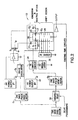
- the dual opposing corona discharge points or pin electrodes 20 and 22 within the reaction chamber 16 of the ITMS 10 are driven with high voltage from two paths as shown in FIG. 2.
- the High Voltage Power Supply 32, HV Switch Circuit 34 and HV Regulator 36 operate to keep the pin electrodes 20 and 22 at the same high voltage (e.g., 1000 volts) as the rest of the walls of the reaction chamber 16 and first grid electrode, E 1 . This is achieved via the high-value resistors R 1 and R 2 .
- the HV Switch Circuit is arranged as in the prior art ITMS, to occasionally provide a kick out pulse of higher voltage so that ions are driven from the chamber through the first grid electrode, E 1 and down through the drift region of the detector.
- ions are generated in the reaction chamber from the dual opposing corona pins 20 and 22 by the action of a high frequency, high voltage at each of the pins 20 and 22.
- the average voltage of the corona pins 20 and 22 is maintained at the level of the reaction chamber 16 surrounding them through the high value resistor R 1 and R 2 .
- high voltage at high frequency (>1MHz) is fed to the pins 20 and 22 through small value capacitors C 1 and C 2 from the high voltage transformer T 1 which is supplied in turn form the gated oscillator O 1 .
- Ions of both polarities are formed in the plasma between the pins 20 and 22 and the ionic population builds up without being discharged on the pins 20 and 22 themselves since the relative polarity of the pins 20 and 22 reverses before most of the ions have sufficient time to reach the pins 20 and 22 and discharge.
- the ionic density increases for a few hundred microseconds after which the gated oscillator O 1 is switched off by the action of the one-shot pulse generator G 1 . At this point the pin voltages return to the same voltage as the walls of the reactor 16.
- the positive and negative ion populations are approximately equal and diffuse outwards from the region of the plasma into the rest of the reaction chamber 16 where interaction with molecules of interest occur.
- variable delay circuit 38 times out after a period variable from a few tens of microseconds to a few milliseconds, after which the one-shot pulse generator G 1 again causes the voltage of the reaction chamber 16 and pins 20 and 22 to increase above that of the grid electrode E 1 . This in turn ejects ions from the reaction chamber 16 into the drift region 26 and the process starts over again.
Landscapes
- Physics & Mathematics (AREA)
- Engineering & Computer Science (AREA)
- Plasma & Fusion (AREA)
- Chemical & Material Sciences (AREA)
- Analytical Chemistry (AREA)
- Other Investigation Or Analysis Of Materials By Electrical Means (AREA)
- Electron Tubes For Measurement (AREA)
Priority Applications (1)
| Application Number | Priority Date | Filing Date | Title |
|---|---|---|---|
| EP10175448A EP2259054A1 (de) | 2000-08-02 | 2001-07-31 | Ionenbeweglichkeitsspektrometer |
Applications Claiming Priority (2)
| Application Number | Priority Date | Filing Date | Title |
|---|---|---|---|
| US222487 | 1988-07-21 | ||
| US22248700P | 2000-08-02 | 2000-08-02 |
Publications (2)
| Publication Number | Publication Date |
|---|---|
| EP1178307A1 true EP1178307A1 (de) | 2002-02-06 |
| EP1178307B1 EP1178307B1 (de) | 2010-09-08 |
Family
ID=22832417
Family Applications (2)
| Application Number | Title | Priority Date | Filing Date |
|---|---|---|---|
| EP01306530A Expired - Lifetime EP1178307B1 (de) | 2000-08-02 | 2001-07-31 | Ionenmobilitätsspektrometer |
| EP10175448A Withdrawn EP2259054A1 (de) | 2000-08-02 | 2001-07-31 | Ionenbeweglichkeitsspektrometer |
Family Applications After (1)
| Application Number | Title | Priority Date | Filing Date |
|---|---|---|---|
| EP10175448A Withdrawn EP2259054A1 (de) | 2000-08-02 | 2001-07-31 | Ionenbeweglichkeitsspektrometer |
Country Status (5)
| Country | Link |
|---|---|
| US (1) | US6690005B2 (de) |
| EP (2) | EP1178307B1 (de) |
| JP (1) | JP2002141017A (de) |
| AT (1) | ATE480769T1 (de) |
| DE (1) | DE60143005D1 (de) |
Cited By (5)
| Publication number | Priority date | Publication date | Assignee | Title |
|---|---|---|---|---|
| KR20040076147A (ko) * | 2003-02-24 | 2004-08-31 | 한국과학기술원 | 동위원소 13c 표지화합물의 호기검사방법 및 장치 |
| WO2008125804A3 (en) * | 2007-04-14 | 2009-07-30 | Smiths Detection Watford Ltd | Detectors and ion sources |
| CN103137417A (zh) * | 2011-12-02 | 2013-06-05 | 同方威视技术股份有限公司 | 电晕放电装置以及具有该电晕放电装置的离子迁移谱仪 |
| EP2778669A1 (de) * | 2013-03-15 | 2014-09-17 | Morpho Detection, LLC | Ionenfallenbeweglichkeitsspektrometer und Verfahren zur Verwendung davon |
| US9147565B1 (en) | 2014-12-30 | 2015-09-29 | Morpho Detection, Llc | Ion mobility spectrometer and method of using the same |
Families Citing this family (51)
| Publication number | Priority date | Publication date | Assignee | Title |
|---|---|---|---|---|
| US6794645B2 (en) * | 2001-11-30 | 2004-09-21 | California Institute Of Technology | Proton-transfer-reaction/ion-mobility-spectrometer and method of using the same |
| US6797943B2 (en) * | 2002-05-07 | 2004-09-28 | Siemens Ag | Method and apparatus for ion mobility spectrometry |
| US6822225B2 (en) * | 2002-09-25 | 2004-11-23 | Ut-Battelle Llc | Pulsed discharge ionization source for miniature ion mobility spectrometers |
| US7456393B2 (en) * | 2003-04-10 | 2008-11-25 | Ge Homeland Protection, Inc. | Device for testing surfaces of articles for traces of explosives and/or drugs |
| JP4163556B2 (ja) * | 2003-05-30 | 2008-10-08 | 浜松ホトニクス株式会社 | イオン移動度検出器 |
| JP4200053B2 (ja) * | 2003-06-09 | 2008-12-24 | 浜松ホトニクス株式会社 | イオン移動度検出器 |
| WO2005050159A2 (en) * | 2003-10-14 | 2005-06-02 | Washington State University Research Foundation | Ion mobility spectrometry method and apparatus |
| US7081618B2 (en) * | 2004-03-24 | 2006-07-25 | Burle Technologies, Inc. | Use of conductive glass tubes to create electric fields in ion mobility spectrometers |
| US7047829B2 (en) * | 2004-08-30 | 2006-05-23 | General Electric Company | Device for testing traces of explosives and/or drugs |
| US7141786B2 (en) | 2004-09-08 | 2006-11-28 | General Electric Company | Particle sampling preconcentrator |
| US7038216B1 (en) | 2004-12-23 | 2006-05-02 | Battelle Energy Alliance, Llc | Electrostatic shape-shifting ion optics |
| EP1869441B1 (de) * | 2005-04-11 | 2017-01-04 | Anthony Jenkins | Verbessertes system zur detektion von dampfspuren und partikeln in luft |
| JP4899012B2 (ja) * | 2005-05-06 | 2012-03-21 | スミス・ディテクション・インコーポレイテッド | パーオキシドベースの爆発物の改良された化学的検出 |
| US7448248B2 (en) * | 2005-12-12 | 2008-11-11 | Ge Homeland Protection Inc. | Calibration and verification tool and method for calibrating a detection apparatus |
| US20070158548A1 (en) * | 2006-01-09 | 2007-07-12 | Ge Security, Inc. | Ion trap mobility spectrometer |
| KR100584570B1 (ko) | 2006-02-28 | 2006-05-30 | 한국기계연구원 | 플라즈마 반응장치 |
| US7518106B2 (en) * | 2006-12-14 | 2009-04-14 | Battelle Energy Alliance, Llc | Ion mobility spectrometers and methods for ion mobility spectrometry |
| US7518105B2 (en) * | 2006-12-14 | 2009-04-14 | Battelle Energy Alliance, Llc | Continuous sampling ion mobility spectrometers and methods therefor |
| JP5125248B2 (ja) * | 2007-06-22 | 2013-01-23 | 株式会社日立製作所 | イオンモビリティ分光計 |
| US8334506B2 (en) | 2007-12-10 | 2012-12-18 | 1St Detect Corporation | End cap voltage control of ion traps |
| US7880137B2 (en) * | 2007-12-28 | 2011-02-01 | Morpho Detection, Inc. | Electrode design for an ion spectrometer |
| US20090203149A1 (en) * | 2008-02-13 | 2009-08-13 | General Electric Company | Enhanced methods for gas and/or vapor phase analysis of biological assays |
| US7973277B2 (en) * | 2008-05-27 | 2011-07-05 | 1St Detect Corporation | Driving a mass spectrometer ion trap or mass filter |
| US8424365B2 (en) * | 2009-02-25 | 2013-04-23 | Morpho Detection, Inc. | Screening system and method for operating the same |
| CN101937823B (zh) * | 2009-06-30 | 2012-05-23 | 同方威视技术股份有限公司 | 离子迁移谱仪的离子收集装置和离子迁移谱仪 |
| CN102074448B (zh) * | 2009-11-20 | 2014-09-24 | 同方威视技术股份有限公司 | 离子迁移谱仪以及提高其检测灵敏度的方法 |
| CA2794650C (en) | 2010-03-26 | 2017-01-03 | Teknoscan Systems Inc. | Non-invasive method and apparatus for detecting the presence of illicit substances |
| CA2796684C (en) | 2011-11-30 | 2018-01-30 | Teknoscan Systems Inc. | Aircraft screening device and method |
| CN103376294B (zh) | 2012-04-26 | 2017-11-03 | 泰克诺什灿系统有限公司 | 威胁物品检测系统 |
| RU2693560C2 (ru) * | 2013-06-21 | 2019-07-03 | Смитс Детекшен Монреаль Инк. | Способ и устройство для покрытого оболочкой источника ионизации коронного разряда |
| CN104752149B (zh) * | 2013-12-30 | 2017-04-05 | 同方威视技术股份有限公司 | 电晕放电组件和包括该电晕放电组件的离子迁移谱仪 |
| JP6421823B2 (ja) | 2014-11-17 | 2018-11-14 | 株式会社島津製作所 | イオン移動度分析装置 |
| US10254248B2 (en) | 2015-04-21 | 2019-04-09 | Battelle Memorial Institute | Collection, release, and detection of analytes with polymer composite sampling materials |
| US10453664B2 (en) | 2015-04-21 | 2019-10-22 | Battelle Memorial Institute | Collection, release, and detection of analytes with polymer composite sampling materials |
| JP6460244B2 (ja) * | 2015-08-24 | 2019-01-30 | 株式会社島津製作所 | イオン移動度分析用ドリフトセル及びイオン移動度分析装置 |
| US9689857B1 (en) | 2016-03-08 | 2017-06-27 | Morpho Detection, Llc | Temperature influenced chemical vaporization and detection of compounds having low volatility |
| US9683981B1 (en) | 2016-03-08 | 2017-06-20 | Morpho Detection, Llc | Chemical vaporization and detection of compounds having low volatility |
| US10386340B2 (en) | 2016-03-31 | 2019-08-20 | Rapiscan Systems, Inc. | Detection of substances of interest using gas-solid phase chemistry |
| US10049868B2 (en) * | 2016-12-06 | 2018-08-14 | Rapiscan Systems, Inc. | Apparatus for detecting constituents in a sample and method of using the same |
| US10707063B2 (en) | 2016-12-22 | 2020-07-07 | Rapiscan Systems, Inc. | Systems and methods for calibration, verification, and sensitivity checks for detectors |
| WO2018125441A1 (en) | 2016-12-28 | 2018-07-05 | Rapiscan Systems, Inc. | Ionization chamber having a potential-well for ion trapping and ion compression |
| US10458885B2 (en) | 2017-03-31 | 2019-10-29 | Rapiscan Systems, Inc. | Rapid desorber heating and cooling for trace detection |
| WO2019231483A1 (en) | 2017-08-10 | 2019-12-05 | Rapiscan Systems, Inc. | Systems and methods for substance detection using thermally stable collection devices |
| CN111630624A (zh) | 2018-01-24 | 2020-09-04 | 拉皮斯坎系统股份有限公司 | 利用极紫外辐射源的表面层破坏和电离 |
| CN110487885B (zh) * | 2018-11-25 | 2021-06-01 | 中国科学院大连化学物理研究所 | 一种高通量测量大气中氨的装置及方法 |
| US11609214B2 (en) | 2019-07-31 | 2023-03-21 | Rapiscan Systems, Inc. | Systems and methods for improving detection accuracy in electronic trace detectors |
| GB2636499A (en) | 2020-05-12 | 2025-06-18 | Rapiscan Systems Inc | Sensitivity traps for electronic trace detection |
| CN113793796B (zh) * | 2020-05-29 | 2022-11-11 | 同方威视技术股份有限公司 | 电晕放电型电离源组件和离子迁移谱仪 |
| EP4237816A1 (de) * | 2020-11-02 | 2023-09-06 | Iontrap LLC | Verfahren und vorrichtung zum schnellen nachweis von in der luft schwebenden viren |
| EP4346392A4 (de) | 2021-06-02 | 2024-08-28 | Michael Stapleton Associates, Ltd. | Aufzeichnung von hundeinspektionen |
| JP7780360B2 (ja) * | 2022-02-25 | 2025-12-04 | シャープ株式会社 | Ims分析装置 |
Citations (5)
| Publication number | Priority date | Publication date | Assignee | Title |
|---|---|---|---|---|
| US3699333A (en) * | 1968-10-23 | 1972-10-17 | Franklin Gno Corp | Apparatus and methods for separating, concentrating, detecting, and measuring trace gases |
| US5200614A (en) * | 1992-01-16 | 1993-04-06 | Ion Track Instruments, Inc. | Ion mobility spectrometers |
| WO1993011554A1 (en) * | 1991-12-03 | 1993-06-10 | Graseby Dynamics Limited | Corona discharge ionisation source |
| US5491337A (en) * | 1994-07-15 | 1996-02-13 | Ion Track Instruments, Inc. | Ion trap mobility spectrometer and method of operation for enhanced detection of narcotics |
| WO1997028444A1 (en) * | 1996-02-02 | 1997-08-07 | Graseby Dynamics Limited | Corona discharge ion source for analytical instruments |
Family Cites Families (4)
| Publication number | Priority date | Publication date | Assignee | Title |
|---|---|---|---|---|
| GB2242141A (en) | 1990-03-24 | 1991-09-25 | Ion Track Instr | Method and apparatus for detecting low volatility atmospheric vapors |
| US5494337A (en) | 1993-08-13 | 1996-02-27 | Behnke; James W. | Bicycle wheel with a straight through spoke and hub combination |
| JP3819146B2 (ja) * | 1998-04-20 | 2006-09-06 | 株式会社日立製作所 | モニタ装置 |
| US6407382B1 (en) * | 1999-06-04 | 2002-06-18 | Technispan Llc | Discharge ionization source |
-
2001
- 2001-07-20 US US09/910,197 patent/US6690005B2/en not_active Expired - Lifetime
- 2001-07-31 EP EP01306530A patent/EP1178307B1/de not_active Expired - Lifetime
- 2001-07-31 DE DE60143005T patent/DE60143005D1/de not_active Expired - Lifetime
- 2001-07-31 AT AT01306530T patent/ATE480769T1/de not_active IP Right Cessation
- 2001-07-31 EP EP10175448A patent/EP2259054A1/de not_active Withdrawn
- 2001-08-01 JP JP2001233101A patent/JP2002141017A/ja active Pending
Patent Citations (5)
| Publication number | Priority date | Publication date | Assignee | Title |
|---|---|---|---|---|
| US3699333A (en) * | 1968-10-23 | 1972-10-17 | Franklin Gno Corp | Apparatus and methods for separating, concentrating, detecting, and measuring trace gases |
| WO1993011554A1 (en) * | 1991-12-03 | 1993-06-10 | Graseby Dynamics Limited | Corona discharge ionisation source |
| US5200614A (en) * | 1992-01-16 | 1993-04-06 | Ion Track Instruments, Inc. | Ion mobility spectrometers |
| US5491337A (en) * | 1994-07-15 | 1996-02-13 | Ion Track Instruments, Inc. | Ion trap mobility spectrometer and method of operation for enhanced detection of narcotics |
| WO1997028444A1 (en) * | 1996-02-02 | 1997-08-07 | Graseby Dynamics Limited | Corona discharge ion source for analytical instruments |
Cited By (16)
| Publication number | Priority date | Publication date | Assignee | Title |
|---|---|---|---|---|
| KR20040076147A (ko) * | 2003-02-24 | 2004-08-31 | 한국과학기술원 | 동위원소 13c 표지화합물의 호기검사방법 및 장치 |
| US8748812B2 (en) | 2007-04-14 | 2014-06-10 | Smiths Detection-Watford Limited | Detectors and ion sources |
| WO2008125804A3 (en) * | 2007-04-14 | 2009-07-30 | Smiths Detection Watford Ltd | Detectors and ion sources |
| CN101663726B (zh) * | 2007-04-14 | 2012-10-03 | 史密斯探测-沃特福特有限公司 | 探测器和离子源 |
| US8299428B2 (en) | 2007-04-14 | 2012-10-30 | Smiths Detection-Watford Limited | Detectors and ion sources |
| EP2156461B1 (de) * | 2007-04-14 | 2018-10-24 | Smiths Detection-Watford Limited | Detektoren und ionenquellen |
| CN103137417B (zh) * | 2011-12-02 | 2016-01-06 | 同方威视技术股份有限公司 | 电晕放电装置以及具有该电晕放电装置的离子迁移谱仪 |
| GB2510542A (en) * | 2011-12-02 | 2014-08-06 | Nutech Company Ltd | Corona discharging device and ion migration spectrometer having same |
| US8921771B2 (en) | 2011-12-02 | 2014-12-30 | Nuctech Company Limited | Corona discharge device and ion mobility spectrometer having corona discharge device |
| WO2013079008A1 (zh) * | 2011-12-02 | 2013-06-06 | 同方威视技术股份有限公司 | 电晕放电装置以及具有该电晕放电装置的离子迁移谱仪 |
| GB2510542B (en) * | 2011-12-02 | 2016-10-05 | Nuctech Co Ltd | Ion mobility spectrometer having corona discharge device |
| DE112012000846B4 (de) * | 2011-12-02 | 2018-02-08 | Nuctech Company Limited | Ionenmobilitätsspektrometer, das eine Korona-Entladungsvorrichtung aufweist |
| CN103137417A (zh) * | 2011-12-02 | 2013-06-05 | 同方威视技术股份有限公司 | 电晕放电装置以及具有该电晕放电装置的离子迁移谱仪 |
| EP2778669A1 (de) * | 2013-03-15 | 2014-09-17 | Morpho Detection, LLC | Ionenfallenbeweglichkeitsspektrometer und Verfahren zur Verwendung davon |
| US8866073B2 (en) | 2013-03-15 | 2014-10-21 | Morpho Detection, Llc | Ion trap mobility spectrometer and method of using the same |
| US9147565B1 (en) | 2014-12-30 | 2015-09-29 | Morpho Detection, Llc | Ion mobility spectrometer and method of using the same |
Also Published As
| Publication number | Publication date |
|---|---|
| US6690005B2 (en) | 2004-02-10 |
| JP2002141017A (ja) | 2002-05-17 |
| EP2259054A1 (de) | 2010-12-08 |
| DE60143005D1 (de) | 2010-10-21 |
| US20020017605A1 (en) | 2002-02-14 |
| EP1178307B1 (de) | 2010-09-08 |
| ATE480769T1 (de) | 2010-09-15 |
Similar Documents
| Publication | Publication Date | Title |
|---|---|---|
| US6690005B2 (en) | Ion mobility spectrometer | |
| US7528367B2 (en) | Ion mobility spectrometer | |
| CA2717817C (en) | Chemical detection method and system | |
| US7576322B2 (en) | Non-contact detector system with plasma ion source | |
| US7138626B1 (en) | Method and device for non-contact sampling and detection | |
| US8921778B2 (en) | Detection apparatus | |
| US6483108B1 (en) | Analytical apparatus | |
| RU2676384C1 (ru) | Источник ионизации на основе диэлектрического барьерного разряда для спектрометрии | |
| EP1371082B1 (de) | Corona ionenquelle | |
| EP1580794B1 (de) | Massenspektrometrischer Apparat und Ionenquelle | |
| US20150069254A1 (en) | Sample analyzing system | |
| US9905407B2 (en) | Mass spectrometry by detecting positively and negatively charged particles | |
| US20030209665A1 (en) | Method and apparatus for ion mobility spectrometry | |
| US20050230614A1 (en) | Mass spectrometry system for continuous control of environment | |
| WO2008054393A1 (en) | Method and device for non-contact sampling and detection | |
| US5665966A (en) | Current measuring system | |
| EP0616213A2 (de) | Praktische Ausführungen eines Ionenbeweglichkeitssensors | |
| Baether et al. | Pulsed electron beams in ion mobility spectrometry | |
| WO2014163939A2 (en) | A mass spectrometer ion trap having asymmetric end cap apertures | |
| McGann | New high-efficiency ion-trap mobility detection system for narcotics | |
| US6995365B2 (en) | Mass analyzer having improved ion selection unit | |
| RU2775707C2 (ru) | Ионизирующее устройство и устройство спектрометра ионной подвижности | |
| GB2497862A (en) | Enhancement of analyte detection by formation of dimer analytes in IMS |
Legal Events
| Date | Code | Title | Description |
|---|---|---|---|
| PUAI | Public reference made under article 153(3) epc to a published international application that has entered the european phase |
Free format text: ORIGINAL CODE: 0009012 |
|
| AK | Designated contracting states |
Kind code of ref document: A1 Designated state(s): AT BE CH CY DE DK ES FI FR GB GR IE IT LI LU MC NL PT SE TR |
|
| AX | Request for extension of the european patent |
Free format text: AL;LT;LV;MK;RO;SI |
|
| 17P | Request for examination filed |
Effective date: 20020430 |
|
| AKX | Designation fees paid |
Free format text: AT BE CH CY DE DK ES FI FR GB GR IE IT LI LU MC NL PT SE TR |
|
| RAP1 | Party data changed (applicant data changed or rights of an application transferred) |
Owner name: ION TRACK INSTRUMENTS LLC |
|
| 17Q | First examination report despatched |
Effective date: 20050308 |
|
| 17Q | First examination report despatched |
Effective date: 20050308 |
|
| RAP1 | Party data changed (applicant data changed or rights of an application transferred) |
Owner name: GE HOMELAND PROTECTION, INC. |
|
| GRAC | Information related to communication of intention to grant a patent modified |
Free format text: ORIGINAL CODE: EPIDOSCIGR1 |
|
| GRAP | Despatch of communication of intention to grant a patent |
Free format text: ORIGINAL CODE: EPIDOSNIGR1 |
|
| GRAS | Grant fee paid |
Free format text: ORIGINAL CODE: EPIDOSNIGR3 |
|
| RAP1 | Party data changed (applicant data changed or rights of an application transferred) |
Owner name: MORPHO DETECTION, INC. |
|
| GRAA | (expected) grant |
Free format text: ORIGINAL CODE: 0009210 |
|
| AK | Designated contracting states |
Kind code of ref document: B1 Designated state(s): AT BE CH CY DE DK ES FI FR GB GR IE IT LI LU MC NL PT SE TR |
|
| REG | Reference to a national code |
Ref country code: GB Ref legal event code: FG4D |
|
| REG | Reference to a national code |
Ref country code: CH Ref legal event code: EP |
|
| REG | Reference to a national code |
Ref country code: IE Ref legal event code: FG4D |
|
| REF | Corresponds to: |
Ref document number: 60143005 Country of ref document: DE Date of ref document: 20101021 Kind code of ref document: P |
|
| REG | Reference to a national code |
Ref country code: NL Ref legal event code: VDEP Effective date: 20100908 |
|
| PG25 | Lapsed in a contracting state [announced via postgrant information from national office to epo] |
Ref country code: AT Free format text: LAPSE BECAUSE OF FAILURE TO SUBMIT A TRANSLATION OF THE DESCRIPTION OR TO PAY THE FEE WITHIN THE PRESCRIBED TIME-LIMIT Effective date: 20100908 Ref country code: FI Free format text: LAPSE BECAUSE OF FAILURE TO SUBMIT A TRANSLATION OF THE DESCRIPTION OR TO PAY THE FEE WITHIN THE PRESCRIBED TIME-LIMIT Effective date: 20100908 |
|
| PG25 | Lapsed in a contracting state [announced via postgrant information from national office to epo] |
Ref country code: CY Free format text: LAPSE BECAUSE OF FAILURE TO SUBMIT A TRANSLATION OF THE DESCRIPTION OR TO PAY THE FEE WITHIN THE PRESCRIBED TIME-LIMIT Effective date: 20100908 |
|
| PG25 | Lapsed in a contracting state [announced via postgrant information from national office to epo] |
Ref country code: SE Free format text: LAPSE BECAUSE OF FAILURE TO SUBMIT A TRANSLATION OF THE DESCRIPTION OR TO PAY THE FEE WITHIN THE PRESCRIBED TIME-LIMIT Effective date: 20100908 Ref country code: NL Free format text: LAPSE BECAUSE OF FAILURE TO SUBMIT A TRANSLATION OF THE DESCRIPTION OR TO PAY THE FEE WITHIN THE PRESCRIBED TIME-LIMIT Effective date: 20100908 Ref country code: GR Free format text: LAPSE BECAUSE OF FAILURE TO SUBMIT A TRANSLATION OF THE DESCRIPTION OR TO PAY THE FEE WITHIN THE PRESCRIBED TIME-LIMIT Effective date: 20101209 |
|
| PG25 | Lapsed in a contracting state [announced via postgrant information from national office to epo] |
Ref country code: IT Free format text: LAPSE BECAUSE OF FAILURE TO SUBMIT A TRANSLATION OF THE DESCRIPTION OR TO PAY THE FEE WITHIN THE PRESCRIBED TIME-LIMIT Effective date: 20100908 Ref country code: PT Free format text: LAPSE BECAUSE OF FAILURE TO SUBMIT A TRANSLATION OF THE DESCRIPTION OR TO PAY THE FEE WITHIN THE PRESCRIBED TIME-LIMIT Effective date: 20110110 |
|
| PG25 | Lapsed in a contracting state [announced via postgrant information from national office to epo] |
Ref country code: BE Free format text: LAPSE BECAUSE OF FAILURE TO SUBMIT A TRANSLATION OF THE DESCRIPTION OR TO PAY THE FEE WITHIN THE PRESCRIBED TIME-LIMIT Effective date: 20100908 Ref country code: ES Free format text: LAPSE BECAUSE OF FAILURE TO SUBMIT A TRANSLATION OF THE DESCRIPTION OR TO PAY THE FEE WITHIN THE PRESCRIBED TIME-LIMIT Effective date: 20101219 |
|
| PLBE | No opposition filed within time limit |
Free format text: ORIGINAL CODE: 0009261 |
|
| STAA | Information on the status of an ep patent application or granted ep patent |
Free format text: STATUS: NO OPPOSITION FILED WITHIN TIME LIMIT |
|
| 26N | No opposition filed |
Effective date: 20110609 |
|
| PG25 | Lapsed in a contracting state [announced via postgrant information from national office to epo] |
Ref country code: DK Free format text: LAPSE BECAUSE OF FAILURE TO SUBMIT A TRANSLATION OF THE DESCRIPTION OR TO PAY THE FEE WITHIN THE PRESCRIBED TIME-LIMIT Effective date: 20100908 |
|
| REG | Reference to a national code |
Ref country code: DE Ref legal event code: R097 Ref document number: 60143005 Country of ref document: DE Effective date: 20110609 |
|
| PGFP | Annual fee paid to national office [announced via postgrant information from national office to epo] |
Ref country code: FR Payment date: 20110805 Year of fee payment: 11 |
|
| PGFP | Annual fee paid to national office [announced via postgrant information from national office to epo] |
Ref country code: GB Payment date: 20110725 Year of fee payment: 11 |
|
| PG25 | Lapsed in a contracting state [announced via postgrant information from national office to epo] |
Ref country code: MC Free format text: LAPSE BECAUSE OF NON-PAYMENT OF DUE FEES Effective date: 20110731 |
|
| REG | Reference to a national code |
Ref country code: CH Ref legal event code: PL |
|
| REG | Reference to a national code |
Ref country code: IE Ref legal event code: MM4A |
|
| PG25 | Lapsed in a contracting state [announced via postgrant information from national office to epo] |
Ref country code: CH Free format text: LAPSE BECAUSE OF NON-PAYMENT OF DUE FEES Effective date: 20110731 Ref country code: DE Free format text: LAPSE BECAUSE OF NON-PAYMENT OF DUE FEES Effective date: 20120201 Ref country code: LI Free format text: LAPSE BECAUSE OF NON-PAYMENT OF DUE FEES Effective date: 20110731 |
|
| REG | Reference to a national code |
Ref country code: DE Ref legal event code: R119 Ref document number: 60143005 Country of ref document: DE Effective date: 20120201 |
|
| PG25 | Lapsed in a contracting state [announced via postgrant information from national office to epo] |
Ref country code: IE Free format text: LAPSE BECAUSE OF NON-PAYMENT OF DUE FEES Effective date: 20110731 |
|
| GBPC | Gb: european patent ceased through non-payment of renewal fee |
Effective date: 20120731 |
|
| REG | Reference to a national code |
Ref country code: FR Ref legal event code: ST Effective date: 20130329 |
|
| PG25 | Lapsed in a contracting state [announced via postgrant information from national office to epo] |
Ref country code: GB Free format text: LAPSE BECAUSE OF NON-PAYMENT OF DUE FEES Effective date: 20120731 Ref country code: FR Free format text: LAPSE BECAUSE OF NON-PAYMENT OF DUE FEES Effective date: 20120731 |
|
| PG25 | Lapsed in a contracting state [announced via postgrant information from national office to epo] |
Ref country code: LU Free format text: LAPSE BECAUSE OF NON-PAYMENT OF DUE FEES Effective date: 20110731 |
|
| PG25 | Lapsed in a contracting state [announced via postgrant information from national office to epo] |
Ref country code: TR Free format text: LAPSE BECAUSE OF FAILURE TO SUBMIT A TRANSLATION OF THE DESCRIPTION OR TO PAY THE FEE WITHIN THE PRESCRIBED TIME-LIMIT Effective date: 20100908 |