EP1178522A1 - Herstellung von Quantenpunkten - Google Patents
Herstellung von Quantenpunkten Download PDFInfo
- Publication number
- EP1178522A1 EP1178522A1 EP01410097A EP01410097A EP1178522A1 EP 1178522 A1 EP1178522 A1 EP 1178522A1 EP 01410097 A EP01410097 A EP 01410097A EP 01410097 A EP01410097 A EP 01410097A EP 1178522 A1 EP1178522 A1 EP 1178522A1
- Authority
- EP
- European Patent Office
- Prior art keywords
- substrate
- silicon
- germanium
- boxes
- material constituting
- Prior art date
- Legal status (The legal status is an assumption and is not a legal conclusion. Google has not performed a legal analysis and makes no representation as to the accuracy of the status listed.)
- Withdrawn
Links
Images

Classifications
-
- H—ELECTRICITY
- H10—SEMICONDUCTOR DEVICES; ELECTRIC SOLID-STATE DEVICES NOT OTHERWISE PROVIDED FOR
- H10H—INORGANIC LIGHT-EMITTING SEMICONDUCTOR DEVICES HAVING POTENTIAL BARRIERS
- H10H20/00—Individual inorganic light-emitting semiconductor devices having potential barriers, e.g. light-emitting diodes [LED]
- H10H20/80—Constructional details
- H10H20/81—Bodies
- H10H20/811—Bodies having quantum effect structures or superlattices, e.g. tunnel junctions
- H10H20/812—Bodies having quantum effect structures or superlattices, e.g. tunnel junctions within the light-emitting regions, e.g. having quantum confinement structures
-
- B—PERFORMING OPERATIONS; TRANSPORTING
- B82—NANOTECHNOLOGY
- B82Y—SPECIFIC USES OR APPLICATIONS OF NANOSTRUCTURES; MEASUREMENT OR ANALYSIS OF NANOSTRUCTURES; MANUFACTURE OR TREATMENT OF NANOSTRUCTURES
- B82Y10/00—Nanotechnology for information processing, storage or transmission, e.g. quantum computing or single electron logic
-
- H—ELECTRICITY
- H10—SEMICONDUCTOR DEVICES; ELECTRIC SOLID-STATE DEVICES NOT OTHERWISE PROVIDED FOR
- H10D—INORGANIC ELECTRIC SEMICONDUCTOR DEVICES
- H10D62/00—Semiconductor bodies, or regions thereof, of devices having potential barriers
- H10D62/80—Semiconductor bodies, or regions thereof, of devices having potential barriers characterised by the materials
- H10D62/81—Semiconductor bodies, or regions thereof, of devices having potential barriers characterised by the materials of structures exhibiting quantum-confinement effects, e.g. single quantum wells; of structures having periodic or quasi-periodic potential variation
- H10D62/812—Single quantum well structures
- H10D62/814—Quantum box structures
-
- H—ELECTRICITY
- H10—SEMICONDUCTOR DEVICES; ELECTRIC SOLID-STATE DEVICES NOT OTHERWISE PROVIDED FOR
- H10H—INORGANIC LIGHT-EMITTING SEMICONDUCTOR DEVICES HAVING POTENTIAL BARRIERS
- H10H20/00—Individual inorganic light-emitting semiconductor devices having potential barriers, e.g. light-emitting diodes [LED]
- H10H20/01—Manufacture or treatment
- H10H20/011—Manufacture or treatment of bodies, e.g. forming semiconductor layers
- H10H20/014—Manufacture or treatment of bodies, e.g. forming semiconductor layers having light-emitting regions comprising only Group IV materials
-
- H—ELECTRICITY
- H10—SEMICONDUCTOR DEVICES; ELECTRIC SOLID-STATE DEVICES NOT OTHERWISE PROVIDED FOR
- H10P—GENERIC PROCESSES OR APPARATUS FOR THE MANUFACTURE OR TREATMENT OF DEVICES COVERED BY CLASS H10
- H10P14/00—Formation of materials, e.g. in the shape of layers or pillars
- H10P14/20—Formation of materials, e.g. in the shape of layers or pillars of semiconductor materials
- H10P14/24—Formation of materials, e.g. in the shape of layers or pillars of semiconductor materials using chemical vapour deposition [CVD]
-
- H—ELECTRICITY
- H10—SEMICONDUCTOR DEVICES; ELECTRIC SOLID-STATE DEVICES NOT OTHERWISE PROVIDED FOR
- H10P—GENERIC PROCESSES OR APPARATUS FOR THE MANUFACTURE OR TREATMENT OF DEVICES COVERED BY CLASS H10
- H10P14/00—Formation of materials, e.g. in the shape of layers or pillars
- H10P14/20—Formation of materials, e.g. in the shape of layers or pillars of semiconductor materials
- H10P14/29—Formation of materials, e.g. in the shape of layers or pillars of semiconductor materials characterised by the substrates
- H10P14/2901—Materials
- H10P14/2902—Materials being Group IVA materials
- H10P14/2905—Silicon, silicon germanium or germanium
-
- H—ELECTRICITY
- H10—SEMICONDUCTOR DEVICES; ELECTRIC SOLID-STATE DEVICES NOT OTHERWISE PROVIDED FOR
- H10P—GENERIC PROCESSES OR APPARATUS FOR THE MANUFACTURE OR TREATMENT OF DEVICES COVERED BY CLASS H10
- H10P14/00—Formation of materials, e.g. in the shape of layers or pillars
- H10P14/20—Formation of materials, e.g. in the shape of layers or pillars of semiconductor materials
- H10P14/32—Formation of materials, e.g. in the shape of layers or pillars of semiconductor materials characterised by intermediate layers between substrates and deposited layers
- H10P14/3202—Materials thereof
- H10P14/3204—Materials thereof being Group IVA semiconducting materials
- H10P14/3211—Silicon, silicon germanium or germanium
-
- H—ELECTRICITY
- H10—SEMICONDUCTOR DEVICES; ELECTRIC SOLID-STATE DEVICES NOT OTHERWISE PROVIDED FOR
- H10P—GENERIC PROCESSES OR APPARATUS FOR THE MANUFACTURE OR TREATMENT OF DEVICES COVERED BY CLASS H10
- H10P14/00—Formation of materials, e.g. in the shape of layers or pillars
- H10P14/20—Formation of materials, e.g. in the shape of layers or pillars of semiconductor materials
- H10P14/32—Formation of materials, e.g. in the shape of layers or pillars of semiconductor materials characterised by intermediate layers between substrates and deposited layers
- H10P14/3242—Structure
- H10P14/3244—Layer structure
- H10P14/3251—Layer structure consisting of three or more layers
-
- H—ELECTRICITY
- H10—SEMICONDUCTOR DEVICES; ELECTRIC SOLID-STATE DEVICES NOT OTHERWISE PROVIDED FOR
- H10P—GENERIC PROCESSES OR APPARATUS FOR THE MANUFACTURE OR TREATMENT OF DEVICES COVERED BY CLASS H10
- H10P14/00—Formation of materials, e.g. in the shape of layers or pillars
- H10P14/20—Formation of materials, e.g. in the shape of layers or pillars of semiconductor materials
- H10P14/32—Formation of materials, e.g. in the shape of layers or pillars of semiconductor materials characterised by intermediate layers between substrates and deposited layers
- H10P14/3242—Structure
- H10P14/3256—Microstructure
-
- H—ELECTRICITY
- H10—SEMICONDUCTOR DEVICES; ELECTRIC SOLID-STATE DEVICES NOT OTHERWISE PROVIDED FOR
- H10P—GENERIC PROCESSES OR APPARATUS FOR THE MANUFACTURE OR TREATMENT OF DEVICES COVERED BY CLASS H10
- H10P14/00—Formation of materials, e.g. in the shape of layers or pillars
- H10P14/20—Formation of materials, e.g. in the shape of layers or pillars of semiconductor materials
- H10P14/34—Deposited materials, e.g. layers
- H10P14/3402—Deposited materials, e.g. layers characterised by the chemical composition
- H10P14/3404—Deposited materials, e.g. layers characterised by the chemical composition being Group IVA materials
- H10P14/3411—Silicon, silicon germanium or germanium
-
- Y—GENERAL TAGGING OF NEW TECHNOLOGICAL DEVELOPMENTS; GENERAL TAGGING OF CROSS-SECTIONAL TECHNOLOGIES SPANNING OVER SEVERAL SECTIONS OF THE IPC; TECHNICAL SUBJECTS COVERED BY FORMER USPC CROSS-REFERENCE ART COLLECTIONS [XRACs] AND DIGESTS
- Y10—TECHNICAL SUBJECTS COVERED BY FORMER USPC
- Y10S—TECHNICAL SUBJECTS COVERED BY FORMER USPC CROSS-REFERENCE ART COLLECTIONS [XRACs] AND DIGESTS
- Y10S438/00—Semiconductor device manufacturing: process
- Y10S438/962—Quantum dots and lines
-
- Y—GENERAL TAGGING OF NEW TECHNOLOGICAL DEVELOPMENTS; GENERAL TAGGING OF CROSS-SECTIONAL TECHNOLOGIES SPANNING OVER SEVERAL SECTIONS OF THE IPC; TECHNICAL SUBJECTS COVERED BY FORMER USPC CROSS-REFERENCE ART COLLECTIONS [XRACs] AND DIGESTS
- Y10—TECHNICAL SUBJECTS COVERED BY FORMER USPC
- Y10S—TECHNICAL SUBJECTS COVERED BY FORMER USPC CROSS-REFERENCE ART COLLECTIONS [XRACs] AND DIGESTS
- Y10S977/00—Nanotechnology
- Y10S977/70—Nanostructure
- Y10S977/701—Integrated with dissimilar structures on a common substrate
- Y10S977/72—On an electrically conducting, semi-conducting, or semi-insulating substrate
- Y10S977/721—On a silicon substrate
-
- Y—GENERAL TAGGING OF NEW TECHNOLOGICAL DEVELOPMENTS; GENERAL TAGGING OF CROSS-SECTIONAL TECHNOLOGIES SPANNING OVER SEVERAL SECTIONS OF THE IPC; TECHNICAL SUBJECTS COVERED BY FORMER USPC CROSS-REFERENCE ART COLLECTIONS [XRACs] AND DIGESTS
- Y10—TECHNICAL SUBJECTS COVERED BY FORMER USPC
- Y10S—TECHNICAL SUBJECTS COVERED BY FORMER USPC CROSS-REFERENCE ART COLLECTIONS [XRACs] AND DIGESTS
- Y10S977/00—Nanotechnology
- Y10S977/84—Manufacture, treatment, or detection of nanostructure
- Y10S977/89—Deposition of materials, e.g. coating, cvd, or ald
- Y10S977/891—Vapor phase deposition
Definitions
- the present invention relates to the manufacture of "quantum dots" of a first material in a second material semiconductor. More particularly, the present invention concerns the realization of quantum dots in a substrate of silicon.
- quantum dots are, for example, described in the document "Ge / Si self-assembled quantum dots grown on Si (100) in an industrial high-pressure chemical vapor deposition reactor "by C. Hernandez, Y. Campidelli, D. Simon, D. Bensahel, I. Sagnes, G. Patriarche, P. Boucaus and S. Sauvage, published in J. Appl. Phys., 86/2, 1999, 1145-1148. They are used in many fields of application. We consider below By way of non-limiting example, the field of telecommunications.
- the energy band gap of silicon between its bands of valence and conduction is relatively low and the transitions are of the "indirect” type.
- indirect is meant that the passage of an electron from the valence band to the band conduction is done in several jumps and not in a single jump as in the case of the III-V compounds.
- the silicon is then almost unusable as a transmitter, i.e. converter from electric energy to light energy. Because of the indirect nature of electronic transitions, these are strongly dissipative and very weakly emitting.
- the relatively low energy band gap on the order 1.1 eV, corresponds to a photon emission of a length wave less than 1 ⁇ m, little used in the telecommunications field.
- FIG. 1 illustrates, in partial sectional view and schematic, a quantum dot as described, for example, in the aforementioned article from the Journal of Applied Physics.
- This box B consists of a germanium island formed on a substrate S of monocrystalline silicon.
- a dome-shaped nanostructure is produced or drop B, having a base L and a height h.
- Box B is encapsulated in a layer of monocrystalline silicon.
- germanium in silicon epitaxy is carried out, for example, by continuous injection of germane (GeH 4 ), on a monocrystalline silicon substrate. Then, the first few atomic thicknesses deposited form a layer whose surface is regular but not planar. Due to the constraints linked to the differences in crystal lattices, the surface has a sinusoidal "wave" shape. In other words, the upper surface of a germanium layer of a few atomic thicknesses, formed on silicon, has hollows and bumps distributed evenly.
- the crystallographic constraints - deformations of the natural network of germanium - cause the growth of drops or boxes similar to those of FIG. 1. This injection must be stopped when the drops or boxes have reached a desired dimension, before a coalescence of the drops occurs, then the formation of a continuous layer containing dislocations.
- FIG. 2 illustrates, in partial section view and schematic, the result of the repeated implementation of such process.
- a silicon substrate 20 For example, on a silicon substrate 20, three substantially horizontal planes of germanium drops (quantum dots) 21 encapsulated in silicon 22.
- Figure 3 illustrates, in partial top view and schematic, any of the drop planes 21.
- an "optimal" temperature which corresponds to a maximum “controllable” growth rate, that is to say a speed as fast as possible to avoid faults mentioned above, and slow enough to interrupt epitaxy precisely at a desired stage (e.g. a few dozen monoatomic layers).
- the silane and germane injections are carried out successively at similar flow rates.
- the hydrogen (carrier gas) is injected at a flow rate of approximately 10 l / min.
- the flow rate of the injected gases is generally maintained between 15 and 25 cm 3 / min, typically of the order of 20 cm 3 / min. This flow rate is chosen as explained above to obtain a maximum controllable deposition rate.
- the present invention aims to provide a method of growth of quantum boxes suitable for forming regular boxes, arranged homogeneously on a substrate.
- the present invention also aims to provide such a process that is reproducible.
- the present invention provides a formation process, on a semiconductor substrate monocrystalline of a first material, of quantum boxes in one second material, consisting of growing by phase epitaxy gaseous the second material on the first material in optimal conditions to ensure growth at a maximum controllable speed, including an initial step consisting in sending a puff of gas onto the substrate comprising the second material, under corresponding conditions at a deposition speed significantly faster than said speed maximum controllable.
- the first material constituting the substrate is silicon and the second material constituting the boxes is germanium.
- the method is implemented in an epitaxy reactor at a temperature of 630 to 670 ° C at a pressure of 0.02 to 0.04 10 5 Pa, said optimal conditions corresponding at a flow rate of the order of 15 to 25 cm 3 / min of germane diluted to 10% in hydrogen, and the initial step consisting in sending a burst of germane diluted to 10% in hydrogen to a flow rate of the order of 200 cm 3 / min for a period of 1 to 5 s.
- the initial stage of sending a puff is followed by an injection of germane under said optimal conditions for 25 to 40 s.
- the first material constituting the substrate is silicon or germanium and the second material making up the boxes is a rare earth.
- the first material constituting the substrate is oxide of silicon and the second material constituting the boxes is silicon nitride.
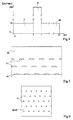
- FIG. 4 illustrates the evolution over time of gas flow rates injected into an epitaxy reactor during the formation of quantum dots.
- the abscissa axis of the diagram represents the injection time t in seconds.
- the ordinate axis represents the flow rate f in cm 3 / min.
- the temperature is maintained at a constant value of between 600 and 700 ° C., for example 635 ° C.
- the pressure is maintained at a value between 0.025 and 0.040.10 5 Pa (20 to 30 torr).
- the method according to the invention begins with initial steps of cleaning and preparing the surface of monocrystalline substrate. For example, we start by growing a few monoatomic layers of silicon, by injecting silane. For example, silane diluted to 10% in hydrogen is injected for substantially 5 s at a rate of between 15 and 25 cm 3 / min, for example 20 cm 3 / min. This first step is illustrated by part I, on the left of FIG. 4.
- an injection of a gas containing germanium, for example germane is carried out to form the quantum dots.
- this injection begins with the sending of a "puff" of german.
- puff means an injection of a large amount of german for a short time.
- germane diluted to 10% in hydrogen will be injected at an average flow rate of 200 cm 3 / min, for a period of 2 s.
- the average flow rate is clearly higher than the optimal flow rate, making it possible to obtain a maximum controllable deposition rate for the reactor considered.
- the germane injection continues at the optimal rate.
- the flux is reduced to a value between 15 and 25 cm 3 / min, for example of the order of 20 cm 3 / min, for a period of 25 to 30 s, for example 28 s.
- one causes, always under the same conditions of pressure, flow and temperature, the growth of a silicon encapsulation layer.
- injected silane diluted in hydrogen serving as a carrier gas at a rate of the order of 20 cm 3 / min.
- the duration of this last step is adjusted as a function of the pressure, flow and temperature conditions so as to increase an encapsulation layer of desired thickness.
- FIG. 5 illustrates, in partial section view and schematic, the formation on a silicon substrate 40, of three successive shots of encapsulated germanium 41 drops in silicon 42, by the method according to the present invention.
- FIG. 6 illustrates, in schematic top view and partial, the state of a drop plane 41 before its encapsulation.
- the plane considered may be the first plane formed directly on the substrate 40, or any upper plane formed on an encapsulation layer 42.
- the drops 41 formed by the process according to the present invention have homogeneous dimensions and a uniform distribution on and in the silicon 40-42. This distribution is uniform both in terms of regularity of difference between the drops 42 on a given plane that density identity terms between two distinct planes.
- the present invention therefore advantageously allows to obtain, from a simple process to implement, and to relatively low temperature, quantum dots of germanium uniformly distributed regularly and reproducible over at least one plane in silicon.
- the present invention is capable of various variants and modifications which will appear to the man of art.
- the dimensions of the quantum dots which are defined by injection conditions only and of which depends on the operating wavelength of the overall device, can be changed in any suitable way.
- germanium boxes in silicon we have considered in the present description the formation of germanium boxes in silicon.
- the present invention also applies to other types of materials. We could for example proceed as described to form nucleation centers when forming a three-layer silicon oxide - silicon nitride - oxide of silicon. More specifically, the method of the invention would allow then, after a classic formation of an underlay of silicon oxide, to cause the growth of drops of silicon nitride encapsulated in silicon oxide instead of a continuous intermediate layer. This type of structure would useful in applications in which one wishes to obtain a variation of the dielectric constant or to limit the diffusion of dopants in the structure during subsequent annealing and would apply in particular to memories with low number electron.
- the method of the invention also makes it possible to introduce rare earth quantum boxes such as erbium (Er), in silicon, germanium and / or alloy substrates strained or relaxed silicon-germanium.
- rare earth quantum boxes such as erbium (Er)
- Er erbium
- the present invention also applies to training of metallic nanostructures in insulating matrices. This makes it possible to modify the dielectric constant of the insulator.
- the present invention applies to formation by chemical vapor deposition of quantum dots of any material in any substrate.
Landscapes
- Engineering & Computer Science (AREA)
- Chemical & Material Sciences (AREA)
- Nanotechnology (AREA)
- Physics & Mathematics (AREA)
- Mathematical Physics (AREA)
- Theoretical Computer Science (AREA)
- Crystallography & Structural Chemistry (AREA)
- Physical Deposition Of Substances That Are Components Of Semiconductor Devices (AREA)
- Recrystallisation Techniques (AREA)
Applications Claiming Priority (2)
| Application Number | Priority Date | Filing Date | Title |
|---|---|---|---|
| FR0010346 | 2000-08-04 | ||
| FR0010346A FR2812763B1 (fr) | 2000-08-04 | 2000-08-04 | Formation de boites quantiques |
Publications (1)
| Publication Number | Publication Date |
|---|---|
| EP1178522A1 true EP1178522A1 (de) | 2002-02-06 |
Family
ID=8853330
Family Applications (1)
| Application Number | Title | Priority Date | Filing Date |
|---|---|---|---|
| EP01410097A Withdrawn EP1178522A1 (de) | 2000-08-04 | 2001-08-03 | Herstellung von Quantenpunkten |
Country Status (3)
| Country | Link |
|---|---|
| US (1) | US6596555B2 (de) |
| EP (1) | EP1178522A1 (de) |
| FR (1) | FR2812763B1 (de) |
Cited By (2)
| Publication number | Priority date | Publication date | Assignee | Title |
|---|---|---|---|---|
| RU2210836C1 (ru) * | 2002-02-11 | 2003-08-20 | Рязанская государственная радиотехническая академия | Способ формирования наноостровков германия на вицинальной поверхности кремния |
| EP1424736A1 (de) * | 2002-11-29 | 2004-06-02 | Max-Planck-Gesellschaft zur Förderung der Wissenschaften e.V. Berlin | Halbleiterstruktur für Infrarotbereich und Herstellungsverfahren |
Families Citing this family (23)
| Publication number | Priority date | Publication date | Assignee | Title |
|---|---|---|---|---|
| US6875995B2 (en) * | 2002-08-16 | 2005-04-05 | Cree, Inc. | Heterogeneous bandgap structures for semiconductor devices and manufacturing methods therefor |
| JP2004087615A (ja) * | 2002-08-23 | 2004-03-18 | Fujitsu Ltd | 半導体レーザの製造方法 |
| KR100486607B1 (ko) * | 2002-09-17 | 2005-05-03 | 주식회사 하이닉스반도체 | 양자점 형성 방법 |
| US7643755B2 (en) * | 2003-10-13 | 2010-01-05 | Noble Peak Vision Corp. | Optical receiver comprising a receiver photodetector integrated with an imaging array |
| US7453129B2 (en) | 2002-12-18 | 2008-11-18 | Noble Peak Vision Corp. | Image sensor comprising isolated germanium photodetectors integrated with a silicon substrate and silicon circuitry |
| US20060055800A1 (en) * | 2002-12-18 | 2006-03-16 | Noble Device Technologies Corp. | Adaptive solid state image sensor |
| US6774014B1 (en) * | 2003-03-28 | 2004-08-10 | National Taiwan University | Method of fabricating spherical quantum dots device by combination of gas condensation and epitaxial technique |
| CN1312813C (zh) * | 2003-05-21 | 2007-04-25 | 中国科学院半导体研究所 | 自组织砷化铟/砷化镓盘状量子点材料的制作方法 |
| AU2003285133A1 (en) * | 2003-11-05 | 2005-06-24 | The Government Of The United States Of America As Represented By The Secretary Of Health And Human Services | Biofunctionalized quantum dots for biological imaging |
| US7884352B2 (en) * | 2003-12-16 | 2011-02-08 | Stmicroelectronics S.A. | Single-crystal semiconductor layer with heteroatomic macronetwork |
| FR2874285B1 (fr) * | 2004-08-13 | 2006-10-13 | Commissariat Energie Atomique | Procede de realisation d'empilements d'ilots de materiau semi-conducteur encapsules dans un autre materiau semi-conducteur |
| US7732237B2 (en) * | 2005-06-27 | 2010-06-08 | The Regents Of The University Of California | Quantum dot based optoelectronic device and method of making same |
| US7629661B2 (en) * | 2006-02-10 | 2009-12-08 | Noble Peak Vision Corp. | Semiconductor devices with photoresponsive components and metal silicide light blocking structures |
| US20070262296A1 (en) * | 2006-05-11 | 2007-11-15 | Matthias Bauer | Photodetectors employing germanium layers |
| US7829162B2 (en) | 2006-08-29 | 2010-11-09 | international imagining materials, inc | Thermal transfer ribbon |
| KR101619292B1 (ko) | 2008-06-17 | 2016-05-10 | 내셔날 리서치 카운실 오브 캐나다 | 원자 양자점 |
| US8084739B2 (en) | 2008-07-16 | 2011-12-27 | Infrared Newco., Inc. | Imaging apparatus and methods |
| US8686365B2 (en) * | 2008-07-28 | 2014-04-01 | Infrared Newco, Inc. | Imaging apparatus and methods |
| US9422159B2 (en) * | 2010-07-15 | 2016-08-23 | Leigh E. Colby | Quantum dot digital radiographic detection system |
| US9425234B2 (en) | 2010-07-15 | 2016-08-23 | Leigh E. Colby | Quantum dot digital radiographic detection system |
| US8492746B2 (en) * | 2011-09-12 | 2013-07-23 | SemiLEDs Optoelectronics Co., Ltd. | Light emitting diode (LED) dice having wavelength conversion layers |
| US9997397B2 (en) * | 2015-02-13 | 2018-06-12 | Taiwan Semiconductor Manufacturing Co., Ltd. | Semiconductor structure and manufacturing method thereof |
| DE102015108402B4 (de) | 2015-05-28 | 2021-03-18 | Infineon Technologies Ag | Halbleiterbauelemente, ein Fluidsensor und ein Verfahren zum Bilden eines Halbleiterbauelements |
Citations (1)
| Publication number | Priority date | Publication date | Assignee | Title |
|---|---|---|---|---|
| US5608229A (en) * | 1994-09-16 | 1997-03-04 | Fujitsu Limited | Quantum box semiconductor device |
Family Cites Families (14)
| Publication number | Priority date | Publication date | Assignee | Title |
|---|---|---|---|---|
| JP3149030B2 (ja) * | 1991-06-13 | 2001-03-26 | 富士通株式会社 | 半導体量子箱装置及びその製造方法 |
| DE4345229C2 (de) * | 1993-09-30 | 1998-04-09 | Reinhard Dr Schwarz | Verfahren zum Herstellen von lumineszenten Elementstrukturen und Elementstrukturen |
| US5783498A (en) * | 1996-05-28 | 1998-07-21 | Nec Corporation | Method of forming silicon dioxide film containing germanium nanocrystals |
| EP0831538A3 (de) * | 1996-09-19 | 1999-07-14 | Canon Kabushiki Kaisha | Photovoltaisches Bauelement mit einer spezifisch dotierten Schicht |
| US5976957A (en) * | 1996-10-28 | 1999-11-02 | Sony Corporation | Method of making silicon quantum wires on a substrate |
| US5850064A (en) * | 1997-04-11 | 1998-12-15 | Starfire Electronics Development & Marketing, Ltd. | Method for photolytic liquid phase synthesis of silicon and germanium nanocrystalline materials |
| US5888885A (en) * | 1997-05-14 | 1999-03-30 | Lucent Technologies Inc. | Method for fabricating three-dimensional quantum dot arrays and resulting products |
| JPH1197667A (ja) * | 1997-09-24 | 1999-04-09 | Sharp Corp | 超微粒子あるいは超細線の形成方法およびこの形成方法による超微粒子あるいは超細線を用いた半導体素子 |
| JP3854731B2 (ja) * | 1998-03-30 | 2006-12-06 | シャープ株式会社 | 微細構造の製造方法 |
| JP2000133836A (ja) * | 1998-10-22 | 2000-05-12 | Japan Science & Technology Corp | 波長可変発光素子及びその製造方法 |
| US6313017B1 (en) * | 1999-01-26 | 2001-11-06 | University Of Vermont And State Agricultural College | Plasma enhanced CVD process for rapidly growing semiconductor films |
| US6313015B1 (en) * | 1999-06-08 | 2001-11-06 | City University Of Hong Kong | Growth method for silicon nanowires and nanoparticle chains from silicon monoxide |
| US6297095B1 (en) * | 2000-06-16 | 2001-10-02 | Motorola, Inc. | Memory device that includes passivated nanoclusters and method for manufacture |
| AU2002306436A1 (en) * | 2001-02-12 | 2002-10-15 | Asm America, Inc. | Improved process for deposition of semiconductor films |
-
2000
- 2000-08-04 FR FR0010346A patent/FR2812763B1/fr not_active Expired - Fee Related
-
2001
- 2001-08-03 US US09/921,642 patent/US6596555B2/en not_active Expired - Lifetime
- 2001-08-03 EP EP01410097A patent/EP1178522A1/de not_active Withdrawn
Patent Citations (1)
| Publication number | Priority date | Publication date | Assignee | Title |
|---|---|---|---|---|
| US5608229A (en) * | 1994-09-16 | 1997-03-04 | Fujitsu Limited | Quantum box semiconductor device |
Non-Patent Citations (3)
| Title |
|---|
| ASAHI H: "SELF-ORGANIZED QUANTUM WIRES AND DOTS IN III-V SEMICONDUCTORS", ADVANCED MATERIALS,DE,VCH VERLAGSGESELLSCHAFT, WEINHEIM, vol. 9, no. 13, 3 November 1997 (1997-11-03), pages 1019 - 1026, XP000721510, ISSN: 0935-9648 * |
| BRUNHES T ET AL: "Electroluminescence of Ge/Si self-assembled quantum dots grown by chemical vapor deposition", APPLIED PHYSICS LETTERS, 18 SEPT. 2000, AIP, USA, vol. 77, no. 12, pages 1822 - 1824, XP002176313, ISSN: 0003-6951 * |
| HERNANDEZ C ET AL: "Ge/Si self-assembled quantum dots grown on Si(001) in an industrial high-pressure chemical vapor deposition reactor", JOURNAL OF APPLIED PHYSICS, 15 JULY 1999, AIP, USA, vol. 86, no. 2, pages 1145 - 1148, XP002163898, ISSN: 0021-8979 * |
Cited By (3)
| Publication number | Priority date | Publication date | Assignee | Title |
|---|---|---|---|---|
| RU2210836C1 (ru) * | 2002-02-11 | 2003-08-20 | Рязанская государственная радиотехническая академия | Способ формирования наноостровков германия на вицинальной поверхности кремния |
| EP1424736A1 (de) * | 2002-11-29 | 2004-06-02 | Max-Planck-Gesellschaft zur Förderung der Wissenschaften e.V. Berlin | Halbleiterstruktur für Infrarotbereich und Herstellungsverfahren |
| US7119358B2 (en) | 2002-11-29 | 2006-10-10 | Max-Planck-Gesellschaft Zur Forderung Der Wissenschaften E.V. | Semiconductor structure for use in the near infrared region and a method of manufacturing this semiconductor structure |
Also Published As
| Publication number | Publication date |
|---|---|
| US6596555B2 (en) | 2003-07-22 |
| FR2812763A1 (fr) | 2002-02-08 |
| FR2812763B1 (fr) | 2002-10-31 |
| US20020039833A1 (en) | 2002-04-04 |
Similar Documents
| Publication | Publication Date | Title |
|---|---|---|
| EP1178522A1 (de) | Herstellung von Quantenpunkten | |
| EP2255029B1 (de) | Verfahren zur herstellung von nanostrukturen auf metalloxidsubstrat und dünnfilmvorrichtung | |
| FR2648618A1 (fr) | Procede de production d'un substrat pour la croissance selective d'un cristal, procede de croissance selective d'un cristal et procede de production d'une pile solaire | |
| FR2650704A1 (fr) | Procede de fabrication par epitaxie de couches monocristallines de materiaux a parametres de mailles differents | |
| FR2604296A1 (fr) | Procede de depot de films minces semi-conducteurs composes iii-v ou ii-vi sur un substrat par decomposition thermique | |
| EP0565414B1 (de) | Verfahren zur Herstellung von heteroepitaxischen dünnen Schichten und elektronischen Bauelementen | |
| FR2601506A1 (fr) | Dispositif de conversion photo-electrique | |
| EP3670709B1 (de) | Herstellungsverfahren einer monokristallinen struktur | |
| EP0199638B1 (de) | Verfahren zur Herstellung auf einem Isoliersubstrat eines gerichteten einkristallinen Siliziumfilms mit lokalisierten Fehlern | |
| FR2578680A1 (fr) | Procede pour former une couche mince monocristalline de compose semi-conducteur | |
| FR2921200A1 (fr) | Heterostructures semi-conductrices monolithiques epitaxiees et leur procede de fabrication | |
| EP0480804B1 (de) | Verfahren zur heteroepitaktischen Züchtung von Schichten | |
| EP0501862A1 (de) | Verfahren zur Herstellung eines Halbleiterlasers mit vergrabener Streifenstruktur unter Verwendung von Trockenätzen zur Herstellung dieses Streifens und ein nach diesem Verfahren hergestellter Laser | |
| FR3112238A1 (fr) | Substrat semi-conducteur avec couche d’interface nitruree | |
| EP4070369A1 (de) | Verfahren zur herstellung eines handhabungssubstrats für eine verbundstruktur für rf-anwendungen und handhabungssubstrat | |
| EP0524114A1 (de) | Verfahren zur Herstellung eines Kristalles mit einem Gittergradient | |
| EP0202977A1 (de) | Verfahren zur Herstellung auf einem Isoliersubstrat eines gerichteten einkristallinen Siliziumfilms mit lokalisierten Fehlern | |
| EP2064374A1 (de) | Verfahren zum wachsenlassen von indiumnitrid | |
| EP0669660B1 (de) | Verfahren zum Bedecken oder Füllen einer Reliefstruktur durch Abscheidung aus der Gasphase und Verwendung dieses Verfahrens für die Herstellung von Halbleiterbauelementen | |
| WO2020127603A1 (fr) | Substrat semi-conducteur avec couche intermediaire dopee n | |
| FR2649537A1 (fr) | Dispositif optoelectronique integre incluant une diode photoluminescente | |
| WO2020127605A1 (fr) | SUBSTRAT SEMI-CONDUCTEUR CO-DOPE n | |
| EP1702354A2 (de) | Einkristall-halbleiterschicht mit heteroaromatischem makronetzwerk | |
| EP4606194A1 (de) | Verfahren zur herstellung einer piezoelektrischen schicht auf einem substrat | |
| FR2820891A1 (fr) | Laser semi conducteur a ruban enterre et procede de fabrication |
Legal Events
| Date | Code | Title | Description |
|---|---|---|---|
| PUAI | Public reference made under article 153(3) epc to a published international application that has entered the european phase |
Free format text: ORIGINAL CODE: 0009012 |
|
| AK | Designated contracting states |
Kind code of ref document: A1 Designated state(s): DE FR GB IT Kind code of ref document: A1 Designated state(s): AT BE CH CY DE DK ES FI FR GB GR IE IT LI LU MC NL PT SE TR |
|
| AX | Request for extension of the european patent |
Free format text: AL;LT;LV;MK;RO;SI |
|
| 17P | Request for examination filed |
Effective date: 20020722 |
|
| AKX | Designation fees paid |
Free format text: DE FR GB IT |
|
| 17Q | First examination report despatched |
Effective date: 20080909 |
|
| STAA | Information on the status of an ep patent application or granted ep patent |
Free format text: STATUS: THE APPLICATION IS DEEMED TO BE WITHDRAWN |
|
| 18D | Application deemed to be withdrawn |
Effective date: 20090120 |