EP1179802A2 - Verfahren und Einrichtung zur Erstellung von Korrelations-Bildpunktmengen - Google Patents
Verfahren und Einrichtung zur Erstellung von Korrelations-Bildpunktmengen Download PDFInfo
- Publication number
- EP1179802A2 EP1179802A2 EP01890224A EP01890224A EP1179802A2 EP 1179802 A2 EP1179802 A2 EP 1179802A2 EP 01890224 A EP01890224 A EP 01890224A EP 01890224 A EP01890224 A EP 01890224A EP 1179802 A2 EP1179802 A2 EP 1179802A2
- Authority
- EP
- European Patent Office
- Prior art keywords
- correlation
- template
- pixel
- correlation pixel
- category
- Prior art date
- Legal status (The legal status is an assumption and is not a legal conclusion. Google has not performed a legal analysis and makes no representation as to the accuracy of the status listed.)
- Granted
Links
Images



Classifications
-
- G—PHYSICS
- G06—COMPUTING OR CALCULATING; COUNTING
- G06V—IMAGE OR VIDEO RECOGNITION OR UNDERSTANDING
- G06V10/00—Arrangements for image or video recognition or understanding
- G06V10/70—Arrangements for image or video recognition or understanding using pattern recognition or machine learning
- G06V10/74—Image or video pattern matching; Proximity measures in feature spaces
- G06V10/75—Organisation of the matching processes, e.g. simultaneous or sequential comparisons of image or video features; Coarse-fine approaches, e.g. multi-scale approaches; using context analysis; Selection of dictionaries
- G06V10/751—Comparing pixel values or logical combinations thereof, or feature values having positional relevance, e.g. template matching
- G06V10/7515—Shifting the patterns to accommodate for positional errors
-
- G—PHYSICS
- G06—COMPUTING OR CALCULATING; COUNTING
- G06V—IMAGE OR VIDEO RECOGNITION OR UNDERSTANDING
- G06V10/00—Arrangements for image or video recognition or understanding
- G06V10/70—Arrangements for image or video recognition or understanding using pattern recognition or machine learning
- G06V10/74—Image or video pattern matching; Proximity measures in feature spaces
- G06V10/75—Organisation of the matching processes, e.g. simultaneous or sequential comparisons of image or video features; Coarse-fine approaches, e.g. multi-scale approaches; using context analysis; Selection of dictionaries
- G06V10/757—Matching configurations of points or features
Definitions
- the invention relates to a method according to the preamble of patent claim 1. Furthermore, the invention relates to a device according to the preamble of Claim 11.
- the method according to the invention and the device according to the invention serve for creating correlation pixel sets with the aid of which a predetermined number of different symbols, e.g. Characters, such as numbers and / or letters and Playing card symbols can be distinguished or recognized in digital gray value images can.
- a predetermined number of different symbols e.g. Characters, such as numbers and / or letters and Playing card symbols can be distinguished or recognized in digital gray value images can.
- these target pixel quantities are suitable also particularly good for recognizing very small and low-contrast Symbols where other methods fail.
- Such correlation pixel sets are mainly used where the Recording quality cannot be improved due to the given boundary conditions.
- the number recognition in optical banknote inspection systems is the number recognition in optical banknote inspection systems.
- the Lighting conditions and camera settings are for quality control of the Banknotes are optimized and therefore cannot be changed for number recognition. Nevertheless, there is a desire to include the banknote numbers in the captured images read, so as another recording system that is not in space and cost reasons Question comes to be avoided.
- a task to be solved could e.g. pretend that in digital grayscale images all symbols within specified areas, e.g. Characters, identified should be.
- the symbols that may appear are known. Characters of the same Kind, but different form, e.g. different size, are considered different. Of each Character is / are at least one, but preferably several, patterns.
- This Image sections, each containing exactly one character, are used in the following template and the associated characters called template categories.
- the templates correspond advantageous the different appearances of the symbols used.
- a set of pixels should be created for each template category with which the associated character can be identified.
- the identification takes place by calculating correlation function values of the pixel sets at different Place the digital image.
- the correlation pixel sets should be such that that there is a good correspondence (good Correlation function value) is achieved, while in all other categories the Agreement (the correlation function value) is always bad.
- An inventive method of the type mentioned is by Characterized features of claim 1.
- a device according to the invention type mentioned is characterized by the features of claim 11. With this procedure or device can obtain correlation pixel sets that allow a more precise examination of symbols.
- FIG. 1 shows the procedure in the preprocessing step in a flow chart.
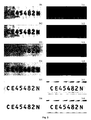
- Fig. 2 shows two histograms. 3 shows individual steps in the sequence according to FIG. 1.
- FIG. 4 outlines the basic procedure for determining the correlation pixels. The The optimal sequence for calculating the correlation image points is outlined in FIG. 5. The Process "Calculate a new correlation point" is described in more detail in FIG. 6.
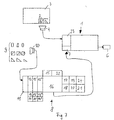
- Fig. 7 schematically shows a device according to the invention.
- the pixels of the characters are smaller Have gray values, i.e. they are darker than the pixels of the background.
- the images can either be inverted or the process adapted accordingly become.
- the method according to the invention for creating correlation pixel sets can include image preprocessing based on the known character templates, also called templates, can be used.
- image preprocessing based on the known character templates, also called templates.
- the calculation of the Correlation pixels based on the possibly pre-processed templates.
- Image preprocessing assumes that the symbols, e.g. Characters, grayscale images are available. An instant binarization where everyone Pixel exactly one binary value would be assigned to very small characters Difficulties cause the finished binary image even with small gray value deviations can be very different in the original picture. But it is according to the invention it is desirable that the templates are in the same template category after the image preprocessing look very similar to each other.
- the image first increased. Additional pixels are generated by an interpolation process. So can the templates in width and height e.g. can be increased by a factor of 2. The The number of pixels then increases fourfold. The factor doesn't necessarily have to be be an integer. The same factor is preferably used for height and width, he but can also be different. By increasing the resolution or The following binarization becomes more precise with the number of pixels.
- very small gray values are replaced by a minimum value.
- very large gray values are replaced by a maximum value.
- This minimal or Maximum values are set differently depending on the application.
- the minimum value is that Gray value from which it can be safely assumed that it is a Character point of the character.
- the maximum value is the gray value from which on Security can be assumed from a background pixel.
- an average filter is applied. For the size of the filter becomes approximate used half the height of the character. With a character height of e.g. 11 Pixels in the original image grow to 22 after doubling the resolution on. A mean filter of size 11x11 is therefore used. Depending on the application a smaller or larger filter may be more suitable.
- the average filtered image is subtracted from the enlarged original image.
- the histogram begins at about 200 gray value and the right one Histogram already at gray value 120. These two values were used as upper threshold values used.
- the gray values of the characters do not form in either histogram pronounced elevation. Instead, there is only one long range of each different gray values with a similar frequency.
- the lower thresholds will be preferably chosen approximately in the middle of these areas or somewhat above.
- the gray values were 130 for the left image and 100 for the right image used.
- a mean filter is applied to the images with the trimmed gray values Size 21x21 applied (304 and 314). Then the difference images between 302 and 304 or calculated between 312 and 314 (305 and 315).
- the freely selected gray value 200 is added to each pixel.
- Fig. 4 outlines the basic procedure for determining the Correlation pixels. For each template category there is a set of correlation pixels calculated. The correlation pixels are determined iteratively. Because of a Correlation measure is made up of a set of Correlation pixel candidate one selected and the set of correlation pixels added. The step is repeated until the correlation pixel set is the has reached the desired size. This is done for each template category.
- the correlation measure is used to assess how good a correlation pixel candidate is supplements the already existing correlation pixel set. The higher the Correlation measure, the more suitable the correlation pixel candidate. This is then the case if the correlation pixel set expanded by the correlation pixel candidate when comparing with templates from the associated template categories good correlation function values and when comparing with templates from other template categories always delivers the lowest possible correlation function values. To do this ensure, is proceeded according to the features of claim 3.
- the characteristics of the Claim 6 are used.
- one for each template category Average template can be calculated. This results from the templates of one Category, by taking the mean value of the gray values of the associated for each pixel position Template pixels are formed. From this mean template a list of Correlation pixel candidates formed, their coordinates and gray values with those of the Mean template match. It is usually beneficial to have more correlation pixel candidates to make available when there are pixels in the mean value template, so also allow non-integer coordinates.
- the associated gray values are obtained from the mean template by interpolation. The higher the number of Correlation pixel candidate, the better the expected result. In return, however, the computing effort increases.
- the correlation measure for a correlation pixel set is a predetermined one or selected function and calculates e.g. the relationship between the best Correlation function value with templates of the non-associated template category and the worst correlation function value with templates of the associated template category, that is, the relationship between the two most critical constellations.
- a high correlation measure means that the correlation pixel set the templates of the associated or own template category well from differentiate between the templates of the other or third-party template category.
- the correlation measure is taken into account hence, in particular, that template of a template category that does not belong, the correlates best with the not yet expanded correlation pixel set. This is the most critical case of the previous iteration step, so to speak.
- a Correlation pixel candidate with regard to this template a particularly good one Differentiation (bad correlation function value) provides, this is in the correlation measure considered.
- the next critical case is then the next correlation pixel especially considered. This way, the critical cases are sequential treated instead of all at once.
- the correlation function also calculates how well the match between a correlation pixel set and a template for a given shift is.
- the displacement determines at which point the Correlation pixel set to be brought into congruence with the template. So will e.g. for each correlation pixel the absolute amount of the gray value difference to associated pixel of the template is calculated.
- the correlation function can then e.g. be the sum of these absolute amounts, the absolute amounts being previously the third Potency could be raised.
- the digit height is 2.5 mm.
- the resolution is 0.25 mm per pixel.
- 100 templates are available for each of the 10 digits.
- the templates are 10x12, i.e. 120 pixels.
- the templates are interpolated around the Factor 2 enlarged in the x and y directions and are then 20x24, i.e. 480 pixels in size.
- the correlation pixel candidates are in obtained a grid twice as fine by interpolation from the mean value templates. The number is therefore 40x48 for each template category, i.e. 1920.
- the correlation function consists of the sum of the third powers of the absolute gray value differences.
- the optimized version gives the same result as the non-optimized version, but with a significantly reduced computing time and represents a preferred embodiment of the invention. According to the invention, the features of the claim come in this case 10 used.
- the correlation pixel set is advantageously in each case only expanded by one, a maximum of two correlation pixel candidates.
- the already contained correlation points remain unchanged. The same applies to their share in Value of the correlation function. Therefore, before testing all correlation pixel candidates are carried out for the not yet expanded correlation pixel set and for each Template combines the calculation with each shift to be examined Storage of the associated correlation function value. Instead of now for everyone Correlation pixel candidates completely recalculate the correlation function values these saved values can be accessed. The new one can be made from them Quickly calculate correlation function value by the proportion for the correlation pixel candidate is added to it. The effort to calculate a Correlation function value is then constant and no longer increases with the size of the Correlation set of pixels.
- Correlation pixel candidate sought that leads to the largest correlation measure.
- For the Calculation of a correlation measure must have the correlation function values for all Combinations of templates and shifts can be calculated. But only that To find correlation pixel candidates with the maximum correlation measure, do not necessarily have the correlation measures for all correlation pixel candidates be calculated. It is often sufficient to measure the correlation values for a few, in extreme cases even to calculate only for a correlation pixel candidate and the correlation measures for all other correlation pixel candidates.
- estimates for a correlation pixel candidate are initially only the correlation function values for the first template of the associated template category and the first template from the set of all other template categories selected. With these correlation function values, a first correlation measure is estimated calculated.
- the correlation function values for the next templates calculated and so on. Either way everyone will Templates examined and thus the actual correlation measure for the Correlation pixel candidate is calculated, or the estimate for the Correlation measure is at some point less than or equal to the correlation measure of the best correlation pixel candidate previously determined. In the latter case, the next correlation pixel candidates are passed over because of the Examination of further templates only a further reduction in the estimate for the Correlation measure value can result, so it is ensured that the Correlation pixel candidate is not more suitable than the best so far.
- This optimization can be increased in its effectiveness by that the templates are determined before the determination of the next correlation point according to their Importance sorted.
- the templates of the associated template category are more important and therefore to be ranked that are high (i.e. bad) with the correlation pixel set Deliver correlation function values.
- the templates of the other template category are more important and therefore to be ranked those that are low with the correlation pixel set (i.e. provide good) correlation function values.
- Image pre-processing This is specially designed for small, low-contrast characters. at large or high-contrast characters can either be omitted (e.g. if already Black and white images are available) or another image preprocessing can be used become.
- Another improvement is achieved in that unlike others Process not a full binarization but only an almost binarization is made. This does not have to be the case with a pixel that is difficult to assess it can be decided whether it is a foreground or background pixel. In this way, unpleasant wrong decisions are avoided.
- the targeted selection can of points are omitted those which do not contribute to character recognition or this even harm.
- the points can also be selected from a very fine grid and thereby be placed precisely.
- the correlation points are calculated in such a way that the small differences that occur in the same character can be tolerated. Such Differences arise e.g. due to pressure or the recording system (e.g. Camera noise).
- the method automatically makes the correlation points this way selected that they come from the most stable parts of the picture. This means areas which vary little in terms of the gray value in all patterns of a character.
- Number of template categories S Number of templates for template category t : D t Template size for the template category t : X t ⁇ Y t Template d for template category t : T t , d ( x , y ), 1 ⁇ t ⁇ S , 1 ⁇ d ⁇ D t , 1 ⁇ x ⁇ X t , 1 ⁇ y ⁇ Y t Average template for template category t : Correlation pixel set with N pixel gray values for the template category t : P t , N ( i ), 1 ⁇ i ⁇ N Coordinates of correlation point i to template category t : ( x t , i , y t , i ) Number of correlation pixel candidates for template category z : C z Gray value of the correlation pixel candidate c for the template category
- T t . d . w k F ( P z . N -1 . T t . d . w k ) +
- Fig. 7 shows schematically an inventive device 8 for performing the inventive method.
- the device 8 is a supplementary or integrated component an examination unit 1 or an independent component, the results of which Corresponding data lines or stored on diskette of the examination unit 1 be fed.
- the examination unit 1 for symbols 2, as it is e.g. in the form of Numbers and / or letters shown on banknotes 3 are used for examination, in particular testing and / or differentiation and / or identification of different symbols, e.g. Letters, numbers, map symbols or the like.
- This Symbols 2 are recorded with an electronic image recording unit 4 and are intended to to be examined. As already mentioned at the beginning, however, this investigation is carried out characteristic pixels are required when examining the corresponding Computing time can be set as short as possible, but without a loss Precision.
- the examination or the correlation of the with the recording unit 4 Symbols 2 recorded takes place in an actual image correlation device 23, which is connected to a Memory 7 with the corresponding correlation pixels, which is determined with the unit 8 were connected.
- a corresponding device 6 is attached to the examination unit 1 for evaluation and / or for optical and / or acoustic display of the measurement results connected.
- the device 8 has an electronic image recording device 10, with the at least for each of the known, predetermined different symbols a pattern 9 is recorded.
- a variety of such each patterns 9 having slight permissible deviations for each symbol 2 added.
- three patterns 9 are shown, which one another and in relation to the actual existing and to be checked symbol 2 have certain deviations, which However, deviations were expressly considered admissible. These deviations were chosen relatively clearly for illustration.
- a variety of patterns specified which may be determined by random samples or randomly from the existing symbols can be selected.
- different three patterns are in the unit 8 template memory 12, 12 ', 12 "is provided. There is one for each different symbol 2 to be examined corresponding number of template memories available.
- the target images recorded by the recording device 10 are shown in a preprocessing device 11 is subjected to a preprocessing step and stored.
- Each template memory 12, 12 ', 12 has a correlation pixel memory 13, 13', 13 "and possibly a correlation pixel candidate memory 14, 14 ', 14" assigned.
- the corresponding calculation steps are carried out in a processor 16, to which a linking unit 15 and a test unit 22 are assigned. affiliated on the processor are further a correlation function memory 17 and Correlation measure memory 18.
- a processor 16 affiliated on the processor are further a correlation function memory 17 and Correlation measure memory 18.
- the correlation function memory 17 are predefined and to be used correlation functions stored.
- Correlation measure memory 24 stores the predetermined correlation measures can be used to determine the correlation measures.
- an averager 19 is provided or a memory 20 in which the dimensions for the respective shift of the correlation image points in With regard to the individual templates of the different template categories are saved.
- the correlation function values of the individual are in a sorting unit 21
- the template or template categories are saved in a row according to their values.
- the correlation function values or the template are sorted with a view to a good one Agreement with the corresponding pixels of the template with regard to Template of your own category and a bad match with the corresponding one Pixel of the template of a foreign template category.
Landscapes
- Engineering & Computer Science (AREA)
- Computer Vision & Pattern Recognition (AREA)
- Theoretical Computer Science (AREA)
- Medical Informatics (AREA)
- Health & Medical Sciences (AREA)
- Databases & Information Systems (AREA)
- Evolutionary Computation (AREA)
- General Health & Medical Sciences (AREA)
- Artificial Intelligence (AREA)
- Software Systems (AREA)
- Computing Systems (AREA)
- Physics & Mathematics (AREA)
- General Physics & Mathematics (AREA)
- Multimedia (AREA)
- Image Analysis (AREA)
- Radar Systems Or Details Thereof (AREA)
- Facsimile Image Signal Circuits (AREA)
- Testing, Inspecting, Measuring Of Stereoscopic Televisions And Televisions (AREA)
Abstract
- dass zur Speicherung der von jedem Symbol (2) aufgenommenen Muster (9), zumindest ein Template-Speicher (12, 12', 12") vorgesehen ist, in dem dieses aufgenommene Soll-Bild eines Symbols (2) als Template in eine diesem Symbol zugeordnete Template-Kategorie eingeordnet ist,
- dass für jede der für die einzelnen Template-Kategorien erstellten KorrelationsBildpunktmengen zumindest ein Korrelationsbildpunkt-Speicher (13, 13', 13") und ein Korrelationsbildpunktkandidaten-Speicher (14, 14', 14") vorgesehen sind,
- dass ein Prozessor (16) vorgesehen ist, in dem jeweils eine für die jeweilige Template-Kategorie anfänglich vorgegebene Ausgangs-Korrelatlonsbildpunktmenge sukzessive durch Hinzufügen von jeweils zumindest einem Korrelationsbildpunktkandidaten aus einer vorgegebenen Menge der gespeicherten Korrelationsbildpunkt-Kandidaten ergänzt wird,
- dass der Prozessor (16) eine Verknüpfungseinheit (15) umfasst, in der Bildpunktwerte der Korrelations-Bildpunkte der jeweiligen Ausgangs-Korrelationsbildpunktmenge und des jeweiligen zugefügten Korrelationsbildpunktkandidaten unter Einsatz einer vorgegebenen Korrelationsfunktion mit Bildpunktwerten von entsprechenden Bildpunkten zumindest eines Templates der zugehörigen sowie der fremden Template-Kategorien verknüpft und die Korrelationsfunktionswerte berechnet werden,
- dass der Prozessor (16) eine Prüfeinheit (22) umfasst, in der für den jeweiligen Korrelationsbildpunktkandidaten überprüft wird, ob die ermittelten Korrelationsfunktionswerte der mit diesem Korrelationsbildpunktkandidaten ergänzten Korrelationsbildpunktmenge mit entsprechenden Bildpunkten der Template der zugehörigen Template-Kategorie eine gute Übereinstimmung und mit entsprechenden Bildpunkten der Template der fremden Template-Kategorien eine schlechte Übereinstimmung ergeben,
- dass vom Prozessor (16) nach Überprüfung der für jede der Template-Kategorien vorgegebenen Menge von Korrelationsbildpunktkandidaten der nach festgelegten Beurteilungs-Kriterien am besten geeignete Korrelationsbildpunktkandidatzur Ausgangs-Korrelatlonsbildpunktmenge der jeweiligen Template-Kategorie hinzugefügt wird, und
- dass das Hinzufügen zumindest eines weiteren Korrelationsbildpunktkandidaten aus der vorgegebenen Menge zu der zuvor mit demam besten geeigneten Korrelationsbildpunktkandidaten ergänzte Korrelationsbildpunktmenge sukzessive fortgesetzt wird, bis ein Abbruchkriterium erreicht ist.
Description
Anzahl der Template-Kategorien: S
Anzahl der Templates zur Template-Kategorie t: Dt
Templategröße zur Template-Kategorie t: Xt × Yt
Template d zur Template-Kategorie t: Tt , d (x,y), 1≤t≤S, 1≤d≤Dt , 1≤x≤Xt ,1≤y≤Yt
Mittelwert-Template zur Template-Kategorie t:
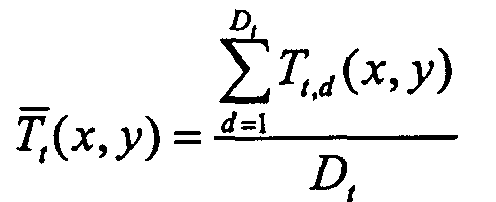
Koordinaten des Korrelationspunktes i zur Template-Kategorie t: (xt , i , yt , i )
Anzahl der Korrelationsbildpunkt-Kandidaten zur Template-Kategorie z: Cz
Grauwert des Korrelationsbildpunkt-Kandidaten c zur Template-Kategorie z: qz , c , 1≤c≤Cz
Koordinaten des Korrelationsbildpunkt-Kandidaten c zur Template-Kategorie z: (xz , c ,yz , c )
Verschiebungen für Korrelations-Bildpunktmengen zu Templates der zugehörigen Template-Kategorie: w andj = (ûj ,v andj ), 1 ≤j≤e
Verschiebungen für Korrelations-Bildpunktmengen zu Templates einer anderen Template-Kategorie: wk = (uk , vk ), 1≤k≤a
Korrelationsfunktion für die Korrelations-Bildpunktmenge Pt , N , das Template Tt,d und die Verschiebung wk :

F(Pt , N ,Tt , d ,wk )=F(Pt , N- 1,Tt , d ,wk )+|Pt , N (N)-Tt , d (xt , N +uk ,yt , N +vk )|γ
Für leere Korrelations-Bildpunktmengen, also für N = 0 gilt per Definition: F(Pt ,0,Tt , d ,wk )=0
Größter Korrelationsfunktionswert zwischen der Korrelations-Bildpunktmenge Pz , N und Templates Tz , d die zur gleichen Template-Kategorie z gehören sowie bezüglich aller Verschiebungen w andj : Ez , N = max F(Pz , N ,Tz , d ,w andj )
Kleinster Korrelationsfunktionswert zwischen der Korrelations-Bildpunktmenge Pz , N , die zur Template-Kategorie z gehört, und allen Templates Tt , d , die nicht zur Template-Kategorie z gehören, sowie bezüglich allen Verschiebungen wk : Az , N = min F(Pz , N ,Tt , d ,wk )
tz , N -1 und dz , N-1 bezeichnen die Template-Kategorie und den Template-Index jenes nicht zur Template-Kategorie z gehörigen Templates, bei dem für die Korrelations-Bildpunktmenge
Pz , N -1 der kleinste Korrelationsfunktionswert erreicht wurde (kritisches Template aus dem letzten Iterationsschritt). Es gilt daher: min F(Pz , N- 1,Ttz , N- 1,dz , N- 1,wk )= Az , N- 1
Kleinster Korrelationsfunktionswert bei diesem Template für die Korrelations-Bildpunktmenge Pz , N : Bz , N =min F(Pz , N ,Ttz , N -1, dz , N -1, k w k )
Das (heuristische gewählte) Korrelationsmaß ist eine Funktion von Az , N , Bz , N und E z, N , sowie dem Gewichtungsfaktor â und dem Exponenten ä: Mz , N = (AZ,N + βBz,N ) δ / max(1,Ez,N ) Für â wird typischerweise ein Wert unter 1 verwendet (z.B. 0.3). Er sollte umso kleiner gewählt werden, je größer die Anzahl S der Template-Kategorien ist (z.B. kann β= 1 / √S verwendet werden). Für ä wird typischerweise der Wert 1 oder 2 verwendet.
für alle zu bestimmenden Korrelationspunkte N = 1...Nt
für alle Verschiebungen für eigene Templates j =1...e
für alle Templates dieser anderen Kategorie d=1...D t
für alle Verschiebungen für andere Templates k =1...a
für alle zu bestimmenden Korrelationspunkte N =1...Nt


falls noch eigenes Template vorhanden:
für alle Verschiebungen für eigene Templates j=1...e
für alle Verschiebungen für andere Templates k = 1...a
für alle Verschiebungen für eigene Templates j =1...e
für alle Templates dieser anderen Kategorie d=1...Dz
für alle Verschiebungen für andere Templates k =1...a
Claims (13)
- Verfahren zur Erstellung von Korrelationsbildpunktmengen, die zur Untersuchung, insbesondere Prüfung und/oder Unterscheidung und/oder Identifizierung, von unterschiedlichen Symbolen, z.B. Buchstaben, Zahlen od.dgl., eingesetzt werden, welche Symbole mit elektronischen Bildaufnahmegeräten aufgenommen werden und in Form von gegebenenfalls vorverarbeiteten, digitalen Ist-Bildern, insbesondere Grauwertbildern, vorliegen, dadurch gekennzeichnet,dass vorab für jedes Symbol zumindest ein, vorzugsweise eine Anzahl, von gegenüber dem jeweiligen Symbol differierendes(n) bzw. zulässige Abweichungen zeigendes(n) Muster(n), aufgenommen wird und diese(s) jeweils aufgenommene(n), gegebenenfalls vorverarbeitete(n), Soll-Bild(er) eines jeden Symbols als Template(s) in eine diesem Symbol zugeordnete bzw. eigene Template-Kategorie eingeordnet wird (werden),dass für jede der einzelnen Template-Kategorien eine eigene bzw. zugehörige Korrelationsbildpunktmenge erstellt wird, indem eine für die jeweilige Template-Kategorie anfänglich vorgegebene Ausgangs-Korrelationsbildpunktmenge sukzessive durch Hinzufügen von zumindest einem Korrelationsbildpunktkandidaten aus einer vorgegebenen Menge von Korrelationsbildpunktkandidaten ergänzt wird,dass Bildpunktwerte der, insbesondere lagemäßig zueinander festgelegten, Korrelations-Bildpunkte der jeweiligen Ausgangs-Korrelationsbildpunktmenge und des(r) jeweiligen zugefügten Korrelationsbildpunktkandidaten unter Einsatz einer vorgegebenen bzw. gewählten Korrelationsfunktion mit Bildpunktwerten von entsprechenden, insbesondere dieselbe lagemäßige Zuordnung besitzenden, Bildpunkten zumindest eines, vorzugsweise einer Anzahl, insbesondere aller, Templates der zugehörigen sowie der fremden Template-Kategorien verknüpft und die Korrelationsfunktionswerte berechnet werden,dass für den (die) jeweils hinzugefügten Korrelationsbildpunktkandidaten überprüft wird, ob die ermittelten Korrelationsfunktionswerte der mit diesem(n) Korrelationsbildpunktkandidaten ergänzten Korrelationsbildpunktmenge mit entsprechenden Bildpunkten der Templates der zugehörigen Template-Kategorie eine gute Übereinstimmung und mit entsprechenden Bildpunkten der Templates der fremden Template-Kategorien eine schlechte Übereinstimmung ergeben,dass nach Überprüfung der für jede der Template-Kategorien vorgegebenen Menge von Korrelationsbildpunktkandidaten der (die) nach festgelegten Beurteilungs-Kriterien am besten geeignete(n) Korrelationsbildpunktkandidat(en), insbesondere derjenige mit dem besten Korrelationsmaßwert, zur Ausgangs-Korrelationsbildpunktmenge der jeweiligen Template-Kategorie hinzugefügt wird,dass für jede Template-Kategorie das jeweilige Hinzufügen zumindest eines weiteren Korrelationsbildpunkt-Kandidaten aus der für sie vorgegebenen Menge der Korrelationsbildpunkt-Kandidaten zu der zuvor mit dem(n) am besten geeigneten Korrelationsbildpunkt-Kandidaten ergänzten - nunmehr die Ausgangs-Korrelationsbildpunktmenge darstellenden - Korrelationsbildpunktmenge, die jeweilige Überprüfung dieser neu ergänzten Korrelationsbildpunktmengen und die Auswahl und das Hinzufügen des(r) als am besten geeigneten Korrelationsbildpunkte(s) zu dieser Korrelationsbildpunktmenge sukzessive fortgesetzt bzw. solange wiederholt wird, bis ein Abbruchkriterium, z.B. eine geforderte Anzahl von Korrelationsbildpunkten erreicht wird,dass bei der Untersuchung der Ist-Bilder der Symbole vorzugsweise jedes aufgenommene Ist-Bild jedes einzelnen Symbols mit jeder der für die Template-Kategorien der unterschiedlichen Symbole ermittelten Korrelationsbildpunktmengen korreliert wird unddass die damit ermittelten Symbol-Korrelationsfunktionswerte zur Ermittlung der Prüfergebnisse und/oder zur Unterscheidung und/oder zur Identifizierung der Symbole herangezogen werden.
- Verfahren nach Anspruch 1, dadurch gekennzeichnet,dass in einem Vorverarbeitungsschritt die in Form digitalisierter Soll-Bilder vorliegenden Templates der Symbole vergrößert werden, wobei gegebenenfalls durch Interpolation der Grauwerte die Grauwerte von weiteren notwendigen bzw. hinzugefügten Bildpunkten erzeugt werden,dass kleine Grauwerte durch einen Minimalwert und große Grauwerte durch einen Maximalwert ersetzt werden,dass auf jedes so erhaltene Bild ein Mittelwertfilter angewendet wird und das mittelwertgefilterte Bild mit dem vergrößerten ursprünglichen Bild verknüpft, insbesondere von diesem subtrahiert wird,dass die resultierenden Bilder binarisiert, vorzugsweise einer Beinahe-Binarisierung unterzogen werden, unddass diese binarisierten oder beinahe-binarisierten Bilder als Templates des Symbols in die Template-Kategorie dieses Symbols eingeordnet werden.
- Verfahren nach Anspruch 1 oder 2, dadurch gekennzeichnet,dass für den jeweiligen Korrelationsbildpunktkandidaten als Beurteilungs-Kriterium für seine Tauglichkeit, der Ausgangs-Korrelationsbildpunktmenge hinzugefügt zu werden, ein Korrelationsmaßwert ermittelt bzw. errechnet wird, wobei das Korrelationsmaß eine vorgegebene bzw. gewählte Funktion, vorzugsweise das Verhältnis, von dem besten Korrelationsfunktionswert der um den jeweiligen Korrelationsbildpunktkandidaten ergänzten Ausgangs-Korrelationsbildpunktmenge mit den Templates der fremden Template-Kategorien und von dem schlechtesten Korrelationsfunktionswert mit den Templates der zugehörigen Template-Kategorie darstellt,dass der jeweiligen Ausgangs-Korrelationsbildpunktmenge der einzelnen Template-Kategorien derjenige Korrelationsbildpunktkandidat hinzugefügt wird, für den für diese Template-Kategorie der beste, vorzugsweise größte, Korrelationsmaßwert unter allen untersuchten Korrelationsbildpunktkandidaten der vorgegebenen Menge ermittelt wurde unddass das sukzessive Hinzfügen von Korrelationsbildpunktkandidaten wiederholt wird, bis ein vorgegebenes Abbruchkriterium erreicht wurde, z.B. die Korrelationsbildpunktmenge eine vorgegebene Anzahl von Korrelations-Bildpunkten enthält oder ein vorgegebener minimaler Korrelationsmaßwert für diese ergänzte Korrelationsbildpunktmenge erreicht wurde.
- Verfahren nach einem der Ansprüche 1 bis 3, dadurch gekennzeichnet,dass die Template-Kategorie oder das in dieser Template-Kategorie enthaltene Template bestimmt wird, die (das) für die Ausgangs-Korrelationsbildpunktmenge den besten Korrelationsfunktionswert in Bezug auf die Templates aller fremden Template-Kategorien ergeben hat unddass für jede mit einem Korrelationsbildpunktkandidaten ergänzte Korrelationsbildpunktmenge der Korrelationsfunktionswert für diese Template-Kategorie bzw. für dieses Template zusätzlich ermittelt wird und dieser zusätzlich ermittelte Korrelationsfunktionswert gemeinsam mit dem ermittelten besten und schlechtesten Korrelationsfunktionswert zur Ermittlung des Korrelationsmaßwertes herangezogen wird.
- Verfahren nach Anspruch 4, dadurch gekennzeichnet, dass vor der Anwendung bzw. Ermittlung des Korrelationsmaßes der Korrelationsfunktionswert für die fremden Template-Kategorie und der zusätzlich ermittelte Korrelationsfunktionswert gewichtet und addiert werden.
- Verfahren nach einem der Ansprüche 1 bis 5, dadurch gekennzeichnet,dass für jede Template-Kategorie ein Mittelwert-Template erstellt bzw. errechnet wird, indem für jede Bildpunkt-Position ein Mittelwert der Grauwerte der Templates dieser Template-Kategorie gebildet wird unddass die Korrelationsbildpunktkandidaten für diese Template-Kategorie aus diesen Bildpunkten ausgewählt und/oder mit diesen Bildpunkten, z.B. durch Interpolation berechnet werden.
- Verfahren nach einem der Ansprüche 1 bis 6, dadurch gekennzeichnet, dass bei Ermittlung der Korrelationsfunktionswerte der mit einem Korrelationsbildpunktkandidaten ergänzten Korrelationsbildpunktmenge mit den entsprechenden Bildpunkten der Templates der zugehörigen Template-Kategorie zusätzliche Korrelationsfunktionswerte für die in vorgegebenen Richtungen und Abständen zu den entsprechenden Bildpunkten verschoben bzw. versetzt angeordneten Korrelationsbildpunktmengen ermittelt werden.
- Verfahren nach einem der Ansprüche 1 bis 6, dadurch gekennzeichnet, dass bei Ermittlung der Korrelationsfunktionswerte der mit einem Korrelationsbildpunktkandidaten ergänzten Korrelationsbildpunktmenge mit den entsprechenden Bildpunkten der Templates der fremden Template-Kategorien zusätzliche Korrelationsfunktionswerte für die in vorgegebenen Richtungen und Abständen zu den entsprechenden Bildpunkten verschoben bzw. versetzt angeordneten Korrelationsbildpunktmengen ermittelt werden.
- Verfahren nach Anspruch 7 oder 8, dadurch gekennzeichnet, dass die Richtung und Abstände für die Verschiebungen der Korrelationsbildpunktmengen für alle zugehörigen Template-Kategorien untereinander gleich sind und für alle fremden Template-Kategorien untereinander gleich sind.
- Verfahren nach einem der Ansprüche 1 bis 9, dadurch gekennzeichnet,dass die Templates der eigenen Template-Kategorie, d.h. einer Template-Kategorie, deren Korrelationsbildpunktmenge gerade untersucht wird, und getrennt davon, die Templates aller fremden Template-Kategorien nach der Größe der für die jeweiligen Templates ermittelten Korrelationsfunktionswerte bezüglich der dieser eigenen Template-Kategorie zugeordneten Korrelationsbildpunktmenge sortiert werden,dass dieser Ausgangs-Korrelationsbildpunktmenge aus der der eigenen Template-Kategorie zugeordneten Menge von Korrelationsbildpunktkandidaten zumindest ein Korrelationsbildpunktkandidat hinzugefügt wird und die Korrelationsfunktionswerte in Bezug auf alle vorhandenen Templates ermittelt werden und mit diesen Korrelationsfunktionswerten durch Anwendung des Korrelationsmaßes ein Ausgangs-Korrelationsmaßwert bestimmt wird,dass dieser Ausgangs-Korrelationsbildpunktmenge aus der der zu untersuchenden Template-Kategorie zugeordneten Menge von Korrelationsbildpunktkandidaten zumindest ein weiterer Korrelationsbildpunktkandidat hinzugefügt wird und die Korrelationsfunktionswerte der erweiterten Menge mit dem an erster Stelle gereihten Template der eigenen Template-Kategorie und mit dem an letzter Stelle gereihten Template der fremden Template-Kategorien und gegebenenfalls mit dem an letzter Stelle gereihten Template einer zusätzlich ausgewählten, fremden Template-Kategorie ermittelt werden, und mit diesen Korrelationsfunktionswerten ein Korrelationsmaßschätzwert ermittelt wird,dass - sofern der ermittelte Korrelationsmaßschätzwert besser ist als der Ausgangs-Korrelationsmaßwert - die Untersuchung der Templates fortgesetzt wird, indem für das jeweils dem zuletzt untersuchten Template folgende Template der eigenen und der fremden und gegebenenfalls der zusätzlichen Template-Kategorie die Korrelationsfunktionswerte und ein Korrelationsmaßschätzwert ermittelt werden,wobei für die Ermittlung des Korrelationsmaßschätzwertes aus den für die eigene Template-Kategorie bereits ermittelten Korrelationsfunktionswerten der maximale Korrelationsfunktionswert und aus den für die fremden bzw. gegebenenfalls zusätzlichen Template-Kategorien bereits ermittelten Korrelationsfunktionswerten der minimale Korrelationsfunktionswert herangezogen wird,dass die Ermittlung von weiteren Korrelationsmaßschätzwerten so lange für die einzelnen, der Größe nach gereihten Templates der eigenen Template-Kategorie und aller fremden Template-Kategorien weitergeführt wird, bis ein Abbruchkriterium erreicht wird,wobei die Untersuchung weiterer Templates der eigenen bzw. der fremden Template-Kategorien bzw. die Ermittlung weiterer Korrelationsfunktionswerte für einen Korrelationsbildpunktkandidaten unterbleibt und dieser untersuchte Korrelationsbildpunktkandidat aus der Untersuchung ausgeschieden wird, wenn ein für die mit diesem Korrelationsbildpunktkandidaten erweiterte Menge ermittelter Korrelationsmaßschätzwert nicht besser als der Ausgangs-Korrelationsmaßwert ist, oder bis alle Templates untersucht sind,dass die Untersuchung sodann mit zumindest einem weiteren Korrelationsbildpunktkandidaten derselben Menge in derselben Weise jeweils unter Zugrundelegung des besten bisher ermittelten Korrelationsmaßwertes als Ausgangs-Korrelationsmaßwert fortgesetzt wird, bis alle für die eigene Template-Kategorie vorhandenen Korrelationsbildpunktkandidaten untersucht wurden, worauf der Korrelationsbildpunktkandidat mit dem besten Korrelationsmaßwert der Korrelationsbildpunktmenge hinzugefügt wird, unddass daraufhin die Untersuchung in der beschriebenen Weise mit der um diese(n) Korrelationsbildpunktkandidaten erweiterten Korrelationsbildpunktmenge als Ausgangs-Korrelationsbildpunktmenge für die eigene Template-Kategorie fortgesetzt wird, bis ein weiteres Abbruchkriterium, z.B. die geforderte Anzahl von Korrelationsbildpunkten in der Korrelationsbildpunktmenge erreicht ist,worauf dieselbe Untersuchung in der gleichen Weise für die nächste Template-Kategorie fortgesetzt wird, die nunmehr als die "eigene" Template-Kategorie angesehen wird.
- Einrichtung zur Erstellung von Korrelationsbildpunktmengen, die zur Untersuchung, insbesondere Prüfung und/oder Unterscheidung und/oder Identifizierung, von unterschiedlichen Symbolen, z.B. Buchstaben, Zahlen od.dgl., eingesetzt werden, welche Symbole mit elektronischen Bildaufnahmegeräten aufgenommen werden und in Form von gegebenenfalls vorverarbeiteten, digitalen Ist-Bildern, insbesondere Grauwertbildern, vorliegen, insbesondere zur Durchführung des Verfahrens nach einem der Ansprüche 1 bis 10, dadurch gekennzeichnet,dass zur Speicherung der(s) von jedem Symbol (2) aufgenommenen Muster(s) (9), vorzugsweise einer Anzahl von differierenden bzw. zulässige Abweichungen zeigenden Mustern (9), zumindest ein Template-Speicher (12, 12', 12") vorgesehen ist, in dem diese(s) jeweils aufgenommene(n), gegebenenfalls vorverarbeitete(n), Soll-Bild(er) eines Symbols (2) als Template(s) in eine diesem Symbol zugeordnete Template-Kategorie eingeordnet ist (sind),dass für jede der für die einzelnen Template-Kategorien erstellten Korrelations-Bildpunktmengen zumindest ein Korrelationsbildpunkt-Speicher (13, 13', 13") und ein Korrelationsbildpunktkandidaten-Speicher (14, 14', 14") vorgesehen sind,dass ein Prozessor (16) vorgesehen ist, in dem jeweils eine für die jeweilige Template-Kategorie anfänglich vorgegebene Ausgangs-Korrelationsbildpunktmenge sukzessive durch Hinzufügen von jeweils zumindest einem Korrelationsbildpunktkandidaten aus einer vorgegebenen Menge der gespeicherten Korrelationsbildpunkt-Kandidaten ergänzt wird,dass der Prozessor (16) eine Verknüpfungseinheit (15) umfasst, in der Bildpunktwerte der, insbesondere lagemäßig zueinander festgelegten, Korrelations-Bildpunkte der jeweiligen Ausgangs-Korrelationsbildpunktmenge und des(r) jeweiligen zugefügten Korrelationsbildpunktkandidaten unter Einsatz einer vorgegebenen, gegebenenfalls in einem Korrelationsfunktions-Speicher (17) gespeicherten, Korrelationsfunktion mit Bildpunktwerten von entsprechenden, insbesondere dieselbe lagemäßige Zuordnung besitzenden, Bildpunkten zumindest eines, vorzugsweise einer Anzahl, insbesondere aller Templates der zugehörigen sowie der fremden Template-Kategorien verknüpft und die Korrelationsfunktionswerte berechnet werden,dass der Prozessor (16) eine Prüfeinheit (22) umfasst, in der für den (die) jeweiligen Korrelationsbildpunktkandidaten überprüft wird, ob die ermittelten Korrelationsfunktionswerte der mit diesem(n) Korrelationsbildpunktkandidaten ergänzten Korrelationsbildpunktmenge mit entsprechenden Bildpunkten der Template der zugehörigen Template-Kategorie eine gute Übereinstimmung und mit entsprechenden Bildpunkten der Template der fremden Template-Kategorien eine schlechte Übereinstimmung ergeben,dass vom Prozessor (16) nach Überprüfung der für jede der Template-Kategorien vorgegebenen Menge von Korrelationsbildpunktkandidaten der (die) nach festgelegten Beurteilungs-Kriterien am besten geeignete(n) Korrelationsbildpunktkandidat(en) zur Ausgangs-Korrelationsbildpunktmenge der jeweiligen Template-Kategorie hinzugefügt wird (werden), unddass das Hinzufügen zumindest eines weiteren Korrelationsbildpunktkandidaten aus der vorgegebenen Menge zu der zuvor mit dem(n) am besten geeigneten Korrelationsbildpunktkandidaten ergänzte Korrelationsbildpunktmenge sukzessive fortgesetzt wird, bis ein Abbruchkriterium erreicht ist.
- Einrichtung nach Anspruch 11, dadurch gekennzeichnet,dass der Prozessor (16) eine Korrelationsmaßwert-Ermittlungseinheit umfasst, mit der die für jede Template-Kategorie anfänglich vorgegebene Ausgangs-Korrelationsbildpunktmenge sukzessive jeweils mit zumindest einem Korrelationsbildpunktkandidaten erweitert wird, indem für den jeweiligen Korrelationsbildpunktkandidaten als Beurteilungs-Kriterium für seine Tauglichkeit, der Ausgangs-Korrelationsbildpunktmenge hinzugefügt zu werden, ein Korrelationsmaßwert ermittelt bzw. errechnet wird, wobei das Korrelationsmaß eine Funktion, vorzugsweise das Verhältnis, von dem besten Korrelationsfunktionswert der um den jeweiligen Korrelationsbildpunktkandidaten ergänzten Ausgangs-Korrelationsbildpunktmenge mit den Templates der fremden Template-Kategorie und von dem schlechtesten Korrelationsfunktionswert mit den Templates der zugehörigen Template-Kategorie darstellt,dass der Prozessor (16) der jeweiligen Ausgangs-Korrelationsbildpunktmenge der einzelnen Template-Kategorien diejenigen Korrelationsbildpunkt-Kandidaten hinzufügt, für die für diese Template-Kategorie der beste, vorzugsweise größte, Korrelationsmaßwert unter allen untersuchten Korrelationsbildpunktkandidaten der vorgegebenen Menge ermittelt wurde unddass der Prozessor (16) das sukzessive Hinzfügen von Korrelationsbildpunktkandidaten wiederholt, bis ein vorgegebenes Abbruchkriterium erreicht wurde, z.B. eine vorgegebene Anzahl von Korrelations-Bildpunkten in der Korrelationsbildpunktmenge oder ein vorgegebener minimaler Korrelationsmaßwert für die ergänzte Korrelationsbildpunktmenge.
- Einrichtung nach Anspruch 11 oder 12, dadurch gekennzeichnet, dass der Prozessor (16) eine Einheit (21), z.B. Vergleicher, zur Bestimmung des besten Korrelationsfunktionswertes und des schlechtesten Korrelationsfunktionswertes der Templates und Korrelationsbildpunktmengen umfasst.
Priority Applications (1)
| Application Number | Priority Date | Filing Date | Title |
|---|---|---|---|
| AT01890224T ATE347147T1 (de) | 2000-08-10 | 2001-08-02 | Verfahren und einrichtung zur erstellung von korrelations-bildpunktmengen |
Applications Claiming Priority (2)
| Application Number | Priority Date | Filing Date | Title |
|---|---|---|---|
| AT13862000 | 2000-08-10 | ||
| AT0138600A AT414177B (de) | 2000-08-10 | 2000-08-10 | Verfahren und einrichtung zur erstellung von korrelations-bildpunktmengen |
Publications (3)
| Publication Number | Publication Date |
|---|---|
| EP1179802A2 true EP1179802A2 (de) | 2002-02-13 |
| EP1179802A3 EP1179802A3 (de) | 2004-10-06 |
| EP1179802B1 EP1179802B1 (de) | 2006-11-29 |
Family
ID=3688176
Family Applications (1)
| Application Number | Title | Priority Date | Filing Date |
|---|---|---|---|
| EP01890224A Expired - Lifetime EP1179802B1 (de) | 2000-08-10 | 2001-08-02 | Verfahren und Einrichtung zur Erstellung von Korrelations-Bildpunktmengen |
Country Status (3)
| Country | Link |
|---|---|
| EP (1) | EP1179802B1 (de) |
| AT (2) | AT414177B (de) |
| DE (1) | DE50111525D1 (de) |
Family Cites Families (6)
| Publication number | Priority date | Publication date | Assignee | Title |
|---|---|---|---|---|
| US3626368A (en) * | 1969-01-13 | 1971-12-07 | Hsing Chu Lee | Character-reading apparatus including improved character set sensing structure |
| US5040133A (en) * | 1990-01-12 | 1991-08-13 | Hughes Aircraft Company | Adaptive clusterer |
| TW197509B (de) * | 1990-01-31 | 1993-01-01 | Hitachi Seisakusyo Kk | |
| AUPN310195A0 (en) * | 1995-05-22 | 1995-06-15 | Canon Kabushiki Kaisha | Template formation method |
| AUPN310095A0 (en) * | 1995-05-22 | 1995-06-15 | Canon Kabushiki Kaisha | Image detection system |
| US5912988A (en) * | 1996-12-27 | 1999-06-15 | Xytec Corporation | Image processing method and apparatus for distortion compensation |
-
2000
- 2000-08-10 AT AT0138600A patent/AT414177B/de not_active IP Right Cessation
-
2001
- 2001-08-02 AT AT01890224T patent/ATE347147T1/de not_active IP Right Cessation
- 2001-08-02 EP EP01890224A patent/EP1179802B1/de not_active Expired - Lifetime
- 2001-08-02 DE DE50111525T patent/DE50111525D1/de not_active Expired - Lifetime
Also Published As
| Publication number | Publication date |
|---|---|
| DE50111525D1 (de) | 2007-01-11 |
| EP1179802A3 (de) | 2004-10-06 |
| AT414177B (de) | 2006-09-15 |
| ATA13862000A (de) | 2005-12-15 |
| ATE347147T1 (de) | 2006-12-15 |
| EP1179802B1 (de) | 2006-11-29 |
Similar Documents
| Publication | Publication Date | Title |
|---|---|---|
| DE3851173T2 (de) | Verfahren und Gerät zur Erkennung von Halbtonbildmustern. | |
| DE69604481T2 (de) | Verfahren und gerät zum trennen des vordergrunds und hintergrunds in textenthaltenden bildern | |
| DE19521346C2 (de) | Bilduntersuchungs/-Erkennungsverfahren, darin verwendetes Verfahren zur Erzeugung von Referenzdaten und Vorrichtungen dafür | |
| DE4103229C2 (de) | ||
| EP2187351B1 (de) | Verfahren und Vorrichtung zum Erkennen von Objekten | |
| DE3515159C2 (de) | ||
| WO1996019778A1 (de) | Verfahren zur trennung einer vordergrundinformation von einer hintergrundinformation in einer vorlage | |
| DE102004004528A1 (de) | Verfahren, Vorrichtung und Programm zur Verarbeitung eines Stereobildes | |
| CH627571A5 (de) | Vorrichtung und verfahren zur bestimmung charakteristischer einzelheiten in einem elektronisch abgetasteten bildmuster. | |
| EP3287951B1 (de) | Verfahren für die urheberschaftsbewertung eines gemäldes | |
| DE102008023915A1 (de) | Verfahren zur Einstellung von wenigstens einer Stellgröße eines Entrauschungsfilters in medizinischen Bildern | |
| DE69331518T2 (de) | Neuronales Netz zum Vergleich von Merkmalen von Bildmustern | |
| EP0753231B1 (de) | Verfahren und vorrichtung zum binarisieren von pixel-daten | |
| DE202021102338U1 (de) | Steuergerät zum Erzeugen von Trainingsdaten zum Trainieren eines Algorithmus des maschinellen Lernens | |
| EP1897067B1 (de) | Verfahren und vorrichtung zur erkennung einer münze unter verwendung ihres prägebildes | |
| EP1179802B1 (de) | Verfahren und Einrichtung zur Erstellung von Korrelations-Bildpunktmengen | |
| EP3655920B1 (de) | Verfahren und vorrichtung zur bewertung von bildausschnitten für eine korrespondenzbildung | |
| DE60030528T2 (de) | Verfahren und Vorrichtung zur Farbquantelung | |
| EP2096578A2 (de) | Verfahren und Vorrichtung zur Charakterisierung der Formation von Papier | |
| DE10326031A1 (de) | Verfahren zur adaptiven Kantenerkennung | |
| DE19536170A1 (de) | Ermittlung von Schwellwerten bei der Digitalisierung von Bildern durch eine Verteilungsanalyse der Informationen | |
| DE102005025220A1 (de) | Gerät, Verfahren und Programm zum Beseitigen von Poren | |
| EP1505541A2 (de) | Verfahren zum Selbsttest eines Bildverarbeitungssystems | |
| DE10024559B4 (de) | Verfahren zur Erkennung von Objekten | |
| DE19810162C2 (de) | Verfahren zur Bildanalyse nach stochastischen Eigenschaften |
Legal Events
| Date | Code | Title | Description |
|---|---|---|---|
| PUAI | Public reference made under article 153(3) epc to a published international application that has entered the european phase |
Free format text: ORIGINAL CODE: 0009012 |
|
| AK | Designated contracting states |
Kind code of ref document: A2 Designated state(s): AT BE CH CY DE DK ES FI FR GB GR IE IT LI LU MC NL PT SE TR |
|
| AX | Request for extension of the european patent |
Free format text: AL;LT;LV;MK;RO;SI |
|
| PUAL | Search report despatched |
Free format text: ORIGINAL CODE: 0009013 |
|
| AK | Designated contracting states |
Kind code of ref document: A3 Designated state(s): AT BE CH CY DE DK ES FI FR GB GR IE IT LI LU MC NL PT SE TR |
|
| AX | Request for extension of the european patent |
Extension state: AL LT LV MK RO SI |
|
| RIC1 | Information provided on ipc code assigned before grant |
Ipc: 7G 06K 9/62 B Ipc: 7G 06K 9/64 A Ipc: 7G 06K 9/38 B |
|
| 17P | Request for examination filed |
Effective date: 20050311 |
|
| 17Q | First examination report despatched |
Effective date: 20050511 |
|
| AKX | Designation fees paid |
Designated state(s): AT BE CH CY DE DK ES FI FR GB GR IE IT LI LU MC NL PT SE TR |
|
| GRAP | Despatch of communication of intention to grant a patent |
Free format text: ORIGINAL CODE: EPIDOSNIGR1 |
|
| GRAS | Grant fee paid |
Free format text: ORIGINAL CODE: EPIDOSNIGR3 |
|
| GRAA | (expected) grant |
Free format text: ORIGINAL CODE: 0009210 |
|
| AK | Designated contracting states |
Kind code of ref document: B1 Designated state(s): AT BE CH CY DE DK ES FI FR GB GR IE IT LI LU MC NL PT SE TR |
|
| PG25 | Lapsed in a contracting state [announced via postgrant information from national office to epo] |
Ref country code: IT Free format text: LAPSE BECAUSE OF FAILURE TO SUBMIT A TRANSLATION OF THE DESCRIPTION OR TO PAY THE FEE WITHIN THE PRESCRIBED TIME-LIMIT;WARNING: LAPSES OF ITALIAN PATENTS WITH EFFECTIVE DATE BEFORE 2007 MAY HAVE OCCURRED AT ANY TIME BEFORE 2007. THE CORRECT EFFECTIVE DATE MAY BE DIFFERENT FROM THE ONE RECORDED. Effective date: 20061129 Ref country code: NL Free format text: LAPSE BECAUSE OF FAILURE TO SUBMIT A TRANSLATION OF THE DESCRIPTION OR TO PAY THE FEE WITHIN THE PRESCRIBED TIME-LIMIT Effective date: 20061129 Ref country code: IE Free format text: LAPSE BECAUSE OF FAILURE TO SUBMIT A TRANSLATION OF THE DESCRIPTION OR TO PAY THE FEE WITHIN THE PRESCRIBED TIME-LIMIT Effective date: 20061129 Ref country code: FI Free format text: LAPSE BECAUSE OF FAILURE TO SUBMIT A TRANSLATION OF THE DESCRIPTION OR TO PAY THE FEE WITHIN THE PRESCRIBED TIME-LIMIT Effective date: 20061129 |
|
| REG | Reference to a national code |
Ref country code: GB Ref legal event code: FG4D Free format text: NOT ENGLISH |
|
| REG | Reference to a national code |
Ref country code: IE Ref legal event code: FG4D Free format text: LANGUAGE OF EP DOCUMENT: GERMAN Ref country code: CH Ref legal event code: EP |
|
| REG | Reference to a national code |
Ref country code: IE Ref legal event code: FG4D Free format text: LANGUAGE OF EP DOCUMENT: GERMAN |
|
| REF | Corresponds to: |
Ref document number: 50111525 Country of ref document: DE Date of ref document: 20070111 Kind code of ref document: P |
|
| PG25 | Lapsed in a contracting state [announced via postgrant information from national office to epo] |
Ref country code: SE Free format text: LAPSE BECAUSE OF FAILURE TO SUBMIT A TRANSLATION OF THE DESCRIPTION OR TO PAY THE FEE WITHIN THE PRESCRIBED TIME-LIMIT Effective date: 20070228 Ref country code: DK Free format text: LAPSE BECAUSE OF FAILURE TO SUBMIT A TRANSLATION OF THE DESCRIPTION OR TO PAY THE FEE WITHIN THE PRESCRIBED TIME-LIMIT Effective date: 20070228 |
|
| PG25 | Lapsed in a contracting state [announced via postgrant information from national office to epo] |
Ref country code: ES Free format text: LAPSE BECAUSE OF FAILURE TO SUBMIT A TRANSLATION OF THE DESCRIPTION OR TO PAY THE FEE WITHIN THE PRESCRIBED TIME-LIMIT Effective date: 20070312 |
|
| PG25 | Lapsed in a contracting state [announced via postgrant information from national office to epo] |
Ref country code: PT Free format text: LAPSE BECAUSE OF FAILURE TO SUBMIT A TRANSLATION OF THE DESCRIPTION OR TO PAY THE FEE WITHIN THE PRESCRIBED TIME-LIMIT Effective date: 20070430 |
|
| NLV1 | Nl: lapsed or annulled due to failure to fulfill the requirements of art. 29p and 29m of the patents act | ||
| GBV | Gb: ep patent (uk) treated as always having been void in accordance with gb section 77(7)/1977 [no translation filed] |
Effective date: 20061129 |
|
| REG | Reference to a national code |
Ref country code: IE Ref legal event code: FD4D |
|
| EN | Fr: translation not filed | ||
| PLBE | No opposition filed within time limit |
Free format text: ORIGINAL CODE: 0009261 |
|
| STAA | Information on the status of an ep patent application or granted ep patent |
Free format text: STATUS: NO OPPOSITION FILED WITHIN TIME LIMIT |
|
| 26N | No opposition filed |
Effective date: 20070830 |
|
| PG25 | Lapsed in a contracting state [announced via postgrant information from national office to epo] |
Ref country code: GB Free format text: LAPSE BECAUSE OF FAILURE TO SUBMIT A TRANSLATION OF THE DESCRIPTION OR TO PAY THE FEE WITHIN THE PRESCRIBED TIME-LIMIT Effective date: 20061129 |
|
| BERE | Be: lapsed |
Owner name: OSTERREICHISCHES FORSCHUNGSZENTRUM SEIBERSDORF GE Effective date: 20070831 |
|
| REG | Reference to a national code |
Ref country code: CH Ref legal event code: PL |
|
| PG25 | Lapsed in a contracting state [announced via postgrant information from national office to epo] |
Ref country code: FR Free format text: LAPSE BECAUSE OF FAILURE TO SUBMIT A TRANSLATION OF THE DESCRIPTION OR TO PAY THE FEE WITHIN THE PRESCRIBED TIME-LIMIT Effective date: 20070720 Ref country code: LI Free format text: LAPSE BECAUSE OF NON-PAYMENT OF DUE FEES Effective date: 20070831 Ref country code: MC Free format text: LAPSE BECAUSE OF NON-PAYMENT OF DUE FEES Effective date: 20070831 Ref country code: CH Free format text: LAPSE BECAUSE OF NON-PAYMENT OF DUE FEES Effective date: 20070831 Ref country code: GR Free format text: LAPSE BECAUSE OF FAILURE TO SUBMIT A TRANSLATION OF THE DESCRIPTION OR TO PAY THE FEE WITHIN THE PRESCRIBED TIME-LIMIT Effective date: 20070301 |
|
| PG25 | Lapsed in a contracting state [announced via postgrant information from national office to epo] |
Ref country code: BE Free format text: LAPSE BECAUSE OF NON-PAYMENT OF DUE FEES Effective date: 20070831 |
|
| PG25 | Lapsed in a contracting state [announced via postgrant information from national office to epo] |
Ref country code: AT Free format text: LAPSE BECAUSE OF NON-PAYMENT OF DUE FEES Effective date: 20070802 Ref country code: FR Free format text: LAPSE BECAUSE OF FAILURE TO SUBMIT A TRANSLATION OF THE DESCRIPTION OR TO PAY THE FEE WITHIN THE PRESCRIBED TIME-LIMIT Effective date: 20061129 |
|
| PG25 | Lapsed in a contracting state [announced via postgrant information from national office to epo] |
Ref country code: LU Free format text: LAPSE BECAUSE OF NON-PAYMENT OF DUE FEES Effective date: 20070802 Ref country code: CY Free format text: LAPSE BECAUSE OF FAILURE TO SUBMIT A TRANSLATION OF THE DESCRIPTION OR TO PAY THE FEE WITHIN THE PRESCRIBED TIME-LIMIT Effective date: 20061129 |
|
| PG25 | Lapsed in a contracting state [announced via postgrant information from national office to epo] |
Ref country code: TR Free format text: LAPSE BECAUSE OF FAILURE TO SUBMIT A TRANSLATION OF THE DESCRIPTION OR TO PAY THE FEE WITHIN THE PRESCRIBED TIME-LIMIT Effective date: 20061129 |
|
| PGFP | Annual fee paid to national office [announced via postgrant information from national office to epo] |
Ref country code: DE Payment date: 20200819 Year of fee payment: 20 |
|
| REG | Reference to a national code |
Ref country code: DE Ref legal event code: R071 Ref document number: 50111525 Country of ref document: DE |