EP1180888A2 - Méthode d'établissement d'une connection de données entre deux ordinateurs et dispositif d'échange de données - Google Patents
Méthode d'établissement d'une connection de données entre deux ordinateurs et dispositif d'échange de données Download PDFInfo
- Publication number
- EP1180888A2 EP1180888A2 EP01117514A EP01117514A EP1180888A2 EP 1180888 A2 EP1180888 A2 EP 1180888A2 EP 01117514 A EP01117514 A EP 01117514A EP 01117514 A EP01117514 A EP 01117514A EP 1180888 A2 EP1180888 A2 EP 1180888A2
- Authority
- EP
- European Patent Office
- Prior art keywords
- computing unit
- unit
- computing
- address
- arithmetic
- Prior art date
- Legal status (The legal status is an assumption and is not a legal conclusion. Google has not performed a legal analysis and makes no representation as to the accuracy of the status listed.)
- Granted
Links
Images

Classifications
-
- H—ELECTRICITY
- H04—ELECTRIC COMMUNICATION TECHNIQUE
- H04L—TRANSMISSION OF DIGITAL INFORMATION, e.g. TELEGRAPHIC COMMUNICATION
- H04L63/00—Network architectures or network communication protocols for network security
- H04L63/02—Network architectures or network communication protocols for network security for separating internal from external traffic, e.g. firewalls
- H04L63/029—Firewall traversal, e.g. tunnelling or, creating pinholes
Definitions
- the invention relates to a method for establishing a data connection between a first and a second computing unit according to the preamble of claim 1 and a Device for exchanging data according to the preamble of claim 8.
- access is usually from a public one Area, such as the Internet, into one closed area, such as an intranet, switched via an access computing unit.
- the access computing unit establishes a connection between the closed area and the outside world.
- the access computing unit trained as a firewall computer that has access authorization an external processing unit checked and if the access authorization is available, access to the closed Range allowed.
- the access computing unit also monitors the establishment of the connection, which is switched to the closed area, and filters the data out of the data stream, the specified one Do not meet parameters. This ensures that only correct data in the closed area reach.
- the Access computing unit with a variety of communication protocols cooperates. Firstly, there is training the access computing unit for compatibility with many Communication protocols are relatively complex and secondly is an extension of the functionality of the access computing unit relatively complex, since software components of the access computing unit must be changed and / or adapted.
- the object of the invention is a method and to provide a device with which easy access to a closed area is possible.
- the object of the invention is achieved by a method according to the Claim 1 and a device according to claim 8 solved.
- a further fourth computing unit is preferably provided, which is connected to the access computing unit, and the establishment of a data connection and the data connection via the access computing unit in the closed area maintains.
- the access processing unit which is operated by the external, first computing unit used communication protocol can process.
- the access computing unit transfers that date transmitted by the external, first computing unit the further processing unit, which is the establishment of a data connection to one located within a closed area second processing unit via the access processing unit performs.
- the other leads Computing unit an access authorization of the external computing unit by. Further reviews of the by data supplied to the external computing unit with respect to correctness of the data, preferably from the further computing unit carried out.
- Another preferred embodiment of the invention exists in that the access computing unit has access authorization checked the external computing unit.
- the access authorization the external, first computing unit from the other Computing unit carried out and after having access authorization a data connection between the external, built up first computing unit and a second computing unit, wherein the data connection from the further computing unit is set up via the access computing unit without the access computing unit the access authorization of the first Computing unit checked.
- the further computing unit preferably changes the one Destination address and sender address contained in the data packet Way that a data exchange between the external, first Computing unit and the second computing unit only via the further one Computing unit follows. This is the further arithmetic unit always the destination address for the first and second processing unit, data packets being output by the further computing unit as the sender address is the address of the other Computing unit included.
- the fifth computing unit determines the on the basis of the alias name Address of the computing unit addressed with the alias shall be. After determining the address, the data packets sent to the address.
- This approach also enables the processing of data packets as Use an alias for the destination address.
- this preferred Embodiment are both the fifth computing unit and also the other computing unit outside of the closed Area arranged.
- a request signal from the external, first Computing unit in the form of a data packet according to the communication protocol Q.931 used.
- Figure 1 shows a network with different areas, wherein a first area 1 a public area such as the Internet represents. At the first area 1 are a variety of computing units such as the first computing unit 2 (Terminal A) connected. The first arithmetic unit 2 provides from the point of view of the second area 5, an external computing unit The first area 1 stands over a data line 3 with a third computing unit 4 in connection. The third Computing unit 4 is in turn connected to a second area 5, which is designed, for example, as an intranet. A plurality of computing units are located on the second area 5 and among other things the second computing unit 6 is connected.
- a public area such as the Internet represents.
- the first area 1 stands over a data line 3 with a third computing unit 4 in connection.
- the third Computing unit 4 is in turn connected to a second area 5, which is designed, for example, as an intranet.
- a plurality of computing units are located on the second area 5 and among other things the second computing unit 6 is connected.
- the third arithmetic unit 4 also has a third area 7 in connection to which a fourth computing unit 8 and a fifth computing unit 9 are connected.
- the fourth Computing unit 8 is, for example, in the form of a proxy server trained the data according to the communication protocol H.323 can handle.
- the fifth computing unit 9 is designed in the form of a gatekeeper, which in a memory has a mapping table of Aliases to IP addresses.
- the third area is 7 For example, trained as a local area network (LAN).
- the third one Computing unit 4 represents an access computing unit that acts as a firewall computing unit is trained through which access to the second area 5 is possible.
- the firewall computing unit usually carries out a check of the access authorization to the second area 5.
- in the second area 5 transmitted data packets to a correct Checked shape.
- the third computing unit 4 is open limited certain communication protocols. For example the third computing unit 4 cannot process data in the form of Internet telephony applications process that for example according to the H.323 communication protocol.
- the fourth computing unit 8 provides a further computing unit represents and can preferably process data for Internet telephony applications be exchanged and for example according to the H.323 communication protocol.
- the third computing unit 4 has software packages, with which can be recognized whether data packets according to the communication protocol H.323 can be transferred. Recognize the third Computing unit 4 data with the communication protocol H.323, this data is forwarded to the fourth computing unit 8.
- Internet telephony is used to establish a voice connection to set up according to the classic telephone call connection.
- Use typical applications and procedures currently various communication protocols.
- One of these Communication protocols is the H.323 protocol family that also includes the protocols Q.931 and H.245.
- firewall computers The primary task of firewall computers is in securing the second area 5 from the outside world and only authorized persons have access to the data and / or to allow computing units of the second area 5.
- Data packets are used, for example, with packet filters checked and only the data packets in the second area 5 transmitted who have an access authorization.
- Some Firewall computing units also hide the structure of the network, which is formed in the second area 5. In this The only embodiment from the outside is the firewall computing unit recognizable.
- the first, second and fourth arithmetic unit 2, 6, 8 are in the way trained to data according to the communication protocol Process H.323, H.245 and Q.931.
- the third computing unit has 4, which is designed as a firewall computing unit, three interfaces.
- An interface is with the first area 1, the Internet, a second interface with the second area 5, an intranet, and a third Interfaces with the third area 7, a local area network connected.
- third computing unit 4 can also have a variety of processing units in the form a firewall system.
- the first computing unit 2 sends a request to the third computing unit 4 to an Internet telephony connection
- the first arithmetic unit is based on the H.323 standard 2 a request signal according to the Q.931 standard to the third arithmetic unit 4.
- the third arithmetic unit 4 checks the incoming signal and recognizes a request in the form of a Q.931 setup signal.
- the third computing unit then transmits 4 the data received from the first computing unit 2 to the fourth computing unit 8, which has a data connection between the first computing unit 2 and a desired second one Computing unit 6 according to the H.323 standard via the third Computing unit 4 builds.
- the fourth arithmetic unit leads 8 preferably a check of the access authorization by and checks the data output by the first computing unit 2 Data in a correct form and therefore preferably takes over the monitoring and verification functions of a firewall computing unit.
- all data from are sent outside to the third computing unit 4, to a Review and a possible forwarding to the fourth Computing unit 8 or to the fourth and fifth computing unit 8, 9 forwarded.
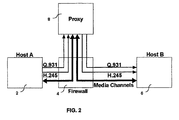
- Figure 2 shows the way in the form of a schematic diagram of the data signals involved in establishing an Internet telephony connection between the first computing unit 2 and the second computing unit 6 can be exchanged.
- the fourth arithmetic unit 8 tracks data the Q.931 standard via the third computing unit 4 to the second arithmetic unit 6.
- data comes from the first arithmetic unit 2 in the form of the H.245 standard over the third Computing unit 4 to the fourth computing unit 8.
- From the fourth Computing unit 8 passes data in the H.245 standard third arithmetic unit 4 to the second arithmetic unit 6.
- Between the first computing unit 2 and the second computing unit 6 are preferably media channels according to the UDP standard from the first computing unit 2 via the third computing unit 4 to the fourth computing unit 8 and from the fourth computing unit 8 via the third computing unit 4 to the second computing unit 6 built.
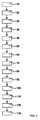
- FIG 3 shows a process flow, the structure of a Data connection according to Figure 2 explained in more detail.
- Program point 10 gives the first computing unit 2 a request signal to the third processing unit in the form of the Q.931 standard 4.
- the third arithmetic unit 4 checks the incoming Signal and recognizes a signal according to the Q.931 standard Program item 20.
- the third computing unit 4 checks whether it that can process received data. However, since the third Computing unit 4 does not process data according to the H.323 standard can, the third arithmetic unit 4 gives at program point 30 the request signal to the fourth computing unit 8.
- the fourth arithmetic unit 8 detects this at program point 40 Request signal and determines the destination address from the request signal, with which a telephone connection is established should.
- the destination address is the addresses of the second arithmetic unit 6.
- the fourth computing unit 8 preferably leads in front of the Transmission of the request signal to the second computing unit 6 a check of the access authorization. In doing so predefined data areas of the request signal to a corresponding one Access ID checked. Contains the request signal If you do not have a corresponding access code, you will be forwarded of the request signal prevented.
- the second arithmetic unit receives 6 the request signal.
- the second arithmetic unit 6 adds Program point 65 a response signal in the form of a Q.931 format via the third computing unit 4 to the fourth computing unit 8.
- the fourth arithmetic unit 8 receives at the program point 70 the response signal and changes both the destination address and also the sender address of the response signal. As the destination address the fourth arithmetic unit 8 sets the address of the first Computing unit 2 and the address of the fourth as the sender address Computing unit 8 fixed.
- the fourth arithmetic unit sends at the following program point 80 8 the changed response signal in the Q.931 standard via the third computing unit 4 to the first computing unit 2.
- the first computing unit 2 evaluates this response signal contained and recognizes on the basis of the response signal, whether the second computing unit 6 to build a Telephone connection is ready. If this is the case, then answer the first arithmetic unit 2 at program point 90 with a setup signal in the form of the H.245 standard. Are in the setup signal contain additional parameters for setting up media channels.
- the setup signal is sent to the third arithmetic unit 4 fourth computing unit 8 sent.
- the fourth computing unit 8 changes both the destination address and the sender address of the setup signal.
- the address of the second is used as the destination address Computing unit 6 and the address of the address of the fourth computing unit 8 used.
- the fourth arithmetic unit sends at the following program point 100 8 the changed setup signal via the third arithmetic unit 4 to the second computing unit 6.
- the second arithmetic unit answers at the following program point 110 6 in the form of a second response signal after the H.245 standard via the third computing unit 4 to the fourth Computing unit 8.
- the fourth computing unit 8 again sets the Sender address and the destination address and transmits that second response signal to the first computing unit 2 Data between the first and the second arithmetic unit become 2, 6 exchanged, leading to the establishment of a media channel are needed.
- the Media channel After exchanging all the data required to build a Media channel becomes a media channel at program point 120, for example in the form of the UDP protocol, the Media channel from the first computing unit 2 through the third Computing unit 4 to the fourth computing unit 8 and from the fourth Computing unit 8 via the third computing unit 4 to the second Computing unit 6 runs.
- the fourth Computing unit 8 and / or the third computing unit 4 the form of the data packets according to predetermined packet forms, so that incorrect Filtered out data packets and before access to the second area 5 are filtered out.
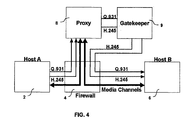
- FIG. 4 shows a development of the invention, in which for the establishment of the data connection by a fifth computing unit 9 is used.
- the fifth computing unit 9 is as Gatekeeper trained and has a data storage, in which a table for assigning alias names to Network addresses, e.g. the IP address is stored.
- the request signal in the Q.931 standard, according to FIG the third computing unit 4 is routed to the fourth computing unit 8.
- the fourth arithmetic unit 8 changes the sender address of the received request signal and writes its own Address as the sender address in the request signal.
- the fourth Computing unit 8 recognizes when checking the request signal, that an alias is used as the destination address.
- the fourth arithmetic unit 8 then transmits the request signal to the fifth processing unit 9.
- the fifth processing unit 9 determined based on that used in the request signal Q.931 Alias names the network address of the desired computing unit. In the described embodiment, a telephone connection from the first computing unit 2 to the second Computing unit 6 desired.
- the fifth arithmetic unit thus determines 9 as the destination address for the request signal, for example the IP address of the second computing unit 6 and transmits the request signal via the third computing unit 4 to the second computing unit 6.
- the response signal of the second arithmetic unit 6 is also via the third computing unit 4 and the gatekeeper 9 to the fourth computing unit 8 passed.
- the fourth arithmetic unit 8 changes according to the method of Figure 3, the destination address and the response signal Sender address, whereby the address of the first arithmetic unit 2 and the address as the sender address the fourth computing unit 8 is used.
- the response signal is also used by the fourth computing unit 8 third computing unit 4 sent to the first computing unit 2.
- the following request signal in the H.245 standard is, as in the Embodiment of Figures 2 and 3 via the third computing unit 4 passed to the fourth computing unit 8.
- the fourth Computing unit 8 in turn recognizes the use of an alias as the destination address.
- the fourth arithmetic unit then changes 8 the sender address of the body signal and transfers the changed setup signal to the fifth computing unit 9.
- the fifth computing unit 9 determines on the basis of the one used Alias name the target address of the desired computing unit and sends the setup signal via the third computing unit 4 the second computing unit 6.
- the access authorization and / or monitoring the correct form of the Data packets are preferably executed by the fourth computing unit 8. However, at least partial tasks of the third arithmetic unit 4 or the fifth arithmetic unit 9 be taken over.
- the invention was based on the example of establishing a data connection for the transmission of Internet telephony data after H.323 standard, Q.931 standard and H.245 standard described. However, the invention is not based on the application of these Data protocols are limited, but can be used for any type of data transfer be used. It is essential that the Processing, checking, implementation of data, sender addresses and destination addresses executed by a computing unit that is outside of a firewall computing unit protected area is arranged. This will make it easy Extension of the processing of data protocols via the Arrangement of a corresponding computing unit enables without change the programming of a firewall computing unit have to. This increases the flexibility of the network and access authorization to a protected area, for example given an intranet.
Landscapes
- Engineering & Computer Science (AREA)
- Computer Hardware Design (AREA)
- Computer Security & Cryptography (AREA)
- Computing Systems (AREA)
- General Engineering & Computer Science (AREA)
- Computer Networks & Wireless Communication (AREA)
- Signal Processing (AREA)
- Data Exchanges In Wide-Area Networks (AREA)
- Computer And Data Communications (AREA)
- Exchange Systems With Centralized Control (AREA)
Applications Claiming Priority (2)
| Application Number | Priority Date | Filing Date | Title |
|---|---|---|---|
| DE10040463A DE10040463C2 (de) | 2000-08-18 | 2000-08-18 | Verfahren zum Aufbauen einer Datenverbindung zwischen einer ersten und einer zweiten Recheneinheit und Vorrichtung zum Austauschen von Daten |
| DE10040463 | 2000-08-18 |
Publications (3)
| Publication Number | Publication Date |
|---|---|
| EP1180888A2 true EP1180888A2 (fr) | 2002-02-20 |
| EP1180888A3 EP1180888A3 (fr) | 2003-10-01 |
| EP1180888B1 EP1180888B1 (fr) | 2006-04-05 |
Family
ID=7652900
Family Applications (1)
| Application Number | Title | Priority Date | Filing Date |
|---|---|---|---|
| EP01117514A Expired - Lifetime EP1180888B1 (fr) | 2000-08-18 | 2001-07-20 | Méthode d'établissement d'une connection de données entre deux ordinateurs et dispositif d'échange de données |
Country Status (4)
| Country | Link |
|---|---|
| US (1) | US20020023228A1 (fr) |
| EP (1) | EP1180888B1 (fr) |
| AT (1) | ATE322787T1 (fr) |
| DE (2) | DE10040463C2 (fr) |
Cited By (1)
| Publication number | Priority date | Publication date | Assignee | Title |
|---|---|---|---|---|
| US5715468A (en) * | 1994-09-30 | 1998-02-03 | Budzinski; Robert Lucius | Memory system for storing and retrieving experience and knowledge with natural language |
Families Citing this family (4)
| Publication number | Priority date | Publication date | Assignee | Title |
|---|---|---|---|---|
| GB2403108A (en) * | 2003-06-20 | 2004-12-22 | Sharp Kk | Remote access via a holding area |
| GB2408614A (en) * | 2003-11-27 | 2005-06-01 | Sharp Kk | Remote access system |
| US7478424B2 (en) * | 2004-11-30 | 2009-01-13 | Cymtec Systems, Inc. | Propagation protection within a network |
| US10129284B2 (en) * | 2013-09-25 | 2018-11-13 | Veracode, Inc. | System and method for automated configuration of application firewalls |
Family Cites Families (13)
| Publication number | Priority date | Publication date | Assignee | Title |
|---|---|---|---|---|
| US5826014A (en) * | 1996-02-06 | 1998-10-20 | Network Engineering Software | Firewall system for protecting network elements connected to a public network |
| US6134583A (en) * | 1996-07-01 | 2000-10-17 | Sun Microsystems, Inc. | Method, system, apparatus and article of manufacture for providing identity-based caching services to a plurality of computer systems (#16) |
| US5944823A (en) * | 1996-10-21 | 1999-08-31 | International Business Machines Corporations | Outside access to computer resources through a firewall |
| US6052718A (en) * | 1997-01-07 | 2000-04-18 | Sightpath, Inc | Replica routing |
| US6345300B1 (en) * | 1997-03-25 | 2002-02-05 | Intel Corporation | Method and apparatus for detecting a user-controlled parameter from a client device behind a proxy |
| US6202156B1 (en) * | 1997-09-12 | 2001-03-13 | Sun Microsystems, Inc. | Remote access-controlled communication |
| US6212565B1 (en) * | 1998-08-26 | 2001-04-03 | Sun Microsystems, Inc. | Apparatus and method for improving performance of proxy server arrays that use persistent connections |
| US6219706B1 (en) * | 1998-10-16 | 2001-04-17 | Cisco Technology, Inc. | Access control for networks |
| US6718388B1 (en) * | 1999-05-18 | 2004-04-06 | Jp Morgan Chase Bank | Secured session sequencing proxy system and method therefor |
| US6463474B1 (en) * | 1999-07-02 | 2002-10-08 | Cisco Technology, Inc. | Local authentication of a client at a network device |
| US6510464B1 (en) * | 1999-12-14 | 2003-01-21 | Verizon Corporate Services Group Inc. | Secure gateway having routing feature |
| US6742039B1 (en) * | 1999-12-20 | 2004-05-25 | Intel Corporation | System and method for connecting to a device on a protected network |
| EP1476815B1 (fr) * | 2002-02-11 | 2014-10-15 | Polycom, Inc. | Systeme et procede pour videoconference a travers des reseaux separes par un pare-feu |
-
2000
- 2000-08-18 DE DE10040463A patent/DE10040463C2/de not_active Expired - Fee Related
-
2001
- 2001-07-20 AT AT01117514T patent/ATE322787T1/de not_active IP Right Cessation
- 2001-07-20 DE DE50109418T patent/DE50109418D1/de not_active Expired - Lifetime
- 2001-07-20 EP EP01117514A patent/EP1180888B1/fr not_active Expired - Lifetime
- 2001-08-20 US US09/933,088 patent/US20020023228A1/en not_active Abandoned
Cited By (1)
| Publication number | Priority date | Publication date | Assignee | Title |
|---|---|---|---|---|
| US5715468A (en) * | 1994-09-30 | 1998-02-03 | Budzinski; Robert Lucius | Memory system for storing and retrieving experience and knowledge with natural language |
Also Published As
| Publication number | Publication date |
|---|---|
| EP1180888B1 (fr) | 2006-04-05 |
| EP1180888A3 (fr) | 2003-10-01 |
| DE10040463C2 (de) | 2003-10-23 |
| US20020023228A1 (en) | 2002-02-21 |
| DE10040463A1 (de) | 2002-03-07 |
| ATE322787T1 (de) | 2006-04-15 |
| DE50109418D1 (de) | 2006-05-18 |
Similar Documents
| Publication | Publication Date | Title |
|---|---|---|
| DE69731965T2 (de) | Zugriff auf rechnerbetriebsmittel von aussen durch eine firewall | |
| WO2004027598A2 (fr) | Systeme de liaison de processus virtuelle par l'intermediaire d'un protocole rdp (remote desktop protocol) | |
| DE10226304A1 (de) | Tokengesteuerte Bildung von drahtlosen Arbeitsgruppen | |
| DE102008032087B4 (de) | System und Verfahren für eine Kommunikation zwischen mehreren Netzwerken | |
| DE60206780T2 (de) | Netzwerkverbindungsvorrichtung, verbindungssystem und netzwerkverbindungsverfahren | |
| DE10038557B4 (de) | System und Verfahren zur Übertragung von Daten über Datennetze, insbesondere Internet, mit asynchroner Datenverbindung | |
| DE10040463C2 (de) | Verfahren zum Aufbauen einer Datenverbindung zwischen einer ersten und einer zweiten Recheneinheit und Vorrichtung zum Austauschen von Daten | |
| EP1494434A1 (fr) | Procédure de configuration d'un appareillage dans un réseau informatique | |
| EP2950199B1 (fr) | Procédé d'impression, système de réalisation du procédé d'impression, programme informatique correspondant et support de stockage correspondant lisible sur ordinateur | |
| WO2004100498A1 (fr) | Procede d'echange de donnees entre des elements de reseau dans des reseaux a differentes zones d'adresse | |
| DE10038562B4 (de) | System und Verfahren zur Übertragung von Daten über Datennetze mit Datenumsetzung durch einen COM Automarschaller | |
| DE19843324C2 (de) | Verfahren und Vorrichtung zum Managen von mindestens einem Netzwerkelement in einem Telekommunikationsnetzwerk | |
| DE602005003938T2 (de) | Inter-domain-router mit modul zur bestimmung der routenaggregation | |
| EP1152581B1 (fr) | Méthode pour assurer la qualité de service des connections entre parties d'un réseau de paquets avec un contrôleur de ressources | |
| EP1158747A2 (fr) | Procédé de transmission de données | |
| DE10119492B4 (de) | Verfahren zur Verwaltung der Mobilität von Telefonapparaten in einem schnurlosen Fernmeldenetz | |
| EP1435026B1 (fr) | Systeme et procede d'emission de donnees d'un appareil, en particulier d'un appareil d'automatisation, par l'intermediaire d'une interface normalisee avec remplacement de variables par l'intermediaire d'un serveur echo | |
| EP1199640B1 (fr) | Méthode de transfert de données entre deux unités d'ordinateur | |
| EP1283629A2 (fr) | Convertisseur de protocole pour la communication entre dispositifs de traitement de donnés et le système de transmission de donnés utilisé | |
| EP1182855A2 (fr) | Procede et dispositif pour etablir une connexion | |
| EP3959850B1 (fr) | Procédé de fourniture de données d'établissement de connexion ainsi qu'ensemble comprenant une pluralité de serveurs de communication et un intermédiaire | |
| DE10245643A1 (de) | Integrierte Steuereinheit | |
| DE19939911C2 (de) | Verfahren zur Datenübertragung | |
| DE19618821B4 (de) | Verfahren zur multifunktionalen Adressierung der Prozeßdaten von Teilnehmern serieller Bussysteme | |
| DE10017573C2 (de) | Verfahren zur Kommunikation zwischen Endeinrichtungen und Endeinrichtung |
Legal Events
| Date | Code | Title | Description |
|---|---|---|---|
| PUAI | Public reference made under article 153(3) epc to a published international application that has entered the european phase |
Free format text: ORIGINAL CODE: 0009012 |
|
| AK | Designated contracting states |
Kind code of ref document: A2 Designated state(s): AT BE CH CY DE DK ES FI FR GB GR IE IT LI LU MC NL PT SE TR |
|
| AX | Request for extension of the european patent |
Free format text: AL;LT;LV;MK;RO;SI |
|
| PUAL | Search report despatched |
Free format text: ORIGINAL CODE: 0009013 |
|
| AK | Designated contracting states |
Kind code of ref document: A3 Designated state(s): AT BE CH CY DE DK ES FI FR GB GR IE IT LI LU MC NL PT SE TR |
|
| AX | Request for extension of the european patent |
Extension state: AL LT LV MK RO SI |
|
| 17P | Request for examination filed |
Effective date: 20030919 |
|
| AKX | Designation fees paid |
Designated state(s): AT BE CH CY DE DK ES FI FR GB GR IE IT LI LU MC NL PT SE TR |
|
| GRAP | Despatch of communication of intention to grant a patent |
Free format text: ORIGINAL CODE: EPIDOSNIGR1 |
|
| GRAS | Grant fee paid |
Free format text: ORIGINAL CODE: EPIDOSNIGR3 |
|
| GRAA | (expected) grant |
Free format text: ORIGINAL CODE: 0009210 |
|
| AK | Designated contracting states |
Kind code of ref document: B1 Designated state(s): AT BE CH CY DE DK ES FI FR GB GR IE IT LI LU MC NL PT SE TR |
|
| PG25 | Lapsed in a contracting state [announced via postgrant information from national office to epo] |
Ref country code: IT Free format text: LAPSE BECAUSE OF FAILURE TO SUBMIT A TRANSLATION OF THE DESCRIPTION OR TO PAY THE FEE WITHIN THE PRESCRIBED TIME-LIMIT;WARNING: LAPSES OF ITALIAN PATENTS WITH EFFECTIVE DATE BEFORE 2007 MAY HAVE OCCURRED AT ANY TIME BEFORE 2007. THE CORRECT EFFECTIVE DATE MAY BE DIFFERENT FROM THE ONE RECORDED. Effective date: 20060405 Ref country code: FI Free format text: LAPSE BECAUSE OF FAILURE TO SUBMIT A TRANSLATION OF THE DESCRIPTION OR TO PAY THE FEE WITHIN THE PRESCRIBED TIME-LIMIT Effective date: 20060405 Ref country code: NL Free format text: LAPSE BECAUSE OF FAILURE TO SUBMIT A TRANSLATION OF THE DESCRIPTION OR TO PAY THE FEE WITHIN THE PRESCRIBED TIME-LIMIT Effective date: 20060405 Ref country code: IE Free format text: LAPSE BECAUSE OF FAILURE TO SUBMIT A TRANSLATION OF THE DESCRIPTION OR TO PAY THE FEE WITHIN THE PRESCRIBED TIME-LIMIT Effective date: 20060405 |
|
| REG | Reference to a national code |
Ref country code: GB Ref legal event code: FG4D Free format text: NOT ENGLISH |
|
| REG | Reference to a national code |
Ref country code: CH Ref legal event code: EP |
|
| REG | Reference to a national code |
Ref country code: IE Ref legal event code: FG4D Free format text: LANGUAGE OF EP DOCUMENT: GERMAN |
|
| REF | Corresponds to: |
Ref document number: 50109418 Country of ref document: DE Date of ref document: 20060518 Kind code of ref document: P |
|
| PG25 | Lapsed in a contracting state [announced via postgrant information from national office to epo] |
Ref country code: DK Free format text: LAPSE BECAUSE OF FAILURE TO SUBMIT A TRANSLATION OF THE DESCRIPTION OR TO PAY THE FEE WITHIN THE PRESCRIBED TIME-LIMIT Effective date: 20060705 Ref country code: SE Free format text: LAPSE BECAUSE OF FAILURE TO SUBMIT A TRANSLATION OF THE DESCRIPTION OR TO PAY THE FEE WITHIN THE PRESCRIBED TIME-LIMIT Effective date: 20060705 |
|
| PG25 | Lapsed in a contracting state [announced via postgrant information from national office to epo] |
Ref country code: ES Free format text: LAPSE BECAUSE OF FAILURE TO SUBMIT A TRANSLATION OF THE DESCRIPTION OR TO PAY THE FEE WITHIN THE PRESCRIBED TIME-LIMIT Effective date: 20060716 |
|
| PG25 | Lapsed in a contracting state [announced via postgrant information from national office to epo] |
Ref country code: BE Free format text: LAPSE BECAUSE OF NON-PAYMENT OF DUE FEES Effective date: 20060731 Ref country code: CH Free format text: LAPSE BECAUSE OF NON-PAYMENT OF DUE FEES Effective date: 20060731 Ref country code: LI Free format text: LAPSE BECAUSE OF NON-PAYMENT OF DUE FEES Effective date: 20060731 Ref country code: MC Free format text: LAPSE BECAUSE OF NON-PAYMENT OF DUE FEES Effective date: 20060731 |
|
| GBT | Gb: translation of ep patent filed (gb section 77(6)(a)/1977) |
Effective date: 20060707 |
|
| PG25 | Lapsed in a contracting state [announced via postgrant information from national office to epo] |
Ref country code: PT Free format text: LAPSE BECAUSE OF FAILURE TO SUBMIT A TRANSLATION OF THE DESCRIPTION OR TO PAY THE FEE WITHIN THE PRESCRIBED TIME-LIMIT Effective date: 20060905 |
|
| NLV1 | Nl: lapsed or annulled due to failure to fulfill the requirements of art. 29p and 29m of the patents act | ||
| REG | Reference to a national code |
Ref country code: IE Ref legal event code: FD4D |
|
| ET | Fr: translation filed | ||
| PLBE | No opposition filed within time limit |
Free format text: ORIGINAL CODE: 0009261 |
|
| STAA | Information on the status of an ep patent application or granted ep patent |
Free format text: STATUS: NO OPPOSITION FILED WITHIN TIME LIMIT |
|
| 26N | No opposition filed |
Effective date: 20070108 |
|
| REG | Reference to a national code |
Ref country code: CH Ref legal event code: PL |
|
| PG25 | Lapsed in a contracting state [announced via postgrant information from national office to epo] |
Ref country code: AT Free format text: LAPSE BECAUSE OF NON-PAYMENT OF DUE FEES Effective date: 20060720 |
|
| BERE | Be: lapsed |
Owner name: TENOVIS G.M.B.H. & CO. KG Effective date: 20060731 |
|
| PG25 | Lapsed in a contracting state [announced via postgrant information from national office to epo] |
Ref country code: GR Free format text: LAPSE BECAUSE OF FAILURE TO SUBMIT A TRANSLATION OF THE DESCRIPTION OR TO PAY THE FEE WITHIN THE PRESCRIBED TIME-LIMIT Effective date: 20060706 |
|
| PG25 | Lapsed in a contracting state [announced via postgrant information from national office to epo] |
Ref country code: TR Free format text: LAPSE BECAUSE OF FAILURE TO SUBMIT A TRANSLATION OF THE DESCRIPTION OR TO PAY THE FEE WITHIN THE PRESCRIBED TIME-LIMIT Effective date: 20060405 Ref country code: LU Free format text: LAPSE BECAUSE OF NON-PAYMENT OF DUE FEES Effective date: 20060720 |
|
| PG25 | Lapsed in a contracting state [announced via postgrant information from national office to epo] |
Ref country code: CY Free format text: LAPSE BECAUSE OF FAILURE TO SUBMIT A TRANSLATION OF THE DESCRIPTION OR TO PAY THE FEE WITHIN THE PRESCRIBED TIME-LIMIT Effective date: 20060405 |
|
| PGFP | Annual fee paid to national office [announced via postgrant information from national office to epo] |
Ref country code: DE Payment date: 20130730 Year of fee payment: 13 |
|
| PGFP | Annual fee paid to national office [announced via postgrant information from national office to epo] |
Ref country code: FR Payment date: 20130719 Year of fee payment: 13 Ref country code: GB Payment date: 20130723 Year of fee payment: 13 |
|
| REG | Reference to a national code |
Ref country code: DE Ref legal event code: R119 Ref document number: 50109418 Country of ref document: DE |
|
| GBPC | Gb: european patent ceased through non-payment of renewal fee |
Effective date: 20140720 |
|
| REG | Reference to a national code |
Ref country code: FR Ref legal event code: ST Effective date: 20150331 |
|
| PG25 | Lapsed in a contracting state [announced via postgrant information from national office to epo] |
Ref country code: DE Free format text: LAPSE BECAUSE OF NON-PAYMENT OF DUE FEES Effective date: 20150203 |
|
| REG | Reference to a national code |
Ref country code: DE Ref legal event code: R119 Ref document number: 50109418 Country of ref document: DE Effective date: 20150203 |
|
| PG25 | Lapsed in a contracting state [announced via postgrant information from national office to epo] |
Ref country code: GB Free format text: LAPSE BECAUSE OF NON-PAYMENT OF DUE FEES Effective date: 20140720 Ref country code: FR Free format text: LAPSE BECAUSE OF NON-PAYMENT OF DUE FEES Effective date: 20140731 |