EP1182014A2 - Klinge für elektrischen Rasiererapparat, Verfahren zum Rasieren unter Verwendung derselben, und elektrischer Rasierapparat mit derselben - Google Patents
Klinge für elektrischen Rasiererapparat, Verfahren zum Rasieren unter Verwendung derselben, und elektrischer Rasierapparat mit derselben Download PDFInfo
- Publication number
- EP1182014A2 EP1182014A2 EP01203206A EP01203206A EP1182014A2 EP 1182014 A2 EP1182014 A2 EP 1182014A2 EP 01203206 A EP01203206 A EP 01203206A EP 01203206 A EP01203206 A EP 01203206A EP 1182014 A2 EP1182014 A2 EP 1182014A2
- Authority
- EP
- European Patent Office
- Prior art keywords
- blade
- interior
- exterior
- electric shaver
- cutting
- Prior art date
- Legal status (The legal status is an assumption and is not a legal conclusion. Google has not performed a legal analysis and makes no representation as to the accuracy of the status listed.)
- Granted
Links
- 238000000034 method Methods 0.000 title claims description 12
- 238000005520 cutting process Methods 0.000 claims description 49
- 238000000465 moulding Methods 0.000 description 12
- 230000006378 damage Effects 0.000 description 10
- 230000007794 irritation Effects 0.000 description 7
- 239000012778 molding material Substances 0.000 description 7
- 230000015572 biosynthetic process Effects 0.000 description 5
- 239000002184 metal Substances 0.000 description 5
- 238000005452 bending Methods 0.000 description 4
- 239000000919 ceramic Substances 0.000 description 4
- 239000011347 resin Substances 0.000 description 4
- 229920005989 resin Polymers 0.000 description 4
- 238000010586 diagram Methods 0.000 description 3
- 238000004519 manufacturing process Methods 0.000 description 3
- 239000000463 material Substances 0.000 description 3
- 238000003825 pressing Methods 0.000 description 3
- 230000000638 stimulation Effects 0.000 description 3
- OKTJSMMVPCPJKN-UHFFFAOYSA-N Carbon Chemical compound [C] OKTJSMMVPCPJKN-UHFFFAOYSA-N 0.000 description 2
- 208000027418 Wounds and injury Diseases 0.000 description 2
- 229910052799 carbon Inorganic materials 0.000 description 2
- 238000004140 cleaning Methods 0.000 description 2
- 239000011248 coating agent Substances 0.000 description 2
- 238000000576 coating method Methods 0.000 description 2
- 239000000470 constituent Substances 0.000 description 2
- 238000010276 construction Methods 0.000 description 2
- 208000014674 injury Diseases 0.000 description 2
- 239000000314 lubricant Substances 0.000 description 2
- 238000012986 modification Methods 0.000 description 2
- 230000004048 modification Effects 0.000 description 2
- 230000002035 prolonged effect Effects 0.000 description 2
- 239000002699 waste material Substances 0.000 description 2
- 238000005422 blasting Methods 0.000 description 1
- JEIPFZHSYJVQDO-UHFFFAOYSA-N iron(III) oxide Inorganic materials O=[Fe]O[Fe]=O JEIPFZHSYJVQDO-UHFFFAOYSA-N 0.000 description 1
- 239000011148 porous material Substances 0.000 description 1
- 238000004080 punching Methods 0.000 description 1
Images




Classifications
-
- B—PERFORMING OPERATIONS; TRANSPORTING
- B26—HAND CUTTING TOOLS; CUTTING; SEVERING
- B26B—HAND-HELD CUTTING TOOLS NOT OTHERWISE PROVIDED FOR
- B26B19/00—Clippers or shavers operating with a plurality of cutting edges, e.g. hair clippers, dry shavers
- B26B19/02—Clippers or shavers operating with a plurality of cutting edges, e.g. hair clippers, dry shavers of the reciprocating-cutter type
- B26B19/04—Cutting heads therefor; Cutters therefor; Securing equipment thereof
- B26B19/044—Manufacture and assembly of cutter blocks
-
- B—PERFORMING OPERATIONS; TRANSPORTING
- B26—HAND CUTTING TOOLS; CUTTING; SEVERING
- B26B—HAND-HELD CUTTING TOOLS NOT OTHERWISE PROVIDED FOR
- B26B19/00—Clippers or shavers operating with a plurality of cutting edges, e.g. hair clippers, dry shavers
- B26B19/02—Clippers or shavers operating with a plurality of cutting edges, e.g. hair clippers, dry shavers of the reciprocating-cutter type
- B26B19/04—Cutting heads therefor; Cutters therefor; Securing equipment thereof
-
- Y—GENERAL TAGGING OF NEW TECHNOLOGICAL DEVELOPMENTS; GENERAL TAGGING OF CROSS-SECTIONAL TECHNOLOGIES SPANNING OVER SEVERAL SECTIONS OF THE IPC; TECHNICAL SUBJECTS COVERED BY FORMER USPC CROSS-REFERENCE ART COLLECTIONS [XRACs] AND DIGESTS
- Y10—TECHNICAL SUBJECTS COVERED BY FORMER USPC
- Y10T—TECHNICAL SUBJECTS COVERED BY FORMER US CLASSIFICATION
- Y10T83/00—Cutting
- Y10T83/04—Processes
Definitions
- the present invention relates to a blade of an electric shaver, method of shaving, and an electric shaver.
- a blade of an electric shaver is provided with an exterior blade formed in a sheet-shape having a plurality of apertures, and an interior blade which slides on the bottom surface of the exterior blade relative to the exterior blade.
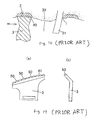
- Figure 16 shows how a human beard (31) is shaved by using a conventional blade of an electric shaver.
- a sharp edge (40) is formed at a top side end of an interior blade (3).
- the beard (31) is introduced into the aperture (1) and is cut by the sharp edge (40) of the interior blade (3).
- the skin (30) may be damaged by excess stimulations because the surface of the skin (30) is shaved by the interior blade (3).
- the interior blade (3) needs to be precisely processed. Further, there is a risk of injury at the time of cleaning of the interior blade (3).
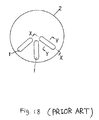
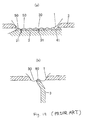
- a conventional blade of an electric shaver disclosed by Japanese patent laid open JITSUKAIHEI 54-113692 is illustrated in Figures 17-19.
- a plurality of convexities (50) which do not have a cutting edge (41) are partially formed along the top end of the interior blade (3).
- convexities (50) as a guard at the top end of the interior blade (3), damages to the skin (30) can be prevented.
- the size of the apertures (1) of the exterior blade (2) can be set such that the beard (31) can be efficiently introduced into the apertures (1).
- the present invention is a blade of an electric shaver.
- the blade comprises an interior blade detachably attached to a drive element of the electric shaver via an interior blade pushing-up means.
- the interior blade comprises a horizontal surface, a vertical surface, and a relief surface provided between the horizontal surface and the vertical surface, and is elastically pushed upward by the interior blade pushing-up means.
- the blade further comprises a sheet-shaped exterior blade having a plurality of blade apertures. A bottom surface of the exterior blade is elastically contacted with the horizontal surface of the interior blade by a pushing force of the interior blade pushing-up means.
- the interior blade Upon driving the drive element, the interior blade is moved laterally such that the horizontal surface of the interior blade rubs against the bottom surface of the exterior blade, and hair introduced into the blade aperture of the exterior blade is held between the horizontal surface of the interior blade and the exterior blade in accordance with a lateral movement of the interior blade and cut by an edge of the exterior blade.
- the present invention is a method for shaving hair by using a blade of an electric shaver.
- the blade used in this method comprises an interior blade and a sheet-shaped exterior blade.
- the interior blade is detachably attached to a drive element of the electric shaver via an interior blade pushing-up means and comprises a horizontal surface, a vertical surface, and a relief surface formed between the horizontal surface and the vertical surface.
- the exterior blade comprises a plurality of blade apertures.
- a bottom surface of the exterior blade is elastically contacted with the horizontal surface of the interior blade by a pushing force of the interior blade pushing-up means.
- the hair thus introduced into the blade aperture is held between the interior blade and the exterior blade in accordance with a lateral movement of the interior blade and cut by an edge of the exterior blade.
- the present invention is an electric shaver.
- the electric shaver comprises a main body having a motor therein, a frame member disposed on a top of the main body, a drive element projecting upward from an upper surface of the frame member and driven by the motor, an interior blade detachably attached to the drive element via an interior blade pushing-up means, the interior blade having a horizontal surface, a vertical surface, and a relief surface provided between the horizontal surface and the vertical surface, and elastically pushed upward by the interior blade pushing-up means, and a head attached to the frame member to cover the interior blade, the head comprising a sheet-shaped exterior blade having a plurality of blade apertures attached to the head, the bottom surface of the exterior blade elastically contacting with the horizontal surface of the interior blade.
- the interior element moves laterally such that the horizontal surface of the interior blade rubs against the bottom surface of the exterior blade, and hair introduced into the blade aperture of the exterior blade is held between the horizontal surface of the interior blade and the exterior blade in accordance with a lateral movement of the interior blade and cut by an edge of the exterior blade.
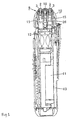
- Figure 1 is a cross-sectional view of an assembled electric shaver showing an embodiment of the present invention.
- Figure 2 is a front view of the assembled electric shaver.
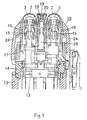
- Figure 3 is an expanded cross-sectional view of a head (10) of the electric shaver.
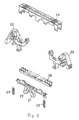
- Figure 4 is a perspective view of a disassembled electric shaver.
- Figure 5 is a perspective view of an interior blade.
- an electric shaver (9) is constructed by attachment of the head (10) to an electric shaver main body (13) containing a battery (11) and a motor (12) such as a linear motor.
- a frame member (14) is provided upon the upper tip of the electric shaver main body (13).
- Two drive elements (15) driven by the motor (12) project upward from the upper surface of the frame member (14).
- the interior blades (3) are detachably attached to the drive elements (15).
- the interior blades (3) are elastically pushed upward by interior blade push-up springs (15a) as shown in Figure 4.
- a slit drive element (26) is attached to one of the drive elements (15).
- a sheet-shaped exterior blade (2) (net blade) having a plurality of blade apertures (1) is attached to an exterior blade frame (16) which is supported by a support frame (17) of the head (10) so as to float freely in the vertical direction.
- a slit blade cassette (18) is attached to the support frame (17) so as to float freely in the vertical direction.
- This slit blade cassette (18) is elastically supported relative to the support frame (17) by a spring so as to float freely in the vertical direction.
- the slit blade cassette (18) comprises a slit exterior blade (19), a slit interior blade (20) (shown in Figure 7), a slit fitting (21), a slit side frame (22), and a slit push-up spring (23).
- the slit blade cassette (18) is constructed so that, while the slit interior blade (20) fixed to the bottom surface of the slit fitting (21) contacts the slit exterior blade (19), the slit side frame (22) is attached to the slit exterior blade (19), a bottom surface boss of the slit fitting (21) fits together with an upper surface boss of the slit frame (22), and the slit interior blade (20) rubs freely in elastic contact with the bottom surface of the slit exterior blade (19).
- a side cover (24) is also attached to the exterior blade frame (16) as shown in Figure 3.
- the spring force of the interior blade push-up spring (15a) causes the interior blade (3), to which the drive element (15) is attached, to rub freely in elastic contact with the bottom surface of the sheet-shaped exterior blade (2) which has a plurality of the blade apertures (1).
- the slit drive element (26), which is attached to one of the drive elements (15), connects to a joint (25) of the slit fitting (21).
- the drive element (15) When the battery (11) or an alternate power source drives the motor (12), the drive element (15) is driven and repeatedly moves laterally, and the interior blade (3) rubs against the bottom surface of the exterior blade (2). Also due to the slit drive element (26) movement in response to driving of the drive element (15), the slit interior blade (20) laterally rubs against the bottom surface of the slit exterior blade (19). Rough shaving of hair (the beard (31)) is carried out due to rubbing of the slit interior blade (20) against the bottom surface of the slit exterior blade (19), and a rough-shaved beard (31) protrudes from the blade aperture (1) of the exterior blade (2) so that the beard (31) is subsequently cut by the exterior blade (2).
- the electric shaver (9) constructed as described above, as indicated by the interior blade (3) of Figure 9, has a horizontal surface (4) that rubs against the exterior blade (2) and a vertical surface (5) roughly perpendicular to this horizontal surface (4) according to the embodiment.
- a relief surface (6) is formed between the horizontal surface (4) and the vertical surface (5) of the interior blade (3).
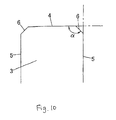
- the above mentioned relief surface (6) formed between the horizontal surface (4) and the vertical surface (5) may have a rounded edge-shape as shown in Figure 9 or may have a tapered-shape as shown in Figure 10.
- the angle ⁇ formed by the relief surface (6) with the horizontal surface (4) of the interior blade (3) is at least 90°.
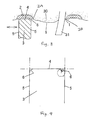
- Figure 8 shows the operation for cutting the beard (31) by the exterior blade (2). Because the relief surface (6) of the interior blade (3) is formed between the horizontal surface (4) which rubs the exterior blade (2) and the vertical surface (5) which is the surface perpendicular to the direction of lateral movement of the interior blade (3), the interior blade (3) can slide over skin (30) without imparting damage to the skin (30). The interior blade (3) moves to the position of an adjacent exterior blade (2) while avoiding damage to the skin (30) in this manner, and the beard (31) is cut by an edge (2a) of the adjacent exterior blade (2), almost like cutting a beard by using a scissors formed by the interior blade (without a sharp edge) and exterior blade (with a sharp edge).
- the interior blade (3) moves to the position of the adjacent exterior blade (2) and performs the function of holding the beard (31) in place, not the function of cutting the beard (31). Only the exterior blade (2) performs the cutting of the beard (31) by its edge (2a). In this manner, even though the interior blade (3) rubs the bottom surface of the exterior blade (2), the conventional sharp blade is not present, and the relief surface (6) slides upon the skin (30). Therefore damage is not imparted to the skin (30) by the interior blade (3), and pleasant beard shaving becomes possible with little irritation to the skin (30).
- FIG 11 shows the relationship between a radius of curvature (R) of the relief surface (6), irritation(stimulation), and cutting performance.
- R radius of curvature
- irritation increases when R is less than 5 microns, irritation becomes small at 5 microns or above.
- cutting performance worsens when R exceeds 30 microns.
- R is in the range of 5 - 30 microns for good cutting performance while avoiding irritation.
- the interior blade (3) is formed of a base member (3a) and a plurality of cutting blade members (3b).
- the interior blade (3) may comprise the base member (3a) produced by molding and a plurality of the cutting blade members (3b) made of metal.
- the interior blade (3) may comprise the base member (3a) and the cutting blade members (3b) formed as a single molding.
- the material used for molding can be resin, metal, ceramic, etc.
- the interior blade (3) can be produced rather easily when resin is used as the molding material.
- hardness is high and wear resistance is good when metal is used as the molding material.
- hardness is high, wear resistance is good, and rust generation is prevented.
- the surface of the molding may be treated by coating.
- wear resistance is improved in comparison to wear resistance resulting from use of the molding alone.
- a porous member is coated, the beard waste adhered to the interior blade (3) can be readily removed.
- the mold may contain another constituent materials in order to add functionality.
- carbon can be added to increase hardness of the mold, or a lubricant, oil, etc. can be added to form an oil-less blade.
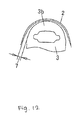
- Figure 12 and Figure 13 show an example of formation of a gap (7) between the interior blade (3) and the exterior blade (2). That is to say, among a plurality of the cutting blade members (3b) of the interior blade (3), only those cutting blade members (3b') located at either end touch the bottom surface of the exterior blade (2). Therefore, the gap (7) can be formed between the cutting blade members (3b) and the exterior blade (2) except at either end of the interior blade (3). Under this configuration, the interior blade (3) and the exterior blade (2) do not interfere to each other so that noise and friction with the cutting blade members (3b) are reduced. Because the interior blade (3) does not perform the function of cutting the beard (31), existence of such gap (7) between the interior blade (3) and the exterior blade (2) does not worsen the cutting performance.
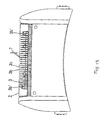
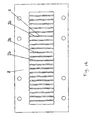
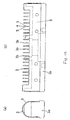
- the interior blade (3) does not require high precision processing such as the conventionally used sharp edge processing, formation becomes possible by bending of an apertured flat plate (8). That is to say, aperturing is carried out by pressing of the flat plate (8) as shown in Figure 14. Thereafter, the flat plate (8) apertured as shown in Figure 14 is bent as shown in Figure 15.
- the flat plate (8) which has a plurality of the cutting blade members (3b) formed in this manner, is bent and attached to the base member (3a). In this manner, a curvature can be readily formed as the relief surface (6) between the horizontal surface (4) and the vertical surface (5) of the cutting blade member (3b) by punching out during aperturing of the flat plate (8) by pressing.
- the present invention as described above is an electric shaver equipped with a sheet-shaped exterior blade having a plurality of blade apertures and an interior blade that rubs the interior surface of this exterior blade for cutting hair with the interior blade and the sheet-shaped exterior blade, wherein the interior blade is equipped with a horizontal surface and a vertical surface roughly perpendicular to this horizontal surface, and the interior blade is provided with a relief surface between the horizontal surface and the vertical surface of the interior blade. Therefore, the tip of the interior blade lacks the conventional sharp edge, and damage is not imparted to the skin even when considerable skin projects from the blade aperture of the exterior blade.
- blade aperture and blade thickness of the exterior blade can be freely set without concern for irritation to the skin, the beard can be cut shorter, and cutting performance improves. Also because the conventional sharp edge is not required at the tip of the interior blade, the interior blade can be readily processed without requiring the precise processing, and concern over injury resulting from the sharp edge during cleaning disappears.
- the relief surface can be readily manufactured, for example, by tumble-barreling, sand-shot blasting, etc. of a punch-out produced by a punch press.
- the present invention sets the angle between the horizontal surface of the interior blade and the relief surface at greater than 90°, thereby improving sliding performance upon the skin surface and prolonging battery life due to lessening of load. Also ready manufacture of the relief surface is possible, for example, by lancing, etc.
- the radius (R) of curvature of the relief surface is set from 5 to 30 microns, good cutting performance is achieved while avoiding irritation.
- the present invention constructs the interior blade as a molding so that interior blade construction and manufacture can be simplified by producing a base member and a cutting blade member simultaneously as a single molding.
- the interior blade is provided by molding process using resin, metal, ceramic, or a surface-coated molding material. Therefore, manufacture from resin as molding material can be readily carried out using a metallic mold.
- metal is used as the molding material
- wear resistance improves.
- ceramic is used as the molding material
- wear resistance improves, and rusting is prevented.
- wear resistance can be improved relative to use of a molding alone.
- a porous material member is coated, the beard waste adhered to the interior blade (3) can be readily removed.
- the interior blade is produced by using a constituent material in order to add functionality such as, for example, carbon to increase hardness of the molding, or a lubricant for formation of an oil-less blade.
- a gap is formed between the interior blade and the exterior blade, thereby avoiding interference between the interior blade and the exterior blade, reducing noise, and reducing friction between the interior blade and the exterior blade so that working life can be prolonged,
- the interior blade is produced by bending of an apertured flat plate, thereby simplifying construction of the interior blade which can be formed from flat plate, thereby making it possible to readily and inexpensively provide an interior blade.
Landscapes
- Engineering & Computer Science (AREA)
- Life Sciences & Earth Sciences (AREA)
- Forests & Forestry (AREA)
- Mechanical Engineering (AREA)
- Manufacturing & Machinery (AREA)
- Dry Shavers And Clippers (AREA)
Applications Claiming Priority (2)
| Application Number | Priority Date | Filing Date | Title |
|---|---|---|---|
| JP2000251163 | 2000-08-22 | ||
| JP2000251163A JP2002058887A (ja) | 2000-08-22 | 2000-08-22 | 電気かみそりの刃 |
Publications (3)
| Publication Number | Publication Date |
|---|---|
| EP1182014A2 true EP1182014A2 (de) | 2002-02-27 |
| EP1182014A3 EP1182014A3 (de) | 2002-03-06 |
| EP1182014B1 EP1182014B1 (de) | 2005-10-19 |
Family
ID=18740606
Family Applications (1)
| Application Number | Title | Priority Date | Filing Date |
|---|---|---|---|
| EP01203206A Expired - Lifetime EP1182014B1 (de) | 2000-08-22 | 2001-08-22 | Klinge für elektrischen Rasiererapparat, Verfahren zum Rasieren unter Verwendung derselben, und elektrischer Rasierapparat mit derselben |
Country Status (6)
| Country | Link |
|---|---|
| US (1) | US6637113B2 (de) |
| EP (1) | EP1182014B1 (de) |
| JP (1) | JP2002058887A (de) |
| CN (1) | CN1207133C (de) |
| AT (1) | ATE307011T1 (de) |
| DE (1) | DE60114104T2 (de) |
Cited By (7)
| Publication number | Priority date | Publication date | Assignee | Title |
|---|---|---|---|---|
| WO2005046947A1 (de) * | 2003-11-12 | 2005-05-26 | Braun Gmbh | Untermesser für einen oszillierend angetriebenen scherkopf eines rasierapparates |
| WO2007014660A1 (de) * | 2005-07-29 | 2007-02-08 | Braun Gmbh | Scherkopf für einen elektrischen rasierapparat |
| CN101132888B (zh) * | 2005-03-05 | 2010-06-16 | 布劳恩股份有限公司 | 电动毛发去除装置的剪切系统 |
| WO2011001395A1 (en) * | 2009-07-03 | 2011-01-06 | Braun Gmbh | Cutting unit for an electric razor with skin protectors |
| WO2011001404A1 (en) * | 2009-07-03 | 2011-01-06 | Braun Gmbh | Bottom cutters for dry shavers |
| WO2011001406A1 (en) * | 2009-07-03 | 2011-01-06 | Braun Gmbh | Lower blade assembly for dry shaver |
| WO2014147520A1 (en) * | 2013-03-22 | 2014-09-25 | Koninklijke Philips N.V. | A shaving apparatus as well as a cutting unit for such a shaving apparatus |
Families Citing this family (21)
| Publication number | Priority date | Publication date | Assignee | Title |
|---|---|---|---|---|
| DE60204973T2 (de) * | 2001-09-10 | 2005-12-01 | Matsushita Electric Works, Ltd., Kadoma | Verfahren zur herstellung einer innenklinge für einen elektrischen rasierapparat |
| JP4739638B2 (ja) * | 2002-06-17 | 2011-08-03 | パナソニック電工株式会社 | 電気カミソリの内刃の構造 |
| USD499842S1 (en) | 2002-12-23 | 2004-12-14 | Soft Lines Limited | Depilatory device |
| JP4273786B2 (ja) * | 2003-02-25 | 2009-06-03 | パナソニック電工株式会社 | 電気かみそり |
| KR200409341Y1 (ko) * | 2005-12-02 | 2006-02-22 | 오태준 | 헤드무빙 전기면도기 |
| DE102006010323A1 (de) * | 2006-03-07 | 2007-09-13 | Braun Gmbh | Trockenrasierer mit schwenkbarem Scherkopf |
| JP4265666B2 (ja) * | 2007-02-23 | 2009-05-20 | パナソニック電工株式会社 | 脱毛装置 |
| USD571959S1 (en) * | 2007-04-03 | 2008-06-24 | Matsushita Electric Works, Ltd. | Electric shaver |
| JP4988777B2 (ja) * | 2009-01-15 | 2012-08-01 | パナソニック株式会社 | 電気かみそり |
| JP5406769B2 (ja) | 2010-03-26 | 2014-02-05 | パナソニック株式会社 | 電気かみそり |
| US9283685B2 (en) * | 2012-07-26 | 2016-03-15 | Shavelogic, Inc. | Pivoting razors |
| US9486930B2 (en) * | 2012-09-27 | 2016-11-08 | Shavelogic, Inc. | Shaving systems |
| WO2014051842A1 (en) | 2012-09-27 | 2014-04-03 | Shavelogic, Inc. | Shaving systems |
| WO2014051843A1 (en) | 2012-09-28 | 2014-04-03 | Shavelogic, Inc. | Shaving systems |
| WO2014091719A1 (ja) * | 2012-12-13 | 2014-06-19 | パナソニック 株式会社 | 電気かみそり |
| US9623575B2 (en) | 2012-12-18 | 2017-04-18 | Shavelogic, Inc. | Shaving systems |
| US20150158192A1 (en) | 2013-12-09 | 2015-06-11 | Shavelogic, Inc. | Multi-material pivot return for shaving systems |
| US11325270B2 (en) | 2014-03-21 | 2022-05-10 | Sl Ip Company Llc | Metal spring return and method |
| US9713877B2 (en) | 2014-11-12 | 2017-07-25 | Medline Industries, Inc. | Clipper head with drag reduction |
| USD779123S1 (en) | 2014-11-12 | 2017-02-14 | Medline Industries, Inc. | Clipper head |
| EP3398733A1 (de) * | 2017-05-05 | 2018-11-07 | Koninklijke Philips N.V. | Schneidemechanismus |
Citations (1)
| Publication number | Priority date | Publication date | Assignee | Title |
|---|---|---|---|---|
| JPS54113692A (en) | 1978-02-27 | 1979-09-05 | Kitani Kazumasa | Production of swellable water retaining agent |
Family Cites Families (8)
| Publication number | Priority date | Publication date | Assignee | Title |
|---|---|---|---|---|
| US2325606A (en) * | 1940-07-26 | 1943-08-03 | Gillette Safety Rasor Company | Shaving implement |
| AU520147B2 (en) * | 1980-03-15 | 1982-01-14 | Matsushita Electric Works Ltd. | Blade assembly of electric shaver |
| GB2109738B (en) * | 1981-11-23 | 1985-07-03 | Gillette Co | Dry shaver |
| AT395125B (de) * | 1991-01-18 | 1992-09-25 | Philips Nv | Elektrisches trockenrasiergeraet |
| JPH06218153A (ja) * | 1993-01-26 | 1994-08-09 | Matsushita Electric Works Ltd | 往復式電気かみそりの内刃 |
| KR100447912B1 (ko) | 1996-04-26 | 2004-11-03 | 산요덴키가부시키가이샤 | 전기면도기와외부날의제조방법 |
| JPH10118358A (ja) | 1996-10-18 | 1998-05-12 | Tec Corp | 電気かみそり |
| DE60113959T2 (de) * | 2001-02-08 | 2006-07-06 | Dr. P.J. Walls | Trockenrasierer mit variabler Schneidehöhe |
-
2000
- 2000-08-22 JP JP2000251163A patent/JP2002058887A/ja active Pending
-
2001
- 2001-06-13 CN CN01118792.1A patent/CN1207133C/zh not_active Expired - Fee Related
- 2001-08-22 EP EP01203206A patent/EP1182014B1/de not_active Expired - Lifetime
- 2001-08-22 US US09/935,284 patent/US6637113B2/en not_active Expired - Fee Related
- 2001-08-22 AT AT01203206T patent/ATE307011T1/de not_active IP Right Cessation
- 2001-08-22 DE DE60114104T patent/DE60114104T2/de not_active Expired - Lifetime
Patent Citations (1)
| Publication number | Priority date | Publication date | Assignee | Title |
|---|---|---|---|---|
| JPS54113692A (en) | 1978-02-27 | 1979-09-05 | Kitani Kazumasa | Production of swellable water retaining agent |
Cited By (11)
| Publication number | Priority date | Publication date | Assignee | Title |
|---|---|---|---|---|
| WO2005046947A1 (de) * | 2003-11-12 | 2005-05-26 | Braun Gmbh | Untermesser für einen oszillierend angetriebenen scherkopf eines rasierapparates |
| CN101132888B (zh) * | 2005-03-05 | 2010-06-16 | 布劳恩股份有限公司 | 电动毛发去除装置的剪切系统 |
| US7895753B2 (en) | 2005-03-05 | 2011-03-01 | Braun Gmbh | Shaving system |
| WO2007014660A1 (de) * | 2005-07-29 | 2007-02-08 | Braun Gmbh | Scherkopf für einen elektrischen rasierapparat |
| RU2401192C2 (ru) * | 2005-07-29 | 2010-10-10 | БРАУН ГмбХ | Режущая головка для электробритвы |
| US8082670B2 (en) | 2005-07-29 | 2011-12-27 | Braun Gmbh | Shaving head for an electric shaver |
| WO2011001395A1 (en) * | 2009-07-03 | 2011-01-06 | Braun Gmbh | Cutting unit for an electric razor with skin protectors |
| WO2011001404A1 (en) * | 2009-07-03 | 2011-01-06 | Braun Gmbh | Bottom cutters for dry shavers |
| WO2011001406A1 (en) * | 2009-07-03 | 2011-01-06 | Braun Gmbh | Lower blade assembly for dry shaver |
| WO2014147520A1 (en) * | 2013-03-22 | 2014-09-25 | Koninklijke Philips N.V. | A shaving apparatus as well as a cutting unit for such a shaving apparatus |
| US10046469B2 (en) | 2013-03-22 | 2018-08-14 | Koninklijke Philips N.V. | Shaving apparatus as well as a cutting unit for such a shaving apparatus |
Also Published As
| Publication number | Publication date |
|---|---|
| US6637113B2 (en) | 2003-10-28 |
| CN1339349A (zh) | 2002-03-13 |
| JP2002058887A (ja) | 2002-02-26 |
| CN1207133C (zh) | 2005-06-22 |
| DE60114104T2 (de) | 2006-07-06 |
| ATE307011T1 (de) | 2005-11-15 |
| EP1182014A3 (de) | 2002-03-06 |
| DE60114104D1 (de) | 2005-11-24 |
| US20020059729A1 (en) | 2002-05-23 |
| EP1182014B1 (de) | 2005-10-19 |
Similar Documents
| Publication | Publication Date | Title |
|---|---|---|
| EP1182014B1 (de) | Klinge für elektrischen Rasiererapparat, Verfahren zum Rasieren unter Verwendung derselben, und elektrischer Rasierapparat mit derselben | |
| KR101081133B1 (ko) | 바리캉 | |
| US8726517B2 (en) | Trimmer mechanism, hair trimmer, and hair trimmer attachment | |
| EP3854547B1 (de) | Elektrischer bartschneider | |
| EP1867446B1 (de) | Haarschneidemaschine | |
| JP4467932B2 (ja) | 内刃組立体、剃刀装置、および剃刀装置を用いて毛剃りする方法 | |
| US5909929A (en) | Supporting bracket for a middle cutter of a shaver | |
| EP1555093B1 (de) | Methode um ein Innenmesser für einen elektrischen Vibrationsrasierapparat herzustellen und Innenmesser für einen elektrischen Vibrationsrasierapparat | |
| GB1558741A (en) | Hair trimming head | |
| JP2007506492A (ja) | 電気かみそり機用のかみそり機構 | |
| EP1273400A1 (de) | Rasiergerät mit statischen und beweglichen Schneiden | |
| EP0951970A1 (de) | Elektrischer Vibrationsrasierapparat | |
| CN115139346A (zh) | 梳状外刀片、刀片单元和电动剃刀 | |
| CN115139344A (zh) | 刀片单元和电动剃刀 | |
| EP1621298A1 (de) | Ein Innenmesser für einen elektrischen Vibrationsrasierapparat | |
| AU765077B2 (en) | Disposable cutting head for clippers | |
| US20060143924A1 (en) | Electric shaver | |
| JP3739476B2 (ja) | 往復式電気かみそり | |
| JP2009232894A (ja) | かみそり器 | |
| JPH0118144Y2 (de) | ||
| JP2629570B2 (ja) | 往復式電気かみそり | |
| JP3383680B2 (ja) | 往復式電気かみそり | |
| WO2026066029A1 (zh) | 刀头装置及毛发修剪器 | |
| AU782424B2 (en) | Disposable cutting head for clippers | |
| JPS5818837Y2 (ja) | 電気かみそり |
Legal Events
| Date | Code | Title | Description |
|---|---|---|---|
| PUAI | Public reference made under article 153(3) epc to a published international application that has entered the european phase |
Free format text: ORIGINAL CODE: 0009012 |
|
| PUAL | Search report despatched |
Free format text: ORIGINAL CODE: 0009013 |
|
| AK | Designated contracting states |
Kind code of ref document: A2 Designated state(s): AT BE CH CY DE DK ES FI FR GB GR IE IT LI LU MC NL PT SE TR |
|
| AX | Request for extension of the european patent |
Free format text: AL;LT;LV;MK;RO;SI |
|
| AK | Designated contracting states |
Kind code of ref document: A3 Designated state(s): AT BE CH CY DE DK ES FI FR GB GR IE IT LI LU MC NL PT SE TR |
|
| AX | Request for extension of the european patent |
Free format text: AL;LT;LV;MK;RO;SI |
|
| 17P | Request for examination filed |
Effective date: 20020904 |
|
| AKX | Designation fees paid |
Free format text: AT BE CH CY DE DK ES FI FR GB GR IE IT LI LU MC NL PT SE TR |
|
| 17Q | First examination report despatched |
Effective date: 20040413 |
|
| GRAP | Despatch of communication of intention to grant a patent |
Free format text: ORIGINAL CODE: EPIDOSNIGR1 |
|
| GRAS | Grant fee paid |
Free format text: ORIGINAL CODE: EPIDOSNIGR3 |
|
| GRAA | (expected) grant |
Free format text: ORIGINAL CODE: 0009210 |
|
| AK | Designated contracting states |
Kind code of ref document: B1 Designated state(s): AT BE CH CY DE DK ES FI FR GB GR IE IT LI LU MC NL PT SE TR |
|
| PG25 | Lapsed in a contracting state [announced via postgrant information from national office to epo] |
Ref country code: IT Free format text: LAPSE BECAUSE OF FAILURE TO SUBMIT A TRANSLATION OF THE DESCRIPTION OR TO PAY THE FEE WITHIN THE PRESCRIBED TIME-LIMIT;WARNING: LAPSES OF ITALIAN PATENTS WITH EFFECTIVE DATE BEFORE 2007 MAY HAVE OCCURRED AT ANY TIME BEFORE 2007. THE CORRECT EFFECTIVE DATE MAY BE DIFFERENT FROM THE ONE RECORDED. Effective date: 20051019 Ref country code: LI Free format text: LAPSE BECAUSE OF FAILURE TO SUBMIT A TRANSLATION OF THE DESCRIPTION OR TO PAY THE FEE WITHIN THE PRESCRIBED TIME-LIMIT Effective date: 20051019 Ref country code: CH Free format text: LAPSE BECAUSE OF FAILURE TO SUBMIT A TRANSLATION OF THE DESCRIPTION OR TO PAY THE FEE WITHIN THE PRESCRIBED TIME-LIMIT Effective date: 20051019 Ref country code: NL Free format text: LAPSE BECAUSE OF FAILURE TO SUBMIT A TRANSLATION OF THE DESCRIPTION OR TO PAY THE FEE WITHIN THE PRESCRIBED TIME-LIMIT Effective date: 20051019 Ref country code: FI Free format text: LAPSE BECAUSE OF FAILURE TO SUBMIT A TRANSLATION OF THE DESCRIPTION OR TO PAY THE FEE WITHIN THE PRESCRIBED TIME-LIMIT Effective date: 20051019 Ref country code: AT Free format text: LAPSE BECAUSE OF FAILURE TO SUBMIT A TRANSLATION OF THE DESCRIPTION OR TO PAY THE FEE WITHIN THE PRESCRIBED TIME-LIMIT Effective date: 20051019 Ref country code: BE Free format text: LAPSE BECAUSE OF FAILURE TO SUBMIT A TRANSLATION OF THE DESCRIPTION OR TO PAY THE FEE WITHIN THE PRESCRIBED TIME-LIMIT Effective date: 20051019 |
|
| REG | Reference to a national code |
Ref country code: GB Ref legal event code: FG4D |
|
| REG | Reference to a national code |
Ref country code: CH Ref legal event code: EP |
|
| REG | Reference to a national code |
Ref country code: IE Ref legal event code: FG4D |
|
| REF | Corresponds to: |
Ref document number: 60114104 Country of ref document: DE Date of ref document: 20051124 Kind code of ref document: P |
|
| PG25 | Lapsed in a contracting state [announced via postgrant information from national office to epo] |
Ref country code: SE Free format text: LAPSE BECAUSE OF FAILURE TO SUBMIT A TRANSLATION OF THE DESCRIPTION OR TO PAY THE FEE WITHIN THE PRESCRIBED TIME-LIMIT Effective date: 20060119 Ref country code: DK Free format text: LAPSE BECAUSE OF FAILURE TO SUBMIT A TRANSLATION OF THE DESCRIPTION OR TO PAY THE FEE WITHIN THE PRESCRIBED TIME-LIMIT Effective date: 20060119 Ref country code: GR Free format text: LAPSE BECAUSE OF FAILURE TO SUBMIT A TRANSLATION OF THE DESCRIPTION OR TO PAY THE FEE WITHIN THE PRESCRIBED TIME-LIMIT Effective date: 20060119 |
|
| PG25 | Lapsed in a contracting state [announced via postgrant information from national office to epo] |
Ref country code: ES Free format text: LAPSE BECAUSE OF FAILURE TO SUBMIT A TRANSLATION OF THE DESCRIPTION OR TO PAY THE FEE WITHIN THE PRESCRIBED TIME-LIMIT Effective date: 20060130 |
|
| PG25 | Lapsed in a contracting state [announced via postgrant information from national office to epo] |
Ref country code: PT Free format text: LAPSE BECAUSE OF FAILURE TO SUBMIT A TRANSLATION OF THE DESCRIPTION OR TO PAY THE FEE WITHIN THE PRESCRIBED TIME-LIMIT Effective date: 20060320 |
|
| NLV1 | Nl: lapsed or annulled due to failure to fulfill the requirements of art. 29p and 29m of the patents act | ||
| REG | Reference to a national code |
Ref country code: CH Ref legal event code: PL |
|
| PG25 | Lapsed in a contracting state [announced via postgrant information from national office to epo] |
Ref country code: IE Free format text: LAPSE BECAUSE OF NON-PAYMENT OF DUE FEES Effective date: 20060822 |
|
| PLBE | No opposition filed within time limit |
Free format text: ORIGINAL CODE: 0009261 |
|
| STAA | Information on the status of an ep patent application or granted ep patent |
Free format text: STATUS: NO OPPOSITION FILED WITHIN TIME LIMIT |
|
| PG25 | Lapsed in a contracting state [announced via postgrant information from national office to epo] |
Ref country code: MC Free format text: LAPSE BECAUSE OF NON-PAYMENT OF DUE FEES Effective date: 20060831 |
|
| 26N | No opposition filed |
Effective date: 20060720 |
|
| EN | Fr: translation not filed | ||
| PG25 | Lapsed in a contracting state [announced via postgrant information from national office to epo] |
Ref country code: FR Free format text: LAPSE BECAUSE OF FAILURE TO SUBMIT A TRANSLATION OF THE DESCRIPTION OR TO PAY THE FEE WITHIN THE PRESCRIBED TIME-LIMIT Effective date: 20061208 |
|
| GBPC | Gb: european patent ceased through non-payment of renewal fee |
Effective date: 20060822 |
|
| REG | Reference to a national code |
Ref country code: IE Ref legal event code: MM4A |
|
| PG25 | Lapsed in a contracting state [announced via postgrant information from national office to epo] |
Ref country code: GB Free format text: LAPSE BECAUSE OF NON-PAYMENT OF DUE FEES Effective date: 20060822 |
|
| PG25 | Lapsed in a contracting state [announced via postgrant information from national office to epo] |
Ref country code: TR Free format text: LAPSE BECAUSE OF FAILURE TO SUBMIT A TRANSLATION OF THE DESCRIPTION OR TO PAY THE FEE WITHIN THE PRESCRIBED TIME-LIMIT Effective date: 20051019 Ref country code: LU Free format text: LAPSE BECAUSE OF NON-PAYMENT OF DUE FEES Effective date: 20060822 |
|
| PG25 | Lapsed in a contracting state [announced via postgrant information from national office to epo] |
Ref country code: CY Free format text: LAPSE BECAUSE OF FAILURE TO SUBMIT A TRANSLATION OF THE DESCRIPTION OR TO PAY THE FEE WITHIN THE PRESCRIBED TIME-LIMIT Effective date: 20051019 Ref country code: FR Free format text: LAPSE BECAUSE OF FAILURE TO SUBMIT A TRANSLATION OF THE DESCRIPTION OR TO PAY THE FEE WITHIN THE PRESCRIBED TIME-LIMIT Effective date: 20051019 |
|
| PGFP | Annual fee paid to national office [announced via postgrant information from national office to epo] |
Ref country code: DE Payment date: 20100818 Year of fee payment: 10 |
|
| REG | Reference to a national code |
Ref country code: DE Ref legal event code: R119 Ref document number: 60114104 Country of ref document: DE Effective date: 20120301 |
|
| PG25 | Lapsed in a contracting state [announced via postgrant information from national office to epo] |
Ref country code: DE Free format text: LAPSE BECAUSE OF NON-PAYMENT OF DUE FEES Effective date: 20120301 |