EP1182113A2 - Einkaufswagen für eine rollstuhlfahrende Person - Google Patents
Einkaufswagen für eine rollstuhlfahrende Person Download PDFInfo
- Publication number
- EP1182113A2 EP1182113A2 EP01117521A EP01117521A EP1182113A2 EP 1182113 A2 EP1182113 A2 EP 1182113A2 EP 01117521 A EP01117521 A EP 01117521A EP 01117521 A EP01117521 A EP 01117521A EP 1182113 A2 EP1182113 A2 EP 1182113A2
- Authority
- EP
- European Patent Office
- Prior art keywords
- basket
- shopping cart
- wheelchair
- transverse wall
- chassis
- Prior art date
- Legal status (The legal status is an assumption and is not a legal conclusion. Google has not performed a legal analysis and makes no representation as to the accuracy of the status listed.)
- Withdrawn
Links
- 230000008878 coupling Effects 0.000 description 2
- 238000010168 coupling process Methods 0.000 description 2
- 238000005859 coupling reaction Methods 0.000 description 2
- 235000004443 Ricinus communis Nutrition 0.000 description 1
- 240000000528 Ricinus communis Species 0.000 description 1
- 230000001154 acute effect Effects 0.000 description 1
- 238000003780 insertion Methods 0.000 description 1
- 230000037431 insertion Effects 0.000 description 1
- 238000000034 method Methods 0.000 description 1
- 230000000630 rising effect Effects 0.000 description 1
- 230000035939 shock Effects 0.000 description 1
Images
Classifications
-
- B—PERFORMING OPERATIONS; TRANSPORTING
- B62—LAND VEHICLES FOR TRAVELLING OTHERWISE THAN ON RAILS
- B62B—HAND-PROPELLED VEHICLES, e.g. HAND CARTS OR PERAMBULATORS; SLEDGES
- B62B3/00—Hand carts having more than one axis carrying transport wheels; Steering devices therefor; Equipment therefor
- B62B3/14—Hand carts having more than one axis carrying transport wheels; Steering devices therefor; Equipment therefor characterised by provisions for nesting or stacking, e.g. shopping trolleys
-
- A—HUMAN NECESSITIES
- A61—MEDICAL OR VETERINARY SCIENCE; HYGIENE
- A61G—TRANSPORT, PERSONAL CONVEYANCES, OR ACCOMMODATION SPECIALLY ADAPTED FOR PATIENTS OR DISABLED PERSONS; OPERATING TABLES OR CHAIRS; CHAIRS FOR DENTISTRY; FUNERAL DEVICES
- A61G5/00—Chairs or personal conveyances specially adapted for patients or disabled persons, e.g. wheelchairs
- A61G5/10—Parts, details or accessories
-
- B—PERFORMING OPERATIONS; TRANSPORTING
- B62—LAND VEHICLES FOR TRAVELLING OTHERWISE THAN ON RAILS
- B62B—HAND-PROPELLED VEHICLES, e.g. HAND CARTS OR PERAMBULATORS; SLEDGES
- B62B5/00—Accessories or details specially adapted for hand carts
- B62B5/002—Adaptations for moving the carts by wheel chair users or other disabled persons
Definitions
- the invention relates to a shopping cart for a wheelchair user with a chassis that carries a basket and with a rear Shifter.
- the floor is of the basket either arranged horizontally or rising to the front. This makes loading the basket with goods more difficult.
- loading is made easier by placing it in the basket Goods always endeavored due to the chosen inclination of the floor is to slide forward to face the front of the basket collect so that there is always enough space for further loading of the basket remains for the hands of a person carrying the shopping cart. This proves to be a great advantage, especially since wheelchair users do not only have to drive the shopping cart, but also the wheelchair and are therefore basically happy when loading the basket with goods is facilitated.
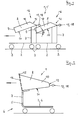
- Fig. 1 shows two identical shopping carts intended for a wheelchair user 1, 1 ', which are partially pushed together in a known manner to save space are.
- the chassis 2 of these wagons equipped with castors 3 1, 1 ' is not only open to the rear in a known manner, so that the front Foot area of a wheelchair fits into this opening, but it also tapers in the sliding direction (arrow) to save space and to enable usually desired nesting.
- a nesting however, the shopping cart 1, 1 ' is not a condition and also not an explicit part of the present invention.
- the Chassis 2 of the shopping carts 1, 1 ' shown points to the rear and supports on both sides 7, which carry a basket 8 for receiving goods.
- the basket 8 has a transverse wall 9 at the front, to which both Connect sides two side walls 10 while a rear transverse wall is missing, so that an opening 12 is formed, from which the goods on the floor 11 of the basket 8 which is inclined towards the front.
- the inclination of the bottom 11 is characterized by the angle ⁇ .
- In the rear area 16 are the flattened both side walls 10 viewed in side view, so that Basket 8 can be loaded more conveniently. From the drawing it can be seen that when pushed into one another or placed one behind the other, the baskets of the shopping trolleys are layered at an angle.
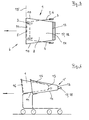
- Each of the shopping carts 1, 1 'shown has one in the sliding direction (Arrow) tapering chassis 2 open to the rear, the two longitudinal spars 4 in the front region 6 by a cross connection 5 are connected.
- the longitudinal bars 4 are led upwards at the front, to form supports 7 which carry a basket 8 which extends in the sliding direction the shopping cart 1, 1 'widened.
- the basket 8 points one to the front sloping bottom 11, has two acute angles to each other arranged side walls 10, the rear by a narrow low Cross wall 13 and front connected by a wide and higher cross wall 14 are.
- the wide transverse wall 14 is around an upper horizontal Axis 15 is arranged in the basket interior pivotable upwards.
- a sliding device follows the narrow transverse wall 13 to the rear 17, designed approximately as a handle bar 18, which is narrower than the width Transverse wall 14. From Fig. 3 is the conically opposed arrangement of basket 8 and chassis 2 clearly recognizable. Fig.
- FIG. 4 in turn shows two space-saving nested shopping carts 1, 1 ", the one to be inserted Shopping trolley 1 'when it is pushed together with its pivotable wide transverse wall 14 against the narrow transverse wall 13 of the ahead shopping cart 1 bounces, making the wide bulkhead 14 of the shopping cart to be inserted, shown on the right in the drawing 1 'is pivoted upwards and the insertion process for so long can be continued until it is in the position shown in the drawing, ends.
- the shopping cart 1, 1 ' can be in a known manner with a coupling device be equipped, the coupling of the shopping cart 1, 1 ' enables a wheelchair.
Landscapes
- Engineering & Computer Science (AREA)
- Chemical & Material Sciences (AREA)
- Combustion & Propulsion (AREA)
- Transportation (AREA)
- Mechanical Engineering (AREA)
- Health & Medical Sciences (AREA)
- Life Sciences & Earth Sciences (AREA)
- Animal Behavior & Ethology (AREA)
- General Health & Medical Sciences (AREA)
- Public Health (AREA)
- Veterinary Medicine (AREA)
- Handcart (AREA)
Abstract
Description
- Fig. 1
- zwei Einkaufswagen;
- Fig. 2 und Fig. 3
- einen weiteren Einkaufswagen in Seitenansicht und in
Draufsicht
sowie - Fig. 4
- zwei Einkaufswagen gemäß Fig. 2 und 3 in platzsparend ineinandergeschobener Lage.
Claims (4)
- Einkaufswagen (1, 1') für eine rollstuhlfahrende Person, mit einem Fahrgestell (2), das einen Korb (8) trägt und mit einer hinten angeordneten Schiebeeinrichtung (17), dadurch gekennzeichnet, dass der Boden (11) des Korbes (8) nach vorne abfallend angeordnet ist.
- Einkaufswagen nach Anspruch 1, dadurch gekennzeichnet, dass der Korb (8) und das Fahrgestell (2) konisch gestaltet und gegenläufig angeordnet sind.
- Einkaufswagen nach Anspruch 1 oder 2, dadurch gekennzeichnet, dass der Korb (8) eine schmale Querwand (13) aufweist, die sich hinten befindet und dass der Korb (8) vorne mit einer breiten Querwand (14) abschließt, die um eine horizontale Achse (15) in das Korbinnere verschwenkbar ist.
- Einkaufswagen nach einem der Ansprüche 1 bis 3, dadurch gekennzeichnet, dass nach hinten, im Anschluss an die schmale Querwand (13), eine quer verlaufende Griffstange (18) folgt, welche die Schiebeeinrichtung (17) bildet, wobei die Griffstange (18) kürzer ist als die breite Querwand (14).
Applications Claiming Priority (2)
| Application Number | Priority Date | Filing Date | Title |
|---|---|---|---|
| DE10040760 | 2000-08-19 | ||
| DE2000140760 DE10040760B4 (de) | 2000-08-19 | 2000-08-19 | Einkaufswagen für eine rollstuhlfahrende Person |
Publications (2)
| Publication Number | Publication Date |
|---|---|
| EP1182113A2 true EP1182113A2 (de) | 2002-02-27 |
| EP1182113A3 EP1182113A3 (de) | 2003-11-12 |
Family
ID=7653108
Family Applications (1)
| Application Number | Title | Priority Date | Filing Date |
|---|---|---|---|
| EP01117521A Withdrawn EP1182113A3 (de) | 2000-08-19 | 2001-07-20 | Einkaufswagen für eine rollstuhlfahrende Person |
Country Status (2)
| Country | Link |
|---|---|
| EP (1) | EP1182113A3 (de) |
| DE (1) | DE10040760B4 (de) |
Cited By (1)
| Publication number | Priority date | Publication date | Assignee | Title |
|---|---|---|---|---|
| DE102008027949A1 (de) * | 2008-06-12 | 2009-12-17 | Wanzl Metallwarenfabrik Gmbh | Einkaufswagen |
Family Cites Families (8)
| Publication number | Priority date | Publication date | Assignee | Title |
|---|---|---|---|---|
| US3309100A (en) * | 1963-10-10 | 1967-03-14 | Steiner Spa Karl | Carriage for the conveyance of goods in bulk, chiefly intended for supermarkets and the like |
| US4257545A (en) * | 1979-04-30 | 1981-03-24 | Clarke Carrier Corporation | Shopping basket for a wheelchair |
| US4484755A (en) * | 1982-09-30 | 1984-11-27 | Rehrig Houston | Wheeled cart for use by handicapped, invalid and frail persons |
| DE3718694A1 (de) * | 1986-06-12 | 1987-12-17 | Wanzl Kg Rudolf | Einkaufswagen fuer rollstuhlfahrer |
| DE4303087A1 (de) * | 1993-02-04 | 1994-08-11 | Siegel Geb Gmbh Co Kg | Einkaufswagen |
| DE9302535U1 (de) * | 1993-02-22 | 1993-05-19 | Karl Gutmann Kg, 7731 Unterkirnach | Kupplungsvorrichtung für Rollstühle und Einkaufswagen |
| FR2756730B1 (fr) * | 1996-12-11 | 1999-05-07 | Micheline Pucheral | Ensemble utilitaire pour personne a mobilite reduite comprenant un fauteuil roulant et un chariot de transport |
| DE19800701A1 (de) * | 1998-01-10 | 1999-07-15 | Erhard Lamberti | Transporteinrichtung |
-
2000
- 2000-08-19 DE DE2000140760 patent/DE10040760B4/de not_active Expired - Lifetime
-
2001
- 2001-07-20 EP EP01117521A patent/EP1182113A3/de not_active Withdrawn
Non-Patent Citations (1)
| Title |
|---|
| None |
Cited By (1)
| Publication number | Priority date | Publication date | Assignee | Title |
|---|---|---|---|---|
| DE102008027949A1 (de) * | 2008-06-12 | 2009-12-17 | Wanzl Metallwarenfabrik Gmbh | Einkaufswagen |
Also Published As
| Publication number | Publication date |
|---|---|
| DE10040760A1 (de) | 2002-02-28 |
| DE10040760B4 (de) | 2009-11-26 |
| EP1182113A3 (de) | 2003-11-12 |
Similar Documents
| Publication | Publication Date | Title |
|---|---|---|
| EP1194324B1 (de) | Stapelbarer einkaufswagen | |
| DE20304921U1 (de) | Kinderkarre | |
| DE20201107U1 (de) | Klappmechanismus für Kinderkarre | |
| DE3448335C2 (en) | supermarket trolley with pull-out tray | |
| DE4337917C2 (de) | Stapelbarer Einkaufswagen | |
| EP0254210B2 (de) | Stapelbarer Einkaufswagen | |
| EP1182113A2 (de) | Einkaufswagen für eine rollstuhlfahrende Person | |
| EP0672569B1 (de) | Einkaufswagen | |
| DE20311916U1 (de) | Einkaufswagen | |
| EP0364873A2 (de) | Einkaufswagen | |
| EP0609663A1 (de) | Einkaufswagen | |
| DE10332868B4 (de) | Einkaufswagen | |
| DE19845738A1 (de) | Rollgestell | |
| EP0905004A2 (de) | Stapelbarer Einkaufswagen | |
| DE8632324U1 (de) | Befestigungseinrichtung, insbesondere für Trennwände in Einkaufswagen für Selbstbedienungsläden | |
| DE10034331C1 (de) | Stapelbarer Einkaufswagen | |
| DE19729754A1 (de) | Stapelbarer Transportwagen | |
| DE4436804A1 (de) | Einkaufswagen | |
| DE20318769U1 (de) | Einkaufswagen | |
| EP0927676A1 (de) | Stapelbarer Transportwagen | |
| DE29612191U1 (de) | Transportwagen | |
| DE3904621C2 (de) | ||
| EP0814009A2 (de) | Stapelbarer Einkaufswagen | |
| DE8912075U1 (de) | Einkaufswagen | |
| DE8913921U1 (de) | Einkaufswagen |
Legal Events
| Date | Code | Title | Description |
|---|---|---|---|
| PUAI | Public reference made under article 153(3) epc to a published international application that has entered the european phase |
Free format text: ORIGINAL CODE: 0009012 |
|
| AK | Designated contracting states |
Kind code of ref document: A2 Designated state(s): AT BE CH CY DE DK ES FI FR GB GR IE IT LI LU MC NL PT SE TR |
|
| AX | Request for extension of the european patent |
Free format text: AL;LT;LV;MK;RO;SI |
|
| PUAL | Search report despatched |
Free format text: ORIGINAL CODE: 0009013 |
|
| AK | Designated contracting states |
Kind code of ref document: A3 Designated state(s): AT BE CH CY DE DK ES FI FR GB GR IE IT LI LU MC NL PT SE TR |
|
| AX | Request for extension of the european patent |
Extension state: AL LT LV MK RO SI |
|
| AKX | Designation fees paid | ||
| REG | Reference to a national code |
Ref country code: DE Ref legal event code: 8566 |
|
| STAA | Information on the status of an ep patent application or granted ep patent |
Free format text: STATUS: THE APPLICATION IS DEEMED TO BE WITHDRAWN |
|
| 18D | Application deemed to be withdrawn |
Effective date: 20040513 |