EP1182604A1 - Verfahren und Gerät zum Lesen eines Barcodes - Google Patents
Verfahren und Gerät zum Lesen eines Barcodes Download PDFInfo
- Publication number
- EP1182604A1 EP1182604A1 EP00118002A EP00118002A EP1182604A1 EP 1182604 A1 EP1182604 A1 EP 1182604A1 EP 00118002 A EP00118002 A EP 00118002A EP 00118002 A EP00118002 A EP 00118002A EP 1182604 A1 EP1182604 A1 EP 1182604A1
- Authority
- EP
- European Patent Office
- Prior art keywords
- bar code
- bar
- image
- obtaining
- intensity
- Prior art date
- Legal status (The legal status is an assumption and is not a legal conclusion. Google has not performed a legal analysis and makes no representation as to the accuracy of the status listed.)
- Withdrawn
Links
Images





Classifications
-
- G—PHYSICS
- G06—COMPUTING OR CALCULATING; COUNTING
- G06K—GRAPHICAL DATA READING; PRESENTATION OF DATA; RECORD CARRIERS; HANDLING RECORD CARRIERS
- G06K7/00—Methods or arrangements for sensing record carriers, e.g. for reading patterns
- G06K7/10—Methods or arrangements for sensing record carriers, e.g. for reading patterns by electromagnetic radiation, e.g. optical sensing; by corpuscular radiation
-
- G—PHYSICS
- G06—COMPUTING OR CALCULATING; COUNTING
- G06K—GRAPHICAL DATA READING; PRESENTATION OF DATA; RECORD CARRIERS; HANDLING RECORD CARRIERS
- G06K7/00—Methods or arrangements for sensing record carriers, e.g. for reading patterns
- G06K7/10—Methods or arrangements for sensing record carriers, e.g. for reading patterns by electromagnetic radiation, e.g. optical sensing; by corpuscular radiation
- G06K7/14—Methods or arrangements for sensing record carriers, e.g. for reading patterns by electromagnetic radiation, e.g. optical sensing; by corpuscular radiation using light without selection of wavelength, e.g. sensing reflected white light
-
- G—PHYSICS
- G06—COMPUTING OR CALCULATING; COUNTING
- G06V—IMAGE OR VIDEO RECOGNITION OR UNDERSTANDING
- G06V30/00—Character recognition; Recognising digital ink; Document-oriented image-based pattern recognition
- G06V30/10—Character recognition
- G06V30/14—Image acquisition
- G06V30/146—Aligning or centring of the image pick-up or image-field
- G06V30/1475—Inclination or skew detection or correction of characters or of image to be recognised
- G06V30/1478—Inclination or skew detection or correction of characters or of image to be recognised of characters or characters lines
Definitions
- This invention relates to the detection and recognition of one-dimensional bar codes from two-dimensional images taken from video or still camera.
- a typical bar code as shown in "Elements of a Bar Code System” from HP Agilent Technologies, Application Note 1013 (available from http://www.semiconductor.agilent.com/barcode/ appindex.html) consists of many black solid lines with varying widths, called bars. Between bars are spaces that also have varying widths.
- the direction parallel to the bar or space lines is referred to as the bar direction or bar axis.
- the direction orthogonal to the bar axis is referred to as the bin direction or bin axis.
- the bin direction is the scanning direction where the bar code signal, represented by alternating widths of the bar and space elements, is encoded.
- 1-D bar bodes can be classified to either a 2-level or a 4-level bar code.
- Four-level bar codes use four different widths for the bar and space elements to encode data characters.
- Examples of the 4-level bar codes are UPC and EAN codes.
- Two-level bar codes use only two different widths in the bar and space elements.
- Examples of the 2-level bar codes are Code 39 and Interleaved 2 of 5 codes.
- an inter-character space element is used to separate one data character to another.
- These bar codes are called discreet bar codes.
- the width of the inter-character element can be arbitrary. The narrowest width of the bar or space element (excluding inter-character element for discreet codes) is called the X-dimension.
- a bar code is read by scanning the bar code label along the bin direction.
- the scanning can be performed by the sweeping motion of a user, or by a back-and-forth movement of a laser beam, or captured by a 1-D array of photosensitive elements.
- These bar code readers require a user to position and orient the bar code to the bar code reader.
- omnidirectional laser-based scanners were designed where the laser beam is swept through a complex repetitive geometric pattern to pick up the bar code signal.
- the image can be obtained from a 2-D image sensor such as a camera, or a 1-D array of photo-sensors with a linear mechanical motion as in a flatbed scanner, of from a laser beam scanning in boh x and y directions.
- US patent 5,124,537 describes a virtual scan of the video raster memory to get 1-D intensity profile of the image similar to that used in the laser-based scanner inside the Point-of-Sale terminal.
- the 1-D intensity profile is then passed to a bar code decoder that checks if there is really a bar code scanned by the virtual scan line.
- This method does not locate the bar code directly; rather it uses a trial (scan) and test (decode) method to search for the legitimate bar code signal.
- US patent 5,155,343 uses 4 types of block cells, each consists of 8 x 32 pixels, at 4 different orientations to determine first the coarse location and orientation of the bar code and then the fine orientation.
- US patent 5,487,115 describes a method to locate multiple bar codes in the image by using the property that most edge points of the bar elements have the same edge orientation, which is along the bin direction.
- edge points By depositing edge points to different feature images according to the orientation of the edge points, bar codes with different orientation can be separated in different feature images.
- weighted morphological filters i.e., majority dilation and minority erosion operators
- the gaps of the edges points in the feature images coming from the edge lines of the bar and space elements are filled. Because the bar and space elements are closely packed in a bar code, this bridging operation can generate a solid rectangle for each bar code.
- the solid rectangle is representative of the bounding box of the bar code. Since other edge points from the cluttered background normally cannot generate a large solid rectangle, by detecting the location and orientation of large solid rectangles, the orientation of each bar code can be determined.
- US patent 5,487,115 also describes a method to compute the widths of bar and space elements of the bar code from the 1-D intensity profile of the image along the bin direction. Instead of locating the edges of the bar and space elements, the known method calculates the widths using the areas under the 1-D profile after some global and local stretching of the 1-D scan profile.
- the images come from a linear array of CCDs (charged coupled devices) and the image size is 782 x 1288 pixels, which is larger than the VGA resolution commonly in video cameras.
- the primary object of the invention is solved by a method for bar code reading comprising the steps of: recording a two-dimensional digital image including said bar code; obtaining edge points from said image; selecting a reference point; projecting said edge points on a line including said reference point; obtaining a direction of a cluster of projected edge points; obtaining an intensity profile along a curve defined by said direction; and decoding said bar code from said intensity profile.
- An apparatus for reading a bar code comprises: an image acquisition device to record a two-dimensional digital image including said bar code; an image processor for: obtaining edge points from said image; selecting a reference point; projecting said edge points on a line including said reference point; obtaining a direction of a cluster of projected edge points; obtaining an intensity profile along a curve defined by said direction and decoding said bar code from said intensity profile.
- the method as well as the apparatus according to the invention project the edge points of the elements captured in the image onto a curve.
- the curve is preferably a straight line through the reference point.
- the edge points from the bars of a bar code appear in one single cluster of projected edge points. This is independent of any spacing between the bars. As a result, the orientation of any bar code is securely detected within the captured image.
- the projection algorithm is based on a modified Hough Transform.
- the conventional Hough Transform which is usually used to detect contiguous forms, is modified to detect the location of spaced-apart bars.
- the method according to this invention enables the use of a low-resolution consumer camera to capture the bar code images and process the image to read the bar codes, independent of the position and orientation of the bar codes.
- a low-power and small bar code reader can be built with no mechanical moving part and no power-hungry laser. This type of bar code reader can then be integrated into a cellular phone or a handheld device such as a PDA (Personal Digital Assistant) for performing barcode reading anywhere anytime.
- bar codes are recognized where there are only a few pixels (1-2 pixels) sampled across the narrowest element. In order to achieve this performance, sub-pixel accuracy for determining the precise edges of the bar and space elements is required.
- the bar code clustering method detects the bar code with high acuracy substantially independent of orientation and background.
- the widths of the elements can be computed in sub-pixel accuracy to read high density bar codes.
- the invention enables the detection of multiple bar codes having arbitrary orientaion and a wide range of bar/space density within one image.
- the projections of the edge points onto a straight line are counted and compared to a threshold value to obtain a peak section within said line thereby locating the projected edge points from a bar code. Then the orientation of the bar code within the captured image can be easily derived.
- An intensity profile of the captured image is taken in a direction normal to the orientation of the peak section.
- multiple intensity profiles within said peak section are obtained to either distinguish between two slightly shifted bar codes having the same direction or to eliminate the wrong bar code signal with adjacent characters at either end of the bar code. From an intensity profile along the bin axis the information presented by the bar code is evaluated.
- the quiet zones within the intensity profiles are detected.
- the intensity value difference between successive sample points along the scanning direction of an intensity profile is obtained and compared to a predefined threshold value.
- a predefined threshold value When the number of samples below said predefined threshold exceeds a preset number Q, a quiet zone is detected. Otherwise the preset number Q is changed and the quiet zone detection steps are repeated.
- the location of the transition between bars and spaces is at the middle intensity between a pair of local maximum and minimum.
- the location is shifted closer to the thin element.
- pairs of consecutive local maxima and local minima as well as pairs of local minima and local maxima are obtained.
- a moving average is calculated for the local maxima and local minima of each pair. When the moving average is closer to the middle intensity of a pair of maximum/minimum then the local maximum/minimum is replaced by the respective moving average to calculate the middle intensity.
- the location of the middle intensity obtained from the moving average instead of the actual value of the local maximum/minimum, which defines the transition between a bar and a space, is shifted to the thin element.
- Any low-pass filtering caused by the capturing of an image by a digital camera is compensated.
- the resolution is enhanced to sub-pixel accuracy. This enables the use of a small CCD- or CMOS-sensor, e.g. with 640 x 480 pixels.
- the correction algorithm from above is also applicable as a standalone method for bar code decoding based on an already present intensity profile of the bar code.
- an apparatus With a low resolution CCD- or CMOS-sensor, an apparatus according to the invention has low power consumption.
- the apparatus can be a handheld device, e.g. a PDA (personal digital assistant) or a mobile phone for a cellular network.
- the handheld device can be powered by a battery.
- the camera with the CCD- or CMOS-sensor may be included into the housing of a mobile phone so that any bar code can be captured.
- the alphanumerical information decoded from the bar code can then be transmitted via the communication link provided by the mobile phone to a central station, e.g. a data base for appropriate evaluation.
- the host returns any value added information back to the mobile phone to provide the user with additional information collected in response to the bar code.
- a 1-D-sensor which scans the bar code can be used instead of a 2-D-sensor.
- the 1-D-sensor may comprise photodiodes moving across the image to be captured thereby providing a 2-D-image. Any other known embodiment for capturing a 2-D digital image can be used in connection with the invention.
- the bar code reader system shown in Figure 12 comprises an image acquisition sub-system 1200, 1210, an image processing and bar code decoding sub-system 1220 and a communication sub-system 1230, 1250.
- the image acquisition system can be a camera 1200 with fixed-focus or auto-focus lens to acquire a 2-D intensity image, e.g. a CCD or CMOS device 1210.
- the image may contain multiple bar codes in the field of view of the camera.
- the image processing and bar code decoding sub-system is a computer or microprocessor based electronic device 1220 with software to process the digitized image, recognize the symbology of the bar code and decode the data characters in the bar code.
- the communication sub-system 1230 sends the bar code message as a stream of ASCII characters to other system for further processing, using Ethernet, ISDN, radio link, or wireless cellular network.
- the bar code reader system being a handheld device, the housing may contains a mobile phone which transmits the data over the antenna 1250 within the data or the control channel to a host system.
- the image acquisition sub-system may also be a 1-D sensor which moves across the image to be captured. Since the method according to the provides subpixel accuracy, a low cost and low power consuming CMOS or CCD sensor can be used. This enables the handheld system to be powered by a battery 1240 with sufficient operating time.
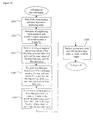
- FIG. 1 shows the overall processing steps of the image processing and bar code decoding sub-system.
- step 100 is to select strong edge points in the image.
- the strong edge points are defined as those pixels in the image whose gradient magnitude is greater than a threshold.
- the gradient magnitude is computed by first convolving the image with two Sobel 3x3 operators, one horizontal and one vertical, as is explained in the book "Machine Vision: Theory, Algorithms, Practicalities" by E. R. Davies, 1997.
- the resulting horizontal edge image (g x ) and vertical edge image (g y ) are then squared and added together, pixel-by-pixel.
- the gradient magnitude image is then derived by taking the square root of the sum image.
- All pixels in the gradient magnitude image whose value is greater than a fixed threshold are selected as strong edge points.
- edge points of the bar and space elements in the bar code are selected because of the high contrast of the bar code.
- the vector (g x , g y ) at each specific strong edge point is normal to the edge line at that point.
- Step 110 performs a modified Hough Transform on the selected strong edge points.
- the purpose is to cluster all strong edge points coming from the bar codes while spreading out those strong edge points coming from the cluttered background. This way the bar codes can be detected easily.
- Techniques to detect straight lines using the general Hough Transform are well known from "Machine Vision: Theory, Algorithms, Practicalities" by E. R. Davies, 1997. However, it cannot be used for bar code detection since in typical bar code reading environment, there are many straight lines in the background that can confuse the detection of bar codes.
- This invention uses a modified Hough Transform to detect patterns that consist of parallel lines.
- the bar code label is a pattern of parallel lines with different spacing between lines.
- Figure 2 shows an example for a barcode 205 having bars 206, 207, 208 and spaces 203, 204.
- the direction 201 is called bin axis
- the direction 202 is called bar axis.
- points 200 and 240 are all strong edge points of the solid bar lines of the bar code.
- the edge normal 210 of point 200 is parallel to the vector (g x , g y ) computed in step 100. If an origin at location 230 is selected, then for each strong edge point 200, a vote point 220 can be located by projecting from the origin 230 to the line 250 formed by the point 200 and its edge normal 210.
- the modified Hough Transform for the strong edge points from this bar code generates a line cluster 330 along the line 320, which passes through the origin 300.
- bar code 340 generates the line cluster 350 in the vote accumulation plane. All other non-bar code strong edge points will be spread over the vote accumulation plane and will not generate high vote count at any one location.
- the height of the line clusters from the bar codes is proportional to the number of the bar elements of the bar code. Therefore the more the data characters in the bar code, the more pronounced the peak is accumulated in the vote accumulation plane.
- this modified Hough Transform compresses bar codes along their individual bin direction.
- the present bar code detection method has higher detection signal-to-noise ratio because of the clustering, there is no break between the bar elements and it requires less processing memory.
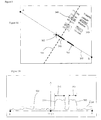
- Step 120 determines the bar directions of all the bar codes in the images. From the example in Figure 3A, there are four prominent bar axis directions since bar code 340 and 360 have the same bar directions. From the vote counts in the vote accumulation plane obtained in step 110, we first select all pixels whose vote counts exceed a threshold. The angular directions of the selected pixels are computed. For each selected pixel, the vote count is deposited on the angular bins from 0 degree to 360 degrees based on the angular position of the selected pixel. To avoid angular singularity, the selected pixels that are close to the origin are ignored. The result is a vote-count weighted angular histogram as shown in Figure 4.
- Each angular position may contain multiple bar codes that are parallel.
- Step 130 determines the extension of the parallel bar codes. Assuming that the angular position corresponding to peak 410 in Figure 4, or the angle where line clusters 350 and 370 are located in Figure 3B is being processed. First a 1-D vote count profile is sampled along the line 395 in Figure 5A. The resulting 1-D function is shown in Figure 5B. This 1-D profile 520 will have two pronounced wide peaks 570 and 580 which correspond to the line clusters 350 and 370 in Figure 3B. The extension of the two wide peak sections can be determined by comparing the 1-D vote profile 520 with a threshold 530, as shown in Figure 5B. The two extensions 540, 560 determine the width and the location of the parallel bar codes along this angular direction, as shown in Figure 5A. Once the extension is determined, a scan line 510 orthogonal to the line 395 can be used to sample the original intensity image by selecting a location within the extension of the bar code.
- Step 130 comprises more complex evalutations due to the inaccuracy of the gradient angle of the strong edge points computed in step 100.
- the intrinsic error of the angle calculation of the edges from the (g x , g y ) vector is about plus or minus 1 degree. Other noise can increase this error further.
- the consequence of this inaccuracy in edge angle is to spread out the clusters of the vote counts in the vote accumulation plane. This is illustrated in Figure 6 where two ideal line clusters 350, 370 in Figure 3B are actually two spreading clusters 650, 670. The spread is larger when the point is further away from the origin. The reason for this spread is similar to the spread of the Hough Transform of a straight line, which is explained in the book from Davies.
- the value of the 1-D vote count function 520 will become smaller as the point is moved away from the origin.
- all the vote counts that are within a certain distance DIST orthogonal to the line 395 are added together. This is illustrated with a rectangular box 610 in Figure 6 which has he width of 2 x DIST. The projected edge points which fall into this box are accumulatively counted. The counts inside this box 610 are added together. The width of the box is 2 x DIST and the height is equal to the sampling distance of the 1-D vote count function 520.
- the distance DIST is proportionally increased so that the ratio of DIST over distance to the origin remains the same.
- This ratio which is the spreading angle, may empirically be set to a predetermined small value, e.g. to 4 degrees.
- Step 140 computes the 1-D intensity profile of the original image along a scan line 510 normal to the selected bar direction 395.
- the position of the scan line can be anywhere within the extension 540 of the wide peak 570 in Figure 5.
- 1-D intensity profiles along scan lines at various locations within the extension 540 are selected for the further processing. There are two reasons for multiple scan lines. Referring to Figure 7, bar codes 710 and 720 generate a single continuous wide peak on the 1-D vote count profile along line 790.
- the extension 740 covers both bar codes. If multiple scan lines, such as the three 771, 772, 773 lines shown in Figure 7, are used to obtain the intensity profile, both bar code signals are obtained for the processing in the further steps. Duplicate detection of the same bar code can be removed in the final step.
- the bar code 730 Normally on both sides of the bar code, there should have a minimal width of white space, called "quiet zone", to isolate the bar code from the background. However, in some cases there are characters on the side of the bar code that are too close. Therefore the two characters 760 along the scan line 782 will be mistaken as part of the bar code signal in steps 150 and 160. This situation will not occur for scan lines 781 and 783.
- the next step 150 finds sections of the 1-D scan profile that may contain a bar code signal.
- the 1-D scan profile may have multiple bar code signals.
- the technique to find the bar code signals is to use the "quiet zones" on both sides of the bar codes.
- step 150 finds contiguous sections where the values of this new function are all below a threshold. These contiguous sections, or detected quiet zones, must have a minimum size of Q pixels (along the scan line). Q corresponds to the minimum size of quiet zones.
- step 150 Between two detected quiet zones is a potential bar code signal. Only those potential bar code signals that have a minimum size of B pixels are selected for further processing. Since bar codes of different density and size can be present in the image, if Q is set to a fixed value, then it is possible that a large space element in a large bar code is so large that it is mistaken as a quiet zone and one complete bar code is separated into two potential bar code signals. Later step 180 will reject both fragmented bar code signals. Therefore, to accommodate bar codes of various scales, several values for the parameter Q are used in step 150.
- FIG 8A Shown in Figure 8A is a 640 x 480 image taken from a CMOS camera, the scan line detected is shown as a white line from the upper right corner to the lower left corner.
- the 1-D scan profile is shown in Figure 8B. Each solid dot is a sampling of the original intensity image with the bi-linear interpolation.
- the central portion of this 1-D profile is blown up in Figure 8C to show the detailed bar code signal.
- the quiet zones can be seen clearly in Figure 8C where the intensity variation is small.
- This potential bar code signal starts from the end of the front quiet zone and end at the start of the back quiet zone, as indicated by two triangular marks (810 and 820) on the horizontal axis of Figure 8C.
- Step 160 determines the precise locations of the high contrast edges with sub-pixel accuracy.
- the contrast of the bar and space lines is not uniform while the widths can be as small as 1 or 2 pixels. This can be seen also in Figure 8A where the narrow bars have lower contrast than the thick bars.
- the width-dependent non-uniform contrast of the bar and space elements is due to the finite size of the CCD or CMOS sensors and the finite bandwidth of the camera system. This is equivalent to a low pass filtering.
- the 1-D scan profile 900 is an ideal bar code signal with intensity value ("2") for space (white) elements and intensity value ("1") for bar (black) elements.
- the profile 960 is obtained by a 3-point summation of the profile 900 to simulate the effect of low-pass filtering.
- the intensity value of the narrow bar 935 is 4, which is higher than the value of the thick bar 936 which is "3".
- the intensity value of the narrow space is 5, which is lower than the value of the thick space which is "6".
- the consequence of this effect is that the precise location of the edge is shifted.
- the edge location of a thick element to a thin element transition each element being a (black) bar or a (white) space, is shifted towards the thick element. Therefore, if a thick bar is between two thin space neighbors, then its width can be reduced by 2 times the location shift, one from each side.
- Step 160 serves to precisely locate the edges of the bar and space elements, to compensate the edge shifting effect discussed above.
- Figure 10 shows detailed processing for step 160.
- the bar code signal of Figure 8A is shown in Figure 11A, which is a further blown-up plot of Figure 8C with some processing results overlapping on the figure.
- step 1010 finds all the local minima and maxima of the 1-D function, in alternating order.
- Step 1020 selects a set of neighboring Min-Max pairs and Max-Min pairs where the difference of intensities between the neighboring local minimum and the local maximum exceed a threshold. These pairs correspond to strong edge transitions from black to white or vice versa. Because low contrast lines can be present, as shown in Figure 8C, this intensity rise/fall threshold should be set to a level that can detect the low contrast bar or space elements while rejecting the noise.
- X Max-MaxMinP [0] and X Min- MaxMinP [0] are the locations of the local maximum and local minimum of the first Max-Min pair. This pair represents the first large falling edge (i.e., greater than the set threshold) of the bar code signal, as shown in Figure 11A at 1160 and Figure 11B at 1110.
- the X Min-MinMaxP [0] and X Max-MinMaxP [0] are the locations of the local minimum and local maximum of the first Min-Max pair. It is the first large rising edge of the bar code signal, as shown in Figure 11A at 1170 and Figure 11B at 1130.
- the Max-Min pairs are marked by circles, while the Min-Max pairs are marked by crosses.
- X Min-MaxMinP [0] and X Min-MinMaxP [0] are the same location as in the case of 1160 and 1170 in Figure 11A. It is not necessary that a Max-Min pair is followed by a Min-Max pair, even though in most cases it is because of the alternating bar and space elements in the bar code.
- the first Max-Min pair 1110 is followed by another Max-Min pair 1120, then followed by a first Min-Max pair 1130.
- the Max-Min pair 1120 is present because the intensity fall of this Max-Min pair exceeds the set threshold. Usually this is caused by the over-enhancement of the edge in the circuitry of some cameras. The consequence is that an odd number of bar code edges are detected. In this case this potential bar code signal will be rejected in the future step 170.
- Step 1030 performs moving averages of the minima values of the Min-Max pairs and Max-Min pairs and the maxima values of the Min-Max pairs and the Max-Min pairs of the four arrays: I(X Max-MaxMinP [0]), I(X Max-MaxMinP [1]), ..., I(X Max-MaxMinP [i]), ... I(X Min-MaxMinP [0]), I(X Min-MaxMinP [1]), ..., I(X Min-MaxMinP [i]), .. I(X Min-MinMaxP [0]), I(X Min-MinMaxP [1]), ..., I(X Min-MinMaxP [i]), ...
- I_AVG(X Max-MaxMinP [i]) (I(X Max-MaxMinP [i-n]) + I(X Max-MaxMinP [I-n+1]) + ... I(X Max-MaxMinP [i+n])) / (2n+1)
- n is an empirical fixed parameter. The same formula applies to other three kinds of locations.
- step 1040 finds a middle intensity I_MIDDLE between I(X Max-MaxMinP [i]) and I(X Min-MaxMinP [i]) so that a precise edge location can be determined, whereby for each Max-Min pair a middle intensity based on the max and min values of this pair and the moving average of the min and max values of the Min-Min pairs is determined.
- the formula for the middle intensity I_MIDDLE is:
- Step 1050 finds a sub-pixel accuracy location X Edge- MaxMinP [i] for the white to black edges between the Max-Min pair X Max-MaxMinP [i] and X Min-MaxMinP [i] so that the interpolated intensity at this location X Edge-MaxMinP [i] is equal to the computed middle intensity I_MIDDLE.
- These precise edge locations are marked as "+" in Figure 11A.
- Step 1060 performs exactly the same procedure as step 1040 and 1050 except the computation is applied to the Min-Max pairs, or black to white edges.
- the edge 930 has a thick bar on the left and a narrow space on the right.
- the corresponding Min-Max pair is indicated by 970 and 980 (with cross marks).
- the intensity at 970 is "3" and is lower than the average of the minima of nearby Min-Max pairs since it is at the side of a thick bar. Therefore I_LOW will be replaced by the average value, which is higher than the value at this minimum location.
- the intensity at 980 is "5" and is lower than the average of the maxima of nearby Min-Max pairs; therefore the I_HIGH at this maximum location will use the original intensity instead of the average value.
- the method also applies to the case of the edge 950, where both the I_LOW and I_HIGH will use original intensities instead of average intensities and there is no push of the edge since the right side and the left side of the edge are all narrow elements.
- step 170 computes the widths of the alternating bar and space elements by calculating the differences between two neighboring edge locations. This requires that the number of edges detected is an even number since the total number of widths of a legitimate bar code is an odd number.
- step 180 then performs the bar code decoding based on the symbologies of various bar codes.
- the technique is well known in the literature.
- Steps 160, 170, and 180 are repeated for different bar code signals detected from the 1-D intensity scan profile obtained in step 150 since there may have multiple bar codes in one scan profile, as shown in Figure 7, scan line 771.
- step 190 uses a larger quiet zone size parameter Q to accommodate large size bar codes and repeat steps 150 to 180. This step can be repeated for more Q parameters, depending on the range of the bar code scale that the system intends to detect.
Landscapes
- Engineering & Computer Science (AREA)
- Physics & Mathematics (AREA)
- Computer Vision & Pattern Recognition (AREA)
- General Physics & Mathematics (AREA)
- Theoretical Computer Science (AREA)
- Health & Medical Sciences (AREA)
- Electromagnetism (AREA)
- General Health & Medical Sciences (AREA)
- Toxicology (AREA)
- Artificial Intelligence (AREA)
- Multimedia (AREA)
- Image Analysis (AREA)
Priority Applications (3)
| Application Number | Priority Date | Filing Date | Title |
|---|---|---|---|
| EP00118002A EP1182604A1 (de) | 2000-08-22 | 2000-08-22 | Verfahren und Gerät zum Lesen eines Barcodes |
| CA002352014A CA2352014A1 (en) | 2000-08-22 | 2001-07-03 | Method and apparatus for reading a bar code |
| US09/925,759 US20020084330A1 (en) | 2000-08-22 | 2001-08-09 | Method and apparatus for reading a bar code |
Applications Claiming Priority (1)
| Application Number | Priority Date | Filing Date | Title |
|---|---|---|---|
| EP00118002A EP1182604A1 (de) | 2000-08-22 | 2000-08-22 | Verfahren und Gerät zum Lesen eines Barcodes |
Publications (1)
| Publication Number | Publication Date |
|---|---|
| EP1182604A1 true EP1182604A1 (de) | 2002-02-27 |
Family
ID=8169606
Family Applications (1)
| Application Number | Title | Priority Date | Filing Date |
|---|---|---|---|
| EP00118002A Withdrawn EP1182604A1 (de) | 2000-08-22 | 2000-08-22 | Verfahren und Gerät zum Lesen eines Barcodes |
Country Status (3)
| Country | Link |
|---|---|
| US (1) | US20020084330A1 (de) |
| EP (1) | EP1182604A1 (de) |
| CA (1) | CA2352014A1 (de) |
Cited By (5)
| Publication number | Priority date | Publication date | Assignee | Title |
|---|---|---|---|---|
| WO2003083762A1 (en) * | 2002-03-22 | 2003-10-09 | Lockheed Martin Corporation | System and method for fast binarization of bar codes in the presence of noise |
| US6651887B1 (en) | 2002-07-26 | 2003-11-25 | Storage Technology Corporation | Reading and interpreting barcodes using low resolution line scan cameras |
| WO2005017812A1 (en) | 2003-07-16 | 2005-02-24 | Scanbuy, Inc. | System and method for decoding and analyzing barcodes using a mobile device |
| EP1693780A3 (de) * | 2005-02-16 | 2009-08-05 | Denso Wave Incorporated | Verfahren und Vorrichtung zum optischen Ablesen von in einem Strichcode gespeicherten Informationen |
| WO2010093680A1 (en) * | 2009-02-11 | 2010-08-19 | Cognex Corporation | System and method for capturing and detecting barcodes using vision on chip processor |
Families Citing this family (51)
| Publication number | Priority date | Publication date | Assignee | Title |
|---|---|---|---|---|
| US20020016750A1 (en) * | 2000-06-20 | 2002-02-07 | Olivier Attia | System and method for scan-based input, storage and retrieval of information over an interactive communication network |
| US6666377B1 (en) * | 2000-07-18 | 2003-12-23 | Scott C. Harris | Bar code data entry device |
| US7028911B2 (en) * | 2002-08-07 | 2006-04-18 | Shenzhen Syscan Technology Co. Limited | Methods and systems for encoding and decoding data in 2D symbology |
| EP1422657A1 (de) * | 2002-11-20 | 2004-05-26 | Setrix AG | Verfahren zur Merkmalenanwesenheitserfassung und Verfahren zur Verwaltung eines Komponentenvorrats |
| US6993573B2 (en) * | 2003-06-06 | 2006-01-31 | Neomedia Technologies, Inc. | Automatic access of internet content with a camera-enabled cell phone |
| US20050082370A1 (en) * | 2003-10-17 | 2005-04-21 | Didier Frantz | System and method for decoding barcodes using digital imaging techniques |
| US7387250B2 (en) * | 2003-12-04 | 2008-06-17 | Scanbuy, Inc. | System and method for on the spot purchasing by scanning barcodes from screens with a mobile device |
| JP4242796B2 (ja) * | 2004-03-12 | 2009-03-25 | パナソニック株式会社 | 画像認識方法及び画像認識装置 |
| US7296747B2 (en) * | 2004-04-20 | 2007-11-20 | Michael Rohs | Visual code system for camera-equipped mobile devices and applications thereof |
| US20050246196A1 (en) * | 2004-04-28 | 2005-11-03 | Didier Frantz | Real-time behavior monitoring system |
| US7309015B2 (en) * | 2004-07-14 | 2007-12-18 | Scanbuy, Inc. | Mobile device gateway providing access to instant information |
| US20060065734A1 (en) * | 2004-09-30 | 2006-03-30 | Symbol Technologies, Inc. | Dual scanner signal acquisition |
| US7721966B2 (en) | 2004-10-18 | 2010-05-25 | Datalogic Scanning, Inc. | System and method of optical reading employing virtual scan lines |
| US7455232B2 (en) * | 2005-03-31 | 2008-11-25 | Symbol Technologies, Inc. | Systems and methods for dataform decoding |
| US7809156B2 (en) | 2005-08-12 | 2010-10-05 | Ricoh Company, Ltd. | Techniques for generating and using a fingerprint for an article |
| US8016187B2 (en) * | 2006-02-21 | 2011-09-13 | Scanbury, Inc. | Mobile payment system using barcode capture |
| US7705231B2 (en) | 2007-09-07 | 2010-04-27 | Microsoft Corporation | Automatic accompaniment for vocal melodies |
| US7599561B2 (en) * | 2006-02-28 | 2009-10-06 | Microsoft Corporation | Compact interactive tabletop with projection-vision |
| US10026177B2 (en) | 2006-02-28 | 2018-07-17 | Microsoft Technology Licensing, Llc | Compact interactive tabletop with projection-vision |
| US8554690B2 (en) * | 2006-03-31 | 2013-10-08 | Ricoh Company, Ltd. | Techniques for using media keys |
| US9525547B2 (en) * | 2006-03-31 | 2016-12-20 | Ricoh Company, Ltd. | Transmission of media keys |
| US20070233612A1 (en) * | 2006-03-31 | 2007-10-04 | Ricoh Company, Ltd. | Techniques for generating a media key |
| US8689102B2 (en) * | 2006-03-31 | 2014-04-01 | Ricoh Company, Ltd. | User interface for creating and using media keys |
| US8150163B2 (en) * | 2006-04-12 | 2012-04-03 | Scanbuy, Inc. | System and method for recovering image detail from multiple image frames in real-time |
| US8756673B2 (en) * | 2007-03-30 | 2014-06-17 | Ricoh Company, Ltd. | Techniques for sharing data |
| US20080243702A1 (en) * | 2007-03-30 | 2008-10-02 | Ricoh Company, Ltd. | Tokens Usable in Value-Based Transactions |
| US8570393B2 (en) * | 2007-11-30 | 2013-10-29 | Cognex Corporation | System and method for processing image data relative to a focus of attention within the overall image |
| EP2269142A4 (de) | 2008-03-14 | 2015-04-22 | Neomedia Tech Inc | Nachrichtenübermittlungs-übergangsstellensystem |
| WO2010122549A1 (en) * | 2009-04-20 | 2010-10-28 | Metaform Ltd. | A multiple barcode detection system and method |
| WO2011011051A2 (en) * | 2009-07-20 | 2011-01-27 | The Regents Of The University Of California, Santa Cruz | Image-based barcode reader |
| CN102034074B (zh) * | 2009-09-25 | 2014-05-14 | 神基科技股份有限公司 | 在图像中定位并撷取条形码区域的图像处理方法及装置 |
| US9514344B2 (en) * | 2010-11-10 | 2016-12-06 | Datalogic ADC, Inc. | Adaptive data reader and method of operating |
| US8657195B2 (en) * | 2011-09-27 | 2014-02-25 | Symbol Technologies, Inc. | Document capture with imaging-based bar code readers |
| US9946730B2 (en) | 2011-11-04 | 2018-04-17 | Ebay Inc. | System and method for onboarding an item collection |
| US10134056B2 (en) | 2011-12-16 | 2018-11-20 | Ebay Inc. | Systems and methods for providing information based on location |
| US9122952B2 (en) * | 2011-12-23 | 2015-09-01 | Cognex Corporation | Methods and apparatus for one-dimensional signal extraction |
| US8608073B2 (en) * | 2012-01-26 | 2013-12-17 | Apple Inc. | System and method for robust real-time 1D barcode detection |
| US9390304B2 (en) * | 2012-06-27 | 2016-07-12 | Honeywell International | Encoded information reading terminal with micro-projector |
| KR101482448B1 (ko) * | 2013-11-01 | 2015-01-15 | 경북대학교 산학협력단 | 허프 변환을 통한 직선 정보 검출 방법 및 장치 |
| JP6455832B2 (ja) * | 2014-12-02 | 2019-01-23 | インターナショナル・ビジネス・マシーンズ・コーポレーションInternational Business Machines Corporation | バーコード検出方法、バーコード検出システムおよびそのためのプログラム |
| US9686428B2 (en) * | 2015-02-26 | 2017-06-20 | Konica Minolta, Inc. | Equipment to determine line width of check image and image-forming apparatus using the same |
| EP3109823A1 (de) | 2015-06-22 | 2016-12-28 | Sick IVP AB | Verfahren und anordnungen zur einschätzung einer oder mehrerer dominierender ausrichtungen in einem digitalen bild |
| US9594936B1 (en) | 2015-11-04 | 2017-03-14 | Datalogic Usa, Inc. | System and method for improved reading of data from reflective surfaces of electronic devices |
| US10331928B2 (en) * | 2015-11-06 | 2019-06-25 | International Business Machines Corporation | Low-computation barcode detector for egocentric product recognition |
| KR102483359B1 (ko) * | 2015-12-09 | 2023-01-02 | (주)테크윙 | 반도체소자 테스트용 핸들러 및 그의 정보처리 방법 |
| TWI619093B (zh) * | 2016-10-19 | 2018-03-21 | 財團法人資訊工業策進會 | 視覺定位裝置、方法及其電腦程式產品 |
| CN107633192B (zh) * | 2017-08-22 | 2020-05-26 | 电子科技大学 | 一种基于机器视觉的复杂背景下条形码分割与识读方法 |
| CN113095102B (zh) * | 2021-03-31 | 2022-07-19 | 深圳市华汉伟业科技有限公司 | 一种条形码区域的定位方法 |
| CN115438682B (zh) * | 2022-10-24 | 2023-01-31 | 北京紫光青藤微系统有限公司 | 用于确定解码方向的方法、装置及解码设备 |
| CN116152834B (zh) * | 2023-02-07 | 2026-03-31 | 杭州晟元数据安全技术股份有限公司 | 一种基于梯度算法的多码解码方法及系统 |
| CN116385742B (zh) * | 2023-03-20 | 2024-04-12 | 北京兆讯恒达技术有限公司 | 一种低质量条码图像信号提取方法和装置 |
Citations (2)
| Publication number | Priority date | Publication date | Assignee | Title |
|---|---|---|---|---|
| US5054098A (en) * | 1990-05-21 | 1991-10-01 | Eastman Kodak Company | Method of detecting the skew angle of a printed business form |
| JPH05346967A (ja) * | 1992-06-15 | 1993-12-27 | Olympus Optical Co Ltd | 線分情報読取装置 |
-
2000
- 2000-08-22 EP EP00118002A patent/EP1182604A1/de not_active Withdrawn
-
2001
- 2001-07-03 CA CA002352014A patent/CA2352014A1/en not_active Abandoned
- 2001-08-09 US US09/925,759 patent/US20020084330A1/en not_active Abandoned
Patent Citations (2)
| Publication number | Priority date | Publication date | Assignee | Title |
|---|---|---|---|---|
| US5054098A (en) * | 1990-05-21 | 1991-10-01 | Eastman Kodak Company | Method of detecting the skew angle of a printed business form |
| JPH05346967A (ja) * | 1992-06-15 | 1993-12-27 | Olympus Optical Co Ltd | 線分情報読取装置 |
Non-Patent Citations (3)
| Title |
|---|
| DUDA R O ET AL: "USE OF THE HOUGH TRANSFORMATION TO DETECT LINES AND CURVES IN PICTURES", COMMUNICATIONS OF THE ASSOCIATION FOR COMPUTING MACHINERY,US,ASSOCIATION FOR COMPUTING MACHINERY. NEW YORK, vol. 5, no. 1, 1972, pages 11 - 15, XP002038006, ISSN: 0001-0782 * |
| MUNIZ R ET AL: "A robust software barcode reader using the Hough transform", PROCEEDINGS 1999 INTERNATIONAL CONFERENCE ON INFORMATION INTELLIGENCE AND SYSTEMS (CAT. NO.PR00446), PROCEEDINGS 1999 INTERNATIONAL CONFERENCE ON INFORMATION INTELLIGENCE AND SYSTEMS, BETHESDA, MD, USA, 31 OCT.-3 NOV. 1999, 1999, Los Alamitos, CA, USA, IEEE Comput. Soc, USA, pages 313 - 319, XP002157449, ISBN: 0-7695-0446-9 * |
| PATENT ABSTRACTS OF JAPAN vol. 018, no. 189 (P - 1721) 31 March 1994 (1994-03-31) * |
Cited By (11)
| Publication number | Priority date | Publication date | Assignee | Title |
|---|---|---|---|---|
| WO2003083762A1 (en) * | 2002-03-22 | 2003-10-09 | Lockheed Martin Corporation | System and method for fast binarization of bar codes in the presence of noise |
| US7051937B2 (en) | 2002-03-22 | 2006-05-30 | Lockheed Martin Corporation | System and method for fast binarization of bar codes in the presence of noise |
| US6651887B1 (en) | 2002-07-26 | 2003-11-25 | Storage Technology Corporation | Reading and interpreting barcodes using low resolution line scan cameras |
| WO2005017812A1 (en) | 2003-07-16 | 2005-02-24 | Scanbuy, Inc. | System and method for decoding and analyzing barcodes using a mobile device |
| EP2064651A4 (de) * | 2003-07-16 | 2009-06-03 | Scanbuy Inc | System und verfahren zum decodieren und analysieren von strichcodes durch verwendung einer mobilen einrichtung |
| EP1693780A3 (de) * | 2005-02-16 | 2009-08-05 | Denso Wave Incorporated | Verfahren und Vorrichtung zum optischen Ablesen von in einem Strichcode gespeicherten Informationen |
| EP2182467A1 (de) | 2005-02-16 | 2010-05-05 | Denso Wave Incorporated | Verfahren und Vorrichtung zum optischen Ablesen von in einem Strichcode gespeicherten Informationen |
| US9230147B2 (en) | 2005-02-16 | 2016-01-05 | Denso Wave Incorporated | Method and apparatus for optically reading out information stored in a barcode |
| US10509933B2 (en) | 2005-02-16 | 2019-12-17 | Denso Wave Incorporated | Method and apparatus for optically reading out information stored in a barcode |
| WO2010093680A1 (en) * | 2009-02-11 | 2010-08-19 | Cognex Corporation | System and method for capturing and detecting barcodes using vision on chip processor |
| US9189670B2 (en) | 2009-02-11 | 2015-11-17 | Cognex Corporation | System and method for capturing and detecting symbology features and parameters |
Also Published As
| Publication number | Publication date |
|---|---|
| CA2352014A1 (en) | 2002-02-22 |
| US20020084330A1 (en) | 2002-07-04 |
Similar Documents
| Publication | Publication Date | Title |
|---|---|---|
| US20020084330A1 (en) | Method and apparatus for reading a bar code | |
| US6097839A (en) | Method and apparatus for automatic discriminating and locating patterns such as finder patterns, or portions thereof, in machine-readable symbols | |
| US5504319A (en) | Method and system for bar code acquisition | |
| US5777309A (en) | Method and apparatus for locating and decoding machine-readable symbols | |
| US7181066B1 (en) | Method for locating bar codes and symbols in an image | |
| EP1580683B1 (de) | Vorrichtung zur erkennung von strichcodes | |
| US5635699A (en) | Omnidirectional scanning method and apparatus | |
| US8469274B2 (en) | Method for fast locating decipherable pattern | |
| JP2927562B2 (ja) | 全方向型バーコードリーダにおけるバーコード記号の検出及び走査方法並びに装置 | |
| US5635697A (en) | Method and apparatus for decoding two-dimensional bar code | |
| EP3462372B1 (de) | System und verfahren zum erfassen von optischen codes mit beschädigten oder unvollständigen suchermustern | |
| JP2957727B2 (ja) | バーコードロケーション及びオリエンテーションのための二重メモリを有する二重プロセッサ全方向型バーコードリーダ | |
| US5936224A (en) | Method and apparatus for reading machine-readable symbols by employing a combination of multiple operators and/or processors | |
| JP4180497B2 (ja) | コード種類判別方法、およびコード境界検出方法 | |
| JP2957726B2 (ja) | 高速・全方向型バーコードリーダのための改良された方法及び装置 | |
| CN111274834B (zh) | 光学代码的读取 | |
| EP3098757B1 (de) | Interessengebietaufindung und selektive bildkompression | |
| US7303130B2 (en) | Method and device for recording of data | |
| US7949187B2 (en) | Character string recognition method and device | |
| EP1278151A2 (de) | System und Verfahren zur Bilderfassung mit hoher Geschwindigkeit | |
| US5486689A (en) | Method and apparatus for decoding unresolved multi-width bar code symbology profiles | |
| US5854478A (en) | Method and apparatus for reading machine-readable symbols having surface or optical distortions | |
| JP7062722B2 (ja) | 光学コードのモジュールサイズの特定 | |
| US7380718B2 (en) | Method for reading out symbol information and device for reading out symbol information | |
| WO2014063836A1 (en) | Method and device for identifying a two-dimensional barcode |
Legal Events
| Date | Code | Title | Description |
|---|---|---|---|
| PUAI | Public reference made under article 153(3) epc to a published international application that has entered the european phase |
Free format text: ORIGINAL CODE: 0009012 |
|
| AK | Designated contracting states |
Kind code of ref document: A1 Designated state(s): AT BE CH CY DE DK ES FI FR GB GR IE IT LI LU MC NL PT SE |
|
| AX | Request for extension of the european patent |
Free format text: AL;LT;LV;MK;RO;SI |
|
| 17P | Request for examination filed |
Effective date: 20020827 |
|
| AKX | Designation fees paid |
Free format text: AT BE CH CY DE DK ES FI FR GB GR IE IT LI LU MC NL PT SE |
|
| 17Q | First examination report despatched |
Effective date: 20030115 |
|
| GRAP | Despatch of communication of intention to grant a patent |
Free format text: ORIGINAL CODE: EPIDOSNIGR1 |
|
| STAA | Information on the status of an ep patent application or granted ep patent |
Free format text: STATUS: THE APPLICATION IS DEEMED TO BE WITHDRAWN |
|
| 18D | Application deemed to be withdrawn |
Effective date: 20040615 |