EP1182632A2 - Etiquette composite et sa méthode de fabrication - Google Patents
Etiquette composite et sa méthode de fabrication Download PDFInfo
- Publication number
- EP1182632A2 EP1182632A2 EP01120172A EP01120172A EP1182632A2 EP 1182632 A2 EP1182632 A2 EP 1182632A2 EP 01120172 A EP01120172 A EP 01120172A EP 01120172 A EP01120172 A EP 01120172A EP 1182632 A2 EP1182632 A2 EP 1182632A2
- Authority
- EP
- European Patent Office
- Prior art keywords
- feed
- teeth
- apertures
- web
- carrier web
- Prior art date
- Legal status (The legal status is an assumption and is not a legal conclusion. Google has not performed a legal analysis and makes no representation as to the accuracy of the status listed.)
- Granted
Links
Images



Classifications
-
- G—PHYSICS
- G09—EDUCATION; CRYPTOGRAPHY; DISPLAY; ADVERTISING; SEALS
- G09F—DISPLAYING; ADVERTISING; SIGNS; LABELS OR NAME-PLATES; SEALS
- G09F3/00—Labels, tag tickets, or similar identification or indication means; Seals; Postage or like stamps
- G09F3/08—Fastening or securing by means not forming part of the material of the label itself
- G09F3/10—Fastening or securing by means not forming part of the material of the label itself by an adhesive layer
Definitions
- This invention relates to the field of composite label webs and to method of using composite label webs.
- All of the teeth on the one feed wheel of the one labeler enter and engage only all of the one feed apertures in the label-carrying web; or all of the teeth on the other feed wheel of the other labeler enter and engage only all of the other feed apertures in the label-carrying web.
- feed wheels differ in width and diameter depending upon the width and length of the labels which the labeler is intended to dispense.
- the number of teeth on a feed wheel of a labeler is dependent on the amount of drag or force required to advance the carrier web through a serpentine path through the labeler.
- There is normally a safety factor so that the number of teeth are more than adequate for advancing the carrier web without unduly stressing the carrier web at the feed apertures.
- This safety factor means that the feed wheels are sometimes designed with more feed teeth than are absolutely necessary to advance the carrier web through the labeler
- the invention relates to an improved composite label web and to method of using a composite label web.
- the invention takes advantage of the fact that the entire safety factor or overdesign may not be absolutely necessary in a properly functioning labeler.
- an improved composite label web is provided that can be used in different labelers having different feed wheels with different feed tooth patterns, without unduly weakening the carrier web of the composite label web or otherwise increasing the tendency of the carrier web to tear.
- the number of feed apertures in the carrier web can be reduced by using less than all the feed teeth of the two different feed wheels.
- one feed wheel can have four laterally spaced circumferentially extending rows of feed teeth, only three of which are used to advance the carrier web.
- only three columns of feed apertures are required in the carrier web for the three rows of feed teeth.
- the unused feed teeth of the remaining row can enter or be received in another column or line of feed apertures in the carrier web but do not drivingly engage the carrier web;
- the other feed wheel can have three laterally spaced, circumferentially extending rows of feed teeth, only two of which are used to advance the carrier web.
- only two columns of feed apertures are required in the carrier web for these two rows of feed teeth.
- the unused feed teeth of the remaining row can enter or be received in another column or line of feed apertures in the carrier web but do not drivingly engage the carrier web. In this way, the unused teeth of each feed wheel merely enter but do not engage feed apertures which would normally be used by the other feed wheel to advance the carrier web.
- a composite label web can be used in labelers having different first and second feed wheels.
- the first feed wheel has a plurality of like first feed tooth patterns.
- the second feed wheel has a plurality of like second feed tooth patterns which differ from the first feed tooth patterns.
- the composite label web includes a longitudinally extending carrier web and labels releasably adhered thereto.
- the carrier web has first repetitive patterns of first feed apertures and second repetitive patterns of second feed apertures.
- the first apertures are engageable with some but not all of the first feed teeth and the second apertures are engageable with some but not all of the second feed teeth.
- the sum of the feed apertures in the first pattern and the second pattern is less than the sum of the feed teeth in the first feed tooth pattern and the second feed tooth pattern.
- the composite label web includes a longitudinally extending carrier web, labels releasably adhered by pressure sensitive adhesive to the carrier web, a composite pattern of feed apertures including a first pattern of first feed apertures and a second pattern of second feed apertures, and wherein the first and second feed aperture patterns overlap so that at least one first feed aperture is engageable by a first feed tooth when the first feed wheel is used, at least one second feed aperture is engageable by a second feed tooth when the second feed wheel is used and at least one of the feed apertures common to the first and second feed apertures pattern is engageable by one of the first teeth when the first feed wheel is used to advance the composite label web or by one of the second teeth when the second feed wheel is used to advance the composite label web.
- the composite label web includes a longitudinally extending carrier web having spaced side edges, labels releasably adhered by pressure sensitive adhesive to the carrier web, feed apertures arranged in a pattern in the carrier web between the side edges wherein the pattern provides for entry of the first feed teeth in less than all the feed apertures when the first feed wheel is used or for entry of the second feed teeth in less than all of the feed apertures when the second feed wheel is used and wherein at least one of the feed apertures is positioned to be used alternately by both at least one first feed tooth and at least one second feed tooth.
- the composite label web comprising: a longitudinally extending carrier web, labels releasably adhered by pressure sensitive adhesive to the carrier web, a composite pattern of feed apertures including a first pattern of first feed apertures arranged to be driven by the first feed teeth and a second pattern of a second feed apertures arranged to be driven by the second feed teeth, the first and second feed aperture patterns being arranged so at least one of the first feed apertures is engaged by one of the first teeth while at least one of the second feed apertures receives and engages one of the first feed teeth, or so at least one of the second feed apertures is engaged by one of the second feed teeth while at least one of the first apertures receives and engages one of the second feed teeth.
- FIGURE 1 there is shown a diagrammatic representation of a labeler generally indicated at 20 and a composite label web C.
- the labeler 20 is shown to include a print head 21, a platen 22 with which the print head 21 cooperates, a delaminator in the form of a peel roller 23, and an applicator 24 in the form of an applicator roll 25.
- a composite label web roll R is comprised of the wound up composite label web C having a carrier web W to which labels L are releasably adhered by pressure sensitive adhesive 26 (FIGURE 8).
- the composite label web C passes in the direction of arrow A from the roll R to beneath a brake roll 26, beneath a roll 28, over the platen 22 and to the peel roller 23 where labels L are successively delaminated as the carrier web W is advanced through a sharp angle bend as shown. From there the web W passes partly about a roll 29 and passes in the direction of arrow B between a toothed feed wheel 30 and a grooved die roller 31.
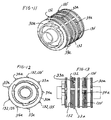
- the feed wheel 30 has four rows of teeth 32 through 35 which are staggered in the circumferential direction as best shown in FIGURES 2 and 4.
- the feed wheel 30 is designed to feed a carrier web having four columns of feed apertures.
- the teeth 32 are disposed in row R1, the teeth 33 are disposed in row R2, the teeth 34 are disposed in row R3, and the teeth 35 are disposed in row R4.
- each of the teeth 34, 32, 35 and 33 of each row is axially offset around the periphery of the feed wheel 30, and the rows R1 through R4 are axially offset or spaced from each other.
- the composite label web C is advanced to bring a label L to a printing position between the print head 21 and the platen 22.
- the print head 21 cooperates with the platen 22
- the label L is printed, and thereafter the feed wheel 30 is again rotated to bring the just printed label L to the label applying position in underlying relationship to the applicator roll 25.
- a stripper 30' strips the carrier web W from the feed wheel 30 as the carrier web W is advanced by the feed wheel 30.
- the labeler 20'of the embodiment of FIGURES 5 through 7 operates in the same way in many respects, and includes a grooved die roller 31', a cooperating feed wheel 36 and a stripper 36'.
- a cooperating feed wheel 36 for further details of such a labeler 20', reference may be had to the type of labeler disclosed in U.S. patent 4,280,862, the disclosure of which is incorporated herein by reference.
- the feed wheel 36 is designed to feed a carrier web having three columns of feed apertures.
- FIGURES 5 through 7 differs from the arrangement shown in FIGURES 1 through 4.
- the arrangement shown in FIGURES 5 through 7 is identical to the arrangement of FIGURES 1 through 4 except that the feed wheel 36 differs from the feed wheel 30.
- the feed wheel 36 has three rows R5, R6 and R7 of teeth 37, 38 and 39 arranged in three sets of like two-one patterns around the periphery or circumference of the feed wheel 36.
- Each two-one pattern has two teeth 37 and 39 and one tooth 38.
- the teeth 37, 38 and 39 of respective rows R5, R6 and R7 are axially offset or spaced, and the teeth 38 are staggered with respect to the pairs of teeth 37 and 39.
- the carrier web or liner W which has a release coating such as silicone on its upper surface 40.
- a series of labels L is releasably adhered by the pressure sensitive adhesive 26 to the carrier web W.
- the adhesive 26 on the underside of labels L releasably adheres the labels L to the silicone on the surface 40.
- the carrier web W has a composite pattern of feed apertures made by forming cuts or slits in the carrier web W between spaced side edges of the web W. There are five different cut configurations of feed apertures formed in a repeating arrangement in the carrier web W. Each cut configuration is disposed in a different column C1 through C5 in the carrier web W.
- the configuration of three cuts define feed apertures 41 disposed in column C1, angle-shaped cuts which extend in one lateral direction define feed apertures 42 in column C2, generally I-shaped cuts define feed apertures 43 in column C3, angle-shaped cuts which extend in the opposite lateral direction in column C4 define feed apertures 44, and generally I-shaped elongate cuts define feed apertures 45 in column C5.
- the feed apertures 41 are longer than feed apertures 44, and feed apertures 45 are longer than feed apertures 43.
- the cuts 41 through 45 which underlie the labels L are shown by broken lines.
- the feed apertures 41 through 45 preferably extend completely through the web W but preferably do not penetrate the labels L.
- the composite pattern of feed apertures includes a pattern of feed apertures 44, 41 and 42 engaged by the feed teeth 34, 32 and 33, respectively, and a pattern of feed apertures 43 and 45 engaged by the feed teeth 38 and 39, respectively.
- Neither the teeth 35 nor the teeth 37 are used to advance the carrier web W, so less than all the feed teeth of the feed wheel 30 are used and less than all of the feed teeth of the feed wheel 36 are used.
- the carrier web W is being advanced in the feed direction shown by arrow B.
- the feed teeth 32 enter the feed apertures 41 and fold flaps 41' out of the plane of the web W as shown, and engage feed faces or surfaces 32'.
- the teeth 33 fold a flap 42' out of the plane of the web W. Engagement of one or more teeth 33 with the feed faces 33' helps to advance the web W.
- the teeth 34 engage the feed apertures 44 at feed faces 34'.
- the feed apertures 45 enable the teeth 35 to enter the web W, however, the teeth 35 do not engage any feed face. As seen in FIGURE 9, when the teeth 32 through 34 engage the web W, the teeth 35 are spaced from both ends of the feed apertures 45. Therefore, the teeth 35 can enter the web W at the feed apertures 45 but do not engage any feed face. The feed teeth 35 merely passively enter into the feed apertures 45. It is apparent that only the feed apertures 41, 42 and 44 in columns C1, C2, and C4 are used by the feed wheel 30 to advance the web W.
- the web W is advanced by the feed wheel 36 in the feed direction shown by the arrow B.
- Rows R5, R6 and R7 are aligned with columns C1, C3 and C5.
- the teeth 38 and 39 which are aligned with columns C3 and C5 open feed apertures 46 and 45 and lift the respective flaps 43' and 45' and engage folded edges of flaps 43" and 45" for advancing the web W.
- the teeth 37 lift the flaps 41' but do not engage any feed face.
- the feed apertures 41 form convenient places for the teeth 37 to enter the web W.
- each feed wheel 30 and 36 are used to feed the web W.
- those teeth 32, 33 and 34 of the feed wheel 30 and those teeth 38 and 39 of the feed wheel 36 can advance the composite label web C through the respective labeler 20 or 20'.
- the teeth 35 and 37 of the respective feed wheels 30 and 36 which are not used do not impede or in any way affect the operation or functioning of labeler 20 or 20'.
- the same composite label web C can be used in either the labeler 20 or the labeler 20'. Yet the web W is wide enough and the cut configurations 41 through 45 are spaced far enough apart so that the integrity or strength of the web is not unduly compromised. Thus, the carrier web W is not as apt to tear as would be the case if there were a feed aperture for every feed tooth or if there were so many apertures in the carrier web W that the feed apertures had to be too close to each other.
- the feed apertures 41 through 45 are in a repeating composite pattern along the web W. As the web W is advanced either by the feed wheel 30 or by the feed wheel 36, multiple teeth engage the web W.
- one or more teeth 32 in column C1 one or more teeth 33 in column C2 and one or more teeth 34 in column C4 engage the carrier web W while teeth 35 enter the feed apertures 45 without engagement of with any feed face on the web W
- one or more teeth 38 in column C3 and one or more teeth 39 in the column C5 engage the web W while teeth 37 enter the feed apertures 37 without engagement of any feed face in the web W.
- M number of feed teeth 32 through 35 are on the feed wheel 30, then less than M number of feed teeth engage the web W to advance it.
- M number of feed teeth 37 through 39 are on the feed wheel 36, then less than the M number of feed teeth engage the web W to advance it.
- the number of feed apertures 32 through 36 in the web W which could be engaged at any one time is less than the sum of M plus N.
- the composite label web Ca of FIGURE 14 is similar in certain respects to the composite web C best shown in FIGURES 1 and 8 and hence components are with the same construction, function and relative location are designated with the same reference characters with the addition of the letter "a".
- the feed wheel of FIGURES 11, 12 and 13 is similar in certain respects to the feed wheel 30 and hence components with the same construction, function and relative location are designated with the same reference characters with the addition of the letter "a”.
- column C1, C2, Ce, C4 and C5 have the same significance in FIGURE 14 as in FIGURE 8, 9 and 10 and arrow A has the same significance in FIGURE 14 as in FIGURES 1 and A, these same reference characters are used.
- the feed wheel 30a is the same as the feed wheel 30 except as indicated hereafter.
- the feed teeth 32, 33, 34 and 35 are staggered in a lateral and a peripheral pattern as shown.
- the feed wheel 30a has feed teeth 33a and 34a which are staggered with respect to each other and feed teeth 132 and 135 which are laterally aligned in pairs.
- the feed teeth 33a and 34a engage the web Wa in respective feed apertures 42a and 44a.
- Feed apertures 141 and 145 in carrier web Wa are identical to each other and are laterally aligned, and thus differ from feed apertures 41 and 45 in carrier web W.
- the feed apertures 141 and 145 are engaged by respective teeth 132 and 135 on the feed wheel 30a.
- the feed wheel 30a thus advances the carrier web Wa and, indeed, the composite label web Ca, by teeth 33a, 34a, 132 and 135 engaged with the carrier web Wa in respective feed apertures 42a, 44a, 141 and 145.
- the feed wheel 36 (FIGURES 5, 6 and 7) can advance the carrier web Ca and, indeed, the composite label web Ca, by teeth 38 engaged in feed apertures 43a and teeth 37 and 39 engaged in respective feed apertures 141 and 145.
- the feed wheel 36 engages feed aperture 43a whereas feed wheel 30a does not engage feed aperture 43a.
- the feed wheel 30a engages feed apertures 42a and 44a whereas the feed wheel 36 does not engage feed apertures 42a and 44a.
- both feed wheels 30a and 36 engage in feed apertures 141 and 145. Therefore, of the repeating composite pattern of feed apertures 42a, 43a, 44a, 141 and 145, the feed apertures 141 and 145 are used, or shared, or are common to both feed wheels 30a and 36. Accordingly, the composite label web Ca can alternately be used in a labeler with the feed wheel 30a and in a labeler with the feed wheel 36.
- the composite label web Ca can be used in two different labelers having feed teeth with different feed tooth patterns.
- the composite feed tooth pattern shown in FIGURE 14 is thus constructed and arranged to receive teeth in two different feed tooth patterns, wherein some of the feed apertures are common to both feed tooth patterns. It is apparent that the composite label web Ca can be used either in an older model labeler having a feed wheel as in FIGURES 5, 6 and 7 or in a newer model labeler having a feed wheel as in FIGURES 11, 12 and 13.
- the pitch of the web is equal to the length of a label La in the longitudinal direction.
- the feed apertures of one label La, or one pitch includes the trailing half of aperture 43a, apertures 42a, 44a, 141, and 145, and the leading half of another aperture 43a.
- a first feed aperture pattern includes feed apertures 42a, 44a, 141 and 145.
- the second feed tooth pattern effectively includes one feed aperture 43a and feed apertures 141 and 145, the feed apertures 141 and 145 being common or shared by both of the first and second feed aperture patterns.
- the feed wheel 30a engages four feed apertures and the feed wheel 36 engages three feed apertures.
- the feed wheel 30, the feed teeth 34, 32, 35 and 33, and feed apertures 44, 41 and 42 can be characterized as "first”, and the feed wheel 36, feed teeth 38 and 39 and feed apertures 43 and 45 can be characterized as "second” solely for clarity of identification, without in any way intending to limit the invention.
- the feed wheel 30a and its feed teeth 33a, 34a, 132 and 135 can be characterized as "first” and the feed wheel 36 and its feed teeth 37, 38 and 39 can be characterized as "second" solely for clarity of identification.
- the composite pattern of the embodiment of FIGURE 14 can be considered to have a "first" feed aperture pattern which comprises feed apertures 42a, 44a, 141 and 145 and the feed wheel 36 can be considered to comprise a "second" feed aperture pattern, with the feed apertures 141 and 145 being common to both the first and second feed tooth patterns.
- more than one first pattern of engaging teeth 34, 32 and 33 can be engaged with the carrier web W at any one time as shown in FIGURE 1; and depending on the diameter of the feed wheel 36 and the number of teeth, more than one second pattern of engaging teeth 39 and 38 can be engaged with the carrier web W at any one time as shown in FIGURE 5.
Landscapes
- Physics & Mathematics (AREA)
- General Physics & Mathematics (AREA)
- Engineering & Computer Science (AREA)
- Theoretical Computer Science (AREA)
- Labeling Devices (AREA)
Applications Claiming Priority (4)
| Application Number | Priority Date | Filing Date | Title |
|---|---|---|---|
| US645846 | 1991-01-25 | ||
| US09/645,846 US6537633B1 (en) | 2000-08-24 | 2000-08-24 | Composite label web and method of using same |
| US925478 | 2001-08-10 | ||
| US09/925,478 US6599601B2 (en) | 2000-08-24 | 2001-08-10 | Composite label web and method of using same |
Publications (3)
| Publication Number | Publication Date |
|---|---|
| EP1182632A2 true EP1182632A2 (fr) | 2002-02-27 |
| EP1182632A3 EP1182632A3 (fr) | 2004-08-04 |
| EP1182632B1 EP1182632B1 (fr) | 2006-06-07 |
Family
ID=27094792
Family Applications (1)
| Application Number | Title | Priority Date | Filing Date |
|---|---|---|---|
| EP20010120172 Expired - Lifetime EP1182632B1 (fr) | 2000-08-24 | 2001-08-22 | Etiquette composite et sa méthode de fabrication |
Country Status (5)
| Country | Link |
|---|---|
| EP (1) | EP1182632B1 (fr) |
| JP (1) | JP2002120816A (fr) |
| AU (1) | AU774683B2 (fr) |
| CA (1) | CA2355789C (fr) |
| DE (1) | DE60120296T2 (fr) |
Citations (7)
| Publication number | Priority date | Publication date | Assignee | Title |
|---|---|---|---|---|
| US4280862A (en) | 1979-08-22 | 1981-07-28 | Monarch Marking Systems, Inc. | Label printing and applying apparatus |
| US4309468A (en) | 1981-01-08 | 1982-01-05 | Monarch Marking Systems, Inc. | Composite label web |
| US4393107A (en) | 1981-03-02 | 1983-07-12 | Monarch Marking Systems, Inc. | Composite label web |
| US4521267A (en) | 1984-06-21 | 1985-06-04 | Monarch Marking Systems, Inc. | Composite label web and method of labeling |
| US4556442A (en) | 1981-05-29 | 1985-12-03 | Monarch Marking Systems, Inc. | Hand-held electrically selectable labeler |
| US5705245A (en) | 1996-07-29 | 1998-01-06 | Monarch Marking Systems, Inc. | Composite label web |
| US5988249A (en) | 1996-08-22 | 1999-11-23 | Monarch Marking Systems, Inc. | Hand-held labeler |
Family Cites Families (3)
| Publication number | Priority date | Publication date | Assignee | Title |
|---|---|---|---|---|
| US4035225A (en) * | 1974-12-19 | 1977-07-12 | Monarch Marking Systems, Inc. | Apparatus for applying pressure sensitive labels |
| US4166757A (en) * | 1977-04-25 | 1979-09-04 | Monarch Marking Systems, Inc. | Hand-held labeler |
| US4125421A (en) * | 1977-07-18 | 1978-11-14 | Monarch Marking Systems, Inc. | Hand-held labeler |
-
2001
- 2001-08-22 DE DE2001620296 patent/DE60120296T2/de not_active Expired - Fee Related
- 2001-08-22 EP EP20010120172 patent/EP1182632B1/fr not_active Expired - Lifetime
- 2001-08-24 AU AU65457/01A patent/AU774683B2/en not_active Ceased
- 2001-08-24 JP JP2001254866A patent/JP2002120816A/ja active Pending
- 2001-08-24 CA CA 2355789 patent/CA2355789C/fr not_active Expired - Fee Related
Patent Citations (7)
| Publication number | Priority date | Publication date | Assignee | Title |
|---|---|---|---|---|
| US4280862A (en) | 1979-08-22 | 1981-07-28 | Monarch Marking Systems, Inc. | Label printing and applying apparatus |
| US4309468A (en) | 1981-01-08 | 1982-01-05 | Monarch Marking Systems, Inc. | Composite label web |
| US4393107A (en) | 1981-03-02 | 1983-07-12 | Monarch Marking Systems, Inc. | Composite label web |
| US4556442A (en) | 1981-05-29 | 1985-12-03 | Monarch Marking Systems, Inc. | Hand-held electrically selectable labeler |
| US4521267A (en) | 1984-06-21 | 1985-06-04 | Monarch Marking Systems, Inc. | Composite label web and method of labeling |
| US5705245A (en) | 1996-07-29 | 1998-01-06 | Monarch Marking Systems, Inc. | Composite label web |
| US5988249A (en) | 1996-08-22 | 1999-11-23 | Monarch Marking Systems, Inc. | Hand-held labeler |
Also Published As
| Publication number | Publication date |
|---|---|
| AU774683B2 (en) | 2004-07-01 |
| DE60120296D1 (de) | 2006-07-20 |
| CA2355789C (fr) | 2008-10-28 |
| AU6545701A (en) | 2002-03-07 |
| EP1182632B1 (fr) | 2006-06-07 |
| EP1182632A3 (fr) | 2004-08-04 |
| JP2002120816A (ja) | 2002-04-23 |
| CA2355789A1 (fr) | 2002-02-24 |
| DE60120296T2 (de) | 2007-06-06 |
Similar Documents
| Publication | Publication Date | Title |
|---|---|---|
| US6599601B2 (en) | Composite label web and method of using same | |
| EP1654162B1 (fr) | Application d'etiquettes adhesives sur des produits et recipients a produits | |
| US7208212B2 (en) | Label applicator system | |
| US5981013A (en) | Perforating blade/label perforating | |
| US7306690B2 (en) | Method for applying labels | |
| US6696127B1 (en) | Differential perforation pattern for dispensing print media | |
| CA1084080A (fr) | Materiel pour la preparation des cartes inserees dans les bracelets d'identification, dans les hopitaux | |
| US20080163973A1 (en) | Composite label and method of using same | |
| CA2208278C (fr) | Bande continue d'etiquettes faite d'un materiau composite | |
| EP1345759B1 (fr) | Fabrication d'etiquettes pour disques optiques | |
| EP1182632B1 (fr) | Etiquette composite et sa méthode de fabrication | |
| US6737140B2 (en) | Web of record members | |
| CA1047452A (fr) | Ruban d'affranchissement sur bande porteuse a perforation en marge | |
| US4348953A (en) | Continuous stencil assembly and method of manufacturing it | |
| CA1117076A (fr) | Etiquette de vente bi-volets, a un seul volet encolle | |
| JP4355521B2 (ja) | ラベル付き伝票 | |
| JPH05944Y2 (fr) | ||
| HK1005940B (en) | A labeler and a composite label web | |
| JPH0668071U (ja) | プリントラベル | |
| MXPA97005125A (en) | Coil for mix labels |
Legal Events
| Date | Code | Title | Description |
|---|---|---|---|
| PUAI | Public reference made under article 153(3) epc to a published international application that has entered the european phase |
Free format text: ORIGINAL CODE: 0009012 |
|
| AK | Designated contracting states |
Kind code of ref document: A2 Designated state(s): AT BE CH CY DE DK ES FI FR GB GR IE IT LI LU MC NL PT SE TR |
|
| AX | Request for extension of the european patent |
Free format text: AL;LT;LV;MK;RO;SI |
|
| PUAL | Search report despatched |
Free format text: ORIGINAL CODE: 0009013 |
|
| AK | Designated contracting states |
Kind code of ref document: A3 Designated state(s): AT BE CH CY DE DK ES FI FR GB GR IE IT LI LU MC NL PT SE TR |
|
| AX | Request for extension of the european patent |
Extension state: AL LT LV MK RO SI |
|
| RIC1 | Information provided on ipc code assigned before grant |
Ipc: 7G 09F 3/10 A Ipc: 7G 03B 27/58 B |
|
| 17P | Request for examination filed |
Effective date: 20040804 |
|
| 17Q | First examination report despatched |
Effective date: 20050210 |
|
| AKX | Designation fees paid |
Designated state(s): DE FR GB NL |
|
| RBV | Designated contracting states (corrected) |
Designated state(s): DE FR GB NL |
|
| GRAP | Despatch of communication of intention to grant a patent |
Free format text: ORIGINAL CODE: EPIDOSNIGR1 |
|
| RIN1 | Information on inventor provided before grant (corrected) |
Inventor name: FOGLE, RONALD LEE Inventor name: MISTYURIK, JOHN D. |
|
| GRAS | Grant fee paid |
Free format text: ORIGINAL CODE: EPIDOSNIGR3 |
|
| GRAA | (expected) grant |
Free format text: ORIGINAL CODE: 0009210 |
|
| AK | Designated contracting states |
Kind code of ref document: B1 Designated state(s): DE FR GB NL |
|
| REG | Reference to a national code |
Ref country code: GB Ref legal event code: FG4D |
|
| REF | Corresponds to: |
Ref document number: 60120296 Country of ref document: DE Date of ref document: 20060720 Kind code of ref document: P |
|
| ET | Fr: translation filed | ||
| PLBE | No opposition filed within time limit |
Free format text: ORIGINAL CODE: 0009261 |
|
| STAA | Information on the status of an ep patent application or granted ep patent |
Free format text: STATUS: NO OPPOSITION FILED WITHIN TIME LIMIT |
|
| 26N | No opposition filed |
Effective date: 20070308 |
|
| PGFP | Annual fee paid to national office [announced via postgrant information from national office to epo] |
Ref country code: NL Payment date: 20080824 Year of fee payment: 8 |
|
| PGFP | Annual fee paid to national office [announced via postgrant information from national office to epo] |
Ref country code: FR Payment date: 20080818 Year of fee payment: 8 |
|
| PGFP | Annual fee paid to national office [announced via postgrant information from national office to epo] |
Ref country code: GB Payment date: 20080827 Year of fee payment: 8 |
|
| PGFP | Annual fee paid to national office [announced via postgrant information from national office to epo] |
Ref country code: DE Payment date: 20080930 Year of fee payment: 8 |
|
| REG | Reference to a national code |
Ref country code: NL Ref legal event code: V1 Effective date: 20100301 |
|
| GBPC | Gb: european patent ceased through non-payment of renewal fee |
Effective date: 20090822 |
|
| REG | Reference to a national code |
Ref country code: FR Ref legal event code: ST Effective date: 20100430 |
|
| PG25 | Lapsed in a contracting state [announced via postgrant information from national office to epo] |
Ref country code: NL Free format text: LAPSE BECAUSE OF NON-PAYMENT OF DUE FEES Effective date: 20100301 Ref country code: FR Free format text: LAPSE BECAUSE OF NON-PAYMENT OF DUE FEES Effective date: 20090831 Ref country code: DE Free format text: LAPSE BECAUSE OF NON-PAYMENT OF DUE FEES Effective date: 20100302 |
|
| PG25 | Lapsed in a contracting state [announced via postgrant information from national office to epo] |
Ref country code: GB Free format text: LAPSE BECAUSE OF NON-PAYMENT OF DUE FEES Effective date: 20090822 |