EP1184406A2 - Verfahren zur Herstellung von Polymerpulvern - Google Patents
Verfahren zur Herstellung von Polymerpulvern Download PDFInfo
- Publication number
- EP1184406A2 EP1184406A2 EP01120019A EP01120019A EP1184406A2 EP 1184406 A2 EP1184406 A2 EP 1184406A2 EP 01120019 A EP01120019 A EP 01120019A EP 01120019 A EP01120019 A EP 01120019A EP 1184406 A2 EP1184406 A2 EP 1184406A2
- Authority
- EP
- European Patent Office
- Prior art keywords
- polymer
- weight
- dispersion
- alkyl
- drying
- Prior art date
- Legal status (The legal status is an assumption and is not a legal conclusion. Google has not performed a legal analysis and makes no representation as to the accuracy of the status listed.)
- Withdrawn
Links
- 229920000642 polymer Polymers 0.000 title claims abstract description 114
- 239000000843 powder Substances 0.000 title claims abstract description 47
- 238000004519 manufacturing process Methods 0.000 title abstract description 11
- 239000006185 dispersion Substances 0.000 claims abstract description 38
- 238000000034 method Methods 0.000 claims abstract description 33
- 239000011230 binding agent Substances 0.000 claims abstract description 29
- 229910052500 inorganic mineral Inorganic materials 0.000 claims abstract description 28
- 239000011707 mineral Substances 0.000 claims abstract description 28
- 150000003839 salts Chemical class 0.000 claims abstract description 23
- WSFSSNUMVMOOMR-UHFFFAOYSA-N formaldehyde Substances O=C WSFSSNUMVMOOMR-UHFFFAOYSA-N 0.000 claims abstract description 18
- 238000001704 evaporation Methods 0.000 claims abstract description 8
- 238000001035 drying Methods 0.000 claims description 42
- 150000001875 compounds Chemical class 0.000 claims description 28
- 239000004815 dispersion polymer Substances 0.000 claims description 23
- 239000000853 adhesive Substances 0.000 claims description 20
- 230000001070 adhesive effect Effects 0.000 claims description 20
- 238000002360 preparation method Methods 0.000 claims description 20
- 239000007859 condensation product Substances 0.000 claims description 17
- 125000000129 anionic group Chemical group 0.000 claims description 15
- 230000008569 process Effects 0.000 claims description 12
- 230000009477 glass transition Effects 0.000 claims description 10
- 238000001694 spray drying Methods 0.000 claims description 10
- 125000000217 alkyl group Chemical group 0.000 claims description 9
- 239000004566 building material Substances 0.000 claims description 9
- 239000000470 constituent Substances 0.000 claims description 9
- 239000004094 surface-active agent Substances 0.000 claims description 9
- 125000004432 carbon atom Chemical group C* 0.000 claims description 8
- 238000010276 construction Methods 0.000 claims description 8
- 125000001273 sulfonato group Chemical group [O-]S(*)(=O)=O 0.000 claims description 8
- 125000005907 alkyl ester group Chemical group 0.000 claims description 6
- 239000000945 filler Substances 0.000 claims description 6
- 239000004570 mortar (masonry) Substances 0.000 claims description 6
- 239000000049 pigment Substances 0.000 claims description 5
- 229920003048 styrene butadiene rubber Polymers 0.000 claims description 5
- 150000008052 alkyl sulfonates Chemical class 0.000 claims description 4
- 239000011248 coating agent Substances 0.000 claims description 4
- 229920002994 synthetic fiber Polymers 0.000 claims description 4
- 239000012209 synthetic fiber Substances 0.000 claims description 4
- 239000000654 additive Substances 0.000 claims description 3
- 229940045714 alkyl sulfonate alkylating agent Drugs 0.000 claims description 3
- 238000000576 coating method Methods 0.000 claims description 3
- 150000001991 dicarboxylic acids Chemical class 0.000 claims description 3
- QJAUKMLCDVOYNX-UHFFFAOYSA-N formaldehyde;2-hydroxybenzenesulfonic acid Chemical compound O=C.OC1=CC=CC=C1S(O)(=O)=O QJAUKMLCDVOYNX-UHFFFAOYSA-N 0.000 claims description 3
- NVVZQXQBYZPMLJ-UHFFFAOYSA-N formaldehyde;naphthalene-1-sulfonic acid Chemical compound O=C.C1=CC=C2C(S(=O)(=O)O)=CC=CC2=C1 NVVZQXQBYZPMLJ-UHFFFAOYSA-N 0.000 claims description 3
- 229910052739 hydrogen Inorganic materials 0.000 claims description 3
- 239000001257 hydrogen Substances 0.000 claims description 3
- 230000007935 neutral effect Effects 0.000 claims description 3
- 239000012875 nonionic emulsifier Substances 0.000 claims description 3
- 239000003973 paint Substances 0.000 claims description 3
- 239000004576 sand Substances 0.000 claims description 3
- 229920006395 saturated elastomer Polymers 0.000 claims description 3
- 229920003002 synthetic resin Polymers 0.000 claims description 3
- 239000000057 synthetic resin Substances 0.000 claims description 3
- 239000001692 EU approved anti-caking agent Substances 0.000 claims description 2
- 150000001768 cations Chemical class 0.000 claims description 2
- KHUXNRRPPZOJPT-UHFFFAOYSA-N phenoxy radical Chemical compound O=C1C=C[CH]C=C1 KHUXNRRPPZOJPT-UHFFFAOYSA-N 0.000 claims description 2
- 125000001997 phenyl group Chemical group [H]C1=C([H])C([H])=C(*)C([H])=C1[H] 0.000 claims description 2
- 239000000835 fiber Substances 0.000 claims 1
- 125000004435 hydrogen atom Chemical class [H]* 0.000 claims 1
- 239000000565 sealant Substances 0.000 claims 1
- 239000002966 varnish Substances 0.000 claims 1
- 239000000463 material Substances 0.000 abstract description 5
- 239000002274 desiccant Substances 0.000 abstract description 4
- 230000008020 evaporation Effects 0.000 abstract description 3
- 239000003945 anionic surfactant Substances 0.000 abstract description 2
- 239000000178 monomer Substances 0.000 description 47
- -1 aromatic sulfonic acids Chemical class 0.000 description 41
- KAKZBPTYRLMSJV-UHFFFAOYSA-N Butadiene Chemical compound C=CC=C KAKZBPTYRLMSJV-UHFFFAOYSA-N 0.000 description 16
- PPBRXRYQALVLMV-UHFFFAOYSA-N Styrene Chemical compound C=CC1=CC=CC=C1 PPBRXRYQALVLMV-UHFFFAOYSA-N 0.000 description 16
- 239000002245 particle Substances 0.000 description 16
- NIXOWILDQLNWCW-UHFFFAOYSA-N 2-Propenoic acid Natural products OC(=O)C=C NIXOWILDQLNWCW-UHFFFAOYSA-N 0.000 description 12
- 239000003995 emulsifying agent Substances 0.000 description 12
- CERQOIWHTDAKMF-UHFFFAOYSA-N Methacrylic acid Chemical compound CC(=C)C(O)=O CERQOIWHTDAKMF-UHFFFAOYSA-N 0.000 description 11
- 239000004568 cement Substances 0.000 description 11
- NIXOWILDQLNWCW-UHFFFAOYSA-M Acrylate Chemical compound [O-]C(=O)C=C NIXOWILDQLNWCW-UHFFFAOYSA-M 0.000 description 10
- XLYOFNOQVPJJNP-UHFFFAOYSA-N water Substances O XLYOFNOQVPJJNP-UHFFFAOYSA-N 0.000 description 10
- SMZOUWXMTYCWNB-UHFFFAOYSA-N 2-(2-methoxy-5-methylphenyl)ethanamine Chemical compound COC1=CC=C(C)C=C1CCN SMZOUWXMTYCWNB-UHFFFAOYSA-N 0.000 description 9
- 230000015572 biosynthetic process Effects 0.000 description 9
- VYPSYNLAJGMNEJ-UHFFFAOYSA-N Silicium dioxide Chemical compound O=[Si]=O VYPSYNLAJGMNEJ-UHFFFAOYSA-N 0.000 description 8
- QAOWNCQODCNURD-UHFFFAOYSA-N Sulfuric acid Chemical compound OS(O)(=O)=O QAOWNCQODCNURD-UHFFFAOYSA-N 0.000 description 8
- 239000004816 latex Substances 0.000 description 8
- 229920000126 latex Polymers 0.000 description 8
- 239000000203 mixture Substances 0.000 description 8
- 238000006116 polymerization reaction Methods 0.000 description 8
- 239000007787 solid Substances 0.000 description 8
- 150000001735 carboxylic acids Chemical class 0.000 description 7
- 239000003795 chemical substances by application Substances 0.000 description 7
- 150000003254 radicals Chemical class 0.000 description 7
- 159000000000 sodium salts Chemical class 0.000 description 7
- 239000007864 aqueous solution Substances 0.000 description 6
- 150000002148 esters Chemical class 0.000 description 6
- 239000004014 plasticizer Substances 0.000 description 6
- 239000007921 spray Substances 0.000 description 6
- 239000000126 substance Substances 0.000 description 6
- 229920002554 vinyl polymer Polymers 0.000 description 6
- RRHGJUQNOFWUDK-UHFFFAOYSA-N Isoprene Chemical compound CC(=C)C=C RRHGJUQNOFWUDK-UHFFFAOYSA-N 0.000 description 5
- 229910052783 alkali metal Inorganic materials 0.000 description 5
- 229910052784 alkaline earth metal Inorganic materials 0.000 description 5
- 229920001577 copolymer Polymers 0.000 description 5
- 238000007720 emulsion polymerization reaction Methods 0.000 description 5
- 239000003999 initiator Substances 0.000 description 5
- 239000000243 solution Substances 0.000 description 5
- VTYYLEPIZMXCLO-UHFFFAOYSA-L Calcium carbonate Chemical compound [Ca+2].[O-]C([O-])=O VTYYLEPIZMXCLO-UHFFFAOYSA-L 0.000 description 4
- 239000011398 Portland cement Substances 0.000 description 4
- ULUAUXLGCMPNKK-UHFFFAOYSA-N Sulfobutanedioic acid Chemical compound OC(=O)CC(C(O)=O)S(O)(=O)=O ULUAUXLGCMPNKK-UHFFFAOYSA-N 0.000 description 4
- 150000001298 alcohols Chemical class 0.000 description 4
- 239000000084 colloidal system Substances 0.000 description 4
- 238000004132 cross linking Methods 0.000 description 4
- 150000001993 dienes Chemical class 0.000 description 4
- 230000001681 protective effect Effects 0.000 description 4
- 239000011163 secondary particle Substances 0.000 description 4
- 239000002562 thickening agent Substances 0.000 description 4
- JAHNSTQSQJOJLO-UHFFFAOYSA-N 2-(3-fluorophenyl)-1h-imidazole Chemical compound FC1=CC=CC(C=2NC=CN=2)=C1 JAHNSTQSQJOJLO-UHFFFAOYSA-N 0.000 description 3
- LSNNMFCWUKXFEE-UHFFFAOYSA-M Bisulfite Chemical compound OS([O-])=O LSNNMFCWUKXFEE-UHFFFAOYSA-M 0.000 description 3
- 239000002253 acid Substances 0.000 description 3
- 150000001408 amides Chemical class 0.000 description 3
- 239000003139 biocide Substances 0.000 description 3
- 230000000694 effects Effects 0.000 description 3
- 238000005516 engineering process Methods 0.000 description 3
- 230000002209 hydrophobic effect Effects 0.000 description 3
- LVHBHZANLOWSRM-UHFFFAOYSA-N methylenebutanedioic acid Natural products OC(=O)CC(=C)C(O)=O LVHBHZANLOWSRM-UHFFFAOYSA-N 0.000 description 3
- 239000012966 redox initiator Substances 0.000 description 3
- 239000013589 supplement Substances 0.000 description 3
- 239000013008 thixotropic agent Substances 0.000 description 3
- 125000004178 (C1-C4) alkyl group Chemical group 0.000 description 2
- IBDVWXAVKPRHCU-UHFFFAOYSA-N 2-(2-methylprop-2-enoyloxy)ethyl 3-oxobutanoate Chemical compound CC(=O)CC(=O)OCCOC(=O)C(C)=C IBDVWXAVKPRHCU-UHFFFAOYSA-N 0.000 description 2
- LEJBBGNFPAFPKQ-UHFFFAOYSA-N 2-(2-prop-2-enoyloxyethoxy)ethyl prop-2-enoate Chemical compound C=CC(=O)OCCOCCOC(=O)C=C LEJBBGNFPAFPKQ-UHFFFAOYSA-N 0.000 description 2
- INQDDHNZXOAFFD-UHFFFAOYSA-N 2-[2-(2-prop-2-enoyloxyethoxy)ethoxy]ethyl prop-2-enoate Chemical compound C=CC(=O)OCCOCCOCCOC(=O)C=C INQDDHNZXOAFFD-UHFFFAOYSA-N 0.000 description 2
- OMIGHNLMNHATMP-UHFFFAOYSA-N 2-hydroxyethyl prop-2-enoate Chemical compound OCCOC(=O)C=C OMIGHNLMNHATMP-UHFFFAOYSA-N 0.000 description 2
- ZHCGVAXFRLLEFW-UHFFFAOYSA-N 2-methyl-3-(prop-2-enoylamino)propane-1-sulfonic acid Chemical compound OS(=O)(=O)CC(C)CNC(=O)C=C ZHCGVAXFRLLEFW-UHFFFAOYSA-N 0.000 description 2
- YHSYGCXKWUUKIK-UHFFFAOYSA-N 2-prop-2-enoyloxyethyl 3-oxobutanoate Chemical compound CC(=O)CC(=O)OCCOC(=O)C=C YHSYGCXKWUUKIK-UHFFFAOYSA-N 0.000 description 2
- KUDUQBURMYMBIJ-UHFFFAOYSA-N 2-prop-2-enoyloxyethyl prop-2-enoate Chemical compound C=CC(=O)OCCOC(=O)C=C KUDUQBURMYMBIJ-UHFFFAOYSA-N 0.000 description 2
- GNSFRPWPOGYVLO-UHFFFAOYSA-N 3-hydroxypropyl 2-methylprop-2-enoate Chemical compound CC(=C)C(=O)OCCCO GNSFRPWPOGYVLO-UHFFFAOYSA-N 0.000 description 2
- QZPSOSOOLFHYRR-UHFFFAOYSA-N 3-hydroxypropyl prop-2-enoate Chemical compound OCCCOC(=O)C=C QZPSOSOOLFHYRR-UHFFFAOYSA-N 0.000 description 2
- IKHGUXGNUITLKF-UHFFFAOYSA-N Acetaldehyde Chemical compound CC=O IKHGUXGNUITLKF-UHFFFAOYSA-N 0.000 description 2
- CSCPPACGZOOCGX-UHFFFAOYSA-N Acetone Chemical compound CC(C)=O CSCPPACGZOOCGX-UHFFFAOYSA-N 0.000 description 2
- HRPVXLWXLXDGHG-UHFFFAOYSA-N Acrylamide Chemical compound NC(=O)C=C HRPVXLWXLXDGHG-UHFFFAOYSA-N 0.000 description 2
- NLHHRLWOUZZQLW-UHFFFAOYSA-N Acrylonitrile Chemical compound C=CC#N NLHHRLWOUZZQLW-UHFFFAOYSA-N 0.000 description 2
- QGZKDVFQNNGYKY-UHFFFAOYSA-O Ammonium Chemical compound [NH4+] QGZKDVFQNNGYKY-UHFFFAOYSA-O 0.000 description 2
- CIWBSHSKHKDKBQ-JLAZNSOCSA-N Ascorbic acid Chemical compound OC[C@H](O)[C@H]1OC(=O)C(O)=C1O CIWBSHSKHKDKBQ-JLAZNSOCSA-N 0.000 description 2
- BHPQYMZQTOCNFJ-UHFFFAOYSA-N Calcium cation Chemical compound [Ca+2] BHPQYMZQTOCNFJ-UHFFFAOYSA-N 0.000 description 2
- UFHFLCQGNIYNRP-UHFFFAOYSA-N Hydrogen Chemical compound [H][H] UFHFLCQGNIYNRP-UHFFFAOYSA-N 0.000 description 2
- MHAJPDPJQMAIIY-UHFFFAOYSA-N Hydrogen peroxide Chemical compound OO MHAJPDPJQMAIIY-UHFFFAOYSA-N 0.000 description 2
- WOBHKFSMXKNTIM-UHFFFAOYSA-N Hydroxyethyl methacrylate Chemical compound CC(=C)C(=O)OCCO WOBHKFSMXKNTIM-UHFFFAOYSA-N 0.000 description 2
- DGAQECJNVWCQMB-PUAWFVPOSA-M Ilexoside XXIX Chemical compound C[C@@H]1CC[C@@]2(CC[C@@]3(C(=CC[C@H]4[C@]3(CC[C@@H]5[C@@]4(CC[C@@H](C5(C)C)OS(=O)(=O)[O-])C)C)[C@@H]2[C@]1(C)O)C)C(=O)O[C@H]6[C@@H]([C@H]([C@@H]([C@H](O6)CO)O)O)O.[Na+] DGAQECJNVWCQMB-PUAWFVPOSA-M 0.000 description 2
- XEEYBQQBJWHFJM-UHFFFAOYSA-N Iron Chemical compound [Fe] XEEYBQQBJWHFJM-UHFFFAOYSA-N 0.000 description 2
- UQSXHKLRYXJYBZ-UHFFFAOYSA-N Iron oxide Chemical compound [Fe]=O UQSXHKLRYXJYBZ-UHFFFAOYSA-N 0.000 description 2
- GYCMBHHDWRMZGG-UHFFFAOYSA-N Methylacrylonitrile Chemical compound CC(=C)C#N GYCMBHHDWRMZGG-UHFFFAOYSA-N 0.000 description 2
- CNCOEDDPFOAUMB-UHFFFAOYSA-N N-Methylolacrylamide Chemical compound OCNC(=O)C=C CNCOEDDPFOAUMB-UHFFFAOYSA-N 0.000 description 2
- WHNWPMSKXPGLAX-UHFFFAOYSA-N N-Vinyl-2-pyrrolidone Chemical compound C=CN1CCCC1=O WHNWPMSKXPGLAX-UHFFFAOYSA-N 0.000 description 2
- 239000004435 Oxo alcohol Substances 0.000 description 2
- ZLMJMSJWJFRBEC-UHFFFAOYSA-N Potassium Chemical compound [K] ZLMJMSJWJFRBEC-UHFFFAOYSA-N 0.000 description 2
- OFOBLEOULBTSOW-UHFFFAOYSA-N Propanedioic acid Natural products OC(=O)CC(O)=O OFOBLEOULBTSOW-UHFFFAOYSA-N 0.000 description 2
- 239000006004 Quartz sand Substances 0.000 description 2
- 239000002174 Styrene-butadiene Substances 0.000 description 2
- GWEVSGVZZGPLCZ-UHFFFAOYSA-N Titan oxide Chemical compound O=[Ti]=O GWEVSGVZZGPLCZ-UHFFFAOYSA-N 0.000 description 2
- KWKOTMDQAMKXQF-UHFFFAOYSA-N [2-methyl-2-(prop-2-enoylamino)propyl]phosphonic acid Chemical compound OP(=O)(O)CC(C)(C)NC(=O)C=C KWKOTMDQAMKXQF-UHFFFAOYSA-N 0.000 description 2
- 239000013543 active substance Substances 0.000 description 2
- 230000002411 adverse Effects 0.000 description 2
- 125000001931 aliphatic group Chemical group 0.000 description 2
- 150000001340 alkali metals Chemical class 0.000 description 2
- 150000001342 alkaline earth metals Chemical class 0.000 description 2
- 125000002947 alkylene group Chemical group 0.000 description 2
- 229940077464 ammonium ion Drugs 0.000 description 2
- 150000003863 ammonium salts Chemical class 0.000 description 2
- 239000012874 anionic emulsifier Substances 0.000 description 2
- PVEOYINWKBTPIZ-UHFFFAOYSA-N but-3-enoic acid Chemical compound OC(=O)CC=C PVEOYINWKBTPIZ-UHFFFAOYSA-N 0.000 description 2
- MTAZNLWOLGHBHU-UHFFFAOYSA-N butadiene-styrene rubber Chemical compound C=CC=C.C=CC1=CC=CC=C1 MTAZNLWOLGHBHU-UHFFFAOYSA-N 0.000 description 2
- 229910000019 calcium carbonate Inorganic materials 0.000 description 2
- 229910001424 calcium ion Inorganic materials 0.000 description 2
- 229910052799 carbon Inorganic materials 0.000 description 2
- 239000001913 cellulose Substances 0.000 description 2
- 229920002678 cellulose Polymers 0.000 description 2
- 125000002993 cycloalkylene group Chemical group 0.000 description 2
- 239000002270 dispersing agent Substances 0.000 description 2
- 239000000839 emulsion Substances 0.000 description 2
- 238000007046 ethoxylation reaction Methods 0.000 description 2
- 238000004108 freeze drying Methods 0.000 description 2
- VOZRXNHHFUQHIL-UHFFFAOYSA-N glycidyl methacrylate Chemical compound CC(=C)C(=O)OCC1CO1 VOZRXNHHFUQHIL-UHFFFAOYSA-N 0.000 description 2
- 239000010440 gypsum Substances 0.000 description 2
- 229910052602 gypsum Inorganic materials 0.000 description 2
- 150000002432 hydroperoxides Chemical class 0.000 description 2
- 125000002887 hydroxy group Chemical group [H]O* 0.000 description 2
- 125000002768 hydroxyalkyl group Chemical group 0.000 description 2
- 229910052809 inorganic oxide Inorganic materials 0.000 description 2
- 230000002427 irreversible effect Effects 0.000 description 2
- VZCYOOQTPOCHFL-UPHRSURJSA-N maleic acid Chemical compound OC(=O)\C=C/C(O)=O VZCYOOQTPOCHFL-UPHRSURJSA-N 0.000 description 2
- 239000011976 maleic acid Substances 0.000 description 2
- FQPSGWSUVKBHSU-UHFFFAOYSA-N methacrylamide Chemical compound CC(=C)C(N)=O FQPSGWSUVKBHSU-UHFFFAOYSA-N 0.000 description 2
- XMYQHJDBLRZMLW-UHFFFAOYSA-N methanolamine Chemical compound NCO XMYQHJDBLRZMLW-UHFFFAOYSA-N 0.000 description 2
- WSFSSNUMVMOOMR-NJFSPNSNSA-N methanone Chemical compound O=[14CH2] WSFSSNUMVMOOMR-NJFSPNSNSA-N 0.000 description 2
- 229940029985 mineral supplement Drugs 0.000 description 2
- 235000020786 mineral supplement Nutrition 0.000 description 2
- DNTMQTKDNSEIFO-UHFFFAOYSA-N n-(hydroxymethyl)-2-methylprop-2-enamide Chemical compound CC(=C)C(=O)NCO DNTMQTKDNSEIFO-UHFFFAOYSA-N 0.000 description 2
- RPQRDASANLAFCM-UHFFFAOYSA-N oxiran-2-ylmethyl prop-2-enoate Chemical compound C=CC(=O)OCC1CO1 RPQRDASANLAFCM-UHFFFAOYSA-N 0.000 description 2
- 150000002978 peroxides Chemical class 0.000 description 2
- 229920006254 polymer film Polymers 0.000 description 2
- 229920002451 polyvinyl alcohol Polymers 0.000 description 2
- 235000019422 polyvinyl alcohol Nutrition 0.000 description 2
- 239000011591 potassium Substances 0.000 description 2
- 229910001414 potassium ion Inorganic materials 0.000 description 2
- 230000002787 reinforcement Effects 0.000 description 2
- 239000000377 silicon dioxide Substances 0.000 description 2
- 239000011734 sodium Substances 0.000 description 2
- 229910001415 sodium ion Inorganic materials 0.000 description 2
- GEHJYWRUCIMESM-UHFFFAOYSA-L sodium sulfite Chemical compound [Na+].[Na+].[O-]S([O-])=O GEHJYWRUCIMESM-UHFFFAOYSA-L 0.000 description 2
- 239000011115 styrene butadiene Substances 0.000 description 2
- CIHOLLKRGTVIJN-UHFFFAOYSA-N tert‐butyl hydroperoxide Chemical compound CC(C)(C)OO CIHOLLKRGTVIJN-UHFFFAOYSA-N 0.000 description 2
- VZCYOOQTPOCHFL-UHFFFAOYSA-N trans-butenedioic acid Natural products OC(=O)C=CC(O)=O VZCYOOQTPOCHFL-UHFFFAOYSA-N 0.000 description 2
- 125000000391 vinyl group Chemical group [H]C([*])=C([H])[H] 0.000 description 2
- ZTWTYVWXUKTLCP-UHFFFAOYSA-N vinylphosphonic acid Chemical compound OP(O)(=O)C=C ZTWTYVWXUKTLCP-UHFFFAOYSA-N 0.000 description 2
- NLVXSWCKKBEXTG-UHFFFAOYSA-N vinylsulfonic acid Chemical compound OS(=O)(=O)C=C NLVXSWCKKBEXTG-UHFFFAOYSA-N 0.000 description 2
- WHOZNOZYMBRCBL-OUKQBFOZSA-N (2E)-2-Tetradecenal Chemical compound CCCCCCCCCCC\C=C\C=O WHOZNOZYMBRCBL-OUKQBFOZSA-N 0.000 description 1
- 229920002818 (Hydroxyethyl)methacrylate Polymers 0.000 description 1
- HNSDLXPSAYFUHK-UHFFFAOYSA-N 1,4-bis(2-ethylhexyl) sulfosuccinate Chemical class CCCCC(CC)COC(=O)CC(S(O)(=O)=O)C(=O)OCC(CC)CCCC HNSDLXPSAYFUHK-UHFFFAOYSA-N 0.000 description 1
- FWVCSXWHVOOTFJ-UHFFFAOYSA-N 1-(2-chloroethylsulfanyl)-2-[2-(2-chloroethylsulfanyl)ethoxy]ethane Chemical compound ClCCSCCOCCSCCCl FWVCSXWHVOOTFJ-UHFFFAOYSA-N 0.000 description 1
- ZDQNWDNMNKSMHI-UHFFFAOYSA-N 1-[2-(2-prop-2-enoyloxypropoxy)propoxy]propan-2-yl prop-2-enoate Chemical compound C=CC(=O)OC(C)COC(C)COCC(C)OC(=O)C=C ZDQNWDNMNKSMHI-UHFFFAOYSA-N 0.000 description 1
- NVZWEEGUWXZOKI-UHFFFAOYSA-N 1-ethenyl-2-methylbenzene Chemical compound CC1=CC=CC=C1C=C NVZWEEGUWXZOKI-UHFFFAOYSA-N 0.000 description 1
- VOBUAPTXJKMNCT-UHFFFAOYSA-N 1-prop-2-enoyloxyhexyl prop-2-enoate Chemical compound CCCCCC(OC(=O)C=C)OC(=O)C=C VOBUAPTXJKMNCT-UHFFFAOYSA-N 0.000 description 1
- XYTBCFDEBPQSPG-UHFFFAOYSA-N 2,2-bis(6-methylheptyl)-3-sulfobutanedioic acid Chemical class C(CCCCC(C)C)C(C(C(=O)O)S(=O)(=O)O)(C(=O)O)CCCCCC(C)C XYTBCFDEBPQSPG-UHFFFAOYSA-N 0.000 description 1
- CTTJWXVQRJUJQW-UHFFFAOYSA-N 2,2-dioctyl-3-sulfobutanedioic acid Chemical class CCCCCCCCC(C(O)=O)(C(C(O)=O)S(O)(=O)=O)CCCCCCCC CTTJWXVQRJUJQW-UHFFFAOYSA-N 0.000 description 1
- 239000004808 2-ethylhexylester Substances 0.000 description 1
- SGJUFIMCHSLMRJ-UHFFFAOYSA-N 2-hydroperoxypropane Chemical compound CC(C)OO SGJUFIMCHSLMRJ-UHFFFAOYSA-N 0.000 description 1
- NEYTXADIGVEHQD-UHFFFAOYSA-N 2-hydroxy-2-(prop-2-enoylamino)acetic acid Chemical compound OC(=O)C(O)NC(=O)C=C NEYTXADIGVEHQD-UHFFFAOYSA-N 0.000 description 1
- AGBXYHCHUYARJY-UHFFFAOYSA-N 2-phenylethenesulfonic acid Chemical compound OS(=O)(=O)C=CC1=CC=CC=C1 AGBXYHCHUYARJY-UHFFFAOYSA-N 0.000 description 1
- PGKQTZHDCHKDQK-UHFFFAOYSA-N 2-phenylethenylphosphonic acid Chemical compound OP(O)(=O)C=CC1=CC=CC=C1 PGKQTZHDCHKDQK-UHFFFAOYSA-N 0.000 description 1
- 125000003903 2-propenyl group Chemical group [H]C([*])([H])C([H])=C([H])[H] 0.000 description 1
- UUEWCQRISZBELL-UHFFFAOYSA-N 3-trimethoxysilylpropane-1-thiol Chemical compound CO[Si](OC)(OC)CCCS UUEWCQRISZBELL-UHFFFAOYSA-N 0.000 description 1
- JHWGFJBTMHEZME-UHFFFAOYSA-N 4-prop-2-enoyloxybutyl prop-2-enoate Chemical compound C=CC(=O)OCCCCOC(=O)C=C JHWGFJBTMHEZME-UHFFFAOYSA-N 0.000 description 1
- GAWIXWVDTYZWAW-UHFFFAOYSA-N C[CH]O Chemical group C[CH]O GAWIXWVDTYZWAW-UHFFFAOYSA-N 0.000 description 1
- 235000008733 Citrus aurantifolia Nutrition 0.000 description 1
- SNRUBQQJIBEYMU-UHFFFAOYSA-N Dodecane Natural products CCCCCCCCCCCC SNRUBQQJIBEYMU-UHFFFAOYSA-N 0.000 description 1
- IAYPIBMASNFSPL-UHFFFAOYSA-N Ethylene oxide Chemical group C1CO1 IAYPIBMASNFSPL-UHFFFAOYSA-N 0.000 description 1
- VVQNEPGJFQJSBK-UHFFFAOYSA-N Methyl methacrylate Chemical compound COC(=O)C(C)=C VVQNEPGJFQJSBK-UHFFFAOYSA-N 0.000 description 1
- BPQQTUXANYXVAA-UHFFFAOYSA-N Orthosilicate Chemical compound [O-][Si]([O-])([O-])[O-] BPQQTUXANYXVAA-UHFFFAOYSA-N 0.000 description 1
- 229910019142 PO4 Inorganic materials 0.000 description 1
- 239000004372 Polyvinyl alcohol Substances 0.000 description 1
- NPYPAHLBTDXSSS-UHFFFAOYSA-N Potassium ion Chemical compound [K+] NPYPAHLBTDXSSS-UHFFFAOYSA-N 0.000 description 1
- BLRPTPMANUNPDV-UHFFFAOYSA-N Silane Chemical group [SiH4] BLRPTPMANUNPDV-UHFFFAOYSA-N 0.000 description 1
- 229920002125 Sokalan® Polymers 0.000 description 1
- 229920002472 Starch Polymers 0.000 description 1
- LSNNMFCWUKXFEE-UHFFFAOYSA-N Sulfurous acid Chemical compound OS(O)=O LSNNMFCWUKXFEE-UHFFFAOYSA-N 0.000 description 1
- 239000004809 Teflon Substances 0.000 description 1
- 229920006362 Teflon® Polymers 0.000 description 1
- 229910010413 TiO 2 Inorganic materials 0.000 description 1
- 235000011941 Tilia x europaea Nutrition 0.000 description 1
- DAKWPKUUDNSNPN-UHFFFAOYSA-N Trimethylolpropane triacrylate Chemical compound C=CC(=O)OCC(CC)(COC(=O)C=C)COC(=O)C=C DAKWPKUUDNSNPN-UHFFFAOYSA-N 0.000 description 1
- XTXRWKRVRITETP-UHFFFAOYSA-N Vinyl acetate Chemical compound CC(=O)OC=C XTXRWKRVRITETP-UHFFFAOYSA-N 0.000 description 1
- 150000007513 acids Chemical class 0.000 description 1
- 230000009471 action Effects 0.000 description 1
- MOVRNJGDXREIBM-UHFFFAOYSA-N aid-1 Chemical compound O=C1NC(=O)C(C)=CN1C1OC(COP(O)(=O)OC2C(OC(C2)N2C3=C(C(NC(N)=N3)=O)N=C2)COP(O)(=O)OC2C(OC(C2)N2C3=C(C(NC(N)=N3)=O)N=C2)COP(O)(=O)OC2C(OC(C2)N2C3=C(C(NC(N)=N3)=O)N=C2)COP(O)(=O)OC2C(OC(C2)N2C(NC(=O)C(C)=C2)=O)COP(O)(=O)OC2C(OC(C2)N2C3=C(C(NC(N)=N3)=O)N=C2)COP(O)(=O)OC2C(OC(C2)N2C3=C(C(NC(N)=N3)=O)N=C2)COP(O)(=O)OC2C(OC(C2)N2C3=C(C(NC(N)=N3)=O)N=C2)COP(O)(=O)OC2C(OC(C2)N2C(NC(=O)C(C)=C2)=O)COP(O)(=O)OC2C(OC(C2)N2C3=C(C(NC(N)=N3)=O)N=C2)COP(O)(=O)OC2C(OC(C2)N2C3=C(C(NC(N)=N3)=O)N=C2)COP(O)(=O)OC2C(OC(C2)N2C3=C(C(NC(N)=N3)=O)N=C2)COP(O)(=O)OC2C(OC(C2)N2C(NC(=O)C(C)=C2)=O)COP(O)(=O)OC2C(OC(C2)N2C3=C(C(NC(N)=N3)=O)N=C2)COP(O)(=O)OC2C(OC(C2)N2C3=C(C(NC(N)=N3)=O)N=C2)COP(O)(=O)OC2C(OC(C2)N2C3=C(C(NC(N)=N3)=O)N=C2)CO)C(O)C1 MOVRNJGDXREIBM-UHFFFAOYSA-N 0.000 description 1
- 150000001299 aldehydes Chemical class 0.000 description 1
- 239000003513 alkali Substances 0.000 description 1
- 150000001336 alkenes Chemical class 0.000 description 1
- 125000002877 alkyl aryl group Chemical group 0.000 description 1
- 150000008051 alkyl sulfates Chemical class 0.000 description 1
- 150000004808 allyl alcohols Chemical class 0.000 description 1
- XYLMUPLGERFSHI-UHFFFAOYSA-N alpha-Methylstyrene Chemical compound CC(=C)C1=CC=CC=C1 XYLMUPLGERFSHI-UHFFFAOYSA-N 0.000 description 1
- PNEYBMLMFCGWSK-UHFFFAOYSA-N aluminium oxide Inorganic materials [O-2].[O-2].[O-2].[Al+3].[Al+3] PNEYBMLMFCGWSK-UHFFFAOYSA-N 0.000 description 1
- 150000004945 aromatic hydrocarbons Chemical class 0.000 description 1
- 125000003118 aryl group Chemical group 0.000 description 1
- 235000010323 ascorbic acid Nutrition 0.000 description 1
- 229960005070 ascorbic acid Drugs 0.000 description 1
- 239000011668 ascorbic acid Substances 0.000 description 1
- 238000000889 atomisation Methods 0.000 description 1
- 239000002585 base Substances 0.000 description 1
- 229940049580 biozide Drugs 0.000 description 1
- 239000011400 blast furnace cement Substances 0.000 description 1
- 244000309464 bull Species 0.000 description 1
- CQEYYJKEWSMYFG-UHFFFAOYSA-N butyl acrylate Chemical compound CCCCOC(=O)C=C CQEYYJKEWSMYFG-UHFFFAOYSA-N 0.000 description 1
- 239000011575 calcium Substances 0.000 description 1
- 159000000007 calcium salts Chemical class 0.000 description 1
- 125000002915 carbonyl group Chemical group [*:2]C([*:1])=O 0.000 description 1
- 125000003178 carboxy group Chemical group [H]OC(*)=O 0.000 description 1
- 150000007942 carboxylates Chemical class 0.000 description 1
- 235000010980 cellulose Nutrition 0.000 description 1
- 230000008859 change Effects 0.000 description 1
- 239000003638 chemical reducing agent Substances 0.000 description 1
- 239000004927 clay Substances 0.000 description 1
- 230000001427 coherent effect Effects 0.000 description 1
- 150000001879 copper Chemical class 0.000 description 1
- LDHQCZJRKDOVOX-NSCUHMNNSA-N crotonic acid Chemical compound C\C=C\C(O)=O LDHQCZJRKDOVOX-NSCUHMNNSA-N 0.000 description 1
- 230000008021 deposition Effects 0.000 description 1
- 238000010790 dilution Methods 0.000 description 1
- 239000012895 dilution Substances 0.000 description 1
- 238000009826 distribution Methods 0.000 description 1
- WNAHIZMDSQCWRP-UHFFFAOYSA-N dodecane-1-thiol Chemical compound CCCCCCCCCCCCS WNAHIZMDSQCWRP-UHFFFAOYSA-N 0.000 description 1
- 125000003438 dodecyl group Chemical group [H]C([H])([H])C([H])([H])C([H])([H])C([H])([H])C([H])([H])C([H])([H])C([H])([H])C([H])([H])C([H])([H])C([H])([H])C([H])([H])C([H])([H])* 0.000 description 1
- 125000003700 epoxy group Chemical group 0.000 description 1
- MEGHWIAOTJPCHQ-UHFFFAOYSA-N ethenyl butanoate Chemical compound CCCC(=O)OC=C MEGHWIAOTJPCHQ-UHFFFAOYSA-N 0.000 description 1
- GLVVKKSPKXTQRB-UHFFFAOYSA-N ethenyl dodecanoate Chemical compound CCCCCCCCCCCC(=O)OC=C GLVVKKSPKXTQRB-UHFFFAOYSA-N 0.000 description 1
- AFSIMBWBBOJPJG-UHFFFAOYSA-N ethenyl octadecanoate Chemical compound CCCCCCCCCCCCCCCCCC(=O)OC=C AFSIMBWBBOJPJG-UHFFFAOYSA-N 0.000 description 1
- UIWXSTHGICQLQT-UHFFFAOYSA-N ethenyl propanoate Chemical compound CCC(=O)OC=C UIWXSTHGICQLQT-UHFFFAOYSA-N 0.000 description 1
- RTZKZFJDLAIYFH-UHFFFAOYSA-N ether Substances CCOCC RTZKZFJDLAIYFH-UHFFFAOYSA-N 0.000 description 1
- 125000001495 ethyl group Chemical group [H]C([H])([H])C([H])([H])* 0.000 description 1
- 150000002191 fatty alcohols Chemical class 0.000 description 1
- 235000013305 food Nutrition 0.000 description 1
- 238000009472 formulation Methods 0.000 description 1
- 238000005227 gel permeation chromatography Methods 0.000 description 1
- 230000014509 gene expression Effects 0.000 description 1
- 229920001519 homopolymer Polymers 0.000 description 1
- 150000002430 hydrocarbons Chemical group 0.000 description 1
- 150000002431 hydrogen Chemical class 0.000 description 1
- SBGKURINHGJRFN-UHFFFAOYSA-N hydroxymethanesulfinic acid Chemical compound OCS(O)=O SBGKURINHGJRFN-UHFFFAOYSA-N 0.000 description 1
- 238000011065 in-situ storage Methods 0.000 description 1
- 239000011261 inert gas Substances 0.000 description 1
- 229910052742 iron Inorganic materials 0.000 description 1
- 125000000959 isobutyl group Chemical group [H]C([H])([H])C([H])(C([H])([H])[H])C([H])([H])* 0.000 description 1
- 125000001449 isopropyl group Chemical group [H]C([H])([H])C([H])(*)C([H])([H])[H] 0.000 description 1
- 239000004922 lacquer Substances 0.000 description 1
- 239000004571 lime Substances 0.000 description 1
- 229920002521 macromolecule Polymers 0.000 description 1
- 238000005259 measurement Methods 0.000 description 1
- 150000002734 metacrylic acid derivatives Chemical class 0.000 description 1
- 125000002496 methyl group Chemical group [H]C([H])([H])* 0.000 description 1
- 238000002156 mixing Methods 0.000 description 1
- 125000000896 monocarboxylic acid group Chemical group 0.000 description 1
- 125000004108 n-butyl group Chemical group [H]C([H])([H])C([H])([H])C([H])([H])C([H])([H])* 0.000 description 1
- 125000004123 n-propyl group Chemical group [H]C([H])([H])C([H])([H])C([H])([H])* 0.000 description 1
- PSZYNBSKGUBXEH-UHFFFAOYSA-N naphthalene-1-sulfonic acid Chemical class C1=CC=C2C(S(=O)(=O)O)=CC=CC2=C1 PSZYNBSKGUBXEH-UHFFFAOYSA-N 0.000 description 1
- 235000016709 nutrition Nutrition 0.000 description 1
- 230000035764 nutrition Effects 0.000 description 1
- 235000019645 odor Nutrition 0.000 description 1
- 239000004058 oil shale Substances 0.000 description 1
- 150000001451 organic peroxides Chemical class 0.000 description 1
- JTJMJGYZQZDUJJ-UHFFFAOYSA-N phencyclidine Chemical class C1CCCCN1C1(C=2C=CC=CC=2)CCCCC1 JTJMJGYZQZDUJJ-UHFFFAOYSA-N 0.000 description 1
- 229940044654 phenolsulfonic acid Drugs 0.000 description 1
- 239000010452 phosphate Substances 0.000 description 1
- NBIIXXVUZAFLBC-UHFFFAOYSA-K phosphate Chemical compound [O-]P([O-])([O-])=O NBIIXXVUZAFLBC-UHFFFAOYSA-K 0.000 description 1
- UEZVMMHDMIWARA-UHFFFAOYSA-M phosphonate Chemical compound [O-]P(=O)=O UEZVMMHDMIWARA-UHFFFAOYSA-M 0.000 description 1
- 150000003009 phosphonic acids Chemical class 0.000 description 1
- 229920002401 polyacrylamide Polymers 0.000 description 1
- 239000003505 polymerization initiator Substances 0.000 description 1
- 239000011148 porous material Substances 0.000 description 1
- 229910052700 potassium Inorganic materials 0.000 description 1
- 238000012545 processing Methods 0.000 description 1
- UIIIBRHUICCMAI-UHFFFAOYSA-N prop-2-ene-1-sulfonic acid Chemical compound OS(=O)(=O)CC=C UIIIBRHUICCMAI-UHFFFAOYSA-N 0.000 description 1
- RZKYDQNMAUSEDZ-UHFFFAOYSA-N prop-2-enylphosphonic acid Chemical compound OP(O)(=O)CC=C RZKYDQNMAUSEDZ-UHFFFAOYSA-N 0.000 description 1
- 230000001105 regulatory effect Effects 0.000 description 1
- 230000008439 repair process Effects 0.000 description 1
- 229930195734 saturated hydrocarbon Natural products 0.000 description 1
- 238000007789 sealing Methods 0.000 description 1
- 229910021487 silica fume Inorganic materials 0.000 description 1
- RMAQACBXLXPBSY-UHFFFAOYSA-N silicic acid Chemical compound O[Si](O)(O)O RMAQACBXLXPBSY-UHFFFAOYSA-N 0.000 description 1
- 235000012239 silicon dioxide Nutrition 0.000 description 1
- 229940079827 sodium hydrogen sulfite Drugs 0.000 description 1
- 235000010267 sodium hydrogen sulphite Nutrition 0.000 description 1
- 235000010265 sodium sulphite Nutrition 0.000 description 1
- 239000002904 solvent Substances 0.000 description 1
- 238000005507 spraying Methods 0.000 description 1
- 229910001220 stainless steel Inorganic materials 0.000 description 1
- 239000010935 stainless steel Substances 0.000 description 1
- 239000008107 starch Substances 0.000 description 1
- 235000019698 starch Nutrition 0.000 description 1
- 238000001256 steam distillation Methods 0.000 description 1
- QAOWNCQODCNURD-UHFFFAOYSA-L sulfate group Chemical group S(=O)(=O)([O-])[O-] QAOWNCQODCNURD-UHFFFAOYSA-L 0.000 description 1
- BDHFUVZGWQCTTF-UHFFFAOYSA-M sulfonate Chemical compound [O-]S(=O)=O BDHFUVZGWQCTTF-UHFFFAOYSA-M 0.000 description 1
- 150000003460 sulfonic acids Chemical class 0.000 description 1
- 230000008961 swelling Effects 0.000 description 1
- 239000000454 talc Substances 0.000 description 1
- 229910052623 talc Inorganic materials 0.000 description 1
- 125000000999 tert-butyl group Chemical group [H]C([H])([H])C(*)(C([H])([H])[H])C([H])([H])[H] 0.000 description 1
- 238000012360 testing method Methods 0.000 description 1
- 230000008719 thickening Effects 0.000 description 1
- 125000003396 thiol group Chemical group [H]S* 0.000 description 1
- 239000004408 titanium dioxide Substances 0.000 description 1
- 238000012549 training Methods 0.000 description 1
- LDHQCZJRKDOVOX-UHFFFAOYSA-N trans-crotonic acid Natural products CC=CC(O)=O LDHQCZJRKDOVOX-UHFFFAOYSA-N 0.000 description 1
- 229910001428 transition metal ion Inorganic materials 0.000 description 1
- 229910052720 vanadium Inorganic materials 0.000 description 1
- GPPXJZIENCGNKB-UHFFFAOYSA-N vanadium Chemical compound [V]#[V] GPPXJZIENCGNKB-UHFFFAOYSA-N 0.000 description 1
- 229920003169 water-soluble polymer Polymers 0.000 description 1
Classifications
-
- C—CHEMISTRY; METALLURGY
- C04—CEMENTS; CONCRETE; ARTIFICIAL STONE; CERAMICS; REFRACTORIES
- C04B—LIME, MAGNESIA; SLAG; CEMENTS; COMPOSITIONS THEREOF, e.g. MORTARS, CONCRETE OR LIKE BUILDING MATERIALS; ARTIFICIAL STONE; CERAMICS; REFRACTORIES; TREATMENT OF NATURAL STONE
- C04B28/00—Compositions of mortars, concrete or artificial stone, containing inorganic binders or the reaction product of an inorganic and an organic binder, e.g. polycarboxylate cements
- C04B28/02—Compositions of mortars, concrete or artificial stone, containing inorganic binders or the reaction product of an inorganic and an organic binder, e.g. polycarboxylate cements containing hydraulic cements other than calcium sulfates
-
- C—CHEMISTRY; METALLURGY
- C04—CEMENTS; CONCRETE; ARTIFICIAL STONE; CERAMICS; REFRACTORIES
- C04B—LIME, MAGNESIA; SLAG; CEMENTS; COMPOSITIONS THEREOF, e.g. MORTARS, CONCRETE OR LIKE BUILDING MATERIALS; ARTIFICIAL STONE; CERAMICS; REFRACTORIES; TREATMENT OF NATURAL STONE
- C04B40/00—Processes, in general, for influencing or modifying the properties of mortars, concrete or artificial stone compositions, e.g. their setting or hardening ability
- C04B40/0028—Aspects relating to the mixing step of the mortar preparation
- C04B40/0039—Premixtures of ingredients
- C04B40/0042—Powdery mixtures
-
- C—CHEMISTRY; METALLURGY
- C08—ORGANIC MACROMOLECULAR COMPOUNDS; THEIR PREPARATION OR CHEMICAL WORKING-UP; COMPOSITIONS BASED THEREON
- C08J—WORKING-UP; GENERAL PROCESSES OF COMPOUNDING; AFTER-TREATMENT NOT COVERED BY SUBCLASSES C08B, C08C, C08F, C08G or C08H
- C08J3/00—Processes of treating or compounding macromolecular substances
- C08J3/12—Powdering or granulating
- C08J3/16—Powdering or granulating by coagulating dispersions
-
- C—CHEMISTRY; METALLURGY
- C04—CEMENTS; CONCRETE; ARTIFICIAL STONE; CERAMICS; REFRACTORIES
- C04B—LIME, MAGNESIA; SLAG; CEMENTS; COMPOSITIONS THEREOF, e.g. MORTARS, CONCRETE OR LIKE BUILDING MATERIALS; ARTIFICIAL STONE; CERAMICS; REFRACTORIES; TREATMENT OF NATURAL STONE
- C04B2103/00—Function or property of ingredients for mortars, concrete or artificial stone
- C04B2103/0045—Polymers chosen for their physico-chemical characteristics
- C04B2103/0057—Polymers chosen for their physico-chemical characteristics added as redispersable powders
-
- C—CHEMISTRY; METALLURGY
- C04—CEMENTS; CONCRETE; ARTIFICIAL STONE; CERAMICS; REFRACTORIES
- C04B—LIME, MAGNESIA; SLAG; CEMENTS; COMPOSITIONS THEREOF, e.g. MORTARS, CONCRETE OR LIKE BUILDING MATERIALS; ARTIFICIAL STONE; CERAMICS; REFRACTORIES; TREATMENT OF NATURAL STONE
- C04B2103/00—Function or property of ingredients for mortars, concrete or artificial stone
- C04B2103/0068—Ingredients with a function or property not provided for elsewhere in C04B2103/00
- C04B2103/0091—Organic co-binders for mineral binder compositions
-
- Y—GENERAL TAGGING OF NEW TECHNOLOGICAL DEVELOPMENTS; GENERAL TAGGING OF CROSS-SECTIONAL TECHNOLOGIES SPANNING OVER SEVERAL SECTIONS OF THE IPC; TECHNICAL SUBJECTS COVERED BY FORMER USPC CROSS-REFERENCE ART COLLECTIONS [XRACs] AND DIGESTS
- Y02—TECHNOLOGIES OR APPLICATIONS FOR MITIGATION OR ADAPTATION AGAINST CLIMATE CHANGE
- Y02W—CLIMATE CHANGE MITIGATION TECHNOLOGIES RELATED TO WASTEWATER TREATMENT OR WASTE MANAGEMENT
- Y02W30/00—Technologies for solid waste management
- Y02W30/50—Reuse, recycling or recovery technologies
- Y02W30/91—Use of waste materials as fillers for mortars or concrete
Definitions
- the present invention relates to a method for manufacturing of polymer powders by evaporating the volatile components from aqueous dispersions of film-forming polymers P in the presence of drying aids T, which are selected from the salts of oligomeric arylsulfonic acid-formaldehyde condensation products. It also affects those obtainable by this process Polymer powder and its use.
- Aqueous dispersions of film-forming polymers are widely used, for example as a binder, especially for synthetic resin plasters or highly pigmented interior paints, adhesives or coating agents.
- aqueous polymer dispersion itself but the contained therein Use polymer in powder form.
- the Dispersion undergoes a drying process in which the volatile Constituents of the dispersion by a suitable method, for example by means of spray drying or freeze drying, be evaporated.
- a suitable method for example by means of spray drying or freeze drying
- the polymer particles the aqueous dispersion on evaporation of the aqueous Dispersing medium irreversibly aggregate with each other and secondary particles can form.
- the secondary particle formation leads to coarsening of the polymer powder, which means poorer redispersibility, usually associated with poorer application technology Properties of the powder. Moreover leads to the formation of deposits on the dryer walls and reduces so the powder yield.
- the irreversible secondary particle formation in powder production to prevent or at least to reduce you set Drying aids. These are widely used as well as spray aids referred to, since spray drying irreversible formation particularly promotes agglomerated secondary particles. This The lower the glass transition temperature, the more pronounced the effect (and thus the softening temperature or the Minimum film formation temperature) of the polymer particles, in particular when it is below the drying temperature.
- drying aids generally reduce training of polymer coating adhering to the dryer wall and thus increase the powder yield.
- Drying aids are common, and not least because their cheap price, the salts, preferably the alkali metal, Alkaline earth metal or ammonium salts of condensation products aromatic sulfonic acids with formaldehyde (arylsulfonic acid-formaldehyde condensation products) used.
- the salts preferably the alkali metal, Alkaline earth metal or ammonium salts of condensation products aromatic sulfonic acids with formaldehyde (arylsulfonic acid-formaldehyde condensation products) used.
- DE-A-24 45 813 describes a redispersible in aqueous systems Powdery polymer that is used as a drying aid 1 up to 20% by weight of a water-soluble sulfonic acid or sulfonate group-containing Condensation product from aromatic hydrocarbons and formaldehyde, for example phenolsulfonic acid or naphthalenesulfonic acid-formaldehyde condensates.
- WO 98/03577 discloses salts of naphthalenesulfonic acid / formaldehyde condensation products with a number average molecular weight M n below 1500 daltons, which have particularly good spray auxiliary properties.
- EP-A-407 889 describes the use a water-soluble alkali or alkaline earth metal salt of a phenolsulfonic acid-formaldehyde condensation product as a spraying aid for the production of polymer powders redispersible in water.
- drying agents in particular arylsulfonic acid-formaldehyde condensation products, but has the disadvantage that the film formation required for the application of the Powder particles adversely affected in the redispersed state becomes.
- the present invention is therefore based on the object To provide processes for producing polymer powders, that when using drying aids based on oligomers Arylsulfonic acid-formaldehyde condensation products polymer powder with better film formation properties.
- the powder is prepared from an aqueous polymer dispersion which, in addition to the oligomeric arylsulfonic acid-formaldehyde condensation products, comprises at least 1.5% by weight, based on the polymer in the dispersion, of at least one anionic surface-active Contains compound AO which has at least one C 6 -C 32 alkyl group.
- the present invention relates to a process for the preparation of polymer powders by evaporating the volatile constituents from aqueous dispersions of film-forming polymers P in the presence of drying aids T, which are selected from the salts of oligomeric arylsulfonic acid-formaldehyde condensation products, which is characterized in that the aqueous Before the volatile constituents are evaporated, the polymer dispersion contains at least 1.5% by weight, preferably at least 1.7% by weight, based on the polymer in the dispersion, of at least one anionic surface-active compound AO which contains at least one C 6 -C 32 -Alkyl distr has.
- Film-forming means that the polymer particles of the aqueous dispersion or the powder particles in an aqueous redispergate when evaporating the water (drying) above one for them specific temperature, the minimum film forming temperature MFT, merge and form a coherent polymer film.
- aqueous Redispergate means an aqueous dispersion of the polymer powder.
- the amount of anionic surfactant Compound AO, based on the polymer in the dispersion Do not exceed 10% by weight and preferably 5% by weight. In particular it is in the range from 1.5 to 4% by weight and particularly preferably in the range from 1.7 to 3% by weight.
- Compounds AO which are suitable according to the invention are salts of those compounds which have at least one C 6 -C 32 alkyl group, in particular a C 8 -C 22 alkyl group and a functionality suitable for salt formation with a base, for. B. have a carboxylate, sulfonate, phosphonate, phosphate or sulfate group, preferably a sulfonate group.
- Preferred salts have alkali metal, alkaline earth metal or ammonium ions and in particular sodium, potassium or calcium ions as counterions. The sodium salts are particularly preferred.
- Such compounds are also known from the prior art as anionic emulsifiers; see for example Houben-Weyl, Methods of Organic Chemistry, Volume XIV / 1, Macromolecular Substances, Georg-Thieme-Verlag, Stuttgart, 1961, pp. 192-208.
- C n -C m refer to the number of carbons of a respective class of compound possible within the scope of the invention.
- Alkyl groups can be linear or branched.
- C n -C m alkylaryl stands for aryl groups which carry a C n -C m alkyl radical.
- suitable compounds AO are salts of alkyl sulfates derived from linear or branched alcohols, e.g. B. fatty or oxo alcohols are derived (alkyl radical: C 8 -C 32 ), from sulfuric acid semiesters of ethoxylated alkanols, the linear or branched alcohols, for. B.
- fatty or oxo alcohols are derived (EO grade: 2 to 50, alkyl radical: C 8 -C 32 ), from sulfuric acid semiesters of ethoxylated alkylphenols with preferably linear alkyl radical (EO degree: 2 to 50, alkyl radical: C 6 -C 22 ), of alkyl sulfonic acids (alkyl radical: C 6 -C 32 ), of dialkyl esters of sulfosuccinic acid (alkyl radical: C 6 -C 32 ) and of alkylarylsulfonic acids with a preferably linear alkyl radical (alkyl radical: C 6 -C 32 ).
- Suitable anionic emulsifiers are also the salts of the di-C 6 -C 32 alkyl derivatives of bis (phenylsulfonyl) ether and their technical mixtures, the z. B. as DOWFAX® 2A1 from DOW Chemical Co.
- R 2 in formula I is particularly preferably hydrogen.
- R 1 is particularly preferably bonded para to the sulfonate group.
- Preferred compounds are furthermore the aforementioned salts of alkyl sulfonic acids, in which the group has 6 to 32 and preferably 10 to 20 C atoms (C 6 -C 32 or C 10 -C 20 alkyl sulfonates).
- the alkyl radical in the alkyl sulfonates can be linear or branched.
- the sulfonate group can be positioned, for example, on the terminal C atom, the vicinal C atom for this purpose or on another C atom of the alkyl radical.
- Preferred compounds AO are furthermore the salts of bis-C 6 -C 32 alkyl esters and in particular of bis-C 6 -C 32 alkyl esters of saturated, sulfonated dicarboxylic acids having 3 to 10 C atoms, e.g.
- B Compounds of Formula II wherein R 3 and R 4 independently of one another represent a linear or branched alkyl radical having 6 to 32 and preferably 6 to 24 and in particular having 6 to 12 carbon atoms; Alk represents a C 1 -C 8 alkylene group or a C 5 -C 8 cycloalkylene group and X has the meaning given above.
- alkylene is a bivalent, aliphatic saturated hydrocarbon residue, e.g. B. for methylene, 1,2-ethylene, 1,2- or 1,3-propylene (propanediyl), 1,2-, 1,3-, 2,3- or 1,4-butylene (butanediyl), 1,2-, 1,3-, 2,3-, 1,4- or 1,5-pentylene (pentadiyl), 1,6-hexylene (hexanediyl) and the like.
- B for methylene, 1,2-ethylene, 1,2- or 1,3-propylene (propanediyl), 1,2-, 1,3-, 2,3- or 1,4-butylene (butanediyl), 1,2-, 1,3-, 2,3-, 1,4- or 1,5-pentylene (pentadiyl), 1,6-hexylene (hexanediyl) and the like.
- Cycloalkylene here stands for a bivalent, saturated cycloaliphatic Rest, e.g. B. for 1,2-, 1,3- or 1,4-cyclohexanediyl.
- Alk is preferably 1,2-ethylene.
- the compounds of the formula II are the salts of bis-C 6 -C 32 alkyl esters of sulfosuccinic acid.
- the bis-C 6 -C 10 - and especially the bis-C 6 -C 12 alkyl esters of sulfosuccinic acid are preferred.
- the salts especially the sodium salts of bis-n-octylsulfosuccinate, bis-iso-octylsulfosuccinate and bis- (2-ethylhexyl) sulfosuccinate.
- the compound AO can during the polymer dispersion to be dried the drying process or preferably added beforehand become. Some or all of the AO can also be used during be added to the preparation of the aqueous polymer dispersion, and if the preparation by radical aqueous emulsion polymerization takes place as an emulsifier for the polymerized Monomer. At least 1% by weight of AO is preferably obtained on the polymer, or at least 2/3 and in particular at least 3/4 of the total amount of AO, the aqueous polymer dispersion added after their manufacture. With the added Compounds are preferably the as preferred specified compounds AO with sulfonate groups.
- the polymer dispersion used in the process according to the invention can also contain nonionic surface-active compounds (nonionic emulsifiers).
- nonionic emulsifiers are araliphatic emulsifiers, for example ethoxylated mono-, di- and trialkylphenols (EO grade: 3 to 50, alkyl radical: C 6 -C 32 ), or aliphatic emulsifiers based on alkyl-substituted aromatics, for example ethoxylates of long-chain alcohols, e.g. B. of oxo or fatty alcohols (EO grade: 3 to 50, alkyl radical: C 8 -C 32 ).
- emulsifiers can in the polymer dispersion in amounts up to 10 wt .-%, preferably up to 4 wt .-% and in particular up to 2 wt .-%, for. B. 0.1 to 10, preferably 0.1 to 4 wt .-% and in particular 0.2 to 2 wt .-%.
- drying aids T used salts of arylsulfonic acid-formaldehyde condensates are known from the prior art, for example from Writings cited at the beginning, to the full extent is referenced.
- arylsulfonic acid-formaldehyde condensation products in particular of naphthalenesulfonic acid-formaldehyde condensation products, which have a number-average molecular weight M n below 1500 daltons and in particular in the range from 600 to 1200 daltons.
- M n number-average molecular weight below 1500 daltons and in particular in the range from 600 to 1200 daltons.
- These preferred drying aids T are disclosed in WO 98/03577 and WO 98/03756, to which reference is hereby made.
- the non-uniformity (defined as M w / M n ) of these preferred drying aids T is preferably in the range from 5 to 15 and in particular in the range from 5 to 11.
- the proportion of condensates with molar masses above 10,000 daltons preferably makes less than 25 in these preferred drying aids % By weight, in particular less than 20% by weight, of the total condensation product.
- the molecular weight given here relates to values determined by gel permeation chromatography, as described in the examples of WO 98/03577 and WO 98/03756.
- the drying aid is used in an amount of 1 up to 50% by weight, preferably 2 to 30% by weight and in particular 5 up to 20% by weight, based on the polymer P, of the dispersion.
- vinyl aromatic compounds are styrene, ⁇ -methylstyrene, C 1 -C 4 -alkylstyrenes such as o-vinyltoluene and tert-butylstyro.
- esters of ⁇ , ⁇ -monoethylenically unsaturated carboxylic acids it is particularly esters of acrylic acid and methacrylic acid.
- esters are methyl (meth) acrylate, Ethyl (meth) acrylate, n-propyl (meth) acrylate, iso-propyl (meth) acrylate, n-butyl (meth) acrylate, iso-butyl (meth) acrylate, t-butyl (meth) acrylate, 2-ethylhexyl (meth) acrylate, n-decyl (meth) acrylate or dodecyl (meth) acrylate.
- vinyl and alkyl esters are vinyl acetate, vinyl propionate, Vinyl n-butyrate, vinyl laurate and vinyl stearate and the corresponding Allyl ester.
- Suitable conjugated C 4 -C 10 diolefins are e.g. B. butadiene and isoprene.
- the weight ratio of vinyl aromatic monomers to butadiene is usually in the range of 1: 9 to 9: 1, especially in the range from 4: 1 to 1: 4 and very particularly preferably in the range from 3: 1 to 1: 1.
- the method according to the invention is particularly suitable for production of polymer powders in which the polymer is in the dispersion a glass transition temperature (DSC, midpoint temperature, ASTM D 3418-82) 65 ° C, in particular 50 ° C, particularly preferably 30 ° C does not exceed.
- the glass transition temperature is the polymer at least -60 ° C, preferably at least -40 ° C and especially at least -20 ° C.
- the glass transition temperature of a polymer approximately corresponds to the minimum film-forming temperature or is something above it.
- Preferred polymer dispersions are furthermore those in which the weight-average diameter d w of the dispersed polymer particles is 100 100 nm. Usually the weight-average diameter d w is 2 2000 nm.
- the d w value of the particle size is, as usual, defined as the weight average of the particle size, as determined using an analytical ultracentrifuge according to the method of W. Scholtan and H. Lange, Kolloid-Z. and Z.-Polymer 250 (1972) pages 782 to 796.
- the ultracentrifuge measurement provides the integral mass distribution of the particle diameter of a sample. From this it can be seen what percentage by weight of the particles have a diameter equal to or less than a certain size.
- the preparation of the polymer dispersions to be dried is known and takes place in the case of polymers made from ethylenically unsaturated Monomers are built up, usually by means of a radical aqueous emulsion polymerization, i.e. the monomers become more surface-active in an aqueous emulsion in the presence Polymerized substances and at least one radical initiator.
- radical initiators Polymerization initiators
- Redox initiator systems which is usually a peroxide compound and a Reducing agents, for example ascorbic acid, hydroxymethanesulfinic acid, Bisulfite adduct on acetone, sodium sulfite or hydrogen sulfite, and / or a transition metal ion that is valued can change, e.g. in the form of water-soluble salts such as iron, vanadium or copper salts and water-soluble complexes thereof.
- Preferred initiator systems are the peroxides and hydroperoxides such as hydrogen peroxide, tert-butyl hydroperoxide, and isopropyl hydroperoxide.
- Preferred initiators are also the salts of Peroxidic sulfuric acid, especially its alkali metal salts (e.g. As potassium and sodium salt) and / or their ammonium salts. Usually becomes the radical initiator in an amount of 0.1 to 3 % By weight, based on the monomers to be polymerized.
- Both protective colloids, ie water-soluble polymers with a molecular weight M n 2000 2000, and the aforementioned anionic or neutral surface-active compounds (emulsifiers) are suitable as surface-active substances, which, in contrast to the protective colloids, generally have a molecular weight M n ⁇ 2000 and in particular Have ⁇ 1000.
- the surface-active substances are usually used in amounts of up to 10% by weight, preferably 0.1 to 5% by weight, based on the monomers to be polymerized, anionic emulsifiers (compounds AO) generally not more than 1% by weight .-%, for example 0.1 to 1% by weight of the monomers to be polymerized.
- Suitable protective colloids are polyvinyl alcohols, starch and cellulose derivatives, Polyacrylic acids, copolymers of acrylic acid and methacrylic acid with hydrophobic monomers and / or with hydroxyl groups bearing monomers, polyacrylamide or vinyl pyrrolidone containing polymers.
- the Polymerization small amounts e.g. 0.01 to 2% by weight regulating substances are also used on the monomers to be polymerized become.
- Suitable controllers are e.g. Connections that have a thiol group and / or a silane group (e.g. t-dodecyl, n-dodecyl mercaptan or mercaptopropyltrimethoxysilane), Allyl alcohols or aldehydes, such as formaldehyde, acetaldehyde and comparable.
- the emulsion polymerization can be both continuous and according to the batch mode, preferably according to a semi-continuous Procedure.
- the ones to be polymerized can Monomers continuously, including step or gradient operation be fed to the polymerization batch.
- the monomers can be used both as a monomer mixture and as a purpose to carry out the polymerization as an aqueous monomer emulsion
- a defined polymer particle size according to the emulsion polymerization the seed latex process or in the presence of those prepared in situ Seed latex. Methods for this are known and can be taken from the prior art (see EP-B 40419 and 'Encyclopedia of Polymer Science and Technology', vol. 5, John Wiley & Sons Inc., New York 1966, p. 847).
- the latex usually has a weight average particle size of 10 to 400 nm, preferably 20 to 120 nm and in particular 20 to 50 nm on. Its constituent monomers are, for example, styrene, Methyl methacrylate, n-butyl acrylate and mixtures thereof, the Seed latex to a lesser extent also ethylenically unsaturated Carboxylic acids, e.g. B. acrylic acid and / or methacrylic acid and / or whose amides, preferably less than 10 wt .-%, based on the Total weight of the polymer particles in the seed latex, polymerized may contain.
- Polymerization pressure and polymerization temperature are of minor importance Importance. Generally one works at temperatures between room temperature and 120 ° C, preferably at temperatures from 40 to 110 ° C and particularly preferably between 50 and 100 ° C at a pressure in the range of 1 to 10 bar.
- the aqueous polymer dispersions according to the invention largely free of odors, such as Residual monomers and other organic volatile constituents shape.
- This can be done physically in a manner known per se by distillative removal (especially by steam distillation) or achieved by stripping with an inert gas become.
- the lowering of the residual monomers can still be chemical by radical post-polymerization, especially under the action of redox initiator systems, such as e.g. B. in the DE-A 44 35 423, DE-A 44 19 518 and DE-A 44 35 422 listed are done.
- Postpolymerization is preferred with a redox initiator system composed of at least one organic peroxide and an organic sulfite.
- Polymer dispersions with polymer contents are obtained in this way up to 80% by weight, based on the total weight of the dispersion, accessible. Usually the solids content is based on this Polymer dispersions produced in the range from 40 to 60% by weight.
- the polymer dispersions available in this way can then, if necessary, on the desired for drying Solids content by dilution with a suitable one Solvents, for example with water or a water-emulsifier mixture and / or by adding an aqueous solution of the Drying aids can be set.
- the solids content of the polymer dispersion to be dried, the already contains the drying aid, is usually in the Range of 10 to 60 wt .-%, preferably in the range of 20 to 55% by weight (each calculated as polymer + drying aid, based on the total weight of the dispersion).
- Evaporation of the volatile constituents from the aqueous polymer dispersion takes place in the usual way, for example by freeze-drying or preferably by spray drying.
- the polymer dispersions to be dried in the presence of the drying aid in a drying tower, through which a warm air flow is passed, dried.
- the temperature of the hot air flow is usually at the entrance the drying tower 100 to 200 ° C, preferably 110 to 170 ° C, and at the tower exit about 30 to 100 ° C, preferably 50 to 80 ° C.
- the Polymer dispersion to be dried can counteract the flow of warm air or preferably be introduced in parallel into the hot air flow. The addition can be via single or multi-component nozzles or via a rotating disc.
- the deposition of the polymer powder takes place in the usual way, e.g. using cyclones or filter separators.
- the drying agent T d. H. the inventive Salts of arylsulfonic acid-formaldehyde condensation products, as well as any other drying aids used the prior art, e.g. Homopolymers and copolymers of vinyl pyrrolidone, homo- and copolymers of acrylic acid and / or methacrylic acid with monomers bearing hydroxyl groups, vinyl aromatic monomers, olefins and / or (meth) acrylic acid esters, Polyvinyl alcohol, in shape during the drying process of solutions, for example as aqueous or aqueous-alcoholic Solutions added to the polymer dispersion to be dried become.
- the drying aid is added before Drying to the polymer dispersion.
- the drying agent can both as a solid or preferably as a solution, e.g. B. as aqueous-alcoholic solution or in particular as an aqueous solution, be added to the dispersion. You can also see some of the Possible drying aids of the prior art already during the preparation of the aqueous polymer dispersion use as protective colloid (see above).
- the polymer dispersion to be dried during an anti-caking agent (anti-caking agent) during the drying process enforce.
- This is a finely divided inorganic Oxide, for example a finely divided silica or a finely divided silicate, e.g. B. talc.
- the finely divided inorganic oxide has an average particle size in the range from 0.01 to 0.5 ⁇ m.
- Finely divided silica is particularly preferred with an average particle size in the range of 0.01 up to 0.5 ⁇ m, which are both hydrophilic and hydrophobic can.
- the anti-caking agent can be used before or during the drying process Polymer dispersion are metered in. In another embodiment put the anti-caking agent in a suitable for solids Mixing device, for example a vibrator, wheelchair screw mixer or the like, to the polymer powder.
- the anti-caking agent will be used in an amount of 0.5 to 15% by weight and preferably in an amount of 2 to 12 % By weight, based on the polymer powder (or on the sum of polymer P + drying aid in the aqueous polymer dispersion), deploy.
- the polymer powders obtained by the process according to the invention are also the subject of the present invention.
- attendance of water e.g. aqueous redispergate of the polymer powder
- the method according to the invention also leads to better results with spray drying, for example one increased powder yield and reduced deposit formation, than when using dispersions that are less than 1.5 wt .-% anionic Contain surface-active compounds AO.
- Other application technology Surprisingly, properties are not adversely affected.
- the polymer powders according to the invention are suitable as cobinders in mineral binders and ready-to-use binders, as a binder in paints, lacquers, Adhesives, coating and sealing compounds, construction adhesives, e.g. Floor adhesive and in particular tile adhesive, as well in synthetic resin plasters.
- Those obtainable according to the invention are particularly suitable Polymer powder as a cobinder in mineral binders or in ready-to-use preparations of these building materials, as well in construction adhesives. These are also the subject of the present Invention.
- compositions that are at least one mineral Binders such as lime, gypsum, clay and / or cement and, if necessary include mineral supplements.
- the ready-to-use preparation is mixed with water into the actual building material preparation that convicts itself when it turns itself is left in the air or under water, if necessary solidified under the influence of elevated temperature.
- mineral supplements contain mineral building material preparations also common aids, e.g. B. depending on the application Thickeners or plasticizers and defoamers.
- Preferred mineral binders contain 70 to 100% by weight Cement and 0 to 30% by weight gypsum.
- cement is the only one mineral binders.
- the effect according to the invention is essentially independent of the type of cement. Depending on Projects can therefore use blast furnace cement, oil shale cement, Portland cement, hydrophobic Portland cement, quick cement, swelling cement or alumina cement can be used, the use of Portland cement proves to be particularly cheap.
- the dry compositions contain more mineral Binders based on the amount of mineral Binder, 0.1 to 20% by weight, in particular 0.5 to 10% by weight modifying polymer powder.
- the weight fraction of polymers mineral binder is usually in the range from 1: 100 to 1: 1.
- the mineral binding materials are often cellulose derivatives and Microsilica too.
- the former usually have a thickening effect and the latter usually form thixotropic agents that increase fluidity of the aqueous mortar before it solidifies in the applied Reduce retirement further.
- defoamers from the perspective of "dry mortar” preferably in powder form
- a practical air pore content 5 to 20% by volume
- Sand e.g. Quartz sand
- optionally fillers such as calcium carbonate and pigments such as titanium dioxide or iron oxide, natural and synthetic fibers are usually the other supplements.
- Building adhesives include e.g. B. Floor adhesive and tile adhesive. They contain at least one according to the invention as an adhesive component Polymer powder and, depending on the type of formulation, plasticizers, Fillers, dispersing agents, biocides, and optionally Water, defoamers, thickeners, thioxotropic agents and other additives. Included in a preferred embodiment they also contain a mineral binder, e.g. B. cement. such Preparations are used in particular as tile adhesives. Due to the mineral binder, they also count the mineral binders.
- a mineral binder e.g. B. cement.
- auxiliaries for example defoamers, thickeners, plasticizers and thixotropic agents, and as a residual amount 30 to 80% by weight of additives, for example sand, fillers (for example CaCO 3 ), pigments (for example TiO 2 ) natural and / or synthetic fibers.
- additives for example sand, fillers (for example CaCO 3 ), pigments (for example TiO 2 ) natural and / or synthetic fibers.
- Defoamers are generally used in an amount of 0.1 to 2% by weight, thixotropic agents to 2% by weight, plasticizers to 1% by weight.
- Typical embodiments of mineral binder building material preparations are cementitious repair or reinforcement mortars. Show here Common reinforcement mortar to increase their crack bridging ability nor natural or synthetic fibers from materials such as. Dralon (length e.g. 1 to 10 mm, length-related Mass e.g. 3 to 10 dtex) in an amount of up to 10% by weight on. H. Reul gives an overview of auxiliary materials and supplements in "Manual of construction chemistry, publishing house for chemical industry, H. Zielkowsky KG, Augsburg, 1991.
- tile adhesives contain as dry preparation in addition to the polymer powder, which, based on 100% by weight dry preparation, usually 0.5 to 10 Wt .-% in particular makes up 2 to 8 wt .-%, 15 to 50 wt .-% mineral Binder, in particular cement, 30 to 80% by weight usual supplements, in particular quartz sand, e.g. B. with a Sieve line of 0.063-0.4 mm, and / or calcium carbonate, as well usual auxiliaries such as thickeners, defoamers, biocides, dispersing agents, Plasticizers (plasticizers), film-forming aids etc. in an amount of 0.1 to 25% by weight.
- auxiliaries such as thickeners, defoamers, biocides, dispersing agents, Plasticizers (plasticizers), film-forming aids etc. in an amount of 0.1 to 25% by weight.
- Polymer dispersion D1 aqueous styrene-butadiene dispersion containing 50% by weight of polymer with a glass transition temperature T g of 4 ° C., the 52.3% by weight of styrene, 43.2% by weight of butadiene and 4.5% by weight % Contains acrylic acid copolymerized and which is stabilized with 0.5 wt .-%, based on the polymer of a nonionic emulsifier (C 12 -alkanolethoxylate with a degree of ethoxylation of 2 to 3).
- a nonionic emulsifier C 12 -alkanolethoxylate with a degree of ethoxylation of 2 to 3
- Polymer Dispersion D2 Aqueous styrene-butadiene dispersion containing about 50% by weight of polymer, the 42% by weight of butadiene, 53% by weight of styrene, 4.5% by weight of acrylic acid and 0.5% by weight Polymerized itaconic acid and which was stabilized with 0.5 wt .-%, based on the polymer, with an anionic emulsifier (sodium salt of a sulfuric acid half-ester of an ethoxylated C 12 alkanol with 2 to 3 ethylene oxide units) and in which the polymer particle size (d 50 value ) was 130 nm and the polymer had a glass transition temperature of about 5 ° C.
- anionic emulsifier sodium salt of a sulfuric acid half-ester of an ethoxylated C 12 alkanol with 2 to 3 ethylene oxide units
- Drying aid T1 naphthtalinsulfonic acid-formaldehyde condensation product produced as calcium salt according to example 2.1 (spray aid S1) of WO 98/03577.
- Anionic emulsifier AO 1 C 12 -alkylphenylsulfonic acid sodium salt as a 15% by weight aqueous solution.
- AO2 sodium salt of bis-2-ethylhexyl ester of sulfosuccinic acid as a 60% by weight aqueous solution
- AO3 sodium salt of a C 10-18 alkyl sulfonate as a 28% strength by weight aqueous solution.
- Non-ionic emulsifier NO 1 C 16 -alkanol ethoxylate with a degree of ethoxylation of 18 as a 28% by weight aqueous solution.
- the polymer powders were produced by spray drying.
- the dispersion D1 was mixed with 10 Parts by weight of drying aids T1 and optionally Emulsifier solution according to the information in Table 1 and provided with water a solids content of 30 wt .-%.
- Spray drying was carried out in a minor laboratory dryer from GEA Wiegand GmbH (stainless steel division) with two-substance atomization (Teflon two-substance nozzle, gap width: 1.3 mm).
- the temperature of the hot air flow at the tower entrance was around 130 ° C and at the tower exit around 60 ° C.
- the drying rate was 2 kg spray / h at the same time with the spray food 120 g / h of a finely divided Silicic acid metered into the drying chamber as an anti-caking agent.
Landscapes
- Chemical & Material Sciences (AREA)
- Engineering & Computer Science (AREA)
- Ceramic Engineering (AREA)
- Organic Chemistry (AREA)
- Chemical Kinetics & Catalysis (AREA)
- Materials Engineering (AREA)
- Structural Engineering (AREA)
- Inorganic Chemistry (AREA)
- Health & Medical Sciences (AREA)
- Medicinal Chemistry (AREA)
- Polymers & Plastics (AREA)
- Dispersion Chemistry (AREA)
- Adhesives Or Adhesive Processes (AREA)
- Paints Or Removers (AREA)
- Processes Of Treating Macromolecular Substances (AREA)
- Sealing Material Composition (AREA)
- Compositions Of Macromolecular Compounds (AREA)
- Phenolic Resins Or Amino Resins (AREA)
Abstract
Description
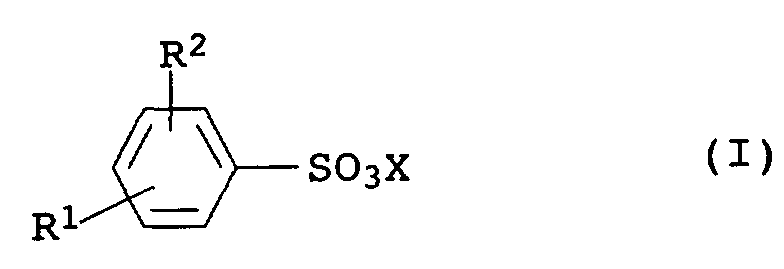
- R1
- für eine C6-C32-Alkyl- und vorzugsweise eine C8-C22-Alkylgruppe steht,
- R2
- für Wasserstoff, C1-C4-Alkyl, einen annellierten Benzolring, der gegebenenfalls mit C1-C4-Alkyl substituiert ist, oder einen Phenoxyrest steht, der gegebenenfalls eine C6-C32-Alkylgruppe und/oder eine Sulfonat-Gruppe aufweist, und
- X
- ein Kationenäquivalent, bedeutet und vorzugsweise für ein Alkalimetallkation, insbesondere für ein Natrium- oder Kaliumion, für ein Äquivalent eines Erdalkalimetallkations, insbesondere 1/2 Ca2+ oder für ein Ammoniumion steht.

- ethylenisch ungesättigte Monomere mit Säuregruppe wie Mono- und Dicarbonsäuren mit 3 bis 8 C-Atomen wie Acrylsäure, Methacrylsäure, Crotonsäure, Acrylamidoglykolsäure, Vinylessigsäure, Maleinsäure, Itaconsäure und die Halbester der Maleinsäure mit C1-C4-Alkanolen, ethylenisch ungesättigte Sulfonsäuren wie Vinylsulfonsäure, Allylsulfonsäure, Styrolsulfonsäure, 2-Acrylamidomethylpropansulfonsäure, und ethylenisch ungesättigte Phosphonsäuren, z. B. Vinylphosphonsäure, Allylphosphonsäure, Styrolphosphonsäure und 2-Acrylamido-2-Methylpropanphosphonsäure und ihre wasserlöslichen Salze, beispielsweise ihre Alkalimetallsalze, vorzugsweise Acrylsäure und Methacrylsäure. Derartige Monomere können in den Polymeren P in einer Menge von bis zu 10 Gew.-%, z.B 0,1 bis 10 Gew.-%, vorzugsweise 0,1 bis 4 Gew.-%, enthalten sein;
- Amide ethylenisch ungesättigter Carbonsäuren, wie Acrylamid und Methacrylamid, sowie die N-Alkylolamide, vorzugsweise die N-Methylolamide ethylenisch ungesättigter Carbonsäuren, wie N-Methylolacrylamid und N-Methylolmethacrylamid. Derartige Monomere können in den Polymeren P in einer Menge von bis zu 10 Gew.-%, z.B 0,1 bis 10 Gew.-%, vorzugsweise 0,1 bis 4 Gew.-%, enthalten sein;
- Hydroxyalkylester ethylenisch ungesättigter Carbonsäuren, insbesondere Hydroxyethyl- und Hydroxypropylester, z. B. Hydroxyethylacrylat, Hydroxypropylacrylat, Hydroxyethylmethacrylat und Hydroxypropylmethacrylat. Derartige Monomere können in den Polymeren P in einer Menge von bis zu 10 Gew.-%, z.B 0,1 bis 10 Gew.-%, vorzugsweise 0,5 bis 5 Gew.-%, enthalten sein
- Acrylnitril und Methacrylnitril. Derartige Monomere können in den Polymeren P in einer Menge von bis zu 10 Gew.-%, z. B. 0,5 bis 10 Gew.-% enthalten sein.
- Reaktive Monomere: Zu den reaktiven Monomeren zählen solche, die eine zur Vernetzung geeignete reaktive Funktionalität aufweisen. Hierzu zählen neben den vorgenannten ethylenisch ungesättigten Carbonsäuren, ihren N-Alkylolamiden und Hydroxyalkylestern Monomere, die eine Carbonylgruppe oder eine Epoxygruppe aufweisen, beispielsweise N-Diacetonacrylamid, N-Diacetonmethacrylamid, Acetylacetoxyethylacrylat und Acetylacetoxyethylmethacrylat, Glycidylacrylat und Glycidylmethacrylat. Derartige Monomere können in den Polymeren P in einer Menge von bis zu 10 Gew.-%, z. B. 0,5 bis 10 Gew.-% enthalten sein.
- und vernetzende Monomere. Zu den vernetzenden Monomeren zählen solche,die wenigstens zwei nicht konjugierte ethylenisch ungesättigte Bindungen aufweisen, z. B. die Di- und Triacrylate bzw. -methacrylate von Di- und trifunktionellen Alkoholen, z. B. Ethylenglykoldiacrylat, Diethylenglykoldiacrylat, Triethylenglykoldiacrylat, Butandioldiacrylat, Hexandioldiacrylat, Trimethylolpropantriacrylat und Tripropylenglykoldiacrylat. Derartige Monomere können in den Polymeren P in einer Menge von bis zu 2 Gew.-%, vorzugsweise nicht mehr als 1 Gew.-%, z. B. 0,01 bis 2 Gew.-%, vorzugsweise 0,01 bis 1 Gew.-%, enthalten sein. In einer bevorzugten Ausführungsform enthalten die Polymere P kein vernetzendes Monomer einpolymerisiert.
- 10 bis 90 Gew.-%, vorzugsweise 20 bis 80 Gew-%, insbesondere 40 bis 75 Gew.-% Styrol und gegebenenfalls ein oder mehrere, davon verschiedene vinylaromatische Monomere,
- 10 bis 90 Gew.-%, vorzugsweise 20 bis 80 Gew.-%, insbesondere 25 bis 60 Gew.-% 1,3-Butadien, gegebenenfalls in Mischung mit einem anderen konjugierten Diolefin wie Isopren und gegebenenfalls
- bis 20 Gew.-%, vorzugsweise bis 10 Gew.-%, z. B. 0,1 bis 20 Gew.-%, vorzugsweise 0,1 bis 10 Gew.-% ein oder mehrere der vorgenannten Monomere (b)
- 20 bis 80 Gew.-%, insbesondere 40 bis 75 Gew.-% Styrol
- 20 bis 80 Gew.-%, insbesondere 25 bis 60 Gew.-% Butadien, und gegebenenfalls
- 0,1 bis 10 Gew.-%, vorzugsweise 0,1 bis 5 Gew.-% Carboxylgruppen enthaltendende Monomdere, insbesondere Acrylsäure, Methacrylsäure und/oder Itaconsäure.
- i
- wenigstens ein filmbildendes Polymer P,
- ii
- 1 bis 50 Gew.-%, bezogen auf das Polymer P, wenigstens eines Trocknungshilfsmittels T,
- iii
- wenigstens 1,5 Gew.-%, bezogen auf das Polymer P, wenigstens einer anionischen oberflächenaktiven Verbindung AO,
- iv
- gegebenenfalls neutrale oberflächenaktive Verbindungen in einer Menge bis 10 Gew.-%, bezogen auf das Polymer P, und
- v
- gegebenenfalls Füllstoffe, Pigmente, Anticakingmittel und/ oder übliche Hilfsmittel, z.b. Trocknungshilfsmittel des Standes der Technik, Biozide und/oder Entschäumer.
- 10 bis 60,
- vorzugsweise 15 bis 50 Gew.-% mineralischem Bindemittel (vorzugsweise ausschließlich Zement, insbesondere Portlandzement)
- 0,1 bis 20
- häufig 0,2 bis 15 Gew.-%, insbesondere 0,5 bis 10 Gew.-% speziell 2 bis 8 Gew.-% erfindungsgemässe Polymerpulver,
| Beispiel | Dispersion | AO | NO1 [Gew.-%] | Sprühtrocknung | Verfilmung | Redispergierbarkeit | |
| Typ | [Gew.-%] | ||||||
| V1 | D1 | AO1 | 0 | 0 | + | --- | o |
| V2 | D1 | AO1 | 0 | 2 | + | --- | o |
| V3 | D1 | AO1 | 0,5 | 0 | + | -- | o |
| 4 | D1 | AO1 | 2 | 0 | +++ | +++ | + |
| V5 | D1 | AO1 | 1 | 0,5 | + | -- | o |
| 6 | D2 | AO2 | 2,5 | 0 | +++ | +++ | + |
| 7 | D2 | AO1 | 2,5 | 0 | +++ | +++ | + |
| 8 | D2 | AO3 | 2,5 | 0 | +++ | +++ | + |
Claims (18)
- Verfahren zur Herstellung von Polymerpulvern durch Verdampfen der flüchtigen Bestandteile aus wässrigen Dispersionen filmbildender Polymere P in Gegenwart von Trocknungshilfsmitteln T, die ausgewählt sind unter den Salzen von oligomeren Arylsulfonäure-Formaldehyd-Kondensationsprodukten, dadurch gekennzeichnet, dass die wässrige Polymerdispersion vor dem Verdampfen der flüchtigen Bestandteile wenigstens 1,5 Gew.-%, bezogen auf das Polymer in der Dispersion, wenigstens einer anionischen oberflächenaktiven Verbindung AO enthält, die wenigstens eine C6-C32-Alkylgruppe aufweist.
- Verfahren nach Anspruch 1, dadurch gekennzeichnet, dass die Gesamtmenge an anionischer oberflächenaktiver Verbindung AO im Bereich von 1,5 bis 4 Gew.-%, bezogen auf das Polymer in der Dispersion, liegt.
- Verfahren nach einem der vorhergehenden Ansprüche, dadurch gekennzeichnet, dass die anionische oberflächeaktive Verbindung AO wenigstens eine Sulfonat-Gruppe aufweist.
- Verfahren nach Anspruch 3, dadurch gekennzeichnet, dass die anionische oberflächenaktive Verbindung AO ausgewählt ist unter Verbindungen der allgemeinen Formel Iworin

- R1
- für eine C6-C32-Alkylgruppe steht,
- R2
- für Wasserstoff, C1-C4-Alkyl, einen annellierten Benzolring, der gegebenenfalls mit C1-C4-Alkyl substituiert ist, oder einen Phenoxyrest steht, der gegebenenfalls eine C6-C32-Alkylgruppe und/oder eine Sulfonat-Gruppe aufweist, und
- X
- ein Kationenäquivalent bedeutet.
- Verfahren nach Anspruch 3, dadurch gekennzeichnet, dass die anionische oberflächenaktive Verbindung AO ausgewählt ist unter C6-C32-Alkylsulfonaten.
- Verfahren nach Anspruch 3, dadurch gekennzeichnet, dass die anionische oberflächenaktive Verbindung ausgewählt ist unter den Salzen von Di-C6-C32-alkylestern von sulfonierten gesättigten Dicarbonsäuren mit 3 bis 10 C-Atomen.
- Verfahren nach einem der vorhergehenden Ansprüche, dadurch gekennzeichnet, dass das Trocknungshilfsmittel ausgewählt ist unter Phenolsulfonsäure-Formaldehyd-Kondensaten und Naphthalinsulfonsäure-Formaldehyd-Kondensaten mit einem zahlenmittleren Molekulargewicht Mn unterhalb 1500 Dalton.
- Verfahren nach einem der vorhergehenden Ansprüche, dadurch gekennzeichnet, dass die Polymerdispersion das Trocknungshilfsmittel T in einer Menge von 1 bis 50 Gew.-%, bezogen auf das Polymer, enthält.
- Verfahren nach einem der vorhergehenden Ansprüche, dadurch gekennzeichnet, dass das Polymer in der Dispersion Styrol-Butadien-Copolymer ist.
- Verfahren nach einem der vorhergehenden Ansprüche, dadurch gekennzeichnet, dass das Polymer in der Dispersion eine Glasübergangstemperatur Tg unterhalb 65 °C aufweist.
- Verfahren nach einem der vorhergehenden Ansprüche, dadurch gekennzeichnet, dass die Polymerdispersion zusätzlich wenigstens einen nichtionischen Emulgator in einer Menge bis 10 Gew.-%, bezogen auf das Polymer enthält.
- Verfahren nach einem der vorhergehenden Ansprüche, dadurch gekennzeichnet, dass das Verdampfen der flüchtigen Bestandteile aus der wässrigen Polymerdispersion nach einem Sprühtrocknungsverfahren erfolgt.
- Polymerpulver, erhältlich durch ein Verfahren gemäss einem der Ansprüche 1 bis 11.
- Polymerpulver nach Anspruch 11, umfassend:
- i
- wenigstens ein filmbildendes Polymer P,
- ii
- 1 bis 50 Gew.-%, bezogen auf das Polymer P, wenigstens eines Trocknungshilfsmittels T
- iii
- wenigstens 1,5 Gew.-%, bezogen auf das Polymer P, wenigstens einer anionischen oberflächenaktiven Verbindung AO,
- iv
- gegebenenfalls neutrale oberflächenaktive Verbindungen in einer Menge bis 10 Gew.-%, bezogen auf das Polymer P, und
- v
- gegebenenfalls Füllstoffe, Pigmente, Anticakingmittel und/oder übliche Hilfsmittel.
- Verwendung des Polymerisatpulvers nach Anspruch 13 oder 14 als Cobindemittel in mineralischen Bindebaustoffen und gebrauchsfertigen Bindebaustoffzubereitungen, als Bindemittel in Anstrichmitteln, Lacken, Klebstoffen, Beschichtungs- und Dichtungsmassen, Bauklebstoffen und in Kunstharzputzen.
- Mineralischer Bindebaustoff, enthaltend wenigstens ein Polymerpulver gemäß einem der Ansprüche 13 oder 14.
- Mineralischer Bindebaustoff nach Anspruch 16 in Form einer Trockenmörtelzubereitung, bestehend aus10 bis 60 Gew.-% mineralisches Bindemittel,0,1 bis 20 Gew.-% Polymerpulver gemäß einem der Ansprüche 13 oder 14,bis zu 25 Gew.-% für mineralische Bindebaustoffe übliche Hilfsmittel undals Restmenge Zuschläge wie Sand, Füllstoffe, Pigmente, natürliche Fasern und/oder synthetische Fasern.
- Mineralischer Bindebaustoff nach Anspruch 16 in Form einer Bauklebstoff-Trockenzubereitung bestehend aus15 bis 50 Gew.-% mineralisches Bindemittel0,5 bis 10 Gew.-% Polymerpulver, gemäß einem der Ansprüche 13 oder 140,1 bis 25 Gew.-% für Bauklebstoffe übliche Hilfsmittel30 bis 80 Gew.-% für Bauklebstoffe übliche Zuschläge
Applications Claiming Priority (2)
| Application Number | Priority Date | Filing Date | Title |
|---|---|---|---|
| DE2000140826 DE10040826A1 (de) | 2000-08-21 | 2000-08-21 | Verfahren zur Herstellung von Polymerpulvern |
| DE10040826 | 2000-08-21 |
Publications (2)
| Publication Number | Publication Date |
|---|---|
| EP1184406A2 true EP1184406A2 (de) | 2002-03-06 |
| EP1184406A3 EP1184406A3 (de) | 2003-04-23 |
Family
ID=7653151
Family Applications (1)
| Application Number | Title | Priority Date | Filing Date |
|---|---|---|---|
| EP20010120019 Withdrawn EP1184406A3 (de) | 2000-08-21 | 2001-08-20 | Verfahren zur Herstellung von Polymerpulvern |
Country Status (4)
| Country | Link |
|---|---|
| US (1) | US6469135B2 (de) |
| EP (1) | EP1184406A3 (de) |
| JP (1) | JP2002138145A (de) |
| DE (1) | DE10040826A1 (de) |
Cited By (5)
| Publication number | Priority date | Publication date | Assignee | Title |
|---|---|---|---|---|
| WO2004101657A1 (de) * | 2003-05-19 | 2004-11-25 | Basf Aktiengesellschaft | Verfahren zur herstellung von polymerpulvern |
| WO2005080478A1 (de) * | 2004-02-25 | 2005-09-01 | Basf Aktiengesellschaft | Verfahren zur herstellung von gut in wasser redispergierbaren polymerisatpulvern |
| WO2013086722A1 (en) | 2011-12-15 | 2013-06-20 | Dow Global Technologies Llc | Dry mix formulations containing carboxylated styrene-butadiene redispersible polymer powders and alumina rich containing cements |
| WO2014093420A1 (en) * | 2012-12-14 | 2014-06-19 | Dow Global Technologies Llc | Additive for hydraulically setting mixtures |
| WO2022200156A1 (en) | 2021-03-23 | 2022-09-29 | Basf Se | Water-dispersible polymer powder compositions for cementing in subterranean formation, their manufacture and use |
Families Citing this family (12)
| Publication number | Priority date | Publication date | Assignee | Title |
|---|---|---|---|---|
| DE19629525A1 (de) * | 1996-07-22 | 1998-01-29 | Basf Ag | Verwendung von Naphthalinsulfonsäure-Formaldehyd-Kondensationsprodukten als Trocknungshilfsmittel |
| DE10043453A1 (de) * | 2000-09-04 | 2002-03-14 | Basf Ag | Polymermodifizierte Formkörper aus Ton |
| DE10322786A1 (de) * | 2003-05-19 | 2004-12-09 | Basf Ag | Verfahren zur Herstellung von Polymerpulvern |
| US20050004263A1 (en) * | 2003-07-02 | 2005-01-06 | Ilford Imaging Uk Limited | Ink jet ink and recording process |
| DE102006007282A1 (de) | 2006-02-16 | 2007-08-23 | Wacker Polymer Systems Gmbh & Co. Kg | Verfahren zur Herstellung von kationisch stabilisierten und in Wasser redispergierbaren Polymerpulverzusammensetzungen |
| US9062143B2 (en) | 2008-02-08 | 2015-06-23 | Dow Global Technologies Llc | Water-redispersible polymer powder |
| JP5379181B2 (ja) * | 2010-04-20 | 2013-12-25 | ダウ グローバル テクノロジーズ エルエルシー | 低カルボキシル化スチレンブタジエンベースのラテックスから製造された再分散可能なポリマー粉体 |
| CA2741255C (en) | 2010-06-15 | 2013-05-14 | Dow Stade Producktions Gmbh & Co. Ohg | Redispersible polymer powder compositions prepared from styrene butadiene-based latex for dry mix formulations |
| JP5403830B2 (ja) | 2010-06-24 | 2014-01-29 | ダウ グローバル テクノロジーズ エルエルシー | カルボキシル化スチレンブタジエンベースのラテックスのブレンドから製造された再分散可能なポリマー粉体 |
| US8529693B2 (en) * | 2010-12-10 | 2013-09-10 | Troy Corporation | Adhesive strength enhancers for cementitious compositions |
| US8366822B2 (en) * | 2011-06-20 | 2013-02-05 | Dow Global Technologies Llc | Cementitious tile adhesives and method of applying the same to a tile substrate |
| JP6391916B2 (ja) * | 2013-06-21 | 2018-09-19 | 日東電工株式会社 | 光学用粘着剤層、粘着剤層付光学フィルムおよび画像表示装置 |
Family Cites Families (8)
| Publication number | Priority date | Publication date | Assignee | Title |
|---|---|---|---|---|
| DE3923229A1 (de) | 1989-07-14 | 1991-01-24 | Basf Ag | In wasser redispergierbare polymerisat-pulver, die durch verspruehen von waessrigen polymerisat-dispersionen hergestellt sind, und ihre verwendung als zusatzmittel zu hydraulischen bindemitteln |
| US5225478A (en) | 1989-07-14 | 1993-07-06 | Basf Aktiengesellschaft | Polymer powders which are redispersible in water and can be prepared by atomizing aqueous polymer dispersions, and their use as additives in hydraulic binders |
| DE4218493A1 (de) * | 1992-06-04 | 1993-12-09 | Wacker Chemie Gmbh | Verwendung von Polypropylenglykol als Schwindmaß-reduzierender Zusatz in Dispersionspulver-Zusammensetzungen für Baustoffe |
| DE19629525A1 (de) | 1996-07-22 | 1998-01-29 | Basf Ag | Verwendung von Naphthalinsulfonsäure-Formaldehyd-Kondensationsprodukten als Trocknungshilfsmittel |
| DE19629526A1 (de) * | 1996-07-22 | 1998-01-29 | Basf Ag | Verwendung von Phenolsulfonsäure-Formaldehyd-Kondensationsprodukten als Trocknungshilfsmittel |
| DE19707746A1 (de) * | 1997-02-26 | 1998-08-27 | Basf Ag | Verwendung von Copolymerisaten aus ethylenisch ungesättigten Carbonsäuren und deren Hydroxyalkylestern als Trocknungshilfsmittel |
| DE19757298A1 (de) * | 1997-12-22 | 1999-06-24 | Basf Ag | Verfahren zur Herstellung von Polymerpulvern |
| DE19949382A1 (de) * | 1999-10-13 | 2001-04-19 | Basf Ag | Verwendung feinteiliger, farbstoffhaltiger Polymerisate PF als farbgebenden Bestandteil in kosmetischen Mitteln |
-
2000
- 2000-08-21 DE DE2000140826 patent/DE10040826A1/de not_active Withdrawn
-
2001
- 2001-08-20 JP JP2001249230A patent/JP2002138145A/ja not_active Withdrawn
- 2001-08-20 EP EP20010120019 patent/EP1184406A3/de not_active Withdrawn
- 2001-08-21 US US09/932,932 patent/US6469135B2/en not_active Expired - Fee Related
Cited By (10)
| Publication number | Priority date | Publication date | Assignee | Title |
|---|---|---|---|---|
| WO2004101657A1 (de) * | 2003-05-19 | 2004-11-25 | Basf Aktiengesellschaft | Verfahren zur herstellung von polymerpulvern |
| US7547741B2 (en) | 2003-05-19 | 2009-06-16 | Basf Aktiengesellschaft | Preparation of polymer powders |
| WO2005080478A1 (de) * | 2004-02-25 | 2005-09-01 | Basf Aktiengesellschaft | Verfahren zur herstellung von gut in wasser redispergierbaren polymerisatpulvern |
| US7820738B2 (en) | 2004-02-25 | 2010-10-26 | Basf Aktiengesellschaft | Method for producing polymer powders that can be easily redispersed in water |
| WO2013086722A1 (en) | 2011-12-15 | 2013-06-20 | Dow Global Technologies Llc | Dry mix formulations containing carboxylated styrene-butadiene redispersible polymer powders and alumina rich containing cements |
| EP2791077A4 (de) * | 2011-12-15 | 2015-11-25 | Dow Global Technologies Llc | Trockengemischformulierungen mit carboxylierten redispergierbaren styrol-butadienpolymerpulvern und tonerdereichen zementen |
| WO2014093420A1 (en) * | 2012-12-14 | 2014-06-19 | Dow Global Technologies Llc | Additive for hydraulically setting mixtures |
| CN104870397A (zh) * | 2012-12-14 | 2015-08-26 | 陶氏环球技术有限责任公司 | 液压凝固混合物的添加剂 |
| CN104870397B (zh) * | 2012-12-14 | 2018-11-09 | 陶氏环球技术有限责任公司 | 液压凝固混合物的添加剂 |
| WO2022200156A1 (en) | 2021-03-23 | 2022-09-29 | Basf Se | Water-dispersible polymer powder compositions for cementing in subterranean formation, their manufacture and use |
Also Published As
| Publication number | Publication date |
|---|---|
| DE10040826A1 (de) | 2002-03-07 |
| US20020062006A1 (en) | 2002-05-23 |
| EP1184406A3 (de) | 2003-04-23 |
| US6469135B2 (en) | 2002-10-22 |
| JP2002138145A (ja) | 2002-05-14 |
Similar Documents
| Publication | Publication Date | Title |
|---|---|---|
| EP1086934B1 (de) | Zementzusammensetzungen, enthaltend redispergierbare Polymerisatpulver | |
| EP0914365B1 (de) | Verwendung von phenolsulfonsäure-formaldehyd-kondensationsprodukten als trocknungshilfsmittel | |
| EP0914366B1 (de) | Verwendung von naphthalinsulfonsäure-formaldehyd-kondensationsprodukten als trocknungshilfsmittel | |
| EP0821660B1 (de) | Verfahren zur konservierung eines mineralischen formkörpers | |
| EP0078449B2 (de) | Verfahren zum Herstellen von blockfesten, in Wasser redispergierbaren Polymerisat-Pulvern durch Versprühen von wässrigen Polymerisat-Dispersionen | |
| EP0754657B1 (de) | Verwendung wässriger Polymerisatdispersionen zum Modifizieren mineralischer Baustoffe | |
| DE3923229A1 (de) | In wasser redispergierbare polymerisat-pulver, die durch verspruehen von waessrigen polymerisat-dispersionen hergestellt sind, und ihre verwendung als zusatzmittel zu hydraulischen bindemitteln | |
| EP0861867B1 (de) | Verwendung von Copolymerisaten aus ethylenisch ungesättigten Carbonsäuren und deren Hydroxyalkylestern als Trocknungshilfsmittel | |
| EP0671435A1 (de) | Durch Sprühtröcknung enthaltene redispergierbare Bindemittelpulver | |
| DE10040826A1 (de) | Verfahren zur Herstellung von Polymerpulvern | |
| EP0924241A2 (de) | Verfahren zur Herstellung von Polymerpulvern | |
| EP0812872B1 (de) | Verfahren zur Herstellung von Polymerisatpulver | |
| DE19705753A1 (de) | Emulgatorsystem für die wässrige Emulsionspolymerisation | |
| EP1347002B1 (de) | Polymerdispersionen als Zusatz in Baumaterialien | |
| EP1341733A1 (de) | Polymermodifizierte erdbaustoffe | |
| EP0869991B1 (de) | Redispergierbare dispersionspulver-zusammensetzung | |
| EP1627009B1 (de) | Verfahren zur herstellung von polymerpulvern | |
| DE3590374T (de) | Emulsion zur Modifizierung anorganischer Formteile und Verfahren zu deren Herstellung | |
| WO2004101462A1 (de) | Verfahren zur herstellung von polymerpulvern | |
| WO2004101656A1 (de) | Verfahren zur herstellung von polymerpulvern | |
| DE19645427A1 (de) | Verfahren zur Herstellung niedrigviskoser, wäßriger Polymerisatdispersionen mit polymodaler Verteilung der Polymerisatteilchengrößen | |
| EP2528959A1 (de) | Verfahren zur herstellung von phenolsulfonsäure-aldehyd-kondensationsprodukten und deren verwendung als trocknungshilfsmittel | |
| DE19730953A1 (de) | Verwendung von Bisphenolsulfonaten als Trocknungshilfsmittel | |
| DE10043453A1 (de) | Polymermodifizierte Formkörper aus Ton |
Legal Events
| Date | Code | Title | Description |
|---|---|---|---|
| PUAI | Public reference made under article 153(3) epc to a published international application that has entered the european phase |
Free format text: ORIGINAL CODE: 0009012 |
|
| AK | Designated contracting states |
Kind code of ref document: A2 Designated state(s): AT BE CH CY DE DK ES FI FR GB GR IE IT LI LU MC NL PT SE TR |
|
| AX | Request for extension of the european patent |
Free format text: AL;LT;LV;MK;RO;SI |
|
| PUAL | Search report despatched |
Free format text: ORIGINAL CODE: 0009013 |
|
| RIC1 | Information provided on ipc code assigned before grant |
Ipc: 7C 04B 24/26 B Ipc: 7C 04B 24/24 B Ipc: 7C 08J 3/16 A |
|
| AK | Designated contracting states |
Designated state(s): AT BE CH CY DE DK ES FI FR GB GR IE IT LI LU MC NL PT SE TR |
|
| AX | Request for extension of the european patent |
Extension state: AL LT LV MK RO SI |
|
| 17P | Request for examination filed |
Effective date: 20031023 |
|
| AKX | Designation fees paid |
Designated state(s): AT BE CH CY DE DK ES FI FR GB GR IE IT LI LU MC NL PT SE TR |
|
| 17Q | First examination report despatched |
Effective date: 20050510 |
|
| STAA | Information on the status of an ep patent application or granted ep patent |
Free format text: STATUS: THE APPLICATION IS DEEMED TO BE WITHDRAWN |
|
| 18D | Application deemed to be withdrawn |
Effective date: 20050921 |