EP1185131A2 - Algorithme adaptatif de plannification de cellules pour un système ATM sans fil - Google Patents
Algorithme adaptatif de plannification de cellules pour un système ATM sans fil Download PDFInfo
- Publication number
- EP1185131A2 EP1185131A2 EP01307018A EP01307018A EP1185131A2 EP 1185131 A2 EP1185131 A2 EP 1185131A2 EP 01307018 A EP01307018 A EP 01307018A EP 01307018 A EP01307018 A EP 01307018A EP 1185131 A2 EP1185131 A2 EP 1185131A2
- Authority
- EP
- European Patent Office
- Prior art keywords
- contention
- wireless network
- weighted fair
- multiple access
- generating
- Prior art date
- Legal status (The legal status is an assumption and is not a legal conclusion. Google has not performed a legal analysis and makes no representation as to the accuracy of the status listed.)
- Withdrawn
Links
Images

Classifications
-
- H—ELECTRICITY
- H04—ELECTRIC COMMUNICATION TECHNIQUE
- H04L—TRANSMISSION OF DIGITAL INFORMATION, e.g. TELEGRAPHIC COMMUNICATION
- H04L12/00—Data switching networks
- H04L12/54—Store-and-forward switching systems
- H04L12/56—Packet switching systems
- H04L12/5601—Transfer mode dependent, e.g. ATM
-
- H—ELECTRICITY
- H04—ELECTRIC COMMUNICATION TECHNIQUE
- H04L—TRANSMISSION OF DIGITAL INFORMATION, e.g. TELEGRAPHIC COMMUNICATION
- H04L47/00—Traffic control in data switching networks
- H04L47/50—Queue scheduling
-
- H—ELECTRICITY
- H04—ELECTRIC COMMUNICATION TECHNIQUE
- H04L—TRANSMISSION OF DIGITAL INFORMATION, e.g. TELEGRAPHIC COMMUNICATION
- H04L47/00—Traffic control in data switching networks
- H04L47/50—Queue scheduling
- H04L47/62—Queue scheduling characterised by scheduling criteria
- H04L47/6215—Individual queue per QOS, rate or priority
-
- H—ELECTRICITY
- H04—ELECTRIC COMMUNICATION TECHNIQUE
- H04L—TRANSMISSION OF DIGITAL INFORMATION, e.g. TELEGRAPHIC COMMUNICATION
- H04L47/00—Traffic control in data switching networks
- H04L47/50—Queue scheduling
- H04L47/62—Queue scheduling characterised by scheduling criteria
- H04L47/622—Queue service order
- H04L47/623—Weighted service order
-
- H—ELECTRICITY
- H04—ELECTRIC COMMUNICATION TECHNIQUE
- H04L—TRANSMISSION OF DIGITAL INFORMATION, e.g. TELEGRAPHIC COMMUNICATION
- H04L47/00—Traffic control in data switching networks
- H04L47/50—Queue scheduling
- H04L47/62—Queue scheduling characterised by scheduling criteria
- H04L47/625—Queue scheduling characterised by scheduling criteria for service slots or service orders
- H04L47/6255—Queue scheduling characterised by scheduling criteria for service slots or service orders queue load conditions, e.g. longest queue first
-
- H—ELECTRICITY
- H04—ELECTRIC COMMUNICATION TECHNIQUE
- H04L—TRANSMISSION OF DIGITAL INFORMATION, e.g. TELEGRAPHIC COMMUNICATION
- H04L47/00—Traffic control in data switching networks
- H04L47/50—Queue scheduling
- H04L47/62—Queue scheduling characterised by scheduling criteria
- H04L47/625—Queue scheduling characterised by scheduling criteria for service slots or service orders
- H04L47/6275—Queue scheduling characterised by scheduling criteria for service slots or service orders based on priority
-
- H—ELECTRICITY
- H04—ELECTRIC COMMUNICATION TECHNIQUE
- H04W—WIRELESS COMMUNICATION NETWORKS
- H04W74/00—Wireless channel access
- H04W74/02—Hybrid access
-
- H—ELECTRICITY
- H04—ELECTRIC COMMUNICATION TECHNIQUE
- H04L—TRANSMISSION OF DIGITAL INFORMATION, e.g. TELEGRAPHIC COMMUNICATION
- H04L12/00—Data switching networks
- H04L12/54—Store-and-forward switching systems
- H04L12/56—Packet switching systems
- H04L12/5601—Transfer mode dependent, e.g. ATM
- H04L2012/5603—Access techniques
- H04L2012/5604—Medium of transmission, e.g. fibre, cable, radio
- H04L2012/5607—Radio
-
- H—ELECTRICITY
- H04—ELECTRIC COMMUNICATION TECHNIQUE
- H04L—TRANSMISSION OF DIGITAL INFORMATION, e.g. TELEGRAPHIC COMMUNICATION
- H04L12/00—Data switching networks
- H04L12/54—Store-and-forward switching systems
- H04L12/56—Packet switching systems
- H04L12/5601—Transfer mode dependent, e.g. ATM
- H04L2012/5678—Traffic aspects, e.g. arbitration, load balancing, smoothing, buffer management
- H04L2012/5679—Arbitration or scheduling
-
- H—ELECTRICITY
- H04—ELECTRIC COMMUNICATION TECHNIQUE
- H04W—WIRELESS COMMUNICATION NETWORKS
- H04W72/00—Local resource management
- H04W72/12—Wireless traffic scheduling
-
- H—ELECTRICITY
- H04—ELECTRIC COMMUNICATION TECHNIQUE
- H04W—WIRELESS COMMUNICATION NETWORKS
- H04W74/00—Wireless channel access
- H04W74/08—Non-scheduled access, e.g. ALOHA
Definitions
- This invention relates to the field of high speed wireless networks. More particularly, this invention relates to the field of integrating a scheduling algorithm to switch between contention and request and grant mode to achieve high performance in an asynchronous transfer mode (ATM) cell.
- ATM asynchronous transfer mode
- the general structure of a high speed wireless network utilizes a central Hub and a number of End User Nodes (EUNs).
- the basic operating unit of the system is a cell, where the Hub is located at the center of the cell and the EUNs are distributed within the coverage range of the Hub.
- the communication channel is a broadcasting channel. In other words, any signal sent by the Hub is received by every EUN in the system.
- each EUN transmission is a unicast heard only by the Hub.
- the EUNs are not configured to receive transmissions from other EUNs.
- the upstream communication channel is shared by many EUNs using one of two types of access systems.
- a first access system is known as a time division multiple access (TDMA) based system is one in which all the EUNs transmit using the same frequency, but avoid colliding by transmitting at different times.
- a second access system is called a frequency division multiple access (FDMA) system is one in which each EUN has a separate frequency assignment to avoid collision when coordinating transmission.
- TDMA time division multiple access
- FDMA frequency division multiple access
- the downstream signal is transmitted at a different carrier frequency than the upstream signal.
- both channels have the same bandwidth.
- the Hub executes a one time ranging operation. Ranging determines the distance between each EUN and the Hub. An EUN which is far from the Hub must transmit faster than an EUN which is near to the Hub. After the ranging is complete, the EUNs are accordingly aligned by the Hub in time slots from the frame of reference of the Hub.
- the Hub may utilize one of two main coordinating modes.
- a contention mode is utilized to coordinate transmission when there is a relatively small number of EUNs in the system trying to capture the upstream bandwidth.
- a request and grant, or piggybacking mode is used.
- the Hub broadcasts which EUNs are eligible to contend for a particular time slot. Each contending EUN will then answer the broadcast if that particular EUN wishes to transmit. This mode is particularly useful when there is a relatively small amount of EUNs in the system, or when idle EUNs require a route to request grants quickly.
- the request and grant, or piggybacking mode functions oppositely of the contention mode.
- each individual EUN that wishes to transmit will unicast a request for a time slot from the Hub.
- the Hub will then broadcast a time slot grant signal to every EUN.
- each individual EUN will receive the signal and will recognize whether it, or another EUN is receiving a time slot grant.
- These grants will assign EUNs to time slots based on bandwidth availability. This mode is most effective when there are a large number of EUNs transmitting continuously.
- a scheduling algorithm is needed to adjust the ratio between request and grant mode and contention mode.
- an algorithm which can seamlessly switch between the two coordinating slotted multiple access modes is desired.
- the present invention is a method of implementing an adaptive cell scheduling algorithm in a wireless network channel shared by a plurality of users.
- the present invention switches between two coordinating slotted multiple access modes to coordinate user transmission.
- the two coordinating slotted multiple access modes are both present in the network at all times and the percentage of each of the modes are dynamically changing values whose sum is always 100%.
- the present invention allocates a queue in a weighted fair queue to generate contention slots.
- a collision occurs between two users, two new requests for generating contention slots are placed in the weighted fair queue.
- a starting request is placed in the weighted fair queue.
- This method allows the weighted fair queue to adjust the rate of generating contention slots automatically.
- the weighted fair queue increases the rate of generating contention slots, and when the network is heavily loaded, the weighted fair queue decreases the rate of generating contention slots.
- the basis for transmission of broadband information in this type of high speed wireless network is asynchronous transfer mode (ATM).
- ATM Cube may be considered in terms of a traditional stack configuration as depicted in Figure 1. More specifically, the Hub receives ATM cells from a back-haul network and delivers them in a special format to the EUNs.
- an EUN receives ATM cells from its subscribers or converts legacy interfaces to ATM and delivers these ATM cells in a special format to the Hub.
- the Hub recovers the ATM cells from the upstream signals and delivers them to the back-haul network.
- any ATM system may be considered in terms of the traditional layered protocol stack (Fig. 1).
- the ATM Layer(10) is responsible for delivery of data across multiple physical connections.
- the ATM Adaption Layers (AALs)(12) and applications operate above the ATM Layer(10).
- the ATM specification refers to a Physical Layer(PHY)(18).
- An ATM's PHY(18) consists of the Transmission Convergence (TC) Sub-Layer(14) and the Physical Medium (PM).
- TC Transmission Convergence
- PM Physical Medium
- the TC is the Data Link Layer (DLL)(16) and the PHY(18) combined.
- the DLL(16) is typically broken down into two sub-layers, a Logical Link Control (LLC), which interfaces to the network, and a MAC which interfaces to the PHY(18).
- LLC Logical Link Control
- an ATM system is also divided into vertical planes, which provide similar services in all protocol layers. These planes are the control, user, and management planes.
- the User Plane(22) is responsible for carrying data, including control and management information, across those connections and for performing functions such as flow control.
- the Control Plane(20) is responsible for performing call control and connection control functions.
- the Management Plane(24) is responsible for resource allocation, error and fault reporting, operation and maintenance (OAM) information flows, and any parameters associated with a given layer.
- OAM operation and maintenance
- an overall Layer Management(26) spans all layers and is responsible for the coordination of the entire system.
- the preferred embodiment of the present method assigns each physical EUN a unique 6-byte physical identification that is used during sign-on. Thereafter, it is assigned a logical EUN_ID from 1 to 254 (i.e. 0000_0001 to 1111_1110).
- the EUN_ID is changeable on the fly and a physical EUN may be assigned multiple EUN_IDs in order to allow it to have more than 256 Virtual Circuits (VCs).
- the link address is a 16 bit number, broken down into an 8 bit EUN_ID, with an 8 bit sub-address. These bits can be used to specify a null, unicast or multicast/broadcast addresses.
- multicast addressing is used for sending control messages and to assign contention slots.
- the multicast addresses use an EUN_ID of 255 (1111_1111).
- This form of addressing uses the 8 bit sub-addresses to specify a group of EUNs. As shown in Figure 2, a group may consist of all EUNs down to a specific EUN.
- the upstream air interface of the preferred embodiment uses TDMA. Individual upstream slots are assigned to a specific VC in a specific EUN. Contention timeslots are assigned to a group of EUNs, using the multicast addressing mode. Since there is no retry mechanism, only cell requests may be transmitted in contention slots.
- Each request includes an 8 bit link layer connection (VCI) address (i.e. a link address without the EUN_ID, which would be the same as that in the Link Address field), and an 8 bit length field, indicating the number of cells which are currently queued at the EUN. Because the actual length is transmitted, the effects of a lost or duplicated request are minimized.
- VCI link layer connection
- the preferred embodiment of the invention also provides a contention mechanism to allow the EUN to notify the Hub of pending traffic. It is anticipated that the majority of the requests will be carried in normal MAC cells (piggybacking), but the contention mechanism provides a route for idle EUNs to request grants quickly. An upstream contention slot will be announced to all EUNs via a grant from the Hub using the multicast addressing mode, which indicates the group of EUNs that may contend:
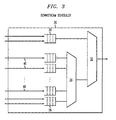
- the preferred embodiment of the present invention is depicted in Figure 3 and is configured to seamlessly switch between request and grant mode and contention mode.
- a scheduling algorithm incorporated by a scheduling block(30) containing a priority queue(32), a bypass queue(34), a weighted fair queue(36) and a contention queue(38) is used to implement this algorithm.
- the bypass queue(36) allows real time traffic such as Constant Bit Rate(CBR) to bypass the weighted fair queue(34) and not be included in the algorithm with the contention mode and the request and grant mode. Therefore, when the bypass queue(36) is not empty, the priority queue will allow the contents of the bypass queue(36) to be delivered before delivering the contents of the weighted fair queue(34).
- CBR Constant Bit Rate
- the weighted fair queue(36) actually implements the scheduling algorithm to serve non-real-time traffic classes so different streams such as EUN requests(40) and the output from the contention queue(38) can be prioritized based on their Quality of Service (QoS).
- QoS Quality of Service
- the QoS is the priority given to any given EUN based upon the monetary value paid by that EUN to use the wireless network. For instance, an EUN that pays more in QoS will have a higher priority and therefore be higher in line than an EUN that pays less.
- the contention queue however, has a priority lower than that of any EUN input(40) requesting bandwidth from the weighted fair queue(34).
- the contention queue(38) when the network is heavily loaded and a number of EUNs are requesting bandwidth(40) from the weighted fair queue(34), the contention queue(38) will occupy a small percentage of the total requests to the weighted fair queue(34). For instance, if there are nine EUNs requesting bandwidth(40) from the weighted fair queue(34) in request and grant mode, the ratio of request and grant/contention will be 9/1 or 90% request and grant and 10% contention.
- the number of EUNs requesting bandwidth(40) from the weighted fair queue(34) decreases.
- the contention queue(38) retains the one input to the weighted fair queue(34). Therefore, as the number of EUNs requesting bandwidth(40) in the request and grant mode decreases, the ration of request and grant/contention decreases. For instance, if the number of EUNs requesting bandwidth(40) decreases to three, then the mode ration will be 3/1 or 75% request and grant and 25% contention. In other words, the percentage of contention in the system will seamlessly increase as the number of EUN requests(40) in the system decrease.
- Alternative embodiments of the present invention include variations of the scheduler block(30) such as omissions, additions or reorganizations of the priority queue(32) or the bypass queue(36).
- the organization of the weighted fair queue(34), the contention queue(38) and the EUN requests(40) will not differ from the preferred embodiment.
- WFQ Weighted Fair Queue
- Allocating the upstream bandwidth in the preferred embodiment is significantly more complicated.
- Each EUN sends requests to the Hub for specific VCs, which are carried with other upstream cells or vital to the contention mechanism.
- the Hub takes these requests and converts them into pseudo cells, which are input to an ATM scheduler.
- the Hub also predicts the arrival of CBR traffic, and generates pseudo cells for them automatically.
- the Hub examines the virtual cell selected by the scheduler and grants an assignment to the corresponding VC at the appropriate EUN. Normally, requests are carried with other traffic in the request fields of upstream MAC cells.
- a contention mechanism is provided to significantly reduce latency when an otherwise idle EUN receives cells to transmit upstream.
- the sign-on procedure of the preferred embodiment is used by an EUN to establish initial ranging and power adjustments and establish a MAC level connection with the Hub and is a variation of the standard ranging process as described in [Survey of Ranging and Calibration Algorithms, KA].
- the DLL performs authentication of the newly connected EUN and VCs.
- a standard sign-off procedure is provided to allow the Hub or a local operator to gracefully terminate an EUN's connection.
- a mechanism for detecting connection loss due to extreme RF conditions and algorithms to automatically reestablish the connection is provided.
Landscapes
- Engineering & Computer Science (AREA)
- Computer Networks & Wireless Communication (AREA)
- Signal Processing (AREA)
- Small-Scale Networks (AREA)
- Mobile Radio Communication Systems (AREA)
- Time-Division Multiplex Systems (AREA)
- Data Exchanges In Wide-Area Networks (AREA)
Applications Claiming Priority (2)
| Application Number | Priority Date | Filing Date | Title |
|---|---|---|---|
| US09/649,265 US7170904B1 (en) | 2000-08-28 | 2000-08-28 | Adaptive cell scheduling algorithm for wireless asynchronous transfer mode (ATM) systems |
| US649265 | 2000-08-28 |
Publications (2)
| Publication Number | Publication Date |
|---|---|
| EP1185131A2 true EP1185131A2 (fr) | 2002-03-06 |
| EP1185131A3 EP1185131A3 (fr) | 2007-07-25 |
Family
ID=24604092
Family Applications (1)
| Application Number | Title | Priority Date | Filing Date |
|---|---|---|---|
| EP01307018A Withdrawn EP1185131A3 (fr) | 2000-08-28 | 2001-08-17 | Algorithme adaptatif de plannification de cellules pour un système ATM sans fil |
Country Status (4)
| Country | Link |
|---|---|
| US (1) | US7170904B1 (fr) |
| EP (1) | EP1185131A3 (fr) |
| JP (1) | JP4335481B2 (fr) |
| CA (1) | CA2352655A1 (fr) |
Families Citing this family (9)
| Publication number | Priority date | Publication date | Assignee | Title |
|---|---|---|---|---|
| US7173921B1 (en) | 2000-10-11 | 2007-02-06 | Aperto Networks, Inc. | Protocol for allocating upstream slots over a link in a point-to-multipoint communication system |
| WO2003098883A1 (fr) * | 2002-05-15 | 2003-11-27 | Mitsubishi Denki Kabushiki Kaisha | Systeme de repartition de paquets et procede de repartition de paquets |
| GB2399991B (en) * | 2003-03-28 | 2005-05-18 | Motorola Inc | Mobile communication methods, systems and apparatus for use therein |
| JP4304372B2 (ja) * | 2003-09-10 | 2009-07-29 | 日本電気株式会社 | 移動通信システム、無線基地局、スケジューリング装置及びそれらに用いるスケジューリング方法 |
| DE60328235D1 (de) | 2003-09-30 | 2009-08-13 | Mitsubishi Electric Corp | System für Mobilkommunikation zur Steuerung des Kommunikationsmodus |
| KR101194108B1 (ko) | 2005-09-22 | 2012-10-24 | 리서치 인 모션 리미티드 | 통신 방법 |
| US8761201B2 (en) * | 2010-10-22 | 2014-06-24 | Intel Corporation | Reducing the maximum latency of reserved streams |
| US8705391B2 (en) | 2011-03-24 | 2014-04-22 | Intel Corporation | Reducing latency of at least one stream that is associated with at least one bandwidth reservation |
| GB2529672B (en) * | 2014-08-28 | 2016-10-12 | Canon Kk | Method and device for data communication in a network |
Citations (3)
| Publication number | Priority date | Publication date | Assignee | Title |
|---|---|---|---|---|
| US564895A (en) | 1896-07-28 | Non-refillable bottle | ||
| EP0773651A1 (fr) | 1995-11-10 | 1997-05-14 | Nec Corporation | Système de communication radio par paquet capable d'éviter une collision de transmission |
| EP0912015A2 (fr) | 1997-10-14 | 1999-04-28 | Lucent Technologies Inc. | Méthode de régulation de surcharge dans un système d'acces multiple pour réseaux de communications |
Family Cites Families (21)
| Publication number | Priority date | Publication date | Assignee | Title |
|---|---|---|---|---|
| WO1991016775A1 (fr) | 1990-04-25 | 1991-10-31 | Telxon Corporation | Systeme de communication a commande adaptative d'acces aux supports |
| US5499243A (en) * | 1993-01-22 | 1996-03-12 | Hall; Dennis R. | Method and apparatus for coordinating transfer of information between a base station and a plurality of radios |
| US5384777A (en) * | 1993-04-19 | 1995-01-24 | International Business Machines Corporation | Adaptive medium access control scheme for wireless LAN |
| GB9408042D0 (en) | 1994-04-22 | 1994-06-15 | Hewlett Packard Co | Device for managing voice data |
| US5677909A (en) * | 1994-05-11 | 1997-10-14 | Spectrix Corporation | Apparatus for exchanging data between a central station and a plurality of wireless remote stations on a time divided commnication channel |
| US5648958A (en) * | 1995-04-05 | 1997-07-15 | Gte Laboratories Incorporated | System and method for controlling access to a shared channel for cell transmission in shared media networks |
| US5559875A (en) | 1995-07-31 | 1996-09-24 | Latitude Communications | Method and apparatus for recording and retrieval of audio conferences |
| TW317058B (en) * | 1996-04-23 | 1997-10-01 | Ibm | Data communication system for a wireless access to an atm network |
| US5922045A (en) | 1996-07-16 | 1999-07-13 | At&T Corp. | Method and apparatus for providing bookmarks when listening to previously recorded audio programs |
| US5892769A (en) * | 1996-08-28 | 1999-04-06 | Motorola Inc. | Method and system for prioritized multiple access using contention signatures for contention-based reservation |
| US6199076B1 (en) | 1996-10-02 | 2001-03-06 | James Logan | Audio program player including a dynamic program selection controller |
| EP0856979A3 (fr) | 1997-02-03 | 2002-01-23 | Siemens Information and Communication Networks, Inc. | Appareil et méthode pour détecter d'information dans un message de parole |
| US6240083B1 (en) * | 1997-02-25 | 2001-05-29 | Telefonaktiebolaget L.M. Ericsson | Multiple access communication network with combined contention and reservation mode access |
| EP1596544B1 (fr) | 1998-02-19 | 2011-09-14 | Micron Technology, Inc. | Procédé et dispositifs d'établissement de communication sans fil |
| DE69834639T2 (de) * | 1998-10-05 | 2006-12-14 | Sony Deutschland Gmbh | Automatische Bestimmung des Punkts für Direktzugriffs-Kanalaufteilungsverfahren |
| DE69842034D1 (de) * | 1998-10-05 | 2011-01-20 | Sony Deutschland Gmbh | Prioritätsschema für einen Zufallszugriffskanal |
| US6366761B1 (en) * | 1998-10-06 | 2002-04-02 | Teledesic Llc | Priority-based bandwidth allocation and bandwidth-on-demand in a low-earth-orbit satellite data communication network |
| US6381228B1 (en) * | 1999-01-15 | 2002-04-30 | Trw Inc. | Onboard control of demand assigned multiple access protocol for satellite ATM networks |
| US6925068B1 (en) * | 1999-05-21 | 2005-08-02 | Wi-Lan, Inc. | Method and apparatus for allocating bandwidth in a wireless communication system |
| EP1214801A1 (fr) * | 1999-09-01 | 2002-06-19 | Motorola, Inc. | Technique et dispositif d'attribution de largeurs de bande dans des protocoles a acces multiple avec reservation fonction des conflits |
| US6353617B1 (en) * | 2000-04-11 | 2002-03-05 | Motorola, Inc. | Method for accessing a communication medium |
-
2000
- 2000-08-28 US US09/649,265 patent/US7170904B1/en not_active Expired - Lifetime
-
2001
- 2001-07-06 CA CA002352655A patent/CA2352655A1/fr not_active Abandoned
- 2001-08-17 EP EP01307018A patent/EP1185131A3/fr not_active Withdrawn
- 2001-08-28 JP JP2001257105A patent/JP4335481B2/ja not_active Expired - Fee Related
Patent Citations (3)
| Publication number | Priority date | Publication date | Assignee | Title |
|---|---|---|---|---|
| US564895A (en) | 1896-07-28 | Non-refillable bottle | ||
| EP0773651A1 (fr) | 1995-11-10 | 1997-05-14 | Nec Corporation | Système de communication radio par paquet capable d'éviter une collision de transmission |
| EP0912015A2 (fr) | 1997-10-14 | 1999-04-28 | Lucent Technologies Inc. | Méthode de régulation de surcharge dans un système d'acces multiple pour réseaux de communications |
Also Published As
| Publication number | Publication date |
|---|---|
| EP1185131A3 (fr) | 2007-07-25 |
| JP2002118576A (ja) | 2002-04-19 |
| US7170904B1 (en) | 2007-01-30 |
| CA2352655A1 (fr) | 2002-02-28 |
| JP4335481B2 (ja) | 2009-09-30 |
Similar Documents
| Publication | Publication Date | Title |
|---|---|---|
| EP0755164B1 (fr) | MAC-protocole de services multiples pour un système ATM sans fil | |
| AU708348B2 (en) | Dynamic bandwidth allocation for a communication network | |
| JP3814393B2 (ja) | セルスケジューリング方法及びその装置 | |
| US6091708A (en) | Traffic shaper with multiply queued virtual paths | |
| EP1256214B1 (fr) | Procede d'ordonnancement multiniveau pour le multiplexage de paquets dans un reseau de communications | |
| JP2986085B2 (ja) | Atmネットワークのホップ毎のフロー制御 | |
| EP0717532A1 (fr) | Formation dynamique et équitable de files d'attente pour supporter un trafic de type meilleur effort dans un réseau ATM | |
| JP2000232402A (ja) | 衛星atmネットワークのための要求割当多重アクセス・システム及び方法 | |
| US6693887B2 (en) | Method for allocating fractional bandwidth in a fixed-frame communication system | |
| JP2002531002A (ja) | 無線ネットワークにおける端末消費電力を低減するデータ送信システム | |
| JP2001504316A (ja) | 通信ネットワーク内でスケジューリングを行うシステム,装置および方法 | |
| US7170904B1 (en) | Adaptive cell scheduling algorithm for wireless asynchronous transfer mode (ATM) systems | |
| US7024469B1 (en) | Medium access control (MAC) protocol with seamless polling/contention modes | |
| WO1997004564A1 (fr) | Gestion de largeurs de bande attribuees et dynamiques | |
| US7450510B1 (en) | System and method for distributing guaranteed bandwidth among service groups in a network node | |
| Ors et al. | Analysis of an adaptive random/reservation MAC protocol for ATM over satellite | |
| Örs et al. | An adaptive random-reservation MAC protocol to guarantee QoS for ATM over satellite | |
| Counterman | Shared-channel ATM-based access for hybrid fiber-and-coaxial architectures | |
| Frigon et al. | Data and voice integration in DR-TDMA for wireless ATM networks | |
| Yu et al. | A Multiple Access Protocol for Multimedia Transmission over 5G Wireless Asynchronous Transfer Mode Network | |
| JP3648377B2 (ja) | Atmセル伝送方法 | |
| Ors et al. | Analysis of a MAC protocol to guarantee QoS for ATM over satellite | |
| KR100204492B1 (ko) | 에이티엠망에서의 계층적 라운드 로빈 큐 서비스방식에 있어서 지터 보장방법 | |
| Bostič et al. | Broadband fixed wireless access | |
| Shim et al. | A new MAC protocol using AWRR/DT in broadband wireless networks: Novel contention methods |
Legal Events
| Date | Code | Title | Description |
|---|---|---|---|
| PUAI | Public reference made under article 153(3) epc to a published international application that has entered the european phase |
Free format text: ORIGINAL CODE: 0009012 |
|
| AK | Designated contracting states |
Kind code of ref document: A2 Designated state(s): AT BE CH CY DE DK ES FI FR GB GR IE IT LI LU MC NL PT SE TR |
|
| AX | Request for extension of the european patent |
Free format text: AL;LT;LV;MK;RO;SI |
|
| PUAL | Search report despatched |
Free format text: ORIGINAL CODE: 0009013 |
|
| AK | Designated contracting states |
Kind code of ref document: A3 Designated state(s): AT BE CH CY DE DK ES FI FR GB GR IE IT LI LU MC NL PT SE TR |
|
| AX | Request for extension of the european patent |
Extension state: AL LT LV MK RO SI |
|
| RIC1 | Information provided on ipc code assigned before grant |
Ipc: H04L 12/56 20060101AFI20070619BHEP |
|
| 17P | Request for examination filed |
Effective date: 20080108 |
|
| AKX | Designation fees paid |
Designated state(s): DE FI FR GB SE |
|
| 17Q | First examination report despatched |
Effective date: 20090120 |
|
| RAP1 | Party data changed (applicant data changed or rights of an application transferred) |
Owner name: AVAYA INC. |
|
| GRAP | Despatch of communication of intention to grant a patent |
Free format text: ORIGINAL CODE: EPIDOSNIGR1 |
|
| RIC1 | Information provided on ipc code assigned before grant |
Ipc: H04L 12/911 20130101AFI20131016BHEP Ipc: H04L 12/863 20130101ALI20131016BHEP |
|
| INTG | Intention to grant announced |
Effective date: 20131121 |
|
| STAA | Information on the status of an ep patent application or granted ep patent |
Free format text: STATUS: THE APPLICATION IS DEEMED TO BE WITHDRAWN |
|
| 18D | Application deemed to be withdrawn |
Effective date: 20140402 |