EP1189129A2 - PCMCIA-Kartengehäuse - Google Patents
PCMCIA-Kartengehäuse Download PDFInfo
- Publication number
- EP1189129A2 EP1189129A2 EP01115730A EP01115730A EP1189129A2 EP 1189129 A2 EP1189129 A2 EP 1189129A2 EP 01115730 A EP01115730 A EP 01115730A EP 01115730 A EP01115730 A EP 01115730A EP 1189129 A2 EP1189129 A2 EP 1189129A2
- Authority
- EP
- European Patent Office
- Prior art keywords
- card
- housing
- door
- pcmcia
- computer
- Prior art date
- Legal status (The legal status is an assumption and is not a legal conclusion. Google has not performed a legal analysis and makes no representation as to the accuracy of the status listed.)
- Withdrawn
Links
Images




Classifications
-
- G—PHYSICS
- G06—COMPUTING OR CALCULATING; COUNTING
- G06F—ELECTRIC DIGITAL DATA PROCESSING
- G06F1/00—Details not covered by groups G06F3/00 - G06F13/00 and G06F21/00
- G06F1/16—Constructional details or arrangements
-
- G—PHYSICS
- G06—COMPUTING OR CALCULATING; COUNTING
- G06F—ELECTRIC DIGITAL DATA PROCESSING
- G06F1/00—Details not covered by groups G06F3/00 - G06F13/00 and G06F21/00
- G06F1/16—Constructional details or arrangements
- G06F1/1613—Constructional details or arrangements for portable computers
- G06F1/1633—Constructional details or arrangements of portable computers not specific to the type of enclosures covered by groups G06F1/1615 - G06F1/1626
- G06F1/1656—Details related to functional adaptations of the enclosure, e.g. to provide protection against EMI, shock, water, or to host detachable peripherals like a mouse or removable expansions units like PCMCIA cards, or to provide access to internal components for maintenance or to removable storage supports like CDs or DVDs, or to mechanically mount accessories
-
- G—PHYSICS
- G06—COMPUTING OR CALCULATING; COUNTING
- G06F—ELECTRIC DIGITAL DATA PROCESSING
- G06F1/00—Details not covered by groups G06F3/00 - G06F13/00 and G06F21/00
- G06F1/16—Constructional details or arrangements
- G06F1/1613—Constructional details or arrangements for portable computers
-
- G—PHYSICS
- G06—COMPUTING OR CALCULATING; COUNTING
- G06F—ELECTRIC DIGITAL DATA PROCESSING
- G06F1/00—Details not covered by groups G06F3/00 - G06F13/00 and G06F21/00
- G06F1/16—Constructional details or arrangements
- G06F1/1613—Constructional details or arrangements for portable computers
- G06F1/163—Wearable computers, e.g. on a belt
-
- G—PHYSICS
- G06—COMPUTING OR CALCULATING; COUNTING
- G06F—ELECTRIC DIGITAL DATA PROCESSING
- G06F1/00—Details not covered by groups G06F3/00 - G06F13/00 and G06F21/00
- G06F1/16—Constructional details or arrangements
- G06F1/18—Packaging or power distribution
- G06F1/181—Enclosures
-
- H—ELECTRICITY
- H05—ELECTRIC TECHNIQUES NOT OTHERWISE PROVIDED FOR
- H05K—PRINTED CIRCUITS; CASINGS OR CONSTRUCTIONAL DETAILS OF ELECTRIC APPARATUS; MANUFACTURE OF ASSEMBLAGES OF ELECTRICAL COMPONENTS
- H05K5/00—Casings, cabinets or drawers for electric apparatus
- H05K5/02—Details
- H05K5/0256—Details of interchangeable modules or receptacles therefor, e.g. cartridge mechanisms
- H05K5/026—Details of interchangeable modules or receptacles therefor, e.g. cartridge mechanisms having standardized interfaces
- H05K5/0265—Details of interchangeable modules or receptacles therefor, e.g. cartridge mechanisms having standardized interfaces of PCMCIA type
- H05K5/0273—Details of interchangeable modules or receptacles therefor, e.g. cartridge mechanisms having standardized interfaces of PCMCIA type having extensions for peripherals, e.g. LAN, antennas
-
- G—PHYSICS
- G06—COMPUTING OR CALCULATING; COUNTING
- G06F—ELECTRIC DIGITAL DATA PROCESSING
- G06F2200/00—Indexing scheme relating to G06F1/04 - G06F1/32
- G06F2200/16—Indexing scheme relating to G06F1/16 - G06F1/18
- G06F2200/163—Indexing scheme relating to constructional details of the computer
- G06F2200/1639—Arrangements for locking plugged peripheral connectors
Definitions
- This invention relates to a PCMCIA card housing according to the features of claim 1.
- PCMCIA is the term commonly used to refer to "Personal Computer Memory Card International Association".
- PCMCIA is an organization consisting of some 500 companies that have developed a standard for small, credit card-sized devices, called "PC Cards". Originally, these PC cards were initially intended for use in adding memory to portable laptop computers; the PCMCIA standard has been expanded several times and is now suitable for many types of devices. There are in fact three types of PCMCIA cards. All three have the same rectangular size (85.6 by 54 mm), but different widths and outside terminal portions. As defined in "Personal Computer Dictionary” by Philip E. Margolis, Random House, Second Edition:
- PCMCIA slots also come in three sizes:
- PC card has the potential to become the dominant expansion technology for desktop model computers as well as portable computers.
- PCMCIA cards are primarily designed to be fitted into PCMCIA slots, however, because of the potential for damage to the portion of the PC card that extends out of the slot (dongle), a complete PCMCIA housing has been proposed in co-pending U.S. patent application USSN 08/975,964. This housing with a door closing encloses a complete Type I or Type II or Type III card but cannot accommodate PC cards with large upwardly projecting end attachments.
- PCMCIA connectors are either limited by the physical size of the device they want to attach to the PCMCIA card or are limited by what size the connector can be and still provide the necessary functionality of the card.
- An example of this might be a PCMCIA card that provides a wireless connection for communicating with other computers.
- Another object of this invention is to provide a PCMCIA card housing having a movable door adapted to accommodate various sizes and shapes of PCMCIA cards.
- a further object of this invention is to provide a PC card housing that will minimize damage to any portion of the card including the end extending dongle.
- Still a further object of this invention is to provide a sliding or movable door which covers said housing wherein the movable door provides for card enclosure in the housing with a minimum exposure of card components.
- Yet another object of this invention is to provide a PC card housing and movable door that can accommodate Type I, Type II and Type III PCMCIA cards.
- Another further object of this invention is to provide a PC card housing wherein a PC card can easily be inserted or removed from the computer.
- Yet still another object of this invention is to provide a PCMCIA card housing where the card does not extend horizontally or longitudinally beyond the terminal portion of a computer where it could be damaged.
- a PCMCIA card housing that is large enough to accommodate all type of PCMCIA cards with a flexible, slidable or movable door closure.
- This innovative door closure minimizes the risk of damage to the dongle and other parts of the card.
- a substantial portion of the PCMCIA dongle is longitudinally exposed because it projects substantially out from the side portions of a computer. This is particularly undesirable in movable computers such as laptop or wearable computers of the prior art (see Figs. 1 and 2 of this disclosure).
- a solution to this problem would be to allow the PCMCIA door to slide back, thus allowing the PCMCIA opening to accept non-standard or large dongled cards.
- the PCMCIA door can have attached to the door a rubber grommet that would provide protection to the inside of the PCMCIA compartment.
- the slide back construction of the door of this invention is primarily designed for use with mobile computers but can be easily adapted for use with conventional computers or laptop computers. While the description of the door of this invention will be defined throughout this disclosure as used in a mobile computer, it should be understood that it can also be used in any type of computer that uses a PCMCIA card.
- a laptop computer 36 as well known in the prior art is illustrated.
- the laptop 36 has the conventional components of a computer including a computer laptop housing 37 and a monitor 38.
- the PCMCIA (PC card) card 39 is shown as conventionally used and attached in a laptop 36. It can be seen in Fig. 1 that PC card 39 and its dongle 45 extend longitudinally to a large degree outside of the housing 37 beyond computer end 43 which exposes it to damage if contacted by any substantial force.
- Fig. 2 a prior art mobile computer 40 is shown with PC card slot openings 41 which are adapted to receive PC cards 42. In both prior art devices shown in Figs.
- the PC cards 39 and 42 and their dongles 45 when in use extend longitudinally substantially beyond the side terminal computer portions 43 and 44 of the laptop 36 and mobile computers 40, respectively.
- the PC cards can be easily broken or damaged, especially in mobile computers, thus rendering the computer capability provided by the PCMCIA (PC) card non-functional. If the PCMCIA card only extended perpendicular to the longitudinal axis of the mobile computer, the card would be much less liable to be damaged.
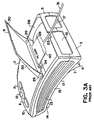
- Fig. 3A the prior art mobile body-worn or body-supported computer 1 of parent application USSN 08/975,964 is shown.
- a lift hinged door 9 is shown which opens into a PC card compartment 26.
- the cable 31 connecting from the housed PC card 28 is extended through slot 23.
- the door 9 when open exposes a connection 34 for at least one PCMCIA card(s) (PC cards) 28 (one to four cards).
- PCMCIA card(s) PC cards
- the PC cards of Type I, II or III are housed totally within the housing 26, only the cable 31 or connector 27 or upward projection 46 extends out from the housing 26 and hinged door 9 through slot 23. Also the housing 26 permits sealing 30 around the door to make it weatherproof when worn outdoors.
- This internal housing 26 now provides means to prevent damaging the PC card 28 and means to weatherproof the card 28 and housing 26 from rain, water, snow or other inclement conditions. Ejecting means on buttons 29 are now easier to get to than the prior art buttons which are recessed and are hard to access.
- the pressure points on the PC card 28 are reduced in the present embodiment to further minimize damage to the card 28.
- Resilient waterproofing seal 30 is used to weatherproof the door and, as noted, protect the interior on housing 26 and card 28 from damage resulting from weather conditions.
- Fig. 3A cable 31 which is connected to card 28 within housing 26 is shown with door 9 open, but when closed it will hermetically seal in card 28.
- Figs. 3A, 4, 6, 7, 8 and 9 on the top front portion 10 of the computer housing 2 are central buttons 11 and joy stick or lever 12.
- the lever 12 is used to move and control a mouse pointer when the computer 1 is used as a mobile or conventional computer.
- the control buttons 11 are used for program execution or menu selection when the computer 1 is used as a conventional computer.
- vent louvers or a heat sink 13 which allow the heat from inside the computer housing 2 to be dissipated or vented out to the atmosphere. These ribbed side vents or louvers 13 help reduce the inside heat which heat could cause malfunctioning or slowing down of the computer functions.
- the computer housing 2 is symmetrical so that when it is worn on either the right-hand side or left-hand side of the user's waist, the back section 5, peripheral connector or computer terminal section 3 and resulting cables will always face the back of the user.
- a stationary stand 14 is used to support the front section 10 of the computer. This front stand 14 may also be used as a belt loop (or handle) as shown in Fig. 3A.
- FIG. 3A This same type mobile computer of Fig. 3A is used in the present invention except that housing 26 is made larger and door 9 is movable along the horizontal axis of computer 1 to accommodate all type PCMCIA cards.
- cables 4 connect to components of a conventional computer such as monitors, keyboards, power supplies or any other desirable component.
- the louvered sides or vents 13 allow heat dissipation in this mode of use.
- buttons 11 are easily accessible to both right and left-handed users.
- the controls of buttons 11 and mouse lever 12 always face the front of the user for easy access and use.
- the controls 11 and 12 when right side 15 is facing up or down when worn, the controls 11 and 12 always face the front, cables 4 and outlet section 3 always face the back of the user.
- Controls or software can be provided to convert or reverse the functions of controls or buttons 11.
- Versa Point® mouse pointing technology may be used as one suitable means in controls 11 and 12.
- Versa Point® is a trademark of Interlink Electronics of 547 Flynn Rd., Carnarillo, CA.
- Opening 22 is an IrDA port that can be used for wireless communications.
- IrDA (Infra Red Data Association) ports are known, for example, as disclosed in U.S. Patent No. 5,491,651 and other publications. IrDA are used as transceivers (transmit and receive) to communicate with local area networks, with printers, with another computer for transferring of information or data and other desired uses.
- the positioning of offset or recessed bottom extension 6 is shown slightly indented and below back portion 5 of the computer housing 2.
- Fig. 4 The curvature 17 of housing 2 which is adjacent to the user's body is shown in Fig. 4. While Fig. 3A and the other applicable figures all show (for clarity purposes only) a rectangular configuration for housing 2, other shapes or configurations may be used if desirable. For example an oval or circular configuration may be used if the other specifics of this invention as claimed are present.
- Openings 16 and 17 provide means for connecting to computer 1 other peripheral equipment such as floppy drives, bar code scanners, VGA port or external monitor connectors.
- Housing 2 preferably is constructed of a lightweight, structurally strong plastic. Peripheral outlets in section 3, any suitable number of them, may be used and are positioned in bottom extension 6. Opening 23 is a cable opening for cables used with PCMCIA card slots.
- Fig. 3A While the structure of Fig. 3A is perfectly designed to protect dongles 45 from damage, it can be seen in Fig. 3B that PCMCIA end extensions 46 will not fit in compartment 26 of the structure shown in Figs. 3A and 3B.
- the door 9 also will not close if the hinged door 9 of Fig. 3A is used. Not only is the compartment 26 of the computer housing shown in Figs. 3A and 3B, not large enough to accommodate the PCMCIA card with projection 46, but also the door 9 will not close. Accordingly, the housing compartment 26 of the present invention needed to be enlarged and door 9 of Fig. 3A needed to be converted to a movable door 47 as shown in Fig. 4.
- the PCMCIA card 48 fits into compartment 26 and has a solid underneath support and a coverage by movable door 47 of all but the upward projection 46. It is critical to this invention that no part of the PCMCIA card extend longitudinally beyond the end portion 3 of the computer. In a wearable computer it is very important that in PCMCIA cards, no component or dongle extend out where it could be easily damaged. An upward projection such as upward extension 46 will be within the limits of the computer and will not jut outward but rather will be within the confines of the computer 1.
- a waterproof edging 49 can be put around the periphery of door 47 and the upper section of compartment 26 to ensure protection to the inside of the PCMCIA compartment 26. While door 47 is shown in Fig. 4 as being slightly ajar and not touching end extension 46, this is for clarity only; in actual use door 47 would fit snugly against upward extension 46.
- the movable door 47 can fit above the top 2 of the computer housing 2 when slid back, and will fit flush with compartment housing opening 26 when in its closed mode.
- FIG. 5 different types of PCMCIA cards are shown, each of which can be properly housed in compartment 26 of this invention.
- Type I, II and III PCMCIA cards are shown in Fig. 5.
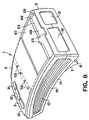
- Figs. 4, 6, 7, 8 and 9 illustrate the novel PCMCIA compartment and movable door 47 of this invention.
- Fig. 4 shows the door 47 moved above and abutting computer top 2; this is accomplished by a structure shown in Figs. 6 and 7.
- a sliding door 47 is connected by brackets 4 on both its sides 50 and 51 with bracket tracks 8.
- the end top portion of bracket 4 is fixed to the sides of door 47, and the end bottom portion of bracket 4 is slidably movable in track 8.
- door 47 fits above the top surface of computer housing 2 as shown in Fig. 7. This open mode shown in Fig.
- a second embodiment of the movable door 47 is illustrated.
- the door 47 moves in or under the top surface of computer top 2.
- the end of the door 47 closest to controls 11 and 12 is spring loaded by the use of a plurality of springs 52.
- the door 47 As door 47 is pushed backward toward components 10, 11 and 12, the door provides an upper opening 53 in compartment 26 through which a PCMCIA projection 46 will extend.
- Door 47 then, because it is spring loaded, will push up against the projection 46 (as shown in Fig. 4) and hold the PCMCIA card in position.
- a flexible rubber waterproofing element 49 can be put around the periphery of door 47 and opening 53 to prevent the opening or compartment 26 from being exposed to the outside environments.
- the movable door 47 can be spring loaded as shown in Figs. 8 and 9 or can be side hinged as shown in Figs. 6 and 7. Obviously, any suitable movable door 47 will be considered within this invention.
- FIG. 5 various PCMCIA cards are illustrated, each having at least a horizontal or base portion 54 and some having an upwardly projecting portion 46.
- the movable compartment door 47 will cover substantially all of the horizontal portion 54 of a PCMCIA card but not any upwardly projecting portion 46 thereof; see in this regard Fig. 4, where portion 46 does not jut out beyond section 3.
- the compartment of recessed PCMCIA card housing 26 will contain substantially the entire card therein so that only the projecting portion 46 of the PCMCIA card is exposed.
- the PCMCIA card 28 thus, can fully seat within the compartment 26 so that the movable door 47 will fit over the horizontal PCMCIA card portion 54 and abut against the upwardly projecting portion 46 of the PCMCIA card 28.
- the compartment 26 and movable door 47 of this invention provide the most secure known support for PCMCIA cards. Not only is the card support an important advantage of this invention, but also the ease with which a card may be inserted and held in a mobile or other computer structure.
Landscapes
- Engineering & Computer Science (AREA)
- Theoretical Computer Science (AREA)
- Computer Hardware Design (AREA)
- General Engineering & Computer Science (AREA)
- General Physics & Mathematics (AREA)
- Physics & Mathematics (AREA)
- Human Computer Interaction (AREA)
- Power Engineering (AREA)
- Microelectronics & Electronic Packaging (AREA)
- Casings For Electric Apparatus (AREA)
- Vehicle Step Arrangements And Article Storage (AREA)
- Packaging Of Annular Or Rod-Shaped Articles, Wearing Apparel, Cassettes, Or The Like (AREA)
- Credit Cards Or The Like (AREA)
- Lock And Its Accessories (AREA)
Applications Claiming Priority (2)
| Application Number | Priority Date | Filing Date | Title |
|---|---|---|---|
| US09/645,843 US6434011B1 (en) | 1997-11-21 | 2000-08-24 | PCMCIA compartment |
| US645843 | 2000-08-24 |
Publications (2)
| Publication Number | Publication Date |
|---|---|
| EP1189129A2 true EP1189129A2 (de) | 2002-03-20 |
| EP1189129A3 EP1189129A3 (de) | 2002-06-19 |
Family
ID=24590697
Family Applications (1)
| Application Number | Title | Priority Date | Filing Date |
|---|---|---|---|
| EP01115730A Withdrawn EP1189129A3 (de) | 2000-08-24 | 2001-07-06 | PCMCIA-Kartengehäuse |
Country Status (7)
| Country | Link |
|---|---|
| US (1) | US6434011B1 (de) |
| EP (1) | EP1189129A3 (de) |
| JP (1) | JP2002073217A (de) |
| KR (1) | KR20020016532A (de) |
| CN (1) | CN1340752A (de) |
| CA (1) | CA2336764C (de) |
| TW (1) | TW525093B (de) |
Cited By (1)
| Publication number | Priority date | Publication date | Assignee | Title |
|---|---|---|---|---|
| EP1387308A1 (de) * | 2002-08-01 | 2004-02-04 | Kabushiki Kaisha Toshiba | IC-Kartenverarbeitungsvorrichtung |
Families Citing this family (5)
| Publication number | Priority date | Publication date | Assignee | Title |
|---|---|---|---|---|
| JP2001044660A (ja) * | 1999-07-27 | 2001-02-16 | Mitsumi Electric Co Ltd | 電子機器 |
| TW508061U (en) * | 2001-08-03 | 2002-10-21 | Hannstar Display Corp | Structure of heat radiation for joining of parts |
| EP1394662A1 (de) * | 2002-08-29 | 2004-03-03 | Hewlett Packard Company, a Delaware Corporation | Kabelanordungsteil für einen Rechner |
| US20060250362A1 (en) * | 2005-05-09 | 2006-11-09 | Areson Technology Corp. | Input device capable of using cabled mouse and wireless mouse |
| US8554154B1 (en) * | 2010-03-16 | 2013-10-08 | Sprint Communications Company L.P. | Connector supporting integrated radio frequency and baseband data |
Family Cites Families (4)
| Publication number | Priority date | Publication date | Assignee | Title |
|---|---|---|---|---|
| US5169218A (en) * | 1991-10-30 | 1992-12-08 | Edward Chu | Computer mainframe front panel assembly |
| CA2083017C (en) * | 1992-11-16 | 1999-02-09 | Alan Walter Ainsbury | Tandem circuit cards |
| US5661634A (en) * | 1993-11-09 | 1997-08-26 | Fujitsu Limited | Information processing system using portable terminal unit and data communication adapter therefor |
| IL126912A (en) * | 1998-07-30 | 2002-11-10 | Xybernaut Corp | A memory card compartment for a personal computer of the International Association |
-
2000
- 2000-08-24 US US09/645,843 patent/US6434011B1/en not_active Expired - Fee Related
-
2001
- 2001-02-15 CA CA002336764A patent/CA2336764C/en not_active Expired - Fee Related
- 2001-02-26 TW TW090104373A patent/TW525093B/zh not_active IP Right Cessation
- 2001-04-04 JP JP2001106444A patent/JP2002073217A/ja active Pending
- 2001-07-06 EP EP01115730A patent/EP1189129A3/de not_active Withdrawn
- 2001-08-22 KR KR1020010050671A patent/KR20020016532A/ko not_active Ceased
- 2001-08-24 CN CN01125787A patent/CN1340752A/zh active Pending
Cited By (1)
| Publication number | Priority date | Publication date | Assignee | Title |
|---|---|---|---|---|
| EP1387308A1 (de) * | 2002-08-01 | 2004-02-04 | Kabushiki Kaisha Toshiba | IC-Kartenverarbeitungsvorrichtung |
Also Published As
| Publication number | Publication date |
|---|---|
| EP1189129A3 (de) | 2002-06-19 |
| CA2336764A1 (en) | 2002-02-24 |
| CN1340752A (zh) | 2002-03-20 |
| CA2336764C (en) | 2004-10-12 |
| US6434011B1 (en) | 2002-08-13 |
| TW525093B (en) | 2003-03-21 |
| KR20020016532A (ko) | 2002-03-04 |
| JP2002073217A (ja) | 2002-03-12 |
Similar Documents
| Publication | Publication Date | Title |
|---|---|---|
| US5769646A (en) | Integrated electrical connector guard device for use in a personal computer | |
| US5719744A (en) | Torso-worn computer without a monitor | |
| KR100336741B1 (ko) | 휴대용 컴퓨터 키보드 시스템 | |
| US7594576B2 (en) | PDA carrying device | |
| US5701232A (en) | Sliding protection door for covering one or both of a pair of mutually exclusive electrical connectors | |
| JP2002509309A (ja) | 電子製品用スライディング・セグメントを有する折畳みキーボード | |
| US6351388B1 (en) | Mobile computer with PC housing for PC card and dongle | |
| EP0962853A1 (de) | Tragbarer Rechner | |
| JP2002091622A (ja) | ドッキングステーションおよび位置合わせ方法 | |
| US7704085B1 (en) | Cover module of electronic device and control method thereof | |
| US6434011B1 (en) | PCMCIA compartment | |
| US6679710B2 (en) | Electronic unit device | |
| JP4015729B2 (ja) | コンピュータ装置 | |
| CA2257742C (en) | Pcmcia compartment | |
| US6437773B1 (en) | Notebook computer | |
| JPH08101900A (ja) | 無線通信用icカードおよび同カードが装着されるデータ処理装置 | |
| HK1045007A (en) | Pcmcia compartment | |
| CN1095110C (zh) | 移动式计算机 | |
| US20040095325A1 (en) | Computer keyboard | |
| HK1025405A (en) | Pcmcia compartment | |
| JPH09330148A (ja) | 小型電子機器構造 | |
| KR200329853Y1 (ko) | 통신커넥터를 갖춘 휴대용 디지털 기기 | |
| WO2007094526A1 (en) | Keyboard have main board of computer within | |
| KR20050010652A (ko) | 통신커넥터를 갖춘 휴대용 디지털 기기 |
Legal Events
| Date | Code | Title | Description |
|---|---|---|---|
| PUAI | Public reference made under article 153(3) epc to a published international application that has entered the european phase |
Free format text: ORIGINAL CODE: 0009012 |
|
| 17P | Request for examination filed |
Effective date: 20010712 |
|
| AK | Designated contracting states |
Kind code of ref document: A2 Designated state(s): AT BE CH CY DE DK ES FI FR GB GR IE IT LI LU MC NL PT SE TR |
|
| AX | Request for extension of the european patent |
Free format text: AL;LT;LV;MK;RO;SI |
|
| PUAL | Search report despatched |
Free format text: ORIGINAL CODE: 0009013 |
|
| AK | Designated contracting states |
Kind code of ref document: A3 Designated state(s): AT BE CH CY DE DK ES FI FR GB GR IE IT LI LU MC NL PT SE TR |
|
| AX | Request for extension of the european patent |
Free format text: AL;LT;LV;MK;RO;SI |
|
| AKX | Designation fees paid |
Designated state(s): AT BE CH CY DE DK ES FI FR GB GR IE IT LI LU MC NL PT SE TR |
|
| STAA | Information on the status of an ep patent application or granted ep patent |
Free format text: STATUS: THE APPLICATION IS DEEMED TO BE WITHDRAWN |
|
| 18D | Application deemed to be withdrawn |
Effective date: 20061020 |