EP1189295A2 - Sekundärbatterie and Kondensator mit Indolverbindungen - Google Patents
Sekundärbatterie and Kondensator mit Indolverbindungen Download PDFInfo
- Publication number
- EP1189295A2 EP1189295A2 EP01121270A EP01121270A EP1189295A2 EP 1189295 A2 EP1189295 A2 EP 1189295A2 EP 01121270 A EP01121270 A EP 01121270A EP 01121270 A EP01121270 A EP 01121270A EP 1189295 A2 EP1189295 A2 EP 1189295A2
- Authority
- EP
- European Patent Office
- Prior art keywords
- electrode
- indole
- active material
- trimer compound
- capacitor
- Prior art date
- Legal status (The legal status is an assumption and is not a legal conclusion. Google has not performed a legal analysis and makes no representation as to the accuracy of the status listed.)
- Granted
Links
Images

Classifications
-
- H—ELECTRICITY
- H01—ELECTRIC ELEMENTS
- H01G—CAPACITORS; CAPACITORS, RECTIFIERS, DETECTORS, SWITCHING DEVICES, LIGHT-SENSITIVE OR TEMPERATURE-SENSITIVE DEVICES OF THE ELECTROLYTIC TYPE
- H01G11/00—Hybrid capacitors, i.e. capacitors having different positive and negative electrodes; Electric double-layer [EDL] capacitors; Processes for the manufacture thereof or of parts thereof
- H01G11/02—Hybrid capacitors, i.e. capacitors having different positive and negative electrodes; Electric double-layer [EDL] capacitors; Processes for the manufacture thereof or of parts thereof using combined reduction-oxidation reactions, e.g. redox arrangement or solion
-
- H—ELECTRICITY
- H01—ELECTRIC ELEMENTS
- H01G—CAPACITORS; CAPACITORS, RECTIFIERS, DETECTORS, SWITCHING DEVICES, LIGHT-SENSITIVE OR TEMPERATURE-SENSITIVE DEVICES OF THE ELECTROLYTIC TYPE
- H01G11/00—Hybrid capacitors, i.e. capacitors having different positive and negative electrodes; Electric double-layer [EDL] capacitors; Processes for the manufacture thereof or of parts thereof
- H01G11/22—Electrodes
- H01G11/30—Electrodes characterised by their material
- H01G11/32—Carbon-based
- H01G11/42—Powders or particles, e.g. composition thereof
-
- H—ELECTRICITY
- H01—ELECTRIC ELEMENTS
- H01G—CAPACITORS; CAPACITORS, RECTIFIERS, DETECTORS, SWITCHING DEVICES, LIGHT-SENSITIVE OR TEMPERATURE-SENSITIVE DEVICES OF THE ELECTROLYTIC TYPE
- H01G11/00—Hybrid capacitors, i.e. capacitors having different positive and negative electrodes; Electric double-layer [EDL] capacitors; Processes for the manufacture thereof or of parts thereof
- H01G11/22—Electrodes
- H01G11/30—Electrodes characterised by their material
- H01G11/48—Conductive polymers
-
- H—ELECTRICITY
- H01—ELECTRIC ELEMENTS
- H01G—CAPACITORS; CAPACITORS, RECTIFIERS, DETECTORS, SWITCHING DEVICES, LIGHT-SENSITIVE OR TEMPERATURE-SENSITIVE DEVICES OF THE ELECTROLYTIC TYPE
- H01G9/00—Electrolytic capacitors, rectifiers, detectors, switching devices, light-sensitive or temperature-sensitive devices; Processes of their manufacture
- H01G9/22—Devices using combined reduction and oxidation, e.g. redox arrangement or solion
-
- H—ELECTRICITY
- H01—ELECTRIC ELEMENTS
- H01M—PROCESSES OR MEANS, e.g. BATTERIES, FOR THE DIRECT CONVERSION OF CHEMICAL ENERGY INTO ELECTRICAL ENERGY
- H01M10/00—Secondary cells; Manufacture thereof
- H01M10/05—Accumulators with non-aqueous electrolyte
-
- H—ELECTRICITY
- H01—ELECTRIC ELEMENTS
- H01M—PROCESSES OR MEANS, e.g. BATTERIES, FOR THE DIRECT CONVERSION OF CHEMICAL ENERGY INTO ELECTRICAL ENERGY
- H01M10/00—Secondary cells; Manufacture thereof
- H01M10/36—Accumulators not provided for in groups H01M10/05-H01M10/34
-
- H—ELECTRICITY
- H01—ELECTRIC ELEMENTS
- H01M—PROCESSES OR MEANS, e.g. BATTERIES, FOR THE DIRECT CONVERSION OF CHEMICAL ENERGY INTO ELECTRICAL ENERGY
- H01M4/00—Electrodes
- H01M4/02—Electrodes composed of, or comprising, active material
- H01M4/13—Electrodes for accumulators with non-aqueous electrolyte, e.g. for lithium-accumulators; Processes of manufacture thereof
- H01M4/137—Electrodes based on electro-active polymers
-
- H—ELECTRICITY
- H01—ELECTRIC ELEMENTS
- H01M—PROCESSES OR MEANS, e.g. BATTERIES, FOR THE DIRECT CONVERSION OF CHEMICAL ENERGY INTO ELECTRICAL ENERGY
- H01M4/00—Electrodes
- H01M4/02—Electrodes composed of, or comprising, active material
- H01M4/36—Selection of substances as active materials, active masses, active liquids
- H01M4/60—Selection of substances as active materials, active masses, active liquids of organic compounds
-
- H—ELECTRICITY
- H01—ELECTRIC ELEMENTS
- H01M—PROCESSES OR MEANS, e.g. BATTERIES, FOR THE DIRECT CONVERSION OF CHEMICAL ENERGY INTO ELECTRICAL ENERGY
- H01M4/00—Electrodes
- H01M4/02—Electrodes composed of, or comprising, active material
- H01M4/36—Selection of substances as active materials, active masses, active liquids
- H01M4/60—Selection of substances as active materials, active masses, active liquids of organic compounds
- H01M4/602—Polymers
- H01M4/606—Polymers containing aromatic main chain polymers
-
- H—ELECTRICITY
- H01—ELECTRIC ELEMENTS
- H01M—PROCESSES OR MEANS, e.g. BATTERIES, FOR THE DIRECT CONVERSION OF CHEMICAL ENERGY INTO ELECTRICAL ENERGY
- H01M4/00—Electrodes
- H01M4/02—Electrodes composed of, or comprising, active material
- H01M4/36—Selection of substances as active materials, active masses, active liquids
- H01M4/60—Selection of substances as active materials, active masses, active liquids of organic compounds
- H01M4/602—Polymers
- H01M4/606—Polymers containing aromatic main chain polymers
- H01M4/608—Polymers containing aromatic main chain polymers containing heterocyclic rings
-
- Y—GENERAL TAGGING OF NEW TECHNOLOGICAL DEVELOPMENTS; GENERAL TAGGING OF CROSS-SECTIONAL TECHNOLOGIES SPANNING OVER SEVERAL SECTIONS OF THE IPC; TECHNICAL SUBJECTS COVERED BY FORMER USPC CROSS-REFERENCE ART COLLECTIONS [XRACs] AND DIGESTS
- Y02—TECHNOLOGIES OR APPLICATIONS FOR MITIGATION OR ADAPTATION AGAINST CLIMATE CHANGE
- Y02E—REDUCTION OF GREENHOUSE GAS [GHG] EMISSIONS, RELATED TO ENERGY GENERATION, TRANSMISSION OR DISTRIBUTION
- Y02E60/00—Enabling technologies; Technologies with a potential or indirect contribution to GHG emissions mitigation
- Y02E60/10—Energy storage using batteries
-
- Y—GENERAL TAGGING OF NEW TECHNOLOGICAL DEVELOPMENTS; GENERAL TAGGING OF CROSS-SECTIONAL TECHNOLOGIES SPANNING OVER SEVERAL SECTIONS OF THE IPC; TECHNICAL SUBJECTS COVERED BY FORMER USPC CROSS-REFERENCE ART COLLECTIONS [XRACs] AND DIGESTS
- Y02—TECHNOLOGIES OR APPLICATIONS FOR MITIGATION OR ADAPTATION AGAINST CLIMATE CHANGE
- Y02E—REDUCTION OF GREENHOUSE GAS [GHG] EMISSIONS, RELATED TO ENERGY GENERATION, TRANSMISSION OR DISTRIBUTION
- Y02E60/00—Enabling technologies; Technologies with a potential or indirect contribution to GHG emissions mitigation
- Y02E60/13—Energy storage using capacitors
Definitions
- the present invention relates to a secondary battery and a capacitor, more particularly utilizing an indole compound as an active material of an electrode and a proton as a charge carrier.
- Indole polymers are known as excellent materials for an active material of electrode in the light of electromotive force and capacity.
- the battery wherein the indole polymers are utilized as an active material has not been satisfactory in the light of a rapid charge and discharge and a cycle characteristic.
- a battery and a capacitor which may provide an excellent high rate and cycle characteristic as well as sufficient electromotive force and capacity can be provided.
- the invention provides a secondary battery and a capacitor having an active material of an electrode comprising a trimer compound comprising three units of indole or indole derivatives in condensed ring form, wherein the second position and the third position of each unit form a six-membered ring, and a proton which can be utilized as a charge carrier of the trimer compound.
- the invention provides a secondary battery and a capacitor comprising:
- the invention provides a secondary battery and a capacitor, wherein the receipt and release of electrons in accordance with the oxidation-reduction reaction of the trimer compound are carried out only by the bonding and elimination of the proton bonded to the trimer compound.
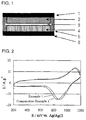
- FIG.1 is a schematic cross section showing a working example of a battery and a capacitor of this invention.
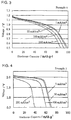
- FIG.2 is the cyclic voltamogram of the positive electrodes in the example 1 and the comparative example 1.
- FIG.3 is the graph showing the results of charge and discharge tests (discharge curves) of the battery in the example 1.
- FIG.4 is the graph showing the results of charge and discharge tests (discharge curves) of the battery in the example 3.
- FIG.5 is the graph showing the results of charge and discharge tests (discharge curves) of the battery in the comparative example 1.
- FIG.6 is the graph showing the results of charge and discharge tests (discharge curves) of the battery in the comparative example 3.
- FIG.1 is a cross section of a secondary battery or a capacitor according to this invention.
- a positive electrode material layer 2 and a negative electrode material layer 4, which are formed on a current collector 1 and a current collector 6 respectively, are arranged so as to face each other via a separator 3; there are provided a gasket 5 made of insulating rubber on the side of the layers wherein the positive electrode material layer 2 and the negative electrode material layer 4 are piled via the separator 3.
- the positive electrode material layer 2 (positive electrode) and the negative electrode material layer 4 (negative electrode) are each impregnated with an electrolyte solution containing protons.
- a trimer compound, wherein bonds are formed among the second position and the third position of each unit of indole or indole derivatives, hereinafter described as an"indole trimer" can be represented by the following general formula (1): wherein each R represents a hydrogen atom or a substituent, independently.
- the indole trimers can be prepared by known electrochemical or chemical methods utilizing known reactions such as electrochemical oxidation, chemical oxidation, condensation reaction and substitution reaction depending on the substituents from, for example, indole or indole derivatives, hereinafter described as an "indole monomer” represented by general formula (2) shown below.
- the indole trimers are prepared usually from indole monomers wherein each R attached to the second position and the third position is a hydrogen atom.
- each R represents one of a hydrogen atom, halogen atom, hydroxyl, carboxyl, sulfonic acid group, sulfuric acid group, nitro, cyano, alkyl, aryl, alkoxyl, amino, alkylthio and arylthio, independently.
- the indole trimers in this invention can be represented by, for example, general formula (1) wherein each R represents a hydrogen atom, halogen atom, hydroxy, carboxyl, sulfonic acid group, sulfuric acid group, nitro, cyano, alkyl, aryl, alkoxyl,amino, alkylthio and arylthio, independently.
- the substituents R in general formula (1) may originate from indole monomers utilized as raw materials.
- halogen atoms of R in general formulas (1) and (2) are, for example, fluorine, chlorine, bromine, and iodine.
- Alkyl groups of R in the formulas are, for example, methyl, ethyl, propyl, isopropyl, n-butyl, s-butyl, isobutyl, t-butyl, n-pentyl, n-hexyl, n-heptyl and n-octyl.
- Alkoxyl groups of R in the formulas are groups represented by -OX wherein X are, for example, the alkyl groups described above.
- Aryl groups of R in the formulas are, for example, phenyl, naphthyl, anthryl and phenanthryl.
- Alkyl groups in the alkylthio groups of R in the formulas are, for example, the alkyl groups described above.
- Aryl groups in the arylthio groups of R in the formulas are, for example, the aryl groups described above.
- a conductive auxiliary material is added to the electrodes to provide them with electrical conductivity, if necessary.
- the conductive auxiliary material is, for example, an electrical conductive material such as, crystal carbon, carbon black and graphite.
- binder may be added to keep moldability of the electrodes and to fix these materials on a current collector.
- Mixing ratio of constituting materials in the electrodes may be arbitrary as long as the required characteristic is obtained.
- a preferable composition ranges 30 to 95 wt% of an indole trimer, 5 to 50 wt% of a conductive auxiliary material and 0 to 20 wt% of a binder.
- An aqueous or nonaqueous solution containing protons is preferably used as an electrolyte solution, so that the protons may be used as charge carriers of indole trimers. Furthermore, a concentration of protons in the electrolyte solution is preferably 10 -3 mol/l to 18 mol/l. Salt or surface active agents may be added to the electrolyte solution to increase the electric conductivity or other properties.
- any material having an electrical insulating property and having or providing ionic conductivity for example, a porous film made of polyethylene or polytetrafluoroethylene is used as a separator saturated with an electrolyte solution.
- An electrolyte such as a gel electrolyte or solid electrolyte as sandwiched between the electrodes may be substituted for the separator.
- the indole trimer in this invention is doped by an electrochemical or a chemical method as illustrated by the reaction formula described below.
- X - in the formula represents a dopant ion, for example, a sulfuric ion, a halide ion, a perchloric ion and trifluoroacetic ion and is not limited to these ions as long as it provides the indole trimer with an electrochemical activity by doping.
- the indole trimer doped by this method generates an electrochemical reaction accompanied with an adsorption and desorption of a proton as illustrated by the following reaction formula 2. Only the adsorption and desorption of a proton in the indole trimer concern with the receipt and release of electrons accompanied with an oxidation-reduction reaction of the indole trimer. Since a transfer material in the electrochemical reaction is only a proton in the battery and the capacitor of this invention using the indole trimer as an electrode material wherein the electrochemical reaction occurs, a volume change of electrodes accompanying the reaction is less and has an excellent cycle characteristic. Furthermore, a high mobility of a proton and a rapid chemical reaction result in an excellent high rate characteristic, i.e., a characteristic of a rapid charge and discharge of the battery.
- FIG. 1 shows a battery having the structure described above which was manufactured according to a usual method.
- Gaskets 5 made of insulating rubber were used as exterior material and current collectors 1 and 6 were made of conductive rubber.
- a separator constituted of porous film impregnated with an electrolyte solution of 40% sulfuric acid was used.
- An indole trimer consisting of a 6-nitroindole trimer was used as an active material in the positive electrode material layer 2 and carbon fibers grown in gas phase were used as a conductive auxiliary material therein.
- Quinoxaline polymer represented by the formula described below was used as an active material in the negative electrode material layer 4 and carbon black was used as a conductive auxiliary material therein.
- an active material used in the negative electrode is not limited to the material if it is active electrochemically and undergoes a reversible oxidation-reduction reaction.
- a mixing ratio of an active material to a conductive auxiliary material constituting electrodes was chosen as weight ratio of 75:25 (an active material: a conductive auxiliary material) both in the positive and the negative electrodes.
- FIG.2 shows a cyclic voltamogram (hereinafter described as "CV") of the positive electrode material layer 2 in an acid aqueous solution.
- CV cyclic voltamogram
- Cycle tests were conducted repeating charging up to 1.2 V and discharging down to 0.9 V at a constant charge-discharge current of 10 mA/cm 2 .
- the number of cycles was 31000 until the final capacity reached 80 % of the initial capacity.
- the battery of this invention using an indole trimer in the positive electrode had an excellent cycle characteristics.
- An indole trimer which has a constant molecular weight and molecular size, is different from an active material of a polymer having a molecular weight distribution and can exist in a crystallized structure or in a similar arrangement in an electrode.
- the transfer path of a reacting ion, i.e., a proton in the electrode is, therefore, nearly linear and its decrease in the mobility is less.
- the polymer material in the electrode is in an amorphous state and the transfer path of a reacting ion has to be bypassed by polymer chains arranged at random.
- the conductivity of the electrode is higher and the transfer of electrons is easier than in the case of using indole polymers as shown in Table 1.
- the transfer velocity of ions and electrons becomes higher by using the indole trimer as an electrode material resulting in an increase in a reaction rate which makes it possible to manufacture a battery having an excellent high rate characteristic.
- An indole trimer is constructed by a five-membered ring unit and a six-membered ring unit having a resonance structure over the entire main skeleton. Therefore, the indole trimer has a higher chemical stability and is hardly deteriorated compared with an electrode material which has no resonance structure in the main skeleton. Furthermore, since the indole trimer has a higher solubility in organic solvents due to the lower molecular weight compared with a polymer material and its chemical property such as solubility is unity because of its constant molecular weight, it is possible to reduce contaminants easily such as metal elements coming from oxidizing agents during preparation in addition to easy purification. It is, therefore, possible to manufacture a battery having an excellent cycle property.
- Example 2 A similar battery was manufactured as in Example 1 except for using an indole trimer consisting of a 5-cyanoindole trimer as an active material in the positive electrode material layer 2.
- Cycle tests were conducted repeating charging up to 1.2 V and discharging down to 0.9 V at a constant charge-discharge current of 10 mA/cm 2 . As a result of the tests the number of cycles was 25000 until the final capacity reached 80 % of the initial capacity.
- PC solution a propylenecarbonate solution wherein 1 mol/l of tetraethylammonium tetrafluoroborate and 0.1 mol/l of trifluoroacetic acid were dissolved.
- An increase in a discharge current from 1 mA/cm 2 to 200 mA/cm 2 results in a decrease in a discharge capacity from 70 mAh/g to 39 mAh/g indicating 44 % decrease in the capacity.
- Cycle tests were conducted repeating charging up to 2.3 V and discharging down to 0.5 V at a constant charge-discharge current of 10 mA/cm 2 . As a result of the tests the number of cycles was 19000 until the final capacity reached 80 % of the initial capacity.
- Example 2 A similar battery was manufactured as in Example 1 except for using an indole polymer, i.e., poly-6-nitroindole as an active material in the positive electrode material layer 2.
- an indole polymer i.e., poly-6-nitroindole
- Example 2 A similar battery was manufactured as in Example 1 except for using an indole polymer, i.e., poly-5-cyanoindole as an active material in the positive electrode material layer 2.
- an indole polymer i.e., poly-5-cyanoindole
- a similar battery was manufactured as in Example 1 except for using an indole polymer,i.e., poly-6-nitroindole as an active material in the positive electrode material layer 2 and a PC solution as an electrolyte wherein 1 mol/l of tetraethylammonium tetrafluoroborate and 0.1 mol/l of trifluoroacetic acid were dissolved.
- an indole polymer i.e., poly-6-nitroindole
- PC solution as an electrolyte wherein 1 mol/l of tetraethylammonium tetrafluoroborate and 0.1 mol/l of trifluoroacetic acid were dissolved.
Landscapes
- Engineering & Computer Science (AREA)
- Chemical & Material Sciences (AREA)
- Chemical Kinetics & Catalysis (AREA)
- Electrochemistry (AREA)
- General Chemical & Material Sciences (AREA)
- Power Engineering (AREA)
- Microelectronics & Electronic Packaging (AREA)
- Materials Engineering (AREA)
- Manufacturing & Machinery (AREA)
- Battery Electrode And Active Subsutance (AREA)
- Secondary Cells (AREA)
- Electric Double-Layer Capacitors Or The Like (AREA)
Applications Claiming Priority (2)
| Application Number | Priority Date | Filing Date | Title |
|---|---|---|---|
| JP2000282309A JP3471304B2 (ja) | 2000-09-18 | 2000-09-18 | インドール系化合物を用いた二次電池及びキャパシタ |
| JP2000282309 | 2000-09-18 |
Publications (3)
| Publication Number | Publication Date |
|---|---|
| EP1189295A2 true EP1189295A2 (de) | 2002-03-20 |
| EP1189295A3 EP1189295A3 (de) | 2004-05-19 |
| EP1189295B1 EP1189295B1 (de) | 2005-12-07 |
Family
ID=18766849
Family Applications (1)
| Application Number | Title | Priority Date | Filing Date |
|---|---|---|---|
| EP01121270A Expired - Lifetime EP1189295B1 (de) | 2000-09-18 | 2001-09-05 | Sekundärbatterie and Kondensator mit Indolverbindungen |
Country Status (5)
| Country | Link |
|---|---|
| US (2) | US6749963B2 (de) |
| EP (1) | EP1189295B1 (de) |
| JP (1) | JP3471304B2 (de) |
| KR (1) | KR100418845B1 (de) |
| DE (1) | DE60115560T2 (de) |
Cited By (10)
| Publication number | Priority date | Publication date | Assignee | Title |
|---|---|---|---|---|
| GB2385706A (en) * | 2002-02-26 | 2003-08-27 | Nec Tokin Corp | Secondary battery and capacitor utilizing indole compounds |
| US6875541B2 (en) | 2001-11-02 | 2005-04-05 | Nec Tokin Corporation | Electrochemical cell using indole-related compounds |
| US7923151B2 (en) | 2003-09-18 | 2011-04-12 | Commonwealth Scientific And Industrial Research Organisation | High performance energy storage devices |
| US9203116B2 (en) | 2006-12-12 | 2015-12-01 | Commonwealth Scientific And Industrial Research Organisation | Energy storage device |
| US9401508B2 (en) | 2009-08-27 | 2016-07-26 | Commonwealth Scientific And Industrial Research Organisation | Electrical storage device and electrode thereof |
| US9450232B2 (en) | 2009-04-23 | 2016-09-20 | Commonwealth Scientific And Industrial Research Organisation | Process for producing negative plate for lead storage battery, and lead storage battery |
| US9508493B2 (en) | 2009-08-27 | 2016-11-29 | The Furukawa Battery Co., Ltd. | Hybrid negative plate for lead-acid storage battery and lead-acid storage battery |
| US9524831B2 (en) | 2009-08-27 | 2016-12-20 | The Furukawa Battery Co., Ltd. | Method for producing hybrid negative plate for lead-acid storage battery and lead-acid storage battery |
| US9666860B2 (en) | 2007-03-20 | 2017-05-30 | Commonwealth Scientific And Industrial Research Organisation | Optimised energy storage device having capacitor material on lead based negative electrode |
| US9812703B2 (en) | 2010-12-21 | 2017-11-07 | Commonwealth Scientific And Industrial Research Organisation | Electrode and electrical storage device for lead-acid system |
Families Citing this family (9)
| Publication number | Priority date | Publication date | Assignee | Title |
|---|---|---|---|---|
| JP3723140B2 (ja) | 2002-03-04 | 2005-12-07 | Necトーキン株式会社 | キノキサリン系化合物を用いた蓄電素子 |
| EP1388906A3 (de) | 2002-08-05 | 2006-10-11 | Nec Tokin Corporation | Zellen-Elektrode und damit hergestellte elektrochemische Zell |
| EP1494303A3 (de) * | 2003-04-25 | 2007-07-18 | Nec Tokin Corporation | Elektrode für elektrochemische Zelle und elektrochemische Zelle |
| JP2005187393A (ja) * | 2003-12-25 | 2005-07-14 | Ihara Chem Ind Co Ltd | インドールカルボン酸エステル三量体及びそれを用いた電気化学セル |
| JP2007149533A (ja) * | 2005-11-29 | 2007-06-14 | Nec Tokin Corp | 電極、およびそれを用いた電気化学セル |
| JP2008288028A (ja) * | 2007-05-17 | 2008-11-27 | Nec Tokin Corp | 電気化学セル用電極および電気化学セル |
| CN101290837B (zh) * | 2008-06-11 | 2010-07-28 | 天津大学 | 大倍率充放电性能超级电容器的多孔炭电极制备方法 |
| US8377546B2 (en) * | 2008-09-08 | 2013-02-19 | Silver H-Plus Technology Co., Ltd. | Plastics electrode material and secondary cell using the material |
| CN113328093B (zh) * | 2021-05-31 | 2023-04-28 | 湖北大学 | 一种金属离子电池有机电极材料、电极、电池以及制备方法 |
Family Cites Families (17)
| Publication number | Priority date | Publication date | Assignee | Title |
|---|---|---|---|---|
| US4211832A (en) * | 1978-12-07 | 1980-07-08 | Wilson Greatbatch Ltd. | Lithium-halogen cell including monomer charge transfer complex |
| FR2527843B1 (fr) * | 1982-06-01 | 1986-01-24 | Thomson Csf | Electrode comprenant un film de polymere electrochrome pouvant servir dans un dispositif d'affichage ou de stockage d'energie |
| JPH0658802B2 (ja) * | 1985-11-08 | 1994-08-03 | 三洋電機株式会社 | 二次電池 |
| BE1004725A3 (fr) * | 1991-04-16 | 1993-01-19 | Solvay | Procede pour la preparation de polyindoles, compositions et dispositifs electroconducteurs les contenant et utilisations des polyindoles. |
| US5512391A (en) | 1993-09-07 | 1996-04-30 | E.C.R. - Electro-Chemical Research Ltd. | Solid state electrochemical cell containing a proton-donating aromatic compound |
| JP4404322B2 (ja) | 1997-04-15 | 2010-01-27 | 昭和電工株式会社 | 二次電池及び該二次電池に用いる電解質、電極活物質 |
| JP3111945B2 (ja) | 1997-10-23 | 2000-11-27 | 日本電気株式会社 | ポリマー二次電池 |
| JP3168962B2 (ja) | 1997-11-04 | 2001-05-21 | 日本電気株式会社 | 電 池 |
| JP2943792B1 (ja) | 1998-04-03 | 1999-08-30 | 日本電気株式会社 | プロトン伝導型ポリマー電池およびその製造方法 |
| JP3348405B2 (ja) | 1999-07-22 | 2002-11-20 | エヌイーシートーキン株式会社 | インドール系高分子を用いた二次電池及びキャパシタ |
| JP2001118577A (ja) | 1999-10-15 | 2001-04-27 | Nec Corp | インドール系高分子を含む電極の製造方法およびそれを用いた二次電池 |
| JP2001118570A (ja) | 1999-10-19 | 2001-04-27 | Nec Corp | ポリマー二次電池用電極の製造方法 |
| JP2001342242A (ja) | 2000-03-31 | 2001-12-11 | Mitsubishi Rayon Co Ltd | ポリインドール誘導体の製造方法及びそれにより得られたポリインドール誘導体 |
| JP3708426B2 (ja) * | 2000-11-13 | 2005-10-19 | Necトーキン株式会社 | プロトン伝導型ポリマー2次電池 |
| JP4004769B2 (ja) * | 2001-10-17 | 2007-11-07 | Necトーキン株式会社 | 電解液、並びにこれを用いた電気化学セル |
| JP3727264B2 (ja) * | 2001-11-02 | 2005-12-14 | Necトーキン株式会社 | インドール系化合物を用いた電気化学セル |
| JP3538185B2 (ja) * | 2002-02-26 | 2004-06-14 | Necトーキン株式会社 | インドール系化合物を用いた二次電池及びキャパシタ |
-
2000
- 2000-09-18 JP JP2000282309A patent/JP3471304B2/ja not_active Expired - Fee Related
-
2001
- 2001-08-31 US US09/942,991 patent/US6749963B2/en not_active Expired - Fee Related
- 2001-09-05 DE DE60115560T patent/DE60115560T2/de not_active Expired - Lifetime
- 2001-09-05 EP EP01121270A patent/EP1189295B1/de not_active Expired - Lifetime
- 2001-09-17 KR KR10-2001-0057088A patent/KR100418845B1/ko not_active Expired - Fee Related
-
2004
- 2004-04-29 US US10/834,005 patent/US7057880B2/en not_active Expired - Fee Related
Cited By (13)
| Publication number | Priority date | Publication date | Assignee | Title |
|---|---|---|---|---|
| US6875541B2 (en) | 2001-11-02 | 2005-04-05 | Nec Tokin Corporation | Electrochemical cell using indole-related compounds |
| GB2385706A (en) * | 2002-02-26 | 2003-08-27 | Nec Tokin Corp | Secondary battery and capacitor utilizing indole compounds |
| GB2385706B (en) * | 2002-02-26 | 2005-06-15 | Nec Tokin Corp | Secondary battery and capacitor utilizing indole compounds |
| US7205071B2 (en) | 2002-02-26 | 2007-04-17 | Nec Tokin Corporation | Secondary battery and capacitor utilizing indole compounds |
| US7923151B2 (en) | 2003-09-18 | 2011-04-12 | Commonwealth Scientific And Industrial Research Organisation | High performance energy storage devices |
| US8232006B2 (en) | 2003-09-18 | 2012-07-31 | Commonwealth Scientific And Industrial Research Organisation | High performance energy storage devices |
| US9203116B2 (en) | 2006-12-12 | 2015-12-01 | Commonwealth Scientific And Industrial Research Organisation | Energy storage device |
| US9666860B2 (en) | 2007-03-20 | 2017-05-30 | Commonwealth Scientific And Industrial Research Organisation | Optimised energy storage device having capacitor material on lead based negative electrode |
| US9450232B2 (en) | 2009-04-23 | 2016-09-20 | Commonwealth Scientific And Industrial Research Organisation | Process for producing negative plate for lead storage battery, and lead storage battery |
| US9401508B2 (en) | 2009-08-27 | 2016-07-26 | Commonwealth Scientific And Industrial Research Organisation | Electrical storage device and electrode thereof |
| US9508493B2 (en) | 2009-08-27 | 2016-11-29 | The Furukawa Battery Co., Ltd. | Hybrid negative plate for lead-acid storage battery and lead-acid storage battery |
| US9524831B2 (en) | 2009-08-27 | 2016-12-20 | The Furukawa Battery Co., Ltd. | Method for producing hybrid negative plate for lead-acid storage battery and lead-acid storage battery |
| US9812703B2 (en) | 2010-12-21 | 2017-11-07 | Commonwealth Scientific And Industrial Research Organisation | Electrode and electrical storage device for lead-acid system |
Also Published As
| Publication number | Publication date |
|---|---|
| DE60115560T2 (de) | 2006-09-21 |
| US20020058185A1 (en) | 2002-05-16 |
| DE60115560D1 (de) | 2006-01-12 |
| US6749963B2 (en) | 2004-06-15 |
| US20040209165A1 (en) | 2004-10-21 |
| KR20020022003A (ko) | 2002-03-23 |
| JP2002093419A (ja) | 2002-03-29 |
| KR100418845B1 (ko) | 2004-02-14 |
| EP1189295B1 (de) | 2005-12-07 |
| JP3471304B2 (ja) | 2003-12-02 |
| EP1189295A3 (de) | 2004-05-19 |
| US7057880B2 (en) | 2006-06-06 |
Similar Documents
| Publication | Publication Date | Title |
|---|---|---|
| EP1189295B1 (de) | Sekundärbatterie and Kondensator mit Indolverbindungen | |
| JP3348405B2 (ja) | インドール系高分子を用いた二次電池及びキャパシタ | |
| Oubaha et al. | Carbonyl‐based π‐conjugated materials: from synthesis to applications in lithium‐ion batteries | |
| CN103534849B (zh) | 蓄电器件 | |
| EP3182501B1 (de) | Elektrolyt für wasserfreie sekundärbatterie und wasserfreie sekundärbatterie damit | |
| US20060008703A1 (en) | Polymer materials for use in an electrode | |
| KR100586823B1 (ko) | 전기화학 셀 용 전극 및 그것을 이용한 전기화학 셀 | |
| US20070095656A1 (en) | Method for purification of indole derivative trimer, electrode active substance comprising the purified trimer, method for manufacturing the electrode active substance, and electrochemical cell using the same | |
| US7205071B2 (en) | Secondary battery and capacitor utilizing indole compounds | |
| JP5818689B2 (ja) | リチウムイオン二次電池 | |
| JP2004055240A (ja) | インドール系化合物を用いた二次電池およびキャパシタ | |
| JP3723140B2 (ja) | キノキサリン系化合物を用いた蓄電素子 | |
| JP3727264B2 (ja) | インドール系化合物を用いた電気化学セル | |
| KR20090032790A (ko) | 초고용량 커패시터용 전해질 첨가제 및 그 제조방법, 그첨가제를 함유하는 전해질 용액 | |
| JP2644480B2 (ja) | 二次電池 | |
| JPS632251A (ja) | 二次電池 | |
| HK1059002A (en) | Secondary battery and capacitor utilizing indole compounds |
Legal Events
| Date | Code | Title | Description |
|---|---|---|---|
| PUAI | Public reference made under article 153(3) epc to a published international application that has entered the european phase |
Free format text: ORIGINAL CODE: 0009012 |
|
| AK | Designated contracting states |
Kind code of ref document: A2 Designated state(s): AT BE CH CY DE DK ES FI FR GB GR IE IT LI LU MC NL PT SE TR |
|
| AX | Request for extension of the european patent |
Free format text: AL;LT;LV;MK;RO;SI |
|
| RAP1 | Party data changed (applicant data changed or rights of an application transferred) |
Owner name: NEC TOKIN CORPORATION |
|
| PUAL | Search report despatched |
Free format text: ORIGINAL CODE: 0009013 |
|
| AK | Designated contracting states |
Kind code of ref document: A3 Designated state(s): AT BE CH CY DE DK ES FI FR GB GR IE IT LI LU MC NL PT SE TR |
|
| AX | Request for extension of the european patent |
Extension state: AL LT LV MK RO SI |
|
| RIC1 | Information provided on ipc code assigned before grant |
Ipc: 7H 01G 9/04 B Ipc: 7H 01M 4/02 A Ipc: 7H 01M 4/60 B |
|
| 17P | Request for examination filed |
Effective date: 20040408 |
|
| AKX | Designation fees paid |
Designated state(s): DE FR GB |
|
| GRAP | Despatch of communication of intention to grant a patent |
Free format text: ORIGINAL CODE: EPIDOSNIGR1 |
|
| GRAS | Grant fee paid |
Free format text: ORIGINAL CODE: EPIDOSNIGR3 |
|
| GRAA | (expected) grant |
Free format text: ORIGINAL CODE: 0009210 |
|
| AK | Designated contracting states |
Kind code of ref document: B1 Designated state(s): DE FR GB |
|
| REG | Reference to a national code |
Ref country code: GB Ref legal event code: FG4D |
|
| REF | Corresponds to: |
Ref document number: 60115560 Country of ref document: DE Date of ref document: 20060112 Kind code of ref document: P |
|
| ET | Fr: translation filed | ||
| PLBE | No opposition filed within time limit |
Free format text: ORIGINAL CODE: 0009261 |
|
| STAA | Information on the status of an ep patent application or granted ep patent |
Free format text: STATUS: NO OPPOSITION FILED WITHIN TIME LIMIT |
|
| 26N | No opposition filed |
Effective date: 20060908 |
|
| PGFP | Annual fee paid to national office [announced via postgrant information from national office to epo] |
Ref country code: GB Payment date: 20090902 Year of fee payment: 9 |
|
| PGFP | Annual fee paid to national office [announced via postgrant information from national office to epo] |
Ref country code: DE Payment date: 20090903 Year of fee payment: 9 |
|
| PGFP | Annual fee paid to national office [announced via postgrant information from national office to epo] |
Ref country code: FR Payment date: 20091012 Year of fee payment: 9 |
|
| GBPC | Gb: european patent ceased through non-payment of renewal fee |
Effective date: 20100905 |
|
| REG | Reference to a national code |
Ref country code: FR Ref legal event code: ST Effective date: 20110531 |
|
| REG | Reference to a national code |
Ref country code: DE Ref legal event code: R119 Ref document number: 60115560 Country of ref document: DE Effective date: 20110401 |
|
| PG25 | Lapsed in a contracting state [announced via postgrant information from national office to epo] |
Ref country code: FR Free format text: LAPSE BECAUSE OF NON-PAYMENT OF DUE FEES Effective date: 20100930 Ref country code: DE Free format text: LAPSE BECAUSE OF NON-PAYMENT OF DUE FEES Effective date: 20110401 |
|
| PG25 | Lapsed in a contracting state [announced via postgrant information from national office to epo] |
Ref country code: GB Free format text: LAPSE BECAUSE OF NON-PAYMENT OF DUE FEES Effective date: 20100905 |