EP1189407A2 - Client-Server System mit Zwischensicherheitsfunktion - Google Patents
Client-Server System mit Zwischensicherheitsfunktion Download PDFInfo
- Publication number
- EP1189407A2 EP1189407A2 EP01121621A EP01121621A EP1189407A2 EP 1189407 A2 EP1189407 A2 EP 1189407A2 EP 01121621 A EP01121621 A EP 01121621A EP 01121621 A EP01121621 A EP 01121621A EP 1189407 A2 EP1189407 A2 EP 1189407A2
- Authority
- EP
- European Patent Office
- Prior art keywords
- server
- client
- message
- intermediary device
- certification
- Prior art date
- Legal status (The legal status is an assumption and is not a legal conclusion. Google has not performed a legal analysis and makes no representation as to the accuracy of the status listed.)
- Withdrawn
Links
Images








Classifications
-
- H—ELECTRICITY
- H04—ELECTRIC COMMUNICATION TECHNIQUE
- H04L—TRANSMISSION OF DIGITAL INFORMATION, e.g. TELEGRAPHIC COMMUNICATION
- H04L63/00—Network architectures or network communication protocols for network security
- H04L63/02—Network architectures or network communication protocols for network security for separating internal from external traffic, e.g. firewalls
- H04L63/0281—Proxies
-
- G—PHYSICS
- G06—COMPUTING OR CALCULATING; COUNTING
- G06F—ELECTRIC DIGITAL DATA PROCESSING
- G06F21/00—Security arrangements for protecting computers, components thereof, programs or data against unauthorised activity
- G06F21/30—Authentication, i.e. establishing the identity or authorisation of security principals
- G06F21/31—User authentication
- G06F21/33—User authentication using certificates
-
- G—PHYSICS
- G06—COMPUTING OR CALCULATING; COUNTING
- G06F—ELECTRIC DIGITAL DATA PROCESSING
- G06F21/00—Security arrangements for protecting computers, components thereof, programs or data against unauthorised activity
- G06F21/60—Protecting data
- G06F21/602—Providing cryptographic facilities or services
-
- H—ELECTRICITY
- H04—ELECTRIC COMMUNICATION TECHNIQUE
- H04L—TRANSMISSION OF DIGITAL INFORMATION, e.g. TELEGRAPHIC COMMUNICATION
- H04L63/00—Network architectures or network communication protocols for network security
- H04L63/04—Network architectures or network communication protocols for network security for providing a confidential data exchange among entities communicating through data packet networks
- H04L63/0428—Network architectures or network communication protocols for network security for providing a confidential data exchange among entities communicating through data packet networks wherein the data content is protected, e.g. by encrypting or encapsulating the payload
-
- H—ELECTRICITY
- H04—ELECTRIC COMMUNICATION TECHNIQUE
- H04L—TRANSMISSION OF DIGITAL INFORMATION, e.g. TELEGRAPHIC COMMUNICATION
- H04L63/00—Network architectures or network communication protocols for network security
- H04L63/08—Network architectures or network communication protocols for network security for authentication of entities
- H04L63/0823—Network architectures or network communication protocols for network security for authentication of entities using certificates
-
- H—ELECTRICITY
- H04—ELECTRIC COMMUNICATION TECHNIQUE
- H04L—TRANSMISSION OF DIGITAL INFORMATION, e.g. TELEGRAPHIC COMMUNICATION
- H04L63/00—Network architectures or network communication protocols for network security
- H04L63/08—Network architectures or network communication protocols for network security for authentication of entities
- H04L63/0884—Network architectures or network communication protocols for network security for authentication of entities by delegation of authentication, e.g. a proxy authenticates an entity to be authenticated on behalf of this entity vis-à-vis an authentication entity
-
- H—ELECTRICITY
- H04—ELECTRIC COMMUNICATION TECHNIQUE
- H04L—TRANSMISSION OF DIGITAL INFORMATION, e.g. TELEGRAPHIC COMMUNICATION
- H04L9/00—Cryptographic mechanisms or cryptographic arrangements for secret or secure communications; Network security protocols
- H04L9/32—Cryptographic mechanisms or cryptographic arrangements for secret or secure communications; Network security protocols including means for verifying the identity or authority of a user of the system or for message authentication, e.g. authorization, entity authentication, data integrity or data verification, non-repudiation, key authentication or verification of credentials
- H04L9/321—Cryptographic mechanisms or cryptographic arrangements for secret or secure communications; Network security protocols including means for verifying the identity or authority of a user of the system or for message authentication, e.g. authorization, entity authentication, data integrity or data verification, non-repudiation, key authentication or verification of credentials involving a third party or a trusted authority
-
- H—ELECTRICITY
- H04—ELECTRIC COMMUNICATION TECHNIQUE
- H04L—TRANSMISSION OF DIGITAL INFORMATION, e.g. TELEGRAPHIC COMMUNICATION
- H04L9/00—Cryptographic mechanisms or cryptographic arrangements for secret or secure communications; Network security protocols
- H04L9/32—Cryptographic mechanisms or cryptographic arrangements for secret or secure communications; Network security protocols including means for verifying the identity or authority of a user of the system or for message authentication, e.g. authorization, entity authentication, data integrity or data verification, non-repudiation, key authentication or verification of credentials
- H04L9/3263—Cryptographic mechanisms or cryptographic arrangements for secret or secure communications; Network security protocols including means for verifying the identity or authority of a user of the system or for message authentication, e.g. authorization, entity authentication, data integrity or data verification, non-repudiation, key authentication or verification of credentials involving certificates, e.g. public key certificate [PKC] or attribute certificate [AC]; Public key infrastructure [PKI] arrangements
- H04L9/3268—Cryptographic mechanisms or cryptographic arrangements for secret or secure communications; Network security protocols including means for verifying the identity or authority of a user of the system or for message authentication, e.g. authorization, entity authentication, data integrity or data verification, non-repudiation, key authentication or verification of credentials involving certificates, e.g. public key certificate [PKC] or attribute certificate [AC]; Public key infrastructure [PKI] arrangements using certificate validation, registration, distribution or revocation, e.g. certificate revocation list [CRL]
-
- G—PHYSICS
- G06—COMPUTING OR CALCULATING; COUNTING
- G06F—ELECTRIC DIGITAL DATA PROCESSING
- G06F2221/00—Indexing scheme relating to security arrangements for protecting computers, components thereof, programs or data against unauthorised activity
- G06F2221/21—Indexing scheme relating to G06F21/00 and subgroups addressing additional information or applications relating to security arrangements for protecting computers, components thereof, programs or data against unauthorised activity
- G06F2221/2107—File encryption
-
- H—ELECTRICITY
- H04—ELECTRIC COMMUNICATION TECHNIQUE
- H04L—TRANSMISSION OF DIGITAL INFORMATION, e.g. TELEGRAPHIC COMMUNICATION
- H04L63/00—Network architectures or network communication protocols for network security
- H04L63/16—Implementing security features at a particular protocol layer
- H04L63/166—Implementing security features at a particular protocol layer at the transport layer
Definitions
- the present invention relates to client-server communication techniques using a security protocol, and in particular to an intermediary device, method, and program for the security protocol.
- server authentication at a client In a client-server system using a security protocol, server authentication at a client, client authentication at a server, and data encryption at both client and server are performed to prevent eavesdropping, tampering, or message forgery, achieving secure communication between two parties.
- SSLv2 Secure Socket Layer version 2, version 3, see http://home.netscape.com/eng/ss13/index.html
- TLSv1 Transport Layer Security Protocol version 1.0, see http://www.ieft.org/rfc/rfc2246.txt
- HTTP/1.1 Hyper Text Transfer Protocol/1.1, see http://www.ieft.org/rfc/rfc2068.txt
- the TLS protocol itself is based on the SSL 3.0 Protocol Specification as published by Netscape Communication Corporation.
- a conventional security providing system will be described taking as an example the TLS Protocol providing connection security.
- the Handshake procedure is performed to exchange parameters necessary for session and connection before starting the session.
- the session and a single connection included therein are concurrently established.
- a session may have a plurality of connections included therein.
- a negotiation step S1 for exchanging necessary parameters is performed before exchanging data with the server.
- the client sends a ClientHello message to the server to inform the server of starting TLS Handshake procedure.
- the ClientHello message includes a list of encryption and compression systems supported by the client.
- the server sends a ServerHello message back to the client.
- the ServerHello message includes a Session ID assigned to the present session and a selected system from the client-supported encryption and compression systems included in the ClientHello message. Accordingly, the ServerHello message informs the client of the encryption and compression system to be used between the server and the client.
- the server uses Certificate, ServerKeyExchange, CertificateRequest, and ServerHelloDone messages to inform the client of X.509 certification and the like including a server public key that is a parameter to be determined before exchanging data with the client.
- the client When the negotiation step S1 has been completed, the client performs an authentication step S2 to determine whether the certification received from the server is valid.
- the timing of the authentication is not defined by the TLS Protocol.
- the authentication step S2 is performed by requesting CRL (Certification Revocation List) from the CA (Certificate Authority) that issued that certification, or using OCSP (Online Certificate Status Protocol, see http://www.ieft.org/rfc/rfc2560.txt ).
- CRL Content Revocation List
- CA Certificate Authority
- OCSP Online Certificate Status Protocol
- the client sends a CRL request to the CA and then downloads CRL data from the CA, The client determines whether the certification of the server is included in the CRL received from the CA. When found, it is determined that the certification of the server has been revoked and the client sends an alert message to the server. When the certification of the server is not included in the CRL, it is determined that the certification of the server is valid and then the next step S3 is started.
- the client uses ClientKeyExchange, ChangeCipherSpec, and Finished messages to exchange a public key required for encryption and decryption and then send a test message encrypted using the public key to the server so that the server check whether encryption and decryption are successfully performed.
- the server uses Changecipherspec and Finished messages to send a test message encrypted using the public key to the client so that the client check whether encryption and decryption are successfully performed. In this manner, the Handshake procedure is completed.
- the client When a new connection is requested after a session has been established, the client sends ClientHello message including the same session ID to the server to establish the new connection.
- the server sends ServerHello message including the same session ID back to the client and then exchanges messages according to the encryption and its key that have been already determined under mutual agreement. In this manner, the new connection is established.
- An object of the present invention is to provide a security protocol intermediary device and method in a client-server data communication system, ensuring high security and lightening load on the system and clients.
- a method for securing data communication between two computers includes the steps of: providing an intermediary device between the two computers; and the intermediary device having at least one of predetermined security functions on behalf of one of the computers.
- the two computers may be a server and a client, wherein the intermediary device has said at least one of predetermined security functions on behalf of the client.
- the predetermined security functions include a server authentication function, a client authentication function, and an encryption and decryption function.
- the intermediary device has at least the server authentication function of checking validity of a server certification by communicating with a certificate authority that has issued the server certification. In this case, the intermediary device sends a server authentication result to the client. The client determines from the server authentication result whether the server is authorized, without doing server authentication. When the server certification is valid, the intermediary device sends a server authentication message to the client, wherein the server authentication message includes an indicator indicating that the server authentication message is a local certification message, wherein the client determines from the indicator that the server authentication has been terminated.
- the intermediary device issues a new certification and sends a server authentication message including the new certification to the client, wherein the client determines whether the server is authorized, depending on whether the server authentication message is valid.
- the intermediary device has at least the client authentication function of submitting a certification necessary for client authentication to the server.
- the intermediary device has at least the encryption and decryption function of encrypting and decrypting data transferred between the server and the intermediary device.
- the encryption and decryption function may also encrypt and decrypt data transferred between the client and the intermediary device.
- a first encryption strength between the server and the intermediary device and a second encryption strength between the client and the intermediary device may be individually determined.
- a method for transferring data between a server and a client via an intermediary device includes the steps of: the intermediary device, a) storing in a management table security information indicating at least one security operation previously selected from server authentication, client authentication, and encryption and decryption, and session information regarding a session formed between the server and the client; b) receiving a message from one of the client and the server; and c) performing a security operation for the received message by referring to the management table.
- the management table stores security information indicating at least the server authentication
- the step c) may include the steps of: c.1) when receiving the message from the client, determining whether the received message requests a server certification; c.2) when the received message requests a server certification, reading information of a certificate authority that has issued the server certification, from the received message; c.3) accessing the certificate authority according to the information of the certificate authority to determine whether the server certification is valid: and c.4) when the server certification is valid, sending a server authentication message to the client, wherein the client determines that the server authentication has been made when receiving the server authentication message.
- the management table stores security information indicating at least the client authentication
- the step c) may include the steps of: c.1) when receiving the message from the server, determining whether the received message requests a client certification; c.2) when the received message requests a client certification, searching the session management table for a client certification of the client; and c.3) when the client certification of the client is found, sending a message including the client certification to the server.
- the management table stores security information indicating at least the encryption and decryption and session information including encryption information for each session, and the step c) may include the steps of: c. 1) receiving a message including first encrypted data from one of the server and the client, wherein the first encrypted data is encrypted according to first encryption information; c.2) converting the first encrypted data to second encrypted data by referring to the management table, wherein the second encrypted data is encrypted according to second encryption information; and c.3) sending the second encrypted data to the other of the server and the client.
- the management table stores security information indicating at least the encryption and decryption and session information including encryption information for each session, and the step c) may include the steps of: c.1) receiving a message including first encrypted data from the server, wherein the first encrypted data is encrypted according to encryption information including a secret key and a predetermined encryption method; c.2) converting the encrypted data to plain data by referring to the management table; c.3) sending the plain data to the client; c.4) receiving a message including plain data from the client: c.5) converting the plain data to second encrypted data by referring to the management table, wherein the second encrypted data is encrypted according to the encryption information: c.6) sending the second encrypted data to the server.
- an intermediary device through which data is transferred between a server and a client, includes: a management table for storing security information indicating at least one security operation previously selected from server authentication, client authentication, and encryption and decryption, and session information regarding a session formed between the server and the client; and a processor section for performing a security operation for a received message by referring to the management table.
- the management table stores security information indicating at least the server authentication.
- the processor section may include; a message interpreter for determining whether a message received from the client requests a server certification: an extractor for extracting information of a certificate authority that has issued the server certification. from the received message, when the received message requests the server certification; an authentication section for determining whether the server certification is valid by accessing the certificate authority according to the information of the certificate authority; and a message shaper for, when the server certification is valid, generating a server authentication message to be sent to the client, wherein the client determines that the server authentication has been made when receiving the server authentication message.
- the management table stores security information indicating at least the client authentication.
- the processor section may include: a message interpreter for determining whether a message received from the server requests a client certification; a certification submission section for, when the received message requests a client certification, searching the session management table for a client certification of the client; and a message shaper for, when the client certification of the client is found, generating a message including the client certification to be sent to the server.
- the management table stores security information indicating at least the encryption and decryption and session information including encryption information for each session.
- the processor section may include: a message interpreter for determining whether a message received from one of the server and the client includes first encrypted data that is encrypted according to first encryption information; an encryption converter for converting the first encrypted data to second encrypted data by referring to the management table, wherein the second encrypted data is encrypted according to second encryption information; and a message shaper for generating a message including the second encrypted data to the other of the server and the client.
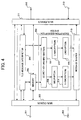
- An intermediary device according to a first embodiment of the present invention will be described, taking as an example the case where the TLS Protocol is employed.
- the intermediary device has a function of checking the validity of a server certification as a substitute for a client.
- MUX/DEMUX multiplexer and demultiplexer
- the intermediary device is provided with a TLS message interpreter 104, a memory 105, a message shaper 107, and a certification check system 117 between the MUX/DEMUX 103 and the MUX/DEMUX 113.
- the certification check system 117 includes a CA information extractor 106, an authentication section 108, a CRL database 109, and a CRL request section 110.
- An input terminal 111 and an output terminal 112 connected to the CRL request section 110 are connected to a CA (Certificate Authority) side. It is not necessary for the memory 105 to be physically incorporated in the intermediary device.
- the memory 105 may be installed in another node having communication and intermediary functions.
- the memory 105 stores a session management table (not shown) and a client management table (not shown).
- the session management table is used to manage sessions and the client management table registers information indicating whether each client requests a certification check process from the intermediary device.
- the session management table is searched to determine whether the destination and source addressed and the port number of the input packet match an entry registered in the session management table.
- the MUX/DEMUX that received the input packet transfers the message included in the input packet to one of the other MUX/DEMUX and the TLS message interpreter 104 depending on whether a match is found in the session management table.
- the TLS message interpreter 104 interprets an input TLS message to transfer it to an appropriate section depending on the type of the input TLS message and performs writing, changing, and deleting of information regarding a session of the client in the session management table of the memory 105.
- the message shaper 107 generates a TLS message from data received from the certification check system 117. If it is valid, the message shaper 107 transfers it to the MUX/DEMUX 103 and if invalid, to the MUX/DEMUX 113.
- the CA information extractor 106 extracts CA information from a certification of the server received from the TLS message interpreter 104 and transfers the CA information to the CRL request section 110 and the message to the authentication section 108.
- the CRL request section 110 uses the CA information to search the CRL database 109. When a valid CRL for the CA is not found, the CRL request section 110 requests CRL from the CA and stores received CRL into the CRL database 109.
- the authentication section 108 uses the CRL supplied from the CRL database 109 to check whether the certification included in the message received from the CA information extractor 106 is valid. The authentication section 108 transfers the check result and the message to the message shaper 107.
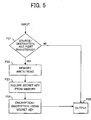
- FIG. 2 and Fig. 3 show the flow chart and the sequence of the operation, respectively.
- a negotiation step S11 for exchanging necessary parameters for encryption and data compression between the client and the server is performed before exchanging data.
- the intermediary device receives the packet before the server does.
- the input packet is transferred from the input terminal 101 to the MUX/DEMUX 103, which determines whether the input packet includes a TLS message.
- the MUX/DEMUX 103 is designed to transfer an input packet to the TLS message interpreter 104 when the TLS message is included therein. More specifically, when the input packet is addressed to the port number "443" that is assigned to TLS, the MUX/DEMUX 103 transfers it to the TLS message interpreter 104 and otherwise to the MUX/DEMUX 113.
- the MUX/DEMUX 103 determines whether the input packet includes a TLS message (step P11). When it include the TLS message (YES at step P11), the TLS message interpreter 104 determines whether the received TLS message is a Certificate message (step P12).
- the TLS message interpreter 104 When the received TLS message is a ClientHello message (NO at step P12), the TLS message interpreter 104 performs registration of a session by writing the address and port number of the client and the address of the server, the TLS status indicating how much the Handshake procedure progresses, and the like into the session management table of the memory 105 (step P13). Accordingly, thereafter, the MUX/DEMUX 103 or 113 can determine whether the input packet includes a TLS message, by searching the session management table of the memory 105 using the addresses and port number of destination and source of the input packet as a key. When a match is found, it is determined that the input packet includes TLS message and then the input packet is transferred to the TLS message interpreter 104.
- the TLS message interpreter 104 transfers the input packet as it is to the MUX/DEMUX 113, which sends the packet to the server through the output terminal 114 (step P19).
- the server When receiving the packet from the client via the intermediary device, the server sends a packet including the ServerHello message back to the client through the intermediary device.
- the intermediary device receives the packet from the server, the MUX/DEMUX 113 checks the address and port number of destination of the packet to determine whether the received packet includes TLS message (step P11). Since this packet includes the ServerHello message (YES at step P11 and NO at step P12), it is transferred to the TLS message interpreter 104, which checks that the TLS session status of the ServerHello message is not contradictory to that registered in the session management table of the memory 105 before updating the TLS status indicating how much the Handshake procedure progresses (step P13).
- the TLS message interpreter 104 transfers the input packet including the ServerHello message as it is to the MUX/DEMUX 103, which sends it to the client through the output terminal 102 (step P19).
- the intermediary device when the server sends a packet including a Certificate message to the client, the intermediary device receives this packet before the client does.
- the input packet is transferred from the input terminal 115 to the MUX/DEMUX 113, which determines whether the input packet includes a TLS message.
- the MUX/DEMUX 113 determines whether the input packet includes a TLS message (step P11). Since the input packet includes the Certificate message (YES at step P11 and step P12), it is transferred to the TLS message interpreter 104, which checks that the TLS session status of the Certificate message is not contradictory to that registered in the session management table of the memory 105 before updating the TLS status indicating how much the Handshake procedure progresses. Thereafter, the TLS message interpreter 104 searches the client management table of the memory 105 to determine whether the client requests a certification check process from the intermediary device (step P14). Here, the client requests the certification check process from the intermediary device.
- the TLS message interpreter 104 transfers the Certificate message to the certification check system 117 to check whether the certification of the server is valid.
- CRL or OCSP may be used to check the validity of a certification.
- CRL is used.
- the CA information extractor 106 extracts CA information from a certification of the server included in the Certificate message received from the TLS message interpreter 104.
- the Certificate message is further transferred to the authentication section 108 and the CA information is transferred to the CRL request section 110.
- the CRL request section 110 inquires from the CRL database 109 whether CRL for the CA extracted by the CA information extractor 106 exists. When a valid CRL for the CA is not found or update time has elapsed, the CRL request section 110 sends a packet including a message requesting CRL from the CA that issued the certification of the server through the output terminal 112 (step P15). When receiving a response packet including CRL from the CA, the CRL request section 110 adds the received CRL to the CRL database 109. When a valid CRL for the CA is found and the next update time has not come, the CRL request process is not performed because the registered CRL is the latest version. In this manner, the CRL database 109 holds the latest CRL for the CA.
- the authentication section 108 uses the CRL supplied from the CRL database 109 to check whether the certification included in the message received from the CA information extractor 106 is valid (step P16). When it is valid (YES at step P16), the authentication section 108 transfers the Certificate message to the message shaper 107. The message shaper 107 generates a packet including a message to be sent to the client from the Certificate message (step P17).
- An authentication result message is generated by 1) generating a new certification that replaces the CA with the intermediary device and then generating a message including the new certification, 2) generating a message including a server certification attached with extended information explicitly indicating that this certification is tentative, 3) generating a message informing the client only that the server certification is valid, and the like.
- the message shaper 107 uses one of these ways to generate a message indicating that the server certification is valid and then shapes it into a packet to be sent to the client through the MUX/DEMUX 103 and the output terminal 102 (step P19).
- the message shaper 107 creates a packet including an Alert message and sends it to the client and the server (step P18).
- the intermediary device informs the client of the validity of a server certification without the client inquiring the CA, resulting reduced load on the client and the client-server network system.
- An intermediary device according to a second embodiment of the present invention will be described, taking as an example the case where the TLS Protocol is employed.
- the intermediary device has a function of encrypting and decrypting application data in data communication between a server and a client as a substitute for a client.
- an input terminal 201 and an output terminal 202 connected to a MUX/DEMUX 203 are connected to a client side and an input terminal 213 and an output terminal 212 connected to a MUX/DEMUX 211 are connected to a server side.
- the intermediary device is provided with a TLS message interpreter 204, a memory 205, a message shaper 210, and a encryption and decryption system 206 between the MUX/DEMUX 203 and the MUX/DEMUX 211.
- the encryption and decryption system 206 includes a secret key inquiry section 207, a decryption section 208, a c-encryption section 214, a c-decryption section 215, and an encryption section 209. It is not necessary for the memory 205 to be physically incorporated in the intermediary device. For example, the memory 205 may be installed in another node having communication and intermediary functions.
- the memory 205 stores a session management table (not shown) and a client management table (not shown).
- the session management table is used to manage sessions and the client management table registers information indicating whether each client requests an encryption and decryption process from the intermediary device.
- the session management table is searched to determine whether the destination and source addressed and the port number of the input packet match an entry registered in the session management table.
- the MUX/DEMUX that received the input packet transfers the message included in the input packet to one of the other MUX/DEMUX and the TLS message interpreter 204 depending on whether a match is found in the session management table.
- the TLS message interpreter 204 interprets an input TLS message to transfer it to an appropriate section depending on the type of the input TLS message and performs writing. changing, and deleting of information regarding a session of the client in the session management table of the memory 205.
- the message shaper 210 generates a TLS message from data received from the encryption and decryption system 206 and transfers it to one of the MUX/DEMUXs 203 and 211 depending on the destination thereof.
- the secret key inquiry section 207 uses the data received from the TLS message interpreter 204 to request session information of the client from the memory 205. Further, the secret key inquiry section 207 looks at the destination of the data and transfers the packet to one of the encryption section 208 and the c-decryption section 215 depending on the destination.
- the decryption section 208 decrypts the server-encrypted data that was encrypted in the server using the secret key.
- the c-decryption section 215 decrypts the client-encrypted data that was encrypted in the client.
- the c-encryption section 214 encrypts data so that the client can decrypt the encrypted data.
- the encryption section 209 encrypts data so that the server can decrypt the encrypted data using the secret key.
- the intermediary device receives packets before the server.
- an input packet is transferred from the input terminal 201 to the MUX/DEMUX 203.
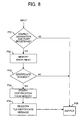
- the MUX/DEMUX 203 accesses the memory 205 to determine whether a set of the source and destination addresses and port numbers of the input packet match that registered in the session management table of the memory 205 (step P21). When they match (YES at step P21), the input packet is transferred to the TLS message interpreter 204. The other packets are transferred to the MUX/DEMUX 211.
- the TLS message interpreter 204 checks whether the TLS message is not contradictory to a corresponding entry status registered in the session management table of the memory 105 (step P22). When no contradictory, the data is transferred to the encryption and decryption system 206.
- the secret key inquiry section 207 searches the session management table of the memory 205 using a set of the source and destination addresses and port numbers of the input data as a key and finds a secret key required for encryption (step P23). Thereafter, the secret key inquiry section 207 transfers the data, the secret key, and the encryption method to the c-decryption section 215. Since the data is no secure, the c-decryption section 215 transfers it to the encryption section 209. The encryption section 209 encrypts the data using the secret key according to the encryption method (step P24). In this way, the original insecure application data, or plain data, received from the client is converted to secure application data.
- the secure application data is packetized by the message shaper 210 and then is sent to the server through the MUX/DEMUX 211 and the output terminal 212 (step P25).
- the intermediary device receives packets before the client.
- an input packet is transferred from the input terminal 213 to the MUX/DEMUX 211.
- the MUX/DEMUX 211 accesses the memory 205 to determine whether a set of the source and destination addresses and port numbers of the input packet match that registered in the session management table of the memory 205 (step P21). When they match (YES at step P21), the input packet is transferred to the TLS message interpreter 204. The other packets are transferred to the MUX/DEMUX 203.
- the TLS message interpreter 204 checks whether the TLS message is not contradictory to a corresponding entry status registered in the session management table of the memory 105 (step P22). When no contradictory, the data is transferred to the encryption and decryption system 206.
- the secret key inquiry section 207 searches the session management table of the memory 205 using a set of the source and destination addresses and port numbers of the input data as a key and finds a secret key required for decryption (step P23). Thereafter, the secret key inquiry section 207 transfers the data, the secret key, and the encryption method to the decryption section 208.
- the decryption section 208 decrypts the secure data using the secret key and the registered encryption method (step P24).
- the decryption section 208 also transfers the decrypted data to the c-encryption section 214. Since this application data is insecure, the c-encryption section 214 transfers it as it is to the message shaper 210.
- the insecure application data is packetized by the message shaper 210 and then is sent to the client through the MUX/DEMUX 203 and the output terminal 202 (step P25).
- insecure data packets are transferred between the client and the intermediary device.
- secure data packets may be transferred between the client and the intermediary device using a predetermined security protocol. which may be the same as or different from the security protocol used between the intermediary device and the server.
- the encryption strength used between the client and the intermediary device is equal to or different from that used between the intermediary device and the server.
- the c-decryption section 215 decrypts the data encrypted by the client and transfers the decrypted data to the encryption section 209.
- the c-encryption section 214 encrypts the data and the encrypted data will be decrypted by the client.
- the intermediary device can perform encryption and decryption processing.
- An intermediary device according to a third embodiment of the present invention will be described, taking as an example the case where the TLS Protocol is employed.
- the intermediary device has a function of submitting a client certification to the server as a substitute for a client.
- an input terminal 301 and an output terminal 302 connected to a MUX/DEMUX 303 are connected to a client side and an input terminal 311 and an output terminal 310 connected to a MUX/DEMUX 309 are connected to a server side.
- the intermediary device is provided with a TLS message interpreter 34, a memory 305, a message shaper 307, and a certification submission system 308 between the MUX/DEMUX 303 and the MUX/DEMUX 309.
- the certification submission system 308 includes a certification inquiry section 306. It is not necessary for the memory 305 to be physically incorporated in the intermediary device. For example, the memory 305 may be installed in another node having communication and intermediary functions.
- the memory 305 stores a session management table (not shown) and a client management table (not shown).
- the session management table is used to manage sessions and the client management table registers information indicating whether each client requests a certification submission process from the intermediary device.
- the session management table is searched to determine whether the destination and source addressed and the port number of the input packet match an entry registered in the session management table.
- the MUX/DEMUX that received the input packet transfers the message included in the input packet to one of the other MUX/DEMUX and the TLS message interpreter 204 depending on whether a match is found in the session management table.
- the TLS message interpreter 304 interprets an input TLS message to transfer it to an appropriate section depending on the type of the input TLS message and performs writing, changing, and deleting of information regarding a session of the client in the session management table of the memory 305.
- the message shaper 307 generates a TLS message from data received from the certification submission system 308 and transfers it to the MUX/DEMUX 309.
- the certification inquiry section 306 inquires the certification for the client from the memory 305 and transfers the inquiry result to the message shaper 307.
- the input packet is transferred from the input terminal 311 to the MUX/DEMUX 309.
- the MUX/DEMUX 309 accesses the memory 305 to determine whether a set of the source and destination addresses and port numbers of the input packet match that registered in the session management table of the memory 305 (step P31). When they match (YES at step P31), the input packet is transferred to the TLS message interpreter 304. The other packets are transferred to the MUX/DEMUX 303.
- the TLS message interpreter 304 checks whether the TLS message is not contradictory to a corresponding entry status registered in the session management table of the memory 305.
- step P32 When no contradictory, the status is updated (step P32). If it is a CertificateRequest message (YES at step P33), then it is transferred to the certification submission system 308. If it is not the CertificateRequest message (NO at step P33), it is transferred to the MUX/DEMUX 303.
- the certification inquiry section 306 searches the session management table of the memory 205 using a set of the source and destination addresses and port numbers of the received message as a key and finds a client certification (step P34). In this case, it is assumed that the client certification is extracted from the client management table when the ClientHello message has been received by the intermediary device and the client certification was registered already when an entry is added to the session management table.
- the certification inquiry section 306 transfers the client certification to the message shaper 307. Thereafter, the message shaper 307 generates a packet including a Certificate message (step P35) and sends it to the server through the MUX/DEMUX 309 and the output terminal 310 (step P36). In this manner, the intermediary device can submit a client certification to the server as a substitute of the client.
- An intermediary device according to a fourth embodiment of the present invention will be described, taking as an example the case where the TLS Protocol is employed.
- the intermediary device according to the fourth embodiment has a combination of previously selected functions of security protocol as a substitute for a client.
- an input terminal 406 and an output terminal 407 connected to a MUX/DEMUX 405 are connected to a client side and an input terminal 414 and an output terminal 415 connected to a MUX/DEMUX 413 are connected to a server side.
- the intermediary device is provided with a memory 401 storing CRL 402, a client management table 403, and a session management table 404, a TLS message interpreter 411, a message shaper 412, and a processor system 416 including a certification check section 408, a certification submission section 409, and an encryption and decryption system 410 between the MUX/DEMUX 405 and the MUX/DEMUX 413.
- a memory 401 may be physically incorporated in the intermediary device.
- the memory 205 may be installed in another node having communication and intermediary functions.
- the CRL 402 stores a CRL list.
- the client management table 403 registers information indicating which service each client previously requests from the intermediary device among services provided by the intermediary device.
- the session management table 404 is used to manage sessions that are now being used and can be added, updated, or deleted by the TLS message interpreter 411.
- Fig. 12 shows an example of the session management table 404.
- the certification check section 408, the certification submission section 409, and the encryption and decryption system 410 are provided with the same functions as described in the first to third embodiments. Accordingly, the details of these functions will be omitted.
- the session management table 404 is searched to determine whether the destination and source addressed and the port number of the input packet match an entry registered in the session management table 404.
- the MUX/DEMUX that received the input packet transfers the message included in the input packet to one of the other MUX/DEMUX and the TLS message interpreter 411 depending on whether a match is found in the session management table.
- the TLS message interpreter 411 interprets an input TLS message to transfer it to an appropriate section depending on the type of the input TLS message and performs writing, changing, and deleting of information regarding a session of the client in the session management table 404 of the memory 401.
- the message shaper 412 generates a TLS message from data received from the processor system 416 and transfers it to one of the MUX/DEMUXs 405 and 413 depending on the destination thereof.
- the intermediary device receives the packet before the server.
- the input packet is transferred from the input terminal 406 to the MUX/DEMUX 405, which determines whether the input packet includes a TLS message.
- the MUX/DEMUX 405 is designed to transfer an input packet to the TLS message interpreter 411 when the input packet is addressed to the port number "443" that is assigned to TLS. Accordingly, the MUX/DEMUX 405 transfers the TLS message to the TLS message interpreter 411.
- the TLS message interpreter 411 interprets the TLS message and, when starting a session, reads predetermined service setting of the intermediary device for the client requesting the session, from the client management table 403 and registers them in the session management table 404 (session registration). As described before, one or more service setting of the intermediary device is previously determined by the client. For example, when the certification check and the certification submission are selected and set by the client, these security functions are delegated to the intermediary device as described before.
- the TLS message interpreter 411 When receiving a TLS message, the TLS message interpreter 411 reads information of relevant entry from the session management table 404, updates the status, and transfers a received message to one of the certification check section 408, the certification submission section 409, the encryption and decryption section 410, and the message shaper 412, depending on the received message to be processed according to the information.
- Each section performs a corresponding function, that is, certification check, certification submission, or encryption/decryption.
- These sections access the CRL 402, the client management table 403, and the session management table 404 as appropriate to read necessary information.
- the data processed by each section is packetized by the message shaper 412 to produce packets including TLS messages. These packets are transferred to the MUS/DEMUX 413 and are sent to the server through the output terminal 415.
- the TLS message interpreter 411 transfers an appropriate message to one of the certification check section 408, the certification submission section 409, the encryption and decryption system 410, and the message shaper 412, depending on the client's setting. After the processing of these sections 408-410, the message is sent to the client through the message shaper 412, the MUS/DEMUX 405, and the output terminal 407. In this manner, the intermediary device can provide TLS functions in place of the client.
- a client can freely select one or more of the certification check section 408.
- the certification submission section 409, the encryption and decryption section 410 to delegate selected functions to the intermediary device. All functions may be delegated to the intermediary device.
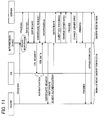
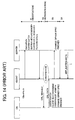
- Fig. 11 shows the TLS handshake procedure in the case where the certification check (authentication) and the encryption/decryption are delegated to the intermediary device and the certification submission is performed by the client itself.
- An intermediary device according to a fifth embodiment of the present invention will be described, taking as an example the case where a client requests a new connection to a server after the session with the server has been established.
- the intermediary device according to the fifth embodiment has a combination of previously selected functions of security protocol as a substitute for a client.
- the structure of the intermediary device is the same as that of the fourth embodiment as shown in Fig. 10 and therefore the descriptions are omitted.
- the intermediary device provides the encryption and decryption function as described before.
- step S31 a session has been established between the client and the server and, in such a state, the client requests a new connection to the same sever by sending a packet including a ClientHello message having the same session ID to the server.
- the intermediary device adds a new entry to the session management table 404 and transfers the packet to the server.
- An example of the session management table 404 is shown in Fig. 12.
- the server When receiving the ClientHello message having the same session ID, the server can know the encryption information used in the same session with the client. The server sends a ServerHello message including the same session ID back to the client. When receiving the ServerHello message, the intermediary device knows from the ServerHello message that a new connection is requested on the existing session between the client and the server.
- step S32 messages are exchanged according to the encryption and its key that have been already determined under mutual agreement. More specifically, when receiving packets including ChangeCipherSpec and Finished messages from the server, similarly to the first request, the intermediary device sends a packet including a Finished message to the client and packets including ChangeCipherSpec and Finished messages to the server.
- the client determines that the handshake procedure is terminated and starts sending application data.
- the intermediary device buffers a message received from the client until the packet including a Finished message has been received from the server.
- the intermediary device encrypts the buffered message to send the encrypted message to the server. Thereafter, encrypted data is normally exchanged to perform normal data communication between the client and the server.
Landscapes
- Engineering & Computer Science (AREA)
- Computer Security & Cryptography (AREA)
- Computer Hardware Design (AREA)
- General Engineering & Computer Science (AREA)
- Computer Networks & Wireless Communication (AREA)
- Signal Processing (AREA)
- Computing Systems (AREA)
- Theoretical Computer Science (AREA)
- Physics & Mathematics (AREA)
- General Physics & Mathematics (AREA)
- Software Systems (AREA)
- Bioethics (AREA)
- General Health & Medical Sciences (AREA)
- Health & Medical Sciences (AREA)
- Computer And Data Communications (AREA)
- Data Exchanges In Wide-Area Networks (AREA)
- Management, Administration, Business Operations System, And Electronic Commerce (AREA)
Applications Claiming Priority (2)
| Application Number | Priority Date | Filing Date | Title |
|---|---|---|---|
| JP2000274589A JP2002082907A (ja) | 2000-09-11 | 2000-09-11 | データ通信におけるセキュリティ機能代理方法、セキュリティ機能代理システム、及び、記録媒体 |
| JP2000274589 | 2000-09-11 |
Publications (2)
| Publication Number | Publication Date |
|---|---|
| EP1189407A2 true EP1189407A2 (de) | 2002-03-20 |
| EP1189407A3 EP1189407A3 (de) | 2004-01-02 |
Family
ID=18760327
Family Applications (1)
| Application Number | Title | Priority Date | Filing Date |
|---|---|---|---|
| EP01121621A Withdrawn EP1189407A3 (de) | 2000-09-11 | 2001-09-11 | Client-Server System mit Zwischensicherheitsfunktion |
Country Status (3)
| Country | Link |
|---|---|
| US (1) | US20020035685A1 (de) |
| EP (1) | EP1189407A3 (de) |
| JP (1) | JP2002082907A (de) |
Cited By (5)
| Publication number | Priority date | Publication date | Assignee | Title |
|---|---|---|---|---|
| WO2007070739A2 (en) | 2005-12-13 | 2007-06-21 | Google Inc. | Tls encryption in a managed e-mail service environment |
| EP2207302A4 (de) * | 2007-11-07 | 2013-05-22 | Nippon Telegraph & Telephone | Einstellungsverfahren für gemeinsamen schlüssel, relaisgerät und programm |
| WO2017087243A1 (en) * | 2015-11-16 | 2017-05-26 | Mastercard International Incorporated | Systems and methods for authenticating network messages |
| CN109150835A (zh) * | 2018-07-20 | 2019-01-04 | 国科量子通信网络有限公司 | 云端数据存取的方法、装置、设备及计算机可读存储介质 |
| US10673839B2 (en) | 2015-11-16 | 2020-06-02 | Mastercard International Incorporated | Systems and methods for authenticating network messages |
Families Citing this family (81)
| Publication number | Priority date | Publication date | Assignee | Title |
|---|---|---|---|---|
| US8209246B2 (en) | 2001-03-20 | 2012-06-26 | Goldman, Sachs & Co. | Proprietary risk management clearinghouse |
| US20110131136A1 (en) * | 2001-03-20 | 2011-06-02 | David Lawrence | Risk Management Customer Registry |
| US20040006532A1 (en) * | 2001-03-20 | 2004-01-08 | David Lawrence | Network access risk management |
| US20030233319A1 (en) * | 2001-03-20 | 2003-12-18 | David Lawrence | Electronic fund transfer participant risk management clearing |
| US8140415B2 (en) | 2001-03-20 | 2012-03-20 | Goldman Sachs & Co. | Automated global risk management |
| US20040193532A1 (en) * | 2001-03-20 | 2004-09-30 | David Lawrence | Insider trading risk management |
| US20030225687A1 (en) * | 2001-03-20 | 2003-12-04 | David Lawrence | Travel related risk management clearinghouse |
| US7899722B1 (en) * | 2001-03-20 | 2011-03-01 | Goldman Sachs & Co. | Correspondent bank registry |
| US8121937B2 (en) | 2001-03-20 | 2012-02-21 | Goldman Sachs & Co. | Gaming industry risk management clearinghouse |
| US20020143562A1 (en) * | 2001-04-02 | 2002-10-03 | David Lawrence | Automated legal action risk management |
| US7237257B1 (en) * | 2001-04-11 | 2007-06-26 | Aol Llc | Leveraging a persistent connection to access a secured service |
| CN1717697B (zh) * | 2001-06-12 | 2012-01-25 | 捷讯研究有限公司 | 压缩安全电子邮件用于与移动通信设备交换的系统和方法 |
| KR20040015272A (ko) | 2001-06-12 | 2004-02-18 | 리서치 인 모션 리미티드 | 인증서 관리 및 전송 시스템 및 방법 |
| US7254712B2 (en) * | 2001-06-12 | 2007-08-07 | Research In Motion Limited | System and method for compressing secure e-mail for exchange with a mobile data communication device |
| WO2003007570A1 (en) | 2001-07-10 | 2003-01-23 | Research In Motion Limited | System and method for secure message key caching in a mobile communication device |
| ES2315379T3 (es) * | 2001-08-06 | 2009-04-01 | Research In Motion Limited | Sistema y metodo para el tratamiento de mensajes codificados. |
| JP2003218873A (ja) * | 2002-01-24 | 2003-07-31 | Fujitsu Ltd | 通信監視装置及び監視方法 |
| AU2003218550A1 (en) * | 2002-03-20 | 2003-09-29 | Research In Motion Limited | System and method for checking digital certificate status |
| KR100431210B1 (ko) * | 2002-08-08 | 2004-05-12 | 한국전자통신연구원 | 공개키 기반구조에서 인증서 정책 및 인증서 정책사상을이용한 인증서 검증서버에서의 인증서 검증방법 |
| CN101505275A (zh) * | 2002-09-20 | 2009-08-12 | 松下电器产业株式会社 | 连接多个数据通信网络的中间网络元件 |
| KR100487741B1 (ko) * | 2002-10-15 | 2005-05-06 | 한국전자통신연구원 | 공개키 기반구조에서 검증서버를 이용한 인증경로 생성방법 |
| JP2004157892A (ja) * | 2002-11-08 | 2004-06-03 | Hitachi Ltd | 計算機システム、記憶装置、アクセス管理方法及びプログラム |
| US20040133520A1 (en) * | 2003-01-07 | 2004-07-08 | Callas Jonathan D. | System and method for secure and transparent electronic communication |
| US7640427B2 (en) * | 2003-01-07 | 2009-12-29 | Pgp Corporation | System and method for secure electronic communication in a partially keyless environment |
| CN102355355B (zh) * | 2003-06-19 | 2014-07-16 | 日本电信电话株式会社 | 会话控制服务器、通信装置、通信系统与通信方法 |
| US7720973B2 (en) * | 2003-06-30 | 2010-05-18 | Microsoft Corporation | Message-based scalable data transport protocol |
| US7366170B2 (en) * | 2003-09-25 | 2008-04-29 | Kabushiki Kaisha Toshiba | Communication connection method, authentication method, server computer, client computer and program |
| KR20050064119A (ko) * | 2003-12-23 | 2005-06-29 | 한국전자통신연구원 | 인터넷접속을 위한 확장인증프로토콜 인증시 단말에서의서버인증서 유효성 검증 방법 |
| US8510300B2 (en) | 2004-07-02 | 2013-08-13 | Goldman, Sachs & Co. | Systems and methods for managing information associated with legal, compliance and regulatory risk |
| US8442953B2 (en) | 2004-07-02 | 2013-05-14 | Goldman, Sachs & Co. | Method, system, apparatus, program code and means for determining a redundancy of information |
| US8996481B2 (en) * | 2004-07-02 | 2015-03-31 | Goldman, Sach & Co. | Method, system, apparatus, program code and means for identifying and extracting information |
| US8762191B2 (en) * | 2004-07-02 | 2014-06-24 | Goldman, Sachs & Co. | Systems, methods, apparatus, and schema for storing, managing and retrieving information |
| US20060036849A1 (en) * | 2004-08-09 | 2006-02-16 | Research In Motion Limited | System and method for certificate searching and retrieval |
| US9094429B2 (en) | 2004-08-10 | 2015-07-28 | Blackberry Limited | Server verification of secure electronic messages |
| JP2006072493A (ja) * | 2004-08-31 | 2006-03-16 | Ntt Docomo Inc | 中継装置及び認証方法 |
| US7549043B2 (en) * | 2004-09-01 | 2009-06-16 | Research In Motion Limited | Providing certificate matching in a system and method for searching and retrieving certificates |
| US7631183B2 (en) | 2004-09-01 | 2009-12-08 | Research In Motion Limited | System and method for retrieving related certificates |
| US7640428B2 (en) | 2004-09-02 | 2009-12-29 | Research In Motion Limited | System and method for searching and retrieving certificates |
| US20060075229A1 (en) * | 2004-09-30 | 2006-04-06 | Marek James A | Method and apparatus for maintaining a communications connection while guarding against bandwidth consuming attacks |
| JP4737089B2 (ja) * | 2004-10-19 | 2011-07-27 | 日本電気株式会社 | Vpnゲートウェイ装置およびホスティングシステム |
| JP4707992B2 (ja) * | 2004-10-22 | 2011-06-22 | 富士通株式会社 | 暗号化通信システム |
| US20060203842A1 (en) * | 2004-11-12 | 2006-09-14 | Wollmershauser Steven M | Dongle-type network access module |
| US7877794B2 (en) | 2004-11-29 | 2011-01-25 | International Business Machines Corporation | Relay apparatus, relay method and program therefor |
| JPWO2006072988A1 (ja) * | 2005-01-06 | 2008-06-12 | 富士通株式会社 | ゲートウェイ装置、端末、及びネットワーク装置 |
| JP2006259906A (ja) * | 2005-03-15 | 2006-09-28 | Ricoh Co Ltd | 通信制御装置、通信制御システム、省電力制御方法、省電力制御プログラム、および該プログラムを記録した記録媒体 |
| JP4667921B2 (ja) * | 2005-03-24 | 2011-04-13 | 三菱電機株式会社 | 検証装置及び通信システム及びトラストストア管理装置及びトラストストア監視装置 |
| US8161296B2 (en) * | 2005-04-25 | 2012-04-17 | Samsung Electronics Co., Ltd. | Method and apparatus for managing digital content |
| KR100708162B1 (ko) * | 2005-04-25 | 2007-04-16 | 삼성전자주식회사 | 도메인 관리 방법 및 그를 위한 장치 |
| CA2585987C (en) * | 2005-10-14 | 2012-12-04 | Research In Motion Limited | System and method for protecting master encryption keys |
| US8291093B2 (en) | 2005-12-08 | 2012-10-16 | Microsoft Corporation | Peer-to-peer remediation |
| AU2006336486A1 (en) | 2006-01-24 | 2007-08-02 | Acei Ab | Game session management |
| JP4745858B2 (ja) * | 2006-02-20 | 2011-08-10 | 富士通株式会社 | セキュリティ管理プログラム、およびセキュリティ管理方法 |
| US7814161B2 (en) | 2006-06-23 | 2010-10-12 | Research In Motion Limited | System and method for handling electronic mail mismatches |
| US8225086B2 (en) * | 2007-11-13 | 2012-07-17 | Oracle America, Inc. | Method and apparatus for remotely authenticating a command |
| US9531695B2 (en) * | 2009-06-12 | 2016-12-27 | Microsoft Technology Licensing, Llc | Access control to secured application features using client trust levels |
| JP5455495B2 (ja) * | 2009-07-31 | 2014-03-26 | キヤノン株式会社 | 通信装置、通信方法及びプログラム |
| JP4879347B2 (ja) * | 2009-12-25 | 2012-02-22 | キヤノンItソリューションズ株式会社 | 中継処理装置、中継処理方法及びプログラム |
| JP5763943B2 (ja) | 2011-03-24 | 2015-08-12 | 株式会社東芝 | 情報処理装置及びプログラム |
| JP5473152B2 (ja) * | 2011-04-08 | 2014-04-16 | 東芝テック株式会社 | 証明書管理機能を有する情報処理装置及び証明書管理プログラム |
| JP5494603B2 (ja) * | 2011-09-29 | 2014-05-21 | 沖電気工業株式会社 | セキュリティ処理代行システム |
| US9986273B2 (en) * | 2012-03-29 | 2018-05-29 | Sony Interactive Entertainment, LLC | Extracting media content from social networking services |
| US10327032B2 (en) | 2012-03-29 | 2019-06-18 | Sony Interactive Entertainment LLC | Extracting media content from social networking services |
| JP5614465B2 (ja) * | 2013-01-30 | 2014-10-29 | 沖電気工業株式会社 | 暗号通信装置、代行サーバ、暗号通信装置プログラム及び代行サーバプログラム |
| US9185088B1 (en) * | 2013-02-19 | 2015-11-10 | Amazon Technologies, Inc. | Secure and efficient communication through an intermediary |
| US20150142984A1 (en) * | 2013-11-20 | 2015-05-21 | Nicolas Thomas Mathieu Dupont | System and Method for Security over a Network |
| US10028277B2 (en) | 2013-11-20 | 2018-07-17 | Cyborg Inc. | Variable frequency data transmission |
| JP6369554B2 (ja) * | 2014-09-25 | 2018-08-08 | 日本電気株式会社 | 解析システム、解析方法、及び、解析プログラム |
| AU2014101252B4 (en) * | 2014-10-15 | 2015-04-23 | Parametric Systems Pty Ltd | Net2Core - An Innovative Computer Systems Design to Protect Computer Systems where System Access through the Internet is Desired or Required. |
| JP6266502B2 (ja) * | 2014-12-05 | 2018-01-24 | 日本電信電話株式会社 | 遠隔デスクトップ連携処理システム及びクライアント状態管理サーバ |
| DE102015119881A1 (de) * | 2015-11-17 | 2017-05-18 | XCOM Aktiengesellschaft | Verfahren zur Durchführung eines Datentransfers |
| JP6084278B1 (ja) * | 2015-11-27 | 2017-02-22 | 株式会社Pfu | 情報処理装置、方法およびプログラム |
| US20170223054A1 (en) * | 2016-02-02 | 2017-08-03 | Cisco Technology, Inc. | Methods and Apparatus for Verifying Transport Layer Security Server by Proxy |
| US10313316B2 (en) * | 2016-05-26 | 2019-06-04 | Pepsico, Inc. | Secure gateways for connected dispensing machines |
| US10951421B2 (en) * | 2016-11-28 | 2021-03-16 | Ssh Communications Security Oyj | Accessing hosts in a computer network |
| US10104077B1 (en) * | 2017-10-06 | 2018-10-16 | Xage Security, Inc. | Enabling multitenant data access on a single industrial network |
| US11032280B1 (en) * | 2017-12-13 | 2021-06-08 | Amazon Technologies, Inc. | Proxy for controlling access to services |
| US10911409B2 (en) | 2018-05-21 | 2021-02-02 | Cisco Technology, Inc. | Engagement and disengagement of transport layer security proxy services with encrypted handshaking |
| JP6705602B1 (ja) * | 2019-01-24 | 2020-06-03 | Necプラットフォームズ株式会社 | 中継装置、中継方法、及び制御プログラム |
| US11595369B2 (en) * | 2019-11-08 | 2023-02-28 | Seagate Technology Llc | Promoting system authentication to the edge of a cloud computing network |
| JP7687031B2 (ja) * | 2021-04-14 | 2025-06-03 | Toppanホールディングス株式会社 | 通信システム、通信方法及びプログラム |
| EP4647947A1 (de) * | 2024-05-07 | 2025-11-12 | ARINC Incorporated | Verfahren zum betrieb eines öffentlichen schlüsselzertifikatvalidierungssystems zur ermöglichung einer sicheren kommunikation zwischen einem flugzeug und einer bodeneinheit |
Family Cites Families (11)
| Publication number | Priority date | Publication date | Assignee | Title |
|---|---|---|---|---|
| US5586260A (en) * | 1993-02-12 | 1996-12-17 | Digital Equipment Corporation | Method and apparatus for authenticating a client to a server in computer systems which support different security mechanisms |
| US5923756A (en) * | 1997-02-12 | 1999-07-13 | Gte Laboratories Incorporated | Method for providing secure remote command execution over an insecure computer network |
| JP3354433B2 (ja) * | 1997-04-25 | 2002-12-09 | 株式会社日立製作所 | ネットワーク通信システム |
| US6094485A (en) * | 1997-09-18 | 2000-07-25 | Netscape Communications Corporation | SSL step-up |
| US6052785A (en) * | 1997-11-21 | 2000-04-18 | International Business Machines Corporation | Multiple remote data access security mechanism for multitiered internet computer networks |
| US6751677B1 (en) * | 1999-08-24 | 2004-06-15 | Hewlett-Packard Development Company, L.P. | Method and apparatus for allowing a secure and transparent communication between a user device and servers of a data access network system via a firewall and a gateway |
| US6775772B1 (en) * | 1999-10-12 | 2004-08-10 | International Business Machines Corporation | Piggy-backed key exchange protocol for providing secure low-overhead browser connections from a client to a server using a trusted third party |
| US6754707B2 (en) * | 1999-10-28 | 2004-06-22 | Supportsoft, Inc. | Secure computer support system |
| US6643701B1 (en) * | 1999-11-17 | 2003-11-04 | Sun Microsystems, Inc. | Method and apparatus for providing secure communication with a relay in a network |
| US6754829B1 (en) * | 1999-12-14 | 2004-06-22 | Intel Corporation | Certificate-based authentication system for heterogeneous environments |
| US20030005019A1 (en) * | 2001-06-27 | 2003-01-02 | Kuldipsingh Pabla | Application frameworks for mobile devices |
-
2000
- 2000-09-11 JP JP2000274589A patent/JP2002082907A/ja not_active Withdrawn
-
2001
- 2001-09-10 US US09/950,339 patent/US20020035685A1/en not_active Abandoned
- 2001-09-11 EP EP01121621A patent/EP1189407A3/de not_active Withdrawn
Cited By (8)
| Publication number | Priority date | Publication date | Assignee | Title |
|---|---|---|---|---|
| WO2007070739A2 (en) | 2005-12-13 | 2007-06-21 | Google Inc. | Tls encryption in a managed e-mail service environment |
| EP1960895A4 (de) * | 2005-12-13 | 2009-12-30 | Google Inc | Tls-verschlüsselung in einer verwalteten e-mail-dienstumgebung |
| US8595814B2 (en) | 2005-12-13 | 2013-11-26 | Google Inc. | TLS encryption in a managed e-mail service environment |
| EP2207302A4 (de) * | 2007-11-07 | 2013-05-22 | Nippon Telegraph & Telephone | Einstellungsverfahren für gemeinsamen schlüssel, relaisgerät und programm |
| WO2017087243A1 (en) * | 2015-11-16 | 2017-05-26 | Mastercard International Incorporated | Systems and methods for authenticating network messages |
| US9769142B2 (en) | 2015-11-16 | 2017-09-19 | Mastercard International Incorporated | Systems and methods for authenticating network messages |
| US10673839B2 (en) | 2015-11-16 | 2020-06-02 | Mastercard International Incorporated | Systems and methods for authenticating network messages |
| CN109150835A (zh) * | 2018-07-20 | 2019-01-04 | 国科量子通信网络有限公司 | 云端数据存取的方法、装置、设备及计算机可读存储介质 |
Also Published As
| Publication number | Publication date |
|---|---|
| JP2002082907A (ja) | 2002-03-22 |
| EP1189407A3 (de) | 2004-01-02 |
| US20020035685A1 (en) | 2002-03-21 |
Similar Documents
| Publication | Publication Date | Title |
|---|---|---|
| EP1189407A2 (de) | Client-Server System mit Zwischensicherheitsfunktion | |
| US6192130B1 (en) | Information security subscriber trust authority transfer system with private key history transfer | |
| US6993651B2 (en) | Security protocol | |
| US20040161110A1 (en) | Server apparatus, key management apparatus, and encrypted communication method | |
| CN1615632B (zh) | 用于支持对有线和无线客户端的服务器端认证的方法、装置和系统 | |
| JP4959750B2 (ja) | トランスコーディング・プロキシでの複数の起点サーバへの動的接続 | |
| JP4707992B2 (ja) | 暗号化通信システム | |
| US6952768B2 (en) | Security protocol | |
| JP3761557B2 (ja) | 暗号化通信のための鍵配付方法及びシステム | |
| US7317798B2 (en) | Communication processing system, communication processing method, server and computer program | |
| CN1701559B (zh) | 会话控制服务器、通信装置、通信系统与通信方法及其程序与记录介质 | |
| US20070288754A1 (en) | Data communication method and system | |
| EP3633949B1 (de) | Verfahren und system zur durchführung von ssl-handshakes | |
| US20030014629A1 (en) | Root certificate management system and method | |
| US20050021956A1 (en) | Method and system for a single-sign-on operation providing grid access and network access | |
| US8751792B2 (en) | Method and system for entity public key acquiring, certificate validation and authentication by introducing an online credible third party | |
| US20040236965A1 (en) | System for cryptographical authentication | |
| JP4962117B2 (ja) | 暗号通信処理方法及び暗号通信処理装置 | |
| GB2357226A (en) | Communication tunnel security protocol with nested security sessions | |
| JP2004007589A (ja) | 文書およびサービスへの安全なアドホックアクセス | |
| CN114157432A (zh) | 数字证书获取方法、装置、电子设备、系统和存储介质 | |
| JP3910611B2 (ja) | 通信支援サーバ、通信支援方法、および通信支援システム | |
| CN114143010A (zh) | 数字证书获取方法、装置、终端、系统和存储介质 | |
| EP1437024B1 (de) | Verfahren und anorndung in einem kommunikationsnetz | |
| JP2005217679A (ja) | 通信相手の認証を行う認証サーバ |
Legal Events
| Date | Code | Title | Description |
|---|---|---|---|
| PUAI | Public reference made under article 153(3) epc to a published international application that has entered the european phase |
Free format text: ORIGINAL CODE: 0009012 |
|
| AK | Designated contracting states |
Kind code of ref document: A2 Designated state(s): AT BE CH CY DE DK ES FI FR GB GR IE IT LI LU MC NL PT SE TR |
|
| AX | Request for extension of the european patent |
Free format text: AL;LT;LV;MK;RO;SI |
|
| PUAL | Search report despatched |
Free format text: ORIGINAL CODE: 0009013 |
|
| AK | Designated contracting states |
Kind code of ref document: A3 Designated state(s): AT BE CH CY DE DK ES FI FR GB GR IE IT LI LU MC NL PT SE TR |
|
| AX | Request for extension of the european patent |
Extension state: AL LT LV MK RO SI |
|
| 17P | Request for examination filed |
Effective date: 20031111 |
|
| 17Q | First examination report despatched |
Effective date: 20040226 |
|
| AKX | Designation fees paid |
Designated state(s): DE FR GB |
|
| STAA | Information on the status of an ep patent application or granted ep patent |
Free format text: STATUS: THE APPLICATION IS DEEMED TO BE WITHDRAWN |
|
| 18D | Application deemed to be withdrawn |
Effective date: 20040908 |