EP1198632B1 - Non tisse de type tissu extensible dans le sens de la trame utilise comme parementure et doublure - Google Patents
Non tisse de type tissu extensible dans le sens de la trame utilise comme parementure et doublure Download PDFInfo
- Publication number
- EP1198632B1 EP1198632B1 EP00950887A EP00950887A EP1198632B1 EP 1198632 B1 EP1198632 B1 EP 1198632B1 EP 00950887 A EP00950887 A EP 00950887A EP 00950887 A EP00950887 A EP 00950887A EP 1198632 B1 EP1198632 B1 EP 1198632B1
- Authority
- EP
- European Patent Office
- Prior art keywords
- nonwoven web
- spunbond
- cross
- necked
- machine direction
- Prior art date
- Legal status (The legal status is an assumption and is not a legal conclusion. Google has not performed a legal analysis and makes no representation as to the accuracy of the status listed.)
- Expired - Lifetime
Links
- 239000000463 material Substances 0.000 claims abstract description 118
- 238000004519 manufacturing process Methods 0.000 claims abstract description 7
- 238000000034 method Methods 0.000 claims description 46
- 239000013536 elastomeric material Substances 0.000 claims description 5
- 238000010438 heat treatment Methods 0.000 claims description 4
- 239000006260 foam Substances 0.000 claims description 3
- 206010021639 Incontinence Diseases 0.000 abstract description 5
- 239000000835 fiber Substances 0.000 description 42
- 229920002633 Kraton (polymer) Polymers 0.000 description 25
- 230000008569 process Effects 0.000 description 20
- -1 for example Polymers 0.000 description 16
- 239000013013 elastic material Substances 0.000 description 12
- 229920000642 polymer Polymers 0.000 description 12
- 239000000203 mixture Substances 0.000 description 8
- 239000002131 composite material Substances 0.000 description 7
- 239000004743 Polypropylene Substances 0.000 description 6
- 239000004744 fabric Substances 0.000 description 6
- 229920001155 polypropylene Polymers 0.000 description 6
- 239000004698 Polyethylene Substances 0.000 description 5
- 230000035699 permeability Effects 0.000 description 5
- 229920000573 polyethylene Polymers 0.000 description 5
- 238000012360 testing method Methods 0.000 description 5
- 229920000098 polyolefin Polymers 0.000 description 4
- 229920001410 Microfiber Polymers 0.000 description 3
- 230000008901 benefit Effects 0.000 description 3
- 229920001577 copolymer Polymers 0.000 description 3
- 239000003658 microfiber Substances 0.000 description 3
- 238000011084 recovery Methods 0.000 description 3
- 239000012815 thermoplastic material Substances 0.000 description 3
- VTYYLEPIZMXCLO-UHFFFAOYSA-L Calcium carbonate Chemical compound [Ca+2].[O-]C([O-])=O VTYYLEPIZMXCLO-UHFFFAOYSA-L 0.000 description 2
- 229920002292 Nylon 6 Polymers 0.000 description 2
- 239000004952 Polyamide Substances 0.000 description 2
- 230000002745 absorbent Effects 0.000 description 2
- 239000002250 absorbent Substances 0.000 description 2
- 239000000956 alloy Substances 0.000 description 2
- 229910045601 alloy Inorganic materials 0.000 description 2
- 238000009960 carding Methods 0.000 description 2
- 229920002647 polyamide Polymers 0.000 description 2
- 229920001748 polybutylene Polymers 0.000 description 2
- 229920000728 polyester Polymers 0.000 description 2
- 238000012545 processing Methods 0.000 description 2
- 239000000126 substance Substances 0.000 description 2
- 229920002725 thermoplastic elastomer Polymers 0.000 description 2
- 238000012549 training Methods 0.000 description 2
- MJBPUQUGJNAPAZ-AWEZNQCLSA-N Butin Natural products C1([C@@H]2CC(=O)C3=CC=C(C=C3O2)O)=CC=C(O)C(O)=C1 MJBPUQUGJNAPAZ-AWEZNQCLSA-N 0.000 description 1
- MJBPUQUGJNAPAZ-UHFFFAOYSA-N Butine Natural products O1C2=CC(O)=CC=C2C(=O)CC1C1=CC=C(O)C(O)=C1 MJBPUQUGJNAPAZ-UHFFFAOYSA-N 0.000 description 1
- JHWNWJKBPDFINM-UHFFFAOYSA-N Laurolactam Chemical compound O=C1CCCCCCCCCCCN1 JHWNWJKBPDFINM-UHFFFAOYSA-N 0.000 description 1
- 239000004677 Nylon Substances 0.000 description 1
- 229920000299 Nylon 12 Polymers 0.000 description 1
- 239000004793 Polystyrene Substances 0.000 description 1
- 241000656145 Thyrsites atun Species 0.000 description 1
- 229920005603 alternating copolymer Polymers 0.000 description 1
- 238000003491 array Methods 0.000 description 1
- 230000009286 beneficial effect Effects 0.000 description 1
- 229920001400 block copolymer Polymers 0.000 description 1
- 229910000019 calcium carbonate Inorganic materials 0.000 description 1
- 230000008602 contraction Effects 0.000 description 1
- 238000001816 cooling Methods 0.000 description 1
- 238000010586 diagram Methods 0.000 description 1
- 230000000694 effects Effects 0.000 description 1
- OYFJQPXVCSSHAI-QFPUQLAESA-N enalapril maleate Chemical compound OC(=O)\C=C/C(O)=O.C([C@@H](C(=O)OCC)N[C@@H](C)C(=O)N1[C@@H](CCC1)C(O)=O)CC1=CC=CC=C1 OYFJQPXVCSSHAI-QFPUQLAESA-N 0.000 description 1
- 238000001125 extrusion Methods 0.000 description 1
- 239000000945 filler Substances 0.000 description 1
- 229920002313 fluoropolymer Polymers 0.000 description 1
- 239000004811 fluoropolymer Substances 0.000 description 1
- 230000006870 function Effects 0.000 description 1
- 229920000578 graft copolymer Polymers 0.000 description 1
- 229920001903 high density polyethylene Polymers 0.000 description 1
- 239000004700 high-density polyethylene Substances 0.000 description 1
- 229920001519 homopolymer Polymers 0.000 description 1
- 229920005621 immiscible polymer blend Polymers 0.000 description 1
- 238000003475 lamination Methods 0.000 description 1
- 229920000092 linear low density polyethylene Polymers 0.000 description 1
- 239000004707 linear low-density polyethylene Substances 0.000 description 1
- 229920001684 low density polyethylene Polymers 0.000 description 1
- 239000004702 low-density polyethylene Substances 0.000 description 1
- 238000005259 measurement Methods 0.000 description 1
- 229920001179 medium density polyethylene Polymers 0.000 description 1
- 239000004701 medium-density polyethylene Substances 0.000 description 1
- 238000002074 melt spinning Methods 0.000 description 1
- 238000002844 melting Methods 0.000 description 1
- 230000008018 melting Effects 0.000 description 1
- 238000002156 mixing Methods 0.000 description 1
- 238000012986 modification Methods 0.000 description 1
- 230000004048 modification Effects 0.000 description 1
- 239000004745 nonwoven fabric Substances 0.000 description 1
- 229920001778 nylon Polymers 0.000 description 1
- 239000002245 particle Substances 0.000 description 1
- 229920003023 plastic Polymers 0.000 description 1
- 239000004033 plastic Substances 0.000 description 1
- 229920001707 polybutylene terephthalate Polymers 0.000 description 1
- 229920000515 polycarbonate Polymers 0.000 description 1
- 239000004417 polycarbonate Substances 0.000 description 1
- 229920000139 polyethylene terephthalate Polymers 0.000 description 1
- 239000005020 polyethylene terephthalate Substances 0.000 description 1
- 229920002223 polystyrene Polymers 0.000 description 1
- 229920005604 random copolymer Polymers 0.000 description 1
- 229920001897 terpolymer Polymers 0.000 description 1
- 238000010998 test method Methods 0.000 description 1
- 229920002554 vinyl polymer Polymers 0.000 description 1
Images
Classifications
-
- D—TEXTILES; PAPER
- D04—BRAIDING; LACE-MAKING; KNITTING; TRIMMINGS; NON-WOVEN FABRICS
- D04H—MAKING TEXTILE FABRICS, e.g. FROM FIBRES OR FILAMENTARY MATERIAL; FABRICS MADE BY SUCH PROCESSES OR APPARATUS, e.g. FELTS, NON-WOVEN FABRICS; COTTON-WOOL; WADDING ; NON-WOVEN FABRICS FROM STAPLE FIBRES, FILAMENTS OR YARNS, BONDED WITH AT LEAST ONE WEB-LIKE MATERIAL DURING THEIR CONSOLIDATION
- D04H13/00—Other non-woven fabrics
-
- B—PERFORMING OPERATIONS; TRANSPORTING
- B32—LAYERED PRODUCTS
- B32B—LAYERED PRODUCTS, i.e. PRODUCTS BUILT-UP OF STRATA OF FLAT OR NON-FLAT, e.g. CELLULAR OR HONEYCOMB, FORM
- B32B5/00—Layered products characterised by the non- homogeneity or physical structure, i.e. comprising a fibrous, filamentary, particulate or foam layer; Layered products characterised by having a layer differing constitutionally or physically in different parts
- B32B5/22—Layered products characterised by the non- homogeneity or physical structure, i.e. comprising a fibrous, filamentary, particulate or foam layer; Layered products characterised by having a layer differing constitutionally or physically in different parts characterised by the presence of two or more layers which are next to each other and are fibrous, filamentary, formed of particles or foamed
- B32B5/24—Layered products characterised by the non- homogeneity or physical structure, i.e. comprising a fibrous, filamentary, particulate or foam layer; Layered products characterised by having a layer differing constitutionally or physically in different parts characterised by the presence of two or more layers which are next to each other and are fibrous, filamentary, formed of particles or foamed one layer being a fibrous or filamentary layer
-
- A—HUMAN NECESSITIES
- A61—MEDICAL OR VETERINARY SCIENCE; HYGIENE
- A61F—FILTERS IMPLANTABLE INTO BLOOD VESSELS; PROSTHESES; DEVICES PROVIDING PATENCY TO, OR PREVENTING COLLAPSING OF, TUBULAR STRUCTURES OF THE BODY, e.g. STENTS; ORTHOPAEDIC, NURSING OR CONTRACEPTIVE DEVICES; FOMENTATION; TREATMENT OR PROTECTION OF EYES OR EARS; BANDAGES, DRESSINGS OR ABSORBENT PADS; FIRST-AID KITS
- A61F13/00—Bandages or dressings; Absorbent pads
- A61F13/15—Absorbent pads, e.g. sanitary towels, swabs or tampons for external or internal application to the body; Supporting or fastening means therefor; Tampon applicators
- A61F13/51—Absorbent pads, e.g. sanitary towels, swabs or tampons for external or internal application to the body; Supporting or fastening means therefor; Tampon applicators characterised by the outer layers of the pads
- A61F13/511—Topsheet, i.e. the permeable cover or layer facing the skin
-
- A—HUMAN NECESSITIES
- A61—MEDICAL OR VETERINARY SCIENCE; HYGIENE
- A61F—FILTERS IMPLANTABLE INTO BLOOD VESSELS; PROSTHESES; DEVICES PROVIDING PATENCY TO, OR PREVENTING COLLAPSING OF, TUBULAR STRUCTURES OF THE BODY, e.g. STENTS; ORTHOPAEDIC, NURSING OR CONTRACEPTIVE DEVICES; FOMENTATION; TREATMENT OR PROTECTION OF EYES OR EARS; BANDAGES, DRESSINGS OR ABSORBENT PADS; FIRST-AID KITS
- A61F13/00—Bandages or dressings; Absorbent pads
- A61F13/15—Absorbent pads, e.g. sanitary towels, swabs or tampons for external or internal application to the body; Supporting or fastening means therefor; Tampon applicators
- A61F13/51—Absorbent pads, e.g. sanitary towels, swabs or tampons for external or internal application to the body; Supporting or fastening means therefor; Tampon applicators characterised by the outer layers of the pads
- A61F13/514—Backsheet, i.e. the impermeable cover or layer furthest from the skin
- A61F13/51456—Backsheet, i.e. the impermeable cover or layer furthest from the skin characterised by its properties
- A61F13/51464—Backsheet, i.e. the impermeable cover or layer furthest from the skin characterised by its properties being stretchable or elastomeric
-
- A—HUMAN NECESSITIES
- A61—MEDICAL OR VETERINARY SCIENCE; HYGIENE
- A61F—FILTERS IMPLANTABLE INTO BLOOD VESSELS; PROSTHESES; DEVICES PROVIDING PATENCY TO, OR PREVENTING COLLAPSING OF, TUBULAR STRUCTURES OF THE BODY, e.g. STENTS; ORTHOPAEDIC, NURSING OR CONTRACEPTIVE DEVICES; FOMENTATION; TREATMENT OR PROTECTION OF EYES OR EARS; BANDAGES, DRESSINGS OR ABSORBENT PADS; FIRST-AID KITS
- A61F13/00—Bandages or dressings; Absorbent pads
- A61F13/15—Absorbent pads, e.g. sanitary towels, swabs or tampons for external or internal application to the body; Supporting or fastening means therefor; Tampon applicators
- A61F13/51—Absorbent pads, e.g. sanitary towels, swabs or tampons for external or internal application to the body; Supporting or fastening means therefor; Tampon applicators characterised by the outer layers of the pads
- A61F13/514—Backsheet, i.e. the impermeable cover or layer furthest from the skin
- A61F13/51474—Backsheet, i.e. the impermeable cover or layer furthest from the skin characterised by its structure
- A61F13/51478—Backsheet, i.e. the impermeable cover or layer furthest from the skin characterised by its structure being a laminate, e.g. multi-layered or with several layers
- A61F13/5148—Backsheet, i.e. the impermeable cover or layer furthest from the skin characterised by its structure being a laminate, e.g. multi-layered or with several layers having an impervious inner layer and a cloth-like outer layer
-
- B—PERFORMING OPERATIONS; TRANSPORTING
- B29—WORKING OF PLASTICS; WORKING OF SUBSTANCES IN A PLASTIC STATE IN GENERAL
- B29C—SHAPING OR JOINING OF PLASTICS; SHAPING OF MATERIAL IN A PLASTIC STATE, NOT OTHERWISE PROVIDED FOR; AFTER-TREATMENT OF THE SHAPED PRODUCTS, e.g. REPAIRING
- B29C55/00—Shaping by stretching, e.g. drawing through a die; Apparatus therefor
- B29C55/02—Shaping by stretching, e.g. drawing through a die; Apparatus therefor of plates or sheets
- B29C55/10—Shaping by stretching, e.g. drawing through a die; Apparatus therefor of plates or sheets multiaxial
- B29C55/12—Shaping by stretching, e.g. drawing through a die; Apparatus therefor of plates or sheets multiaxial biaxial
- B29C55/14—Shaping by stretching, e.g. drawing through a die; Apparatus therefor of plates or sheets multiaxial biaxial successively
- B29C55/146—Shaping by stretching, e.g. drawing through a die; Apparatus therefor of plates or sheets multiaxial biaxial successively firstly transversely to the direction of feed and then parallel thereto
-
- B—PERFORMING OPERATIONS; TRANSPORTING
- B29—WORKING OF PLASTICS; WORKING OF SUBSTANCES IN A PLASTIC STATE IN GENERAL
- B29C—SHAPING OR JOINING OF PLASTICS; SHAPING OF MATERIAL IN A PLASTIC STATE, NOT OTHERWISE PROVIDED FOR; AFTER-TREATMENT OF THE SHAPED PRODUCTS, e.g. REPAIRING
- B29C55/00—Shaping by stretching, e.g. drawing through a die; Apparatus therefor
- B29C55/02—Shaping by stretching, e.g. drawing through a die; Apparatus therefor of plates or sheets
- B29C55/18—Shaping by stretching, e.g. drawing through a die; Apparatus therefor of plates or sheets by squeezing between surfaces, e.g. rollers
-
- B—PERFORMING OPERATIONS; TRANSPORTING
- B32—LAYERED PRODUCTS
- B32B—LAYERED PRODUCTS, i.e. PRODUCTS BUILT-UP OF STRATA OF FLAT OR NON-FLAT, e.g. CELLULAR OR HONEYCOMB, FORM
- B32B27/00—Layered products comprising a layer of synthetic resin
- B32B27/12—Layered products comprising a layer of synthetic resin next to a fibrous or filamentary layer
-
- B—PERFORMING OPERATIONS; TRANSPORTING
- B32—LAYERED PRODUCTS
- B32B—LAYERED PRODUCTS, i.e. PRODUCTS BUILT-UP OF STRATA OF FLAT OR NON-FLAT, e.g. CELLULAR OR HONEYCOMB, FORM
- B32B38/00—Ancillary operations in connection with laminating processes
- B32B38/0036—Heat treatment
-
- D—TEXTILES; PAPER
- D04—BRAIDING; LACE-MAKING; KNITTING; TRIMMINGS; NON-WOVEN FABRICS
- D04H—MAKING TEXTILE FABRICS, e.g. FROM FIBRES OR FILAMENTARY MATERIAL; FABRICS MADE BY SUCH PROCESSES OR APPARATUS, e.g. FELTS, NON-WOVEN FABRICS; COTTON-WOOL; WADDING ; NON-WOVEN FABRICS FROM STAPLE FIBRES, FILAMENTS OR YARNS, BONDED WITH AT LEAST ONE WEB-LIKE MATERIAL DURING THEIR CONSOLIDATION
- D04H1/00—Non-woven fabrics formed wholly or mainly of staple fibres or like relatively short fibres
- D04H1/40—Non-woven fabrics formed wholly or mainly of staple fibres or like relatively short fibres from fleeces or layers composed of fibres without existing or potential cohesive properties
- D04H1/44—Non-woven fabrics formed wholly or mainly of staple fibres or like relatively short fibres from fleeces or layers composed of fibres without existing or potential cohesive properties the fleeces or layers being consolidated by mechanical means, e.g. by rolling
-
- D—TEXTILES; PAPER
- D04—BRAIDING; LACE-MAKING; KNITTING; TRIMMINGS; NON-WOVEN FABRICS
- D04H—MAKING TEXTILE FABRICS, e.g. FROM FIBRES OR FILAMENTARY MATERIAL; FABRICS MADE BY SUCH PROCESSES OR APPARATUS, e.g. FELTS, NON-WOVEN FABRICS; COTTON-WOOL; WADDING ; NON-WOVEN FABRICS FROM STAPLE FIBRES, FILAMENTS OR YARNS, BONDED WITH AT LEAST ONE WEB-LIKE MATERIAL DURING THEIR CONSOLIDATION
- D04H18/00—Needling machines
- D04H18/02—Needling machines with needles
-
- D—TEXTILES; PAPER
- D04—BRAIDING; LACE-MAKING; KNITTING; TRIMMINGS; NON-WOVEN FABRICS
- D04H—MAKING TEXTILE FABRICS, e.g. FROM FIBRES OR FILAMENTARY MATERIAL; FABRICS MADE BY SUCH PROCESSES OR APPARATUS, e.g. FELTS, NON-WOVEN FABRICS; COTTON-WOOL; WADDING ; NON-WOVEN FABRICS FROM STAPLE FIBRES, FILAMENTS OR YARNS, BONDED WITH AT LEAST ONE WEB-LIKE MATERIAL DURING THEIR CONSOLIDATION
- D04H3/00—Non-woven fabrics formed wholly or mainly of yarns or like filamentary material of substantial length
- D04H3/02—Non-woven fabrics formed wholly or mainly of yarns or like filamentary material of substantial length characterised by the method of forming fleeces or layers, e.g. reorientation of yarns or filaments
-
- D—TEXTILES; PAPER
- D06—TREATMENT OF TEXTILES OR THE LIKE; LAUNDERING; FLEXIBLE MATERIALS NOT OTHERWISE PROVIDED FOR
- D06C—FINISHING, DRESSING, TENTERING OR STRETCHING TEXTILE FABRICS
- D06C3/00—Stretching, tentering or spreading textile fabrics; Producing elasticity in textile fabrics
-
- D—TEXTILES; PAPER
- D06—TREATMENT OF TEXTILES OR THE LIKE; LAUNDERING; FLEXIBLE MATERIALS NOT OTHERWISE PROVIDED FOR
- D06C—FINISHING, DRESSING, TENTERING OR STRETCHING TEXTILE FABRICS
- D06C7/00—Heating or cooling textile fabrics
-
- A—HUMAN NECESSITIES
- A61—MEDICAL OR VETERINARY SCIENCE; HYGIENE
- A61F—FILTERS IMPLANTABLE INTO BLOOD VESSELS; PROSTHESES; DEVICES PROVIDING PATENCY TO, OR PREVENTING COLLAPSING OF, TUBULAR STRUCTURES OF THE BODY, e.g. STENTS; ORTHOPAEDIC, NURSING OR CONTRACEPTIVE DEVICES; FOMENTATION; TREATMENT OR PROTECTION OF EYES OR EARS; BANDAGES, DRESSINGS OR ABSORBENT PADS; FIRST-AID KITS
- A61F13/00—Bandages or dressings; Absorbent pads
- A61F2013/00089—Wound bandages
- A61F2013/00119—Wound bandages elastic
- A61F2013/00131—Wound bandages elastic elasticity distribution
- A61F2013/00136—Wound bandages elastic elasticity distribution anisotropy
-
- A—HUMAN NECESSITIES
- A61—MEDICAL OR VETERINARY SCIENCE; HYGIENE
- A61F—FILTERS IMPLANTABLE INTO BLOOD VESSELS; PROSTHESES; DEVICES PROVIDING PATENCY TO, OR PREVENTING COLLAPSING OF, TUBULAR STRUCTURES OF THE BODY, e.g. STENTS; ORTHOPAEDIC, NURSING OR CONTRACEPTIVE DEVICES; FOMENTATION; TREATMENT OR PROTECTION OF EYES OR EARS; BANDAGES, DRESSINGS OR ABSORBENT PADS; FIRST-AID KITS
- A61F13/00—Bandages or dressings; Absorbent pads
- A61F13/15—Absorbent pads, e.g. sanitary towels, swabs or tampons for external or internal application to the body; Supporting or fastening means therefor; Tampon applicators
- A61F13/51—Absorbent pads, e.g. sanitary towels, swabs or tampons for external or internal application to the body; Supporting or fastening means therefor; Tampon applicators characterised by the outer layers of the pads
- A61F13/511—Topsheet, i.e. the permeable cover or layer facing the skin
- A61F13/513—Topsheet, i.e. the permeable cover or layer facing the skin characterised by its function or properties, e.g. stretchability, breathability, rewet, visual effect; having areas of different permeability
- A61F2013/51322—Topsheet, i.e. the permeable cover or layer facing the skin characterised by its function or properties, e.g. stretchability, breathability, rewet, visual effect; having areas of different permeability being elastomeric or stretchable
- A61F2013/51327—Topsheet, i.e. the permeable cover or layer facing the skin characterised by its function or properties, e.g. stretchability, breathability, rewet, visual effect; having areas of different permeability being elastomeric or stretchable in only one specific direction
-
- A—HUMAN NECESSITIES
- A61—MEDICAL OR VETERINARY SCIENCE; HYGIENE
- A61F—FILTERS IMPLANTABLE INTO BLOOD VESSELS; PROSTHESES; DEVICES PROVIDING PATENCY TO, OR PREVENTING COLLAPSING OF, TUBULAR STRUCTURES OF THE BODY, e.g. STENTS; ORTHOPAEDIC, NURSING OR CONTRACEPTIVE DEVICES; FOMENTATION; TREATMENT OR PROTECTION OF EYES OR EARS; BANDAGES, DRESSINGS OR ABSORBENT PADS; FIRST-AID KITS
- A61F13/00—Bandages or dressings; Absorbent pads
- A61F13/15—Absorbent pads, e.g. sanitary towels, swabs or tampons for external or internal application to the body; Supporting or fastening means therefor; Tampon applicators
- A61F13/51—Absorbent pads, e.g. sanitary towels, swabs or tampons for external or internal application to the body; Supporting or fastening means therefor; Tampon applicators characterised by the outer layers of the pads
- A61F13/514—Backsheet, i.e. the impermeable cover or layer furthest from the skin
- A61F13/51401—Backsheet, i.e. the impermeable cover or layer furthest from the skin characterised by the material
- A61F2013/51409—Backsheet, i.e. the impermeable cover or layer furthest from the skin characterised by the material being a film
- A61F2013/51429—Backsheet, i.e. the impermeable cover or layer furthest from the skin characterised by the material being a film being elastomeric or stretchable sheet
-
- B—PERFORMING OPERATIONS; TRANSPORTING
- B29—WORKING OF PLASTICS; WORKING OF SUBSTANCES IN A PLASTIC STATE IN GENERAL
- B29K—INDEXING SCHEME ASSOCIATED WITH SUBCLASSES B29B, B29C OR B29D, RELATING TO MOULDING MATERIALS OR TO MATERIALS FOR MOULDS, REINFORCEMENTS, FILLERS OR PREFORMED PARTS, e.g. INSERTS
- B29K2105/00—Condition, form or state of moulded material or of the material to be shaped
- B29K2105/06—Condition, form or state of moulded material or of the material to be shaped containing reinforcements, fillers or inserts
- B29K2105/08—Condition, form or state of moulded material or of the material to be shaped containing reinforcements, fillers or inserts of continuous length, e.g. cords, rovings, mats, fabrics, strands or yarns
- B29K2105/10—Cords, strands or rovings, e.g. oriented cords, strands or rovings
- B29K2105/101—Oriented
- B29K2105/108—Oriented arranged in parallel planes and crossing at substantial angles
-
- B—PERFORMING OPERATIONS; TRANSPORTING
- B32—LAYERED PRODUCTS
- B32B—LAYERED PRODUCTS, i.e. PRODUCTS BUILT-UP OF STRATA OF FLAT OR NON-FLAT, e.g. CELLULAR OR HONEYCOMB, FORM
- B32B2305/00—Condition, form or state of the layers or laminate
- B32B2305/10—Fibres of continuous length
- B32B2305/20—Fibres of continuous length in the form of a non-woven mat
-
- B—PERFORMING OPERATIONS; TRANSPORTING
- B32—LAYERED PRODUCTS
- B32B—LAYERED PRODUCTS, i.e. PRODUCTS BUILT-UP OF STRATA OF FLAT OR NON-FLAT, e.g. CELLULAR OR HONEYCOMB, FORM
- B32B2307/00—Properties of the layers or laminate
- B32B2307/70—Other properties
- B32B2307/732—Dimensional properties
-
- B—PERFORMING OPERATIONS; TRANSPORTING
- B32—LAYERED PRODUCTS
- B32B—LAYERED PRODUCTS, i.e. PRODUCTS BUILT-UP OF STRATA OF FLAT OR NON-FLAT, e.g. CELLULAR OR HONEYCOMB, FORM
- B32B2437/00—Clothing
-
- B—PERFORMING OPERATIONS; TRANSPORTING
- B32—LAYERED PRODUCTS
- B32B—LAYERED PRODUCTS, i.e. PRODUCTS BUILT-UP OF STRATA OF FLAT OR NON-FLAT, e.g. CELLULAR OR HONEYCOMB, FORM
- B32B2535/00—Medical equipment, e.g. bandage, prostheses or catheter
-
- B—PERFORMING OPERATIONS; TRANSPORTING
- B32—LAYERED PRODUCTS
- B32B—LAYERED PRODUCTS, i.e. PRODUCTS BUILT-UP OF STRATA OF FLAT OR NON-FLAT, e.g. CELLULAR OR HONEYCOMB, FORM
- B32B2555/00—Personal care
-
- B—PERFORMING OPERATIONS; TRANSPORTING
- B32—LAYERED PRODUCTS
- B32B—LAYERED PRODUCTS, i.e. PRODUCTS BUILT-UP OF STRATA OF FLAT OR NON-FLAT, e.g. CELLULAR OR HONEYCOMB, FORM
- B32B2555/00—Personal care
- B32B2555/02—Diapers or napkins
Definitions
- This invention relates to elasticized materials and a method for making same. More particularly, this invention relates to cloth-like, cross-machine direction extensible, nonwoven webs including nonwoven webs which, in addition to being CD extensible, are also full width manufacturable, or necked nonwoven webs which are easily CD extensible much beyond their original manufactured width, and methods for producing such nonwoven webs. This invention also relates to nonwoven webs which, when attached to an elastic filament or nonwoven material, such as a film, foam or meltblown, constitute stretchable laminates.
- an elastic filament or nonwoven material such as a film, foam or meltblown
- nonwoven webs and laminates are suitable for use as facings, outer covers and liners in a variety of articles including personal care articles such as diapers, incontinence garments, feminine care products such as sanitary pads and napkins, and in other types of articles such as wipes, garments including face masks, surgical gowns and the like, tissues, bandages, dressings and the like.
- Nonwoven webs formed by nonwoven extrusion processes may be manufactured into products or components of products so inexpensively that the products may be disposed of after only one or a few uses. Such products include diapers, training pants, incontinence garments, wipes and feminine care products.
- nonwoven webs formed from nonelastic polymers normally lack elasticity, thereby restricting use of these nonwoven web materials in applications where elasticity is desirable or necessary, such as in disposable diapers, incontinence garments and sanitary pads and napkins.
- Some of the problems in this area are the provision of elastic materials which are resilient and flexible while still feeling pleasant to the touch and which do not feel plastic or rubbery.
- the aesthetic properties of elastic materials can be improved by forming a laminate of an elastic material with one or more nonelastic materials on the outer face or surface which provide better tactile or hand properties.
- Composite materials of elastic and nonelastic material have been made by bonding the nonelastic material to the elastic material in a manner that allows the entire composite material to stretch or elongate and recover. In one such composite material, a nonelastic material is joined to the elastic material while the elastic material is in a stretched condition so that when the elastic material is relaxed, the nonelastic material gathers between the points at which it is bonded to the elastic material.
- the composite elastic material is stretchable to the extent that the nonelastic material gathered between the bond points allows the elastic material to elongate.
- Such a composite is taught, for example, by U.S. Patent 4,720,415 to Vander Wielen et aL
- the nonwoven facings are necked and then laminated to produce a cross-machine direction stretchable material.
- full width use of the base machine is lost, resulting in a loss of base machine productivity as measured in square yards per hour.
- necking of nonwoven web materials to impart extensible properties thereto is known in the art. See, for example, U.S. Patent 4,965,122 to Morman .
- one problem with necked material is that it can only be extended to approximately its original manufactured width. As a material can only be necked so far before it breaks, the amount of stretch that can be imparted to the material is limited.
- a prior art method having the features of the preamble of claim 1, is disclosed in US-5914084 .
- a method for producing a nonwoven web material having cross-direction extensibility in which a nonwoven web is conveyed through means for elongating the nonwoven web in a cross-machine direction.
- the elongated nonwoven web is then necked, forming a cross-machine direction extensible nonwoven web material.
- the nonwoven web is necked to less than its original width resulting in a very high cross-direction stretch nonwoven, higher than just necking the original web.
- the nonwoven web produced in accordance with this embodiment may be stretched up to about seven times its necked width.
- the extensible nonwoven web material is heat treated.
- the extensible nonwoven web is attached to an elastic nonwoven material, for example, a film.
- nonwoven web means a web that has a structure of individual fibers or threads which are interlaid, but not in an identifiable repeating manner.
- Nonwoven webs have been, in the past, formed by a variety of processes such as, for example, meltblowing processes, spunbonding processes, coforming processes and bonded carded web processes.
- necked material refers to any material which has been constricted in at least one dimension by processes such as, for example, drawing or gathering.
- neckable material means any material which can be necked.
- stretchable refers to necked materials arid laminates of necked materials which have extensibility in a direction substantially parallel to the direction of necking in the range of about 100% of its necked width.
- highly stretchable or “highly stretchable materials” refers to necked materials and laminates of necked materials which have extensibility in a direction substantially parallel to the direction of necking in the range of about 3 to about 7 times its necked width.
- percent stretch refers to the ratio determined by measuring the increase in the stretched dimension and dividing that value by the original dimension, i.e. (increase in stretched dimension/original dimension) x 100.
- machine direction means the length of a fabric in the direction in which it is produced.
- cross machine direction means the width of fabric, that is a direction generally perpendicular to the MD.
- spunbond fibers refers to small diameter fibers which are formed by extruding molten thermoplastic material as filaments from a plurality of fine, usually circular capillaries of a spinneret, with the diameter of the extruded filaments then being rapidly reduced as by, for example, in U.S. Patent 4,340,563 to Appel et al. , U.S. Patent 3,692,618 to Dorschner et al. , U.S. Patent 3,802,817 to Matsuki et al. , U.S. Patent 3,338,992 and 3,341,394 to Kinney , U.S. Patent 3,502,763 to Hartmann , and U.S.
- Spunbond fibers are generally not tacky when they are deposited onto a collecting surface. Spunbond fibers are generally continuous and have average diameters (from a sample of at least 10 fibers) larger than 7 microns, more particularly, between about 10 and 30 microns. The fibers may also halve shapes such as those described in U.S. Patent 5,277,976 to Hogle et al. , U.S. Patent 5,466,410 to Hills , and U.S. Patent 5,069,970 and U.S. Patent 5,057,368 to Largman et al. , which describe hybrids with unconventional shapes. A nonwoven web of spunbond fibers produced by melt spinning is referred to as a "spunbond.”
- meltblown fibers means fibers formed by extruding a molten thermoplastic material through a plurality of fine, usually circular, die capillaries as molten threads or filaments into converging high velocity, usually hot, gas (for example, air) streams which attenuate the filaments of molten thermoplastic material to reduce their diameter, which may be to microfiber diameter. Thereafter, the meltblown fibers are carried by the high velocity gas stream and are deposited on a collecting surface to form a web of randomly dispersed meltblown fibers, Such a process is disclosed, for example, by U.S. Patent 3,849,241 to Butin et al. Meltblown fibers are microfibers which may be continuous or discontinuous, are generally smaller than 10 microns in average diameter.
- bonded carded web refers to webs made from staple fibers which are sent through a combing or carding unit, which breaks apart and aligns the staple fibers in the machine direction to form a generally machine direction-oriented fibrous nonwoven web.
- Such fibers are usually purchased in bales which are placed in a piker or fiberizer which separates the fibers prior to the carding unit. Once the web is formed, it is then bonded by one or more of several known bonding methods.
- polymer generally includes, but is not limited to, homopolymers, copolymers, such as for example, block, graft, random and alternating copolymers, terpolymers, etc., and blends and modifications thereof.
- polymer also includes all possible geometric configurations of the molecule. These configurations include, but are not limited to, isotactic, syndiotactic and random symmetries.
- microfibers refers to small diameter fibers having an average diameter not greater than about 50 microns, for example, having an average diameter of from about 0.5 microns to about 40 microns, or more particularly, having an average diameter of from about 2 microns to about 25 microns.
- denier is defined as grams per 9000 meters of a fiber, and may be calculated as fiber diameter in microns squared, multiplied by the density in grams/cc, multiplied by 0.00707. A lower denier indicates a finer fiber and a higher denier indicates a thicker or heavier fiber.
- a diameter of a polypropylene fiber given as 15 microns may be converted to denier by squaring, multiplying the results by 0.89 g/cc and multiplying by 0.00707.
- a 15 micron polypropylene fiber has a denier of about 1.42. Outside the United States, the unit of measurement is more commonly the "tex,” which is defined as the grams per kilometer of fiber. Tex may be calculated as denier/9.
- blend means a mixture of two or more polymers while the term “alloy” means a sub-class of blends wherein the components are immiscible but have been compatibilized.
- miscibility and miscibility are defined as blends having negative and positive values, respectively, for the free energy of mixing.
- compatibilization is defined as the process of modifying the interfacial properties of an immiscible polymer blend in order to make an alloy.
- bicomponent fibers refers to fibers which have been formed from at least two polymers extruded from separate extruders but spun together to form one fiber.
- Bicomponent fibers are also sometimes referred to as conjugate fibers or multicomponent fibers.
- the polymers are arranged in substantially constantly positioned distinct zones across the cross-sections of the bicomponent fibers and extend continuously along the length of the bicomponent fibers.
- the configuration of such a bicomponent fiber may be, for example, a sheath/core arrangement wherein one polymer is surrounded by another, or may be a side-by-side arrangement, a pie arrangement, or an "islands-in-the-sea" arrangement.
- Bicomponent fibers are taught by U.S.
- Patent 5,108,820 to Kaneko et al. U.S. Patent 4,795,668 to Krueger et al.
- U.S. Patent 5,540,992 to Marcher et al. and U.S. Patent 5,336,552 to Strack et al.
- Bicomponent fibers are also taught by U.S. Patent 5,382,400 to Pike et al .
- the polymers may be present in ratios of 75/25, 50/50, 25/75 or any other desired ratio.
- heat treating refers to heating a material suitable for use in the method of this invention to provide the material with memory when it is necked to enable the material to return to its necked condition.
- a reversibly necked material having the capability of stretching at least about 75 percent and recovering at least about 50 percent when stretched about 75 percent, typically in the direction generally parallel to the direction of necking is made by applying a tensioning force to a material to neck the material, heating the necked material, and cooling the necked material.
- elastic and elastomeric are used interchangeably to mean a material that is generally capable of recovering its shape after deformation when the deforming force is removed.
- elastic or elastomeric is meant to be that property of any material which upon application of a biasing force, permits that material to be stretchable to a stretched biased length which is at least about 25 percent greater than its relaxed unbiased length, and that will cause the material to recover at least 40 percent of its elongation upon release of the stretching elongating force.
- a hypothetical example which would satisfy this definition of an elastomeric material would be a one (1) inch sample of a material which is elongatable to at least 1.25 inches (3.1 cm) and which, upon being elongated to 1.25 inches (3.1 cm) and released, will recover to a length of not more than 1.15 (2.9 cm) inches.
- Many elastic materials may be stretched by much more than 25 percent of their relaxed length, and many of these will recover to substantially their original relaxed length upon release of the stretching, elongating force. This latter class of materials is generally beneficial for purposes of the present invention.
- personal care absorbent article means disposable diapers, training pants, absorbent underpants, adult incontinence products, feminine hygiene products including sanitary pads and napkins, wipes, tissues, bandages, dressings and the like.
- Nonwoven web materials having cross-machine direction extensibility are produced in accordance with the method of this invention by conveying a nonwoven web through means for elongating the nonwoven web in the cross-machine direction and necking the resulting cross-machine direction elongated nonwoven web, thereby forming the nonwoven web materials with cross-machine direction extensibility.
- Elongation of the nonwoven web in the cross-machine direction may be carried out by any means known to those skilled in the art, such as tenter frame equipment, but is preferably carried out by an intermeshing grooved roll system, various implementations of which are taught, for example, by U.S. Patent 3,383,449 to Müller , U.S. Patent 3,849,526 to Müller et al ,; U.S.
- the amount of cross-machine direction stretch is a function of the depth to which the grooved rolls are set; the deeper the grooved rolls are meshed, the greater is the percent cross-machine direction extension. Addition of heat in the grooved rolls or during cross-machine direction orientation can further enhance orientation and reduce damage to the material.
- the rolls are adjusted so as not to tear the material.
- the grooved roll system provides a further benefit of softening the material.
- the nonwoven web is necked, forming a cross-machine direction extensible nonwoven web material.
- Necking may be carried out by any method known to those skilled in the art. In accordance with one preferred embodiment of this invention, necking of the nonwoven web is achieved by applying a machine direction tension thereto.
- the material may be bonded by any suitable bonding process such as through-air bonding or point bonding.
- the elongated nonwoven web material is necked back to its original width, which corresponds to the full machine width, and then laminated to produce a CD stretchable material.
- the facing material of the laminate has CD extension while still taking advantage of the full width of the machine. This, in rum, enables full capacity operation of the machine, resulting in the realization of cost savings.
- the nonwoven web is sent through an intermeshing grooved roller system in which the cross-machine direction stretch of the nonwoven web is increased by at least about 50%.
- the CD stretched web is then necked or narrowed by application of machine direction tension.
- the nonwoven web does not have much retractive force when it is stretched to its widened width.
- the web is heat treated to lock in the CD extensibility. Heat treating of the web in this manner increases the retractive force.
- the amount of CD extension attainable by the nonwoven web produced in accordance with this embodiment of the method of this invention may be as high as about seven times the necked width.
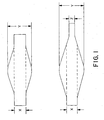
- the web is further tensioned to neck the material to width "Z" inches, which is smaller than the original width "X,” and then heat-set.
- the stretching of the nonwoven web in the cross-machine direction and then necking it to less than its original width produces a very high CD stretch nonwoven - higher than just necking by itself.
- the grooved roll process can readily double the effective width, "X,” and some webs can readily be necked to about 1/4 of their original width.
- the combination of the grooved rolls and the high necking with heat-treating produces a web having about 700% stretch with recovery. Referring to Fig.
- a nonwoven web has an original width ("X") of 10 inches (25 ⁇ 4 cm) and it is stretched in the cross-machine direction to a stretched width ("Y") of 20 inches (50 ⁇ 8 cm) the percent stretch is 100% ((Y-X)/X) x 100. If the elongated nonwoven web is then necked down to 1 ⁇ 2 of its original width to a necked width ("Z") of 5 inches (12 ⁇ 7 cm) and heat-set so as to retain its necked width, the percent stretch is now 300% ((Y - Z)/Z) x 100.
- the CD extensible nonwoven web material is bonded to an elastomeric material, producing a laminate with cloth-like feel and CD extensibility.
- a method for forming a composite elastic necked-bonded material in which a neckable material is necked and then joined to an elastic sheet is taught, for example, by U.S. Patent 5,226,992 to Morman .
- the CD extensible nonwoven web material may be joined to an elastic sheet in such a manner as to provide a laminate having multi-directional stretch capabilities.
- patent 5,116,662 to Morman teaches a method for producing a composite elastic material capable of stretching in at least two directions wherein a necked material is joined to the elastic sheet at least at three locations arranged in a nonlinear configuration such that the necked web is gathered between at least two of those locations.
- the laminate is formed first and then conveyed through the grooved roller system. For example, conveyance of a non-stretchable SMS (spunbond-meltblown-spunbond) laminate having an elastic meltblown component through a grooved roller system produces a laminate having CD stretch/recovery and cloth-like aesthetics.
- Suitable elastomeric materials for use in the method and materials of this invention preferably are selected from the group consisting films, foams, spunbonds, meltblowns and arrays of filaments and netting.
- Films suitable for use in this invention include breathable films, that is, films that may be microporous. Such breathable films may be produced by aperturing or by stretch-thinning a film loaded with filler, such as CaCO 3 particles.
- Nonwoven web materials suitable for use in the method of this invention are preferably selected from the group consisting ofspunbond, meltblown, spunbond-meltblown-spunbond laminates, coform, spunbond-film-spunbond laminates, bicomponent spunbond, bicomponent meltblown, biconstituent spunbond, biconstituent meltblown, bonded carded web, airlaid and combinations thereof.
- the nonwoven web materials are preferably formed with polymers selected from the group including polyolefins, polyamides, polyesters, polycarbonates, polystyrenes, thermoplastic elastomers, fluoropolymers, vinyl polymers, and blends and copolymers thereof.
- Suitable polyolefins include, but are not limited to, polyethylene, polypropylene, polybutylene, and the like;
- suitable polyamides include, but are not limited to, nylon 6, nylon 6/6, nylon 10, nylon 12 and the like;
- suitable polyesters include, but are not limited to, polyethylene terephthalate, polybutylene terephthalate and the like.
- Particularly suitable polymers for use in the present invention are polyolefins including polyethylene, for example, linear low density polyethylene, low density polyethylene, medium density polyethylene, high density polyethylene and blends thereof; polypropylene; polybutylene and copolymers as well as blends thereof. Additionally, the suitable fiber forming polymers may have thermoplastic elastomers blended therein.
- the conformability and drapeability of a nonwoven fabric may be measured according to the "cup crush" test.
- the cup crush test evaluates the fabric by measuring the peak load and energy required for a 4.5cm diameter hemispherically shaped foot to crush a 23cm by 23 cm piece of fabric shaped into an approximately 6.5 cm diameter by 6.5 cm tall inverted cup while the cup shaped fabric is surrounded by an approximately 6.5cm diameter cylinder to maintain a uniform deformation of the cup shaped fabric. An average of ten readings is used. The foot and the cup are aligned to avoid contact between the cup walls and the foot which could affect the reading. The cup crush load is measured while the foot is descending at a rate of about 0.25 inches per second (380 mm per minute) and is measured in grams.
- cup crush energy is the total energy required to crush a sample which is the total energy from the start of the test to the peak load point, i.e., the area under the curve formed by the load in grams on one axis and the distance the foot travels on the other. Crush energy is, therefore, reported in gram-millimeters. Lower cup crush values indicate a more drapeable and comfortable laminate.
- a suitable device for measuring cup crush is a model FTD-G-500 load cell (500 gram range) available from the Schaevitz Company, Pennsauken, N.J.
- the web was then stretched in a Sintec Tensile Tester to neck the material to about 1 ⁇ 2 of its original width. When the tension was released, the material relaxed to about its original width.
- the test was then repeated except that the material while in the necked condition was heated, as determined by a Raytek Raynger Model STAL infrared gun (available from Raytek Corporation, Santa Cruz, CA), to a temperature in the range of about 150°F to about 170°F using a Revlon 1800 watt hair dryer for about 45 seconds.
- a Raytek Raynger Model STAL infrared gun available from Raytek Corporation, Santa Cruz, CA
- Revlon 1800 watt hair dryer for about 45 seconds.
- bicomponent polyethylene/polypropylene prism a bicomponent fiber produced in accordance with the method of, for example, U.S. Patent 5,382,400 , wherein two different polymers are extruded through the same extruder opening
- spunbond having a basis weight of about 25 gsm
- KRATON Shell Chemical Company, Houston, TX meltblown (MB) material as described in U.S. Patent 4,663,220 having a basis weight of about 144 gsm:
- Table 1 hereinbelow compares the difference between the control spunbond and the control spunbond with KRATON meltblown MB. The data show that when the spunbond is attached to the KRATON meltblown, all measured tensile properties are increased. Table 1: Cross-Direction Tensile Properties of Sample 1 vs. Sample 2 Sample Basis Weight (gsm) Peak Load (gm) Peak Strain (%) 1 25 866.2 65 2 177 1401.5 96.5
- Table 2 compares the control spunbond/KRATON MB sample with the grooved spunbond/KRATON MB.
- the control spunbond/KRATON MB had higher tensile peak load than the grooved spunbond/KRATON MB laminate.
- the grooved spunbond/KRATON MB material had higher peak strain percentages compared to the control spunbond/KRATON MB material.
- Table 2 Cross-Direction Tensile Properties of Sample 2 vs. Sample 3 Sample Basis Weight (gsm) Peak Load (gm) Peak Strain (%) 2 177 1401.5 96.5 3 165 883.6 174.8
- Table 3 sets forth the differences between Samples 3 and 4 where Sample 4 consisted of a grooved spunbond that was necked from 6 inches (15 cm) to 4.25 inches (10.6 cm) to approximately match the original basis weight of the spunbond prior to passing through the grooved rolls. As can be seen, peak strain increased slightly. Table 3: Cross-Direction Tensile Properties of Sample 3 vs. Sample 4 Sample Basis Weight (gsm) Peak Load (gm) Peak Strain (%) 3 165 883.6 174.8 4 220 1122.1 189.9
- Table 4 hereinbelow sets forth the .difference between a grooved spunbond/KRATON MB material and a necked grooved spunbond/KRATON MB material. As shown, peak strain increased with necking. Table 4: Cross-Direction Tensile Properties of Sample 3 vs. Sample 5 Sample Basis Weight (gsm) Peak Load (gm) Peak Strain (%) 3 165 883.6 174.8 5 Not measured 1300 388.7
- Tables 5a and 5b compare the material of Samples 6 and 7.
- Table 5a shows the properties in cross-direction and Table 5b shows the properties in machine direction.
- Sample 6 was made to be biaxially extensible. The grooved spunbond was necked and adhesively laminated to a KRATON MB material that was stretched in the machine direction. Both the spunbond material and the KRATON MB material were under tension during lamination. Sample 7 was made to provide cross-direction extensibility. The control spunbond material was MD stretched and 50% "neck in” was achieved. The KRATON MB material was adhesively laminated to the control spunbond. The results show that Sample 6 had high MD extensibility but somewhat lower CD extensibility when compared to Sample 7.
- Table 5a Cross-Direction Tensile Properties of Sample 6 and Sample 7 Sample Basis Weight (gsm) Peak Load (gm) Peak Strain (%) 6 118 1460.0 191.2 7 127 1852.5 263
- Table 5b Machine-Direction Tensile Properties of Sample 6 and Sample 7 Sample Basis Weight (gsm) Peak Load (gm) Peak Strain (%) 6 118 2858.5 182.1 *7 127 5098 75.8 *Only one repeat due to limited sample size
- Table 6 shows a comparison of a grooved spunbond/KRATON (3), a grooved spunbond necked from 6 inches (15 cm) to 3 inches (7.5 cm) plus KRATON (5), and a control spunbond necked from 6 inches (15 cm) to 3 inches (7.5) plus KRATON (7) material.
- the necked grooved spunbond/KRATON MB material provided the highest peak strain percent. This indicates that the necked grooved spunbond/KRATON (5) sample is more extensible compared to Samples 3 and 7.
- a spunbond-meltblown-spunbond (SMS) hand sample was passed through the cross direction rollers of a grooved roll system.
- the meltblown layer of the SMS was composed of metallocene elastomeric polyolefin (Dow ENGAGE, 30 melt index, 0.5 osy, available from Dow Chemical Company).
- a 20 percent CD orientation was achieved with 0.150 inches (0.375 cm) engagement.
- Cross direction (CD) percent orientation is a measured quantity determined by putting a circle on a material, feeding the material through a grooved roller process, and measuring the resulting circle at its widest diameter. The percentage increase is the calculated value ((final diameter - initial diameter)/initial diameter) x 100.
- the material is fed through the grooved roll process as a hand sheet so there is minimal tension going into the grooved rolls and no tension coming out from between the grooved rolls.
- the production of materials having cross direction percent orientation is taught, for example, by U.S. Patent 4,368,565 .
- Table 7 compares the control spunbond-meltblown (elastomeric)-spunbond (SMS) and grooved oriented SMS samples. The results show that grooved SMS sample had a lower tensile peak load but a higher peak strain. Table 7: Cross-Direction Tensile Properties of Sample A vs. Sample B Sample Basis Weight (gsm) Peak Load (gm) Peak Strain (%) A 97 3868 66.9 B 80 976.5 118.6 A. SMS @ 97 GSM B. Grooved SMS @ 80 GSM
- SBL stretched-bonded laminate
- the data in Table 8 show the differences between a spunbond-meltblown (elastomeric)-spunbond material, a grooved spunbond-meltblown (elastomeric)-spunbond material, a necked-bonded-laminate (NBL) material, and a stretched-bonded-laminate (SBL) material.
- the SMS sample was subjected to grooved roll stretching, the result was a softer laminate as indicated by the cup crush data.
- the grooved roll SMS sample also had a higher air permeability compared to the control SMS sample.
- the NBL sample consists of spunbond and film and, thus, is not air permeable. In comparison with the SBL sample, the grooved SMS sample had a higher air permeability in both relaxed and CD stretched state.
- Table 8 Air Permeability and Softness Properties of SMS and Grooved SMS Sample Basis Weight (gsm) Relaxed State Air Permeability (cfm) CD Stretched Air Permeability (cfm) Cup Crush Load (gms) Cup Crush Energy (gm/mm) SMS 97 274 Can't stretch 173 3422 Grooved SMS 80 446 568 38 459 NBL 96 0 0 Did not measure Did not measure SBL 133 239 339 Did not measure Did not measure
Landscapes
- Engineering & Computer Science (AREA)
- Health & Medical Sciences (AREA)
- Textile Engineering (AREA)
- Vascular Medicine (AREA)
- Animal Behavior & Ethology (AREA)
- Veterinary Medicine (AREA)
- Public Health (AREA)
- Epidemiology (AREA)
- Biomedical Technology (AREA)
- Heart & Thoracic Surgery (AREA)
- Mechanical Engineering (AREA)
- Life Sciences & Earth Sciences (AREA)
- General Health & Medical Sciences (AREA)
- Dermatology (AREA)
- Thermal Sciences (AREA)
- Physics & Mathematics (AREA)
- Nonwoven Fabrics (AREA)
- Absorbent Articles And Supports Therefor (AREA)
- Materials For Medical Uses (AREA)
- Woven Fabrics (AREA)
- Laminated Bodies (AREA)
Abstract
Claims (9)
- Procédé pour produire un matériau de voile non tissé ayant une extensibilité dans un sens travers, comprenant les étapes de ;
transport d'un voile non tissé ayant une largeur d'origine (X) à travers des moyens pour allonger ledit voile non tissé dans un sens travers (Y) ; et
étranglement ensuite dudit voile non tissé allongé jusqu'à une largeur (Z) inférieure à ladite largeur d'origine (X), en formant un matériau de voile non tissé extensible dans le sens travers ;
caractérisé en ce que ledit procédé comprend en outre l'étape de :chauffage dudit voile non tissé allongé étranglé jusqu'à une température adaptée pour traiter thermiquement ledit voile non-tissé allongé étranglé. - Procédé selon la revendication 1, dans lequel ledit voile non-tissé est étranglé par application d'une tension dans le sens machine.
- Procédé selon la revendication 1 ou 2, dans lequel ledit voile non-tissé extensible est attaché à un matériau élastomère, en formant un stratifié étirable dans le sens travers.
- Procédé selon la revendication 3, dans lequel ledit matériau élastomère est un matériau choisi parmi le groupe constitué d'un film, d'une mousse, d'un matériau extrudé-soufflé, d'un matériau filé-lié, d'un réseau de filaments et d'un filet, et de stratifiés de ceux-ci.
- Procédé selon la revendication 1 ou 2, dans lequel ledit voile non-tissé extensible est attaché à un matériau élastomère, en formant un stratifié étirable dans des directions multiples.
- Procédé selon l'une quelconque des revendications précédentes, dans lequel ledit voile non-tissé comprend un matériau choisi parmi le groupe constitué d'un voile filé-lié, d'un voile extrudé-soufflé, d'un voile appliqué avec de l'air, d'une coforme, d'un voile cardé lié et de stratifiés de ceux-ci.
- Procédé selon l'une quelconque des revendications 1 à 5, dans lequel ledit voile non-tissé est un stratifié filé-lié/extrudé-soufflé/filé-lié ayant un composant élastomère extrudé-soufflé.
- Procédé selon l'une quelconque des revendications précédentes, dans lequel ledit voile non-tissé est allongé dans ledit sens travers d'au moins environ 50 %.
- Procédé selon l'une quelconque des revendications précédentes, dans lequel ledit matériau de voile non-tissé extensible est fortement étirable.
Applications Claiming Priority (3)
| Application Number | Priority Date | Filing Date | Title |
|---|---|---|---|
| US36312499A | 1999-07-28 | 1999-07-28 | |
| PCT/US2000/020756 WO2001009424A1 (fr) | 1999-07-28 | 2000-07-27 | Non tisse de type tissu extensible dans le sens de la trame utilise comme parementure et doublure |
| US363124 | 2002-03-11 |
Publications (2)
| Publication Number | Publication Date |
|---|---|
| EP1198632A1 EP1198632A1 (fr) | 2002-04-24 |
| EP1198632B1 true EP1198632B1 (fr) | 2012-02-01 |
Family
ID=23428905
Family Applications (1)
| Application Number | Title | Priority Date | Filing Date |
|---|---|---|---|
| EP00950887A Expired - Lifetime EP1198632B1 (fr) | 1999-07-28 | 2000-07-27 | Non tisse de type tissu extensible dans le sens de la trame utilise comme parementure et doublure |
Country Status (11)
| Country | Link |
|---|---|
| US (1) | US20040135286A1 (fr) |
| EP (1) | EP1198632B1 (fr) |
| JP (1) | JP2003506581A (fr) |
| KR (1) | KR100717231B1 (fr) |
| CN (1) | CN100378263C (fr) |
| AR (1) | AR024987A1 (fr) |
| AU (1) | AU772070B2 (fr) |
| BR (1) | BR0012786B1 (fr) |
| MX (1) | MXPA02000366A (fr) |
| WO (1) | WO2001009424A1 (fr) |
| ZA (1) | ZA200200346B (fr) |
Families Citing this family (14)
| Publication number | Priority date | Publication date | Assignee | Title |
|---|---|---|---|---|
| US8877316B2 (en) | 2002-12-20 | 2014-11-04 | The Procter & Gamble Company | Cloth-like personal care articles |
| US7226880B2 (en) | 2002-12-31 | 2007-06-05 | Kimberly-Clark Worldwide, Inc. | Breathable, extensible films made with two-component single resins |
| US7198742B2 (en) | 2003-12-30 | 2007-04-03 | Kimberly-Clark Worldwide, Inc. | Apparatus and method for deforming sheet material |
| US20060143767A1 (en) * | 2004-12-14 | 2006-07-06 | Kaiyuan Yang | Breathable protective articles |
| US7651653B2 (en) * | 2004-12-22 | 2010-01-26 | Kimberly-Clark Worldwide, Inc. | Machine and cross-machine direction elastic materials and methods of making same |
| US20060141887A1 (en) * | 2004-12-23 | 2006-06-29 | Morman Michael T | Cross-direction elastic film laminates, and methods of making same |
| US7833917B2 (en) * | 2004-12-30 | 2010-11-16 | Kimberly-Clark Worldwide, Inc. | Extensible and stretch laminates with comparably low cross-machine direction tension and methods of making same |
| US20070134303A1 (en) * | 2005-12-14 | 2007-06-14 | Ali Yahiaoui | Protective and therapeutic article |
| JP2009530506A (ja) * | 2006-03-15 | 2009-08-27 | インヴィスタ テクノロジー エスアエルエル | 医療品用の弾性不織シート |
| JP5006654B2 (ja) * | 2007-01-11 | 2012-08-22 | 旭化成せんい株式会社 | 伸縮性不織布 |
| ES2590205T3 (es) * | 2011-09-02 | 2016-11-18 | Rkw Se | Procedimiento para el estirado de una lámina continúa |
| US10507633B2 (en) * | 2015-04-21 | 2019-12-17 | First Quality Baby Products, Llc | Manufacturing process for elastomeric laminate |
| WO2017011341A1 (fr) | 2015-07-10 | 2017-01-19 | Berry Plastics Corporation | Film microporeux perméable à l'air et procédé de fabrication dudit film microporeux perméable à l'air |
| FR3053921B1 (fr) * | 2016-07-15 | 2021-06-25 | Aplix Sa | Ensemble lamine et procede de fabrication |
Family Cites Families (99)
| Publication number | Priority date | Publication date | Assignee | Title |
|---|---|---|---|---|
| US3338992A (en) * | 1959-12-15 | 1967-08-29 | Du Pont | Process for forming non-woven filamentary structures from fiber-forming synthetic organic polymers |
| DK97537C (da) * | 1961-06-09 | 1963-12-09 | Ole-Bendt Rasmussen | Fremgangsmåde ved lægdestrækning i kold tilstand af et orienterbart foliemateriale. |
| US3502763A (en) * | 1962-02-03 | 1970-03-24 | Freudenberg Carl Kg | Process of producing non-woven fabric fleece |
| US3502538A (en) * | 1964-08-17 | 1970-03-24 | Du Pont | Bonded nonwoven sheets with a defined distribution of bond strengths |
| US3383449A (en) * | 1964-10-01 | 1968-05-14 | Muller Paul Adolf | Method for producing an endless filter string |
| GB1292301A (en) * | 1968-11-06 | 1972-10-11 | Monsanto Co | A helically crimped bicomponent polyamidepolyurethane filament |
| DE2048006B2 (de) * | 1969-10-01 | 1980-10-30 | Asahi Kasei Kogyo K.K., Osaka (Japan) | Verfahren und Vorrichtung zur Herstellung einer breiten Vliesbahn |
| GB1453447A (en) * | 1972-09-06 | 1976-10-20 | Kimberly Clark Co | Nonwoven thermoplastic fabric |
| US4039364A (en) * | 1974-07-05 | 1977-08-02 | Rasmussen O B | Method for producing a laminated high strength sheet |
| DE2441781C3 (de) * | 1974-08-31 | 1980-12-04 | Hoechst Ag, 6000 Frankfurt | Verfahren zur Verbesserung der Wasseraufnahme und Saugfähigkeit von Fasermaterialien |
| US4116892A (en) * | 1975-03-31 | 1978-09-26 | Biax-Fiberfilm Corporation | Process for stretching incremental portions of an orientable thermoplastic substrate and product thereof |
| US4144008A (en) * | 1975-03-31 | 1979-03-13 | Biax-Fiberfilm Corporation | Apparatus for stretching a tubularly-formed sheet of thermoplastic material |
| US4153751A (en) * | 1975-03-31 | 1979-05-08 | Biax-Fiberfilm Corporation | Process for stretching an impregnated film of material and the microporous product produced thereby |
| US4285100A (en) * | 1975-03-31 | 1981-08-25 | Biax Fiberfilm Corporation | Apparatus for stretching a non-woven web or an orientable polymeric material |
| US4336638A (en) * | 1975-05-23 | 1982-06-29 | Netlon Limited | Apparatus for stretching plastic webs |
| US4138459A (en) * | 1975-09-08 | 1979-02-06 | Celanese Corporation | Process for preparing a microporous polymer film |
| US4153664A (en) * | 1976-07-30 | 1979-05-08 | Sabee Reinhardt N | Process for pattern drawing of webs |
| US4368565A (en) * | 1978-03-28 | 1983-01-18 | Biax-Fiberfilm Corporation | Grooved roller assembly for laterally stretching film |
| US4251585A (en) * | 1978-05-01 | 1981-02-17 | Biax Fiberfilm Corporation | Product and process for stretching a tubularly formed sheet of orientable thermoplastic material |
| JPS5598915A (en) * | 1979-01-16 | 1980-07-28 | Japan Exlan Co Ltd | Production of fiber swelling with water |
| US4243802A (en) * | 1979-06-06 | 1981-01-06 | Hercules Incorporated | Surfactant-soluble cellulose derivatives |
| US4438167A (en) * | 1979-10-15 | 1984-03-20 | Biax Fiberfilm Corporation | Novel porous fabric |
| US4340563A (en) * | 1980-05-05 | 1982-07-20 | Kimberly-Clark Corporation | Method for forming nonwoven webs |
| JPS57117951A (en) * | 1981-01-16 | 1982-07-22 | Mitsubishi Rayon Co | Porous polyethylene film and its manufacture |
| US4374888A (en) * | 1981-09-25 | 1983-02-22 | Kimberly-Clark Corporation | Nonwoven laminate for recreation fabric |
| US4424257A (en) * | 1981-11-12 | 1984-01-03 | Monsanto Company | Self-crimping multi-component polyamide filament wherein the components contain differing amounts of polyolefin |
| US4517714A (en) * | 1982-07-23 | 1985-05-21 | The Procter & Gamble Company | Nonwoven fabric barrier layer |
| US4795668A (en) * | 1983-10-11 | 1989-01-03 | Minnesota Mining And Manufacturing Company | Bicomponent fibers and webs made therefrom |
| FR2555102B1 (fr) * | 1983-11-21 | 1986-09-26 | Prouvost Sa | Procede de fabrication en continu d'un complexe souple de permeabilite controlee pour, notamment, le tenturage mural et une installation de mise en oeuvre du procede |
| US4590124A (en) * | 1984-05-10 | 1986-05-20 | W. R. Grace & Co., Cryovac Div. | Storm window film |
| US4820590A (en) * | 1985-05-08 | 1989-04-11 | Exxon Chemical Patents Inc. | Oriented elastomeric film and method of manufacture |
| US4663220A (en) * | 1985-07-30 | 1987-05-05 | Kimberly-Clark Corporation | Polyolefin-containing extrudable compositions and methods for their formation into elastomeric products including microfibers |
| US4720415A (en) * | 1985-07-30 | 1988-01-19 | Kimberly-Clark Corporation | Composite elastomeric material and process for making the same |
| US4806300A (en) * | 1985-12-09 | 1989-02-21 | Richard R. Walton | Method for softening a nonwoven web |
| IN167421B (fr) * | 1987-01-16 | 1990-10-27 | Rasmussen O B | |
| US4833172A (en) * | 1987-04-24 | 1989-05-23 | Ppg Industries, Inc. | Stretched microporous material |
| USH1558H (en) * | 1987-06-19 | 1996-07-02 | Goulait; David J. K. | Method for manufacturing and an absorbent article having elastically extensible portions |
| US4994335A (en) * | 1988-09-10 | 1991-02-19 | Ube Industries, Ltd. | Microporous film, battery separator employing the same, and method of producing them |
| US5226992A (en) * | 1988-09-23 | 1993-07-13 | Kimberly-Clark Corporation | Process for forming a composite elastic necked-bonded material |
| US5514470A (en) * | 1988-09-23 | 1996-05-07 | Kimberly-Clark Corporation | Composite elastic necked-bonded material |
| US4965122A (en) * | 1988-09-23 | 1990-10-23 | Kimberly-Clark Corporation | Reversibly necked material |
| US4981747A (en) * | 1988-09-23 | 1991-01-01 | Kimberly-Clark Corporation | Composite elastic material including a reversibly necked material |
| DE68920133T2 (de) * | 1989-01-27 | 1995-05-04 | Nippon Petrochemicals Co Ltd | Kreuzgelegter, gestreckter Vliesstoff und Verfahren zur Herstellung desselben. |
| JP2682130B2 (ja) * | 1989-04-25 | 1997-11-26 | 三井石油化学工業株式会社 | 柔軟な長繊維不織布 |
| US5108827A (en) * | 1989-04-28 | 1992-04-28 | Fiberweb North America, Inc. | Strong nonwoven fabrics from engineered multiconstituent fibers |
| US5188885A (en) * | 1989-09-08 | 1993-02-23 | Kimberly-Clark Corporation | Nonwoven fabric laminates |
| US5501679A (en) * | 1989-11-17 | 1996-03-26 | Minnesota Mining And Manufacturing Company | Elastomeric laminates with microtextured skin layers |
| US5120594A (en) * | 1989-11-20 | 1992-06-09 | Minnesota Mining And Manufacturing Company | Microporous polyolefin shaped articles with patterned surface areas of different porosity |
| US5116662A (en) * | 1989-12-15 | 1992-05-26 | Kimberly-Clark Corporation | Multi-direction stretch composite elastic material |
| US5202173A (en) * | 1990-02-12 | 1993-04-13 | Clopay Corporation | Ultra soft cloth-like embossed plastic film having post-embossed stretched areas |
| US5429856A (en) * | 1990-03-30 | 1995-07-04 | Minnesota Mining And Manufacturing Company | Composite materials and process |
| US5093422A (en) * | 1990-04-23 | 1992-03-03 | Shell Oil Company | Low stress relaxation extrudable elastomeric composition |
| US5117540A (en) * | 1990-09-24 | 1992-06-02 | Richard R. Walton | Longitudinal compressive treatment of web materials |
| US5149576A (en) * | 1990-11-26 | 1992-09-22 | Kimberly-Clark Corporation | Multilayer nonwoven laminiferous structure |
| US5405887A (en) * | 1991-04-26 | 1995-04-11 | Mitsui Toatsu Chemicals, Inc. | Porous film |
| DK132191D0 (da) * | 1991-07-05 | 1991-07-05 | Danaklon As | Fibre og fremstilling deraf |
| US5277976A (en) * | 1991-10-07 | 1994-01-11 | Minnesota Mining And Manufacturing Company | Oriented profile fibers |
| US6194532B1 (en) * | 1991-10-15 | 2001-02-27 | The Dow Chemical Company | Elastic fibers |
| US5382400A (en) * | 1992-08-21 | 1995-01-17 | Kimberly-Clark Corporation | Nonwoven multicomponent polymeric fabric and method for making same |
| US5405682A (en) * | 1992-08-26 | 1995-04-11 | Kimberly Clark Corporation | Nonwoven fabric made with multicomponent polymeric strands including a blend of polyolefin and elastomeric thermoplastic material |
| US5599420A (en) * | 1993-04-06 | 1997-02-04 | Kimberly-Clark Corporation | Patterned embossed nonwoven fabric, cloth-like liquid barrier material and method for making same |
| CA2101865C (fr) * | 1993-04-12 | 2007-11-13 | Richard Joseph Kamps | Methode de fabrication de papier de soie |
| US5424025A (en) * | 1993-05-03 | 1995-06-13 | Minnesota Mining And Manufacturing Company | Process of making zone orientated continuous web |
| US5411636A (en) * | 1993-05-21 | 1995-05-02 | Kimberly-Clark | Method for increasing the internal bulk of wet-pressed tissue |
| US5518801A (en) * | 1993-08-03 | 1996-05-21 | The Procter & Gamble Company | Web materials exhibiting elastic-like behavior |
| US6169045B1 (en) * | 1993-11-16 | 2001-01-02 | Kimberly-Clark Worldwide, Inc. | Nonwoven filter media |
| DE9317616U1 (de) * | 1993-11-19 | 1995-03-16 | Beloit Technologies, Inc., Wilmington, Del. | Wickelmaschine |
| US5439626A (en) * | 1994-03-14 | 1995-08-08 | E. I. Du Pont De Nemours And Company | Process for making hollow nylon filaments |
| US5498468A (en) * | 1994-09-23 | 1996-03-12 | Kimberly-Clark Corporation | Fabrics composed of ribbon-like fibrous material and method to make the same |
| US5651853A (en) * | 1994-12-02 | 1997-07-29 | P.L.G. Research Limited | Mesh structure/fabric laminate |
| US5539124A (en) * | 1994-12-19 | 1996-07-23 | Occidental Chemical Corporation | Polymerization catalysts based on transition metal complexes with ligands containing pyrrolyl ring |
| US5707468A (en) * | 1994-12-22 | 1998-01-13 | Kimberly-Clark Worldwide, Inc. | Compaction-free method of increasing the integrity of a nonwoven web |
| DE69631716T2 (de) * | 1995-06-06 | 2004-07-22 | Chisso Corp. | Endlosfaservliesstoff und Verfahren zur Herstellung |
| US5763334A (en) * | 1995-08-08 | 1998-06-09 | Hercules Incorporated | Internally lubricated fiber, cardable hydrophobic staple fibers therefrom, and methods of making and using the same |
| US5628097A (en) * | 1995-09-29 | 1997-05-13 | The Procter & Gamble Company | Method for selectively aperturing a nonwoven web |
| US5770531A (en) * | 1996-04-29 | 1998-06-23 | Kimberly--Clark Worldwide, Inc. | Mechanical and internal softening for nonwoven web |
| US6355200B1 (en) * | 1996-05-28 | 2002-03-12 | The Procter & Gamble Company | Method for making fluid distribution materials |
| US6054002A (en) * | 1996-06-27 | 2000-04-25 | Kimberly-Clark Worldwide, Inc. | Method of making a seamless tubular band |
| US5783503A (en) * | 1996-07-22 | 1998-07-21 | Fiberweb North America, Inc. | Meltspun multicomponent thermoplastic continuous filaments, products made therefrom, and methods therefor |
| US6258308B1 (en) * | 1996-07-31 | 2001-07-10 | Exxon Chemical Patents Inc. | Process for adjusting WVTR and other properties of a polyolefin film |
| US6028016A (en) * | 1996-09-04 | 2000-02-22 | Kimberly-Clark Worldwide, Inc. | Nonwoven Fabric Substrates Having a Durable Treatment |
| US6017832A (en) * | 1996-09-04 | 2000-01-25 | Kimberly-Clark Worldwide, Inc. | Method and composition for treating substrates for wettability |
| US6204208B1 (en) * | 1996-09-04 | 2001-03-20 | Kimberly-Clark Worldwide, Inc. | Method and composition for treating substrates for wettability and skin wellness |
| US5885908A (en) * | 1996-10-04 | 1999-03-23 | Minnesota Mining And Manufacturing Co. | Anisotropic elastic films |
| US5910136A (en) * | 1996-12-30 | 1999-06-08 | Kimberly-Clark Worldwide, Inc. | Oriented polymeric microporous films with flexible polyolefins |
| US5723546A (en) * | 1997-03-24 | 1998-03-03 | Rexene Corporation | Low- and high-molecular weight amorphous polyalphaolefin polymer blends having high melt viscosity, and products thereof |
| US6383431B1 (en) * | 1997-04-04 | 2002-05-07 | The Procter & Gamble Company | Method of modifying a nonwoven fibrous web for use as component of a disposable absorbent article |
| US5914084A (en) * | 1997-04-04 | 1999-06-22 | The Procter & Gamble Company | Method of making a stabilized extensible nonwoven web |
| US6129801A (en) * | 1997-04-23 | 2000-10-10 | The Procter & Gamble Company | Method for making a stable web having enhanced extensibility in multiple directions |
| US5883028A (en) * | 1997-05-30 | 1999-03-16 | Kimberly-Clark Worldwide, Inc. | Breathable elastic film/nonwoven laminate |
| WO1999024174A1 (fr) * | 1997-11-10 | 1999-05-20 | Katoot Mohammad W | Procede permettant de modifier la surface d'un objet |
| US6203654B1 (en) * | 1998-02-20 | 2001-03-20 | The Procter & Gamble Company | Method of making a slitted or particulate absorbent material |
| US6586354B1 (en) * | 1998-12-28 | 2003-07-01 | Kimberly-Clark Worldwide, Inc. | Microlayer breathable hybrid films of degradable polymers and thermoplastic elastomers |
| US6172177B1 (en) * | 1997-12-31 | 2001-01-09 | Kimberly-Clark Worldwide, Inc. | Grafted poly(ethylene oxide) compositions |
| CA2315688A1 (fr) * | 1998-01-23 | 1999-07-29 | The Procter & Gamble Company | Procede de fabrication d'une bande continue non tissee stable a extensibilite amelioree dans de multiples directions |
| US6225243B1 (en) * | 1998-08-03 | 2001-05-01 | Bba Nonwovens Simpsonville, Inc. | Elastic nonwoven fabric prepared from bi-component filaments |
| CA2346455A1 (fr) * | 1998-10-16 | 2000-04-27 | John H. Mackay | Procede de production de films imper-respirants microporeux en polyolefine |
| US6214274B1 (en) * | 1999-05-14 | 2001-04-10 | Kimberly-Clark Worldwide, Inc. | Process for compressing a web which contains superabsorbent material |
| FR2801612B1 (fr) * | 1999-11-29 | 2002-08-30 | Aplix Sa | Fibre a ame elastique et tissu non tisse elastique |
-
2000
- 2000-07-27 KR KR1020027001111A patent/KR100717231B1/ko not_active Expired - Fee Related
- 2000-07-27 EP EP00950887A patent/EP1198632B1/fr not_active Expired - Lifetime
- 2000-07-27 CN CNB008109419A patent/CN100378263C/zh not_active Expired - Fee Related
- 2000-07-27 JP JP2001513676A patent/JP2003506581A/ja not_active Abandoned
- 2000-07-27 MX MXPA02000366A patent/MXPA02000366A/es active IP Right Grant
- 2000-07-27 AU AU63919/00A patent/AU772070B2/en not_active Ceased
- 2000-07-27 WO PCT/US2000/020756 patent/WO2001009424A1/fr not_active Ceased
- 2000-07-27 BR BRPI0012786-8A patent/BR0012786B1/pt not_active IP Right Cessation
- 2000-07-28 AR ARP000103925A patent/AR024987A1/es active IP Right Grant
-
2002
- 2002-01-15 ZA ZA200200346A patent/ZA200200346B/xx unknown
-
2003
- 2003-12-23 US US10/744,024 patent/US20040135286A1/en not_active Abandoned
Also Published As
| Publication number | Publication date |
|---|---|
| CN1371437A (zh) | 2002-09-25 |
| JP2003506581A (ja) | 2003-02-18 |
| WO2001009424A1 (fr) | 2001-02-08 |
| KR100717231B1 (ko) | 2007-05-11 |
| US20040135286A1 (en) | 2004-07-15 |
| BR0012786B1 (pt) | 2012-01-10 |
| CN100378263C (zh) | 2008-04-02 |
| AR024987A1 (es) | 2002-11-06 |
| EP1198632A1 (fr) | 2002-04-24 |
| ZA200200346B (en) | 2003-03-26 |
| AU6391900A (en) | 2001-02-19 |
| KR20020022783A (ko) | 2002-03-27 |
| AU772070B2 (en) | 2004-04-08 |
| BR0012786A (pt) | 2002-04-30 |
| MXPA02000366A (es) | 2002-07-02 |
Similar Documents
| Publication | Publication Date | Title |
|---|---|---|
| EP1836052B1 (fr) | Procédé de fabrication de matériaux élastiques suivant le sens perpendiculaire au sens de la machine | |
| EP1572454B1 (fr) | Stratifie extensible presentant des proprietes d'etirage ameliorees et son procede de fabrication | |
| KR100714342B1 (ko) | 착용자의 윤곽에 영구적으로 정합가능한 통기성 라미네이트 | |
| EP1198632B1 (fr) | Non tisse de type tissu extensible dans le sens de la trame utilise comme parementure et doublure | |
| CN1325249C (zh) | 一个方向有弹性另一个方向可扩展的复合材料 | |
| EP0388465B1 (fr) | Procede de production d'un materiau a etranglement reversible, materiau ainsi produit et materiau multicouche comprenant au moins un materiau a etranglement reversible | |
| EP0930968B1 (fr) | Tissu lamine avec elasticite transversale | |
| US5921973A (en) | Nonwoven fabric useful for preparing elastic composite fabrics | |
| EP1240014B1 (fr) | Stratifie imper-respirant susceptible de se conformer de maniere permanente a la silhouette d'un utilisateur | |
| KR20050053615A (ko) | 제어된 수축력을 갖는 신장성 부직 재료 및 그의 제조 방법 | |
| AU2001279255A1 (en) | Composite elastic in one direction and extensible in another direction | |
| EP1531980A1 (fr) | Dispositif et procede a impact multiple de traitement de bandes souples | |
| EP1711343B1 (fr) | Procédé de fabrication de laminés extensibles et étirables | |
| US20050241750A1 (en) | Method and apparatus for making extensible and stretchable laminates | |
| WO2006071317A1 (fr) | Stratifie extensible et procede |
Legal Events
| Date | Code | Title | Description |
|---|---|---|---|
| PUAI | Public reference made under article 153(3) epc to a published international application that has entered the european phase |
Free format text: ORIGINAL CODE: 0009012 |
|
| 17P | Request for examination filed |
Effective date: 20020116 |
|
| AK | Designated contracting states |
Kind code of ref document: A1 Designated state(s): AT BE CH CY DE DK ES FI FR GB GR IE IT LI LU MC NL PT SE |
|
| AX | Request for extension of the european patent |
Free format text: AL;LT;LV;MK;RO;SI |
|
| RBV | Designated contracting states (corrected) |
Designated state(s): DE FR GB |
|
| 17Q | First examination report despatched |
Effective date: 20080304 |
|
| GRAP | Despatch of communication of intention to grant a patent |
Free format text: ORIGINAL CODE: EPIDOSNIGR1 |
|
| GRAS | Grant fee paid |
Free format text: ORIGINAL CODE: EPIDOSNIGR3 |
|
| GRAA | (expected) grant |
Free format text: ORIGINAL CODE: 0009210 |
|
| AK | Designated contracting states |
Kind code of ref document: B1 Designated state(s): DE FR GB |
|
| REG | Reference to a national code |
Ref country code: GB Ref legal event code: FG4D |
|
| REG | Reference to a national code |
Ref country code: DE Ref legal event code: R096 Ref document number: 60046892 Country of ref document: DE Effective date: 20120329 |
|
| PLBE | No opposition filed within time limit |
Free format text: ORIGINAL CODE: 0009261 |
|
| STAA | Information on the status of an ep patent application or granted ep patent |
Free format text: STATUS: NO OPPOSITION FILED WITHIN TIME LIMIT |
|
| 26N | No opposition filed |
Effective date: 20121105 |
|
| REG | Reference to a national code |
Ref country code: DE Ref legal event code: R097 Ref document number: 60046892 Country of ref document: DE Effective date: 20121105 |
|
| PGFP | Annual fee paid to national office [announced via postgrant information from national office to epo] |
Ref country code: DE Payment date: 20130729 Year of fee payment: 14 |
|
| PGFP | Annual fee paid to national office [announced via postgrant information from national office to epo] |
Ref country code: GB Payment date: 20130729 Year of fee payment: 14 Ref country code: FR Payment date: 20130717 Year of fee payment: 14 |
|
| REG | Reference to a national code |
Ref country code: DE Ref legal event code: R119 Ref document number: 60046892 Country of ref document: DE |
|
| GBPC | Gb: european patent ceased through non-payment of renewal fee |
Effective date: 20140727 |
|
| REG | Reference to a national code |
Ref country code: FR Ref legal event code: ST Effective date: 20150331 |
|
| PG25 | Lapsed in a contracting state [announced via postgrant information from national office to epo] |
Ref country code: DE Free format text: LAPSE BECAUSE OF NON-PAYMENT OF DUE FEES Effective date: 20150203 |
|
| REG | Reference to a national code |
Ref country code: DE Ref legal event code: R119 Ref document number: 60046892 Country of ref document: DE Effective date: 20150203 |
|
| PG25 | Lapsed in a contracting state [announced via postgrant information from national office to epo] |
Ref country code: FR Free format text: LAPSE BECAUSE OF NON-PAYMENT OF DUE FEES Effective date: 20140731 Ref country code: GB Free format text: LAPSE BECAUSE OF NON-PAYMENT OF DUE FEES Effective date: 20140727 |