EP1199708A2 - Rauschrobuste Mustererkennung - Google Patents
Rauschrobuste Mustererkennung Download PDFInfo
- Publication number
- EP1199708A2 EP1199708A2 EP01124141A EP01124141A EP1199708A2 EP 1199708 A2 EP1199708 A2 EP 1199708A2 EP 01124141 A EP01124141 A EP 01124141A EP 01124141 A EP01124141 A EP 01124141A EP 1199708 A2 EP1199708 A2 EP 1199708A2
- Authority
- EP
- European Patent Office
- Prior art keywords
- noise
- pattern recognition
- training
- signal
- noise reduction
- Prior art date
- Legal status (The legal status is an assumption and is not a legal conclusion. Google has not performed a legal analysis and makes no representation as to the accuracy of the status listed.)
- Granted
Links
Images





Classifications
-
- G—PHYSICS
- G10—MUSICAL INSTRUMENTS; ACOUSTICS
- G10L—SPEECH ANALYSIS TECHNIQUES OR SPEECH SYNTHESIS; SPEECH RECOGNITION; SPEECH OR VOICE PROCESSING TECHNIQUES; SPEECH OR AUDIO CODING OR DECODING
- G10L21/00—Speech or voice signal processing techniques to produce another audible or non-audible signal, e.g. visual or tactile, in order to modify its quality or its intelligibility
- G10L21/02—Speech enhancement, e.g. noise reduction or echo cancellation
- G10L21/0208—Noise filtering
-
- G—PHYSICS
- G06—COMPUTING OR CALCULATING; COUNTING
- G06F—ELECTRIC DIGITAL DATA PROCESSING
- G06F18/00—Pattern recognition
- G06F18/20—Analysing
- G06F18/21—Design or setup of recognition systems or techniques; Extraction of features in feature space; Blind source separation
- G06F18/214—Generating training patterns; Bootstrap methods, e.g. bagging or boosting
-
- G—PHYSICS
- G10—MUSICAL INSTRUMENTS; ACOUSTICS
- G10L—SPEECH ANALYSIS TECHNIQUES OR SPEECH SYNTHESIS; SPEECH RECOGNITION; SPEECH OR VOICE PROCESSING TECHNIQUES; SPEECH OR AUDIO CODING OR DECODING
- G10L15/00—Speech recognition
- G10L15/06—Creation of reference templates; Training of speech recognition systems, e.g. adaptation to the characteristics of the speaker's voice
-
- G—PHYSICS
- G10—MUSICAL INSTRUMENTS; ACOUSTICS
- G10L—SPEECH ANALYSIS TECHNIQUES OR SPEECH SYNTHESIS; SPEECH RECOGNITION; SPEECH OR VOICE PROCESSING TECHNIQUES; SPEECH OR AUDIO CODING OR DECODING
- G10L15/00—Speech recognition
- G10L15/20—Speech recognition techniques specially adapted for robustness in adverse environments, e.g. in noise, of stress induced speech
-
- G—PHYSICS
- G10—MUSICAL INSTRUMENTS; ACOUSTICS
- G10L—SPEECH ANALYSIS TECHNIQUES OR SPEECH SYNTHESIS; SPEECH RECOGNITION; SPEECH OR VOICE PROCESSING TECHNIQUES; SPEECH OR AUDIO CODING OR DECODING
- G10L21/00—Speech or voice signal processing techniques to produce another audible or non-audible signal, e.g. visual or tactile, in order to modify its quality or its intelligibility
- G10L21/02—Speech enhancement, e.g. noise reduction or echo cancellation
- G10L21/0208—Noise filtering
- G10L21/0216—Noise filtering characterised by the method used for estimating noise
Definitions
- the present invention relates to pattern recognition.
- the present invention relates to training models for pattern recognition.
- a pattern recognition system such as a speech recognition system, takes an input signal and attempts to decode the signal to find a pattern represented by the signal. For example, in a speech recognition system, a speech signal (often referred to as a test signal) is received by the recognition system and is decoded to identify a string of words represented by the speech signal.
- a speech signal (often referred to as a test signal) is received by the recognition system and is decoded to identify a string of words represented by the speech signal.
- most recognition systems utilize one or more models that describe the likelihood that a portion of the test signal represents a particular pattern. Examples of such models include Neural Nets, Dynamic Time Warping, segment models, and Hidden Markov Models.
- a model Before a model can be used to decode an incoming signal, it must be trained. This is typically done by measuring input training signals generated from a known training pattern. For example, in speech recognition, a collection of speech signals is generated by speakers reading from a known text. These speech signals are then used to train the models.
- the signals used to train the model should be similar to the eventual test signals that are decoded.
- the training signals should have the same amount and type of noise as the test signals that are decoded.
- some prior art systems collect the training signal under the same conditions that are expected to be present when the test signal is generated. For example, speech training signals are collected in the same noisy environments where the speech recognition system will be used. Other systems collect the training data under relatively noiseless (or "clean") conditions and then add the expected noise to the clean training data.
- a method and apparatus for training and using a pattern recognition model are provided.
- additive noise that matches noise expected in a test signal is included in a training signal.
- the noisy training signal is passed through one or more noise reduction techniques to produce pseudo-clean training data.
- the pseudo-clean training data is then used to train the pattern recognition model.
- test signal When the test signal is received, it is passed through the same noise reduction techniques used on the noisy training signal. This produces pseudo-clean test data that better matches the pseudo-clean training data. The pseudo-clean test data is then applied to the pattern recognition model to determine the most likely pattern represented by the test signal.
- sets of training data are produced with each set containing a different type of noise.
- one set may include fan noise from a computer while another set may include keyboard noise.
- each set of training data may be passed through the same noise reduction techniques or different sets of training data may be passed through different noise reduction techniques.
- the noise in the test data is sampled to identify a particular set of training data that contains a similar type of noise.
- the noise reduction technique applied to the best matching training data is then applied to the test data to form the pseudo-clean test data.
- the test data is passed through the different noise reduction techniques producing multiple different versions of pseudo-clean test data.
- Each of these separate forms of pseudo-clean test data is then applied to the models to determine a probability for a pattern.
- the proper noise reduction technique to apply to the test data is then implicitly selected by selecting the form or combination of forms of the pseudo-clean test data that produces the highest probability pattern.
- FIG. 1 illustrates an example of a suitable computing system environment 100 on which the invention may be implemented.
- the computing system environment 100 is only one example of a suitable computing environment and is not intended to suggest any limitation as to the scope of use or functionality of the invention. Neither should the computing environment 100 be interpreted as having any dependency or requirement relating to any one or combination of components illustrated in the exemplary operating environment 100.
- the invention is operational with numerous other general purpose or special purpose computing system environments or configurations.
- Examples of well known computing systems, environments, and/or configurations that may be suitable for use with the invention include, but are not limited to, personal computers, server computers, hand-held or laptop devices, multiprocessor systems, microprocessor-based systems, set top boxes, programmable consumer electronics, network PCs, minicomputers, mainframe computers, distributed computing environments that include any of the above systems or devices, and the like.
- the invention may be described in the general context of computer-executable instructions, such as program modules, being executed by a computer.
- program modules include routines, programs, objects, components, data structures, etc. that perform particular tasks or implement particular abstract data types.
- the invention may also be practiced in distributed computing environments where tasks are performed by remote processing devices that are linked through a communications network.
- program modules may be located in both local and remote computer storage media including memory storage devices.
- an exemplary system for implementing the invention includes a general-purpose computing device in the form of a computer 110.
- Components of computer 110 may include, but are not limited to, a processing unit 120, a system memory 130, and a system bus 121 that couples various system components including the system memory to the processing unit 120.
- the system bus 121 may be any of several types of bus structures including a memory bus or memory controller, a peripheral bus, and a local bus using any of a variety of bus architectures.
- such architectures include Industry Standard Architecture (ISA) bus, Micro Channel Architecture (MCA) bus, Enhanced ISA (EISA) bus, Video Electronics Standards Association (VESA) local bus, and Peripheral Component Interconnect (PCI) bus also known as Mezzanine bus.
- ISA Industry Standard Architecture
- MCA Micro Channel Architecture
- EISA Enhanced ISA
- VESA Video Electronics Standards Association
- PCI Peripheral Component Interconnect
- Computer 110 typically includes a variety of computer readable media.
- Computer readable media can be any available media that can be accessed by computer 110 and includes both volatile and nonvolatile media, removable and non-removable media.
- Computer readable media may comprise computer storage media and communication media.
- Computer storage media includes both volatile and nonvolatile, removable and non-removable media implemented in any method or technology for storage of information such as computer readable instructions, data structures, program modules or other data.
- Computer storage media includes, but is not limited to, RAM, ROM, EEPROM, flash memory or other memory technology, CD-ROM, digital versatile disks (DVD) or other optical disk storage, magnetic cassettes, magnetic tape, magnetic disk storage or other magnetic storage devices, or any other medium which can be used to store the desired information and which can be accessed by computer 100.
- Communication media typically embodies computer readable instructions, data structures, program modules or other data in a modulated data signal such as a carrier wave or other transport mechanism and includes any information delivery media.
- modulated data signal means a signal that has one or more of its characteristics set or changed in such a manner as to encode information in the signal.
- communication media includes wired media such as a wired network or direct-wired connection, and wireless media such as acoustic, FR, infrared and other wireless media. Combinations of any of the above should also be included within the scope of computer readable media.
- the system memory 130 includes computer storage media in the form of volatile and/or nonvolatile memory such as read only memory (ROM) 131 and random access memory (RAM) 132.
- ROM read only memory
- RAM random access memory
- BIOS basic input/output system
- RAM 132 typically contains data and/or program modules that are immediately accessible to and/or presently being operated on by processing unit 120.
- FIG. 1 illustrates operating system 134, application programs 135, other program modules 136, and program data 137.
- the computer 110 may also include other removable/non-removable volatile/nonvolatile computer storage media.
- FIG. 1 illustrates a hard disk drive 141 that reads from or writes to non-removable, nonvolatile magnetic media, a magnetic disk drive 151 that reads from or writes to a removable, nonvolatile magnetic disk 152, and an optical disk drive 155 that reads from or writes to a removable, nonvolatile optical disk 156 such as a CD ROM or other optical media.
- removable/non-removable, volatile/nonvolatile computer storage media that can be used in the exemplary operating environment include, but are not limited to, magnetic tape cassettes, flash memory cards, digital versatile disks, digital video tape, solid state RAM, solid state ROM, and the like.
- the hard disk drive 141 is typically connected to the system bus 121 through a non-removable memory interface such as interface 140, and magnetic disk drive 151 and optical disk drive 155 are typically connected to the system bus 121 by a removable memory interface, such as interface 150.
- hard disk drive 141 is illustrated as storing operating system 144, application programs 145, other program modules 146, and program data 147. Note that these components can either be the same as or different from operating system 134, application programs 135, other program modules 136, and program data 137. Operating system 144, application programs 145, other program modules 146, and program data 147 are given different numbers here to illustrate that, at a minimum, they are different copies.
- a user may enter commands and information into the computer 110 through input devices such as a keyboard 162, a microphone 163, and a pointing device 161, such as a mouse, trackball or touch pad.
- Other input devices may include a joystick, game pad, satellite dish, scanner, or the like.
- a monitor 191 or other type of display device is also connected to the system bus 121 via an interface, such as a video interface 190.
- computers may also include other peripheral output devices such as speakers 197 and printer 196, which may be connected through an output peripheral interface 190.
- the computer 110 may operate in a networked environment using logical connections to one or more remote computers, such as a remote computer 180.
- the remote computer 180 may be a personal computer, a hand-held device, a server, a router, a network PC, a peer device or other common network node, and typically includes many or all of the elements described above relative to the computer 110.
- the logical connections depicted in FIG. 1 include a local area network (LAN) 171 and a wide area network (WAN) 173, but may also include other networks.
- LAN local area network
- WAN wide area network
- Such networking environments are commonplace in offices, enterprise-wide computer networks, intranets and the Internet.
- the computer 110 When used in a LAN networking environment, the computer 110 is connected to the LAN 171 through a network interface or adapter 170. When used in a WAN networking environment, the computer 110 typically includes a modem 172 or other means for establishing communications over the WAN 173, such as the Internet.
- the modem 172 which may be internal or external, may be connected to the system bus 121 via the user input interface 160, or other appropriate mechanism.
- program modules depicted relative to the computer 110, or portions thereof may be stored in the remote memory storage device.
- FIG. 1 illustrates remote application programs 185 as residing on remote computer 180. It will be appreciated that the network connections shown are exemplary and other means of establishing a communications link between the computers may be used.
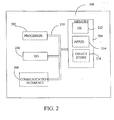
- FIG. 2 is a block diagram of a mobile device 200, which is an exemplary computing environment.
- Mobile device 200 includes a microprocessor 202, memory 204, input/output (I/O) components 206, and a communication interface 208 for communicating with remote computers or other mobile devices.
- I/O input/output
- the afore-mentioned components are coupled for communication with one another over a suitable bus 210.
- Memory 204 is implemented as non-volatile electronic memory such as random access memory (RAM) with a battery back-up module (not shown) such that information stored in memory 204 is not lost when the general power to mobile device 200 is shut down.
- RAM random access memory
- a portion of memory 204 is preferably allocated as addressable memory for program execution, while another portion of memory 204 is preferably used for storage, such as to simulate storage on a disk drive.
- Memory 204 includes an operating system 212, application programs 214 as well as an object store 216.
- operating system 212 is preferably executed by processor 202 from memory 204.
- Operating system 212 in one preferred embodiment, is a WINDOWS® CE brand operating system commercially available from Microsoft Corporation.
- Operating system 212 is preferably designed for mobile devices, and implements database features that can be utilized by applications 214 through a set of exposed application programming interfaces and methods.
- the objects in object store 216 are maintained by applications 214 and operating system 212, at least partially in response to calls to the exposed application programming interfaces and methods.
- Communication interface 208 represents numerous devices and technologies that allow mobile device 200 to send and receive information.
- the devices include wired and wireless modems, satellite receivers and broadcast tuners to name a few.
- Mobile device 200 can also be directly connected to a computer to exchange data therewith.
- communication interface 208 can be an infrared transceiver or a serial or parallel communication connection, all of which are capable of transmitting streaming information.
- Input/output components 206 include a variety of input devices such as a touch-sensitive screen, buttons, rollers, and a microphone as well as a variety of output devices including an audio generator, a vibrating device, and a display.
- input devices such as a touch-sensitive screen, buttons, rollers, and a microphone
- output devices including an audio generator, a vibrating device, and a display.
- the devices listed above are by way of example and need not all be present on mobile device 200.
- other input/output devices may be attached to or found with mobile device 200 within the scope of the present invention.
- FIG. 3 shows one embodiment of a method for performing such matching.
- raw training data is created that includes anticipated additive noise.
- This anticipated additive noise is similar to the noise that is expected to be present in the test data.
- This anticipated additive noise can be placed in the training data by having a trainer speak in a noisy environment such as a train platform, a car, or an industrial environment. In other embodiments, the trainer speaks in a relatively noiseless environment and additive noise is then added to the "clean" training speech signals.
- the noise added to the clean training signal can be noise that is recorded from selected noisy environments, such as those listed above or noise that has the same statistical properties as the anticipated noise.
- the noisy training data is applied to a noise reduction module which applies one or more noise reduction techniques to the noisy training data.
- noise reduction techniques can include but are not limited to Spectral Subtraction or Stereo Piecewise Linear Compensation for Environments (SPLICE).
- SPLICE Stereo Piecewise Linear Compensation for Environments
- more than one noise reduction technique may be applied to the noisy data.
- the output of the noise reduction module is only "pseudo-clean" training data.
- this pseudo-clean training data is used to train a pattern model that will later be used to detect the most likely pattern that can be represented by a given test signal. This training is shown as step 304 in FIG. 3.
- the models that are trained under the present invention can include, but are not limited to, Neural Nets, Dynamic Time Warping, segment models, and Hidden Markov Models.
- test data is received by the speech recognition system at step 306.
- the same noise reduction techniques that were applied to the noisy training data are then applied to the test data to produce pseudo-clean test data. These noise reduction techniques are applied at step 308 of FIG. 3.
- the present invention brings the test data into a pseudo-clean state that more closely matches the pseudo-clean state of the training data.
- the pseudo-clean test data is applied against the trained model at step 310 to decode the test data and determine the most likely pattern that is represented by the test data.
- FIG. 4 provides a block diagram of hardware components and program modules found in the general computing environments of FIGS. 1 and 2 that are particularly relevant to an embodiment of the present invention used for speech recognition.
- an input speech signal from a speaker 400 and additive noise 402 are converted into an electrical signal by a microphone 404, which is connected to an analog-to-digital (A-to-D) converter 406.
- A-to-D analog-to-digital
- additive noise 402 is shown entering through microphone 404 in the embodiment of FIG. 4, in other embodiments, additive noise 402 may be added to the input speech signal as a digital signal after A-to-D converter 406.
- A-to-D converter 406 converts the analog signal from microphone 404 into a series of digital values. In several embodiments, A-to-D converter 406 samples the analog signal at 16 kHz and 16 bits per sample, thereby creating 32 kilobytes of speech data per second.
- noise reduction module 408 which removes some of the noise in the digital signal using one or more noise reduction techniques.
- noise reduction techniques include but are not limited to Spectral Subtraction or Stereo Piecewise Linear Compensation for Environments (SPLICE).
- the output of noise reduction module 408 is provided to feature extractor 400, which extracts a feature from the digital speech signal.
- feature extraction modules include modules for performing Linear Predictive Coding (LPC), LPC derived cepstrum, Perceptive Linear Prediction (PLP), Auditory model feature extraction, and Mel-Frequency Cepstrum Coefficients (MFCC) feature extraction. Note that the invention is not limited to these feature extraction modules and that other modules may be used within the context of the present invention.
- the feature extraction module receives the stream of digital values from noise reduction module 408 and produces a stream of feature vectors that are each associated with a frame of the speech signal.
- the centers of the frames are separated by 10 milliseconds.
- noise reduction module 408 is shown before feature extractor 400 in the embodiment of FIG. 4, in other embodiments, noise reduction module 408 appears after feature extractor 400.
- the stream of feature vectors produced by the extraction module is provided to a decoder 412, which identifies a most likely sequence of words based on the stream of feature vectors, a lexicon 414, a language model 416, and an acoustic model 418.
- acoustic model 418 is a Hidden Markov Model consisting of a set of hidden states. Each linguistic unit represented by the model consists of a subset of these states. For example, in one embodiment, each phoneme is constructed of three interconnected states. Each state has an associated set of probability distributions that in combination allow efficient computation of the likelihoods against any arbitrary sequence of input feature vectors for each sequence of linguistic units (such as words).
- the model also includes probabilities for transitioning between two neighboring model states as well as allowed transitions between states for particular linguistic units. By selecting the states that provide the highest combination of matching probabilities and transition probabilities for the input feature vectors, the model is able to assign linguistic units to the speech. For example, if a phoneme was constructed of states 0, 1 and 2 and if the first three frames of speech matched state 0, the next two matched state 1 and the next three matched state 2, the model would assign the phoneme to these eight frames of speech.
- the size of the linguistic units can be different for different embodiments of the present invention.
- the linguistic units may be senones, phonemes, noise phones, diphones, triphones, or other possibilities.
- acoustic model 418 is a segment model that indicates how likely it is that a sequence of feature vectors would be produced by a segment of a particular duration.
- the segment model differs from the frame-based model because it uses multiple feature vectors at the same time to make a determination about the likelihood of a particular segment. Because of this, it provides a better model of large-scale transitions in the speech signal.
- the segment model looks at multiple durations for each segment and determines a separate probability for each duration. As such, it provides a more accurate model for segments that have longer durations.
- Several types of segment models may be used with the present invention including probabilistic-trajectory segmental Hidden Markov Models.
- Language model 416 provides a set of likelihoods that a particular sequence of words will appear in the language of interest.
- the language model is based on a text database such as the North American Business News (NAB), which is described in greater detail in a publication entitled CSR-III Text Language Model, University of Penn., 1994.
- the language model may be a context-free grammar or a statistical N-gram model such as a trigram.
- the language model is a compact trigram model that determines the probability of a sequence of words based on the combined probabilities of three-word segments of the sequence.
- decoder 412 Based on the acoustic model, the language model, and the lexicon, decoder 412 identifies a most likely sequence of words from all possible word sequences.
- the particular method used for decoding is not important to the present invention and any of several known methods for decoding may be used.
- Confidence measure module 420 identifies which words are most likely to have been improperly identified by the speech recognizer, based in part on a secondary frame-based acoustic model. Confidence measure module 420 then provides the sequence of hypothesis words to an output module 422 along with identifiers indicating which words may have been improperly identified. Those skilled in the art will recognize that confidence measure module 420 is not necessary for the practice of the present invention.
- Acoustic model 418 above is trained by a trainer 424 based on a training text 426 and the features extracted by feature extractor 410 from one or more training speech signals associated with training text 426. Any suitable training method that is appropriate for the particular model may be used within the scope of the present invention.
- the training speech signals include additive noise that is partially removed by noise reduction model 408 to produce pseudo-clean data.
- One possible noise reduction technique that can be used under the present invention is spectral subtraction. In spectral subtraction, noise in the speech signal is sampled and the samples are converted to the frequency domain. The frequency content of the noise is then subtracted from a frequency representation of the speech signal to produce a pseudo-clean speech signal.
- the noise can be sampled from the speech data by sampling the speech signal during pauses in the actual speech.
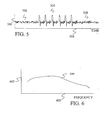
- an example of a noisy speech signal is shown with time along horizontal axis 500 and the amplitude of the speech signal shown along vertical axis 502.
- the speech signal includes an active speech area 504 and two pauses 506 and 508.
- the active speech portion 504 of the speech signal has a higher energy content than the pauses 506 and 508.
- FIG. 6 provides an example of the spectral content of noise samples taken during a pause in speech such as pause 506 of FIG. 5.
- frequency is shown along horizontal axis 600 and the amplitude of each frequency component is shown along vertical axis 602.
- the spectral content has a higher magnitude in the middle band of frequencies and a lower magnitude at the lower and higher frequencies.
- this frequency signature is used to generate a noise correction value for each frequency of the speech signal. The respective correction values are then subtracted from the corresponding frequency values of the speech signal to reduce the noise in the speech signal.
- FIG. 7 provides a block diagram for one embodiment of noise reduction module 408 and feature extractor 410 of FIG. 4.
- noise reduction module 408 performs a spectral subtraction and feature extractor 410 produces Cepstral coefficients as its extracted features.
- noise reduction module 408 and feature extractor 410 are integrated together to form a single operating module. Although the functions of these two modules are integrated in FIG. 7, those skilled in the art will recognize that the individual components used to produce the embodiment of FIG. 7 need not be found on the same chip in hardware implementations of the invention or in the same software module in software implementations of the invention.
- FFT 700 converts the time-domain digital values into a series of frequency-domain values describing the frequency content of frames of the speech signal.
- the frequency domain values produced by FFT 700 are provided to a noise identification module 702.
- Noise identification module 702 looks at the energy content of the frequency domain values of each frame to identify whether the current portion of the speech signal represents active speech or a pause in speech. Techniques for identifying pauses in speech are well known in the art.
- the frequency-domain values produced by FFT 700 are also provided to a weighting module 704 that receives control values from noise identification module 702 and has access to a memory containing past noise samples 706.
- noise identification module 702 determines that the current section of speech corresponds to a pause in speech, it activates weighting module 704 to generate a new set of noise reduction values.
- weighting module 704 produces the noise reduction values by combining the last "N” noise frames from the speech signal. These past “N” frames are recovered from memory 706. Under one embodiment, weighting module 704 combines the past "N” noise frames by more heavily weighting the more recent noise frames relative to the older noise frames in memory 706. As part of its processing of the new noise correction value, weighting module 704 also stores the current noise frame in memory 706.
- the correction values produced by weighting module 704 are stored in a memory 708 that is accessed by a spectral subtractor 710.
- Spectral subtractor 710 also receives the frequency domain values from FFT 700. For each frequency associated with the correction values stored in memory 708, spectral subtractor 710 subtracts the corresponding value in memory 708 from the frequency-domain value provided by FFT 700. This results in pseudo-clean frequency domain values at the output of spectral subtractor 710.
- the pseudo-clean frequency values output by spectral subtractor 710 are provided to a log module 712, which takes the log of each of the values.
- the log values are then provided to an inverse Fast Fourier Transform 714 which takes the inverse Fast Fourier Transform of the log values to produce a set of Cepstral coefficients for each frame of the speech signal.
- These sets of Cepstral coefficients represent the output of the feature extractor.
- the present invention uses Stereo Piecewise Linear Compensation for Environments (SPLICE) as the noise reduction technique.
- SPLICE noise reduction technique is discussed in detail in a U.S. Patent Application entitled METHOD OF NOISE REDUCTION USING CORRECTION VECTORS, filed on even date herewith, having attorney docket number M61.12-0325 and hereby incorporated by reference.
- noise is reduced by estimating the most likely clean feature vector that could be represented by a noisy feature vector from a noisy pattern signal. This is done by selecting a correction vector to add to the noisy feature vector to form the clean feature vector. To select the correction vector, the method determines which of a set of mixture components the noisy feature vector best matches. The correction vector associated with that mixture component is then added to the noisy feature vector.
- Each correction vector is formed in part by subtracting a sequence of noisy channel feature vectors from a sequence of clean channel feature vectors, where the noisy channel and the clean channel contain the same speech signal, but where the noisy channel has additive noise.
- the correction vectors are formed before either the training data or test data are provided to the noise reduction module.
- multiple sets of training data are used to incorporate multiple types of noisy environments in the training model.
- some training data is collected at a train platform, while other data is collected in a car, and still further data is collected in an airplane.
- FIG. 8 provides a flow diagram of one method under the present invention for training a model using multiple sets of training data.
- one set of training data with additive noise is created, by for example having a trainer speak in a selected noisy environment.
- one or more noise reduction techniques are applied to the set of training data.
- the noise reduction techniques applied to the training data in step 802 can be the same for each type of noisy environment or may be tailored for the specific noisy environment upon which the noise reduction techniques are being applied.
- step 804 the method determines if there is another set of training data to be collected. If there is another set, the process returns to step 800.
- each set of training data is associated with a different type of noise. Thus, one set may contain air-conditioning noise, and another may contain background speech noise.
- step 806 the acoustic model is trained using all of the sets of pseudo-clean training data that result from the noise reduction techniques of step 802.
- the embodiments of the present invention produce more sharply defined models. This can be seen in FIGS. 9 through 12.
- FIG. 9 shows three probability distributions for a unit of speech.
- the feature vector from the speech signal is shown along horizontal axis 900 and the probability of the speech unit is shown along vertical axis 902.
- Probability distributions, 904, 906 and 908 of FIG. 9 are each associated with a different set of training data.
- each of the probability distributions is associated with a different type of additive noise.
- the sets of training data have not been passed through a noise reduction module.
- a probability distribution such as distribution 1000 of FIG. 10 is created. As in FIG. 9, the values of the feature vectors are shown along horizontal axis 1002 and the probability of the unit of speech is shown along vertical axis 1004.
- probability distributions 904, 906 and 908 are spread out along the horizontal axis, the resulting combined probability distribution is flat. Such a distribution causes the model to be broadly defined so that the level of certainty in selecting the proper unit of speech is reduced since a given speech signal will produce similar probabilities for a large number of speech units.
- FIG. 11 shows the effects of applying noise reduction to multiple sets of training data.
- the feature vector values after noise reduction are shown along horizontal axis 1100 and the probability of a unit of speech is shown along vertical axis 1102.
- the three probability distributions of FIG. 9 have been brought closer together by the noise reduction techniques. This results in distributions 1104, 1106 and 1108 respectively.
- the combined distribution 1200 shown in FIG. 12 is more sharply defined. Having such sharp definition in the probability distribution results in more certainty in the decision making process for selecting a unit of speech given an input speech signal.
- the sharpness of the definition is shown in distribution 1200 by the fact that the distribution rises quickly near a particular feature vector along the feature vectors of horizontal axis 1202 and provides a higher probability along vertical axis 1206.
- FIG. 13 provides a block diagram of a noise reduction module 1300 for one such embodiment of the present invention.
- noise reduction module 1300 the noise in the input test speech signal is sampled by a noise sampler 1301, by for example using the technique described above in connection with FIG. 5.
- the noise sample is provided to a noise comparator 1302, which compares the spectral content of the noise in the test signal to samples of training noise stored in memory 1304. Note that multiple samples of noise may be stored for each set of training data. The number of samples stored is selected by striking a balance between memory usage and the accuracy desired for the noise reduction selection process.
- noise comparator 1302 retrieves the set identifier for the matching signal from memory 1304.
- the set identifier is provided to a noise reduction selector 1303, which retrieves the names of the noise reduction techniques that were applied to the identified set of training data. To do this, noise reduction selector 1303 accesses a training set/noise reduction database 1305, which contains a list of noise reduction techniques that were applied to each set of training data.
- noise reduction selector 1303 routes the test data to the noise reduction modules associated with the identified set or cluster. In FIG. 13, this involves routing the test data to one of the noise reduction modules 1306, 1308, or 1310. Note that although noise reduction modules 1306, 1308, and 1310 are shown in parallel in FIG.13, in other embodiments, the test data is passed through a series of noise reduction modules. The output of the selected noise reduction modules is the "pseudo-clean" test data.
- multiple acoustic models are trained using different sets of training data, different noise reduction techniques or combinations of both.
- different sets of pseudo-clean training data are generated and then used to form different respective models, instead of combining the different sets of training data into a single model as was discussed above.
- each noise reduction technique that is used to form the respective pseudo-clean training data is also applied to the test data. This creates a plurality of sets of pseudo-clean test data, with one set for each respective model. Each set of pseudo-clean test data is then applied against its respective model to find a probability for the model/ test data pair.
- the decoder then examines all of the probabilities and selects the model/test data pair that provides the highest probability. This selection can be made based on the probability across the entire speech signal such that one model and one respective set of noise reduction techniques is applied across the entire speech signal or the selection can be made based on a probability for a segment of speech such that different segments use different models and noise reduction techniques. For example, a first phoneme may be decoded using one model/test data pair while a neighboring phoneme is decoded using a second model/test data pair. Using such a technique allows the decoder to inherently select the best noise reduction technique and model to apply to each segment of test data.
- different sets of pseudo-clean training data are formed using different noise reduction techniques but only one model is constructed.
- the different noise reduction techniques are then applied to the test data to form multiple sets of pseudo-clean test data.
- Each different set of pseudo-clean test data is applied against the model and the decoder selects the pseudo-clean test data that generates the highest probability. This selection can be made based on a probability across the entire speech signal or it can be made based on a probability for a segment of the speech signal.
Landscapes
- Engineering & Computer Science (AREA)
- Physics & Mathematics (AREA)
- Multimedia (AREA)
- Acoustics & Sound (AREA)
- Human Computer Interaction (AREA)
- Audiology, Speech & Language Pathology (AREA)
- Health & Medical Sciences (AREA)
- Computational Linguistics (AREA)
- Theoretical Computer Science (AREA)
- Artificial Intelligence (AREA)
- Data Mining & Analysis (AREA)
- Bioinformatics & Cheminformatics (AREA)
- General Physics & Mathematics (AREA)
- Computer Vision & Pattern Recognition (AREA)
- Quality & Reliability (AREA)
- Signal Processing (AREA)
- Bioinformatics & Computational Biology (AREA)
- Evolutionary Computation (AREA)
- Evolutionary Biology (AREA)
- Life Sciences & Earth Sciences (AREA)
- General Engineering & Computer Science (AREA)
- Noise Elimination (AREA)
- Filters That Use Time-Delay Elements (AREA)
- Compression, Expansion, Code Conversion, And Decoders (AREA)
- Holo Graphy (AREA)
- Inspection Of Paper Currency And Valuable Securities (AREA)
- Circuit For Audible Band Transducer (AREA)
Applications Claiming Priority (2)
| Application Number | Priority Date | Filing Date | Title |
|---|---|---|---|
| US688950 | 2000-10-16 | ||
| US09/688,950 US6876966B1 (en) | 2000-10-16 | 2000-10-16 | Pattern recognition training method and apparatus using inserted noise followed by noise reduction |
Publications (3)
| Publication Number | Publication Date |
|---|---|
| EP1199708A2 true EP1199708A2 (de) | 2002-04-24 |
| EP1199708A3 EP1199708A3 (de) | 2003-10-15 |
| EP1199708B1 EP1199708B1 (de) | 2006-11-29 |
Family
ID=24766456
Family Applications (1)
| Application Number | Title | Priority Date | Filing Date |
|---|---|---|---|
| EP01124141A Expired - Lifetime EP1199708B1 (de) | 2000-10-16 | 2001-10-10 | Rauschrobuste Mustererkennung |
Country Status (5)
| Country | Link |
|---|---|
| US (1) | US6876966B1 (de) |
| EP (1) | EP1199708B1 (de) |
| JP (1) | JP4195211B2 (de) |
| AT (1) | ATE347161T1 (de) |
| DE (1) | DE60124842T2 (de) |
Cited By (11)
| Publication number | Priority date | Publication date | Assignee | Title |
|---|---|---|---|---|
| WO2004104908A1 (en) * | 2003-05-21 | 2004-12-02 | Koninklijke Philips Electronics N.V. | Method and device for verifying the identity of an object |
| WO2009039897A1 (en) | 2007-09-26 | 2009-04-02 | Fraunhofer - Gesellschaft Zur Förderung Der Angewandten Forschung E.V. | Apparatus and method for extracting an ambient signal in an apparatus and method for obtaining weighting coefficients for extracting an ambient signal and computer program |
| WO2010002266A1 (en) | 2008-06-30 | 2010-01-07 | Tandberg Telecom As | Method and device for typing noise removal |
| US8041026B1 (en) | 2006-02-07 | 2011-10-18 | Avaya Inc. | Event driven noise cancellation |
| CN102419974A (zh) * | 2010-09-24 | 2012-04-18 | 国际商业机器公司 | 处理语音识别的稀疏表示特征的方法和系统 |
| WO2014182453A3 (en) * | 2013-05-06 | 2014-12-31 | Motorola Mobility Llc | Method and apparatus for training a voice recognition model database |
| US9275638B2 (en) | 2013-03-12 | 2016-03-01 | Google Technology Holdings LLC | Method and apparatus for training a voice recognition model database |
| CN105448303A (zh) * | 2015-11-27 | 2016-03-30 | 百度在线网络技术(北京)有限公司 | 语音信号的处理方法和装置 |
| CN110505332A (zh) * | 2019-09-05 | 2019-11-26 | 深圳传音控股股份有限公司 | 一种降噪方法、装置、移动终端及存储介质 |
| CN111863008A (zh) * | 2020-07-07 | 2020-10-30 | 北京达佳互联信息技术有限公司 | 一种音频降噪方法、装置及存储介质 |
| US11557308B2 (en) | 2013-03-12 | 2023-01-17 | Google Llc | Method and apparatus for estimating variability of background noise for noise suppression |
Families Citing this family (60)
| Publication number | Priority date | Publication date | Assignee | Title |
|---|---|---|---|---|
| US6778994B2 (en) | 2001-05-02 | 2004-08-17 | Victor Gogolak | Pharmacovigilance database |
| US7542961B2 (en) * | 2001-05-02 | 2009-06-02 | Victor Gogolak | Method and system for analyzing drug adverse effects |
| US7925612B2 (en) * | 2001-05-02 | 2011-04-12 | Victor Gogolak | Method for graphically depicting drug adverse effect risks |
| US7461006B2 (en) * | 2001-08-29 | 2008-12-02 | Victor Gogolak | Method and system for the analysis and association of patient-specific and population-based genomic data with drug safety adverse event data |
| US7165028B2 (en) * | 2001-12-12 | 2007-01-16 | Texas Instruments Incorporated | Method of speech recognition resistant to convolutive distortion and additive distortion |
| US7209881B2 (en) * | 2001-12-20 | 2007-04-24 | Matsushita Electric Industrial Co., Ltd. | Preparing acoustic models by sufficient statistics and noise-superimposed speech data |
| US7130776B2 (en) * | 2002-03-25 | 2006-10-31 | Lockheed Martin Corporation | Method and computer program product for producing a pattern recognition training set |
| US7117148B2 (en) | 2002-04-05 | 2006-10-03 | Microsoft Corporation | Method of noise reduction using correction vectors based on dynamic aspects of speech and noise normalization |
| US7174292B2 (en) * | 2002-05-20 | 2007-02-06 | Microsoft Corporation | Method of determining uncertainty associated with acoustic distortion-based noise reduction |
| US7107210B2 (en) * | 2002-05-20 | 2006-09-12 | Microsoft Corporation | Method of noise reduction based on dynamic aspects of speech |
| US7103540B2 (en) * | 2002-05-20 | 2006-09-05 | Microsoft Corporation | Method of pattern recognition using noise reduction uncertainty |
| JP4352790B2 (ja) * | 2002-10-31 | 2009-10-28 | セイコーエプソン株式会社 | 音響モデル作成方法および音声認識装置ならびに音声認識装置を有する乗り物 |
| US7370057B2 (en) * | 2002-12-03 | 2008-05-06 | Lockheed Martin Corporation | Framework for evaluating data cleansing applications |
| US20070239444A1 (en) * | 2006-03-29 | 2007-10-11 | Motorola, Inc. | Voice signal perturbation for speech recognition |
| JP4245617B2 (ja) * | 2006-04-06 | 2009-03-25 | 株式会社東芝 | 特徴量補正装置、特徴量補正方法および特徴量補正プログラム |
| JP4316583B2 (ja) | 2006-04-07 | 2009-08-19 | 株式会社東芝 | 特徴量補正装置、特徴量補正方法および特徴量補正プログラム |
| US7840287B2 (en) * | 2006-04-13 | 2010-11-23 | Fisher-Rosemount Systems, Inc. | Robust process model identification in model based control techniques |
| US8407160B2 (en) * | 2006-11-15 | 2013-03-26 | The Trustees Of Columbia University In The City Of New York | Systems, methods, and media for generating sanitized data, sanitizing anomaly detection models, and/or generating sanitized anomaly detection models |
| US8195453B2 (en) * | 2007-09-13 | 2012-06-05 | Qnx Software Systems Limited | Distributed intelligibility testing system |
| US8615397B2 (en) * | 2008-04-04 | 2013-12-24 | Intuit Inc. | Identifying audio content using distorted target patterns |
| JP5150542B2 (ja) * | 2009-03-26 | 2013-02-20 | 株式会社東芝 | パターン認識装置、パターン認識方法、及び、プログラム |
| EP2339576B1 (de) * | 2009-12-23 | 2019-08-07 | Google LLC | Mehrmodulare Eingabe in eine elektronische Vorrichtung |
| US11416214B2 (en) | 2009-12-23 | 2022-08-16 | Google Llc | Multi-modal input on an electronic device |
| US8660842B2 (en) * | 2010-03-09 | 2014-02-25 | Honda Motor Co., Ltd. | Enhancing speech recognition using visual information |
| US8265928B2 (en) * | 2010-04-14 | 2012-09-11 | Google Inc. | Geotagged environmental audio for enhanced speech recognition accuracy |
| US8468012B2 (en) | 2010-05-26 | 2013-06-18 | Google Inc. | Acoustic model adaptation using geographic information |
| US8352245B1 (en) | 2010-12-30 | 2013-01-08 | Google Inc. | Adjusting language models |
| US8296142B2 (en) | 2011-01-21 | 2012-10-23 | Google Inc. | Speech recognition using dock context |
| HUP1200018A2 (en) | 2012-01-11 | 2013-07-29 | 77 Elektronika Mueszeripari Kft | Method of training a neural network, as well as a neural network |
| US20140074466A1 (en) | 2012-09-10 | 2014-03-13 | Google Inc. | Answering questions using environmental context |
| US8484017B1 (en) | 2012-09-10 | 2013-07-09 | Google Inc. | Identifying media content |
| US9734819B2 (en) | 2013-02-21 | 2017-08-15 | Google Technology Holdings LLC | Recognizing accented speech |
| US9237225B2 (en) | 2013-03-12 | 2016-01-12 | Google Technology Holdings LLC | Apparatus with dynamic audio signal pre-conditioning and methods therefor |
| US20140278393A1 (en) | 2013-03-12 | 2014-09-18 | Motorola Mobility Llc | Apparatus and Method for Power Efficient Signal Conditioning for a Voice Recognition System |
| CN103310789B (zh) * | 2013-05-08 | 2016-04-06 | 北京大学深圳研究生院 | 一种基于改进的并行模型组合的声音事件识别方法 |
| US9842592B2 (en) | 2014-02-12 | 2017-12-12 | Google Inc. | Language models using non-linguistic context |
| US9412365B2 (en) | 2014-03-24 | 2016-08-09 | Google Inc. | Enhanced maximum entropy models |
| US9858922B2 (en) | 2014-06-23 | 2018-01-02 | Google Inc. | Caching speech recognition scores |
| US9953646B2 (en) | 2014-09-02 | 2018-04-24 | Belleau Technologies | Method and system for dynamic speech recognition and tracking of prewritten script |
| US9299347B1 (en) | 2014-10-22 | 2016-03-29 | Google Inc. | Speech recognition using associative mapping |
| KR102167719B1 (ko) | 2014-12-08 | 2020-10-19 | 삼성전자주식회사 | 언어 모델 학습 방법 및 장치, 음성 인식 방법 및 장치 |
| US9535905B2 (en) * | 2014-12-12 | 2017-01-03 | International Business Machines Corporation | Statistical process control and analytics for translation supply chain operational management |
| KR101988222B1 (ko) * | 2015-02-12 | 2019-06-13 | 한국전자통신연구원 | 대어휘 연속 음성 인식 장치 및 방법 |
| US10134394B2 (en) | 2015-03-20 | 2018-11-20 | Google Llc | Speech recognition using log-linear model |
| US9786270B2 (en) | 2015-07-09 | 2017-10-10 | Google Inc. | Generating acoustic models |
| KR102494139B1 (ko) * | 2015-11-06 | 2023-01-31 | 삼성전자주식회사 | 뉴럴 네트워크 학습 장치 및 방법과, 음성 인식 장치 및 방법 |
| US20170148466A1 (en) * | 2015-11-25 | 2017-05-25 | Tim Jackson | Method and system for reducing background sounds in a noisy environment |
| US10229672B1 (en) | 2015-12-31 | 2019-03-12 | Google Llc | Training acoustic models using connectionist temporal classification |
| US9978367B2 (en) | 2016-03-16 | 2018-05-22 | Google Llc | Determining dialog states for language models |
| US20180018973A1 (en) | 2016-07-15 | 2018-01-18 | Google Inc. | Speaker verification |
| US10832664B2 (en) | 2016-08-19 | 2020-11-10 | Google Llc | Automated speech recognition using language models that selectively use domain-specific model components |
| US10311860B2 (en) | 2017-02-14 | 2019-06-04 | Google Llc | Language model biasing system |
| US10706840B2 (en) | 2017-08-18 | 2020-07-07 | Google Llc | Encoder-decoder models for sequence to sequence mapping |
| US11929085B2 (en) | 2018-08-30 | 2024-03-12 | Dolby International Ab | Method and apparatus for controlling enhancement of low-bitrate coded audio |
| CN111210810A (zh) * | 2019-12-17 | 2020-05-29 | 秒针信息技术有限公司 | 模型训练方法和装置 |
| EP3862782A1 (de) * | 2020-02-04 | 2021-08-11 | Infineon Technologies AG | Vorrichtung und verfahren zur korrektur eines eingangssignals |
| CN111429930B (zh) * | 2020-03-16 | 2023-02-28 | 云知声智能科技股份有限公司 | 一种基于自适应采样率的降噪模型处理方法及系统 |
| CN112614484B (zh) | 2020-11-23 | 2022-05-20 | 北京百度网讯科技有限公司 | 特征信息挖掘方法、装置及电子设备 |
| CN113515556A (zh) * | 2021-04-15 | 2021-10-19 | 阿里巴巴新加坡控股有限公司 | 数据处理方法、客户端及电子设备 |
| CN114190953B (zh) * | 2021-12-09 | 2024-07-23 | 四川新源生物电子科技有限公司 | 针对脑电采集设备的脑电信号降噪模型的训练方法和系统 |
Family Cites Families (6)
| Publication number | Priority date | Publication date | Assignee | Title |
|---|---|---|---|---|
| DE4309985A1 (de) * | 1993-03-29 | 1994-10-06 | Sel Alcatel Ag | Geräuschreduktion zur Spracherkennung |
| DE4322372A1 (de) * | 1993-07-06 | 1995-01-12 | Sel Alcatel Ag | Verfahren und Vorrichtung zur Spracherkennung |
| US6067517A (en) * | 1996-02-02 | 2000-05-23 | International Business Machines Corporation | Transcription of speech data with segments from acoustically dissimilar environments |
| US6026359A (en) * | 1996-09-20 | 2000-02-15 | Nippon Telegraph And Telephone Corporation | Scheme for model adaptation in pattern recognition based on Taylor expansion |
| US5950157A (en) * | 1997-02-28 | 1999-09-07 | Sri International | Method for establishing handset-dependent normalizing models for speaker recognition |
| US6529872B1 (en) * | 2000-04-18 | 2003-03-04 | Matsushita Electric Industrial Co., Ltd. | Method for noise adaptation in automatic speech recognition using transformed matrices |
-
2000
- 2000-10-16 US US09/688,950 patent/US6876966B1/en not_active Expired - Lifetime
-
2001
- 2001-10-10 AT AT01124141T patent/ATE347161T1/de not_active IP Right Cessation
- 2001-10-10 DE DE60124842T patent/DE60124842T2/de not_active Expired - Lifetime
- 2001-10-10 EP EP01124141A patent/EP1199708B1/de not_active Expired - Lifetime
- 2001-10-16 JP JP2001317824A patent/JP4195211B2/ja not_active Expired - Fee Related
Cited By (15)
| Publication number | Priority date | Publication date | Assignee | Title |
|---|---|---|---|---|
| CN100356391C (zh) * | 2003-05-21 | 2007-12-19 | 皇家飞利浦电子股份有限公司 | 验证身份的方法、识别设备和读/写设备 |
| WO2004104908A1 (en) * | 2003-05-21 | 2004-12-02 | Koninklijke Philips Electronics N.V. | Method and device for verifying the identity of an object |
| US8041026B1 (en) | 2006-02-07 | 2011-10-18 | Avaya Inc. | Event driven noise cancellation |
| US8588427B2 (en) | 2007-09-26 | 2013-11-19 | Frauhnhofer-Gesellschaft Zur Foerderung Der Angewandten Forschung E.V. | Apparatus and method for extracting an ambient signal in an apparatus and method for obtaining weighting coefficients for extracting an ambient signal and computer program |
| WO2009039897A1 (en) | 2007-09-26 | 2009-04-02 | Fraunhofer - Gesellschaft Zur Förderung Der Angewandten Forschung E.V. | Apparatus and method for extracting an ambient signal in an apparatus and method for obtaining weighting coefficients for extracting an ambient signal and computer program |
| TWI426502B (zh) * | 2007-09-26 | 2014-02-11 | Fraunhofer Ges Forschung | 用於獲得提取環境信號的加權係數的裝置和方法中的用於提取環境信號的裝置和方法以及電腦程式 |
| WO2010002266A1 (en) | 2008-06-30 | 2010-01-07 | Tandberg Telecom As | Method and device for typing noise removal |
| EP2294697A4 (de) * | 2008-06-30 | 2016-07-20 | Cisco Systems Int Sarl | Verfahren und vorrichtung zur geräuschunterdrückung |
| CN102419974A (zh) * | 2010-09-24 | 2012-04-18 | 国际商业机器公司 | 处理语音识别的稀疏表示特征的方法和系统 |
| US9275638B2 (en) | 2013-03-12 | 2016-03-01 | Google Technology Holdings LLC | Method and apparatus for training a voice recognition model database |
| US11557308B2 (en) | 2013-03-12 | 2023-01-17 | Google Llc | Method and apparatus for estimating variability of background noise for noise suppression |
| WO2014182453A3 (en) * | 2013-05-06 | 2014-12-31 | Motorola Mobility Llc | Method and apparatus for training a voice recognition model database |
| CN105448303A (zh) * | 2015-11-27 | 2016-03-30 | 百度在线网络技术(北京)有限公司 | 语音信号的处理方法和装置 |
| CN110505332A (zh) * | 2019-09-05 | 2019-11-26 | 深圳传音控股股份有限公司 | 一种降噪方法、装置、移动终端及存储介质 |
| CN111863008A (zh) * | 2020-07-07 | 2020-10-30 | 北京达佳互联信息技术有限公司 | 一种音频降噪方法、装置及存储介质 |
Also Published As
| Publication number | Publication date |
|---|---|
| EP1199708B1 (de) | 2006-11-29 |
| JP2002140089A (ja) | 2002-05-17 |
| EP1199708A3 (de) | 2003-10-15 |
| DE60124842T2 (de) | 2007-04-12 |
| US6876966B1 (en) | 2005-04-05 |
| ATE347161T1 (de) | 2006-12-15 |
| DE60124842D1 (de) | 2007-01-11 |
| JP4195211B2 (ja) | 2008-12-10 |
Similar Documents
| Publication | Publication Date | Title |
|---|---|---|
| US6876966B1 (en) | Pattern recognition training method and apparatus using inserted noise followed by noise reduction | |
| US6985858B2 (en) | Method and apparatus for removing noise from feature vectors | |
| US6959276B2 (en) | Including the category of environmental noise when processing speech signals | |
| US7181390B2 (en) | Noise reduction using correction vectors based on dynamic aspects of speech and noise normalization | |
| KR101201146B1 (ko) | 최적의 추정을 위한 중요한 양으로서 순간적인 신호 대 잡음비를 사용하는 잡음 감소 방법 | |
| US7769582B2 (en) | Method of pattern recognition using noise reduction uncertainty | |
| US6990447B2 (en) | Method and apparatus for denoising and deverberation using variational inference and strong speech models | |
| US7133826B2 (en) | Method and apparatus using spectral addition for speaker recognition | |
| KR20050050534A (ko) | 복수-감지기형 음성 향상 방법 및 컴퓨터-판독가능 매체 | |
| US7617104B2 (en) | Method of speech recognition using hidden trajectory Hidden Markov Models | |
| US6917918B2 (en) | Method and system for frame alignment and unsupervised adaptation of acoustic models | |
| EP1199712B1 (de) | Verfahren zur Geräuschunterdrückung | |
| JP2012053218A (ja) | 音響処理装置および音響処理プログラム |
Legal Events
| Date | Code | Title | Description |
|---|---|---|---|
| PUAI | Public reference made under article 153(3) epc to a published international application that has entered the european phase |
Free format text: ORIGINAL CODE: 0009012 |
|
| AK | Designated contracting states |
Kind code of ref document: A2 Designated state(s): AT BE CH CY DE DK ES FI FR GB GR IE IT LI LU MC NL PT SE TR |
|
| AX | Request for extension of the european patent |
Free format text: AL;LT;LV;MK;RO;SI |
|
| RIN1 | Information on inventor provided before grant (corrected) |
Inventor name: DENG, LI Inventor name: HUANG, XUEDONG Inventor name: PLUMPE, MICHAEL D. |
|
| PUAL | Search report despatched |
Free format text: ORIGINAL CODE: 0009013 |
|
| AK | Designated contracting states |
Kind code of ref document: A3 Designated state(s): AT BE CH CY DE DK ES FI FR GB GR IE IT LI LU MC NL PT SE TR |
|
| AX | Request for extension of the european patent |
Extension state: AL LT LV MK RO SI |
|
| 17P | Request for examination filed |
Effective date: 20040405 |
|
| AKX | Designation fees paid |
Designated state(s): AT BE CH CY DE DK ES FI FR GB GR IE IT LI LU MC NL PT SE TR |
|
| 17Q | First examination report despatched |
Effective date: 20041029 |
|
| GRAP | Despatch of communication of intention to grant a patent |
Free format text: ORIGINAL CODE: EPIDOSNIGR1 |
|
| GRAS | Grant fee paid |
Free format text: ORIGINAL CODE: EPIDOSNIGR3 |
|
| GRAA | (expected) grant |
Free format text: ORIGINAL CODE: 0009210 |
|
| AK | Designated contracting states |
Kind code of ref document: B1 Designated state(s): AT BE CH CY DE DK ES FI FR GB GR IE IT LI LU MC NL PT SE TR |
|
| PG25 | Lapsed in a contracting state [announced via postgrant information from national office to epo] |
Ref country code: IT Free format text: LAPSE BECAUSE OF FAILURE TO SUBMIT A TRANSLATION OF THE DESCRIPTION OR TO PAY THE FEE WITHIN THE PRESCRIBED TIME-LIMIT;WARNING: LAPSES OF ITALIAN PATENTS WITH EFFECTIVE DATE BEFORE 2007 MAY HAVE OCCURRED AT ANY TIME BEFORE 2007. THE CORRECT EFFECTIVE DATE MAY BE DIFFERENT FROM THE ONE RECORDED. Effective date: 20061129 Ref country code: FI Free format text: LAPSE BECAUSE OF FAILURE TO SUBMIT A TRANSLATION OF THE DESCRIPTION OR TO PAY THE FEE WITHIN THE PRESCRIBED TIME-LIMIT Effective date: 20061129 Ref country code: LI Free format text: LAPSE BECAUSE OF FAILURE TO SUBMIT A TRANSLATION OF THE DESCRIPTION OR TO PAY THE FEE WITHIN THE PRESCRIBED TIME-LIMIT Effective date: 20061129 Ref country code: BE Free format text: LAPSE BECAUSE OF FAILURE TO SUBMIT A TRANSLATION OF THE DESCRIPTION OR TO PAY THE FEE WITHIN THE PRESCRIBED TIME-LIMIT Effective date: 20061129 Ref country code: NL Free format text: LAPSE BECAUSE OF FAILURE TO SUBMIT A TRANSLATION OF THE DESCRIPTION OR TO PAY THE FEE WITHIN THE PRESCRIBED TIME-LIMIT Effective date: 20061129 Ref country code: AT Free format text: LAPSE BECAUSE OF FAILURE TO SUBMIT A TRANSLATION OF THE DESCRIPTION OR TO PAY THE FEE WITHIN THE PRESCRIBED TIME-LIMIT Effective date: 20061129 Ref country code: CH Free format text: LAPSE BECAUSE OF FAILURE TO SUBMIT A TRANSLATION OF THE DESCRIPTION OR TO PAY THE FEE WITHIN THE PRESCRIBED TIME-LIMIT Effective date: 20061129 |
|
| REG | Reference to a national code |
Ref country code: GB Ref legal event code: FG4D |
|
| REG | Reference to a national code |
Ref country code: IE Ref legal event code: FG4D Ref country code: CH Ref legal event code: EP |
|
| REG | Reference to a national code |
Ref country code: IE Ref legal event code: FG4D |
|
| REF | Corresponds to: |
Ref document number: 60124842 Country of ref document: DE Date of ref document: 20070111 Kind code of ref document: P |
|
| PG25 | Lapsed in a contracting state [announced via postgrant information from national office to epo] |
Ref country code: SE Free format text: LAPSE BECAUSE OF FAILURE TO SUBMIT A TRANSLATION OF THE DESCRIPTION OR TO PAY THE FEE WITHIN THE PRESCRIBED TIME-LIMIT Effective date: 20070228 Ref country code: DK Free format text: LAPSE BECAUSE OF FAILURE TO SUBMIT A TRANSLATION OF THE DESCRIPTION OR TO PAY THE FEE WITHIN THE PRESCRIBED TIME-LIMIT Effective date: 20070228 |
|
| PG25 | Lapsed in a contracting state [announced via postgrant information from national office to epo] |
Ref country code: ES Free format text: LAPSE BECAUSE OF FAILURE TO SUBMIT A TRANSLATION OF THE DESCRIPTION OR TO PAY THE FEE WITHIN THE PRESCRIBED TIME-LIMIT Effective date: 20070312 |
|
| PG25 | Lapsed in a contracting state [announced via postgrant information from national office to epo] |
Ref country code: PT Free format text: LAPSE BECAUSE OF FAILURE TO SUBMIT A TRANSLATION OF THE DESCRIPTION OR TO PAY THE FEE WITHIN THE PRESCRIBED TIME-LIMIT Effective date: 20070430 |
|
| NLV1 | Nl: lapsed or annulled due to failure to fulfill the requirements of art. 29p and 29m of the patents act | ||
| REG | Reference to a national code |
Ref country code: CH Ref legal event code: PL |
|
| ET | Fr: translation filed | ||
| PLBE | No opposition filed within time limit |
Free format text: ORIGINAL CODE: 0009261 |
|
| STAA | Information on the status of an ep patent application or granted ep patent |
Free format text: STATUS: NO OPPOSITION FILED WITHIN TIME LIMIT |
|
| 26N | No opposition filed |
Effective date: 20070830 |
|
| PG25 | Lapsed in a contracting state [announced via postgrant information from national office to epo] |
Ref country code: GR Free format text: LAPSE BECAUSE OF FAILURE TO SUBMIT A TRANSLATION OF THE DESCRIPTION OR TO PAY THE FEE WITHIN THE PRESCRIBED TIME-LIMIT Effective date: 20070301 |
|
| PG25 | Lapsed in a contracting state [announced via postgrant information from national office to epo] |
Ref country code: MC Free format text: LAPSE BECAUSE OF NON-PAYMENT OF DUE FEES Effective date: 20071031 |
|
| PG25 | Lapsed in a contracting state [announced via postgrant information from national office to epo] |
Ref country code: IE Free format text: LAPSE BECAUSE OF NON-PAYMENT OF DUE FEES Effective date: 20071010 |
|
| PG25 | Lapsed in a contracting state [announced via postgrant information from national office to epo] |
Ref country code: CY Free format text: LAPSE BECAUSE OF FAILURE TO SUBMIT A TRANSLATION OF THE DESCRIPTION OR TO PAY THE FEE WITHIN THE PRESCRIBED TIME-LIMIT Effective date: 20061129 Ref country code: LU Free format text: LAPSE BECAUSE OF NON-PAYMENT OF DUE FEES Effective date: 20071010 |
|
| PG25 | Lapsed in a contracting state [announced via postgrant information from national office to epo] |
Ref country code: TR Free format text: LAPSE BECAUSE OF FAILURE TO SUBMIT A TRANSLATION OF THE DESCRIPTION OR TO PAY THE FEE WITHIN THE PRESCRIBED TIME-LIMIT Effective date: 20061129 |
|
| REG | Reference to a national code |
Ref country code: DE Ref legal event code: R082 Ref document number: 60124842 Country of ref document: DE Representative=s name: GRUENECKER, KINKELDEY, STOCKMAIR & SCHWANHAEUS, DE |
|
| REG | Reference to a national code |
Ref country code: GB Ref legal event code: 732E Free format text: REGISTERED BETWEEN 20150108 AND 20150114 |
|
| REG | Reference to a national code |
Ref country code: DE Ref legal event code: R082 Ref document number: 60124842 Country of ref document: DE Representative=s name: GRUENECKER PATENT- UND RECHTSANWAELTE PARTG MB, DE Effective date: 20150126 Ref country code: DE Ref legal event code: R081 Ref document number: 60124842 Country of ref document: DE Owner name: MICROSOFT TECHNOLOGY LICENSING, LLC, REDMOND, US Free format text: FORMER OWNER: MICROSOFT CORP., REDMOND, WASH., US Effective date: 20150126 |
|
| REG | Reference to a national code |
Ref country code: FR Ref legal event code: TP Owner name: MICROSOFT TECHNOLOGY LICENSING, LLC, US Effective date: 20150724 |
|
| REG | Reference to a national code |
Ref country code: FR Ref legal event code: PLFP Year of fee payment: 16 |
|
| REG | Reference to a national code |
Ref country code: FR Ref legal event code: PLFP Year of fee payment: 17 |
|
| REG | Reference to a national code |
Ref country code: FR Ref legal event code: PLFP Year of fee payment: 18 |
|
| PGFP | Annual fee paid to national office [announced via postgrant information from national office to epo] |
Ref country code: FR Payment date: 20180913 Year of fee payment: 18 |
|
| PGFP | Annual fee paid to national office [announced via postgrant information from national office to epo] |
Ref country code: DE Payment date: 20180925 Year of fee payment: 18 |
|
| PGFP | Annual fee paid to national office [announced via postgrant information from national office to epo] |
Ref country code: GB Payment date: 20181010 Year of fee payment: 18 |
|
| REG | Reference to a national code |
Ref country code: DE Ref legal event code: R119 Ref document number: 60124842 Country of ref document: DE |
|
| PG25 | Lapsed in a contracting state [announced via postgrant information from national office to epo] |
Ref country code: DE Free format text: LAPSE BECAUSE OF NON-PAYMENT OF DUE FEES Effective date: 20200501 |
|
| GBPC | Gb: european patent ceased through non-payment of renewal fee |
Effective date: 20191010 |
|
| PG25 | Lapsed in a contracting state [announced via postgrant information from national office to epo] |
Ref country code: FR Free format text: LAPSE BECAUSE OF NON-PAYMENT OF DUE FEES Effective date: 20191031 Ref country code: GB Free format text: LAPSE BECAUSE OF NON-PAYMENT OF DUE FEES Effective date: 20191010 |