EP1200534B1 - Abdichtmasse und verfahren zur herstellung einer abdichtung - Google Patents
Abdichtmasse und verfahren zur herstellung einer abdichtung Download PDFInfo
- Publication number
- EP1200534B1 EP1200534B1 EP00958346A EP00958346A EP1200534B1 EP 1200534 B1 EP1200534 B1 EP 1200534B1 EP 00958346 A EP00958346 A EP 00958346A EP 00958346 A EP00958346 A EP 00958346A EP 1200534 B1 EP1200534 B1 EP 1200534B1
- Authority
- EP
- European Patent Office
- Prior art keywords
- sealing
- acrylate
- thixotropic agent
- sealant
- sealing composition
- Prior art date
- Legal status (The legal status is an assumption and is not a legal conclusion. Google has not performed a legal analysis and makes no representation as to the accuracy of the status listed.)
- Expired - Lifetime
Links
- 238000007789 sealing Methods 0.000 title claims abstract description 19
- 238000000034 method Methods 0.000 title claims abstract description 9
- 239000003566 sealing material Substances 0.000 title abstract 4
- NIXOWILDQLNWCW-UHFFFAOYSA-M Acrylate Chemical compound [O-]C(=O)C=C NIXOWILDQLNWCW-UHFFFAOYSA-M 0.000 claims abstract description 13
- 230000000750 progressive effect Effects 0.000 claims abstract 3
- 239000013008 thixotropic agent Substances 0.000 claims description 15
- 239000000203 mixture Substances 0.000 claims 7
- 239000007787 solid Substances 0.000 claims 1
- 239000000565 sealant Substances 0.000 description 20
- 229920001577 copolymer Polymers 0.000 description 6
- 150000001875 compounds Chemical class 0.000 description 5
- 238000006116 polymerization reaction Methods 0.000 description 5
- 239000007921 spray Substances 0.000 description 4
- 239000011324 bead Substances 0.000 description 2
- 238000001816 cooling Methods 0.000 description 2
- 238000010438 heat treatment Methods 0.000 description 2
- 239000007788 liquid Substances 0.000 description 2
- 239000004033 plastic Substances 0.000 description 2
- XLYOFNOQVPJJNP-UHFFFAOYSA-N water Substances O XLYOFNOQVPJJNP-UHFFFAOYSA-N 0.000 description 2
- 230000015572 biosynthetic process Effects 0.000 description 1
- 239000003795 chemical substances by application Substances 0.000 description 1
- 208000018459 dissociative disease Diseases 0.000 description 1
- 230000000694 effects Effects 0.000 description 1
- 238000001125 extrusion Methods 0.000 description 1
- 230000002349 favourable effect Effects 0.000 description 1
- 239000000835 fiber Substances 0.000 description 1
- 230000009969 flowable effect Effects 0.000 description 1
- 230000009477 glass transition Effects 0.000 description 1
- 239000004816 latex Substances 0.000 description 1
- 229920000126 latex Polymers 0.000 description 1
- 238000002360 preparation method Methods 0.000 description 1
- 238000001228 spectrum Methods 0.000 description 1
- 239000010409 thin film Substances 0.000 description 1
Images
Classifications
-
- C—CHEMISTRY; METALLURGY
- C09—DYES; PAINTS; POLISHES; NATURAL RESINS; ADHESIVES; COMPOSITIONS NOT OTHERWISE PROVIDED FOR; APPLICATIONS OF MATERIALS NOT OTHERWISE PROVIDED FOR
- C09K—MATERIALS FOR MISCELLANEOUS APPLICATIONS, NOT PROVIDED FOR ELSEWHERE
- C09K3/00—Materials not provided for elsewhere
- C09K3/10—Materials in mouldable or extrudable form for sealing or packing joints or covers
-
- C—CHEMISTRY; METALLURGY
- C09—DYES; PAINTS; POLISHES; NATURAL RESINS; ADHESIVES; COMPOSITIONS NOT OTHERWISE PROVIDED FOR; APPLICATIONS OF MATERIALS NOT OTHERWISE PROVIDED FOR
- C09K—MATERIALS FOR MISCELLANEOUS APPLICATIONS, NOT PROVIDED FOR ELSEWHERE
- C09K2200/00—Chemical nature of materials in mouldable or extrudable form for sealing or packing joints or covers
- C09K2200/06—Macromolecular organic compounds, e.g. prepolymers
- C09K2200/0615—Macromolecular organic compounds, e.g. prepolymers obtained by reactions only involving carbon-to-carbon unsaturated bonds
- C09K2200/0625—Polyacrylic esters or derivatives thereof
Definitions
- the invention relates to a sealing compound based on acrylate and a method for sealing columns.
- EP 504 630 A From EP 504 630 A is to the prior art there known a Step by step polymerization in relation to water (latex) based sealants described. The sealant should also react. This is not favorable for a processing at high temperatures.
- EP A 615 008 relates to Abdichtmassen and mentioned acrylate fibers as thixotropic agent. However, that is this already no sealing compound with a stage polymerization.
- the object of the invention is to provide a sealing compound which is very effective especially for narrow gaps. Furthermore also the task of specifying a method for sealing columns. These Task is solved in claims 1 and 4, respectively.
- the sealant is important that the acrylate, a Copolymer, obtained by way of a stage polymerization and with a Thixotropic agent is provided.
- the molecular weight of the acrylate copolymer is in the range of 20,000 to 70,000, preferably in the range of 25,000 to 50,000.
- a sealing compound is thus available which is very effective especially for narrow columns is.
- the sealant is at room temperatures almost firm, with high bond strength, but hardens not from.
- the adhesion of the sealant to Spaltbegrenzungsletonn is surprisingly strong. Even with usual Room temperature remains an adhesion. It does not come to tearing the sealant and thus about to capillary formation, into which liquid / water could invade.
- the sealing compound preferably adjusted so that they - first - at elevated temperature well above 50 ° C, preferably above 100 ° C, is flowable.
- the Thixotropic agent improves the cold flow properties and increases the heat resistance. It may be particular also be a stereothixotropic agent.
- the thixotropic agent is also preferred one based on acrylate. There are several Possibilities known in the art.
- the Molecular weight of the thixotropic agent is in the range from 50,000 to 120,000, preferably in the range of 70,000 to 100,000. Further preferred is the molecular weight the thixotropic agent so chosen, that it is higher than the molecular weight of each Acrylate copolymer of the sealant.
- the thixotropic agent moreover, preferably also has a higher one Glass transition temperature as said acrylate copolymer the sealant on. This contributes to an advantageous good temperature stability at.
- the thixotropic agent provides in said acrylate copolymer of Sealant, as it were an armoring effect.
- the invention relates to a method for Caulking columns, with a sealant on Acrylate base obtained by step polymerization is, at elevated temperature of over 50 °, preferred above 100 ° C, is introduced into a gap. Surprised has been shown that in such sealing of columns no or only a very small preparation the column is required. In particular, tolerated this process still contains moisture in the gap. Due to the high temperature of the sealant When entering the gap moisture is at the same time expelled from the gap.
- the sealant preferably has a thixotropic agent more preferably one based on acrylate is.
- the acrylate based sealant is total preferably one with molecular weights in the range of 25,000 to 60,000.
- By multi-stage polymerization is a molecular weight curve in reached a very narrow spectrum.
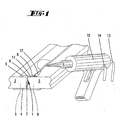
- the sole figure of the drawing shows schematically partly in section and in perspective, a fugue, which is covered with a joint strip and in which Groove the sealant is introduced.
- the joint 1 is a T-shaped plastic strip. 6 introduced, the vertical T-section 7 in the joint 1 protrudes, while the horizontal T-lugs 8, 9 over the length of the joint 1, the adjacent wall parts 2, 3, on the outside, cover.
- a heatable spray gun 10 is under Raising a horizontal T-section 8 Sealant 11, as schematically shown in cross-section, both in the actual joint 1 as well as on the T-section 8 covered subsequent surface section of the wall part 2 introduced.
- the spray gun 10 has a hydraulic connection 13 and an electrical connection 14.
- the hydraulic connection 13 supplies a hydraulic extrusion ram within the spray gun, while the electrical connection 14, the required Heating, by heating wires laid in the spray gun, allows.
- the introduced sealant is at temperatures introduced by about 120 ° in a liquid state. After the introduction is usually a certain Proportion 12 of the sealant swelled out of the joint on the outside. This can after cooling by means of a spatula be removed.
Landscapes
- Chemical & Material Sciences (AREA)
- Engineering & Computer Science (AREA)
- Materials Engineering (AREA)
- Organic Chemistry (AREA)
- Sealing Material Composition (AREA)
- Glass Compositions (AREA)
- Addition Polymer Or Copolymer, Post-Treatments, Or Chemical Modifications (AREA)
- Organic Low-Molecular-Weight Compounds And Preparation Thereof (AREA)
Description
Claims (6)
- Abdichtmasse auf Acrylatbasis, wobei das Acrylat durch eine Stufenpolymerisation erhalten ist und mit einem Thixotropiemittel versehen ist, wobei weiter die Abdichtmasse bei Raumtemperatur fest ist und erst bei erhöhter Temperatur deutlich über 50° C, bevorzugt oberhalb von 100° C, fließfähig ist.
- Abdichtmasse nach Anspruch 1, dadurch gekennzeichnet, dass das Thixotropiemitt auf Acrylatbasis gebildet ist.
- Abdichtmasse nach einem der Ansprüche 1 oder 2, dadurch gekennzeichnet, dass die Abdichtmasse ein Molekulargewicht im Bereich von 25000 bis 60000 aufweist.
- Verfahren zum Abdichten von Spalten, wobei eine Dichtmasse auf Acrylatbasis, die durch Stufenpolymerisation erhalten ist, bei erhöhter Temperatur von über 50°, bevorzugt über 100°, in den Spalt eingebracht - wird.
- Verfahren nach Anspruch 4, dadurch gekennzeichnet, dass die Dichtmasse ein Thixotropiemittel enthält.
- Verfahren nach einem der Ansprüche 4 oder 5, dadurch gekennzeichnet, dass das Thixotropiemittel auf Acrylatbasis gebildet ist.
Applications Claiming Priority (5)
| Application Number | Priority Date | Filing Date | Title |
|---|---|---|---|
| DE19935583 | 1999-08-02 | ||
| DE19935583 | 1999-08-02 | ||
| DE19944387A DE19944387A1 (de) | 1999-08-02 | 1999-09-16 | Abdichtmasse und Verfahren zur Herstellung einer Abdichtung |
| DE19944387 | 1999-09-16 | ||
| PCT/EP2000/007436 WO2001009264A2 (de) | 1999-08-02 | 2000-08-01 | Abdichtmasse und verfahren zur herstellung einer abdichtung |
Publications (2)
| Publication Number | Publication Date |
|---|---|
| EP1200534A2 EP1200534A2 (de) | 2002-05-02 |
| EP1200534B1 true EP1200534B1 (de) | 2005-10-19 |
Family
ID=26054383
Family Applications (1)
| Application Number | Title | Priority Date | Filing Date |
|---|---|---|---|
| EP00958346A Expired - Lifetime EP1200534B1 (de) | 1999-08-02 | 2000-08-01 | Abdichtmasse und verfahren zur herstellung einer abdichtung |
Country Status (5)
| Country | Link |
|---|---|
| EP (1) | EP1200534B1 (de) |
| AT (1) | ATE307179T1 (de) |
| AU (1) | AU6989900A (de) |
| DE (1) | DE50011390D1 (de) |
| WO (1) | WO2001009264A2 (de) |
Family Cites Families (2)
| Publication number | Priority date | Publication date | Assignee | Title |
|---|---|---|---|---|
| US5077360A (en) * | 1991-03-20 | 1991-12-31 | Tremco Inc. | Acrylic sealant composition and methods relating thereto |
| US5362562A (en) * | 1993-03-12 | 1994-11-08 | Cytec Technology Corp. | Crimped acrylic fibers having improved thixotropic performance |
-
2000
- 2000-08-01 WO PCT/EP2000/007436 patent/WO2001009264A2/de not_active Ceased
- 2000-08-01 AU AU69899/00A patent/AU6989900A/en not_active Abandoned
- 2000-08-01 EP EP00958346A patent/EP1200534B1/de not_active Expired - Lifetime
- 2000-08-01 DE DE50011390T patent/DE50011390D1/de not_active Expired - Fee Related
- 2000-08-01 AT AT00958346T patent/ATE307179T1/de not_active IP Right Cessation
Also Published As
| Publication number | Publication date |
|---|---|
| AU6989900A (en) | 2001-02-19 |
| WO2001009264A3 (de) | 2001-08-09 |
| WO2001009264A2 (de) | 2001-02-08 |
| EP1200534A2 (de) | 2002-05-02 |
| ATE307179T1 (de) | 2005-11-15 |
| DE50011390D1 (de) | 2005-11-24 |
Similar Documents
| Publication | Publication Date | Title |
|---|---|---|
| EP2456943B1 (de) | Verfahren zum herstellen einer isolierglasscheibe | |
| EP3046813B1 (de) | Fügeverfahren | |
| EP0158046B1 (de) | Verbindung zweier Bauteile, insbesondere zweier Kunststoffhalbschalen | |
| DE60007054T2 (de) | Verbundblech zum Tiefziehen | |
| EP3611237A1 (de) | Verfahren zur herstellung einer versiegelten falzverbindung | |
| EP1200534B1 (de) | Abdichtmasse und verfahren zur herstellung einer abdichtung | |
| DE4441124C2 (de) | Verfahren zur Erzeugung eines haftfesten, feuchtigkeitsdichten Überzugs aus Kunststoff auf einer Unterlage und dessen Verwendung | |
| DE1271975B (de) | Thermoplastische Dichtungs-, Versiegelungs- und Klebemischung | |
| DE2206824C2 (de) | Vorrichtung zum Beschichten von Distanzprofilen für Mehrscheiben-Isolierglas mit Dicht- bzw. Klebemitteln | |
| EP3081615B1 (de) | Fugenabdichtung für eine fuge mit mindestens einer schicht einer bitumenhaltigen ersten und einer bitumenhaltigen zweiten masse | |
| CH703688B1 (de) | Verfahren zur Herstellung eines metallverstärkten Kunststoff-Verbundrohrs und metallverstärktes Kunststoff-Verbundrohr. | |
| DE19649476C2 (de) | Verfahren und Fugendichtung zum nachträglichen Abdichten von Bauwerksfugen zwischen Betonbauteilen | |
| DE19944387A1 (de) | Abdichtmasse und Verfahren zur Herstellung einer Abdichtung | |
| DE10052108B4 (de) | Verfahren zum Abdichten von Blechfügespalten | |
| WO2007135186A1 (de) | Klebverbundkörper mit erhöhter haftung | |
| EP1469021B1 (de) | (Meth)acrylatharz und Verwendung desselben | |
| AT412567B (de) | Verfahren zum spaltüberbrückenden verbinden von hohlprofilen | |
| DE102007018672A1 (de) | Anschmelzbares plastisch-elastisches Bitumen-Fugenband zur Herstellung von Nähten und von Anschlüssen und Verfahren zu dessen Herstellung | |
| EP0100876A2 (de) | Einspritzkopf, insbesondere zum Aufbringen einer Beschichtung auf flächige Werkstücke | |
| DE3209160A1 (de) | Verfahren und vorrichtung zum verpressen von rissen in bauwerksteilen mittels kunstharze | |
| DE102021113474B3 (de) | Verfahren zum Verschließen von Rohrenden | |
| DE202006006139U1 (de) | Luftleitungskanal | |
| DE883824C (de) | Verfahren zur Herstellung isolierter Metallschlaeuche | |
| DE10163844C1 (de) | Verfahren zum Zusammenbauen von Isolierglasscheiben mit innenliegendem Sprossenrahmen und polymerem Abstandshalter | |
| EP3309342A1 (de) | Verfahren zur herstellung von verklotzungen und applikationsvorrichtung |
Legal Events
| Date | Code | Title | Description |
|---|---|---|---|
| PUAI | Public reference made under article 153(3) epc to a published international application that has entered the european phase |
Free format text: ORIGINAL CODE: 0009012 |
|
| 17P | Request for examination filed |
Effective date: 20020206 |
|
| AK | Designated contracting states |
Kind code of ref document: A2 Designated state(s): AT BE CH CY DE DK ES FI FR GB GR IE IT LI LU MC NL PT SE |
|
| AX | Request for extension of the european patent |
Free format text: AL;LT;LV;MK;RO;SI |
|
| 17Q | First examination report despatched |
Effective date: 20040804 |
|
| GRAP | Despatch of communication of intention to grant a patent |
Free format text: ORIGINAL CODE: EPIDOSNIGR1 |
|
| GRAS | Grant fee paid |
Free format text: ORIGINAL CODE: EPIDOSNIGR3 |
|
| GRAA | (expected) grant |
Free format text: ORIGINAL CODE: 0009210 |
|
| AK | Designated contracting states |
Kind code of ref document: B1 Designated state(s): AT BE CH CY DE DK ES FI FR GB GR IE IT LI LU MC NL PT SE |
|
| PG25 | Lapsed in a contracting state [announced via postgrant information from national office to epo] |
Ref country code: IT Free format text: LAPSE BECAUSE OF FAILURE TO SUBMIT A TRANSLATION OF THE DESCRIPTION OR TO PAY THE FEE WITHIN THE PRESCRIBED TIME-LIMIT;WARNING: LAPSES OF ITALIAN PATENTS WITH EFFECTIVE DATE BEFORE 2007 MAY HAVE OCCURRED AT ANY TIME BEFORE 2007. THE CORRECT EFFECTIVE DATE MAY BE DIFFERENT FROM THE ONE RECORDED. Effective date: 20051019 Ref country code: GB Free format text: LAPSE BECAUSE OF FAILURE TO SUBMIT A TRANSLATION OF THE DESCRIPTION OR TO PAY THE FEE WITHIN THE PRESCRIBED TIME-LIMIT Effective date: 20051019 Ref country code: FI Free format text: LAPSE BECAUSE OF FAILURE TO SUBMIT A TRANSLATION OF THE DESCRIPTION OR TO PAY THE FEE WITHIN THE PRESCRIBED TIME-LIMIT Effective date: 20051019 Ref country code: IE Free format text: LAPSE BECAUSE OF FAILURE TO SUBMIT A TRANSLATION OF THE DESCRIPTION OR TO PAY THE FEE WITHIN THE PRESCRIBED TIME-LIMIT Effective date: 20051019 Ref country code: NL Free format text: LAPSE BECAUSE OF FAILURE TO SUBMIT A TRANSLATION OF THE DESCRIPTION OR TO PAY THE FEE WITHIN THE PRESCRIBED TIME-LIMIT Effective date: 20051019 |
|
| REG | Reference to a national code |
Ref country code: GB Ref legal event code: FG4D Free format text: NOT ENGLISH |
|
| REG | Reference to a national code |
Ref country code: CH Ref legal event code: EP |
|
| REG | Reference to a national code |
Ref country code: IE Ref legal event code: FG4D Free format text: LANGUAGE OF EP DOCUMENT: GERMAN |
|
| REF | Corresponds to: |
Ref document number: 50011390 Country of ref document: DE Date of ref document: 20051124 Kind code of ref document: P |
|
| PG25 | Lapsed in a contracting state [announced via postgrant information from national office to epo] |
Ref country code: GR Free format text: LAPSE BECAUSE OF FAILURE TO SUBMIT A TRANSLATION OF THE DESCRIPTION OR TO PAY THE FEE WITHIN THE PRESCRIBED TIME-LIMIT Effective date: 20060119 Ref country code: DK Free format text: LAPSE BECAUSE OF FAILURE TO SUBMIT A TRANSLATION OF THE DESCRIPTION OR TO PAY THE FEE WITHIN THE PRESCRIBED TIME-LIMIT Effective date: 20060119 Ref country code: SE Free format text: LAPSE BECAUSE OF FAILURE TO SUBMIT A TRANSLATION OF THE DESCRIPTION OR TO PAY THE FEE WITHIN THE PRESCRIBED TIME-LIMIT Effective date: 20060119 |
|
| PG25 | Lapsed in a contracting state [announced via postgrant information from national office to epo] |
Ref country code: ES Free format text: LAPSE BECAUSE OF FAILURE TO SUBMIT A TRANSLATION OF THE DESCRIPTION OR TO PAY THE FEE WITHIN THE PRESCRIBED TIME-LIMIT Effective date: 20060130 |
|
| PG25 | Lapsed in a contracting state [announced via postgrant information from national office to epo] |
Ref country code: PT Free format text: LAPSE BECAUSE OF FAILURE TO SUBMIT A TRANSLATION OF THE DESCRIPTION OR TO PAY THE FEE WITHIN THE PRESCRIBED TIME-LIMIT Effective date: 20060320 |
|
| NLV1 | Nl: lapsed or annulled due to failure to fulfill the requirements of art. 29p and 29m of the patents act | ||
| GBV | Gb: ep patent (uk) treated as always having been void in accordance with gb section 77(7)/1977 [no translation filed] |
Effective date: 20051019 |
|
| REG | Reference to a national code |
Ref country code: IE Ref legal event code: FD4D |
|
| PLBE | No opposition filed within time limit |
Free format text: ORIGINAL CODE: 0009261 |
|
| STAA | Information on the status of an ep patent application or granted ep patent |
Free format text: STATUS: NO OPPOSITION FILED WITHIN TIME LIMIT |
|
| PG25 | Lapsed in a contracting state [announced via postgrant information from national office to epo] |
Ref country code: LI Free format text: LAPSE BECAUSE OF NON-PAYMENT OF DUE FEES Effective date: 20060831 Ref country code: BE Free format text: LAPSE BECAUSE OF NON-PAYMENT OF DUE FEES Effective date: 20060831 Ref country code: MC Free format text: LAPSE BECAUSE OF NON-PAYMENT OF DUE FEES Effective date: 20060831 Ref country code: CH Free format text: LAPSE BECAUSE OF NON-PAYMENT OF DUE FEES Effective date: 20060831 |
|
| 26N | No opposition filed |
Effective date: 20060720 |
|
| EN | Fr: translation not filed | ||
| PG25 | Lapsed in a contracting state [announced via postgrant information from national office to epo] |
Ref country code: FR Free format text: LAPSE BECAUSE OF FAILURE TO SUBMIT A TRANSLATION OF THE DESCRIPTION OR TO PAY THE FEE WITHIN THE PRESCRIBED TIME-LIMIT Effective date: 20061208 |
|
| PG25 | Lapsed in a contracting state [announced via postgrant information from national office to epo] |
Ref country code: DE Free format text: LAPSE BECAUSE OF NON-PAYMENT OF DUE FEES Effective date: 20070301 |
|
| REG | Reference to a national code |
Ref country code: CH Ref legal event code: PL |
|
| PG25 | Lapsed in a contracting state [announced via postgrant information from national office to epo] |
Ref country code: AT Free format text: LAPSE BECAUSE OF NON-PAYMENT OF DUE FEES Effective date: 20060801 |
|
| BERE | Be: lapsed |
Owner name: ILLBRUCK G.M.B.H. Effective date: 20060831 |
|
| PG25 | Lapsed in a contracting state [announced via postgrant information from national office to epo] |
Ref country code: LU Free format text: LAPSE BECAUSE OF NON-PAYMENT OF DUE FEES Effective date: 20060801 |
|
| PG25 | Lapsed in a contracting state [announced via postgrant information from national office to epo] |
Ref country code: FR Free format text: LAPSE BECAUSE OF FAILURE TO SUBMIT A TRANSLATION OF THE DESCRIPTION OR TO PAY THE FEE WITHIN THE PRESCRIBED TIME-LIMIT Effective date: 20051019 Ref country code: CY Free format text: LAPSE BECAUSE OF FAILURE TO SUBMIT A TRANSLATION OF THE DESCRIPTION OR TO PAY THE FEE WITHIN THE PRESCRIBED TIME-LIMIT Effective date: 20051019 |