EP1201491A2 - Fahrzeuginnenmaterial, insbesondere für eine Kopfstütze - Google Patents
Fahrzeuginnenmaterial, insbesondere für eine Kopfstütze Download PDFInfo
- Publication number
- EP1201491A2 EP1201491A2 EP01116626A EP01116626A EP1201491A2 EP 1201491 A2 EP1201491 A2 EP 1201491A2 EP 01116626 A EP01116626 A EP 01116626A EP 01116626 A EP01116626 A EP 01116626A EP 1201491 A2 EP1201491 A2 EP 1201491A2
- Authority
- EP
- European Patent Office
- Prior art keywords
- absorbing member
- impact absorbing
- impact
- vehicle interior
- interior material
- Prior art date
- Legal status (The legal status is an assumption and is not a legal conclusion. Google has not performed a legal analysis and makes no representation as to the accuracy of the status listed.)
- Withdrawn
Links
- 239000000463 material Substances 0.000 title claims abstract description 31
- 238000009423 ventilation Methods 0.000 claims abstract description 34
- 229920005830 Polyurethane Foam Polymers 0.000 claims description 5
- 239000011496 polyurethane foam Substances 0.000 claims description 5
- 230000002040 relaxant effect Effects 0.000 claims description 5
- 210000004027 cell Anatomy 0.000 description 17
- 230000006835 compression Effects 0.000 description 8
- 238000007906 compression Methods 0.000 description 8
- 229920005862 polyol Polymers 0.000 description 8
- 238000010521 absorption reaction Methods 0.000 description 7
- 239000003054 catalyst Substances 0.000 description 7
- 239000000203 mixture Substances 0.000 description 7
- 150000003077 polyols Chemical class 0.000 description 7
- 238000000034 method Methods 0.000 description 6
- 230000000704 physical effect Effects 0.000 description 6
- 239000003795 chemical substances by application Substances 0.000 description 5
- 239000006260 foam Substances 0.000 description 5
- 239000012948 isocyanate Substances 0.000 description 5
- 238000004519 manufacturing process Methods 0.000 description 5
- 238000005336 cracking Methods 0.000 description 4
- 150000002513 isocyanates Chemical class 0.000 description 4
- 238000002474 experimental method Methods 0.000 description 3
- 229920001296 polysiloxane Polymers 0.000 description 3
- 239000011358 absorbing material Substances 0.000 description 2
- 238000004891 communication Methods 0.000 description 2
- 239000011162 core material Substances 0.000 description 2
- 230000007423 decrease Effects 0.000 description 2
- 230000003247 decreasing effect Effects 0.000 description 2
- 230000007547 defect Effects 0.000 description 2
- 238000010586 diagram Methods 0.000 description 2
- 230000005489 elastic deformation Effects 0.000 description 2
- 210000003127 knee Anatomy 0.000 description 2
- 238000000465 moulding Methods 0.000 description 2
- 239000011148 porous material Substances 0.000 description 2
- 230000002441 reversible effect Effects 0.000 description 2
- XLYOFNOQVPJJNP-UHFFFAOYSA-N water Substances O XLYOFNOQVPJJNP-UHFFFAOYSA-N 0.000 description 2
- 206010071366 Post-traumatic neck syndrome Diseases 0.000 description 1
- 208000021567 Whiplash injury Diseases 0.000 description 1
- 239000000654 additive Substances 0.000 description 1
- 230000015572 biosynthetic process Effects 0.000 description 1
- 230000001419 dependent effect Effects 0.000 description 1
- 230000006866 deterioration Effects 0.000 description 1
- 239000006185 dispersion Substances 0.000 description 1
- 238000004090 dissolution Methods 0.000 description 1
- 238000011156 evaluation Methods 0.000 description 1
- 238000004880 explosion Methods 0.000 description 1
- 238000005187 foaming Methods 0.000 description 1
- 125000002887 hydroxy group Chemical group [H]O* 0.000 description 1
- 238000005259 measurement Methods 0.000 description 1
- QSHDDOUJBYECFT-UHFFFAOYSA-N mercury Chemical compound [Hg] QSHDDOUJBYECFT-UHFFFAOYSA-N 0.000 description 1
- 229910052753 mercury Inorganic materials 0.000 description 1
- 238000000053 physical method Methods 0.000 description 1
- -1 polyol Isocyanate Chemical class 0.000 description 1
- 239000002994 raw material Substances 0.000 description 1
- 238000011084 recovery Methods 0.000 description 1
- 239000000126 substance Substances 0.000 description 1
- 150000003512 tertiary amines Chemical class 0.000 description 1
- IMNIMPAHZVJRPE-UHFFFAOYSA-N triethylenediamine Chemical compound C1CN2CCN1CC2 IMNIMPAHZVJRPE-UHFFFAOYSA-N 0.000 description 1
- 230000037303 wrinkles Effects 0.000 description 1
Images


Classifications
-
- C—CHEMISTRY; METALLURGY
- C08—ORGANIC MACROMOLECULAR COMPOUNDS; THEIR PREPARATION OR CHEMICAL WORKING-UP; COMPOSITIONS BASED THEREON
- C08G—MACROMOLECULAR COMPOUNDS OBTAINED OTHERWISE THAN BY REACTIONS ONLY INVOLVING UNSATURATED CARBON-TO-CARBON BONDS
- C08G18/00—Polymeric products of isocyanates or isothiocyanates
- C08G18/06—Polymeric products of isocyanates or isothiocyanates with compounds having active hydrogen
- C08G18/08—Processes
- C08G18/14—Manufacture of cellular products
-
- B—PERFORMING OPERATIONS; TRANSPORTING
- B60—VEHICLES IN GENERAL
- B60N—SEATS SPECIALLY ADAPTED FOR VEHICLES; VEHICLE PASSENGER ACCOMMODATION NOT OTHERWISE PROVIDED FOR
- B60N2/00—Seats specially adapted for vehicles; Arrangement or mounting of seats in vehicles
- B60N2/80—Head-rests
-
- B—PERFORMING OPERATIONS; TRANSPORTING
- B60—VEHICLES IN GENERAL
- B60N—SEATS SPECIALLY ADAPTED FOR VEHICLES; VEHICLE PASSENGER ACCOMMODATION NOT OTHERWISE PROVIDED FOR
- B60N2/00—Seats specially adapted for vehicles; Arrangement or mounting of seats in vehicles
- B60N2/80—Head-rests
- B60N2/888—Head-rests with arrangements for protecting against abnormal g-forces, e.g. by displacement of the head-rest
-
- C—CHEMISTRY; METALLURGY
- C08—ORGANIC MACROMOLECULAR COMPOUNDS; THEIR PREPARATION OR CHEMICAL WORKING-UP; COMPOSITIONS BASED THEREON
- C08G—MACROMOLECULAR COMPOUNDS OBTAINED OTHERWISE THAN BY REACTIONS ONLY INVOLVING UNSATURATED CARBON-TO-CARBON BONDS
- C08G2110/00—Foam properties
- C08G2110/0008—Foam properties flexible
-
- C—CHEMISTRY; METALLURGY
- C08—ORGANIC MACROMOLECULAR COMPOUNDS; THEIR PREPARATION OR CHEMICAL WORKING-UP; COMPOSITIONS BASED THEREON
- C08G—MACROMOLECULAR COMPOUNDS OBTAINED OTHERWISE THAN BY REACTIONS ONLY INVOLVING UNSATURATED CARBON-TO-CARBON BONDS
- C08G2110/00—Foam properties
- C08G2110/0083—Foam properties prepared using water as the sole blowing agent
Definitions
- the present invention relates to a vehicle interior material, more specifically to a vehicle interior material such as a headrest and the like provided with an impact absorbing member which can reduce impact applied to passengers in a bump accident and the like.
- cushioning interior materials such as a headrest mounted to upper part of a sheet back, a cushioning material provided inside pillars, and the like.
- impact absorbing members such as a cushion and the like placed on a region to which a body of a passenger is pressed in occurrence of an accident and the like.
- the impact absorbing member causes effective absorption and dispersion of impact energy applied from outside by generating compression and cracking, and deformations such as buckling and the like by the extraneous impact energy, leading to protection of passengers from the impact.
- the impact absorbing members For attaining effective impact absorption by the impact absorbing members, it may be advantageous to control counter impact as low as possible, the counter impact being generated as a result of absorption of extraneous impact applied via a passenger in bump and rebound generated by remaining impact which has not been absorbed by the impact absorbing member. Since this is in reverse proportion to compression and cracking, and the amount of deformations such as buckling and the like of the impact absorbing member, it maybe advantageous to control the volume of the impact absorbing member as large as possible.
- the present invention has been made in view of the problems inherent in conventional vehicle interior materials and suggested to solve the problems, and an object thereof is to provide a vehicle interior material which can satisfy various physical properties like use comfortableness and the like such as touch feeling and the like, and simultaneously an ability to absorb impact energy generated in an accident and the like.
- a vehicle interior material for absorbing and relaxing impact applied to passengers in vehicle crash wherein the energy absorptivity of an impact absorbing member provided in the vehicle interior material is set in the range of 40% or more, and ventilation quantity is set in the range from 10 to 60 ml/cm 2 ⁇ sec.
- Fig. 1 is a sectional view of a headrest as a vehicle interior material according to an embodiment of the invention.
- Fig. 2 is a sectional view of a headrest as a vehicle interior material according to another embodiment of the invention.
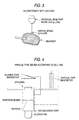
- Fig. 3 is a schematic view of a measuring apparatus used in JIS K 6401 according to an experimental example.
- Fig. 4 is a schematic view of a fragile type tester used in JIS L 1096 according to an experimental example.
- Fig. 5 is a load-deflection amount correlation diagram used for calculating energy absorptivity in the experimental example.
- Fig. 6 is a graph showing a relation of energy absorptivity and ventilation quantity obtained in an experimental Example 2.
- a property required for a vehicle interior material as an impact absorbing member is to absorb at least about 40 to 60% of impact energy applied from outside in collision of a passenger to a vehicle interior material in an accident and the like.
- elastic strength, hardness and the like which can satisfy comfortableness in usual use and energy absorbing property in generation of impact simultaneously.
- the elastic strength herein referred to can be represented as a ratio of stress on the impact absorbing member to strain thereof, namely, as easiness to cause reversible deformation of the impact absorbing member obtained by elastic modulus and degree of manifestation of this elastic modulus.
- the elastic modulus has a relation to the number of pores in the impact absorbing material, namely, porosity (the amount of aggregates per unit volume forming a core material) and to the strength of aggregate part of the cell skeleton.
- the manifestation degree of elastic modulus has a relation to easiness of air in an impact-absorbing member disturbing manifestation of the elastic modulus to pass through into outside, namely, degree of communication of the pore.
- the hardness may advantageously have a value which does not disturb usual use.
- elastic modulus has a relation with porosity and aggregate strength of cell skeleton and can be evaluated by their values, and when actual use is envisaged, specific evaluation is supposed to be possible by using as an index a form-recovering force after compression deformation by input from outside, considering that an impact absorbing member manifesting a behavior such as complete inelastic collision is most excellent.
- repulsion elastic modulus (%) defined in "JIS K 6401" (namely, ratio of the amount of input energy in compressing an impact absorbing member to the amount of output energy in recovering (proportion of structurally absorbable energy)) is suitable, and adopted also in the present invention.
- this value is excellent in a headrest, generation of whiplash injury and the like can be reduced by absorbing generated impact by reception thereof by a passenger, while suppressing rebound against the passenger due to its form recovery.
- Ventilation quantity (ml/cm 2 ⁇ sec) defined in "JIS K 1096" (namely, ventilation quantity of a gas per unit time and area) is suitable, and have adopted this value.
- a headrest 10 according to the embodiment of the present invention is constituted basically of a stay 20 engaged to a sheet not shown, an impact absorbing member 12 as a core material constituting the main body part, being molded to cover necessary parts of this stays, and a skin material 14 covering the surface of this impact absorbing member 12, as shown in Fig. 1.
- the stay 20 is a member which fixes the headrest 10 to a sheet in a height-controllable manner and is used as a base part in manufacturing the impact absorbing member 12.
- the present invention can also be preferably adopted in vehicle interior materials such as, for example, a pillar guard placed beside a passenger, a knee pad placed in front of knee, and the like.
- the impact absorbing member 12 is a formedmaterial shaped into given form from an elastic foamed body, and as this elastic foamed body, a polyurethane foam which has high degree of freedom in form and can easily change the various physical properties such as porosity and the like is suitably used.
- the repulsion elastic modulus is 40% or less, and simultaneously the ventilation quantity is in the range of 10 to 60 ml/cm 2 ⁇ sec.
- the repulsion elastic modulus preferably has a value of about 50% from the standpoints of comfortableness in use, namely, touch feeling, and the like, however, it has been found that even if it is 40% or less, both of comfortableness in use and energy absorptivity can be satisfied at high levels.
- the repulsion elastic modulus is over 40%, the energy absorptivity is less than 40%, causing a fear of insufficient function as an impact absorbing member.
- the ventilation quantity is in the range from 10 to 60 ml/cm 2 ⁇ sec, preferably from 35 to 50 ml/cm 2 ⁇ sec.
- this value is less than 10 ml/cm 2 ⁇ sec, namely when the impact absorbing member 12 has a structure composed solely of closed cells or containing a small proportion of open cells, the repulsion elastic modulus is 40% or less, and even if energy absorption is structurally possible, a gas such as air and the like confined inside performs a function of cushioning, resultantly, the energy absorptivity decreases, obtaining no desired result.
- any of conventionally known materials can be used.
- the impact absorbing member 12 used in a vehicle interior material such as the headrest 10 and the like is produced according to a conventional known method by mixing a polyol, isocyanate and various catalysts, foam controlling agent, and/or various additives such as a cell opener and the like with water at a given ratio, foaming the mixture and molding it into desired form.
- the ventilation quantity is attained by adding 0.3 to 1.0 part by weight of a foam controlling agent, 0.3 to 1.0 part by weight of a catalyst and/or 0.5 to 1.5 parts by weight of a cell opener based on 100 parts by weight of a polyol component, main raw material of the polyurethane foam and the like.
- a foam controlling agent for example, silicone is preferable
- the catalyst for example, tertiary amines and the like are preferable, respectively.
- Particularly addition of the cell opener is effective for securing desired ventilation quantity, and a polyalkyleneoxypolyol and the like are preferable.
- the repulsion elastic modulus In order to attain the repulsion elastic modulus, there are listed methods of formation of a fine cell skeleton, improvement in ability to relax stress in a hard segment and/or use of a polyol having high OHV (the amount of hydroxyl groups), and the like, and specifically, the repulsion elastic modulus is attained by use of a low active silicone, use of an isocyanate having molecular softness and/or use of a polyol having low number-average molecular weight.
- all of inner parts coated with the skin material 14, namely, almost all of the headrest 10 is composed of the impact absorbing member 12, however, a structure as shown in Fig. 2 may also be possible in which an impact absorbing member 12 is used only in part at given position, and other parts are composed of a usual foamed body 16.
- the following experimental examples show changes of ventilation quantity and energy absorptivity depending on the addition amount of a cell opener in a vehicle interior material of the example, and relations of the ventilation quantity, repulsion elastic modulus and energy absorptivity.
- a headrest having usual form was made using the resulted impact absorbing member, and repulsion elastic modulus was measured according to "JIS J 6401" . That is, as shown in Fig. 3, the headrest was fixed at given position, then, a spherical head part model of ⁇ 165 having a weight of 6.8 kg is allowed to fall toward the headrest at a speed in collision of 6.2 km/hr, and repulsion elastic modulus is measured from the fallen distance and rebound distance of the spherical head part model in this action.
- a headrest having usual form was made using the resulted impact absorbing member, and ventilation quantity was measured according to "JIS L 1096" . That is, five specimens in total having suitable sizes are taken out from different regions of the headrest, and ventilation quantity is measured as follows using a given fragile type tester as shown in Fig. 4.
- the specimen is fitted on the fragile type tester, so sucked that a sloping type barometer shows a mercury pressure of 1.27 cm, and the suction fan is controlled and ventilation quantity is calculated from the pressure indicated by a vertical type barometer and the kind of an air hole used, using the appended table.
- Energy absorptivity is obtained from the area of a load-deflection amount correlation diagram as shown in Fig. 5 obtained from load applied to a headrest and deflection amount thereof in the measurement of repulsion elastic modulus.
- Example 2 The same compositions as in Example 1 were used, and various physical properties were measured by controlling production conditions such as temperature and the like, and the addition amount of the cell opener, and the like while changing only ventilation quantity, to obtain results as shown in the following Table 3. Based on these results, a relation of energy absorptivity and ventilation was graphed to confirm a maximum value of the energy absorptivity in the range of ventilation quantity from 40 to 50 ml/cm 2 ⁇ sec as shown in Fig. 6, and to find that sufficient energy absorptivity is not secured when the ventilation quantity is less than 10 ml/cm 2 ⁇ sec and over 60 ml/cm 2 ⁇ sec, even at the same repulsion elastic modulus.
- compositions were produced using the compositions as in Example 1 as base compositions except that production conditions such as temperature and the like, the number-average molecular weight of a polyol component and/or the addition amount of a cell opener were changed, and various physical properties were measured while varying repulsion elastic modulus and ventilation quantity approximately proportionally, to give results shown in Table 4. Namely, it was found that, depending on ventilation quantity, energy absorptivity is low even if repulsion elastic modulus is as low as less than 30% and energy absorptivity is sufficient even if repulsion elastic modulus is around 40%. No.1 No.2 No.3 No.4 Repulsion elastic modulus (%) 27 25 31 33 Ventilation quantity (ml/cm 2 .
- a vehicle interior material of the present invention comfortableness in usual use can be maintained, in addition, sufficient impact absorptivity can be manifested and the outer form as a product can easily be kept even after absorption of impact.
Landscapes
- Engineering & Computer Science (AREA)
- Chemical & Material Sciences (AREA)
- Aviation & Aerospace Engineering (AREA)
- Transportation (AREA)
- Mechanical Engineering (AREA)
- Medicinal Chemistry (AREA)
- Health & Medical Sciences (AREA)
- Chemical Kinetics & Catalysis (AREA)
- Manufacturing & Machinery (AREA)
- Polymers & Plastics (AREA)
- Organic Chemistry (AREA)
- Seats For Vehicles (AREA)
- Vehicle Interior And Exterior Ornaments, Soundproofing, And Insulation (AREA)
- Laminated Bodies (AREA)
- Vibration Dampers (AREA)
- Chair Legs, Seat Parts, And Backrests (AREA)
- Polyurethanes Or Polyureas (AREA)
Applications Claiming Priority (2)
| Application Number | Priority Date | Filing Date | Title |
|---|---|---|---|
| JP2000295073 | 2000-09-27 | ||
| JP2000295073A JP3978568B2 (ja) | 2000-09-27 | 2000-09-27 | 車両用内装材 |
Publications (2)
| Publication Number | Publication Date |
|---|---|
| EP1201491A2 true EP1201491A2 (de) | 2002-05-02 |
| EP1201491A3 EP1201491A3 (de) | 2003-11-19 |
Family
ID=18777563
Family Applications (1)
| Application Number | Title | Priority Date | Filing Date |
|---|---|---|---|
| EP01116626A Withdrawn EP1201491A3 (de) | 2000-09-27 | 2001-07-12 | Fahrzeuginnenmaterial, insbesondere für eine Kopfstütze |
Country Status (4)
| Country | Link |
|---|---|
| US (1) | US20020060482A1 (de) |
| EP (1) | EP1201491A3 (de) |
| JP (1) | JP3978568B2 (de) |
| CA (1) | CA2351050A1 (de) |
Cited By (2)
| Publication number | Priority date | Publication date | Assignee | Title |
|---|---|---|---|---|
| WO2006136485A1 (de) * | 2005-06-23 | 2006-12-28 | Volkswagen Aktiengesellschaft | Whiplash optimierte kopfstütze |
| DE102011077840A1 (de) * | 2011-06-20 | 2012-12-20 | Bayerische Motoren Werke Aktiengesellschaft | Kraftfahrzeug |
Families Citing this family (8)
| Publication number | Priority date | Publication date | Assignee | Title |
|---|---|---|---|---|
| SE0100324D0 (sv) * | 2001-02-02 | 2001-02-02 | Gunnar Baltzer | Headrest for alleviating whiplash injury and the use of specific polyurethane foams therein |
| US6880891B2 (en) * | 2003-06-23 | 2005-04-19 | Lear Corporation | Head restraint for seat |
| US7066544B2 (en) * | 2004-09-23 | 2006-06-27 | Baton Digital Electronic Tech. Co., Ltd. | Headrest mounting structure |
| DE112007000947B4 (de) * | 2006-04-17 | 2016-07-28 | GM Global Technology Operations LLC (n. d. Ges. d. Staates Delaware) | Durch aktives Material betätigte Kopfstütze, Verfahren zum selektiven Umkonfigurieren einer Form oder einer Moduleigenschaft einer Kopfstütze sowie Kopfstützenanordnung |
| US20080265645A1 (en) * | 2007-04-24 | 2008-10-30 | Tachi-S Co., Ltd. | Headrest |
| DE102008029617B4 (de) * | 2008-06-23 | 2013-05-23 | Lear Corp. | Fahrzeugsitzanordnung mit einer Energieabsorptionsvorrichtung |
| US10011058B2 (en) * | 2011-11-28 | 2018-07-03 | Ford Global Technologies, Llc | Dual firmness head restraint |
| DE102013201813A1 (de) * | 2013-02-05 | 2014-08-07 | Johnson Controls Gmbh | Kopfstütze für ein Fahrzeug und Verfahren zu deren Herstellung |
Family Cites Families (5)
| Publication number | Priority date | Publication date | Assignee | Title |
|---|---|---|---|---|
| US3680912A (en) * | 1970-09-14 | 1972-08-01 | Hirotsugu Matsura | Head-rest of the shock absorbing system |
| US5356177A (en) * | 1993-06-25 | 1994-10-18 | Davidson Textron Inc. | Side impact protection apparatus |
| JP3112259B2 (ja) * | 1996-10-22 | 2000-11-27 | 東海化成工業株式会社 | 衝撃吸収ヘッドレスト |
| JPH11180314A (ja) * | 1997-12-19 | 1999-07-06 | Toyota Central Res & Dev Lab Inc | ステアリングホイール |
| DE19840728B4 (de) * | 1998-09-07 | 2006-02-09 | Ise Intex Gmbh | Kopfstütze und Verfahren zu deren Herstellung |
-
2000
- 2000-09-27 JP JP2000295073A patent/JP3978568B2/ja not_active Expired - Fee Related
-
2001
- 2001-06-19 CA CA002351050A patent/CA2351050A1/en not_active Abandoned
- 2001-07-12 EP EP01116626A patent/EP1201491A3/de not_active Withdrawn
- 2001-09-26 US US09/962,087 patent/US20020060482A1/en not_active Abandoned
Non-Patent Citations (1)
| Title |
|---|
| None |
Cited By (6)
| Publication number | Priority date | Publication date | Assignee | Title |
|---|---|---|---|---|
| WO2006136485A1 (de) * | 2005-06-23 | 2006-12-28 | Volkswagen Aktiengesellschaft | Whiplash optimierte kopfstütze |
| DE102005030313A1 (de) * | 2005-06-23 | 2006-12-28 | Volkswagen Ag | Whiplash optimierte Kopfstütze |
| US7926871B2 (en) | 2005-06-23 | 2011-04-19 | Volkswagen Aktiengesellschaft | Headrest for protecting against whiplash |
| DE102005030313B4 (de) * | 2005-06-23 | 2016-02-04 | Volkswagen Ag | Whiplash optimierte Kopfstütze |
| DE102011077840A1 (de) * | 2011-06-20 | 2012-12-20 | Bayerische Motoren Werke Aktiengesellschaft | Kraftfahrzeug |
| DE102011077840B4 (de) | 2011-06-20 | 2021-09-09 | Bayerische Motoren Werke Aktiengesellschaft | Kraftfahrzeug |
Also Published As
| Publication number | Publication date |
|---|---|
| CA2351050A1 (en) | 2002-03-27 |
| US20020060482A1 (en) | 2002-05-23 |
| JP2002104041A (ja) | 2002-04-09 |
| JP3978568B2 (ja) | 2007-09-19 |
| EP1201491A3 (de) | 2003-11-19 |
Similar Documents
| Publication | Publication Date | Title |
|---|---|---|
| US6158815A (en) | Seat having a seat cushion including a polyurethane foam pad onto a portion of which a stretchable, nonwoven fabric is laminated | |
| JP3181279B2 (ja) | シートクッションパッド | |
| KR101243417B1 (ko) | 연질 폴리우레탄 폼, 그 제조 방법, 및 자동차용 시트 | |
| EP1201491A2 (de) | Fahrzeuginnenmaterial, insbesondere für eine Kopfstütze | |
| CN102762133A (zh) | 缓冲垫及其制造方法 | |
| CN1103704C (zh) | 特别适合于车辆的座椅 | |
| JP3341259B2 (ja) | 軟質ポリウレタン発泡体の製造法及び軟質ポリウレタン発泡体を用いた車両用内装材、車両用ヘッドレスト、車両用シートにおけるシートバック | |
| JP3644640B2 (ja) | シートクッションパッド | |
| JP2014167115A (ja) | ポリウレタンフォーム配合物、製品、および方法 | |
| JPH0716867A (ja) | 自動車用内装部材の緩衝構造 | |
| JP4689428B2 (ja) | シートクッション | |
| JP2005124744A (ja) | シートクッションパッドおよび車両用シート | |
| JP3077678B2 (ja) | 車両用ヘッドレスト及びその製造方法 | |
| JP2005124867A (ja) | シートクッションパッド | |
| JP7847932B2 (ja) | シートパッド | |
| JP2000109536A (ja) | 軟質ポリウレタン発泡体並びにそれを用いた車両用内装材 | |
| JP2002253381A (ja) | シート構造 | |
| JP2006008773A (ja) | 軟質ポリウレタンフォーム、及びその製造方法 | |
| WO2024080268A1 (ja) | シートパッド | |
| JP4344599B2 (ja) | シートパッド | |
| JP2024058539A (ja) | シートパッド | |
| JP5456634B2 (ja) | シートクッションの製造方法 | |
| WO2022229713A1 (en) | Headrest for motor vehicles | |
| JP2022040772A (ja) | クッション材とそれを備える車両用シート | |
| JP2006008774A (ja) | 軟質ポリウレタンフォーム、及びその製造方法 |
Legal Events
| Date | Code | Title | Description |
|---|---|---|---|
| PUAI | Public reference made under article 153(3) epc to a published international application that has entered the european phase |
Free format text: ORIGINAL CODE: 0009012 |
|
| AK | Designated contracting states |
Kind code of ref document: A2 Designated state(s): AT BE CH CY DE DK ES FI FR GB GR IE IT LI LU MC NL PT SE TR |
|
| AX | Request for extension of the european patent |
Free format text: AL;LT;LV;MK;RO;SI |
|
| PUAL | Search report despatched |
Free format text: ORIGINAL CODE: 0009013 |
|
| AK | Designated contracting states |
Kind code of ref document: A3 Designated state(s): AT BE CH CY DE DK ES FI FR GB GR IE IT LI LU MC NL PT SE TR |
|
| AX | Request for extension of the european patent |
Extension state: AL LT LV MK RO SI |
|
| RIC1 | Information provided on ipc code assigned before grant |
Ipc: 7B 60R 21/04 B Ipc: 7C 08G 18/14 B Ipc: 7B 60N 2/48 A |
|
| AKX | Designation fees paid | ||
| REG | Reference to a national code |
Ref country code: DE Ref legal event code: 8566 |
|
| STAA | Information on the status of an ep patent application or granted ep patent |
Free format text: STATUS: THE APPLICATION IS DEEMED TO BE WITHDRAWN |
|
| 18D | Application deemed to be withdrawn |
Effective date: 20040520 |