EP1202184A2 - Méthodologie de programmation et architecture pour un système analogique programmable sur une puce - Google Patents
Méthodologie de programmation et architecture pour un système analogique programmable sur une puce Download PDFInfo
- Publication number
- EP1202184A2 EP1202184A2 EP01125563A EP01125563A EP1202184A2 EP 1202184 A2 EP1202184 A2 EP 1202184A2 EP 01125563 A EP01125563 A EP 01125563A EP 01125563 A EP01125563 A EP 01125563A EP 1202184 A2 EP1202184 A2 EP 1202184A2
- Authority
- EP
- European Patent Office
- Prior art keywords
- analog
- blocks
- block
- function
- switched capacitor
- Prior art date
- Legal status (The legal status is an assumption and is not a legal conclusion. Google has not performed a legal analysis and makes no representation as to the accuracy of the status listed.)
- Withdrawn
Links
Images









Classifications
-
- G—PHYSICS
- G06—COMPUTING OR CALCULATING; COUNTING
- G06F—ELECTRIC DIGITAL DATA PROCESSING
- G06F1/00—Details not covered by groups G06F3/00 - G06F13/00 and G06F21/00
- G06F1/26—Power supply means, e.g. regulation thereof
- G06F1/32—Means for saving power
-
- G—PHYSICS
- G06—COMPUTING OR CALCULATING; COUNTING
- G06F—ELECTRIC DIGITAL DATA PROCESSING
- G06F1/00—Details not covered by groups G06F3/00 - G06F13/00 and G06F21/00
- G06F1/04—Generating or distributing clock signals or signals derived directly therefrom
- G06F1/08—Clock generators with changeable or programmable clock frequency
-
- G—PHYSICS
- G06—COMPUTING OR CALCULATING; COUNTING
- G06F—ELECTRIC DIGITAL DATA PROCESSING
- G06F15/00—Digital computers in general; Data processing equipment in general
- G06F15/76—Architectures of general purpose stored program computers
- G06F15/78—Architectures of general purpose stored program computers comprising a single central processing unit
- G06F15/7867—Architectures of general purpose stored program computers comprising a single central processing unit with reconfigurable architecture
-
- G—PHYSICS
- G06—COMPUTING OR CALCULATING; COUNTING
- G06G—ANALOGUE COMPUTERS
- G06G7/00—Devices in which the computing operation is performed by varying electric or magnetic quantities
- G06G7/06—Programming arrangements, e.g. plugboard for interconnecting functional units of the computer; Digital programming
-
- H—ELECTRICITY
- H03—ELECTRONIC CIRCUITRY
- H03B—GENERATION OF OSCILLATIONS, DIRECTLY OR BY FREQUENCY-CHANGING, BY CIRCUITS EMPLOYING ACTIVE ELEMENTS WHICH OPERATE IN A NON-SWITCHING MANNER; GENERATION OF NOISE BY SUCH CIRCUITS
- H03B5/00—Generation of oscillations using amplifier with regenerative feedback from output to input
- H03B5/30—Generation of oscillations using amplifier with regenerative feedback from output to input with frequency-determining element being electromechanical resonator
- H03B5/32—Generation of oscillations using amplifier with regenerative feedback from output to input with frequency-determining element being electromechanical resonator being a piezoelectric resonator
- H03B5/36—Generation of oscillations using amplifier with regenerative feedback from output to input with frequency-determining element being electromechanical resonator being a piezoelectric resonator active element in amplifier being semiconductor device
- H03B5/364—Generation of oscillations using amplifier with regenerative feedback from output to input with frequency-determining element being electromechanical resonator being a piezoelectric resonator active element in amplifier being semiconductor device the amplifier comprising field effect transistors
-
- H—ELECTRICITY
- H03—ELECTRONIC CIRCUITRY
- H03H—IMPEDANCE NETWORKS, e.g. RESONANT CIRCUITS; RESONATORS
- H03H19/00—Networks using time-varying elements, e.g. N-path filters
- H03H19/004—Switched capacitor networks
-
- H—ELECTRICITY
- H03—ELECTRONIC CIRCUITRY
- H03K—PULSE TECHNIQUE
- H03K3/00—Circuits for generating electric pulses; Monostable, bistable or multistable circuits
- H03K3/01—Details
- H03K3/012—Modifications of generator to improve response time or to decrease power consumption
-
- H—ELECTRICITY
- H03—ELECTRONIC CIRCUITRY
- H03K—PULSE TECHNIQUE
- H03K3/00—Circuits for generating electric pulses; Monostable, bistable or multistable circuits
- H03K3/01—Details
- H03K3/014—Modifications of generator to ensure starting of oscillations
-
- H—ELECTRICITY
- H03—ELECTRONIC CIRCUITRY
- H03K—PULSE TECHNIQUE
- H03K3/00—Circuits for generating electric pulses; Monostable, bistable or multistable circuits
- H03K3/02—Generators characterised by the type of circuit or by the means used for producing pulses
- H03K3/023—Generators characterised by the type of circuit or by the means used for producing pulses by the use of differential amplifiers or comparators, with internal or external positive feedback
- H03K3/0231—Astable circuits
- H03K3/02315—Stabilisation of output, e.g. using crystal
Definitions
- the present disclosure generally relates to the field of microcontrollers. More specifically, the present disclosure pertains to a methodology for dynamically configuring and programming a mixed signal system-on-a-chip architecture to perform a variety of analog functions.
- Microcontrollers function to replace mechanical and electromechanical components in a variety of applications and devices. Microcontrollers have evolved since they were first introduced approximately 30 years ago, to the point where they can be used for increasingly complex applications. Some microcontrollers in use today are also programmable, expanding the number of applications in which they can be used.
- ASICs Application specific integrated circuits
- ASICs may suggest a solution to the problem of finding a suitable microcontroller for an application.
- ASICs can also be problematic because they require a sophisticated level of design expertise, and the obstacles of long development times, high costs, and large volume requirements still remain. Solutions such as gate arrays and programmable logic devices provide flexibility, but they too are expensive and require a sophisticated level of design expertise.
- the present invention provides a programmable analog system methodology and architecture that is suited for a variety of applications and that can reduce development time and expenses.
- the programmable analog system architecture is integrated with a microcontroller that provides sequencing and programming instructions.
- Embodiments of the present invention introduce a method of configuring and programming a set of tailored analog blocks and elements that can be configured and reconfigured in different ways to implement a variety of different analog functions.
- the present invention also introduces a single chip solution that contains a set of tailored analog blocks and elements that can be dynamically configured and reconfigured in different ways to implement a variety of different analog functions.
- the analog blocks can be electrically coupled to each other in different combinations to perform different analog functions.
- Each analog block includes analog elements that have changeable characteristics that can be specified according to the function to be performed.
- Configuration registers define the type of function to be performed, the way in which the analog blocks are to be coupled, the inputs and outputs of the analog blocks, and the characteristics of the analog elements.
- the configuration registers can be dynamically
- the analog blocks are arranged in an array on a single integrated circuit, or chip.
- the analog system architecture can be generally referred to as an analog "programmable system-on-a-chip," or PSoC, block.
- PSoC blocks can be used in those applications that typically require multiple chips that may be fabricated using different technologies. Implementation in embedded applications, including audio, wireless, handheld, data communications, Internet control, and industrial and consumer systems, is contemplated.
- the analog block are arranged on a single integrated circuit or chip.
- the analog blocks can be electrically coupled in different combinations to perform different analog functions.
- Each analog block can also be configured according to the function to be performed.
- the analog blocks include analog elements that have changeable characteristics that can be specified according to the function to be performed. Inputs received by an analog block are directed through the analog block according to the specified characteristics of the analog elements.
- the combination of analog blocks and the characteristics of the analog elements, and hence the analog function to be performed, can be dynamically programmed .
- the analog blocks include switched analog blocks that can be electrically coupled to and decoupled from one or more other analog blocks according to configuration information in configuration registers. That is, latches and switches can be dynamically configured so that signals can be passed from one block to another, while other blocks are bypassed. Accordingly, a set of analog blocks can be selectively combined to implement a particular analog function. Other analog functions can be implemented by selectively combining a different set of analog blocks.
- the switched analog blocks are switched capacitor blocks.
- two different types of switched capacitor blocks are used; the two types are distinguishable according to the type and number of inputs they receive and how those inputs are treated.
- the analog blocks also include continuous time blocks.
- the continuous time blocks and the switched capacitor blocks are arranged in rows and columns in an array.
- the array includes a first row of continuous time blocks and multiple rows of switched capacitor blocks, where the first row of continuous time blocks is disposed between the switched capacitor blocks and an edge of the array.
- the analog blocks in a column are each coupled to a respective digital bus (that is, there is a digital bus for each column of analog blocks).
- a number of configuration registers are coupled to the analog blocks. Each analog block is assigned a subset of these configuration registers. In one embodiment, up to four configuration registers are assigned to each analog block.
- the configuration registers may be internal to or external to the analog blocks; that is, they may be integrated into the analog blocks, or they may physically reside in a location outside of the analog blocks.
- Configuration information is received into the configuration registers at boot time (bootup) of the microcontroller, or at a subsequent time during program execution.
- the information in the configuration registers is used for selectively coupling analog blocks, for specifying characteristics of the analog elements in each of the analog blocks, and for specifying the inputs and outputs for the analog blocks.
- the information in the registers can be dynamically changed to couple different combinations of analog blocks, to specify different characteristics of the analog elements, or to specify different inputs and outputs for the analog blocks, thereby realizing different analog functions using the same array of analog blocks.
- the analog functions that can be performed using the system architecture and method of the present invention include (but are not limited to) an amplifier function, a digital-to-analog converter function, an analog-to-digital converter function, an analog driver function, a low band pass filter function, and a high band pass filter function.
- bit(s) are set in the configuration register (or registers) of an analog block to: include a compensating capacitor for a comparator function or to bypass the compensating capacitor; specify a power level; specify a resistance value of a resistor; specify a capacitance of a capacitor; change the phase of an input; select a clock phase for sampling an input; and/or control a switch.
- the present invention provides a programmable, multi-functional analog system and method that comprise a number of analog blocks comprising a number of analog elements that have been selected to perform a large number of different analog functions and applications.
- the present invention uses latches and switches to selectively and electrically couple analog blocks in different combinations depending on the function to be performed. The characteristics of the analog elements in an analog block can also be specified according to the function to be performed.
- the device can be used to realize a large number of different analog functions and applications.
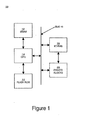
- FIG. 1 is a block diagram showing an exemplary integrated circuit (or microcontroller) 10 upon which embodiments of the present invention may be implemented.
- integrated circuit 10 includes a bus 11, and coupled to bus 11 are synchronous random access memory (SRAM) 12 for storing volatile or temporary data during firmware execution, central processing unit (CPU) 14 for processing information and instructions, flash read-only memory (ROM) 16 for holding instructions (e.g., firmware), input/output (I/O) pins providing an interface with external devices and the like, and analog blocks 20.
- SRAM synchronous random access memory
- CPU central processing unit
- ROM read-only memory
- I/O input/output
- a test interface may be coupled to integrated circuit 10 to perform debugging operations during startup and initialization of the integrated circuit.
- flash ROM 16 stores parameters describing microcontroller 10, allowing microcontroller 10 to be programmed during production, during system testing, or in the field. It is contemplated that microcontroller 10 may also be self-programmed remotely.
- Analog blocks 20 are configurable system resources that can reduce the need for other microcontroller parts and external components.
- analog blocks 20 include an array of twelve blocks.
- a precision internal voltage reference provides accurate analog comparisons.
- a temperature sensor input is provided to the array of analog blocks to support applications like battery chargers and data acquisition without requiring external components.
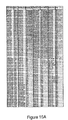
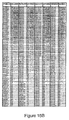
- each of the register banks contains 256 bytes. A portion of these bytes are allocated for addressing configuration registers used to configure the analog blocks 20. Additional information is provided in conjunction with Figures 15A, 15B and 16, below.
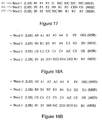
- each of the analog blocks 20 is assigned up to four registers for programming block functions, characteristics (e.g., coefficient values) of analog elements in the analog blocks 20, and routing of inputs and outputs for the analog blocks 20. These registers may be physically located either on the analog blocks or external to the analog blocks. Additional information is provided in conjunction with Figures 17, 18A and 18B, below.
- Switched capacitor blocks provide discrete time analog functions such as analog-to-digital conversion (ADC) and digital-to-analog conversion (DAC) functions.
- ADC analog-to-digital conversion
- DAC digital-to-analog conversion
- the key difference between the type A and type B switched capacitor blocks is in generating biquad filters (see Figures 14A and 14B below). Both type A and type B blocks can implement basic switched capacitor functions (outside of filters), and the type A block can also function as a summing amplifier. Switched capacitor blocks are described in further detail in conjunction with Figures 9A and 12A below.
- Analog functions supported by integrated circuit 10 comprising analog blocks 20 include, but are not limited to: 14-bit multi-slope and 12-bit delta-sigma ADC, successive approximation ADCs up to nine bits, DACs up to nine bits, programmable gain stages, sample and hold circuits, filters (high band pass and low band pass) with programmable coefficients, amplifiers, differential comparators, and temperature sensors.
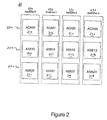
- FIG. 2 shows an array of analog blocks 20 in accordance with one embodiment of the present invention.
- Each column 23a-d includes one of each type of analog block, e.g., a continuous time block 21a-d (designated "ACAxx”); a type A switched capacitor block 21 e, 21g, 21j and 211 (designated "ASAxx”); and a type B switched capacitor block 21f, 21 h, 21 i, and 21k (designated "ASBxx").
- the type A and type B switched capacitor blocks in rows 22b and 22c are arranged in an alternating, or checkerboard, pattern.
- the analog blocks 21a-I can be powered down individually to different power levels, so that it is not necessary for all of the blocks to be running at full power. In one embodiment, the analog blocks 21a-I have four power levels.
- FIG. 3 shows the interconnects between analog blocks 20 in an array in accordance with one embodiment of the present invention.
- each analog block 21a-I is interconnected with its adjacent (e.g., nearest neighbor) analog block.
- the analog blocks 21a-I may not be electrically coupled.
- the distinction between being connected and being electrically coupled is important because the analog functions performed by the analog blocks 20 are implemented by enabling certain analog blocks of the circuit and bypassing others according to user programming. That is, certain analog blocks in the array of analog blocks 20 are selectively and electrically coupled to other analog blocks according to the function to be performed.
- the analog functions are also implemented by setting characteristics of passive elements (e.g., capacitors and resistors) within each of the analog blocks 20.
- analog blocks 20 can be selected according to the user programming in order to perform different functions.
- individual analog blocks can be enabled and bypassed, respectively, by enabling and closing appropriate switches in response to the programming. Signals are thereby routed through the analog blocks 20 by enabling and closing programmable switches, so that the signals are routed to the analog blocks necessary to accomplish the particular analog function selected. Mechanisms other than switches may be used to enable and bypass analog blocks.
- each column 23a-d there is a respective digital bus 24a-d and a respective analog bus 25a-d coupled to each analog block in the column. Any analog block on these buses can have its output enabled to drive the buses.
- the analog buses 25a-d are each a gated operational amplifier (op-amp) output.
- the digital buses 24a-d are each a comparator output derived by buffering the operational amplifier (op-amp) output through an inverter.
- reference buses (not shown) are also provided to provide a reference voltage for ADC and DAC functions.
- data essentially flow through the array of analog blocks 20 from top to bottom (e.g., from row 22a to row 22c).
- the continuous time blocks 21a-d can be programmed to serve as a first-order isolation buffer, if necessary.
- output signals from each analog block include D0 and those signals that include “out” in their designation (such as OUT, GOUT, and LOUT). Signals labeled otherwise are input signals to a block.
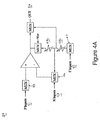
- FIG 4A is a functional block diagram of one embodiment of a continuous time block 40 in accordance with the present invention.
- Continuous time block 40 exemplifies continuous time blocks 21a-d of Figures 2 and 3.
- Continuous time block 40 is unclocked; that is, an analog signal input to continuous time block 40 may vary with time, and the output of continuous time block 40 will reflect that (instead of sampling the input as a clocked block would).
- continuous time block 40 of Figure 4A performs basic amplifier operations.
- one function of continuous time block 40 is to amplify and isolate analog inputs to the array of analog blocks 20 ( Figure 3), although continuous time block 40 may not always be used in this manner.
- Continuous time block 40 also provides the means to convert differential input voltages into single-ended signals to drive other analog blocks 20.
- continuous time block 40 of Figure 4A receives positive (P) inputs 41 at multiplexer (MUX) 45, negative (N) inputs 42 at MUX 46, and feedback (F) inputs at MUX 47.
- Multiplexers 45, 46 and 47 function as controlled switches for directing the inputs through continuous time block 40. It is appreciated that the inputs to continuous time block 40 are a function of the location of continuous time block 40 in the array of analog blocks 20 ( Figures 2 and 3), and that the inputs received by continuous time block 40 depend on the particular analog function being implemented.
- Continuous time block 40 also includes analog elements having characteristics. that can be set and changed in response to the user's programming in accordance with the particular analog function to be implemented.
- continuous time block 40 includes programmable resistors 48a and 48b. In accordance with the present invention, the resistance of resistors 48a and 48b can be changed in response to the user's programming.
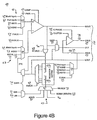
- FIG 4B is a schematic diagram of one embodiment of a continuous time block 40 in accordance with the present invention.
- Block inputs 60 are inputs received from other analog blocks in the array of analog blocks 20 ( Figure 2).
- SCBLK (SOUTH) 53 is the input from a switched capacitor block below continuous time block 40 in a column 23a-d ( Figure 3).
- Port inputs 61 are inputs received from components and elements external to the array of analog blocks 20.
- ABUS 25 is the input from the analog bus (e.g., analog buses 25a-d of Figure 3) and AGND 54 is the analog ground.
- CBUS 24 is the output to the digital bus (e.g., buses 24a-d of Figure 3).
- Other outputs (OUT) 30 include GOUT, OUT and LOUT (see Figure 3). When cascading two blocks, GOUT is used when trying to achieve a gain, and LOUT is used when trying to achieve a loss.
- REFLO 72 and REFHI 73 are reference voltages.
- GAIN 74 controls whether the resistor string (48a, 48b) is connected around the op-amp for gain or loss (note that GAIN 74 does not guarantee a gain or loss block; this is determined by the routing of the other ends of the resistors 48a-b).
- GIN 51 and LIN 52 are inputs to continuous time block 40 (see also Figure 3).
- P.MUX 55, N.MUX 56 and RB.MUX 70 are bit streams which control the non-inverting input MUX 45, the inverting input MUX 46, and MUX 47, respectively.
- R.MUX 69 is a bit stream controlling the center tap of the resistor string 48a-b.
- RT.MUX 68 is a bit stream controlling the connection of the two ends of the resistor string 48a-b.
- RT.MUX bits 68 control the top end of the resistor string 48a-b, which can either be connected to Vcc or to the op-amp output.
- RB.MUX bits 70 control the connection of the bottom end of the resistor string 48a-b.
- MUX 32 under control of bit stream O.MUX 77 provides a testability feature by feeding signals into continuous time block 40 that bypass the other portions of the block.
- COMP 49 is a bit controlling whether the compensation capacitor (not shown) is switched in or not in the op-amp. By not switching in the compensation capacitance, a fast response can be obtained if the amplifier is being used as a comparator.
- PWR 50 is a bit stream for encoding the power level for continuous time block 40.
- C.PHASE 75 controls which internal clock phase the comparator data are latched on.
- C.LATCH 76 controls whether the latch is active or if it is always transparent.
- CS 78 controls a tri-state buffer that drives the comparator logic.
- OS 79 controls the analog output bus (ABUS 25).
- a complementary metal oxide semiconductor (CMOS) switch connects the op-amp output to ABUS 25.
- CMOS complementary metal oxide semiconductor
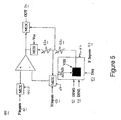
- Figure 5 illustrates the feedback inputs 43 into a continuous time block 40 in accordance with one embodiment of the present invention.
- DING 51 is GIN 51 of Figure 4B
- DINL 52 is LIN 52 of Figure 4B
- AGND 54 is the analog (actual) ground.
- IN6 (SCBLK) 53 is the input from a switched capacitor block situated below continuous time block 40 in a column 23a-d in an array of analog blocks 20 ( Figure 3).
- Figure 6 illustrates the positive inputs 41 into a continuous time block 40 in accordance with one embodiment of the present invention.
- AGND 54 is the analog ground
- OBUS (ABUS) 25 is the input from the analog bus (e.g., analog buses 25a-d of Figure 3).
- INA 63 and IND 65 are the inputs from another continuous time block; that is, the continuous time blocks to either side of continuous time block 40. If continuous time block 40 is situated on the left or right edge of the array of analog blocks 20 ( Figure 3), such as in columns 23a or 23d, then only one of the inputs INA 63 or IND 65 would be present.
- INB 64 is the input from outside of the array of analog blocks 20.
- IN4 66 and IN5 67 are input from adjacent switched capacitor blocks, either in the same column as continuous time block 40 or from a switched capacitor block in an adjacent column.
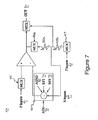
- Figure 7 illustrates the negative inputs 42 into a continuous time block 40 in accordance with one embodiment of the present invention.
- AGND 54 is the analog ground
- AIN 71 is the input from an adjacent continuous time block (depending on the location of continuous time block 40 in the array of analog blocks 20 of Figure 3, there may be more than one input from an adjacent continuous time block, as described in the preceding paragraph).
- RF1 (REFLO) 72 and RF2 (REFHI) 73 are reference voltages.
- FIGs 8A and 8B are circuit diagrams illustrating the functionality of a switched capacitor circuit 85 by comparison to another circuit 80 in accordance with one embodiment of the present invention.
- an amount of current flows through resistor 81 in a time period T.
- Resistor 81 has a resistance value of R1.
- switch 86 and switch 87 of switched capacitor circuit 85 are enabled and closed according to clock phases (1 and (2, respectively.
- Switched capacitor circuit 85 also includes a capacitor 88 with a capacitance of C1.
- An amount of charge will transfer through switches 86 and 87 in a time period T. In essence, the amount of charge transferred through switches 86 and 87 in time period T will appear like a current (current being charge per time).
- the resistance of switched capacitor circuit 85 equivalent to R1 is T/C1.
- FIG. 9A is a block diagram of one embodiment of a switched capacitor block 90 in accordance with the present invention.
- This embodiment of switched capacitor block 90 is referred to as a type A switched capacitor block.
- Switched capacitor block 90 exemplifies analog blocks 21e, 21g, 21j and 211 of Figures 2 and 3.
- switched capacitor block 90 receives reference (REF) inputs 130, SN input 99, and inputs from three different types of capacitor arrays, CA inputs 131, CB inputs 140 and CC inputs 141.
- REF reference
- CA CA inputs
- CB CB inputs
- CC CC inputs
- REF inputs 130 and CA inputs 131 are described further in conjunction with Figure 10
- CB inputs 140 and CC inputs 141 are described further in conjunction with Figure 11.
- SN input 99 is a summary node of the array of analog blocks 20 ( Figure 3). It is appreciated that the inputs to switched capacitor block 90 are a function of the location of switched capacitor block 90 in the array of analog blocks 20 ( Figures 2 and 3), and that the inputs received by switched capacitor block 90 depend on the particular analog function being implemented.
- AGND 54 is the analog ground
- OBUS (ABUS) 25 is the output to the analog bus (e.g., analog buses 25a-d of Figure 3)
- OUT 98 is an output from switched capacitor block 90 that may serve as an input to an adjacent switched capacitor block (refer to Figure 3).
- switched capacitor block 90 includes a multiplicity of switches 91a, 91b, 93a, 93b, 94, 95, 96a, 96b and 97.
- Each of the switches 91a-b, 93a-b, 94, and 96a-b is assigned to a clock phase ⁇ 1 or ⁇ 2; that is, they are enabled or closed depending on the clock phase.
- Switches 93a-b, 94, and 96a-b are assigned to gated clocks and function in a known manner.
- Switches 95 and 97 are not clocked but instead are enabled or closed depending on the user's programming.
- Switched capacitor block 90 also includes analog elements having characteristics that can be set and changed in response to the user's programming in accordance with the particular analog function to be implemented.
- switched capacitor block 90 includes capacitors 92a-92e.
- the capacitance of capacitors 92a-e can be changed in response to the user's programming.
- the capacitors 92a-c are binarily weighted capacitors that allow the capacitor weights to be programmed by the user, while the capacitors 92d-e are either "in” or "out” (that is, they are not binarily weighted) according to the user programming.
- the binary encoding of capacitor size for capacitors 92a-c comprises 31 units (plus zero) each and the encoding of capacitor size for capacitors 92d-e is 16 units each.
- Switched capacitor block 90 is configured such that it can be used for the input stage of a switched capacitor biquad filter. When followed by a type B switched capacitor block, the combination of blocks provides a complete switched capacitor biquad (see Figures 14A and 14B).
- FIG. 9B is a schematic diagram of a switched capacitor block 90a in accordance with one embodiment of the present invention.
- ABUS 25 is the output to the analog bus (e.g., buses 25a-d of Figure 3).
- CBUS 24 is the output to the digital bus (e.g., buses 24a-d of Figure 3).
- PWR 50 is a bit stream for encoding the power level for switched capacitor block 90a.
- CS 78 controls the output to CBUS 24.
- BQTAP 161 is used when switched capacitor block 90a is used with a type B switched capacitor block to form a switched capacitor biquad (refer to Figures 14A and 14B below).
- AC.MUX 162 is for controlling the multiplexing of the inputs for both the C (CC) inputs 141 and the A (CA) inputs 131.
- A.REF 163 is for controlling the reference voltage inputs (REF 130).
- A.SIGN 164 controls the switch phasing of the switches on the bottom plate of the capacitor 92b.
- B.MUX 165 is for controlling the multiplexing of the inputs for the B (CB) inputs 140.
- OS (91 b) gates the output to the analog column bus 25.
- AZ (93a, 93b, 94, 95) controls the shorting of the inverting input of the op-amp.
- the op-amp When shorted, the op-amp is basically a follower. The output is the op-amp offset.
- AZ also controls a pair of switches between the A and B branches and the summing node of the op-amp. If AZ is enabled, then the pair of switches is active.
- F.SW0 (96) is used to control a switch in the integrator capacitor path, and connects the output of the op-amp to analog ground.
- F.SW1 (95) is used to control a switch in the integrator capacitor path. The state of F.SW1 is affected by the state of the AZ bit.
- F.CAP controls the size of the switched feedback capacitor in the integrator.
- the A.CAP bits (92b) set the value of the capacitor in the A path
- the B.CAP (92c) bits set the value of the capacitor in the B path
- the C.CAP (92a) bits set the value of the capacitor in the C path.
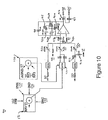
- Figure 10 shows one set of inputs into one embodiment of a type A switched capacitor block 90 in accordance with the present invention. It is appreciated that the inputs to switched capacitor block 90 are a function of the location of switched capacitor block 90 in the array of analog blocks 20 ( Figures 2 and 3), and that the inputs received by switched capacitor block 90 depend on the particular analog function being implemented.
- REF inputs 130 includes the analog ground AGND 54 and reference voltages RF1 (REFLO) 72 and RF2 (REFHI) 73.
- CA inputs 131 can include inputs INB 132, INC 133, IND 134 and INE 135 from a continuous time block and/or switched capacitor block adjacent to switched capacitor block 90.
- CA inputs 131 can also include reference voltage RF2 (REFHI) 73 from a continuous time block and/or switched capacitor block adjacent to switched capacitor block 90.
- MUX 136 can be programmed so that either CA inputs 131 or REF inputs 130 are sampled on clock phase ⁇ 1, thereby allowing inverting or non-inverting configurations.
- the selection of RF1 (REFLO) 72 and RF2 (REFHI) 73 can be controlled by a comparator (see Figures 19 and 20).
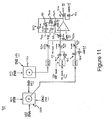
- FIG 11 shows the other set of inputs into the type A switched capacitor block 90 of Figure 9A in accordance with the present invention.
- the inputs to switched capacitor block 90 are a function of the location of switched capacitor block 90 in the array of analog blocks 20 ( Figures 2 and 3), and the inputs received by switched capacitor block 90 depend on the particular analog function being implemented.
- CB inputs 140 can include inputs INA 142, INB 143, INC 144 and IND 145 from a continuous time block and/or switched capacitor block adjacent to switched capacitor block 90.
- CC inputs 141 can include INB 143 and INE 146 from a continuous time block and/or switched capacitor block adjacent to switched capacitor block 90.
- FIG 12A is a block diagram of another embodiment of a switched capacitor block 100 in accordance with the present invention.
- This embodiment of switched capacitor block 100 is referred to as a type B switched capacitor block.
- Switched capacitor block 100 exemplifies analog blocks 21f, 21h, 21i and 21k of Figures 2 and 3.
- switched capacitor block 100 receives reference (REF) inputs 101, CCAOUT outputs 112, and inputs from two different types of capacitor arrays, CA inputs 102 and CB inputs 103.
- the designations "CA” and “CB” are chosen to distinguish the two different types of capacitor arrays that are inputs to switched capacitor block 100, and they may be different from the CA inputs 131 and CB inputs 140 of Figure 9A.
- REF inputs 101, CA inputs 102 and CB inputs 103 are described further in conjunction with Figure 13.
- CCAOUT 112 is a non-switched capacitor feedback from the output. It is appreciated that the inputs to switched capacitor block 100 are a function of the location of switched capacitor block 100 in the array of analog blocks 20 ( Figures 2 and 3), and that the inputs received by switched capacitor block 100 depend on the particular analog function being implemented.
- AGND 54 is the analog ground
- OBUS (ABUS) 25 is the output to the analog bus (e.g., analog buses 25a-d of Figure 3)
- OUT 113 is an output from switched capacitor block 100 that may serve as an input to an adjacent switched capacitor block (refer to Figure 3).
- switched capacitor block 100 includes a multiplicity of switches 104a, 104b, 105a, 105b, 106a, 106b, 107, 108 and 109.
- Each of the switches 104a-b, 105a-b, 106a-b and 109 is assigned to a clock phase ⁇ 1 or ⁇ 2; that is, they are enabled or closed depending on the clock phase.
- Switches 105a-b, 106a-b and 109 are assigned to gated clocks and function in a known manner. Switches 107 and 108 are not clocked but instead are enabled or closed depending on the user's programming.
- Switched capacitor block 100 also includes analog elements having characteristics that can be set and changed in response to the user's programming in accordance with the particular analog function to be implemented.
- switched capacitor block 100 includes programmable capacitors 111a-111e.
- the capacitance of capacitors 111a-e can be changed in response to the user's programming.
- the capacitors 111a-c are binarily weighted capacitors that allow the capacitor weights to be programmed by the user, while the capacitors 111d-e are either "in” or "out” (that is, they are not binarily weighted) according to the user programming.
- the binary encoding of capacitor size for capacitors 111a-c comprises 31 units (plus zero) each and the encoding of capacitor size for capacitors 111d-e is 16 units each.
- Switched capacitor block 100 is configured such that it can be used for the output stage of a switched capacitor biquad filter. When preceded by a type A switched capacitor block, the combination of blocks provides a complete switched capacitor biquad (see Figures 14A and 14B).
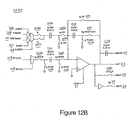
- FIG 12B is a schematic diagram of a switched capacitor block 100a in accordance with one embodiment of the present invention.
- ABUS 25 is the output to the analog bus (e.g., buses 25a-d of Figure 3).
- CBUS 24 is the output to the digital bus (e.g., buses 24a-d of Figure 3).
- PWR 50 is a bit stream for encoding the power level for switched capacitor block 90a.
- CS 78 controls the output to CBUS 24.
- B.SW (104a, 104b) is used to control switching in the B (CB) branch.
- BQTAP 161 is used when switched capacitor block 100a is used with a type A switched capacitor block to form a switched capacitor biquad (refer to Figures 14A and 14B below).
- A.MUX 166 is for controlling the multiplexing of the inputs for the A (CA) inputs 102.
- A.REF 167 is for controlling the reference voltage inputs (REF inputs 101).
- A.SIGN 168 controls the switch phasing of the switches on the bottom plate of the capacitor 111 b; the bottom plate samples the input or the reference.
- B.MUX 169 is for controlling the multiplexing of the inputs for the B (CB) inputs 103.
- OS (104b) gates the output to the analog column bus 25.
- AZ (105a, 105b, 107, 109) controls the shorting of the inverting input of the op-amp.
- the op-amp When shorted, the op-amp is basically a follower. The output is the op-amp offset.
- AZ also controls a pair of switches between the A and B branches and the summing node of the op-amp. If AZ is enabled, then the pair of switches is active.
- F.SW0 (106a) is used to control a switch in the integrator capacitor path, and connects the output of the op-amp to analog ground.
- F.SW1 (107) is used to control a switch in the integrator capacitor path. The state of F.SW1 is affected by the state of the AZ bit.
- F.CAP controls the size of the switched feedback capacitor in the integrator.
- the A.CAP bits (111 b) set the value of the capacitor in the A path
- the B.CAP (111c) bits set the value of the capacitor in the B path
- the C.CAP (111a) bits set the value of the capacitor in the C path.
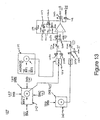
- Figure 13 shows the inputs into one embodiment of a type B switched capacitor block 100 in accordance with the present invention. It is appreciated that the inputs to switched capacitor block 100 are a function of the location of switched capacitor block 100 in the array of analog blocks 20 ( Figures 2 and 3), and that the inputs received by switched capacitor block 100 depend on the particular analog function being implemented.
- REF inputs 101 includes the analog ground AGND 54 and reference voltages RF1 (REFLO) 72 and RF2 (REFHI) 73.
- CA inputs 102 can include inputs INA 121, INB 122, INC 123, IND 124 and INE 125 from a continuous time block and/or switched capacitor block adjacent to switched capacitor block 100.
- CB inputs 103 can include INB 122 and INE 125 from a continuous time block and/or switched capacitor block adjacent to switched capacitor block 100.
- MUX 126 can be programmed so that either CA inputs 102 or REF inputs 101 are sampled on clock phase (1, thereby allowing inverting or non-inverting configurations.
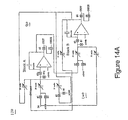
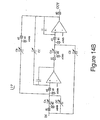
- Figures 14A and 14B are diagrams showing one embodiment of a switched capacitor biquad 110 in accordance with the present invention.
- Figure 14A shows the basic interconnection between a type A switched capacitor block 90 and a type B switched capacitor block 100.
- Figure 14B is a schematic of a switched capacitor biquad 110 resulting from the interconnection of switched capacitor block 90 and switched capacitor block 100.
- Figures 15A and 15B are exemplary register banks 150a and 150b used by microcontroller 10 ( Figure 1) for configuring on-chip resources in accordance with one embodiment of the present invention. It is appreciated that a single register bank or more than two register banks may alternatively be used with the present invention.
- Register banks 150a and 150b are used for "personalization” and “parameterization” of the on-chip resources.
- Personalization refers to the loading of configuration registers to achieve a particular analog function or a particular configuration (combination) of analog blocks.
- a configuration is realized as a set of data located in flash ROM 16 ( Figure 1) which is loaded into appropriate registers at boot time.
- Parameterization refers to the modification of registers to modify some aspect of the microcontroller and its functions. Parameterization can occur at boot time and, combined with personalization, achieves a default selection of parameters and characteristics. Parameterization can also occur during program execution to change the operation of the microcontroller.
- a set of analog blocks can be personalized to form a timer, which is then parameterized to specify an output destination and period.
- switched capacitor blocks are personalized to form a bandpass filter, which is parameterized for frequency and bandwidth.
- each of the register banks 150a and 150b contains 256 bytes. A user can select between the two banks by setting a bit in another configuration register.
- configuration registers are assigned to each of the analog blocks 20 ( Figure 1), although it is appreciated that more or less than four configuration registers can also be used.
- the settings in these registers are used for selectively coupling analog blocks, for specifying characteristics of the analog elements in each of the analog blocks, and for specifying the inputs and outputs for the analog blocks.
- the information in the registers can be dynamically changed to couple different combinations of analog blocks, to specify different characteristics of the analog elements, or to specify different inputs and outputs for the analog blocks, thereby realizing different analog functions using the same array of analog blocks.
- the configuration registers are described further in conjunction with Figures 17, 18A and 18B.
- the configuration registers are mapped from the register banks 150a and 150b of Figures 15A and 15B, respectively.
- the registers are designated in register banks 150a and 150b as "ACAxxCRx" for the continuous time blocks, "ASAxxCRx” for the type A switched capacitor blocks, and "ASBxxCRx” for the type B switched capacitor blocks.
- the address for each of the registers is also shown.
- analog block ACA00CR0 refers to the first configuration register for analog block ACA00 21a ( Figure 2) with address 071.
- Figures 15A and 15B only show three registers for each of the continuous time blocks, with one additional address reserved for each continuous time block.
- a contiguous 256-byte memory space (e.g., register banks 150a and 150b of Figures 15A and 15B) is assigned to and under control of the microcontroller 10 ( Figure 1).
- register banks 150a and 150b can each specify 256 eight-bit addresses for writing data.
- 48 are assigned to the configuration registers for analog blocks 20 of Figure 2 (in this embodiment, there are 12 analog blocks, with up to four configuration registers each).
- the configuration registers are thereby memory mapped from the register banks 150a and 150b.
- the configuration registers appear to reside contiguously in memory, when in actuality the configuration registers may reside in disparate locations anywhere on microcontroller 10 (or in a location accessible by microcontroller 10).
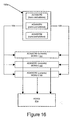
- Figure 16 is a diagram exemplifying the relationship between registers and analog blocks in accordance with one embodiment of the present invention. Only the portion of register bank 150a that includes the memory mapping of the three configuration registers ACA00CR0, ACA00CR1, and ACA00CR2 for analog block ACA00 21a (a continuous time block) is shown. As mentioned above, any number of configuration registers can be assigned to each analog block. Four configuration registers are typically assigned to each switched capacitor block.
- Register bank 150a is under the control of microcontroller 10 ( Figure 1).
- Register bank 150a includes the names of the configuration registers and their respective addresses.
- the configuration registers themselves may be physically located anywhere on or accessible by microcontroller 10.
- the configuration registers are coupled to their respective analog blocks (e.g., configuration registers ACA00CR0, ACA00CR1, and ACA00CR2 are coupled to analog block ACA00 21a), while in another embodiment the configuration registers are integrated into their respective analog blocks.
- each of the configuration registers ACA00CR0, ACA00CR1, and ACA00CR2 includes up to eight bits, designated as word 1 151, word 2 152 and word 3 153. Each of the bits, or the combination of the bits, is for implementing a particular analog function, as described more fully below in conjunction with Figures 17, 18A and 18B.
- each of the configuration registers is written to using an address bus (e.g., address bus 154) and a data bus (e.g., data bus 155).
- Figure 17 describes one embodiment of the contents of the registers for configuring a continuous time block (e.g., continuous time block 40 of Figure 4) in accordance with the present invention.
- a continuous time block e.g., continuous time block 40 of Figure 4
- Only three registers are used, although a different number of registers can be used in accordance with the present invention.
- Each bit or combination of bits in the registers is used to implement an analog function by selectively coupling analog blocks, by specifying characteristics of the analog elements in each of the analog blocks, and/or by specifying the inputs and outputs for the analog blocks.
- the F0, F1 and F2 bits specify the F inputs 43 to continuous time block 40.
- the three bits F0, F1 and F2 in combination can be used to specify eight different states.
- the three bits P0, P1 and P2 and the three bits N0, N1 and N2 are for specifying the P inputs 41 and N inputs 42.
- the G bit is for setting either a gain or loss (attenuation) configuration for the output tap, by specifying either a positive function or a negative function.
- the bits designated N/C are not connected (not used).
- the CEN bit is a comparator-enable bit.
- An operational amplifier typically includes a compensating capacitor; however, the compensating capacitor can slow operation if the op-amp is to be used as a comparator.
- the CEN bit is used to bypass the compensating capacitor.
- the OS bit of Figure 17 is to enable output onto the analog bus for the column of analog blocks (e.g., analog buses 25a-d of Figure 3), because only one block in a column can drive the analog bus at a time.
- analog blocks e.g., analog buses 25a-d of Figure 3
- the combination of S0 and S1 bits of Figure 17 is for selecting one of the four possible power levels for running continuous time block 40 ( Figure 4).
- the combination of the R0, R1, R2 and R3 bits is for selecting one of the 16 resistor taps, to change the resistance values of the programmable resistors 48a and 48b ( Figure 4), and to change the ratio of the resistances of these two resistors.
- Figure 18A describes one embodiment of the contents of the registers for configuring switched capacitor block 90 of Figure 9 (a type A switched capacitor block) in accordance with the present invention.
- Figure 18B describes one embodiment of the contents of the registers for configuring the switched capacitor block 100 of Figure 10 (a type B switched capacitor block) in accordance with the present invention.
- four registers are used for each analog block, although a different number of registers can be used in accordance with the present invention.
- Each bit or combination of bits in the registers is used to implement an analog function by selectively coupling analog blocks, by specifying characteristics of the analog elements in each of the analog blocks, and/or by specifying the inputs and outputs for the analog blocks.
- the bits A0-A4, B0-B4 and C0-C4 are for selecting one of the states (capacitances) for the programmable capacitors 92a-e ( Figure 9) or 111a-e ( Figure 10).
- the S bit is a sign bit controlling the inversion of the CA inputs 131 ( Figure 9) or 102 ( Figure 10); that is, the S bit changes the phase of the switches to invert the CA input.
- the PS bit is for selecting the clock phase during which a switched capacitor block will sample data.
- Each switched capacitor block 90 or 100 ( Figures 9 and 10, respectively) works off of two phases. The output is valid during one of these phases, while each block is sampling input during the other phase. For example, the output may be valid during (2 and the input might be sampled on (1.
- the phases for one of the blocks need to be swapped so that when one of the blocks is outputting data in one phase, the other block is sampling that data in that phase. Accordingly, the PS bit is used for specifying what phase a switched capacitor block will sample data.
- the OSZ, DO1, DO2 and AZ bits of Figures 18A and 18B are for controlling the gated switches in switched capacitor blocks 90 and 100 of Figures 9 and 10.
- the I11 and 112 bits of Figure 18A, and the I11, I12 and 113 bits of Figure 18B, are for selecting the CA inputs 131 ( Figure 9) or 102 ( Figure 10).
- the IS21 and IS22 bits of Figure 18A, and the MB bit of Figure 18B, are for selecting the CB inputs 140 and 103 ( Figures 9 and 10, respectively).
- the IS3 bit of Figure 18A is for selecting the CC input 141 of Figure 9.
- the S0 and S1 bits are for selecting the power level at which the analog block is to be run.
- the R1 and R2 bits are for selecting the REF input 130 ( Figure 9) or 101 ( Figure 10).
- the OS bit is to enable output onto the analog bus for the column of analog blocks, as described in conjunction with Figure 17.
- the CS bit is analogous to the CEN bit of Figure 17.
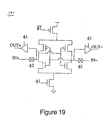
- Figure 19 is a schematic diagram showing one embodiment of a comparator cell 190 in accordance with the present invention.
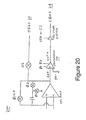
- Figure 20 is a schematic diagram showing one embodiment of a comparator connection 200 including comparator cell 190 in accordance with the present invention.
- the value of the CEN or CS bit determines whether the output of comparator cell 190 is allowed to reach the digital bus (CBUS) 24.
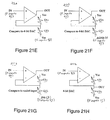
- Figures 21A, 21B, 21C, 21D, 21E, 21F, 21G and 21H are exemplary applications using continuous time blocks (e.g., continuous time block 40 of Figure 4) in accordance with the present invention. Other applications may be possible.
- Circuit 211 a is a non-inverting gain application
- circuit 211b is a non-inverting loss application
- circuit 211c is an inverting amplifier application
- circuit 211d is a comparator/uncontrolled op-amp application
- circuit 211e is one type of compare to a four-bit digital to analog converter (DAC)
- circuit 211f is another type of compare to four-bit DAC
- circuit 211g is a compare to scaled input application
- circuit 211h is a four-bit DAC.
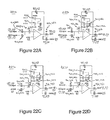
- Circuit 221 a is a delta-sigma modulator with correlated double sampling for 1/f noise reduction (the comparator cell 190 of Figure 19 is not shown).
- Circuit 221b is an analog portion of an incremental analog-to-digital converter (the comparator cell 190 of Figure 19 is not shown).
- Circuit 221c is a five-bit non-inverting DAC.
- Circuit 221d is a five-bit inverting DAC.
- Circuit 221e implements subtraction of CA inputs 131 and CB inputs 140.
- Circuit 221f implements addition of CA inputs 131 and CB inputs 140.
- Circuit 221g is for modulation from a digital configurable system module (DCSM) 222 (DCSMs are described in the provisional application referenced above).
- Circuit 221h is a switched capacitor integrator.
- Circuit 221 i implements a gain of 31/16 (not quite two).
- Circuit 221j is a switched capacitor comparator.
- Circuit 221k is a charge redistribution comparator.
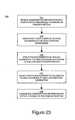
- Figure 23 is a flowchart of the steps in a process 230 for programming and configuring a multi-functional device (e.g., microcontroller 10 of Figure 1) in accordance with the various embodiments of the present invention.
- a multi-functional device e.g., microcontroller 10 of Figure 1
- steps in process 230 are exemplary. That is, the present invention is well suited to performing various other steps or variations of the steps recited in process 230. It is appreciated that the steps in process 230 may be performed in an order different than presented, and that not all of the steps in process 230 may be performed.
- step 231 of Figure 23 configuration information is received into the configuration register (or registers) for each analog block 21a-I ( Figure 2).
- configuration registers or registers for each analog block 21a-I ( Figure 2).
- Configuration information is realized as a set of data in flash ROM 16 ( Figure 1) which is loaded into the configuration registers at boot time. Because the information in the configuration registers can be dynamically changed, configuration information can also be loaded during program execution subsequent to boot time.
- analog blocks 21a-I are selectively and electrically coupled according to the information in the configuration registers. That is, certain of the analog blocks 21a-I are electrically coupled in a particular combination to achieve a particular analog function, while other analog blocks are bypassed (not included in the combination).
- step 233 in the present embodiment, characteristics of the analog elements of each of the analog blocks 21a-I (or the subset of analog blocks selectively coupled in step 232) are specified according to the information in the configuration registers to achieve the particular analog function. For example, bit(s) are set in the configuration register (or registers) of an analog block to: include a compensating capacitor for a comparator function or to bypass the compensating capacitor; specify a power level; specify a resistance value of a resistor; specify a capacitance of a capacitor; change the phase of an input; select a clock phase for sampling an input; and/or control a switch.
- step 234 in the present embodiment, inputs and outputs to the analog blocks 21a-I (or the subset of analog blocks selectively coupled in step 232) are specified according to the information in the configuration registers. Note that this step may be integrated with step 232, such that by specifying the inputs and outputs to each of the analog blocks, selected analog blocks are electrically coupled while others are bypassed.
- the configuration information can be dynamically changed, either at a subsequent boot time or during program execution.
- some aspect of the analog function already in place can be changed (e.g., parameterization); for example, characteristics of one or more analog elements can be changed within the combination of analog blocks selected in step 232.
- the analog blocks 21a-I can be selectively and electrically coupled in a different combination to perform a different analog function (e.g., personalization).
- parameterization and personalization of the analog blocks can be performed in combination.
- Figure 24 is a flowchart of the steps in a process 1500 for implementing multiple functions using a single integrated circuit (e.g., integrated circuit 10 of Figure 1) in accordance with one embodiment of the present invention .
- a single integrated circuit e.g., integrated circuit 10 of Figure 1
- integrated circuit 10 includes a plurality of analog blocks 20 ( Figures 2 and 3) that can be electrically coupled in different combinations to perform different functions.
- an analog block is selected from analog blocks 20.
- the selected analog block is selectively and electrically coupled to one or more of the other analog blocks 20, depending on the particular analog function to be implemented and according to the user's programming. Certain analog blocks may be bypassed (not used) in the resultant circuit. Characteristics of elements in the analog blocks 20 can also be specified according to the user's programming, also depending on the particular analog function to be implemented.
- the analog blocks 20 are reconfigured to perform a different analog function (e.g., a different combination of the analog blocks 20 can be selectively and electrically coupled to perform another function).
- the present invention provides an analog system methodology and architecture that introduces a single chip solution that contains a set of tailored analog blocks and elements that can be dynamically configured and reconfigured in different ways to implement a variety of different analog functions.
- Configuration registers define the type of function to be performed, the way in which the analog blocks are to be coupled, the inputs and outputs of the analog blocks, and the characteristics of the analog elements.
- the configuration registers can be dynamically programmed.
- each analog block has up to four registers for programming block functions, coefficient values, routing to and from peripherals, and routing to and from other blocks.
- the block functions are programmed by enabling certain parts of the circuit by closing appropriate switches in response to user programming of the register values.
- the coefficients are programmed by selecting the values (characteristics) of passive circuit elements in response to the register values.
- the passive elements include capacitors (in switched capacitor blocks) and resistors (in continuous time blocks). The desired routing is realized by enabling selected switches.
- the present invention thus provides a microcontroller solution and programmable analog system architecture that is suited for a variety of applications and therefore can reduce development time and expenses.
- the present invention facilitates the design of customized chips (integrated circuits and microcontrollers) at reduced costs.
- chips integrated circuits and microcontrollers
- designers are not subjected to the volume requirements needed to make contemporary designs viable.
- pre-designed (personalized) combinations of analog blocks (“user modules") can be provided to designers.
Landscapes
- Engineering & Computer Science (AREA)
- Theoretical Computer Science (AREA)
- Physics & Mathematics (AREA)
- Computer Hardware Design (AREA)
- General Physics & Mathematics (AREA)
- General Engineering & Computer Science (AREA)
- Power Engineering (AREA)
- Mathematical Physics (AREA)
- Chemical & Material Sciences (AREA)
- Crystallography & Structural Chemistry (AREA)
- Semiconductor Integrated Circuits (AREA)
Applications Claiming Priority (8)
| Application Number | Priority Date | Filing Date | Title |
|---|---|---|---|
| US929891 | 1997-09-15 | ||
| US24370800P | 2000-10-26 | 2000-10-26 | |
| US243708P | 2000-10-26 | ||
| US909047 | 2001-07-18 | ||
| US09/909,047 US6941336B1 (en) | 2000-10-26 | 2001-07-18 | Programmable analog system architecture |
| US09/930,021 US6910126B1 (en) | 2000-10-26 | 2001-08-14 | Programming methodology and architecture for a programmable analog system |
| US930021 | 2001-08-14 | ||
| US09/929,891 US7092980B1 (en) | 2000-10-26 | 2001-08-14 | Programming architecture for a programmable analog system |
Publications (2)
| Publication Number | Publication Date |
|---|---|
| EP1202184A2 true EP1202184A2 (fr) | 2002-05-02 |
| EP1202184A3 EP1202184A3 (fr) | 2004-12-29 |
Family
ID=27500130
Family Applications (1)
| Application Number | Title | Priority Date | Filing Date |
|---|---|---|---|
| EP01125563A Withdrawn EP1202184A3 (fr) | 2000-10-26 | 2001-10-25 | Méthodologie de programmation et architecture pour un système analogique programmable sur une puce |
Country Status (2)
| Country | Link |
|---|---|
| EP (1) | EP1202184A3 (fr) |
| TW (1) | TW567503B (fr) |
Cited By (1)
| Publication number | Priority date | Publication date | Assignee | Title |
|---|---|---|---|---|
| CN111007819A (zh) * | 2019-12-19 | 2020-04-14 | 杭州和利时自动化有限公司 | 一种复用ai通道和di通道的io模块 |
Family Cites Families (4)
| Publication number | Priority date | Publication date | Assignee | Title |
|---|---|---|---|---|
| US5245262A (en) * | 1992-07-13 | 1993-09-14 | Allegro Microsystems, Inc. | Hybrid control law servo co-processor integrated circuit |
| US5677691A (en) * | 1993-06-25 | 1997-10-14 | Fraunhofer-Gesellschaft Zur Forderung Der Angewandten Forschung E.V. | Configurable analog and digital array |
| WO1995032478A1 (fr) * | 1994-05-24 | 1995-11-30 | Imp, Inc. | Circuit integre presentant des fonctions analogiques programmables et techniques assistees par ordinateur pour programmer le circuit |
| US5691664A (en) * | 1996-01-16 | 1997-11-25 | Motorola, Inc. | Programmable analog array and method for establishing a feedback loop therein |
-
2001
- 2001-10-25 EP EP01125563A patent/EP1202184A3/fr not_active Withdrawn
- 2001-10-26 TW TW90126525A patent/TW567503B/zh not_active IP Right Cessation
Non-Patent Citations (1)
| Title |
|---|
| None * |
Cited By (2)
| Publication number | Priority date | Publication date | Assignee | Title |
|---|---|---|---|---|
| CN111007819A (zh) * | 2019-12-19 | 2020-04-14 | 杭州和利时自动化有限公司 | 一种复用ai通道和di通道的io模块 |
| CN111007819B (zh) * | 2019-12-19 | 2020-11-27 | 杭州和利时自动化有限公司 | 一种复用ai通道和di通道的io模块 |
Also Published As
| Publication number | Publication date |
|---|---|
| TW567503B (en) | 2003-12-21 |
| EP1202184A3 (fr) | 2004-12-29 |
Similar Documents
| Publication | Publication Date | Title |
|---|---|---|
| US6910126B1 (en) | Programming methodology and architecture for a programmable analog system | |
| US7092980B1 (en) | Programming architecture for a programmable analog system | |
| US6941336B1 (en) | Programmable analog system architecture | |
| US10725954B2 (en) | Microcontroller programmable system on a chip | |
| EP2031518A2 (fr) | Circuit | |
| US6967511B1 (en) | Method for synchronizing and resetting clock signals supplied to multiple programmable analog blocks | |
| US7023257B1 (en) | Architecture for synchronizing and resetting clock signals supplied to multiple programmable analog blocks | |
| US6611220B1 (en) | Architecture for decimation algorithm | |
| US7190190B1 (en) | Programmable logic device with on-chip nonvolatile user memory | |
| WO1995032481A1 (fr) | Circuit integre comportant des modules analogiques programmables avec des interconnexions configurables entre eux | |
| CN1934787A (zh) | 可编程输入范围模数转换器 | |
| CN107092577B (zh) | 带有可编程块和模拟电路控制的集成电路器件 | |
| US9124285B1 (en) | On-chip calibration method | |
| JP2004515013A (ja) | 双方向の離散及びアナログ信号を条件付けし且つ変換するための集積回路 | |
| US10911060B1 (en) | Low power device for high-speed time-interleaved sampling | |
| US20160285433A1 (en) | Configurable capacitor arrays and switched capacitor circuits | |
| US7042380B2 (en) | Digital potentiometer with resistor binary weighting decoding | |
| EP2999120A2 (fr) | Dispositif de circuit intégré avec sous-système analogique programmable | |
| CN107112997A (zh) | 可重构半导体装置 | |
| EP3358438B1 (fr) | Dispositif d'interface d'horloge configurable | |
| EP1202184A2 (fr) | Méthodologie de programmation et architecture pour un système analogique programmable sur une puce | |
| EP4591220A1 (fr) | Processeur de réseau neuronal | |
| US10386415B2 (en) | Mixed-signal integrated circuit | |
| CN114026552A (zh) | 具有可配置逻辑外围设备的微控制器 | |
| US5867715A (en) | Apparatus for programmably converting an operating voltage of a CPU and chipset |
Legal Events
| Date | Code | Title | Description |
|---|---|---|---|
| PUAI | Public reference made under article 153(3) epc to a published international application that has entered the european phase |
Free format text: ORIGINAL CODE: 0009012 |
|
| AK | Designated contracting states |
Kind code of ref document: A2 Designated state(s): AT BE CH CY DE DK ES FI FR GB GR IE IT LI LU MC NL PT SE TR |
|
| AX | Request for extension of the european patent |
Free format text: AL;LT;LV;MK;RO;SI |
|
| PUAL | Search report despatched |
Free format text: ORIGINAL CODE: 0009013 |
|
| AK | Designated contracting states |
Kind code of ref document: A3 Designated state(s): AT BE CH CY DE DK ES FI FR GB GR IE IT LI LU MC NL PT SE TR |
|
| AX | Request for extension of the european patent |
Extension state: AL LT LV MK RO SI |
|
| 17P | Request for examination filed |
Effective date: 20050620 |
|
| AKX | Designation fees paid |
Designated state(s): AT BE CH CY DE DK ES FI FR GB GR IE IT LI LU MC NL PT SE TR |
|
| 17Q | First examination report despatched |
Effective date: 20070926 |
|
| RAP1 | Party data changed (applicant data changed or rights of an application transferred) |
Owner name: CYPRESS SEMICONDUCTOR CORPORATION |
|
| STAA | Information on the status of an ep patent application or granted ep patent |
Free format text: STATUS: EXAMINATION IS IN PROGRESS |
|
| STAA | Information on the status of an ep patent application or granted ep patent |
Free format text: STATUS: THE APPLICATION IS DEEMED TO BE WITHDRAWN |
|
| 18D | Application deemed to be withdrawn |
Effective date: 20190501 |