EP1202307A2 - Schalter und Verbindungsanordnung - Google Patents
Schalter und Verbindungsanordnung Download PDFInfo
- Publication number
- EP1202307A2 EP1202307A2 EP01308705A EP01308705A EP1202307A2 EP 1202307 A2 EP1202307 A2 EP 1202307A2 EP 01308705 A EP01308705 A EP 01308705A EP 01308705 A EP01308705 A EP 01308705A EP 1202307 A2 EP1202307 A2 EP 1202307A2
- Authority
- EP
- European Patent Office
- Prior art keywords
- electrical
- electrical connector
- housing
- members
- contacts
- Prior art date
- Legal status (The legal status is an assumption and is not a legal conclusion. Google has not performed a legal analysis and makes no representation as to the accuracy of the status listed.)
- Withdrawn
Links
Images


Classifications
-
- H—ELECTRICITY
- H01—ELECTRIC ELEMENTS
- H01H—ELECTRIC SWITCHES; RELAYS; SELECTORS; EMERGENCY PROTECTIVE DEVICES
- H01H11/00—Apparatus or processes specially adapted for the manufacture of electric switches
- H01H11/0006—Apparatus or processes specially adapted for the manufacture of electric switches for converting electric switches
- H01H11/0031—Apparatus or processes specially adapted for the manufacture of electric switches for converting electric switches for allowing different types or orientation of connections to contacts
-
- H—ELECTRICITY
- H01—ELECTRIC ELEMENTS
- H01R—ELECTRICALLY-CONDUCTIVE CONNECTIONS; STRUCTURAL ASSOCIATIONS OF A PLURALITY OF MUTUALLY-INSULATED ELECTRICAL CONNECTING ELEMENTS; COUPLING DEVICES; CURRENT COLLECTORS
- H01R43/00—Apparatus or processes specially adapted for manufacturing, assembling, maintaining, or repairing of line connectors or current collectors or for joining electric conductors
-
- H—ELECTRICITY
- H01—ELECTRIC ELEMENTS
- H01R—ELECTRICALLY-CONDUCTIVE CONNECTIONS; STRUCTURAL ASSOCIATIONS OF A PLURALITY OF MUTUALLY-INSULATED ELECTRICAL CONNECTING ELEMENTS; COUPLING DEVICES; CURRENT COLLECTORS
- H01R4/00—Electrically-conductive connections between two or more conductive members in direct contact, i.e. touching one another; Means for effecting or maintaining such contact; Electrically-conductive connections having two or more spaced connecting locations for conductors and using contact members penetrating insulation
- H01R4/24—Connections using contact members penetrating or cutting insulation or cable strands
- H01R4/2416—Connections using contact members penetrating or cutting insulation or cable strands the contact members having insulation-cutting edges, e.g. of tuning fork type
- H01R4/2445—Connections using contact members penetrating or cutting insulation or cable strands the contact members having insulation-cutting edges, e.g. of tuning fork type the contact members having additional means acting on the insulation or the wire, e.g. additional insulation penetrating means, strain relief means or wire cutting knives
- H01R4/245—Connections using contact members penetrating or cutting insulation or cable strands the contact members having insulation-cutting edges, e.g. of tuning fork type the contact members having additional means acting on the insulation or the wire, e.g. additional insulation penetrating means, strain relief means or wire cutting knives the additional means having two or more slotted flat portions
- H01R4/2454—Connections using contact members penetrating or cutting insulation or cable strands the contact members having insulation-cutting edges, e.g. of tuning fork type the contact members having additional means acting on the insulation or the wire, e.g. additional insulation penetrating means, strain relief means or wire cutting knives the additional means having two or more slotted flat portions forming a U-shape with slotted branches
-
- H—ELECTRICITY
- H01—ELECTRIC ELEMENTS
- H01R—ELECTRICALLY-CONDUCTIVE CONNECTIONS; STRUCTURAL ASSOCIATIONS OF A PLURALITY OF MUTUALLY-INSULATED ELECTRICAL CONNECTING ELEMENTS; COUPLING DEVICES; CURRENT COLLECTORS
- H01R9/00—Structural associations of a plurality of mutually-insulated electrical connecting elements, e.g. terminal strips or terminal blocks; Terminals or binding posts mounted upon a base or in a case; Bases therefor
- H01R9/22—Bases, e.g. strip, block, panel
- H01R9/24—Terminal blocks
- H01R9/2425—Structural association with built-in components
- H01R9/2433—Structural association with built-in components with built-in switch
-
- H—ELECTRICITY
- H01—ELECTRIC ELEMENTS
- H01H—ELECTRIC SWITCHES; RELAYS; SELECTORS; EMERGENCY PROTECTIVE DEVICES
- H01H1/00—Contacts
- H01H1/58—Electric connections to or between contacts; Terminals
- H01H1/5844—Electric connections to or between contacts; Terminals making use of wire-gripping clips or springs
- H01H1/585—Electric connections to or between contacts; Terminals making use of wire-gripping clips or springs and piercing the wire insulation
-
- H—ELECTRICITY
- H01—ELECTRIC ELEMENTS
- H01H—ELECTRIC SWITCHES; RELAYS; SELECTORS; EMERGENCY PROTECTIVE DEVICES
- H01H1/00—Contacts
- H01H1/58—Electric connections to or between contacts; Terminals
- H01H1/5866—Electric connections to or between contacts; Terminals characterised by the use of a plug and socket connector
Definitions
- the present invention relates generally to electrical switch mechanisms and electrical connector components, and more particularly to a new and improved low-profile combination electrical switch and connector assembly which facilitates easy assembly of the switch mechanism and connector component, wherein the connector component and switch mechanism are connected together in a properly oriented or polarized manner, and wherein the electrical contacts disposed within the electrical connector not only facilitate easy connection to external wires through means of insulation displacement techniques, but in addition, the electrical contacts are self-supporting and self-generate requisite forces for electrical connection to tab members of the switch mechanism.
- Switch mechanisms and operatively associated electrical connector components are often mounted upon support panels, walls, or the like so as to remotely control electrical appliances, lighting fixtures, or other electrical equipment. Space for accommodating the electrical switch mechanisms and their operatively associated electrical connector components, however, is often limited, confined, or simply not readily accessible whereby it becomes necessary to minimize or optimize the component or hardware dimensions.
- the electrical switch mechanism and the electrical connector component be able to be electrically connected to, and when required, electrically disconnected from, each other in a relatively simple, properly oriented, and cost-effective manner, preferably by means of non-soldered plug-in and/or insulation displacement type connections. Accordingly, replacement or exchange of the assembly components would be facilitated and expedited.
- such an electrical connector and switch mechanism assembly does not presently exist in the current state of the art.
- a combination electrical switch mechanism and electrical connector assembly which comprises an electrical connector having electrical contacts disposed therein, and a switch mechanism which includes a plurality of dependent tab members for insertion within the electrical connector for mating with the contact members of the electrical connector in a frictionfit solderless manner.
- the switch mechanism also comprises a three-sided shrouded housing whereby the switch mechanism can only be mated with the electrical connector in a predetermined polarized manner.
- the contact members of the electrical connector also have insulation displacement portions for terminating external wiring therein in a solderless manner, and the contact members are self-supporting so as not to require external support from the electrical connector housing.
- the contact members also self-generate the requisite forces required for mating with the dependent tab members of the switch mechanism.
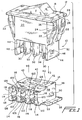
- a first embodiment of the combination electrical switch mechanism and electrical connector assembly is disclosed, is generally indicated by the reference character 10, and is seen to comprise the electrical switch mechanism 12 and the electrical connector 14.
- the switch mechanism 12 may comprise, for example, a conventional rocker switch element 16 which is mounted within a switch plate 18 wherein the plate 18 is adapted to be disposed externally upon a support panel, wall, plate, or the like, not shown, when the switch mechanism 12 is mounted upon the support panel, wall, plate, or the like, not shown.
- the switch mechanism 12 further comprises a housing 20 which has a configuration which is substantially that of a rectangular parallelepiped, and a pair of flexible mounting fingers 22 is mounted upon respective opposite ends 24 of the switch housing 20 in a cantilevered manner.
- Each one of the flexible mounting fingers 22 is integrally mounted at its lower end portion upon a lower end region of the switch housing 20, while an upper distal end portion 26 of each finger 22 is disposed at an elevational level which is below the lower edge of switch plate 18 so as to define a space 28 having a predetermined dimension.
- the dimension of space 28 is adapted to substantially match the thickness dimension of the support panel, wall, plate, or the like, not shown, upon which the combination switch mechanism and electrical connector 10 is to be mounted in a snap-fitted manner.
- the switch mechanism 12 is adapted to be inserted downwardly through an aperture, not shown, defined within the support panel, plate, wall, or the like, also not shown, whereby the flexible fingers 22 will be forced inwardly, from their illustrated positions toward the switch mechanism housing 20, by the side walls of the support panel, plate, wall, or the like, not shown, which define the aperture, not shown.
- the fingers 22 will expand outwardly or snap back to their illustrated positions so as to lockingly engage the undersurface of the support panel, plate, wall, or the like, whereby the switch mechanism 12 will be fixedly mounted upon the support panel, wall, plate, or the like, not shown.
- the switch mechanism 12 is seen to further comprise a plurality of dependent blade-type contact members 30 extending downwardly from the bottom portion of the switch housing 20, and a three-sided shroud 32 integral with the end walls 24 of the switch housing, and the rear wall, not shown, of the switch housing 20, and depending downwardly so as to surround the dependent blade members 30 upon three sides thereof, leaving the fourth front side open, and also define a substantially enclosed space 34.
- the electrical connector 14 is seen to comprise an electrical connector contact housing 36 which has the configuration of a rectangular parallelepiped and which is supported upon a lower base or foundation 38.
- the upper surface 40 of the electrical connector housing 36 is seen to comprise a plurality of apertures 42 for receiving or accommodating insertion or reception of the dependent blade members 30 of the switch mechanism 12, and the apertures 42 connect to interior hollow portions of the housing 36 within which electrical contact portions are disposed, as will be more fully disclosed and explained hereinafter, for mating electrical connection with the blade members 30 of the switch mechanism 12 when the switch mechanism 12 and electrical connector 14 are mated together as a result of the switch mechanism 12 being moved downwardly relative to the electrical connector J4 in accordance with the arrow D or as a result of the electrical connector 14 being moved upwardly relative to the switch mechanism 12 in accordance with the arrow U.
- Opposite end walls 44 of the dependent shroud are provided with apertures 46, and opposite end walls 48 of the connector housing 36 are provided with detents 50 which are adapted to be lockingly snap-fitted within the apertures 46 of the shroud end walls 44 when the switch mechanism 12 is mated with the electrical connector 14.
- the switch housing 20 when the electrical switch mechanism 12 is mounted upon or mated with the electrical connector 14, the switch housing 20 is disposed atop the connector housing 36 and the three-sided shroud 32 of the switch mechanism 12 substantially encloses the opposite end walls 48,48 and rear wall, not shown, of the electrical connector housing 36.
- the bottom surface portions of the shroud end walls 44,44, as well as the bottom portion of its rear wall 52, are supported upon the base or foundation 38 of the connector 14.
- the electrical connector 14 is also provided with an auxiliary housing portion 53 which is integrally formed upon and projects forwardly of the connector housing 36.Auxiliary housing portion 53 is provided f or facilitating insertion of the electrical connector contacts into the electrical connector 14 wherein the electrical connector contacts provide electrical connection between external wiring and the contact blade members 30 of the switch mechanism 12.
- the switch mechanism 12 due to the interactive structure of the switch mechanism 12 and the electrical connector 14, and in particular, the provision of the three-sided shroud portion 32 upon the switch mechanism 12 as well as the provision of the auxiliary housing portion 53 upon the electrical connector 14, the switch mechanism 12 must be disposed in a uniquely required orientation when the switch mechanism 12 is to be mounted upon the electrical connector 14 whereby, in effect, a polarized connection is established or defined between the switch mechanism 12 and the electrical connector 14 so as to ensure proper mounting or mating of such components parts with respect to each other.
- the electrical connector 14 is adapted to have inserted therein three electrical connector contacts for electrical mating with the three dependent blade members 30 of the switch mechanism. Accordingly, with additional reference being made to FIGURES 3 and 4, the new and improved electrical connector contacts are disclosed and are generally indicated by the reference character 54. It is noted that FIGURE 3 discloses the electrical contact 54 as disposed in its normal orientation for insertion within the electrical connector 14, while FIGURE 4 discloses the electrical contact 54 as disposed in an inverted mode so as to clearly illustrate additional features of the contact 54 which are not apparent from FIGURE 3.
- orientation terminology will be used in connection with the description of the contact 54 as shown in FIGURE 3, although such terminology may not be accurate with respect to the disclosure of FIGURE 4 due to the inversion of the contact 54 as disclosed in FIGURE 4 as compared to its orientation in FIGURE 3, however, the component parts of the contact 54 as shown in FIGURE 4 which correspond to the same parts of the contact 54 as shown in FIGURE 3 will be designated by the same reference characters for clarity and consistency.
- each one of the electrical connector contacts 54 is seen to comprise, as considered from the viewpoint of the disposition of the contact 54 when the same is mounted within the electrical connector 14, a forwardly disposed insulation displacement contact portion 56 for electrical connection to external wiring and a rearwardly disposed blade-engaging contact portion 58 for electrical connection to the blade members 30 of the switch mechanism 12.
- the insulation displacement contact portion 56 is seen to comprise a pair of vertically spaced upper and lower insulation displacement contact members 60,62.
- the contact members 60,62 are connected to each other at left side or edge portions thereof, again as considered from the viewpoint of the disposition of the contacts 54 when the contacts 54 are disposed or mounted within the electrical connector 14, by means of a vertically disposed wall member 64, and the right side portions of the contact members 60,62 define free edge portions 66,68.
- the upstanding wall member 64 and the free edge portions 66,68 of the contacts 54 help serve to support the contacts 54 within the electrical connector 14.
- substantially central portions of the contact members 60,62 are of course provided with slotted regions 70,72 which are provided for achieving insulation displacement or insulation stripping procedures in connection with external wires, not shown, to be electrically connected to the electrical connector contacts 54 in accordance with well-known techniques.
- the blade-engaging contact portion 58 of each one of the electrical contacts 54 is seen to comprise a left side wall member 74 which, in effect, is an integral extension of the upstanding side wall member 64 of the insulation displacement contact portion 56, and a floor member 76 which is integrally connected at its left edge portion to the lower end of the upstanding wall member 74.
- a first downwardly extending blade-engaging contact member 78 is integrally connected to the upper end of the upstanding wall member 74, and a second upwardly extending blade-engaging contact member 80 is integrally connected to the right edge portion of the floor member 76.
- first blade-engaging contact member 78 is provided with a vertically central, longitudinally extending planar portion 82
- second blade-engaging contact member 80 is similarly provided with a vertically central, longitudinally extending planar portion 84 which is transversely spaced from the planar portion 82 of contact member 78 so as to permit insertion of a respective one of the blade members 30 of the switch mechanism 12 therebetween.
- planar surfaces or portions 82,84 establish surface-to-surface contact with the blade member 30, and in order to facilitate insertion of the blade member 30 into the space or channel 86 defined between the planar portions 82,84, the upper end of the contact member 78 is provided with an outwardly inclined or divergent entrance portion 88 and the upper end of the contact member 80 is similarly provided with an outwardly inclined or divergent entrance portion 90.
- both of the blade engaging contact members 78,80 are respectively freely mounted upon the upstanding wall and floor members 74,76 so as to be resiliently flexible, and in this manner, the contact members 78,80 are self-supporting self-generate the necessary forces in the transverse or lateral direction so as to properly engage a respective one of the blade members 30 when the blade member 30 is inserted into space or channel 86 between the contact portions 82,84.
- the forward end portions 92,94 of the contact members 78,80 are longitudinally or axially spaced as at 96 from rear edge portions 98,100 of the insulation displacement contact members 60,62.
- rear end portions 102,104 of the contact members 78, 80 are longitudinally or axially recessed forwardly as at 106, 108 from the respective rear edge surface portions 110,112 of the upstanding wall and horizontal floor members 74, 76 such that when the electrical contacts 54 are mounted within the electrical connector 14, the rear end portions 102,104 of the contact members 78,80 will not engage or abrade the rear internal wall surface of the electrical connector housing 36. It is also to be appreciated that all electrical connections characteristic of the combination electrical switch and connector assembly 10 of the present invention, that is, between the external wires, not shown, and the insulation displacement contacts 60,62, and between the blade members 30 and the contact members 78,80 are entirely solderless.
- the electrical connector 14, comprising the primary connector housing 36 and the auxiliary connector housing 53 comprises, for example, four upstanding wall members 114 so as to define, in effect, three electrical contact sockets 116 therebetween which extend substantially the full depth of the electrical connector 14 and within which the electrical contacts 54 will be disposed. More particularly, a horizontally disposed or extending channel 118 is defined within a vertically central portion of each left-side interior wall surface of each upstanding wall member 114, and in a similar manner, a pair of vertically spaced horizontally extending channels 120,122 are defined within vertically central portions of each right-side interior wall surface of each upstanding wall member 114.
- electrical contact vertical wall member 64/74 will be disposed within the electrical connector channel 118 while the free edge portions 66,68 of each contact 54 will be respectively disposed within the channels 120,122 of the connector 14.
- each one of the sockets 116 is also provided with an internal upstanding boss or the like, not shown, upon which the floor member 76 of each contact 54 is supported so as to support the rearward portion of each contact 54, particularly in connection with the resistance to any downward force which may be impressed thereon when the blade members 30 of the switch mechanism 12 are being inserted into the spaces 86 of the contact members 54 so as to be electrically engaged with the flexibly movable contact portions 78,80.
- each one of the upstanding wall members 114 has integrally formed upon forward end portions thereof, at upper and lower vertically spaced levels, a plurality of oppositely disposed tab members 126 which serve to retain the external wires, not shown, which are to be inserted into the sockets 116 for electrical connection to the insulation displacement contact members 60,62.
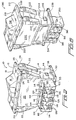
- FIGURES 5a,5b, and 6 a second embodiment of the new and improved combination electrical switch mechanism and electrical connector assembly is disclosed and is generally indicated by the reference character 210.
- the second embodiment of the combination electrical switch mechanism and electrical connector assembly 210 as disclosed within FIGURES 5a,5b and 6 is structurally and operationally similar to the first embodiment of the combination electrical switch mechanism and electrical connector assembly 10 as disclosed within FIGURES 1 and 2, except as will be specifically noted hereinafter, and accordingly component parts of the second embodiment of the combination electrical switch mechanism and electrical connector assembly 210 as disclosed within FIGURES 5a,5b and 6 which are similar to corresponding parts of the first embodiment of the combination electrical switch mechanism and electrical connector assembly 10 as disclosed within FIGURES 1 and 2 will be designated by corresponding reference characters except that the reference characters will be within the 200 and 300 series.
- the major difference between the first embodiment of the combination electrical switch mechanism and electrical connector assembly 10 as disclosed within FIGURES 1 and 2 and the second embodiment of the combination electrical switch mechanism and electrical connector assembly 210 as disclosed within FIGURES 5a,5b and 6 resides in the fact that, in lieu of the auxiliary housing portion 53 projecting forwardly from a side portion of the electrical connector housing 36 as was the case with the first embodiment of the combination electrical switch mechanism and electrical connector assembly 10 as disclosed within FIGURES 1 and 2, the auxiliary housing portion 253 of the electrical connector 214 projects downwardly from the bottom, base, or foundation portion 238 of the electrical connector housing 236.
- the contact housing 236 is disposed atop the auxiliary housing portion 253 as opposed to the housings being disposed in effect in a side-by-side arrangement as was the case of housing 36 and auxiliary housing 53 of the first embodiment of the combination electrical switch mechanism and electrical connector assembly 10 as disclosed within FIGURES 1 and 2.
- the wires to be mated with the electrical contacts disposed within the auxiliary housing portion 253 will extend horizontally, as opposed Co vertically, thus permitting the second embodiment of the combination electrical switch mechanism and electrical connector assembly 210 disclosed within FIGURES 5a,5b and 6 to be used within applications which may require orientations which are different from those afforded by the first embodiment of the combination electrical switch mechanism and electrical connector assembly 10 as disclosed within FIGURES 1 and 2.
- the auxiliary housing portion 253 comprises four upstanding wall members 314 which are disposed parallel to each other in a manner similar to the disposition of the upstanding wall members 114 of the auxiliary housing portion 53 of the first embodiment of the combination electrical switch mechanism and electrical connector assembly 10 as disclosed within FIGURES 1 and 2, however, in lieu of the horizontally disposed channels 118,120,122 extending rearwardly from forwardly disposed faces of the upstanding wall members 114, the upstanding wall members 314 are respectively provided with vertically disposed channels 318,320,322 which extend upwardly from lower or bottom surfaces 315 of the upstanding wall members 314 as best seen in FIGURE 5b.
- a new and improved combination electrical switch mechanism and electrical connector assembly has been developed wherein the assembly has a relatively low profile and wherein all electrical connections between the switch mechanism and the electrical connector, as well as between the electrical connector and external wiring, is achieved through means of solderless connections.
- the connection between the switch mechanism and the electrical connector is polarized such that the components can only be connected to each other in a predetermined proper mode or orientation.
- the electrical contacts disposed within the electrical connector are self-supporting and self-generate the necessary forces for properly mating with the blade members of the switch mechanism.
Landscapes
- Engineering & Computer Science (AREA)
- Manufacturing & Machinery (AREA)
- Details Of Connecting Devices For Male And Female Coupling (AREA)
- Switch Cases, Indication, And Locking (AREA)
- Connector Housings Or Holding Contact Members (AREA)
- Connecting Device With Holders (AREA)
- Coupling Device And Connection With Printed Circuit (AREA)
Applications Claiming Priority (2)
| Application Number | Priority Date | Filing Date | Title |
|---|---|---|---|
| US696407 | 1991-05-06 | ||
| US09/696,407 US6312288B1 (en) | 2000-10-25 | 2000-10-25 | Low profile combination switch and connector assembly |
Publications (1)
| Publication Number | Publication Date |
|---|---|
| EP1202307A2 true EP1202307A2 (de) | 2002-05-02 |
Family
ID=24796935
Family Applications (1)
| Application Number | Title | Priority Date | Filing Date |
|---|---|---|---|
| EP01308705A Withdrawn EP1202307A2 (de) | 2000-10-25 | 2001-10-12 | Schalter und Verbindungsanordnung |
Country Status (10)
| Country | Link |
|---|---|
| US (1) | US6312288B1 (de) |
| EP (1) | EP1202307A2 (de) |
| JP (1) | JP2002170644A (de) |
| KR (1) | KR100791040B1 (de) |
| CN (1) | CN1178245C (de) |
| BR (1) | BR0104501A (de) |
| CA (1) | CA2357438A1 (de) |
| HK (1) | HK1046468A1 (de) |
| MX (1) | MXPA01010756A (de) |
| TW (1) | TW540186B (de) |
Families Citing this family (17)
| Publication number | Priority date | Publication date | Assignee | Title |
|---|---|---|---|---|
| GB0020983D0 (en) * | 2000-08-26 | 2000-10-11 | Honeywell Control Syst | Limit switch |
| US6488539B1 (en) * | 2001-09-20 | 2002-12-03 | Illinois Tool Works Inc. | Electrical connector |
| CA2494641A1 (en) * | 2002-08-29 | 2004-03-11 | Emrise Corporation | Rotary switch detent structure independent of knob |
| US6969271B2 (en) * | 2002-09-10 | 2005-11-29 | Visteon Global Technologies, Inc. | Snap pin connector |
| DE10349486A1 (de) * | 2002-10-25 | 2004-05-13 | Yazaki Corporation | Anschlussklemme und Steckverbindung |
| US7109430B2 (en) * | 2002-11-05 | 2006-09-19 | Emrise Corporation | Low profile rotary switch with detent in the bushing |
| USD568818S1 (en) * | 2004-11-18 | 2008-05-13 | Mollon Mark L | Molded pin retainer for electrical connector |
| USD605138S1 (en) * | 2008-05-07 | 2009-12-01 | Honda Tsushin Kogyo Co., Ltd. | Shell for electric connector |
| JP5377485B2 (ja) * | 2008-07-10 | 2013-12-25 | 三菱電機株式会社 | エレベータの操作パネル装置 |
| CN102842451B (zh) * | 2012-09-10 | 2015-09-30 | 乐清市平兴电子有限公司 | 按钮开关及其连接器 |
| US9184515B1 (en) * | 2012-09-28 | 2015-11-10 | Anthony Freakes | Terminal blocks for printed circuit boards |
| US8974245B2 (en) * | 2013-08-05 | 2015-03-10 | Hubbell Incorporated | Grounding electrical connector |
| DE102013216472A1 (de) * | 2013-08-20 | 2015-02-26 | Brose Fahrzeugteile GmbH & Co. Kommanditgesellschaft, Würzburg | Elektrische Kontaktanordnung für einen Elektromotor und Verfahren zur Herstellung |
| DE102017129515A1 (de) * | 2017-12-12 | 2019-06-13 | Johnson Electric Germany GmbH & Co. KG | Elektrischer Schalter |
| TWD212149S (zh) * | 2020-06-30 | 2021-06-11 | 大陸商東莞立訊技術有限公司 | 遮蔽殼體 |
| TWD212150S (zh) * | 2020-06-30 | 2021-06-11 | 大陸商東莞立訊技術有限公司 | 端子模組 |
| US11381020B1 (en) * | 2021-01-25 | 2022-07-05 | TE Connectivity Services Gmbh | Electrical terminal for mating with two coplanar tabs |
Family Cites Families (17)
| Publication number | Priority date | Publication date | Assignee | Title |
|---|---|---|---|---|
| US2294085A (en) * | 1940-10-21 | 1942-08-25 | Anton E Hanson | Safety electrical couplings |
| US3555493A (en) * | 1968-03-25 | 1971-01-12 | Molex Products Co | Right angle printed circuit board connector |
| US4210382A (en) * | 1979-05-23 | 1980-07-01 | Ford Motor Company | Electrical connector and housing |
| US4349176A (en) * | 1980-02-19 | 1982-09-14 | Ross Operating Valve Company | Electrical terminal construction |
| US4472016A (en) * | 1982-09-17 | 1984-09-18 | Illinois Tool Works, Inc. | Terminal block connector |
| US4533202A (en) * | 1983-09-29 | 1985-08-06 | The Siemon Company | Multiple electrical connector and block with printed circuit board connector clip |
| JPS6091573A (ja) * | 1983-10-26 | 1985-05-22 | 矢崎総業株式会社 | 自動車用ワイヤ−ハ−ネス |
| US4669804A (en) * | 1985-06-14 | 1987-06-02 | Eagle Electric Mfg. Co., Inc. | Wall-mountable wiring installation |
| JPH0511671Y2 (de) * | 1987-08-17 | 1993-03-23 | ||
| US5030132A (en) * | 1987-12-17 | 1991-07-09 | Amp Incorporated | Bidirectional insulation displacement electrical contact terminal |
| US5162004A (en) * | 1989-05-19 | 1992-11-10 | Yazaki Corporation | Multi-terminal electric connector requiring low insertion and removal force |
| KR950014476A (ko) * | 1993-11-25 | 1995-06-16 | 김무연 | 레요넷 에스 효소를 이용한 과수분리방법 |
| US5513999A (en) * | 1994-06-02 | 1996-05-07 | Molex Incorporated | Electrical connector assembly with a switch |
| US5658158A (en) * | 1995-08-28 | 1997-08-19 | Milan; Henry | Modular surge protection system with interchangeable surge protection modules |
| KR0180462B1 (ko) * | 1996-10-21 | 1999-04-01 | 삼성전자주식회사 | 히스테리시스형 비교기 |
| KR19980028169U (ko) * | 1996-11-21 | 1998-08-05 | 강경호 | 와이퍼 모터와 토글 스위치의 커넥터 |
| US6220890B1 (en) * | 1999-03-25 | 2001-04-24 | Illinois Tool Works Inc. | Electrical switch connector assembly |
-
2000
- 2000-10-25 US US09/696,407 patent/US6312288B1/en not_active Expired - Lifetime
-
2001
- 2001-09-13 KR KR1020010056450A patent/KR100791040B1/ko not_active Expired - Fee Related
- 2001-09-18 CA CA002357438A patent/CA2357438A1/en not_active Abandoned
- 2001-09-26 JP JP2001293707A patent/JP2002170644A/ja active Pending
- 2001-10-12 EP EP01308705A patent/EP1202307A2/de not_active Withdrawn
- 2001-10-12 TW TW090125199A patent/TW540186B/zh not_active IP Right Cessation
- 2001-10-15 CN CNB011364068A patent/CN1178245C/zh not_active Expired - Fee Related
- 2001-10-15 BR BR0104501-6A patent/BR0104501A/pt not_active IP Right Cessation
- 2001-10-23 MX MXPA01010756A patent/MXPA01010756A/es active IP Right Grant
-
2002
- 2002-09-06 HK HK02106606.1A patent/HK1046468A1/en unknown
Also Published As
| Publication number | Publication date |
|---|---|
| CN1350316A (zh) | 2002-05-22 |
| KR100791040B1 (ko) | 2008-01-03 |
| JP2002170644A (ja) | 2002-06-14 |
| KR20020032299A (ko) | 2002-05-03 |
| MXPA01010756A (es) | 2002-05-02 |
| HK1046468A1 (en) | 2003-01-10 |
| US6312288B1 (en) | 2001-11-06 |
| CN1178245C (zh) | 2004-12-01 |
| BR0104501A (pt) | 2002-05-28 |
| TW540186B (en) | 2003-07-01 |
| CA2357438A1 (en) | 2002-04-25 |
Similar Documents
| Publication | Publication Date | Title |
|---|---|---|
| US6312288B1 (en) | Low profile combination switch and connector assembly | |
| EP0548942B1 (de) | Verbinder | |
| US4448467A (en) | Connector assembly having compact keying and latching system | |
| KR100607633B1 (ko) | 소켓 접점 및 소켓 커넥터 | |
| JP3529026B2 (ja) | 雌端子 | |
| US6176747B1 (en) | Terminal block with front to multiple rear fast-on terminations | |
| US7140925B2 (en) | Power connector with safety feature | |
| US3519978A (en) | Connector construction | |
| JP2010129540A (ja) | 電気コネクタ | |
| WO1998013904A1 (en) | Hybrid grounded and stacked connector assembly with audio jacks | |
| US7137851B2 (en) | Electrical connector | |
| JP2019110086A (ja) | 電源コネクタ及び電源コネクタ装置 | |
| US6220890B1 (en) | Electrical switch connector assembly | |
| KR100571903B1 (ko) | 역끼워 맞춤 방지 커넥터 | |
| JPH0517905U (ja) | 自動車用電気接続装置 | |
| JP2929420B2 (ja) | 圧接コネクタ | |
| US6206732B1 (en) | Electrical connector | |
| JP3549190B2 (ja) | 多極コネクタ用レセプタクル | |
| KR102954731B1 (ko) | 전자 부품용 커넥터 조립체 | |
| JP4089578B2 (ja) | 配線器具 | |
| JPH11126555A (ja) | 回路遮断器 | |
| JPH10302901A (ja) | コネクタ | |
| US6183291B1 (en) | Electrical connector assembly | |
| JPH0652933A (ja) | ハーネスプラグ | |
| KR20230072815A (ko) | 전자 부품용 커넥터 조립체 |
Legal Events
| Date | Code | Title | Description |
|---|---|---|---|
| PUAI | Public reference made under article 153(3) epc to a published international application that has entered the european phase |
Free format text: ORIGINAL CODE: 0009012 |
|
| AK | Designated contracting states |
Kind code of ref document: A2 Designated state(s): AT BE CH CY DE DK ES FI FR GB GR IE IT LI LU MC NL PT SE TR |
|
| AX | Request for extension of the european patent |
Free format text: AL;LT;LV;MK;RO;SI |
|
| STAA | Information on the status of an ep patent application or granted ep patent |
Free format text: STATUS: THE APPLICATION HAS BEEN WITHDRAWN |
|
| 18W | Application withdrawn |
Effective date: 20021213 |
|
| REG | Reference to a national code |
Ref country code: HK Ref legal event code: WD Ref document number: 1046468 Country of ref document: HK |