EP1203603A2 - Support d'enregistrement, programme, système d'exécution de programme et appareil d'exécution de programme - Google Patents
Support d'enregistrement, programme, système d'exécution de programme et appareil d'exécution de programme Download PDFInfo
- Publication number
- EP1203603A2 EP1203603A2 EP01309307A EP01309307A EP1203603A2 EP 1203603 A2 EP1203603 A2 EP 1203603A2 EP 01309307 A EP01309307 A EP 01309307A EP 01309307 A EP01309307 A EP 01309307A EP 1203603 A2 EP1203603 A2 EP 1203603A2
- Authority
- EP
- European Patent Office
- Prior art keywords
- obstacle
- character
- program
- operating
- character object
- Prior art date
- Legal status (The legal status is an assumption and is not a legal conclusion. Google has not performed a legal analysis and makes no representation as to the accuracy of the status listed.)
- Withdrawn
Links
Images







Classifications
-
- A63F13/10—
-
- A—HUMAN NECESSITIES
- A63—SPORTS; GAMES; AMUSEMENTS
- A63F—CARD, BOARD, OR ROULETTE GAMES; INDOOR GAMES USING SMALL MOVING PLAYING BODIES; VIDEO GAMES; GAMES NOT OTHERWISE PROVIDED FOR
- A63F13/00—Video games, i.e. games using an electronically generated display having two or more dimensions
- A63F13/40—Processing input control signals of video game devices, e.g. signals generated by the player or derived from the environment
- A63F13/42—Processing input control signals of video game devices, e.g. signals generated by the player or derived from the environment by mapping the input signals into game commands, e.g. mapping the displacement of a stylus on a touch screen to the steering angle of a virtual vehicle
- A63F13/422—Processing input control signals of video game devices, e.g. signals generated by the player or derived from the environment by mapping the input signals into game commands, e.g. mapping the displacement of a stylus on a touch screen to the steering angle of a virtual vehicle automatically for the purpose of assisting the player, e.g. automatic braking in a driving game
-
- A—HUMAN NECESSITIES
- A63—SPORTS; GAMES; AMUSEMENTS
- A63F—CARD, BOARD, OR ROULETTE GAMES; INDOOR GAMES USING SMALL MOVING PLAYING BODIES; VIDEO GAMES; GAMES NOT OTHERWISE PROVIDED FOR
- A63F13/00—Video games, i.e. games using an electronically generated display having two or more dimensions
- A63F13/45—Controlling the progress of the video game
-
- A—HUMAN NECESSITIES
- A63—SPORTS; GAMES; AMUSEMENTS
- A63F—CARD, BOARD, OR ROULETTE GAMES; INDOOR GAMES USING SMALL MOVING PLAYING BODIES; VIDEO GAMES; GAMES NOT OTHERWISE PROVIDED FOR
- A63F13/00—Video games, i.e. games using an electronically generated display having two or more dimensions
- A63F13/55—Controlling game characters or game objects based on the game progress
- A63F13/57—Simulating properties, behaviour or motion of objects in the game world, e.g. computing tyre load in a car race game
-
- A—HUMAN NECESSITIES
- A63—SPORTS; GAMES; AMUSEMENTS
- A63F—CARD, BOARD, OR ROULETTE GAMES; INDOOR GAMES USING SMALL MOVING PLAYING BODIES; VIDEO GAMES; GAMES NOT OTHERWISE PROVIDED FOR
- A63F2300/00—Features of games using an electronically generated display having two or more dimensions, e.g. on a television screen, showing representations related to the game
- A63F2300/60—Methods for processing data by generating or executing the game program
- A63F2300/6045—Methods for processing data by generating or executing the game program for mapping control signals received from the input arrangement into game commands
- A63F2300/6054—Methods for processing data by generating or executing the game program for mapping control signals received from the input arrangement into game commands by generating automatically game commands to assist the player, e.g. automatic braking in a driving game
-
- A—HUMAN NECESSITIES
- A63—SPORTS; GAMES; AMUSEMENTS
- A63F—CARD, BOARD, OR ROULETTE GAMES; INDOOR GAMES USING SMALL MOVING PLAYING BODIES; VIDEO GAMES; GAMES NOT OTHERWISE PROVIDED FOR
- A63F2300/00—Features of games using an electronically generated display having two or more dimensions, e.g. on a television screen, showing representations related to the game
- A63F2300/60—Methods for processing data by generating or executing the game program
- A63F2300/64—Methods for processing data by generating or executing the game program for computing dynamical parameters of game objects, e.g. motion determination or computation of frictional forces for a virtual car
Definitions
- the present invention relates to a recording medium storing a program wherein a game proceeds by an object such as a character moving on a screen overcoming obstacle objects such as rivers, rocks, and so forth, the program thereof, and a program executing system and program executing device whereby the program is executed.
- Entertainment apparatuses capable of executing game programs such as video games or the like have become commonplace.
- An operating device and a display device are electrically connected to the entertainment apparatus.
- characters displayed in a display screen based on operations made by the operator (user or player) of the operating devices are caused to perform various actions such as dashing, jumping, kicking, and so forth. This allows the characters to defeat enemy characters, avoid dangers, and so forth.
- the game program is executed in such a manner, thus carrying out the story, object, etc., thereof.
- the game is arranged such that the user can operate direction buttons or the like to move the character vertically or horizontally, or operating a button appropriated for an act of escaping the terrain so as to jump or so forth, thereby escaping the terrain which cannot be navigated.
- the present invention has been made in light of the above-described problems, and accordingly, it is an object thereof to provide a recording medium storing a program wherein, in the event that an object such as a character or the like displayed on the screen encounters an obstacle object on the screen, the obstacle object can be readily overcome, the program thereof, and a program executing system and program executing device whereby the program is executed.
- the recording medium stores a program for causing character objects displayed on a screen to perform predetermined actions, with operating output from an operating device having a plurality of operating portions as commands thereof, the program comprising code for an obstacle overcoming step whereby, in the event that the character object encounters an obstacle object on the screen, the obstacle object is automatically overcome by operating a particular operating portion of the plurality of operating portions, so the obstacle objects can be readily overcome.
- obstacle overcoming actions corresponding to the current state of the character object may be programmed so as to be executed in the obstacle overcoming step, so the obstacle objects can be overcome in a more realistic manner.
- the obstacle overcoming actions may be saved as attributes data correlated with the obstacle object, and obstacle overcoming actions corresponding to the current state of the character object may be predetermined in the attributes data, so that obstacle overcoming actions can be executed in an appropriate and smooth manner corresponding to the type of obstacle object, for example.
- the current state of the character object may be the current speed of motion of the character object.
- the obstacle overcoming action may be a jumping-over action in the event that the current speed of motion of the character object is relatively fast, and may be a scaling action in the event that the current speed of motion of the character object is slow, so as to execute actions harmonized with the state of the character object.
- the program according to the present invention for causing character objects displayed on a screen to perform predetermined actions, with operating output from an operating device having a plurality of operating portions as commands thereof, comprises code for an obstacle overcoming step whereby, in the event that the character object encounters an obstacle object on the screen, the obstacle object is automatically overcome by operating a particular operating portion of the plurality of operating portions, so the obstacle objects can be readily overcome.
- the program executing system comprises: a program executing device for reading and executing programs stored in a recording medium; an operating device which is connected to the program executing device and has a plurality of operating portions for instructing operating requests by an operator to the program executing device; and a display device for displaying pictures output from the program executing device; the program executing device comprising a storing unit storing a program for causing a character object displayed on a screen of the display device to perform predetermined actions with operating output of the operating device as commands thereof, the program comprising code for an obstacle overcoming step whereby, in the event that the character object encounters an obstacle object on the screen, the obstacle object is automatically overcome by operating a particular operating portion of the plurality of operating portions of the operating device, and an executing unit for reading and executing programs stored in the storing unit.
- the operator in the event that a character object encounters an obstacle object on the screen, the operator can overcome the obstacle object with simple operations of the operating device.
- the program executing device which is connectable to an operating device having a plurality of operating portions for outputting operating requests by an operator and a display device for displaying images, comprises a storing unit storing a program for causing a character object displayed on a screen of the display device to perform predetermined actions with operating output of the operating device as commands thereof, the program comprising code for an obstacle overcoming step whereby, in the event that the character object encounters an obstacle object on the screen, the obstacle object is automatically overcome by operating a particular operating portion of the plurality of operating portions of the operating device, and an executing unit for reading and executing programs stored in the storing unit.
- the operator in the event that a character object encounters an obstacle object on the screen, the operator can overcome the obstacle object with simple operations of the operating device.
- Fig. 1 illustrates a schematic external view of an entertainment system 10, as an example of a program executing system to which an embodiment of the present invention has been applied.
- This entertainment system 10 is basically configured of an entertainment device 12 serving as a program executing device having functions for executing various programs and so forth, a memory card 14 which is a card-type external storing device (external memory) which is detachable from the entertainment device 12, an operating device (controller) 16 which is detachably connected to the entertainment device 12 by a connector 15 for externally inputting instructions of operating requests from an operator (player) to the entertainment device 12, and a display device (monitor or display) 18 such as a television receiver or the like for displaying pictures and outputting audio based on supplied picture and audio signals output from the entertainment device 12.
- a display device such as a television receiver or the like for displaying pictures and outputting audio based on supplied picture and audio signals output from the entertainment device 12.
- Such an entertainment system 10 is integrally formed.
- the entertainment device 12 is of a shape with flat rectangular parallelepipeds placed one upon another.
- the front panel thereof has a disk tray 22 which moves forwards and backwards to serve as a disk mounting unit where optical disks 20 which are program data recording media are mounted, a reset switch 24 for arbitrarily resetting programs and the like currently being executed and so forth, an open button 26 for extracting the disk tray 22, two insertion slots 30 for memory cards 14, two controller terminals 32 wherein connectors 15 for controllers 16 are inserted, and so forth.
- the rear side thereof has a power switch 28, an unshown AV (Audio Visual) multi-output terminal which is a picture and audio output terminal connected to a monitor 18 via an AV cable, and so forth.
- AV Audio Visual
- the entertainment device 12 has various functions, such as control functions for reading programs from optical disks 20 serving as recording media, such as CD-ROMs, DVD-ROMs, etc., wherein programs and data for computer games (video games) are recorded, and executing the games, thereby displaying characters and scenes on the monitor 18, as well as various control functions for reproducing pictures from DVDs (Digital Versatile (or Video) Disks) and playing music from CDDA (Compact Disk Digital Audio), and other like optical disks 20.
- the entertainment device 12 also has functions for executing program obtained by communication via communication networks and the like. Three-dimensional computer graphics pictures generated by the entertainment device 12 are displayed on the screen 19 of the monitor 18 serving as the display device while executing the game program.
- signals from the controllers 16 are also processed by one of the aforementioned control functions of the entertainment device 12, and the contents thereof are reflected in, for example, the movement of character objects (hereafter simply referred to as "characters"), switching over of characters, switching over of scenes, and so forth on the screen of the monitor 18.
- characters hereafter simply referred to as "characters"
- the controller 16 has first and second operating portions 51 and 52 formed to the left and right of the center on the upper face thereof, with third and fourth operating portions 53 and 54 formed on the sides thereof, and a left stick 70 and a right stick 72 serving as joysticks for making analog operations to the right and left of the front side of the upper face.
- the left and right sticks 70 and 72 serving as operating levers generate output according to the direction that each are inclined in the X-Y orthogonal direction, and the degree of inclination. For example, these have the functions of moving an object such as a character displayed on the monitor 18 to the right and left, forwards and backwards, by operating the left stick 70.
- the left and right sticks 70 and 72 are provided with vibrating motors in the driving portions thereof, such that vibrations are applied to the left and right sticks 70 and 72 by instructions of the program.
- the first operating portion 51 is a pressing operating portion for providing actions to characters and the like displayed on the monitor 18 for example, and the functions thereof are set by the program or the like recorded in the optical disk 20.
- the first operating portion 51 is formed of four operating keys (also called “direction keys") 51a, 51b, 51c, and 51d having functions for moving characters and the like up, down, left, right, and so forth.
- the direction key 51a is also referred to as the "up” key, the direction key 51b as the “down” key, the direction key 51c as the "left” key, and the direction key 51d as the "right” key.
- the second operating unit 52 has four cylindrical operating buttons 52a, 52b, 52c, and 52d, for pressing operations.
- the tops of the operating buttons 52a through 52d are marked with the identification marks of "triangle ( ⁇ )”, “circle ( ⁇ )”, “cross (X)”, and “square ( ⁇ )", so the operating buttons 52a through 52d are also referred to as “triangle button 52a”, “circle button 52b”, “cross button 52c”, and “square button 52d”.
- the functions of the operating buttons 52a through 52d on the second operating unit 52 are set by the program or the like recorded in the optical disk 20, and functions for moving the left arm, right arm, left leg, and right leg, of the character, are appropriated to the operating buttons 52a through 52d, for example.
- the third and fourth operating portions 53 and 54 are of approximately the same structure, both having two pressing operating buttons arrayed vertically, i.e., an operating button 53a (also referred to as the "L1 button”) and an operating button 53b (also referred to as the "L2 button”), and an operating button 54a (also referred to as the "R1 button”), an operating button 54b (also referred to as the "R2 button”).
- the functions of the third and fourth operating portions 53 and 54 are also set by the program or the like recorded in the optical disk 20.
- the third and fourth operating portions 53 and 54 are appropriated with functions for causing the characters to perform special actions, or functions for changing the characters, for example.
- the left and right sticks 70 and 72 each comprise signal input elements such as variable resistors or the like, so as to be rotatable in 360° on the operating axis.
- the left and right sticks 70 and 72 each have an unshown elastic member, so as to return to a neutral position. Also, at this neutral position, the left and right sticks 70 and 72 respectively have functions of operating buttons 70a (L3 button) and 72a (R3 button) serving as the fifth an sixth operating portions for pressing operations.
- Rotationally operating the left and right sticks 70 and 72 allows command signals to be input which enable analog motions such as, for example, rotating a character or the like while in motion, or moving while changing the speed thereof, or further changing the state thereof.
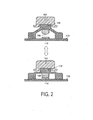
- each of the direction keys 51a through 51d making up the first operating portion 51, the operating buttons 52a through 52d making up the second operating portion 52, the L1 and L2 buttons 53a and 53b and the R1 and R2 buttons 54a and 54b making up the third and fourth operating portions 53 and 54, and the L3 and R3 operating buttons 70a and 72a making up the fifth and sixth operating portions (representatively referred to as "operating element 102") are provided with an elastic electroconductive member 106 which is wide at the base and comes to a point at the apex which is at the center thereof, via an insulating elastic member 104, as shown in Figs. 2 and 3.
- a resistor 110 with one end thereof connected to a voltage source Vcc and the other end thereof connected to a fixed resistor 108 is opposed at each position facing each electroconductive member 106.
- the resistor 110 is disposed on an insulating substrate 112, and the other end of the fixed resistor 108 is grounded.
- the electroconductive member 106 comes into contact with the opposing resistor 110, and the apparent resistor value of the resistor 110 changes corresponding to the area of contact between the resistor 110 and the electroconductive member 106 according to the pressure applied thereto.
- the divided voltage value (analog signal) Va between the resistor 110 and the resistor 108 changes, and this becomes the input signals to an A/D converter 114.
- a pressure-sensitive element is formed of an electroconductive member 106 and a resistor 110, and the electrical resistance values of the pressure-sensitive element change according to the pressing force applied by the operating element 102.
- Fig. 2 illustrates the action of the pressure-sensitive element serving as the element for outputting signal output proportionate to the pressing force
- Fig. 3 illustrates the configuration of the principal components of the controller 16.
- the controller 16 has an MPU (Microprocessor Unit) 118 serving as control means, with the MPU 118 containing a CPU 120 serving as control means, and ROM 122 and RAM 124 mutually connected therewith. Also, the MPU 118 is provided with a switch-over device 126 of which actions are controlled by the CPU 120, and the A/D converter 114. Analog signals (voltage) Va output from the output terminal of the resistor 110 are input to the A/D converter 114, and converted into digital signals Vd.
- MPU Microprocessor Unit
- the digital signal Vd output from the A/D converter 114 is sent to the entertainment device 12 via an interface 128 provided on an interior substrate in the controller 16.
- the motions and the like of game characters for example are executed based on the digital signals Vd.
- the change in level of the analog signal Va output from the output terminal of the resistor 110 corresponds to the change in the pressing force applied from the operating element 102, as described above.
- the digital signal Vd output from the A/D converter 114 corresponds to the pressing force applied by the user (operator or player) to the operating elements 102. Controlling the movement and the like of game characters with digital signals having such correlation to the pressing operation by the user allows movements to be realized which are smoother in an analog manner than those realized by control with the binary digital signals of "1" and "0".
- the controller 16 is constructed so as to control the switch-over device 126 via the interface 128 by control signals sent from the entertainment device 12, based on the program recorded on the optical disk 20. That is to say, at the time of executing the program recorded on the optical disk 20, control signals are output from the entertainment device 12, specifying, according to the contents of the program, whether to cause the A/D converting unit 114 as means for outputting multi-value digital signals Vd with values from 0 through 255 for example, or to function as means for outputting binary on/off digital signals Vd with the values of "0" and "1".
- the switch-over device 126 selects and switches over the functions of the A/D converting unit 114 (binary output or multi output) based on these control signals. Accordingly, whether binary output is used or multi-value output is used, is determined by the program.
- the left and right sticks 70 and 72, and the first and second operating portions 51 and 52 can be switched over from one to another for use.
- the switching thereof is performed by an analog mode switch 74.
- a display portion 76 is lit, thus indicating that the left and right sticks 70 and 72 are in the selected state.
- the left and right sticks 70 and 72 generate voltage of 0 to ⁇ 127 steps in both the X and Y directions. This voltage is also supplied to the A/D converting unit 114 as analog signals Va and converted to digital signals Vd, and then supplied to the entertainment device 12 via the interface 128. Multiple A/D converting units 114 may be used.
- a start button (start switch) 78 for instructing starting of a game
- a selection button (selection switch) 80 for selecting the difficulty of the game when starting the game, and so forth.
- RAM 402 which is semiconductor memory, and a bus 403, are each connected to a CPU 401, which serves as a computer and an executing unit (executing means).
- the RAM 402 also functions as a storing unit (storing means) for sequentially storing programs containing data recorded in the optical disk 20.
- the CPU 401 also functions as an executing unit for reading out programs within the RAM 402 serving as the storing unit or within the optical disk 20 and executing the programs.
- a graphic synthesizer (GS) 404 and an input/output processor (IOP) 409 are each connected to the bus 403.
- Contained in the GS 404 are RAM 405 including a frame buffer, Z buffer, texture memory, etc., and a rendering engine 406 having rendering functions including drawing functions to the frame buffer within the RAM 405.
- the GS 404 thus configured is connected to a monitor 18 serving as an external device, via an encoder 407 for converting digital RGB signals or the like for example, into NTSC standard television signals.
- a driver (DRV) 410 for reproducing and decoding data recorded in the optical disk 20
- a sound processor (SP) 412 for reproducing and decoding data recorded in the optical disk 20
- SP sound processor
- the SP 412 is connected to a speaker 414 and monitor 18 serving as external devices, via an amplifier 413, thereby supplying audio signals.
- the memory card 14 is a card-type external storing device formed of a CPU or gate array and flash memory, and is detachably inserted to an insertion slot 30 of the entertainment device 12 shown in Fig. 1, and the partway state of the game, programs for DVD reproduction, and so forth, are stored in the memory card 14.
- the controller 16 is for providing commands (binary commands or multi commands) to the entertainment device 12 by pressing the multiple buttons or operating the joysticks arrayed on the controller 16.
- the driver 410 has a decoder for decoding encoded images based on the MPEG (Moving Picture Experts Group) standard.
- the object data made up of polygon apex data and texture data and the like recorded on the optical disk 20, and data on the world coordinates WC of this object data, are read in via a driver 410, and are held in the RAM 402 of the CPU 401.
- Fig. 5 schematically illustrates the state of objects OBa and OBb of object data being positioned on the three-dimensional world coordinates WC comprising the three orthogonal axes of X, Y, and Z, with the world coordinates point of origin WO.
- the object OBa represents the character object, and may also be referred to as "character OBa”.
- the object OBb is an object representing a building, but sometimes is an obstacle to the character OBa, and accordingly may also be referred to as "obstacle object OBb".
- an obstacle object OBb is a factor inhibiting progress of the game unless the player operates the controller 16 in an appropriate manner, and accordingly might also be referred to as a game progression inhibiting factor object.
- the CPU 401 computes the position of the object on the three-dimensional camera coordinates CC comprising the three orthogonal axes of V, U, and N, with the camera coordinates point of origin CO, and the orientation as to the viewpoint, based on the instructions.
- the coordinates point of origin CO of the camera coordinates CC is positioned in the later-described screen, in the middle thereof for example.
- the polygon apex data of the object defined by the coordinate values of the three orthogonal axes of X, Y, and Z is converted into the camera coordinates CC.
- the polygon apex data P (x, y, z) following conversion to camera coordinates CC is converted into two-dimensional coordinates data Q (x', y') on the screen SP defined by screen coordinates SC having a screen coordinates point of origin SO (e.g., the upper left point on the screen SP) as the base point thereof, by transmittance conversion processing with the viewpoint VP as the reference.
- SO screen coordinates point of origin
- the post-conversion two-dimensional X-Y coordinates data (x', y'), Z data (z), and texture data are supplied to the GS 404.
- the GS 404 performs rendering based on the post-conversion two-dimensional X-Y coordinates data (x', y') and Z data (z), and sequentially writes (draws) texture data to the RAM 405 serving as memory (in this case, the frame buffer), thereby carrying out the drawing processing.
- the texture data that is drawn is encoded by the encoder 407 as one frame of image completed by the drawing processing and supplied to the monitor 18, and is displayed as a three-dimensional image or a two-dimensional image on the screen 19.
- the entertainment system 10 is basically configured and operates as described above. Next, the contents of the game program which runs on this entertainment system 10 will be described.
- character serving as the character object OBa
- Fig. 8 illustrates the relation between the inclination ⁇ of the left stick 70 (128 steps of 0 to ⁇ 127 in both the X and Y directions) and the movement speed v of the character OBa.
- the speed v is made to change with acceleration by changing of the inclination range RS, and also has inertia. That is to say, the speeds v1 through v3 each are the maximum speeds for the respective ranges RS1 through RS3.
- the character OBa has perimeter centers 200 through 204 at the apex of the head, the tops of the arms, at the waist, and between the feet.
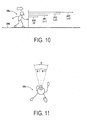
- a perimeter range of 10 cm to several tens of cm is set for the perimeter centers 200 through 204 of the character OBa when stationary (these perimeter centers will be denoted by the symbol AD).
- the perimeter centers may be restricted to the apex of the head and between the feet and so forth.
- the perimeter range AD is arranged so as to change according to the current speed v of the character OBa.
- Fig. 10 illustrates the change in the perimeter range AD of the character OBa moving in the direction of the outlined arrow over the ground 206.
- the perimeter range AD is set so as to be greater in the direction of progression in proportion to the speed v.
- the character OBa has a field of recognition ⁇ for objects (object OBb), of an angle ⁇ of around 30° to the right and left of view direction, which is expressed as ⁇ 1. Areas outside of this are outside of recognition.
- the character OBa is programmed so as to, at the time of pressing of the cross button 52c and so forth, react to objects within the field of recognition angle ⁇ and also within the perimeter range AD, i.e., perimeter ranges overlapping the perimeter range AD, and execute actions to deal with the object.
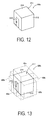
- Fig. 12 illustrates an example of an object OBb.
- the object OBb which is a building 211 is made up of a door 210, walls 212, and a roof 214. Steps are formed between the ground and the walls 212, and between the walls 212 and the roof 214. Other aspects of the objects will be described in the later description of executing the program.
- Fig. 13 illustrates the perimeter range AD of the object OBb which is the building 211.
- perimeter ranges AD there are, as perimeter ranges AD, the perimeter range ADa in front of the door 210, perimeter ranges ADb for the front, rear, and side walls 212, and perimeter range ADc above the roof 214.
- the perimeter ranges AD thereof do not change.
- the perimeter ranges AD thereof may be made to match the outer surface positions of the object OBb.
- various actions are spontaneously generated in the event that the player operates the cross button 52c which is a particular operating portion on the controller 16. For example, in the event that the character OBa encounters an obstacle object OBb on the screen, operating this cross button 52c generates an action which automatically overcomes the obstacle object OBb.
- the actions automatically generated (automatically executed) by operating the cross button 52c are obstacle overcoming actions and the like corresponding to the current state of the character OBa, and the following three types of actions are programmed.
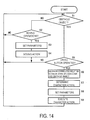
- Fig. 14 is a flowchart indicating fundamental processing procedures for the primary components of the game program.
- the game program is stored in an optical disk 20 which is a recording medium, written to RAM 402 by a predetermined amount via the DRV 410 and IOP 409 making up the entertainment device 12, read out by the CPU 401, and executed.
- Pictures (images) are displayed on the screen 19 of the monitor 18 via the GS 404 and encoder 407 as a result of the execution, and also audio is output from a speaker built into the monitor 18 or an external speaker 414, via the DRV 410, IOP 409, SP 412, and amplifier 413.
- the fundamental processing procedures shown in Fig. 14 indicate processing partway through, following processing relating to the story or the like of the game program having already been started.
- the judging entity is the CPU 401.
- step S1 judgment is made regarding whether or not an obstacle object OBb which the character OBa cannot traverse has been detected. This judgment can be made based on whether or not an obstacle object OBb exists within a predetermined range in the direction of the line of view of the character OBa (e.g., this predetermined range is set so as to be within the perimeter range AD3 and the field of recognition ⁇ and the within the screen 19 exceeding this).
- step S2 judgment is made in step S2 regarding whether or not operating input for moving the character object OBa has been made i.e., whether or not there has been operating input of the left stick 70 equal to or exceeding a predetermined inclination angle. That is to say, judgment is made here regarding whether or not there has been operating input of the left stick 70 of the inclination ranges RS1 through RS3 within the inclination ranges RS shown in Fig. 8.
- step S3 parameters are set to a next-time display lest such that the movement speed v corresponds to the inclination range RS.
- step S4 drawing is performed for moving across the screen 19 at a predetermined speed v, such that movement of the character OBa at the moving speed v corresponding to the range RS of the inclination ⁇ is realized on the screen 19. Subsequently, the processing of step S1 is repeated.
- step S1 the event that an obstacle object OBb is detected, judgment is made in the processing in step S5 regarding whether or not the cross button 52c has been operated. In the event that there has been no operating input, the flow repeats the processing in step S1.
- step S5 In the event that operating of the cross button 52c is detected in the judging processing in step S5, the correlated relation between the current state of the character OBa and the obstacle object OBb are deciphered in step S6.
- the perimeter relation between the perimeter ranges AD0 through AD3 of the character OBa and the perimeter ranges ADa through ADc of the building 211 obstacle object OBb i.e., the overlapping relation
- the arrow lines indicating the perimeter ranges ADa through ADc and the dotted lines indicating the perimeter range ADb shown on the screen 19 corresponding to Fig. 15 are not displayed on the screen 19 (are not visible to the player), but an arrangement may be made so that these become visible to the player on the screen 19 by performing a special operation with the controller 16.
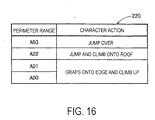
- the obstacle overcoming table 220 stipulates the correlated relation between the perimeter ranges AD0 through AD3 of the character OBa and character actions.
- step S7 an action of jumping over is selected as the character action.
- step S8 parameters relating to the action of jumping over are set in the next time display list.
- step S9 a picture of the character action of jumping over is displayed on the screen 19, based on the parameter settings.
- the screen 19 displays a picture of the character OBa jumping over the obstacle object OBb.
- step S6 shows that perimeter range AD2 of the character OBa and the perimeter range ADb of the wall 212 which is the obstacle object OBb overlap
- the processing of the steps S7 through S9 displays a picture on the screen 19 of the character OBa jumping onto the roof 214 of the obstacle object OBb and climbing up, as shown in Fig. 17B.
- step S6 shows that perimeter range AD1 or AD0 of the character OBa and the perimeter range ADb of the wall 212 which is the obstacle object OBb overlap
- the processing of the steps S7 through S9 displays a picture on the screen 19 of the character OBa holding onto the edge of the roof 214 of the obstacle object OBb and then climbing up onto the roof 214, as shown in Fig. 17C.
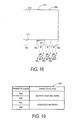
- a perimeter range ADb of the wall 212 is set in front of the front wall 212 of the obstacle object OBb, and a perimeter range ADa of the door 210 is set in front of the door 210.
- the character OBa is situated at the position Q1 in front of the door 210, i.e., in the event that only the door 210 exists within the field of recognition ⁇ of the character OBa, reference is made to the obstacle overcoming table 222 shown in Fig. 19, which is attributes data saved correlated to the perimeter range ADb of the door 210.
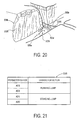
- FIG. 20 illustrates a state wherein the character OBa has encountered an obstacle object OBb which is a river 224 ahead, and obstacle objects OBb which are sheer cliffs 226 on either side.
- the character OBa must take some sort of special action to proceed any further. Let is say that the character OBa must jump over the obstacle object OBb which is the river 224 to proceed with the game. At this time, the player operates the cross button 52c which is the button for invoking character actions. The character OBa can jump over the obstacle object OBb which is the river 224 due to this operation.
- FIG. 22A illustrates a state of a character OBa which has been moving along a road 229 encountering ahead an obstacle object OBb which is a boulder 230 formed to look like an apple.
- the character OBa must take some sort of special action to proceed any further. Accordingly, the player operates the cross button 52c which is the button for invoking character actions. Upon the cross button 52c being operated, reference is made to the obstacle overcoming table 232 shown in Fig. 23 relating to the attributes data saved correlated to the perimeter range ADe of the boulder 230, and character action is determined.
- the cross button 52c which has been appropriated beforehand for escaping processing by the program, allows the character object OBa to automatically overcome the obstacle object OBb.
- the player does not need to perform troublesome operations wherein obstacle objects OBb such as terrain which apparently cannot be traversed is overcome only by operating multiple buttons at specific timings, as with the conventional art, and accordingly the player can enjoy the game more.
- providing the cross button 52c which is a player-automatic action invoking button has made the user interface more user friendly.
- this single particular button is by no means restricted to the cross button 52c.
- arrangements may be made wherein the character OBa is operated with operations of only the stick, by making this single particular button to be the L3 button 70a on the left stick 70 or the R3 button 72a on the right stick 72.
- the obstacle overcoming processing can be appropriately determined according to the current state of the character OBa, such as whether the character OBa is walking or running, how fast the character OBa is running, and/or conditions of the character OBa such as the weight of the character OBa or the like.
- a wide variety of processing can be performed according to the state, so the entertainment factor of the game can be further increased.
- the object which the player operates on the screen 19 with the controller 16 is not restricted to the character OBa; rather, this can be applied to, for example, objects in which people might ride, such as vehicle objects, airplane objects, train objects, ship objects, and so forth.
- OBa objects in which people might ride
- vehicle objects for example, in the event that the vehicle is about to fall down a cliff or crash into an obstacle, appropriate actions can be invoked with a single button operation to avoid the state encountered.
- the obstacle object in the event that a character object encounters an obstacle object on the screen while being operated, the obstacle object can be automatically overcome by operating a single particular operating portion. Accordingly, the player operating the character object can overcome or escape the obstacle object with a simple operation. That is, at the time of overcoming the obstacle object, instantaneous judgment and operations of the player are not needed as with the conventional art, so the player can readily overcome or escape the obstacle object. This is particularly advantageous in that beginning players in particular can smoothly proceed with the story or the like of the program.
Landscapes
- Engineering & Computer Science (AREA)
- Multimedia (AREA)
- Human Computer Interaction (AREA)
- Theoretical Computer Science (AREA)
- Processing Or Creating Images (AREA)
- Stored Programmes (AREA)
Applications Claiming Priority (4)
| Application Number | Priority Date | Filing Date | Title |
|---|---|---|---|
| JP2000334493 | 2000-11-01 | ||
| JP2000334493 | 2000-11-01 | ||
| JP2001330328A JP2002200333A (ja) | 2000-11-01 | 2001-10-29 | 記録媒体、プログラム、プログラム実行システムおよびプログラム実行装置 |
| JP2001330328 | 2001-10-29 |
Publications (2)
| Publication Number | Publication Date |
|---|---|
| EP1203603A2 true EP1203603A2 (fr) | 2002-05-08 |
| EP1203603A3 EP1203603A3 (fr) | 2003-10-01 |
Family
ID=26603272
Family Applications (1)
| Application Number | Title | Priority Date | Filing Date |
|---|---|---|---|
| EP01309307A Withdrawn EP1203603A3 (fr) | 2000-11-01 | 2001-11-01 | Support d'enregistrement, programme, système d'exécution de programme et appareil d'exécution de programme |
Country Status (3)
| Country | Link |
|---|---|
| US (1) | US6793576B2 (fr) |
| EP (1) | EP1203603A3 (fr) |
| JP (1) | JP2002200333A (fr) |
Cited By (1)
| Publication number | Priority date | Publication date | Assignee | Title |
|---|---|---|---|---|
| WO2021258627A1 (fr) * | 2020-06-22 | 2021-12-30 | 苏州幻塔网络科技有限公司 | Procédé et appareil d'escalade de personnage, programme informatique et support lisible par ordinateur |
Families Citing this family (11)
| Publication number | Priority date | Publication date | Assignee | Title |
|---|---|---|---|---|
| JP3979540B2 (ja) * | 2005-12-28 | 2007-09-19 | 株式会社コナミデジタルエンタテインメント | ゲーム装置、ゲーム装置の制御方法、ゲームシステム、ゲームシステムの制御方法及びプログラム |
| JP2008073184A (ja) * | 2006-09-20 | 2008-04-03 | Namco Bandai Games Inc | プログラム、情報記憶媒体及びゲーム装置 |
| US20080222882A1 (en) * | 2007-03-14 | 2008-09-18 | Hsin-Wen Gung | Device for assembling engaging parts |
| JP5620042B2 (ja) * | 2007-10-16 | 2014-11-05 | 株式会社カプコン | プログラムおよびゲームシステム |
| US9248372B2 (en) * | 2011-10-05 | 2016-02-02 | Wargaming.Net Llp | Using and exporting experience gained in a video game |
| JP6403371B2 (ja) * | 2013-10-04 | 2018-10-10 | 任天堂株式会社 | ゲームプログラム、ゲーム装置、ゲームシステム、およびゲーム処理方法 |
| US9421461B2 (en) * | 2013-12-26 | 2016-08-23 | Microsoft Technology Licensing, Llc | Player avatar movement assistance in a virtual environment |
| CN108635853B (zh) * | 2018-03-23 | 2019-06-21 | 腾讯科技(深圳)有限公司 | 对象的控制方法和装置、存储介质、电子装置 |
| CN110193198B (zh) * | 2019-05-23 | 2023-02-10 | 腾讯科技(深圳)有限公司 | 对象跳跃控制方法、装置、计算机设备及存储介质 |
| CN110660272A (zh) * | 2019-09-27 | 2020-01-07 | 南京莱斯网信技术研究院有限公司 | 一种适用于内河水上船舶碰撞预警检测的方法 |
| US12172081B2 (en) * | 2022-03-31 | 2024-12-24 | Advanced Micro Devices, Inc. | Detecting personal-space violations in artificial intelligence based non-player characters |
Family Cites Families (8)
| Publication number | Priority date | Publication date | Assignee | Title |
|---|---|---|---|---|
| JPS60166392U (ja) * | 1984-04-16 | 1985-11-05 | 株式会社 ユニバ−サル | ビデオゲ−ム装置 |
| US5513307A (en) * | 1992-11-20 | 1996-04-30 | Sega Of America, Inc. | Video game with switchable collision graphics |
| JP3239683B2 (ja) * | 1995-05-11 | 2001-12-17 | 株式会社セガ | 画像処理装置および画像処理方法 |
| JP3571452B2 (ja) * | 1996-02-16 | 2004-09-29 | 株式会社ハドソン | 階層変換画像処理方法 |
| US6226008B1 (en) * | 1997-09-04 | 2001-05-01 | Kabushiki Kaisha Sega Enterprises | Image processing device |
| US6692357B2 (en) * | 1998-11-19 | 2004-02-17 | Nintendo Co., Ltd. | Video game apparatus and method with enhanced player object action control |
| JP2000153061A (ja) | 1998-11-19 | 2000-06-06 | Nintendo Co Ltd | ビデオゲーム装置およびビデオゲーム用情報記憶媒体 |
| US6283861B1 (en) * | 1999-03-23 | 2001-09-04 | Square Co., Ltd. | Video game device and video game method |
-
2001
- 2001-10-29 JP JP2001330328A patent/JP2002200333A/ja active Pending
- 2001-11-01 EP EP01309307A patent/EP1203603A3/fr not_active Withdrawn
- 2001-11-01 US US10/002,519 patent/US6793576B2/en not_active Expired - Lifetime
Cited By (1)
| Publication number | Priority date | Publication date | Assignee | Title |
|---|---|---|---|---|
| WO2021258627A1 (fr) * | 2020-06-22 | 2021-12-30 | 苏州幻塔网络科技有限公司 | Procédé et appareil d'escalade de personnage, programme informatique et support lisible par ordinateur |
Also Published As
| Publication number | Publication date |
|---|---|
| US20020115483A1 (en) | 2002-08-22 |
| US6793576B2 (en) | 2004-09-21 |
| JP2002200333A (ja) | 2002-07-16 |
| EP1203603A3 (fr) | 2003-10-01 |
Similar Documents
| Publication | Publication Date | Title |
|---|---|---|
| US20010049301A1 (en) | Recording medium, program, entertainment system, and entertainment apparatus | |
| US8979650B2 (en) | Game apparatus, recording medium having game program recorded thereon, and game system | |
| EP0844587B1 (fr) | Processeur d'image, procede de traitement d'images, jeu electronique et support d'enregistrement | |
| US7690988B2 (en) | Information processing method | |
| US20020155889A1 (en) | Video game apparatus and information storage medium for video game | |
| US6923722B2 (en) | Game system and game program for providing multi-player gameplay on individual displays and a common display | |
| US6670957B2 (en) | Entertainment apparatus, storage medium and object display method | |
| EP1170043B1 (fr) | Système de jeu vidéo | |
| US6878065B2 (en) | Video game system, character action control method, and readable storage medium storing character action control program | |
| US8427471B2 (en) | Program execution system, program execution device and recording medium and computer executable program therefor | |
| US6692357B2 (en) | Video game apparatus and method with enhanced player object action control | |
| US6793576B2 (en) | Methods and apparatus for causing a character object to overcome an obstacle object | |
| US6762746B2 (en) | Entertainment apparatus, storage medium and operation method of manipulating object | |
| JP3987296B2 (ja) | 情報処理方法、情報処理プログラムを情報処理装置に実行させる媒体、プログラム実行装置、情報処理プログラム | |
| US6989832B2 (en) | Entertainment apparatus, storage medium and object display method | |
| US7985136B2 (en) | Image producing device, speed expressing method, and program | |
| JP4741164B2 (ja) | プログラム実行システム、プログラム実行装置、記録媒体及び画像表示方法 | |
| JP2004130146A (ja) | プログラム実行システム、プログラム実行装置、記録媒体及びプログラム、並びに視点を切り換える方法及び照準を切り換える方法 | |
| JP2002102533A (ja) | 記録媒体、プログラム、プログラム実行システム及びプログラム実行装置 |
Legal Events
| Date | Code | Title | Description |
|---|---|---|---|
| PUAI | Public reference made under article 153(3) epc to a published international application that has entered the european phase |
Free format text: ORIGINAL CODE: 0009012 |
|
| AK | Designated contracting states |
Kind code of ref document: A2 Designated state(s): AT BE CH CY DE DK ES FI FR GB GR IE IT LI LU MC NL PT SE TR |
|
| AX | Request for extension of the european patent |
Free format text: AL;LT;LV;MK;RO;SI |
|
| RIN1 | Information on inventor provided before grant (corrected) |
Inventor name: KOIKE, AKIRA C/O SONY COMP. ENTERT. INC. Inventor name: WATANABE, MASAYA C/O DEEP SPACE INC. Inventor name: SUGANO, YUZO C/O DEEP SPACE INC. Inventor name: FUJIWARA, TOKURO C/O DEEP SPACE INC. |
|
| PUAL | Search report despatched |
Free format text: ORIGINAL CODE: 0009013 |
|
| AK | Designated contracting states |
Kind code of ref document: A3 Designated state(s): AT BE CH CY DE DK ES FI FR GB GR IE IT LI LU MC NL PT SE TR |
|
| AX | Request for extension of the european patent |
Extension state: AL LT LV MK RO SI |
|
| AKX | Designation fees paid | ||
| REG | Reference to a national code |
Ref country code: DE Ref legal event code: 8566 |
|
| STAA | Information on the status of an ep patent application or granted ep patent |
Free format text: STATUS: THE APPLICATION IS DEEMED TO BE WITHDRAWN |
|
| 18D | Application deemed to be withdrawn |
Effective date: 20040402 |