EP1205303A1 - Drucker, Druckkopf und Druckkopfherstellungsverfahren - Google Patents
Drucker, Druckkopf und Druckkopfherstellungsverfahren Download PDFInfo
- Publication number
- EP1205303A1 EP1205303A1 EP01126304A EP01126304A EP1205303A1 EP 1205303 A1 EP1205303 A1 EP 1205303A1 EP 01126304 A EP01126304 A EP 01126304A EP 01126304 A EP01126304 A EP 01126304A EP 1205303 A1 EP1205303 A1 EP 1205303A1
- Authority
- EP
- European Patent Office
- Prior art keywords
- ink
- heating element
- printer head
- printer
- wall surface
- Prior art date
- Legal status (The legal status is an assumption and is not a legal conclusion. Google has not performed a legal analysis and makes no representation as to the accuracy of the status listed.)
- Granted
Links
Images


Classifications
-
- B—PERFORMING OPERATIONS; TRANSPORTING
- B41—PRINTING; LINING MACHINES; TYPEWRITERS; STAMPS
- B41J—TYPEWRITERS; SELECTIVE PRINTING MECHANISMS, i.e. MECHANISMS PRINTING OTHERWISE THAN FROM A FORME; CORRECTION OF TYPOGRAPHICAL ERRORS
- B41J2/00—Typewriters or selective printing mechanisms characterised by the printing or marking process for which they are designed
- B41J2/005—Typewriters or selective printing mechanisms characterised by the printing or marking process for which they are designed characterised by bringing liquid or particles selectively into contact with a printing material
- B41J2/01—Ink jet
- B41J2/135—Nozzles
- B41J2/14—Structure thereof only for on-demand ink jet heads
- B41J2/14016—Structure of bubble jet print heads
- B41J2/14088—Structure of heating means
- B41J2/14112—Resistive element
- B41J2/14129—Layer structure
-
- B—PERFORMING OPERATIONS; TRANSPORTING
- B41—PRINTING; LINING MACHINES; TYPEWRITERS; STAMPS
- B41J—TYPEWRITERS; SELECTIVE PRINTING MECHANISMS, i.e. MECHANISMS PRINTING OTHERWISE THAN FROM A FORME; CORRECTION OF TYPOGRAPHICAL ERRORS
- B41J2/00—Typewriters or selective printing mechanisms characterised by the printing or marking process for which they are designed
- B41J2/005—Typewriters or selective printing mechanisms characterised by the printing or marking process for which they are designed characterised by bringing liquid or particles selectively into contact with a printing material
- B41J2/01—Ink jet
- B41J2/135—Nozzles
- B41J2/16—Production of nozzles
- B41J2/1601—Production of bubble jet print heads
- B41J2/1603—Production of bubble jet print heads of the front shooter type
-
- B—PERFORMING OPERATIONS; TRANSPORTING
- B41—PRINTING; LINING MACHINES; TYPEWRITERS; STAMPS
- B41J—TYPEWRITERS; SELECTIVE PRINTING MECHANISMS, i.e. MECHANISMS PRINTING OTHERWISE THAN FROM A FORME; CORRECTION OF TYPOGRAPHICAL ERRORS
- B41J2/00—Typewriters or selective printing mechanisms characterised by the printing or marking process for which they are designed
- B41J2/005—Typewriters or selective printing mechanisms characterised by the printing or marking process for which they are designed characterised by bringing liquid or particles selectively into contact with a printing material
- B41J2/01—Ink jet
- B41J2/135—Nozzles
- B41J2/16—Production of nozzles
- B41J2/1621—Manufacturing processes
- B41J2/1623—Manufacturing processes bonding and adhesion
-
- B—PERFORMING OPERATIONS; TRANSPORTING
- B41—PRINTING; LINING MACHINES; TYPEWRITERS; STAMPS
- B41J—TYPEWRITERS; SELECTIVE PRINTING MECHANISMS, i.e. MECHANISMS PRINTING OTHERWISE THAN FROM A FORME; CORRECTION OF TYPOGRAPHICAL ERRORS
- B41J2/00—Typewriters or selective printing mechanisms characterised by the printing or marking process for which they are designed
- B41J2/005—Typewriters or selective printing mechanisms characterised by the printing or marking process for which they are designed characterised by bringing liquid or particles selectively into contact with a printing material
- B41J2/01—Ink jet
- B41J2/135—Nozzles
- B41J2/16—Production of nozzles
- B41J2/1621—Manufacturing processes
- B41J2/1626—Manufacturing processes etching
- B41J2/1628—Manufacturing processes etching dry etching
-
- B—PERFORMING OPERATIONS; TRANSPORTING
- B41—PRINTING; LINING MACHINES; TYPEWRITERS; STAMPS
- B41J—TYPEWRITERS; SELECTIVE PRINTING MECHANISMS, i.e. MECHANISMS PRINTING OTHERWISE THAN FROM A FORME; CORRECTION OF TYPOGRAPHICAL ERRORS
- B41J2/00—Typewriters or selective printing mechanisms characterised by the printing or marking process for which they are designed
- B41J2/005—Typewriters or selective printing mechanisms characterised by the printing or marking process for which they are designed characterised by bringing liquid or particles selectively into contact with a printing material
- B41J2/01—Ink jet
- B41J2/135—Nozzles
- B41J2/16—Production of nozzles
- B41J2/1621—Manufacturing processes
- B41J2/1631—Manufacturing processes photolithography
-
- B—PERFORMING OPERATIONS; TRANSPORTING
- B41—PRINTING; LINING MACHINES; TYPEWRITERS; STAMPS
- B41J—TYPEWRITERS; SELECTIVE PRINTING MECHANISMS, i.e. MECHANISMS PRINTING OTHERWISE THAN FROM A FORME; CORRECTION OF TYPOGRAPHICAL ERRORS
- B41J2/00—Typewriters or selective printing mechanisms characterised by the printing or marking process for which they are designed
- B41J2/005—Typewriters or selective printing mechanisms characterised by the printing or marking process for which they are designed characterised by bringing liquid or particles selectively into contact with a printing material
- B41J2/01—Ink jet
- B41J2/135—Nozzles
- B41J2/16—Production of nozzles
- B41J2/1621—Manufacturing processes
- B41J2/1632—Manufacturing processes machining
-
- B—PERFORMING OPERATIONS; TRANSPORTING
- B41—PRINTING; LINING MACHINES; TYPEWRITERS; STAMPS
- B41J—TYPEWRITERS; SELECTIVE PRINTING MECHANISMS, i.e. MECHANISMS PRINTING OTHERWISE THAN FROM A FORME; CORRECTION OF TYPOGRAPHICAL ERRORS
- B41J2/00—Typewriters or selective printing mechanisms characterised by the printing or marking process for which they are designed
- B41J2/005—Typewriters or selective printing mechanisms characterised by the printing or marking process for which they are designed characterised by bringing liquid or particles selectively into contact with a printing material
- B41J2/01—Ink jet
- B41J2/135—Nozzles
- B41J2/16—Production of nozzles
- B41J2/1621—Manufacturing processes
- B41J2/164—Manufacturing processes thin film formation
- B41J2/1642—Manufacturing processes thin film formation thin film formation by CVD [chemical vapor deposition]
-
- B—PERFORMING OPERATIONS; TRANSPORTING
- B41—PRINTING; LINING MACHINES; TYPEWRITERS; STAMPS
- B41J—TYPEWRITERS; SELECTIVE PRINTING MECHANISMS, i.e. MECHANISMS PRINTING OTHERWISE THAN FROM A FORME; CORRECTION OF TYPOGRAPHICAL ERRORS
- B41J2/00—Typewriters or selective printing mechanisms characterised by the printing or marking process for which they are designed
- B41J2/005—Typewriters or selective printing mechanisms characterised by the printing or marking process for which they are designed characterised by bringing liquid or particles selectively into contact with a printing material
- B41J2/01—Ink jet
- B41J2/135—Nozzles
- B41J2/16—Production of nozzles
- B41J2/1621—Manufacturing processes
- B41J2/164—Manufacturing processes thin film formation
- B41J2/1646—Manufacturing processes thin film formation thin film formation by sputtering
-
- B—PERFORMING OPERATIONS; TRANSPORTING
- B41—PRINTING; LINING MACHINES; TYPEWRITERS; STAMPS
- B41J—TYPEWRITERS; SELECTIVE PRINTING MECHANISMS, i.e. MECHANISMS PRINTING OTHERWISE THAN FROM A FORME; CORRECTION OF TYPOGRAPHICAL ERRORS
- B41J2202/00—Embodiments of or processes related to ink-jet or thermal heads
- B41J2202/01—Embodiments of or processes related to ink-jet heads
- B41J2202/13—Heads having an integrated circuit
-
- Y—GENERAL TAGGING OF NEW TECHNOLOGICAL DEVELOPMENTS; GENERAL TAGGING OF CROSS-SECTIONAL TECHNOLOGIES SPANNING OVER SEVERAL SECTIONS OF THE IPC; TECHNICAL SUBJECTS COVERED BY FORMER USPC CROSS-REFERENCE ART COLLECTIONS [XRACs] AND DIGESTS
- Y10—TECHNICAL SUBJECTS COVERED BY FORMER USPC
- Y10T—TECHNICAL SUBJECTS COVERED BY FORMER US CLASSIFICATION
- Y10T29/00—Metal working
- Y10T29/49—Method of mechanical manufacture
- Y10T29/49002—Electrical device making
- Y10T29/49082—Resistor making
- Y10T29/49083—Heater type
Definitions
- the present invention relates to a printer, a printer head, and a method of producing the printer head.
- the present invention is applicable to a printer which makes use of a process that causes ink droplets to fly out as a result of heating by a heater.
- a dot is formed by causing small drops of recording liquid (ink) to fly out from a nozzle of a recording head and causing them to adhere to what is to be subjected to a recording operation.
- the inkjet process is classified into, for example, an electrostatic attraction process, a continuous vibration generation process (piezo process), and a thermal process, depending on the method used to cause the ink to fly out.
- air bubbles are produced by heating localized portions of the ink in order to push out the ink from a discharge opening by the air bubbles, thereby causing the ink to fly out to what is to be subjected to printing. This makes it possible to print a color image using a simple structure.
- a printer which operates by this thermal process is constructed using what is called a printer head, which has mounted therein a heating element which heats ink, a drive circuit based on a logic integrated circuit which drives the heating element, and other component parts.
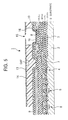
- Fig. 5 is a sectional view partly showing a thermal head.
- an isolation area 3 LOCOS: local oxidation of silicon
- MOS metal oxide semiconductor
- a contact hole is formed in order to form a first-layer wiring pattern 7.
- the MOS transistors 5 and 6, forming the drive circuit are connected to each other, thereby forming a logic integrated circuit.
- heating element materials such as tantalum, tantalum aluminum, or titanium nitride
- heating elements 8 which heat ink are formed.
- a contact hole is formed to form a second-layer wiring pattern 9.
- a connection portion between the switching transistors 4 and the heating elements 8 a connection portion between the heating elements 8 and a power supply, a ground line, and the like, are formed.
- the printer head 1 an insulating material, such as SiO 2 or SiN, is deposited in order to form a protective layer 10, after which a Ta film is formed on localized portions of the heating elements 8. By the Ta film, a cavitation resistance layer 11 is formed.
- a dry film 13 and an orifice plate 14 are successively placed upon each other.
- the dry film 13 is formed of, for example, carbon resin, which is hardened to a predetermined shape and film thickness so that a partition of an ink path and an ink chamber is formed with a predetermined height.
- the orifice plate 14 is formed of a plate-shaped material which is processed into a predetermined shape so that a nozzle 15, which is a very small ink discharge opening, is formed above the heating elements 8.
- the orifice plate 14 is supported on the top portion of the dry film 13 as a result of adhering it thereto.
- the nozzle 15, an ink chamber 16, a path for guiding ink into the ink chamber 16, etc. are formed at the printer head 1.
- the ink is guided to the ink chamber 16, and, by a switching operation of the switching transistors 4, the heating elements 8 generate heat in order to heat localized portions of the ink.
- the heating core air bubbles are produced at side surfaces of the heating elements 8 of the ink chamber 16. These core air bubbles combine to form film air bubbles.
- pressure is increased by the air bubbles, the ink is pushed out from the nozzle 15 and flies out to what is to be subjected to printing.
- intermittent heating by the heating elements 8 causes the ink to successively adhere to what is to be subjected to printing, so that a desired image is formed.
- the switching transistors 4, which drive the heating elements 8 are controlled by the same logic integrated circuit formed by the MOS transistors 5 and 6. Therefore, the heating elements 8 are disposed very closely together, thereby making it possible to reliably drive them by their corresponding switching transistors.
- the heating elements 8 need to be disposed very close to each other. More specifically, in order to obtain, for example, a 600 DPI printed result, the heating elements 8 need to be disposed at intervals of 42,333 ⁇ m. It is extremely difficult to dispose individual drive elements at the heating elements 8 disposed very close to each other. Therefore, in the printer head 1, for example, switching transistors are formed on the semiconductor substrate and are connected to the corresponding heating elements 8 by an integrated circuit technology. Then, by the drive circuits similarly formed on the semiconductor substrate, the corresponding switching transistors are driven in order to make it possible to simply and reliably drive each of the heating elements 8.
- the printer head 1 having such a structure has a problem in that it is difficult to bring the orifice plate 14 sufficiently into close contact with the dry film 13 and to bond it thereto.
- the first-layer wiring pattern 7 is formed with the minimum thickness required, and the second-layer wiring pattern 9, which forms a power supply line and a ground line, is made thick in order to obtain a desired current capacity.
- the printer head 1 In contrast to this, in the printer head 1, the situation is reversed with respect to the case of the commonly used semiconductor integrated circuit, so that the first-layer wiring pattern is made thick, whereas the second-layer wiring pattern is made thin, in order to obtain good covering property at the silicon nitride film forming the ink protective layer 10 and the tantalum cavitation resistance layer 11, which are formed above the heating elements 8.
- the second-layer wiring pattern is formed with a thickness of the order of 1 ⁇ m when an aluminum wiring pattern is used, and a stepped portion having a size of the order of 1 ⁇ m is formed at the second-layer wiring pattern 9.
- the stepped portion having a size of the order of 1 ⁇ m is formed at the second-layer wiring pattern 9
- very fine recesses and protrusions are formed at the surface of the protective layer 10, which is formed on top of the wiring pattern 9, and the surface of the dry film 13. Because of the very fine recesses and protrusions, it becomes difficult to bring the orifice plate 14 sufficiently into close contact with the dry film 13 and to bond it thereto. In this connection, when the surfaces of the protective layer 10 and the dry film 13 become very uneven, ink leakage may occur.
- the present invention is applied to the printer or the printer head, and at least one of lamination materials that are placed upon each other on a semiconductor substrate is smoothened so that a surface at which a plate-shaped material is disposed becomes smooth.
- the present invention is applied to a method of producing the printer head.
- the method comprises the step of smoothening at least one of the lamination materials placed upon each other on the semiconductor substrate so that the surface where the plate-shaped material is disposed becomes smooth.
- the structure of the present invention by smoothening at least one of the lamination materials placed upon each other on the semiconductor substrate so that the surface where the plate-shaped material is disposed becomes smooth, it is possible to dispose the plate-shaped material on a smooth surface. This makes it possible to bond the orifice plate by bringing it sufficiently into close contact with what it is to be bonded to.
- the printer head by bonding the orifice plate by bringing it sufficiently into close contact with what it is to be bonded to.
- Figs. 1A to 4B are sectional views illustrating the steps of producing a printer head of an embodiment of the present invention.
- silicon nitride films are deposited thereon.
- the silicon substrate 22 is processed in order to remove the silicon nitride films deposited on areas other than predetermined areas where transistors are formed.
- silicon nitride films are formed in the areas on the silicon substrate 22 where the transistors are to be formed.
- thermal silicon oxide films are formed in the areas from which the silicon nitride films have been removed, and, by the thermal silicon oxide films, an isolation area (LOCOS) 23 for isolating the transistors is formed.
- LOC isolation area
- gates having tungsten silicide/polysilicon/thermally oxide film structures are formed.
- the silicon substrate 22 is processed in order to form, for example, MOS switching transistors 24 and 25.
- the switching transistor 24 is a MOS driver transistor having a pressure resistance of the order of 30 V, and is used to drive heating elements.
- the transistor 25 forms an integrated circuit that controls the driver transistor, and operates by a voltage of 5 V. Then, in the process, by CVD (chemical vapor deposition), a BPSG (borophosepho silicate glass) film 26 is deposited in order to form an interlayer insulating film.
- CVD chemical vapor deposition
- connection hole is formed at a silicon semiconductor diffusion layer (source ⁇ drain).
- the silicon substrate 22 is washed using rare fluorinated acid.
- a titanium film having a thickness of 20 nm and a titanium nitride barrier metal having a thickness of 50 nm are successively deposited.
- WF 6 as a source gas
- a silicon oxide film 29 (what is called TEOS), which is an interlayer insulating film, is deposited by CVD in order to, by CMP (chemical mechanical polishing), smoothen the silicon oxide film 29. Accordingly, in the process, the protrusions and recesses formed by the wiring pattern 28 as well as by the transistors 24 and 25 and the contact 27 are such that they do not appear at the top surface of the silicon oxide film 29.
- TEOS silicon oxide film 29
- CMP chemical mechanical polishing
- connection hole via hole
- tungsten is embedded in the connection hole.
- a titanium film having a thickness of 10 nm and a titanium nitride film having a thickness of 50 nm are successively deposited, after which aluminum to which 0.5at% of copper has been added is deposited to a film thickness of 600 nm. Accordingly, in this process, a wiring film formed of aluminum is formed.
- the aluminum wiring film is processed in order to form a second-layer wiring pattern 31.
- a power supply wiring pattern and a ground wiring pattern are formed, and a wiring pattern for connecting the drive transistor 24 to the heating elements is formed.
- a silicon oxide film 32 which is an interlayer insulating film, is deposited, and is smoothened by CMP. Therefore, in this process, the recesses and protrusions of the wiring pattern 31 are such as not to appear at the top surface of the silicon oxide film 32.
- connection hole via hole
- tungsten is embedded in the connection hole in order to form a tungsten plug 33 for connecting the heating elements.
- a silicon oxide film 34 which is an interlayer insulating layer, is then deposited, and is smoothened by CMP. Then, by photolithography and dry etching, a groove 35A having a depth of 60 nm to 100 nm for embedding resistors of the heating elements is formed in the interlayer film 34, which is a silicon oxide film.
- the groove 35A is formed so that the tungsten plug 33 is exposed.
- heating elements 35 are formed by embedding the resistors in the groove 35 so that the recesses and protrusions do not appear at the top side thereof, and, through the tungsten plug 33, the heating elements 35 are such as to be connected to the switching transistor 24 and the power supply.
- the heating elements 35 are disposed at the top side of the second-layer wiring pattern 31, and the distance from the heating elements 35 to an ink chamber is made small, so that heat generated by the heating elements 35 can be correspondingly efficiently conducted to the ink chamber.
- By smoothening some of the layers below the heating elements 35 it is possible to correspondingly prevent, for example, breakage of wires of the heating elements 35.
- a silicon nitride film 37 which functions as an ink protective layer, is deposited to a film thickness of 300 nm above each of the heating elements 35.
- a tantalum film having a thickness of 200 nm is deposited in order to form a cavitation resistance layer 38 by the tantalum film.
- some of the layers below the cavitation resistance layer 38 are smoothened, and the cavitation resistance layer 38 is formed to a thickness of 200 nm, so that the cavitation resistance layer 38 is formed on a considerably smoother surface at the top surface than are conventional cavitation resistance layers. Accordingly, by forming the cavitation resistance layer 38 on such a smoothened surface, in the embodiment, the cavitation resistance layer 38 can be made more reliable than conventional cavitation resistance layers.
- an orifice plate 14 and a dry film 13, formed of carbon resin are successively placed.
- an ink chamber 16 By the dry film 13 and the orifice 14, an ink chamber 16, a path which guides ink into the ink chamber 16, and a nozzle 15 are formed.
- the smoothened layers below the dry film 13 are formed considerably smoother than the layers below conventional dry films, so that the orifice plate 14 can be brought sufficiently into close contact with the dry film 13 in order to bond it thereto.
- the semiconductor substrate 22 is processed, so that the semiconductor substrate 22 having the transistors 24 and 25 disposed thereon (as shown in Fig. 1A) is formed.
- the interlayer insulating films 29, 32, etc., the wiring patterns 28 and 32, the dry film 13, the orifice plate 14, etc., are successively placed upon each other on the semiconductor substrate 22 in order to produce the printer head (as shown in Figs. 1B to 4B).
- the interlayer insulating films are smoothened by CMP, so that the dry film 13 is placed on a smooth surface, after which the orifice plate 14 is bonded to the dry film 13. Accordingly, in this production process, the lamination materials that are placed upon each other on the semiconductor substrate 22 are smoothened for production, so that the orifice plate 4 can be bonded to a smooth surface, brought sufficiently into close contact with the smooth surface, and supported by the smooth surface. Therefore, in the production process, sufficient strength can be ensured, and an accident, such as leakage of ink, can be prevented from occurring.
- the resistors of the heating elements 35 and the cavitation resistance layer 38 can be formed on smooth surfaces, thereby making it possible to ensure that the heating elements 35 and the cavitation resistance layer 38 are satisfactorily reliable.
- the heating elements 35 are formed on the second-layer wiring pattern 31, the heating elements 35 can be formed on a smooth surface. Therefore, in this production process, the heating elements 35 are disposed at the top portion side of the second-layer wiring pattern 31 and near the ink chamber 16, so that it is possible to correspondingly efficiently heat the ink.
- the groove 35A is formed and has a resistance material embedded therein in order to dispose the heating elements 35. Accordingly, in the production process, even when the heating elements 35 are disposed, very fine recesses and protrusions are prevented from being formed at the surface where the orifice plate 14 is disposed, so that the orifice plate 14 is correspondingly sufficiently brought into close contact with the dry film 13 and is disposed.
- the printer head of the embodiment it is possible to sufficiently bring the orifice plate into close contact with the dry film 13 in order to be bonded thereto, so that it is possible to correspondingly satisfactorily make the orifice plate more reliable. It is possible to ensure that a printer using the printer head is sufficiently reliable.
- predetermined materials are successively placed upon each other on the semiconductor substrate of a semiconductor device.
- the orifice plate can be brought sufficiently into close contact with the dry film in order to be bonded thereto.
- the lamination layers to be smoothened are the interlayer insulating films, the heating elements and the cavitation resistance film are formed on smooth surfaces, thereby making it possible to increase reliability.
- the heating elements are formed by forming resistance films on the top side of the wiring pattern at the topmost layer, the heating elements are formed on a smooth surface, thereby making it possible to ensure satisfactory reliability. Therefore, the heating elements are disposed at the top side of the wiring pattern at the topmost layer, so that, while maintaining sufficient reliability, the ink in the ink chamber can be efficiently heated.
- the heating elements By forming the heating elements using shapes formed by forming a groove in an interlayer insulating film and embedding the resistance films in the groove, it is possible to prevent the production of recesses and protrusions formed by the heating elements, thereby making it possible to more sufficiently bring the orifice plate into close contact with the dry film in order to bond it thereto.
- the present invention is not limited thereto, so that, when the orifice plate can be bonded to a surface which is sufficiently smooth for practical purposes, such an operation can be omitted.
- each interlayer insulating film is smoothened
- the present invention is not limited thereto. The point is that as long as the surface to which the orifice plate is bonded is sufficiently smooth for practical purposes, the orifice plate can be bonded to the surface by sufficiently bringing it into close contact with this surface. Therefore, when necessary, when, for example, the interlayer insulating film at the topmost layer alone is to be smoothened, it is possible to omit any one of the other smoothening operations in the above-described embodiment when necessary.
- the present invention is not limited thereto, so that the present invention may be widely applied to, for example, a structure having one layer of wiring pattern or a structure having three of more layers of wiring patterns.
- the present invention is not limited thereto, so that the present invention may be widely applied to, for example, the case where the heating elements are disposed at the bottom side of the wiring pattern at the topmost layer.
- the present invention is not limited thereto, so various other types of lamination materials may be used when necessary.
Landscapes
- Engineering & Computer Science (AREA)
- Manufacturing & Machinery (AREA)
- Particle Formation And Scattering Control In Inkjet Printers (AREA)
Applications Claiming Priority (2)
| Application Number | Priority Date | Filing Date | Title |
|---|---|---|---|
| JP2000344227 | 2000-11-07 | ||
| JP2000344227A JP4706098B2 (ja) | 2000-11-07 | 2000-11-07 | プリンタ、プリンタヘッド及びプリンタヘッドの製造方法 |
Publications (3)
| Publication Number | Publication Date |
|---|---|
| EP1205303A1 true EP1205303A1 (de) | 2002-05-15 |
| EP1205303B1 EP1205303B1 (de) | 2008-04-16 |
| EP1205303B9 EP1205303B9 (de) | 2008-09-24 |
Family
ID=18818456
Family Applications (1)
| Application Number | Title | Priority Date | Filing Date |
|---|---|---|---|
| EP01126304A Expired - Lifetime EP1205303B9 (de) | 2000-11-07 | 2001-11-06 | Drucker, Druckkopf und Druckkopfherstellungsverfahren |
Country Status (4)
| Country | Link |
|---|---|
| US (1) | US6685304B2 (de) |
| EP (1) | EP1205303B9 (de) |
| JP (1) | JP4706098B2 (de) |
| DE (1) | DE60133611T2 (de) |
Cited By (3)
| Publication number | Priority date | Publication date | Assignee | Title |
|---|---|---|---|---|
| EP2017083A1 (de) * | 2007-07-16 | 2009-01-21 | Samsung Electronics Co., Ltd. | Tintenstrahldruckkopf und Herstellungsverfahren dafür |
| EP1872949A3 (de) * | 2006-06-27 | 2009-08-05 | Samsung Electronics Co., Ltd. | Druckkopf und Herstellungsverfahren dafür |
| EP3470228A1 (de) * | 2017-10-11 | 2019-04-17 | Canon Kabushiki Kaisha | Elementsubstrat, herstellungsverfahren dafür, druckkopf und druckvorrichtung |
Families Citing this family (9)
| Publication number | Priority date | Publication date | Assignee | Title |
|---|---|---|---|---|
| EP1225048A1 (de) * | 2001-01-18 | 2002-07-24 | Tonejet Corporation Pty Ltd | Elektrode für auf Abruf Tropfen erzeugender Drucker |
| JP3734246B2 (ja) * | 2001-10-30 | 2006-01-11 | キヤノン株式会社 | 液体吐出ヘッド及び構造体の製造方法、液体吐出ヘッド並びに液体吐出装置 |
| KR100453058B1 (ko) * | 2002-10-30 | 2004-10-15 | 삼성전자주식회사 | 잉크젯 프린트헤드 |
| KR100553914B1 (ko) | 2004-01-29 | 2006-02-24 | 삼성전자주식회사 | 잉크젯 프린트헤드 및 그 제조방법 |
| JP4305401B2 (ja) * | 2005-02-28 | 2009-07-29 | セイコーエプソン株式会社 | 半導体装置 |
| US7735952B2 (en) * | 2007-04-12 | 2010-06-15 | Lexmark International, Inc. | Method of bonding a micro-fluid ejection head to a support substrate |
| US8833908B2 (en) * | 2011-09-29 | 2014-09-16 | Lexmark International, Inc. | Planar heater structures for ejection devices |
| JP2016198908A (ja) | 2015-04-08 | 2016-12-01 | キヤノン株式会社 | 液体吐出ヘッド |
| JP6929150B2 (ja) | 2017-06-30 | 2021-09-01 | キヤノン株式会社 | 半導体装置、その製造方法、液体吐出ヘッド及び液体吐出装置 |
Citations (5)
| Publication number | Priority date | Publication date | Assignee | Title |
|---|---|---|---|---|
| US5943076A (en) * | 1997-02-24 | 1999-08-24 | Xerox Corporation | Printhead for thermal ink jet devices |
| EP1005995A2 (de) * | 1998-12-03 | 2000-06-07 | Canon Kabushiki Kaisha | Verfahren zur Herstellung eines Flüssigkeitsausstosskopfes , Flüssigkeitsausstosskopf, Kopfkassette und Flüssigkeitsstrahlaufzeichnungsgerät |
| US6079811A (en) * | 1997-01-24 | 2000-06-27 | Lexmark International, Inc. | Ink jet printhead having a unitary actuator with a plurality of active sections |
| US6126276A (en) * | 1998-03-02 | 2000-10-03 | Hewlett-Packard Company | Fluid jet printhead with integrated heat-sink |
| US6126272A (en) * | 1997-01-15 | 2000-10-03 | Samsung Electronics Co., Ltd. | Ink spraying device for print head |
Family Cites Families (13)
| Publication number | Priority date | Publication date | Assignee | Title |
|---|---|---|---|---|
| JP2611981B2 (ja) * | 1987-02-04 | 1997-05-21 | キヤノン株式会社 | インクジエツト記録ヘツド用基板及びインクジエツト記録ヘツド |
| US4926197A (en) * | 1988-03-16 | 1990-05-15 | Hewlett-Packard Company | Plastic substrate for thermal ink jet printer |
| JPH08118635A (ja) * | 1994-10-28 | 1996-05-14 | Canon Inc | 記録ヘッド用基板、記録ヘッド及び記録装置 |
| JP3275600B2 (ja) * | 1995-01-09 | 2002-04-15 | 富士ゼロックス株式会社 | インクジェット記録ヘッド |
| JPH08187859A (ja) * | 1995-01-13 | 1996-07-23 | Matsushita Electric Ind Co Ltd | インクジェットヘッド及びその製造方法 |
| JPH09109392A (ja) * | 1995-10-13 | 1997-04-28 | Canon Inc | インクジェット記録ヘッドの製造方法および同方法により製造されたインクジェット記録ヘッド、並びにインクジェット記録装置 |
| JPH10109421A (ja) * | 1996-10-08 | 1998-04-28 | Canon Inc | 液体噴射記録ヘッド用発熱基板 |
| JP3618965B2 (ja) * | 1997-06-19 | 2005-02-09 | キヤノン株式会社 | 液体噴射記録ヘッド用基板およびその製造方法ならびに液体噴射記録装置 |
| DE69708067T2 (de) * | 1997-06-27 | 2002-07-11 | Stmicroelectronics S.R.L., Agrate Brianza | Integrierter Tintenstrahldruckkopf und sein Herstellungsverfahren |
| US6331259B1 (en) * | 1997-12-05 | 2001-12-18 | Canon Kabushiki Kaisha | Method for manufacturing ink jet recording heads |
| US6328428B1 (en) * | 1999-04-22 | 2001-12-11 | Hewlett-Packard Company | Ink-jet printhead and method of producing same |
| JP2002052725A (ja) * | 2000-08-07 | 2002-02-19 | Sony Corp | プリンタ、プリンタヘッド及びプリンタヘッドの製造方法 |
| JP4654494B2 (ja) * | 2000-08-07 | 2011-03-23 | ソニー株式会社 | プリンタ、プリンタヘッド及びプリンタヘッドの製造方法 |
-
2000
- 2000-11-07 JP JP2000344227A patent/JP4706098B2/ja not_active Expired - Fee Related
-
2001
- 2001-11-06 DE DE60133611T patent/DE60133611T2/de not_active Expired - Lifetime
- 2001-11-06 EP EP01126304A patent/EP1205303B9/de not_active Expired - Lifetime
- 2001-11-07 US US10/053,468 patent/US6685304B2/en not_active Expired - Fee Related
Patent Citations (5)
| Publication number | Priority date | Publication date | Assignee | Title |
|---|---|---|---|---|
| US6126272A (en) * | 1997-01-15 | 2000-10-03 | Samsung Electronics Co., Ltd. | Ink spraying device for print head |
| US6079811A (en) * | 1997-01-24 | 2000-06-27 | Lexmark International, Inc. | Ink jet printhead having a unitary actuator with a plurality of active sections |
| US5943076A (en) * | 1997-02-24 | 1999-08-24 | Xerox Corporation | Printhead for thermal ink jet devices |
| US6126276A (en) * | 1998-03-02 | 2000-10-03 | Hewlett-Packard Company | Fluid jet printhead with integrated heat-sink |
| EP1005995A2 (de) * | 1998-12-03 | 2000-06-07 | Canon Kabushiki Kaisha | Verfahren zur Herstellung eines Flüssigkeitsausstosskopfes , Flüssigkeitsausstosskopf, Kopfkassette und Flüssigkeitsstrahlaufzeichnungsgerät |
Cited By (5)
| Publication number | Priority date | Publication date | Assignee | Title |
|---|---|---|---|---|
| EP1872949A3 (de) * | 2006-06-27 | 2009-08-05 | Samsung Electronics Co., Ltd. | Druckkopf und Herstellungsverfahren dafür |
| EP2017083A1 (de) * | 2007-07-16 | 2009-01-21 | Samsung Electronics Co., Ltd. | Tintenstrahldruckkopf und Herstellungsverfahren dafür |
| EP3470228A1 (de) * | 2017-10-11 | 2019-04-17 | Canon Kabushiki Kaisha | Elementsubstrat, herstellungsverfahren dafür, druckkopf und druckvorrichtung |
| CN109649012A (zh) * | 2017-10-11 | 2019-04-19 | 佳能株式会社 | 元件基板、元件基板的制造方法、打印头和打印装置 |
| US10493774B2 (en) | 2017-10-11 | 2019-12-03 | Canon Kabushiki Kaisha | Element substrate, manufacturing method thereof, printhead, and printing apparatus |
Also Published As
| Publication number | Publication date |
|---|---|
| EP1205303B1 (de) | 2008-04-16 |
| JP2002144571A (ja) | 2002-05-21 |
| JP4706098B2 (ja) | 2011-06-22 |
| US20020126182A1 (en) | 2002-09-12 |
| US6685304B2 (en) | 2004-02-03 |
| EP1205303B9 (de) | 2008-09-24 |
| DE60133611T2 (de) | 2009-05-28 |
| DE60133611D1 (de) | 2008-05-29 |
Similar Documents
| Publication | Publication Date | Title |
|---|---|---|
| TWI729228B (zh) | 形成熱噴墨印刷頭的方法、熱噴墨印刷頭及半導體晶圓 | |
| US6685304B2 (en) | Printer, printer head and method of producing the print head to promote reliable bonding of print head structures | |
| US6536877B2 (en) | Printer, printer head, and method for fabricating printer head formed with a multilayer wiring pattern | |
| US6513912B2 (en) | Heat generating element for printer head and manufacturing method therefor | |
| US6592209B2 (en) | Printer, printer head, and method of producing the printer head | |
| US7270759B2 (en) | Structure with through hole, production method thereof, and liquid discharge head | |
| JP3695530B2 (ja) | プリンタヘッドの製造方法 | |
| KR100866270B1 (ko) | 액체 분사 헤드, 액체 분사 장치 및 액체 분사 헤드의제조 방법 | |
| JP2004276511A (ja) | 液体吐出ヘッド、液体吐出装置及び液体吐出ヘッドの製造方法 | |
| JP2003127377A (ja) | プリンタヘッド、プリンタ及びプリンタヘッドの製造方法 | |
| JP2003145767A (ja) | 液体吐出ヘッド、その製造方法及び液体吐出装置 | |
| JP2004276378A (ja) | 液体吐出ヘッド、液体吐出装置及び液体吐出ヘッドの製造方法 | |
| KR20040043640A (ko) | 잉크젯 노즐 제작방법 | |
| JP2005041177A (ja) | 発熱抵抗体の製造方法、インクジェット記録ヘッドの製造方法 | |
| JP2002307684A (ja) | プリンタ、プリンタヘッド及びプリンタヘッドの製造方法 | |
| JP2000158655A (ja) | 液体噴射記録装置およびその製造方法 | |
| JP2005178398A (ja) | プリンタヘッド及びプリンタ | |
| JP2003127376A (ja) | プリンタヘッド、プリンタ及びプリンタヘッドの製造方法 | |
| KR20030002526A (ko) | 노즐용 마이크로 머신 형성방법 |
Legal Events
| Date | Code | Title | Description |
|---|---|---|---|
| PUAI | Public reference made under article 153(3) epc to a published international application that has entered the european phase |
Free format text: ORIGINAL CODE: 0009012 |
|
| AK | Designated contracting states |
Kind code of ref document: A1 Designated state(s): AT BE CH CY DE DK ES FI FR GB GR IE IT LI LU MC NL PT SE TR |
|
| AX | Request for extension of the european patent |
Free format text: AL;LT;LV;MK;RO;SI |
|
| 17P | Request for examination filed |
Effective date: 20021015 |
|
| AKX | Designation fees paid |
Designated state(s): DE FR GB IT |
|
| 17Q | First examination report despatched |
Effective date: 20050830 |
|
| GRAP | Despatch of communication of intention to grant a patent |
Free format text: ORIGINAL CODE: EPIDOSNIGR1 |
|
| GRAS | Grant fee paid |
Free format text: ORIGINAL CODE: EPIDOSNIGR3 |
|
| GRAA | (expected) grant |
Free format text: ORIGINAL CODE: 0009210 |
|
| AK | Designated contracting states |
Kind code of ref document: B1 Designated state(s): DE FR GB IT |
|
| REF | Corresponds to: |
Ref document number: 60133611 Country of ref document: DE Date of ref document: 20080529 Kind code of ref document: P |
|
| ET | Fr: translation filed | ||
| PLBE | No opposition filed within time limit |
Free format text: ORIGINAL CODE: 0009261 |
|
| STAA | Information on the status of an ep patent application or granted ep patent |
Free format text: STATUS: NO OPPOSITION FILED WITHIN TIME LIMIT |
|
| 26N | No opposition filed |
Effective date: 20090119 |
|
| REG | Reference to a national code |
Ref country code: GB Ref legal event code: 746 Effective date: 20091130 |
|
| PGFP | Annual fee paid to national office [announced via postgrant information from national office to epo] |
Ref country code: IT Payment date: 20101123 Year of fee payment: 10 |
|
| PGFP | Annual fee paid to national office [announced via postgrant information from national office to epo] |
Ref country code: FR Payment date: 20121130 Year of fee payment: 12 Ref country code: DE Payment date: 20121121 Year of fee payment: 12 |
|
| PGFP | Annual fee paid to national office [announced via postgrant information from national office to epo] |
Ref country code: GB Payment date: 20121120 Year of fee payment: 12 |
|
| PG25 | Lapsed in a contracting state [announced via postgrant information from national office to epo] |
Ref country code: IT Free format text: LAPSE BECAUSE OF NON-PAYMENT OF DUE FEES Effective date: 20121106 |
|
| GBPC | Gb: european patent ceased through non-payment of renewal fee |
Effective date: 20131106 |
|
| REG | Reference to a national code |
Ref country code: FR Ref legal event code: ST Effective date: 20140731 |
|
| PG25 | Lapsed in a contracting state [announced via postgrant information from national office to epo] |
Ref country code: DE Free format text: LAPSE BECAUSE OF NON-PAYMENT OF DUE FEES Effective date: 20140603 |
|
| REG | Reference to a national code |
Ref country code: DE Ref legal event code: R119 Ref document number: 60133611 Country of ref document: DE Effective date: 20140603 |
|
| PG25 | Lapsed in a contracting state [announced via postgrant information from national office to epo] |
Ref country code: FR Free format text: LAPSE BECAUSE OF NON-PAYMENT OF DUE FEES Effective date: 20131202 Ref country code: GB Free format text: LAPSE BECAUSE OF NON-PAYMENT OF DUE FEES Effective date: 20131106 |