EP1205486B1 - Procédé amélioré pour la préparation de (5,5'-dichlor-6,6'-diméthoxybiphényle-2,2'-diyl)-bis-(diphénylphosphineoxides) - Google Patents
Procédé amélioré pour la préparation de (5,5'-dichlor-6,6'-diméthoxybiphényle-2,2'-diyl)-bis-(diphénylphosphineoxides) Download PDFInfo
- Publication number
- EP1205486B1 EP1205486B1 EP01126101A EP01126101A EP1205486B1 EP 1205486 B1 EP1205486 B1 EP 1205486B1 EP 01126101 A EP01126101 A EP 01126101A EP 01126101 A EP01126101 A EP 01126101A EP 1205486 B1 EP1205486 B1 EP 1205486B1
- Authority
- EP
- European Patent Office
- Prior art keywords
- formula
- aromatic hydrocarbon
- diphenylphosphine oxide
- solution
- stage
- Prior art date
- Legal status (The legal status is an assumption and is not a legal conclusion. Google has not performed a legal analysis and makes no representation as to the accuracy of the status listed.)
- Expired - Lifetime
Links
- 238000000034 method Methods 0.000 title claims abstract description 19
- -1 5,5'-dichloro-6,6'-dimethoxybiphenyl-2,2'-diyl Chemical group 0.000 title claims description 13
- 238000002360 preparation method Methods 0.000 title claims description 9
- 150000004945 aromatic hydrocarbons Chemical class 0.000 claims abstract description 40
- 239000002904 solvent Substances 0.000 claims abstract description 20
- YFPJFKYCVYXDJK-UHFFFAOYSA-N Diphenylphosphine oxide Chemical compound C=1C=CC=CC=1[P+](=O)C1=CC=CC=C1 YFPJFKYCVYXDJK-UHFFFAOYSA-N 0.000 claims abstract description 17
- 239000000203 mixture Substances 0.000 claims abstract description 17
- 229910052794 bromium Inorganic materials 0.000 claims abstract description 12
- 229910052801 chlorine Inorganic materials 0.000 claims abstract description 9
- 238000002425 crystallisation Methods 0.000 claims abstract description 9
- 230000008025 crystallization Effects 0.000 claims abstract description 9
- 229910052731 fluorine Inorganic materials 0.000 claims abstract description 8
- 229910052739 hydrogen Inorganic materials 0.000 claims abstract description 8
- 125000001997 phenyl group Chemical group [H]C1=C([H])C([H])=C(*)C([H])=C1[H] 0.000 claims abstract description 8
- 150000001338 aliphatic hydrocarbons Chemical class 0.000 claims abstract description 7
- 229920006395 saturated elastomer Polymers 0.000 claims abstract description 7
- 125000000113 cyclohexyl group Chemical group [H]C1([H])C([H])([H])C([H])([H])C([H])(*)C([H])([H])C1([H])[H] 0.000 claims abstract description 6
- 125000001072 heteroaryl group Chemical group 0.000 claims abstract description 6
- 125000001624 naphthyl group Chemical group 0.000 claims abstract description 6
- 229910052760 oxygen Inorganic materials 0.000 claims abstract description 6
- HBAQYPYDRFILMT-UHFFFAOYSA-N 8-[3-(1-cyclopropylpyrazol-4-yl)-1H-pyrazolo[4,3-d]pyrimidin-5-yl]-3-methyl-3,8-diazabicyclo[3.2.1]octan-2-one Chemical class C1(CC1)N1N=CC(=C1)C1=NNC2=C1N=C(N=C2)N1C2C(N(CC1CC2)C)=O HBAQYPYDRFILMT-UHFFFAOYSA-N 0.000 claims abstract description 5
- 125000005842 heteroatom Chemical group 0.000 claims abstract description 5
- 230000007062 hydrolysis Effects 0.000 claims abstract description 3
- 238000006460 hydrolysis reaction Methods 0.000 claims abstract description 3
- WYURNTSHIVDZCO-UHFFFAOYSA-N Tetrahydrofuran Chemical compound C1CCOC1 WYURNTSHIVDZCO-UHFFFAOYSA-N 0.000 claims description 50
- YXFVVABEGXRONW-UHFFFAOYSA-N Toluene Chemical compound CC1=CC=CC=C1 YXFVVABEGXRONW-UHFFFAOYSA-N 0.000 claims description 48
- YLQBMQCUIZJEEH-UHFFFAOYSA-N tetrahydrofuran Natural products C=1C=COC=1 YLQBMQCUIZJEEH-UHFFFAOYSA-N 0.000 claims description 25
- ZCYVEMRRCGMTRW-UHFFFAOYSA-N 7553-56-2 Chemical compound [I] ZCYVEMRRCGMTRW-UHFFFAOYSA-N 0.000 claims description 19
- 229910052740 iodine Inorganic materials 0.000 claims description 19
- 239000011630 iodine Substances 0.000 claims description 19
- RYGMFSIKBFXOCR-UHFFFAOYSA-N Copper Chemical compound [Cu] RYGMFSIKBFXOCR-UHFFFAOYSA-N 0.000 claims description 16
- 238000006243 chemical reaction Methods 0.000 claims description 12
- 229910052802 copper Inorganic materials 0.000 claims description 12
- 239000010949 copper Substances 0.000 claims description 12
- 238000001816 cooling Methods 0.000 claims description 11
- ZAMOUSCENKQFHK-UHFFFAOYSA-N Chlorine atom Chemical compound [Cl] ZAMOUSCENKQFHK-UHFFFAOYSA-N 0.000 claims description 10
- GDTBXPJZTBHREO-UHFFFAOYSA-N bromine Substances BrBr GDTBXPJZTBHREO-UHFFFAOYSA-N 0.000 claims description 10
- 239000000706 filtrate Substances 0.000 claims description 10
- 238000003756 stirring Methods 0.000 claims description 10
- 239000000460 chlorine Substances 0.000 claims description 9
- PXGOKWXKJXAPGV-UHFFFAOYSA-N Fluorine Chemical compound FF PXGOKWXKJXAPGV-UHFFFAOYSA-N 0.000 claims description 8
- WKBOTKDWSSQWDR-UHFFFAOYSA-N Bromine atom Chemical compound [Br] WKBOTKDWSSQWDR-UHFFFAOYSA-N 0.000 claims description 7
- OFBQJSOFQDEBGM-UHFFFAOYSA-N Pentane Chemical class CCCCC OFBQJSOFQDEBGM-UHFFFAOYSA-N 0.000 claims description 7
- VLKZOEOYAKHREP-UHFFFAOYSA-N n-Hexane Chemical class CCCCCC VLKZOEOYAKHREP-UHFFFAOYSA-N 0.000 claims description 7
- UHOVQNZJYSORNB-UHFFFAOYSA-N Benzene Chemical compound C1=CC=CC=C1 UHOVQNZJYSORNB-UHFFFAOYSA-N 0.000 claims description 6
- 239000011737 fluorine Substances 0.000 claims description 6
- 239000001257 hydrogen Substances 0.000 claims description 6
- 239000011777 magnesium Substances 0.000 claims description 6
- IJGRMHOSHXDMSA-UHFFFAOYSA-N Atomic nitrogen Chemical compound N#N IJGRMHOSHXDMSA-UHFFFAOYSA-N 0.000 claims description 5
- FYYHWMGAXLPEAU-UHFFFAOYSA-N Magnesium Chemical compound [Mg] FYYHWMGAXLPEAU-UHFFFAOYSA-N 0.000 claims description 5
- NINIDFKCEFEMDL-UHFFFAOYSA-N Sulfur Chemical compound [S] NINIDFKCEFEMDL-UHFFFAOYSA-N 0.000 claims description 5
- QPQGTZMAQRXCJW-UHFFFAOYSA-N [chloro(phenyl)phosphoryl]benzene Chemical compound C=1C=CC=CC=1P(=O)(Cl)C1=CC=CC=C1 QPQGTZMAQRXCJW-UHFFFAOYSA-N 0.000 claims description 5
- 229910052749 magnesium Inorganic materials 0.000 claims description 5
- 239000001301 oxygen Substances 0.000 claims description 5
- 238000010626 work up procedure Methods 0.000 claims description 5
- 125000004169 (C1-C6) alkyl group Chemical group 0.000 claims description 4
- KMGUEILFFWDGFV-UHFFFAOYSA-N 2-benzoyl-2-benzoyloxy-3-hydroxybutanedioic acid Chemical compound C=1C=CC=CC=1C(=O)C(C(C(O)=O)O)(C(O)=O)OC(=O)C1=CC=CC=C1 KMGUEILFFWDGFV-UHFFFAOYSA-N 0.000 claims description 4
- UFHFLCQGNIYNRP-UHFFFAOYSA-N Hydrogen Chemical compound [H][H] UFHFLCQGNIYNRP-UHFFFAOYSA-N 0.000 claims description 4
- OFOBLEOULBTSOW-UHFFFAOYSA-N Malonic acid Chemical compound OC(=O)CC(O)=O OFOBLEOULBTSOW-UHFFFAOYSA-N 0.000 claims description 4
- QVGXLLKOCUKJST-UHFFFAOYSA-N atomic oxygen Chemical compound [O] QVGXLLKOCUKJST-UHFFFAOYSA-N 0.000 claims description 4
- 125000004432 carbon atom Chemical group C* 0.000 claims description 4
- 150000002431 hydrogen Chemical class 0.000 claims description 4
- 150000002762 monocarboxylic acid derivatives Chemical class 0.000 claims description 4
- 239000008096 xylene Substances 0.000 claims description 4
- 150000008280 chlorinated hydrocarbons Chemical class 0.000 claims description 3
- 150000001991 dicarboxylic acids Chemical class 0.000 claims description 3
- 125000000956 methoxy group Chemical group [H]C([H])([H])O* 0.000 claims description 3
- 150000002763 monocarboxylic acids Chemical class 0.000 claims description 3
- 229910052757 nitrogen Inorganic materials 0.000 claims description 3
- 239000002245 particle Substances 0.000 claims description 3
- 239000002244 precipitate Substances 0.000 claims description 3
- 125000000229 (C1-C4)alkoxy group Chemical group 0.000 claims description 2
- 125000004191 (C1-C6) alkoxy group Chemical group 0.000 claims description 2
- 150000002148 esters Chemical class 0.000 claims description 2
- 150000003738 xylenes Chemical class 0.000 claims description 2
- 239000005864 Sulphur Substances 0.000 claims 2
- 230000008020 evaporation Effects 0.000 claims 2
- 238000001704 evaporation Methods 0.000 claims 2
- 239000003849 aromatic solvent Substances 0.000 claims 1
- 125000001153 fluoro group Chemical group F* 0.000 claims 1
- 239000000463 material Substances 0.000 claims 1
- 238000004519 manufacturing process Methods 0.000 abstract description 4
- 229910052717 sulfur Inorganic materials 0.000 abstract description 3
- NGNBDVOYPDDBFK-UHFFFAOYSA-N 2-[2,4-di(pentan-2-yl)phenoxy]acetyl chloride Chemical compound CCCC(C)C1=CC=C(OCC(Cl)=O)C(C(C)CCC)=C1 NGNBDVOYPDDBFK-UHFFFAOYSA-N 0.000 abstract 2
- KIGXMYYGQYMICF-UHFFFAOYSA-N Diphenylphosphine Acid Chemical compound C=1C=CC=CC=1P(=O)(CCCCC(=O)O)C1=CC=CC=C1 KIGXMYYGQYMICF-UHFFFAOYSA-N 0.000 abstract 2
- 125000003545 alkoxy group Chemical group 0.000 abstract 2
- 125000000217 alkyl group Chemical group 0.000 abstract 2
- 125000003118 aryl group Chemical group 0.000 abstract 1
- 238000001465 metallisation Methods 0.000 abstract 1
- 239000000243 solution Substances 0.000 description 50
- YMWUJEATGCHHMB-UHFFFAOYSA-N Dichloromethane Chemical compound ClCCl YMWUJEATGCHHMB-UHFFFAOYSA-N 0.000 description 21
- HEMHJVSKTPXQMS-UHFFFAOYSA-M Sodium hydroxide Chemical compound [OH-].[Na+] HEMHJVSKTPXQMS-UHFFFAOYSA-M 0.000 description 15
- 239000007787 solid Substances 0.000 description 15
- 239000012074 organic phase Substances 0.000 description 14
- 239000011541 reaction mixture Substances 0.000 description 11
- 238000010992 reflux Methods 0.000 description 11
- XEKOWRVHYACXOJ-UHFFFAOYSA-N Ethyl acetate Chemical compound CCOC(C)=O XEKOWRVHYACXOJ-UHFFFAOYSA-N 0.000 description 9
- 239000000047 product Substances 0.000 description 9
- XLYOFNOQVPJJNP-UHFFFAOYSA-N water Substances O XLYOFNOQVPJJNP-UHFFFAOYSA-N 0.000 description 9
- ZMXDDKWLCZADIW-UHFFFAOYSA-N N,N-Dimethylformamide Chemical compound CN(C)C=O ZMXDDKWLCZADIW-UHFFFAOYSA-N 0.000 description 6
- ZCSHNCUQKCANBX-UHFFFAOYSA-N lithium diisopropylamide Chemical compound [Li+].CC(C)[N-]C(C)C ZCSHNCUQKCANBX-UHFFFAOYSA-N 0.000 description 6
- 150000003839 salts Chemical class 0.000 description 6
- 239000008346 aqueous phase Substances 0.000 description 5
- ASUOLLHGALPRFK-UHFFFAOYSA-N phenylphosphonoylbenzene Chemical class C=1C=CC=CC=1P(=O)C1=CC=CC=C1 ASUOLLHGALPRFK-UHFFFAOYSA-N 0.000 description 5
- XHXFXVLFKHQFAL-UHFFFAOYSA-N phosphoryl trichloride Chemical class ClP(Cl)(Cl)=O XHXFXVLFKHQFAL-UHFFFAOYSA-N 0.000 description 5
- 239000000725 suspension Substances 0.000 description 5
- WALSTSOFDWJIBZ-UHFFFAOYSA-N 1-chloro-4-diphenylphosphoryl-2-methoxybenzene Chemical compound C1=C(Cl)C(OC)=CC(P(=O)(C=2C=CC=CC=2)C=2C=CC=CC=2)=C1 WALSTSOFDWJIBZ-UHFFFAOYSA-N 0.000 description 4
- BGQBKFHIWCPCEA-UHFFFAOYSA-N 1-chloro-4-diphenylphosphoryl-3-iodo-2-methoxybenzene Chemical compound COC1=C(Cl)C=CC(P(=O)(C=2C=CC=CC=2)C=2C=CC=CC=2)=C1I BGQBKFHIWCPCEA-UHFFFAOYSA-N 0.000 description 4
- XKRFYHLGVUSROY-UHFFFAOYSA-N Argon Chemical compound [Ar] XKRFYHLGVUSROY-UHFFFAOYSA-N 0.000 description 4
- VEXZGXHMUGYJMC-UHFFFAOYSA-N Hydrochloric acid Chemical compound Cl VEXZGXHMUGYJMC-UHFFFAOYSA-N 0.000 description 4
- 238000001914 filtration Methods 0.000 description 4
- UAMVKOTWSHJOSY-UHFFFAOYSA-N 4-bromo-1-chloro-2-methoxybenzene Chemical compound COC1=CC(Br)=CC=C1Cl UAMVKOTWSHJOSY-UHFFFAOYSA-N 0.000 description 3
- 229910052799 carbon Inorganic materials 0.000 description 3
- 239000012065 filter cake Substances 0.000 description 3
- PNDPGZBMCMUPRI-UHFFFAOYSA-N iodine Chemical compound II PNDPGZBMCMUPRI-UHFFFAOYSA-N 0.000 description 3
- 238000000926 separation method Methods 0.000 description 3
- 239000011877 solvent mixture Substances 0.000 description 3
- 238000005406 washing Methods 0.000 description 3
- YONLFQNRGZXBBF-KBPBESRZSA-N (2s,3s)-2,3-dibenzoyloxybutanedioic acid Chemical compound O([C@H](C(=O)O)[C@H](OC(=O)C=1C=CC=CC=1)C(O)=O)C(=O)C1=CC=CC=C1 YONLFQNRGZXBBF-KBPBESRZSA-N 0.000 description 2
- 0 *c1cc(Br)c(*)c(*)c1* Chemical compound *c1cc(Br)c(*)c(*)c1* 0.000 description 2
- 239000004215 Carbon black (E152) Substances 0.000 description 2
- YNQLUTRBYVCPMQ-UHFFFAOYSA-N Ethylbenzene Chemical compound CCC1=CC=CC=C1 YNQLUTRBYVCPMQ-UHFFFAOYSA-N 0.000 description 2
- BZLVMXJERCGZMT-UHFFFAOYSA-N Methyl tert-butyl ether Chemical compound COC(C)(C)C BZLVMXJERCGZMT-UHFFFAOYSA-N 0.000 description 2
- MZRVEZGGRBJDDB-UHFFFAOYSA-N N-Butyllithium Chemical compound [Li]CCCC MZRVEZGGRBJDDB-UHFFFAOYSA-N 0.000 description 2
- IMNFDUFMRHMDMM-UHFFFAOYSA-N N-Heptane Chemical class CCCCCCC IMNFDUFMRHMDMM-UHFFFAOYSA-N 0.000 description 2
- CTQNGGLPUBDAKN-UHFFFAOYSA-N O-Xylene Chemical compound CC1=CC=CC=C1C CTQNGGLPUBDAKN-UHFFFAOYSA-N 0.000 description 2
- XYFCBTPGUUZFHI-UHFFFAOYSA-N Phosphine Chemical compound P XYFCBTPGUUZFHI-UHFFFAOYSA-N 0.000 description 2
- GCBRCSSVOVNEIX-UHFFFAOYSA-N [4-chloro-2-(3-chloro-6-diphenylphosphanyl-2-methoxyphenyl)-3-methoxyphenyl]-diphenylphosphane Chemical compound COC=1C(Cl)=CC=C(P(C=2C=CC=CC=2)C=2C=CC=CC=2)C=1C=1C(OC)=C(Cl)C=CC=1P(C=1C=CC=CC=1)C1=CC=CC=C1 GCBRCSSVOVNEIX-UHFFFAOYSA-N 0.000 description 2
- 229910052786 argon Inorganic materials 0.000 description 2
- 238000009835 boiling Methods 0.000 description 2
- 239000003795 chemical substances by application Substances 0.000 description 2
- PESFQZRACRVIMO-UHFFFAOYSA-N diphenylphosphinic acid;hydrochloride Chemical compound Cl.C=1C=CC=CC=1P(=O)(O)C1=CC=CC=C1 PESFQZRACRVIMO-UHFFFAOYSA-N 0.000 description 2
- 238000000605 extraction Methods 0.000 description 2
- 239000007789 gas Substances 0.000 description 2
- 229930195733 hydrocarbon Natural products 0.000 description 2
- 150000002430 hydrocarbons Chemical class 0.000 description 2
- 239000005457 ice water Substances 0.000 description 2
- 229910052751 metal Inorganic materials 0.000 description 2
- 239000002184 metal Substances 0.000 description 2
- 238000006263 metalation reaction Methods 0.000 description 2
- SYSQUGFVNFXIIT-UHFFFAOYSA-N n-[4-(1,3-benzoxazol-2-yl)phenyl]-4-nitrobenzenesulfonamide Chemical class C1=CC([N+](=O)[O-])=CC=C1S(=O)(=O)NC1=CC=C(C=2OC3=CC=CC=C3N=2)C=C1 SYSQUGFVNFXIIT-UHFFFAOYSA-N 0.000 description 2
- ACVYVLVWPXVTIT-UHFFFAOYSA-N phosphinic acid Chemical compound O[PH2]=O ACVYVLVWPXVTIT-UHFFFAOYSA-N 0.000 description 2
- 230000001681 protective effect Effects 0.000 description 2
- 238000009419 refurbishment Methods 0.000 description 2
- GEHJYWRUCIMESM-UHFFFAOYSA-L sodium sulfite Chemical compound [Na+].[Na+].[O-]S([O-])=O GEHJYWRUCIMESM-UHFFFAOYSA-L 0.000 description 2
- AKHNMLFCWUSKQB-UHFFFAOYSA-L sodium thiosulfate Chemical compound [Na+].[Na+].[O-]S([O-])(=O)=S AKHNMLFCWUSKQB-UHFFFAOYSA-L 0.000 description 2
- 235000019345 sodium thiosulphate Nutrition 0.000 description 2
- 239000011593 sulfur Chemical group 0.000 description 2
- ZDHXKXAHOVTTAH-UHFFFAOYSA-N trichlorosilane Chemical compound Cl[SiH](Cl)Cl ZDHXKXAHOVTTAH-UHFFFAOYSA-N 0.000 description 2
- 239000005052 trichlorosilane Substances 0.000 description 2
- MYMOFIZGZYHOMD-UHFFFAOYSA-N Dioxygen Chemical compound O=O MYMOFIZGZYHOMD-UHFFFAOYSA-N 0.000 description 1
- UQONAEXHTGDOIH-AWEZNQCLSA-N O=C(N1CC[C@@H](C1)N1CCCC1=O)C1=CC2=C(NC3(CC3)CCO2)N=C1 Chemical compound O=C(N1CC[C@@H](C1)N1CCCC1=O)C1=CC2=C(NC3(CC3)CCO2)N=C1 UQONAEXHTGDOIH-AWEZNQCLSA-N 0.000 description 1
- VYPSYNLAJGMNEJ-UHFFFAOYSA-N Silicium dioxide Chemical compound O=[Si]=O VYPSYNLAJGMNEJ-UHFFFAOYSA-N 0.000 description 1
- CDBYLPFSWZWCQE-UHFFFAOYSA-L Sodium Carbonate Chemical compound [Na+].[Na+].[O-]C([O-])=O CDBYLPFSWZWCQE-UHFFFAOYSA-L 0.000 description 1
- 239000002253 acid Substances 0.000 description 1
- 125000001931 aliphatic group Chemical group 0.000 description 1
- 239000012670 alkaline solution Substances 0.000 description 1
- 239000011260 aqueous acid Substances 0.000 description 1
- 239000007864 aqueous solution Substances 0.000 description 1
- 239000012300 argon atmosphere Substances 0.000 description 1
- 239000012298 atmosphere Substances 0.000 description 1
- CODNYICXDISAEA-UHFFFAOYSA-N bromine monochloride Chemical compound BrCl CODNYICXDISAEA-UHFFFAOYSA-N 0.000 description 1
- 239000003054 catalyst Substances 0.000 description 1
- 239000003638 chemical reducing agent Substances 0.000 description 1
- 238000003776 cleavage reaction Methods 0.000 description 1
- 239000003086 colorant Substances 0.000 description 1
- 239000012141 concentrate Substances 0.000 description 1
- WQAWEUZTDVWTDB-UHFFFAOYSA-N dimethyl(oxo)phosphanium Chemical compound C[P+](C)=O WQAWEUZTDVWTDB-UHFFFAOYSA-N 0.000 description 1
- 238000004821 distillation Methods 0.000 description 1
- 238000001035 drying Methods 0.000 description 1
- 238000005516 engineering process Methods 0.000 description 1
- 238000010438 heat treatment Methods 0.000 description 1
- 238000005984 hydrogenation reaction Methods 0.000 description 1
- 238000002955 isolation Methods 0.000 description 1
- 231100001231 less toxic Toxicity 0.000 description 1
- 239000003446 ligand Substances 0.000 description 1
- 238000002156 mixing Methods 0.000 description 1
- QJGQUHMNIGDVPM-UHFFFAOYSA-N nitrogen group Chemical group [N] QJGQUHMNIGDVPM-UHFFFAOYSA-N 0.000 description 1
- TWNQGVIAIRXVLR-UHFFFAOYSA-N oxo(oxoalumanyloxy)alumane Chemical compound O=[Al]O[Al]=O TWNQGVIAIRXVLR-UHFFFAOYSA-N 0.000 description 1
- AUONHKJOIZSQGR-UHFFFAOYSA-N oxophosphane Chemical compound P=O AUONHKJOIZSQGR-UHFFFAOYSA-N 0.000 description 1
- 150000002978 peroxides Chemical class 0.000 description 1
- 239000012071 phase Substances 0.000 description 1
- 229910000073 phosphorus hydride Inorganic materials 0.000 description 1
- 239000000843 powder Substances 0.000 description 1
- 230000035484 reaction time Effects 0.000 description 1
- 238000011084 recovery Methods 0.000 description 1
- 230000001105 regulatory effect Effects 0.000 description 1
- 239000012047 saturated solution Substances 0.000 description 1
- 230000007017 scission Effects 0.000 description 1
- 235000010265 sodium sulphite Nutrition 0.000 description 1
- 239000012265 solid product Substances 0.000 description 1
- 239000007858 starting material Substances 0.000 description 1
- 239000000126 substance Substances 0.000 description 1
- 231100000331 toxic Toxicity 0.000 description 1
- 230000002588 toxic effect Effects 0.000 description 1
- IMFACGCPASFAPR-UHFFFAOYSA-N tributylamine Chemical compound CCCCN(CCCC)CCCC IMFACGCPASFAPR-UHFFFAOYSA-N 0.000 description 1
- 230000000007 visual effect Effects 0.000 description 1
Classifications
-
- C—CHEMISTRY; METALLURGY
- C07—ORGANIC CHEMISTRY
- C07F—ACYCLIC, CARBOCYCLIC OR HETEROCYCLIC COMPOUNDS CONTAINING ELEMENTS OTHER THAN CARBON, HYDROGEN, HALOGEN, OXYGEN, NITROGEN, SULFUR, SELENIUM OR TELLURIUM
- C07F9/00—Compounds containing elements of Groups 5 or 15 of the Periodic Table
- C07F9/02—Phosphorus compounds
- C07F9/28—Phosphorus compounds with one or more P—C bonds
- C07F9/50—Organo-phosphines
- C07F9/53—Organo-phosphine oxides; Organo-phosphine thioxides
- C07F9/5329—Polyphosphine oxides or thioxides
Definitions
- Such bis-diphenylphosphine oxides can be combined with the corresponding bis-diphenylphosphines reduce that used as ligands for metal complexes become.
- Such metal complexes in turn are catalysts for enantioselective Hydrogenations of importance (see DE-A1-195 22 293 or the corresponding US-A 5 710 339 and 5 801 261).
- the metalation is carried out with magnesium in tetrahydrofuran, the phosphorus oxychloride is used as a solution in tetrahydrofuran and the product is isolated by concentrating a solution in methylene chloride and stirring with tert-butyl methyl ether. It is obtained in a yield of 70%.
- the known overall process for the preparation of the bis-diphenylphosphine oxides is disadvantageous, unsuitable for use on a larger scale and uneconomical, because it delivers products with unsatisfactory yields, many, some toxic solvent required, the process is very complicated, the application of very low temperatures (down to -76 ° C) and long reaction times and large amounts of solvents and auxiliaries are to be used.
- R 1 preferably represents unsubstituted phenyl, unsubstituted naphthyl, heteroaryl having 4 or 5 carbon atoms and 1 or 2 heteroatoms from the group consisting of oxygen and sulfur or unsubstituted cyclohexyl.
- Aromatic hydrocarbons can be, for example, benzene, Trade toluene or xylenes. Toluene is preferred.
- Saturated aliphatic hydrocarbons can be, for example trade those with boiling points above 30 ° C (at normal pressure). Are preferred straight-chain or branched pentanes, hexanes, heptanes and octanes.
- N-Pentane is particularly preferred.
- the first stage you can e.g. using magnesium, that, if necessary, e.g. by adding little iodine.
- For the Metallation can, for example, based on 1 mol of bromine compound of the formula (IIa) Use 1 to 1.5 moles of magnesium.
- the solvent mixture to be used can, for example, 20 to almost 100 vol .-% tetrahydrofuran and supplementary contain 100 vol .-% aromatic hydrocarbon. Preferably contains it 40 to 60 vol .-%, in particular 45 to 55 vol .-% tetrahydrofuran and in addition to 100 vol.% aromatic hydrocarbon.
- the phosphinic acid chloride of the formula (II) is then not added in solution Form, but in substance, for example with cooling to temperatures in the Range -10 to + 15 ° C.
- Working up the reaction mixture present after carrying out the first stage can be done, for example, by pouring it on ice water, the separates organic phase, the aqueous phase with an aromatic hydrocarbon extracted, the organic phase and the extract combined, with dilute aqueous alkaline solution and water washes and concentrates.
- a concentrated solution of the diphenylphosphine oxide produced of the formula (III) in the aromatic hydrocarbon from which none solid components fail.
- a saturated aliphatic is then used Hydrocarbon added and after, for example, 5 to 20 hours formed, easily filtered precipitate is filtered off, optionally with the saturated Washed and dried aliphatic hydrocarbon.
- a diphenylphosphine oxide of the formula (III) can be obtained in the form of a white Powder obtained in yields of over 80% and in purities of over 92%.
- a solution of iodine in for example Prepare tetrahydrofuran and cool it down to, for example, -25 to 0 ° C. A solution B is thus obtained.
- Solvents e.g.
- the temperature is maintained during the Reaction at -25 ° C to -10 ° C.
- Solutions A and B may also be metered in, for example, from 10 to 150 Stir minutes for example at -10 to + 10 ° C. After that still existing excess iodine is conveniently removed, e.g. by adding one dilute aqueous solution of sodium thiosulfate.
- Working up the reaction mixture present after carrying out the second stage can be done, for example, by first organic Phase separated, the remaining aqueous phase with an extracting agent, e.g. an aromatic hydrocarbon, which combined with the extract if necessary, the organic phase is washed with water and concentrated.
- an extracting agent e.g. an aromatic hydrocarbon
- Such solutions can go directly to the third stage of the process be used.
- the second process stage carried out according to the invention is characterized by the Application of temperatures which can be maintained with little technical effort, shorter dosing times, increased yields and an easy refurbishment option out.
- a dendritic copper is preferably used, as described in the Glossary of Terms Relating to Particle Technology, edition May 1, 1996.
- Such copper can have an average particle size of, for example, 1 to 100 ⁇ m, preferably 30 to 50 ⁇ m, a surface area of, for example, 0.04 to 1 m 2 / g, preferably 0.07 to 0.5 m 2 / g and a purity of more than 99.5%, preferably over 99.7%.
- Dendritic copper to be used according to the invention is commercially available.
- Per mole of 2-iodo-diphenylphosphine oxide of the formula (IV) for example, 1 to 10 mol, preferably 2 to Use 8 moles of dendritic copper.
- the metering and The total stirring time can be, for example, 3 to 8 hours.
- To work up can you e.g.
- the third reaction stage carried out according to the invention is characterized by the Use of inexpensive and less toxic solvents, through a simple Refurbishment and shorter response times.
- the salt can be processed further, e.g. by putting it in an aromatic Hydrocarbon absorbs it with dilute aqueous acid and dilute washes aqueous base, the organic phase is then heated to boiling and just so much aromatic hydrocarbon evaporates or adds that a almost saturated solution is present. After cooling, e.g. to 10 to 30 ° C, can one the crystallizing enantiomerically pure form of bis-diphenylphosphine oxide separate the formula (I). You get the product i.a. with a Enantiomeric excess of ee over 99%.
- the filtrate from the workup after the reaction with a pure enantiomer can first be worked up in a manner similar to that salt taken up with an aromatic hydrocarbon, for example by mixing it directly with dilute acid and then with dilute aqueous base washes. By changing the solvent, e.g. on an aromatic hydrocarbon, Concentration and cooling can give a solid in which it is a racemic feed. From the filtrate from the separation of the racemic feed can be further concentrated and cooled the second enantiomer of bis-phenylphosphine oxide of formula (I) i.a. with a Enantiomeric excess ee of over 99% obtained.
- the fourth method step according to the invention is characterized by the saving of approx. 50% enantiomerically pure mono- or dicarboxylic acid and simple work-up out.
- enantiomerically pure bis-diphenylphosphine oxide of formula (I) wants to reduce to the corresponding bis-diphenylphosphine, can be done in a known manner, for example with trichlorosilane as Reducing agent according to the literature mentioned at the beginning.
- the reaction was carried out under a protective gas atmosphere and was free of peroxide Tetrahydrofuran used.
- 150 ml of tetrahydrofuran were placed in another reaction vessel and opened - cooled down to 20 ° C.
- the contents of the first reaction vessel were simultaneously used for this and a solution of 43.9 g of iodine in 150 ml of tetrahydrofuran was added dropwise so that the Internal temperature could be kept at -15 ° C. Through visual control ensures that a slight excess of iodine is always present in the reaction mixture was.
- reaction vessel brought to an internal temperature of 0 ° C and 1 hour at this temperature stirred. Now the reaction mixture was also cooled to 0 ° C Solution of 60 g of sodium thiosulfate in 500 ml of water and an additional 250 ml Water added.
- the organic phase was separated and the aqueous phase twice with each Extracted 125 ml of toluene.
- the combined organic phases were with 125 ml Washed water and on a rotary evaporator to a volume of 250 ml concentrated.
- the solution thus obtained had a content of 24% by weight (4-chloro-2-iodo-3-methoxyphenyl) diphenylphosphine oxide, which corresponds to a yield of 93.5%.
- the filter cake was washed 3 times with 100 ml of dichloromethane each time, the washing solution was evaporated to dryness on a rotary evaporator and the remaining solid was added to the filtrate of the mixture.
- the suspension obtained was then heated to reflux, with all of the solid present again being dissolved.
- the mixture was then slowly cooled to room temperature with stirring.
- the solid now present was suction filtered and washed twice with 50 ml of cold toluene each time.
- the solid was then dried at 50 ° C. in vacuo. 35.7 g of a white solid containing 83% by weight of the product were isolated. This corresponds to a yield of 68%.
- the salt was worked up by first taking it up in 100 ml of toluene and Was extracted 2 times with 200 ml of 1N aqueous sodium hydroxide solution. By briefly The solid present in the organic phase was brought into solution by heating. The organic phase was then aqueous with 200 ml of 1N Hydrochloric acid, 1N aqueous sodium hydroxide solution and water. On the rotary evaporator 64.5 g of toluene were then distilled off. The resulting suspension was heated to reflux and added as much toluene as needed to all to dissolve existing solid. The solution was then brought to room temperature cooled and the product which crystallized out was filtered off and dried.
- the filtrate which after separation of the salt from the reaction with (+) - dibenzoyl tartaric acid was obtained, was washed twice with 200 ml each in aqueous sodium hydroxide solution.
- the organic phase was then aqueous with 200 ml each Hydrochloric acid, 1N aqueous sodium hydroxide solution and water. It was on one Concentrated amount of 250 g, then added 180 g of toluene and again on a Amount of 125 g concentrated.
- the solution then present was at room temperature cooled and the precipitated solid filtered. It was dried and all that 28% by weight of the racemic feed is recovered.
- the total recovery of the racemic starting material used was thus 86%.
Landscapes
- Chemical & Material Sciences (AREA)
- Organic Chemistry (AREA)
- Health & Medical Sciences (AREA)
- Life Sciences & Earth Sciences (AREA)
- Biochemistry (AREA)
- General Health & Medical Sciences (AREA)
- Molecular Biology (AREA)
- Organic Low-Molecular-Weight Compounds And Preparation Thereof (AREA)
Claims (9)
- Procédé pour la préparation d'oxydes de bis-diphénylphosphine de formule (I), à l'état d'énantiomère purdans laquelle

- R1
- représente un groupe phényle, naphtyle, hétéroaryle à 4 ou 5 atomes de carbone et 1 ou 2 hétéroatomes choisi parmi l'azote, l'oxygène et le soufre, ou un groupe cyclohexyle, ces groupes pouvant le cas échéant porter des substituants R', OR', NO2, NH2, NHR' ou NR'2, R' représentant dans tous les cas un groupe alkyle en C1-C6,
- R2
- représente un groupe alcoxy en C1-C4,
- R3
- représente l'hydrogène, le fluor, le chlore ou le brome et
- R4 et R5
- représentent chacun, indépendamment l'un de l'autre, l'hydrogène, le fluor, le chlore, le brome, un groupe alkyle en C1-C6 ou alcoxy en C1-C6,
dans laquelle
- R2 à R5
- ont les significations indiquées en référence à la formule (I),
dans laquelle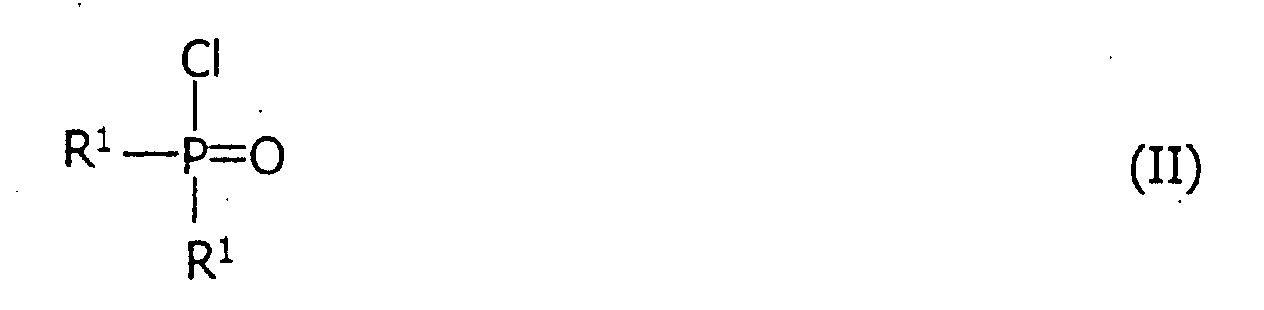
- R1
- a les significations indiquées en référence à la formule (I),
dans laquelle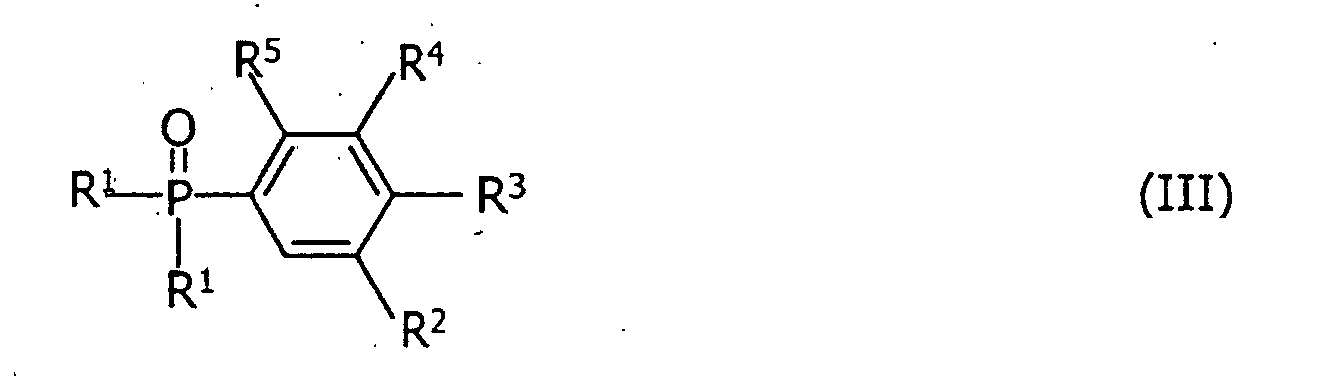
- R1 à R5
- ont les significations indiquées en référence à la formule (I),
dans laquelle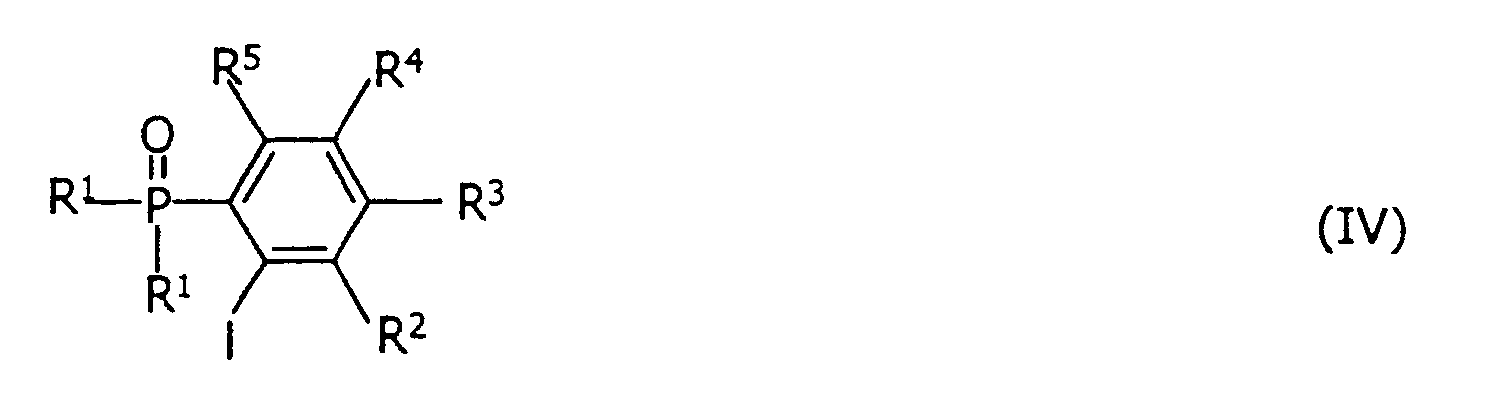
- R1 à R5
- ont les significations indiquées en référence à la formule (I),
ce procédé se caractérisant en ce que
au premier stade, on utilise en tant que solvant un mélange de tétrahydrofuranne et d'un hydrocarbure aromatique et on met en oeuvre le chlorure d'acide diphénylphosphinique de formule (II) sans solvant, puis on isole l'oxyde de diphénylphosphine de formule (III) ainsi obtenu à partir d'une solution dans un hydrocarbure aromatique par addition d'un hydrocarbure aliphatique saturé,
au deuxième stade, on applique des températures qui ne descendent pas au-dessous de -25°C, on introduit l'oxyde de diphénylphosphine métallisé de formule (III) et l'iode simultanément en veillant à ce qu'il y ait toujours un léger excès d'iode, et on sépare l'oxyde de 2-iodo-diphénylphosphine ainsi obtenu à l'état de solution dans un hydrocarbure aromatique,
au troisième stade, on utilise du cuivre dendritique et, en tant que solvant, un hydrocarbure aromatique et on fait cristalliser l'oxyde de bis-diphénylphosphine racémique de formule (I) ainsi obtenu à partir d'une solution dans un hydrocarbure aromatique, et
au quatrième stade, on utilise un acide mono- ou di-carboxylique à l'état d'énantiomère pur, on isole le premier énantiomère par cristallisation à partir d'une solution dans un hydrocarbure aromatique et le deuxième énantiomère par hydrolyse suivie d'une cristallisation à partir d'une solution dans un hydrocarbure aromatique. - Procédé selon la revendication 1, caractérisé en ce que, dans les formules (I) à (IV), R1 représente un groupe phényle non substitué, naphtyle non substitué, hétéroaryle à 4 ou 5 atomes de carbone et 1 ou 2 hétéroatomes du groupe consistant en l'oxygène ou le soufre, ou bien un groupe cyclohexyle non substitué, et dans les formules (I), (IIa) (III) et (IV), R2 représente un groupe méthoxy, R3 le fluor ou le chlore et R4 et R5 l'hydrogène.
- Procédé selon les revendications 1 à 2, caractérisé en ce que les hydrocarbures aromatiques en question sont le benzène, le toluène ou les xylènes.
- Procédé selon les revendications 1 à 3, caractérisé en ce que les hydrocarbures aliphatiques saturés sont des pentanes, hexanes ou octanes à chaínes droites ou ramifiées.
- Procédé selon les revendications 1 à 4, caractérisé en ce que, au premier stade, pour 1 mol du dérivé bromé de formule (IIa), on utilise 1 à 1,5 mol de magnésium et, en tant que solvant, un mélange de 20 à presque 100 % en volume de tétrahydrofuranne, le complément à 100 % en volume consistant en un hydrocarbure aromatique et on filtre le précipité formé 5 à 20 h après l'addition de l'hydrocarbure aliphatique saturé.
- Procédé selon les revendications 1 à 5, caractérisé en ce que, au deuxième stade, on métallise l'oxyde de diphénylphosphine de formule (III) à une température de -25 à 0°C dans le tétrahydrofuranne, on prépare séparément une solution d'iode dans le tétrahydrofuranne, on ajoute les deux solutions à des températures de -25 à 0°C dans du tétrahydrofuranne en veillant à ce qu'il y ait toujours un léger excès d'iode, on élimine ensuite l'excès d'iode et on sépare les oxydes de 2-iodo-diphénylphosphine de formule (IV) à l'état de solutions à des concentrations de 15 à 30 % en poids dans un hydrocarbure aromatique.
- Procédé selon les revendications 1 à 6, caractérisé en ce que, au troisième stade, on utilise du cuivre dendritique à une dimension de particule moyenne de 1 à 100 µm, une surface de 0,04 à 1 m2/g, et une pureté supérieure à 99,5 %, on part du cuivre dendritique et d'un solvant aromatique et on ajoute à une température de 70 à 140°C la solution de l'oxyde de 2-iodo-diphénylphosphine de formule (IV) obtenue au deuxième stade, on utilise 1 à 10 mol de cuivre dendritique par mole de l'oxyde de 2-iodo-diphénylphosphine de formule (IV), on observe une durée d'addition et d'agitation complémentaire de 3 à 8 h au total et on fait cristalliser l'oxyde de bis-diphénylphosphine racémique de formule (I) par refroidissement à une température de 0 à 25°C.
- Procédé selon les revendications 1 à 7, caractérisé en ce que, au quatrième stade, on fait réagir l'oxyde de bis-diphénylphosphine racémique de formule (I) en solution dans un hydrocarbure chloré avec un acide dibenzoyltartrique à l'état d'énantiomère pur en solution dans un ester, à chaud, et on isole l'oxyde de bis-diphénylphosphine de formule (I) à l'état d'énantiomère pur par refroidissement d'un solution dans un hydrocarbure aromatique à une température de 0 à 30°C.
- Procédé selon revendication 8, caractérisé en ce que, à partir du filtrat obtenu après la réaction avec un acide dibenzoyltartrique à l'état d'énantiomère pur, on prépare une solution dans un hydrocarbure aromatique, et à partir de celle-ci, par concentration et refroidissement, on récupère d'abord du produit de départ racémique et, par une nouvelle concentration et un nouveau refroidissement, l'autre forme énantiomère pure de l'oxyde de bis-diphénylphosphine de formule (I).
Applications Claiming Priority (2)
| Application Number | Priority Date | Filing Date | Title |
|---|---|---|---|
| DE10056310A DE10056310A1 (de) | 2000-11-14 | 2000-11-14 | Verbessertes Verfahren zur Herstellung von enantiomerenreinen(5,5`-Dichlor-6,6`-dimethoxybiphenyl-2,2`-diyl)-bis-(diphenylphosphinoxiden) |
| DE10056310 | 2000-11-14 |
Publications (2)
| Publication Number | Publication Date |
|---|---|
| EP1205486A1 EP1205486A1 (fr) | 2002-05-15 |
| EP1205486B1 true EP1205486B1 (fr) | 2004-02-11 |
Family
ID=7663200
Family Applications (1)
| Application Number | Title | Priority Date | Filing Date |
|---|---|---|---|
| EP01126101A Expired - Lifetime EP1205486B1 (fr) | 2000-11-14 | 2001-11-02 | Procédé amélioré pour la préparation de (5,5'-dichlor-6,6'-diméthoxybiphényle-2,2'-diyl)-bis-(diphénylphosphineoxides) |
Country Status (6)
| Country | Link |
|---|---|
| US (1) | US6489513B2 (fr) |
| EP (1) | EP1205486B1 (fr) |
| JP (1) | JP3900254B2 (fr) |
| AT (1) | ATE259371T1 (fr) |
| DE (2) | DE10056310A1 (fr) |
| ES (1) | ES2215835T3 (fr) |
Families Citing this family (2)
| Publication number | Priority date | Publication date | Assignee | Title |
|---|---|---|---|---|
| JP4526777B2 (ja) * | 2003-04-04 | 2010-08-18 | ニッタ・ハース株式会社 | 水性コンディショニング液およびコンディショニング法 |
| US7094725B2 (en) | 2003-07-11 | 2006-08-22 | The Hong Kong Polytechnic University | Biphenyldiphosphine compounds |
Family Cites Families (10)
| Publication number | Priority date | Publication date | Assignee | Title |
|---|---|---|---|---|
| DK350383A (da) * | 1982-08-27 | 1984-02-28 | Hoffmann La Roche | Phosphorforbindelser |
| ATE141278T1 (de) * | 1991-03-15 | 1996-08-15 | Hoffmann La Roche | Diphosphonsaurederivate als zwischenprodukte zur herstellung von diphosphinliganden |
| DK0579797T3 (da) * | 1992-01-31 | 1999-10-25 | Hoffmann La Roche | Diphosphinligander |
| EP0565975B1 (fr) * | 1992-04-16 | 1996-09-04 | F. Hoffmann-La Roche Ag | Procédé pour la préparation de dérivés isopréniques |
| DE4330730A1 (de) * | 1993-09-10 | 1995-03-16 | Bayer Ag | Neue Bisphosphine für asymmetrische Hydrierkatalysatoren |
| DE4422672A1 (de) * | 1994-06-30 | 1996-01-04 | Hoechst Ag | Halogenierte Biphenyl-2,2'-diyl-bis-diphenylphosphine, ihre Herstellung und ihre Verwendung |
| DE19522293A1 (de) | 1995-06-20 | 1997-01-02 | Bayer Ag | Neue Bisphospine als Katalysatoren für asymmetrische Reaktionen |
| US5760106A (en) | 1995-07-05 | 1998-06-02 | Board Of Trustees Operating Michigan State University | Sealant method of epoxy resin-clay composites |
| JP3892118B2 (ja) * | 1997-07-31 | 2007-03-14 | 高砂香料工業株式会社 | 2,2’−ビス(ジアリールホスフィノ)−6,6’−ビス(トリフルオロメチル)−1,1’−ビフェニル、これを配位子とする遷移金属錯体および光学活性な3−ヒドロキシ酪酸エステル誘導体あるいはβ−ブチロラクトンの製造方法 |
| US6162929A (en) * | 1997-12-23 | 2000-12-19 | Hoffmann-La Roche Inc. | Process for the manufacture of bisphosphine oxide and bisphosphonate compounds |
-
2000
- 2000-11-14 DE DE10056310A patent/DE10056310A1/de not_active Withdrawn
-
2001
- 2001-11-02 DE DE50101468T patent/DE50101468D1/de not_active Expired - Lifetime
- 2001-11-02 ES ES01126101T patent/ES2215835T3/es not_active Expired - Lifetime
- 2001-11-02 EP EP01126101A patent/EP1205486B1/fr not_active Expired - Lifetime
- 2001-11-02 AT AT01126101T patent/ATE259371T1/de not_active IP Right Cessation
- 2001-11-08 JP JP2001343031A patent/JP3900254B2/ja not_active Expired - Fee Related
- 2001-11-13 US US10/010,176 patent/US6489513B2/en not_active Expired - Lifetime
Also Published As
| Publication number | Publication date |
|---|---|
| ES2215835T3 (es) | 2004-10-16 |
| US20020058814A1 (en) | 2002-05-16 |
| DE10056310A1 (de) | 2002-05-16 |
| EP1205486A1 (fr) | 2002-05-15 |
| ATE259371T1 (de) | 2004-02-15 |
| DE50101468D1 (de) | 2004-03-18 |
| US6489513B2 (en) | 2002-12-03 |
| JP3900254B2 (ja) | 2007-04-04 |
| JP2002179693A (ja) | 2002-06-26 |
Similar Documents
| Publication | Publication Date | Title |
|---|---|---|
| EP0104375B1 (fr) | Dérivés biphényliques contenant du phosphore et leur utilisation pour l'hydrogénation asymétrique et la migration énantiosélective d'hydrogène | |
| EP0647648B1 (fr) | Composés de phosphore optiquement actifs | |
| EP0794957B1 (fr) | Procede de production de phosphines de metallocenyle optiquement actives | |
| EP0398132B1 (fr) | Composés du phosphore | |
| EP0582692B1 (fr) | Ligands diphosphiniques | |
| EP0749973B1 (fr) | Nouvelles bisphosphines comme catalyseurs de réactions asymmétriques | |
| JP3204668B2 (ja) | キラルなホスフイン | |
| WO1993015090A1 (fr) | Ligands diphosphiniques | |
| EP0530336A1 (fr) | Phosphines chirales. | |
| DE69306595T2 (de) | Regioselektive synthese von 4-chlor-2-thiophencarbonsäure | |
| EP1205486B1 (fr) | Procédé amélioré pour la préparation de (5,5'-dichlor-6,6'-diméthoxybiphényle-2,2'-diyl)-bis-(diphénylphosphineoxides) | |
| EP0803508B1 (fr) | Procédé de préparation de sels d'aluminium d'acides phosphiniques | |
| EP0704450B1 (fr) | Nouvelles phosphines sulfonées, leur procédé de préparation et leur utilisation comme constituants de systèmes de catalyseurs | |
| Sokolov et al. | Stereochemistry of redox-demercuration of an optically active 8-(α-bromomercuriethyl) quinoline with zerovalent palladium complexes | |
| EP0565975A2 (fr) | Procédé pour la préparation de dérivés isopréniques | |
| EP0659739B1 (fr) | Procédé pour la préparation de l'acide 9-(Z)-rétinoique | |
| DE3214828A1 (de) | Phosphorverbindungen | |
| DE2524299C2 (de) | Verfahren zur Herstellung von Toluoyl-1-methyl-pyrrol-2-acetonitrilen | |
| DE2613817A1 (de) | Phenylpropionsaeuren, pyruvatverfahren zu ihrer herstellung und verwendung | |
| EP0114359A1 (fr) | Procédé pour la préparation de composés carbocycliques ou hétérocycliques substitués par un groupe perfluoroalkyle | |
| WO2004031110A2 (fr) | Isomerisation de derives homogenes chiraux de o,o'-dihydroxy-biphenyle | |
| EP0778281B1 (fr) | Procédé de préparation de composés renfermant des hétéroatomes et contenant un pont méthylène et nouveaux bis (diorganylphosphino) méthanes | |
| DE2338216A1 (de) | Optisch aktive chelate und ihre verwendung fuer die asymmetrische synthese optisch aktiver verbindungen | |
| DE965490C (de) | Verfahren zur Herstellung von aromatischen Sulfoniumverbindungen | |
| AT376224B (de) | Verfahren zur herstellung neuer o-aryl-nphosphonmethylglycinnitrile bzw. deren sauren und alkalischen salzen |
Legal Events
| Date | Code | Title | Description |
|---|---|---|---|
| PUAI | Public reference made under article 153(3) epc to a published international application that has entered the european phase |
Free format text: ORIGINAL CODE: 0009012 |
|
| AK | Designated contracting states |
Kind code of ref document: A1 Designated state(s): AT BE CH CY DE DK ES FI FR GB GR IE IT LI LU MC NL PT SE TR |
|
| AX | Request for extension of the european patent |
Free format text: AL;LT;LV;MK;RO;SI |
|
| 17P | Request for examination filed |
Effective date: 20021115 |
|
| AKX | Designation fees paid |
Designated state(s): AT BE CH CY DE DK ES FI FR GB GR IE IT LI LU MC NL PT SE TR |
|
| GRAH | Despatch of communication of intention to grant a patent |
Free format text: ORIGINAL CODE: EPIDOS IGRA |
|
| GRAS | Grant fee paid |
Free format text: ORIGINAL CODE: EPIDOSNIGR3 |
|
| GRAA | (expected) grant |
Free format text: ORIGINAL CODE: 0009210 |
|
| RAP1 | Party data changed (applicant data changed or rights of an application transferred) |
Owner name: BAYER CHEMICALS AG |
|
| AK | Designated contracting states |
Kind code of ref document: B1 Designated state(s): AT BE CH CY DE DK ES FI FR GB GR IE IT LI LU MC NL PT SE TR |
|
| PG25 | Lapsed in a contracting state [announced via postgrant information from national office to epo] |
Ref country code: CY Free format text: LAPSE BECAUSE OF FAILURE TO SUBMIT A TRANSLATION OF THE DESCRIPTION OR TO PAY THE FEE WITHIN THE PRESCRIBED TIME-LIMIT Effective date: 20040211 Ref country code: IE Free format text: LAPSE BECAUSE OF FAILURE TO SUBMIT A TRANSLATION OF THE DESCRIPTION OR TO PAY THE FEE WITHIN THE PRESCRIBED TIME-LIMIT Effective date: 20040211 Ref country code: TR Free format text: LAPSE BECAUSE OF FAILURE TO SUBMIT A TRANSLATION OF THE DESCRIPTION OR TO PAY THE FEE WITHIN THE PRESCRIBED TIME-LIMIT Effective date: 20040211 Ref country code: FI Free format text: LAPSE BECAUSE OF FAILURE TO SUBMIT A TRANSLATION OF THE DESCRIPTION OR TO PAY THE FEE WITHIN THE PRESCRIBED TIME-LIMIT Effective date: 20040211 |
|
| REG | Reference to a national code |
Ref country code: GB Ref legal event code: FG4D Free format text: NOT ENGLISH |
|
| REG | Reference to a national code |
Ref country code: CH Ref legal event code: EP |
|
| REG | Reference to a national code |
Ref country code: CH Ref legal event code: NV Representative=s name: E. BLUM & CO. PATENTANWAELTE |
|
| REG | Reference to a national code |
Ref country code: IE Ref legal event code: FG4D Free format text: GERMAN |
|
| REF | Corresponds to: |
Ref document number: 50101468 Country of ref document: DE Date of ref document: 20040318 Kind code of ref document: P |
|
| GBT | Gb: translation of ep patent filed (gb section 77(6)(a)/1977) |
Effective date: 20040303 |
|
| PG25 | Lapsed in a contracting state [announced via postgrant information from national office to epo] |
Ref country code: DK Free format text: LAPSE BECAUSE OF FAILURE TO SUBMIT A TRANSLATION OF THE DESCRIPTION OR TO PAY THE FEE WITHIN THE PRESCRIBED TIME-LIMIT Effective date: 20040511 Ref country code: GR Free format text: LAPSE BECAUSE OF FAILURE TO SUBMIT A TRANSLATION OF THE DESCRIPTION OR TO PAY THE FEE WITHIN THE PRESCRIBED TIME-LIMIT Effective date: 20040511 Ref country code: SE Free format text: LAPSE BECAUSE OF FAILURE TO SUBMIT A TRANSLATION OF THE DESCRIPTION OR TO PAY THE FEE WITHIN THE PRESCRIBED TIME-LIMIT Effective date: 20040511 |
|
| REG | Reference to a national code |
Ref country code: IE Ref legal event code: FD4D |
|
| REG | Reference to a national code |
Ref country code: ES Ref legal event code: FG2A Ref document number: 2215835 Country of ref document: ES Kind code of ref document: T3 |
|
| PG25 | Lapsed in a contracting state [announced via postgrant information from national office to epo] |
Ref country code: AT Free format text: LAPSE BECAUSE OF NON-PAYMENT OF DUE FEES Effective date: 20041102 Ref country code: LU Free format text: LAPSE BECAUSE OF NON-PAYMENT OF DUE FEES Effective date: 20041102 |
|
| ET | Fr: translation filed | ||
| PG25 | Lapsed in a contracting state [announced via postgrant information from national office to epo] |
Ref country code: MC Free format text: LAPSE BECAUSE OF NON-PAYMENT OF DUE FEES Effective date: 20041130 |
|
| PLBE | No opposition filed within time limit |
Free format text: ORIGINAL CODE: 0009261 |
|
| STAA | Information on the status of an ep patent application or granted ep patent |
Free format text: STATUS: NO OPPOSITION FILED WITHIN TIME LIMIT |
|
| 26N | No opposition filed |
Effective date: 20041112 |
|
| REG | Reference to a national code |
Ref country code: GB Ref legal event code: 732E |
|
| NLS | Nl: assignments of ep-patents |
Owner name: LANXESS DEUTSCHLAND GMBH Effective date: 20070305 |
|
| REG | Reference to a national code |
Ref country code: CH Ref legal event code: PUE Owner name: LANXESS DEUTSCHLAND GMBH Free format text: BAYER CHEMICALS AG# #51368 LEVERKUSEN (DE) -TRANSFER TO- LANXESS DEUTSCHLAND GMBH# #51369 LEVERKUSEN (DE) |
|
| PG25 | Lapsed in a contracting state [announced via postgrant information from national office to epo] |
Ref country code: PT Free format text: LAPSE BECAUSE OF NON-PAYMENT OF DUE FEES Effective date: 20040711 |
|
| REG | Reference to a national code |
Ref country code: FR Ref legal event code: TP |
|
| PGFP | Annual fee paid to national office [announced via postgrant information from national office to epo] |
Ref country code: FR Payment date: 20101123 Year of fee payment: 10 Ref country code: NL Payment date: 20101110 Year of fee payment: 10 |
|
| PGFP | Annual fee paid to national office [announced via postgrant information from national office to epo] |
Ref country code: BE Payment date: 20101117 Year of fee payment: 10 Ref country code: IT Payment date: 20101112 Year of fee payment: 10 Ref country code: GB Payment date: 20101027 Year of fee payment: 10 |
|
| PGFP | Annual fee paid to national office [announced via postgrant information from national office to epo] |
Ref country code: ES Payment date: 20101217 Year of fee payment: 10 |
|
| BERE | Be: lapsed |
Owner name: *LANXESS DEUTSCHLAND G.M.B.H. Effective date: 20111130 |
|
| REG | Reference to a national code |
Ref country code: NL Ref legal event code: V1 Effective date: 20120601 |
|
| GBPC | Gb: european patent ceased through non-payment of renewal fee |
Effective date: 20111102 |
|
| PG25 | Lapsed in a contracting state [announced via postgrant information from national office to epo] |
Ref country code: NL Free format text: LAPSE BECAUSE OF NON-PAYMENT OF DUE FEES Effective date: 20120601 |
|
| REG | Reference to a national code |
Ref country code: FR Ref legal event code: ST Effective date: 20120731 |
|
| PG25 | Lapsed in a contracting state [announced via postgrant information from national office to epo] |
Ref country code: BE Free format text: LAPSE BECAUSE OF NON-PAYMENT OF DUE FEES Effective date: 20111130 Ref country code: IT Free format text: LAPSE BECAUSE OF NON-PAYMENT OF DUE FEES Effective date: 20111102 |
|
| PG25 | Lapsed in a contracting state [announced via postgrant information from national office to epo] |
Ref country code: GB Free format text: LAPSE BECAUSE OF NON-PAYMENT OF DUE FEES Effective date: 20111102 |
|
| PG25 | Lapsed in a contracting state [announced via postgrant information from national office to epo] |
Ref country code: FR Free format text: LAPSE BECAUSE OF NON-PAYMENT OF DUE FEES Effective date: 20111130 |
|
| REG | Reference to a national code |
Ref country code: ES Ref legal event code: FD2A Effective date: 20130606 |
|
| PG25 | Lapsed in a contracting state [announced via postgrant information from national office to epo] |
Ref country code: ES Free format text: LAPSE BECAUSE OF NON-PAYMENT OF DUE FEES Effective date: 20111103 |
|
| REG | Reference to a national code |
Ref country code: DE Ref legal event code: R082 Ref document number: 50101468 Country of ref document: DE Representative=s name: WICHMANN, BIRGID, DIPL.-CHEM. DR.RER.NAT., DE |
|
| REG | Reference to a national code |
Ref country code: DE Ref legal event code: R081 Ref document number: 50101468 Country of ref document: DE Owner name: SALTIGO GMBH, DE Free format text: FORMER OWNER: SALTIGO GMBH, 51371 LEVERKUSEN, DE Effective date: 20131213 Ref country code: DE Ref legal event code: R082 Ref document number: 50101468 Country of ref document: DE Representative=s name: WICHMANN, BIRGID, DIPL.-CHEM. DR.RER.NAT., DE Effective date: 20131213 |
|
| PGFP | Annual fee paid to national office [announced via postgrant information from national office to epo] |
Ref country code: CH Payment date: 20151111 Year of fee payment: 15 Ref country code: DE Payment date: 20151028 Year of fee payment: 15 |
|
| REG | Reference to a national code |
Ref country code: DE Ref legal event code: R119 Ref document number: 50101468 Country of ref document: DE |
|
| REG | Reference to a national code |
Ref country code: CH Ref legal event code: PL |
|
| PG25 | Lapsed in a contracting state [announced via postgrant information from national office to epo] |
Ref country code: LI Free format text: LAPSE BECAUSE OF NON-PAYMENT OF DUE FEES Effective date: 20161130 Ref country code: CH Free format text: LAPSE BECAUSE OF NON-PAYMENT OF DUE FEES Effective date: 20161130 |
|
| PG25 | Lapsed in a contracting state [announced via postgrant information from national office to epo] |
Ref country code: DE Free format text: LAPSE BECAUSE OF NON-PAYMENT OF DUE FEES Effective date: 20170601 |