EP1205593B1 - Mit aufeinanderfolgenden reaktiven Ausrüstungsmitteln beschichtetes Polyestergarn, Verfahren zur Herstellung dieses Garnes, sowie dieses Garn enthaltender Kautschukverbundwerkstoff - Google Patents
Mit aufeinanderfolgenden reaktiven Ausrüstungsmitteln beschichtetes Polyestergarn, Verfahren zur Herstellung dieses Garnes, sowie dieses Garn enthaltender Kautschukverbundwerkstoff Download PDFInfo
- Publication number
- EP1205593B1 EP1205593B1 EP20010125439 EP01125439A EP1205593B1 EP 1205593 B1 EP1205593 B1 EP 1205593B1 EP 20010125439 EP20010125439 EP 20010125439 EP 01125439 A EP01125439 A EP 01125439A EP 1205593 B1 EP1205593 B1 EP 1205593B1
- Authority
- EP
- European Patent Office
- Prior art keywords
- yarn
- range
- epoxy
- coating
- epoxide
- Prior art date
- Legal status (The legal status is an assumption and is not a legal conclusion. Google has not performed a legal analysis and makes no representation as to the accuracy of the status listed.)
- Expired - Lifetime
Links
- 229920001971 elastomer Polymers 0.000 title claims description 39
- 239000005060 rubber Substances 0.000 title claims description 39
- 229920000728 polyester Polymers 0.000 title claims description 32
- 238000000034 method Methods 0.000 title claims description 18
- 230000008569 process Effects 0.000 title claims description 17
- 239000002131 composite material Substances 0.000 title claims description 12
- 239000004593 Epoxy Substances 0.000 claims description 50
- 229920000647 polyepoxide Polymers 0.000 claims description 50
- RTZKZFJDLAIYFH-UHFFFAOYSA-N Diethyl ether Chemical compound CCOCC RTZKZFJDLAIYFH-UHFFFAOYSA-N 0.000 claims description 37
- 150000002118 epoxides Chemical group 0.000 claims description 34
- 239000011248 coating agent Substances 0.000 claims description 29
- 238000000576 coating method Methods 0.000 claims description 29
- PEDCQBHIVMGVHV-UHFFFAOYSA-N Glycerine Chemical compound OCC(O)CO PEDCQBHIVMGVHV-UHFFFAOYSA-N 0.000 claims description 27
- 239000003822 epoxy resin Substances 0.000 claims description 27
- -1 tris(hydroxyphenyl) methane epoxide Chemical class 0.000 claims description 22
- 125000003118 aryl group Chemical group 0.000 claims description 19
- 125000003700 epoxy group Chemical group 0.000 claims description 18
- 229920003986 novolac Polymers 0.000 claims description 18
- GYZLOYUZLJXAJU-UHFFFAOYSA-N diglycidyl ether Chemical group C1OC1COCC1CO1 GYZLOYUZLJXAJU-UHFFFAOYSA-N 0.000 claims description 16
- 125000002496 methyl group Chemical group [H]C([H])([H])* 0.000 claims description 15
- 125000002887 hydroxy group Chemical group [H]O* 0.000 claims description 13
- 229920005989 resin Polymers 0.000 claims description 13
- 239000011347 resin Substances 0.000 claims description 13
- 125000000217 alkyl group Chemical group 0.000 claims description 12
- 239000000243 solution Substances 0.000 claims description 12
- ISWSIDIOOBJBQZ-UHFFFAOYSA-N Phenol Chemical compound OC1=CC=CC=C1 ISWSIDIOOBJBQZ-UHFFFAOYSA-N 0.000 claims description 11
- 229920005862 polyol Polymers 0.000 claims description 11
- 150000003077 polyols Chemical class 0.000 claims description 11
- IISBACLAFKSPIT-UHFFFAOYSA-N bisphenol A Chemical compound C=1C=C(O)C=CC=1C(C)(C)C1=CC=C(O)C=C1 IISBACLAFKSPIT-UHFFFAOYSA-N 0.000 claims description 10
- 239000002253 acid Substances 0.000 claims description 9
- 150000002894 organic compounds Chemical class 0.000 claims description 9
- 150000003839 salts Chemical class 0.000 claims description 9
- 150000002170 ethers Chemical class 0.000 claims description 8
- 229910052736 halogen Inorganic materials 0.000 claims description 8
- 150000002367 halogens Chemical class 0.000 claims description 8
- 229910052739 hydrogen Inorganic materials 0.000 claims description 8
- 239000001257 hydrogen Substances 0.000 claims description 8
- 125000004435 hydrogen atom Chemical class [H]* 0.000 claims description 8
- 239000004816 latex Substances 0.000 claims description 8
- 229920000126 latex Polymers 0.000 claims description 8
- 125000001997 phenyl group Chemical group [H]C1=C([H])C([H])=C(*)C([H])=C1[H] 0.000 claims description 8
- 235000013824 polyphenols Nutrition 0.000 claims description 8
- 239000002904 solvent Substances 0.000 claims description 8
- 125000001931 aliphatic group Chemical group 0.000 claims description 7
- 239000007795 chemical reaction product Substances 0.000 claims description 7
- 239000006185 dispersion Substances 0.000 claims description 7
- 125000005842 heteroatom Chemical group 0.000 claims description 7
- 229910052760 oxygen Inorganic materials 0.000 claims description 7
- 229910052717 sulfur Inorganic materials 0.000 claims description 7
- QTWJRLJHJPIABL-UHFFFAOYSA-N 2-methylphenol;3-methylphenol;4-methylphenol Chemical compound CC1=CC=C(O)C=C1.CC1=CC=CC(O)=C1.CC1=CC=CC=C1O QTWJRLJHJPIABL-UHFFFAOYSA-N 0.000 claims description 6
- FBPFZTCFMRRESA-FSIIMWSLSA-N D-Glucitol Natural products OC[C@H](O)[C@H](O)[C@@H](O)[C@H](O)CO FBPFZTCFMRRESA-FSIIMWSLSA-N 0.000 claims description 6
- FBPFZTCFMRRESA-JGWLITMVSA-N D-glucitol Chemical compound OC[C@H](O)[C@@H](O)[C@H](O)[C@H](O)CO FBPFZTCFMRRESA-JGWLITMVSA-N 0.000 claims description 6
- 229930003836 cresol Natural products 0.000 claims description 6
- LEQAOMBKQFMDFZ-UHFFFAOYSA-N glyoxal Chemical compound O=CC=O LEQAOMBKQFMDFZ-UHFFFAOYSA-N 0.000 claims description 6
- 239000000600 sorbitol Substances 0.000 claims description 6
- 125000001424 substituent group Chemical group 0.000 claims description 6
- 125000002947 alkylene group Chemical group 0.000 claims description 5
- 229940106691 bisphenol a Drugs 0.000 claims description 5
- 125000004432 carbon atom Chemical group C* 0.000 claims description 5
- 239000004848 polyfunctional curative Substances 0.000 claims description 5
- 125000000732 arylene group Chemical group 0.000 claims description 4
- 229910052757 nitrogen Inorganic materials 0.000 claims description 4
- 150000008442 polyphenolic compounds Chemical class 0.000 claims description 4
- 229940015043 glyoxal Drugs 0.000 claims description 3
- 150000003944 halohydrins Chemical class 0.000 claims description 3
- 239000007788 liquid Substances 0.000 claims description 3
- 229920000223 polyglycerol Polymers 0.000 claims description 3
- 238000009998 heat setting Methods 0.000 claims description 2
- 239000002245 particle Substances 0.000 claims description 2
- 239000005062 Polybutadiene Substances 0.000 claims 2
- 150000004982 aromatic amines Chemical group 0.000 claims 2
- 125000003055 glycidyl group Chemical group C(C1CO1)* 0.000 claims 2
- 229920002857 polybutadiene Polymers 0.000 claims 2
- 239000003960 organic solvent Substances 0.000 claims 1
- 229920003171 Poly (ethylene oxide) Polymers 0.000 description 42
- 238000012360 testing method Methods 0.000 description 38
- 239000000203 mixture Substances 0.000 description 21
- XLYOFNOQVPJJNP-UHFFFAOYSA-N water Substances O XLYOFNOQVPJJNP-UHFFFAOYSA-N 0.000 description 20
- 229920000139 polyethylene terephthalate Polymers 0.000 description 16
- 239000005020 polyethylene terephthalate Substances 0.000 description 16
- 150000001298 alcohols Chemical class 0.000 description 15
- 150000001875 compounds Chemical class 0.000 description 12
- 229920003319 Araldite® Polymers 0.000 description 11
- 238000004804 winding Methods 0.000 description 11
- LYCAIKOWRPUZTN-UHFFFAOYSA-N Ethylene glycol Chemical compound OCCO LYCAIKOWRPUZTN-UHFFFAOYSA-N 0.000 description 10
- IAYPIBMASNFSPL-UHFFFAOYSA-N Ethylene oxide Chemical compound C1CO1 IAYPIBMASNFSPL-UHFFFAOYSA-N 0.000 description 10
- 239000000839 emulsion Substances 0.000 description 10
- 239000004615 ingredient Substances 0.000 description 10
- 239000004359 castor oil Substances 0.000 description 9
- 235000019438 castor oil Nutrition 0.000 description 9
- ZEMPKEQAKRGZGQ-XOQCFJPHSA-N glycerol triricinoleate Natural products CCCCCC[C@@H](O)CC=CCCCCCCCC(=O)OC[C@@H](COC(=O)CCCCCCCC=CC[C@@H](O)CCCCCC)OC(=O)CCCCCCCC=CC[C@H](O)CCCCCC ZEMPKEQAKRGZGQ-XOQCFJPHSA-N 0.000 description 9
- 239000000314 lubricant Substances 0.000 description 9
- 229910052799 carbon Inorganic materials 0.000 description 8
- 229920001577 copolymer Polymers 0.000 description 8
- 239000000126 substance Substances 0.000 description 8
- 235000011187 glycerol Nutrition 0.000 description 7
- HEMHJVSKTPXQMS-UHFFFAOYSA-M Sodium hydroxide Chemical compound [OH-].[Na+] HEMHJVSKTPXQMS-UHFFFAOYSA-M 0.000 description 6
- 229920001223 polyethylene glycol Polymers 0.000 description 6
- SCVFZCLFOSHCOH-UHFFFAOYSA-M potassium acetate Chemical compound [K+].CC([O-])=O SCVFZCLFOSHCOH-UHFFFAOYSA-M 0.000 description 6
- 238000003756 stirring Methods 0.000 description 6
- ZORQXIQZAOLNGE-UHFFFAOYSA-N 1,1-difluorocyclohexane Chemical compound FC1(F)CCCCC1 ZORQXIQZAOLNGE-UHFFFAOYSA-N 0.000 description 5
- WKBOTKDWSSQWDR-UHFFFAOYSA-N Bromine atom Chemical compound [Br] WKBOTKDWSSQWDR-UHFFFAOYSA-N 0.000 description 5
- 229940126062 Compound A Drugs 0.000 description 5
- NLDMNSXOCDLTTB-UHFFFAOYSA-N Heterophylliin A Natural products O1C2COC(=O)C3=CC(O)=C(O)C(O)=C3C3=C(O)C(O)=C(O)C=C3C(=O)OC2C(OC(=O)C=2C=C(O)C(O)=C(O)C=2)C(O)C1OC(=O)C1=CC(O)=C(O)C(O)=C1 NLDMNSXOCDLTTB-UHFFFAOYSA-N 0.000 description 5
- 239000000853 adhesive Substances 0.000 description 5
- 230000001070 adhesive effect Effects 0.000 description 5
- GDTBXPJZTBHREO-UHFFFAOYSA-N bromine Substances BrBr GDTBXPJZTBHREO-UHFFFAOYSA-N 0.000 description 5
- 229910052794 bromium Inorganic materials 0.000 description 5
- 239000000460 chlorine Substances 0.000 description 5
- 229910052801 chlorine Inorganic materials 0.000 description 5
- 239000003995 emulsifying agent Substances 0.000 description 5
- 150000002148 esters Chemical class 0.000 description 5
- 239000001593 sorbitan monooleate Substances 0.000 description 5
- 235000011069 sorbitan monooleate Nutrition 0.000 description 5
- 229940035049 sorbitan monooleate Drugs 0.000 description 5
- VFBJXXJYHWLXRM-UHFFFAOYSA-N 2-[2-[3-(3,5-ditert-butyl-4-hydroxyphenyl)propanoyloxy]ethylsulfanyl]ethyl 3-(3,5-ditert-butyl-4-hydroxyphenyl)propanoate Chemical compound CC(C)(C)C1=C(O)C(C(C)(C)C)=CC(CCC(=O)OCCSCCOC(=O)CCC=2C=C(C(O)=C(C=2)C(C)(C)C)C(C)(C)C)=C1 VFBJXXJYHWLXRM-UHFFFAOYSA-N 0.000 description 4
- ZAMOUSCENKQFHK-UHFFFAOYSA-N Chlorine atom Chemical compound [Cl] ZAMOUSCENKQFHK-UHFFFAOYSA-N 0.000 description 4
- 239000002202 Polyethylene glycol Substances 0.000 description 4
- GOOHAUXETOMSMM-UHFFFAOYSA-N Propylene oxide Chemical compound CC1CO1 GOOHAUXETOMSMM-UHFFFAOYSA-N 0.000 description 4
- 239000002585 base Substances 0.000 description 4
- 239000000835 fiber Substances 0.000 description 4
- 239000003550 marker Substances 0.000 description 4
- BWHMMNNQKKPAPP-UHFFFAOYSA-L potassium carbonate Chemical compound [K+].[K+].[O-]C([O-])=O BWHMMNNQKKPAPP-UHFFFAOYSA-L 0.000 description 4
- 239000001044 red dye Substances 0.000 description 4
- GHMLBKRAJCXXBS-UHFFFAOYSA-N resorcinol Chemical compound OC1=CC=CC(O)=C1 GHMLBKRAJCXXBS-UHFFFAOYSA-N 0.000 description 4
- ALSTYHKOOCGGFT-KTKRTIGZSA-N (9Z)-octadecen-1-ol Chemical compound CCCCCCCC\C=C/CCCCCCCCO ALSTYHKOOCGGFT-KTKRTIGZSA-N 0.000 description 3
- 229910019142 PO4 Inorganic materials 0.000 description 3
- 229920002565 Polyethylene Glycol 400 Polymers 0.000 description 3
- 239000004721 Polyphenylene oxide Substances 0.000 description 3
- 239000012190 activator Substances 0.000 description 3
- 150000001412 amines Chemical class 0.000 description 3
- 230000015572 biosynthetic process Effects 0.000 description 3
- 239000012153 distilled water Substances 0.000 description 3
- 239000004744 fabric Substances 0.000 description 3
- LNEPOXFFQSENCJ-UHFFFAOYSA-N haloperidol Chemical compound C1CC(O)(C=2C=CC(Cl)=CC=2)CCN1CCCC(=O)C1=CC=C(F)C=C1 LNEPOXFFQSENCJ-UHFFFAOYSA-N 0.000 description 3
- 239000012948 isocyanate Substances 0.000 description 3
- QIQXTHQIDYTFRH-UHFFFAOYSA-M octadecanoate Chemical compound CCCCCCCCCCCCCCCCCC([O-])=O QIQXTHQIDYTFRH-UHFFFAOYSA-M 0.000 description 3
- 239000003921 oil Substances 0.000 description 3
- 235000019198 oils Nutrition 0.000 description 3
- 229940055577 oleyl alcohol Drugs 0.000 description 3
- XMLQWXUVTXCDDL-UHFFFAOYSA-N oleyl alcohol Natural products CCCCCCC=CCCCCCCCCCCO XMLQWXUVTXCDDL-UHFFFAOYSA-N 0.000 description 3
- 235000021317 phosphate Nutrition 0.000 description 3
- 229920001707 polybutylene terephthalate Polymers 0.000 description 3
- 229920000570 polyether Polymers 0.000 description 3
- 229920001296 polysiloxane Polymers 0.000 description 3
- 235000011056 potassium acetate Nutrition 0.000 description 3
- 239000007787 solid Substances 0.000 description 3
- 238000007711 solidification Methods 0.000 description 3
- 230000008023 solidification Effects 0.000 description 3
- JNYAEWCLZODPBN-JGWLITMVSA-N (2r,3r,4s)-2-[(1r)-1,2-dihydroxyethyl]oxolane-3,4-diol Chemical compound OC[C@@H](O)[C@H]1OC[C@H](O)[C@H]1O JNYAEWCLZODPBN-JGWLITMVSA-N 0.000 description 2
- ZCYVEMRRCGMTRW-UHFFFAOYSA-N 7553-56-2 Chemical compound [I] ZCYVEMRRCGMTRW-UHFFFAOYSA-N 0.000 description 2
- IJGRMHOSHXDMSA-UHFFFAOYSA-N Atomic nitrogen Chemical compound N#N IJGRMHOSHXDMSA-UHFFFAOYSA-N 0.000 description 2
- KAKZBPTYRLMSJV-UHFFFAOYSA-N Butadiene Chemical compound C=CC=C KAKZBPTYRLMSJV-UHFFFAOYSA-N 0.000 description 2
- WSFSSNUMVMOOMR-UHFFFAOYSA-N Formaldehyde Chemical compound O=C WSFSSNUMVMOOMR-UHFFFAOYSA-N 0.000 description 2
- 108090001005 Interleukin-6 Proteins 0.000 description 2
- AFVFQIVMOAPDHO-UHFFFAOYSA-N Methanesulfonic acid Chemical compound CS(O)(=O)=O AFVFQIVMOAPDHO-UHFFFAOYSA-N 0.000 description 2
- DNIAPMSPPWPWGF-UHFFFAOYSA-N Propylene glycol Chemical compound CC(O)CO DNIAPMSPPWPWGF-UHFFFAOYSA-N 0.000 description 2
- BLRPTPMANUNPDV-UHFFFAOYSA-N Silane Chemical group [SiH4] BLRPTPMANUNPDV-UHFFFAOYSA-N 0.000 description 2
- FAPWRFPIFSIZLT-UHFFFAOYSA-M Sodium chloride Chemical compound [Na+].[Cl-] FAPWRFPIFSIZLT-UHFFFAOYSA-M 0.000 description 2
- PPBRXRYQALVLMV-UHFFFAOYSA-N Styrene Chemical compound C=CC1=CC=CC=C1 PPBRXRYQALVLMV-UHFFFAOYSA-N 0.000 description 2
- QAOWNCQODCNURD-UHFFFAOYSA-N Sulfuric acid Chemical compound OS(O)(=O)=O QAOWNCQODCNURD-UHFFFAOYSA-N 0.000 description 2
- KKEYFWRCBNTPAC-UHFFFAOYSA-N Terephthalic acid Chemical compound OC(=O)C1=CC=C(C(O)=O)C=C1 KKEYFWRCBNTPAC-UHFFFAOYSA-N 0.000 description 2
- ZJCCRDAZUWHFQH-UHFFFAOYSA-N Trimethylolpropane Chemical compound CCC(CO)(CO)CO ZJCCRDAZUWHFQH-UHFFFAOYSA-N 0.000 description 2
- 229910052784 alkaline earth metal Inorganic materials 0.000 description 2
- 239000003963 antioxidant agent Substances 0.000 description 2
- WERYXYBDKMZEQL-UHFFFAOYSA-N butane-1,4-diol Chemical compound OCCCCO WERYXYBDKMZEQL-UHFFFAOYSA-N 0.000 description 2
- 125000003178 carboxy group Chemical group [H]OC(*)=O 0.000 description 2
- 230000000052 comparative effect Effects 0.000 description 2
- 230000000694 effects Effects 0.000 description 2
- 125000001033 ether group Chemical group 0.000 description 2
- 238000006266 etherification reaction Methods 0.000 description 2
- PNDPGZBMCMUPRI-UHFFFAOYSA-N iodine Chemical compound II PNDPGZBMCMUPRI-UHFFFAOYSA-N 0.000 description 2
- 229910052740 iodine Inorganic materials 0.000 description 2
- 239000011630 iodine Substances 0.000 description 2
- QQVIHTHCMHWDBS-UHFFFAOYSA-N isophthalic acid Chemical compound OC(=O)C1=CC=CC(C(O)=O)=C1 QQVIHTHCMHWDBS-UHFFFAOYSA-N 0.000 description 2
- NBIIXXVUZAFLBC-UHFFFAOYSA-K phosphate Chemical compound [O-]P([O-])([O-])=O NBIIXXVUZAFLBC-UHFFFAOYSA-K 0.000 description 2
- 239000010452 phosphate Substances 0.000 description 2
- 229920000642 polymer Polymers 0.000 description 2
- 229910000027 potassium carbonate Inorganic materials 0.000 description 2
- 239000000047 product Substances 0.000 description 2
- 239000000376 reactant Substances 0.000 description 2
- APSBXTVYXVQYAB-UHFFFAOYSA-M sodium docusate Chemical compound [Na+].CCCCC(CC)COC(=O)CC(S([O-])(=O)=O)C(=O)OCC(CC)CCCC APSBXTVYXVQYAB-UHFFFAOYSA-M 0.000 description 2
- 238000009987 spinning Methods 0.000 description 2
- 238000003786 synthesis reaction Methods 0.000 description 2
- BPSIOYPQMFLKFR-UHFFFAOYSA-N trimethoxy-[3-(oxiran-2-ylmethoxy)propyl]silane Chemical compound CO[Si](OC)(OC)CCCOCC1CO1 BPSIOYPQMFLKFR-UHFFFAOYSA-N 0.000 description 2
- KATAXDCYPGGJNJ-UHFFFAOYSA-N 1,3-bis(oxiran-2-ylmethoxy)propan-2-ol Chemical compound C1OC1COCC(O)COCC1CO1 KATAXDCYPGGJNJ-UHFFFAOYSA-N 0.000 description 1
- OVSKIKFHRZPJSS-UHFFFAOYSA-N 2,4-D Chemical compound OC(=O)COC1=CC=C(Cl)C=C1Cl OVSKIKFHRZPJSS-UHFFFAOYSA-N 0.000 description 1
- XQESJWNDTICJHW-UHFFFAOYSA-N 2-[(2-hydroxy-5-methyl-3-nonylphenyl)methyl]-4-methyl-6-nonylphenol Chemical compound CCCCCCCCCC1=CC(C)=CC(CC=2C(=C(CCCCCCCCC)C=C(C)C=2)O)=C1O XQESJWNDTICJHW-UHFFFAOYSA-N 0.000 description 1
- TXBCBTDQIULDIA-UHFFFAOYSA-N 2-[[3-hydroxy-2,2-bis(hydroxymethyl)propoxy]methyl]-2-(hydroxymethyl)propane-1,3-diol Chemical compound OCC(CO)(CO)COCC(CO)(CO)CO TXBCBTDQIULDIA-UHFFFAOYSA-N 0.000 description 1
- PTJWCLYPVFJWMP-UHFFFAOYSA-N 2-[[3-hydroxy-2-[[3-hydroxy-2,2-bis(hydroxymethyl)propoxy]methyl]-2-(hydroxymethyl)propoxy]methyl]-2-(hydroxymethyl)propane-1,3-diol Chemical compound OCC(CO)(CO)COCC(CO)(CO)COCC(CO)(CO)CO PTJWCLYPVFJWMP-UHFFFAOYSA-N 0.000 description 1
- LJBWJFWNFUKAGS-UHFFFAOYSA-N 2-[bis(2-hydroxyphenyl)methyl]phenol Chemical compound OC1=CC=CC=C1C(C=1C(=CC=CC=1)O)C1=CC=CC=C1O LJBWJFWNFUKAGS-UHFFFAOYSA-N 0.000 description 1
- ISPYQTSUDJAMAB-UHFFFAOYSA-N 2-chlorophenol Chemical compound OC1=CC=CC=C1Cl ISPYQTSUDJAMAB-UHFFFAOYSA-N 0.000 description 1
- HXIQYSLFEXIOAV-UHFFFAOYSA-N 2-tert-butyl-4-(5-tert-butyl-4-hydroxy-2-methylphenyl)sulfanyl-5-methylphenol Chemical compound CC1=CC(O)=C(C(C)(C)C)C=C1SC1=CC(C(C)(C)C)=C(O)C=C1C HXIQYSLFEXIOAV-UHFFFAOYSA-N 0.000 description 1
- KGIGUEBEKRSTEW-UHFFFAOYSA-N 2-vinylpyridine Chemical compound C=CC1=CC=CC=N1 KGIGUEBEKRSTEW-UHFFFAOYSA-N 0.000 description 1
- AGNTUZCMJBTHOG-UHFFFAOYSA-N 3-[3-(2,3-dihydroxypropoxy)-2-hydroxypropoxy]propane-1,2-diol Chemical compound OCC(O)COCC(O)COCC(O)CO AGNTUZCMJBTHOG-UHFFFAOYSA-N 0.000 description 1
- NEQFBGHQPUXOFH-UHFFFAOYSA-N 4-(4-carboxyphenyl)benzoic acid Chemical compound C1=CC(C(=O)O)=CC=C1C1=CC=C(C(O)=O)C=C1 NEQFBGHQPUXOFH-UHFFFAOYSA-N 0.000 description 1
- VHUUQVKOLVNVRT-UHFFFAOYSA-N Ammonium hydroxide Chemical compound [NH4+].[OH-] VHUUQVKOLVNVRT-UHFFFAOYSA-N 0.000 description 1
- FBPFZTCFMRRESA-KVTDHHQDSA-N D-Mannitol Chemical compound OC[C@@H](O)[C@@H](O)[C@H](O)[C@H](O)CO FBPFZTCFMRRESA-KVTDHHQDSA-N 0.000 description 1
- MHZGKXUYDGKKIU-UHFFFAOYSA-N Decylamine Chemical compound CCCCCCCCCCN MHZGKXUYDGKKIU-UHFFFAOYSA-N 0.000 description 1
- BRLQWZUYTZBJKN-UHFFFAOYSA-N Epichlorohydrin Chemical compound ClCC1CO1 BRLQWZUYTZBJKN-UHFFFAOYSA-N 0.000 description 1
- 244000043261 Hevea brasiliensis Species 0.000 description 1
- 239000002841 Lewis acid Substances 0.000 description 1
- OFOBLEOULBTSOW-UHFFFAOYSA-N Malonic acid Chemical compound OC(=O)CC(O)=O OFOBLEOULBTSOW-UHFFFAOYSA-N 0.000 description 1
- 229930195725 Mannitol Natural products 0.000 description 1
- 239000006087 Silane Coupling Agent Substances 0.000 description 1
- NINIDFKCEFEMDL-UHFFFAOYSA-N Sulfur Chemical compound [S] NINIDFKCEFEMDL-UHFFFAOYSA-N 0.000 description 1
- 229910021627 Tin(IV) chloride Inorganic materials 0.000 description 1
- GSEJCLTVZPLZKY-UHFFFAOYSA-N Triethanolamine Chemical compound OCCN(CCO)CCO GSEJCLTVZPLZKY-UHFFFAOYSA-N 0.000 description 1
- ORLQHILJRHBSAY-UHFFFAOYSA-N [1-(hydroxymethyl)cyclohexyl]methanol Chemical compound OCC1(CO)CCCCC1 ORLQHILJRHBSAY-UHFFFAOYSA-N 0.000 description 1
- IBKKMFMBXQARGV-UHFFFAOYSA-N [3-nonanoyloxy-2,2-bis(nonanoyloxymethyl)propyl] nonanoate Chemical compound CCCCCCCCC(=O)OCC(COC(=O)CCCCCCCC)(COC(=O)CCCCCCCC)COC(=O)CCCCCCCC IBKKMFMBXQARGV-UHFFFAOYSA-N 0.000 description 1
- LNWBFIVSTXCJJG-UHFFFAOYSA-N [diisocyanato(phenyl)methyl]benzene Chemical compound C=1C=CC=CC=1C(N=C=O)(N=C=O)C1=CC=CC=C1 LNWBFIVSTXCJJG-UHFFFAOYSA-N 0.000 description 1
- 239000003377 acid catalyst Substances 0.000 description 1
- 230000003213 activating effect Effects 0.000 description 1
- 230000001476 alcoholic effect Effects 0.000 description 1
- 150000007824 aliphatic compounds Chemical class 0.000 description 1
- 150000001447 alkali salts Chemical class 0.000 description 1
- 150000001342 alkaline earth metals Chemical class 0.000 description 1
- QGZKDVFQNNGYKY-UHFFFAOYSA-N ammonia Natural products N QGZKDVFQNNGYKY-UHFFFAOYSA-N 0.000 description 1
- 150000003868 ammonium compounds Chemical group 0.000 description 1
- QGZKDVFQNNGYKY-UHFFFAOYSA-O ammonium group Chemical group [NH4+] QGZKDVFQNNGYKY-UHFFFAOYSA-O 0.000 description 1
- 230000003078 antioxidant effect Effects 0.000 description 1
- QVGXLLKOCUKJST-UHFFFAOYSA-N atomic oxygen Chemical group [O] QVGXLLKOCUKJST-UHFFFAOYSA-N 0.000 description 1
- 230000008901 benefit Effects 0.000 description 1
- 229920001400 block copolymer Polymers 0.000 description 1
- SCYIFSKDXXZMMH-UHFFFAOYSA-N bromomethoxyethene Chemical group BrCOC=C SCYIFSKDXXZMMH-UHFFFAOYSA-N 0.000 description 1
- OZCRKDNRAAKDAN-UHFFFAOYSA-N but-1-ene-1,4-diol Chemical compound O[CH][CH]CCO OZCRKDNRAAKDAN-UHFFFAOYSA-N 0.000 description 1
- QUEICCDHEFTIQD-UHFFFAOYSA-N buta-1,3-diene;2-ethenylpyridine;styrene Chemical compound C=CC=C.C=CC1=CC=CC=C1.C=CC1=CC=CC=N1 QUEICCDHEFTIQD-UHFFFAOYSA-N 0.000 description 1
- 239000006227 byproduct Substances 0.000 description 1
- 150000004649 carbonic acid derivatives Chemical class 0.000 description 1
- 239000003054 catalyst Substances 0.000 description 1
- 150000001767 cationic compounds Chemical class 0.000 description 1
- 238000006243 chemical reaction Methods 0.000 description 1
- 239000003795 chemical substances by application Substances 0.000 description 1
- 125000001309 chloro group Chemical group Cl* 0.000 description 1
- XENVCRGQTABGKY-ZHACJKMWSA-N chlorohydrin Chemical compound CC#CC#CC#CC#C\C=C\C(Cl)CO XENVCRGQTABGKY-ZHACJKMWSA-N 0.000 description 1
- STZUMARNGFQGPH-UHFFFAOYSA-N chloromethoxyethene Chemical group ClCOC=C STZUMARNGFQGPH-UHFFFAOYSA-N 0.000 description 1
- 239000003240 coconut oil Substances 0.000 description 1
- 235000019864 coconut oil Nutrition 0.000 description 1
- 239000008367 deionised water Substances 0.000 description 1
- 229910021641 deionized water Inorganic materials 0.000 description 1
- 150000001991 dicarboxylic acids Chemical class 0.000 description 1
- 235000014113 dietary fatty acids Nutrition 0.000 description 1
- GPLRAVKSCUXZTP-UHFFFAOYSA-N diglycerol Chemical compound OCC(O)COCC(O)CO GPLRAVKSCUXZTP-UHFFFAOYSA-N 0.000 description 1
- 238000009826 distribution Methods 0.000 description 1
- LQZZUXJYWNFBMV-UHFFFAOYSA-N dodecan-1-ol Chemical compound CCCCCCCCCCCCO LQZZUXJYWNFBMV-UHFFFAOYSA-N 0.000 description 1
- POULHZVOKOAJMA-UHFFFAOYSA-M dodecanoate Chemical compound CCCCCCCCCCCC([O-])=O POULHZVOKOAJMA-UHFFFAOYSA-M 0.000 description 1
- 239000000975 dye Substances 0.000 description 1
- 238000006735 epoxidation reaction Methods 0.000 description 1
- 125000001495 ethyl group Chemical group [H]C([H])([H])C([H])([H])* 0.000 description 1
- 239000000194 fatty acid Substances 0.000 description 1
- 229930195729 fatty acid Natural products 0.000 description 1
- 150000004665 fatty acids Chemical class 0.000 description 1
- 239000005002 finish coating Substances 0.000 description 1
- 238000007730 finishing process Methods 0.000 description 1
- 239000008098 formaldehyde solution Substances 0.000 description 1
- RBNPOMFGQQGHHO-UHFFFAOYSA-N glyceric acid Chemical group OCC(O)C(O)=O RBNPOMFGQQGHHO-UHFFFAOYSA-N 0.000 description 1
- 125000003827 glycol group Chemical group 0.000 description 1
- 150000002334 glycols Chemical class 0.000 description 1
- 229930195733 hydrocarbon Natural products 0.000 description 1
- 150000002430 hydrocarbons Chemical class 0.000 description 1
- 150000004679 hydroxides Chemical class 0.000 description 1
- QWPPOHNGKGFGJK-UHFFFAOYSA-N hypochlorous acid Chemical compound ClO QWPPOHNGKGFGJK-UHFFFAOYSA-N 0.000 description 1
- 230000006872 improvement Effects 0.000 description 1
- OOUYOVDJTBUNBM-UHFFFAOYSA-N iodomethoxyethene Chemical group ICOC=C OOUYOVDJTBUNBM-UHFFFAOYSA-N 0.000 description 1
- 150000002513 isocyanates Chemical class 0.000 description 1
- 229940070765 laurate Drugs 0.000 description 1
- 150000007517 lewis acids Chemical class 0.000 description 1
- VTHJTEIRLNZDEV-UHFFFAOYSA-L magnesium dihydroxide Chemical compound [OH-].[OH-].[Mg+2] VTHJTEIRLNZDEV-UHFFFAOYSA-L 0.000 description 1
- 239000000347 magnesium hydroxide Substances 0.000 description 1
- 229910001862 magnesium hydroxide Inorganic materials 0.000 description 1
- 239000000594 mannitol Substances 0.000 description 1
- 235000010355 mannitol Nutrition 0.000 description 1
- 238000004519 manufacturing process Methods 0.000 description 1
- 239000000463 material Substances 0.000 description 1
- 229940098779 methanesulfonic acid Drugs 0.000 description 1
- 239000000401 methanolic extract Substances 0.000 description 1
- XJRBAMWJDBPFIM-UHFFFAOYSA-N methyl vinyl ether Chemical class COC=C XJRBAMWJDBPFIM-UHFFFAOYSA-N 0.000 description 1
- 150000007522 mineralic acids Chemical class 0.000 description 1
- NJTGANWAUPEOAX-UHFFFAOYSA-N molport-023-220-454 Chemical compound OCC(O)CO.OCC(O)CO NJTGANWAUPEOAX-UHFFFAOYSA-N 0.000 description 1
- KYTZHLUVELPASH-UHFFFAOYSA-N naphthalene-1,2-dicarboxylic acid Chemical compound C1=CC=CC2=C(C(O)=O)C(C(=O)O)=CC=C21 KYTZHLUVELPASH-UHFFFAOYSA-N 0.000 description 1
- 229920003052 natural elastomer Polymers 0.000 description 1
- 229920001194 natural rubber Polymers 0.000 description 1
- SLCVBVWXLSEKPL-UHFFFAOYSA-N neopentyl glycol Chemical compound OCC(C)(C)CO SLCVBVWXLSEKPL-UHFFFAOYSA-N 0.000 description 1
- 229940117969 neopentyl glycol Drugs 0.000 description 1
- FBUKVWPVBMHYJY-UHFFFAOYSA-M nonanoate Chemical compound CCCCCCCCC([O-])=O FBUKVWPVBMHYJY-UHFFFAOYSA-M 0.000 description 1
- 235000014593 oils and fats Nutrition 0.000 description 1
- BARWIPMJPCRCTP-UHFFFAOYSA-N oleic acid oleyl ester Natural products CCCCCCCCC=CCCCCCCCCOC(=O)CCCCCCCC=CCCCCCCCC BARWIPMJPCRCTP-UHFFFAOYSA-N 0.000 description 1
- 125000001117 oleyl group Chemical group [H]C([*])([H])C([H])([H])C([H])([H])C([H])([H])C([H])([H])C([H])([H])C([H])([H])C([H])([H])/C([H])=C([H])\C([H])([H])C([H])([H])C([H])([H])C([H])([H])C([H])([H])C([H])([H])C([H])([H])C([H])([H])[H] 0.000 description 1
- BARWIPMJPCRCTP-CLFAGFIQSA-N oleyl oleate Chemical compound CCCCCCCC\C=C/CCCCCCCCOC(=O)CCCCCCC\C=C/CCCCCCCC BARWIPMJPCRCTP-CLFAGFIQSA-N 0.000 description 1
- 125000000962 organic group Chemical group 0.000 description 1
- 125000005702 oxyalkylene group Chemical group 0.000 description 1
- 239000001301 oxygen Substances 0.000 description 1
- WXZMFSXDPGVJKK-UHFFFAOYSA-N pentaerythritol Chemical compound OCC(CO)(CO)CO WXZMFSXDPGVJKK-UHFFFAOYSA-N 0.000 description 1
- JLFNLZLINWHATN-UHFFFAOYSA-N pentaethylene glycol Chemical compound OCCOCCOCCOCCOCCO JLFNLZLINWHATN-UHFFFAOYSA-N 0.000 description 1
- 150000002989 phenols Chemical class 0.000 description 1
- 150000003013 phosphoric acid derivatives Chemical class 0.000 description 1
- 229920000233 poly(alkylene oxides) Polymers 0.000 description 1
- 229920000435 poly(dimethylsiloxane) Polymers 0.000 description 1
- 229920000098 polyolefin Polymers 0.000 description 1
- BWILYWWHXDGKQA-UHFFFAOYSA-M potassium propanoate Chemical compound [K+].CCC([O-])=O BWILYWWHXDGKQA-UHFFFAOYSA-M 0.000 description 1
- 239000004331 potassium propionate Substances 0.000 description 1
- 235000010332 potassium propionate Nutrition 0.000 description 1
- YOSXTSJZQNTKKX-UHFFFAOYSA-M potassium;heptanoate Chemical compound [K+].CCCCCCC([O-])=O YOSXTSJZQNTKKX-UHFFFAOYSA-M 0.000 description 1
- 150000003242 quaternary ammonium salts Chemical class 0.000 description 1
- 230000009257 reactivity Effects 0.000 description 1
- 239000000344 soap Chemical group 0.000 description 1
- 239000011780 sodium chloride Substances 0.000 description 1
- BDHFUVZGWQCTTF-UHFFFAOYSA-M sulfonate Chemical compound [O-]S(=O)=O BDHFUVZGWQCTTF-UHFFFAOYSA-M 0.000 description 1
- 150000008054 sulfonate salts Chemical class 0.000 description 1
- 150000003871 sulfonates Chemical class 0.000 description 1
- 239000011593 sulfur Substances 0.000 description 1
- 150000003467 sulfuric acid derivatives Chemical class 0.000 description 1
- 239000003760 tallow Substances 0.000 description 1
- YODZTKMDCQEPHD-UHFFFAOYSA-N thiodiglycol Chemical compound OCCSCCO YODZTKMDCQEPHD-UHFFFAOYSA-N 0.000 description 1
- 229950006389 thiodiglycol Drugs 0.000 description 1
- 150000003573 thiols Chemical class 0.000 description 1
- HPGGPRDJHPYFRM-UHFFFAOYSA-J tin(iv) chloride Chemical compound Cl[Sn](Cl)(Cl)Cl HPGGPRDJHPYFRM-UHFFFAOYSA-J 0.000 description 1
- JOXIMZWYDAKGHI-UHFFFAOYSA-N toluene-4-sulfonic acid Chemical compound CC1=CC=C(S(O)(=O)=O)C=C1 JOXIMZWYDAKGHI-UHFFFAOYSA-N 0.000 description 1
- QXJQHYBHAIHNGG-UHFFFAOYSA-N trimethylolethane Chemical compound OCC(C)(CO)CO QXJQHYBHAIHNGG-UHFFFAOYSA-N 0.000 description 1
- 238000005303 weighing Methods 0.000 description 1
- 239000000080 wetting agent Substances 0.000 description 1
Classifications
-
- C—CHEMISTRY; METALLURGY
- C08—ORGANIC MACROMOLECULAR COMPOUNDS; THEIR PREPARATION OR CHEMICAL WORKING-UP; COMPOSITIONS BASED THEREON
- C08J—WORKING-UP; GENERAL PROCESSES OF COMPOUNDING; AFTER-TREATMENT NOT COVERED BY SUBCLASSES C08B, C08C, C08F, C08G or C08H
- C08J5/00—Manufacture of articles or shaped materials containing macromolecular substances
- C08J5/04—Reinforcing macromolecular compounds with loose or coherent fibrous material
- C08J5/06—Reinforcing macromolecular compounds with loose or coherent fibrous material using pretreated fibrous materials
-
- D—TEXTILES; PAPER
- D06—TREATMENT OF TEXTILES OR THE LIKE; LAUNDERING; FLEXIBLE MATERIALS NOT OTHERWISE PROVIDED FOR
- D06M—TREATMENT, NOT PROVIDED FOR ELSEWHERE IN CLASS D06, OF FIBRES, THREADS, YARNS, FABRICS, FEATHERS OR FIBROUS GOODS MADE FROM SUCH MATERIALS
- D06M13/00—Treating fibres, threads, yarns, fabrics or fibrous goods made from such materials, with non-macromolecular organic compounds; Such treatment combined with mechanical treatment
- D06M13/10—Treating fibres, threads, yarns, fabrics or fibrous goods made from such materials, with non-macromolecular organic compounds; Such treatment combined with mechanical treatment with compounds containing oxygen
- D06M13/144—Alcohols; Metal alcoholates
- D06M13/148—Polyalcohols, e.g. glycerol or glucose
-
- D—TEXTILES; PAPER
- D06—TREATMENT OF TEXTILES OR THE LIKE; LAUNDERING; FLEXIBLE MATERIALS NOT OTHERWISE PROVIDED FOR
- D06M—TREATMENT, NOT PROVIDED FOR ELSEWHERE IN CLASS D06, OF FIBRES, THREADS, YARNS, FABRICS, FEATHERS OR FIBROUS GOODS MADE FROM SUCH MATERIALS
- D06M15/00—Treating fibres, threads, yarns, fabrics, or fibrous goods made from such materials, with macromolecular compounds; Such treatment combined with mechanical treatment
- D06M15/19—Treating fibres, threads, yarns, fabrics, or fibrous goods made from such materials, with macromolecular compounds; Such treatment combined with mechanical treatment with synthetic macromolecular compounds
- D06M15/37—Macromolecular compounds obtained otherwise than by reactions only involving carbon-to-carbon unsaturated bonds
- D06M15/55—Epoxy resins
-
- D—TEXTILES; PAPER
- D06—TREATMENT OF TEXTILES OR THE LIKE; LAUNDERING; FLEXIBLE MATERIALS NOT OTHERWISE PROVIDED FOR
- D06M—TREATMENT, NOT PROVIDED FOR ELSEWHERE IN CLASS D06, OF FIBRES, THREADS, YARNS, FABRICS, FEATHERS OR FIBROUS GOODS MADE FROM SUCH MATERIALS
- D06M15/00—Treating fibres, threads, yarns, fabrics, or fibrous goods made from such materials, with macromolecular compounds; Such treatment combined with mechanical treatment
- D06M15/693—Treating fibres, threads, yarns, fabrics, or fibrous goods made from such materials, with macromolecular compounds; Such treatment combined with mechanical treatment with natural or synthetic rubber, or derivatives thereof
-
- C—CHEMISTRY; METALLURGY
- C08—ORGANIC MACROMOLECULAR COMPOUNDS; THEIR PREPARATION OR CHEMICAL WORKING-UP; COMPOSITIONS BASED THEREON
- C08J—WORKING-UP; GENERAL PROCESSES OF COMPOUNDING; AFTER-TREATMENT NOT COVERED BY SUBCLASSES C08B, C08C, C08F, C08G or C08H
- C08J2321/00—Characterised by the use of unspecified rubbers
-
- D—TEXTILES; PAPER
- D06—TREATMENT OF TEXTILES OR THE LIKE; LAUNDERING; FLEXIBLE MATERIALS NOT OTHERWISE PROVIDED FOR
- D06M—TREATMENT, NOT PROVIDED FOR ELSEWHERE IN CLASS D06, OF FIBRES, THREADS, YARNS, FABRICS, FEATHERS OR FIBROUS GOODS MADE FROM SUCH MATERIALS
- D06M2101/00—Chemical constitution of the fibres, threads, yarns, fabrics or fibrous goods made from such materials, to be treated
- D06M2101/16—Synthetic fibres, other than mineral fibres
- D06M2101/30—Synthetic polymers consisting of macromolecular compounds obtained otherwise than by reactions only involving carbon-to-carbon unsaturated bonds
- D06M2101/32—Polyesters
Definitions
- This invention relates: (a) to a novel twice-coated multifilament polyester yarn, such as polyethylene terephthalate (PET) coated with a known halohydroxy reactive spin finish and then over-coated with a second (hence "top-coated") reactive epoxide finish; (b) to a new polyester fiber finishing process to make the top-coated yarn, in which process the reactive epoxide is applied to the once-coated yarn; and (c) a rubber composite comprising a coated, over-coated and RFL (resorcinol-formaldehyde-latex) dip coated yarn in a rubber composition.
- PTT polyethylene terephthalate
- top-coated second
- RFL resorcinol-formaldehyde-latex
- Polyester fibers are routinely given a spin-finish, which improves adhesion of rubber to the fibers when they are spun into yam, and the yarn is twisted into cord for use in tires, conveyor belts and the like.
- spin finish is used herein to emphasize that the finish is applied after spinning the filaments but before drawing the yarn.
- Polyester yarn coated with a spin finish is referred to in the art as being “adhesive-activated” yarn, and the finish as being an “adhesive-activating" finish.
- the term “adhesive-activated” is commonly used, there appears to be no consensus as to when a spin-finish fulfills the function of an "activator", and even less as to why, or how it does so.
- a conventional RFL dip is formulated with a resorcinol/formaldehyde solution added to 2-vinylpyridine-styrene-butadiene, typically at least 12% by weight.
- Yarn is coated either in a single stage or a multiple stage process, with finishing compositions such as are disclosed in Japanese Patent Application No. 9-158053; U.S. Patent Nos. 3,730,892; 3,940,544; 4,054,634; 4,210,700; and, U.S. Patents Nos. 4,929,769; 4,933,236 ('236) and 5,328,765 ('765), inter alia.
- the finish according to the '765 patent provides excellent adhesion for most applications when used as the only coating.
- top-coat refers to a second coating superimposed upon a primary coating which is a spin finish.
- the term was used in the '236 patent to refer to a quaternary ammonium salt of a polyepoxide wherein the ammonium moiety is bonded directly to a carbon atom of the polyepoxide chain.
- the polyepoxide was used to coat drawn yarn.
- spin finish was used to refer to the polyepoxide when it was used to coat undrawn yarn (see col 11, lines 43-46, of the '236 patent). The polyepoxide was not used to coat a yarn which had already been coated with a spin finish.
- finishing composition which is present in wide-ranging amounts.
- the amount may range from just sufficient to coat only a portion of the available surface area of the yarn, up to an amount of the finish greatly in excess of that required to coat the entire surface of the yarn.
- Japanese Patent Application No. 9-158053 teaches a spinning finish containing an ethylene oxide and/or propylene oxide adduct of an aliphatic compound which is coated on a yarn which is thermally drawn. Then a finishing oil is applied to the yarn, this finishing oil containing an epoxy compound having two epoxy groups in one molecule, a blocked isocyanate compound, a silane coupling agent and an ethylene oxide and/or propylene oxide adduct of a fatty acid amide.
- the adhesive activator is a halohydroxy compound such as one having the structure (I) below, namely an ether of a polyol, typically glycerol, containing at least some oxychloropropylene units, each with a terminal glycerol ether unit, in combination with a coreactant.
- the halohydroxy organic compound has primary halogen and hydroxyl functionalities, a halohydrin value less than or equal to 1.7% and an epoxy value less than or equal to 0.36%.
- the coreactant consists essentially of a salt of a weak acid, typically a cationic compound of an acid having an ionization constant pK a > 2.5, e.g. an alkaline earth metal carbonate.
- Formula (I) is represented by the structure wherein R represents the remainder of the halohydroxy compound without its OH groups; m is a number in the range from 0 to 7, preferably 2 to 5, being the number of repeating units in each ether chain; n is in a range of 1 to 8; Y is selected from the group consisting of hydroxy, chlorine, bromine, iodine, and mixtures thereof; the sum of all Y-substituted methyloxyethylene units is 1 to 25, typically 2 to 8; and Y must be a halogen, identified herein, in at least a portion of the overall molecule, with the proviso that when bromine and iodine are absent in Y there must be at least two 2-chloromethyloxyethylene units in the overall molecule, and when Y is either bromine or iodine there is at least one 2-bromomethyloxyethylene or 2-iodomethyloxyethylene unit in the overall molecule.
- the remainder R is typically a polyol, thiol,
- adhesion of rubber to polyester yam or cord such as is provided the reactive spin finish disclosed in the '765 patent, can be unexpectedly increased by over-coating or "top-coating” with a second reactive finish (hereafter “reactive topcoat” to distinguish it over the reactive first finish) of an epoxy resin having at least two reactive epoxy groups, typically terminal groups. No conventional hardener is added to cure the epoxide resin top-coat.
- Such yarn coated with a conventional RFL dip and heated to a temperature in the range from about 200°C to 250°C unexpectedly provides further improvement in the superior adhesion provided by the '765 finish; such adhesion is obtained when the cords are embedded in rubber and heated to the rubber's curing temperature in the range from about 135°C to 185°C.
- the degree of adhesion obtained between RFL-treated cord and cured rubber depends upon both, the choice of the spin finish and its halohydroxy compound, the reactant, and the choice of the epoxy resin top-coat.
- the once-coated heat-set yarn is then coated with a polyepoxide having from 2 to about 12 epoxy groups, preferably a polyglycidyl-ether having from 3 to about 10 glycidylether groups.
- the yarn is then twisted into cord having desired characteristics before it is dipped in a conventional RFL dip, heated and then embedded in rubber and cured at curing temperature.
- the yarn may be woven into a fabric which is dipped in a conventional RFL dip, heated and then embedded in rubber and cured at curing temperature.
- top-coated yarn is dipped in a conventional RFL dip and cured, a cohesive or near-cohesive bond is obtained between the cords twisted from the yarn and the rubber in which they are embedded.
- It is another specific object of the invention to provide a composite comprising a coated polyester yam wherein the first coating is the reaction product of a halohydroxy organic compound in a salt of a weak acid, a second coating is an epoxy resin having at least two epoxy groups and being present in an amount in the range of from about 0.001 % to about 1.0% by weight of the yam, and a third coating of a conventional RFL dip.
- the composite could be manufactured in a conventional way into a tire.
- polyester yarns manufactured by well-known methods are used. Such yarns are typically obtained by reacting one or more glycols of the series HO(CH 2 ) p OH wherein p is an integer in the range from 2 to about 6, or dimethylol cyclohexane, with one or more dicarboxylic acids such as naphthalene dicarboxylic acid, 4,4'-diphenyl dicarboxylic acid, isophthalic acid, or, preferably, terephthalic acid or the ester equivalent of the dicarboxylic acid.
- dicarboxylic acids such as naphthalene dicarboxylic acid, 4,4'-diphenyl dicarboxylic acid, isophthalic acid, or, preferably, terephthalic acid or the ester equivalent of the dicarboxylic acid.
- the polyester is PET which has an intrinsic viscosity (IV) of at least 0.35, and when employed in the production of tire yarn or other industrial elastomeric applications, has a preferred IV of at least 0.7 deciliters per gram.
- IV is the intercept at zero concentration of a graph plotting the ratio of specific viscosity (SV) to concentration (C) in grams per deciliter, namely SV/C, against C at 25°C of solutions of the polyester in orthochlorophenol.
- the halogenated polyether (I) contains at least one unit 2-halomethyloxyethylene and at least one 2,3-dihydroxypropoxy end group, preferably at least two 2,3-dihydroxypropoxy end groups and no epoxy groups; formula (I) is typically formed from a polyol R-(OH) y having from 1 to about 8, preferably from 2 to 6, reactive OH groups and free of any other reactive group which might interfere with the synthesis sequence set forth herein and in the '765 patent, the disclosure of which is incorporated by reference thereto as if fully set forth herein.
- Representative polyhydroxy compounds include glycerol, ethylene glycol, pentaerythritol, 1,2-propylene glycol, 1,4-butanediol, 1,4-butenediol, trimethylolpropane, sorbitol, mannitol, triethanolamine, thiodiglycol, polyethylene glycol, diglycerol, triglycerol, decaglyerol, neopentylglycol, sorbitan, trimethylolethane, bisphenol A, dipentaerythritol, tripentaerythritol, etc.
- Preferred polyethylene glycols commonly have molecular weights ranging from about 150 to 3,350.
- Preferred compounds are glycerol (1,2,3-trihydroxypropane), ethylene glycol, polyethylene glycol, and trimethylolpropane, ethylene glycol and glycerol being most preferred.
- the polyhydroxy compound is etherified in the presence of an appropriate catalyst with an epihalohydrin represented by the structure: wherein X is chlorine, bromine, iodine, or mixtures thereof, most preferred being chlorine.
- Suitable acid catalysts for etherification are Lewis acids, such as BF 3 , stannic chloride, organotitanates, etc.; organo acids, such as para-toluene sulfonic acid, methane sulfonic acid, etc.; and inorganic acids, such as sulfuric acid; most preferred is BF 3 used in a concentration in the range from about 0.02% to 0.2% by weight based on the weight of the reactants.
- Etherification of R-(OH) y results in the formation of wherein n is in the range from 1 to 8, and not all OH groups need be etherified; m has the same connotation as that given hereinabove; and, the molar amount of epihalohydrin to be used is determined by the fraction of OH groups to be etherified.
- Formula (III) is then epoxidized in the presence of a base, e.g. sodium hydroxide, at ambient conditions wherein water and sodium chloride are formed as byproducts.
- bases which may be used include alkaline earth metal, and other alkali salts, e.g. the carbonates such as potassium carbonate, and the hydroxides such as magnesium hydroxide, in an equimolar amount corresponding to the number of ether side chains which extend from the residual portion of the polyol.
- Severe epoxidation conditions e.g., higher base concentrations and/or elevated temperatures, will convert a portion of chlorine, bromine, and iodine-substituted methyloxyethylene units to hydroxy-substituted methyloxyethylene units.
- the epoxidized material is then hydrolyzed to convert the epoxy groups to glycol groups, as shown in Formula (I).
- the product (I) is mixed with the coreactant and coated on the yarn or cord which is drawn, preferably twice, and conventionally heat-set as disclosed in the '765 patent.
- the heat-set yarn is cooled to ambient temperature and coated with an epoxide dispersion or solution so that substantially the entire available surface of the yarn is coated.
- the epoxide chosen is not critical so long as it provides at least one reactive epoxide group for reaction with the OH groups of (I), and at least one for the phenolic or alcoholic groups in components of the RFL dip.
- polyepoxide having one or more reactive silane groups produces improved bonding
- most preferred polyepoxides are those which do not contain a reactive silane group, which may interfere with generating a strong bond with reactive groups of (I) and those of the RFL dip.
- Such preferred polyepoxides include:
- glycidyl epoxy resins are most preferred, which in general, are mixtures of high and low-molecular weight resins, the distribution of the molecular weights varying with the conditions of synthesis, most preferred being resins having a molecular weight in the range from about 300 to 5000.
- Useful polyepoxides are tetraglycidyl ether of glyoxal phenol novolac such as XB 4399-3; and Tactix® tris(hydroxyphenyl) methane based epoxies; Araldite® epoxy cresol novolacs ECNs 9511, 1273, 1280, 1299, 1400; Araldite® epoxy phenol novolacs EPNs 1179, 1180, 9880, PY 307-1; Araldite® epoxies MYs 0500, 0510; 721, 9655, 720, 9612, 9512, 9634, 9663; and many other reactive epoxy resins having no other reactive groups other than 1,2-epoxide groups, all the foregoing being available from VANTICO (formerly Ciba).
- polyglycidyl ethers of polyols such as glycerol polyglycidyl ether, sorbitol polyglycidyl ether, polyglycerol polyglycidyl ether, and the like, all available from Nagase.
- preferred epoxy resins are either solids or high-viscosity liquids at ambient conditions, and not readily dispersed homogeneously in the top-coat composition, except as aqueous dispersions or emulsions of the epoxy resin, it is applied in a solvent in which the epoxy resin is soluble up to at least 10% and preferably at least 50% by weight of solution.
- Preferred solvents are essentially non-volatile at about 38°C and preferably even at processing temperatures up to about 200°C so they are almost non-flammable at atmospheric pressure.
- Most preferred solvents are liquid polymer solvents which have a flash point above about 100°C and are essentially free of a reactive OH group.
- Such solvents are exemplified by reverse block copolymers of lower (C 2 - C 4 ) alkylene oxides having terminal secondary OH groups; polyoxyalkylene mono- and di- C 1 -C 20 ethers, polyoxyalkylene di- C 1 -C 20 esters, and polyoxyalkylene C 1 -C 20 etheresters, wherein polyoxyalkylene represents from 2 to 20 repeating oxyalkylene units either the same or different (in a copolymer), e.g. oxyethylene, oxypropylene, oxybutylene.
- Preferred solvents include a reverse block 10/90 ethylene oxide (EO)/propylene oxide (PO) copolymer; polyoxyethylene POE(6)C 8 -C 18 alcohols with a methyl cap; polyethylene glycol PEG 400 with double methyl cap; POE(9)pelargonate with ethyl cap; POE(9)laurate with methyl cap; PEG 400 dilaurate; and the like.
- the most preferred solvents being alkoxylated, particularly ethoxylated compositions.
- Lubricants and emulsifiers which may be used in the composition are well known to those skilled in the art; some lubricants also function as emulsifiers, and some emulsifiers also function as lubricants.
- Such conventional lubricants include polyalkylene oxide polymers and copolymers, natural, refined and synthetic hydrocarbons, alkoxylated alcohols and phenols, natural oils and fats, oxidized polyolefins, silicones, sulfates and sulfonates, phosphates, alkoxylated amines, tertiary ammonium compounds, soaps, amphoteric compounds, and the like.
- Emulsifying agents such as ethoxylated sorbitan esters or ethoxylated long chain alcohols; and conventional antioxidants such as 4,4'-thiobis(6-tertiary butyl-m-cresol) or 2,2'-methylene bis(4-methyl-6-nonylphenol) may also be added.
- conventional antioxidants such as 4,4'-thiobis(6-tertiary butyl-m-cresol) or 2,2'-methylene bis(4-methyl-6-nonylphenol) may also be added.
- the temperature at which the top coat is applied is in the range from about 20°C to about 100°C, preferably from about 20° to about 60°C.
- the total amount of dry epoxy applied on the surface of the yam typically ranges from about 0.03% to about 1.0% by weight of the yarn, preferably from about 0.1% to about 0.5% by weight. Since the dry epoxy is typically present in the topcoat in the range from 10 to 100% of the dry weight of the topcoat, the dry weight of topcoat on yarn ranges from 0.03 to 10%, preferably from 0.1 to 1.5%.
- a typical analysis of the halohydroxy adhesive compound is a hydroxyl value of 382 milligrams of KOH per gram, a chlorine content of 23.4% and an epoxy content of 0.14% (as epichlorohydrin) and a chlorohydrin content of 0.3% (as chlorine).
- phosphate K salt 1.0 Ucon 75H 9500 (an ethylene oxide, propylene oxide copolymer) 0.7 ester lubricant 2.0 POP(7.6)stearate 11.5 POE(20)sorbitan mono-oleate 19.3 POE(25) hydrogenated castor oil 4.0 POE(25) hydrogenated castor oil trilaurate 10.0 POE(9)C 11 -C 15 sec. alcohols 5.0 POE(6)C 8 -C 18 alcohols/methyl cap 24.9 Component Spin-draw finish used in Example 5 Amount, % (dry weight) halohydroxy compound A 13.0 potassium heptanoate 4.8 Irganox 1035 0.5 Afilan 4LPN 5.0 POE(5)C 12 -C 15 alc.
- phosphate K salt 1.0 Ucon 75H 9500 (an ethylene oxide, propylene oxide copolymer) 0.7 ester lubricant 2.0 POP(7.6)stearate 27.0 POE(25) hydrogenated castor oil 16.0 POE(25) hydrogenated castor oil trilaurate 6.5 POE(9)C 11 -C 15 sec. alcohols 5.0 POE(6)C 8 -C 18 alcohols/methyl cap 11.4 POE(10)oleyl alcohol 7.1
- the spin-draw finish used in Example 6 below is the same as the spin-draw finish used in Example 3.
- Example 7 The spin-draw finish used in Example 7 below is the same as the spin-draw finish used in Example 1.
- Component Spin-draw finish used in Examples 8-12 Amount, % (dry weight) halohydroxy compound A 13.0 potassium acetate 1.7 Irganox 1035 1.0
- Afilan 4LPN 5.0 Ucon 75H 9500 (an ethylene oxide, propylene oxide copolymer) 0.7 ester lubricant 2.0
- compositions of epoxy top-coats used in the following illustrative examples:
- ECN 9499 Ciba Araldite ECN 9499 (Ciba Specialty Chemicals Corp., Tarrytown,NY, USA) (25%) dissolved in a POE(6)C 8 -C 18 alcohols with a methyl cap (75%) with a minor amount of dyes as markers.
- ECN 9499 is cresol novolac poly glycidyl ether with 5.4 epoxy groups per molecule.
- aqueous dispersion of a cresol novolac polyglycidyl ether resin with 5.4 epoxy groups per molecule is diluted from 40% to 7.5% concentration, and mixed with 0.1 % of Tergitol 15-S-9 wetting agent.
- Adhesion testing The adhesion test samples were prepared according to ASTM D-4393-98, with minor changes. In section 8.1, a backing fabric is used in place of a Holland cloth; the samples were built so that the cords were side by side and touching each other, but not counted. The average force required to pull the sample apart at a specified temperature was recorded and averaged, and the amount of rubber remaining on the cords was estimated visually and rated. A score of 10 indicates cohesive failure corresponding to 100% of the surface of the cords being covered with rubber; a score of 9 indicates near-cohesive failure corresponding to 90% of the surface of the cords being covered with rubber; a score of 6 indicates 60% of the cords' surface is covered with rubber. The rubber, known to be particularly challenging with respect to obtaining good adhesion to cords, was deliberately chosen to magnify differences between different finishes.
- test results are the average obtained from a statistically significant number of test samples.
- a spin-draw finish was applied to the spun yarn after solidification, and before drawing, by means of a metered finish applicator, so that the spin-draw finish lubricated the yarn through the subsequent drawing and winding.
- the spin-draw finish contained 95% water and 5% non-water ingredients as an emulsion.
- the composition of the 5% non-aqueous portion is shown in the table of finishes.
- the dry weight of finish remaining on yarn after winding was determined to be 0.39% by weighing the methanol extract of the yarn.
- the product spun filaments are subjected to a two-stage drawing process with the first stage drawing conducted at about 25°C and a draw ratio of 1.25; and with a second stage being conducted at elevated temperature in the range from about 175°C to about 245°C and at a draw ratio of 1.60.
- the PET was heat set at about 245°C and then wound at a speed of 4655 m/min (meters per minute) to obtain a slight (about 2%) relaxation.
- the drawn yarn was 1500 denier.
- the drawn yarn was then rewound onto another bobbin at 300 m/min, with the yarn passing over a metered finish applicator and a topcoat applied to the yarn.
- the topcoat finish shown in the topcoat finish table was metered onto the yarn at a rate of 2.2 ml/min (milliliters per minute), giving an add-on of 0.3% dry top-coat Ciba (94-105) on yarn.
- the yarn was then twisted individually, then double-plied into cord with 3.5 turns/cm (8.9 turns/inch), which cord was then conventionally treated with a RFL dip at ambient temperature to a target dry dip pick-up level of 8% by weight.
- the treating conditions for the first zone is 160°C, for 10 seconds at a 1 % relax.
- the treating conditions for the second zone is 246°C, for 20 seconds at a 4.5% relax.
- the treated cord was used to reinforce test samples of uncured rubber and cured in a mold.
- the peel adhesion test pieces and tests were made as described earlier.
- the average force required to pull the sample apart at 22°C and at 120°C was recorded and averaged, and the amount of rubber coverage on the cords was estimated visually and rated.
- the results of testing the yam in this example were as follows and compared to the results of the same yarn, but with no Ciba 94-105 applied.
- the RFL composition used in each of the following examples is prepared as follows:
- An RF resin solution is prepared by dissolving first 18.0 grams of 10% sodium hydroxide solution into 707.4 g of distilled water, then stirring in 33.0 g of resorcinol, then stirring in 48.7 g of 37% formaldeyde solution (Fisher Scientific, Pittsburg, Pennsylvania, USA). This solution was stirred for 5 minutes than left unstirred to polymerize for 6 hours.
- the latex dispersion was prepared by stirring 585.1 g of a 41 % solids copolymer latex of butadiene/styrene/vinylpyridine (Gentac 118, Omnova Solutions Inc., Mogadore, Ohio, USA) into 177.0 g of distilled water, then stirring in 150.1 grams of a 40% solids latex of natural rubber.
- the RF resin solution was added, stirred for 5 minutes, then 33.0 g of 28% aqueous ammonia stirred in.
- the RFL was stirred for 10 min, then left unstirred in a sealed container overnight.
- Aerosol OT-75 (Cytek Industries, West Paterson, NJ, USA) (1.0 g) was stirred into 52.4 g of distilled water followed by 34.9 g of a 50% dispersion of GRILBOND IL-6(caprolactam-blocked diphenylmethylene di-isocyanate) (EMS-Chemie AG, Domat/Ems, Switzerland). This mixture was then added into the RFL dip with stirring, making 1840.6 g total dip. The dip was kept stirred while awaiting use and while in use. The dip was used on the day that the blocked di-isocyanate was added to the RFL.
- Test results were as follows: Yarn Adhesion Ibs (kg) Rubber Rating test temperature 22°C 120°C 22°C 120°C with 94-105 top-coat 49.9 (22.63) 33.6 (15.24) 6.5 6.8 without top-coat 49.5 (22.45) 29.1 (13.20) 6.5 4.5
- molten PET as used therein is spun at about 304°C, and a spin-draw finish applied to the spun yarn after solidification and before drawing, by means of a kiss roll, so that the spin-draw finish lubricated the yarn through the subsequent drawing and winding.
- the spin-draw finish contained 85% of water and 15% by weight of non-water ingredients as an emulsion.
- the 15% non-aqueous finish portion is shown in the table of finish compositions. The dry weight of finish remaining on the yam after winding was 0.48% as determined above.
- the spun filaments are subjected to a two-stage drawing process with the first stage drawing conducted at 115°C and a draw ratio of 3.45; and with a second stage being conducted at 125°C and at a draw ratio of 1.65.
- the PET was heat set at 230°C and then slightly relaxed at a speed of about 2440 m/min.
- the yarn was then wound onto bobbins.
- the drawn yarn was 1000 denier.
- the drawn yarn was then rewound onto another bobbin at 525 m/min, with the yarn passing over a metered finish applicator and a topcoat applied to the yarn.
- the topcoat finish was as shown in the topcoat table.
- the topcoat was metered onto the yarn at a rate of 0.58 ml/min, giving an add-on of 1.0% topcoat solution, or 0.25% of dry ECN 9499 (Ciba Specialty Chemicals Corp., Tarrytown, NY, USA) on yarn.
- Example 2 The yarn was then twisted individually, double-plied into cord with 11.5 turns/in (4.53 turns/cm) and the cord treated with an RFL dip to a target dry dip pick-up level of 7% by weight.
- the treating conditions were the same as Example 1.
- the treated cord was used to produce test samples as described in Example 1 above, which samples were tested as described and compared to those obtained with the same yarn, but with no epoxy top-coat (ECN 9499) applied.
- the spun filaments are subjected to a two-stage drawing process with the first stage drawing conducted at about 25°C and a draw ratio of 1.21 and with a second stage being conducted at from about 175°C to 245°C and at a draw ratio of 1.60.
- the yarn was heat set at about 244°C and then wound at a speed of 4651 m/min to obtain a slight relaxation.
- the drawn yarn was 1000 denier.
- the drawn yarn was then rewound onto another bobbin at 525 m/min with the yarn passing over a metered finish applicator and a topcoat applied to the yam.
- the topcoat finish was the same dry finish as used in Example 2 and metered at a rate of 0.58 ml/min, giving an add-on of 1.0% topcoat solution, or 0.25% ECN 9499 on yarn.
- Example 1 The yarn was then twisted individually, then double-plied into cord with 11.5 turns per inch (4.53 turns/cm) and treated with a RFL dip to a target dry dip pick-up level of 7% by weight.
- the treating conditions were the same as Example 1.
- the cord with the cured RFL was made into test pieces with uncured rubber and cured in a mold. Test results obtained as described in Example 1 above are compared to results obtained with the same yam, but with no top-coat (ECN 9499).
- molten PET as used therein is spun at about 310°C, and a spin-draw finish containing 92.5% water and 7.5% non-water ingredients as an emulsion, was applied.
- the composition of the 7.5% non-aqueous finish in this Example 4 is given above.
- the dry weight of finish on yarn after winding is 0.39%, as determined above.
- the spun filaments are subjected to a two-stage drawing process with the first stage drawing conducted at about 25°C and a draw ratio of 1.22 and with a second stage being conducted at from about 175°C to 245°C and at a draw ratio of 1.60.
- the PET was heat set at about 245°C and then slightly relaxed at a speed of about 4969 m/min.
- the yarn was then wound onto bobbins.
- the drawn yarn was 1300 denier.
- the drawn yarn was then rewound onto another bobbin at 525 m/min with the yarn passing over a finish applicator metering the topcoat used in Example 2 at a rate of 0.76 ml/min giving an add-on equal to 0.25% by weight of dry ECN 9499 on yarn.
- Example 1 The yarn was then twisted individually, double-plied into cord with 3.6 turns/cm (9.2 turns/in) and conventionally treated with a RFL dip to a target dry dip pick-up level of 7% by weight.
- the treating conditions were the same as in Example 1.
- the treated cord was used to produce test samples as described in Example 1 above, which samples were tested as described and compared to those obtained with the same yarn, but with no epoxy top-coat (ECN 9499), applied.
- Example 2 As in Example 1, a spin-draw finish containing 92.5% water and 7.5% non-water ingredients as an emulsion, was applied. The composition of the 7.5% non-aqueous finish in this Example 5 is given above. The dry weight of finish on the yarn after winding is 0.33%, as determined above.
- the drawn yarn was then rewound onto another bobbin at 525 m/min with the yarn passing over a finish applicator metering the topcoat used in Example 2 at a rate of 0.76 ml/min giving an add-on equal to 0.25% by weight of dry ECN 9499 on yarn.
- the yarn was then twisted individually, double-plied into cord with 3.6 turns/cm (9.2 turns/in) and treated with a RFL dip to a target dry dip pick-up level of 7% by weight.
- the treating conditions were the same as in Example 1.
- the treated cord was used to produce test samples as described in Example 1 above, which samples were tested as described and compared to those obtained with the same yarn, but with no epoxy top-coat (ECN 9499) applied.
- Example 4 molten PET as used therein is spun at about 310°C, and as in Example 1, a spin-draw finish containing 92.5% water and 7.5% non-water ingredients as an emulsion, was applied.
- the composition of the 7.5% non-aqueous finish in this Example 4 is given above.
- the dry weight of finish on the yarn after winding is 0.39%, as determined above.
- the spun filaments are subjected to a two-stage drawing process with the first stage drawing conducted at about 25°C and a draw ratio of 1.18 and with a second stage being conducted at from about 175°C to about 245°C and at a draw ratio of 1.57.
- the PET was heat set at about 229°C and then slightly relaxed at a speed of about 5524 m/min.
- the yarn was then wound onto bobbins.
- the drawn yam was 1000 denier.
- the drawn yam was then rewound onto another bobbin at 525 m/min with the yarn passing over a finish applicator metering the topcoat used in Example 2 at a rate of 0.58 ml/min giving an add-on equal to 0.25% by weight of dry ECN 9499 on yarn.
- the 1000 denier yarn was then twisted individually, double-plied into cord with 4.5 turns/cm (11.5 turns/in) and treated with a RFL dip to a target dry dip pick-up level of 7% by weight.
- the treating conditions were the same as in Example 1.
- the treated cord was used to produce test samples as described in Example 1 above, which samples were tested as described and compared to those obtained with the same yarn, but with no epoxy top-coat (ECN 9499) applied.
- molten PET as used therein is spun at about 304°C, and a spin-draw finish applied to the spun yarn, as described hereinabove.
- the spin-draw finish specified above for this Example 7 is applied as described above so that the dry weight of finish remaining on the yarn was 0.39% as determined above.
- the spun filaments are subjected to a two-stage drawing process as described above to produce a 1500 denier drawn yarn.
- the drawn yarn was then rewound onto another bobbin with the yam passing over a metered finish applicator and a topcoat applied to the yarn, giving an add-on of 0.30% dry topcoat on the yarn.
- the 1500 denier yarn was twisted individually, double plied into a cord with 3.5 turns/cm (8.9 turns per inch) and treated with the RFL dip to a target dry dip pick-up level of 11 % by weight.
- the treating conditions were the same as in Example 1.
- the treated cord was used to produce test samples as described in Example 1 above, which samples were tested as described and compared to those obtained with the same yarn, but with no epoxy top-coat (ECN 9499) applied.
- the spin-draw finish specified above for this Example 8 was applied as before. It contained 92.5% water and 7.5% non-water ingredients as an emulsion. The dry weight of finish on the yarn after winding was 0.37% as determined above.
- the spun filaments are subjected to a two-stage drawing process as described above to produce a 1300 denier drawn yarn. The drawn yarn was then rewound onto another bobbin with the yarn passing over a metered finish applicator and a topcoat applied to the yarn, giving an add-on of 0.25% dry ECN 9499 top-coat on the yarn.
- the 1300 denier yam was twisted individually, double plied into a cord with 3.6 turns/cm (9.2 turns/in) and treated with the RFL dip to a target dry dip pick-up level of 10% by weight.
- the treating conditions were the same as in Example 1.
- the treated cord was used to produce test samples as described in Example 1 above, which samples were tested as described and compared to those obtained with the same yarn, but with no epoxy top-coat (ECN 9499) applied.
- molten PET was spun and drawn as described in Example 1 above, and the same spin-draw finish used in Example 8 above, containing 92.5% water and 7.5% non-water ingredients, is applied as before, to provide a concentration of dry ingredients on the yarn, after winding, of 0.39%.
- the yarn was 1500 denier.
- the yarn was twisted and double-plied into a cord with 3.5 turns/cm (8.9 turns/in) and treated with a RFL dip to a target dry dip pickup level of 7% by weight.
- the treating conditions were the same as in Example 1.
- the treated cord was used to produce test samples as described in Example 1, and these samples were tested as described and compared to those obtained with the same yarn, but with no epoxy topcoat (Denacol EX 622) applied.
- the drawn yam with 0.39% dry weight of finish was then rewound onto another bobbin at 500 mpm (meters per minute), with the yarn passing over a finish applicator, metering the topcoat specified above for this example 10, at a rate of 0.42 ml/min, giving an add-on equal to 0.25% by weight of Denacol EX 622 on yarn.
- the yarn was then twisted and double-plied into cord with 3.5 turns/cm and treated with a RFL dip to a target dry dip pickup level of 7% by weight.
- the treating conditions were the same as in Example 1.
- the treated cord was used to produce test samples as described in Example 1, and these samples were tested as described and compared to those obtained with the same yarn, but with no epoxy topcoat (Denacol EX 622) applied.
- the drawn yam with 0.39% dry weight of finish was then rewound onto another bobbin at 500 mpm (meters per minute), with the yarn passing over a finish applicator, metering the topcoat specified above for this example 11, at a rate of 0.84 ml/min, giving an add-on equal to 0.25% by weight of Araldite EPN 9880 CH on the yarn.
- the yarn was then twisted and double-plied into cord with 3.5 turns/cm and treated with a RFL dip to a target dry dip pickup level of 7% by weight.
- the treating conditions were the same as in Example 1.
- the treated cord was used to produce test samples as described in example 1, and these samples were tested as described and compared to those obtained with the same yarn, but with no epoxy topcoat (Araldite EPN 9880 CH) applied.
- the drawn yarn with 0.39% dry weight of finish was then rewound onto another bobbin at 500 mpm (meters per minute), with the yarn passing over a finish applicator, metering the topcoat specified above for this Example 12, at a rate of 0.84 ml/min, giving an add-on equal to 0.25% by weight of Araldite MY 721 on the yarn.
- the yarn was then twisted and double-plied into cord with 3.5 turns/cm and treated with a RFL dip to a target dry dip pickup level of 7% by weight.
- the treating conditions were the same as in Example 1.
- the treated cord was used to produce test samples as described in Example 1, and these samples were tested as described and compared to those obtained with the same yam, but with no epoxy topcoat (Araldite MY 721) applied.
- Yarn was prepared according to Example 1, except the windup speed was 4821 m/min. A portion of this yam was divided into three groups A, B and C each approximately equal in amount to the other. Yarn from groups A and B were spin-finished with finishes formulated from U.S. Patent No. 3,730,892 to Allied Chemical Corporation, and Japanese patent application 9-158053 to Unitika Ltd. respectively, and yarn from group C was spin-finished with the '765 patent finish. None of the yarns was top-coated before being dipped in the same RFL bath before each was embedded in the same rubber and cured. The Allied and Unitika spin-finishes are duplicated as closely as was practical.
- composition of an emulsion (Unitika) used to spin-finish Group B is a composition of an emulsion (Unitika) used to spin-finish Group B:
- composition of the '765 patent finish used to spin-finish Group C is the same as given in Example 1 above.
- glycerol epoxy topcoats 72162, 72163 and 72164 were formulated based on the disclosure in Japanese Patent Application No. 9-158053 have the following components: Component 72162 72163 72164 POE(10)coco amine 8.44 8.48 7.25 dioctyl Na-sulfosuccinate 1.69 0.8 0.72 POE(20)hydrogenated castor oil 6.75 6.79 5.8 polyethylene glycol, MW 1450 8.45 8.49 7.25 Denacol EX-313, glycerol polyglycidyl ether 67.56 68.29 58.4 Z-6040 glycidoxypropyl trimethoxysilane (Dow Corning Corp., Midland, Michigan, USA) 7.11 7.15 6.13 IL-6 (50% active - adjust) blocked isocyanate 14.45
- Table 2 indicates that all spin finish coatings have improved adhesion by top coating with an epoxy composition.
Landscapes
- Engineering & Computer Science (AREA)
- Chemical & Material Sciences (AREA)
- Textile Engineering (AREA)
- Health & Medical Sciences (AREA)
- Chemical Kinetics & Catalysis (AREA)
- Materials Engineering (AREA)
- Manufacturing & Machinery (AREA)
- Emergency Medicine (AREA)
- Medicinal Chemistry (AREA)
- Polymers & Plastics (AREA)
- Organic Chemistry (AREA)
- Treatments For Attaching Organic Compounds To Fibrous Goods (AREA)
- Reinforced Plastic Materials (AREA)
Claims (25)
- Polyesterfaden mit einer ersten Beschichtung aus einem Umsetzungsprodukt aus einer organischen Halogenhydroxyverbindung und einem Salz einer schwachen Säure, gekennzeichnet durch eine auf der ersten Beschichtung aufgetragene zweite Beschichtung aus einem Epoxidharz mit mindestens zwei Epoxidgruppen, wobei das Epoxidharz in einer Menge von 0,001 bis 1,0 Gew.-%, bezogen auf Fadengewicht vorliegt.
- Polyesterfaden nach Anspruch 1, bei dem das Epoxidharz unter(i) Polyglycidylethern mit drei oder mehr Glycidylethergruppen aus einem Polyol mit 3 bis 15 Kohlenstoffatomen oder einem Polyphenyol mit 2 bis 20 wiederkehrenden Einheiten,(ii) Epoxidnovolakharz entsprechend der Strukturwobei
 Ph für einen Phenylring undE für einen Epoxidring
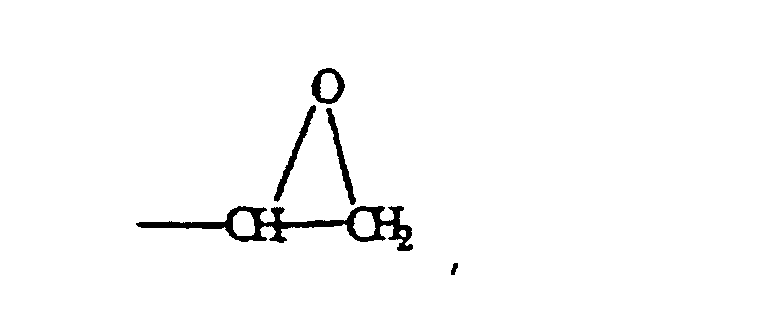 R1 als Substituent am Phenylring für Wasserstoff, Halogen, Alkyl oder Aryl und bevorzugt für C1-C4-Alkyl,R2 für Wasserstoff, Alkyl, Aryl oder eine durch Glycidylether substituierte Arylgruppe und n1 für eine Zahl größer 0 und bevorzugt im Bereich von 0,1 bis 5 steht,(iii) polyfunktionellem Epoxid entsprechend der Strukturwobei
 R für einen gegebenenfalls substituierten aromatischen, aliphatischen oder Aralkylrest,E für einen Epoxidring,Y für ein unter O, N und S ausgewähltes Heteroatom,y für 0 oder 1,p für eine ganze Zahl von 1 bis 6,q für eine ganze Zahl von 2 bis 12 unds für 1 oder 2 steht,(iv) Diglycidylethern entsprechend der Strukturwobei Ra Alkylen oder Arylen und
E für ein Epoxid steht, und(v) auf Bisphenol A basierendem Harz entsprechend der Strukturwobei BisPh für O - Ph - C(Me)2 - Ph - O, ausgewählt ist.E für einen Epoxidring,Me für eine Methylgruppe undn" für einen Wert im Bereich von 0,1 bis 5 steht,
 - Polyesterfaden nach Anspruch 2, bei dem das Expoxidharz mit 0,001 bis 0,5 Gew.-%, bezogen auf Fadengewicht, vorliegt.
- Polyesterfaden nach Anspruch 2 oder 3, bei dem die organische Halogenhydroxyverbindung primäre Halogen- und Hydroxyfunktionalitäten aufweist, wobei ihr Halogenhydrinwert höchstens 1,7% und ihr Epoxidwert höchstens 0,36% beträgt.
- Polyesterfaden nach Anspruch 2, 3 oder 4, bei dem das Epoxidharz unter Polyglycidylethern der Polyole ausgewählt ist.
- Polyesterfaden nach einem der Ansprüche 2 bis 5, bei dem die Gruppe der Polyglycidylether der Polyole Glycerinpolyglycidylether, Sorbitpolyglycidylether und Polyglycerinpolyglycidylether umfaßt.
- Polyesterfaden nach einem der Ansprüche 2 bis 6, bei dem das Epoxidharz unter den Strukturenund
 ausgewählt ist, wobei R für einen gegebenenfalls substituierten aromatischen, aliphatischen oder Aralkylrest,
 steht.E für einen Epoxidring,Y für ein unter O und S ausgewähltes Heteroatom,m für eine ganze Zahl von 1 bis 4,p für eine ganze Zahl von 1 bis 6 undq für eine ganze Zahl von 2 bis 12
 - Polyesterfaden nach Anspruch 7, bei dem das Epoxidharz unter Epoxidphenolnovolak, Epoxidkresolnovolak, Tetraglycidylether des Glyoxylphenolnovolaks, Polybutadienpolyepoxid, Tris(hydroxyphenyl)methanepoxid und mindestens einfach durch Glycidylether substituiertem Aminoepoxid ausgewählt ist, wobei die Epoxidharze jeweils ein Molekulargewicht von 300 bis 5000 aufweisen.
- Polyesterfaden nach Anspruch 7 oder 8, bei dem das Epoxidharz 2 bis 4 endständige Aminoepoxidgruppen aufweist und für R ein an den N-Positionen mit Glycidylgruppen vollsubstituiertes aromatisches Amin steht.
- Polyesterfaden nach einem der Ansprüche 1 bis 9, bei dem die Beschichtung kein Härtungsmittel enthält.
- Verfahren zur Modifizierung der Oberfläche eines Polyesterspinnfadens, bei dem man den Faden mit einem Umsetzungsprodukt aus einer organischen Halogenhydroxyverbindung und einem Salz einer schwachen Säure beschichtet, verstreckt, thermofixiert und mit einem mindestens zwei Epoxidgruppen aufweisenden Polyepoxid beschichtet.
- Verfahren nach Anspruch 11, bei dem man mit dem Polyepoxid bei einer Temperatur von 20°C bis 100°C beschichtet.
- Verfahren nach Anspruch 11 oder 12, bei dem das Polyepoxid mit 0,001 bis 1,0 Gew.-%, bezogen auf Fadengewicht, vorliegt und einer Struktur aus der Reihewobei BisPh für O - Ph - C(Me)2 - Ph - O,(i) Polyglycidylether mit drei oder mehr Glycidylethergruppen aus einem Polyol mit 3 bis 15 Kohlenstoffatomen oder einem Polyphenyol mit 2 bis 20 wiederkehrenden Einheiten,(ii) Epoxidnovolakharz entsprechend der Strukturwobei
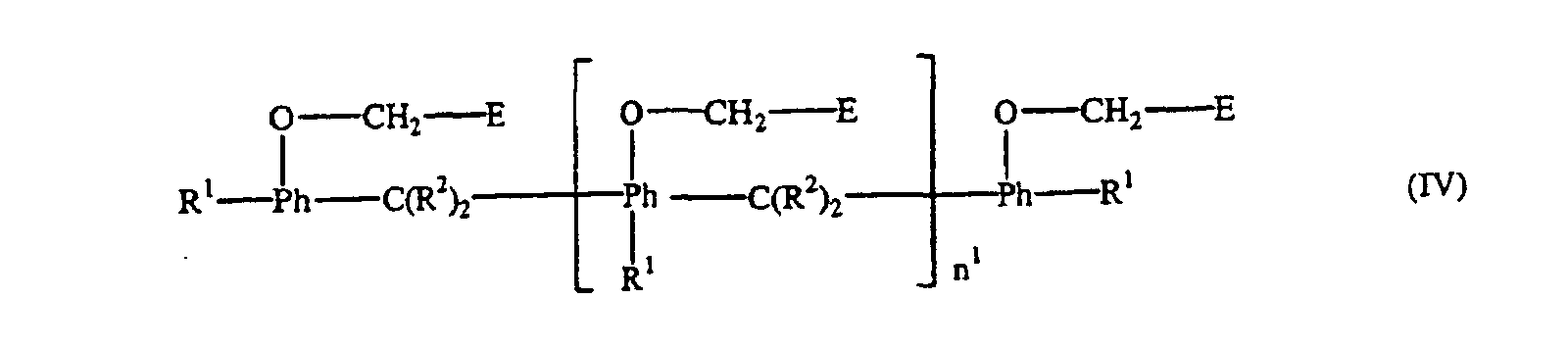 Ph für einen Phenylring undE für einen Epoxidring
 R1 als Substituent am Phenylring für Wasserstoff, Halogen, Alkyl oder Aryl und bevorzugt für C1-C4-Alkyl,R2 für Wasserstoff, Alkyl, Aryl oder eine durch Glycidylether substituierte Arylgruppe und n1 für eine Zahl größer 0 und bevorzugt im Bereich von 0,1 bis 5 steht,(iii) polyfunktionelles Epoxid entsprechend der Strukturwobei
 R für einen gegebenenfalls substituierten aromatischen, aliphatischen oder Aralkylrest,E für einen Epoxidring,Y für ein unter O, N und S ausgewähltes Heteroatom,y für 0 oder 1,p für eine ganze Zahl von 1 bis 6,q für eine ganze Zahl von 2 bis 12 unds für 1 oder 2 steht,(iv) Diglycidylether entsprechend der Strukturwobei Ra Alkylen oder Arylen und
E für ein Epoxid steht, und(v) auf Bisphenol A basierendes Harz entsprechend der Struktur entspricht.E für einen Epoxidring,Me für eine Methylgruppe undn" für einen Wert im Bereich von 0,1 bis etwa 5 steht,
 - Verfahren nach Anspruch 11, 12 oder 13, bei dem man mit dem Polyepoxid unter Zusatz eines im Bereich von 38°C bis 200°C nichtflüchtigen Lösungsmittels beschichtet.
- Verfahren nach einem der Ansprüche 11 bis 14, bei dem sich das Polyepoxid in einem von reaktiven OH-Gruppen freien flüssigen organischen Lösungsmittel mit mindestens 10 Gew.-% löst, bezogen auf die Lösung.
- Verfahren nach einem der Ansprüche 11 bis 15, bei dem das Polyepoxid als wäßrige Dispersion feiner, weniger als 2 Mikron kleiner Teilchen in der Beschichtung vorliegt.
- Verbundkörper, enthaltend: einen beschichteten Polyesterfaden in einem Gummierzeugnis, wobei der beschichtete Polyesterfaden eine erste Beschichtung aus einem Umsetzungsprodukt aus einer Halogenhydroxyverbindung und einem Salz einer schwachen Säure, eine auf der ersten Beschichtung aufgetragene zweite Beschichtung aus einem Epoxidharz mit mindestens zwei Epoxidgruppen in einer Menge von 0,001 bis 1,0 Gew.-%, bezogen auf das Fadengewicht, und eine auf der zweiten Beschichtung aufgebrachte dritte Beschichtung aus einem ausgehärteten Resorcin-Formaldehyd-Latex-Dip (RFL) aufweist.
- Verbundkörper nach Anspruch 17, bei dem das Epoxidharz unterwobei BisPh für O - Ph - C(Me)2 - Ph - O,(i) Polyglycidylethern mit drei oder mehr Glycidylethergruppen aus einem Polyol mit 3 bis 15 Kohlenstoffatomen oder einem Polyphenyol mit 2 bis 20 wiederkehrenden Einheiten,(ii) Epoxidnovolakharz entsprechend der Strukturwobei
 Ph für einen Phenylring undE für einen Epoxidring
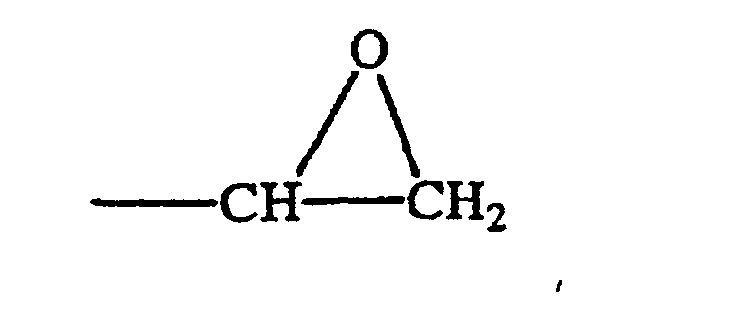 R1 als Substituent am Phenylring für Wasserstoff, Halogen, Alkyl oder Aryl und bevorzugt für C1-C4-Alkyl,R2 für Wasserstoff, Alkyl, Aryl oder eine durch Glycidylether substituierte Arylgruppe und n1 für eine Zahl größer 0 und bevorzugt im Bereich von 0,1 bis 5 steht,(iii) polyfunktionellen Epoxid entsprechend der Strukturwobei
 R für einen gegebenenfalls substituierten aromatischen, aliphatischen oder Aralkylrest,E für einen Epoxidring,Y für ein unter O, N und S ausgewähltes Heteroatom,y für 0 oder 1,p für eine ganze Zahl von 1 bis 6,q für eine ganze Zahl von 2 bis 12 unds für 1 oder 2 steht,(iv) Diglycidylethern entsprechend der Strukturwobei Ra Alkylen oder Arylen und
E für ein Epoxid steht, und(v) auf Bisphenol A basierenden Harz entsprechend der Struktur ausgewählt ist.E für einen Epoxidring,Me für eine Methylgruppe undn" für einen Wert im Bereich von 0,1 bis etwa 5 steht,
 - Verbundkörper nach Anspruch 17, bei dem das Epoxidharz unter den Strukturenund
 ausgewählt ist, wobei R für einen gegebenenfalls substituierten aromatischen, aliphatischen oder Aralkylrest,
 E für einen Epoxidring,Y für ein unter O und S ausgewähltes Heteroatom,m für eine ganze Zahl von 1 bis 4,p für eine ganze Zahl von 1 bis 6 undq für eine ganze Zahl von 2 bis 12 steht.
 - Verbundkörper nach Anspruch 19, bei dem das Epoxidharz unter Epoxidphenolnovolak, Epoxidkresolnovolak, Tetraglycidylether des Glyoxylphenolnovolaks, Polybutadienpolyepoxid, Tris(hydroxyphenyl)methanepoxid und mindestens einfach durch Glycidylether substituiertem Aminoepoxid ausgewählt ist, wobei die Epoxidharze jeweils ein Molekulargewicht von 300 bis 5000 aufweisen.
- Verbundkörper nach Anspruch 19 oder 20, bei dem das Epoxidharz 2 bis 4 endständigen Aminoepoxidgruppen aufweist und für R ein an den N-Positionen mit Glycidylgruppen vollsubstituiertes aromatisches Amin steht.
- Verbundkörper nach einem der Ansprüche 18 bis 21, bei dem die organische Halogenhydroxyverbindung primäre Halogen- und Hydroxyfunktionalitäten aufweist, wobei ihr Halogenhydrinwert höchstens 1,7% und ihr Epoxidwert höchstens 0,36% beträgt.
- Verbundkörper nach einem der Ansprüche 18 bis 22, bei dem die Gruppe der Polyglycidylether von Polyester Glycerinpolyglycidylether, Sorbitpolyglycidylether und Polyglycerinpolyglycidylether umfaßt.
- Verbundkörper nach einem der Ansprüche 17 bis 23, bei dem die Beschichtung kein Härtungsmittel enthält.
- Reifen mit einem beschichteten Polyesterfaden in einem Gummireifen, wobei der beschichtete Polyesterfaden eine erste Beschichtung aus einem Umsetzungsprodukt aus einer Halogenhydroxyverbindung und einem Salz einer schwachen Säure, eine auf der ersten Beschichtung aufgetragene zweite Beschichtung aus einem Epoxidharz mit mindestens zwei Epoxidgruppen in einer Menge von 0,001 bis 1,0 Gew.-%, bezogen auf das Fadengewicht, und eine auf der zweiten Beschichtung aufgebrachte dritte Beschichtung aus einem ausgehärteten Resorcin-Formaldehyd-Latex-Dip (RFL) aufweist.
Applications Claiming Priority (2)
| Application Number | Priority Date | Filing Date | Title |
|---|---|---|---|
| US708330 | 1991-05-31 | ||
| US70833000A | 2000-11-08 | 2000-11-08 |
Publications (2)
| Publication Number | Publication Date |
|---|---|
| EP1205593A1 EP1205593A1 (de) | 2002-05-15 |
| EP1205593B1 true EP1205593B1 (de) | 2004-01-28 |
Family
ID=24845368
Family Applications (1)
| Application Number | Title | Priority Date | Filing Date |
|---|---|---|---|
| EP20010125439 Expired - Lifetime EP1205593B1 (de) | 2000-11-08 | 2001-11-02 | Mit aufeinanderfolgenden reaktiven Ausrüstungsmitteln beschichtetes Polyestergarn, Verfahren zur Herstellung dieses Garnes, sowie dieses Garn enthaltender Kautschukverbundwerkstoff |
Country Status (3)
| Country | Link |
|---|---|
| EP (1) | EP1205593B1 (de) |
| DE (1) | DE60101884T2 (de) |
| TR (1) | TR200400264T4 (de) |
Cited By (1)
| Publication number | Priority date | Publication date | Assignee | Title |
|---|---|---|---|---|
| RU2496805C2 (ru) * | 2011-10-25 | 2013-10-27 | Общество с ограниченной ответственностью "Научно-производственное предприятие "Ленпенопласт" | Способ получения полимерных композиций с использованием стадии переработки отходов полиэтилентерефталата |
Families Citing this family (3)
| Publication number | Priority date | Publication date | Assignee | Title |
|---|---|---|---|---|
| US20100080992A1 (en) * | 2006-11-07 | 2010-04-01 | Teijin Fibers Limited | Polyester multifilament for resin reinforcement and process for producing the same |
| EP2084322B1 (de) * | 2006-11-18 | 2011-03-30 | Diolen Industrial Fibers B.V. | Verfahren zur herstellung eines multifilamentgarns |
| CN109058613A (zh) * | 2018-06-01 | 2018-12-21 | 公安部上海消防研究所 | 一种高附着力轻便型共挤橡胶水带及制造方法 |
Family Cites Families (4)
| Publication number | Priority date | Publication date | Assignee | Title |
|---|---|---|---|---|
| US4397985A (en) * | 1980-04-04 | 1983-08-09 | Allied Corporation | Polyester yarn finish composition |
| US4348517A (en) * | 1980-12-09 | 1982-09-07 | Allied Chemical Corporation | Process and finish composition for producing adhesive active polyester yarn |
| MX172438B (es) * | 1989-04-28 | 1993-12-16 | Hoechst Celanese Corp | Polimeros organicos que tienen una superficie modificada y procedimiento para su obtencion |
| CA2043056A1 (en) * | 1990-05-25 | 1991-11-26 | Norman S. Anderson | Organic polymers having a modified surface and process therefor |
-
2001
- 2001-11-02 DE DE2001601884 patent/DE60101884T2/de not_active Expired - Fee Related
- 2001-11-02 TR TR2004/00264T patent/TR200400264T4/xx unknown
- 2001-11-02 EP EP20010125439 patent/EP1205593B1/de not_active Expired - Lifetime
Cited By (1)
| Publication number | Priority date | Publication date | Assignee | Title |
|---|---|---|---|---|
| RU2496805C2 (ru) * | 2011-10-25 | 2013-10-27 | Общество с ограниченной ответственностью "Научно-производственное предприятие "Ленпенопласт" | Способ получения полимерных композиций с использованием стадии переработки отходов полиэтилентерефталата |
Also Published As
| Publication number | Publication date |
|---|---|
| DE60101884T2 (de) | 2004-12-30 |
| EP1205593A1 (de) | 2002-05-15 |
| TR200400264T4 (tr) | 2004-03-22 |
| DE60101884D1 (de) | 2004-03-04 |
Similar Documents
| Publication | Publication Date | Title |
|---|---|---|
| KR102324817B1 (ko) | 고무 보강재용 친환경 접착 조성물 및 이를 이용한 고무 보강재의 제조방법 | |
| US4831098A (en) | Antistatic agent | |
| RU2628374C2 (ru) | Сухой волокнистый материал для дальнейшей пропитки смолой | |
| RU2690360C2 (ru) | Композиция проклеивающего средства для волокна, дисперсия проклеивающего средства для волокна, раствор проклеивающего средства для волокна, способ для производства пучков волокон, композитный промежуточный материал и армированный волокном композиционный материал | |
| US4438178A (en) | Adhesive activated polyester fibrous material | |
| US4374031A (en) | Method for manufacturing polyester fibers with good adhesion to rubber | |
| US4477619A (en) | Preparation of fabric for bonding to rubber | |
| US3940544A (en) | Production of polyester yarn | |
| EP1205593A1 (de) | Mit aufeinanderfolgenden reaktiven Ausrüstungsmitteln beschichtetes Polyestergarn, Verfahren zur Herstellung dieses Garnes, sowie dieses Garn enthaltender Kautschukverbundwerkstoff | |
| US4397985A (en) | Polyester yarn finish composition | |
| US5328765A (en) | Organic polymers having a modified surface and process therefor | |
| US5352483A (en) | Preadhered melt spun spin-drawn polyester filaments | |
| US4572863A (en) | Aqueous polyester/epoxy emulsion treatment for yarn, method of preparation and a rubber/cord composite | |
| JP2001316980A (ja) | 繊維の集束用樹脂組成物 | |
| EP0395435B1 (de) | Organische Polymere mit modifizierter Oberfläche und Verfahren dafür | |
| KR101086454B1 (ko) | 접착 조성물 및 상기 조성물로 처리된 고무 보강 섬유 | |
| EP0175587A2 (de) | Verfahren zum Behandeln von chemisch stabilisierten, durch Klebstoff aktivierten Polyestermaterialien, durch dieses Verfahren behandeltes Polyestermaterial und Appreturzusammensetzung | |
| KR20020056669A (ko) | 접착성이 개선된 폴리에스테르 섬유의 제조방법 | |
| US5483010A (en) | Organic polymers having a surface modified with haloester polymers | |
| US5128054A (en) | Adhesive-active polyester yarn | |
| US3375224A (en) | Polyurethane impregnating and bonding resin | |
| EP0458647A2 (de) | Organische Polymere mit modifizierter Oberfläche und Verfahren dafür | |
| KR100501471B1 (ko) | 고무와의 접착성이 개선된 폴리에스테르 섬유및 그 제조방법 | |
| KR100346059B1 (ko) | 폴리에스테르 섬유의 제조방법 | |
| US4387069A (en) | Method of manufacturing polyester fibers with good adhesion to rubber |
Legal Events
| Date | Code | Title | Description |
|---|---|---|---|
| PUAI | Public reference made under article 153(3) epc to a published international application that has entered the european phase |
Free format text: ORIGINAL CODE: 0009012 |
|
| AK | Designated contracting states |
Kind code of ref document: A1 Designated state(s): AT BE CH CY DE DK ES FI FR GB GR IE IT LI LU MC NL PT SE TR |
|
| AX | Request for extension of the european patent |
Free format text: AL;LT;LV;MK;RO;SI |
|
| 17P | Request for examination filed |
Effective date: 20021115 |
|
| AKX | Designation fees paid |
Designated state(s): CH DE FR LI NL TR |
|
| GRAH | Despatch of communication of intention to grant a patent |
Free format text: ORIGINAL CODE: EPIDOS IGRA |
|
| GRAS | Grant fee paid |
Free format text: ORIGINAL CODE: EPIDOSNIGR3 |
|
| GRAA | (expected) grant |
Free format text: ORIGINAL CODE: 0009210 |
|
| AK | Designated contracting states |
Kind code of ref document: B1 Designated state(s): CH DE FR LI NL TR |
|
| REG | Reference to a national code |
Ref country code: CH Ref legal event code: EP |
|
| REG | Reference to a national code |
Ref country code: IE Ref legal event code: FG4D |
|
| REF | Corresponds to: |
Ref document number: 60101884 Country of ref document: DE Date of ref document: 20040304 Kind code of ref document: P |
|
| ET | Fr: translation filed | ||
| PLBE | No opposition filed within time limit |
Free format text: ORIGINAL CODE: 0009261 |
|
| STAA | Information on the status of an ep patent application or granted ep patent |
Free format text: STATUS: NO OPPOSITION FILED WITHIN TIME LIMIT |
|
| 26N | No opposition filed |
Effective date: 20041029 |
|
| REG | Reference to a national code |
Ref country code: CH Ref legal event code: PFA Owner name: INVISTA TECHNOLOGIES S.A.R.L. Free format text: ARTEVA TECHNOLOGIES S.A.R.L.#TALSTRASSE 80#8001 ZUERICH (CH) -TRANSFER TO- INVISTA TECHNOLOGIES S.A.R.L.#TALSTRASSE 80#8001 ZUERICH (CH) |
|
| NLT1 | Nl: modifications of names registered in virtue of documents presented to the patent office pursuant to art. 16 a, paragraph 1 |
Owner name: INVISTA TECHNOLOGIES S.A.R.L. |
|
| REG | Reference to a national code |
Ref country code: FR Ref legal event code: CD |
|
| PGFP | Annual fee paid to national office [announced via postgrant information from national office to epo] |
Ref country code: DE Payment date: 20071025 Year of fee payment: 7 Ref country code: NL Payment date: 20071104 Year of fee payment: 7 |
|
| PGFP | Annual fee paid to national office [announced via postgrant information from national office to epo] |
Ref country code: CH Payment date: 20071029 Year of fee payment: 7 |
|
| PGFP | Annual fee paid to national office [announced via postgrant information from national office to epo] |
Ref country code: FR Payment date: 20071108 Year of fee payment: 7 |
|
| PGFP | Annual fee paid to national office [announced via postgrant information from national office to epo] |
Ref country code: TR Payment date: 20071010 Year of fee payment: 7 |
|
| REG | Reference to a national code |
Ref country code: CH Ref legal event code: PL |
|
| PG25 | Lapsed in a contracting state [announced via postgrant information from national office to epo] |
Ref country code: NL Free format text: LAPSE BECAUSE OF NON-PAYMENT OF DUE FEES Effective date: 20090601 |
|
| NLV4 | Nl: lapsed or anulled due to non-payment of the annual fee |
Effective date: 20090601 |
|
| REG | Reference to a national code |
Ref country code: FR Ref legal event code: ST Effective date: 20090731 |
|
| PG25 | Lapsed in a contracting state [announced via postgrant information from national office to epo] |
Ref country code: DE Free format text: LAPSE BECAUSE OF NON-PAYMENT OF DUE FEES Effective date: 20090603 Ref country code: LI Free format text: LAPSE BECAUSE OF NON-PAYMENT OF DUE FEES Effective date: 20081130 Ref country code: CH Free format text: LAPSE BECAUSE OF NON-PAYMENT OF DUE FEES Effective date: 20081130 |
|
| PG25 | Lapsed in a contracting state [announced via postgrant information from national office to epo] |
Ref country code: TR Free format text: LAPSE BECAUSE OF NON-PAYMENT OF DUE FEES Effective date: 20100928 Ref country code: FR Free format text: LAPSE BECAUSE OF NON-PAYMENT OF DUE FEES Effective date: 20081130 |
|
| PG25 | Lapsed in a contracting state [announced via postgrant information from national office to epo] |
Ref country code: TR Free format text: LAPSE BECAUSE OF NON-PAYMENT OF DUE FEES Effective date: 20081102 |