EP1205698A2 - Ventil, insbesondere Heizkörperventil - Google Patents
Ventil, insbesondere Heizkörperventil Download PDFInfo
- Publication number
- EP1205698A2 EP1205698A2 EP01203473A EP01203473A EP1205698A2 EP 1205698 A2 EP1205698 A2 EP 1205698A2 EP 01203473 A EP01203473 A EP 01203473A EP 01203473 A EP01203473 A EP 01203473A EP 1205698 A2 EP1205698 A2 EP 1205698A2
- Authority
- EP
- European Patent Office
- Prior art keywords
- valve
- valve element
- insert
- seats
- valve seat
- Prior art date
- Legal status (The legal status is an assumption and is not a legal conclusion. Google has not performed a legal analysis and makes no representation as to the accuracy of the status listed.)
- Granted
Links
- 238000007789 sealing Methods 0.000 claims description 16
- 238000005192 partition Methods 0.000 claims description 8
- 238000002347 injection Methods 0.000 claims description 3
- 239000007924 injection Substances 0.000 claims description 3
- XLYOFNOQVPJJNP-UHFFFAOYSA-N water Substances O XLYOFNOQVPJJNP-UHFFFAOYSA-N 0.000 description 18
- 238000010438 heat treatment Methods 0.000 description 4
- 239000012530 fluid Substances 0.000 description 3
- 238000010276 construction Methods 0.000 description 2
- 239000008236 heating water Substances 0.000 description 2
- 238000009434 installation Methods 0.000 description 2
- 239000007788 liquid Substances 0.000 description 2
- 239000011324 bead Substances 0.000 description 1
- 230000000694 effects Effects 0.000 description 1
- 230000002996 emotional effect Effects 0.000 description 1
- 238000001746 injection moulding Methods 0.000 description 1
- 238000003754 machining Methods 0.000 description 1
- 238000004519 manufacturing process Methods 0.000 description 1
- 239000000463 material Substances 0.000 description 1
- 239000002184 metal Substances 0.000 description 1
- 238000000034 method Methods 0.000 description 1
- 238000012797 qualification Methods 0.000 description 1
- 238000000926 separation method Methods 0.000 description 1
- 230000002123 temporal effect Effects 0.000 description 1
- 230000001960 triggered effect Effects 0.000 description 1
Images


Classifications
-
- F—MECHANICAL ENGINEERING; LIGHTING; HEATING; WEAPONS; BLASTING
- F16—ENGINEERING ELEMENTS AND UNITS; GENERAL MEASURES FOR PRODUCING AND MAINTAINING EFFECTIVE FUNCTIONING OF MACHINES OR INSTALLATIONS; THERMAL INSULATION IN GENERAL
- F16K—VALVES; TAPS; COCKS; ACTUATING-FLOATS; DEVICES FOR VENTING OR AERATING
- F16K1/00—Lift valves or globe valves, i.e. cut-off apparatus with closure members having at least a component of their opening and closing motion perpendicular to the closing faces
- F16K1/32—Details
- F16K1/34—Cutting-off parts, e.g. valve members, seats
- F16K1/44—Details of seats or valve members of double-seat valves
Definitions
- the invention relates to a valve, in particular a radiator valve, with a housing that has an inlet port and has an outlet port, wherein in Flow path between these two ports one Shut-off device with a valve element and one Valve seat arrangement is arranged.
- Such a valve designed as a radiator valve is known from WO 99/22282.
- Radiator valves usually have a predefined one Flow direction, in some cases on the outside the housing is marked with an arrow. Often it only results from installation instructions, or corresponding information is completely missing. This flow direction must be observed during assembly in order to To avoid disruptions, which are mainly unpleasant Make noise noticeable. If the valves installed "correctly”, then the water hits (or other heating fluid) through the inlet port flows in through the valve seat on the valve element. If now the valve element on the valve seat is moved to, then finds a gradual one Throttling of the water flowing through instead. at this "correct" mode of operation normally arises no problem.
- valve it looks different if the valve is connected incorrectly will, i.e. the supply line of a heating system is connected to the outlet port. In this case the water flows over the valve element to the valve seat and from there into the inlet connection. If the valve closes, the valve element is closed towards the valve seat emotional. If the gap between the valve element and the valve seat falls below a certain size, the valve element closes abruptly, which also sudden increase in pressure at the outlet connection Has. This increase in pressure manifests itself in a water hammer. The water hammer not only has unpleasant noises result, but can also damage the Cause pipe system. This water hammer can but can also be triggered by another impulse, for example through another valve that suddenly closes or opens, a pump that starts or stops, or other. These causes that are not yet all of which have been completely clarified are particularly critical if the valve is incorrectly installed.
- radiator valves In recent years there has been a risk of incorrect assembly increased by radiator valves. This will be mainly attributed to two causes. For one, can you no longer have the necessary assembly staff Require qualification. On the other hand one occasionally not in older houses or facilities determine more exactly which line to the inflow and which is used to drain the heating water especially if you failed to dismantle, determine the direction of flow.
- the invention has for its object a valve to be able to operate independently of the flow direction.
- valve seat assembly a first valve seat associated with the inlet port is, and a second valve seat, the outlet port is assigned, wherein the valve element interacts simultaneously with both valve seats.
- valve element is always flowing through Water through an opening delimited by a valve seat is flowed to.
- valve element is on the valve seat is closed, there is always one gradual throttling of the free flow cross section.
- the valve element through inflowing heating water onto the valve seat is pushed down. So the water always flows against the side of the valve element that is connected to the Valve seat assembly interacts independently of the connection through which the water flows. It is not necessary that the valve element on both valve seats at exactly the same time as the system comes, although a temporal match is sought should be.
- valve seat is used as an abbreviation used for the state in which the valve element on Valve seat is present.
- both valve seats in the same boundary wall of a valve chamber arranged are in which the valve element perpendicular to the boundary wall is movable.
- This is a relatively simple one Education.
- Both valve seats can be perpendicular to the boundary wall are applied simultaneously, i.e. the openings, which are formed by the valve seats be closed at the same time.
- a complicated one Movement control of the valve element in that both valve seats are acted on simultaneously not mandatory.
- the two valve seats are preferably in one insert arranged. This results in a very simple and inexpensive construction because machining the Housing only required to a relatively small extent is. You have to edit the case that the insert can be used sealingly. Furthermore the case can remain "empty” because all Guide surfaces and walls for the water in use can be trained.
- the insert is preferably formed from a plastic.
- the housing is usually made of metal.
- the use of a plastic has the advantage that the plastic is usually a little more flexible than the material of the housing, so that the tightness is easier to manufacture, for example in that the plastic insert is pressed into the housing. Plastic can also be easily processed and shape with the necessary accuracy.
- Injection molding is a relative simple process to mold plastic parts.
- the two valve seats preferably enclose openings, which are jointly adapted to a circular area. This makes it possible to use a valve element which also has a circular surface shape. You use now this circular surface shape for the largest possible openings so that the valve has sufficient flow capacity Has. The good exploitation need not mean that the total area under the valve element completely from the openings defined by the valve seats is exploited. It is enough if the openings are large enough to provide the desired valve capacity.
- the two valve seats are arranged concentrically to each other. In order to can the area below the valve element on make best use of.
- a partition is the inner Valve seat forms on the valve element facing Rounded face. This leads to the fact that Valve a relatively low noise level Has.
- the rounding is normally in the range of 0.75 to 1 mm, and this measure can also be the thickness the partition defined.
- the ratio of the area which is enclosed by the partition to the surface a ring channel that leads around the outside of the partition depends on the capacity requirements to the valve. Preferably both surfaces be at least approximately the same.
- the valve element preferably has that cooperates with the outer valve seat, one Sealing lip on. With this the power that is needed to complete Closing the valve is necessary, small held.
- the valve chamber can be sealed is before the gap between the valve element and partition is completely closed. This results in high reliability in avoiding water hammer, because regardless of the flow direction always a gradual throttling of the flowing Amount of water.
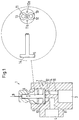
- Fig. 1 shows schematically a radiator valve 1 with a Housing 2, which has an inlet port 3 and a Has outlet port 4.
- the designation inlet connection and outlet connection here becomes only that Purpose chosen, differentiate both connections to be able to. Because of the following Construction does not require water or another heating fluid is actually on the inlet port flows in and flows out at the outlet connection. The Flow can also take place in the opposite direction.
- shut-off device 5 Between the inlet port and the outlet port 4 a shut-off device 5 is arranged, which is a valve element 6, which is movable in a valve chamber 7 in the direction of a double arrow 8.
- the movement of the valve element 6 is from a only schematically shown actuator 9, for example one from a thermostatic valve attachment controlled plunger, controlled.
- actuator 9 for example one from a thermostatic valve attachment controlled plunger, controlled.
- return springs or the like are details such as return springs or the like, not shown.
- the inlet port 3 is via a channel 10 and the Outlet port 4 is via a channel 11 with the valve chamber 7 connected.
- the respective mouths of the channels 10, 11 in the valve chamber 7 are of valve seats 12, 13, surrounded, shown here only schematically are. They can have any known shape, for example ring-shaped beads or simply sealing surfaces, with an end face 14 of the valve element 6 can work together in a sealing manner.
- valve element 6 is so large that it has both valve seats 12, 13 covered. This has several effects Consequence: On the one hand, the valve element 6 is always on it Flow against the end face 14. Any closing movement of the valve element 6 thus takes place against the pressure of the inflowing water. On the other hand, it results in Always include an increasing throttling between the Valve element 6 and both valve seats 12, 13, so that the water flowing through is reliably throttled. Then when the valve element 6 on the two valve seats 12, 13 is present, then the water flowing through it gradually slowed down and came to a standstill, so that there is no sudden pressure surge must be dismantled.
- Fig. 1 also shows an enlarged section of the Valve element and the boundary wall of the valve chamber 7, in which the channels 10, 11 open.
- the channels 10, 11 can further channels (not shown) be provided with the inlet port 3rd or are connected to the outlet port 4, so that the flow cross-section that for the flowing Liquid is available, is enlarged.
- the other channels are also at their mouths Surround valve seats, which are not shown and also simply through the surrounding ones Can be formed flat.
- guide pins 10a, 11a can also be provided for the valve element 6 guide pins 10a, 11a can also be provided.
- valve of FIG. 2 for an angled arrangement is provided while the valve of FIG. 3rd is intended for straight through installation.
- the explanation is therefore mainly based on the Fig. 3, wherein the same parts with the same reference numerals are provided.
- an insert 15 is arranged, which as Injection molded part is formed from plastic.
- the stake is arranged in a bore 16, the present Case runs perpendicular to the inlet port 3. Other Angles are possible.
- the housing 2 is only here shown schematically. Of course, the housing 2 at least one opening through which the insert 15 can be used in the housing 2. This opening can be closed with a lid. The stake 15 can also be attached to the lid.
- the insert 15 has a partition 17, which is in the Cross-section over the entire area of the inlet connection 3 extends.
- the insert 15 has on its bottom a foot 18, which in the embodiment according to FIG. 2 is closed on the side of the inlet port 3, while it is continuous in the embodiment according to FIG. 3 closed is.
- the insert 15 also has one Head 19 on. In the head 19 are a first opening 20 and a second opening 21 arranged by an annular surface 22 are enclosed together, the annular surface 22 cooperates with the valve element 6. Further a web 23 placed on the partition 17 is provided, which also interacts with the valve element 6. The web 23 and the annular surface 22 form two Valve seats that surround the openings 20, 21.
- the insert 15 faces the inlet connection 3 facing side an opening 24 and on the opposite Page an opening 25.
- dashed lines Arrows 26 shown it is when that Valve element 6 is lifted from the head 19, possible that the heating fluid through the opening 24 in the insert 15, through the opening 20 into the valve chamber 7, through the opening 21 re-enters the insert 15 and then insert either through opening 25 or through an opening 26 in the foot 18 in the outlet port 4 transgresses. If the valve is installed "incorrectly", the flow path reversed. In both cases it is ensured that the valve element 6 from the "correct” Flows from the side.
- valve element 6 When the valve is closed, the valve element 6 lowered on the insert 15, whereby the Gap between the valve element 6 on the one hand and the Web 23 or the annular surface 22 on the other hand gradually reduced. Since no additional in the valve chamber 7 Pressure is built up, the valve element 6 can be controlled be moved to the insert 15.
- the insert 15 is arranged diagonally Sealing ring 27 sealed against the housing 2.
- This Sealing ring 27 provides a reliable seal between inlet port 3 and outlet port 4. A Liquid flow is only when the valve element is open 6 possible. Instead of a single diagonally arranged Sealing rings can also use two sealing rings become.
- the channel 10 is surrounded by an annular wall 28 which at its the Valve element 6 facing end face 29 rounded is, the rounding in cross section through a semicircle defined with a diameter of 0.75 to 1 mm can be.
- the ring wall 28 has a comparable one Strength.
- the end face forms a first valve seat.
- the channel 11, which is connected to the outlet port 4 is through an open to the outlet port Ring channel formed which surrounds the ring wall 28.
- the housing 2 points in the boundary wall of the valve chamber 7, in which the two channels 10, 11 open, another Sealing surface 30 on which the valve element 6 for contact is feasible.
- the sealing surface forms a second Valve seat.
- valve element 6 points in the area in which it is connected the sealing surface 30 cooperates, a lip 31, which is deformable to a certain extent. You can do this Design lip 31 so that it is on the sealing surface 30th comes into contact before a central area of the valve element 6 comes to rest on the end face 29. This ensures that when closing in the valve chamber 7 can not build up a higher pressure and after lip 31 has been placed against the sealing surface 30 a further throttling of the gap between the valve element 6 and end face 29 can be done.
- annular wall 28 in one of the housing 2 separately manufactured insert is formed, which is not shown in the present case is.
Landscapes
- Engineering & Computer Science (AREA)
- General Engineering & Computer Science (AREA)
- Mechanical Engineering (AREA)
- Valve Housings (AREA)
- Multiple-Way Valves (AREA)
- Lift Valve (AREA)
- Temperature-Responsive Valves (AREA)
Abstract
Description
- Fig. 1
- eine schematische Darstellung des Prinzips des Ventils,
- Fig. 2
- eine abgewandelte Ausführungsform mit einem Einsatz,
- Fig. 3
- eine Darstellung entsprechend Fig. 2 mit geradem Durchgang,
- Fig. 4
- einen Schnitt IV-IV nach Fig. 3 und
- Fig. 5
- eine weitere Ausführungsform eines Ventils im Querschnitt.
Claims (10)
- Ventil, insbesondere Heizkörperventil, mit einem Gehäuse, das einen Einlaßanschluß und einen Auslaßanschluß aufweist, wobei im Strömungsweg zwischen diesen beiden Anschlüssen eine Absperreinrichtung mit einem Ventilelement und einer Ventilsitzanordnung angeordnet ist, dadurch gekennzeichnet, daß die Ventilsitzanordnung einen ersten Ventilsitz (12; 22, 23; 29), der dem Einlaßanschluß (3) zugeordnet ist, und einen zweiten Ventilsitz (13; 22, 23; 30), der dem Auslaßanschluß (4) zugeordnet ist, aufweist, wobei das Ventilelement (6) gleichzeitig mit beiden Ventilsitzen (12; 13; 22, 23; 29, 30) zusammenwirkt.
- Ventil nach Anspruch 1, dadurch gekennzeichnet, daß beide Ventilsitze (12; 13; 22, 23; 29, 30) in der gleichen Begrenzungswand einer Ventilkammer (7) angeordnet sind, in der das Ventilelement (6) senkrecht zu der Begrenzungswand bewegbar ist.
- Ventil nach Anspruch 1 oder 2, dadurch gekennzeichnet, daß die beiden Ventilsitze (22, 23) in einem Einsatz (15) angeordnet sind.
- Ventil nach Anspruch 3, dadurch gekennzeichnet, daß der Einsatz (15) mit einem diagonal verlaufenden Dichtring (27) gegenüber dem Gehäuse (2) abgedichtet ist.
- Ventil nach Anspruch 3 oder 4, dadurch gekennzeichnet, daß der Einsatz (15) aus einem Kunststoff gebildet ist.
- Ventil nach Anspruch 5, dadurch gekennzeichnet, daß der Einsatz (15) als Spritzgußteil ausgebildet ist.
- Ventil nach einem der Ansprüche 1 bis 6, dadurch gekennzeichnet, daß die beiden Ventilsitze (22, 23; 29, 30) Öffnungen (10, 11) umschließen, die gemeinsam an eine Kreisfläche angepaßt sind.
- Ventil nach Anspruch 7, dadurch gekennzeichnet, daß die beiden Ventilsitze (29, 30) konzentrisch zueinander angeordnet sind.
- Ventil nach Anspruch 8, dadurch gekennzeichnet, daß eine Trennwand (28), die den inneren Ventilsitz bildet, an ihrer dem Ventilelement (6) zugewandten Stirnseite (29) abgerundet ist.
- Ventil nach Anspruch 8 oder 9, dadurch gekennzeichnet, daß das Ventilelement (6) in einem Bereich, der mit dem äußeren Ventilsitz (30) zusammenwirkt, eine Dichtlippe (31) aufweist.
Applications Claiming Priority (2)
| Application Number | Priority Date | Filing Date | Title |
|---|---|---|---|
| DE10055614 | 2000-11-09 | ||
| DE10055614A DE10055614B4 (de) | 2000-11-09 | 2000-11-09 | Ventil,insbesondere Heizkörprventil |
Publications (3)
| Publication Number | Publication Date |
|---|---|
| EP1205698A2 true EP1205698A2 (de) | 2002-05-15 |
| EP1205698A3 EP1205698A3 (de) | 2003-03-12 |
| EP1205698B1 EP1205698B1 (de) | 2005-12-07 |
Family
ID=7662740
Family Applications (1)
| Application Number | Title | Priority Date | Filing Date |
|---|---|---|---|
| EP01203473A Expired - Lifetime EP1205698B1 (de) | 2000-11-09 | 2001-09-14 | Ventil, insbesondere Heizkörperventil |
Country Status (3)
| Country | Link |
|---|---|
| EP (1) | EP1205698B1 (de) |
| AT (1) | ATE312310T1 (de) |
| DE (1) | DE10055614B4 (de) |
Cited By (1)
| Publication number | Priority date | Publication date | Assignee | Title |
|---|---|---|---|---|
| WO2007095952A1 (de) * | 2006-02-24 | 2007-08-30 | Danfoss A/S | Ventil, insbesondere heizkörperventil, und einsatz für ein derartiges ventil |
Families Citing this family (1)
| Publication number | Priority date | Publication date | Assignee | Title |
|---|---|---|---|---|
| DE10230343A1 (de) * | 2002-07-05 | 2004-01-29 | Danfoss A/S | Heizkörperventil |
Citations (1)
| Publication number | Priority date | Publication date | Assignee | Title |
|---|---|---|---|---|
| WO1999022282A1 (en) | 1997-10-23 | 1999-05-06 | Myson Heating Controls Limited | Flow control valves |
Family Cites Families (10)
| Publication number | Priority date | Publication date | Assignee | Title |
|---|---|---|---|---|
| US3257097A (en) * | 1963-05-06 | 1966-06-21 | Grinnell Corp | Diaphragm valve |
| US3477693A (en) * | 1966-12-16 | 1969-11-11 | Perry S Bezanis | Cam operated fluid valve |
| FR1545924A (fr) * | 1967-10-06 | 1968-11-15 | Ferodo Sa | Robinet à plusieurs voies à ouverture progressive |
| BE755469A (fr) * | 1969-08-29 | 1971-02-01 | Hayday Valve And Equipement Cy | Perfectionnements aux soupapes |
| US3720234A (en) * | 1971-02-24 | 1973-03-13 | Dresser Ind | Double seated regulating valve |
| DE2648751C2 (de) * | 1976-10-27 | 1986-04-30 | Max-Planck-Gesellschaft zur Förderung der Wissenschaften e.V., 3400 Göttingen | Vorrichtung für die Zuführung flüssiger oder gasförmiger Substanzen zu einem Verarbeitungsgefäß |
| IE61799B1 (en) * | 1990-02-26 | 1994-11-30 | Branagan Anthony Joseph | Improved control valve |
| US5542444A (en) * | 1994-11-07 | 1996-08-06 | Abbott Laboratories | Valve and method of using |
| DE19647028A1 (de) * | 1996-11-14 | 1998-05-28 | Danfoss As | Heizkörperventil |
| DE19839955C1 (de) * | 1998-09-02 | 2000-06-21 | Danfoss As | Hubventil |
-
2000
- 2000-11-09 DE DE10055614A patent/DE10055614B4/de not_active Expired - Fee Related
-
2001
- 2001-09-14 AT AT01203473T patent/ATE312310T1/de active
- 2001-09-14 EP EP01203473A patent/EP1205698B1/de not_active Expired - Lifetime
Patent Citations (1)
| Publication number | Priority date | Publication date | Assignee | Title |
|---|---|---|---|---|
| WO1999022282A1 (en) | 1997-10-23 | 1999-05-06 | Myson Heating Controls Limited | Flow control valves |
Cited By (5)
| Publication number | Priority date | Publication date | Assignee | Title |
|---|---|---|---|---|
| WO2007095952A1 (de) * | 2006-02-24 | 2007-08-30 | Danfoss A/S | Ventil, insbesondere heizkörperventil, und einsatz für ein derartiges ventil |
| GB2448461A (en) * | 2006-02-24 | 2008-10-15 | Danfoss As | Valve in particular radiator valve and use of a valve of this type |
| RU2392523C1 (ru) * | 2006-02-24 | 2010-06-20 | Данфосс А/С | Клапан, в частности радиаторный клапан, и вставка для такого клапана |
| GB2448461B (en) * | 2006-02-24 | 2010-12-29 | Danfoss As | Valve |
| CN101389890B (zh) * | 2006-02-24 | 2012-07-18 | 丹佛斯公司 | 阀,尤其加热器阀和这种阀的插入件 |
Also Published As
| Publication number | Publication date |
|---|---|
| EP1205698B1 (de) | 2005-12-07 |
| EP1205698A3 (de) | 2003-03-12 |
| DE10055614B4 (de) | 2005-06-02 |
| DE10055614A1 (de) | 2002-06-06 |
| ATE312310T1 (de) | 2005-12-15 |
Similar Documents
| Publication | Publication Date | Title |
|---|---|---|
| EP0271765B1 (de) | Eigenmediumgesteuertes, durch ein vorzugsweise elektromagnetisch betätigtes Steuerventil auslösbares Ventil | |
| DE10029656B4 (de) | Vorrichtung zur Verhinderung von Rückströmungen | |
| EP0122323B1 (de) | Doppelsitzventil mit zwei Ventiltellern | |
| DE102010006376A1 (de) | Strahlregler | |
| DE69217946T2 (de) | Rückführventil | |
| EP1350896A2 (de) | Ventilanordnung für einen Rohrtrenner | |
| DE1450598B1 (de) | Klappenventil | |
| EP1193432B1 (de) | Ventil, insbesondere Heizkörperventil | |
| DE2133422B2 (de) | Mehrstufiges druckreduzierventil | |
| EP0350017B1 (de) | Absperrorgan mit Leckageanzeige | |
| DE2418732A1 (de) | Stromregelventil | |
| EP0112977A1 (de) | Absperrarmatur für aggressive Medien | |
| WO2007095952A1 (de) | Ventil, insbesondere heizkörperventil, und einsatz für ein derartiges ventil | |
| CH572179A5 (en) | Non-return valve with flexible shutter - shutter bears against ported walls of taper insert and held by flange | |
| CH660410A5 (de) | Mehrwege-hahn. | |
| DE102005052385B4 (de) | Druckminderer | |
| EP1205698B1 (de) | Ventil, insbesondere Heizkörperventil | |
| DE2846250A1 (de) | Kombinationsventil | |
| EP1378693B1 (de) | Heizkörperventil | |
| DE19944364A1 (de) | Einbauventil für einen Gliederheizkörper | |
| DE1550453A1 (de) | Geraet zum Mischen unterschiedliche Temperaturen aufweisender Medien | |
| DE102005056212A1 (de) | Ventil zum Steuern eines Fluids | |
| DE3331977A1 (de) | Sitzventil zum steuern des durchflusses eines stroemenden mediums durch ein rohrstueck | |
| DE10048689B4 (de) | Heizkörperventil | |
| EP0634529B1 (de) | Systemtrenner |
Legal Events
| Date | Code | Title | Description |
|---|---|---|---|
| PUAI | Public reference made under article 153(3) epc to a published international application that has entered the european phase |
Free format text: ORIGINAL CODE: 0009012 |
|
| AK | Designated contracting states |
Kind code of ref document: A2 Designated state(s): AT BE CH CY DE DK ES FI FR GB GR IE IT LI LU MC NL PT SE TR |
|
| AX | Request for extension of the european patent |
Free format text: AL;LT;LV;MK;RO;SI |
|
| PUAL | Search report despatched |
Free format text: ORIGINAL CODE: 0009013 |
|
| AK | Designated contracting states |
Kind code of ref document: A3 Designated state(s): AT BE CH CY DE DK ES FI FR GB GR IE IT LI LU MC NL PT SE TR |
|
| AX | Request for extension of the european patent |
Extension state: AL LT LV MK RO SI |
|
| 17P | Request for examination filed |
Effective date: 20030404 |
|
| AKX | Designation fees paid |
Designated state(s): AT DE FR GB IT |
|
| 17Q | First examination report despatched |
Effective date: 20041229 |
|
| GRAP | Despatch of communication of intention to grant a patent |
Free format text: ORIGINAL CODE: EPIDOSNIGR1 |
|
| GRAS | Grant fee paid |
Free format text: ORIGINAL CODE: EPIDOSNIGR3 |
|
| GRAA | (expected) grant |
Free format text: ORIGINAL CODE: 0009210 |
|
| AK | Designated contracting states |
Kind code of ref document: B1 Designated state(s): AT FR GB IT |
|
| PG25 | Lapsed in a contracting state [announced via postgrant information from national office to epo] |
Ref country code: IT Free format text: LAPSE BECAUSE OF FAILURE TO SUBMIT A TRANSLATION OF THE DESCRIPTION OR TO PAY THE FEE WITHIN THE PRESCRIBED TIME-LIMIT;WARNING: LAPSES OF ITALIAN PATENTS WITH EFFECTIVE DATE BEFORE 2007 MAY HAVE OCCURRED AT ANY TIME BEFORE 2007. THE CORRECT EFFECTIVE DATE MAY BE DIFFERENT FROM THE ONE RECORDED. Effective date: 20051207 |
|
| REG | Reference to a national code |
Ref country code: GB Ref legal event code: FG4D Free format text: NOT ENGLISH |
|
| GBT | Gb: translation of ep patent filed (gb section 77(6)(a)/1977) |
Effective date: 20060313 |
|
| ET | Fr: translation filed | ||
| PLBE | No opposition filed within time limit |
Free format text: ORIGINAL CODE: 0009261 |
|
| STAA | Information on the status of an ep patent application or granted ep patent |
Free format text: STATUS: NO OPPOSITION FILED WITHIN TIME LIMIT |
|
| 26N | No opposition filed |
Effective date: 20060908 |
|
| REG | Reference to a national code |
Ref country code: DE Ref legal event code: 8566 |
|
| REG | Reference to a national code |
Ref country code: FR Ref legal event code: PLFP Year of fee payment: 15 |
|
| REG | Reference to a national code |
Ref country code: FR Ref legal event code: PLFP Year of fee payment: 16 |
|
| PGFP | Annual fee paid to national office [announced via postgrant information from national office to epo] |
Ref country code: GB Payment date: 20160914 Year of fee payment: 16 |
|
| PGFP | Annual fee paid to national office [announced via postgrant information from national office to epo] |
Ref country code: AT Payment date: 20160826 Year of fee payment: 16 Ref country code: FR Payment date: 20160816 Year of fee payment: 16 |
|
| REG | Reference to a national code |
Ref country code: AT Ref legal event code: MM01 Ref document number: 312310 Country of ref document: AT Kind code of ref document: T Effective date: 20170914 |
|
| GBPC | Gb: european patent ceased through non-payment of renewal fee |
Effective date: 20170914 |
|
| REG | Reference to a national code |
Ref country code: FR Ref legal event code: ST Effective date: 20180531 |
|
| PG25 | Lapsed in a contracting state [announced via postgrant information from national office to epo] |
Ref country code: GB Free format text: LAPSE BECAUSE OF NON-PAYMENT OF DUE FEES Effective date: 20170914 |
|
| PG25 | Lapsed in a contracting state [announced via postgrant information from national office to epo] |
Ref country code: AT Free format text: LAPSE BECAUSE OF NON-PAYMENT OF DUE FEES Effective date: 20170914 Ref country code: FR Free format text: LAPSE BECAUSE OF NON-PAYMENT OF DUE FEES Effective date: 20171002 |