EP1205841A1 - Procédé pour le développement du logiciel - Google Patents
Procédé pour le développement du logiciel Download PDFInfo
- Publication number
- EP1205841A1 EP1205841A1 EP00650171A EP00650171A EP1205841A1 EP 1205841 A1 EP1205841 A1 EP 1205841A1 EP 00650171 A EP00650171 A EP 00650171A EP 00650171 A EP00650171 A EP 00650171A EP 1205841 A1 EP1205841 A1 EP 1205841A1
- Authority
- EP
- European Patent Office
- Prior art keywords
- collaboration
- action
- refinement
- model
- use cases
- Prior art date
- Legal status (The legal status is an assumption and is not a legal conclusion. Google has not performed a legal analysis and makes no representation as to the accuracy of the status listed.)
- Withdrawn
Links
Images




Classifications
-
- G—PHYSICS
- G06—COMPUTING OR CALCULATING; COUNTING
- G06F—ELECTRIC DIGITAL DATA PROCESSING
- G06F8/00—Arrangements for software engineering
- G06F8/10—Requirements analysis; Specification techniques
Definitions
- the invention relates to development of software.
- the invention is directed towards providing a software development process which addresses these problems.
- a software development method comprising the steps of defining process workflows for use cases and roles, wherein:
- At least some use cases are represented in the meta model as a collaboration linked to actions, in which each action and the collaboration is linked to an associated effect, and the collaboration is a more detailed representation of the actions.
- each effect states both a pre-condition and a post-condition.
- a collaboration is linked to an action by a refinement relationship.
- the refinement relationship states what stage of the project life-cycle the project is at.
- the method uses a predicate justification stating how each clause in an action's pre-condition expression is realised by a clause in a collaboration pre-condition.
- the method uses a diagrammatic justification defining how entities of the action are realised in the refining collaboration.
- a model for a project is generated from the meta model by re-use of parts of the meta model in the asset repository.
- the model is generated by use of an include pattern for inclusion of actions and collaborations of the meta model.
- the model comprises only a reference to a collaboration or action, the actual action or collaboration being stored in the meta model.
- the model is extended by inheriting behaviour of reference types and refinement of included collaborations.
- the meta model models a business context for a business process.
- the method uses a proactive content group that proactively creates re-useable artefacts.
- the comprises the step of mapping requirements to software components for technical mapping.
- the meta model represents use cases at different levels of abstraction and in different contexts.
- the meta model comprises refinement relationships linking views of processes at different levels of detail to provide traceability.
- a refinement relationship links an action to a collaboration, in which a collaboration is a more detailed representation of an action.
- the meta model represents use cases independent of context, and allows a context to be applied without change to a base use case.
- the invention provides a software development system comprising means for defining process workflows for use cases and roles in a method as defined above.
- the invention provides a software development process which allows iteration, but does so in a well-controlled manner. It is regarded as a significant improvement over the known "Rational Unified Process” (RUP), which requires (a) use cases as a unifying strand through all phases of a project life-cycle, and (b) iterations providing iterative releases.
- ROP Replacement Unified Process
- a use case may, for example, be "Purchase Goods" in a shopping portal.
- a use case may be nothing more than a textual description of functionality, when used correctly it is a very effective tool for "fencing in” the project scope and allows for excellent segmentation of deliverables within the project plan.
- use cases define a set of requirements for a project, allowing a project manager to implement change control in a well-defined and transparent way. Thus if a customer decides to change direction during a project then there is a verifiable "audit trail" of easily understood use cases that allow the changes to be quantified for planning purposes.
- a problem with the RUP approach is that iterations are difficult to control in many projects.
- this is overcome by defining work-flows which collectively describe the project life-cycle.
- Each workflow corresponds to a set of activities, the outputs (artefacts) of which are verifiable and facilitate a clear progression within the project life-cycle. At the end of a work-flow all outputs are clearly defined and verifiable.
- Each workflow has a predecessor and a successor, with the exception of the first (Account Planning) and last (Release).
- Each iteration corresponds to a set of completed functional groups, a functional group comprising one or more related use cases.
- a major work-flow is a design/construction workflow and iterations are confined to this work flow only. Thus, iterations are controlled and may be run in parallel, sequentially, or a hybrid of both depending on the inter-dependencies between functional groups themselves and between the functional groups and shared packages. The project manager and senior technical people decide on the dependencies.
- the invention also provides an asset repository, in which an asset is a reusable artefact developed during the project life-cycle.
- the asset repository comprises a metamodel and content.
- Content is knowledge related to the delivery of systems and is embodied in reusable artefacts.
- the metamodel is a schema for storage of the content.
- traceability The problem of demonstrating that certain software components actually deliver on their requirements is referred to as "traceability".
- Procure Goods a highly abstract representation of a procurement process
- Order Goods a representation of one of the sub-actions of the Procure Goods use case.
- Use Case 2 Order Goods (expansion of step 1 in use case 1)
- Refinement is the linking of two views of a business process, where one view is a more detailed representation of the other. Noting that progressing through the stages of a software life-cycle essentially boils down to adding detail, it becomes clear that refinement is the means by which the project manager can trace from requirements to code.
- the diagram of Fig. 1 shows how the two use cases can be represented using an object diagram.
- Use case 1 is represented by the Collaboration "Procure Goods”. It contains three Actions - "Order Goods", "Fulfill Order” and "Make Payment”. These actions represent the steps in the "Main Success Scenario" of the use case.
- the traceability link is modelled using the refinement relationship. It links an Action to a Collaboration, with the meaning that the Collaboration is a more detailed representation of the Action. Applying this relationship repeatedly allows one to navigate any depth of abstraction, including from business process models to software code.
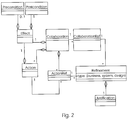
- This mechanism is generalised in the representative implementation illustrated in Fig. 2, illustrating the section of the metamodel which enables refinement.
- the Collaboration is a representation of a business process (use case) at some level of abstraction. It has a single Effect, which is an optional Pre-condition and a required Post-condition. The Effect defines the changes the business process has on business entities.
- a Collaboration consists of a number of actions that represent the steps in the business process. Each Action also has an Effect that describes what changes it causes in business entities.
- Actions and Collaborations are very similar - they both define changes in business entities.
- Collaborations describe the steps involved in the changes and Actions do not.
- Actions are abstract representations of Collaborations (or alternatively Collaborations are Actions that "expose their innards").
- Actions are abstract representations of Collaborations, it is a relatively simple step to formally represent this relationship. This is achieved via the Refinement type. It links an Action (via the ActionRef type) and a Collaboration and has the semantic that the Collaboration is a more detailed view of the Action.
- the Refinement type has an attribute called "type", which states what stage of the project life-cycle that the associated Collaboration is at (business analysis, system analysis, or design for example).
- an Action and a Collaboration can be associated via Refinement, and the semantic of the association is that the Collaboration is a more detailed view of the Action.
- the Collaboration has exactly the same Effect as the Action, but is modelled at a greater level of detail. This is what enables the traceability from business to code. Every refining Collaboration has to be a plug-in replacement for its abstract Action. This requirement is so important in fact that it needs to be enforced. This is achieved by the Justification type, described below.
- Manage detail during Business Analysis - a refinement object of type "business" linking an Action and a Collaboration states that the Collaboration is a more detailed view of the Action but that both Action and Collaboration express Business Analysis level detail.
- Bridge Business Analysis and Systems Analysis - a refinement object of type "system" linking an Action at Business Analysis level to a Collaboration states that the Collaboration is a System Analysis level representation of the Action.
- Manage detail during System Analysis - a refinement object of type "system" linking an Action at System Analysis level and a Collaboration states that the Collaboration is a more detailed view of the Action but that both Action and Collaboration express System Analysis level detail.
- Bridge System Analysis and Design - a refinement object of type "design" linking an Action at System Analysis level to a Collaboration states that the Collaboration is a Design level representation of the Action.
- Refinement is also used to trace into code, but that is treated as a separate pattern.
- the goal of a life-cycle is regarded as a process by which business requirements are continuously and traceably refined to a more software-like form until they actually are software.
- This interpretation allows one to combine the notions of process and reusable assets in a very interesting and powerful way: any given reusable asset can be a more software-like representation of another reusable asset and as such represents a step along the software lifecycle.
- Enabling reuse across the life-cycle makes use of two mechanisms: refinement to provide traceability through the lifecycle (as described above) and the asset repository ("e-nome” or "Enome”).
- the e-nomeTM is a repository of reusable content that spans the software lifecycle. It includes business models that are refined into system models that are refined into design models that are refined into software components. Every element in the e-nomeTM is made as generic as possible so it can be included in many customer-specific models.
- a user can nominate elements from the e-nomeTM for inclusion in his project. He can also extend the content he has included from the e-nomeTM. This mechanism is known as the "Include and Extend Pattern”.
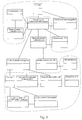
- the diagram of Fig. 3 helps to illustrate. At the top of this diagram is an Enome that contains a single Collaboration Package "Procurement”. That package contains two collaborations: “Procure Goods” and "Make Payment”. "Procure Goods" is the reusable Collaboration mentioned in the example above. There is a model towards the bottom of the diagram. A model represents a project for a particular customer. This particular model needs to reference the reusable "Procure Goods" Collaboration in the Enome. It does so by first of all including a reference to the package that contains the reusable collaboration.
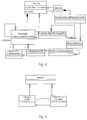
- FIG. 4 shows the section of the metamodel that enables the "Include and Extend Pattern".
- the include and extend pattern is best explained by looking at the mechanism of inclusion and extension separately.
- Any content that has to be included in a model from an e-nome is represented by two types. One is the content itself, the other is a reference to the content (in terms of Fig. 4, the content is represented by the type called “CollaborationPackage” and the reference type is “CollaborationPackageRef”). References inherit from real types-they are the real types and more. The "more” bit is that they may refer to a real type and delegate to it while still retaining the ability to act exactly like the real type.
- a CollaborationPackageRef will refer to a single CollaborationPackage. However, it can also contain Collaborations, as if it was the real type itself.
- Real content is always navigated to via the reference types. This enables one to ignore where real content is located - the real content might share the same parent as the reference type, or it might be in some totally different parent. So inclusion is supported.
- the only question left to be answered is where to locate the real content.
- the rule here is to always locate it where it is first created.
- the real collaboration "Procure Goods” is located in the "Procurement” package in the Enome. This is because the Enome editor first created that collaboration in the content of that package.
- the CollaborationPackage "Customer Specific” is located in the Model, because this is where the Model builder first created it. Therefore, inclusion is supported using the pattern shown in Fig. 5.
- the types that represent real content are known as "Real” and the types that refer to content are known as "Reference”.
- ModelCollaborationRef is a special case of a reference type. It inherits from a Reference type and defines new behaviour to achieve extension. In this case it adds a PhaseInstance object. So this is the rule for extension of included content: create a type that inherits from the relevant Reference type and define the extending behaviour. Such extending types are known as "ExtendingReferences.” So, extension is supported using the pattern illustrated in Fig. 6:
- a business model uses business processes and entities in numerous contexts.
- the business process "Make Payment" may be used in a business model to pay for received goods, issue a refund or award a prize.
- the process is used in, its effect is still the same: money passes from payer to payee. So, the problem is how to realise this reuse opportunity.
- ActionRef may refer to an Action that is contained by its parent Collaboration or it may refer to an Action that is contained in some other Collaboration.
- ActionRef may refer to an Action that is contained by its parent Collaboration or it may refer to an Action that is contained in some other Collaboration.
- the question then is where to locate Actions.
- the rule is that Actions are always placed in the Collaboration in which they are created and referred to via an ActionRef.
- the Collaboration is a business process that has a purpose in a given business. This purpose is represented using a BusinessDesc object.
- the Collaboration describes the steps involved in the business process it represents by referring, via ActionRef objects, to any number of Action objects that describes a discrete change of state in a number of business entities. The sum of these changes of state realise the Collaboration change of state (Effect). However, every ActionRef adds a business reason for the Action that it refers to.
- Fig. 8 shows one Collaboration "Procure Goods" that contains an Action called "Make Payment”. That Action is used for the business reason of paying a supplier for goods received. There is a second Collaboration "Make Refund” that also uses the "Make Payment" action in the first Collaboration. But this second Collaboration uses it for a different business reason: to refund a customer for substandard services.
- the invention provides for Sharing of Actions - in the e-nomeTM, in models and between the e-nomeTM and models.
- the invention provides a division, called the Content Group, that proactively creates reusable artifacts for given businesses and disseminates them through the e-nomeTM.
- the Content Group can be instructed to create assets in selected businesses. The group will actively pursue that task while the sales force is winning business.
- the Content Group will create new assets and may re-factor existing assets to make them more suitable for the given business domain. When a contract is won and a project becomes live, project team members can leverage the assets that the Content Group has already generated.
- the invention provides for proactive reuse - proactively generating high quality models for business domains that are strategic.
- the invention achieves Technology Mapping - by leveraging the mechanism of refinement, business requirements can be associated with the technologies that implement them.
- the refinement mechanism realises traceability, as described above. It enables association of an Action and a Collaboration, with the semantic that the Collaboration is a more detailed representation of the Action, and as such represents a step along the software life-cycle. But how does one prove that this statement is correct? Therefore, it is important to apply rigor to the refinement relationship such that the refining Collaboration is demonstrably equivalent to the abstract Action.
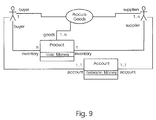
- the invention addresses this problem as described with reference to Fig. 9.
- the post-condition is that the buyer owns the Goods and the Supplier has been paid for them. This is equivalent to a more detailed Collaboration illustrated in Fig. 10.
- the post-condition is that the Buying Company owns the Goods and the Supplying Company has been paid for them.
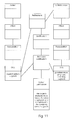
- Fig. 11 a Predicate Justification diagram is shown.
- Predicates based on Object Constraint Language (OCL) can be justified using Predicate Justifications.
- OCL Object Constraint Language
- the snapshot diagram for this case is illustrated in Fig. 11.
- the Predicate Justification links two predicates and explains verbally how they are equivalent.
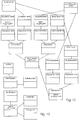
- a Verbal Justification is a series of paragraphs of text that explain in English how the entities in the abstract Action involved in a refinement are realised in the refining Collaboration.
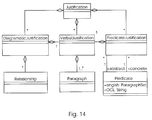
- the snapshot diagram of Fig. 13 illustrates this, and the diagram of Fig. 14 shows the section of the metamodel that enables justification.
- a Justification consists of any number of DiagrammaticJustification's, VerbalJustifications and PredicateJustifications.
- the invention applies rigor to traceability - by requiring that refinements are justified, the justification processes forces the developer to think about and make explicit the relationships between abstract Actions and refining Collaborations. Additionally, the presence of this information guides the reader through the levels of abstraction and makes traceability explicit.
Landscapes
- Engineering & Computer Science (AREA)
- General Engineering & Computer Science (AREA)
- Theoretical Computer Science (AREA)
- Software Systems (AREA)
- Physics & Mathematics (AREA)
- General Physics & Mathematics (AREA)
- Management, Administration, Business Operations System, And Electronic Commerce (AREA)
- Stored Programmes (AREA)
- Debugging And Monitoring (AREA)
Priority Applications (5)
| Application Number | Priority Date | Filing Date | Title |
|---|---|---|---|
| EP00650171A EP1205841A1 (fr) | 2000-10-26 | 2000-10-26 | Procédé pour le développement du logiciel |
| EP01978630A EP1402345A2 (fr) | 2000-10-26 | 2001-10-26 | Developpement de logiciel |
| US10/415,466 US8051404B2 (en) | 2000-10-26 | 2001-10-26 | Software development |
| AU2002210726A AU2002210726A1 (en) | 2000-10-26 | 2001-10-26 | Software development |
| PCT/GB2001/004772 WO2002035342A2 (fr) | 2000-10-26 | 2001-10-26 | Developpement de logiciel |
Applications Claiming Priority (1)
| Application Number | Priority Date | Filing Date | Title |
|---|---|---|---|
| EP00650171A EP1205841A1 (fr) | 2000-10-26 | 2000-10-26 | Procédé pour le développement du logiciel |
Publications (1)
| Publication Number | Publication Date |
|---|---|
| EP1205841A1 true EP1205841A1 (fr) | 2002-05-15 |
Family
ID=8174478
Family Applications (2)
| Application Number | Title | Priority Date | Filing Date |
|---|---|---|---|
| EP00650171A Withdrawn EP1205841A1 (fr) | 2000-10-26 | 2000-10-26 | Procédé pour le développement du logiciel |
| EP01978630A Withdrawn EP1402345A2 (fr) | 2000-10-26 | 2001-10-26 | Developpement de logiciel |
Family Applications After (1)
| Application Number | Title | Priority Date | Filing Date |
|---|---|---|---|
| EP01978630A Withdrawn EP1402345A2 (fr) | 2000-10-26 | 2001-10-26 | Developpement de logiciel |
Country Status (4)
| Country | Link |
|---|---|
| US (1) | US8051404B2 (fr) |
| EP (2) | EP1205841A1 (fr) |
| AU (1) | AU2002210726A1 (fr) |
| WO (1) | WO2002035342A2 (fr) |
Cited By (1)
| Publication number | Priority date | Publication date | Assignee | Title |
|---|---|---|---|---|
| WO2012106810A1 (fr) * | 2011-02-11 | 2012-08-16 | Blueprint Software Systems Inc. | Appareil et procédé de simulation multi aspects |
Families Citing this family (20)
| Publication number | Priority date | Publication date | Assignee | Title |
|---|---|---|---|---|
| US7134113B2 (en) * | 2002-11-04 | 2006-11-07 | International Business Machines Corporation | Method and system for generating an optimized suite of test cases |
| FR2864285A1 (fr) * | 2003-12-19 | 2005-06-24 | Thales Sa | Procede de remontee automatique des exigences de modeles uml et de leur mise a jour |
| EP1674957A1 (fr) * | 2004-12-21 | 2006-06-28 | Siemens Aktiengesellschaft | Ingénerie distribuée, basée sur des règles |
| EP1677187A1 (fr) * | 2004-12-31 | 2006-07-05 | Anna Rita Laurenzi | Procédé de développement de logiciels |
| US20060178858A1 (en) * | 2005-02-07 | 2006-08-10 | Microsoft Corporation | Baseline architecture monitor application for distributed systems |
| US20060230382A1 (en) * | 2005-04-12 | 2006-10-12 | Moulckers Ingrid M | System and method for managing a reusable set of business solution components |
| US8887130B2 (en) * | 2006-06-16 | 2014-11-11 | Sony Corporation | Software design and development in a service oriented environment |
| US8555247B2 (en) * | 2006-10-13 | 2013-10-08 | International Business Machines Corporation | Systems and methods for expressing temporal relationships spanning lifecycle representations |
| US8010938B2 (en) * | 2006-11-27 | 2011-08-30 | International Business Machines Corporation | Computer method and system for pattern specification using meta-model of a target domain |
| US8191044B1 (en) * | 2006-12-14 | 2012-05-29 | Fannie Mae | System and method for maintaining requirements traceability |
| US20080270196A1 (en) * | 2007-04-24 | 2008-10-30 | Seiki Yaegashi | Transforming A Usecase Scenario To Its Process Model |
| US20090100406A1 (en) * | 2007-10-16 | 2009-04-16 | Microsoft Corporation | Software factory specification and execution model |
| US20100269089A1 (en) * | 2009-04-21 | 2010-10-21 | Vinod R Panicker | Method and system for generation of reusable design patterns |
| BR112012008833A2 (pt) * | 2009-10-15 | 2015-09-08 | Abbott Lab | imunoglobulinas de dominio variavel duplo e usos das mesmas |
| US8707250B2 (en) * | 2009-12-22 | 2014-04-22 | Board Of Regents, The University Of Texas System | Automation support for domain modeling |
| US8887125B1 (en) * | 2011-04-19 | 2014-11-11 | Misys Ireland Limited | Systems and methods for dynamic artefact substitution |
| US8863099B2 (en) * | 2012-11-05 | 2014-10-14 | International Business Machines Corporation | Compilation and placement of instructions in a memory system |
| US20150254587A1 (en) * | 2014-03-10 | 2015-09-10 | International Business Machines Corporation | Estimates using historical analysis |
| US10120652B2 (en) * | 2017-02-16 | 2018-11-06 | Wipro Limited | System and method for representing software development requirements into standard diagrams |
| US10977156B2 (en) * | 2018-10-10 | 2021-04-13 | International Business Machines Corporation | Linking source code with compliance requirements |
Family Cites Families (12)
| Publication number | Priority date | Publication date | Assignee | Title |
|---|---|---|---|---|
| US5892947A (en) * | 1996-07-01 | 1999-04-06 | Sun Microsystems, Inc. | Test support tool system and method |
| US6415396B1 (en) * | 1999-03-26 | 2002-07-02 | Lucent Technologies Inc. | Automatic generation and maintenance of regression test cases from requirements |
| US6851105B1 (en) * | 1999-10-05 | 2005-02-01 | Borland Software Corporation | Method and system for generating, applying, and defining a pattern |
| US7334216B2 (en) * | 2000-04-04 | 2008-02-19 | Sosy, Inc. | Method and apparatus for automatic generation of information system user interfaces |
| US6647513B1 (en) * | 2000-05-25 | 2003-11-11 | International Business Machines Corporation | Coverage-based test generation for microprocessor verification |
| US6505342B1 (en) * | 2000-05-31 | 2003-01-07 | Siemens Corporate Research, Inc. | System and method for functional testing of distributed, component-based software |
| US20020066074A1 (en) * | 2000-06-05 | 2002-05-30 | Jabri Mohamed I. | Method and system for developing and executing software applications at an abstract design level |
| US6973640B2 (en) * | 2000-10-04 | 2005-12-06 | Bea Systems, Inc. | System and method for computer code generation |
| US20040205703A1 (en) * | 2000-12-28 | 2004-10-14 | Yeda Research And Development Co . , Ltd. , | Playing in scenarios of system behavior |
| US7603332B2 (en) * | 2002-08-06 | 2009-10-13 | Siemens Energy & Automation, Inc. | Devices, systems, and methods for mediated rule-based translation system configuration information |
| TWI262383B (en) * | 2003-01-10 | 2006-09-21 | Univ Nat Cheng Kung | A generic software testing system and method |
| US7430732B2 (en) * | 2003-10-23 | 2008-09-30 | Microsoft Corporation | Design of application programming interfaces (APIs) |
-
2000
- 2000-10-26 EP EP00650171A patent/EP1205841A1/fr not_active Withdrawn
-
2001
- 2001-10-26 WO PCT/GB2001/004772 patent/WO2002035342A2/fr not_active Ceased
- 2001-10-26 AU AU2002210726A patent/AU2002210726A1/en not_active Abandoned
- 2001-10-26 US US10/415,466 patent/US8051404B2/en not_active Expired - Fee Related
- 2001-10-26 EP EP01978630A patent/EP1402345A2/fr not_active Withdrawn
Non-Patent Citations (2)
| Title |
|---|
| BUHR R J A: "USE CASE MAPS AS ARCHITECTURAL ENTITIES FOR COMPLEX SYSTEMS", IEEE TRANSACTIONS ON SOFTWARE ENGINEERING, IEEE INC. NEW YORK, US, vol. 24, no. 12, December 1998 (1998-12-01), pages 1131 - 1155, XP000849867, ISSN: 0098-5589 * |
| SUTCLIFFE A G ET AL: "SUPPORTING SCENARIO-BASED REQUIREMENTS ENGINEERING", IEEE TRANSACTIONS ON SOFTWARE ENGINEERING, IEEE INC. NEW YORK, US, vol. 24, no. 12, December 1998 (1998-12-01), pages 1072 - 1088, XP000849866, ISSN: 0098-5589 * |
Cited By (2)
| Publication number | Priority date | Publication date | Assignee | Title |
|---|---|---|---|---|
| WO2012106810A1 (fr) * | 2011-02-11 | 2012-08-16 | Blueprint Software Systems Inc. | Appareil et procédé de simulation multi aspects |
| US9063761B2 (en) | 2011-02-11 | 2015-06-23 | Blueprint Software Systems Inc. | Apparatus and method for multi-aspect simulation |
Also Published As
| Publication number | Publication date |
|---|---|
| US20050125769A1 (en) | 2005-06-09 |
| WO2002035342A3 (fr) | 2004-01-08 |
| AU2002210726A1 (en) | 2002-05-06 |
| WO2002035342A2 (fr) | 2002-05-02 |
| EP1402345A2 (fr) | 2004-03-31 |
| US8051404B2 (en) | 2011-11-01 |
Similar Documents
| Publication | Publication Date | Title |
|---|---|---|
| EP1205841A1 (fr) | Procédé pour le développement du logiciel | |
| Agarwal et al. | Software engineering and testing | |
| Rosen et al. | Applied SOA: service-oriented architecture and design strategies | |
| US20200294038A1 (en) | System and method for executing transactions on blockchain networks | |
| Von Rosing et al. | Business Process Model and Notation-BPMN. | |
| MacCormack | Product-development practices that work: How Internet companies build software | |
| Erder et al. | Continuous architecture: sustainable architecture in an agile and cloud-centric world | |
| US8370188B2 (en) | Management of work packets in a software factory | |
| US6237020B1 (en) | Task-oriented automatic distribution of software | |
| US8347402B2 (en) | Software development and distribution workflow employing meta-object time stamping | |
| Telang et al. | Comma: A commitment-based business modeling methodology and its empirical evaluation | |
| Kharmoum et al. | A novel automatic transformation method from the business value model to the UML use case diagram | |
| Saleh | Documenting electronic commerce systems and software using the unified modeling language | |
| Avila-García et al. | Using software product lines to manage model families in model-driven engineering | |
| Kerdoudi et al. | Opening web applications for third-party development: a service-oriented solution | |
| Arsanjani | Empowering the business analyst for on demand computing | |
| Kwantes et al. | Towards compliance verification between global and local process models | |
| Zimmermann et al. | Architectural decision models as micro-methodology for service-oriented analysis and design | |
| Strassner et al. | TMF white paper on NGOSS and MDA | |
| Santos et al. | A transformation of business process models into software-executable models using MDA | |
| Abad et al. | i* in practice: Identifying Frequent Problems in its Application | |
| Kraljić et al. | ERP implementation: Requirements engineering for ERP product customization | |
| Zimmermann et al. | The role of architectural decisions in model-driven SOA construction | |
| François et al. | Designing the Organizational Reuse Environment-Enabling Citizen Developers to Reuse Process Automation Artifacts | |
| Pussinen | A survey on software product-line evolution |
Legal Events
| Date | Code | Title | Description |
|---|---|---|---|
| PUAI | Public reference made under article 153(3) epc to a published international application that has entered the european phase |
Free format text: ORIGINAL CODE: 0009012 |
|
| AK | Designated contracting states |
Kind code of ref document: A1 Designated state(s): AT BE CH CY DE DK ES FI FR GB GR IE IT LI LU MC NL PT SE |
|
| AX | Request for extension of the european patent |
Free format text: AL;LT;LV;MK;RO;SI |
|
| RAP1 | Party data changed (applicant data changed or rights of an application transferred) |
Owner name: STEEL TRACE LIMITED |
|
| AKX | Designation fees paid | ||
| STAA | Information on the status of an ep patent application or granted ep patent |
Free format text: STATUS: THE APPLICATION IS DEEMED TO BE WITHDRAWN |
|
| 18D | Application deemed to be withdrawn |
Effective date: 20021116 |