EP1206849B1 - Verfahren zur synchronisation von feststationen in einem mobilen kommunikationssystem - Google Patents
Verfahren zur synchronisation von feststationen in einem mobilen kommunikationssystem Download PDFInfo
- Publication number
- EP1206849B1 EP1206849B1 EP00951751A EP00951751A EP1206849B1 EP 1206849 B1 EP1206849 B1 EP 1206849B1 EP 00951751 A EP00951751 A EP 00951751A EP 00951751 A EP00951751 A EP 00951751A EP 1206849 B1 EP1206849 B1 EP 1206849B1
- Authority
- EP
- European Patent Office
- Prior art keywords
- base station
- synchronisation
- base stations
- random access
- access channel
- Prior art date
- Legal status (The legal status is an assumption and is not a legal conclusion. Google has not performed a legal analysis and makes no representation as to the accuracy of the status listed.)
- Expired - Lifetime
Links
- 238000000034 method Methods 0.000 title claims description 22
- 238000010295 mobile communication Methods 0.000 title description 2
- 230000005540 biological transmission Effects 0.000 claims description 45
- 238000004891 communication Methods 0.000 claims description 9
- FGUUSXIOTUKUDN-IBGZPJMESA-N C1(=CC=CC=C1)N1C2=C(NC([C@H](C1)NC=1OC(=NN=1)C1=CC=CC=C1)=O)C=CC=C2 Chemical compound C1(=CC=CC=C1)N1C2=C(NC([C@H](C1)NC=1OC(=NN=1)C1=CC=CC=C1)=O)C=CC=C2 FGUUSXIOTUKUDN-IBGZPJMESA-N 0.000 claims 1
- 238000013459 approach Methods 0.000 description 5
- 239000011159 matrix material Substances 0.000 description 5
- 238000010586 diagram Methods 0.000 description 4
- 230000007246 mechanism Effects 0.000 description 4
- 230000001360 synchronised effect Effects 0.000 description 4
- 238000005259 measurement Methods 0.000 description 3
- 230000003111 delayed effect Effects 0.000 description 2
- 238000012545 processing Methods 0.000 description 2
- 238000012549 training Methods 0.000 description 2
- 230000008901 benefit Effects 0.000 description 1
- 230000001413 cellular effect Effects 0.000 description 1
- 230000008859 change Effects 0.000 description 1
- 230000000694 effects Effects 0.000 description 1
- 230000030279 gene silencing Effects 0.000 description 1
- 238000010348 incorporation Methods 0.000 description 1
- 230000000737 periodic effect Effects 0.000 description 1
- 230000008439 repair process Effects 0.000 description 1
- 230000003068 static effect Effects 0.000 description 1
- 238000012546 transfer Methods 0.000 description 1
Images

Classifications
-
- H—ELECTRICITY
- H04—ELECTRIC COMMUNICATION TECHNIQUE
- H04W—WIRELESS COMMUNICATION NETWORKS
- H04W64/00—Locating users or terminals or network equipment for network management purposes, e.g. mobility management
-
- G—PHYSICS
- G01—MEASURING; TESTING
- G01S—RADIO DIRECTION-FINDING; RADIO NAVIGATION; DETERMINING DISTANCE OR VELOCITY BY USE OF RADIO WAVES; LOCATING OR PRESENCE-DETECTING BY USE OF THE REFLECTION OR RERADIATION OF RADIO WAVES; ANALOGOUS ARRANGEMENTS USING OTHER WAVES
- G01S5/00—Position-fixing by co-ordinating two or more direction or position line determinations; Position-fixing by co-ordinating two or more distance determinations
- G01S5/02—Position-fixing by co-ordinating two or more direction or position line determinations; Position-fixing by co-ordinating two or more distance determinations using radio waves
-
- H—ELECTRICITY
- H04—ELECTRIC COMMUNICATION TECHNIQUE
- H04B—TRANSMISSION
- H04B7/00—Radio transmission systems, i.e. using radiation field
- H04B7/24—Radio transmission systems, i.e. using radiation field for communication between two or more posts
- H04B7/26—Radio transmission systems, i.e. using radiation field for communication between two or more posts at least one of which is mobile
- H04B7/2662—Arrangements for Wireless System Synchronisation
- H04B7/2671—Arrangements for Wireless Time-Division Multiple Access [TDMA] System Synchronisation
- H04B7/2678—Time synchronisation
- H04B7/2687—Inter base stations synchronisation
- H04B7/2696—Over the air autonomous synchronisation, e.g. by monitoring network activity
-
- H—ELECTRICITY
- H04—ELECTRIC COMMUNICATION TECHNIQUE
- H04J—MULTIPLEX COMMUNICATION
- H04J3/00—Time-division multiplex systems
- H04J3/02—Details
- H04J3/06—Synchronising arrangements
- H04J3/0635—Clock or time synchronisation in a network
- H04J3/0682—Clock or time synchronisation in a network by delay compensation, e.g. by compensation of propagation delay or variations thereof, by ranging
-
- G—PHYSICS
- G01—MEASURING; TESTING
- G01S—RADIO DIRECTION-FINDING; RADIO NAVIGATION; DETERMINING DISTANCE OR VELOCITY BY USE OF RADIO WAVES; LOCATING OR PRESENCE-DETECTING BY USE OF THE REFLECTION OR RERADIATION OF RADIO WAVES; ANALOGOUS ARRANGEMENTS USING OTHER WAVES
- G01S5/00—Position-fixing by co-ordinating two or more direction or position line determinations; Position-fixing by co-ordinating two or more distance determinations
- G01S5/02—Position-fixing by co-ordinating two or more direction or position line determinations; Position-fixing by co-ordinating two or more distance determinations using radio waves
- G01S5/06—Position of source determined by co-ordinating a plurality of position lines defined by path-difference measurements
Definitions
- the present invention relates to improvements in or relating to mobile telecommunications systems and is more particularly concerned with synchronisation of base stations within a telecommunications system.
- Reliable operation in the UTRA TDD mode requires synchronisation between base stations within a compliant telecommunications system.
- the mode also requires the provision of position information for the mobile stations affiliated to each base station. Synchronisation between base stations is also desirable in order to maximise system capacity.
- the synchronisation of base stations must be achieved at the levels of time slots, frames and multi-frames, where a multi-frame is a repeating cycle of a number of frames.
- GPS global positioning system
- the base stations are synchronised over the backhaul network; the network which enables base stations to switch mobile communications into public telephone networks or the internet.
- this mechanism is implemented according to a packet protocol (for example, internet protocol (IP) or asynchronous transfer mode (ATM)), then synchronisation will only be possible to a coarse accuracy.
- IP internet protocol
- ATM asynchronous transfer mode
- a method of providing synchronisation between a plurality of base stations in a telecommunications system for each base station there is a telecommunications cell within which there is at least one mobile station and for each base station the method comprises the steps of: providing at least one channel for usage in the telecommunications cell; a transmission step, wherein said at least one channel is utilised for transmission of a synchronisation signal, the transmission being from a first base station to those remaining base stations within the telecommunications system which are within transmission range; and a first calculation step, in which a time difference between clock pulses from the first base station and clock pulses transmitted by other base stations within transmission range is calculated.
- the method has the further steps: a reporting step, in which each of the plurality of base stations reports the time differences calculated in the time difference calculation step to a radio network controller; a second calculation step, wherein a synchronising adjustment corresponding to each base station is calculated from the reported time differences; and an adjusting step, wherein each base station is individually sent the corresponding synchronising adjustment and the clock of the base station concerned is adjusted accordingly.
- each of the plurality of base stations can act autonomously on the basis of information received from the available remaining base stations to adjust the clock timing of that base station.
- the channel utilised for transmission of the synchronisation signal is preferably a random access channel (RACH) which is transmitted at a frequency within a band of frequencies that is provided for communications with mobile stations.
- the random access channel advantageously comprises a single time slot per TDMA frame. More preferably, the RACH is allocated to transmissions from mobile stations to initiate communications. Preferably, communications are initiated by requesting a resource unit (time slot and CDMA code combination) for uplink usage.
- the method preferably further comprises a scheduling step in which the utilisation of each RACH time slot for base station synchronisation is allocated according to a schedule.
- the method further comprises a silencing step in which a second channel is used by the base station to silence mobile station communications in the RACH time slots to allow the transmission of synchronisation transmissions to other base stations.
- This second channel is most preferably the broadcast control channel (BCCH).
- the UTRA TDD mode is illustrated.
- Information is transmitted in bursts at a certain combination of frequency, time (within a frame 102), and coding.
- Frames 102 are divided into time slots 104 and each time slot is just long enough for a single burst of information.
- Transmission of information is multiplexed through the use of orthogonal codes (CDMA).
- CDMA orthogonal codes
- the information transmitted within a particular time slot is divided according to these codes: as a result, each burst contains a plurality of independent time slot and code combinations, called resource units 106.
- the UTRA TDD mode uses a scheme called Time Division - Code Division Multiple Access (TD-CDMA).
- TD-CDMA Time Division - Code Division Multiple Access
- This scheme provides for a random access channel (RACH) which is a single time slot 104 per TDMA frame 102.
- RACH random access channel
- the RACH is allocated to transmissions from mobile stations to initiate communications, usually by requesting a resource unit 106 for uplink usage.
- each TDMA frame 200 contains a plurality of time slots 210; fifteen time slots in TDD mode, as shown.
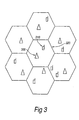
- Figure 3 depicts a typical cellular deployment.
- Each base station 300 has an associated cell 320.
- the range between neighbouring base stations 300 is roughly double the range from any base station to a mobile station 310 at its cell boundary. In an urban deployment, this typically leads to a path loss which is of the order of 12dB greater to the neighbouring base station 300 than to the cell-edge mobile station 310.
- the base station 300 would have a height gain advantage over a mobile station 310 at the same location.
- the base station antennas are typically constructed with a 'down tilt' intended to reduce inter cell interference. These opposing effects are of similar magnitude and will tend to cancel, making the 12dB figure a reasonable estimate for the increase in path loss.
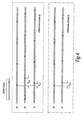
- Figure 4 shows how the time differences, d i,j , between the local base station 'a' and the neighbouring base stations 'b' and 'c' are derived from the synchronisation signals.
- the shaded time slot represents the RACH which can carry synchronisation signals.
- the upper boxed area represents the time differences at base 'a': from top to bottom the lines represent: a) the base station's own signal; b) the delayed signal from base station 'b'; and c) the delayed signal from base station 'c'.
- the lower boxed area represents the time differences at base 'b'. There is no line corresponding to base station 'c' - as would be the case when 'c' was out of range of the signal from 'b'.
- a base station which conforms to the UTRA TDD mode.
- the base station uses the RACH to synchronise with other base stations which are within transmission range.
- the base station is arranged to 'steal' the RACH time slot for transmissions to other base stations at suitable times.
- the times at which a base station should steal a RACH time slot can be determined according to the following criteria:
- the base station When the base station has a schedule assigned for RACH stealing in the near future, at a suitable time it makes a broadcast transmission (preferably on its broadcast control channel, BCCH) to all mobile stations affiliated to the base station, to instruct these mobile stations that the RACH will be unavailable for mobile station transmissions in the forthcoming scheduled stolen RACH time slot. This will clear the stolen RACH time slot for inter cell synchronisation usage.
- BCCH broadcast control channel
- Arranging for the stealing base station to silence mobile stations affiliated to the stealing base station when the RACH is stolen, will prevent unnecessary collisions on the RACH channel.
- the neighbouring base stations will not silence their respective affiliated mobile stations from making RACH transmissions.
- These RACH transmissions will be power controlled and it should be possible for the neighbouring base stations to receive the transmission from the base station stealing the RACH timeslot and to receive any RACH transmissions from their own affiliated mobile stations.
- stolen RACH timeslots are scheduled by the RNC, it is optionally possible to arrange for the neighbouring base stations to silence RACH transmissions from their mobile stations using the same procedure as described for the RACH time slot stealing.
- interference to the synchronisation transmission can be substantially removed, except from distant stations. If this option is not employed then interference to the reception of synchronisation transmission in the RACH timeslot may prevent its reception. However, given the statistics of RACH traffic, a high proportion of such measurements should be received.
- RACH slots are arranged throughout the network of base stations to be allocated to synchronisation at regular fixed intervals. During these allocated RACH slots, none of the mobile stations make RACH transmissions, and it is unnecessary to instruct the mobile stations not to make the RACH transmissions since they are capable of determining such times for themselves. However, the base stations do transmit a simple binary signal periodically to indicate that this mode of operation applies: such a transmission would not be necessary in a network where all base stations had associated GPS receivers. In consequence, during the allocated RACH time slots all base stations are either listening for synchronisation transmissions or making them.
- the subset of base stations making synchronisation transmissions changes from one selected RACH time slot to the next. It is necessary to ensure that the spread of transmissions is such that only one dominant synchronisation signal is received at any given base station in any given selected RACH time slot.
- the planning of these subsets can be performed either manually or automatically according to scheme similar to dynamic channel assignment (DCA).
- bursts are transmitted within time slots and each burst is sub-divided into 2560 chips which are zoned into two data fields, one midamble field and a guard period.
- the midamble field contains training sequences. Because the base stations are static and have accurate frequency references, it is possible to perform correlation across the entire time slot. Correlation makes use of training sequences so the synchronisation burst, with the exception of the guard period, is arranged to have no data fields and effectively becomes all midamble.
- Whole time slot correlation affords a processing gain of about 34dB. This high processing gain serves to compensate for the increased path loss to the neighbouring cells.
- the first and second embodiments of the invention detail methods of gaining access to RACH timeslots. Either embodiment can be implemented according to the distributed or centralised approaches.
- every base station acts autonomously on the basis of the information it has received to adjust its clock timing in such a way that, given that all other base stations operate similarly, they will come into synchronisation.
- each base station measures the timing of each received synchronisation burst relative to its own timing. This can be viewed as the timing of the received burst relative to the time at which it would make its transmission.
- Each base station is provided with a matched filter, matched to the synchronisation code. When a burst.is received, there will usually be several discrete paths. The earliest significant path will be taken to provide the timing since this is most likely to correspond to the line of sight path if there is one. The following discussion relates to the centralised synchronisation procedure, following coarse level synchronisation.
- each base station in the telecommunications system can be synchronised with every other base station.
- synchronisation is important in locating mobile stations.
- initial coarse synchronisation can be achieved in a straightforward manner.
- the base stations When a network is commissioned the base stations may be activated in sequence either by manual intervention or under control of the RNC.
- the first base station to be activated becomes the temporary timing master and makes periodic synchronisation burst transmissions in its RACH channel.
- Other base stations, activated later are only allowed to transmit after they have received a synchronisation burst. In this way the network will become synchronised globally. If an individual base station requires re-synchronisation, following a failure and repair, for example, again that base station is not allowed to transmit until it has received a RACH synchronisation burst from at least one other base station. It may then make its own RACH burst transmission, after making a coarse update to its timing from the initial burst.
- Multi-frame synchronisation can be achieved by a number of means.
- the simplest and preferred method is to make the RACH slot which is 'stolen' for synchronisation always be contained in the first frame or any fixed arbitrary numbered frame within a multi-frame.
Landscapes
- Engineering & Computer Science (AREA)
- Computer Networks & Wireless Communication (AREA)
- Signal Processing (AREA)
- Physics & Mathematics (AREA)
- General Physics & Mathematics (AREA)
- Radar, Positioning & Navigation (AREA)
- Remote Sensing (AREA)
- Mobile Radio Communication Systems (AREA)
- Time-Division Multiplex Systems (AREA)
- Synchronisation In Digital Transmission Systems (AREA)
Claims (10)
- Verfahren zur Herstellung der Synchronität zwischen einer Mehrzahl von Feststationen (300) in einem Telekommunikationssystem, wobei das Telekommunikationssystem eine Mehrzahl von Zellen (320) umfasst, wobei jede dieser Mehrzahl von Zellen eine von der besagten Mehrzahl von Feststationen sowie mindestens eine Mobilstation (310) beinhaltet, und wobei das Verfahren folgende Schritte umfasst:a) Bereitstellen eines Random Access Channel (Direktzugriffkanal), der mit einer Frequenz innerhalb eines Frequenzbandes übertragen wird, das für die Kommunikation mit Mobilstationen zugewiesen ist, wobei der Kanal Zeitschlitze (210) beinhaltet, die in der Mehrzahl von Zellen genutzt werden;b) Übertragen eines Synchronisationssignals in einem gegebenen Zeitschlitz des Random Access Channel, wobei die Übertragung von jeder der Mehrzahl von Feststationen an diejenigen übrigen Feststationen in dem Telekommunikationssystem erfolgt, die sich innerhalb des Sendebereichs der jeweiligen Feststation befinden;c) für jede der betreffenden Feststationen Berechnen der jeweiligen Zeitdifferenzen d a,b , b a,c zwischen den entsprechenden Synchronisationssignalen, die von der jeweiligen Feststation gesendet werden und von anderen Feststationen innerhalb des Sendebereichs der betreffenden Feststation empfangen werden; undd) Justieren des Takts der Synchronisationssignale für die jeweilige Feststation entsprechend den berechneten Zeitdifferenzen.
- Verfahren nach Anspruch 1, wobei der Random Access Channel einen Zeitschlitz pro TDMA-Rahmen umfasst.
- Verfahren nach Anspruch 2, wobei der Random Access Channel für Übertragungen in Aufwärtsrichtung zugewiesen ist, um eine Kommunikation zu veranlassen.
- Verfahren nach Anspruch 3, wobei die Kommunikation dadurch veranlasst wird, dass eine Ressourceneinheit für die Belegung in Aufwärtsrichtung angefordert wird.
- Verfahren nach einem der vorhergehenden Ansprüche, das ferner die folgenden Schritte umfasst:e) für jede der Mehrzahl von Feststationen Melden der in Schritt c) berechneten Zeitdifferenzen an einen Funknetz-Controller;f) Berechnen eines Justagewerts für die Synchronisation, der jeder Feststation entspricht, anhand der gemeldeten Zeitdifferenzen;g) Informieren jeder einzelnen Feststation über den entsprechenden, in Schritt f) berechneten Justagewert für die Synchronisation; undh) Synchronisieren jeder Feststation gemäß dem entsprechenden Justagewert für die Synchronisation.
- Verfahren nach einem der Ansprüche 1-4, das ferner folgenden Schritt umfasst:i) autonomes Handeln jeder der betreffenden Feststationen anhand der in Schritt c) berechneten Zeitdifferenzen, indem sie ihre Synchronisation so justiert, dass die Zeitdifferenzen auf ein Minimum reduziert werden.
- Verfahren nach einem der Ansprüche 2-6, das ferner folgenden Schritt umfasst:j) Zuweisen der Nutzung jedes Zeitschlitzes im Random Access Channel für die Synchronisation der Feststation gemäß einem Plan.
- Verfahren nach einem der Ansprüche 2-6, das ferner folgenden Schritt umfasst:k) Nutzen eines weiteren Kanals zum Unterdrücken der Kommunikation in Aufwärtsrichtung in den Zeitschlitzen des Random Access Channel, um die Übertragung der Synchronisationsübertragungen von der jeweiligen Feststation an die übrigen Feststationen zu ermöglichen.
- Verfahren nach Anspruch 8, wobei der weitere Kanal der Broadcast Control Channel (Steuerkanal) ist.
- Verfahren nach einem der vorhergehenden Ansprüche, wobei der benutzte Zeitschlitz des Random Access Channel immer in einem fest nummerierten Rahmen innerhalb einer Mehrzahl von Mehrfachrahmen enthalten ist, um die Mehrzahl von Feststationen über Mehrfachrahmen zu synchronisieren.
Applications Claiming Priority (5)
| Application Number | Priority Date | Filing Date | Title |
|---|---|---|---|
| GB9919973 | 1999-08-24 | ||
| GBGB9919973.9A GB9919973D0 (en) | 1999-08-24 | 1999-08-24 | Improvements in or relating to mobile telecommunications systems |
| GB0007143A GB2353671B (en) | 1999-08-24 | 2000-03-24 | Improvements in or relating to mobile telecommunications systems |
| GB0007143 | 2000-03-24 | ||
| PCT/GB2000/003111 WO2001015340A1 (en) | 1999-08-24 | 2000-08-11 | Method for synchronizing base stations in a mobile communication system |
Publications (2)
| Publication Number | Publication Date |
|---|---|
| EP1206849A1 EP1206849A1 (de) | 2002-05-22 |
| EP1206849B1 true EP1206849B1 (de) | 2005-11-23 |
Family
ID=26243952
Family Applications (1)
| Application Number | Title | Priority Date | Filing Date |
|---|---|---|---|
| EP00951751A Expired - Lifetime EP1206849B1 (de) | 1999-08-24 | 2000-08-11 | Verfahren zur synchronisation von feststationen in einem mobilen kommunikationssystem |
Country Status (8)
| Country | Link |
|---|---|
| US (1) | US7110781B1 (de) |
| EP (1) | EP1206849B1 (de) |
| JP (1) | JP2003507957A (de) |
| CN (1) | CN1210894C (de) |
| DE (1) | DE60024276D1 (de) |
| ES (1) | ES2250168T3 (de) |
| GB (1) | GB2386801B (de) |
| WO (1) | WO2001015340A1 (de) |
Cited By (1)
| Publication number | Priority date | Publication date | Assignee | Title |
|---|---|---|---|---|
| US11832202B2 (en) | 2018-08-03 | 2023-11-28 | Huawei Technologies Co., Ltd. | Clock state detection method and apparatus |
Families Citing this family (45)
| Publication number | Priority date | Publication date | Assignee | Title |
|---|---|---|---|---|
| US6674787B1 (en) * | 1999-05-19 | 2004-01-06 | Interdigital Technology Corporation | Raising random access channel packet payload |
| DE10125013A1 (de) * | 2001-05-22 | 2002-11-28 | Siemens Ag | Verfahren zur Synchronisation von Basisstationen in einem Funk-Kommunikationssystem |
| US6861982B2 (en) | 2001-08-16 | 2005-03-01 | Itt Manufacturing Enterprises, Inc. | System for determining position of an emitter |
| US7813311B2 (en) * | 2002-02-05 | 2010-10-12 | Interdigital Technology Corporation | Method and apparatus for synchronizing base stations |
| JP3801123B2 (ja) | 2002-09-06 | 2006-07-26 | 株式会社日立製作所 | 無線システムおよびそのサーバーならびにその基地局 |
| GB2396272B (en) * | 2002-12-13 | 2004-11-17 | Motorola Inc | Communication system,communication unit and method for synchronising communication therefor |
| DE10331311B4 (de) * | 2003-07-10 | 2008-02-07 | Siemens Ag | Verfahren zur Synchronisation eines in Funkzellen aufgeteilten Funkkommunikationssystems |
| WO2005107292A1 (en) * | 2004-04-28 | 2005-11-10 | Nortel Networks Limited | Independent scheduling in a wireless network |
| CN100370864C (zh) * | 2004-06-17 | 2008-02-20 | 大唐移动通信设备有限公司 | 移动通信系统中的网元时间同步方法 |
| EP1760942A4 (de) * | 2004-06-25 | 2008-10-08 | Mitsubishi Electric Corp | Verfahren zur zeitsynchronisation zwischen basisstationen, timing-master-einrichtung und basisstation |
| GB2416635A (en) * | 2004-07-23 | 2006-02-01 | Hewlett Packard Development Co | Positioning system |
| CN100421367C (zh) * | 2004-07-26 | 2008-09-24 | 华为技术有限公司 | 一种实现基站同步传输的方法 |
| US8364185B2 (en) * | 2005-04-18 | 2013-01-29 | Samsung Electronics Co., Ltd. | Method and system for synchronizing a clock for an adjacent network to a clock for an overlay network |
| JP2009503992A (ja) * | 2005-07-26 | 2009-01-29 | テレフオンアクチーボラゲット エル エム エリクソン(パブル) | アップリンクおよびダウンリンクにおける到着時間ポジショニングのためのスケジューリング方法 |
| US8169982B2 (en) | 2005-08-10 | 2012-05-01 | Qualcomm Incorporated | Method and apparatus for creating a fingerprint for a wireless network |
| US20070064665A1 (en) * | 2005-08-23 | 2007-03-22 | Interdigital Technology Corporation | Method and apparatus for accessing an uplink random access channel in a single carrier frequency division multiple access system |
| GB0517488D0 (en) * | 2005-08-26 | 2005-10-05 | Univ Bradford | Ad-hoc networking over umts protocol |
| CN101123468B (zh) * | 2006-08-08 | 2011-07-20 | 电信科学技术研究院 | 一种实现基站间空口同步的方法及系统 |
| CN101123465B (zh) * | 2006-08-09 | 2012-07-04 | 上海贝尔阿尔卡特股份有限公司 | 无线通信系统中用于进行网络设备间同步的方法和装置 |
| GB2480191A (en) | 2007-02-02 | 2011-11-09 | Ubiquisys Ltd | Determining the location of a base station |
| CN101039146A (zh) * | 2007-05-15 | 2007-09-19 | 中兴通讯股份有限公司 | 一种无线移动通信系统基站间空口时钟同步的装置和方法 |
| US9137745B2 (en) | 2007-10-12 | 2015-09-15 | Qualcomm Incorporated | System and method to locate femto cells with passive assistance from a macro cellular wireless network |
| US9253653B2 (en) | 2007-11-09 | 2016-02-02 | Qualcomm Incorporated | Access point configuration based on received access point signals |
| ES2444851T3 (es) * | 2008-05-30 | 2014-02-27 | Vodafone Group Plc | Método, sistema y dispositivo para intercambiar paquetes de datos en redes telefónicas celulares de área extendida |
| JP4719252B2 (ja) * | 2008-06-25 | 2011-07-06 | 京セラ株式会社 | 無線通信システム、管理装置および無線通信方法 |
| WO2010000695A1 (en) | 2008-07-01 | 2010-01-07 | Nokia Siemens Networks Oy | Preamble offset for femto base stations |
| EP2154921A1 (de) * | 2008-08-11 | 2010-02-17 | Nokia Siemens Networks OY | Verfahren zum Wechseln des Bereitschaftsmodus einer Basisstation eines drahtlosen Kommunikationsnetzwerks in einen vollständig aktivierten Modus |
| EP2356841A4 (de) * | 2008-11-12 | 2017-02-15 | Nokia Solutions and Networks Oy | Struktur für ota-enb-enb-kommunikation |
| WO2010114442A1 (en) * | 2009-04-01 | 2010-10-07 | Telefonaktiebolaget L M Ericsson (Publ) | Method and arrangement for base station synchronisation |
| CN101888696B (zh) * | 2009-05-15 | 2012-08-15 | 电信科学技术研究院 | 组播单频网中的信道同步方法、系统及设备 |
| US8838096B2 (en) | 2009-05-29 | 2014-09-16 | Qualcomm Incorporated | Non-macro cell search integrated with macro-cellular RF carrier monitoring |
| JP2010283756A (ja) * | 2009-06-08 | 2010-12-16 | Sony Corp | 無線通信装置、通信制御装置、無線通信システム、無線通信方法および通信制御方法 |
| US8737274B2 (en) * | 2009-09-09 | 2014-05-27 | Lg Electronics Inc. | Scheduling method, MS apparatus using the scheduling method, data transmission method, and BS apparatus using the data transmission method in wireless communication system |
| CN101668333B (zh) * | 2009-09-30 | 2012-11-21 | 华为技术有限公司 | 时钟同步方法和基站 |
| CN102026363B (zh) * | 2009-10-14 | 2013-07-10 | 电信科学技术研究院 | 一种分层系统基站内同步的方法及基站 |
| EP2339761B1 (de) * | 2009-12-22 | 2012-07-11 | Mitsubishi Electric R&D Centre Europe B.V. | Verfahren zur Synchronisation von Knoten |
| EP2567583B1 (de) * | 2010-05-06 | 2016-03-09 | Telefonaktiebolaget LM Ericsson (publ) | Verfahren und anordnung in einem drahtlosen kommunikationssystem |
| US8923892B2 (en) | 2010-05-14 | 2014-12-30 | Qualcomm Incorporated | Method and apparatus for updating femtocell proximity information |
| EP2544387B1 (de) * | 2011-07-04 | 2016-03-16 | Mitsubishi Electric R&D Centre Europe B.V. | Verfahren und Vorrichtungen zur Synchronisationsdurchführung und Kompensierung von Taktabweichung unter Kommunikationsvorrichtungen |
| CN102510575B (zh) * | 2011-12-09 | 2014-05-14 | 浙江宏睿通信技术有限公司 | 一种基于tdma的多级中继同步实现方法 |
| CN103313381B (zh) * | 2013-06-06 | 2016-10-26 | 安徽华东光电技术研究所 | 一种无线通信发射基站同步方法 |
| JP5973967B2 (ja) * | 2013-07-19 | 2016-08-23 | 株式会社Nttドコモ | ユーザ装置、基地局、発見信号受信方法、及び発見信号送信方法 |
| WO2015084981A1 (en) * | 2013-12-03 | 2015-06-11 | Red Point Positioning Corporation | Method and system to estimate the location of a receiving device |
| US9867004B2 (en) * | 2015-12-23 | 2018-01-09 | Qualcomm Incorporated | Broadcast time-of-departure (TOD) frame format |
| US12563522B2 (en) * | 2022-08-04 | 2026-02-24 | Nokia Technologies Oy | Positioning a user device |
Family Cites Families (27)
| Publication number | Priority date | Publication date | Assignee | Title |
|---|---|---|---|---|
| US4812852A (en) | 1987-02-20 | 1989-03-14 | Scientific Development Corporation | Locating system and method |
| SE457184B (sv) | 1987-04-03 | 1988-12-05 | Ericsson Telefon Ab L M | Foerfarande och utrustning foer synkronisering och oeverfoering av information i ett radiokommunikationsnaet |
| JP2665497B2 (ja) | 1988-12-19 | 1997-10-22 | 日本電信電話株式会社 | 基地局間同期確立方法 |
| FR2646302B1 (fr) | 1989-04-25 | 1993-01-15 | Matra Communication | Procede de pseudo-synchronisation d'un reseau de communication a multiplexage dans le temps et applications |
| US5293380A (en) | 1989-12-27 | 1994-03-08 | Nec Corporation | Frame synchronization system among multiple radio base stations for TDMA digital mobile communications system |
| FI86236C (fi) | 1990-09-05 | 1992-07-27 | Nokia Mobile Phones Ltd | Tidsanpassningslogik foer mobiltelefon i gsm-systemet. |
| SE466376B (sv) * | 1990-09-13 | 1992-02-03 | Televerket | Foerfarande foer lokalisering i mobilradiosystem |
| US5293645A (en) | 1991-10-04 | 1994-03-08 | Sharp Microelectronics Technology, Inc. | Apparatus and method for locating mobile and portable radio terminals in a radio network |
| FI920976A0 (fi) | 1992-03-05 | 1992-03-05 | Tecnomen Oy | Radiosynkroniseringsfoerfarande foer stoedstationer i ett simulcastingnaet. |
| US5317323A (en) * | 1993-03-05 | 1994-05-31 | E-Systems, Inc. | Passive high accuracy geolocation system and method |
| US5448570A (en) | 1993-03-17 | 1995-09-05 | Kyocera Corporation | System for mutual synchronization and monitoring between base stations |
| AU4072193A (en) * | 1993-05-27 | 1994-12-20 | Nokia Telecommunications Oy | Base station for a tdma cellular radio network |
| US5363376A (en) | 1993-07-30 | 1994-11-08 | Bell Communications Research, Inc. | Method and apparatus for synchronizing timing among radio ports in wireless communications systems |
| EP0752113B1 (de) * | 1994-03-25 | 2001-11-07 | QUALCOMM Incorporated | Standortsbestimmungsverfahren zur verwendung mit einem analogen zellularsystem |
| EP0800319A1 (de) * | 1996-04-02 | 1997-10-08 | Hewlett-Packard Company | Lokalisierungsverfahren für Mobilfunksysteme |
| EP0817405A3 (de) | 1996-06-28 | 2000-07-26 | Nec Corporation | Mobile Kommunikationsanordnung und Kontrollkanalstellungsmethode in mobile Kommunikationsanordnung |
| US6606309B1 (en) * | 1996-11-19 | 2003-08-12 | Ericsson Inc. | Time-multiplexed short message acknowledgement systems and methods |
| JPH10190562A (ja) | 1996-12-26 | 1998-07-21 | Toshiba Corp | 移動通信システムの基地局間フレーム同期方式およびこの方式を適用した基地局装置 |
| GB2330716A (en) * | 1997-10-27 | 1999-04-28 | Motorola Ltd | Position determination using a reference transmitter |
| WO1999029130A1 (en) * | 1997-12-01 | 1999-06-10 | Telefonaktiebolaget Lm Ericsson (Publ) | Positioning system and method for cellular mobile radio |
| US6243587B1 (en) * | 1997-12-10 | 2001-06-05 | Ericsson Inc. | Method and system for determining position of a mobile transmitter |
| US6134228A (en) * | 1997-12-12 | 2000-10-17 | Telefonaktiebolaget Lm Ericsson (Publ) | Method and system for determining the position of a mobile terminal in a CDMA mobile communications system |
| EP0954122A1 (de) | 1998-04-28 | 1999-11-03 | Siemens Aktiengesellschaft | Verfahren zum Betreiben eines Funk-Kommunikationssystems und derartiges Funk-Kommunikationssystem |
| DE69941256D1 (de) * | 1998-05-04 | 2009-09-24 | Nokia Corp | Verfahren zur synchronisierung eines basisstationennetzwerks |
| US6590881B1 (en) * | 1998-12-04 | 2003-07-08 | Qualcomm, Incorporated | Method and apparatus for providing wireless communication system synchronization |
| US6567482B1 (en) * | 1999-03-05 | 2003-05-20 | Telefonaktiebolaget Lm Ericsson (Publ) | Method and apparatus for efficient synchronization in spread spectrum communications |
| US6721299B1 (en) * | 1999-03-15 | 2004-04-13 | Lg Information & Communications, Ltd. | Pilot signals for synchronization and/or channel estimation |
-
2000
- 2000-03-24 GB GB0314794A patent/GB2386801B/en not_active Expired - Lifetime
- 2000-08-11 ES ES00951751T patent/ES2250168T3/es not_active Expired - Lifetime
- 2000-08-11 WO PCT/GB2000/003111 patent/WO2001015340A1/en not_active Ceased
- 2000-08-11 US US10/069,269 patent/US7110781B1/en not_active Expired - Lifetime
- 2000-08-11 CN CN00814640.3A patent/CN1210894C/zh not_active Expired - Lifetime
- 2000-08-11 EP EP00951751A patent/EP1206849B1/de not_active Expired - Lifetime
- 2000-08-11 JP JP2001518948A patent/JP2003507957A/ja active Pending
- 2000-08-11 DE DE60024276T patent/DE60024276D1/de not_active Expired - Lifetime
Cited By (1)
| Publication number | Priority date | Publication date | Assignee | Title |
|---|---|---|---|---|
| US11832202B2 (en) | 2018-08-03 | 2023-11-28 | Huawei Technologies Co., Ltd. | Clock state detection method and apparatus |
Also Published As
| Publication number | Publication date |
|---|---|
| DE60024276D1 (de) | 2005-12-29 |
| CN1382329A (zh) | 2002-11-27 |
| WO2001015340A8 (en) | 2001-04-19 |
| GB0314794D0 (en) | 2003-07-30 |
| GB2386801A (en) | 2003-09-24 |
| EP1206849A1 (de) | 2002-05-22 |
| GB2386801B (en) | 2004-03-24 |
| ES2250168T3 (es) | 2006-04-16 |
| US7110781B1 (en) | 2006-09-19 |
| WO2001015340A1 (en) | 2001-03-01 |
| JP2003507957A (ja) | 2003-02-25 |
| CN1210894C (zh) | 2005-07-13 |
Similar Documents
| Publication | Publication Date | Title |
|---|---|---|
| EP1206849B1 (de) | Verfahren zur synchronisation von feststationen in einem mobilen kommunikationssystem | |
| KR100893888B1 (ko) | 기지국을 동기화시키기 위한 방법 및 장치 | |
| JP4846956B2 (ja) | 無線通信方式における基地局同期化方式 | |
| EP0626769B1 (de) | Netzwerksynchronisierung für zellulare TDMA Kommunikation unter Verwendung von Signalen von Mobilstationen in benachbarten Zellen | |
| RU2447617C2 (ru) | Способ синхронизации системы радиосвязи, распределенной по ячейкам радиосвязи | |
| JPH10190562A (ja) | 移動通信システムの基地局間フレーム同期方式およびこの方式を適用した基地局装置 | |
| US6845085B1 (en) | Synchronization method for a processing communication satellite | |
| US6332069B1 (en) | Apparatus and method for grouping carriers to minimize the occurrence of call blocking in a satellite-based communications network | |
| GB2460356A (en) | Wireless communication device, mobile wireless communication control method and wireless station | |
| EP1902527B1 (de) | Verfahren und system zur dämpfung von gleichkanalinterferenzen | |
| SE502168C2 (sv) | Förfarande och anordning vid ett radiokommunikationssystem | |
| GB2353671A (en) | Base station synchronisation | |
| CN1836386B (zh) | 用于同步被划分成无线电小区的无线电通信系统的方法 | |
| GB2356774A (en) | Synchronisation of base stations | |
| EP1089464A2 (de) | Synchronisationsverfahren für einen datenverarbeitenden Satellit | |
| WO2003056731A1 (en) | Synchronisation methods for a communications system | |
| KR20040009780A (ko) | 어레이 안테나를 이용한 무선통신시스템의 신호 수신 방법 | |
| MXPA98008522A (en) | Method and apparatus for the wireless communication of multiple access systems of division of the time, that use collector arrangements for the extent of the ftaa |
Legal Events
| Date | Code | Title | Description |
|---|---|---|---|
| PUAI | Public reference made under article 153(3) epc to a published international application that has entered the european phase |
Free format text: ORIGINAL CODE: 0009012 |
|
| 17P | Request for examination filed |
Effective date: 20020131 |
|
| RBV | Designated contracting states (corrected) |
Designated state(s): DE ES FR GB IT |
|
| 17Q | First examination report despatched |
Effective date: 20040809 |
|
| RAP1 | Party data changed (applicant data changed or rights of an application transferred) |
Owner name: SIEMENS AKTIENGESELLSCHAFT |
|
| GRAP | Despatch of communication of intention to grant a patent |
Free format text: ORIGINAL CODE: EPIDOSNIGR1 |
|
| GRAS | Grant fee paid |
Free format text: ORIGINAL CODE: EPIDOSNIGR3 |
|
| GRAA | (expected) grant |
Free format text: ORIGINAL CODE: 0009210 |
|
| AK | Designated contracting states |
Kind code of ref document: B1 Designated state(s): DE ES FR GB IT |
|
| PG25 | Lapsed in a contracting state [announced via postgrant information from national office to epo] |
Ref country code: IT Free format text: LAPSE BECAUSE OF FAILURE TO SUBMIT A TRANSLATION OF THE DESCRIPTION OR TO PAY THE FEE WITHIN THE PRESCRIBED TIME-LIMIT;WARNING: LAPSES OF ITALIAN PATENTS WITH EFFECTIVE DATE BEFORE 2007 MAY HAVE OCCURRED AT ANY TIME BEFORE 2007. THE CORRECT EFFECTIVE DATE MAY BE DIFFERENT FROM THE ONE RECORDED. Effective date: 20051123 |
|
| REG | Reference to a national code |
Ref country code: GB Ref legal event code: FG4D |
|
| REF | Corresponds to: |
Ref document number: 60024276 Country of ref document: DE Date of ref document: 20051229 Kind code of ref document: P |
|
| PG25 | Lapsed in a contracting state [announced via postgrant information from national office to epo] |
Ref country code: DE Free format text: LAPSE BECAUSE OF FAILURE TO SUBMIT A TRANSLATION OF THE DESCRIPTION OR TO PAY THE FEE WITHIN THE PRESCRIBED TIME-LIMIT Effective date: 20060224 |
|
| REG | Reference to a national code |
Ref country code: ES Ref legal event code: FG2A Ref document number: 2250168 Country of ref document: ES Kind code of ref document: T3 |
|
| ET | Fr: translation filed | ||
| PLBE | No opposition filed within time limit |
Free format text: ORIGINAL CODE: 0009261 |
|
| STAA | Information on the status of an ep patent application or granted ep patent |
Free format text: STATUS: NO OPPOSITION FILED WITHIN TIME LIMIT |
|
| 26N | No opposition filed |
Effective date: 20060824 |
|
| GBPC | Gb: european patent ceased through non-payment of renewal fee |
Effective date: 20060811 |
|
| PG25 | Lapsed in a contracting state [announced via postgrant information from national office to epo] |
Ref country code: GB Free format text: LAPSE BECAUSE OF NON-PAYMENT OF DUE FEES Effective date: 20060811 |
|
| REG | Reference to a national code |
Ref country code: FR Ref legal event code: TP |
|
| PGFP | Annual fee paid to national office [announced via postgrant information from national office to epo] |
Ref country code: ES Payment date: 20080828 Year of fee payment: 9 |
|
| PGFP | Annual fee paid to national office [announced via postgrant information from national office to epo] |
Ref country code: FR Payment date: 20080813 Year of fee payment: 9 |
|
| REG | Reference to a national code |
Ref country code: FR Ref legal event code: ST Effective date: 20100430 |
|
| PG25 | Lapsed in a contracting state [announced via postgrant information from national office to epo] |
Ref country code: FR Free format text: LAPSE BECAUSE OF NON-PAYMENT OF DUE FEES Effective date: 20090831 |
|
| REG | Reference to a national code |
Ref country code: ES Ref legal event code: FD2A Effective date: 20090812 |
|
| PG25 | Lapsed in a contracting state [announced via postgrant information from national office to epo] |
Ref country code: ES Free format text: LAPSE BECAUSE OF NON-PAYMENT OF DUE FEES Effective date: 20090812 |