EP1207178B1 - Pièce en matériau thermoplastique recyclé, procédé de fabrication correspondant et palette comprenant au moins un profilé de ce type - Google Patents
Pièce en matériau thermoplastique recyclé, procédé de fabrication correspondant et palette comprenant au moins un profilé de ce type Download PDFInfo
- Publication number
- EP1207178B1 EP1207178B1 EP20010402903 EP01402903A EP1207178B1 EP 1207178 B1 EP1207178 B1 EP 1207178B1 EP 20010402903 EP20010402903 EP 20010402903 EP 01402903 A EP01402903 A EP 01402903A EP 1207178 B1 EP1207178 B1 EP 1207178B1
- Authority
- EP
- European Patent Office
- Prior art keywords
- polyethylene terephthalate
- pallet
- reinforcing filler
- recycled
- flakes
- Prior art date
- Legal status (The legal status is an assumption and is not a legal conclusion. Google has not performed a legal analysis and makes no representation as to the accuracy of the status listed.)
- Expired - Lifetime
Links
- 239000012815 thermoplastic material Substances 0.000 title claims description 15
- 238000000034 method Methods 0.000 title claims description 4
- 238000000465 moulding Methods 0.000 title 1
- 238000002360 preparation method Methods 0.000 title 1
- -1 polyethylene terephthalate Polymers 0.000 claims description 37
- 229920000139 polyethylene terephthalate Polymers 0.000 claims description 28
- 239000005020 polyethylene terephthalate Substances 0.000 claims description 28
- 239000000463 material Substances 0.000 claims description 24
- 239000000203 mixture Substances 0.000 claims description 22
- 229920001903 high density polyethylene Polymers 0.000 claims description 13
- 239000004700 high-density polyethylene Substances 0.000 claims description 13
- 239000012763 reinforcing filler Substances 0.000 claims description 13
- 238000004519 manufacturing process Methods 0.000 claims description 9
- 239000011521 glass Substances 0.000 claims description 7
- 235000011837 pasties Nutrition 0.000 claims description 6
- 238000001816 cooling Methods 0.000 claims description 5
- 239000003365 glass fiber Substances 0.000 claims description 3
- 238000001035 drying Methods 0.000 claims description 2
- 230000000284 resting effect Effects 0.000 claims description 2
- 239000011806 microball Substances 0.000 claims 1
- 239000003795 chemical substances by application Substances 0.000 description 8
- 239000002699 waste material Substances 0.000 description 6
- 238000001125 extrusion Methods 0.000 description 3
- 239000000945 filler Substances 0.000 description 3
- 230000007062 hydrolysis Effects 0.000 description 3
- 238000006460 hydrolysis reaction Methods 0.000 description 3
- 238000002347 injection Methods 0.000 description 3
- 239000007924 injection Substances 0.000 description 3
- 238000004064 recycling Methods 0.000 description 3
- 230000035939 shock Effects 0.000 description 3
- 239000002023 wood Substances 0.000 description 3
- 230000008030 elimination Effects 0.000 description 2
- 238000003379 elimination reaction Methods 0.000 description 2
- 238000004945 emulsification Methods 0.000 description 2
- 239000003995 emulsifying agent Substances 0.000 description 2
- 239000000835 fiber Substances 0.000 description 2
- 239000008187 granular material Substances 0.000 description 2
- 238000000227 grinding Methods 0.000 description 2
- 239000011325 microbead Substances 0.000 description 2
- 238000002156 mixing Methods 0.000 description 2
- 230000002787 reinforcement Effects 0.000 description 2
- 239000000243 solution Substances 0.000 description 2
- 239000002344 surface layer Substances 0.000 description 2
- FMRLDPWIRHBCCC-UHFFFAOYSA-L Zinc carbonate Chemical compound [Zn+2].[O-]C([O-])=O FMRLDPWIRHBCCC-UHFFFAOYSA-L 0.000 description 1
- 238000004026 adhesive bonding Methods 0.000 description 1
- 230000015572 biosynthetic process Effects 0.000 description 1
- 230000015556 catabolic process Effects 0.000 description 1
- 238000006731 degradation reaction Methods 0.000 description 1
- 238000007598 dipping method Methods 0.000 description 1
- 238000009826 distribution Methods 0.000 description 1
- 239000010791 domestic waste Substances 0.000 description 1
- 230000000694 effects Effects 0.000 description 1
- 238000011049 filling Methods 0.000 description 1
- 238000010438 heat treatment Methods 0.000 description 1
- 238000000265 homogenisation Methods 0.000 description 1
- 238000010169 landfilling Methods 0.000 description 1
- 238000012423 maintenance Methods 0.000 description 1
- 239000000049 pigment Substances 0.000 description 1
- 239000000779 smoke Substances 0.000 description 1
- 238000003860 storage Methods 0.000 description 1
- 239000000126 substance Substances 0.000 description 1
- 229920002994 synthetic fiber Polymers 0.000 description 1
- 229920001169 thermoplastic Polymers 0.000 description 1
- 239000004416 thermosoftening plastic Substances 0.000 description 1
- 238000005406 washing Methods 0.000 description 1
- XLYOFNOQVPJJNP-UHFFFAOYSA-N water Substances O XLYOFNOQVPJJNP-UHFFFAOYSA-N 0.000 description 1
- 238000003466 welding Methods 0.000 description 1
- 229910000010 zinc carbonate Inorganic materials 0.000 description 1
- 235000004416 zinc carbonate Nutrition 0.000 description 1
- 239000011667 zinc carbonate Substances 0.000 description 1
Images

Classifications
-
- B—PERFORMING OPERATIONS; TRANSPORTING
- B29—WORKING OF PLASTICS; WORKING OF SUBSTANCES IN A PLASTIC STATE IN GENERAL
- B29B—PREPARATION OR PRETREATMENT OF THE MATERIAL TO BE SHAPED; MAKING GRANULES OR PREFORMS; RECOVERY OF PLASTICS OR OTHER CONSTITUENTS OF WASTE MATERIAL CONTAINING PLASTICS
- B29B17/00—Recovery of plastics or other constituents of waste material containing plastics
- B29B17/0026—Recovery of plastics or other constituents of waste material containing plastics by agglomeration or compacting
- B29B17/0042—Recovery of plastics or other constituents of waste material containing plastics by agglomeration or compacting for shaping parts, e.g. multilayered parts with at least one layer containing regenerated plastic
-
- B—PERFORMING OPERATIONS; TRANSPORTING
- B65—CONVEYING; PACKING; STORING; HANDLING THIN OR FILAMENTARY MATERIAL
- B65D—CONTAINERS FOR STORAGE OR TRANSPORT OF ARTICLES OR MATERIALS, e.g. BAGS, BARRELS, BOTTLES, BOXES, CANS, CARTONS, CRATES, DRUMS, JARS, TANKS, HOPPERS, FORWARDING CONTAINERS; ACCESSORIES, CLOSURES, OR FITTINGS THEREFOR; PACKAGING ELEMENTS; PACKAGES
- B65D19/00—Pallets or like platforms, with or without side walls, for supporting loads to be lifted or lowered
- B65D19/0004—Rigid pallets without side walls
- B65D19/0053—Rigid pallets without side walls the load supporting surface being made of more than one element
- B65D19/0077—Rigid pallets without side walls the load supporting surface being made of more than one element forming discontinuous or non-planar contact surfaces
- B65D19/0089—Rigid pallets without side walls the load supporting surface being made of more than one element forming discontinuous or non-planar contact surfaces the base surface being made of more than one element
- B65D19/0093—Rigid pallets without side walls the load supporting surface being made of more than one element forming discontinuous or non-planar contact surfaces the base surface being made of more than one element forming discontinuous or non-planar contact surfaces
- B65D19/0095—Rigid pallets without side walls the load supporting surface being made of more than one element forming discontinuous or non-planar contact surfaces the base surface being made of more than one element forming discontinuous or non-planar contact surfaces and each contact surface having a stringer-like shape
-
- C—CHEMISTRY; METALLURGY
- C08—ORGANIC MACROMOLECULAR COMPOUNDS; THEIR PREPARATION OR CHEMICAL WORKING-UP; COMPOSITIONS BASED THEREON
- C08J—WORKING-UP; GENERAL PROCESSES OF COMPOUNDING; AFTER-TREATMENT NOT COVERED BY SUBCLASSES C08B, C08C, C08F, C08G or C08H
- C08J11/00—Recovery or working-up of waste materials
- C08J11/04—Recovery or working-up of waste materials of polymers
- C08J11/06—Recovery or working-up of waste materials of polymers without chemical reactions
-
- C—CHEMISTRY; METALLURGY
- C08—ORGANIC MACROMOLECULAR COMPOUNDS; THEIR PREPARATION OR CHEMICAL WORKING-UP; COMPOSITIONS BASED THEREON
- C08L—COMPOSITIONS OF MACROMOLECULAR COMPOUNDS
- C08L67/00—Compositions of polyesters obtained by reactions forming a carboxylic ester link in the main chain; Compositions of derivatives of such polymers
- C08L67/02—Polyesters derived from dicarboxylic acids and dihydroxy compounds
-
- B—PERFORMING OPERATIONS; TRANSPORTING
- B29—WORKING OF PLASTICS; WORKING OF SUBSTANCES IN A PLASTIC STATE IN GENERAL
- B29K—INDEXING SCHEME ASSOCIATED WITH SUBCLASSES B29B, B29C OR B29D, RELATING TO MOULDING MATERIALS OR TO MATERIALS FOR MOULDS, REINFORCEMENTS, FILLERS OR PREFORMED PARTS, e.g. INSERTS
- B29K2023/00—Use of polyalkenes or derivatives thereof as moulding material
- B29K2023/04—Polymers of ethylene
- B29K2023/06—PE, i.e. polyethylene
-
- B—PERFORMING OPERATIONS; TRANSPORTING
- B29—WORKING OF PLASTICS; WORKING OF SUBSTANCES IN A PLASTIC STATE IN GENERAL
- B29K—INDEXING SCHEME ASSOCIATED WITH SUBCLASSES B29B, B29C OR B29D, RELATING TO MOULDING MATERIALS OR TO MATERIALS FOR MOULDS, REINFORCEMENTS, FILLERS OR PREFORMED PARTS, e.g. INSERTS
- B29K2067/00—Use of polyesters or derivatives thereof, as moulding material
-
- B—PERFORMING OPERATIONS; TRANSPORTING
- B29—WORKING OF PLASTICS; WORKING OF SUBSTANCES IN A PLASTIC STATE IN GENERAL
- B29L—INDEXING SCHEME ASSOCIATED WITH SUBCLASS B29C, RELATING TO PARTICULAR ARTICLES
- B29L2031/00—Other particular articles
- B29L2031/712—Containers; Packaging elements or accessories, Packages
- B29L2031/7178—Pallets
-
- B—PERFORMING OPERATIONS; TRANSPORTING
- B65—CONVEYING; PACKING; STORING; HANDLING THIN OR FILAMENTARY MATERIAL
- B65D—CONTAINERS FOR STORAGE OR TRANSPORT OF ARTICLES OR MATERIALS, e.g. BAGS, BARRELS, BOTTLES, BOXES, CANS, CARTONS, CRATES, DRUMS, JARS, TANKS, HOPPERS, FORWARDING CONTAINERS; ACCESSORIES, CLOSURES, OR FITTINGS THEREFOR; PACKAGING ELEMENTS; PACKAGES
- B65D2519/00—Pallets or like platforms, with or without side walls, for supporting loads to be lifted or lowered
- B65D2519/00004—Details relating to pallets
- B65D2519/00009—Materials
- B65D2519/00014—Materials for the load supporting surface
- B65D2519/00034—Plastic
-
- B—PERFORMING OPERATIONS; TRANSPORTING
- B65—CONVEYING; PACKING; STORING; HANDLING THIN OR FILAMENTARY MATERIAL
- B65D—CONTAINERS FOR STORAGE OR TRANSPORT OF ARTICLES OR MATERIALS, e.g. BAGS, BARRELS, BOTTLES, BOXES, CANS, CARTONS, CRATES, DRUMS, JARS, TANKS, HOPPERS, FORWARDING CONTAINERS; ACCESSORIES, CLOSURES, OR FITTINGS THEREFOR; PACKAGING ELEMENTS; PACKAGES
- B65D2519/00—Pallets or like platforms, with or without side walls, for supporting loads to be lifted or lowered
- B65D2519/00004—Details relating to pallets
- B65D2519/00009—Materials
- B65D2519/00014—Materials for the load supporting surface
- B65D2519/00039—Agglomerates, i.e. different materials mixed together
-
- B—PERFORMING OPERATIONS; TRANSPORTING
- B65—CONVEYING; PACKING; STORING; HANDLING THIN OR FILAMENTARY MATERIAL
- B65D—CONTAINERS FOR STORAGE OR TRANSPORT OF ARTICLES OR MATERIALS, e.g. BAGS, BARRELS, BOTTLES, BOXES, CANS, CARTONS, CRATES, DRUMS, JARS, TANKS, HOPPERS, FORWARDING CONTAINERS; ACCESSORIES, CLOSURES, OR FITTINGS THEREFOR; PACKAGING ELEMENTS; PACKAGES
- B65D2519/00—Pallets or like platforms, with or without side walls, for supporting loads to be lifted or lowered
- B65D2519/00004—Details relating to pallets
- B65D2519/00009—Materials
- B65D2519/00049—Materials for the base surface
- B65D2519/00069—Plastic
-
- B—PERFORMING OPERATIONS; TRANSPORTING
- B65—CONVEYING; PACKING; STORING; HANDLING THIN OR FILAMENTARY MATERIAL
- B65D—CONTAINERS FOR STORAGE OR TRANSPORT OF ARTICLES OR MATERIALS, e.g. BAGS, BARRELS, BOTTLES, BOXES, CANS, CARTONS, CRATES, DRUMS, JARS, TANKS, HOPPERS, FORWARDING CONTAINERS; ACCESSORIES, CLOSURES, OR FITTINGS THEREFOR; PACKAGING ELEMENTS; PACKAGES
- B65D2519/00—Pallets or like platforms, with or without side walls, for supporting loads to be lifted or lowered
- B65D2519/00004—Details relating to pallets
- B65D2519/00009—Materials
- B65D2519/00049—Materials for the base surface
- B65D2519/00074—Agglomerates, i.e. different materials mixed together
-
- B—PERFORMING OPERATIONS; TRANSPORTING
- B65—CONVEYING; PACKING; STORING; HANDLING THIN OR FILAMENTARY MATERIAL
- B65D—CONTAINERS FOR STORAGE OR TRANSPORT OF ARTICLES OR MATERIALS, e.g. BAGS, BARRELS, BOTTLES, BOXES, CANS, CARTONS, CRATES, DRUMS, JARS, TANKS, HOPPERS, FORWARDING CONTAINERS; ACCESSORIES, CLOSURES, OR FITTINGS THEREFOR; PACKAGING ELEMENTS; PACKAGES
- B65D2519/00—Pallets or like platforms, with or without side walls, for supporting loads to be lifted or lowered
- B65D2519/00004—Details relating to pallets
- B65D2519/00009—Materials
- B65D2519/00084—Materials for the non-integral separating spacer
- B65D2519/00104—Plastic
-
- B—PERFORMING OPERATIONS; TRANSPORTING
- B65—CONVEYING; PACKING; STORING; HANDLING THIN OR FILAMENTARY MATERIAL
- B65D—CONTAINERS FOR STORAGE OR TRANSPORT OF ARTICLES OR MATERIALS, e.g. BAGS, BARRELS, BOTTLES, BOXES, CANS, CARTONS, CRATES, DRUMS, JARS, TANKS, HOPPERS, FORWARDING CONTAINERS; ACCESSORIES, CLOSURES, OR FITTINGS THEREFOR; PACKAGING ELEMENTS; PACKAGES
- B65D2519/00—Pallets or like platforms, with or without side walls, for supporting loads to be lifted or lowered
- B65D2519/00004—Details relating to pallets
- B65D2519/00009—Materials
- B65D2519/00084—Materials for the non-integral separating spacer
- B65D2519/00109—Agglomerates, i.e. different materials mixed together
-
- B—PERFORMING OPERATIONS; TRANSPORTING
- B65—CONVEYING; PACKING; STORING; HANDLING THIN OR FILAMENTARY MATERIAL
- B65D—CONTAINERS FOR STORAGE OR TRANSPORT OF ARTICLES OR MATERIALS, e.g. BAGS, BARRELS, BOTTLES, BOXES, CANS, CARTONS, CRATES, DRUMS, JARS, TANKS, HOPPERS, FORWARDING CONTAINERS; ACCESSORIES, CLOSURES, OR FITTINGS THEREFOR; PACKAGING ELEMENTS; PACKAGES
- B65D2519/00—Pallets or like platforms, with or without side walls, for supporting loads to be lifted or lowered
- B65D2519/00004—Details relating to pallets
- B65D2519/00258—Overall construction
- B65D2519/00283—Overall construction of the load supporting surface
- B65D2519/00293—Overall construction of the load supporting surface made of more than one piece
-
- B—PERFORMING OPERATIONS; TRANSPORTING
- B65—CONVEYING; PACKING; STORING; HANDLING THIN OR FILAMENTARY MATERIAL
- B65D—CONTAINERS FOR STORAGE OR TRANSPORT OF ARTICLES OR MATERIALS, e.g. BAGS, BARRELS, BOTTLES, BOXES, CANS, CARTONS, CRATES, DRUMS, JARS, TANKS, HOPPERS, FORWARDING CONTAINERS; ACCESSORIES, CLOSURES, OR FITTINGS THEREFOR; PACKAGING ELEMENTS; PACKAGES
- B65D2519/00—Pallets or like platforms, with or without side walls, for supporting loads to be lifted or lowered
- B65D2519/00004—Details relating to pallets
- B65D2519/00258—Overall construction
- B65D2519/00283—Overall construction of the load supporting surface
- B65D2519/00298—Overall construction of the load supporting surface skeleton type
-
- B—PERFORMING OPERATIONS; TRANSPORTING
- B65—CONVEYING; PACKING; STORING; HANDLING THIN OR FILAMENTARY MATERIAL
- B65D—CONTAINERS FOR STORAGE OR TRANSPORT OF ARTICLES OR MATERIALS, e.g. BAGS, BARRELS, BOTTLES, BOXES, CANS, CARTONS, CRATES, DRUMS, JARS, TANKS, HOPPERS, FORWARDING CONTAINERS; ACCESSORIES, CLOSURES, OR FITTINGS THEREFOR; PACKAGING ELEMENTS; PACKAGES
- B65D2519/00—Pallets or like platforms, with or without side walls, for supporting loads to be lifted or lowered
- B65D2519/00004—Details relating to pallets
- B65D2519/00258—Overall construction
- B65D2519/00313—Overall construction of the base surface
- B65D2519/00323—Overall construction of the base surface made of more than one piece
-
- B—PERFORMING OPERATIONS; TRANSPORTING
- B65—CONVEYING; PACKING; STORING; HANDLING THIN OR FILAMENTARY MATERIAL
- B65D—CONTAINERS FOR STORAGE OR TRANSPORT OF ARTICLES OR MATERIALS, e.g. BAGS, BARRELS, BOTTLES, BOXES, CANS, CARTONS, CRATES, DRUMS, JARS, TANKS, HOPPERS, FORWARDING CONTAINERS; ACCESSORIES, CLOSURES, OR FITTINGS THEREFOR; PACKAGING ELEMENTS; PACKAGES
- B65D2519/00—Pallets or like platforms, with or without side walls, for supporting loads to be lifted or lowered
- B65D2519/00004—Details relating to pallets
- B65D2519/00258—Overall construction
- B65D2519/00313—Overall construction of the base surface
- B65D2519/00328—Overall construction of the base surface shape of the contact surface of the base
- B65D2519/00333—Overall construction of the base surface shape of the contact surface of the base contact surface having a stringer-like shape
-
- B—PERFORMING OPERATIONS; TRANSPORTING
- B65—CONVEYING; PACKING; STORING; HANDLING THIN OR FILAMENTARY MATERIAL
- B65D—CONTAINERS FOR STORAGE OR TRANSPORT OF ARTICLES OR MATERIALS, e.g. BAGS, BARRELS, BOTTLES, BOXES, CANS, CARTONS, CRATES, DRUMS, JARS, TANKS, HOPPERS, FORWARDING CONTAINERS; ACCESSORIES, CLOSURES, OR FITTINGS THEREFOR; PACKAGING ELEMENTS; PACKAGES
- B65D2519/00—Pallets or like platforms, with or without side walls, for supporting loads to be lifted or lowered
- B65D2519/00004—Details relating to pallets
- B65D2519/00258—Overall construction
- B65D2519/00368—Overall construction of the non-integral separating spacer
- B65D2519/00373—Overall construction of the non-integral separating spacer whereby at least one spacer is made of one piece
-
- B—PERFORMING OPERATIONS; TRANSPORTING
- B65—CONVEYING; PACKING; STORING; HANDLING THIN OR FILAMENTARY MATERIAL
- B65D—CONTAINERS FOR STORAGE OR TRANSPORT OF ARTICLES OR MATERIALS, e.g. BAGS, BARRELS, BOTTLES, BOXES, CANS, CARTONS, CRATES, DRUMS, JARS, TANKS, HOPPERS, FORWARDING CONTAINERS; ACCESSORIES, CLOSURES, OR FITTINGS THEREFOR; PACKAGING ELEMENTS; PACKAGES
- B65D2519/00—Pallets or like platforms, with or without side walls, for supporting loads to be lifted or lowered
- B65D2519/00004—Details relating to pallets
- B65D2519/00547—Connections
- B65D2519/00552—Structures connecting the constitutive elements of the pallet to each other, i.e. load supporting surface, base surface and/or separate spacer
- B65D2519/00557—Structures connecting the constitutive elements of the pallet to each other, i.e. load supporting surface, base surface and/or separate spacer without separate auxiliary elements
-
- C—CHEMISTRY; METALLURGY
- C08—ORGANIC MACROMOLECULAR COMPOUNDS; THEIR PREPARATION OR CHEMICAL WORKING-UP; COMPOSITIONS BASED THEREON
- C08J—WORKING-UP; GENERAL PROCESSES OF COMPOUNDING; AFTER-TREATMENT NOT COVERED BY SUBCLASSES C08B, C08C, C08F, C08G or C08H
- C08J2367/00—Characterised by the use of polyesters obtained by reactions forming a carboxylic ester link in the main chain; Derivatives of such polymers
- C08J2367/02—Polyesters derived from dicarboxylic acids and dihydroxy compounds
-
- Y—GENERAL TAGGING OF NEW TECHNOLOGICAL DEVELOPMENTS; GENERAL TAGGING OF CROSS-SECTIONAL TECHNOLOGIES SPANNING OVER SEVERAL SECTIONS OF THE IPC; TECHNICAL SUBJECTS COVERED BY FORMER USPC CROSS-REFERENCE ART COLLECTIONS [XRACs] AND DIGESTS
- Y02—TECHNOLOGIES OR APPLICATIONS FOR MITIGATION OR ADAPTATION AGAINST CLIMATE CHANGE
- Y02W—CLIMATE CHANGE MITIGATION TECHNOLOGIES RELATED TO WASTEWATER TREATMENT OR WASTE MANAGEMENT
- Y02W30/00—Technologies for solid waste management
- Y02W30/50—Reuse, recycling or recovery technologies
- Y02W30/62—Plastics recycling; Rubber recycling
-
- Y—GENERAL TAGGING OF NEW TECHNOLOGICAL DEVELOPMENTS; GENERAL TAGGING OF CROSS-SECTIONAL TECHNOLOGIES SPANNING OVER SEVERAL SECTIONS OF THE IPC; TECHNICAL SUBJECTS COVERED BY FORMER USPC CROSS-REFERENCE ART COLLECTIONS [XRACs] AND DIGESTS
- Y10—TECHNICAL SUBJECTS COVERED BY FORMER USPC
- Y10T—TECHNICAL SUBJECTS COVERED BY FORMER US CLASSIFICATION
- Y10T428/00—Stock material or miscellaneous articles
- Y10T428/249921—Web or sheet containing structurally defined element or component
- Y10T428/249924—Noninterengaged fiber-containing paper-free web or sheet which is not of specified porosity
- Y10T428/24994—Fiber embedded in or on the surface of a polymeric matrix
-
- Y—GENERAL TAGGING OF NEW TECHNOLOGICAL DEVELOPMENTS; GENERAL TAGGING OF CROSS-SECTIONAL TECHNOLOGIES SPANNING OVER SEVERAL SECTIONS OF THE IPC; TECHNICAL SUBJECTS COVERED BY FORMER USPC CROSS-REFERENCE ART COLLECTIONS [XRACs] AND DIGESTS
- Y10—TECHNICAL SUBJECTS COVERED BY FORMER USPC
- Y10T—TECHNICAL SUBJECTS COVERED BY FORMER US CLASSIFICATION
- Y10T428/00—Stock material or miscellaneous articles
- Y10T428/249921—Web or sheet containing structurally defined element or component
- Y10T428/249924—Noninterengaged fiber-containing paper-free web or sheet which is not of specified porosity
- Y10T428/24994—Fiber embedded in or on the surface of a polymeric matrix
- Y10T428/249942—Fibers are aligned substantially parallel
- Y10T428/249946—Glass fiber
-
- Y—GENERAL TAGGING OF NEW TECHNOLOGICAL DEVELOPMENTS; GENERAL TAGGING OF CROSS-SECTIONAL TECHNOLOGIES SPANNING OVER SEVERAL SECTIONS OF THE IPC; TECHNICAL SUBJECTS COVERED BY FORMER USPC CROSS-REFERENCE ART COLLECTIONS [XRACs] AND DIGESTS
- Y10—TECHNICAL SUBJECTS COVERED BY FORMER USPC
- Y10T—TECHNICAL SUBJECTS COVERED BY FORMER US CLASSIFICATION
- Y10T428/00—Stock material or miscellaneous articles
- Y10T428/25—Web or sheet containing structurally defined element or component and including a second component containing structurally defined particles
-
- Y—GENERAL TAGGING OF NEW TECHNOLOGICAL DEVELOPMENTS; GENERAL TAGGING OF CROSS-SECTIONAL TECHNOLOGIES SPANNING OVER SEVERAL SECTIONS OF THE IPC; TECHNICAL SUBJECTS COVERED BY FORMER USPC CROSS-REFERENCE ART COLLECTIONS [XRACs] AND DIGESTS
- Y10—TECHNICAL SUBJECTS COVERED BY FORMER USPC
- Y10T—TECHNICAL SUBJECTS COVERED BY FORMER US CLASSIFICATION
- Y10T428/00—Stock material or miscellaneous articles
- Y10T428/25—Web or sheet containing structurally defined element or component and including a second component containing structurally defined particles
- Y10T428/252—Glass or ceramic [i.e., fired or glazed clay, cement, etc.] [porcelain, quartz, etc.]
-
- Y—GENERAL TAGGING OF NEW TECHNOLOGICAL DEVELOPMENTS; GENERAL TAGGING OF CROSS-SECTIONAL TECHNOLOGIES SPANNING OVER SEVERAL SECTIONS OF THE IPC; TECHNICAL SUBJECTS COVERED BY FORMER USPC CROSS-REFERENCE ART COLLECTIONS [XRACs] AND DIGESTS
- Y10—TECHNICAL SUBJECTS COVERED BY FORMER USPC
- Y10T—TECHNICAL SUBJECTS COVERED BY FORMER US CLASSIFICATION
- Y10T428/00—Stock material or miscellaneous articles
- Y10T428/26—Web or sheet containing structurally defined element or component, the element or component having a specified physical dimension
-
- Y—GENERAL TAGGING OF NEW TECHNOLOGICAL DEVELOPMENTS; GENERAL TAGGING OF CROSS-SECTIONAL TECHNOLOGIES SPANNING OVER SEVERAL SECTIONS OF THE IPC; TECHNICAL SUBJECTS COVERED BY FORMER USPC CROSS-REFERENCE ART COLLECTIONS [XRACs] AND DIGESTS
- Y10—TECHNICAL SUBJECTS COVERED BY FORMER USPC
- Y10T—TECHNICAL SUBJECTS COVERED BY FORMER US CLASSIFICATION
- Y10T428/00—Stock material or miscellaneous articles
- Y10T428/29—Coated or structually defined flake, particle, cell, strand, strand portion, rod, filament, macroscopic fiber or mass thereof
- Y10T428/2913—Rod, strand, filament or fiber
- Y10T428/2927—Rod, strand, filament or fiber including structurally defined particulate matter
Definitions
- the present invention relates to recycled thermoplastic material products and a method of manufacturing the same.
- thermoplastic materials in the production of consumer products and consequently the elimination of waste containing such materials. Indeed, these materials are not readily biodegradable so that the mere landfilling of such waste is not a satisfactory solution from an ecological point of view. It is thus known from the documents JP-2000 129099 , US 4,778,842 and US 5,965,655 , a composition for producing products made of synthetic materials.
- thermoplastic materials The recyclability of thermoplastic materials depends in particular on their physico-chemical characteristics. Thermoplastic materials having good recyclability are generally milled and cleaned for use in the manufacturing cycle of a large number of new products by being incorporated into the material intended to constitute them. The materials thermoplastics whose recyclability is low are generally simply milled for use as filling or backfilling materials, or are optionally incorporated in materials intended to constitute poor quality products having low mechanical characteristics.
- Virgin polyethylene terephthalate is a material frequently used in the manufacture of widely distributed products such as bottles or consumer goods (see for example the document WO-A-91/08263 ).
- Recycled polyethylene terephthalate in particular that from household waste, often has a heterogeneous character and physicochemical characteristics of relatively low level which restrict its use to the manufacture of thin products and poor quality, in the material of which it is incorporated in small quantities. Given the volumes of products made of virgin polyethylene terephthalate and the difficulty of recycling this material, the recycling of all the polyethylene terephthalate product is currently practically impossible.
- compositions are also known documents EP 666,285 and US 5,951,940 .
- This piece which can have a massive structure.
- This piece also has satisfactory mechanical characteristics which, in the preferred composition, are similar to those of wood particularly with respect to the breaking strength and gives the piece assembly possibilities similar to those of wood.
- the process comprises the subsequent step of cooling the mixture contained in the mold.
- Cooling of the mixture contained in the mold immediately after the intrusion of the pasty mixture into the mold makes it possible to obtain a profile having a surface layer in a more flexible amorphous phase. This improves the mechanical properties of the material and in particular its impact resistance.
- the invention also relates to a transport pallet comprising parallel support elements having end portions fixed by means of assembly to transverse connecting elements resting on brackets and at least one of these elements is constituted by a beam having one of the aforementioned characteristics.
- the pallet thus formed can be made by assembling the various elements and has properties of the same order as those of conventional pallets and in particular those of wood, or even greater than those of pallets made of injected thermoplastic material of the current type.
- At least one of the transverse elements is formed of a beam of C cross section having an upper wing on which are fixed the support elements, a core and a lower wing which are recessed by at least one notch to form on each side of it two brackets spaced apart and in one piece with the transverse element.
- the C-shaped profile of the beam allows a good distribution of the weight supported by the pallet, thus providing an improvement in the resistance thereof.
- by the use of such a beam it forms in one piece the different parts of the conventional assembly, which reduces the number of parts and simplify the manufacture of the pallet.
- the pallet comprises at least one stiffening element extending parallel to the support elements at a distance thereof between two opposite brackets, the element of stiffening being formed by a beam shaped board, the bottom surface of the beam being grooved and the latter comprising at least one chamfer formed on at least one of its upper longitudinal edges.
- the pallet is thus particularly resistant. This also allows on the one hand to lighten the pallet and on the other hand to limit the risk of a shock between the stiffening element and the end of the forks.
- high density polyethylene makes it possible to obtain a material which is of greater amorphous character than if only polyethylene terephthalate (which is very crystalline) was used. This improves the mechanical strength of the material obtained.
- the compatibilizing agent is here that referenced LOTADER AX8900 of the company ELF ATOCHEM which is used to ensure the homogenization of the mixture of recycled polyethylene terephthalate and recycled high-density polyethylene.
- Other compatibilizing agents having comparable properties can of course be used.
- the reinforcing filler may be formed of glass microbeads such as those produced under the reference 050-20-215 by the company SOVITEC.
- the reinforcing filler used may also be formed of glass fibers such as those produced under the reference 3540 by the company PPG. These fibers, which have a length of 3 mm, improve Young's modulus and impact resistance.
- the reinforcing filler may also be formed of glass flakes of the type produced under the reference MICROGLAS by the company NGF EUROPE. These scales make it possible to obtain an increase in the Young's modulus and an increase in elongation which is accompanied by an increase in the impact resistance.
- the use of glass flakes makes it possible to limit the increase in the viscosity of the mixture due to the introduction of said flakes into it with respect to the introduction of fibers.
- the scales are more likely on the one hand to influence the crystallinity and on the other hand an influence on the shrinkage as they limit the formation of microcracks.
- fillers can of course be added to the mixture.
- an emulsifier such as zinc carbonate can be used. This creates bubbles in the material and reduces the mass of profiles made with it. Pigments can also be added to color the material.
- the profiles 10, 20, 30 are made by extrusion-molding or extrusion-intrusion.
- the recycled polyethylene terephthalate and the recycled high-density polyethylene used are preferably in the form of flakes obtained by grinding polyethylene terephthalate waste and high-density polyethylene waste and washing the flakes obtained. Granules of these materials could also be used, but this requires additional operations (mixing the flakes of each material with fillers, extruding these mixtures, cooling and then grinding into granules).
- the flakes of polyethylene terephthalate are firstly dried, for example in a desiccator, in order to prevent hydrolysis of the polyethylene terephthalate occurring during the subsequent extrusion thereof.
- High density polyethylene can also be dried.
- the flakes of polyethylene terephthalate and high density polyethylene, the compatibilizing agent and the reinforcing fillers are then mixed and introduced into the feed hopper of an extruder. It is important to ensure that the flakes are lowered into the hopper.
- the temperature of the heating body of the extruder is here of the order of 250 ° of the side of the hopper and 275 ° on the output side of the extruder.
- the residence time thereof in the extruder is preferably between one and a few minutes.
- the residence time of the material in the extruder is determined in particular by the length of the screw of the extruder, the pitch thereof and its rotational speed.
- a pasty mixture is obtained which is directly introduced into a mold whose shape corresponds to the beam to be produced (the extruder opens directly into the latter through an opening in the wall of the mold).
- the extruder opens directly into the latter through an opening in the wall of the mold.
- the pressure of the injection of the material into the mold is provided by the thrust force exerted on the mixture by the screw of the extruder.
- a portion of the injection pressure will be provided by the emulsification.
- the residence time of the material in the extruder will preferably be calculated so that the emulsification takes place in the extruder and not in the mold (because in the latter case, the amount of material to be introduced in the mold is more difficult to determine).
- the mold is immersed in a bath of cold water, for example at a temperature of less than or equal to 20 ° C. This makes it possible to obtain a beam which has a relatively thick amorphous phase surface layer which is relatively flexible and relatively resistant to shocks.
- Other modes of cooling are of course usable and in particular the dipping of the parts themselves in a bath or the maintenance of parts or molds containing them in a flow of cold gas.
- the pallet according to the invention can be made of any thermoplastic material by assembling the various elements constituting it.
- the pallet described here is made of the aforementioned thermoplastic material.
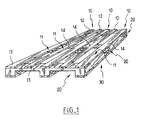
- the pallet includes support members 10 in the form of planks having a rough top surface 11.
- the support members 10 are attached at their opposite ends 12, 13 and their middle portion 14 to transverse link beams.
- the connecting beams 20 of C cross section have an upper flange 21 and a lower flange 22 connected by a core 23.
- the support elements 10 are fixed on the upper flange 21.
- each connecting section three brackets generally designated 25 and connected by the upper flange 21. It will be noted here that each recess 24 is formed in a lower portion of the core 23 so that a remaining portion of the core 23 extends above the recess between the brackets. Other arrangements of the recesses are possible.
- the facing lower flange portions 22 belonging to the three connecting beams are connected by three stiffening elements 30 which extend parallel to the support elements 10.
- the stiffening elements 30 are board-shaped and have a lower surface 31 having longitudinal grooves 32 and an upper surface 33 on which are fixed the lower flanges 22 of the connecting pieces 20.
- the upper longitudinal edges 34 of the stiffening elements 30 are chamfered.
- the ends of forks of the trucks are generally bevelled in their lower part so that by cooperating with these bevelled parts, the chamfers form ramps guiding the ends of the forks above the elements 30. The risk of a shock between these elements 30 and the forks is thus limited. This also makes it possible to lighten these stiffening elements.
- the assembly of the various elements constituting the pallet is achieved by screwing, nailing, gluing or welding or by combining these means. Note that the pallet according to the invention is particularly well suited to a nailing assembly.
Landscapes
- Chemical & Material Sciences (AREA)
- Engineering & Computer Science (AREA)
- Chemical Kinetics & Catalysis (AREA)
- Health & Medical Sciences (AREA)
- Mechanical Engineering (AREA)
- Medicinal Chemistry (AREA)
- Polymers & Plastics (AREA)
- Organic Chemistry (AREA)
- Environmental & Geological Engineering (AREA)
- Sustainable Development (AREA)
- Life Sciences & Earth Sciences (AREA)
- Pallets (AREA)
- Compositions Of Macromolecular Compounds (AREA)
- Manufacture Of Macromolecular Shaped Articles (AREA)
- Casting Or Compression Moulding Of Plastics Or The Like (AREA)
- Extrusion Moulding Of Plastics Or The Like (AREA)
Description
- La présente invention concerne des produits en matériau thermoplastique recyclé et un procédé de fabrication de ceux-ci.
- L'écologie prenant une part prépondérante dans notre société, les acteurs industriels et les consommateurs ont été conduits à maîtriser l'impact de leur activité et de leur comportement sur l'environnement afin d'éviter des pollutions ou dégradations de celui-ci.
- L'un des principaux problèmes lié à cette préoccupation concerne la part croissante prise par les matériaux thermoplastiques dans la réalisation des produits de grande consommation et par voie de conséquence l'élimination des déchets contenant de tels matériaux. En effet, ces matériaux ne sont pas rapidement biodégradables de sorte que la simple mise en décharge de tels déchets ne constitue pas une solution satisfaisante d'un point de vue écologique. Il est ainsi connu des documents
JP-2000 129099 US 4 778 842 etUS 5 965 655 , une composition pour la réalisation de produits en matériaux synthétiques. - Pour éliminer ces déchets, il a été recouru à l'incinération qui permet l'élimination physique des déchets et évite leur stockage. Toutefois, cette incinération produit des fumées qui réchauffent et polluent l'atmosphère.
- Une solution à ce problème est de recycler ces produits. Les compositions figurant dans les trois documents ci-dessus ne font pas intervenir de matériaux thermoplastiques recyclés. L'aptitude au recyclage des matériaux thermoplastiques dépend notamment de leurs caractéristiques physico-chimiques. Les matériaux thermoplastiques présentant une bonne aptitude au recyclage sont généralement broyés et nettoyés pour être utilisés dans le cycle de fabrication d'un grand nombre de nouveaux produits en étant incorporés dans le matériau destiné à constituer ceux-ci. Les matériaux thermoplastique dont l'aptitude au recyclage est faible sont d'une manière générale simplement broyés pour être utilisés comme matériaux de remplissage ou de remblaiement, ou sont éventuellement incorporés dans des matériaux destinés à constituer des produits de qualité médiocre présentant de faibles caractéristiques mécaniques.
- Le polyéthylène téréphtalate vierge est un matériau fréquemment utilisé dans la fabrication de produits à large diffusion telle que des bouteilles ou des articles de consommation courante (voir par exemple le document
WO-A-91/08263 - Des tentatives de recyclage ont ainsi été envisagées dans le document
US-A-5 405 567 , mais les quantités de polyéthèlène téréphtalate restent relativement faibles. - D'autres compositions sont également connus des documents
EP 666 285 US 5 951 940 . - Il serait donc intéressant de pouvoir obtenir des pièces massives incorporant du polyéthylène téréphtalate recyclé tout en ayant de bonnes caractéristiques mécaniques.
- A cet effet, on prévoit, selon l'invention, une pièce en matériau thermoplastique, caractérisé en ce que le matériau comprend sensiblement, en poids :
- entre 49 % et 63,5 % de polyéthylène téréphtalate recyclé,
- entre 27 % et 36 % et de préférence 33 % de polyéthylène haute densité recyclé,
- entre 4 % et 6 % et de préférence 5 % d'agent compatibilisant,
- entre 5 % et 10 % et de préférence 7 % de charge de renfort.
- Il est ainsi obtenu une pièce qui peut avoir une structure massive. Cette pièce présente en outre des caractéristiques mécaniques satisfaisantes qui, dans la composition préférée, se rapprochent de celles du bois notamment en ce qui concerne la résistance à la rupture et confère à la pièce des possibilités d'assemblage similaires à celles du bois.
- L'invention a également pour objet un procédé de fabrication d'une pièce du type précédent formant un profilé, qui comprend les étapes de :
- sécher des paillettes de polyéthylène téréphtalate recyclé,
- introduire dans une extrudeuse ces paillettes de polyéthylène téréphtalate, des paillettes de polyéthylène haute densité recyclé, l'agent compatibilisant et la charge de renfort pour obtenir un mélange pâteux,
- et introduire le mélange pâteux dans un moule disposé directement à la sortie de l'extrudeuse.
- Le séchage des paillettes de polyéthylène téréphtalate permet d'éviter une hydrolyse du polyéthylène téréphtalate lors de l'extrusion. On s'est en effet aperçu qu'une telle hydrolyse provoque directement une diminution de la résistance aux chocs du polyéthylène téréphtalate.
- Avantageusement le procédé comprend l'étape ultérieure de refroidissement du mélange contenu dans le moule.
- Le refroidissement du mélange contenu dans le moule immédiatement après l'intrusion du mélange pâteux dans le moule permet d'obtenir un profilé présentant une couche superficielle dans une phase amorphe plus souple. Ceci améliore les propriétés mécaniques du matériau et notamment sa résistance aux chocs.
- L'invention a aussi pour objet une palette de transport comprenant des éléments de support parallèles ayant des portions d'extrémité fixées par des moyens d'assemblage à des éléments transversaux de liaison reposant sur des équerres et l'un au moins de ces éléments est constitué par une poutre présentant l'une des caractéristiques précitées.
- La palette ainsi constituée peut être réalisée par assemblage des différents éléments et présente des propriétés du même ordre que celles des palettes classiques et notamment celles en bois, voire supérieures à celles des palettes réalisée en matériau thermoplastique injecté du type courant.
- Avantageusement, au moins un des éléments transversaux est formé d'une poutre de section transversale en C ayant une aile supérieure sur laquelle sont fixés les éléments support, une âme et une aile inférieure lesquelles sont évidées par au moins une échancrure pour former de chaque côté de celle-ci deux équerres espacées et en une seule pièce avec l'élément transversal. Le profil en C de la poutre permet une bonne répartition du poids supporté par la palette, apportant ainsi une amélioration à la résistance de celle-ci. En outre, par l'utilisation d'une telle poutre, on forme en un seul tenant les différentes parties de l'assemblage classique, ce qui permet de diminuer le nombre de pièces et de simplifier la fabrication de la palette.
- Selon un mode de réalisation particulier, la palette comprend au moins un élément de rigidification s'étendant parallèlement aux éléments support à distance de ceux-ci entre deux équerres opposées, l'élément de rigidification étant formé par une poutre en forme de planche, la surface inférieure de cette poutre étant rainurée et cette dernière comprenant au moins un chanfrein ménagé sur au moins un de ses bords longitudinaux supérieurs. La palette est ainsi particulièrement résistante. Ceci permet en outre d'une part d'alléger la palette et d'autre part de limiter le risque d'un choc entre l'élément de rigidification et l'extrémité des fourches.
- D'autres caractéristiques et avantages de l'invention ressortiront à la lecture de la description qui suit d'un mode de mise en oeuvre particulier non limitatif de l'invention.
- Il sera fait référence aux dessins annexés, parmi lesquels :
- la
figure 1 est une vue en perspective d'une palette conforme à l'invention, - la
figure 2 est une vue en perspective d'un premier type de poutre conforme à l'invention, - la
figure 3 est une vue en perspective d'un deuxième type de poutre conforme à l'invention. - En référence aux figures, les profilés généralement désignés en 10, 20, 30 conformes à l'invention sont réalisés à partir d'un matériau thermoplastique qui comprend sensiblement en poids :
- 55 % de polyéthylène téréphtalate recyclé,
- 33 % de polyéthylène haute densité recyclé,
- 5 % d'un agent compatibilisant, et
- 7 % d'une charge de renfort.
- La composition du matériau thermoplastique peut varier mais les proportions en poids des différents composants sont de préférence sensiblement comprises entre :
- 49 % et 63,5 % pour le polyéthylène téréphtalate,
- 27 % et 36 % pour le polyéthylène haute densité,
- 4 % et 6 % pour l'agent compatibilisant,
- 5 % et 10 % pour la charge de renfort.
- L'adjonction de polyéthylène haute densité permet d'obtenir un matériau qui a un caractère amorphe plus important que si seul du polyéthylène téréphtalate (qui est très cristallin) était utilisé. Ceci améliore la résistance mécanique du matériau obtenu.
- L'agent compatibilisant est ici celui référencé LOTADER AX8900 de la société ELF ATOCHEM qui est utilisé pour assurer l'homogénéisation du mélange du polyéthylène téréphtalate recyclé et du polyéthylène haute densité recyclé. D'autres agents compatibilisants ayant des propriétés comparables peuvent bien entendu être utilisés.
- La charge de renfort peut être formée de microbilles de verre telles que celles produite sous la référence 050-20-215 par la société SOVITEC.
- La charge de renfort utilisée peut en outre être formée de fibres de verre telles que celles produites sous la référence 3540 par la société PPG. Ces fibres, qui ont une longueur de 3 mm, améliorent le module d'Young et la résistance aux chocs.
- La charge de renfort peut également être formée d'écailles de verre du type produit sous la référence MICROGLAS par la société NGF EUROPE. Ces écailles permettent l'obtention d'un accroissement du module d'Young et une augmentation de l'allongement qui s'accompagne par une augmentation de la résistance aux chocs. En outre, l'utilisation d'écailles de verre permet de limiter l'augmentation de la viscosité du mélange due à l'introduction desdites écailles dans celui-ci par rapport à l'introduction de fibres. Les écailles ont de plus vraisemblablement d'une part une influence sur la cristallinité et d'autre part une influence sur le retrait telle qu'elles limitent la formation de microfissures.
- D'autres charges de renfort peuvent être employées seules ou en combinaison. Un mélange de microbilles de verre et/ou de fibres de verre et/ou d'écailles de verre est ainsi utilisable.
- D'autres types de charges peuvent bien entendu être ajoutés au mélange. Parmi ces charges, on peut utiliser un émulsifiant comme du carbonate de zinc. Ceci permet de créer des bulles dans le matériau et permet de diminuer la masse des profilés fabriqués avec celui-ci. Des pigments peuvent également être ajoutés pour colorer le matériau.
- Les profilés 10, 20, 30 sont réalisés par extrusion-moulage ou extrusion-intrusion.
- Le polyéthylène téréphtalate recyclé et le polyéthylène haute densité recyclé utilisés sont de préférence sous forme de paillettes obtenues par broyage de déchets en polyéthylène téréphtalate et de déchets en polyéthylène haute densité et lavage des paillettes obtenues. On pourrait également utiliser des granulés de ces matériaux mais cela nécessite des opérations supplémentaires (mélange des paillettes de chaque matériau à des charges, extrusion de ces mélanges, refroidissement puis broyage en granulés).
- Les paillettes de polyéthylène téréphtalate sont dans un premier temps séchées par exemple dans un dessiccateur afin d'éviter qu'une hydrolyse du polyéthylène téréphtalate intervienne lors de l'extrusion ultérieure de celui-ci. Le polyéthylène haute densité peut également être séché.
- Les paillettes de polyéthylène téréphtalate et de polyéthylène haute densité, l'agent compatibilisant et les charges de renfort sont ensuite mélangés et introduits dans la trémie d'alimentation d'une extrudeuse. Il est important de s'assurer que la descente des paillettes dans la trémie est régulière.
- La température du corps de chauffe de l'extrudeuse est ici de l'ordre de 250° du côté de la trémie et de 275° du côté de la sortie de l'extrudeuse. Afin d'assurer un mélange correct des différents composants du matériau thermoplastique, la durée de séjour de celui-ci dans l'extrudeuse est de préférence compris entre une et quelques minutes. Le temps de séjour de la matière dans l'extrudeuse est déterminé notamment par la longueur de la vis de l'extrudeuse, le pas de celle-ci et sa vitesse de rotation.
- A la sortie de l'extrudeuse, on obtient un mélange pâteux qui est directement introduit dans un moule dont la forme correspond a la poutre à réaliser (l'extrudeuse débouche directement dans celui-ci par un orifice ménagé dans la paroi du moule). On notera que si la forme intérieure du moule est complexe, il sera peut-être nécessaire de réaliser plusieurs orifices d'injection de la matière. La pression de l'injection de la matière dans le moule est procurée par l'effort de poussée exercée sur le mélange par la vis de l'extrudeuse. Dans le cas où un émulsifiant a été ajouté à la matière, une partie de la pression d'injection sera fournie par l'émulsification. Dans un tel cas, le temps de séjour de la matière dans l'extrudeuse sera de préférence calculé de manière que l'émulsification ait lieu dans l'extrudeuse et non dans le moule (car dans ce dernier cas, la quantité de matière à introduire dans le moule est plus difficile à déterminer).
- Une fois le moule rempli, le moule est plongé dans un bain d'eau froide, par exemple à une température inférieure ou égale à 20°C. Ceci permet d'obtenir une poutre qui présente une couche superficielle relativement épaisse en phase amorphe qui est relativement souple et résiste relativement bien aux chocs. D'autres modes de refroidissement sont bien évidemment utilisables et notamment le trempage des pièces elles-mêmes dans un bain ou le maintien des pièces ou des moules contenant celles-ci dans un flux de gaz froid.
- La palette conforme à l'invention peut être réalisée en tout matériau thermoplastique par assemblage des différents éléments la constituant. La palette ici décrite est réalisée dans le matériau thermoplastique précité.
- La palette comprend des éléments supports 10 sous forme de planches ayant une surface supérieure 11 rugueuse. Les éléments supports 10 sont fixés au niveau de leurs extrémités opposées 12, 13 et de leur portion médiane 14 sur des poutres de liaison 20 transversales.
- Les poutres de liaison 20 de section transversale en C présentent une aile supérieure 21 et une aile inférieure 22 reliée par une âme 23. Les éléments supports 10 sont fixés sur l'aile supérieure 21.
- Deux évidements 24 espacés l'un de l'autre échancrent à la fois l'aile inférieure 22 et l'âme 23 pour former un passage pour les fourches d'un chariot de manutention de palettes de type classique. Il est ainsi délimité pour chaque profilé de liaison trois équerres généralement désignées en 25 et reliées par l'aile supérieure 21. On notera ici que chaque évidement 24 est réalisé dans une partie inférieure de l'âme 23 de telle manière qu'une partie restante de l'âme 23 s'étend au-dessus de l'évidement entre les équerres. D'autres agencements des évidements sont possibles.
- Les portions d'ailes inférieures 22 en regard appartenant aux trois poutres de liaison sont reliées par trois éléments de rigidification 30 qui s'étendent parallèlement aux éléments supports 10. Les pièces de rigidification 30 ont une forme de planche et comportent une surface inférieure 31 présentant des rainures longitudinales 32 et une surface supérieure 33 sur laquelle sont fixées les ailes inférieures 22 des pièces de liaison 20. Les bords longitudinaux supérieurs 34 des éléments de rigidification 30 sont chanfreinés. Les extrémités des fourches des chariots de manutention sont généralement biseautées dans leur partie inférieure de sorte qu'en coopérant avec ces parties biseautées, les chanfreins forment des rampes guidant les extrémités des fourches au-dessus des éléments 30. Le risque d'un choc entre ces éléments 30 et les fourches est ainsi limité. Ceci permet en outre d'alléger ces éléments de rigidification.
- L'assemblage des différents éléments constituant la palette est réalisé par vissage, par clouage, par collage ou par soudage ou par combinaison de ces moyens. On notera que la palette conforme à l'invention est particulièrement bien adaptée à un assemblage par clouage.
- Bien entendu, l'invention n'est pas limitée au mode de réalisation décrit et on peut y apporter des variantes de réalisation sans sortir du cadre de l'invention tel que défini par les revendications.
- D'autres applications peuvent en particulier être envisagées pour les pièces conformes à l'invention.
Claims (12)
- Pièce en matériau thermoplastique, caractérisé en ce que le matériau comprend sensiblement, en poids :- entre 49 % et 63,5 % de polyéthylène téréphtalate recyclé,- entre 27 % et 36 % de polyéthylène haute densité recyclé,- entre 4 % et 6 % d'agent compatibilisant,- entre 5 % et 10 % de charge de renfort.
- Pièce selon la revendication 1, caractérisé en ce que le matériau thermoplastique comprend sensiblement, en poids :- 55 % de polyéthylène téréphtalate,- 33 % de polyéthylène haute densité,- 5 % d'agent compatibilisant,- 7 % de charge de renfort.
- Pièce selon la revendication 1 ou la revendication 2, caractérisé en ce que la charge de renfort comprend des écailles de verre.
- Pièce selon la revendication 1 ou la revendication 2, caractérisé en ce que la charge de renfort comprend des fibres de verre.
- Pièce selon la revendication 1 ou la revendication 2, caractérisé en ce que la charge de renfort comprend des microbilles de verre.
- Procédé de fabrication d'un profilé conforme à l'une quelconque des revendications précédentes, caractérisé en ce qu'il comprend les étapes de :- sécher des paillettes de polyéthylène téréphtalate recyclé,- introduire dans une extrudeuse ces paillettes de polyéthylène téréphtalate, des paillettes de polyéthylène haute densité recyclé, l'agent compatibilisant et la charge de renfort pour obtenir un mélange pâteux,- et introduire le mélange pâteux dans un moule disposé directement à la sortie de l'extrudeuse.
- Procédé selon la revendication 6, caractérisé en ce qu'il comprend l'étape ultérieure de refroidissement du mélange contenu dans le moule.
- Palette de transport, caractérisée en ce qu'elle comprend des éléments de support (10) parallèles ayant des portions d'extrémité (12, 13) fixées par des moyens d'assemblage à des poutres transversales de liaison (20) reposant sur des équerres (25) et en ce que l'un au moins de ces éléments/poutres est constitué par une pièce conforme à l'une des revendications 1 à 5.
- Palette selon la revendication 8, caractérisée en ce qu'au moins une des poutres transversales comporte une section transversale en C ayant une aile supérieure (21) sur laquelle sont fixés les éléments support, une âme (23) et une aile inférieure (22) les deux évidées par au moins une échancrure (24) pour former de chaque côté de celle-ci deux équerres (25) espacés et en une seule pièce avec l'aile supérieure (21).
- Palette selon la revendication 8 ou la revendication 9, caractérisée en ce qu'elle comprend au moins un élément de rigidification (30) s'étendant parallèlement aux éléments support (10) à distance de ceux-ci entre deux équerres (25) opposées, l'élément de rigidification étant en forme de planche.
- Palette selon la revendication 10, caractérisée en ce que la surface inférieure (31) de l'élément en forme de planche est rainurée.
- Palette selon la revendication 10 ou la revendication 11, caractérisée en ce que l'élément de rigidification comprend au moins un chanfrein ménagé sur au moins un de ses bords longitudinaux supérieurs (34).
Applications Claiming Priority (2)
| Application Number | Priority Date | Filing Date | Title |
|---|---|---|---|
| FR0014783 | 2000-11-16 | ||
| FR0014783A FR2816627B1 (fr) | 2000-11-16 | 2000-11-16 | Piece en materiau thermoplastique recycle, procede de fabrication correspondant et palette comprenant au moins un profile de ce type |
Publications (2)
| Publication Number | Publication Date |
|---|---|
| EP1207178A1 EP1207178A1 (fr) | 2002-05-22 |
| EP1207178B1 true EP1207178B1 (fr) | 2013-07-31 |
Family
ID=8856538
Family Applications (1)
| Application Number | Title | Priority Date | Filing Date |
|---|---|---|---|
| EP20010402903 Expired - Lifetime EP1207178B1 (fr) | 2000-11-16 | 2001-11-13 | Pièce en matériau thermoplastique recyclé, procédé de fabrication correspondant et palette comprenant au moins un profilé de ce type |
Country Status (5)
| Country | Link |
|---|---|
| US (1) | US6780500B2 (fr) |
| EP (1) | EP1207178B1 (fr) |
| JP (1) | JP2002234993A (fr) |
| CZ (1) | CZ20014101A3 (fr) |
| FR (1) | FR2816627B1 (fr) |
Families Citing this family (34)
| Publication number | Priority date | Publication date | Assignee | Title |
|---|---|---|---|---|
| US7785763B2 (en) * | 2006-10-13 | 2010-08-31 | Xerox Corporation | Emulsion aggregation processes |
| US7851519B2 (en) * | 2007-01-25 | 2010-12-14 | Xerox Corporation | Polyester emulsion containing crosslinked polyester resin, process, and toner |
| US8039187B2 (en) | 2007-02-16 | 2011-10-18 | Xerox Corporation | Curable toner compositions and processes |
| WO2010071612A1 (fr) * | 2008-12-17 | 2010-06-24 | Ali Hakan Guven | Palette de transport composite à base de plastique |
| US8192912B2 (en) | 2009-05-08 | 2012-06-05 | Xerox Corporation | Curable toner compositions and processes |
| US8073376B2 (en) * | 2009-05-08 | 2011-12-06 | Xerox Corporation | Curable toner compositions and processes |
| US10118200B2 (en) | 2009-07-06 | 2018-11-06 | Optimal Plus Ltd | System and method for binning at final test |
| IT1394513B1 (it) * | 2009-07-06 | 2012-07-05 | Corinaldesi | Metodo di produzione di un articolo in plastica a partire da bottiglie di plastica riciclate. |
| US20110027714A1 (en) | 2009-07-29 | 2011-02-03 | Xerox Corporation | Toner compositions |
| US8323865B2 (en) * | 2009-08-04 | 2012-12-04 | Xerox Corporation | Toner processes |
| US9594319B2 (en) * | 2009-09-03 | 2017-03-14 | Xerox Corporation | Curable toner compositions and processes |
| US8722299B2 (en) * | 2009-09-15 | 2014-05-13 | Xerox Corporation | Curable toner compositions and processes |
| US20110086302A1 (en) * | 2009-10-09 | 2011-04-14 | Xerox Corporation | Toner compositions and processes |
| US8257895B2 (en) * | 2009-10-09 | 2012-09-04 | Xerox Corporation | Toner compositions and processes |
| US8168361B2 (en) * | 2009-10-15 | 2012-05-01 | Xerox Corporation | Curable toner compositions and processes |
| WO2011073496A1 (fr) * | 2009-12-16 | 2011-06-23 | Upm-Kymmene Corporation | Palette et procédé de fabrication d'une palette |
| US8163459B2 (en) * | 2010-03-01 | 2012-04-24 | Xerox Corporation | Bio-based amorphous polyester resins for emulsion aggregation toners |
| US9012118B2 (en) | 2010-03-04 | 2015-04-21 | Xerox Corporation | Toner compositions and processes |
| US8221951B2 (en) | 2010-03-05 | 2012-07-17 | Xerox Corporation | Toner compositions and methods |
| US8178269B2 (en) * | 2010-03-05 | 2012-05-15 | Xerox Corporation | Toner compositions and methods |
| US8221953B2 (en) | 2010-05-21 | 2012-07-17 | Xerox Corporation | Emulsion aggregation process |
| US8142975B2 (en) | 2010-06-29 | 2012-03-27 | Xerox Corporation | Method for controlling a toner preparation process |
| US8574804B2 (en) | 2010-08-26 | 2013-11-05 | Xerox Corporation | Toner compositions and processes |
| US8394566B2 (en) | 2010-11-24 | 2013-03-12 | Xerox Corporation | Non-magnetic single component emulsion/aggregation toner composition |
| EP2463072A1 (fr) * | 2010-12-10 | 2012-06-13 | SP Kloner Ecotec S.L. | Composite pour la fabrication d'éléments structurels basés sur des polymères thermoplastiques à partir de matériaux recyclés |
| LT3208207T (lt) | 2011-07-15 | 2020-06-10 | Chep Technology Pty Limited | Padėklas su vientisų pavažų pavidalo atraminiais elementais ir atitinkamas būdas |
| US8671848B2 (en) * | 2011-08-04 | 2014-03-18 | Wayne Randall | Pallet protector device and method |
| US8841055B2 (en) | 2012-04-04 | 2014-09-23 | Xerox Corporation | Super low melt emulsion aggregation toners comprising a trans-cinnamic di-ester |
| US9023574B2 (en) | 2013-06-28 | 2015-05-05 | Xerox Corporation | Toner processes for hyper-pigmented toners |
| US9195155B2 (en) | 2013-10-07 | 2015-11-24 | Xerox Corporation | Toner processes |
| US9285699B2 (en) | 2014-05-01 | 2016-03-15 | Xerox Corporation | Carrier and developer |
| US9309392B2 (en) | 2014-07-18 | 2016-04-12 | Qatar University | Reinforced polymer composites from recycled plastic |
| US9188890B1 (en) | 2014-09-17 | 2015-11-17 | Xerox Corporation | Method for managing triboelectric charge in two-component developer |
| IT202400001737A1 (it) * | 2024-01-30 | 2025-07-30 | Cpr System Soc Cooperativa | Pallet in plastica riciclata. |
Citations (3)
| Publication number | Priority date | Publication date | Assignee | Title |
|---|---|---|---|---|
| US4778842A (en) * | 1985-02-15 | 1988-10-18 | Kuraray Co., Ltd. | Polyester resin compositions |
| US5965655A (en) * | 1993-08-19 | 1999-10-12 | General Electric Company | Mineral filled moldable thermoplastic composition |
| JP2000129099A (ja) * | 1998-10-21 | 2000-05-09 | Sumitomo Chem Co Ltd | ポリエステル−ポリオレフィン樹脂組成物及びポリエステル樹脂とポリオレフィン樹脂の相溶化方法 |
Family Cites Families (4)
| Publication number | Priority date | Publication date | Assignee | Title |
|---|---|---|---|---|
| GB8926632D0 (en) * | 1989-11-24 | 1990-01-17 | Ici Plc | Polymer blend composition |
| US5405567A (en) * | 1993-12-10 | 1995-04-11 | Plastic Pallets, Inc. | Molding of articles from plastics |
| DE69424521T2 (de) * | 1994-02-02 | 2000-09-14 | European Economic Community E.E.C., Luxemburg/Luxembourg | PET Verpackungsmaterial |
| US5951940A (en) * | 1994-05-02 | 1999-09-14 | Rutgers, The State University | Method of recycling post-consumer plastic waste |
-
2000
- 2000-11-16 FR FR0014783A patent/FR2816627B1/fr not_active Expired - Fee Related
-
2001
- 2001-11-13 EP EP20010402903 patent/EP1207178B1/fr not_active Expired - Lifetime
- 2001-11-13 JP JP2001347467A patent/JP2002234993A/ja active Pending
- 2001-11-14 CZ CZ20014101A patent/CZ20014101A3/cs unknown
- 2001-11-15 US US09/987,594 patent/US6780500B2/en not_active Expired - Fee Related
Patent Citations (3)
| Publication number | Priority date | Publication date | Assignee | Title |
|---|---|---|---|---|
| US4778842A (en) * | 1985-02-15 | 1988-10-18 | Kuraray Co., Ltd. | Polyester resin compositions |
| US5965655A (en) * | 1993-08-19 | 1999-10-12 | General Electric Company | Mineral filled moldable thermoplastic composition |
| JP2000129099A (ja) * | 1998-10-21 | 2000-05-09 | Sumitomo Chem Co Ltd | ポリエステル−ポリオレフィン樹脂組成物及びポリエステル樹脂とポリオレフィン樹脂の相溶化方法 |
Also Published As
| Publication number | Publication date |
|---|---|
| US6780500B2 (en) | 2004-08-24 |
| CZ20014101A3 (cs) | 2002-07-17 |
| JP2002234993A (ja) | 2002-08-23 |
| FR2816627A1 (fr) | 2002-05-17 |
| US20020058134A1 (en) | 2002-05-16 |
| EP1207178A1 (fr) | 2002-05-22 |
| FR2816627B1 (fr) | 2003-03-07 |
Similar Documents
| Publication | Publication Date | Title |
|---|---|---|
| EP1207178B1 (fr) | Pièce en matériau thermoplastique recyclé, procédé de fabrication correspondant et palette comprenant au moins un profilé de ce type | |
| EP1207115B1 (fr) | Palette de transport | |
| EP1737755B1 (fr) | Articles d'emballage tels que bouteilles opaques et procede de fabrication de ces articles | |
| US20070007685A1 (en) | Methods and systems for making long fiber reinforced products and resultant products | |
| EP0165093A1 (fr) | Procédé de fabrication d'un produit composite constitué d'un mélange de particules cellulosiques et d'un liant thermoplastique | |
| FR2859659A1 (fr) | Procede et extrudeuse pour fabriquer une matiere plastique syntactique | |
| FR2672252A1 (fr) | Roue en resine synthetique du type d'une seule piece. | |
| EP1397248A1 (fr) | Tube protege en matiere plastique et procede de fabrication dudit tube | |
| EP1423246A1 (fr) | Procedes de fabrication de preformes et de contenants en pet tels que des bouteilles alimentaires, contenants et preformes intermediaires obtenus | |
| US20060073319A1 (en) | Method and apparatus for making products from polymer wood fiber composite | |
| FR2850606A1 (fr) | Procede et appareillage pour incorporer une forte proportion de fibres naturelles coupees dans une matiere plastique, produits obtenus et applications | |
| FR2679935A1 (fr) | Traverse de rail composite ainsi que son procede de fabrication. | |
| EP1066946B1 (fr) | Procédé de fabrication de pièces optiques pour éclairage ou signalisation de véhicules automobiles | |
| FR3109114A1 (fr) | Fabrication d’une pièce moulée à partir de broyats de composites thermodurcissables et de broyats de fibres de verre | |
| EP0693362B1 (fr) | Procédé pour réaliser des pièces en au moins deux matières thermoplastiques | |
| BE1032152B1 (fr) | Procédé de fabrication continue d'un film de polypropylène chargé | |
| EP4274720B1 (fr) | Procédé de recyclage de résidus sous forme de paillettes | |
| EP1132188B1 (fr) | Procédé de fabrication de composants pour dispositifs d'éclairage ou de signalisation de véhicules automobiles | |
| EP4368383A1 (fr) | Ensemble de carrosserie de véhicule frigorique et procédé de fabrication associé | |
| WO2001094094A1 (fr) | Materiau composite thermoplastique, et procede et installation de fabrication de ce materiau | |
| FR2543489A1 (fr) | Procede de fabrication de brides a collerette, haute pression, en materiau composite, et produit obtenu | |
| EP2914410A1 (fr) | Procédé d'injection de pièces minces en plastique | |
| FR2736579A1 (fr) | Procede et installation pour la fabrication de produits composites et produits en resultant | |
| FR2796879A1 (fr) | Procede pour le recyclage de bandes magnetiques par extrusion | |
| FR2850605A1 (fr) | Procede et appareillage pour incorporer une forte proportion de fibres naturelles coupees dans une matiere plastique, produits obtenus et applications |
Legal Events
| Date | Code | Title | Description |
|---|---|---|---|
| PUAI | Public reference made under article 153(3) epc to a published international application that has entered the european phase |
Free format text: ORIGINAL CODE: 0009012 |
|
| AX | Request for extension of the european patent |
Free format text: AL;LT;LV;MK;RO;SI |
|
| 17P | Request for examination filed |
Effective date: 20021118 |
|
| AKX | Designation fees paid |
Designated state(s): AT BE CH CY DE DK ES FI FR GB GR IE IT LI LU MC NL PT SE TR |
|
| 17Q | First examination report despatched |
Effective date: 20050323 |
|
| RAP1 | Party data changed (applicant data changed or rights of an application transferred) |
Owner name: DUMOUCHEL, CATHERINE Owner name: CYBELE ENVIRONNEMENT |
|
| 18D | Application deemed to be withdrawn |
Effective date: 20060927 |
|
| R17C | First examination report despatched (corrected) |
Effective date: 20050323 |
|
| GRAP | Despatch of communication of intention to grant a patent |
Free format text: ORIGINAL CODE: EPIDOSNIGR1 |
|
| GRAS | Grant fee paid |
Free format text: ORIGINAL CODE: EPIDOSNIGR3 |
|
| GRAA | (expected) grant |
Free format text: ORIGINAL CODE: 0009210 |
|
| RAP1 | Party data changed (applicant data changed or rights of an application transferred) |
Owner name: DUMOUCHEL, CATHERINE Owner name: CYBELE ENVIRONNEMENT |
|
| AK | Designated contracting states |
Kind code of ref document: B1 Designated state(s): AT BE CH CY DE DK ES FI FR GB GR IE IT LI LU MC NL PT SE TR |
|
| REG | Reference to a national code |
Ref country code: CH Ref legal event code: EP |
|
| REG | Reference to a national code |
Ref country code: AT Ref legal event code: REF Ref document number: 624637 Country of ref document: AT Kind code of ref document: T Effective date: 20130815 |
|
| REG | Reference to a national code |
Ref country code: IE Ref legal event code: FG4D Free format text: LANGUAGE OF EP DOCUMENT: FRENCH |
|
| REG | Reference to a national code |
Ref country code: DE Ref legal event code: R096 Ref document number: 60148194 Country of ref document: DE Effective date: 20130926 |
|
| REG | Reference to a national code |
Ref country code: AT Ref legal event code: MK05 Ref document number: 624637 Country of ref document: AT Kind code of ref document: T Effective date: 20130731 |
|
| REG | Reference to a national code |
Ref country code: NL Ref legal event code: VDEP Effective date: 20130731 |
|
| PG25 | Lapsed in a contracting state [announced via postgrant information from national office to epo] |
Ref country code: PT Free format text: LAPSE BECAUSE OF FAILURE TO SUBMIT A TRANSLATION OF THE DESCRIPTION OR TO PAY THE FEE WITHIN THE PRESCRIBED TIME-LIMIT Effective date: 20131202 Ref country code: AT Free format text: LAPSE BECAUSE OF FAILURE TO SUBMIT A TRANSLATION OF THE DESCRIPTION OR TO PAY THE FEE WITHIN THE PRESCRIBED TIME-LIMIT Effective date: 20130731 Ref country code: SE Free format text: LAPSE BECAUSE OF FAILURE TO SUBMIT A TRANSLATION OF THE DESCRIPTION OR TO PAY THE FEE WITHIN THE PRESCRIBED TIME-LIMIT Effective date: 20130731 Ref country code: CY Free format text: LAPSE BECAUSE OF NON-PAYMENT OF DUE FEES Effective date: 20130428 |
|
| PGFP | Annual fee paid to national office [announced via postgrant information from national office to epo] |
Ref country code: FR Payment date: 20131120 Year of fee payment: 13 Ref country code: DE Payment date: 20131121 Year of fee payment: 13 |
|
| PG25 | Lapsed in a contracting state [announced via postgrant information from national office to epo] |
Ref country code: NL Free format text: LAPSE BECAUSE OF FAILURE TO SUBMIT A TRANSLATION OF THE DESCRIPTION OR TO PAY THE FEE WITHIN THE PRESCRIBED TIME-LIMIT Effective date: 20130731 Ref country code: FI Free format text: LAPSE BECAUSE OF FAILURE TO SUBMIT A TRANSLATION OF THE DESCRIPTION OR TO PAY THE FEE WITHIN THE PRESCRIBED TIME-LIMIT Effective date: 20130731 Ref country code: GR Free format text: LAPSE BECAUSE OF FAILURE TO SUBMIT A TRANSLATION OF THE DESCRIPTION OR TO PAY THE FEE WITHIN THE PRESCRIBED TIME-LIMIT Effective date: 20131101 |
|
| PG25 | Lapsed in a contracting state [announced via postgrant information from national office to epo] |
Ref country code: CY Free format text: LAPSE BECAUSE OF NON-PAYMENT OF DUE FEES Effective date: 20130731 |
|
| PG25 | Lapsed in a contracting state [announced via postgrant information from national office to epo] |
Ref country code: DK Free format text: LAPSE BECAUSE OF FAILURE TO SUBMIT A TRANSLATION OF THE DESCRIPTION OR TO PAY THE FEE WITHIN THE PRESCRIBED TIME-LIMIT Effective date: 20130731 |
|
| PG25 | Lapsed in a contracting state [announced via postgrant information from national office to epo] |
Ref country code: ES Free format text: LAPSE BECAUSE OF FAILURE TO SUBMIT A TRANSLATION OF THE DESCRIPTION OR TO PAY THE FEE WITHIN THE PRESCRIBED TIME-LIMIT Effective date: 20130731 Ref country code: IT Free format text: LAPSE BECAUSE OF FAILURE TO SUBMIT A TRANSLATION OF THE DESCRIPTION OR TO PAY THE FEE WITHIN THE PRESCRIBED TIME-LIMIT Effective date: 20130731 |
|
| BERE | Be: lapsed |
Owner name: CYBELE ENVIRONNEMENT Effective date: 20131130 Owner name: DUMOUCHEL, CATHERINE Effective date: 20131130 |
|
| PLBE | No opposition filed within time limit |
Free format text: ORIGINAL CODE: 0009261 |
|
| STAA | Information on the status of an ep patent application or granted ep patent |
Free format text: STATUS: NO OPPOSITION FILED WITHIN TIME LIMIT |
|
| REG | Reference to a national code |
Ref country code: CH Ref legal event code: PL |
|
| 26N | No opposition filed |
Effective date: 20140502 |
|
| PG25 | Lapsed in a contracting state [announced via postgrant information from national office to epo] |
Ref country code: MC Free format text: LAPSE BECAUSE OF FAILURE TO SUBMIT A TRANSLATION OF THE DESCRIPTION OR TO PAY THE FEE WITHIN THE PRESCRIBED TIME-LIMIT Effective date: 20130731 Ref country code: LI Free format text: LAPSE BECAUSE OF NON-PAYMENT OF DUE FEES Effective date: 20131130 Ref country code: CH Free format text: LAPSE BECAUSE OF NON-PAYMENT OF DUE FEES Effective date: 20131130 |
|
| REG | Reference to a national code |
Ref country code: DE Ref legal event code: R097 Ref document number: 60148194 Country of ref document: DE Effective date: 20140502 |
|
| REG | Reference to a national code |
Ref country code: IE Ref legal event code: MM4A |
|
| PG25 | Lapsed in a contracting state [announced via postgrant information from national office to epo] |
Ref country code: BE Free format text: LAPSE BECAUSE OF NON-PAYMENT OF DUE FEES Effective date: 20131130 |
|
| PG25 | Lapsed in a contracting state [announced via postgrant information from national office to epo] |
Ref country code: IE Free format text: LAPSE BECAUSE OF NON-PAYMENT OF DUE FEES Effective date: 20131113 |
|
| REG | Reference to a national code |
Ref country code: DE Ref legal event code: R082 Ref document number: 60148194 Country of ref document: DE Representative=s name: SCHAUMBURG & PARTNER PATENTANWAELTE GBR, DE Ref country code: DE Ref legal event code: R082 Ref document number: 60148194 Country of ref document: DE Representative=s name: SCHAUMBURG UND PARTNER PATENTANWAELTE MBB, DE |
|
| REG | Reference to a national code |
Ref country code: DE Ref legal event code: R119 Ref document number: 60148194 Country of ref document: DE |
|
| PG25 | Lapsed in a contracting state [announced via postgrant information from national office to epo] |
Ref country code: TR Free format text: LAPSE BECAUSE OF FAILURE TO SUBMIT A TRANSLATION OF THE DESCRIPTION OR TO PAY THE FEE WITHIN THE PRESCRIBED TIME-LIMIT Effective date: 20130731 |
|
| GBPC | Gb: european patent ceased through non-payment of renewal fee |
Effective date: 20141113 |
|
| PG25 | Lapsed in a contracting state [announced via postgrant information from national office to epo] |
Ref country code: LU Free format text: LAPSE BECAUSE OF NON-PAYMENT OF DUE FEES Effective date: 20131113 |
|
| REG | Reference to a national code |
Ref country code: FR Ref legal event code: ST Effective date: 20150731 |
|
| PG25 | Lapsed in a contracting state [announced via postgrant information from national office to epo] |
Ref country code: DE Free format text: LAPSE BECAUSE OF NON-PAYMENT OF DUE FEES Effective date: 20150602 Ref country code: GB Free format text: LAPSE BECAUSE OF NON-PAYMENT OF DUE FEES Effective date: 20141113 |
|
| PG25 | Lapsed in a contracting state [announced via postgrant information from national office to epo] |
Ref country code: FR Free format text: LAPSE BECAUSE OF NON-PAYMENT OF DUE FEES Effective date: 20141201 |