EP1207210A1 - Procédé d'analyse de produits de la PCR répétitive au moyen de la courbe de dénaturation thermique - Google Patents
Procédé d'analyse de produits de la PCR répétitive au moyen de la courbe de dénaturation thermique Download PDFInfo
- Publication number
- EP1207210A1 EP1207210A1 EP01126930A EP01126930A EP1207210A1 EP 1207210 A1 EP1207210 A1 EP 1207210A1 EP 01126930 A EP01126930 A EP 01126930A EP 01126930 A EP01126930 A EP 01126930A EP 1207210 A1 EP1207210 A1 EP 1207210A1
- Authority
- EP
- European Patent Office
- Prior art keywords
- probe
- hybridization
- segment
- target nucleic
- nucleic acid
- Prior art date
- Legal status (The legal status is an assumption and is not a legal conclusion. Google has not performed a legal analysis and makes no representation as to the accuracy of the status listed.)
- Granted
Links
Images



Classifications
-
- C—CHEMISTRY; METALLURGY
- C12—BIOCHEMISTRY; BEER; SPIRITS; WINE; VINEGAR; MICROBIOLOGY; ENZYMOLOGY; MUTATION OR GENETIC ENGINEERING
- C12Q—MEASURING OR TESTING PROCESSES INVOLVING ENZYMES, NUCLEIC ACIDS OR MICROORGANISMS; COMPOSITIONS OR TEST PAPERS THEREFOR; PROCESSES OF PREPARING SUCH COMPOSITIONS; CONDITION-RESPONSIVE CONTROL IN MICROBIOLOGICAL OR ENZYMOLOGICAL PROCESSES
- C12Q1/00—Measuring or testing processes involving enzymes, nucleic acids or microorganisms; Compositions therefor; Processes of preparing such compositions
- C12Q1/68—Measuring or testing processes involving enzymes, nucleic acids or microorganisms; Compositions therefor; Processes of preparing such compositions involving nucleic acids
- C12Q1/6813—Hybridisation assays
- C12Q1/6816—Hybridisation assays characterised by the detection means
- C12Q1/6818—Hybridisation assays characterised by the detection means involving interaction of two or more labels, e.g. resonant energy transfer
-
- C—CHEMISTRY; METALLURGY
- C12—BIOCHEMISTRY; BEER; SPIRITS; WINE; VINEGAR; MICROBIOLOGY; ENZYMOLOGY; MUTATION OR GENETIC ENGINEERING
- C12Q—MEASURING OR TESTING PROCESSES INVOLVING ENZYMES, NUCLEIC ACIDS OR MICROORGANISMS; COMPOSITIONS OR TEST PAPERS THEREFOR; PROCESSES OF PREPARING SUCH COMPOSITIONS; CONDITION-RESPONSIVE CONTROL IN MICROBIOLOGICAL OR ENZYMOLOGICAL PROCESSES
- C12Q1/00—Measuring or testing processes involving enzymes, nucleic acids or microorganisms; Compositions therefor; Processes of preparing such compositions
- C12Q1/68—Measuring or testing processes involving enzymes, nucleic acids or microorganisms; Compositions therefor; Processes of preparing such compositions involving nucleic acids
- C12Q1/6813—Hybridisation assays
- C12Q1/6827—Hybridisation assays for detection of mutation or polymorphism
Definitions
- Hybridization techniques are well known in the art of molecular biology. They allow for the detection of specific sequences, in case a specific hybridization probe is available Usually, the hybridization probe is labeled with a detectable moiety, e. g. a radioactive or fluorescent label.
- a detectable moiety e. g. a radioactive or fluorescent label.
- PCR Polymerase Chain Reaction
- suitable fluorescently labeled hybridization probes which are already present during the amplification reaction may be used subsequently in a homogenous assay without opening the reaction vessel in order to perform a temperature dependent melting curve analysis.
- the temperature of the sample is increased continiously and the exact melting temperature is determined at which the previosly generated hybrid complex between (amplified ) target nucleic acid and hybridization probe is resolved.
- Such an approach may be used in order to detect differences in melting temperatures of target molecules which only differ from each other by a single nucleotide polymorphism. In other words, melting curve analysis can even be used for the detection or identification of point mutations.
- two oligonucleotide hybridization probes each labeled with a fluorescent moiety are used which are capable of hybridizing to adjacent but non overlapping regions of one strand of the amplification product.
- one oligonucleotide is labeled at the 5' end and the second oligonucleotide is labeled at the 3' end.
- the two fluorescent labels are brought into close contact, such that fluorescence resonance energy transfer between the two fluorescent moieties can take place.
- the hybridization can be monitored through excitation of the donor moiety and subsequent measurement of fluorescence emission of the second acceptor moiety (WO 97/46714).
- fluorescently labeled probe In a similar embodiment, only one fluorescently labeled probe is used, which together with one appropriately labeled primer may also serve as a specific FRET pair (Bernard et al., Analytical Biochemistry 235, p. 101-107 (1998)).
- a molecular beacon oligonucleotide is labeled with a fluorescent compound and a quencher compound, which due to the secondary structure of the molecule are in close vicinity to each other.
- the intramolecular hydrogen bonding is broken, and the fluorescent compound attached at one end of the probe is separated from the quencher compound, which is attached at the opposite end of the probe (Lizardi et al., US 5, 118,801).
- Microsatellites are short tandem repeats which are distributed over the entire human genome. Micro-satellites occur statistically about once every 100,000 base pairs. Up to now 5 classes of MIS have been described which differ from one another in the length of their smallest repetitive unit as a mono-, di-, tri-, tetra- or pentanucleotide repeat. As a rule these repetitive units occur repeatedly 10 to 40 times in a tandem arrangement. Microsatellite instability (MIN) in the form of small deletions or insertions can be detected in many tumour patients if one compares DNA from tumour material with normal DNA of the same individual (Thibodeau et al., (1993), Science, 260, 816-819) (WO 94/19492).
- MIN Microsatellite instability
- tumours are classified as "replication error-positive" (RER+).
- RER+ replication error-positive phenotype is characteristic for colorectal tumours in families with HNPCC (hereditary non-polyposis colon cancer) (Aaltonen et al., (1993), Science, 260, 812-816).
- microsatellites is an extremely attractive method for diagnostic applications as well as for the examination of the tumourigenesis of RER+ tumours. Because it is simple to carry out the determination of MIN before sequencing the mismatch repair gene of HNPCC families is a suitable aid in identifying potential RER+ patients.
- MIN analysis is also of major importance for the prognostic diagnosis of sporadic colorectal carcinoma because the occurrence of MIN correlates with a better prognosis (Lothe et al. (1993) Cancer Res., 53, 5849-5852; Thibodeau et al. (1993), Science, 260, 816-819; Bubb et al. (1996) Oncogene, 12, 2641-2649).
- MIN can be detected in more than 90 % of all HNPCC tumours (Liu et al., (1996) Nature Med., 2, 169-174) whereas MIN only occurs with a frequency of 10-20 % in sporadic colorectal tumours (Thibodeau et al. (1993) Science, 260, 816-819; Ionov et al. (1993), Nature, 363, 558-561; Aaltonen et al. (1993) Science, 260, 812-816; Lothe et al. (1993) Cancer Res., 53, 5849-5852).
- MIN is not restricted to colorectal tumours but has also been detected in other tumours.
- pancreatic carcinomas Han et al. (1993) Cancer Res., 53, 5087 -5089
- gastric carcinomas Han et al. (1993) Cancer Res., 53, 5087-5089
- prostate carcinomas Gao et al. (1994) Oncogene, 9, 2999-3003
- carcinomas of the endometrium Rost al.
- the new invention relates to method, wherein the number of repeat sequences which are present in a sample is detemined by means of melting temperature analysis.
- the invention relates to a method for analysis of a target nucleic acid consisting of repetitive and non repetitive sequences comprising:
- the melting point temperature can then be correlated with the number of repeats present in the target nucleic acid
- the invention relates also to a method for analysis of a target nucleic acid in a sample said target nucleic acid consisting of repetitive and non repetitive sequences comprising:
- the target nucleic acid is amplified prior to hybridization.
- Amplification can easily be achieved for example by a Polymerase Chain Reaction.
- the at least one hybridization probe is labeled and the label is preferably a fluorophore.
- detection according to the FRET/Hybprobe principle is performed.
- hybridization is performed with two adjacently hybridizing probes each labeled with a different fluorophor, such that Flourescence Resonance Energy Transfer can take place, when both probes are hybridized to the target nucleic acid.
- the new method is applicable for a variety of different experimental set ups, wherein the number of repeat structures in a repetitive sequence needs to be determined.
- a specific aspect of the invention relates to an application of the new method for the analysis of Microsatellites, and especially Microsatellite Instability (MIN).
- MIN Microsatellite Instability
- Another aspect of the invention focuses on the use of the new method for the identification of an individual in a population, for example in order to resolve forensic problems.
- the invention also relates to respective polynucleotide hybridization probes, comprising a first segment which is complementary to a non repititive region and a second segment which is compementary to an adjacent repetitive region, said second part consisting of a defined number of repeats.
- the number of repeats present in the probe is identical to the number of repeats in the wild type of the target sequence. If there is no specific wild type, the number of repeats within the probe is preferably identical to the maximum number of repeats occuring in the repeat locus to be investigated.
- the non repetitive segment of such hybridization probes has a length of 3-10 nucleotides, even more preferably 3, 4, 5 or 6 nucleotides.
- the invention relates to a pair of FRET hybridization probes, wherein the first probe consists of non repetitive sequences and the second probe comprises a non repetitive region and a second segment which is complementary to an adjacent repetitive region, said second part consisting of a defined number of repeats.
- the label of the second probe is attached at the non repetitive region of the probe.
- the invention relates to specific polynucleotide hybridization probes having a sequence according to SEQ. ID. NO: 4 for analysis of BAT 26 and SEQ. ID. NO: 7 for analysis of BAT 25 , which all are in accordance with the probe characteristics disclosed above.
- a repeat in the context of this invention is a short nucleic acid sequence, which occurs several times in a longer fragment of a DNA or sometimes also in an RNA molecule. Within one repeat, the nucleotide bases are always present in the same order. Those repeats often occur in selfish, noncoding regions of the genome. In most of the cases, these repeat structures are called Microsatellites.
- the number of nucleotides generating one repeat may vary.
- Mononucleotide repeats consist of a single nucleotide base, i.e. A, G, C or T and result in a stretch of Mononucleotides.
- Dinucleotide repats consist consist of two types of nucleotide bases, e.g. CA and result in a stretch of alternating sequence, i.e. (CA)n.
- CA alternating sequence
- Pentanucleotide repeats also have been observed frequently (.).
- n-nucleotde repeat is understood is a repetititivs structure comprising repeats which have a length n, wherein n is anumber between 1, and 10, preferably between 1 and 5 and mostly prefered 1 or two nucleotides.
- repetitive sequence is a sequence with several repeats that are present in a consecutive order or in an inverted order. Sometimes, repetitive sequences may be interrupted by unique, non repetitive sequences. In addition, repetitive sequences have been identified, which contain several types of repeats, especially several types of mononucleotide repeats.
- Hybridization probes are polynucleotides having sequences which are completely identical with or exactly complementary to the sequence of the target nucleic acid. Yet, it is also within the scope of the invention, if the probes contain one or several mismatches, as long as they are capable of hybridizing to the analyte under appropriate hybridization conditions. In any case, it has been proven to be particular advantageous, if the sequence identity or complementarity is 100% over a range of at least 10 contiguous residues. It has also been proven to be advantageous, if the length of the probe does not exceed 100 nucleotides, preferably not more than 40 nucleotides
- hybridization probes may have 5' or 3' overhangs which do not hybridize to the target nucleic acid. This is, because the invention relates to methods for detecting the number of repeats present in the target nucleic acid, and, therefore, the number of repeats in the probe needs to be identical to the maximum number of repeats which can be expected for the target nucleic acid.
- Hybridization probes may be conjugated to a detectable entity, for example a fluorescent compound, such that the hybridization event can be detected by methods known in the art.
- FRET Hybridization probes is defined as a pair of hybridization probes, each probe carrying a fluorescent compound, which together may act as a FRET pair thus enabeling the detection of a nucleic acid, when both probes are hybridized adjacently to a target molecule.
- Polynucleotide summarizes not only (Desoxy)-Oligo-Ribonucleotides, but also all DNA- or RNA-derivatives known in the art like e.g. Methyl-Phosphonates, Phosphothioates , 2'-O-Alkyl-derivatives as well as Peptide Nucleic Acids, and analoga comprising modified bases like 7-Deaza-Purines.
- melting point temperature predominantly depends on the size of the double stranded region of the target/probe hybrid. In case a hybridization probe comprising repetitive sequences is used, the hybridization temperature thus depends on and can be correlated with the number of repeats present in the target DNA.
- the melting point temperature is usually determined experimentally by subjecting the sample to a constitutive increase in temperature and continously measuring the dissociation of the hybridization complex into single strands.
- the dissociation can be detected by a variety of different methods, for example by a shift in UV absorbance, by surface plamon resonance or preferably by means of flourescence.
- the hybridization probe is usually labeled with a fluorescent entity, and the generation of a fluorescent signal somehow depends on the formation of the hybridization complex.
- the assay is performed in a homogeneous detection formate:
- the target nucleic acid may be amplified prior to melting temperature determination in a typical PCR reaction with suitable amplification primers.
- a suitable hybridization probe is already present during the amplification reaction.
- the hybridization probe preferably carries a fluorescent label which is detectable after appropiate excitation.
- the hybridization probe may be either a molecular beacon (Lizardi et al., US 5, 118,801). or a pair of fluorescently labeled oligonucleotides which together are capable of acting according to the FRET-Hybprobe formate (WO 97/46714).
- the temperature of the sample is constitutively increased. Fluorescence can be detected as long as the hybridization probe is bound to the target DNA. However, at melting temperature, the hybridization probe is released from its target, and the fluorescent signal is decreasing immediately down to the background level. This decrease is monitored with an appropiate temperature-time plot, such that an exact temperature value can be determined, at which the temperature decrease is observed.
- Figure 1 illustrates two alternative probe designs which may be used in case one hybridization probe is applied. This may be the case either in any heterogenous assay formate or, alternatively using the homogenous molecular beacon formate, wherein a fluorescent entity is bound at or close to either the 5' end or the 3' end of the probe and a quencher moitey is bound at or close to the opposite end of the probe.
- a probe according to the invention may even consist of two non repetitive segments at the 5' and the 3' end connected by an internal repetitive segment.
- the probe comprises a non repetitive part which is complementary to one unique region in the target sequence that is located directly adjacent to the repeat region either at its 5' end or at its 3' end.
- a single stranded overhang of the probe is generated and the melting temperature is reduced as compared to a situation , wherein the number of repeats in the hybridization probe and the target sequence is equal. More generally, the melting temperature depends directly on the number of repeats present in the target, i. e. the more repeats present in the sample, the higher the melting temperature.
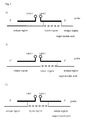
- Figure 2 illustrates 3 alternative FRET Hybprobe designs, which however, are not limiting the scope of the invention.
- the second probe comprising the repetitive region has a melting temperature which is higher than the melting temperature of the probe containing no repetitive sequences, since the FRET process is interrupted as soon as one probe is dissociated from the target molecule.
- Fig. 2A discloses a pair of hybridization probes, wherein the first hybridization probe consists exclusively of non repetitive sequences which are complementary to a region in close vicinity upstream of the repetitive region to be analyzed.
- the fluorescent label is attached to the 3' end of the probe.
- the second probe is designed according to the invention and therefore has a sequence complementary to a non repetitive sequence and a second sequence complementary to the repeat sequence of the target nucleic acid. This probe carries the fluorescent label at its 5' end, which is brought into close vicinity with the label of the first probe, when both probes are hybridized to the target molecule.
- the probe consisting exclusively of non repetitive sequences carries a label at its 5' end and hybridizes downstream of the repetitive region, whereas the second probe designed according to the invention is labeled at its 3' end.
- Fig. 2B illustrates an alternative approach of probe design according to the invention.
- the fluorescent label of the probe containing both repetitive and non repetitive sequences is attached at the repetitive segment of the probe.
- loops within this probe will be generated, such that the melting temperature is decreased.
- Both probes comprise a first segment which is complementary to a non repetitive region and a second segment which is complementary to an adjacent repetitive region, said second segment consisting of a defined number of repeats.
- the two fluorescent labels are then attached within the repetitive region of the two probes.
- the number of repeats present in both probes together corresponds to the maximum number of repeats which may be expected in the target nucleic acid to be analyzed. Again, if there are less repeats present in the target nucleic acid, loop structures within the hybridization probes are formed and the melting temperatures are lowered.
- this embodiment of the invention is especially useful for the analysis of very long repeat structures, moreover because the maximum length of an oligonucleotide hybridization probe is limited by the capacities of conventional oligonucleotide synthesis chemistry.
- a probe design may result in decreased specificity, since these probes may also bind together to genomic loci different from the repeat locus of interest, in case these loci consist of the same type of repeats.
- the invention is suitable for a variety of different applications for analyzing repetitive sequences and especially for analysing Microsatellite repeats: For example, Microstaellite repeat analysis according to the invention can be applied for assessing Loss of Heterozygosity as an indicator for genomic imbalance of tumor suppressor genes, thus beeing indicative of several types of tumors (Knudson, Proc. Natl. Acad. Sci. US 90, p 10914-10921, 1993).
- the new invention is applicable for the analysis of Microsatellite instability, which is indicative for mutations in mismatch repair genes and therefore known to be indicative for hereditary non-polyposis colorectal cancer (HNPCC) (Peltomaki et al., Science 260, p 810-812, 1993).
- HNPCC hereditary non-polyposis colorectal cancer
- other types of cancers like e.g. small cell lung cancer also may be prediagnosed.
- the invention is generally applicable for all types of population studies and forensic applications including pesonal identification, tissue typing and population genetic analyses (Koeth et al., J. of Path. 178, p. 239-248, 1996).
- Tumor and normal tissue regions were microdissected for LightCycler analysis from 5 ⁇ m sections of formalin-fixed paraffin-embedded tissues by laser assisted (PALM, Bernried, Germany) or manual microdissection. DNA from microdissected tissues was prepared by High Pure PCR Preparation Kit (Roche).
- the LightCycler (Roche Molecular Biochemicals) was used for subsequent Real Time PCR amplification monitoring.
- BAT26 PCR amplification program started with a single denaturation step at 95°C for 90 sec and proceeded with 50 cycles of 95°C/0 sec, 60°C/10sec, 50°C/3 sec for signal detection, and 72°C/ 10 sec. Afterwards, a melting profile was established by incubating the amplicons at 95°C/0sec, 35°C/30sec, and increasing temperature to 95°C with 0.2°/sec with a continously canal F2 detection
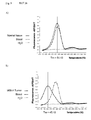
- BAT26 melting point analysis revealed a melting temperature (Tm) of 51-51,8°C for normal tissue, blood or MSS tumors (Fig.3A).
- Tm melting temperature
- Fig.3B melting temperature
- the BAT25 amplification program contained a single denaturation step at 95°C for 90 sec and 50 cycles of 95°C/0 sec, 60°C/10sec for signal detection, and 72°C/10sec. Melting profile was established by incubating the amplicons at 95°C/0sec, 30°C/30sec and a temperature ramp to 95°C with 0.2°/sec with a continously F3 detection. Results are shown in Fig. 4.
- the melting point analysis of BAT25 revealed a Tm of 44.5°C in normal tissue and MSS tumor DNA (Fig. 4A) whereas BAT25-Tm of two MSI-H tumors was significantly lower at 42°C (Fig.4B).
- the LightCycler amplification program was as follows: a single denaturation step at 95°C for 90sec and 50 cycles of 95°C/0 sec, 60°C/10sec, 45°C/2sec. for signal detection, and 72°C/10sec.
- the duplex melting curve program was: 95°C/0 sec, 30°C/30 sec and a temperature ramp to 95°C with 0.2 °/sec with a continously fluorescence detection at F2 and F3.
Landscapes
- Chemical & Material Sciences (AREA)
- Organic Chemistry (AREA)
- Life Sciences & Earth Sciences (AREA)
- Zoology (AREA)
- Wood Science & Technology (AREA)
- Proteomics, Peptides & Aminoacids (AREA)
- Health & Medical Sciences (AREA)
- Engineering & Computer Science (AREA)
- Microbiology (AREA)
- Immunology (AREA)
- Physics & Mathematics (AREA)
- Molecular Biology (AREA)
- Biotechnology (AREA)
- Biophysics (AREA)
- Analytical Chemistry (AREA)
- Biochemistry (AREA)
- Bioinformatics & Cheminformatics (AREA)
- General Engineering & Computer Science (AREA)
- General Health & Medical Sciences (AREA)
- Genetics & Genomics (AREA)
- Measuring Or Testing Involving Enzymes Or Micro-Organisms (AREA)
Priority Applications (1)
| Application Number | Priority Date | Filing Date | Title |
|---|---|---|---|
| EP01126930A EP1207210B1 (fr) | 2000-11-15 | 2001-11-13 | Procédé d'analyse de produits de la PCR répétitive au moyen de la courbe de dénaturation thermique |
Applications Claiming Priority (3)
| Application Number | Priority Date | Filing Date | Title |
|---|---|---|---|
| EP00124897 | 2000-11-15 | ||
| EP00124897 | 2000-11-15 | ||
| EP01126930A EP1207210B1 (fr) | 2000-11-15 | 2001-11-13 | Procédé d'analyse de produits de la PCR répétitive au moyen de la courbe de dénaturation thermique |
Publications (2)
| Publication Number | Publication Date |
|---|---|
| EP1207210A1 true EP1207210A1 (fr) | 2002-05-22 |
| EP1207210B1 EP1207210B1 (fr) | 2005-10-12 |
Family
ID=26071597
Family Applications (1)
| Application Number | Title | Priority Date | Filing Date |
|---|---|---|---|
| EP01126930A Expired - Lifetime EP1207210B1 (fr) | 2000-11-15 | 2001-11-13 | Procédé d'analyse de produits de la PCR répétitive au moyen de la courbe de dénaturation thermique |
Country Status (1)
| Country | Link |
|---|---|
| EP (1) | EP1207210B1 (fr) |
Cited By (8)
| Publication number | Priority date | Publication date | Assignee | Title |
|---|---|---|---|---|
| US6664064B1 (en) * | 2000-11-15 | 2003-12-16 | Roche Diagnostics Corporation | Method for melting curve analysis of repetitive PCR products |
| EP1405920A3 (fr) * | 2002-10-02 | 2004-04-14 | Roche Diagnostics GmbH | Méthode améliorée de FRET |
| WO2004031408A1 (fr) * | 2002-09-30 | 2004-04-15 | F.Hoffmann-La Roche Ag | Oligonucleotides pour le genotypage du gene de thymidylate synthase |
| EP1403382A3 (fr) * | 2002-08-06 | 2004-05-06 | Roche Diagnostics GmbH | Sondes améliorées de FRET |
| EP1426447A1 (fr) * | 2002-12-06 | 2004-06-09 | Roche Diagnostics GmbH | Méthode de détection de bactéries pathogéniques et gram positives, sélectionné des genera Staphylococcus, Enterococcus et Streptococcus |
| WO2006070666A1 (fr) * | 2004-12-28 | 2006-07-06 | Takara Bio Inc. | Procede de detection simultanee de polymorphismes genetiques |
| EP1748083A1 (fr) * | 2005-07-25 | 2007-01-31 | Roche Diagnostics GmbH | Procédés et reactifs pour détecter d'acides nucléic cibles |
| GB2497510A (en) * | 2011-11-10 | 2013-06-19 | Harry Cuppens | Methods for determining mononucleotide sequence repeats |
Citations (6)
| Publication number | Priority date | Publication date | Assignee | Title |
|---|---|---|---|---|
| WO1997027328A1 (fr) * | 1996-01-26 | 1997-07-31 | Abbott Laboratories | Methode d'analyse de sequences repetees d'acide nucleique |
| WO1998011433A1 (fr) * | 1996-09-12 | 1998-03-19 | Varian Australia Pty. Ltd. | Methode d'analyse d'un adn |
| WO1998018965A1 (fr) * | 1996-10-29 | 1998-05-07 | University Of Nebraska At Lincoln | Procede de detection des mutations ponctuelles dans de l'adn a l'aide du transfert d'energie de fluorescence |
| WO1999012031A1 (fr) * | 1997-08-29 | 1999-03-11 | Southern Cross University | Technique de genotypage |
| US6083701A (en) * | 1996-11-29 | 2000-07-04 | Amersham Pharmacia Biotech Uk Limited | Method for determining tandem repeat sequence length |
| US6140054A (en) * | 1998-09-30 | 2000-10-31 | University Of Utah Research Foundation | Multiplex genotyping using fluorescent hybridization probes |
-
2001
- 2001-11-13 EP EP01126930A patent/EP1207210B1/fr not_active Expired - Lifetime
Patent Citations (6)
| Publication number | Priority date | Publication date | Assignee | Title |
|---|---|---|---|---|
| WO1997027328A1 (fr) * | 1996-01-26 | 1997-07-31 | Abbott Laboratories | Methode d'analyse de sequences repetees d'acide nucleique |
| WO1998011433A1 (fr) * | 1996-09-12 | 1998-03-19 | Varian Australia Pty. Ltd. | Methode d'analyse d'un adn |
| WO1998018965A1 (fr) * | 1996-10-29 | 1998-05-07 | University Of Nebraska At Lincoln | Procede de detection des mutations ponctuelles dans de l'adn a l'aide du transfert d'energie de fluorescence |
| US6083701A (en) * | 1996-11-29 | 2000-07-04 | Amersham Pharmacia Biotech Uk Limited | Method for determining tandem repeat sequence length |
| WO1999012031A1 (fr) * | 1997-08-29 | 1999-03-11 | Southern Cross University | Technique de genotypage |
| US6140054A (en) * | 1998-09-30 | 2000-10-31 | University Of Utah Research Foundation | Multiplex genotyping using fluorescent hybridization probes |
Cited By (13)
| Publication number | Priority date | Publication date | Assignee | Title |
|---|---|---|---|---|
| US6664064B1 (en) * | 2000-11-15 | 2003-12-16 | Roche Diagnostics Corporation | Method for melting curve analysis of repetitive PCR products |
| EP1403382A3 (fr) * | 2002-08-06 | 2004-05-06 | Roche Diagnostics GmbH | Sondes améliorées de FRET |
| US7919235B2 (en) | 2002-09-30 | 2011-04-05 | F. Hoffman-La Roche Ag | Oligonucleotides for genotyping thymidylate synthase gene |
| WO2004031408A1 (fr) * | 2002-09-30 | 2004-04-15 | F.Hoffmann-La Roche Ag | Oligonucleotides pour le genotypage du gene de thymidylate synthase |
| US8507225B2 (en) | 2002-09-30 | 2013-08-13 | F. Hoffmann-La Roche Ag | Oligonucleotides for genotyping thymidylate synthase gene |
| EP1405920A3 (fr) * | 2002-10-02 | 2004-04-14 | Roche Diagnostics GmbH | Méthode améliorée de FRET |
| EP1426447A1 (fr) * | 2002-12-06 | 2004-06-09 | Roche Diagnostics GmbH | Méthode de détection de bactéries pathogéniques et gram positives, sélectionné des genera Staphylococcus, Enterococcus et Streptococcus |
| WO2004053148A1 (fr) * | 2002-12-06 | 2004-06-24 | Roche Diagnostics Gmbh | Methode de detection de bacteries gram positif pathogenes appartenant aux genres staphylococcus, enterococcus et streptococcus |
| WO2006070666A1 (fr) * | 2004-12-28 | 2006-07-06 | Takara Bio Inc. | Procede de detection simultanee de polymorphismes genetiques |
| US7977108B2 (en) | 2005-07-25 | 2011-07-12 | Roche Molecular Systems, Inc. | Method for detecting a mutation in a repetitive nucleic acid sequence |
| EP1748083A1 (fr) * | 2005-07-25 | 2007-01-31 | Roche Diagnostics GmbH | Procédés et reactifs pour détecter d'acides nucléic cibles |
| GB2497510A (en) * | 2011-11-10 | 2013-06-19 | Harry Cuppens | Methods for determining mononucleotide sequence repeats |
| US9695466B2 (en) | 2011-11-10 | 2017-07-04 | Dname-It | Methods to reduce repeats of identical nucleotides in copies of a target DNA molecule including such repeats |
Also Published As
| Publication number | Publication date |
|---|---|
| EP1207210B1 (fr) | 2005-10-12 |
Similar Documents
| Publication | Publication Date | Title |
|---|---|---|
| US6664064B1 (en) | Method for melting curve analysis of repetitive PCR products | |
| Wen et al. | Comparison of TP53 mutations identified by oligonucleotide microarray and conventional DNA sequence analysis | |
| US6475738B2 (en) | Methods for detecting mutations using primer extension for detecting disease | |
| JP5112592B2 (ja) | ハイブリダイゼーション・ビーコン、並びに迅速に配列を検出および判別する方法 | |
| CA2786696C (fr) | Oligonucleotides et methodes de detection des mutations pik3c4 | |
| WO1995015400A1 (fr) | Genotypage par analyse simultanee de multiples loci a microsatellites | |
| EP1975254A1 (fr) | Procede de detection d'une sequence d'acide nucleique en utilisant une sonde intramoleculaire | |
| HK1216653A1 (zh) | 多重核酸檢測方法 | |
| JP2015508995A (ja) | 核酸ハイブリダイゼーションプローブ | |
| JP3752466B2 (ja) | 遺伝子検査方法 | |
| JP2013090622A (ja) | 多型検出用プローブ、多型検出方法、薬効判定方法及び多型検出用キット | |
| KR101857227B1 (ko) | 다중 증폭 이중 시그널 증폭에 의한 암 유전자 분석 방법 및 이를 위한 암 유전자 분석용 키트 | |
| JP2018528780A (ja) | 短いホモポリマー反復の改良された検出 | |
| EP1207210B1 (fr) | Procédé d'analyse de produits de la PCR répétitive au moyen de la courbe de dénaturation thermique | |
| JP2003518951A (ja) | 多型核酸配列の同時増幅およびリアルタイム検出のための方法 | |
| Moranova et al. | Electrochemical detection of BRAF V600E mutation in a liquid biopsy format: LAMPing the way to an improved diagnostics and treatment | |
| US20030113723A1 (en) | Method for evaluating microsatellite instability in a tumor sample | |
| WO2016093333A1 (fr) | Procédé de détection de mutation de base et kit, et procédé pour supprimer l'amplification en chaîne par la polymérase d'un échantillon d'acide nucléique | |
| WO2010048691A1 (fr) | Test de génotypage multiplex permettant la détection de mutations dans le gène k-ras | |
| US20040106109A1 (en) | Detection of ras mutations | |
| US20250043362A1 (en) | Selective digital multiplexing | |
| EP4700132A1 (fr) | Procédé de détection d'adnct cible et kit de détection d'adnct cible | |
| WO2002029005A2 (fr) | Detection de mutations de ras | |
| EP3458603A1 (fr) | Polymorphismes penta e pour identification humaine | |
| JP5584385B2 (ja) | ヒトパピローマウイルスの検出法及びタイピング方法 |
Legal Events
| Date | Code | Title | Description |
|---|---|---|---|
| PUAI | Public reference made under article 153(3) epc to a published international application that has entered the european phase |
Free format text: ORIGINAL CODE: 0009012 |
|
| AX | Request for extension of the european patent |
Free format text: AL;LT;LV;MK;RO;SI |
|
| 17P | Request for examination filed |
Effective date: 20021122 |
|
| AKX | Designation fees paid |
Designated state(s): AT BE CH CY DE DK ES FI FR GB GR IE IT LI LU MC NL PT SE TR |
|
| 17Q | First examination report despatched |
Effective date: 20030916 |
|
| GRAP | Despatch of communication of intention to grant a patent |
Free format text: ORIGINAL CODE: EPIDOSNIGR1 |
|
| GRAS | Grant fee paid |
Free format text: ORIGINAL CODE: EPIDOSNIGR3 |
|
| GRAA | (expected) grant |
Free format text: ORIGINAL CODE: 0009210 |
|
| AK | Designated contracting states |
Kind code of ref document: B1 Designated state(s): AT BE CH CY DE DK ES FI FR GB GR IE IT LI LU MC NL PT SE TR |
|
| PG25 | Lapsed in a contracting state [announced via postgrant information from national office to epo] |
Ref country code: IT Free format text: LAPSE BECAUSE OF FAILURE TO SUBMIT A TRANSLATION OF THE DESCRIPTION OR TO PAY THE FEE WITHIN THE PRESCRIBED TIME-LIMIT;WARNING: LAPSES OF ITALIAN PATENTS WITH EFFECTIVE DATE BEFORE 2007 MAY HAVE OCCURRED AT ANY TIME BEFORE 2007. THE CORRECT EFFECTIVE DATE MAY BE DIFFERENT FROM THE ONE RECORDED. Effective date: 20051012 Ref country code: NL Free format text: LAPSE BECAUSE OF FAILURE TO SUBMIT A TRANSLATION OF THE DESCRIPTION OR TO PAY THE FEE WITHIN THE PRESCRIBED TIME-LIMIT Effective date: 20051012 Ref country code: BE Free format text: LAPSE BECAUSE OF FAILURE TO SUBMIT A TRANSLATION OF THE DESCRIPTION OR TO PAY THE FEE WITHIN THE PRESCRIBED TIME-LIMIT Effective date: 20051012 Ref country code: TR Free format text: LAPSE BECAUSE OF FAILURE TO SUBMIT A TRANSLATION OF THE DESCRIPTION OR TO PAY THE FEE WITHIN THE PRESCRIBED TIME-LIMIT Effective date: 20051012 Ref country code: AT Free format text: LAPSE BECAUSE OF FAILURE TO SUBMIT A TRANSLATION OF THE DESCRIPTION OR TO PAY THE FEE WITHIN THE PRESCRIBED TIME-LIMIT Effective date: 20051012 Ref country code: CH Free format text: LAPSE BECAUSE OF FAILURE TO SUBMIT A TRANSLATION OF THE DESCRIPTION OR TO PAY THE FEE WITHIN THE PRESCRIBED TIME-LIMIT Effective date: 20051012 Ref country code: LI Free format text: LAPSE BECAUSE OF FAILURE TO SUBMIT A TRANSLATION OF THE DESCRIPTION OR TO PAY THE FEE WITHIN THE PRESCRIBED TIME-LIMIT Effective date: 20051012 Ref country code: FI Free format text: LAPSE BECAUSE OF FAILURE TO SUBMIT A TRANSLATION OF THE DESCRIPTION OR TO PAY THE FEE WITHIN THE PRESCRIBED TIME-LIMIT Effective date: 20051012 |
|
| REG | Reference to a national code |
Ref country code: GB Ref legal event code: FG4D |
|
| REG | Reference to a national code |
Ref country code: CH Ref legal event code: EP |
|
| REG | Reference to a national code |
Ref country code: IE Ref legal event code: FG4D |
|
| PG25 | Lapsed in a contracting state [announced via postgrant information from national office to epo] |
Ref country code: CY Free format text: LAPSE BECAUSE OF FAILURE TO SUBMIT A TRANSLATION OF THE DESCRIPTION OR TO PAY THE FEE WITHIN THE PRESCRIBED TIME-LIMIT Effective date: 20051113 |
|
| PG25 | Lapsed in a contracting state [announced via postgrant information from national office to epo] |
Ref country code: IE Free format text: LAPSE BECAUSE OF NON-PAYMENT OF DUE FEES Effective date: 20051114 |
|
| REF | Corresponds to: |
Ref document number: 60113945 Country of ref document: DE Date of ref document: 20051117 Kind code of ref document: P |
|
| PG25 | Lapsed in a contracting state [announced via postgrant information from national office to epo] |
Ref country code: MC Free format text: LAPSE BECAUSE OF NON-PAYMENT OF DUE FEES Effective date: 20051130 |
|
| PG25 | Lapsed in a contracting state [announced via postgrant information from national office to epo] |
Ref country code: LU Free format text: LAPSE BECAUSE OF NON-PAYMENT OF DUE FEES Effective date: 20051212 |
|
| PG25 | Lapsed in a contracting state [announced via postgrant information from national office to epo] |
Ref country code: SE Free format text: LAPSE BECAUSE OF FAILURE TO SUBMIT A TRANSLATION OF THE DESCRIPTION OR TO PAY THE FEE WITHIN THE PRESCRIBED TIME-LIMIT Effective date: 20060112 Ref country code: GR Free format text: LAPSE BECAUSE OF FAILURE TO SUBMIT A TRANSLATION OF THE DESCRIPTION OR TO PAY THE FEE WITHIN THE PRESCRIBED TIME-LIMIT Effective date: 20060112 Ref country code: DK Free format text: LAPSE BECAUSE OF FAILURE TO SUBMIT A TRANSLATION OF THE DESCRIPTION OR TO PAY THE FEE WITHIN THE PRESCRIBED TIME-LIMIT Effective date: 20060112 |
|
| PG25 | Lapsed in a contracting state [announced via postgrant information from national office to epo] |
Ref country code: ES Free format text: LAPSE BECAUSE OF FAILURE TO SUBMIT A TRANSLATION OF THE DESCRIPTION OR TO PAY THE FEE WITHIN THE PRESCRIBED TIME-LIMIT Effective date: 20060123 |
|
| PG25 | Lapsed in a contracting state [announced via postgrant information from national office to epo] |
Ref country code: PT Free format text: LAPSE BECAUSE OF FAILURE TO SUBMIT A TRANSLATION OF THE DESCRIPTION OR TO PAY THE FEE WITHIN THE PRESCRIBED TIME-LIMIT Effective date: 20060313 |
|
| NLV1 | Nl: lapsed or annulled due to failure to fulfill the requirements of art. 29p and 29m of the patents act | ||
| REG | Reference to a national code |
Ref country code: CH Ref legal event code: PL |
|
| ET | Fr: translation filed | ||
| PLBE | No opposition filed within time limit |
Free format text: ORIGINAL CODE: 0009261 |
|
| STAA | Information on the status of an ep patent application or granted ep patent |
Free format text: STATUS: NO OPPOSITION FILED WITHIN TIME LIMIT |
|
| REG | Reference to a national code |
Ref country code: IE Ref legal event code: MM4A |
|
| 26N | No opposition filed |
Effective date: 20060713 |
|
| PGFP | Annual fee paid to national office [announced via postgrant information from national office to epo] |
Ref country code: DE Payment date: 20071130 Year of fee payment: 7 |
|
| PGFP | Annual fee paid to national office [announced via postgrant information from national office to epo] |
Ref country code: FR Payment date: 20071105 Year of fee payment: 7 Ref country code: GB Payment date: 20071005 Year of fee payment: 7 |
|
| GBPC | Gb: european patent ceased through non-payment of renewal fee |
Effective date: 20081113 |
|
| REG | Reference to a national code |
Ref country code: FR Ref legal event code: ST Effective date: 20090731 |
|
| PG25 | Lapsed in a contracting state [announced via postgrant information from national office to epo] |
Ref country code: DE Free format text: LAPSE BECAUSE OF NON-PAYMENT OF DUE FEES Effective date: 20090603 |
|
| PG25 | Lapsed in a contracting state [announced via postgrant information from national office to epo] |
Ref country code: GB Free format text: LAPSE BECAUSE OF NON-PAYMENT OF DUE FEES Effective date: 20081113 |
|
| PG25 | Lapsed in a contracting state [announced via postgrant information from national office to epo] |
Ref country code: FR Free format text: LAPSE BECAUSE OF NON-PAYMENT OF DUE FEES Effective date: 20081130 |