EP1207656A2 - System und Verfahren zur Datenübertragung - Google Patents
System und Verfahren zur Datenübertragung Download PDFInfo
- Publication number
- EP1207656A2 EP1207656A2 EP01308862A EP01308862A EP1207656A2 EP 1207656 A2 EP1207656 A2 EP 1207656A2 EP 01308862 A EP01308862 A EP 01308862A EP 01308862 A EP01308862 A EP 01308862A EP 1207656 A2 EP1207656 A2 EP 1207656A2
- Authority
- EP
- European Patent Office
- Prior art keywords
- network
- data
- mobile device
- transmitter
- communication link
- Prior art date
- Legal status (The legal status is an assumption and is not a legal conclusion. Google has not performed a legal analysis and makes no representation as to the accuracy of the status listed.)
- Withdrawn
Links
Images


Classifications
-
- H—ELECTRICITY
- H04—ELECTRIC COMMUNICATION TECHNIQUE
- H04W—WIRELESS COMMUNICATION NETWORKS
- H04W88/00—Devices specially adapted for wireless communication networks, e.g. terminals, base stations or access point devices
- H04W88/02—Terminal devices
- H04W88/06—Terminal devices adapted for operation in multiple networks or having at least two operational modes, e.g. multi-mode terminals
-
- H—ELECTRICITY
- H04—ELECTRIC COMMUNICATION TECHNIQUE
- H04L—TRANSMISSION OF DIGITAL INFORMATION, e.g. TELEGRAPHIC COMMUNICATION
- H04L12/00—Data switching networks
- H04L12/54—Store-and-forward switching systems
- H04L12/56—Packet switching systems
- H04L12/5691—Access to open networks; Ingress point selection, e.g. ISP selection
- H04L12/5692—Selection among different networks
-
- H—ELECTRICITY
- H04—ELECTRIC COMMUNICATION TECHNIQUE
- H04L—TRANSMISSION OF DIGITAL INFORMATION, e.g. TELEGRAPHIC COMMUNICATION
- H04L9/00—Cryptographic mechanisms or cryptographic arrangements for secret or secure communications; Network security protocols
- H04L9/40—Network security protocols
-
- H—ELECTRICITY
- H04—ELECTRIC COMMUNICATION TECHNIQUE
- H04L—TRANSMISSION OF DIGITAL INFORMATION, e.g. TELEGRAPHIC COMMUNICATION
- H04L69/00—Network arrangements, protocols or services independent of the application payload and not provided for in the other groups of this subclass
- H04L69/14—Multichannel or multilink protocols
-
- H—ELECTRICITY
- H04—ELECTRIC COMMUNICATION TECHNIQUE
- H04W—WIRELESS COMMUNICATION NETWORKS
- H04W4/00—Services specially adapted for wireless communication networks; Facilities therefor
-
- H—ELECTRICITY
- H04—ELECTRIC COMMUNICATION TECHNIQUE
- H04W—WIRELESS COMMUNICATION NETWORKS
- H04W68/00—User notification, e.g. alerting and paging, for incoming communication, change of service or the like
-
- H—ELECTRICITY
- H04—ELECTRIC COMMUNICATION TECHNIQUE
- H04W—WIRELESS COMMUNICATION NETWORKS
- H04W84/00—Network topologies
- H04W84/02—Hierarchically pre-organised networks, e.g. paging networks, cellular networks, WLAN [Wireless Local Area Network] or WLL [Wireless Local Loop]
- H04W84/10—Small scale networks; Flat hierarchical networks
-
- H—ELECTRICITY
- H04—ELECTRIC COMMUNICATION TECHNIQUE
- H04W—WIRELESS COMMUNICATION NETWORKS
- H04W92/00—Interfaces specially adapted for wireless communication networks
- H04W92/02—Inter-networking arrangements
Definitions
- the present invention relates to a data transfer system and apparatus and a method of data transfer. More particularly, but not exclusively, it relates to a data transfer system, apparatus and method for telecommunication with a mobile device.
- mobile device encompasses but is not limited to all mobile receivers or transceivers of data, for example personal digital assistants, mobile telephones and lap top computers.
- communications network and network encompasses, but is not limited to computer and telephony networks wherein data is passed over the network between entities/devices connected to the network.
- Data is used to refer to any form of information carried over the network, for example video, telephony, audio or textual information.
- WAP wireless application protocol
- GSM Global System for Mobile Communications
- GPRS General Packet Radio System
- GPRS achievable data transfer rates may be as low as 30kbits -1 .
- a method of data transfer including:
- the method may include providing the first communication link over a PLMN.
- the PLMN may provide the first communication link in a cellular structure.
- the first communication link may be effected via a GSM network or alternatively via a GPRS or 3G network.
- the method may also include providing the second communication link via a wide band short-range (WBSR) network.
- WBSR wide band short-range
- Short range is taken to include distances of up to a few tens of metres or up to a few hundreds of metres.
- the second communication link may be provided via a wireless network or alternatively via a hardwired connection to the mobile device.
- the second communication link may be provided using any one of IEEE802.11, Bluetooth, or HIPERLAN.
- the method may further include providing the second communication link at a fixed location.
- the second communication link may be provided in the unlicensed portion of the electromagnetic spectrum, (e.g. ISM bands).
- ISM bands unlicensed portion of the electromagnetic spectrum
- the first and second communication links may only be temporarily formed.
- the method may include the step of notifying the mobile device at a first bit rate which is lower than a second bit rate at which the data is transferred to the mobile device.
- the second bit rate is at least x5, x10, x20, x30, x40, x50, x100, x250, >x250, greater than the first bit rate, or in which the second bit rate is between any pair of the above listed values a multiple of the first bit rate.
- the first communication link and second communication link may transmit an alert message plus data (alert via first communications link, data via second) such that the rate of the time and/or amount of data transmitted by the first communication link relative to the second communication link is 1:5, 1:10, 1:20, 1:30, 1:40, 1:50, 1:100, 1:200, 1:500, 1:10N, 1:500, 1:1000, 1:5000, 1:10000, or higher.
- the notification of the data awaiting transfer may be provided as an SMS message or as an audible signal or as an alert through WAP.
- the method may further include the step of providing either or both of the mobile device or/and a location of a base station of the second communication link with GPS sensors thus allowing the nearest location of the second location link to the mobile device to be ascertained.
- the method may further include the step of providing a plurality of second communication links at a plurality of locations, for example in/on telephone boxes, at traffic signals, in/on public transport stations.
- the method may also include the steps of encrypting the data prior to its transfer to the mobile device; passing a decrypting code to the mobile device via the first communication link; and decrypting the data once received at the mobile device using said decrypting code.
- a method of data transfer to a mobile device comprising providing a mobile device communicatable with a first communications network and with a second communication network;
- the second network has the capability of transferring the data to the device more cheaply than if it were transferred over the first network.
- the first and second networks have telecommunication links to the device of different bandwidths/or data rates: preferably the second network has a bandwidth/data rate that is significantly higher than that of the first network.
- the method may include the step of transferring the message to the device at a bit rate which is lower than the bit rate at which the data is transferred to the device.
- the second bit rate is at least x5, x10, x20, x30, x40, x100, x250, or >x250, greater than the first bit rate, or in which the second bit rate is between any pair of the above listed values a multiple of the first bit rate.
- the first network comprises a wireless network, with wireless communication to the mobile device.
- the second network may have a wireless link with the device when the device is in range of a second network transmitter and/or receiver.
- the second network has a wireless link to mobile device, with the link preferably being in the unlicensed spectrum (e.g. in the GHz range, possibly in the 2.4 GHz band or thereabouts, e.g. within 10 or 20 or so GHz).
- the link preferably being in the unlicensed spectrum (e.g. in the GHz range, possibly in the 2.4 GHz band or thereabouts, e.g. within 10 or 20 or so GHz).
- a method of data transfer including;
- a data transfer system comprising a network, a mobile device, a first transmitter and a second transmitter, the network being adapted to contain data, the mobile device being adapted to receive signals from both the first and second transmitters, the first transmitter being adapted to transmit a signal to the mobile device when data on the network is available to be transferred to the mobile device, the second transmitter being adapted to transmit data to the mobile device.
- the network may be an internet or it may be an intranet. Alternatively it may be the Internet.
- the network may include a telecommunication network.
- the network may include a public land mobile network (PLMN) which may be cellular.
- PLMN public land mobile network
- the network may be a cellular telecommunication network.
- the network may be a GSM network or, alternatively, it may be a GPRS network or it may be a third generation mobile telecommunication network.
- the network may have at least two network elements.
- the network may include at least one server.
- the first transmitter may be a relatively low bandwidth (data transfer rate) transmitter.
- the transmitter may be a GSM transmitter, i.e. 9kbits -1 maximum bandwidth or it may be a GPRS transmitter, i.e. 115kbits -1 maximum bandwidth.
- the first transmitter may operate at a frequency within the range of about 900 MHz to about 1900 MHz. Alternatively or additionally it may generate at a frequency at or near the 2 GHz band.
- the first transmitter may also be capable of receiving signals from the mobile device.
- the first transmitter may be a long range transmitter, for example, have a useable range in excess of 100m, or excess of 500m, or_in excess of a kilometre or more, or several kilometers or more. Typically the first transmitter will have a range of at least 1km, more typically at least a 5km.
- the first transmitter may be a PLMN transmitter and may be a cellular telecommunications transmitter. Alternatively, the first transmitter may be satellite based.
- the signal transmitted by the first transmitter may be a digitally encoded signal.
- the signal may be a textual message, for example a short message service (SMS) signal.
- SMS short message service
- the signal may be an audible or a visual signal.
- the signal may be in the form of a wireless application protocol (WAP) signal.
- WAP wireless application protocol
- the purpose of the transmitted signal may be to alert a user of the mobile device that data on the network is available for download to the mobile device, in use.
- the second transmitter may be a high bandwidth (data transfer rate) transmitter.
- the transmitter may be a short-range transmitter for example having a range of up to a few hundred metres, more typically a few tens of metres or ten metres.
- the transmitter may be a wireless local area network (LAN) base station.
- the second transmitter may operate at a frequency within the range of the order of a GHz, (e.g. 2.4 GHz or a few_GHz), to, say, a few tens of GHz.
- the transmitter may employ IEEE802 for data transfer, more typically the transmitter may employ IEEE802.11 protocols giving a maximum bandwidth of 11Mbits -1 .
- the transmitter may employ Bluetooth having a maximum bandwidth of 1Mbits -1 , or HIPERLAN, having a maximum bandwidth of 23Mbits -1 or_54 Mbits -1 (there are two HIPERLAN'S).
- the second transmitter may be removably hardwired to the mobile device when data transfer is required. The second transmitter may establish a high bandwidth channel with the mobile device.
- a plurality of second transmitters may be distributed geographically.
- the geographic distribution of the second transmitters serves to increase accessibility by users.
- the second transmitters may be located on/in public telephone boxes. This has the advantage of incorporating a ready means of accessing the network.
- the second transmitters could be mounted on traffic signals or located on/in public transport or at public transport stations/stops.
- the second transmitter may operate in an unlicensed portion of the electromagnetic spectrum, typically of the order of tens of GHz. As the second transmitter may act only as a conduit for data it will have only limited memory requirements.
- the data may be a digitally encoded form of any one of, or a combination of, text, for example E-mail using the simple mail transfer protocol (SMTP) or facsimile, still video image, for example a JPEG encoded image, moving video images, for example an MPEG encoded image, real time video images or audio.
- SMTP simple mail transfer protocol
- JPEG encoded image still video image
- moving video images for example an MPEG encoded image
- real time video images or audio real time video images or audio.
- the mobile device may be a mobile telephone, it may be a personal digital assistant (PDA) or a laptop computer.
- PDA personal digital assistant
- the means for receiving signals from either, or both of, the first and second transmitters may be in the form of an additional, non-integral component, for example a "card", which can be fitted to the mobile device.
- An existing mobile device may be converted into one in accordance with the present invention by fitting an appropriate card, or chip or other insert or add-on, or by loading appropriate software.
- the mobile device may be fitted with a global positioning system (GPS) sensor, as may the second transmitter.
- GPS global positioning system
- the mobile device may use the GPS sensors signals to determine the closest second transmitter and direct a mobile device user to the closest second transmitter.
- the mobile device may determine is position by communications with other devices in its vicinity who know their position (e.g. mobile devices which do have GPS, or fixed devices, e.g. street furniture (e.g. lamp post, traffic lights etc.)) by communication over WBSR links, giving an accuracy of a few tens of metres. This allows a mobile device user to be directed to the closest/most convenient second transmitter.
- position e.g. mobile devices which do have GPS, or fixed devices, e.g. street furniture (e.g. lamp post, traffic lights etc.)
- WBSR links giving an accuracy of a few tens of metres. This allows a mobile device user to be directed to the closest/most convenient second transmitter.
- the data may be encrypted.
- a key may be required to decrypt the data.
- the key may be a public key.
- the public key may originate from the public key infrastructure. The use of encryption and public keys increases the security of the data downloaded onto the mobile device.
- the data may be electronically watermarked. There may be an electronic authentication certificate associated with the public key.
- a converter device adapted for use with a network having an interface, suitable to interface with a mobile device and a wide band communication link such that the device is capable of allowing the mobile device to perform any of the preceding methods according to the present invention, thereby converting a mobile device into a mobile device in accordance with the present invention.
- a wide bandwidth short range transceiver adapted to mediate a flow of data between a mobile device and a network in response to a request from said mobile device, the mobile device having received a notification that the data is awaiting transfer via a wireless network, e.g. cellular network or satellite based.
- a wireless network e.g. cellular network or satellite based.
- a mobile telecommunications device having a long range telecommunications link, a wide bandwidth telecommunications link, a control processor, and a program memory carrying a program accessible by the control processor, the control processor, in use, being capable of operating the program so as to enable the device to receive an incoming long range telecommunications signal indicative of the presence of data being available elsewhere at a high bandwidth telecommunications signal station and to inform the user of the device that there is data to be collected from a remote high bandwidth station.
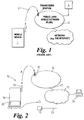
- Figure 1 shows a mobile device 1 (in this case a personal digital assistant, PDA) communicable with a PLMN2 via a wireless link 3.
- a remote device 4 wishing to send the PDA 1 data accesses the PLMN2 and sends the data over the PLMN2 and link 3.
- the data is sent out at, say, 9.6Kbits -1 .
- FIG. 2 is a diagram of a data transfer system embodying the invention.
- the data transfer system 10 includes a network 12 (e.g. a land/fibre/wire - based network), a PLMN 14, a WBSR (Wide Band Short Range) base station transceiver 16 and a mobile device 18, again in this example a PDA.
- a network 12 e.g. a land/fibre/wire - based network
- PLMN 14 e.g. a land/fibre/wire - based network
- WBSR Wide Band Short Range
- the mobile device 18 has a first transceiver 19 capable of two-way communication with the PLMN 14 and also a second transceiver 20 capable of communicating with the WBSR base station 16.
- the transceiver 20 in this example is capable of 2-way communication with its base station 16, but in another example it may be capable of receive only.
- the network 12 may be the Internet and is connected to the PLMN 14 and the WBSR base station 16 by respective transmission links 21, 22. These would typically not be wireless, but wire, or optical fibre hard connections (of course, they may be wireless).
- Data resident upon the network 12 can either be requested by a user of the mobile device 18 or can be sent to the mobile device 18 from a network element, such as a computer, present on the network 12.
- the network element sending the information to the mobile device 18 may be connected to the network 12 only temporarily.
- a message is routed along the land-line link 21 to the PLMN 14.
- the PLMN 14 locates the mobile device 18 within its cellular structure and passes the message to an appropriate transceiver station 26.
- the message comprises a notification that data is awaiting transfer from the network 12 to the device 18 and this message is passed from the station 26 to the first transceiver 19 of the device 18 (notified by the arrow A is Figure 2) by wireless transmission.
- a user of the mobile device 18 Upon receipt of a "data is waiting" message a user of the mobile device 18 decides whether they wish to receiver the data from the network 12 via the low bandwidth PLMN 14 connection, this typically having a data transfer rate of 9kbits -1 for GSM and an average data transfer rate of 30 kbits -1 for GPRS, or whether the user wishes to move to within range of a WBSR base station 16 (if they are not already in range).
- the message transmitted to the device 18 via the wireless link A may include one or more of the following: the amount of data to be transmitted; the time it will take to transmit the data via the PLMN14; the cost of the telephone call/telecommunication charge if they choose to transmit the data to the device via the PLMN; an indication of the level of urgency that the sender of the data thinks the recipient should give to receiving the data; the location of, directions to, distance to, or time to, at least one (preferably the nearest) WBSR base station (or the WBSR base station that is estimated will enable the user to download the data fastest). Another embodiment also gives distance/time to a selection of nearest WBSR base stations - some may have a queue or better data transfer rates.
- the data can be optionally encrypted by the sender by software provided by a network element, for example the computer 24, or a programmable logic array (PLA) or E 2 PROM.
- a network element for example the computer 24, or a programmable logic array (PLA) or E 2 PROM.
- PKA programmable logic array
- E 2 PROM E 2 PROM.
- PKI public key infrastructure
- the data which can be of any form, e.g. text, audio or visual signals or any combination of the three, remains within the network 12 until the user brings the device 18 within range, typically tens of metres, of the WBSR base station 16 and a request is made by the user via the device 18 and base station 16 to download the data from network 12.
- the network 12 When a request to download the data is received by the network 12 the network knows which WBSR base station 16 to route the data to (there will usually be many WBSR base stations on the network). The data is passed to the correct WBSR link and through the WBSR base station 16 to the second transceiver 20 of the device 18.
- the receiver/user of the mobile device may be able to select which WBSR base station, out of a choice of them, will receive the data, possibly in advance of being within range of the WBSR base station.
- the system may send it to the selected base station then, without waiting for the device to be in communication with the station 16, the data being stored at the WBSR station 16 for downloading. This may allow for slower rates of data transfer to the WBSR station because there will be a delay in the device 18 requesting the data from the station 18 because it will have to get there first (within the physical proximity).
- the WBSR base station 16 in many embodiments acts only as a conduit for the flow of data it may require only a small amount of buffer memory. This low memory requirement would increase the speed and reduces the power requirements, of the WBSR base station.
- a further refinement of the present invention allows a user of the mobile device to transfer data onto the network 12.
- the user enters or loads the data onto the mobile device 18.
- the mobile device 18 can determine whether it is preferable to upload the data onto the network via the PLMN 14 or the WBSR base station 16. This decision may be made from a pre-programmed "cost-benefit" type analysis which may include such criteria as amount of data to be uploaded, estimated time/cost of upload via PLMN 14 and distance to the nearest/most convenient WBSR base station 16.
- the data to be uploaded can, in an embodiment, be split into a first, minor, portion which is transmitted via the PLMN 14 and a second, major, portion which is transmitted when the mobile device 18 is within range, typically a few tens of metres or a WBSR band station 16.
- the data could be uploaded onto the network 12 in a single block via either the PLMN 14 or the WBSR base station 16.
- There may be software at the base station which assesses the data and generates a suitable information "data waiting" message to be sent by conventional mobile phone e.m. spectrum.
- the first, minor, data portion is a notification message similar to that in the embodiment detailed hereinbefore.
- the wireless technologies used in the WBSR base station to mobile device data transfer are typically, one of Bluetooth, IEEE 802.11 or HIPERLAN.
- Typical mobile devices include mobile telephones, personal digital assistants (PDA's) and laptop computers.
- PDA's personal digital assistants
- laptop computers laptop computers.
- the mobile device need not have means for communicating with a WBSR base station mounted integrally therewith, for example such means could be mounted upon a card which is inserted in a port in the mobile device.
- the communication means may take the form of a computer program which re-programs the mobile device to allow it to interface with a WBSR base station.
- FIG 3 shows a schematic representation geographically distributed array of WBSR base stations 16 connected to a network 12.
- the stations 16 are mounted on various platforms including a traffic signal 28, a telephone kiosk 30, a turnstile 32, for example at a sports stadium or subway station, and at a rail station (or other public transport depot) 34.
- the PLMN 14 could notify a user that a party wishes to video conference with them (as a common example of a high data-rate activity).
- the user could then locate a WBSR 16a which has been adapted for video conferencing by the provision of a screen 36, camera 38, microphone 40, and a booth 41 (for privacy) or could video conference via a computer 42 or via their mobile device 18 if it had a camera, screen microphone, and speaker (the booth or private area would then not need video conferencing equipment).
- the WBSR base stations can be situated in any area where there will be a significant density of potential users, or where a lot of users will pass by (e.g. a gateway entrance to a building or mall).
- the number of WBSR base stations will depend upon a variety of factors including increasing the number of transceivers in areas where there is a high density of users, such as shopping malls, in order to maintain high data transfer rates.
- An attraction of such sites as telephone kiosks is that they already have telecommunication links.
- An attraction of traffic signals and turnstiles e.g. subway turnstiles
- the traffic may come to a standstill, which will facilitate data transfer; the mobile device will dwell in the vicinity of the base station for a significant amount of time, time enough for data transfer._Another possible site for mounting the base stations 16 is at post boxes.
- the mobile device 18 may have respective GPS transceivers 44, 45 built into them. These GPS transceivers 44, 45 allow the mobile device 18 to estimate which WBSR base station 16 is the nearest to the present position of the mobile device 18. It is possible that the mobile device 18 may have a map 44 of its locale programmed into it (or downloadable to it) and will be able to display the map showing locations of the WBSR base stations 16 in order to direct the user to the nearest/most convenient WBSR base station 16. The map may be automatically updated via the PLMN 14 at such time as the mobile device 18 enters a different cell. Alternatively, directions (or the address or location) may be displayed/audio presented to the user without actually displaying a map. Some mobile devices may not have a display screen.
- the mobile device 18 may have a "learn" facility whereby it learns a users usual route or a daily pattern of movement and can therefore direct the data to a convenient WBSR base station 16.
- This convenient WBSR base station 16 may not be the nearest base station but one may be passed by the user during their ordinary daily movements.
- the mobile device 18 may not have position awareness but may communicate via a WBSR link 49 with fixed bodies, for example street lights 48, traffic signals 50, or turnstiles 52, which have GPS transceivers 54 mounted thereupon.
- the mobile device 18 can use the positional data obtained from the fixed bodies in order to estimate its own position and which WBSR base station 16 is the nearest/most convenient.
- the device 18 could additionally or alternatively communicate with other mobile devices that do have GPS facility and know their position.
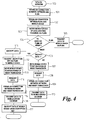
- Figure 4 is a flow chart showing the processes involved in the transfer of data according to the method of the present invention.
- Data is put onto the network in some way (not shown), data which is resident upon the network 12 (step 100) and is addressed to the mobile device 18 causes a connection to be established between the network 12 and the PLMN 14 (step 101) and prompts the formation of a connection between the PLMN 14 and the mobile device 18 (step 102).
- the mobile device 18 is passed a notification that there is data awaiting transfer (step 103) and the user decides whether to download the data via the PLMN 14 or via a WBSR base station 16 (step 104).
- the data is transmitted in the conventional, prior art, way (step 105).
- a choice as to whether to encrypt that data, or not, is made either by the user or as a privacy flag set by the sender (step 106).
- This choice need not be present as encryption may not be present in the system or may be automatic dependent upon the infrastructure provided by the service provided.
- the mobile device 18 If it is decided not to encrypt the data the mobile device 18 must be brought with the transmission range of a WBSR base station 16 (step 107) and a request for the data from the network 12 made. (step 108). Typically, it may be necessary to be within a few tens of metres of the base station 16 for telecommunication with it (e.g. within 10m or so).
- This request for the data is relayed by the WBSR station back to the network in order that the data can be addressed to the correct WBSR base station 16 and a connection established between the network 12 and WBSR base station 16 (step 109).
- the data is then passed to the WBSR base station via the connection and is transmitted to the mobile device 18 via the WBSR base station (step 110).
- the data is encrypted using a known technique such as the public key infrastructure (step 111) and the decryption key and authentication certificate is passed over the PLMN to the mobile device (step 112).
- the establishing of a connection and transmission of data is the same as for the non-encrypted case (steps 113, 114, 115, 116).
- the encrypted data is decrypted at the mobile device using the decryption key passed over the PLMN (step 117).
- the WBSR stations 16 communicate with the mobile device 18 using the unlicensed spectrum of wavelengths - i.e. free (no payment to licensor of spectrum/reserved frequencies).
- a large amount of data can be transferred at a lower cost than using the PLMN for the whole of the data.
- Just a short alerting message can be sent on the expensive PLMN and the vast majority of the data sent on the much cheaper Internet/other cheap network to the right base station 16, which will then use unlicensed spectrum.
- the mobile device and the base station may communicate via the licensed spectrum instead of the unlicensed (or as well as using unlicensed spectrum). For example, preferential prices for use of one or more licensed bands may be available for the base station - mobile device communication. If this were so there would still be a cost saving for the user to take their mobile device to the base station.
- connection between the device 18 and the base station 16 could be a wired connection (e.g. plug the device into a port), but wireless telecommunication had advantages. For example a person could have their data automatically transferred to them as they walked past a mass transit turnstile or doorway, without having to stop specifically to collect it.
- the data transmitted via the first and/or second communication link could be any sort of data.
- it could be voice, voice plus video image, just static data (eg. text or documents or images), or indeed anything.
Landscapes
- Engineering & Computer Science (AREA)
- Computer Networks & Wireless Communication (AREA)
- Signal Processing (AREA)
- Computer Security & Cryptography (AREA)
- Mobile Radio Communication Systems (AREA)
- Data Exchanges In Wide-Area Networks (AREA)
Applications Claiming Priority (2)
| Application Number | Priority Date | Filing Date | Title |
|---|---|---|---|
| US715131 | 1985-03-22 | ||
| US09/715,131 US7257386B1 (en) | 2000-11-20 | 2000-11-20 | Data transfer system and method of data transfer |
Publications (2)
| Publication Number | Publication Date |
|---|---|
| EP1207656A2 true EP1207656A2 (de) | 2002-05-22 |
| EP1207656A3 EP1207656A3 (de) | 2003-09-03 |
Family
ID=24872781
Family Applications (1)
| Application Number | Title | Priority Date | Filing Date |
|---|---|---|---|
| EP01308862A Withdrawn EP1207656A3 (de) | 2000-11-20 | 2001-10-18 | System und Verfahren zur Datenübertragung |
Country Status (3)
| Country | Link |
|---|---|
| US (1) | US7257386B1 (de) |
| EP (1) | EP1207656A3 (de) |
| JP (1) | JP2002209276A (de) |
Cited By (11)
| Publication number | Priority date | Publication date | Assignee | Title |
|---|---|---|---|---|
| EP1432212A1 (de) * | 2002-12-19 | 2004-06-23 | TeliaSonera Finland Oyj | Verfahren und System für die drahtlose Übertragung eines elektronischen Dienstes zu einem Endgerät |
| WO2004062114A2 (en) | 2002-06-21 | 2004-07-22 | Thomson Licensing S.A. | Multimedia content delivery through wlan coverage area |
| EP1553728A1 (de) * | 2004-01-07 | 2005-07-13 | Nec Corporation | Verfahren zur Auswahl eines drahtlosen Pfades in einem tragbaren Kommunikationsendgerät, tragbares Kommunikationsendgerät und entsprechendes System. |
| EP1648184A1 (de) * | 2004-10-12 | 2006-04-19 | Deutsche Telekom AG | Kommunikationsverfahren zum Zugang in ein Telekommunikationsnetz über einen öffentlichen Zugangpunkt |
| US7454215B2 (en) | 2002-08-30 | 2008-11-18 | Fujitsu Limited | Communication method, communication apparatus and communication system |
| US7558198B2 (en) | 2002-08-19 | 2009-07-07 | Motorola, Inc. | Method and apparatus for data transfer |
| GB2457140A (en) * | 2008-02-07 | 2009-08-12 | Wilico Wireless Networking Sol | Providing information to a mobile communications device |
| WO2010034114A1 (en) * | 2008-09-29 | 2010-04-01 | Nortel Networks Limited | Gigabit wireless transmission |
| US20120066347A1 (en) * | 2010-09-14 | 2012-03-15 | Fujitsu Limited | Method and System for Facilitating Remote Downloading |
| US9344483B2 (en) | 2010-10-13 | 2016-05-17 | Fujitsu Limited | System and method for facilitating remote downloading |
| JP2016220044A (ja) * | 2015-05-20 | 2016-12-22 | 株式会社Nttドコモ | 通信制御装置、端末装置および移動体通信システム |
Families Citing this family (15)
| Publication number | Priority date | Publication date | Assignee | Title |
|---|---|---|---|---|
| JP5118793B2 (ja) * | 2000-06-29 | 2013-01-16 | ソニー株式会社 | サービス提供システム |
| US7890099B2 (en) * | 2001-02-26 | 2011-02-15 | Kineto Wireless, Inc. | Method for automatic and seamless call transfers between a licensed wireless system and an unlicensed wireless system |
| US7391761B1 (en) | 2001-12-21 | 2008-06-24 | At&T Delaware Intellectual Property, Inc. | System and method for voice over internet protocol using a standard telephone system |
| US7545780B2 (en) * | 2002-05-28 | 2009-06-09 | Interdigital Technology Corporation | Flow-based selective reverse tunneling in wireless local area network (WLAN)-cellular systems |
| TWI445358B (zh) * | 2003-03-27 | 2014-07-11 | Lenovo Singapore Pte Ltd | 提供存取無線區域網路的方法、電腦程式元件及行動站 |
| JP2004357095A (ja) | 2003-05-30 | 2004-12-16 | Sony Corp | 情報処理システム、情報処理装置および情報処理方法、受信装置および受信方法、並びにプログラム |
| US8359349B2 (en) * | 2004-03-18 | 2013-01-22 | Nokia Corporation | System and associated terminal, method and computer program product for uploading content |
| JP2006014230A (ja) * | 2004-06-29 | 2006-01-12 | Toshiba Corp | 無線通信システム及び通信端末 |
| KR100750043B1 (ko) * | 2004-12-16 | 2007-08-16 | 후지쯔 가부시끼가이샤 | 통신 방법, 통신 장치 및 통신 시스템 |
| US20070066314A1 (en) * | 2005-08-24 | 2007-03-22 | Itay Sherman | System and method for wireless communication systems coexistence |
| KR100845695B1 (ko) * | 2007-06-22 | 2008-07-11 | 후지쯔 가부시끼가이샤 | 통신 방법 |
| US8753209B2 (en) * | 2007-08-31 | 2014-06-17 | Adobe Systems Incorporated | Dedicated device ports for data exchange |
| US9596309B2 (en) * | 2008-09-03 | 2017-03-14 | Alcatel-Lucent Usa Inc. | Method and apparatus for parameterized promotion and delivery of data |
| US9215283B2 (en) * | 2011-09-30 | 2015-12-15 | Alcatel Lucent | System and method for mobility and multi-homing content retrieval applications |
| US9369823B2 (en) * | 2013-09-24 | 2016-06-14 | Google Technology Holdings LLC | System and method for transferring software applications and data between two mobile devices with different operating systems |
Family Cites Families (29)
| Publication number | Priority date | Publication date | Assignee | Title |
|---|---|---|---|---|
| US5754961A (en) * | 1994-06-20 | 1998-05-19 | Kabushiki Kaisha Toshiba | Radio communication system including SDL having transmission rate of relatively high speed |
| US5589838A (en) * | 1994-09-06 | 1996-12-31 | The Regents Of The University Of California | Short range radio locator system |
| FI103245B (fi) | 1995-05-10 | 1999-05-14 | Sonera Oyj | Menetelmä solukkoradiojärjestelmän matkaviestimen käyttäjän opastamise ksi sekä tietoliikennejärjestelmän palvelukeskus |
| US5809415A (en) * | 1995-12-11 | 1998-09-15 | Unwired Planet, Inc. | Method and architecture for an interactive two-way data communication network |
| GB2313981B (en) | 1996-06-06 | 2001-04-18 | Roke Manor Research | Assymetric communications channel for a portable computer |
| US6813261B1 (en) * | 1996-08-07 | 2004-11-02 | Hitachi, Ltd. | Method of mobile communication and apparatus therefor |
| US6643506B1 (en) * | 1996-08-07 | 2003-11-04 | Telxon Corporation | Wireless software upgrades with version control |
| US6253061B1 (en) * | 1997-09-19 | 2001-06-26 | Richard J. Helferich | Systems and methods for delivering information to a transmitting and receiving device |
| US6496928B1 (en) | 1998-01-07 | 2002-12-17 | Microsoft Corporation | System for transmitting subscription information and content to a mobile device |
| MY121817A (en) * | 1998-02-19 | 2006-02-28 | Swisscom Mobile Ag | Game system, corresponding method and adapted devices |
| US6421781B1 (en) * | 1998-04-30 | 2002-07-16 | Openwave Systems Inc. | Method and apparatus for maintaining security in a push server |
| US6138158A (en) * | 1998-04-30 | 2000-10-24 | Phone.Com, Inc. | Method and system for pushing and pulling data using wideband and narrowband transport systems |
| FI105978B (fi) | 1998-05-12 | 2000-10-31 | Nokia Mobile Phones Ltd | Menetelmä langattoman päätelaitteen kytkemiseksi tiedonsiirtoverkkoon ja langaton päätelaite |
| US6198941B1 (en) * | 1998-08-07 | 2001-03-06 | Lucent Technologies Inc. | Method of operating a portable communication device |
| US6493550B1 (en) * | 1998-11-20 | 2002-12-10 | Ericsson Inc. | System proximity detection by mobile stations |
| FI108506B (fi) * | 1999-01-11 | 2002-01-31 | Ericsson Telefon Ab L M | Paikallisia langattomia palveluita |
| US6577849B1 (en) * | 1999-02-03 | 2003-06-10 | Motorola, Inc. | Method and apparatus for providing additional information about a broadcast |
| US20020013852A1 (en) * | 2000-03-03 | 2002-01-31 | Craig Janik | System for providing content, management, and interactivity for thin client devices |
| JP2000270007A (ja) * | 1999-03-12 | 2000-09-29 | Sony Corp | ネットワークシステム、ネットワークサーバ及び端末装置 |
| US6453371B1 (en) * | 1999-04-23 | 2002-09-17 | Palm, Inc. | Method, apparatus, and system for selection of a port for data exchange |
| US6524189B1 (en) * | 1999-07-09 | 2003-02-25 | Nokia Corporation | Multi-player game system using mobile telephone and game unit |
| US6587835B1 (en) * | 2000-02-09 | 2003-07-01 | G. Victor Treyz | Shopping assistance with handheld computing device |
| US6714797B1 (en) * | 2000-05-17 | 2004-03-30 | Nokia Corporation | System and method for the transfer of digital data to a mobile device |
| US6754484B1 (en) * | 2000-07-10 | 2004-06-22 | Nokia Corporation | Short messaging using information beacons |
| US6470180B1 (en) * | 2000-07-31 | 2002-10-22 | Motorola, Inc. | Exploiting a broadcast system to enhance a wireless gaming experience |
| US20020022961A1 (en) * | 2000-08-15 | 2002-02-21 | Stefan Sepanaho | Displaying information on a portable digital device by transmission of a universal resource locator over a short-range radio frequency link |
| US7035932B1 (en) * | 2000-10-27 | 2006-04-25 | Eric Morgan Dowling | Federated multiprotocol communication |
| US6600913B1 (en) * | 2000-10-27 | 2003-07-29 | Sony International (Europe) Gmbh | Two-port demodulation device |
| WO2009054146A1 (ja) | 2007-10-26 | 2009-04-30 | Panasonic Corporation | ホッピング方法、無線通信端末装置および無線通信基地局装置 |
-
2000
- 2000-11-20 US US09/715,131 patent/US7257386B1/en not_active Expired - Lifetime
-
2001
- 2001-10-18 EP EP01308862A patent/EP1207656A3/de not_active Withdrawn
- 2001-11-16 JP JP2001351156A patent/JP2002209276A/ja active Pending
Cited By (23)
| Publication number | Priority date | Publication date | Assignee | Title |
|---|---|---|---|---|
| EP1532826A4 (de) * | 2002-06-21 | 2008-12-10 | Thomson Licensing | Übermitteln von multimediainhalten durch ein wlan-deckungsgebiet |
| WO2004062114A2 (en) | 2002-06-21 | 2004-07-22 | Thomson Licensing S.A. | Multimedia content delivery through wlan coverage area |
| JP2013081191A (ja) * | 2002-06-21 | 2013-05-02 | Thomson Licensing | Wlan受信可能領域を通じたマルチメディアコンテンツ配信 |
| JP2006508621A (ja) * | 2002-06-21 | 2006-03-09 | トムソン ライセンシング | Wlan受信可能領域を通じたマルチメディアコンテンツ配信 |
| US7558198B2 (en) | 2002-08-19 | 2009-07-07 | Motorola, Inc. | Method and apparatus for data transfer |
| US7454215B2 (en) | 2002-08-30 | 2008-11-18 | Fujitsu Limited | Communication method, communication apparatus and communication system |
| CN100477846C (zh) * | 2002-08-30 | 2009-04-08 | 富士通株式会社 | 通信方法和通信装置以及通信系统 |
| US7949339B2 (en) | 2002-08-30 | 2011-05-24 | Fujitsu Limited | Communication method, communication apparatus and communication system |
| US7983683B2 (en) | 2002-08-30 | 2011-07-19 | Fujitsu Limited | Communication method, communication apparatus and communication system |
| EP1432212A1 (de) * | 2002-12-19 | 2004-06-23 | TeliaSonera Finland Oyj | Verfahren und System für die drahtlose Übertragung eines elektronischen Dienstes zu einem Endgerät |
| US7233784B2 (en) | 2004-01-07 | 2007-06-19 | Nec Corporation | Method for selecting wireless path of portable communication terminal, portable communication terminal and wireless communication system for use thereof |
| EP1553728A1 (de) * | 2004-01-07 | 2005-07-13 | Nec Corporation | Verfahren zur Auswahl eines drahtlosen Pfades in einem tragbaren Kommunikationsendgerät, tragbares Kommunikationsendgerät und entsprechendes System. |
| EP1648184A1 (de) * | 2004-10-12 | 2006-04-19 | Deutsche Telekom AG | Kommunikationsverfahren zum Zugang in ein Telekommunikationsnetz über einen öffentlichen Zugangpunkt |
| US8200276B2 (en) | 2004-10-12 | 2012-06-12 | Deutsche Telekom Ag | Communication method |
| GB2457140A (en) * | 2008-02-07 | 2009-08-12 | Wilico Wireless Networking Sol | Providing information to a mobile communications device |
| WO2010034114A1 (en) * | 2008-09-29 | 2010-04-01 | Nortel Networks Limited | Gigabit wireless transmission |
| EP2332372A4 (de) * | 2008-09-29 | 2015-03-11 | Apple Inc | Drahtlose gigabit-übertragung |
| GB2483754A (en) * | 2010-09-14 | 2012-03-21 | Fujitsu Ltd | Method and system for facilitating remote downloading |
| US20120066347A1 (en) * | 2010-09-14 | 2012-03-15 | Fujitsu Limited | Method and System for Facilitating Remote Downloading |
| US8719380B2 (en) * | 2010-09-14 | 2014-05-06 | Fujitsu Limited | Method and system for facilitating remote downloading |
| GB2483754B (en) * | 2010-09-14 | 2017-01-18 | Fujitsu Ltd | Method and system for facilitating remote downloading |
| US9344483B2 (en) | 2010-10-13 | 2016-05-17 | Fujitsu Limited | System and method for facilitating remote downloading |
| JP2016220044A (ja) * | 2015-05-20 | 2016-12-22 | 株式会社Nttドコモ | 通信制御装置、端末装置および移動体通信システム |
Also Published As
| Publication number | Publication date |
|---|---|
| EP1207656A3 (de) | 2003-09-03 |
| US7257386B1 (en) | 2007-08-14 |
| JP2002209276A (ja) | 2002-07-26 |
Similar Documents
| Publication | Publication Date | Title |
|---|---|---|
| US7257386B1 (en) | Data transfer system and method of data transfer | |
| JP4201601B2 (ja) | 情報サービスを提供するためのビーコンを有する機器構成 | |
| US9179296B2 (en) | System and method for device authentication in a dynamic network using wireless communication devices | |
| JP4641350B2 (ja) | 情報通信システム、情報端末、サーバー、インターネット接続方法および広告配信方法 | |
| US6636256B1 (en) | Video communication system | |
| EP1457081B1 (de) | Verfahren und vorrichtung zum umschalten des zugriffs zwischen mobilnetzwerken | |
| KR100769741B1 (ko) | 무선 통신 시스템, 무선 통신 장치, 무선 통신 단말, 및 이동 무선 통신 장치 | |
| US9609513B2 (en) | System and method for device authentication in a dynamic network using wireless communication devices | |
| EP1113678A2 (de) | Positionsgeheimhaltung für drahtlose Mobilstationen und Verwendungsverfahren | |
| EP1085696B1 (de) | Verfahren und System zur Strassenfahrzeugkommunikation | |
| EP1414190B1 (de) | Verfahren und System zur Information über eine WLAN-Zugänglichkeit an einen Benutzter | |
| US20040097260A1 (en) | Communication infrastructure | |
| KR101668267B1 (ko) | 웹 서비스를 제공하는 모바일 단말 및 그의 동작방법, 웹 서비스 제공 시스템 및 방법 | |
| EP1530342A2 (de) | Mobiles Kommunikationsendgerät, mobiles Kommunikationssystem und Inhaltsablieferungssystem | |
| JP2002077190A (ja) | 携帯端末、ローカル無線サーバ、及び申し込みサーバ | |
| EP3185601A1 (de) | System und verfahren zur vorrichtungsauthentifizierung in einem dynamischen netzwerk mit drahtloskommunikationsvorrichtungen und kommunikationsübergabe von mobilen auf wifi netzwerk | |
| US9479919B2 (en) | Network with isolated nodes | |
| US20030134659A1 (en) | Personal digital assistant, wireless communication system and method of link establishment | |
| JP2010109688A (ja) | 蓄積搬送通信システム、無線通信端末、ベースノード、リレー及び仮想セグメント接続網 | |
| KR100627738B1 (ko) | 이동 통신 단말기를 이용한 목적지 도착 알림 서비스 방법 | |
| US8014350B2 (en) | Method and equipment for data transmission by ad-hoc network | |
| ES2292030T3 (es) | Aparato de gestion de conexion, sistema de gestion de conexion y procedimiento de gestion de conexion. | |
| GB2399715A (en) | Traffic and road condition data capture and distribution system for a mobile telecommunications network | |
| EP2337381B1 (de) | Drahtlose basisstation, drahtlosnetzwerksteuerung und automatisches vernetzungsverfahren | |
| RU2754639C1 (ru) | Сотовый телефон |
Legal Events
| Date | Code | Title | Description |
|---|---|---|---|
| PUAI | Public reference made under article 153(3) epc to a published international application that has entered the european phase |
Free format text: ORIGINAL CODE: 0009012 |
|
| AX | Request for extension of the european patent |
Free format text: AL;LT;LV;MK;RO;SI |
|
| PUAL | Search report despatched |
Free format text: ORIGINAL CODE: 0009013 |
|
| AK | Designated contracting states |
Kind code of ref document: A3 Designated state(s): AT BE CH CY DE DK ES FI FR GB GR IE IT LI LU MC NL PT SE TR |
|
| AX | Request for extension of the european patent |
Extension state: AL LT LV MK RO SI |
|
| 17P | Request for examination filed |
Effective date: 20040227 |
|
| AKX | Designation fees paid |
Designated state(s): DE FR GB |
|
| 17Q | First examination report despatched |
Effective date: 20040423 |
|
| STAA | Information on the status of an ep patent application or granted ep patent |
Free format text: STATUS: THE APPLICATION IS DEEMED TO BE WITHDRAWN |
|
| 18D | Application deemed to be withdrawn |
Effective date: 20070501 |