EP1209247B1 - Procédé de dépôt chimique en phase vapeur pour la production d'un revêtement modifié adhésive d'aluminure de platine afin d'améliorer la performance à haute température - Google Patents
Procédé de dépôt chimique en phase vapeur pour la production d'un revêtement modifié adhésive d'aluminure de platine afin d'améliorer la performance à haute température Download PDFInfo
- Publication number
- EP1209247B1 EP1209247B1 EP01306073A EP01306073A EP1209247B1 EP 1209247 B1 EP1209247 B1 EP 1209247B1 EP 01306073 A EP01306073 A EP 01306073A EP 01306073 A EP01306073 A EP 01306073A EP 1209247 B1 EP1209247 B1 EP 1209247B1
- Authority
- EP
- European Patent Office
- Prior art keywords
- reactive metal
- gas generator
- gas
- retort
- halide gas
- Prior art date
- Legal status (The legal status is an assumption and is not a legal conclusion. Google has not performed a legal analysis and makes no representation as to the accuracy of the status listed.)
- Expired - Lifetime
Links
- 238000000034 method Methods 0.000 title claims description 38
- 229910000951 Aluminide Inorganic materials 0.000 title claims description 30
- 150000003057 platinum Chemical class 0.000 title claims description 14
- 230000008569 process Effects 0.000 title description 13
- 229910052751 metal Inorganic materials 0.000 claims description 54
- 239000002184 metal Substances 0.000 claims description 54
- 238000000576 coating method Methods 0.000 claims description 47
- BASFCYQUMIYNBI-UHFFFAOYSA-N platinum Chemical group [Pt] BASFCYQUMIYNBI-UHFFFAOYSA-N 0.000 claims description 46
- 239000011248 coating agent Substances 0.000 claims description 40
- 239000000758 substrate Substances 0.000 claims description 39
- 229910052735 hafnium Inorganic materials 0.000 claims description 37
- 229910000601 superalloy Inorganic materials 0.000 claims description 27
- 229910052782 aluminium Inorganic materials 0.000 claims description 26
- 238000009792 diffusion process Methods 0.000 claims description 26
- 239000000203 mixture Substances 0.000 claims description 25
- 239000000654 additive Substances 0.000 claims description 23
- 230000000996 additive effect Effects 0.000 claims description 23
- 239000012720 thermal barrier coating Substances 0.000 claims description 23
- 229910052697 platinum Inorganic materials 0.000 claims description 22
- 229910001507 metal halide Inorganic materials 0.000 claims description 19
- 150000005309 metal halides Chemical class 0.000 claims description 19
- XAGFODPZIPBFFR-UHFFFAOYSA-N aluminium Chemical compound [Al] XAGFODPZIPBFFR-UHFFFAOYSA-N 0.000 claims description 18
- 238000000151 deposition Methods 0.000 claims description 12
- 150000002739 metals Chemical class 0.000 claims description 11
- 238000010438 heat treatment Methods 0.000 claims description 10
- 229910052759 nickel Inorganic materials 0.000 claims description 9
- 239000000919 ceramic Substances 0.000 claims description 6
- 150000004820 halides Chemical class 0.000 claims description 6
- 229910052758 niobium Inorganic materials 0.000 claims description 4
- 239000012530 fluid Substances 0.000 claims description 3
- 229910052726 zirconium Inorganic materials 0.000 claims description 3
- 229910052684 Cerium Inorganic materials 0.000 claims description 2
- GIGQFSYNIXPBCE-UHFFFAOYSA-N alumane;platinum Chemical compound [AlH3].[Pt] GIGQFSYNIXPBCE-UHFFFAOYSA-N 0.000 claims description 2
- 229910052746 lanthanum Inorganic materials 0.000 claims description 2
- 238000002156 mixing Methods 0.000 claims description 2
- 229910052720 vanadium Inorganic materials 0.000 claims description 2
- 239000007789 gas Substances 0.000 description 87
- VBJZVLUMGGDVMO-UHFFFAOYSA-N hafnium atom Chemical compound [Hf] VBJZVLUMGGDVMO-UHFFFAOYSA-N 0.000 description 30
- VSCWAEJMTAWNJL-UHFFFAOYSA-K aluminium trichloride Chemical compound Cl[Al](Cl)Cl VSCWAEJMTAWNJL-UHFFFAOYSA-K 0.000 description 24
- 238000005229 chemical vapour deposition Methods 0.000 description 17
- PXHVJJICTQNCMI-UHFFFAOYSA-N Nickel Chemical compound [Ni] PXHVJJICTQNCMI-UHFFFAOYSA-N 0.000 description 12
- 238000012360 testing method Methods 0.000 description 11
- 230000008901 benefit Effects 0.000 description 9
- PDPJQWYGJJBYLF-UHFFFAOYSA-J hafnium tetrachloride Chemical compound Cl[Hf](Cl)(Cl)Cl PDPJQWYGJJBYLF-UHFFFAOYSA-J 0.000 description 7
- 229910052739 hydrogen Inorganic materials 0.000 description 6
- 239000001257 hydrogen Substances 0.000 description 6
- UFHFLCQGNIYNRP-UHFFFAOYSA-N Hydrogen Chemical compound [H][H] UFHFLCQGNIYNRP-UHFFFAOYSA-N 0.000 description 5
- 230000003247 decreasing effect Effects 0.000 description 5
- 230000006872 improvement Effects 0.000 description 5
- 229910017052 cobalt Inorganic materials 0.000 description 4
- 239000010941 cobalt Substances 0.000 description 4
- GUTLYIVDDKVIGB-UHFFFAOYSA-N cobalt atom Chemical compound [Co] GUTLYIVDDKVIGB-UHFFFAOYSA-N 0.000 description 4
- 239000000463 material Substances 0.000 description 4
- 239000012159 carrier gas Substances 0.000 description 3
- 239000000567 combustion gas Substances 0.000 description 3
- 238000001816 cooling Methods 0.000 description 3
- 230000008021 deposition Effects 0.000 description 3
- 230000004048 modification Effects 0.000 description 3
- 238000012986 modification Methods 0.000 description 3
- 229910052710 silicon Inorganic materials 0.000 description 3
- 229910052715 tantalum Inorganic materials 0.000 description 3
- XKRFYHLGVUSROY-UHFFFAOYSA-N Argon Chemical compound [Ar] XKRFYHLGVUSROY-UHFFFAOYSA-N 0.000 description 2
- IJGRMHOSHXDMSA-UHFFFAOYSA-N Atomic nitrogen Chemical compound N#N IJGRMHOSHXDMSA-UHFFFAOYSA-N 0.000 description 2
- VEXZGXHMUGYJMC-UHFFFAOYSA-M Chloride anion Chemical compound [Cl-] VEXZGXHMUGYJMC-UHFFFAOYSA-M 0.000 description 2
- VEXZGXHMUGYJMC-UHFFFAOYSA-N Hydrochloric acid Chemical compound Cl VEXZGXHMUGYJMC-UHFFFAOYSA-N 0.000 description 2
- NPXOKRUENSOPAO-UHFFFAOYSA-N Raney nickel Chemical compound [Al].[Ni] NPXOKRUENSOPAO-UHFFFAOYSA-N 0.000 description 2
- -1 aluminum halide Chemical class 0.000 description 2
- 238000009713 electroplating Methods 0.000 description 2
- IXCSERBJSXMMFS-UHFFFAOYSA-N hydrogen chloride Substances Cl.Cl IXCSERBJSXMMFS-UHFFFAOYSA-N 0.000 description 2
- 229910000041 hydrogen chloride Inorganic materials 0.000 description 2
- 238000004519 manufacturing process Methods 0.000 description 2
- 238000002844 melting Methods 0.000 description 2
- 230000008018 melting Effects 0.000 description 2
- 239000003607 modifier Substances 0.000 description 2
- 238000010926 purge Methods 0.000 description 2
- 230000008439 repair process Effects 0.000 description 2
- 239000010703 silicon Substances 0.000 description 2
- 229910002076 stabilized zirconia Inorganic materials 0.000 description 2
- 229910003865 HfCl4 Inorganic materials 0.000 description 1
- 229910000943 NiAl Inorganic materials 0.000 description 1
- 229910045601 alloy Inorganic materials 0.000 description 1
- 239000000956 alloy Substances 0.000 description 1
- 238000013459 approach Methods 0.000 description 1
- 229910052786 argon Inorganic materials 0.000 description 1
- 230000015572 biosynthetic process Effects 0.000 description 1
- 238000005524 ceramic coating Methods 0.000 description 1
- 238000006243 chemical reaction Methods 0.000 description 1
- 150000001805 chlorine compounds Chemical group 0.000 description 1
- 229910052804 chromium Inorganic materials 0.000 description 1
- 230000000694 effects Effects 0.000 description 1
- 230000007613 environmental effect Effects 0.000 description 1
- 239000000446 fuel Substances 0.000 description 1
- 239000001307 helium Substances 0.000 description 1
- 229910052734 helium Inorganic materials 0.000 description 1
- SWQJXJOGLNCZEY-UHFFFAOYSA-N helium atom Chemical compound [He] SWQJXJOGLNCZEY-UHFFFAOYSA-N 0.000 description 1
- 150000002431 hydrogen Chemical class 0.000 description 1
- 229910001510 metal chloride Inorganic materials 0.000 description 1
- 239000007769 metal material Substances 0.000 description 1
- 229910052750 molybdenum Inorganic materials 0.000 description 1
- 229910000907 nickel aluminide Inorganic materials 0.000 description 1
- 229910052757 nitrogen Inorganic materials 0.000 description 1
- 230000003647 oxidation Effects 0.000 description 1
- 238000007254 oxidation reaction Methods 0.000 description 1
- TWNQGVIAIRXVLR-UHFFFAOYSA-N oxo(oxoalumanyloxy)alumane Chemical compound O=[Al]O[Al]=O TWNQGVIAIRXVLR-UHFFFAOYSA-N 0.000 description 1
- 238000012545 processing Methods 0.000 description 1
- 230000001681 protective effect Effects 0.000 description 1
- 230000009467 reduction Effects 0.000 description 1
- 229910001173 rene N5 Inorganic materials 0.000 description 1
- 229910052702 rhenium Inorganic materials 0.000 description 1
- 238000000926 separation method Methods 0.000 description 1
- 239000000126 substance Substances 0.000 description 1
- 238000012546 transfer Methods 0.000 description 1
- 229910052721 tungsten Inorganic materials 0.000 description 1
- 229910052727 yttrium Inorganic materials 0.000 description 1
Images
Classifications
-
- C—CHEMISTRY; METALLURGY
- C23—COATING METALLIC MATERIAL; COATING MATERIAL WITH METALLIC MATERIAL; CHEMICAL SURFACE TREATMENT; DIFFUSION TREATMENT OF METALLIC MATERIAL; COATING BY VACUUM EVAPORATION, BY SPUTTERING, BY ION IMPLANTATION OR BY CHEMICAL VAPOUR DEPOSITION, IN GENERAL; INHIBITING CORROSION OF METALLIC MATERIAL OR INCRUSTATION IN GENERAL
- C23C—COATING METALLIC MATERIAL; COATING MATERIAL WITH METALLIC MATERIAL; SURFACE TREATMENT OF METALLIC MATERIAL BY DIFFUSION INTO THE SURFACE, BY CHEMICAL CONVERSION OR SUBSTITUTION; COATING BY VACUUM EVAPORATION, BY SPUTTERING, BY ION IMPLANTATION OR BY CHEMICAL VAPOUR DEPOSITION, IN GENERAL
- C23C10/00—Solid state diffusion of only metal elements or silicon into metallic material surfaces
- C23C10/28—Solid state diffusion of only metal elements or silicon into metallic material surfaces using solids, e.g. powders, pastes
- C23C10/34—Embedding in a powder mixture, i.e. pack cementation
- C23C10/52—Embedding in a powder mixture, i.e. pack cementation more than one element being diffused in one step
-
- C—CHEMISTRY; METALLURGY
- C23—COATING METALLIC MATERIAL; COATING MATERIAL WITH METALLIC MATERIAL; CHEMICAL SURFACE TREATMENT; DIFFUSION TREATMENT OF METALLIC MATERIAL; COATING BY VACUUM EVAPORATION, BY SPUTTERING, BY ION IMPLANTATION OR BY CHEMICAL VAPOUR DEPOSITION, IN GENERAL; INHIBITING CORROSION OF METALLIC MATERIAL OR INCRUSTATION IN GENERAL
- C23C—COATING METALLIC MATERIAL; COATING MATERIAL WITH METALLIC MATERIAL; SURFACE TREATMENT OF METALLIC MATERIAL BY DIFFUSION INTO THE SURFACE, BY CHEMICAL CONVERSION OR SUBSTITUTION; COATING BY VACUUM EVAPORATION, BY SPUTTERING, BY ION IMPLANTATION OR BY CHEMICAL VAPOUR DEPOSITION, IN GENERAL
- C23C10/00—Solid state diffusion of only metal elements or silicon into metallic material surfaces
- C23C10/02—Pretreatment of the material to be coated
-
- C—CHEMISTRY; METALLURGY
- C23—COATING METALLIC MATERIAL; COATING MATERIAL WITH METALLIC MATERIAL; CHEMICAL SURFACE TREATMENT; DIFFUSION TREATMENT OF METALLIC MATERIAL; COATING BY VACUUM EVAPORATION, BY SPUTTERING, BY ION IMPLANTATION OR BY CHEMICAL VAPOUR DEPOSITION, IN GENERAL; INHIBITING CORROSION OF METALLIC MATERIAL OR INCRUSTATION IN GENERAL
- C23C—COATING METALLIC MATERIAL; COATING MATERIAL WITH METALLIC MATERIAL; SURFACE TREATMENT OF METALLIC MATERIAL BY DIFFUSION INTO THE SURFACE, BY CHEMICAL CONVERSION OR SUBSTITUTION; COATING BY VACUUM EVAPORATION, BY SPUTTERING, BY ION IMPLANTATION OR BY CHEMICAL VAPOUR DEPOSITION, IN GENERAL
- C23C10/00—Solid state diffusion of only metal elements or silicon into metallic material surfaces
- C23C10/28—Solid state diffusion of only metal elements or silicon into metallic material surfaces using solids, e.g. powders, pastes
- C23C10/34—Embedding in a powder mixture, i.e. pack cementation
- C23C10/36—Embedding in a powder mixture, i.e. pack cementation only one element being diffused
- C23C10/48—Aluminising
- C23C10/50—Aluminising of ferrous surfaces
-
- C—CHEMISTRY; METALLURGY
- C23—COATING METALLIC MATERIAL; COATING MATERIAL WITH METALLIC MATERIAL; CHEMICAL SURFACE TREATMENT; DIFFUSION TREATMENT OF METALLIC MATERIAL; COATING BY VACUUM EVAPORATION, BY SPUTTERING, BY ION IMPLANTATION OR BY CHEMICAL VAPOUR DEPOSITION, IN GENERAL; INHIBITING CORROSION OF METALLIC MATERIAL OR INCRUSTATION IN GENERAL
- C23C—COATING METALLIC MATERIAL; COATING MATERIAL WITH METALLIC MATERIAL; SURFACE TREATMENT OF METALLIC MATERIAL BY DIFFUSION INTO THE SURFACE, BY CHEMICAL CONVERSION OR SUBSTITUTION; COATING BY VACUUM EVAPORATION, BY SPUTTERING, BY ION IMPLANTATION OR BY CHEMICAL VAPOUR DEPOSITION, IN GENERAL
- C23C16/00—Chemical coating by decomposition of gaseous compounds, without leaving reaction products of surface material in the coating, i.e. chemical vapour deposition [CVD] processes
- C23C16/44—Chemical coating by decomposition of gaseous compounds, without leaving reaction products of surface material in the coating, i.e. chemical vapour deposition [CVD] processes characterised by the method of coating
- C23C16/448—Chemical coating by decomposition of gaseous compounds, without leaving reaction products of surface material in the coating, i.e. chemical vapour deposition [CVD] processes characterised by the method of coating characterised by the method used for generating reactive gas streams, e.g. by evaporation or sublimation of precursor materials
- C23C16/4488—Chemical coating by decomposition of gaseous compounds, without leaving reaction products of surface material in the coating, i.e. chemical vapour deposition [CVD] processes characterised by the method of coating characterised by the method used for generating reactive gas streams, e.g. by evaporation or sublimation of precursor materials by in situ generation of reactive gas by chemical or electrochemical reaction
-
- Y—GENERAL TAGGING OF NEW TECHNOLOGICAL DEVELOPMENTS; GENERAL TAGGING OF CROSS-SECTIONAL TECHNOLOGIES SPANNING OVER SEVERAL SECTIONS OF THE IPC; TECHNICAL SUBJECTS COVERED BY FORMER USPC CROSS-REFERENCE ART COLLECTIONS [XRACs] AND DIGESTS
- Y02—TECHNOLOGIES OR APPLICATIONS FOR MITIGATION OR ADAPTATION AGAINST CLIMATE CHANGE
- Y02T—CLIMATE CHANGE MITIGATION TECHNOLOGIES RELATED TO TRANSPORTATION
- Y02T50/00—Aeronautics or air transport
- Y02T50/60—Efficient propulsion technologies, e.g. for aircraft
Definitions
- This invention relates generally to components of the hot section of gas turbine engines, and in particular, to a CVD aluminiding process for producing a modified platinum aluminide bond coat for improved high temperature performance.
- gas turbine engines for example, aircraft engines
- air is drawn into the front of the eng ne, compressed by a shaft-mounted rotary compressor, and mixed with fuel.
- the mixture is burned, and the hot exhaust gases are passed through a turbine mounted on a shaft.
- the flow of gas turns the turbine, which turn the shaft and drives the compressor.
- the hot exhaust gases flow from the back of the engine, providing thrust that propels the aircraft forward.
- the temperatures of combustion gases may exceed 1649°C (3,000°F), considerably higher than the melting temperatures of the metal parts of the engine, which are in contact with these gases.
- the metal parts that are particularly subject to high temperatures, and thus require particular attention with respect to cooling, are the hot section components exposed to the combustion gases, such as blades and vanes used to direct the flow of the hot gases, as well as other components such as shrouds and combustors.
- hot section components such as the turbine vanes and blades are made of cobalt-based and nickel-based superalloys, and can operate a temperatures of up to 1093-1260°C (2000°- 2300° F).
- the metal temperatures can be maintained below melting levels with current cooling techniques by using a combination of improved cooling designs and thermal barrier coatings.
- a thermal barrier coating system is applied to ihe metallic turbine component, which becomes the substrate.
- the thermal barrier coating system includes a ceramic thermal barrier coating that is applied to the external surface of metal parts within engines to impede the transfer of heat from hot combustion gases to the metal parts, thus insulating the component from the hot exhaust gas. This permits the exhaust gas to be hotter than would otherwise be possible with the particular material and fabrication process of the component.
- Thermal barrier coatings are well-known ceramic coatings, for example, ytrium stabilized zirconia. Ceramic thermal barrier coatings usually do not adhere optimally directly to the superalloys used in the substrates. Therefore, an additional metallic layer called a bond coat is placed for example, by chemical vapor deposition (CVD), between the substrate and the TBC to improve adhesion of the TBC to the underlying component.
- the bond coat is made of a diffusion nickel aluminide or platinum aluminide, whose surface oxidizes to form a protective aluminum oxide scale in addition to improving adherence of the ceramic TBC.
- the bond coat temperature is critical to the life of the TBC and has been limited to about 1149°C (2100° F). Once the bond coat exceeds this temperature, the coating system can quickly deteriorate, resulting in separation of the TBC from the bond coat.
- the addition of small amounts of reactive elements to platinum aluminide coatings, such as Hf, Si, Zr, and Y have been shown to increase performance of such coatings.
- U.S. Patent No. 5,658,614 to Basta et al. discloses a method of improving the oxidation resistance of a platinum modified aluminide coating applied to a nickel based superalloy substrate.
- a hafnium-modified aluminide coating was formed using a coating gas mixture of aluminum trichloride, hydrogen and hafnium chloride.
- the first coating gas mixture was generated externally to a retort holding the platinum-plated workpiece that was to be coated by passing hydrogen and hydrogen chloride over a pure source of aluminum.
- a second mixture of Ar and HCI was generated in a separate generator external to the retort that also contained a pure hafnium bed, thereby forming hafnium chloride.
- the mixtures were then introduced concurrently to the coating retort forming a hafnium modified outwardly grown, single phase aluminide coating, as the gases flowed over the workpiece, depositing Hf and Al.
- U.S. Patent No. 5,989,733 to Warnes et al. is directed to a CVD outwardly grown platinum aluminide diffusion coating on a nickel or cobalt based superalloy substrate wherein the platinum modified aluminide diffusion coating is modified to include a combination of hafnium and silicon in a concentration of about 0.01 % by weight (w/o) to about 8 w/o of the outer additive layer of the coating.
- the coating gas mixture was generated externally by passing high purity hydrogen and high purity hydrogen chloride over a high purity pure source of aluminum and then passing the mixture over a high purity pure source of silicon, both sources at 290 ° C (554° F). and external of the retort.
- a mixture of Ar and HCI was flowed in an external chloride generator through a hafnium bed at 430° C (806° F). Both gas coating mixtures were then introduced concurrently to the retort.
- Prior modified platinum aluminum bond coat practice involves generating two or more distinct gas coating mixtures in multiple external gas generators and concurrently introducing these mixtures into the retort.
- U.S. Patent No. 5,667,663 to Rickerby et al. discloses a method for adhering a ceramic TBC layer to a superalloy article containing a predetermined amount of aluminum. After applying a layer of platinum to the superalloy article and heat treating the article, the aluminum diffuses from the superalloy article into the platinum.
- hafnium is added to the platinum layer by chemical vapor deposition to up to a level of 0.8 w/o. Deposition of the aluminum by CVD is not disclosed.
- the present invention fulfills this need, and further provides related advantages.
- the present invention provides a method of depositing a modified platinum aluminide diffusion coating onto a superalloy substrate, comprising the steps of: applying a layer of a Pt-group metal over at least one surface of the supe alloy substrate; placing the Pt-group metal-coated superalloy substrate into a CVD retort (2): generating an Al-halide gas in an external gas generator 4); generating a modified reactive metal-halide gas by passing a portion of the Al-halide gas generated in the external gas generator (4) into an internal gas generator, a portion of which extends into the retort and that includes at least one reactive metal to produce a modified reactive metal-halide gas; the internal gas generator being positioned between the external gas generator and the retort, mixing the Al-halide gas and the modified reactive metal-halide gas together; passing the mixture of Al-halide gas and the reactive metal-halide gas over the Pt-group-plated, superalloy substrate in the retort
- reactive metals include Zr, Hf, V Nb, Ta, Y, La and Ce.
- the reactive metal is activated by the aluminum halide gas to form a mixture of aluminum halide gases and at least one reactive metal halide gas species.
- a reactive metal and aluminum are co-deposited by an internal gas generation method onto the parts to be coated as the gases pass over the parts to produce a modified single phase additive layer of platinum aluminide.
- the present invention also provides an apparatus for co-depositing reactive metals and aluminum onto a superalloy substrate comprising: a retort (2) suitable for holding the substrate; means for heating the retort to a first elevated temperature; a source of halide gas; a source of Al within an external gas generator (4); means for heating the external gas generator (4) to a second elevated temperature; means (6) for introducing the halide gas into the external gas generator (4) at preselected pressures to form an Al-halide gas; an internal gas generator (8) positioned between the external gas generator (4) and the retort (2); a fluid conduit for transporting Al-halide gas from the external gas generator (4) to the retort (2) through the internal gas generator (8); and a source of reactive metal (22) in the internal gas generator to generate a reactive metal-halide gas.
- the method of the present invention provides a chemical vapor deposited outwardly grown platinum aluminide diffusion coating on a nickel or cobalt based superalloy substrate wherein hafnium and aluminum are co-deposited by an internal gas generation method onto the platinum-plated parts to produce a single phase additive layer of platinum aluminide with up to about 0.5 percent hafnium by weight percent, and about 1 to about 15 weight percent of hafnium in the boundary between the diffusion layer and the additive layer.
- the method according to the present invention may be used to provide a TBC system for application to a superalloy substrate used in the hot section of a gas turbine engine.
- a layer of a platinum group metal is first applied to the superalloy substrate.
- a modified platinum aluminide diffusion coating is formed by applying, by co-deposition, aluminum and at least one reactive metal, such as hafnium, using chemical vapor deposition to the platinum group metal, the coating comprising a single phase additive layer of platinum aluminide with at least about 0.1 percent hafnium by weight (w/o) and about 0.1 to about 15 weight percent (w/o) of hafnium in the boundary formed by the diffusion layer between the substrate and the additive layer; and a ceramic thermal barrier coating applied to the modified platinum aluminide diffusion coating.
- the amount in weight percentage of reactive metal will vary depending upon the species selected.
- hafnium chloride and aluminum chloride gas coating mixtures are separately generated externally then concurrently introduced into the retort causing the hafnium and aluminum to precipitate out as they pass over the workpiece
- there is only one external gas generator generating the gases bearing both the reactive metal species and the aluminum.
- there is a relatively low concentration of the reactive metal so that the reactive metal is in solution with the platinum and aluminum.
- One advantage of the present invention is that the coating system produced by this invention demonstrates increased service life resulting from improved spallation resistance of the TBC system.
- Another advantage of the present invention is that the process consists of a single step that additionally coats the internal and external surfaces of an article to be coated with the modified platinum aluminum coating. This one step process allows for cost savings during the manufacturing process.
- Still another advantage of the present invention is that the internal gas generation process provides the capability for the modification of existing CVD reactors to produce reactive element-modified coatings without the addition of new external gas generation systems.
- Yet another advantage of the present invention is that the process can be easily adapted for use in airfoil material repair operations. It is advantageous to have the ability to repair a damaged section of an airfoil, rather than having to strip the entire TBC coating and completely re-bond and re-coat a TBC coating to the entire part.
- Another advantage of the present invention is that the CVD coating device and process can be simplified as the device of the present invention requires only one external gas generator.
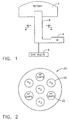
- Fig. 1 a schematic of a CVD system of a version of the present invention.
- Articles to be coated (not shown), for example, components requiring environmental coatings and/or thermal barrier coating systems were fixtured in a retort 2 after applying a layer of platinum to the article using known methods, for example, electroplating followed by an optional diffusion heat treatment.
- an optional diffusion heat treatment is performed, a mixture of Pt and PtAl 2 and NiAl can be produced.
- This optional diffusion layer can be grown into the substrate as Al and Ni from the substrate diffuse outwardly.
- These components may be, for example, components located in the hot section of a gas turbine engine, for example, a jet engine, such as, for example, turbine blades and vanes, combustors, shrouds and other such components.
- An external generator 4 receiving a flow of gas from gas inlets 6 was used to produce aluminum trichloride gas using standard CVD processes well known in the art.
- a source of halide gas is introduced into the external generator that includes a source of aluminum.
- the generator is maintained at an elevated temperature by a heat source to allow for the formation of AlCl 3 .
- the externally generated AlCl 3 gas was passed through an internal gas generator 8.
- the internal generator 8 was in the form of an array 20 of seven tubes 22 configured as shown in Fig.
- the portion of the tubes 22 disposed within the retort was perforated in a manner and in a location that allowed active gas to be released directly into the retort 2.
- a preselected number, three in the preferred embodiment, of the outer tubes 22 were filled with hafnium metal chips as shown in Fig. 2. The number of tubes filled and the amount of reactive metal chips in each tube can be varied to produce the desired partial pressure of reactive metal halide, which will affect the concentration of reactive metal deposited on the parts in the retort.
- the AlCl 3 gas produced in the external generator 4 was passed over these hafnium chips, producing internally within the retort 2 a hafnium chloride gas. It is believed that the hafnium species was most likely HfCl 4 with some lesser hafnium chloride species. At least a portion of the AlCl 3 was reduced to either a dichloride or a monochloride. While there was most likely a mixture of several metal chlorides, what is critical was that at least some of the aluminum chloride coming from the external generator 4 activated the hafnium metal, in the preferred embodiment, contained within the tubes and that aluminum chloride and hafnium chloride gases were allowed to mix well before reaching the articles to be coated.
- An inert carrier gas for example hydrogen, helium, argon or nitrogen was flowed with AlCl 3 through the remaining four tubes of the array. In this manner, the gases were thoroughly mixed and both aluminum and hafnium were co-deposited onto the part without the need for two external generators.
- the resulting additive coating consisted of a single phase microstructure that has been shown to significantly increase the furnace cycle test life of the modified platinum aluminide bond coat.
- a single phase additive layer of platinum aluminide was produced with at least about 0.1 w/o Hf, and about 0.1 to about 15 w/o Hf in the coating immediately below the additive layer in the outermost portion of the diffusion layer.
- the Hf and Al diffuse inward from the additive layer while some deposited Pt and Ni from the substrate also diffuse through the additive layer to its outer surface.
- the aluminum content of the coating as well as the platinum content of the coating can be adjusted to be any operable amount by adjusting their amounts in the additive layer.
- the single phase nature of the additive layer is believed to have occurred because the hafnium and aluminum are in solution.
- the hafnium is believed to precipitate out of solution, hence the amount of hafnium in this region can vary from the amount in the single phase additive layer, as little as 0.1w/o Hf, up to 15 w/o Hf.
- a thermal barrier coating such as yttrium-stabilized zirconia (YSZ) may be deposited over the modified platinum aluminide bond coat of the present invention using techniques well known in the art.
- TBC thermal barrier coating
- YSZ yttrium-stabilized zirconia
- the internal generator is in the form of seven tubes, three of which are occupied by hafnium chips to produce the coating having the composition as set forth above. It will be understood by those skilled in the art that the number of tubes can be increased or decreased as desired. It will be further understood by those skilled in the art that the partial pressure of the reactive metal gases delivered to the retort can be varied by increasing or decreasing the number of tubes containing the reactive metals. The partial pressure may be controlled by increasing or decreasing the amount and size of the reactive metal material in the tubes over which the halide gas must pass. By increasing or decreasing the available surface area of the reactive metal present, the activity of the reaction between the reactive metal and the chloride gas will be increased or decreased and the deposition rate can be controlled.
- the composition of the coating is also modified to include more than one reactive metal, if desired.
- these reactive metals can be added to the composition by including chips of these desired metals in one or more of the tubes shown in Fig. 2.
- tubes in the internal generator can include chips of Hf, Ta and Nb, which can be converted to chloride-bearing species of each of these elements as the AlCl 3 is passed over the metal chips.
- the desired partial pressure, and hence the amount of each reactive element in the coating can be adjusted by controlling the amount of metal chips in the tubes. More tubes have additional amounts of these reactive metals added, or additional metals added to achieve both the desired, composition and concentration in the coating.
- an optional heat treatment of from about 1 to about 4 hours at temperatures of from about 1800°F to about 2000°F (982-1093°C) is applied to allow for additional diffusion of elements from the additive layer into the diffusion layer as well as growth of the diffusion layer, and to allow elements such as Pt and Ni to diffuse into the additive layer, if desired, prior to application of a TBC.
- the optional heat treatment is not necessary, since sufficient diffusion occurs while the substrate is within the retort during CVD processing. Because the CVD process is applied at temperatures between 1800-2200°F (982-1204°C) for periods of time of 1-4 hours, there is sufficient time at elevated temperatures for diffusion to occur and for a diffusion layer to form between the additive layer and unaffected substrate.
- a sample of 20 test coupons were prepared using a composition of Rene N5 superalloy, which nominally is 7.5 wt. % Co; 6.2 wt. % Al; 7 wt. % Cr; 6.5 wt. % Ta; 5 wt. % W; 1.5 wt. % Mo; 3 wt. % Re; 0.15 wt. % Hf; 0.5 wt. % max Y; 0.05 wt. % C; 63.1 wt. % Ni; and 40 ppm B.
- All samples had a layer of platinum applied utilizing electroplating followed by a heat treatment in the temperature range of about 1800° - 2000°F (982-1093°C) for about 1 to 4 hours as is well known in the art to produce a thickness of about 7,62 ⁇ m (0.3 mils).
- Hydrogen carrier gas was flowed through the center pipe at about 189 lpm, through the inactive internal pipes (those without hafnium chips) at about 19 lpm, and through the active internal pipes (those containing the hafnium chips) at about 47 lpm for a total of about 480 minutes (not including warm-up/purge/shutdown).
- each cycle of the furnace cycle test consisted of heating the coupon to about 2125°F (1163°C) over a 10 minute period, maintaining the coupon at a temperature of about 2125°F (1163°C) for a period of about 45 minutes, and allowing the coupon to cool to a temperature of about 200° F (93°C) over a nine minute period. This cycle was repeated until there was bond failure.
- the baseline coupons had an average furnace cycle test (FCT) life of 240 cycles, while the modified platinum aluminide bond coat of the present invention had an average FCT life of 818 cycles, clearly signifying an FCT life improvement (representing increased bond strength).
- FCT furnace cycle test
- Hydrogen carrier gas was flowed through the center pipe at about 189 lpm, through the inactive internal pipes (those without hafnium chips) at about 19 lpm, and through the active internal pipes (those containing the hafnium chips) at about 47 lpm for a total of about 480 minutes (not including warm-up/purge/shutdown).
- Example 1 Following application of the modified platinum aluminide bond coat according to the present invention, the eight test coupons and were subjected to furnace cycle testing as described in Example 1 and compared to the FCT life of the three baseline coupons described in Example 1.
- the modified platinum aluminide bond coat had an average FCT life of 1008 cycles compared to the baseline coupons average FCT life of 240 cycles, clearly signifying further improvement in FCT life (representing further increased bond strength).
- a major factor in arriving at the benefits of the present invention is that the aluminum and reactive metals such as hafnium are co-deposited in solution as a single phase in the additive layer utilizing only one external gas generator.
- a further advantage of the present invention is that the process provides the capability for modification of existing CVD reactors to produce hafnium-modified coatings or coatings including a plurality of reactive metals without the addition of new external gas generation systems.
- Hf modifier has been used as an exemplar, it is envisioned other reactive metal modifiers may be utilized individually in place of Hf or in combination with Hf and with themselves, as desired.
Landscapes
- Chemical & Material Sciences (AREA)
- Chemical Kinetics & Catalysis (AREA)
- Engineering & Computer Science (AREA)
- Materials Engineering (AREA)
- Mechanical Engineering (AREA)
- Metallurgy (AREA)
- Organic Chemistry (AREA)
- General Chemical & Material Sciences (AREA)
- Electrochemistry (AREA)
- Chemical Vapour Deposition (AREA)
- Solid-Phase Diffusion Into Metallic Material Surfaces (AREA)
Claims (14)
- Procédé de dépôt d'un revêtement à diffusion d'aluminure de platine modifié sur un support en superalliage, qui comprend les étapes consistant à :appliquer une couche d'un métal du groupe du platine sur au moins une surface du support en superalliage,placer le support en superalliage revêtu du métal du groupe du platine dans l'enceinte (2) d'un dispositif de dépôt chimique à partir d'une phase gazeuse (CVD),produire un halogénure d'aluminium gazeux dans un générateur de gaz externe (4),produire un halogénure gazeux de métal réactif modifié en faisant passer une partie de l'halogénure d'aluminium gazeux produit dans le générateur de gaz externe (4), dans un générateur de gaz interne dont une partie s'étend dans l'enceinte et qui comprend au moins un métal réactif pour produire un halogénure gazeux de métal réactif modifié, le générateur de gaz interne étant placé entre le générateur de gaz externe et l'enceinte,mélanger l'halogénure d'aluminium gazeux et l'halogénure gazeux de métal réactif modifié,faire passer le mélange d'halogénure d'aluminium gazeux et de l'halogénure gazeux de métal réactif sur le support en superalliage revêtu du métal du groupe du platine, placé dans l'enceinte (2), pendant une durée fixée à l'avance et à une température fixée à l'avance, etdéposer simultanément de l'aluminium et le métal réactif sur le support en superalliage revêtu du métal du groupe du platine, pour former sur le support un revêtement d'aluminure du métal du groupe du platine, modifié par le métal réactif.
- Procédé selon la revendication 1, dans lequel l'étape de production d'un halogénure gazeux de métal réactif modifié comprend la mise en contact d'une partie de l'halogénure d'aluminium gazeux avec un générateur de gaz comprenant au moins un métal réactif choisi parmi Hf, Zr, V, Nb, Ta, Y, La et Ce.
- Procédé selon la revendication 1 ou 2, dans lequel on réalise l'étape de production d'un halogénure gazeux de métal modifié en faisant traverser à l'halogénure d'aluminium gazeux un générateur de gaz interne (8) contenant au moins un métal réactif.
- Procédé selon la revendication 3, dans lequel le générateur de gaz interne (8) comprend plusieurs tubes (22) dont au moins l'un renferme au moins un métal réactif.
- Procédé selon la revendication 4, dans lequel le générateur de gaz interne (8) comporte sept tubes (22) pour faire passer l'halogénure d'aluminium gazeux depuis le générateur de gaz externe (4) à l'enceinte (2), au moins l'un des tubes (22) renfermant une source d'au moins un métal réactif pour produire l'halogénure gazeux de métal réactif modifié.
- Procédé selon l'une quelconque des revendications précédentes, qui comprend en outre une étape d'application d'un revêtement en céramique formant une barrière thermique, sur le revêtement en aluminure de métal du groupe du platine, modifié par le métal réactif.
- Procédé selon la revendication 2, dans lequel l'étape de production d'un halogénure gazeux de métal réactif modifié comprend le passage d'une partie de l'halogénure d'aluminium gazeux dans un générateur de gaz renfermant le métal réactif Hf.
- Procédé selon la revendication 7, dans lequel l'étape de dépôt simultané de l'aluminium et du métal réactif comprend le dépôt simultané de Hf et de Al sur un support en superalliage revêtu de platine pour former un revêtement d'aluminure de platine modifié par Hf, présentant une couche d'addition, à une seule phase, d'aluminure de platine contenant au moins environ 0,1 % en poids de Hf, et une couche de diffusion formée entre le support et la couche d'addition, la couche de diffusion ayant une teneur variable en Hf, allant d'environ 0,1 % en poids à environ 15 % en poids, le complément de la couche de diffusion comprenant Al, Pt et Ni.
- Procédé selon l'une quelconque des revendications précédentes, dans lequel on réalise l'étape de passage du mélange d'halogénure d'aluminium gazeux et de l'halogénure gazeux de métal réactif sur le support en superalliage revêtu de métal du groupe du platine, placé dans l'enceinte (2), à une température fixée à l'avance, pendant une durée d'environ une à quatre heures.
- Procédé selon l'une quelconque des revendications précédentes, dans lequel on réalise l'étape de passage du mélange d'halogénure d'aluminium gazeux et d'halogénure gazeux de métal réactif sur le support en superalliage revêtu d'un métal du groupe du platine, placé dans l'enceinte (2), pendant une durée fixée à l'avance, à une température comprise dans l'intervalle allant d'environ 982 à environ 1104 °C (1800 à 2200 °F).
- Procédé selon l'une quelconque des revendications précédentes, qui comprend en outre un traitement thermique du support en superalliage revêtu d'un métal du groupe du platine, pendant une durée d'environ une à environ quatre heures, à une température comprise dans l'intervalle allant d'environ 982 à environ 1093 °C (1800 à 2000 °F), pour former une zone de diffusion entre le métal du groupe du platine déposé et le support avant de placer le support dans l'enceinte (2).
- Procédé selon la revendication 2, dans lequel on réalise l'étape de production d'un halogénure gazeux de métal réactif modifié en faisant passer une partie de l'halogénure d'aluminium gazeux produit dans le générateur de gaz externe (4), dans le générateur de gaz (8) placé dans l'enceinte (2), entre le support et le générateur de gaz externe (4).
- Appareil pour déposer simultanément des métaux réactifs et de l'aluminium sur un support en superalliage, qui comprend :une enceinte (2) apte à contenir le support,des moyens pour chauffer l'enceinte à une première température élevée,une source de gaz halogéné,une source d'aluminium au sein d'un générateur de gaz externe (4),des moyens pour chauffer le générateur de gaz externe (4) à une seconde température élevée,des moyens (6) pour introduire le gaz halogéné dans le générateur de gaz externe (4), à une pression fixée à l'avance, pour former un halogénure d'aluminium gazeux,un générateur de gaz interne (8), placé entre le générateur de gaz externe (4) et l'enceinte (2),un conduit de fluide pour faire passer l'halogénure d'aluminium gazeux depuis le générateur de gaz externe (4) jusqu'à l'enceinte (2), en lui faisant traverser le générateur de gaz interne (8), etune source de métal réactif (22), placée dans le générateur de gaz interne, pour produire un halogénure gazeux de métal réactif.
- Appareil selon la revendication 13, dont le générateur de gaz interne (8) comprend plusieurs tubes (22) pour faire réagir le métal réactif contenu dans les tubes avec l'halogénure d'aluminium gazeux, lesdits tubes ayant chacun une première extrémité débouchant dans le générateur de gaz externe (4) et une seconde extrémité débouchant dans l'enceinte (2).
Applications Claiming Priority (2)
| Application Number | Priority Date | Filing Date | Title |
|---|---|---|---|
| US666959 | 1991-03-11 | ||
| US09/666,959 US6602356B1 (en) | 2000-09-20 | 2000-09-20 | CVD aluminiding process for producing a modified platinum aluminide bond coat for improved high temperature performance |
Publications (2)
| Publication Number | Publication Date |
|---|---|
| EP1209247A1 EP1209247A1 (fr) | 2002-05-29 |
| EP1209247B1 true EP1209247B1 (fr) | 2005-11-16 |
Family
ID=24676237
Family Applications (1)
| Application Number | Title | Priority Date | Filing Date |
|---|---|---|---|
| EP01306073A Expired - Lifetime EP1209247B1 (fr) | 2000-09-20 | 2001-07-13 | Procédé de dépôt chimique en phase vapeur pour la production d'un revêtement modifié adhésive d'aluminure de platine afin d'améliorer la performance à haute température |
Country Status (3)
| Country | Link |
|---|---|
| US (1) | US6602356B1 (fr) |
| EP (1) | EP1209247B1 (fr) |
| DE (1) | DE60114973T2 (fr) |
Families Citing this family (25)
| Publication number | Priority date | Publication date | Assignee | Title |
|---|---|---|---|---|
| US6697130B2 (en) * | 2001-01-16 | 2004-02-24 | Visteon Global Technologies, Inc. | Flexible led backlighting circuit |
| US20030047141A1 (en) * | 2001-09-10 | 2003-03-13 | Warnes Bruce M. | Coating gas generator and method |
| US6793966B2 (en) | 2001-09-10 | 2004-09-21 | Howmet Research Corporation | Chemical vapor deposition apparatus and method |
| FR2830874B1 (fr) * | 2001-10-16 | 2004-01-16 | Snecma Moteurs | Procede de protection par aluminisation de pieces metalliques de turbomachines munies de trous et cavites |
| US20030112931A1 (en) * | 2001-12-19 | 2003-06-19 | Wendell Brown | Facilitating navigation of an interactive voice response (IVR) menu to establish a telephone connection |
| EP1447457A1 (fr) * | 2003-02-17 | 2004-08-18 | ALSTOM Technology Ltd | Procédé pour renforcer les joints de grains d'une composant en superalliage de nickel |
| US7390535B2 (en) | 2003-07-03 | 2008-06-24 | Aeromet Technologies, Inc. | Simple chemical vapor deposition system and methods for depositing multiple-metal aluminide coatings |
| US7153586B2 (en) * | 2003-08-01 | 2006-12-26 | Vapor Technologies, Inc. | Article with scandium compound decorative coating |
| US7273635B2 (en) * | 2003-09-29 | 2007-09-25 | Howmet Corporation | Method of forming aluminide diffusion coatings |
| US20060166019A1 (en) * | 2005-01-21 | 2006-07-27 | Irene Spitsberg | Thermal/environmental barrier coating for silicon-comprising materials |
| US7115326B2 (en) * | 2005-01-21 | 2006-10-03 | General Electric Company | Thermal/environmental barrier coating with transition layer for silicon-comprising materials |
| US7326468B2 (en) * | 2005-01-21 | 2008-02-05 | General Electric Company | Thermal/environmental barrier coating for silicon-comprising materials |
| US7115327B2 (en) | 2005-01-21 | 2006-10-03 | General Electric Company | Thermal/environmental barrier coating with transition layer for silicon-comprising materials |
| US7449254B2 (en) * | 2005-01-21 | 2008-11-11 | General Electric Company | Environmental barrier coating with physical barrier layer for silicon-comprising materials |
| US20070026205A1 (en) | 2005-08-01 | 2007-02-01 | Vapor Technologies Inc. | Article having patterned decorative coating |
| CA2564539C (fr) * | 2005-11-14 | 2014-05-06 | Sulzer Metco Coatings B.V. | Procede de revetement d'un corps de base avec de l'aluminure modifie parle platine de type ptma1 au moyen d'un depot physique hors de la phase vapeur |
| US7371428B2 (en) * | 2005-11-28 | 2008-05-13 | Howmet Corporation | Duplex gas phase coating |
| US20080182026A1 (en) * | 2007-01-31 | 2008-07-31 | Honeywell International, Inc. | Reactive element-modified aluminide coating for gas turbine airfoils |
| US20110159210A1 (en) * | 2007-03-14 | 2011-06-30 | Hubert Patrovsky | Metal halide reactor deposition method |
| EP2432912B1 (fr) | 2009-05-18 | 2018-08-15 | Sifco Industries, Inc. | Formation de revêtements en aluminiure modifiés avec des éléments réactifs avec des techniques de diffusion en phase vapeur |
| CN102292465B (zh) | 2009-05-20 | 2014-04-09 | 豪梅特公司 | Pt-Al-Hf/Zr涂层及方法 |
| US9909202B2 (en) | 2014-05-02 | 2018-03-06 | General Electric Company | Apparatus and methods for slurry aluminide coating repair |
| CN104388892B (zh) * | 2014-11-20 | 2017-01-04 | 哈尔滨广瀚燃气轮机有限公司 | 燃气轮机空心涡轮叶片渗Co-Al炉装置 |
| US11319332B2 (en) * | 2017-12-20 | 2022-05-03 | Basf Se | Process for the generation of metal-containing films |
| FR3141473A1 (fr) * | 2022-10-26 | 2024-05-03 | Safran | Revêtement comprenant de l’hafnium |
Family Cites Families (14)
| Publication number | Priority date | Publication date | Assignee | Title |
|---|---|---|---|---|
| SE8000480L (sv) | 1979-02-01 | 1980-08-02 | Johnson Matthey Co Ltd | Artikel lemplig for anvendning vid hoga temperaturer |
| US4698244A (en) * | 1985-10-31 | 1987-10-06 | Air Products And Chemicals, Inc. | Deposition of titanium aluminides |
| US5261963A (en) | 1991-12-04 | 1993-11-16 | Howmet Corporation | CVD apparatus comprising exhaust gas condensation means |
| US5407705A (en) | 1993-03-01 | 1995-04-18 | General Electric Company | Method and apparatus for producing aluminide regions on superalloy substrates, and articles produced thereby |
| US5658614A (en) | 1994-10-28 | 1997-08-19 | Howmet Research Corporation | Platinum aluminide CVD coating method |
| CA2165641C (fr) | 1994-12-24 | 2007-02-06 | David Stafford Rickerby | Methode pour appliquer un revetement thermique protecteur sur un article en superalliage; revetement thermique protecteur ainsi obtenu |
| US5716720A (en) | 1995-03-21 | 1998-02-10 | Howmet Corporation | Thermal barrier coating system with intermediate phase bondcoat |
| US5824423A (en) | 1996-02-07 | 1998-10-20 | N.V. Interturbine | Thermal barrier coating system and methods |
| US5897966A (en) | 1996-02-26 | 1999-04-27 | General Electric Company | High temperature alloy article with a discrete protective coating and method for making |
| GB9612811D0 (en) | 1996-06-19 | 1996-08-21 | Rolls Royce Plc | A thermal barrier coating for a superalloy article and a method of application thereof |
| US5989733A (en) * | 1996-07-23 | 1999-11-23 | Howmet Research Corporation | Active element modified platinum aluminide diffusion coating and CVD coating method |
| US5788823A (en) | 1996-07-23 | 1998-08-04 | Howmet Research Corporation | Platinum modified aluminide diffusion coating and method |
| US6022632A (en) | 1996-10-18 | 2000-02-08 | United Technologies | Low activity localized aluminide coating |
| US6042880A (en) | 1998-12-22 | 2000-03-28 | General Electric Company | Renewing a thermal barrier coating system |
-
2000
- 2000-09-20 US US09/666,959 patent/US6602356B1/en not_active Expired - Lifetime
-
2001
- 2001-07-13 DE DE60114973T patent/DE60114973T2/de not_active Expired - Lifetime
- 2001-07-13 EP EP01306073A patent/EP1209247B1/fr not_active Expired - Lifetime
Also Published As
| Publication number | Publication date |
|---|---|
| DE60114973T2 (de) | 2006-07-27 |
| US6602356B1 (en) | 2003-08-05 |
| EP1209247A1 (fr) | 2002-05-29 |
| DE60114973D1 (de) | 2005-12-22 |
Similar Documents
| Publication | Publication Date | Title |
|---|---|---|
| EP1209247B1 (fr) | Procédé de dépôt chimique en phase vapeur pour la production d'un revêtement modifié adhésive d'aluminure de platine afin d'améliorer la performance à haute température | |
| US6440496B1 (en) | Method of forming a diffusion aluminide coating | |
| US6273678B1 (en) | Modified diffusion aluminide coating for internal surfaces of gas turbine components | |
| US6436473B2 (en) | Graded reactive element containing aluminide coatings for improved high temperature performance and method for producing | |
| US6929825B2 (en) | Method for aluminide coating of gas turbine engine blade | |
| EP0821078B1 (fr) | Revêtement par diffusion de platine-aluminure modifié et procédé de dépôt chimique en phase vapeur | |
| US6332926B1 (en) | Apparatus and method for selectively coating internal and external surfaces of an airfoil | |
| JP3474788B2 (ja) | 断熱皮膜系およびその製法 | |
| US6933052B2 (en) | Diffusion barrier and protective coating for turbine engine component and method for forming | |
| US6607611B1 (en) | Post-deposition oxidation of a nickel-base superalloy protected by a thermal barrier coating | |
| EP1199377B1 (fr) | Protection de la surface d'un article à base de nickel par une couche en alliage d'aluminium résistante à la corrosion | |
| EP0886685B1 (fr) | Systeme et procedes ameliores de revetement formant barriere thermique | |
| US5334263A (en) | Substrate stabilization of diffusion aluminide coated nickel-based superalloys | |
| EP1927672B1 (fr) | Procédé de revêtement d'aluminure par diffusion | |
| JPH11172463A (ja) | 超合金のアルミ化物拡散コーティングシステム | |
| EP1445346B2 (fr) | Revêtement d'aluminure pour aube de turbine à gaz | |
| US6391475B1 (en) | Modified aluminum-containing protective coating and its preparation | |
| C Patnaik | Intermetallic coatings for high temperature applications-a review | |
| EP1123987A1 (fr) | Revêtements réparables d'aluminures à diffusion | |
| JP4907072B2 (ja) | 選択的領域気相アルミナイズ方法 | |
| EP1790825B1 (fr) | Procédé d' application d'un revêtement de liaison et un d' couche de barrière thermique sur une surface aluminée | |
| EP0995817B1 (fr) | Systeme et procédes de revêtement formant barrière thermique |
Legal Events
| Date | Code | Title | Description |
|---|---|---|---|
| PUAI | Public reference made under article 153(3) epc to a published international application that has entered the european phase |
Free format text: ORIGINAL CODE: 0009012 |
|
| AK | Designated contracting states |
Kind code of ref document: A1 Designated state(s): AT BE CH CY DE DK ES FI FR GB GR IE IT LI LU MC NL PT SE TR |
|
| AX | Request for extension of the european patent |
Free format text: AL;LT;LV;MK;RO;SI |
|
| 17P | Request for examination filed |
Effective date: 20021129 |
|
| AKX | Designation fees paid |
Designated state(s): DE FR GB |
|
| 17Q | First examination report despatched |
Effective date: 20030507 |
|
| GRAP | Despatch of communication of intention to grant a patent |
Free format text: ORIGINAL CODE: EPIDOSNIGR1 |
|
| GRAS | Grant fee paid |
Free format text: ORIGINAL CODE: EPIDOSNIGR3 |
|
| GRAA | (expected) grant |
Free format text: ORIGINAL CODE: 0009210 |
|
| AK | Designated contracting states |
Kind code of ref document: B1 Designated state(s): DE FR GB |
|
| REG | Reference to a national code |
Ref country code: GB Ref legal event code: FG4D |
|
| REF | Corresponds to: |
Ref document number: 60114973 Country of ref document: DE Date of ref document: 20051222 Kind code of ref document: P |
|
| ET | Fr: translation filed | ||
| PLBE | No opposition filed within time limit |
Free format text: ORIGINAL CODE: 0009261 |
|
| STAA | Information on the status of an ep patent application or granted ep patent |
Free format text: STATUS: NO OPPOSITION FILED WITHIN TIME LIMIT |
|
| 26N | No opposition filed |
Effective date: 20060817 |
|
| REG | Reference to a national code |
Ref country code: FR Ref legal event code: PLFP Year of fee payment: 16 |
|
| PGFP | Annual fee paid to national office [announced via postgrant information from national office to epo] |
Ref country code: DE Payment date: 20160726 Year of fee payment: 16 Ref country code: GB Payment date: 20160727 Year of fee payment: 16 |
|
| PGFP | Annual fee paid to national office [announced via postgrant information from national office to epo] |
Ref country code: FR Payment date: 20160726 Year of fee payment: 16 |
|
| REG | Reference to a national code |
Ref country code: DE Ref legal event code: R119 Ref document number: 60114973 Country of ref document: DE |
|
| GBPC | Gb: european patent ceased through non-payment of renewal fee |
Effective date: 20170713 |
|
| REG | Reference to a national code |
Ref country code: FR Ref legal event code: ST Effective date: 20180330 |
|
| PG25 | Lapsed in a contracting state [announced via postgrant information from national office to epo] |
Ref country code: DE Free format text: LAPSE BECAUSE OF NON-PAYMENT OF DUE FEES Effective date: 20180201 Ref country code: GB Free format text: LAPSE BECAUSE OF NON-PAYMENT OF DUE FEES Effective date: 20170713 |
|
| PG25 | Lapsed in a contracting state [announced via postgrant information from national office to epo] |
Ref country code: FR Free format text: LAPSE BECAUSE OF NON-PAYMENT OF DUE FEES Effective date: 20170731 |