EP1209532B1 - Polythiophene enthaltende Tonerzusammensetzung - Google Patents
Polythiophene enthaltende Tonerzusammensetzung Download PDFInfo
- Publication number
- EP1209532B1 EP1209532B1 EP01127875A EP01127875A EP1209532B1 EP 1209532 B1 EP1209532 B1 EP 1209532B1 EP 01127875 A EP01127875 A EP 01127875A EP 01127875 A EP01127875 A EP 01127875A EP 1209532 B1 EP1209532 B1 EP 1209532B1
- Authority
- EP
- European Patent Office
- Prior art keywords
- toner
- toner particles
- group
- percent
- particles
- Prior art date
- Legal status (The legal status is an assumption and is not a legal conclusion. Google has not performed a legal analysis and makes no representation as to the accuracy of the status listed.)
- Expired - Lifetime
Links
- 239000000203 mixture Substances 0.000 title claims description 79
- 229920000123 polythiophene Polymers 0.000 title claims description 37
- 239000002245 particle Substances 0.000 claims description 500
- 239000000178 monomer Substances 0.000 claims description 137
- YTPLMLYBLZKORZ-UHFFFAOYSA-N Thiophene Chemical compound C=1C=CSC=1 YTPLMLYBLZKORZ-UHFFFAOYSA-N 0.000 claims description 123
- -1 sodium alkyl naphthalene sulfonates Chemical class 0.000 claims description 104
- 238000000034 method Methods 0.000 claims description 103
- 230000001590 oxidative effect Effects 0.000 claims description 89
- 238000011161 development Methods 0.000 claims description 65
- 239000007800 oxidant agent Substances 0.000 claims description 65
- 239000002019 doping agent Substances 0.000 claims description 63
- 229930192474 thiophene Natural products 0.000 claims description 62
- 230000008569 process Effects 0.000 claims description 61
- 229920001609 Poly(3,4-ethylenedioxythiophene) Polymers 0.000 claims description 48
- JOXIMZWYDAKGHI-UHFFFAOYSA-N toluene-4-sulfonic acid Chemical compound CC1=CC=C(S(O)(=O)=O)C=C1 JOXIMZWYDAKGHI-UHFFFAOYSA-N 0.000 claims description 46
- 238000003384 imaging method Methods 0.000 claims description 26
- 229920005989 resin Polymers 0.000 claims description 26
- 239000011347 resin Substances 0.000 claims description 26
- 239000003086 colorant Substances 0.000 claims description 23
- 239000000049 pigment Substances 0.000 claims description 23
- 230000001939 inductive effect Effects 0.000 claims description 21
- 125000002877 alkyl aryl group Chemical group 0.000 claims description 13
- 125000005248 alkyl aryloxy group Chemical group 0.000 claims description 13
- 125000003710 aryl alkyl group Chemical group 0.000 claims description 13
- 125000002102 aryl alkyloxo group Chemical group 0.000 claims description 13
- 125000004104 aryloxy group Chemical group 0.000 claims description 13
- 239000002904 solvent Substances 0.000 claims description 11
- 125000003545 alkoxy group Chemical group 0.000 claims description 10
- 125000003118 aryl group Chemical group 0.000 claims description 10
- GVGUFUZHNYFZLC-UHFFFAOYSA-N dodecyl benzenesulfonate;sodium Chemical compound [Na].CCCCCCCCCCCCOS(=O)(=O)C1=CC=CC=C1 GVGUFUZHNYFZLC-UHFFFAOYSA-N 0.000 claims description 10
- 239000011734 sodium Substances 0.000 claims description 10
- 229910052708 sodium Inorganic materials 0.000 claims description 10
- 229940080264 sodium dodecylbenzenesulfonate Drugs 0.000 claims description 10
- 125000000217 alkyl group Chemical group 0.000 claims description 9
- 125000000623 heterocyclic group Chemical group 0.000 claims description 9
- 125000004435 hydrogen atom Chemical group [H]* 0.000 claims description 9
- 230000001360 synchronised effect Effects 0.000 claims description 7
- DAJSVUQLFFJUSX-UHFFFAOYSA-M sodium;dodecane-1-sulfonate Chemical compound [Na+].CCCCCCCCCCCCS([O-])(=O)=O DAJSVUQLFFJUSX-UHFFFAOYSA-M 0.000 claims description 6
- 150000003871 sulfonates Chemical class 0.000 claims description 6
- MIOPJNTWMNEORI-GMSGAONNSA-N (S)-camphorsulfonic acid Chemical compound C1C[C@@]2(CS(O)(=O)=O)C(=O)C[C@@H]1C2(C)C MIOPJNTWMNEORI-GMSGAONNSA-N 0.000 claims description 5
- LDMOEFOXLIZJOW-UHFFFAOYSA-N 1-dodecanesulfonic acid Chemical compound CCCCCCCCCCCCS(O)(=O)=O LDMOEFOXLIZJOW-UHFFFAOYSA-N 0.000 claims description 5
- SRSXLGNVWSONIS-UHFFFAOYSA-N benzenesulfonic acid Chemical compound OS(=O)(=O)C1=CC=CC=C1 SRSXLGNVWSONIS-UHFFFAOYSA-N 0.000 claims description 5
- 229940092714 benzenesulfonic acid Drugs 0.000 claims description 5
- PSZYNBSKGUBXEH-UHFFFAOYSA-N naphthalene-1-sulfonic acid Chemical compound C1=CC=C2C(S(=O)(=O)O)=CC=CC2=C1 PSZYNBSKGUBXEH-UHFFFAOYSA-N 0.000 claims description 5
- WBIQQQGBSDOWNP-UHFFFAOYSA-N 2-dodecylbenzenesulfonic acid Chemical compound CCCCCCCCCCCCC1=CC=CC=C1S(O)(=O)=O WBIQQQGBSDOWNP-UHFFFAOYSA-N 0.000 claims description 4
- 229940060296 dodecylbenzenesulfonic acid Drugs 0.000 claims description 4
- 230000000379 polymerizing effect Effects 0.000 claims description 4
- 239000000243 solution Substances 0.000 description 145
- GKWLILHTTGWKLQ-UHFFFAOYSA-N 2,3-dihydrothieno[3,4-b][1,4]dioxine Chemical class O1CCOC2=CSC=C21 GKWLILHTTGWKLQ-UHFFFAOYSA-N 0.000 description 112
- XLYOFNOQVPJJNP-UHFFFAOYSA-N water Substances O XLYOFNOQVPJJNP-UHFFFAOYSA-N 0.000 description 112
- PPBRXRYQALVLMV-UHFFFAOYSA-N Styrene Chemical compound C=CC1=CC=CC=C1 PPBRXRYQALVLMV-UHFFFAOYSA-N 0.000 description 104
- 239000004816 latex Substances 0.000 description 64
- 229920000126 latex Polymers 0.000 description 64
- 125000004432 carbon atom Chemical group C* 0.000 description 60
- 239000002002 slurry Substances 0.000 description 53
- ROOXNKNUYICQNP-UHFFFAOYSA-N ammonium persulfate Chemical compound [NH4+].[NH4+].[O-]S(=O)(=O)OOS([O-])(=O)=O ROOXNKNUYICQNP-UHFFFAOYSA-N 0.000 description 52
- 239000008367 deionised water Substances 0.000 description 48
- 229910021641 deionized water Inorganic materials 0.000 description 48
- 239000008188 pellet Substances 0.000 description 44
- 238000003756 stirring Methods 0.000 description 41
- OKKJLVBELUTLKV-UHFFFAOYSA-N Methanol Chemical compound OC OKKJLVBELUTLKV-UHFFFAOYSA-N 0.000 description 39
- 238000006116 polymerization reaction Methods 0.000 description 39
- 239000007787 solid Substances 0.000 description 38
- CQEYYJKEWSMYFG-UHFFFAOYSA-N butyl acrylate Chemical compound CCCCOC(=O)C=C CQEYYJKEWSMYFG-UHFFFAOYSA-N 0.000 description 37
- NIXOWILDQLNWCW-UHFFFAOYSA-N 2-Propenoic acid Natural products OC(=O)C=C NIXOWILDQLNWCW-UHFFFAOYSA-N 0.000 description 36
- SOGAXMICEFXMKE-UHFFFAOYSA-N Butylmethacrylate Chemical compound CCCCOC(=O)C(C)=C SOGAXMICEFXMKE-UHFFFAOYSA-N 0.000 description 33
- 239000000523 sample Substances 0.000 description 33
- SMZOUWXMTYCWNB-UHFFFAOYSA-N 2-(2-methoxy-5-methylphenyl)ethanamine Chemical compound COC1=CC=C(C)C=C1CCN SMZOUWXMTYCWNB-UHFFFAOYSA-N 0.000 description 32
- 238000009826 distribution Methods 0.000 description 32
- 239000000463 material Substances 0.000 description 29
- 239000012153 distilled water Substances 0.000 description 27
- 230000006698 induction Effects 0.000 description 27
- 239000011257 shell material Substances 0.000 description 27
- 229910001870 ammonium persulfate Inorganic materials 0.000 description 26
- 239000011162 core material Substances 0.000 description 24
- 229920000642 polymer Polymers 0.000 description 23
- 239000002356 single layer Substances 0.000 description 23
- 238000000576 coating method Methods 0.000 description 22
- 230000000052 comparative effect Effects 0.000 description 22
- 238000007639 printing Methods 0.000 description 22
- 239000011248 coating agent Substances 0.000 description 21
- 239000006185 dispersion Substances 0.000 description 21
- 239000010410 layer Substances 0.000 description 21
- WEVYAHXRMPXWCK-UHFFFAOYSA-N Acetonitrile Chemical compound CC#N WEVYAHXRMPXWCK-UHFFFAOYSA-N 0.000 description 18
- 229920001940 conductive polymer Polymers 0.000 description 17
- 125000001273 sulfonato group Chemical group [O-]S(*)(=O)=O 0.000 description 17
- 239000000843 powder Substances 0.000 description 16
- LFQSCWFLJHTTHZ-UHFFFAOYSA-N Ethanol Chemical compound CCO LFQSCWFLJHTTHZ-UHFFFAOYSA-N 0.000 description 15
- HEMHJVSKTPXQMS-UHFFFAOYSA-M Sodium hydroxide Chemical compound [OH-].[Na+] HEMHJVSKTPXQMS-UHFFFAOYSA-M 0.000 description 15
- 229920001225 polyester resin Polymers 0.000 description 14
- 239000004645 polyester resin Substances 0.000 description 14
- 239000004094 surface-active agent Substances 0.000 description 14
- HJUGFYREWKUQJT-UHFFFAOYSA-N tetrabromomethane Chemical compound BrC(Br)(Br)Br HJUGFYREWKUQJT-UHFFFAOYSA-N 0.000 description 14
- 238000004220 aggregation Methods 0.000 description 13
- 230000002776 aggregation Effects 0.000 description 13
- 239000003945 anionic surfactant Substances 0.000 description 13
- 239000000126 substance Substances 0.000 description 13
- 238000012546 transfer Methods 0.000 description 13
- MTHSVFCYNBDYFN-UHFFFAOYSA-N diethylene glycol Chemical compound OCCOCCO MTHSVFCYNBDYFN-UHFFFAOYSA-N 0.000 description 12
- 108091008699 electroreceptors Proteins 0.000 description 12
- 239000000839 emulsion Substances 0.000 description 12
- 238000010438 heat treatment Methods 0.000 description 12
- 238000011068 loading method Methods 0.000 description 12
- 229910052799 carbon Inorganic materials 0.000 description 11
- 238000006243 chemical reaction Methods 0.000 description 11
- 239000002736 nonionic surfactant Substances 0.000 description 11
- 239000000047 product Substances 0.000 description 11
- DNIAPMSPPWPWGF-GSVOUGTGSA-N (R)-(-)-Propylene glycol Chemical compound C[C@@H](O)CO DNIAPMSPPWPWGF-GSVOUGTGSA-N 0.000 description 10
- 230000001965 increasing effect Effects 0.000 description 10
- 238000002156 mixing Methods 0.000 description 10
- DNIAPMSPPWPWGF-UHFFFAOYSA-N monopropylene glycol Natural products CC(O)CO DNIAPMSPPWPWGF-UHFFFAOYSA-N 0.000 description 10
- 235000013772 propylene glycol Nutrition 0.000 description 10
- 239000000758 substrate Substances 0.000 description 10
- CSCPPACGZOOCGX-UHFFFAOYSA-N Acetone Chemical compound CC(C)=O CSCPPACGZOOCGX-UHFFFAOYSA-N 0.000 description 9
- 229910021578 Iron(III) chloride Inorganic materials 0.000 description 9
- 239000006229 carbon black Substances 0.000 description 9
- RBTARNINKXHZNM-UHFFFAOYSA-K iron trichloride Chemical compound Cl[Fe](Cl)Cl RBTARNINKXHZNM-UHFFFAOYSA-K 0.000 description 9
- NLKNQRATVPKPDG-UHFFFAOYSA-M potassium iodide Chemical compound [K+].[I-] NLKNQRATVPKPDG-UHFFFAOYSA-M 0.000 description 9
- 239000011541 reaction mixture Substances 0.000 description 9
- 239000011343 solid material Substances 0.000 description 9
- IJGRMHOSHXDMSA-UHFFFAOYSA-N Atomic nitrogen Chemical compound N#N IJGRMHOSHXDMSA-UHFFFAOYSA-N 0.000 description 8
- LYCAIKOWRPUZTN-UHFFFAOYSA-N Ethylene glycol Chemical compound OCCO LYCAIKOWRPUZTN-UHFFFAOYSA-N 0.000 description 8
- GRYLNZFGIOXLOG-UHFFFAOYSA-N Nitric acid Chemical compound O[N+]([O-])=O GRYLNZFGIOXLOG-UHFFFAOYSA-N 0.000 description 8
- 239000007864 aqueous solution Substances 0.000 description 8
- 230000001143 conditioned effect Effects 0.000 description 8
- 230000008021 deposition Effects 0.000 description 8
- 230000005684 electric field Effects 0.000 description 8
- 238000007720 emulsion polymerization reaction Methods 0.000 description 8
- 238000001914 filtration Methods 0.000 description 8
- 230000009477 glass transition Effects 0.000 description 8
- 229910017604 nitric acid Inorganic materials 0.000 description 8
- 229920000728 polyester Polymers 0.000 description 8
- 229920002799 BoPET Polymers 0.000 description 7
- OKTJSMMVPCPJKN-UHFFFAOYSA-N Carbon Chemical compound [C] OKTJSMMVPCPJKN-UHFFFAOYSA-N 0.000 description 7
- 230000015572 biosynthetic process Effects 0.000 description 7
- 238000004581 coalescence Methods 0.000 description 7
- WNAHIZMDSQCWRP-UHFFFAOYSA-N dodecane-1-thiol Chemical compound CCCCCCCCCCCCS WNAHIZMDSQCWRP-UHFFFAOYSA-N 0.000 description 7
- 238000011065 in-situ storage Methods 0.000 description 7
- 239000003505 polymerization initiator Substances 0.000 description 7
- 229920005604 random copolymer Polymers 0.000 description 7
- 229920006395 saturated elastomer Polymers 0.000 description 7
- BDHFUVZGWQCTTF-UHFFFAOYSA-M sulfonate Chemical compound [O-]S(=O)=O BDHFUVZGWQCTTF-UHFFFAOYSA-M 0.000 description 7
- 239000003643 water by type Substances 0.000 description 7
- OZAIFHULBGXAKX-UHFFFAOYSA-N 2-(2-cyanopropan-2-yldiazenyl)-2-methylpropanenitrile Chemical compound N#CC(C)(C)N=NC(C)(C)C#N OZAIFHULBGXAKX-UHFFFAOYSA-N 0.000 description 6
- LRHPLDYGYMQRHN-UHFFFAOYSA-N N-Butanol Chemical compound CCCCO LRHPLDYGYMQRHN-UHFFFAOYSA-N 0.000 description 6
- JUJWROOIHBZHMG-UHFFFAOYSA-N Pyridine Chemical group C1=CC=NC=C1 JUJWROOIHBZHMG-UHFFFAOYSA-N 0.000 description 6
- 229920006026 co-polymeric resin Polymers 0.000 description 6
- 230000003750 conditioning effect Effects 0.000 description 6
- 125000004122 cyclic group Chemical group 0.000 description 6
- 238000004821 distillation Methods 0.000 description 6
- 230000003287 optical effect Effects 0.000 description 6
- MNCGMVDMOKPCSQ-UHFFFAOYSA-M sodium;2-phenylethenesulfonate Chemical compound [Na+].[O-]S(=O)(=O)C=CC1=CC=CC=C1 MNCGMVDMOKPCSQ-UHFFFAOYSA-M 0.000 description 6
- 125000001424 substituent group Chemical group 0.000 description 6
- 125000000547 substituted alkyl group Chemical group 0.000 description 6
- YZYKBQUWMPUVEN-UHFFFAOYSA-N zafuleptine Chemical compound OC(=O)CCCCCC(C(C)C)NCC1=CC=C(F)C=C1 YZYKBQUWMPUVEN-UHFFFAOYSA-N 0.000 description 6
- 239000004698 Polyethylene Substances 0.000 description 5
- KEAYESYHFKHZAL-UHFFFAOYSA-N Sodium Chemical class [Na] KEAYESYHFKHZAL-UHFFFAOYSA-N 0.000 description 5
- 239000012736 aqueous medium Substances 0.000 description 5
- 238000001816 cooling Methods 0.000 description 5
- 238000004108 freeze drying Methods 0.000 description 5
- 239000011521 glass Substances 0.000 description 5
- 239000000976 ink Substances 0.000 description 5
- 239000007788 liquid Substances 0.000 description 5
- 239000002609 medium Substances 0.000 description 5
- 238000003801 milling Methods 0.000 description 5
- 108091008695 photoreceptors Proteins 0.000 description 5
- 229920000573 polyethylene Polymers 0.000 description 5
- 239000007921 spray Substances 0.000 description 5
- 239000006228 supernatant Substances 0.000 description 5
- DGAQECJNVWCQMB-PUAWFVPOSA-M Ilexoside XXIX Chemical compound C[C@@H]1CC[C@@]2(CC[C@@]3(C(=CC[C@H]4[C@]3(CC[C@@H]5[C@@]4(CC[C@@H](C5(C)C)OS(=O)(=O)[O-])C)C)[C@@H]2[C@]1(C)O)C)C(=O)O[C@H]6[C@@H]([C@H]([C@@H]([C@H](O6)CO)O)O)O.[Na+] DGAQECJNVWCQMB-PUAWFVPOSA-M 0.000 description 4
- XEEYBQQBJWHFJM-UHFFFAOYSA-N Iron Chemical compound [Fe] XEEYBQQBJWHFJM-UHFFFAOYSA-N 0.000 description 4
- UFWIBTONFRDIAS-UHFFFAOYSA-N Naphthalene Chemical compound C1=CC=CC2=CC=CC=C21 UFWIBTONFRDIAS-UHFFFAOYSA-N 0.000 description 4
- 239000004952 Polyamide Substances 0.000 description 4
- 239000004372 Polyvinyl alcohol Substances 0.000 description 4
- CDBYLPFSWZWCQE-UHFFFAOYSA-L Sodium Carbonate Chemical compound [Na+].[Na+].[O-]C([O-])=O CDBYLPFSWZWCQE-UHFFFAOYSA-L 0.000 description 4
- 238000009825 accumulation Methods 0.000 description 4
- 239000003929 acidic solution Substances 0.000 description 4
- 239000011149 active material Substances 0.000 description 4
- 229910052782 aluminium Inorganic materials 0.000 description 4
- MTAZNLWOLGHBHU-UHFFFAOYSA-N butadiene-styrene rubber Chemical class C=CC=C.C=CC1=CC=CC=C1 MTAZNLWOLGHBHU-UHFFFAOYSA-N 0.000 description 4
- WOZVHXUHUFLZGK-UHFFFAOYSA-N dimethyl terephthalate Chemical compound COC(=O)C1=CC=C(C(=O)OC)C=C1 WOZVHXUHUFLZGK-UHFFFAOYSA-N 0.000 description 4
- FPDLLPXYRWELCU-UHFFFAOYSA-M dimethyl(dioctadecyl)azanium;methyl sulfate Chemical compound COS([O-])(=O)=O.CCCCCCCCCCCCCCCCCC[N+](C)(C)CCCCCCCCCCCCCCCCCC FPDLLPXYRWELCU-UHFFFAOYSA-M 0.000 description 4
- 238000001035 drying Methods 0.000 description 4
- 229920001971 elastomer Polymers 0.000 description 4
- 238000010894 electron beam technology Methods 0.000 description 4
- 125000001301 ethoxy group Chemical group [H]C([H])([H])C([H])([H])O* 0.000 description 4
- 238000005189 flocculation Methods 0.000 description 4
- 230000016615 flocculation Effects 0.000 description 4
- 230000002209 hydrophobic effect Effects 0.000 description 4
- WGCNASOHLSPBMP-UHFFFAOYSA-N hydroxyacetaldehyde Natural products OCC=O WGCNASOHLSPBMP-UHFFFAOYSA-N 0.000 description 4
- 238000012423 maintenance Methods 0.000 description 4
- 229910052757 nitrogen Inorganic materials 0.000 description 4
- 229920003229 poly(methyl methacrylate) Polymers 0.000 description 4
- 229920002647 polyamide Polymers 0.000 description 4
- 239000004926 polymethyl methacrylate Substances 0.000 description 4
- 229920002451 polyvinyl alcohol Polymers 0.000 description 4
- 235000019422 polyvinyl alcohol Nutrition 0.000 description 4
- 239000005060 rubber Substances 0.000 description 4
- 229920003048 styrene butadiene rubber Polymers 0.000 description 4
- 238000003786 synthesis reaction Methods 0.000 description 4
- 125000000391 vinyl group Chemical group [H]C([*])=C([H])[H] 0.000 description 4
- 229920002554 vinyl polymer Polymers 0.000 description 4
- ACUZDYFTRHEKOS-SNVBAGLBSA-N 2-Decanol Natural products CCCCCCCC[C@@H](C)O ACUZDYFTRHEKOS-SNVBAGLBSA-N 0.000 description 3
- RTZKZFJDLAIYFH-UHFFFAOYSA-N Diethyl ether Chemical compound CCOCC RTZKZFJDLAIYFH-UHFFFAOYSA-N 0.000 description 3
- RPNUMPOLZDHAAY-UHFFFAOYSA-N Diethylenetriamine Chemical compound NCCNCCN RPNUMPOLZDHAAY-UHFFFAOYSA-N 0.000 description 3
- VEXZGXHMUGYJMC-UHFFFAOYSA-N Hydrochloric acid Chemical compound Cl VEXZGXHMUGYJMC-UHFFFAOYSA-N 0.000 description 3
- 238000012695 Interfacial polymerization Methods 0.000 description 3
- 239000002174 Styrene-butadiene Substances 0.000 description 3
- 125000004018 acid anhydride group Chemical group 0.000 description 3
- 125000002252 acyl group Chemical group 0.000 description 3
- 239000000654 additive Substances 0.000 description 3
- 125000003172 aldehyde group Chemical group 0.000 description 3
- XAGFODPZIPBFFR-UHFFFAOYSA-N aluminium Chemical compound [Al] XAGFODPZIPBFFR-UHFFFAOYSA-N 0.000 description 3
- 125000003368 amide group Chemical group 0.000 description 3
- 125000003277 amino group Chemical group 0.000 description 3
- QGZKDVFQNNGYKY-UHFFFAOYSA-O ammonium group Chemical group [NH4+] QGZKDVFQNNGYKY-UHFFFAOYSA-O 0.000 description 3
- IVRMZWNICZWHMI-UHFFFAOYSA-N azide group Chemical group [N-]=[N+]=[N-] IVRMZWNICZWHMI-UHFFFAOYSA-N 0.000 description 3
- 239000002585 base Substances 0.000 description 3
- 239000011324 bead Substances 0.000 description 3
- 125000002915 carbonyl group Chemical group [*:2]C([*:1])=O 0.000 description 3
- YMKDRGPMQRFJGP-UHFFFAOYSA-M cetylpyridinium chloride Chemical compound [Cl-].CCCCCCCCCCCCCCCC[N+]1=CC=CC=C1 YMKDRGPMQRFJGP-UHFFFAOYSA-M 0.000 description 3
- 229960001927 cetylpyridinium chloride Drugs 0.000 description 3
- 230000008859 change Effects 0.000 description 3
- 239000003795 chemical substances by application Substances 0.000 description 3
- 125000004093 cyano group Chemical group *C#N 0.000 description 3
- ACUZDYFTRHEKOS-UHFFFAOYSA-N decan-2-ol Chemical compound CCCCCCCCC(C)O ACUZDYFTRHEKOS-UHFFFAOYSA-N 0.000 description 3
- 230000003247 decreasing effect Effects 0.000 description 3
- 125000004185 ester group Chemical group 0.000 description 3
- 125000001033 ether group Chemical group 0.000 description 3
- 239000004744 fabric Substances 0.000 description 3
- 125000005843 halogen group Chemical group 0.000 description 3
- 239000011874 heated mixture Substances 0.000 description 3
- NAQMVNRVTILPCV-UHFFFAOYSA-N hexane-1,6-diamine Chemical compound NCCCCCCN NAQMVNRVTILPCV-UHFFFAOYSA-N 0.000 description 3
- 125000002887 hydroxy group Chemical group [H]O* 0.000 description 3
- 125000000879 imine group Chemical group 0.000 description 3
- 125000000468 ketone group Chemical group 0.000 description 3
- 239000000696 magnetic material Substances 0.000 description 3
- 239000012528 membrane Substances 0.000 description 3
- 125000002560 nitrile group Chemical group 0.000 description 3
- 125000000449 nitro group Chemical group [O-][N+](*)=O 0.000 description 3
- 125000000018 nitroso group Chemical group N(=O)* 0.000 description 3
- 230000002572 peristaltic effect Effects 0.000 description 3
- 125000002467 phosphate group Chemical group [H]OP(=O)(O[H])O[*] 0.000 description 3
- XYFCBTPGUUZFHI-UHFFFAOYSA-N phosphine group Chemical group P XYFCBTPGUUZFHI-UHFFFAOYSA-N 0.000 description 3
- 125000005496 phosphonium group Chemical group 0.000 description 3
- 229920001296 polysiloxane Polymers 0.000 description 3
- 239000002244 precipitate Substances 0.000 description 3
- 230000035484 reaction time Effects 0.000 description 3
- 238000011160 research Methods 0.000 description 3
- 150000003839 salts Chemical class 0.000 description 3
- 230000035945 sensitivity Effects 0.000 description 3
- 229910001220 stainless steel Inorganic materials 0.000 description 3
- 239000010935 stainless steel Substances 0.000 description 3
- 239000011115 styrene butadiene Substances 0.000 description 3
- 125000005415 substituted alkoxy group Chemical group 0.000 description 3
- 125000003107 substituted aryl group Chemical group 0.000 description 3
- QAOWNCQODCNURD-UHFFFAOYSA-L sulfate group Chemical group S(=O)(=O)([O-])[O-] QAOWNCQODCNURD-UHFFFAOYSA-L 0.000 description 3
- 125000001174 sulfone group Chemical group 0.000 description 3
- 125000003375 sulfoxide group Chemical group 0.000 description 3
- QAOWNCQODCNURD-UHFFFAOYSA-N sulfuric acid Substances OS(O)(=O)=O QAOWNCQODCNURD-UHFFFAOYSA-N 0.000 description 3
- 239000002344 surface layer Substances 0.000 description 3
- 125000002813 thiocarbonyl group Chemical group *C(*)=S 0.000 description 3
- 125000000101 thioether group Chemical group 0.000 description 3
- 125000003396 thiol group Chemical group [H]S* 0.000 description 3
- 150000003577 thiophenes Chemical class 0.000 description 3
- 125000004417 unsaturated alkyl group Chemical group 0.000 description 3
- GQEZCXVZFLOKMC-UHFFFAOYSA-N 1-hexadecene Chemical compound CCCCCCCCCCCCCCC=C GQEZCXVZFLOKMC-UHFFFAOYSA-N 0.000 description 2
- OXBLVCZKDOZZOJ-UHFFFAOYSA-N 2,3-Dihydrothiophene Chemical class C1CC=CS1 OXBLVCZKDOZZOJ-UHFFFAOYSA-N 0.000 description 2
- TXWSZJSDZKWQAU-UHFFFAOYSA-N 2,9-dimethyl-5,12-dihydroquinolino[2,3-b]acridine-7,14-dione Chemical compound N1C2=CC=C(C)C=C2C(=O)C2=C1C=C(C(=O)C=1C(=CC=C(C=1)C)N1)C1=C2 TXWSZJSDZKWQAU-UHFFFAOYSA-N 0.000 description 2
- WYGWHHGCAGTUCH-UHFFFAOYSA-N 2-[(2-cyano-4-methylpentan-2-yl)diazenyl]-2,4-dimethylpentanenitrile Chemical compound CC(C)CC(C)(C#N)N=NC(C)(C#N)CC(C)C WYGWHHGCAGTUCH-UHFFFAOYSA-N 0.000 description 2
- ZGHFDIIVVIFNPS-UHFFFAOYSA-N 3-Methyl-3-buten-2-one Chemical compound CC(=C)C(C)=O ZGHFDIIVVIFNPS-UHFFFAOYSA-N 0.000 description 2
- UPMLOUAZCHDJJD-UHFFFAOYSA-N 4,4'-Diphenylmethane Diisocyanate Chemical compound C1=CC(N=C=O)=CC=C1CC1=CC=C(N=C=O)C=C1 UPMLOUAZCHDJJD-UHFFFAOYSA-N 0.000 description 2
- LSNNMFCWUKXFEE-UHFFFAOYSA-M Bisulfite Chemical compound OS([O-])=O LSNNMFCWUKXFEE-UHFFFAOYSA-M 0.000 description 2
- CURLTUGMZLYLDI-UHFFFAOYSA-N Carbon dioxide Chemical compound O=C=O CURLTUGMZLYLDI-UHFFFAOYSA-N 0.000 description 2
- 229920013683 Celanese Polymers 0.000 description 2
- 229920001634 Copolyester Polymers 0.000 description 2
- QXNVGIXVLWOKEQ-UHFFFAOYSA-N Disodium Chemical compound [Na][Na] QXNVGIXVLWOKEQ-UHFFFAOYSA-N 0.000 description 2
- 229920002449 FKM Polymers 0.000 description 2
- CSNNHWWHGAXBCP-UHFFFAOYSA-L Magnesium sulfate Chemical compound [Mg+2].[O-][S+2]([O-])([O-])[O-] CSNNHWWHGAXBCP-UHFFFAOYSA-L 0.000 description 2
- BAPJBEWLBFYGME-UHFFFAOYSA-N Methyl acrylate Chemical compound COC(=O)C=C BAPJBEWLBFYGME-UHFFFAOYSA-N 0.000 description 2
- 229910019142 PO4 Inorganic materials 0.000 description 2
- ABLZXFCXXLZCGV-UHFFFAOYSA-N Phosphorous acid Chemical group OP(O)=O ABLZXFCXXLZCGV-UHFFFAOYSA-N 0.000 description 2
- OAICVXFJPJFONN-UHFFFAOYSA-N Phosphorus Chemical compound [P] OAICVXFJPJFONN-UHFFFAOYSA-N 0.000 description 2
- 238000012951 Remeasurement Methods 0.000 description 2
- UIIMBOGNXHQVGW-UHFFFAOYSA-M Sodium bicarbonate Chemical compound [Na+].OC([O-])=O UIIMBOGNXHQVGW-UHFFFAOYSA-M 0.000 description 2
- WQDUMFSSJAZKTM-UHFFFAOYSA-N Sodium methoxide Chemical compound [Na+].[O-]C WQDUMFSSJAZKTM-UHFFFAOYSA-N 0.000 description 2
- NINIDFKCEFEMDL-UHFFFAOYSA-N Sulfur Chemical compound [S] NINIDFKCEFEMDL-UHFFFAOYSA-N 0.000 description 2
- WYURNTSHIVDZCO-UHFFFAOYSA-N Tetrahydrofuran Chemical compound C1CCOC1 WYURNTSHIVDZCO-UHFFFAOYSA-N 0.000 description 2
- 239000007983 Tris buffer Substances 0.000 description 2
- 239000002253 acid Substances 0.000 description 2
- 150000001412 amines Chemical class 0.000 description 2
- QVGXLLKOCUKJST-UHFFFAOYSA-N atomic oxygen Chemical compound [O] QVGXLLKOCUKJST-UHFFFAOYSA-N 0.000 description 2
- 238000000498 ball milling Methods 0.000 description 2
- 239000003637 basic solution Substances 0.000 description 2
- DFYKHEXCUQCPEB-UHFFFAOYSA-N butyl 2-methylprop-2-enoate;styrene Chemical compound C=CC1=CC=CC=C1.CCCCOC(=O)C(C)=C DFYKHEXCUQCPEB-UHFFFAOYSA-N 0.000 description 2
- WIHMDCQAEONXND-UHFFFAOYSA-M butyl-hydroxy-oxotin Chemical compound CCCC[Sn](O)=O WIHMDCQAEONXND-UHFFFAOYSA-M 0.000 description 2
- 235000011089 carbon dioxide Nutrition 0.000 description 2
- 239000003054 catalyst Substances 0.000 description 2
- 150000001768 cations Chemical class 0.000 description 2
- 238000004140 cleaning Methods 0.000 description 2
- 238000004320 controlled atmosphere Methods 0.000 description 2
- 239000007771 core particle Substances 0.000 description 2
- WYACBZDAHNBPPB-UHFFFAOYSA-N diethyl oxalate Chemical compound CCOC(=O)C(=O)OCC WYACBZDAHNBPPB-UHFFFAOYSA-N 0.000 description 2
- RXQGGECQTVPOOB-UHFFFAOYSA-L disodium 4,6-dimethyl-2-sulfobenzene-1,3-dicarboxylate Chemical compound CC1=CC(=C(C(=C1C(=O)[O-])S(=O)(=O)O)C(=O)[O-])C.[Na+].[Na+] RXQGGECQTVPOOB-UHFFFAOYSA-L 0.000 description 2
- VVTXSHLLIKXMPY-UHFFFAOYSA-L disodium;2-sulfobenzene-1,3-dicarboxylate Chemical compound [Na+].[Na+].OS(=O)(=O)C1=C(C([O-])=O)C=CC=C1C([O-])=O VVTXSHLLIKXMPY-UHFFFAOYSA-L 0.000 description 2
- XWPWZOJBTOJEGW-UHFFFAOYSA-L disodium;benzene-1,3-disulfonate Chemical compound [Na+].[Na+].[O-]S(=O)(=O)C1=CC=CC(S([O-])(=O)=O)=C1 XWPWZOJBTOJEGW-UHFFFAOYSA-L 0.000 description 2
- YGSZNSDQUQYJCY-UHFFFAOYSA-L disodium;naphthalene-1,5-disulfonate Chemical compound [Na+].[Na+].C1=CC=C2C(S(=O)(=O)[O-])=CC=CC2=C1S([O-])(=O)=O YGSZNSDQUQYJCY-UHFFFAOYSA-L 0.000 description 2
- 238000004090 dissolution Methods 0.000 description 2
- 230000000694 effects Effects 0.000 description 2
- 238000005516 engineering process Methods 0.000 description 2
- FJKIXWOMBXYWOQ-UHFFFAOYSA-N ethenoxyethane Chemical compound CCOC=C FJKIXWOMBXYWOQ-UHFFFAOYSA-N 0.000 description 2
- 238000002474 experimental method Methods 0.000 description 2
- 239000000835 fiber Substances 0.000 description 2
- 125000005842 heteroatom Chemical group 0.000 description 2
- 230000001771 impaired effect Effects 0.000 description 2
- 238000010884 ion-beam technique Methods 0.000 description 2
- 150000002500 ions Chemical class 0.000 description 2
- 229910052742 iron Inorganic materials 0.000 description 2
- VCJMYUPGQJHHFU-UHFFFAOYSA-N iron(3+);trinitrate Chemical compound [Fe+3].[O-][N+]([O-])=O.[O-][N+]([O-])=O.[O-][N+]([O-])=O VCJMYUPGQJHHFU-UHFFFAOYSA-N 0.000 description 2
- VNWKTOKETHGBQD-UHFFFAOYSA-N methane Chemical compound C VNWKTOKETHGBQD-UHFFFAOYSA-N 0.000 description 2
- 229910052760 oxygen Inorganic materials 0.000 description 2
- 239000001301 oxygen Substances 0.000 description 2
- NBIIXXVUZAFLBC-UHFFFAOYSA-K phosphate Chemical compound [O-]P([O-])([O-])=O NBIIXXVUZAFLBC-UHFFFAOYSA-K 0.000 description 2
- 239000010452 phosphate Substances 0.000 description 2
- 229910052698 phosphorus Inorganic materials 0.000 description 2
- 239000011574 phosphorus Substances 0.000 description 2
- 229920000767 polyaniline Polymers 0.000 description 2
- 229920002959 polymer blend Polymers 0.000 description 2
- 239000002952 polymeric resin Substances 0.000 description 2
- BWHMMNNQKKPAPP-UHFFFAOYSA-L potassium carbonate Chemical compound [K+].[K+].[O-]C([O-])=O BWHMMNNQKKPAPP-UHFFFAOYSA-L 0.000 description 2
- USHAGKDGDHPEEY-UHFFFAOYSA-L potassium persulfate Chemical compound [K+].[K+].[O-]S(=O)(=O)OOS([O-])(=O)=O USHAGKDGDHPEEY-UHFFFAOYSA-L 0.000 description 2
- 238000002360 preparation method Methods 0.000 description 2
- 230000002265 prevention Effects 0.000 description 2
- 238000010526 radical polymerization reaction Methods 0.000 description 2
- 238000001878 scanning electron micrograph Methods 0.000 description 2
- 229920002545 silicone oil Polymers 0.000 description 2
- 229920002379 silicone rubber Polymers 0.000 description 2
- 239000004945 silicone rubber Substances 0.000 description 2
- 229910000029 sodium carbonate Inorganic materials 0.000 description 2
- 238000001694 spray drying Methods 0.000 description 2
- 229910052717 sulfur Inorganic materials 0.000 description 2
- 239000011593 sulfur Substances 0.000 description 2
- 239000010414 supernatant solution Substances 0.000 description 2
- 229920003002 synthetic resin Polymers 0.000 description 2
- KKEYFWRCBNTPAC-UHFFFAOYSA-L terephthalate(2-) Chemical compound [O-]C(=O)C1=CC=C(C([O-])=O)C=C1 KKEYFWRCBNTPAC-UHFFFAOYSA-L 0.000 description 2
- MZAGXDHQGXUDDX-JSRXJHBZSA-N (e,2z)-4-ethyl-2-hydroxyimino-5-nitrohex-3-enamide Chemical compound [O-][N+](=O)C(C)C(/CC)=C/C(=N/O)/C(N)=O MZAGXDHQGXUDDX-JSRXJHBZSA-N 0.000 description 1
- PAAZPARNPHGIKF-UHFFFAOYSA-N 1,2-dibromoethane Chemical compound BrCCBr PAAZPARNPHGIKF-UHFFFAOYSA-N 0.000 description 1
- JFIKENUFKAQPIP-UHFFFAOYSA-N 1,2-dibromohexadecane Chemical compound CCCCCCCCCCCCCCC(Br)CBr JFIKENUFKAQPIP-UHFFFAOYSA-N 0.000 description 1
- NUUUANNAZVEWHM-UHFFFAOYSA-N 1,2-dibromohexane Chemical compound CCCCC(Br)CBr NUUUANNAZVEWHM-UHFFFAOYSA-N 0.000 description 1
- KTZVZZJJVJQZHV-UHFFFAOYSA-N 1-chloro-4-ethenylbenzene Chemical compound ClC1=CC=C(C=C)C=C1 KTZVZZJJVJQZHV-UHFFFAOYSA-N 0.000 description 1
- OZCMOJQQLBXBKI-UHFFFAOYSA-N 1-ethenoxy-2-methylpropane Chemical compound CC(C)COC=C OZCMOJQQLBXBKI-UHFFFAOYSA-N 0.000 description 1
- RCSKFKICHQAKEZ-UHFFFAOYSA-N 1-ethenylindole Chemical compound C1=CC=C2N(C=C)C=CC2=C1 RCSKFKICHQAKEZ-UHFFFAOYSA-N 0.000 description 1
- IGGDKDTUCAWDAN-UHFFFAOYSA-N 1-vinylnaphthalene Chemical compound C1=CC=C2C(C=C)=CC=CC2=C1 IGGDKDTUCAWDAN-UHFFFAOYSA-N 0.000 description 1
- YMMGRPLNZPTZBS-UHFFFAOYSA-N 2,3-dihydrothieno[2,3-b][1,4]dioxine Chemical compound O1CCOC2=C1C=CS2 YMMGRPLNZPTZBS-UHFFFAOYSA-N 0.000 description 1
- NWIYUAISDYJVMZ-UHFFFAOYSA-N 2,3-dihydrothieno[3,4-b][1,4]dioxine-5,7-dicarboxylic acid Chemical compound O1CCOC2=C(C(=O)O)SC(C(O)=O)=C21 NWIYUAISDYJVMZ-UHFFFAOYSA-N 0.000 description 1
- XKZQKPRCPNGNFR-UHFFFAOYSA-N 2-(3-hydroxyphenyl)phenol Chemical compound OC1=CC=CC(C=2C(=CC=CC=2)O)=C1 XKZQKPRCPNGNFR-UHFFFAOYSA-N 0.000 description 1
- DKPACNKRVZMLAL-UHFFFAOYSA-N 2-[(2-cyano-3-methylpentan-2-yl)diazenyl]-2,3-dimethylpentanenitrile Chemical compound CCC(C)C(C)(C#N)N=NC(C)(C#N)C(C)CC DKPACNKRVZMLAL-UHFFFAOYSA-N 0.000 description 1
- WHBAYNMEIXUTJV-UHFFFAOYSA-N 2-chloroethyl prop-2-enoate Chemical compound ClCCOC(=O)C=C WHBAYNMEIXUTJV-UHFFFAOYSA-N 0.000 description 1
- CFVWNXQPGQOHRJ-UHFFFAOYSA-N 2-methylpropyl prop-2-enoate Chemical compound CC(C)COC(=O)C=C CFVWNXQPGQOHRJ-UHFFFAOYSA-N 0.000 description 1
- ZCYVEMRRCGMTRW-UHFFFAOYSA-N 7553-56-2 Chemical compound [I] ZCYVEMRRCGMTRW-UHFFFAOYSA-N 0.000 description 1
- HRPVXLWXLXDGHG-UHFFFAOYSA-N Acrylamide Chemical compound NC(=O)C=C HRPVXLWXLXDGHG-UHFFFAOYSA-N 0.000 description 1
- NLHHRLWOUZZQLW-UHFFFAOYSA-N Acrylonitrile Chemical compound C=CC#N NLHHRLWOUZZQLW-UHFFFAOYSA-N 0.000 description 1
- WKBOTKDWSSQWDR-UHFFFAOYSA-N Bromine atom Chemical compound [Br] WKBOTKDWSSQWDR-UHFFFAOYSA-N 0.000 description 1
- 239000004593 Epoxy Substances 0.000 description 1
- JIGUQPWFLRLWPJ-UHFFFAOYSA-N Ethyl acrylate Chemical compound CCOC(=O)C=C JIGUQPWFLRLWPJ-UHFFFAOYSA-N 0.000 description 1
- 238000006424 Flood reaction Methods 0.000 description 1
- UFHFLCQGNIYNRP-UHFFFAOYSA-N Hydrogen Chemical compound [H][H] UFHFLCQGNIYNRP-UHFFFAOYSA-N 0.000 description 1
- OFOBLEOULBTSOW-UHFFFAOYSA-N Malonic acid Chemical compound OC(=O)CC(O)=O OFOBLEOULBTSOW-UHFFFAOYSA-N 0.000 description 1
- VVQNEPGJFQJSBK-UHFFFAOYSA-N Methyl methacrylate Chemical compound COC(=O)C(C)=C VVQNEPGJFQJSBK-UHFFFAOYSA-N 0.000 description 1
- GYCMBHHDWRMZGG-UHFFFAOYSA-N Methylacrylonitrile Chemical compound CC(=C)C#N GYCMBHHDWRMZGG-UHFFFAOYSA-N 0.000 description 1
- 229920000144 PEDOT:PSS Polymers 0.000 description 1
- 229920002396 Polyurea Polymers 0.000 description 1
- ZLMJMSJWJFRBEC-UHFFFAOYSA-N Potassium Chemical compound [K] ZLMJMSJWJFRBEC-UHFFFAOYSA-N 0.000 description 1
- NRCMAYZCPIVABH-UHFFFAOYSA-N Quinacridone Chemical class N1C2=CC=CC=C2C(=O)C2=C1C=C1C(=O)C3=CC=CC=C3NC1=C2 NRCMAYZCPIVABH-UHFFFAOYSA-N 0.000 description 1
- 240000007651 Rubus glaucus Species 0.000 description 1
- 235000011034 Rubus glaucus Nutrition 0.000 description 1
- 235000009122 Rubus idaeus Nutrition 0.000 description 1
- 229910006067 SO3−M Inorganic materials 0.000 description 1
- 244000061456 Solanum tuberosum Species 0.000 description 1
- 235000002595 Solanum tuberosum Nutrition 0.000 description 1
- 238000003917 TEM image Methods 0.000 description 1
- XTXRWKRVRITETP-UHFFFAOYSA-N Vinyl acetate Chemical compound CC(=O)OC=C XTXRWKRVRITETP-UHFFFAOYSA-N 0.000 description 1
- BZHJMEDXRYGGRV-UHFFFAOYSA-N Vinyl chloride Chemical compound ClC=C BZHJMEDXRYGGRV-UHFFFAOYSA-N 0.000 description 1
- QYKIQEUNHZKYBP-UHFFFAOYSA-N Vinyl ether Chemical class C=COC=C QYKIQEUNHZKYBP-UHFFFAOYSA-N 0.000 description 1
- 230000002378 acidificating effect Effects 0.000 description 1
- 239000000853 adhesive Substances 0.000 description 1
- 230000001070 adhesive effect Effects 0.000 description 1
- 125000005011 alkyl ether group Chemical group 0.000 description 1
- 125000005227 alkyl sulfonate group Chemical group 0.000 description 1
- AZDRQVAHHNSJOQ-UHFFFAOYSA-N alumane Chemical group [AlH3] AZDRQVAHHNSJOQ-UHFFFAOYSA-N 0.000 description 1
- 238000004873 anchoring Methods 0.000 description 1
- 150000001450 anions Chemical class 0.000 description 1
- 239000001000 anthraquinone dye Chemical class 0.000 description 1
- PCCNIENXBRUYFK-UHFFFAOYSA-O azanium;cerium(4+);pentanitrate Chemical compound [NH4+].[Ce+4].[O-][N+]([O-])=O.[O-][N+]([O-])=O.[O-][N+]([O-])=O.[O-][N+]([O-])=O.[O-][N+]([O-])=O PCCNIENXBRUYFK-UHFFFAOYSA-O 0.000 description 1
- 238000010923 batch production Methods 0.000 description 1
- UWCPYKQBIPYOLX-UHFFFAOYSA-N benzene-1,3,5-tricarbonyl chloride Chemical compound ClC(=O)C1=CC(C(Cl)=O)=CC(C(Cl)=O)=C1 UWCPYKQBIPYOLX-UHFFFAOYSA-N 0.000 description 1
- 239000011230 binding agent Substances 0.000 description 1
- GDTBXPJZTBHREO-UHFFFAOYSA-N bromine Substances BrBr GDTBXPJZTBHREO-UHFFFAOYSA-N 0.000 description 1
- 229910052794 bromium Inorganic materials 0.000 description 1
- INLLPKCGLOXCIV-UHFFFAOYSA-N bromoethene Chemical compound BrC=C INLLPKCGLOXCIV-UHFFFAOYSA-N 0.000 description 1
- 150000001732 carboxylic acid derivatives Chemical group 0.000 description 1
- VZDYWEUILIUIDF-UHFFFAOYSA-J cerium(4+);disulfate Chemical compound [Ce+4].[O-]S([O-])(=O)=O.[O-]S([O-])(=O)=O VZDYWEUILIUIDF-UHFFFAOYSA-J 0.000 description 1
- 229910000355 cerium(IV) sulfate Inorganic materials 0.000 description 1
- 239000003153 chemical reaction reagent Substances 0.000 description 1
- 239000011247 coating layer Substances 0.000 description 1
- 238000004891 communication Methods 0.000 description 1
- 239000004020 conductor Substances 0.000 description 1
- 229920001577 copolymer Polymers 0.000 description 1
- XCJYREBRNVKWGJ-UHFFFAOYSA-N copper(II) phthalocyanine Chemical compound [Cu+2].C12=CC=CC=C2C(N=C2[N-]C(C3=CC=CC=C32)=N2)=NC1=NC([C]1C=CC=CC1=1)=NC=1N=C1[C]3C=CC=CC3=C2[N-]1 XCJYREBRNVKWGJ-UHFFFAOYSA-N 0.000 description 1
- WMPOZLHMGVKUEJ-UHFFFAOYSA-N decanedioyl dichloride Chemical compound ClC(=O)CCCCCCCCC(Cl)=O WMPOZLHMGVKUEJ-UHFFFAOYSA-N 0.000 description 1
- 239000003989 dielectric material Substances 0.000 description 1
- 150000001993 dienes Chemical class 0.000 description 1
- BLYQDJZMMFOERZ-UHFFFAOYSA-N diethyl 2,3-dihydrothieno[3,4-b][1,4]dioxine-5,7-dicarboxylate Chemical compound O1CCOC2=C(C(=O)OCC)SC(C(=O)OCC)=C21 BLYQDJZMMFOERZ-UHFFFAOYSA-N 0.000 description 1
- YOKOBAHUBJPMGP-UHFFFAOYSA-N diethyl 3,4-dihydroxythiophene-2,5-dicarboxylate Chemical compound CCOC(=O)C=1SC(C(=O)OCC)=C(O)C=1O YOKOBAHUBJPMGP-UHFFFAOYSA-N 0.000 description 1
- 150000002009 diols Chemical class 0.000 description 1
- 230000009977 dual effect Effects 0.000 description 1
- 239000000975 dye Substances 0.000 description 1
- 238000005421 electrostatic potential Methods 0.000 description 1
- 230000007613 environmental effect Effects 0.000 description 1
- 125000003700 epoxy group Chemical group 0.000 description 1
- 230000032050 esterification Effects 0.000 description 1
- 238000005886 esterification reaction Methods 0.000 description 1
- 150000002148 esters Chemical class 0.000 description 1
- MEGHWIAOTJPCHQ-UHFFFAOYSA-N ethenyl butanoate Chemical compound CCCC(=O)OC=C MEGHWIAOTJPCHQ-UHFFFAOYSA-N 0.000 description 1
- UIWXSTHGICQLQT-UHFFFAOYSA-N ethenyl propanoate Chemical compound CCC(=O)OC=C UIWXSTHGICQLQT-UHFFFAOYSA-N 0.000 description 1
- SUPCQIBBMFXVTL-UHFFFAOYSA-N ethyl 2-methylprop-2-enoate Chemical compound CCOC(=O)C(C)=C SUPCQIBBMFXVTL-UHFFFAOYSA-N 0.000 description 1
- 230000001747 exhibiting effect Effects 0.000 description 1
- 238000001125 extrusion Methods 0.000 description 1
- XUCNUKMRBVNAPB-UHFFFAOYSA-N fluoroethene Chemical compound FC=C XUCNUKMRBVNAPB-UHFFFAOYSA-N 0.000 description 1
- 239000008187 granular material Substances 0.000 description 1
- 238000000227 grinding Methods 0.000 description 1
- PBZROIMXDZTJDF-UHFFFAOYSA-N hepta-1,6-dien-4-one Chemical compound C=CCC(=O)CC=C PBZROIMXDZTJDF-UHFFFAOYSA-N 0.000 description 1
- 239000012456 homogeneous solution Substances 0.000 description 1
- 229910052739 hydrogen Inorganic materials 0.000 description 1
- 239000001257 hydrogen Substances 0.000 description 1
- 238000010348 incorporation Methods 0.000 description 1
- 239000004615 ingredient Substances 0.000 description 1
- 239000002198 insoluble material Substances 0.000 description 1
- PNDPGZBMCMUPRI-UHFFFAOYSA-N iodine Chemical compound II PNDPGZBMCMUPRI-UHFFFAOYSA-N 0.000 description 1
- 229910052740 iodine Inorganic materials 0.000 description 1
- 239000011630 iodine Substances 0.000 description 1
- 239000002563 ionic surfactant Substances 0.000 description 1
- RUTXIHLAWFEWGM-UHFFFAOYSA-H iron(3+) sulfate Chemical compound [Fe+3].[Fe+3].[O-]S([O-])(=O)=O.[O-]S([O-])(=O)=O.[O-]S([O-])(=O)=O RUTXIHLAWFEWGM-UHFFFAOYSA-H 0.000 description 1
- 229910000360 iron(III) sulfate Inorganic materials 0.000 description 1
- 239000012948 isocyanate Substances 0.000 description 1
- 150000002513 isocyanates Chemical class 0.000 description 1
- PBOSTUDLECTMNL-UHFFFAOYSA-N lauryl acrylate Chemical compound CCCCCCCCCCCCOC(=O)C=C PBOSTUDLECTMNL-UHFFFAOYSA-N 0.000 description 1
- 230000031700 light absorption Effects 0.000 description 1
- 230000007774 longterm Effects 0.000 description 1
- 229920002521 macromolecule Polymers 0.000 description 1
- 229910052943 magnesium sulfate Inorganic materials 0.000 description 1
- 238000004519 manufacturing process Methods 0.000 description 1
- 239000011159 matrix material Substances 0.000 description 1
- 230000007246 mechanism Effects 0.000 description 1
- 238000010309 melting process Methods 0.000 description 1
- 125000000956 methoxy group Chemical group [H]C([H])([H])O* 0.000 description 1
- XYMMVQAUXLFLAM-UHFFFAOYSA-N methyl 2-(2-methoxy-2-sulfanylideneethoxy)acetate Chemical compound COC(=O)COCC(=S)OC XYMMVQAUXLFLAM-UHFFFAOYSA-N 0.000 description 1
- AWJZTPWDQYFQPQ-UHFFFAOYSA-N methyl 2-chloroprop-2-enoate Chemical compound COC(=O)C(Cl)=C AWJZTPWDQYFQPQ-UHFFFAOYSA-N 0.000 description 1
- XJRBAMWJDBPFIM-UHFFFAOYSA-N methyl vinyl ether Chemical compound COC=C XJRBAMWJDBPFIM-UHFFFAOYSA-N 0.000 description 1
- 238000012986 modification Methods 0.000 description 1
- 230000004048 modification Effects 0.000 description 1
- 150000005673 monoalkenes Chemical class 0.000 description 1
- 150000002763 monocarboxylic acids Chemical class 0.000 description 1
- 230000003472 neutralizing effect Effects 0.000 description 1
- HILCQVNWWOARMT-UHFFFAOYSA-N non-1-en-3-one Chemical compound CCCCCCC(=O)C=C HILCQVNWWOARMT-UHFFFAOYSA-N 0.000 description 1
- 238000009828 non-uniform distribution Methods 0.000 description 1
- ANISOHQJBAQUQP-UHFFFAOYSA-N octyl prop-2-enoate Chemical compound CCCCCCCCOC(=O)C=C ANISOHQJBAQUQP-UHFFFAOYSA-N 0.000 description 1
- 238000007645 offset printing Methods 0.000 description 1
- 239000012044 organic layer Substances 0.000 description 1
- 239000012074 organic phase Substances 0.000 description 1
- 239000003973 paint Substances 0.000 description 1
- UCUUFSAXZMGPGH-UHFFFAOYSA-N penta-1,4-dien-3-one Chemical class C=CC(=O)C=C UCUUFSAXZMGPGH-UHFFFAOYSA-N 0.000 description 1
- PNJWIWWMYCMZRO-UHFFFAOYSA-N pent‐4‐en‐2‐one Natural products CC(=O)CC=C PNJWIWWMYCMZRO-UHFFFAOYSA-N 0.000 description 1
- 230000000737 periodic effect Effects 0.000 description 1
- JRKICGRDRMAZLK-UHFFFAOYSA-L persulfate group Chemical group S(=O)(=O)([O-])OOS(=O)(=O)[O-] JRKICGRDRMAZLK-UHFFFAOYSA-L 0.000 description 1
- 239000012071 phase Substances 0.000 description 1
- WRAQQYDMVSCOTE-UHFFFAOYSA-N phenyl prop-2-enoate Chemical compound C=CC(=O)OC1=CC=CC=C1 WRAQQYDMVSCOTE-UHFFFAOYSA-N 0.000 description 1
- 229920001467 poly(styrenesulfonates) Polymers 0.000 description 1
- 229920000647 polyepoxide Polymers 0.000 description 1
- 229920006267 polyester film Polymers 0.000 description 1
- 229920002635 polyurethane Polymers 0.000 description 1
- 239000004814 polyurethane Substances 0.000 description 1
- 239000011591 potassium Substances 0.000 description 1
- 229910052700 potassium Inorganic materials 0.000 description 1
- 229910000027 potassium carbonate Inorganic materials 0.000 description 1
- 238000012545 processing Methods 0.000 description 1
- 238000010992 reflux Methods 0.000 description 1
- 239000011342 resin composition Substances 0.000 description 1
- 238000002390 rotary evaporation Methods 0.000 description 1
- 238000012216 screening Methods 0.000 description 1
- 238000000926 separation method Methods 0.000 description 1
- 229910000030 sodium bicarbonate Inorganic materials 0.000 description 1
- QDRKDTQENPPHOJ-UHFFFAOYSA-N sodium ethoxide Chemical compound [Na+].CC[O-] QDRKDTQENPPHOJ-UHFFFAOYSA-N 0.000 description 1
- HFQQZARZPUDIFP-UHFFFAOYSA-M sodium;2-dodecylbenzenesulfonate Chemical compound [Na+].CCCCCCCCCCCCC1=CC=CC=C1S([O-])(=O)=O HFQQZARZPUDIFP-UHFFFAOYSA-M 0.000 description 1
- 238000004381 surface treatment Methods 0.000 description 1
- 239000000725 suspension Substances 0.000 description 1
- LXEJRKJRKIFVNY-UHFFFAOYSA-N terephthaloyl chloride Chemical compound ClC(=O)C1=CC=C(C(Cl)=O)C=C1 LXEJRKJRKIFVNY-UHFFFAOYSA-N 0.000 description 1
- 238000010998 test method Methods 0.000 description 1
- 238000012360 testing method Methods 0.000 description 1
- YLQBMQCUIZJEEH-UHFFFAOYSA-N tetrahydrofuran Natural products C=1C=COC=1 YLQBMQCUIZJEEH-UHFFFAOYSA-N 0.000 description 1
- 229920005992 thermoplastic resin Polymers 0.000 description 1
- UVZICZIVKIMRNE-UHFFFAOYSA-N thiodiacetic acid Chemical compound OC(=O)CSCC(O)=O UVZICZIVKIMRNE-UHFFFAOYSA-N 0.000 description 1
- AVWQQPYHYQKEIZ-UHFFFAOYSA-K trisodium;2-dodecylbenzenesulfonate;3-dodecylbenzenesulfonate;4-dodecylbenzenesulfonate Chemical compound [Na+].[Na+].[Na+].CCCCCCCCCCCCC1=CC=C(S([O-])(=O)=O)C=C1.CCCCCCCCCCCCC1=CC=CC(S([O-])(=O)=O)=C1.CCCCCCCCCCCCC1=CC=CC=C1S([O-])(=O)=O AVWQQPYHYQKEIZ-UHFFFAOYSA-K 0.000 description 1
- KOZCZZVUFDCZGG-UHFFFAOYSA-N vinyl benzoate Chemical compound C=COC(=O)C1=CC=CC=C1 KOZCZZVUFDCZGG-UHFFFAOYSA-N 0.000 description 1
- 229920001567 vinyl ester resin Polymers 0.000 description 1
- FUSUHKVFWTUUBE-UHFFFAOYSA-N vinyl methyl ketone Natural products CC(=O)C=C FUSUHKVFWTUUBE-UHFFFAOYSA-N 0.000 description 1
- 238000005406 washing Methods 0.000 description 1
- 239000002699 waste material Substances 0.000 description 1
- 210000000707 wrist Anatomy 0.000 description 1
Images


Classifications
-
- G—PHYSICS
- G03—PHOTOGRAPHY; CINEMATOGRAPHY; ANALOGOUS TECHNIQUES USING WAVES OTHER THAN OPTICAL WAVES; ELECTROGRAPHY; HOLOGRAPHY
- G03G—ELECTROGRAPHY; ELECTROPHOTOGRAPHY; MAGNETOGRAPHY
- G03G9/00—Developers
- G03G9/08—Developers with toner particles
- G03G9/0825—Developers with toner particles characterised by their structure; characterised by non-homogenuous distribution of components
-
- G—PHYSICS
- G03—PHOTOGRAPHY; CINEMATOGRAPHY; ANALOGOUS TECHNIQUES USING WAVES OTHER THAN OPTICAL WAVES; ELECTROGRAPHY; HOLOGRAPHY
- G03G—ELECTROGRAPHY; ELECTROPHOTOGRAPHY; MAGNETOGRAPHY
- G03G9/00—Developers
- G03G9/08—Developers with toner particles
- G03G9/087—Binders for toner particles
- G03G9/08742—Binders for toner particles comprising macromolecular compounds obtained otherwise than by reactions only involving carbon-to-carbon unsaturated bonds
- G03G9/08771—Polymers having sulfur in the main chain, with or without oxygen, nitrogen or carbon only
Definitions
- Powder development systems normally fall into two classes: two component, in which the developer material comprises magnetic carrier granules having toner particles adhering triboelectrically thereto, and single component, which typically uses toner only. Toner particles are attracted to the latent image, forming a toner powder image.
- the operating latitude of a powder xerographic development system is determined to a great degree by the ease with which toner particles are supplied to an electrostatic image. Placing charge on the particles, to enable movement and imagewise development via electric fields, is most often accomplished with triboelectricity.
- the electrostatic image in electrophotographic copying/printing systems is typically developed with a nonmagnetic, insulative toner that is charged by the phenomenon of triboelectricity.
- the triboelectric charging is obtained either by mixing the toner with larger carrier beads in a two component development system or by rubbing the toner between a blade and donor roll in a single component system.
- Triboelectricity is often not well understood and is often unpredictable because of a strong materials sensitivity.
- the materials sensitivity causes difficulties in identifying a triboelectrically compatible set of color toners that can be blended for custom colors.
- small toner particles about 5 micron diameter are desired.
- a non-tribo toner charging system can be desirable to enable a more stable development system with greater toner materials latitude.
- Conventional single component development (SCD) systems based on induction charging employ a magnetic loaded toner to suppress background deposition. If with such SCD systems one attempts to suppress background deposition by using an electric field of polarity opposite to that of the image electric field (as practiced with electrophotographic systems that use a triboelectric toner charging development system), toner of opposite polarity to the image toner will be induction charged and deposited in the background regions. To circumvent this problem, the electric field in the background regions is generally set to near zero.
- a magnetic material is included in the toner so that a magnetic force can be applied by the incorporation of magnets inside the development roll.
- This type of SCD system is frequently employed in printing apparatus that also include a transfuse process, since conductive (black) toner may not be efficiently transferred to paper with an electrostatic force if the relative humidity is high.
- Some printing apparatus that use an electron beam to form an electrostatic image on an electroreceptor also use a SCD system with conductive, magnetic (black) toner. For these apparatus, the toner is fixed to the paper with a cold high-pressure system. Unfortunately, the magnetic material in the toner for these printing systems precludes bright colors.
- Powder-based toning systems are desirable because they circumvent a need to manage and dispose of liquid vehicles used in several printing technologies including offset, thermal ink jet, liquid ink development, and the like.
- phase change inks do not have the liquid management and disposal issue, the preference that the ink have a sharp viscosity dependence on temperature can compromise the mechanical properties of the ink binder material when compared to heat/pressure fused powder toner images.
- Thin images can be achieved with a monolayer of small (about 5 micron) toner particles. With this toner particle size, images of desirable thinness can best be obtained with monolayer to sub-monolayer toner coverage.
- the toner preferably is in a nearly ordered array on a microscopic scale.
- the toner For a printing process using an induction toner charging mechanism, the toner should have a certain degree of conductivity. Induction charged conductive toner, however, can be difficult to transfer efficiently to paper by an electrostatic force if the relative humidity is high. Accordingly, it is generally preferred for the toner to be rheologically transferred to the (heated) paper.
- a marking process that enables high-speed printing also has considerable value.
- Electrically conductive toner particles are also useful in imaging processes such as those described in, for example, U.S. Patent 3,639,245, U.S. Patent 3,563,734, European Patent 0,441,426, French Patent 1,456,993, and United Kingdom Patent 1,406,983.
- JP-A-3100561 discloses a toner comprising core particles having a conductive polymer of thiophene or derivatives thereof attached to the surface of the particles, and further the preparation of a toner by immersing core particles into a solvent such as methanol or water, and stirring in the presence of thiophene, an oxidant and a dopant.
- US-A-5424160 discloses a carrier composition comprising a core with a coating thereon which comprises a thiophene polymer, and further a preparation of a toner by mixing PVF with FeCl 3 x 6H 2 O in a solvent and stirring in the presence of thiophene, washing with p-toluene sulfonic acid, drying and grinding.
- EP-A-0636943 relates to toner powders containing a conductive material in form of a thin polymeric matrix in the volume of toner particles.
- the document further suggests a melting process, wherein polyaniline is melted together with a thermoplastic resin and then ground to give the required particle size. Alternatively, the resin is dissolved and the polyaniline complex is distributed therein, then either the solvent is evaporated and the particles are ground or the dispersion is spray-dried.
- EP-A-113 4620 discloses toner particles provided with an intermediate layer and afterwards coated with a conductive surface layer of polyethylene dioxythiophene. Said document further relates to a process comprising the mixture of toner cores with ethylenedioxythiophene and polymerizing the thiophene.
- compositions and processes are suitable for their intended purposes, a need remains for improved marking processes. In addition, a need remains for improved electrostatic imaging processes. Further, a need remains for toners that can be charged inductively and used to develop electrostatic latent images. Additionally, a need remains for toners that can be used to develop electrostatic latent images without the need for triboelectric charging of the toner with a carrier. There is also a need for toners that are sufficiently conductive to be employed in an inductive charging process without being magnetic. In addition, there is a need for conductive, nonmagnetic toners that enable controlled, stable, and predictable inductive charging.
- conductive, nonmagnetic, inductively chargeable toners that are available in a wide variety of colors. Additionally, there is a need for conductive, nonmagnetic, inductively chargeable toners that enable uniform development of electrostatic images. A need also remains for conductive, nonmagnetic, inductively chargeable toners that enable development of high quality full color and custom or highlight color images. In addition, a need remains for conductive, nonmagnetic, inductively chargeable toners that enable generation of transparent, light-transmissive color images. Further, a need remains for toners suitable for use in printing apparatus that employ electron beam imaging processes. Additionally, a need remains for toners suitable for use in printing apparatus that employ single component development imaging processes.
- conductive, nonmagnetic, inductively chargeable toners that can be prepared by relatively simple and inexpensive methods.
- the toner comprises a resin particle encapsulated with a conductive polymer, wherein the conductive polymer is chemically bound to the particle surface.
- insulative, triboelectrically chargeable toners that are available in a wide variety of colors.
- insulative, triboelectrically chargeable toners that enable uniform development of electrostatic images.
- insulative, triboelectrically chargeable toners that enable development of high quality full color and custom or highlight color images.
- insulative, triboelectrically chargeable toners that enable generation of transparent, light-transmissive color images.
- insulative, triboelectrically chargeable toners that can be prepared by relatively simple and inexpensive methods.
- the toner comprises a resin particle encapsulated with a polymer, wherein the polymer is chemically bound to the particle surface.
- a need also remains for insulative, triboelectrically chargeable toners that can be made to charge either positively or negatively, as desired, without varying the resin or colorant comprising the toner particles.
- a need remains for insulative, triboelectrically chargeable toners that can be made to charge either positively or negatively, as desired, without the need to use or vary surface additives.
- the present invention is directed to a process comprising the steps of:
- the present invention is also directed to a toner comprising particles of a resin and an optional colorant, said toner particles having coated thereon a polythiophene, wherein said toner is obtainable by the above process.
- the present invention is further directed to a process which comprises (a) generating an electrostatic latent image on an imaging member, and (b) developing the latent image by contacting the imaging member with charged toner particles and to a process for developing a latent image recorded on a surface of an image receiving member to form a developed image, said process comprising (a) moving the surface of the image receiving member at a predetermined process speed; (b) storing in a reservoir a supply of toner particles; (c) transporting the toner particles on an outer surface of a donor member to a development zone adjacent the image receiving member; and (d) inductive charging said toner particles on said outer surface of said donor member prior to the development zone to a predefined charge level.
- the present invention is finally directed to a toner comprising particles of a resin and an optical colorant, said toner particles having coated thereon a polythiophene, said polythiophene having no more than 100 repeat monomer units, wherein the polythiophene is doped with a dopant present in an amount of at least 0.1 molar equivalent of dopant per molar equivalent of thiophene monomer and present in an amount of no more than 5 molar equivalents of dopant per molar equivalent of thiophene monomer, wherein the polythiophene has at least 3 repeat monomer units, and wherein the dopant is added in an amount of at least 0.5 molar equivalents and no more than 5 molar equivalents of dopant per molar equivalent of thiophene monomer, and wherein the dopant is selected from the group consisting of p-toluene sulfonic acid, camphor sulfonic acid, dodecane sulfonic acid,
- This invention relates to toners comprising particles of a resin and an optional colorant, said toner particles having coated thereon a polythiophene.
- Toners of the present invention can be used in conventional electrostatic imaging processes, such as electrophotography, ionography, electrography, or the like.
- the toner can comprise particles that are relatively insulative for use with triboelectric charging processes, with average bulk conductivity values typically of no more than about 10 -12 Siemens per centimeter, and preferably no more than about 10 -13 Siemens per centimeter, and with conductivity values typically no less than about 10 -16 Siemens per centimeter, and preferably no less than about 10 -15 Siemens per centimeter, although the conductivity values can be outside of these ranges.
- Average bulk conductivity refers to the ability for electrical charge to pass through a pellet of the particles, measured when the pellet is placed between two electrodes.
- the particle conductivity can be adjusted by various synthetic parameters of the polymerization; reaction time, molar ratios of oxidant and dopant to thiophene monomer, temperature, and the like. These insulative toner particles are charged triboelectrically and used to develop the electrostatic latent image.
- toners of the present invention can be employed alone in single component development processes, or they can be employed in combination with carrier particles in two component development processes. Any suitable carrier particles can be employed with the toner particles.
- Any suitable conventional electrophotographic development technique can be utilized to deposit toner particles of the present invention on an electrostatic latent image on an imaging member.
- Well known electrophotographic development techniques include magnetic brush development, cascade development, powder cloud development, and the like.
- the toner can comprise particles that are relatively conductive, with average bulk conductivity values typically of no less than about 10 -11 Siemens per centimeter, and preferably no less than about 10 -7 Siemens per centimeter, although the conductivity values can be outside of these ranges.
- average bulk conductivity refers to the ability for electrical charge to pass through a pellet of the particles, measured when the pellet is placed between two electrodes. The particle conductivity can be adjusted by various synthetic parameters of the polymerization; reaction time, molar ratios of oxidant and dopant to thiophene monomer, temperature, and the like.
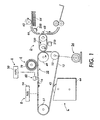
- FIG. 1 there is shown an illustrative electrostatographic printing machine.
- the printing machine in the shown embodiment an electrophotographic printer (although other printers are also suitable, such as ionographic printers and the like), incorporates a photoreceptor 10, in the shown embodiment in the form of a belt (although other known configurations are also suitable, such as a roll, a drum, a sheet, or the like), having a photoconductive surface layer 12 deposited on a substrate.
- the substrate can be made from, for example, a polyester film such as MYLAR® that has been coated with a thin conductive layer which is electrically grounded.
- the belt is driven by means of motor 54 along a path defined by rollers 49, 51, and 52, the direction of movement being counterclockwise as viewed and as shown by arrow 16. Initially a portion of the belt 10 passes through a charge station A at which a corona generator 48 charges surface 12 to a relatively high, substantially uniform, potential. A high voltage power supply 50 is coupled to device 48.
- a Raster Output Scanner (ROS) 56 scans the photoconductive surface in a series of scan lines perpendicular to the process direction. Each scan line has a specified number of pixels per inch.
- the ROS includes a laser with a rotating polygon mirror to provide the scanning perpendicular to the process direction.
- the ROS imagewise exposes the charged photoconductive surface 12.
- Other methods of exposure are also suitable, such as light lens exposure of an original document or the like.
- belt 10 advances the latent electrostatic image to development station C as shown in Figure 1.
- a development system or developer unit 44 develops the latent image recorded on the photoconductive surface.
- the chamber in the developer housing stores a supply of developer material.
- the developer material comprises insulative toner particles that are triboelectrically charged
- the developer material comprises conductive or semiconductive toner particles that are inductively charged
- the developer material is a single component developer consisting of nonmagnetic, conductive toner that is induction charged on a dielectric overcoated donor roll prior to the development zone.
- the developer material may be a custom color consisting of two or more different colored dry powder toners.
- belt 10 advances the developed image to transfer station D.
- Transfer can be directly from the imaging member to a receiving sheet or substrate, such as paper, transparency, or the like, or can be from the imaging member to an intermediate and subsequently from the intermediate to the receiving sheet or substrate.
- the developed image is tack transferred to a heated transfuse belt or roll 100.
- the covering on the compliant belt or drum typically consists of a thick (1.3 millimeter) soft (IRHD hardness of about 40) silicone rubber. (Thinner and harder rubbers provide tradeoffs in latitudes.
- the rubber can also have a thin VITON® top coat for improved reliability.
- tack transfer of the toner from the photoreceptor to the transfuse belt or drum can be obtained with a nip pressure of about 3.5 ⁇ 10 5 Pa (50 pounds per square inch).
- the toned image advances from the photoreceptor-transfuse belt nip to the transfuse belt-medium transfuse nip formed between transfuse belt 100 and roller 68, the toner is softened by the -120°C transfuse belt temperature.
- transfuse of the image to the receiving sheet is obtained with a nip pressure of about 6.9 ⁇ 10 8 Pa (100 pounds per square inch).
- a nip pressure of about 6.9 ⁇ 10 8 Pa (100 pounds per square inch).
- the toner release from the roll 100 can be aided by a small amount of silicone oil that is imbibed in the roll for toner release at the toner/roll interface.
- the bulk of the compliant silicone material also contains a conductive carbon black to dissipate any charge accumulation.
- a cleaner 210 for the transfuse belt material is provided to remove residual toner and fiber debris.
- An optional glossing station (not shown) can be employed by the customer to select a desired image gloss level.
- the residual developer material adhering to photoconductive surface 12 is removed therefrom by a rotating fibrous brush 78 at cleaning station E in contact with photoconductive surface 12.
- a discharge lamp (not shown) floods photoconductive surface 12 with light to dissipate any residual electrostatic charge remaining thereon prior to the charging thereof for the next successive imaging cycle.
- FIG 2 illustrates a specific embodiment of the present invention in which the toner in housing 44 is inductively charged, as the donor 42 rotates in the direction of arrow 69, a voltage DC D 300 is applied to the donor roll to transfer electrostatically the desired polarity of toner to the belt 10 while at the same time preventing toner transfer in the nonimage areas of the imaged belt 10.
- Donor roll 42 is mounted, at least partially, in the chamber of developer housing 44 containing nonmagnetic conductive toner.
- the chamber in developer housing 44 stores a supply of the toner that is in contact with donor roll 42.
- Donor roll 42 can be, for example, a conductive aluminum core overcoated with a thin (50 micron) dielectric insulating layer.
- a voltage DC L 302 applied between the developer housing 44 and the donor roll 42 causes induction charging and loading of the nonmagnetic conductive toner onto the dielectric overcoated donor roll.
- a toner dispenser (not shown) stores a supply of toner particles.
- the toner dispenser is in communication with housing 44. As the level of toner particles in the chamber is decreased, fresh toner particles are furnished from the toner dispenser.
- the maximum loading of induction charged, conductive toner onto the dielectric overcoated donor roll 42 is preferably limited to approximately a monolayer of toner.
- the monolayer loading is essentially independent of bias level.
- the charge induced on the toner monolayer is proportional to the voltage DC L 302.
- the charge-to-mass ratio of the toner loaded on donor roll 42 can be controlled according to the voltage DC L 302. As an example, if a DC L voltage of -200 volts is applied to load conductive toner onto donor roll 42 with a dielectric overcoating thickness of 25 microns, the toner charge-to-mass ratio is -17 microcoulombs per gram.
- a toner layer conditioning device 400 is illustrated in Figure 2. This particular example uses a compliant overcoated roll that is biased at a voltage DCc 304. The overcoating material is charge relaxable to enable dissipation of any charge accumulation.
- the voltage DC C 304 is set at a higher magnitude than the voltage DC L 302.
- any toner on donor roll 42 that is on top of toner in the layer is induction charged with opposite polarity and deposited on the roll 400.
- a doctor blade on conditioning roll 400 continually removes the deposited toner.
- the now induction charged and conditioned toner layer is moved into development zone 310, defined by a synchronous contact between donor 42 and the photoreceptor belt 10.
- development zone 310 defined by a synchronous contact between donor 42 and the photoreceptor belt 10.
- the toner layer on the donor roll is developed onto the photoreceptor by electric fields created by the latent image.
- the electric fields prevent toner deposition. Since the adhesion of induction charged, conductive toner is typically less than that of triboelectrically charged toner, only DC electric fields are required to develop the latent electrostatic image in the development zone.
- the DC field is provided by both the DC voltages DC D 300 and DC L 302, and the electrostatic potentials of the latent image on photoconductor 10.
- a charge neutralizing device may be employed.
- a rotating electrostatic brush 315 is brought into contact with the toned donor roll.
- the voltage on the brush 315 is set at or near the voltage applied to the core of donor roll 42.
- An advantageous feature of nonmagnetic inductive charging is that the precharging of conductive, nonmagnetic toner prior to the development zone enables the application of an electrostatic force in the development zone for the prevention of background toner and the deposition of toner in the image areas.
- Background control and image development with an induction charged, nonmagnetic toner employs a process for forming a monolayer of toner that is brought into contact with an electrostatic image. Monolayer toner coverage is sufficient in providing adequate image optical density if the coverage is uniform. Monolayer coverage with small toner enables thin images desired for high image quality.
- FIG 3 illustrates a monolayer of induction charged toner on a dielectric overcoated substrate 42.
- the monolayer of toner is deposited on the substrate when a voltage V A is applied to conductive toner.
- the 0.32 R p term (obtained from empirical studies) describes the average dielectric thickness of the air space between the monolayer of conductive particles and the insulative layer.
- the calculated surface charge density is -18 nC/cm 2 . Since the toner mass density for a square lattice of 13 micron nonmagnetic toner is about 0.75 mg/cm 2 , the toner charge-to-mass ratio is about -17 microcoulombs per gram. Since the toner charge level is controlled by the induction charging voltage and the thickness of the dielectric layer, one can expect that the toner charging will not depend on other factors such as the toner pigment, flow additives, relative humidity, or the like.
- Figure 4 illustrates an idealized situation wherein a monolayer of previously induction charged conductive spheres is sandwiched between donor 42 and receiver dielectric materials 10.
- the first term because of an electrostatic image force from neighboring particles, becomes zero when the dielectric thicknesses of the receiver and its air gap are equal to the dielectric thicknesses of the donor and its air gap. Under these conditions, the threshold applied voltage for transferring toner to the receiver should be zero if the difference in the receiver and donor short-range forces is negligible. One expects, however, a distribution in the short-range forces.
- toner conducting toner of 13 micron volume average particle size biased at a potential of -200 volts was placed in contact with a 25 micron thick MYLAR® (grounded aluminum on backside) donor belt moving at a speed of 4.2 inches per second.
- MYLAR® grounded aluminum on backside
- a 25 micron thick MYLAR® covered aluminum roll was biased at a potential of -300 volts and contacted with the toned donor belt at substantially the same speed as the donor belt. This step was repeated a second time.
- the conditioned toner layer was then contacted to an electrostatic image moving at substantially the same speed as the toned donor belt.
- the electrostatic image had a potential of -650 volts in the nonimage areas and -200 volts in the image areas.
- a DC potential of +400 volts was applied to the substrate of electrostatic image bearing member during synchronous contact development. A toned image with adequate optical density and low background was observed.
- Nonmagnetic inductive charging systems based on induction charging of conductive toner prior to the development zone offer a number of advantages compared to electrophotographic development systems based on triboelectric charging of insulative toner.
- the toner charging depends only on the induction charging bias, provided that the toner conductivity is sufficiently high.
- the charging is insensitive to toner materials such as pigment and resin.
- the performance should not depend on environmental conditions such as relative humidity.
- Nonmagnetic inductive charging systems can also be used in electrographic printing systems for printing black plus one or several separate custom colors with a wide color gamut obtained by blending multiple conductive, nonmagnetic color toners in a single component development system.
- the induction charging of conductive toner blends is generally pigment-independent.
- Each electrostatic image is formed with either ion or Electron Beam Imaging (EBI) and developed on separate electroreceptors. The images are tack transferred image-next-to-image onto a transfuse belt or drum for subsequent heat and pressure transfuse to a wide variety of media.
- EBI Electron Beam Imaging
- the custom color toners including metallics, are obtained by blending different combinations and percentages of toners from a set of nine primary toners plus transparent and black toners to control the lightness or darkness of the custom color.
- the blending of the toners can be done either outside of the electrophotographic printing system or within the system, in which situation the different proportions of color toners are directly added to the in-situ toner dispenser.
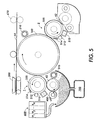
- Figure 5 illustrates the components and architecture of such a system for custom color printing.
- Figure 5 illustrates two electroreceptor modules, although it is understood that additional modules can be included for the printing of multiple custom colors on a document.
- the electroreceptor module 2 uses a nonmagnetic, conductive toner single component development (SCD) system that has been described in Figure 2.
- SCD nonmagnetic, conductive toner single component development
- a conventional SCD system that uses magnetic, conductive toner that is induction charged by the electrostatic image on the electroreceptor can also be used to print the black toner.
- an electrostatic image is formed on an electroreceptor drum 505 with either ion or Electron Beam Imaging device 510 as taught in U.S. Patent 5,039,598.
- the nonmagnetic, single component development system contains a blend of nonmagnetic, conductive toners to produce a desired custom color.
- An insulative overcoated donor 42 is loaded with the induction charged blend of toners.
- a toner layer conditioning station 400 helps to ensure a monolayer of induction charged toner on the donor. (Monolayer toner coverage is sufficient to provide adequate image optical density if the coverage is uniform. Monolayer coverage with small toner particles enables thin images desired for high image quality.)
- the monolayer of induction charged toner on the donor is brought into synchronous contact with the imaged electroreceptor 505.
- the development system assembly can be cammed in and out so that it is only in contact with warmer electroreceptor during copying/printing.
- the precharged toner enables the application of an electrostatic force in the development zone for the prevention of background toner and the deposition of toner in the image areas.
- the toned image on the electroreceptor is tack transferred to the heated transfuse member 100 which can be a belt or drum.
- the covering on the compliant transfuse belt or drum typically consists of a thick (1.3 millimeter) soft (IRHD hardness of about 40) silicone rubber. Thinner and harder rubbers can provide tradeoffs in latitudes. The rubber can also have a thin VITON® top coat for improved reliability.
- the transfuse belt/drum is maintained at a temperature near 120°C, tack transfer of the toner from the electroreceptor to the transfuse belt/drum can be obtained with a nip pressure of about 3.5 ⁇ 10 5 Pa (50 psi).
- the toned image advances from the electroreceptor-transfuse drum nip for each module to the transfuse drum-medium transfuse nip, the toner is softened by the about 120°C transfuse belt temperature.
- transfuse of the image to the medium is obtained with a nip pressure of about 6.9 ⁇ 10 5 Pa (100 psi).
- the toner release from the silicone belt can be aided by a small amount of silicone oil that is imbibed in the belt for toner release at the toner/belt interface.
- the bulk of the compliant silicone material also contains a conductive carbon black to dissipate any charge accumulation.
- a cleaner 210 for the transfuse drum material is provided to remove residual toner and fiber debris.
- An optional glossing station 610 enables the customer to select a desired image gloss level.
- the electroreceptor cleaner 514 and erase bar 512 are provided to prepare for the next imaging cycle.
- the illustrated black plus custom color(s) printing system enables improved image quality through the use of smaller toners (3 to 10 microns), such as toners prepared by an emulsion aggregation process.
- the SCD system for module 1 shown in Figure 5 inherently can have a small sump of toner, which is advantageous in switching the custom color to be used in the SCD system.
- the bulk of the blended toner can be returned to a supply bottle of the particular blend.
- the residual toner in the housing can be removed by vacuuming 700.
- SCD systems are advantaged compared to two-component developer systems, since in two-component systems the toner must be separated from the carrier beads if the same beads are to be used for the new custom color blend.
- a particular custom color can be produced by offline equipment that blends a number of toners selected from a set of nine primary color toners (plus transparent and black toners) that enable a wide custom color gamut, such as PANTONE® colors.
- a process for selecting proportional amounts of the primary toners for in-situ addition to a SCD housing can be provided by dispenser 600. The color is controlled by the relative weights of primaries.
- the P 1 ...P N primaries can be selected to dispense toner into a toner bottle for feeding toner to a SCD housing in the machine, or to dispense directly to the sump of the SCD system on a periodic basis according to the amount needed based on the run length and area coverage.
- the dispensed toners are tumbled/agitated to blend the primary toners prior to use.
- metallic toners which tend to be conducting and therefore compatible with the SCD process
- Custom color blends of toner can be made in an offline (paint shop) batch process; one can also arrange to have a set of primary color toners continuously feeding a sump of toner within (in-situ) the printer, which enables a dial-a-color system provided that an in-situ toner waste system is provided for color switching.
- the marking materials of the present invention comprise toner particles typically having an average particle diameter of no more than about 17 microns, preferably no more than about 15 microns, and more preferably no more than about 14 microns, although the particle size can be outside of these ranges, and typically have a particle size distribution of GSD equal to no more than about 1.45, preferably no more than about 1.38, and more preferably no more than about 1.35, although the particle size distribution can be outside of these ranges.
- the toners of the present invention comprise particles typically having an average particle diameter of no more than about 13 microns, preferably no more than about 12 microns, more preferably no more than about 10 microns, and even more preferably no more than about 7 microns, although the particle size can be outside of these ranges, and typically have a particle size distribution of GSD equal to no more than about 1.25, preferably no more than about 1.23, and more preferably no more than about 1.20, although the particle size distribution can be outside of these ranges.
- larger particles can be preferred even for those toners made by emulsion aggregation processes, such as particles of between about 7 and about 13 microns, because in these instances the toner particle surface area is relatively less with respect to particle mass and accordingly a lower amount by weight of conductive polymer with respect to toner particle mass can be used to obtain the desired particle conductivity or charging, resulting in a thinner shell of the conductive polymer and thus a reduced effect on the color of the toner.
- the toner particles comprise a resin and an optional colorant, said toner particles having coated thereon a polythiophene.
- the toners of the present invention can be employed for the development of electrostatic images in processes such as electrography, electrophotography, ionography, and the like.
- Another embodiment of the present invention is directed to a process which comprises (a) generating an electrostatic latent image on an imaging member, and (b) developing the latent image by contacting the imaging member with charged toner particles comprising a resin and an optional colorant, said toner particles having coated thereon a polythiophene.
- the toner particles are charged triboelectrically, in either a single component development process or a two-component development process.
- the toner particles can be charged triboelectrically by admixing them with carrier particles.
- the toner particles are charged by an inductive charging process.
- the developing apparatus comprises a housing defining a reservoir storing a supply of developer material comprising the conductive toner; a donor member for transporting toner on an outer surface of said donor member to a development zone; means for loading a toner layer onto said outer surface of said donor member; and means for inductive charging said toner layer onto said outer surface of said donor member prior to the development zone to a predefined charge level.
- the inductive charging means comprises means for biasing the toner reservoir relative to the bias on the donor member.
- the developing apparatus further comprises means for moving the donor member into synchronous contact with the imaging member to detach toner in the development zone from the donor member, thereby developing the latent image.
- the predefined charge level has an average toner charge-to-mass ratio of from about 5 to about 50 microcoulombs per gram in magnitude.
- Yet another specific embodiment of the present invention is directed to a process for developing a latent image recorded on a surface of an image receiving member to form a developed image, said process comprising (a) moving the surface of the image receiving member at a predetermined process speed; (b) storing in a reservoir a supply of toner particles according to the present invention; (c) transporting the toner particles on an outer surface of a donor member to a development zone adjacent the image receiving member; and (d) inductive charging said toner particles on said outer surface of said donor member prior to the development zone to a predefined charge level.
- the inductive charging step includes the step of biasing the toner reservoir relative to the bias on the donor member.
- the donor member is brought into synchronous contact with the imaging member to detach toner in the development zone from the donor member, thereby developing the latent image.
- the predefined charge level has an average toner charge-to-mass ratio of from about 5 to about 50 microCoulombs per gram in magnitude.
- the deposited toner image can be transferred to a receiving member such as paper or transparency material by any suitable technique conventionally used in electrophotography, such as corona transfer, pressure transfer, adhesive transfer, bias roll transfer, and the like.
- the transferred toner image can be fixed to the receiving sheet.
- the fixing step can be also identical to that conventionally used in electrophotographic imaging.
- the toner particles of the present invention comprise a resin and an optional colorant.
- Typical toner resins include polyesters, polyamides, epoxies, polyurethanes, diolefins, vinyl resins, and polymeric esterification products of a dicarboxylic acid and a diol comprising a diphenol.
- vinyl monomers include styrene, p-chlorostyrene, vinyl naphthalene, unsaturated mono-olefins such as ethylene, propylene, butylene, isobutylene, and the like; vinyl halides such as vinyl chloride, vinyl bromide, vinyl fluoride, vinyl acetate, vinyl propionate, vinyl benzoate, and vinyl butyrate; vinyl esters such as esters of monocarboxylic acids, including methyl acrylate, ethyl acrylate, n-butyl acrylate, isobutyl acrylate, dodecyl acrylate, n-octyl acrylate, 2-chloroethyl acrylate, phenyl acrylate, methylalpha-chloroacrylate, methyl methacrylate, ethyl methacrylate, butyl methacrylate, and the like; acrylonitrile, methacrylonitrile, acrylamide, vinyl acryl
- Patent 4,560,635 mixtures of these monomers; and the like. Mixtures of two or more polymers can also constitute the toner resin.
- the resin is present in the toner in any effective amount, typically from about 75 to about 98 percent by weight, preferably from about 90 to about 98 percent by weight, and more preferably from about 95 to about 96 percent by weight, although the amount can be outside of these ranges.
- Suitable colorants include dyes and pigments, such as carbon black magnetites, phthalocyanines, 2,9-dimethyl-substituted quinacridone and anthraquinone dyes, and the like, as well as mixtures thereof. Mixtures of colorants can also be employed.
- the optional colorant is present in the toner particles in any desired or effective amount, typically at least about 1 percent by weight of the toner particles, and preferably at least about 2 percent by weight of the toner particles, and typically no more than about 25 percent by weight of the toner particles, and preferably no more than about 15 percent by weight of the toner particles, depending on the desired particle size, although the amount can be outside of these ranges.
- the toner particles of the present invention have coated thereon a polythiophene.
- suitable thiophenes for the present invention include those of the general formula (shown in the reduced form) wherein R and R' each, independently of the other, is a hydrogen atom, an alkyl group, including linear, branched, saturated, unsaturated, cyclic, and substituted alkyl groups, typically with from 1 to about 20 carbon atoms and preferably with from 1 to about 16 carbon atoms, although the number of carbon atoms can be outside of these ranges, an alkoxy group, including linear, branched, saturated, unsaturated, cyclic, and substituted alkoxy groups, typically with from 1 to about 20 carbon atoms and preferably with from 1 to about 16 carbon atoms, although the number of carbon atoms can be outside of these ranges, an aryl group, including substituted aryl groups, typically with from 6 to about 16 carbon atoms, and preferably with from 6 to about 14 carbon atoms, although the number
- thiophene is simple thiophene, of the formula (shown in the reduced form).
- the polymerized thiophene (shown in the reduced form) is of the formula wherein R and R' are as defined above and n is an integer representing the number of repeat monomer units.
- a particularly preferred class of thiophenes is that of 3,4-ethylenedioxythiophenes.
- a poly(3,4-ethylenedioxythiophene), in its reduced form, is of the formula wherein each of R 1 , R 2 , R 3 , and R 4 , independently of the others, is a hydrogen atom, an alkyl group, including linear, branched, saturated, unsaturated, cyclic, and substituted alkyl groups, typically with from 1 to about 20 carbon atoms and preferably with from 1 to about 16 carbon atoms, although the number of carbon atoms can be outside of these ranges, an alkoxy group, including linear, branched, saturated, unsaturated, cyclic, and substituted alkoxy groups, typically with from 1 to about 20 carbon atoms and preferably with from 1 to about 16 carbon atoms, although the number of carbon atoms can be outside of these ranges, an aryl group, including substituted aryl groups, typically with from 6 to about 16 carbon atom
- R 1 , R 2 , R 3 , and R 4 groups on the 3,4-ethylenedioxythiophene monomer and poly(3,4-ethylenedioxythiophene) polymer include hydrogen atoms, linear alkyl groups of the formula -(CH 2 ) n CH 3 wherein n is an integer of from 0 to about 16, linear alkyl sulfonate groups of the formula -(CH 2 ) n SO 3 -M + wherein n is an integer of from 1 to about 6 and M is a cation, such as sodium, potassium, other monovalent cations, or the like, and linear alkyl ether groups of the formula -(CH 2 ) n OR 3 wherein n is an integer of from 0 to about 6 and R 3 is a hydrogen atom or a linear alkyl group of the formula -(CH 2 ) m CH 3 wherein n is an integer of from 0 to about 6.
- R 1 and R 3 as hydrogen groups and R 2 and R 4 groups as follows:
- Unsubstituted 3,4-ethylenedioxythiophene monomer is commercially available from, for example Bayer AG.
- Substituted 3,4-ethylenedioxythiophene monomers can be prepared by known methods.
- the substituted thiophene monomer 3,4-ethylenedioxythiophene can be synthesized following early methods of Fager (Fager, E. W. J. Am. Chem. Soc. 1945, 67, 2217), Becker et al. (Becker, H. J.; Stevens, W. Rec. Trav. Chim. 1940, 59, 435) Guha and lyer (Guha, P. C., lyer, B. H.; J. Ind. Inst. Sci.
- the disodium 2,5-dicarbethyoxy-3,4-dioxythiophene ( 6 ) derivative of 5 can also be used instead of the methoxy derivative.
- This material is prepared similarly to 5 except 3 and diethyl oxalate ( 4 ) in ethanol is added dropwise into a cooled solution of sodium ethoxide in ethanol.
- the salt either 5 or 6 is dissolved in water and acidified with 1 Molar HCl added slowly dropwise with constant stirring until the solution becomes acidic. Immediately following, thick white precipitate falls out. After filtration, the precipitate is washed with water and air-dried to give 2,5-dicarbethoxy-3,4-dihydroxythiophene ( 7 ).
- the salt either ( 5 , 2.5 grams) or 6 can be alkylated directly or the dihydrothiophene derivative ( 7 ) can be suspended in the appropriate 1,2-dihaloalkane or substituted 1,2-dihaloalkane and refluxed for 24 hours in the presence of anhydrous K 2 CO 3 in anhydrous DMF.
- EDOT either 1,2-dicholorethane (commercially available from Aldrich) or 1,2-dibromoethane (commercially from Aldrich) is used.
- 1,2-dibromoalkane such as 1-dibromodecane, 1,2-dibromohexadecane (prepared from 1-hexadecene and bromine), 1,2-dibromohexane, other reported 1,2-dibromoalkane derivatives, and the like.
- the resulting 2,5-dicarbethoxy-3,4-ethylenedioxythiophene or 2,5-dicarbethoxy-3,4-alkylenedioxythiophene is refluxed in base, for example 10 percent aqueous sodium hydroxide solution for 1 to 2 hours, and the resulting insoluble material is collected by filtration.
- This material is acidified with 1 Normal HCl and recrystallized from methanol to produce either 2,5-dicarboxy-3,4-ethylenedioxythiophene or the corresponding 2,5-dicarboxy-3,4-alkylenedioxythiophene.
- the final step to reduce the carboxylic acid functional groups to hydrogen to produce the desired monomer is given in the references above.
- the polythiophene can be applied to the toner particle surfaces by an oxidative polymerization process.
- the toner particles are suspended in a solvent in which the toner particles will not dissolve, such as water, methanol, ethanol, butanol, acetone, acetonitrile, blends of water with methanol, ethanol, butanol, acetone, acetonitrile, and/or the like, preferably in an amount of from about 5 to about 20 weight percent toner particles in the solvent, and the thiophene monomer is added slowly (a typical addition time period would be over about 10 minutes) to the solution with stirring.
- the thiophene monomer typically is added in an amount of from about 5 to about 15 percent by weight of the toner particles.
- the thiophene monomer is hydrophobic, and it is desired that the monomer become adsorbed onto the toner particle surfaces. Thereafter, the solution is stirred for a period of time, typically from about 0.5 to about 3 hours to enable the monomer to be absorbed into the toner particle surface.
- a dopant is employed, it is typically added at this stage, although it can also be added after addition of the oxidant.
- the oxidant selected is dissolved in a solvent sufficiently polar to keep the particles from dissolving therein, such as water, methanol, ethanol, butanol, acetone, acetonitrile, or the like, typically in a concentration of from about 0.1 to about 5 molar equivalents of oxidant per molar equivalent of thiophene monomer, and slowly added dropwise with stirring to the solution containing the toner particles.
- a solvent sufficiently polar to keep the particles from dissolving therein such as water, methanol, ethanol, butanol, acetone, acetonitrile, or the like
- the amount of oxidant added to the solution typically is in a molar ratio of 1:1 or less with respect to the thiophene, although a molar excess of oxidant can also be used and can be preferred in some instances.
- the oxidant is preferably added to the solution subsequent to addition of the thiophene monomer so that the thiophene has had time to adsorb onto the toner particle surfaces prior to polymerization, thereby enabling the thiophene to polymerize on the toner particle surfaces instead of forming separate particles in the solution.
- the solution is again stirred for a period of time, typically from about 1 to about 2 days, although the time can be outside of this range, to allow the polymerization and doping process to occur.
- the toner particles having the polythiophene polymerized on the surfaces thereof are washed, preferably with water, to remove therefrom any polythiophene that formed in the solution as separate particles instead of as a coating on the toner particle surfaces, and the toner particles are dried.
- the entire process typically takes place at about room temperature (typically from about 15 to about 30°C), although lower temperatures can also be used if desired.
- Suitable oxidants include water soluble persulfates, such as ammonium persulfate, potassium persulfate, and the like, cerium (IV) sulfate, ammonium cerium (IV) nitrate, ferric salts, such as ferric chloride, iron (III) sulfate, ferric nitrate nanohydrate, tris(p-toluenesulfonato)iron (III) (commercially available from Bayer under the tradename Baytron C), and the like.
- water soluble persulfates such as ammonium persulfate, potassium persulfate, and the like
- cerium (IV) sulfate such as ammonium cerium (IV) nitrate
- ferric salts such as ferric chloride, iron (III) sulfate, ferric nitrate nanohydrate, tris(p-toluenesulfonato)iron (III) (commercially available from Bayer under the tradename Bay
- the oxidant is typically employed in an amount of at least about 0.1 molar equivalent of oxidant per molar equivalent of thiophene monomer, preferably at least about 0.25 molar equivalent of oxidant per molar equivalent of thiophene monomer, and more preferably at least about 0.5 molar equivalent of oxidant per molar equivalent of thiophene monomer, and typically is employed in an amount of no more than about 5 molar equivalents of oxidant per molar equivalent of thiophene monomer, preferably no more than about 4 molar equivalents of oxidant per molar equivalent of thiophene monomer, and more preferably no more than about 3 molar equivalents of oxidant per molar equivalent of thiophene monomer, although the relative amounts of oxidant and thiophene can be outside of these ranges.
- the molecular weight of the polythiophene formed on the toner particle surfaces need not be high; typically the polymer can have three to six or more repeat thiophene units to enable the desired toner particle conductivity, and no more than about 100 repeat monomer units. If desired, however, the molecular weight of the polythiophene formed on the toner particle surfaces can be adjusted by varying the molar ratio of oxidant to thiophene monomer, the acidity of the medium, the reaction time of the oxidative polymerization, and/or the like. Molecular weights wherein the number of thiophene repeat monomer units is about 1,000 or higher can be employed, although higher molecular weights tend to make the material more insoluble and therefore more difficult to process.
- an aqueous dispersion of the desired polythiophene such as poly(3,4-ethylenedioxythiophene) (such as that commercially available under the tradename Baytron P from Bayer), can be used to produce a conductive surface on the toner particles by adding some of the aqueous dispersion of polythiophene to a suspension of the toner particles.
- the polythiophene When the toner is used in a process in which the toner particles are triboelectrically charged, the polythiophene can be in its reduced form. To achieve the desired toner particle conductivity for toners suitable for nonmagnetic inductive charging processes, it is sometimes desirable for the polythiophene to be in its oxidized form.
- the polythiophene can be shifted to its oxidized form by doping it with dopants such as sulfonate, phosphate, or phosphonate moieties, iodine, or the like.
- Poly(3,4-ethylenedioxythiophene) in its doped and oxidized form is believed to be of the formula wherein R 1 , R 2 , R 3 , and R 4 are as defined above, D- corresponds to the dopant, and n is an integer representing the number of repeat monomer units.
- poly(3,4-ethylenedioxythiophene) in its oxidized form and doped with sulfonate moieties is believed to be of the formula wherein R 1 , R 2 , R 3 , and R 4 are as defined above, R corresponds to the organic portion of the sulfonate dopant molecule, such as an alkyl group, including linear, branched, saturated, unsaturated, cyclic, and substituted alkyl groups, typically with from 1 to about 20 carbon atoms and preferably with from 1 to about 16 carbon atoms, although the number of carbon atoms can be outside of these ranges, an alkoxy group, including linear, branched, saturated, unsaturated, cyclic, and substituted alkoxy groups, typically with from 1 to about 20 carbon atoms and preferably with from 1 to about 16 carbon atoms, although the number of carbon atoms can be outside of these ranges, an aryl group, including substituted aryl groups, typically with from 6 to about 16 carbon
- One method of causing the polythiophene to be doped is to select as the toner resin a polymer wherein at least some of the repeat monomer units have groups such as sulfonate groups thereon, such as sulfonated polyester resins and sulfonated vinyl resins.
- the sulfonated resin has surface exposed sulfonate groups that serve the dual purpose of anchoring and doping the coating layer of polythiophene onto the toner particle surface.
- Another method of causing the polythiophene to be doped is to dope with sulfonate containing anions of the formula RSO 3 - wherein R is an alkyl group, an alkoxy group, an aryl group, an aryloxy group, an arylalkyl group, an alkylaryl group, an arylalkyloxy group, an alkylaryloxy group, or mixtures thereof.
- the ionic surfactant selected for the emulsion aggregation process can be an anionic surfactant having a sulfonate group thereon, such as sodium dodecyl sulfonate, sodium dodecylbenzene sulfonate, dodecylbenzene sulfonic acid, dialkyl benzenealkyl sulfonates, such as 1,3-benzene disulfonic acid sodium salt, para-ethylbenzene sulfonic acid sodium salt, and the like, sodium alkyl naphthalene sulfonates, such as 1,5-naphthalene disulfonic acid sodium salt, 2-naphthalene disulfonic acid, and the
- the surfactant becomes grafted and/or adsorbed onto the latex particles that are later aggregated and coalesced. While the toner particles are washed subsequent to their synthesis to remove surfactant therefrom, some of this surfactant still remains on the particle surfaces, and in sufficient amounts to enable doping of the polythiophene so that it is desirably conductive.
- Yet another method of causing the polythiophene to be doped is to add small dopant molecules containing sulfonate, phosphate, or phosphonate groups to the toner particle solution before, during, or after the oxidative polymerization of the thiophene.
- the dopant can be added to the solution.
- the dopant is a solid, it is allowed to dissolve prior to addition of the thiophene monomer, typically for a period of about 0.5 hour.
- the dopant can be added after addition of the thiophene and before addition of the oxidant, or after addition of the oxidant, or at any other time during the process.
- the dopant is added to the polythiophene in any desired or effective amount, typically at least about 0.1 molar equivalent of dopant per molar equivalent of thiophene monomer, preferably at least about 0.25 molar equivalent of dopant per molar equivalent of thiophene monomer, and more preferably at least about 0.5 molar equivalent of dopant per molar equivalent of thiophene monomer, and typically no more than about 5 molar equivalents of dopant per molar equivalent of thiophene monomer, preferably no more than about 4 molar equivalents of dopant per molar equivalent of thiophene monomer, and more preferably no more than about 3 molar equivalents of dopant per molar equivalent of thiophene monomer.
- Suitable dopants are p-toluene sulfonic acid, camphor sulfonic acid, dodecane sulfonic acid, benzene sulfonic acid, naphthalene sulfonic acid, dodecylbenzene sulfonic acid, sodium dodecyl sulfonate, sodium dodecylbenzene sulfonate, dialkyl benzenealkyl sulfonates, such as 1,3-benzene disulfonic acid sodium salt, para-ethylbenzene sulfonic acid sodium salt, and the like, sodium alkyl naphthalene sulfonates, such as 1,5-naphthalene disulfonic acid sodium salt, 2-naphthalene disulfonic acid, and the like, poly(styrene sulfonate sodium salt), and the like.
- Still another method of doping the polythiophene is to expose the toner particles that have the polythiophene on the particle surfaces to iodine vapor in solution, as disclosed in, for example, Yamamoto, T.; Morita, A.; Miyazaki, Y.; Maruyama, T.; Wakayama, H.; Zhou, Z. H.; Nakamura, Y.; Kanbara, T.; Sasaki, S.; Kubota, K.; Macromolecules, 1992, 25, 1214 and Yamamoto, T.; Abla, M.; Shimizu, T.; Komarudin, D.; Lee, B-L.; Kurokawa, E. Polymer Bulletin, 1999, 42, 321.
- the polythiophene thickness on the toner particles is a function of the surface area exposed for surface treatment, which is related to toner particle size and particle morphology, spherical vs potato or raspberry.
- the weight fraction of thiophene monomer used based on total mass of particles can be increased to, for example, 20 percent from 10 or 5 percent.
- the coating weight typically is at least about 5 weight percent of the toner particle mass, and typically is no more than about 20 weight percent of the toner particle mass.
- the solids loading of the toner particles can be measured using a heated balance which evaporates off the water, and, based on the initial mass and the mass of the dried material, the solids loading can be calculated.
- the toner slurry is diluted to a 10 percent loading of toner in water.
- the total mass of toner slurry is 200 grams and 2 grams of 3,4-ethylenedioxythiophene is used. Then the 3,4-ethylenedioxythiophene and other reagents are added as indicated hereinabove.
- the thickness of the conductive polymer shell was 20 nanometers. Depending on the surface morphology, which also can change the surface area, the shell can be thicker or thinner or even incomplete.
- the coatings of poly(3,4-ethylenedioxythiophene) in its oxidized form on the toner particles of the present invention are nearly non-colored and transparent, and can be coated onto toner particles of a wide variety of colors without impairing toner color quality.
- the use of a conductive polymeric coating on the toner particle to impart conductivity thereto is believed to be superior to other methods of imparting conductivity, such as blending with conductive surface additives, which can result in disadvantages such as reduced toner transparency, impaired gloss features, and impaired fusing performance.
- the toners of the present invention typically are capable of exhibiting surface charging of from about + or -2 to about + or -60 microcoulombs per gram, and preferably of from about + or -10 to about + or -50 microcoulombs per gram, although the charging capability can be outside of these ranges. Charging can be accomplished triboelectrically, either against a carrier in a two component development system, or in a single component development system, or inductively.
- the polarity to which the toner particles of the present invention can be charged can be determined by the choice of oxidant used during the oxidative polymerization of the thiophene monomer. For example, using oxidants such as ammonium persulfate and potassium persulfate for the oxidative polymerization of the thiophene monomer tends to result in formation of toner particles that become negatively charged when subjected to triboelectric or inductive charging processes.
- toner particles can be obtained with the desired charge polarity without the need to change the toner resin composition, and can be achieved independently of any dopant used with the polythiophene.
- the particle flow values of the toner particles were measured with a Hosokawa Micron Powder tester by applying a 1 millimeter vibration for 90 seconds to 2 grams of the toner particles on a set of stacked screens.
- the top screen contained 150 micron openings
- the middle screen contained 75 micron openings
- the bottom screen contained 45 micron openings.
- the input energy applied to the apparatus of 300 millivolts was decreased to 50 millivolts to increase the sensitivity of the test.
- Conductivity values of the toners were determined by preparing pellets of each material under 1,000 to 3,000 pounds per square inch and then applying 10 DC volts across the pellet. The value of the current flowing was then recorded, the pellet was removed and its thickness measured, and the bulk conductivity for the pellet was calculated in Siemens per centimeter.
- a linear sulfonated random copolyester resin comprising 46.5 mole percent terephthalate, 3.5 mole percent sodium sulfoisophthalate, 47.5 mole percent 1,2-propanediol, and 2.5 mole percent diethylene glycol was prepared as follows.
- the reactor was then heated to 165°C with stirring for 3 hours whereby 1.33 kilograms of distillate were collected in the distillation receiver, and which distillate comprised about 98 percent by volume methanol and 2 percent by volume 1,2-propanediol as measured by the ABBE refractometer available from American Optical Corporation.
- the reactor mixture was then heated to 190°C over a one hour period, after which the pressure was slowly reduced from atmospheric pressure to about 3.4 ⁇ 10 4 Pa (260 Torr) over a one hour period, and then reduced to 667 Pa (5 Torr) over a two hour period with the collection of approximately 470 grams of distillate in the distillation receiver, and which distillate comprised approximately 97 percent by volume 1,2-propanediol and 3 percent by volume methanol as measured by the ABBE refractometer.
- the pressure was then further reduced to about 134 Pa (1 Torr) over a 30 minute period whereby an additional 530 grams of 1,2-propanediol were collected.
- the reactor was then purged with nitrogen to atmospheric pressure, and the polymer product discharged through the bottom drain onto a container cooled with dry ice to yield 5.60 kilograms of 3.5 mole percent sulfonated polyester resin, sodio salt of (1,2-propylene-dipropylene-5-sulfoisophthalate)-copoly (1,2-propylene-dipropylene terephthalate).
- the sulfonated polyester resin glass transition temperature was measured to be 56.6°C (onset) utilizing the 910 Differential Scanning Calorimeter available from E.I. DuPont operating at a heating rate of 10°C per minute.
- the number average molecular weight was measured to be 3,250 grams per mole, and the weight average molecular weight was measured to be 5,290 grams per mole using tetrahydrofuran as the solvent.
- a 15 percent solids concentration of colloidal sulfonate polyester resin dissipated in aqueous media was prepared by first heating about 2 liters of deionized water to about 85°C with stirring, and adding thereto 300 grams of the sulfonated polyester resin, followed by continued heating at about 85°C and stirring of the mixture for a duration of from about one to about two hours, followed by cooling to about room temperature (25°C).
- the colloidal solution of sodio-sulfonated polyester resin particles had a characteristic blue tinge and particle sizes in the range of from about 5 to about 150 nanometers, and typically in the range of 20 to 40 nanometers, as measured by the NiCOMP® particle sizer.
- a 2 liter colloidal solution containing 15 percent by weight of the sodio sulfonated polyester resin was charged into a 4 liter kettle equipped with a mechanical stirrer.
- To this solution was added 42 grams of a cyan pigment dispersion containing 30 percent by weight of Pigment Blue 15:3 (available from Sun Chemicals), and the resulting mixture was heated to 56°C with stirring at about 180 to 200 revolutions per minute.
- To this heated mixture was then added dropwise 760 grams of an aqueous solution containing 5 percent by weight of zinc acetate dihydrate.
- the dropwise addition of the zinc acetate dihydrate solution was accomplished utilizing a peristaltic pump, at a rate of addition of approximately 2.5 milliliters per minute.
- the mixture was stirred for an additional 3 hours.
- a sample (about 1 gram) of the reaction mixture was then retrieved from the kettle, and a particle size of 4.9 microns with a GSD of 1.18 was measured by the Coulter Counter.
- the mixture was then allowed to cool to room temperature, about 25°C, overnight, about 18 hours, with stirring.
- the product was filtered off through a 3 micron hydrophobic membrane cloth, and the toner cake was reslurried into about 2 liters of deionized water and stirred for about 1 hour.
- the toner slurry was refiltered and dried on a freeze drier for 48 hours.
- the conductivity was determined by preparing a pressed pellet of the material under 6.9 ⁇ 10 6 Pa to 2.1 ⁇ 10 7 Pa (1,000 to 3,000 pounds per square inch) of pressure and then applying 10 DC volts across the pellet. The value of the current flowing through the pellet was recorded, the pellet was removed and its thickness measured, and the bulk conductivity for the pellet was calculated in Siemens per centimeter.
- the toner particles thus prepared were charged by blending 24 grams of carrier particles (65 micron Hoegänes core having a coating in an amount of 1 percent by weight of the carrier, said coating comprising a mixture of poly(methyl methacrylate) and SC Ultra carbon black in a ratio of 80 to 20 by weight) with 1.0 gram of toner particles to produce a developer with a toner concentration (Tc) of 4 weight percent.
- carrier particles 65 micron Hoegänes core having a coating in an amount of 1 percent by weight of the carrier, said coating comprising a mixture of poly(methyl methacrylate) and SC Ultra carbon black in a ratio of 80 to 20 by weight
- Tc toner concentration
- One sample of this mixture was conditioned overnight in a controlled atmosphere at 15 percent relative humidity at 10°C (referred to as C zone) and another sample was conditioned overnight in a controlled atmosphere at 85 percent relative humidity at 28°C (referred to as A zone), followed by roll milling the developer (toner and carrier) for 30 minutes to reach a stable developer
- the insulative uncoated particles reached a triboelectric charge of -48.8 microCoulombs per gram in C zone and -18.2 microcoulombs per gram in A zone.
- the flow properties of this toner were measured with a Hosakawa powder flow tester to be 98.9 percent cohesion.
- a colloidal solution of sodio-sulfonated polyester resin particles was prepared as described in Comparative Example A.
- a 2 liter colloidal solution containing 15 percent by weight of the sodio sulfonated polyester resin was charged into a 4 liter kettle equipped with a mechanical stirrer and heated to 56°C with stirring at about 180 to 200 revolutions per minute.
- To this heated mixture was then added dropwise 760 grams of an aqueous solution containing 5 percent by weight of zinc acetate dihydrate.
- the dropwise addition of the zinc acetate dihydrate solution was accomplished utilizing a peristaltic pump, at a rate of addition of approximately 2.5 milliliters per minute. After the addition was complete (about 5 hours), the mixture was stirred for an additional 3 hours.
- a sample (about 1 gram) of the reaction mixture was then retrieved from the kettle, and a particle size of 4.9 microns with a GSD of 1.18 was measured by the Coulter Counter.
- the mixture was then allowed to cool to room temperature, about 25°C, overnight, about 18 hours, with stirring.
- the product was then filtered off through a 3 micron hydrophobic membrane cloth, and the toner cake was reslurried into about 2 liters of deionized water and stirred for about 1 hour.
- the toner slurry was refiltered and dried on a freeze drier for 48 hours.
- the toner particles thus prepared were admixed with a carrier and charged as described in Comparative Example A.
- the particles reached a triboelectric charge of -137.4 microcoulombs per gram in C zone and -7.75 microCoulombs per gram in A zone.
- the flow properties of this toner were measured with a Hosakawa powder flow tester to be 70.8 percent cohesion.
- Cyan toner particles were prepared by the method described in Comparative Example A.
- the toner particles had an average particle size of 5.13 microns with a GSD of 1.16.
- cyan toner particles were dispersed in 52 grams of aqueous slurry (19.4 percent by weight solids pre-washed toner) with a slurry pH of 6.0 and a slurry solution conductivity of 15 microSiemens per centimeter.
- aqueous slurry (19.4 percent by weight solids pre-washed toner) with a slurry pH of 6.0 and a slurry solution conductivity of 15 microSiemens per centimeter.
- To the aqueous toner slurry was first added 2.0 grams (8.75 mmol) of the oxidant ammonium persulfate followed by stirring at room temperature for 15 minutes.
- the toner particles thus prepared were admixed with a carrier and charged as described in Comparative Example A.
- the particles reached a triboelectric charge of -49.7 microCoulombs per gram in C zone.
- the resulting toner particles will also be highly conductive at about 2.1 ⁇ 10 -3 Siemens per centimeter and that the thickness and uniformity of the poly(3,4-ethylenedioxythiophene) shell will be improved over the 5 weight percent poly(3,4-ethylenedioxythiophene) conductive shell described in this example.
- Cyan toner particles were prepared by the method described in Comparative Example A.
- the toner particles had an average particle size of 5.13 microns with a GSD of 1.16.
- the cyan toner particles were dispersed in water to give 62 grams of cyan toner particles in water (20.0 percent by weight solids loading) with a slurry pH of 6.2 and slurry solution conductivity of 66 microSiemens per centimeter.
- aqueous toner slurry was first added 12.5 grams (54.5 mmol) of the oxidant ammonium persulfate followed by stirring at room temperature for 15 minutes. Thereafter, 3,4-ethylenedioxythiophene monomer (3.1 grams, 21.8 mmol) was added neat and dropwise to the solution over 15 to 20 minute period with vigorous stirring.
- the molar ratio of oxidant to 3,4-ethylenedioxythiophene monomer was 2.5 to 1.0, and the monomer concentration was 5 percent by weight of toner solids.
- the dopant para- toluenesulfonic acid (3.75 grams, 21.8 mmol, equimolar to 3,4-ethylenedioxythiophene monomer) was added.
- the mixture was stirred for 48 hours at room temperature to afford a surface-coated cyan toner.
- the toner particles were filtered from the aqueous media, washed 3 times with deionized water, and then freeze-dried for 2 days. A dry yield of 71.19 grams for the poly(3,4-ethylenedioxythiophene) treated cyan 5 micron toner was obtained.
- the particle bulk conductivity was measured at 2.6 ⁇ 10 -4 Siemens per centimeter.
- the toner particles thus prepared were admixed with a carrier and charged as described in Comparative Example A.
- the particles reached a triboelectric charge of -51.8 microcoulombs per gram in C zone and -19.7 microcoulombs per gram in A zone.
- the flow properties of this toner were measured with a Hosakawa powder flow tester to be 62.8 percent cohesion.
- Unpigmented toner particles were prepared by the method described in Comparative Example B.
- the toner particles had an average particle size of 5.0 microns with a GSD of 1.18.
- cyan toner particles were dispersed in 52 grams of aqueous slurry (19.4 percent by weight solids pre-washed toner) with a slurry pH of 6.0 and a slurry solution conductivity of 15 microSiemens per centimeter.
- aqueous toner slurry was first added 4.0 grams (17.5 mmol) of the oxidant ammonium persulfate followed by stirring at room temperature for 15 minutes. Thereafter, 3,4-ethylenedioxythiophene monomer (1.0 gram, 7.0 mmol) was added neat and dropwise to the solution over 15 to 20 minute period with vigorous stirring.
- the molar ratio of oxidant to 3,4-ethylenedioxythiophene monomer was 2.5 to 1.0, and the monomer concentration was 10 percent by weight of toner solids.
- the dopant para- toluenesulfonic acid (1.2 grams, 7.0 mmol, equimolar to 3,4-ethylenedioxythiophene monomer) was added.
- the mixture was stirred for 48 hours at slightly elevated temperature (between 32°C to 35°C) to afford a surface-coated cyan toner.
- the toner particles were filtered from the aqueous media, washed 3 times with deionized water, and then freeze-dried for 48 hours. A dry yield of 9.54 grams for the poly(3,4-ethylenedioxythiophene) treated cyan 5 micron toner was obtained.
- the particle bulk conductivity was measured at 2.9 ⁇ 10 -7 Siemens per centimeter.
- the toner particles thus prepared were admixed with a carrier and charged as described in Comparative Example A.
- the particles reached a triboelectric charge of -11.1 microcoulombs per gram in C zone.
- Toner particles were prepared by aggregation of a styrene/n-butyl acrylate/acrylic acid latex using a flocculate poly(aluminum chloride) followed by particle coalescence at elevated temperature.
- the polymeric latex was prepared by the emulsion polymerization of styrene/n-butyl acrylate/acrylic acid (monomer ratio 82 parts by weight styrene, 18 parts by weight n-butyl acrylate, 2 parts by weight acrylic acid) in a nonionic/anionic surfactant solution (40.0 percent by weight solids) as follows: 279.6 kilograms of styrene, 61.4 kilograms of n-butyl acrylate, 6.52 kilograms of acrylic acid, 3.41 kilograms of carbon tetrabromide, and 11.2 kilograms of dodecanethiol were mixed with 461 kilograms of deionized water, to which had been added 7.67 kilograms of sodium dodecyl benz
- the emulsion thus formed was polymerized at 70°C for 3 hours, followed by heating to 85°C for an additional 1 hour.
- the resulting latex contained 59.5 percent by weight water and 40.5 percent by weight solids, which solids comprised particles of a random copolymer of poly(styrene/n-butyl acrylate/acrylic acid); the glass transition temperature of the latex dry sample was 47.7°C, as measured on a DuPont DSC.
- the latex had a weight average molecular weight of 30,600 and a number average molecular weight of 4,400 as determined with a Waters gel permeation chromatograph.
- the particle size of the latex as measured on a Disc Centrifuge was 278 nanometers.
- styrene/n-butyl acrylate/acrylic acid anionic latex thus prepared was then diluted with 761.43 grams of deionized water.
- the diluted latex solution was blended with an acidic solution of the flocculant, 3.35 grams of poly(aluminum chloride) in 7.86 grams of 1 molar nitric acid solution, using a high shear homogenizer at 4,000 to 5,000 revolutions per minutes for 2 minutes, producing a flocculation or heterocoagulation of gelled particles consisting of nanometer sized latex particles.
- the slurry was heated at a controlled rate of 0.25°C per minute to 50°C, at which point the average particle size was 4.5 microns and the particle size distribution was 1.17.
- the pH of the solution was adjusted to 7.0 using 4 percent sodium hydroxide solution.
- the mixture was then heated at a controlled rate of 0.5°C per minute to 95°C.
- the pH was dropped to 5.0 using 1 Molar nitric acid, followed by maintenance of the temperature at 95°C for 6 hours.
- the particles were washed and reslurried in deionized water.
- the average particle size of the toner particles was 5.4 microns and the particle size distribution was 1.26. A total of 5 washes were performed before the particle surface was treated by the in situ polymerization of the conductive polymer.
- the molar ratio of oxidant to EDOT was 2.5:1, and EDOT was present in an amount of 10 percent by weight of the toner particles.
- the reaction was stirred for 15 minutes, followed by the addition of 2 grams of the external dopant para-toluene sulfonic acid (p-TSA) dissolved in 10 milliliters of water. The solution was stirred overnight at room temperature.
- the resulting blue-green toner particles (with the slight coloration being the result of the poly(3,4-ethylenedioxythiophene) (PEDOT) particle coating) were washed 7 times with distilled water and then dried with a freeze dryer for 48 hours.
- the chemical oxidative polymerization of EDOT to produce PEDOT occurred on the toner particle surface, and the particle surfaces were rendered conductive by the presence of the sulfonate groups from the toner particle surfaces and by the added p-TSA.
- the conductivity was determined by preparing a pressed pellet of the material under 6.9 ⁇ 10 6 Pa to 2.1 ⁇ 10 7 Pa (1,000 to 3,000 pounds per square inch) of pressure and then applying 10 DC volts across the pellet. The value of the current flowing through the pellet was recorded, the pellet was removed and its thickness measured, and the bulk conductivity for the pellet was calculated in Siemens per centimeter.
- the conductive toner particles were charged by blending 24 grams of carrier particles (65 micron Hoegänes core having a coating in an amount of 1 percent by weight of the carrier, said coating comprising a mixture of poly(methyl methacrylate) and SC Ultra carbon black in a ratio of 80 to 20 by weight) with 1.0 gram of toner particles to produce a developer with a toner concentration (Tc) of 4 weight percent.
- This mixture was conditioned overnight at 50 percent relative humidity at 22°C, followed by roll milling the developer (toner and carrier) for 30 minutes to reach a stable developer charge.
- the total toner blow off method was used to measure the average charge ratio (Q/M) of the developer with a Faraday Cage apparatus (such as described at column 11, lines 5 to 28 of U.S.
- Patent 3,533,835) The conductive particles reached a triboelectric charge of 5.5 microcoulombs per gram.
- the flow properties of this toner were measured with a Hosakawa powder flow tester to be 4.5 percent cohesion. Scanning electron micrographs (SEM) of the treated particles indicated that a surface coating was indeed on the surface, and transmission electron micrographs indicated that the surface layer of PEDOT was 20 nanometers thick.
- the average bulk conductivity of a pressed pellet of the pigmentless toner particles provided in the first slurry in Example IV prior to reaction with the other ingredients was measured at 7.2 ⁇ 10 -15 Siemens per centimeter.
- the conductive toner particles were charged by blending 24 grams of carrier particles (65 micron Hoegänes core having a coating in an amount of 1 percent by weight of the carrier, said coating comprising a mixture of poly(methyl methacrylate) and SC Ultra carbon black in a ratio of 80 to 20 by weight) with 1.0 gram of toner particles to produce a developer with a toner concentration (Tc) of 4 weight percent.
- This mixture was conditioned overnight at 50 percent relative humidity at 22°C, followed by roll milling the developer (toner and carrier) for 30 minutes to reach a stable developer charge.
- the total toner blow off method was used to measure the average charge ratio (Q/M) of the developer with a Faraday Cage apparatus (such as described at column 11, lines 5 to 28 of U.S. Patent 3,533,835).
- the conductive particles reached a triboelectric charge of 0.51 microcoulombs per gram.
- the flow properties of this toner were measured with a Hosakawa powder flow tester to be 21.4 percent cohesion.
- EDOT 3,4-ethylenedioxythiophene
- the average particle size was 5.1 microns with a particle size distribution of 1.22.
- the bulk conductivity of a pressed pellet of this sample was measured to be 3.0 ⁇ 10 -15 Siemens per centimeter, indicating that insufficient or no polymerization of the EDOT onto the particle surfaces occurred.
- PEDOT polymer 10 percent by weight of particles
- the average particle size was 5.1 microns with a particle size distribution of 1.22.
- the bulk conductivity of a pressed pellet of this sample was measured to be 7.4 ⁇ 10 -15 Siemens per centimeter, indicating that insufficient or no deposition of the PEDOT onto the particle surfaces occurred.
- EDOT 3,4-ethylenedioxythiophene
- p-TSA dopant para-toluene sulfonic acid
- EDOT 3,4-ethylenedioxythiophene
- the average particle size was 5.6 microns with a particle size distribution of 1.24.
- the bulk conductivity of a pressed pellet of this sample was measured to be 9.9 ⁇ 10 -15 Siemens per centimeters, indicating that insufficient or no polymerization of the EDOT onto the particle surfaces occurred.
- Toner particles were prepared by aggregation of a styrene/n-butyl acrylate/acrylic acid latex using a flocculate poly(aluminum chloride) followed by particle coalescence at elevated temperature.
- the polymeric latex was prepared by the emulsion polymerization of styrene/n-butyl acrylate/acrylic acid (monomer ratio 82 parts by weight styrene, 18 parts by weight n-butyl acrylate, 2 parts by weight acrylic acid) in a nonionic/anionic surfactant solution (40.0 percent by weight solids) as follows: 279.6 kilograms of styrene, 61.4 kilograms of n-butyl acrylate, 6.52 kilograms of acrylic acid, 3.41 kilograms of carbon tetrabromide, and 11.2 kilograms of dodecanethiol were mixed with 461 kilograms of deionized water, to which had been added 7.67 kilograms of sodium dodecyl benz
- the emulsion thus formed was polymerized at 70°C for 3 hours, followed by heating to 85°C for an additional 1 hour.
- the resulting latex contained 59.5 percent by weight water and 40.5 percent by weight solids, which solids comprised particles of a random copolymer of poly(styrene/n-butyl acrylate/acrylic acid); the glass transition temperature of the latex dry sample was 47.7°C, as measured on a DuPont DSC.
- the latex had a weight average molecular weight of 30,600 and a number average molecular weight of 4,400 as determined with a Waters gel permeation chromatograph.
- the particle size of the latex as measured on a Disc Centrifuge was 278 nanometers.
- styrene/n-butyl acrylate/acrylic acid anionic latex thus prepared was then diluted with 761.43 grams of deionized water.
- the diluted latex solution was blended with an acidic solution of the flocculant, 3.345 grams of poly(aluminum chloride) in 7.86 grams of 1 molar nitric acid solution, using a high shear homogenizer at 4,000 to 5,000 revolutions per minutes for 2 minutes, producing a flocculation or heterocoagulation of gelled particles consisting of nanometer sized latex particles.
- the slurry was heated at a controlled rate of 0.25°C per minute to 53°C, at which point the average particle size was 5.2 microns and the particle size distribution was 1.20.
- the pH of the solution was adjusted to 7.2 using 4 percent sodium hydroxide solution.
- the mixture was then heated at a controlled rate of 0.5°C per minute to 95°C.
- the pH was dropped to 5.0 using 1 Molar nitric acid, followed by maintenance of the temperature at 95°C for 6 hours.
- the particles were washed and reslurried in deionized water.
- the average particle size of the toner particles was 5.6 microns and the particle size distribution was 1.24. A total of 5 washes were performed before the particle surface was treated by the in situ polymerization of the conductive polymer.
- the molar ratio of dopant to EDOT was 1:1, and EDOT was present in an amount of 10 percent by weight of the toner particles.
- the dissolved oxidant ammonium persulfate (4.02 grams (0.0176 mole) in 10 milliliters of deionized water) was added dropwise over a 10 minute period.
- the molar ratio of oxidant to EDOT was 1:1.
- the solution was then stirred overnight at room temperature and thereafter allowed to stand for 3 days.
- the resulting bluish toner particles (with the slight coloration being the result of the PEDOT particle coating) were washed 7 times with distilled water and then dried with a freeze dryer for 48 hours.
- the chemical oxidative polymerization of EDOT to produce PEDOT occurred on the toner particle surface, and the particle surfaces were rendered conductive by the presence of the sulfonate groups from the toner particle surfaces and by the added p -TSA.
- Toner particles were prepared as described in Example V. Into a 250 milliliter beaker was added 150 grams of the pigmentless toner size particle slurry (average particle diameter 5.6 microns; particle size distribution GSD 1.24) thus prepared, providing a total of 25.0 grams of solid material in the solution. The solution was then further diluted with deionized water to create a 250 gram particle slurry. The pH of the particle slurry was measured to be 6.02. Into this stirred solution was added 8.37 grams (0.0440 mole) of the dopant para -toluene sulfonic acid ( p -TSA) and the pH was measured as 0.87.
- p -TSA dopant para -toluene sulfonic acid
- EDOT 3,4-ethylenedioxythiophene monomer
- the molar ratio of dopant to EDOT was 2.5:1, and EDOT was present in an amount of 10 percent by weight of the toner particles.
- the dissolved oxidant (ammonium persulfate 5.02 grams (0.0219 mole) in 10 milliliters of deionized water) was added dropwise over a 10 minute period.
- the molar ratio of oxidant to EDOT was 1.25:1. The solution was stirred overnight at room temperature and then allowed to stand for 3 days.
- the resulting bluish toner particles (with the slight coloration being the result of the PEDOT particle coating) were washed 7 times with distilled water and then dried with a freeze dryer for 48 hours.
- the chemical oxidative polymerization of EDOT to produce PEDOT occurred on the toner particle surface, and the particle surfaces were rendered conductive by the presence of the sulfonate groups from the toner particle surfaces and by the added p -TSA.
- Cyan toner particles were prepared by aggregation of a styrene/n-butyl acrylate/acrylic acid latex using a flocculate poly(aluminum chloride) followed by particle coalescence at elevated temperature.
- the polymeric latex was prepared by the emulsion polymerization of styrene/n-butyl acrylate/acrylic acid (monomer ratio 82 parts by weight styrene, 18 parts by weight n-butyl acrylate, 2 parts by weight acrylic acid) in a nonionic/anionic surfactant solution (40.0 percent by weight solids) as follows: 279.6 kilograms of styrene, 61.4 kilograms of n-butyl acrylate, 6.52 kilograms of acrylic acid, 3.41 kilograms of carbon tetrabromide, and 11.2 kilograms of dodecanethiol were mixed with 461 kilograms of deionized water, to which had been added 7.67 kilograms of sodium dodecyl
- the emulsion thus formed was polymerized at 70°C for 3 hours, followed by heating to 85°C for an additional 1 hour.
- the resulting latex contained 59.5 percent by weight water and 40.5 percent by weight solids, which solids comprised particles of a random copolymer of poly(styrene/n-butyl acrylate/acrylic acid); the glass transition temperature of the latex dry sample was 47.7°C, as measured on a DuPont DSC.
- the latex had a weight average molecular weight of 30,600 and a number average molecular weight of 4,400 as determined with a Waters gel permeation chromatograph.
- the particle size of the latex as measured on a Disc Centrifuge was 278 nanometers.
- the cyan toner particles were prepared using the latex thus prepared, wherein the toner particles consisted of 70 percent by weight of the latex mixed with pigment to prepare the particle cores and 30 percent by weight of the same latex used to form shells around the pigmented cores.
- the toner particles consisted of 70 percent by weight of the latex mixed with pigment to prepare the particle cores and 30 percent by weight of the same latex used to form shells around the pigmented cores.
- Into a 2 liter glass reaction kettle was added 249.4 grams of the styrene/n-butyl acrylate/acrylic acid anionic latex thus prepared and diluted with 646.05 grams of deionized water.
- BHD 6000 pigment dispersion obtained from Sun Chemical, containing 51.4 percent by weight solids of pigment blue cyan 15:3) dispersed into sodium dodecyl benzene sulfonate anionic surfactant (Neogen R) solution.
- the pigmented latex solution was blended with an acidic solution of the flocculant (3.2 grams of poly(aluminum chloride) in 7.5 grams of 1 molar nitric acid solution) using a high shear homogenizer at 4,000 to 5,000 revolutions per minutes for 2 minutes, producing a flocculation or heterocoagulation of gelled particles consisting of nanometer sized pigmented latex particles.
- the slurry was heated at a controlled rate of 0.25°C per minute to 50°C, at which point the average particle size was 4.75 microns and the particle size distribution was 1.20.
- 106.98 grams of the above latex was added to aggregate around the already toner sized pigmented cores to form polymeric shells.
- the aggregated particles had an average particle size of 5.55 microns and a particle size distribution of 1.33.
- the pH of the solution was adjusted to 8.0 using 4 percent sodium hydroxide solution.
- the mixture was then heated at a controlled rate of 0.5°C per minute to 96°C.
- the pH was dropped to 5.5 using 1 molar nitric acid, followed by maintenance of this temperature for 6 hours.
- the particles were washed and reslurried in deionized water.
- the average particle size of the toner particles was 5.6 microns and the particle size distribution was 1.24. A total of 5 washes were performed before the particle surface was treated by the in situ polymerization of the conductive polymer.
- the resulting bluish toner particles (with the slight coloration being the result of the PEDOT particle coating) in a yellowish supernatant solution were washed 5 times with distilled water and then dried with a freeze dryer for 48 hours.
- the solution conductivity was measured on the supernatant using an Accumet Research AR20 pH/conductivity meter purchased from Fisher Scientific and found to be 5.499 ⁇ 10 -2 Siemens per centimeter.
- the chemical oxidative polymerization of EDOT to produce PEDOT occurred on the toner particle surface, and the particle surfaces were rendered semi-conductive by the presence of the sulfonate groups from the toner particle surfaces and by the added p -TSA.
- Cyan toner particles were prepared as described in Example VII. Into a 250 milliliter beaker was added 150 grams of the cyan toner size particle slurry (average particle diameter 5.6 microns; particle size distribution GSD 1.24) thus prepared, providing a total of 18.7 grams of solid material in the solution. The solution was then further diluted with deionized water to create a 200 gram particle slurry. Into this stirred solution was added 2.51 grams (0.0132 mole) of the dopant para -toluene sulfonic acid ( p -TSA) and the pH was measured as 0.87. After 15 minutes, 1.87 grams (0.0132 mole) of 3,4-ethylenedioxythiophene monomer (EDOT) was added to the solution.
- p -TSA dopant para -toluene sulfonic acid
- EDOT 3,4-ethylenedioxythiophene monomer
- the molar ratio of dopant to EDOT was 1:1, and EDOT was present in an amount of 10 percent by weight of the toner particles.
- the dissolved oxidant ammonium persulfate (7.53 grams (0.033 mole) in 10 milliliters of deionized water) was added dropwise over a 10 minute period.
- the molar ratio of oxidant to EDOT was 2.5:1.
- the solution was then stirred overnight at room temperature.
- the resulting bluish toner particles (with the slight coloration being the result of the PEDOT particle coating) in a yellowish supernatant solution were washed 5 times with distilled water and then dried with a freeze dryer for 48 hours.
- the solution conductivity was measured on the supernatant using an Accumet Research AR20 pH/conductivity meter purchased from Fisher Scientific and found to be 5.967 ⁇ 10 -2 Siemens per centimeter.
- the chemical oxidative polymerization of EDOT to produce PEDOT occurred on the toner particle surface, and the particle surfaces were rendered semi-conductive by the presence of the sulfonate groups from the toner particle surfaces and by the added p -TSA.
- a black toner composition is prepared as follows. 92 parts by weight of a styrene-n-butylmethacrylate polymer containing 58 percent by weight styrene and 42 percent by weight n-butylmethacrylate, 6 parts by weight of Regal 330® carbon black from Cabot Corporation, and 2 parts by weight of cetyl pyridinium chloride are melt blended in an extruder wherein the die is maintained at a temperature of between 130 and 145°C and the barrel temperature ranges from about 80 to about 100°C, followed by micronization and air classification to yield toner particles of a size of 12 microns in volume average diameter.
- the black toner of 12 microns thus prepared is then resuspended in an aqueous surfactant solution and surface treated by oxidative polymerization of 3,4-ethylenedioxythiophene monomer to render the insulative toner surface conductive by a shell of intrinsically conductive polymer poly(3,4-ethylenedioxythiophene).
- a sulfonated water soluble surfactant sodium dodecylbenzene sulfonate SDBS available from Aldrich Chemical Co., Milwaukee, WI.
- the sulfonated surfactant also functions as a dopant to rendered the PEDOT polymer conductive.
- To the homogeneous solution is added 25 grams of the dried 12 micron black toner particles. The slurry is stirred for two hours to allow the surfactant to wet the toner surface and produce a well-dispersed toner slurry without any agglomerates of toner.
- the toner particles are loaded at 10 percent by weight of the slurry. After 2 hours, 2.5 grams (0.0176 mole) of 3,4-ethylenedioxythiophene monomer is added to the solution.
- the molar ratio of dopant to EDOT is 2.5:1, and EDOT is present in an amount of 10 percent by weight of the toner particles.
- the dissolved oxidant (ammonium persulfate 5.02 grams (0.0219 mole) in 10 milliliters of deionized water) is added dropwise over a 10 minute period.
- the molar ratio of oxidant to EDOT is 1.25:1.
- the solution is stirred overnight at room temperature and then allowed to stand for 3 days.
- the particles are then washed and dried. It is believed that the resulting conductive black toner particles will have a bulk conductivity in the range of 10 -4 to 10 -3 Siemens per centimeter.
- a red toner composition is prepared as follows. 85 parts by weight of styrene butadiene, 1 part by weight of distearyl dimethyl ammonium methyl sulfate, available from Hexcel Corporation, 13.44 parts by weight of a 1:1 blend of styrene-n-butylmethacrylate and Lithol Scarlet NB3755 from BASF, and 0.56 parts by weight of Hostaperm Pink E from Hoechst Corporation are melt blended in an extruder wherein the die is maintained at a temperature of between 130 and 145°C and the barrel temperature ranges from about 80 to about 100°C, followed by micronization and air classification to yield toner particles of a size of 11.5 microns in volume average diameter.
- the red toner thus prepared is then resuspended in an aqueous surfactant solution and surface treated by oxidative polymerization of 3,4-ethylenedioxythiophene monomer to render the insulative toner surface conductive by a shell of intrinsically conductive polymer poly(3,4-ethylenedioxythiophene) by the method described in Example IX. It is believed that the resulting conductive red toner particles will have a bulk conductivity in the range of 10 -4 to 10 -3 Siemens per centimeter.
- a blue toner is prepared as follows. 92 parts by weight of styrene butadiene, 1 part by weight of distearyl dimethyl ammonium methyl sulfate, available from Hexcel Corporation, and 7 parts by weight of PV Fast Blue from BASF are melt blended in an extruder wherein the die is maintained at a temperature of between 130 and 145°C and the barrel temperature ranges from about 80 to about 100°C, followed by micronization and air classification to yield toner particles of a size of 12 microns in volume average diameter.
- the blue toner thus prepared is then resuspended in an aqueous surfactant solution and surface treated by oxidative polymerization of 3,4-ethylenedioxythiophene monomer to render the insulative toner surface conductive by a shell of intrinsically conductive polymer poly(3,4-ethylenedioxythiophene) by the method described in Example IX. It is believed that the resulting conductive blue toner particles will have a bulk conductivity in the range of 10 -4 to 10 -3 Siemens per centimeter.
- a green toner is prepared as follows. 89.5 parts by weight of styrene butadiene, 0.5 part by weight of distearyl dimethyl ammonium methyl sulfate, available from Hexcel Corporation, 5 parts by weight of Sudan Blue from BASF, and 5 parts by weight of Permanent FGL Yellow from E. I. Du Pont de Nemours and Company are melt blended in an extruder wherein the die is maintained at a temperature of between 130 and 145°C and the barrel temperature ranges from about 80 to about 100°C, followed by micronization and air classification to yield toner particles of a size of 12.5 microns in volume average diameter.
- the green toner thus prepared is then resuspended in an aqueous surfactant solution and surface treated by oxidative polymerization of 3,4-ethylenedioxythiophene monomer to render the insulative toner surface conductive by a shell of intrinsically conductive polymer poly(3,4-ethylenedioxythiophene) by the method described in Example IX. It is believed that the resulting conductive green toner particles will have a bulk conductivity in the range of 10 -4 to 10 -3 Siemens per centimeter.
- a microencapsulated toner is prepared using the following procedure. Into a 250 milliliter polyethylene bottle is added 39.4 grams of a styrene monomer (Polysciences Inc.), 26.3 grams of an n-butyl methacrylate monomer (Polysciences Inc.), 43.8 grams of a 52/48 ratio of styrene/n-butyl methacrylate copolymer resin, 10.5 grams of Lithol Scarlet D3700 pigment (BASF), and 5 millimeter diameter ball bearings which occupy 40 to 50 percent by volume of the total sample. This sample is ball milled for 24 to 48 hours to disperse the pigment particles into the monomer/polymer mixture.
- styrene monomer Polysciences Inc.
- n-butyl methacrylate monomer Polysciences Inc.
- BASF Lithol Scarlet D3700 pigment
- ball bearings which occupy 40 to 50 percent by volume of the total sample. This sample is ball milled for 24 to 48 hours to
- the composition thus formed comprises about 7 percent by weight of pigment, about 20 percent by weight of shell polymer, and about 73 percent by weight of the mixture of core monomers and polymers, which mixture comprises about 40 percent by weight of a styrene-n-butyl methacrylate copolymer with about 52 percent by weight of styrene and about 48 percent by weight of n-butyl methacrylate, about 35 percent by weight of styrene monomer, and about 24 percent by weight of n-butyl methacrylate monomer.
- the volume of the reaction mixture is increased to 1.5 liters with distilled water, and an aqueous solution containing 3.0 grams of potassium iodide (Aldrich) dissolved in 10.0 milliliters of distilled water is added.
- the temperature is increased to 65°C for 4 hours to initiate the free radical polymerization of the core.
- the temperature is increased again to 85°C for 8 hours to complete the core polymerization and to minimize the amount of residual monomers encapsulated by the shell.
- the solution is then cooled to room temperature and is washed 7 times with distilled water by settling and decanting off the supernatant.
- Particle size is determined by screening the particles through 425 and 250 micron sieves and then spray drying using a Yamato-Ohkawara spray dryer model DL-41.
- the average particle size is about 14.5 microns with a GSD of 1.7 as determined with a Coulter Counter.
- the particle surfaces are treated by oxidative polymerization of 3,4-ethylenedioxythiophene monomer and doped to produce a conductive polymeric shell on top of the polyamide shell encapsulating the red toner core.
- a 250 milliliter beaker is added 150 grams of the red toner particle slurry thus prepared, providing a total of 25.0 grams of solid material in the solution.
- the solution is then further diluted with deionized water to create a 250 gram particle slurry.
- Into this stirred solution is added 8.37 grams (0.0440 mole) of the dopant para-toluene sulfonic acid (p-TSA).
- EDOT 3,4-ethylenedioxythiophene monomer
- the molar ratio of dopant to EDOT is 2.5:1, and EDOT is present in an amount of 10 percent by weight of the toner particles.
- the dissolved oxidant (ammonium persulfate 5.02 grams (0.0219 mole) in 10 milliliters of deionized water) is added dropwise over a 10 minute period.
- the molar ratio of oxidant to EDOT is 1.25:1.
- the solution is stirred overnight at room temperature and then allowed to stand for 3 days.
- the particles are washed once with distilled water and then dried with a freeze dryer for 48 hours.
- the chemical oxidative polymerization of EDOT to produce PEDOT occurs on the toner particle surfaces, and the particle surfaces are rendered conductive by the presence of the dopant sulfonate groups. It is believed that the average bulk conductivity of a pressed pellet of this toner will be about 10 -4 to about 10 -3 Siemens per centimeter.
- a microencapsulated toner is prepared using the following procedure. Into a 250 milliliter polyethylene bottle is added 10.5 grams of Lithol Scarlet D3700 (BASF), 52.56 grams of styrene monomer (Polysciences Inc.), 35.04 grams of n-butyl methacrylate monomer (Polysciences Inc.), 21.9 grams of a 52/48 ratio of styrene/n-butyl methacrylate copolymer resin, and 5 millimeter diameter ball bearings which occupy 40 percent by volume of the total sample. This sample is ball milled overnight for approximately 17 hours to disperse the pigment particles into the monomer/polymer mixture.
- Lithol Scarlet D3700 BASF
- 52.56 grams of styrene monomer Polysciences Inc.
- n-butyl methacrylate monomer Polysciences Inc.
- 5 millimeter diameter ball bearings which occupy 40 percent by volume of the total sample. This sample is ball milled overnight for approximately 17
- the composition thus formed comprises 7 percent by weight pigment, 20 percent by weight shell material, and 73 percent by weight of the mixture of core monomers and polymers, wherein the mixture comprises 20 percent polymeric resin, a 52/48 styrene/n-butyl methacrylate monomer ratio, 48 percent styrene monomer, and 32 percent n-butyl methacrylate.
- the pigmented monomer solution is transferred into another 250 milliliter polyethylene bottle, and into this is dispersed with a Brinkmann PT45/80 homogenizer and a PTA-20TS generator probe at 5,000 rpm for 30 seconds 12.0 grams of sebacoyl chloride (Aldrich), 8.0 grams of 1,35-benzenetricarboxylic acid chloride (Aldrich), 1.8055 grams of 2,2'-azo-bis(2,3-dimethylvaleronitrile), (Polysciences Inc.), and 0.5238 gram of 2,2'-azo-bis-isobutyronitrile, (Polysciences Inc.).
- the volume of the reaction mixture is increased to 1.5 liters with distilled water, followed by increasing the temperature to 54°C for 12 hours to polymerize the core monomers.
- the solution is then cooled to room temperature and is washed 7 times with distilled water by settling the particles and decanting off the supernatant.
- the particles are screened through 425 and 250 micron sieves and then spray dried using a Yamato-Ohkawara spray dryer model DL-41 with an inlet temperature of 120°C and an outlet temperature of 65°C.
- the average particle size is about 14.5 microns with a GSD value of 1.66 as determined with a Coulter Counter.
- the particle surfaces are treated by oxidative polymerization of 3,4-ethylenedioxythiophene monomer and doped to produce a conductive polymeric shell on top of the shell encapsulating the toner core by the method described in Example XIII. It is believed that the average bulk conductivity of a pressed pellet of the resulting toner will be about 10 -4 to about 10 -3 Siemens per centimeter.
- a microencapsulated toner is prepared by the following procedure. Into a 250 milliliter polyethylene bottle is added 13.1 grams of styrene monomer (Polysciences Inc.), 52.6 grams of n-butyl methacrylate monomer (Polysciences Inc.), 33.3 grams of a 52/48 ratio of styrene/n-butyl methacrylate copolymer resin, and 21.0 grams of a mixture of Sudan Blue OS pigment (BASF) flushed into a 65/35 ratio of styrene/n-butyl methacrylate copolymer resin wherein the pigment to polymer ratio is 50/50.
- BASF Sudan Blue OS pigment
- the composition thus formed comprises 7 percent by weight of pigment, 20 percent by weight shell, and 73 percent by weight of the mixture of core monomers and polymers, which mixture comprises 9.6 percent copolymer resin (65/35 ratio of styrene/n-butyl methacrylate monomers), 30.4 percent copolymer resin (52/48 ratio of styrene/n-butyl methacrylate monomers), 12 percent styrene monomer, and 48.0 percent n-butyl methacrylate monomer.
- the pH of the solution is adjusted to pH 7 to 8 with dilute hydrochloric acid (BDH) and is then heated for 12 hours at 85°C while still stirring. During this time, the monomeric material in the core undergoes free radical polymerization to complete formation of the core material.
- the solution is cooled to room temperature and is washed 7 times with distilled water.
- the particles are screened wet through 425 and 250 micron sieves and then spray dried using a Yamato-Ohkawara spray dryer model DL-41.
- the average particle size is about 164 microns with a GSD of 1.41 as determined by a Coulter Counter.
- the particle surfaces are treated by oxidative polymerization of 3,4-ethylenedioxythiophene monomer and doped to produce a conductive polymeric shell on top of the shell encapsulating the toner core by the method described in Example XIII. It is believed that the average bulk conductivity of a pressed pellet of the resulting toner will be about 10 -4 to about 10 -3 Siemens per centimeter.
- Toner particles comprising about 92 percent by weight of a poly-n-butylmethacrylate resin with an average molecular weight of about 68,000, about 6 percent by weight of Regal® 330 carbon black, and about 2 percent by weight of cetyl pyridinium chloride are prepared by the extrusion process and have an average particle diameter of 11 microns.
- the black toner thus prepared is then resuspended in an aqueous surfactant solution and surface treated by oxidative polymerization of 3,4-ethylenedioxythiophene monomer to render the insulative toner surface conductive by a shell of intrinsically conductive polymer poly(3,4-ethylenedioxythiophene) by the method described in Example IX. It is believed that the resulting conductive black toner particles will have a bulk conductivity in the range of 10 -4 to 10 -3 Siemens per centimeter.
- a blue toner composition is prepared containing 90.5 percent by weight Pliotone® resin (obtained from Goodyear), 7.0 percent by weight PV Fast Blue B2G-A pigment (obtained from Hoechst-Celanese), 2.0 percent by weight Bontron E-88 aluminum compound charge control agent (obtained from Orient Chemical, Japan), and 0.5 percent by weight cetyl pyridinium chloride charge control agent (obtained from Hexcel Corporation).
- the toner components are first dry blended and then melt mixed in an extruder. The extruder strands are cooled, chopped into small pellets, ground into toner particles, and then classified to narrow the particle size distribution. The toner particles have a particle size of 12.5 microns in volume average diameter.
- the blue toner thus prepared is then resuspended in an aqueous surfactant solution and surface treated by oxidative polymerization of 3,4-ethylenedioxythiophene monomer to render the insulative toner surface conductive by a shell of intrinsically conductive polymer poly(3,4-ethylenedioxythiophene) by the method described in Example IX. It is believed that the resulting conductive blue toner particles will have a bulk conductivity in the range of 10 -4 to 10 -3 Siemens per centimeter.
- a red toner composition is prepared as follows. 91.72 parts by weight Pliotone® resin (obtained from Goodyear), 1 part by weight distearyl dimethyl ammonium methyl sulfate (obtained from Hexcel Corporation), 6.72 parts by weight Lithol Scarlet NB3755 pigment (obtained from BASF), and 0.56 parts by weight Magenta Predisperse (Hostaperm Pink E pigment dispersed in a polymer resin, obtained from Hoechst-Celanese) are melt blended in an extruder wherein the die is maintained at a temperature of between 130 and 145°C and the barrel temperature ranges from about 80 to about 100°C, followed by micronization and air classification to yield toner particles of a size of 12.5 microns in volume average diameter.
- Pliotone® resin obtained from Goodyear
- distearyl dimethyl ammonium methyl sulfate obtained from Hexcel Corporation
- Lithol Scarlet NB3755 pigment obtained from BASF
- the red toner thus prepared is then resuspended in an aqueous surfactant solution and surface treated by oxidative polymerization of 3,4-ethylenedioxythiophene monomer to render the insulative toner surface conductive by a shell of intrinsically conductive polymer poly(3,4-ethylenedioxythiophene) by the method described in Example IX. It is believed that the resulting conductive red toner particles will have a bulk conductivity in the range of 10 -4 to 10 -3 Siemens per centimeter.
- Unpigmented toner particles were prepared by aggregation of a styrene/n-butyl acrylate/acrylic acid latex using a flocculent (poly(aluminum chloride)) followed by particle coalescence at elevated temperature.
- a flocculent poly(aluminum chloride)
- the polymeric latex was prepared by the emulsion polymerization of styrene/n-butyl acrylate/acrylic acid (monomer ratio 82 parts by weight styrene, 18 parts by weight n-butyl acrylate, 2 parts by weight acrylic acid) in a nonionic/anionic surfactant solution (40.0 percent by weight solids) as follows; 279.6 kilograms of styrene, 61.4 kilograms of n-butyl acrylate, 6.52 kilograms of acrylic acid, 3.41 kilograms of carbon tetrabromide, and 11.2 kilograms of dodecanethiol were mixed with 461 kilograms of deionized water in which had been dissolved 7.67 kilograms of sodium dodecyl benzene sulfonate anionic surfactant (Neogen RK; contains 60 percent active component), 3.66 kilograms of a nonophenol ethoxy nonionic surfactant (Antarox CA-897, 100 percent active material),
- the emulsion thus formed was polymerized at 70°C for 3 hours, followed by heating to 85°C for an additional 1 hour.
- the resulting latex contained 59.5 percent by weight water and 40.5 percent by weight solids, which solids comprised particles of a random copolymer of poly(styrene/n-butyl acrylate/acrylic acid); the glass transition temperature of the latex dry sample was 47.7°C, as measured on a DuPont DSC.
- the latex had a weight average molecular weight of 30,600 and a number average molecular weight of 4,400 as determined with a Waters gel permeation chromatograph.
- the particle size of the latex as measured on a Disc Centrifuge was 278 nanometers.
- styrene/n-butyl acrylate/acrylic acid anionic latex thus prepared was diluted with 761.43 grams of deionized water.
- the diluted latex solution was blended with an acidic solution of the flocculent (3.35 grams of poly(aluminum chloride) in 7.86 grams of 1 molar nitric acid solution) using a high shear homogenizer at 4,000 to 5,000 revolutions per minute for 2 minutes, producing a flocculation or heterocoagulation of gelled particles consisting of nanometer sized latex particles.
- the slurry was heated at a controlled rate of 0.25°C per minute to 50°C, at which point the average particle size was 4.5 microns and the particle size distribution was 1.17.
- the pH of the solution was adjusted to 7.0 using 4 percent sodium hydroxide solution.
- the mixture was then heated at a controlled rate of 0.5°C per minute to 95°C.
- the pH was dropped to 5.0 using 1 molar nitric acid, followed by maintenance of this temperature for 6 hours.
- the particles were then cooled to room temperature. From this toner slurry 150 grams was removed and washed 6 times by filtration and resuspension in deionized water. The particles were then dried with a freeze dryer for 48 hours.
- the average particle size of the toner particles was 5.2 microns and the particle size distribution was 1.21.
- the bulk conductivity of this sample when pressed into a pellet was 7.2 ⁇ 10 -15 Siemens per centimeter.
- the percent cohesion was measured to be 21.5 percent by a Hosokawa flow tester and the triboelectric charge measured by the method and with the carrier described in Comparative Example A was +0.51 microcoulombs per gram.
- a pigmentless toner size particle slurry (average particle diameter 5.7 microns; particle size distribution GSD 1.24) providing a total of 11.25 grams of solid material in the solution.
- the pH of the solution was then adjusted by adding the dopant, para-toluene sulfonic acid (pTSA) until the pH was 2.73.
- pTSA para-toluene sulfonic acid
- EDOT 3,4-ethylenedioxythiophene monomer
- the molar ratio of oxidant to EDOT was 2.5:1, and EDOT was present in an amount of 4 percent by weight of the toner particles.
- the reaction was stirred overnight at room temperature.
- the resulting greyish toner particles (with the slight coloration being the result of the PEDOT particle coating) were washed 6 times with distilled water and then dried with a freeze dryer for 48 hours.
- the chemical oxidative polymerization of EDOT to produce PEDOT occurred on the toner particle surface, and the particle surfaces were rendered slightly conductive by the presence of the sulfonate groups from the toner particle surfaces and by the added p TSA.
- the average particle size of the toner particles was 5.1 microns and the particle size distribution was 1.24.
- the bulk conductivity of this sample when pressed into a pellet was 3.1 ⁇ 10 -13 Siemens per centimeter.
- the triboelectric charge measured by the method and with the carrier described in Comparative Example A was -36.3 microCoulombs per gram at 50 percent relative humidity at 22°C.
- Unpigmented toner particles were prepared by the method described in Example XIX. Into a 250 milliliter beaker was added 150 grams of a pigmentless toner size particle slurry (average particle diameter 5.7 microns; particle size distribution GSD 1.24) providing a total of 20.0 grams of solid material in the solution. The pH of the solution was not adjusted before the oxidant was added. Into this stirred solution was dissolved the oxidant ammonium persulfate (3.7 grams; 0.0162 mole). After 15 minutes, 2.0 grams (0.0141 mole) of 3,4-ethylenedioxythiophene monomer (EDOT) was added to the solution.
- EDOT 3,4-ethylenedioxythiophene monomer
- the molar ratio of oxidant to EDOT was 1.1:1, and EDOT was present in an amount of 10 percent by weight of the toner particles.
- the reaction was stirred overnight at room temperature.
- the resulting greyish toner particles (with the slight coloration being the result of the PEDOT particle coating) were washed 6 times with distilled water and then dried with a freeze dryer for 48 hours.
- the chemical oxidative polymerization of EDOT to produce PEDOT occurred on the toner particle surfaces, and the particle surfaces were rendered slightly conductive by the presence of the sulfonate groups from the toner particle surfaces.
- the average particle size of the toner particles was 5.2 microns and the particle size distribution was 1.23.
- Toner particles were prepared by aggregation of a styrene/n-butyl acrylate/styrene sulfonate sodium salt/acrylic acid latex using a flocculent (poly(aluminum chloride)) followed by particle coalescence at elevated temperature.
- a flocculent poly(aluminum chloride)
- the polymeric latex was prepared by the emulsion polymerization of styrene/n-butyl acrylate/styrene sulfonate sodium salt/acrylic acid (monomer ratio 81.5 parts by weight styrene, 18 parts by weight n-butyl acrylate, 0.5 parts by weight of styrene sulfonate sodium salt, 2 parts by weight acrylic acid) without a nonionic surfactant and without an anionic surfactant.
- the solution consisted of 40.0 percent by weight solids as follows; 277.92 kilograms of styrene, 61.38 kilograms of n-butyl acrylate, 1.7 kilograms of styrene sulfonate sodium salt, 6.52 kilograms of acrylic acid, 3.41 kilograms of carbon tetrabromide, and 11.2 kilograms of dodecanethiol were mixed with 461 kilograms of deionized water and 3.41 kilograms of ammonium persulfate polymerization initiator dissolved in 50 kilograms of deionized water. The emulsion thus formed was polymerized at 70°C for 3 hours, followed by heating to 85°C for an additional 1 hour.
- the resulting self stabilized latex contained 59.5 percent by weight water and 40.5 percent by weight solids, which solids comprised particles of a random copolymer; the glass transition temperature of the latex dry sample was 48°C, as measured on a DuPont DSC.
- the latex had a weight average molecular weight of 30,600 and a number average molecular weight of 5,000 as determined with a Waters gel permeation chromatograph.
- the particle size of the latex as measured on a Disc Centrifuge was 278 nanometers.
- the average particle size of the toner particles was in the nanometer size range.
- the bulk conductivity of this sample when pressed into a pellet was 1.3 ⁇ 10 -7 Siemens per centimeter.
- the triboelectric charge measured by the method and with the carrier described in Comparative Example A was -3.6 microCoulombs per gram at 50 percent relative humidity at 22°C.
- Unpigmented toner particles were prepared by the method described in Example XIX. Into a 250 milliliter beaker was added 150 grams of a pigmentless toner size particle slurry (average particle diameter 5.7 microns; particle size distribution GSD 1.24) providing a total of 11.25 grams of solid material in the solution. The pH of the solution was then adjusted by adding the dopant para-toluene sulfonic acid (pTSA) until the pH was 2.73. Into this stirred solution was dissolved the oxidant ferric chloride (1.3 grams; 8.0 mmole). After 15 minutes, 0.45 grams (3.17 mmole) of 3,4-ethylenedioxythiophene monomer (EDOT) was added to the solution.
- pTSA dopant para-toluene sulfonic acid
- the molar ratio of oxidant to EDOT was 2.5:1, and EDOT was present in an amount of 4 percent by weight of the toner particles.
- the reaction was stirred overnight at room temperature.
- the resulting greyish toner particles (with the slight coloration being the result of the PEDOT particle coating) were washed 6 times with distilled water and then dried with a freeze dryer for 48 hours.
- the chemical oxidative polymerization of EDOT to produce PEDOT occurred on the toner particle surfaces, and the particle surfaces were rendered slightly conductive by the presence of the sulfonate groups from the toner particle surfaces and by the added p TSA.
- the average particle size of the toner particles was 5.1 microns and the particle size distribution was 1.22.
- the bulk conductivity of this sample when pressed into a pellet was 1.7 ⁇ 10 -13 Siemens per centimeter.
- the triboelectric charge measured by the method and with the carrier described in Comparative Example A was +15.8 microCoulombs per gram at 50 percent relative humidity at 22°C.
- Toner particles were prepared by aggregation of a styrene/n-butyl acrylate/styrene sulfonate sodium salt/acrylic acid latex using a flocculent (poly(aluminum chloride)) followed by particle coalescence at elevated temperature.
- a flocculent poly(aluminum chloride)
- the polymeric latex was prepared by the emulsion polymerization of styrene/n-butyl acrylate/styrene sulfonate sodium salt/acrylic acid (monomer ratio 81.5 parts by weight styrene, 18 parts by weight n-butyl acrylate, 0.5 parts by weight of styrene sulfonate sodium salt, 2 parts by weight acrylic acid) without a nonionic surfactant and without an anionic surfactant.
- the solution consisted of 40.0 percent by weight solids as follows; 277.92 kilograms of styrene, 61.38 kilograms of n-butyl acrylate, 1.7 kilograms of styrene sulfonate sodium salt, 6.52 kilograms of acrylic acid, 3.41 kilograms of carbon tetrabromide, and 11.2 kilograms of dodecanethiol were mixed with 461 kilograms of deionized water and 3.41 kilograms of ammonium persulfate polymerization initiator dissolved in 50 kilograms of deionized water. The emulsion thus formed was polymerized at 70°C for 3 hours, followed by heating to 85°C for an additional 1 hour.
- the resulting self stabilized latex contained 59.5 percent by weight water and 40.5 percent by weight solids, which solids comprised particles of a random copolymer; the glass transition temperature of the latex dry sample was 48°C, as measured on a DuPont DSC.
- the latex had a weight average molecular weight of 30,600 and a number average molecular weight of 5,000 as determined with a Waters gel permeation chromatograph.
- the particle size of the latex as measured on a Disc Centrifuge was 278 nanometers.
- the bulk conductivity of this sample when pressed into a pellet was 3.5 ⁇ 10 -9 Siemens per centimeter.
- the triboelectric charge measured by the method and with the carrier described in Comparative Example A was +4.1 microcoulombs per gram at 50 percent relative humidity at 22°C.
- Toner particles were prepared by aggregation of a styrene/n-butyl acrylate/styrene sulfonate sodium salt/acrylic acid latex using a flocculent (poly(aluminum chloride)) followed by particle coalescence at elevated temperature.
- a flocculent poly(aluminum chloride)
- the polymeric latex was prepared by the emulsion polymerization of styrene/n-butyl acrylate/styrene sulfonate sodium salt/acrylic acid (monomer ratio 81.5 parts by weight styrene, 18 parts by weight n-butyl acrylate, 0.5 parts by weight of styrene sulfonate sodium salt, 2 parts by weight acrylic acid) without a nonionic surfactant and without an anionic surfactant.
- the solution consisted of 40.0 percent by weight solids as follows; 277.92 kilograms of styrene, 61.38 kilograms of n-butyl acrylate, 1.7 kilograms of styrene sulfonate sodium salt, 6.52 kilograms of acrylic acid, 3.41 kilograms of carbon tetrabromide, and 11.2 kilograms of dodecanethiol were mixed with 461 kilograms of deionized water and 3.41 kilograms of ammonium persulfate polymerization initiator dissolved in 50 kilograms of deionized water. The emulsion thus formed was polymerized at 70°C for 3 hours, followed by heating to 85°C for an additional 1 hour.
- the resulting self stabilized latex contained 59.5 percent by weight water and 40.5 percent by weight solids, which solids comprised particles of a random copolymer; the glass transition temperature of the latex dry sample was 48°C, as measured on a DuPont DSC.
- the latex had a weight average molecular weight of 30,600 and a number average molecular weight of 5,000 as determined with a Waters gel permeation chromatograph.
- the particle size of the latex as measured on a Disc Centrifuge was 278 nanometers.
- the bulk conductivity of this sample when pressed into a pellet was 1.5 ⁇ 10 -7 Siemens per centimeter.
- the triboelectric charge measured by the method and with the carrier described in Comparative Example A was +7.1 microcoulombs per gram at 50 percent relative humidity at 22°C.
- Toner compositions are prepared as described in Examples I through XXIV except that no dopant is employed. It is believed that the resulting toner particles will be relatively insulative and suitable for two-component development processes.
- Toners are prepared as described in Examples XIX, XX, XXII, and XXV.
- the toners thus prepared are each admixed with a carrier as described in Comparative Example A to form developer compositions.
- the developers thus prepared are each incorporated into an electrophotographic imaging apparatus. In each instance, an electrostatic latent image is generated on the photoreceptor and developed with the developer. Thereafter the developed images are transferred to paper substrates and affixed thereto by heat and pressure.
- a linear sulfonated random copolyester resin comprising 46.5 mole percent terephthalate, 3.5 mole percent sodium sulfoisophthalate, 47.5 mole percent 1,2-propanediol, and 2.5 mole percent diethylene glycol is prepared as follows.
- the reactor is then heated to 165°C with stirring for 3 hours whereby 1.33 kilograms of distillate are collected in the distillation receiver, and which distillate comprises about 98 percent by volume methanol and 2 percent by volume 1,2-propanediol as measured by the ABBE refractometer available from American Optical Corporation.
- the reactor mixture is then heated to 190°C over a one hour period, after which the pressure is slowly reduced from atmospheric pressure to about 3.4 ⁇ 10 4 Pa (260 Torr) over a one hour period, and then reduced to 667 Pa (5 Torr) over a two hour period with the collection of approximately 470 grams of distillate in the distillation receiver, and which distillate comprises approximately 97 percent by volume 1,2-propanediol and 3 percent by volume methanol as measured by the ABBE refractometer.
- the pressure is then further reduced to about 134 Pa (1 Torr) over a 30 minute period whereby an additional 530 grams of 1,2-propanediol are collected.
- the reactor is then purged with nitrogen to atmospheric pressure, and the polymer product discharged through the bottom drain onto a container cooled with dry ice to yield 3.5 mole percent sulfonated polyester resin, sodio salt of (1,2-propylene-dipropylene-5-sulfoisophthalate)-copoly (1,2-propylene-dipropylene terephthalate).
- a 15 percent by weight solids concentration of the colloidal sulfonated polyester resin dissipated in an aqueous medium is prepared by first heating 2 liters of deionized water to 85°C with stirring and adding thereto 300 grams of a sulfonated polyester resin, followed by continued heating at about 85°C and stirring of the mixture for a duration of from about one to about two hours, followed by cooling to room temperature (about 25°C).
- the colloidal solution of the sodio-sulfonated polyester resin particles have a characteristic blue tinge and particle sizes in the range of from about 5 to about 150 nanometers, and typically in the range of 20 to 40 nanometers, as measured by a NiCOMP® Particle Size Analyzer.
- a 2 liter colloidal solution containing 15 percent by weight of the sodio sulfonated polyester resin is then charged into a 4 liter kettle equipped with a mechanical stirrer.
- To this solution is added 42 grams of a carbon black pigment dispersion containing 30 percent by weight of Regal® 330 (available from Cabot, Inc.), and the resulting mixture is heated to 56°C with stirring at about 180 to 200 revolutions per minute.
- To this heated mixture is then added dropwise 760 grams of an aqueous solution containing 5 percent by weight of zinc acetate dihydrate.
- the dropwise addition of the zinc acetate dihydrate solution is accomplished utilizing a peristaltic pump, at a rate of addition of about 2.5 milliliters per minute.
- the mixture is stirred for an additional 3 hours.
- the mixture is then allowed to cool to room temperature (about 25°C) overnight (about 18 hours) with stirring.
- the product is then filtered through a 3 micron hydrophobic membrane cloth and the toner cake is reslurried into about 2 liters of deionized water and stirred for about 1 hour.
- the toner slurry is refiltered and dried with a freeze drier for 48 hours.
- the beaker containing the toner, thiophene, and ferric chloride is then covered and left overnight under continuous stirring.
- the toner dispersion is thereafter filtered and washed twice in 600 milliliters of distilled water, filtered, and freeze dried.
- the conductive toner particles thus prepared are charged by blending 24 grams of carrier particles (65 micron Hoegänes core having a coating in an amount of 1 percent by weight of the carrier, said coating comprising a mixture of poly(methyl methacrylate) and SC Ultra carbon black in a ratio of 80 to 20 by weight) with 1.0 gram of toner particles to produce a developer with a toner concentration (Tc) of 4 weight percent.
- This mixture is conditioned overnight at 50 percent relative humidity at 22°C, followed by roll milling the developer (toner and carrier) for 30 minutes at 80°F and 80 percent relative humidity to reach a stable developer charge.
- the total toner blow off method is used to measure the average charge ratio (Q/M) of the developer with a Faraday Cage apparatus (such as described at column 11, lines 5 to 28 of U.S. Patent 3,533,835).
- the conductive particles will reach a triboelectric charge of about +0.56 microcoulombs per gram.
- another 1.0 gram of these toner particles are roll milled for 30 minutes with carrier while at 50°F and 20 percent relative humidity. In this instance it is believed that the triboelectric charge will reach about +1.52 microCoulombs per gram.
- the measured average bulk conductivity of a pressed pellet of this toner will be about 1 ⁇ 10 -2 Siemens per centimeter.
- Black toner particles are prepared by aggregation of a polyester latex with a carbon black pigment dispersion as described in Example XXVII.
- this solution is then added dropwise to the toner in water/thiophene/p-toluene sulfonic acid dispersion.
- the beaker containing the toner, thiophene, p-toluene sulfonic acid, and ammonium persulfate is then covered and left overnight under continuous stirring.
- the toner dispersion is thereafter filtered and the toner is washed twice in 600 milliliters of distilled water, filtered, and freeze dried.
- the conductive toner particles thus prepared are blended with carrier particles and triboelectric charging is measured as described in Example XXVII.
- This mixture is conditioned overnight at 50 percent relative humidity at 22°C, followed by roll milling the developer (toner and carrier) for 30 minutes at 80°F and 80 percent relative humidity to reach a stable developer charge. It is believed that the conductive particles will reach a triboelectric charge of about -3.85 microCoulombs per gram. It is believed that the triboelectric charge measured for this mixture of toner and carrier roll milled for 30 minutes at 50°F and 20 percent relative humidity will be about -5.86 microcoulombs per gram.
- the measured average bulk conductivity of a pressed pellet of this toner will be about 1 ⁇ 10 -2 Siemens per centimeter.
- Toners are prepared as described in Examples I to XVIII, XXI, XXIII, XXIV, XXVII, and XXVIII.
- the toners are evaluated for nonmagnetic inductive charging by placing each toner on a conductive (aluminum) grounded substrate and touching the toner with a 25 micron thick MYLAR® covered electrode held at a bias of +100 volts.
- MYLAR® covered electrode Upon separation of the MYLAR® covered electrode from the toner, it is believed that a monolayer of toner will be adhered to the MYLAR® and that the electrostatic surface potential of the induction charged monolayer will be approximately -100 volts.
- the fact that the electrostatic surface potential is equal and opposite to the bias applied to the MYLAR® electrode indicates that the toner is sufficiently conducting to enable induction toner charging.
Landscapes
- Physics & Mathematics (AREA)
- General Physics & Mathematics (AREA)
- Chemical & Material Sciences (AREA)
- Chemical Kinetics & Catalysis (AREA)
- Spectroscopy & Molecular Physics (AREA)
- Developing Agents For Electrophotography (AREA)
- Dry Development In Electrophotography (AREA)
Claims (11)
- Verfahren, umfassend die Schritte des- Dispergierens von Toner-Teilchen, die ein Harz und gegebenenfalls ein Färbemittel umfassen, in einem Lösungsmittel;- Zusetzens von Thiophen-Monomeren zu der die Toner-Teilchen enthaltenden Lösung;- Zusetzens eines Oxidationsmittels zu der die Toner-Teilchen enthaltenden Lösung;- Zusetzens eines Dotierungsmittels zu der die Toner-Teilchen enthaltenden Lösung, worin das Dotierungsmittel zugesetzt wird in einer Menge von wenigstens 0,5 molaren Äquivalenten und nicht mehr als 5 molaren Äquivalenten Dotierungsmittel pro molarem Äquivalent Thiophen-Monomer, und worin das Dotierungsmittel gewählt ist aus der Gruppe, die besteht aus p-Toluolsulfonsäure, Kampfersulfonsäure, Dodecansulfonsäure, Benzolsulfonsäure, Naphthalinsulfonsäure, Dodecylbenzolsulfonsäure, Natriumdodecylsulfonat, Natriumdodecylbenzolsulfonat, Dialkylbenzolalkylsulfonate und Natriumalkylnaphthalinsulfonate;- Polymerisierens und Dotierens der Thiophen-Monomere auf den Toner-Teilchen.
- Toner, umfassend Teilchen eines Harzes und gegebenenfalls ein Färbemittel, wobei die Toner-Teilchen darauf beschichtungsmäßig aufgebracht ein Polythiophen aufweisen, wobei das Polythiophen nicht mehr als 100 wiederkehrende Monomer-Einheiten aufweist, worin das Polythiophen mit einem Dotierungsmittel dotiert wird, das in einer Menge von wenigstens 0,5 molaren Äquivalenten Dotierungsmittel pro molarem Äquivalent Thiophen-Monomer zugegen ist und in einer Menge von nicht mehr als 5 molaren Äquivalenten Dotierungsmittel pro molarem Äquivalent Thiophen-Monomer zugegen ist, worin das Polythiophen wenigstens 3 wiederkehrende Monomer-Einheiten aufweist, und worin das Dotierungsmittel gewählt ist aus der Gruppe, die besteht aus p-Toluolsulfonsäure, Kampfersulfonsäure, Dodecansulfonsäure, Benzol-sulfonsäure, Naphthalinsulfonsäure, Dodecylbenzolsulfonsäure, Natriumdo-decylsulfonat, Natriumdodecylbenzolsulfonat, Dialkylbenzolalkylsulfonate und Natriumalkylnaphthalinsulfonate.
- Toner nach Anspruch 2, worin die Toner-Teilchen weiter ein Pigment-Färbemittel umfassen.
- Toner nach Anspruch 2, worin das Polythiophen die folgende Formel aufweist:
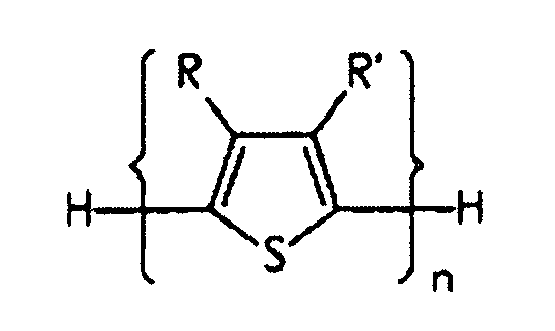
- Toner nach Anspruch 2, worin das Polythiophen ein Poly-(3,4-ethylendioxythiophen) ist.
- Toner nach Anspruch 5, worin das Poly-(3,4-ethylendioxythiophen) gebildet wird aus Monomeren der Formel

- Toner nach Anspruch 6, worin R1 und R3 Wasserstoff-Atome sind und R2 und R4 stehen für (a) R2=H, R4=H; (b) R2=(CH2)nCH3 worin n=0-14, R4=H; (c) R2=(CH2)nCH3 worin n=0-14, R4=(CH2)nCH3 worin n=0-14; (d) R2=(CH2)nSO3 - Na+ worin n=1-6, R4=H; (e) R2=(CH2)nSO3Na+ worin n=1-6, R4=(CH2)nSO3 - Na+ worin n=1-6; (f) R2=(CH2)nOR6 worin n=0-4 und R6=(i) H oder (ii) (CH2)mCH3 worin m=0-4, R4=H oder (g) R2=(CH2)nOR6 worin n=0-4 und R6= (i) H oder (ii) (CH2)mCH3 worin m=0-4, R4=(CH2)nOR6 worin n=0-4 und R6= (i) H oder (ii) (CH2)mCH3 worin m=0-4.
- Toner nach Anspruch 5, worin das Poly-(3,4-ethylendioxythiophen) die folgende Formel aufweist:

- Verfahren, welches umfasst (a) das Erzeugen eines elektrostatischen latenten Bildes auf einem Bildgebungs-Element; und (b) das Entwickeln des latenten Bildes durch In-Kontakt-Bringen des Bildgebungs-Elements mit geladenen Toner-Teilchen nach einem der Ansprüche 2 bis 8.
- Verfahren zum Entwickeln eines latenten Bildes, das auf einer Oberfläche eines Bild-Aufnahme-Elements aufgezeichnet wurde, unter Bildung eines entwickelten Bildes, wobei das Verfahren umfasst (a) das Bewegen der Oberfläche des Bild-Aufnahme-Elements mit einer vorbestimmten Prozess-Geschwindigkeit; (b) das Speichern einer Vorratsmenge von Toner-Teilchen nach einem der Ansprüche 2 bis 8 in einem Reservoir; (c) das Transportieren der Toner-Teilchen auf einer Außenoberfläche eines Donor-Elements zu einer Entwicklungs-Zone in Nachbarschaft zu dem Bild-Aufnahme-Element; und (d) ein induktives Laden der Toner-Teilchen auf der Außenoberfläche des Donor-Elements vor der Entwicklungs-Zone auf einen vordefinierten Ladungswert.
- Verfahren nach Anspruch 10, wobei das Donor-Element in synchronem Kontakt mit dem Bildgebungs-Element gebracht wird und so Toner in der Entwicklungszone von dem Donor-Element abgelöst wird, wodurch das latente Bild entwickelt wird.
Applications Claiming Priority (2)
| Application Number | Priority Date | Filing Date | Title |
|---|---|---|---|
| US09/724,458 US6503678B1 (en) | 2000-11-28 | 2000-11-28 | Toner compositions comprising polythiophenes |
| US724458 | 2000-11-28 |
Publications (3)
| Publication Number | Publication Date |
|---|---|
| EP1209532A2 EP1209532A2 (de) | 2002-05-29 |
| EP1209532A3 EP1209532A3 (de) | 2003-05-02 |
| EP1209532B1 true EP1209532B1 (de) | 2006-11-15 |
Family
ID=24910522
Family Applications (1)
| Application Number | Title | Priority Date | Filing Date |
|---|---|---|---|
| EP01127875A Expired - Lifetime EP1209532B1 (de) | 2000-11-28 | 2001-11-22 | Polythiophene enthaltende Tonerzusammensetzung |
Country Status (4)
| Country | Link |
|---|---|
| US (2) | US6503678B1 (de) |
| EP (1) | EP1209532B1 (de) |
| JP (1) | JP3942407B2 (de) |
| DE (1) | DE60124492T2 (de) |
Families Citing this family (10)
| Publication number | Priority date | Publication date | Assignee | Title |
|---|---|---|---|---|
| US6673501B1 (en) * | 2000-11-28 | 2004-01-06 | Xerox Corporation | Toner compositions comprising polyester resin and polypyrrole |
| US6965746B2 (en) * | 2003-06-17 | 2005-11-15 | Xerox Corporation | Hybrid electrophotographic development with toner induction charged via AC induced conductivity |
| JP4157467B2 (ja) * | 2003-12-09 | 2008-10-01 | 株式会社リコー | 半導体のパターン形成方法、半導体のパターン形成装置、電子素子、電子素子アレイ及び表示装置 |
| US7419754B2 (en) * | 2005-03-31 | 2008-09-02 | Xerox Corporation | Particle having conductive polymer surface additive |
| JP4534998B2 (ja) * | 2006-02-21 | 2010-09-01 | セイコーエプソン株式会社 | 帯電粒子の製造方法、帯電粒子、電気泳動分散液、電気泳動シート、電気泳動装置および電子機器 |
| KR20080028718A (ko) * | 2006-09-27 | 2008-04-01 | 삼성전자주식회사 | 토너 조성물 제조방법 |
| DE102007041722A1 (de) * | 2007-09-04 | 2009-03-05 | H.C. Starck Gmbh | Verfahren zur Herstellung von leitfähigen Polymeren |
| US8771802B1 (en) * | 2012-04-20 | 2014-07-08 | Xactiv, Inc. | Device and materials fabrication and patterning via shaped slot electrode control of direct electrostatic powder deposition |
| WO2015110174A1 (en) | 2014-01-24 | 2015-07-30 | Hewlett-Packard Indigo B.V. | Electrostatic ink compositions |
| JP6658567B2 (ja) * | 2017-01-24 | 2020-03-04 | 京セラドキュメントソリューションズ株式会社 | 静電潜像現像用トナー |
Family Cites Families (27)
| Publication number | Priority date | Publication date | Assignee | Title |
|---|---|---|---|---|
| US4299898A (en) | 1979-05-03 | 1981-11-10 | Xerox Corporation | Positively charged toners containing quaternary ammonium salts attached to acrylate polymers |
| JPS61141452A (ja) | 1984-12-15 | 1986-06-28 | Hitachi Metals Ltd | 磁性トナ− |
| DE3628894A1 (de) * | 1986-08-26 | 1988-03-10 | Hoechst Ag | Kondensationsprodukte 5-gliedriger heterocyclen mit triboelektrischer steuerwirkung fuer elektrophotographische aufzeichnungsverfahren |
| DE3843412A1 (de) | 1988-04-22 | 1990-06-28 | Bayer Ag | Neue polythiophene, verfahren zu ihrer herstellung und ihre verwendung |
| JPH03100561A (ja) * | 1989-09-14 | 1991-04-25 | Japan Carlit Co Ltd:The | 電子写真用トナー |
| NL9000268A (nl) | 1990-02-05 | 1991-09-02 | Oce Nederland Bv | Gedoteerd tinoxidepoeder, een werkwijze voor zijn bereiding, en de toepassing ervan in elektrisch geleidende of antistatische bekledingen. |
| US6025104A (en) | 1992-07-29 | 2000-02-15 | Xerox Corporation | Toner and developer compositions with polyoxazoline resin particles |
| JP3217510B2 (ja) * | 1992-12-25 | 2001-10-09 | 株式会社リコー | 有機磁性体および磁性トナー |
| US5569567A (en) * | 1993-05-11 | 1996-10-29 | Agfa-Gevaert, N.V. | Negatively charged toner powder for use in electrostatography |
| JPH06332263A (ja) * | 1993-05-26 | 1994-12-02 | Ricoh Co Ltd | 新規な現像剤 |
| US5348832A (en) * | 1993-06-01 | 1994-09-20 | Xerox Corporation | Toner compositions |
| NL9301307A (nl) | 1993-07-26 | 1995-02-16 | Oce Nederland Bv | Electrisch geleidend tonerpoeder voor beeldontwikkeling in electrostatische, elektrofotografische of magnetografische beeldvormingsprocessen. |
| US5424160A (en) * | 1994-06-29 | 1995-06-13 | Xerox Corporation | Conductive carrier coatings and processes for the perfection thereof |
| US5834080A (en) | 1994-10-18 | 1998-11-10 | Xerox Corporation | Controllably conductive polymer compositions for development systems |
| JP3100561B2 (ja) | 1997-04-16 | 2000-10-16 | 日本磁力選鉱株式会社 | 破袋装置 |
| US5853906A (en) | 1997-10-14 | 1998-12-29 | Xerox Corporation | Conductive polymer compositions and processes thereof |
| US5766817A (en) | 1997-10-29 | 1998-06-16 | Xerox Corporation | Toner miniemulsion process |
| US5962178A (en) | 1998-01-09 | 1999-10-05 | Xerox Corporation | Sediment free toner processes |
| NL1014657C2 (nl) * | 2000-03-16 | 2001-09-19 | Ocu Technologies B V | Toner gecoat met geleidend polymeer. |
| US6387442B1 (en) | 2000-11-28 | 2002-05-14 | Xerox Corporation | Ballistic aerosol marking process employing marking material comprising polyester resin and poly(3,4-ethylenedioxypyrrole) |
| US6686111B1 (en) * | 2000-11-28 | 2004-02-03 | Xerox Corporation | Toner compositions comprising vinyl resin and poly (3,4-ethylenedioxythiophene) |
| US6439711B1 (en) | 2000-11-28 | 2002-08-27 | Xerox Corporation | Ballistic aerosol marking process employing marking material comprising polyester resin and poly (3,4-ethylenedioxythiophene) |
| US6360067B1 (en) | 2000-11-28 | 2002-03-19 | Xerox Corporation | Electrophotographic development system with induction charged toner |
| US6387581B1 (en) | 2000-11-28 | 2002-05-14 | Xerox Corporation | Toner compositions comprising polyester resin and poly (3,4-ethylenedioxypyrrole) |
| US6365318B1 (en) | 2000-11-28 | 2002-04-02 | Xerox Corporation | Process for controlling triboelectric charging |
| US6353723B1 (en) | 2000-11-28 | 2002-03-05 | Xerox Corporation | Electrophotographic development system with induction charged toner |
| US6383561B1 (en) | 2000-11-28 | 2002-05-07 | Xerox Corporation | Ballistic aerosol marking process employing marking material comprising vinyl resin and poly(3,4-ethylenedioxythiophene) |
-
2000
- 2000-11-28 US US09/724,458 patent/US6503678B1/en not_active Expired - Fee Related
-
2001
- 2001-11-20 JP JP2001353895A patent/JP3942407B2/ja not_active Expired - Fee Related
- 2001-11-22 EP EP01127875A patent/EP1209532B1/de not_active Expired - Lifetime
- 2001-11-22 DE DE60124492T patent/DE60124492T2/de not_active Expired - Lifetime
-
2002
- 2002-09-24 US US10/253,760 patent/US6569591B2/en not_active Expired - Fee Related
Also Published As
| Publication number | Publication date |
|---|---|
| JP2002169340A (ja) | 2002-06-14 |
| EP1209532A3 (de) | 2003-05-02 |
| JP3942407B2 (ja) | 2007-07-11 |
| DE60124492T2 (de) | 2007-03-01 |
| EP1209532A2 (de) | 2002-05-29 |
| US6569591B2 (en) | 2003-05-27 |
| DE60124492D1 (de) | 2006-12-28 |
| US6503678B1 (en) | 2003-01-07 |
| US20030059702A1 (en) | 2003-03-27 |
Similar Documents
| Publication | Publication Date | Title |
|---|---|---|
| US6730450B1 (en) | Toner compositions comprising polyester resin and poly (3,4-ethylenedioxythiophene) | |
| US6387581B1 (en) | Toner compositions comprising polyester resin and poly (3,4-ethylenedioxypyrrole) | |
| US6673501B1 (en) | Toner compositions comprising polyester resin and polypyrrole | |
| EP1209532B1 (de) | Polythiophene enthaltende Tonerzusammensetzung | |
| EP0640884A1 (de) | Ortho-benzoesäuresulphimid als Ladungssteuerungsmittel | |
| EP1209531B1 (de) | Tonerzusammensetzungen die Vinylharz und Poly(3,4-ethylendioxythiophen) enthalten | |
| EP0689100A1 (de) | Träger für die Elektrophotographie, Zwei-Komponenten-Entwickler und Verfahren zur Bildherstellung | |
| EP1209533B1 (de) | Verfahren zur Kontrolle triboelektrischer Ladung | |
| US20050255398A1 (en) | Electrophotographic toner and manufacturing method thereof, polyester resin for electrophotographic toner and manufacturing method thereof, electrophotographic developer and image forming method | |
| US6593051B1 (en) | Toner and electrophotographic method | |
| EP1209530B1 (de) | Tonerzusammensetzungen die Polypyrrole enthalten | |
| KR101399355B1 (ko) | 전자사진용 토너 | |
| US6485874B1 (en) | Toner compositions comprising vinyl resin and poly(3,4-ethylenedioxypyrrole) | |
| US6353723B1 (en) | Electrophotographic development system with induction charged toner | |
| JP4461723B2 (ja) | 静電荷像現像用トナー及びその製造方法並びに画像形成方法 | |
| US6360067B1 (en) | Electrophotographic development system with induction charged toner | |
| US20260036920A1 (en) | Toner for development of electrostatic latent images | |
| JPH06332263A (ja) | 新規な現像剤 | |
| US5631729A (en) | Image forming apparatus | |
| KR20090058946A (ko) | 토너 입자 및 이를 채용한 전자사진용 화상형성장치 | |
| KR20060070163A (ko) | 전자사진용 현상제 | |
| JPH10186729A (ja) | 帯電制御剤及びそれを用いたトナー |
Legal Events
| Date | Code | Title | Description |
|---|---|---|---|
| PUAI | Public reference made under article 153(3) epc to a published international application that has entered the european phase |
Free format text: ORIGINAL CODE: 0009012 |
|
| AK | Designated contracting states |
Kind code of ref document: A2 Designated state(s): AT BE CH CY DE DK ES FI FR GB GR IE IT LI LU MC NL PT SE TR |
|
| AX | Request for extension of the european patent |
Free format text: AL;LT;LV;MK;RO;SI |
|
| PUAL | Search report despatched |
Free format text: ORIGINAL CODE: 0009013 |
|
| AK | Designated contracting states |
Designated state(s): AT BE CH CY DE DK ES FI FR GB GR IE IT LI LU MC NL PT SE TR |
|
| AX | Request for extension of the european patent |
Extension state: AL LT LV MK RO SI |
|
| RIC1 | Information provided on ipc code assigned before grant |
Ipc: 7G 03G 9/087 A Ipc: 7G 03G 9/097 B |
|
| 17P | Request for examination filed |
Effective date: 20031103 |
|
| AKX | Designation fees paid |
Designated state(s): DE FR GB |
|
| 17Q | First examination report despatched |
Effective date: 20040126 |
|
| GRAP | Despatch of communication of intention to grant a patent |
Free format text: ORIGINAL CODE: EPIDOSNIGR1 |
|
| GRAS | Grant fee paid |
Free format text: ORIGINAL CODE: EPIDOSNIGR3 |
|
| GRAA | (expected) grant |
Free format text: ORIGINAL CODE: 0009210 |
|
| AK | Designated contracting states |
Kind code of ref document: B1 Designated state(s): DE FR GB |
|
| REG | Reference to a national code |
Ref country code: GB Ref legal event code: FG4D |
|
| REF | Corresponds to: |
Ref document number: 60124492 Country of ref document: DE Date of ref document: 20061228 Kind code of ref document: P |
|
| ET | Fr: translation filed | ||
| PLBE | No opposition filed within time limit |
Free format text: ORIGINAL CODE: 0009261 |
|
| STAA | Information on the status of an ep patent application or granted ep patent |
Free format text: STATUS: NO OPPOSITION FILED WITHIN TIME LIMIT |
|
| 26N | No opposition filed |
Effective date: 20070817 |
|
| PGFP | Annual fee paid to national office [announced via postgrant information from national office to epo] |
Ref country code: DE Payment date: 20101117 Year of fee payment: 10 |
|
| PGFP | Annual fee paid to national office [announced via postgrant information from national office to epo] |
Ref country code: GB Payment date: 20101117 Year of fee payment: 10 |
|
| PGFP | Annual fee paid to national office [announced via postgrant information from national office to epo] |
Ref country code: FR Payment date: 20111118 Year of fee payment: 11 |
|
| GBPC | Gb: european patent ceased through non-payment of renewal fee |
Effective date: 20121122 |
|
| REG | Reference to a national code |
Ref country code: FR Ref legal event code: ST Effective date: 20130731 |
|
| REG | Reference to a national code |
Ref country code: DE Ref legal event code: R119 Ref document number: 60124492 Country of ref document: DE Effective date: 20130601 |
|
| PG25 | Lapsed in a contracting state [announced via postgrant information from national office to epo] |
Ref country code: DE Free format text: LAPSE BECAUSE OF NON-PAYMENT OF DUE FEES Effective date: 20130601 |
|
| PG25 | Lapsed in a contracting state [announced via postgrant information from national office to epo] |
Ref country code: GB Free format text: LAPSE BECAUSE OF NON-PAYMENT OF DUE FEES Effective date: 20121122 Ref country code: FR Free format text: LAPSE BECAUSE OF NON-PAYMENT OF DUE FEES Effective date: 20121130 |