EP1209932B1 - System, mobiles Endgerät und Verfahren zur Informationsmitteilung in einem drahtlosen Telekommunikationsnetz - Google Patents
System, mobiles Endgerät und Verfahren zur Informationsmitteilung in einem drahtlosen Telekommunikationsnetz Download PDFInfo
- Publication number
- EP1209932B1 EP1209932B1 EP01307897A EP01307897A EP1209932B1 EP 1209932 B1 EP1209932 B1 EP 1209932B1 EP 01307897 A EP01307897 A EP 01307897A EP 01307897 A EP01307897 A EP 01307897A EP 1209932 B1 EP1209932 B1 EP 1209932B1
- Authority
- EP
- European Patent Office
- Prior art keywords
- document
- signal
- mobile terminal
- terminal
- shared
- Prior art date
- Legal status (The legal status is an assumption and is not a legal conclusion. Google has not performed a legal analysis and makes no representation as to the accuracy of the status listed.)
- Expired - Lifetime
Links
- 238000000034 method Methods 0.000 title claims abstract description 18
- 238000004891 communication Methods 0.000 claims abstract description 7
- 230000001360 synchronised effect Effects 0.000 claims description 16
- 230000008859 change Effects 0.000 claims description 10
- 230000005236 sound signal Effects 0.000 claims description 10
- 230000004044 response Effects 0.000 claims description 5
- 230000000007 visual effect Effects 0.000 claims description 2
- 238000005516 engineering process Methods 0.000 description 17
- 230000008569 process Effects 0.000 description 8
- 230000006870 function Effects 0.000 description 5
- 230000008901 benefit Effects 0.000 description 4
- 230000001413 cellular effect Effects 0.000 description 3
- 230000002452 interceptive effect Effects 0.000 description 3
- 230000011664 signaling Effects 0.000 description 3
- 238000013500 data storage Methods 0.000 description 2
- 239000000835 fiber Substances 0.000 description 2
- 238000007792 addition Methods 0.000 description 1
- 230000005540 biological transmission Effects 0.000 description 1
- 239000003086 colorant Substances 0.000 description 1
- 230000000694 effects Effects 0.000 description 1
- 230000010354 integration Effects 0.000 description 1
- 238000010295 mobile communication Methods 0.000 description 1
- 230000008447 perception Effects 0.000 description 1
- 239000002243 precursor Substances 0.000 description 1
- 230000002194 synthesizing effect Effects 0.000 description 1
- 230000003245 working effect Effects 0.000 description 1
Images



Classifications
-
- H—ELECTRICITY
- H04—ELECTRIC COMMUNICATION TECHNIQUE
- H04W—WIRELESS COMMUNICATION NETWORKS
- H04W4/00—Services specially adapted for wireless communication networks; Facilities therefor
- H04W4/12—Messaging; Mailboxes; Announcements
-
- H—ELECTRICITY
- H04—ELECTRIC COMMUNICATION TECHNIQUE
- H04W—WIRELESS COMMUNICATION NETWORKS
- H04W4/00—Services specially adapted for wireless communication networks; Facilities therefor
- H04W4/06—Selective distribution of broadcast services, e.g. multimedia broadcast multicast service [MBMS]; Services to user groups; One-way selective calling services
-
- H—ELECTRICITY
- H04—ELECTRIC COMMUNICATION TECHNIQUE
- H04W—WIRELESS COMMUNICATION NETWORKS
- H04W88/00—Devices specially adapted for wireless communication networks, e.g. terminals, base stations or access point devices
- H04W88/18—Service support devices; Network management devices
- H04W88/184—Messaging devices, e.g. message centre
-
- H—ELECTRICITY
- H04—ELECTRIC COMMUNICATION TECHNIQUE
- H04W—WIRELESS COMMUNICATION NETWORKS
- H04W92/00—Interfaces specially adapted for wireless communication networks
- H04W92/16—Interfaces between hierarchically similar devices
- H04W92/18—Interfaces between hierarchically similar devices between terminal devices
Definitions
- This invention relates in general to the field of data sharing, especially to online shared documents in a mobile environment, to the field of remote synchronization in a mobile environment, and to the field of group calendar technology, particularly online shared functionality of calendars in a mobile environment.
- the General Packet Radio Servie (GPRS) for mobile telecommunications offers a third generation environment where data can be transferred transparently from and to a mobile terminal.
- Data traffic is becoming increasingly important in wireless networks. It is already overtaking voice in fixed networks, and may soon do so in wireless networks.
- the so-called third generation wireless system is expected to add the capabilities necessary to allow the simultaneous integration of voice and data traffic at high speeds and increased bandwidth.
- GSM Global System for Mobile Communications
- the GPRS is being introduced as an intermediate step with a range of supported bandwidths useful for e-mail, web browsing and large data transfers.
- GSM Global System for Mobile Communications
- GPRS also supports quality of service and fast connection setup so that the user has the perception of being continually on.
- shared functions When two or more devices are connected there are a number of shared functions that they can perform together.
- the very basic case of this is a simple phone call, and a more advanced example of this is a terminal connection.
- shared functions technology is a synchronously shared document, for example, text or a picture or a folder; throughout this disclosure, the word "document” is used in this broad inclusive sense.
- Document sharing is "synchronous" if it occurs between terminals in a specific time relationship, under control of a master clock, with a constant time between successively shared bits, characters, or events.
- document sharing In fixed networks, document sharing is handled either with a document server (as in World Wide Web), with a dedicated groupware application, or simply by just copying the document from one device to another via a common file system.
- a document server as in World Wide Web
- a dedicated groupware application or simply by just copying the document from one device to another via a common file system.
- the methods that are currently used are functioning well in PC systems and distributed networks.
- a synchronously shared online document in a mobile environment means, for example, that a document which is open in a remote mobile terminal A can be transferred and viewed also at one or more other terminals which will receive not merely an initial snapshot of the terminal A document but a synchronous view of the document as user A manipulates or updates the document.
- mobile devices like Personal Digital Assistants (PDAs) or communicators, for this kind of task.
- Documents that are created and stored in office systems can already be viewed by users of multiple personal computers, with editing commands being sent from participating terminals to the other participating terminals. See, for instance, Adams ( U.S. Patent No. 5,781,732 ).
- an arrangement has not been devised for a mobile terminal, in remote contact with either another mobile device or with a fixed system such as a PC, whereby a single mobile editor allows others to see a document synchronously as he alone makes edits.
- the main implementations are local user-initiated synchronization when devices are near each other, and remote synchronization using user-initiated or timed TCP/IP (Transfer Control Protocol/Internet Protocol) data connection.
- TCP/IP Transfer Control Protocol/Internet Protocol
- the benefit of local synchronization is that the connection is cheap and fast.
- the drawback of local synchronization is that the devices must be relatively near each other for infrared, low power radiofrequency (LPRF), or cable connection.
- LPRF low power radiofrequency
- the benefit of remote synchronization is that the devices can be in different locations, and the synchronization can be performed anytime.
- One drawback in remote synchronization is that the synchronization must be initiated from the mobile terminal, and it has to be user-initiated; the information center cannot be active for synchronization in current systems.
- the other drawback is that the synchronization is slow, and it interrupts all other user tasks.
- a drawback in current systems is that the mobile user can synchronize only contact information and calendars.
- a remote central processing unit supports one or more mobile users who interact with a single terminal-set that is coupled to a set-top transceiver.
- the mobile users operate PDAs that interact via a remote CPU with a television terminal having a set-top box.
- the CPU is the only remote component, and the mobile users are not remote from the interactive terminal or from each other.
- the synchronization signal includes a first display control signal for controlling the display of the PDA and a second display control signal for controlling the display of the television. This synchronization signal causes the displays to show information in a synchronized manner to the user.
- An especially useful implementation of shared functions technology is a group calendar.
- group calendars There are several implementations for group calendars in office systems with networked PCs. Thus far there have been no creative solutions for mobile devices, like PDAs or communicators, for this kind of task.
- One existing implementation for calendar handling is the calendar reservation and request system that was introduced in the Nokia 9000I Communicator.
- All group calendars and shared calendars thus far are based on an environment of networked personal computers in fixed networks and on the idea of one common calendar database in a server somewhere in the system.
- the inventive solution is characterized by a system, a mobile terminal and a method incorporating the features of claims 1, 3, and 12 respectively.
- a mobile terminal is capable of being remotely and continuously connected to one or more other terminals, and all of these terminals repeatedly update each other so that all selected categories of data in each computer are revised uniformly. This entire process occurs automatically and synchronously without user disruption.
- a mobile terminal can stay synchronized with a main information center, for example a PC, using a network such as GPRS as a platform and with synchronization active all the time.
- Devices can keep track of the changes in each terminal's data storage and update the information regularly to the other terminal.
- the information center and mobile terminal are not required to have a physical connection, and the synchronization can be executed anytime when changes are tracked. This is important, for example, when:
- a mobile terminal edits and controls a document, and has a remote link to one or more other terminals whereby those other terminals are given a real-time view of the document as it is discussed, scrolled, highlighted and/or edited.
- the remote discussion or conversation can be conducted orally, and simultaneously with the remote document sharing.
- a "remote" connection is understood to mean a wireless telephone connection.
- two or more mobile terminal users can share online and view a synchronously updated document that physically resides in one master mobile terminal.
- a "master" terminal is meant a terminal which exclusively manipulates and exclusively controls a shared document. Because the document is simply controlled by one editor, instead of by a plurality of editors, it is straightforward for the editor to verify that he has exactly the document that he desires. In other words, the editor is the complete master of the shared document, and all of the other users are slaves.
- a mobile terminal is capable of having a remote link to one or more other mobile terminals. Calendar data from each user terminal is exchanged, and then each terminal displays the superimposed calendars. Also, if third generation technology is used, the shared calendar can be simultaneously discussed while users update their individual calendars and thereby cause immediate and automatic updates to the superimposed display.
- This solution allows two or more users to share and compare their calendars while at home, office, or on the road, using existing connection technologies.
- the implementation possibilities of this aspect of the invention will also improve when third generation mobile solutions become available, making it possible, for example, to conduct an active voice call before, during and after the calendar data exchange.
- the context of this embodiment is a wireless telecommunications system, which simply means that the invention is capable of being utilized via an ordinary wireless telephone call between the terminals that share documents. Additional systems or intermediaries, such as the internet, are unnecessary.
- the wireless telephone communications system in which this embodiment operates is the same system necessary to make any wireless telephone call.
- the embodiment offers a way of having an information center and a mobile terminal regularly and mutually update important data in synchrony.
- the embodiment enables real time online document sharing for a mobile terminal with a remote connection to other terminals.
- the embodiment enables real time online calendar sharing and group calendars for a mobile terminal with a remote connection to other terminals.
- Fig. 1 shows a system for sharing documents online between mobile terminals and between mobile terminals and fixed terminals.
- the system is preferably capable of simultaneously carrying voice conferencing between the mobile terminals and between the mobile terminals and the fixed terminals.
- the system 10 includes a plurality of mobile terminals 12a, 12b, 12c that communicate via a wireless mobile network 14 for the purpose of communicating among themselves and also for communicating with other networks, such as the network 16 illustrated in Fig. 1 .
- the telephone call between terminals is preferably direct, meaning that contact with the Internet, or like packet networks, is not necessary and does not occur.
- the network 14 may be any kind of wireless network, such as the known second-generation wireless network (GSM), a general packet radio service network (GPRS), a third-generation wireless network such as Universal Mobile Telecommunications System (UMTS), or a wireless Asynchronous Transfer Mode (ATM) network. It could even be an analog network of the first-generation type with the capability of utilizing high bandwidth cellular data terminals, such as shown in the above-mentioned U.S. Pat. No. 5,946,633 .
- the mobile terminals 12a, 12b, and 12c include a graphical interface for presenting images, documents, and the like. They also include one or more input devices for calling up documents or images, for changing or annotating documents or images, and the like.
- the network 16 may be any kind of network, such as the public narrowband network including Signaling System 7 (SS7), a private or public X.25 packet-switched network, a public broadband network (SS7 and ATM), a private or public frame relay network, a private ATM network, the Internet, or any of the wireless networks mentioned above.
- SS7 Signaling System 7
- ATM public broadband network
- private or public frame relay network a private ATM network
- the Internet or any of the wireless networks mentioned above.
- Terminals 18 are shown connected to the network 16 , and these terminals may be fixed terminals, such as desktop computers, computers having Internet access, etc. These also have a display device and one or more input/output devices for enabling the viewing and changing of documents or images provided over the networks 14, 16.
- a given mobile terminal 12a is able to display a document on its display that is the same as the document in another mobile terminal 12b or fixed terminal 18 .
- a "master" terminal exclusively manipulates and exclusively controls any shared document, and the other terminals that share the document can be thought of as "slaves" with respect to that document.
- a terminal can simultaneously be a master with respect to one shared document and a slave with respect to another shared document. Assuming that terminal 12a is a master terminal, then terminal 12a is the designated editor of the document, and this master mobile terminal 12a is thus the only terminal able to edit, change, annotate or otherwise manipulate the document.
- Any manipulation by mobile terminal 12a is communicated at about the same time to at least one terminal, which may be another mobile terminal 12b or may be a fixed terminal 18 with which the given mobile terminal 12a is in communication, but in any case is "remote" from terminal 12a in the sense that a wireless telephone connection is necessary to connect and share the document originating at terminal 12a.
- the system can be viewed as a system within a larger wireless telecommunications system.
- Primary elements of the invention include at least one master mobile terminal 12a and at least one slave terminal 12b , as seen in Fig. 1 .
- Each of the master terminals is responsive to user input, and, as seen in Fig. 2 , is for providing an outgoing radio signal on a line 264 .
- the outgoing radio signal synchronously shares information about one or more internally controlled shared documents exclusively controlled by the master mobile terminal.
- the slave terminals are responsive to the outgoing radio signal on the line 264 , and are designed to provide an external document display signal on a line 226 , as seen in Fig. 2 .
- the system of the present invention preferably also includes means for audio discussion simultaneous with real-time document sharing so that the signals on the lines 264, 266 also contain information relating thereto.
- This communication is best accomplished by an information, synchronization and broadcast server 19, 20 or 22 , which receives requests for online sharing of documents from mobile terminals or fixed terminals and facilitates the sharing by saving document information, by providing synchronization signals, and by broadcasting information, which broadcasted information may of course include text, images, or both.
- the information, synchronization and broadcast server thus facilitates sharing the document among multiple terminals, including two or more mobile terminals, or among one or more mobile terminals and one or more fixed terminals.
- These multiple servers can be deployed throughout the system 10 in order to increase efficiency and availability of the services provided thereby.
- one of these servers can be deployed as part of the master mobile terminal that functions as the document editor, either attached to or integrated with that master mobile terminal's signal processor 221 shown in Fig. 2 .
- An information, synchronization and broadcast server 19, 20 , or 22 includes means for receiving a request from one of the mobile terminals 12a, 12b , or 12c or from a fixed terminal 18 for an online document sharing session.
- This request could, for instance, originate in a particular mobile terminal 12a such as shown in Fig. 2 , wherein a user utilizes a manual input device 210 to signal that an online document sharing session is desired.
- an application program within the server 19, 20 , or 22 Upon receiving the initial request for an online document sharing session, an application program within the server 19, 20 , or 22 will then interact with the display in order to set up the requested document sharing session as the user instructs.
- This system should preferably have the capability to handle requests for online document or image sharing using various types of document application programs.
- a document may be a text document, a picture, a folder, or some other configuration, and, as mentioned previously, the word "document" is used throughout this disclosure in this broad sense. Therefore, a mobile terminal or server should preferably be equipped with a large number of application programs which can be called up upon receiving a request for a particular type of document or image sharing session. It will, of course, be realized that all signals involved in the sharing of documents may comprise a large plurality of back-and-forth signaling sequences, each carrying an amount of information concerning the nature of the setup, etc., all of which is well known to those of skill in the art and need not be detailed here.
- the document to be shared can originate in one of the terminals, such as one of the mobile terminals or fixed terminals, or can reside in a separate server 19, 20 or 22. If the document or image is first created in one of the terminals and the server receives a request for online sharing, the document must be communicated to the server and stored therein for purposes of communication to other terminals, some of which may join the session at different times, and the document can also be stored for future reference for use during future sharing sessions. In that case, the document need not be created again and can be used as a network resource by multiple terminal users, both fixed and mobile.
- the terminal that originated a document-sharing request need not be a mobile terminal, but could be a fixed terminal originating the request for document or image sharing between itself and a mobile terminal.
- the terminal that is the exclusive editor of the document may be different from the terminal that originates the document-sharing request, and the former terminal may initially need to receive the document from a third terminal before opening the document.
- Each component of this system, including each mobile terminal should preferably include a synchronization device for ensuring that document-sharing occurs in a synchronous manner.
- the user of a slave mobile terminal 12b will preferably be free to save a snapshot of any shared document for his own future use, and an additional feature would allow any document-sharing terminal to obtain and save a continuous record of the evolution of the shared document.
- the mobile terminal 12a that is the designated editor or master of the shared document can preferably enable the user to use the manual input device 210 to edit, highlight, scroll or annotate the shared document.
- the manual input device 210 may include a keyboard, a mouse, and/or other devices operated by hand.
- the resulting document changes are immediately displayed for the user's observation on his own display 238 , while at the same time the changes are communicated to users elsewhere.
- This document-sharing process may all be accompanied by voice discussion going on simultaneously on a conference channel available to all participants, and preferably there will be means for written discussion (e.g. suggested text being sent to the editor).
- the system includes a mobile terminal 12a equipped with an antenna for transmitting the outgoing radio signal on the line 264 and for receiving the incoming radio signal on the line 266 , in a wireless telecommunications-system.
- the mobile terminal 12a includes an input device 210 which is responsive to user input and is for providing an internal document manipulation signal on a line 213 .
- the internal document manipulation signal is for exclusively manipulating at least one internally controlled shared document that is synchronously shared with at least one other terminal.
- the mobile terminal 12a of Fig. 2 also includes a receiver 270 that is responsive to the incoming radio signal on the line 266 , and which is for forwarding an external-document-manipulation signal on a line 256 to a signal processor 221 .
- This external document manipulation signal is for exclusively manipulating at least one externally controlled shared document that is synchronously shared with the other terminal or terminals.
- the mobile terminal further includes the signal processor 221 , responsive to the external document manipulation signal on the line 256 and the internal document manipulation signal on the line 213 .
- the signal processor 221 is for providing a synchronized internal document sharing signal on a line 236 which basically conveys information to a transmitter 268 about a document exclusively controlled by terminal 12a .
- the signal processor is also for providing an internal document display signal on a line 244 , and an external document display signal on a line 226 , both of which signals simply carry to a display 238 the information necessary to display shared documents which are internally or externally controlled, respectively.
- the transmitter 268 provides the outgoing radio signal on the line 264 .
- the display 238 provides visual communication to the user.
- the mobile terminal 12a of this invention also preferably includes a speaker 228 , which is responsive to a speaker signal on a line 272 from the signal processor 221 , the speaker providing audio output to the user.
- the signal processor provides this speaker signal on the line 272 in response to a received audio signal on a line 274 from the receiver 270 . All of this is illustrated in Figures 2 and 3 .
- the terminal also includes a microphone 217 for providing an audio input signal on a line 219 to the signal processor 221 , which causes the signal processor to emit an outgoing audio signal on a line 239 to the transmitter.
- this mobile terminal 12a is capable of supporting an audio conversation in real time, simultaneously with real time document sharing.
- the mobile terminal 12a is also preferably capable of being a slave terminal and a master terminal concurrently, with respect to different shared documents (i.e. a slave terminal with respect to one or more documents, and a master terminal with respect to one or more different documents).
- the mobile terminal 12a may alternatively be capable of being a slave and a master terminal only at different times. Still another possibility would be for a mobile terminal 12a to be only capable of being a slave terminal or only capable of being a master terminal.
- Fig. 3 shows some of the inner workings of the signal processor 221 .
- Fig. 3 shows an incoming audio processing means 376 which takes the received audio signal on the line 274 , processes it, and yields the speaker signal on a line 272 .
- This audio processing may include decoding, synthesizing, and other typical or even atypical audio processes.
- the outgoing audio processing means 382 takes the audio input signal on the line 219 , applies audio processes such as encoding, and produces the outgoing audio signal on the line 239 .
- the actual hardware inside of the signal processor 221 is not described in Fig. 3 .
- a typical general purpose signal processor architecture would suffice. This would include the usual central processing unit (CPU), random access memory (RAM), read only memory (ROM), address bus, data bus, control bus, and input/output port.
- CPU central processing unit
- RAM random access memory
- ROM read only memory
- address bus address bus
- data bus control bus
- input/output port input/output port
- the signal processor 221 is accomplished using appropriate software document sharing application programs.
- the signal processor 221 could be implemented using equivalent discrete or dedicated hardware.
- the signal processor 221 of Fig. 3 contains a memory unit 390 which includes both an external shared document memory means 320 and an internal shared document memory means 314 .
- the external memory 320 stores shared documents that are controlled by other terminals
- the internal memory 314 stores shared documents that are controlled by the terminal 12a .
- the mobile terminal 12a may also comprise memory means for storing documents that are not shared.
- the signal on the line 256 entering the external memory and the signal on the line 213 entering the internal memory are respectively the external-document-manipulation signal and the internal-document-manipulation signal mentioned previously.
- the signals exiting the memory 390 have already been described above.
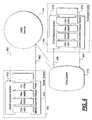
- the external memory means 320 includes a group of documents that mirrors a group of documents at an information center 460 shown in Fig. 4 , the group of documents being updated to keep pace with whatever changes are made at the information center.
- the mobile terminal and the information terminal shown in Fig. 4 have exactly similar data contents.
- Fig. 4 shows an example where the similar data contents are "contacts”, “messages”, “calendar”, and other "documents.” There are also unlabelled contents in Fig.
- each terminal may contain documents that are not shared and are not similar; in other words, it will be understood that the shared data in the fixed information center 460 may be only a subset of the information center's whole data storage, and likewise for the mobile terminal 12a . It will also be understood that this process can operate in reverse, with the information center 460 behaving as the slave and the mobile terminal 12a behaving as the master, with respect to some documents.
- the mobile terminal device 12a can be connected to the information center 460 in the way that is described in Fig. 4 ; i.e., it can be connected to the network via a GPRS or third generation connection and then to the information center 460 via an office system 416.
- a mobile document change tracker 470 is included in, or integrated with, the mobile terminal device 12a, and the mobile document change tracker 470 can keep track of any user-designated internal data in the mobile device 12a that is changed. For example, calendar events are added, new or revised documents are saved, a contact database is changed or new messages are received, and these changes are reported by the mobile document change tracker 470 which sends a mobile document change signal on a line 480.
- the information center 460 can replicate all of these changes, in response to a mobile document update signal on a line 486.
- the information center 460 maintains a subset of central changing documents that mirrors documents being edited at the master mobile terminal.
- the information center has a similar functionality. Its central document change tracker 478 identifies and monitors changes in a designated subset of central storage documents that occur within the information center 460, and sends a central change signal on a line 484; subsequently, those changes are implemented by a mobile document updater 472 in response to a central update signal on a line 482.
- the mobile document updater 472 synchronously updates each designated shared document in the mobile terminal, as that document is manipulated or changed at the information center, or at any terminal having exclusive control of the shared document.
- the combined information center 460 and office system 416 can be carried out on the server 19 such as shown in Fig. 1 , which could be fixed or mobile.
- the mobile terminal 12a is connected to a GPRS network (or similar).
- the office system in this example has a connection to the GPRS network.
- the information center 460 may have a standard connection, for example TCP/IP, to the local office system 416.
- Jack calls Jill to talk about the latest sales offer.
- Jack opens the sales offer document in his terminal device and clicks on or presses a "Share Document” button.
- Jill receives the document instantly into her terminal and sees the information while Jack points out interesting items and scrolls in the original document.
- Jill wants to have the document for further reading, and she clicks on or presses "Save” to get the document stored into her device.
- Jack has exercised the prerogatives of editor.
- Figures 5 and 6 show the normal situation when there are user calendars for two different users, let's call them Jack and Jill, respectively.
- Jack makes a phone call to Jill with his Personal Digital Assistant terminal (PDA) in order to agree to a meeting time.
- PDA Personal Digital Assistant terminal
- both terminals are functioning as calendar editor terminals.
- they both press a "Share Calendar” button and then each terminal accesses the calendar which is solely and exclusively edited by the other terminal.
- Each terminal then superimposes the two calendars ( Fig. 6 ), using a different format for one of the calendars in order to help distinguish them.
- Jack's calendar could appear in regular font and Jill's in italics, or the two calendars could appear in different colors when superimposed. From the superimposed calendars it is easy for Jack and Jill to see what calendar events are overlapping and when they have a common opportunity to have a meeting.
- the system described thus far can, as discussed, handle calendar sharing including the following features.
- the calendar data can be selected for a particular time frame, and then it can be read from connected devices to one server where the calendar data is gathered. The gathered data then can be sent to the terminals which show the superimposed calendars. When the connection is closed, the original individual calendar data can be returned.
- Implementing any kind of traditional calendar functionality is easy using the described method and will become fast and fluent using GPRS.
- the system might handle document sharing in the following way, given a connection between two mobile terminals 12a and 12b .
- the document data is sent from mobile terminal 12a to mobile terminal 12b directly, without any separate intermediate server.
- the functions of the server are integrated into terminal 12a .
- the synchronization signal for this embodiment does not come from a separate server but rather from the synchronization source in one of the mobile terminals.
- Terminal 12b receives the document and opens it in an appropriate viewer.
- the functionality of the document sharing application program in conjunction with the synchronization source, offers synchronous signaling and document handling tools enabling such features as remote pointing, scrolling and emphasizing. Using GPRS, this sharing of documents will be fast and fluent.
- SMS Short Message Service
- each signal described in this disclosure is defined broadly as a cause and effect relationship.
- the signal may be direct or indirect, may comprise any number of intermediate steps, and may be integrated together with other signals, as will be understood by those skilled in the art.
Landscapes
- Engineering & Computer Science (AREA)
- Computer Networks & Wireless Communication (AREA)
- Signal Processing (AREA)
- Mobile Radio Communication Systems (AREA)
- Information Transfer Between Computers (AREA)
- Telephonic Communication Services (AREA)
- Radio Relay Systems (AREA)
Claims (14)
- System in einem Drahtlostelekommunikationsnetzwerk, das aufweist:ein erstes Mobilendgerät (12a), das auf eine Anwendereingabe anspricht und konfiguriert ist, ein abgehendes Funksignal (264) bereitzustellen, wobei das abgehende Funksignal Informationen synchron über Editieren eines ersten mitbenutzten Dokuments austauscht, über welches das erste Mobilendgerät exklusiv Kontrolle hat; undein zweites Endgerät (12b oder 18), das auf das abgehende Funksignal (264) anspricht und konfiguriert ist, ein externes Dokumentenanzeigesignal (226) bereitzustellen,wobei das externe Dokumentenanzeigesignal (226) Informationen trägt, um eine synchrone Anzeige des ersten mitbenutzten Dokuments bereitzustellen, während das erste mitbenutzte Dokument durch das erste Endgerät editiert wird,wobei das zweite Endgerät weiter konfiguriert wird, synchron ein zweites mitbenutztes Dokument darzustellen, über welches das zweite Endgerät exklusiv Kontrolle hat, undwobei eine Anzeige des zweiten Endgeräts konfiguriert ist, das erste mitbenutzte Dokument und das zweite mitbenutzte Dokument in einem zueinander unterschiedlichen Format überlagert anzuzeigen und zu wechseln, während das erste mitbenutzte Dokument oder das zweite mitbenutzte Dokument editiert wird.
- System gemäß Anspruch 1, weiter aufweisend Mittel zur Audiodiskussion simultan zu einer gemeinsamen Dokumentennutzung in Echtzeit.
- Mobilendgerät (12a), das auf eine Anwendereingabe anspricht, aufweisend:einen Sender, der konfiguriert ist, ein abgehendes Funksignal (264) bereitzustellen, welches Informationen über Editieren eines ersten mitbenutzten Dokuments austauscht, über welches das mobile Endgerät exklusiv Kontrolle hat;einen Signalprozessor, der auf ein eingehendes Funksignal (266) anspricht, wobei der Signalprozessor konfiguriert ist, ein externes Dokumentenanzeigesignal (226) bereitzustellen, undeine Anzeige, die konfiguriert ist, synchron das erste mitbenutzte Dokument und ein zweites mitbenutztes Dokument, über das ein anderes Mobilendgerät exklusiv Kontrolle hat, in einem zueinander unterschiedlichen Format überlagert bereitzustellen;wobei das externe Dokumentenanzeigesignal Informationen trägt, um das zweite mitbenutzte Dokument bereitzustellen, während das zweite mitbenutzte Dokument durch das andere Endgerät editiert wird,wobei die Anzeige wechselt, während das erste mitbenutzte Dokument oder das zweite mitbenutzte Dokument editiert wird.
- Mobilendgerät (12a) gemäß Anspruch 3, ausgestattet mit einer Antenne zum Senden des abgehenden Funksignals (264) und zum Empfangen des eingehenden Funksignals (266), aufweisend:eine Eingabeeinrichtung (210), die auf eine Anwendereingabe anspricht, zum Bereitstellen eines internen Dokumenteneditierungssignals (213), wobei das interne Dokumenteneditierungssignal exklusiv zum Editieren des ersten mitbenutzten Dokumentes ist,einen Empfänger (270), der auf das eingehende Funksignal (266) anspricht, zum Weiterleiten eines externen Dokumenteneditierungssignals (256), wobei das externe Dokumenteneditierungssignal exklusiv zum Editieren des zweiten mitbenutzten Dokuments ist;den Signalprozessor (221), der auf das externe Dokumenteneditierungssignal (256) und das interne Dokumenteneditierungssignal (213) anspricht, zum Bereitstellen eines synchronisierten internen Dokumentenmitbenutzungssignals (236), eines internen Dokumentenanzeigesignals (244) und des externen Dokumentenanzeigesignals (226);den Sender (268), der auf das synchronisierte interne Dokumentenmitbenutzungssignal (236) anspricht, zum Bereitstellen des abgehenden Funksignals (264); unddie Anzeige (238), die auf das interne Dokumentenanzeigesignal (244) und das externe Dokumentenanzeigesignal (226) anspricht, zum Bereitstellen einer visuellen Kommunikation mit dem Anwender.
- Mobilendgerät (12a) gemäß einem der Ansprüche 4 bis 6, wobei:das Mobilendgerät weiter einen Lautsprecher (228) aufweist, der auf ein Lautsprechersignal (272) anspricht, zum Bereitstellen einer Audioausgabe an den Anwender;das Mobilendgerät weiter ein Mikrofon (217) aufweist, das auf eine mündliche Eingabe anspricht, zum Bereitstellen eines Audioeingabesignals (219);der Empfänger auch dient zum Bereitstellen eines empfangenen Audiosignals (274);der Signalprozessor auch auf das empfangene Audiosignal (274) anspricht und auf das Audioeingabesignal (219) anspricht und auch zum Bereitstellen eines abgehenden Audiosignals (239) und zum Bereitstellen eines Lautsprechersignals (272) dient; undder Sender auch auf das abgehende Audiosignal (239) anspricht.
- Mobilendgerät gemäß Anspruch 5, wobei das Mobilendgerät (12a) in der Lage ist, eine Audiokonversation in Echtzeit simultan mit einer Mitbenutzung eines Dokuments in Echtzeit zu unterstützen.
- Mobilendgerät (12a) gemäß einem der Ansprüche 3 bis 6, wobei das erste mitbenutzte Dokument und das zweite mitbenutzte Dokument Kalenderdokumente aufweisen, wobei die Kalenderdokumente in Echtzeit überlagert werden und wobei die Anzeige in Echtzeit wechselt, während die Kontrolle habenden Endgeräte jeweils die Kalenderdokumente editieren.
- Mobilendgerät gemäß einem der Ansprüche 4 bis 7, wobei der Signalprozessor (221) aufweist:Speicher (320) für externe mitbenutzte Dokumente, der auf das externe Dokumenteneditierungssignal (256) anspricht, zum Bereitstellen des externen Dokumentenanzeigesignals (226); undSpeicher (314) für interne mitbenutzte Dokumente, der auf das interne Dokumenteneditierungssignal (213) anspricht, zum Bereitstellen des internen Dokumentenanzeigesignals (244) und zum Bereitstellen des synchronisierten internen Dokumentenmitbenutzungssignals (236).
- Mobilendgerät gemäß Anspruch 8, wobei die Speichermittel (320) für externe mitbenutzte Dokumente in der Lage sind, eine Gruppe synchron aktualisierter Dokumenten zu halten, die eine entsprechende Gruppe von Dokumenten an einer Informationszentrale (460) spiegeln, wobei das andere Endgerät (12b, 18) die Informationszentrale (460) aufweist, und das zweite mitbenutzte Dokument die Gruppe synchron aktualisierter Dokumente aufweist.
- Mobilendgerät gemäß einem der Ansprüche 4 bis 8, wobei die Speichermittel (314) für interne mitbenutzte Dokumente in der Lage sind, eine Gruppe interner Dokumenten zu halten, die mit einer entsprechenden Gruppe von Dokumenten an einer Informationszentrale (460) gespiegelt wird, wobei das andere Endgerät (12a oder 18) die zentrale Informationszentrale (460) aufweist und das erste mitbenutzte Dokument die Gruppe der internen Dokumente aufweist.
- Mobilendgerät gemäß Anspruch 5, wobei der Signalprozessor (221) aufweist:Speichermittel (320) für ein extern mitbenutztes Dokument, die auf das externe Dokumenteneditierungssignal (256) ansprechen, zum Bereitstellen des externen Dokumentenanzeigesignals (226);Speichermittel (314) für ein internes mitbenutztes Dokument, die auf das interne Dokumenteneditierungssignal (213) ansprechen, zum Bereitstellen des internen Dokumentenanzeigesignals (244) und zum Bereitstellen des synchronisierten internen Dokumentenmitbenutzungssignals (236);Verarbeitungsmittel (376) für eingehendes Audio, die auf das empfangene Audiosignal (274) ansprechen, zum Bereitstellen eines Lautsprechersignals (272); undVerarbeitungsmittel (382) für abgehendes Audio, die auf das Audioeingangssignal (219) ansprechen, zum Bereitstellen des abgehenden Audiosignals (239).
- Verfahren zum gemeinsamen Nutzen von Informationen in einem Drahtlostelekommunikationsnetzwerk, aufweisend:Bereitstellen von einem ersten Mobilendgerät eines abgehenden Funksignals (264) in Reaktion auf eine Anwendereingabe, wobei das abgehende Funksignal synchron Informationen über ein Editieren eines ersten mitbenutzten Dokuments austauscht, über welches das erste Mobilendgerät exklusiv Kontrolle hat, undBereitstellen an ein zweites Endgerät (12b; 18) eines externen Dokumentenanzeigesignals (226) in Reaktion auf das abgehende Funksignal (264), wobei das externe Dokumentenanzeigesignal Informationen zum Bereitstellen einer synchronen Anzeige des ersten mitbenutzten Dokuments trägt, während das erste mitbenutzte Dokument durch das erste Endgerät editiert wird,synchrones Darstellen durch das zweite Endgerät eines zweiten mitbenutzten Dokuments, über welches das zweite Endgerät exklusiv Kontrolle hat, überlagert mit und in einem anderen Format als das des ersten mitbenutzten Dokuments, undWechseln einer Anzeige des zweiten Endgeräts, während das erste mitbenutzte Dokument oder das zweite mitbenutzte Dokument editiert wird.
- Verfahren gemäß Anspruch 12, weiter aufweisend den Durchführungsschritt einer Audiodiskussion simultan mit einer Dokumentenmitbenutzung in Echtzeit.
- Verfahren gemäß Anspruch 12 oder 13, wobei das erste mitbenutzte Dokument und das zweite mitbenutzte Dokument Kalenderdokumente aufweisen, wobei die Kalenderdokumente in Echtzeit überlagert werden und aufweisend Anzeigen von Änderungen in Echtzeit, während die Endgeräte jeweils die Kalenderdokumente editieren.
Applications Claiming Priority (2)
| Application Number | Priority Date | Filing Date | Title |
|---|---|---|---|
| US09/722,616 US6879997B1 (en) | 2000-11-27 | 2000-11-27 | Synchronously shared online documents |
| US722616 | 2000-11-27 |
Publications (3)
| Publication Number | Publication Date |
|---|---|
| EP1209932A2 EP1209932A2 (de) | 2002-05-29 |
| EP1209932A3 EP1209932A3 (de) | 2003-10-29 |
| EP1209932B1 true EP1209932B1 (de) | 2008-11-12 |
Family
ID=24902613
Family Applications (1)
| Application Number | Title | Priority Date | Filing Date |
|---|---|---|---|
| EP01307897A Expired - Lifetime EP1209932B1 (de) | 2000-11-27 | 2001-09-17 | System, mobiles Endgerät und Verfahren zur Informationsmitteilung in einem drahtlosen Telekommunikationsnetz |
Country Status (5)
| Country | Link |
|---|---|
| US (1) | US6879997B1 (de) |
| EP (1) | EP1209932B1 (de) |
| AT (1) | ATE414383T1 (de) |
| DE (1) | DE60136520D1 (de) |
| DK (1) | DK1209932T3 (de) |
Families Citing this family (83)
| Publication number | Priority date | Publication date | Assignee | Title |
|---|---|---|---|---|
| US7721210B2 (en) * | 2000-11-29 | 2010-05-18 | Nokia Corporation | Electronic calendar system |
| US7092381B2 (en) * | 2000-12-29 | 2006-08-15 | Telefonaktiebolaget Lm Ericsson (Publ) | Delivery of broadcast teleservice messages over packet data networks |
| JP2002236630A (ja) * | 2001-02-08 | 2002-08-23 | Fujitsu Ltd | 処理装置、管理装置、コンピュータシステム、記録媒体およびプログラム |
| GB0108044D0 (en) * | 2001-03-30 | 2001-05-23 | British Telecomm | Application synchronisation |
| WO2002079896A2 (en) * | 2001-03-30 | 2002-10-10 | British Telecommunications Public Limited Company | Multi-modal interface |
| US20040122915A1 (en) * | 2001-11-28 | 2004-06-24 | John Saare | Method and system for an extensible client specific calendar application in a portal server |
| EP1333636A1 (de) * | 2002-01-30 | 2003-08-06 | Koninklijke KPN N.V. | Mobilendegerät und Datenanbietern zur elektronischen Formularausfüllung |
| WO2003084173A1 (en) * | 2002-03-28 | 2003-10-09 | British Telecommunications Public Limited Company | Synchronisation in multi-modal interfaces |
| US20040039755A1 (en) * | 2002-06-05 | 2004-02-26 | Matthew Kunze | Metadata relationships |
| US7346705B2 (en) | 2002-08-28 | 2008-03-18 | Apple Inc. | Method of synchronising three or more electronic devices and a computer system for implementing that method |
| US7234117B2 (en) * | 2002-08-28 | 2007-06-19 | Microsoft Corporation | System and method for shared integrated online social interaction |
| EP1546846A2 (de) * | 2002-09-09 | 2005-06-29 | Apple Computer, Inc. | Verfahren zur verwaltung eines kalenders und computersystem zur implementierung dieses verfahrens |
| KR100605845B1 (ko) * | 2002-09-16 | 2006-07-31 | 삼성전자주식회사 | 단문 메시지 서비스를 이용한 스케줄 전송 및 등록 방법 |
| JP2004133733A (ja) * | 2002-10-11 | 2004-04-30 | Sony Corp | 表示装置および方法、並びにプログラム |
| JP2004260274A (ja) * | 2003-02-24 | 2004-09-16 | Nec Corp | 携帯端末データメモリ共有システム及び携帯端末データメモリ共有機能を実現させるためのプログラム |
| JP4345353B2 (ja) * | 2003-05-20 | 2009-10-14 | 株式会社日立製作所 | コミュニケーション端末装置 |
| US9094805B2 (en) * | 2003-06-25 | 2015-07-28 | Oracle International Corporation | Mobile messaging concierge |
| US8538992B1 (en) * | 2003-06-30 | 2013-09-17 | Novell, Inc. | Methods, systems, and data structures for federating electronic calendars |
| US7302274B2 (en) * | 2003-09-19 | 2007-11-27 | Nokia Corporation | Method and device for real-time shared editing mobile video |
| US7089604B2 (en) * | 2003-11-05 | 2006-08-15 | Wright Glenn H | Toilet support device and method |
| US7672693B2 (en) | 2003-11-10 | 2010-03-02 | Nokia Corporation | Controlling method, secondary unit and radio terminal equipment |
| KR100585748B1 (ko) * | 2003-11-27 | 2006-06-07 | 엘지전자 주식회사 | 전화번호 싱크 방법 및 시스템 |
| FI116764B (fi) * | 2003-12-22 | 2006-02-15 | Nokia Corp | Menetelmä kalenterisisällön jakamiseksi kommunikaatiojärjestelmässä, kommunikaatiojärjestelmä ja päätelaite |
| US7707150B2 (en) * | 2004-03-05 | 2010-04-27 | Intel Corporation | Automatic exchange of information in an ad-hoc computing environment |
| US7849135B2 (en) * | 2004-04-09 | 2010-12-07 | At&T Mobility Ii Llc | Sharing content on mobile devices |
| US7653001B2 (en) * | 2004-04-09 | 2010-01-26 | At&T Mobility Ii Llc | Managing differences in user devices when sharing content on mobile devices |
| US7295833B2 (en) | 2004-04-09 | 2007-11-13 | At&T Mobility Ii Llc | Spam control for sharing content on mobile devices |
| US7991637B1 (en) | 2004-05-24 | 2011-08-02 | Apple Inc. | Freeform communication in calendaring system |
| US20060026502A1 (en) * | 2004-07-28 | 2006-02-02 | Koushik Dutta | Document collaboration system |
| US8090844B2 (en) * | 2004-10-08 | 2012-01-03 | Truecontext Corporation | Content management across shared, mobile file systems |
| WO2006043128A1 (en) | 2004-10-22 | 2006-04-27 | Nokia Corporation | Recording data at a mobile telephone during a telephone call |
| US20060242589A1 (en) * | 2005-04-26 | 2006-10-26 | Rod Cooper | System and method for remote examination services |
| US7657574B2 (en) * | 2005-06-03 | 2010-02-02 | Microsoft Corporation | Persistent storage file change tracking |
| US7925701B2 (en) * | 2005-07-25 | 2011-04-12 | Sony Ericsson Mobile Communications Ab | Mobile communication terminal supporting information sharing |
| US20070053333A1 (en) * | 2005-09-08 | 2007-03-08 | Interdigital Technology Corporation | Method and apparatus for sharing desired information among wireless transmit/receive units |
| US7835736B2 (en) | 2006-04-03 | 2010-11-16 | Disney Enterprises, Inc. | System and method for initializing a portable communication device within a group at a point of activation |
| US20070273695A1 (en) * | 2006-05-26 | 2007-11-29 | Stevens Matthew J | Mechanism for collaboratively exchanging navigation information in distributed document review |
| US7921189B2 (en) * | 2006-11-20 | 2011-04-05 | Microsoft Corporation | Single virtual client for multiple client access and equivalency |
| US7805420B2 (en) * | 2006-11-20 | 2010-09-28 | Microsoft Corporation | Versioning and concurrency control for multiple client access of data |
| US20080215406A1 (en) * | 2007-03-01 | 2008-09-04 | Julian Pachon | Scheduling Resources for Airline Flights |
| US9378471B2 (en) * | 2007-03-01 | 2016-06-28 | Ge Aviation Systems Taleris Ltd | Multiple user resource scheduling |
| US7769810B1 (en) * | 2007-04-26 | 2010-08-03 | Adobe Systems Incorporated | Method and system for collaborative editing |
| US8205151B2 (en) * | 2007-05-31 | 2012-06-19 | Red Hat, Inc. | Syndication of documents in increments |
| US9361294B2 (en) * | 2007-05-31 | 2016-06-07 | Red Hat, Inc. | Publishing tool for translating documents |
| US10296588B2 (en) * | 2007-05-31 | 2019-05-21 | Red Hat, Inc. | Build of material production system |
| US8798607B1 (en) * | 2007-07-03 | 2014-08-05 | Kyocera Corporation | Method and apparatus for synchronizing contact and calendar information between a handset and a computing device |
| US8122362B2 (en) | 2007-07-20 | 2012-02-21 | Microsoft Corporation | Control and visibility for digital calendar sharing |
| US20090040875A1 (en) * | 2007-08-09 | 2009-02-12 | T-Mobile Usa, Inc. | Method and system for synchronization and display of a plurality of calendars on a device |
| US7797644B1 (en) * | 2007-10-09 | 2010-09-14 | Intuit Inc. | Method and system for inputting optional values into an input field |
| US8805348B2 (en) * | 2008-07-30 | 2014-08-12 | Qualcomm Incorporated | Diary synchronization for smart phone applications |
| US8700072B2 (en) | 2008-12-23 | 2014-04-15 | At&T Mobility Ii Llc | Scalable message fidelity |
| US20100167711A1 (en) * | 2008-12-30 | 2010-07-01 | Motorola, Inc. | Method and system for creating communication groups |
| US20100167646A1 (en) * | 2008-12-30 | 2010-07-01 | Motorola, Inc. | Method and apparatus for device pairing |
| US8327278B2 (en) * | 2009-02-17 | 2012-12-04 | Microsoft Corporation | Synchronizing metadata describes user content updates and an indication of user gestures being performed within the document, and across client systems using different communication channels |
| US8812136B2 (en) * | 2009-11-05 | 2014-08-19 | Blackberry Limited | Method and apparatus for controlling a location automation system via a calendar database |
| AU2011240695A1 (en) | 2010-04-12 | 2012-11-01 | Google Inc. | Real-time collaboration in a hosted word processor |
| EP3214556A3 (de) | 2010-04-12 | 2017-10-18 | Google, Inc. | Kollaborative cursoren be einem gehosteten textverarbeitungssystem |
| US20120005613A1 (en) * | 2010-06-30 | 2012-01-05 | International Business Machines Corporation | Creating and managing location based meetings |
| US8566708B1 (en) | 2011-01-13 | 2013-10-22 | Google Inc. | Merging electronic document redraws |
| US8700986B1 (en) | 2011-03-18 | 2014-04-15 | Google Inc. | System and method for displaying a document containing footnotes |
| US8510266B1 (en) | 2011-03-03 | 2013-08-13 | Google Inc. | System and method for providing online data management services |
| US8484561B1 (en) | 2011-09-02 | 2013-07-09 | Google Inc. | System and method for updating an object instance based on instructions received from multiple devices |
| US9336137B2 (en) | 2011-09-02 | 2016-05-10 | Google Inc. | System and method for performing data management in a collaborative development environment |
| US8738706B1 (en) | 2011-11-16 | 2014-05-27 | Google Inc. | Systems and methods for collaborative document editing |
| US9286276B2 (en) * | 2012-06-11 | 2016-03-15 | Google Inc. | System and method of document embedding in collaborative editors |
| US9529785B2 (en) | 2012-11-27 | 2016-12-27 | Google Inc. | Detecting relationships between edits and acting on a subset of edits |
| US9462037B2 (en) | 2013-01-07 | 2016-10-04 | Google Inc. | Dynamically sizing chunks in a partially loaded spreadsheet model |
| US10956667B2 (en) | 2013-01-07 | 2021-03-23 | Google Llc | Operational transformations proxy for thin clients |
| US9311622B2 (en) | 2013-01-15 | 2016-04-12 | Google Inc. | Resolving mutations in a partially-loaded spreadsheet model |
| US9971752B2 (en) | 2013-08-19 | 2018-05-15 | Google Llc | Systems and methods for resolving privileged edits within suggested edits |
| US10200478B1 (en) * | 2013-08-19 | 2019-02-05 | Dell Software Inc. | Systems and methods for predictive logins to session(s) or resource(s) |
| US9348803B2 (en) * | 2013-10-22 | 2016-05-24 | Google Inc. | Systems and methods for providing just-in-time preview of suggestion resolutions |
| US9740362B1 (en) * | 2014-07-16 | 2017-08-22 | Google Inc. | Event chips in calendar |
| US20160379171A1 (en) * | 2015-06-25 | 2016-12-29 | Cisco Technology, Inc. | Crowd-source calendar sharing |
| US10007410B2 (en) | 2015-08-19 | 2018-06-26 | Google Llc | Incorporating user content within a communication session interface |
| CN110162283B (zh) * | 2018-02-13 | 2024-09-20 | 北京三星通信技术研究有限公司 | 共享外接显示设备的方法、共享信息的方法及用户设备 |
| US12307536B2 (en) * | 2020-06-16 | 2025-05-20 | Prologis, L.P. | Systems and methods for automated staging and capture of real estate negotiations |
| US20220091707A1 (en) | 2020-09-21 | 2022-03-24 | MBTE Holdings Sweden AB | Providing enhanced functionality in an interactive electronic technical manual |
| US20220262358A1 (en) | 2021-02-18 | 2022-08-18 | MBTE Holdings Sweden AB | Providing enhanced functionality in an interactive electronic technical manual |
| US12242711B2 (en) | 2021-05-19 | 2025-03-04 | MBTE Holdings Sweden AB | Providing enhanced functionality in an interactive electronic technical manual |
| US11947906B2 (en) * | 2021-05-19 | 2024-04-02 | MBTE Holdings Sweden AB | Providing enhanced functionality in an interactive electronic technical manual |
| US12045359B2 (en) | 2021-11-10 | 2024-07-23 | Bank Of America Corporation | Recursive data and electronic signature document updater |
| US12360651B2 (en) | 2022-11-02 | 2025-07-15 | MBTE Holdings Sweden AB | Providing enhanced functionality in an interactive electronic technical manual |
Family Cites Families (17)
| Publication number | Priority date | Publication date | Assignee | Title |
|---|---|---|---|---|
| US4831552A (en) | 1987-01-29 | 1989-05-16 | International Business Machines Corporation | Method for concurrently displaying entries from a plurality of different electronic calendars based on interactively entered non-temporal criteria |
| JP3429789B2 (ja) * | 1992-06-19 | 2003-07-22 | 株式会社リコー | 画面表示装置の制御方法 |
| US5666530A (en) | 1992-12-02 | 1997-09-09 | Compaq Computer Corporation | System for automatic synchronization of common file between portable computer and host computer via communication channel selected from a plurality of usable channels there between |
| US5583993A (en) | 1994-01-31 | 1996-12-10 | Apple Computer, Inc. | Method and apparatus for synchronously sharing data among computer |
| JPH09101767A (ja) * | 1995-07-31 | 1997-04-15 | Canon Inc | 端末装置、端末の制御方法、会議システム、およびコンピュータ可読メモリ |
| US5831664A (en) | 1995-12-15 | 1998-11-03 | Mediaone Group, Inc. | Method and system for synchronizing data between at least one mobile interface device and an interactive terminal |
| FI102869B (fi) | 1996-02-26 | 1999-02-26 | Nokia Mobile Phones Ltd | Laite, menetelmä ja järjestelmä eri sovelluksiin liittyvien tietojen l ähettämiseksi ja vastaanottamiseksi |
| US5781732A (en) | 1996-06-20 | 1998-07-14 | Object Technology Licensing Corp. | Framework for constructing shared documents that can be collaboratively accessed by multiple users |
| US5862330A (en) | 1996-07-16 | 1999-01-19 | Lucent Technologies Inc. | Technique for obtaining and exchanging information on wolrd wide web |
| US5946633A (en) | 1996-12-13 | 1999-08-31 | Motorola Inc. | Method and terminal for high bandwidth cellular data transmission |
| JP2000083282A (ja) * | 1998-09-07 | 2000-03-21 | Mitsubishi Electric Corp | 移動体通信装置 |
| JP3996718B2 (ja) * | 1999-01-07 | 2007-10-24 | 株式会社日立コミュニケーションテクノロジー | 端末間通信方法 |
| US6553037B1 (en) * | 1999-04-08 | 2003-04-22 | Palm, Inc. | System and method for synchronizing data among a plurality of users via an intermittently accessed network |
| US6466236B1 (en) * | 1999-04-08 | 2002-10-15 | Palm, Inc. | System and method for displaying and manipulating multiple calendars on a personal digital assistant |
| JP3254434B2 (ja) * | 1999-04-13 | 2002-02-04 | 三菱電機株式会社 | データ通信装置 |
| US6470189B1 (en) * | 1999-09-29 | 2002-10-22 | Motorola, Inc. | Method and apparatus in a wireless transceiver for seeking and transferring information available from a network server |
| US6553228B1 (en) * | 2000-06-26 | 2003-04-22 | Motorola, Inc. | Method and apparatus for distributing processing load for decoding paging messages in a radio communication system |
-
2000
- 2000-11-27 US US09/722,616 patent/US6879997B1/en not_active Expired - Lifetime
-
2001
- 2001-09-17 DK DK01307897T patent/DK1209932T3/da active
- 2001-09-17 AT AT01307897T patent/ATE414383T1/de not_active IP Right Cessation
- 2001-09-17 EP EP01307897A patent/EP1209932B1/de not_active Expired - Lifetime
- 2001-09-17 DE DE60136520T patent/DE60136520D1/de not_active Expired - Lifetime
Also Published As
| Publication number | Publication date |
|---|---|
| US6879997B1 (en) | 2005-04-12 |
| EP1209932A2 (de) | 2002-05-29 |
| EP1209932A3 (de) | 2003-10-29 |
| DK1209932T3 (da) | 2009-02-23 |
| DE60136520D1 (de) | 2008-12-24 |
| ATE414383T1 (de) | 2008-11-15 |
Similar Documents
| Publication | Publication Date | Title |
|---|---|---|
| EP1209932B1 (de) | System, mobiles Endgerät und Verfahren zur Informationsmitteilung in einem drahtlosen Telekommunikationsnetz | |
| US7765258B2 (en) | Presentation navigation over telephone infrastructure | |
| US5526354A (en) | Packet communication terminal having synchronized audio and cursor data | |
| KR100751184B1 (ko) | 아바타와 같은 그래픽 데이터를 이동 전기통신 단말기에의해 변화시키는 방법 | |
| CN116325662B (zh) | 基于群组的通信系统中的环境的自组织多媒体协作的计算机可读介质、方法和系统 | |
| US7751347B2 (en) | Converged conferencing appliance methods for concurrent voice and data conferencing sessions over networks | |
| EP2386942A1 (de) | Kommunikationsverfahren, Master-Anzeigevorrichtung, Slave-Anzeigevorrichtung und damit ausgestattetes Kommunikationssystem | |
| KR20050051472A (ko) | 전화번호 싱크 방법 및 시스템 | |
| WO2003058465A1 (en) | Duplicating digital streams for digital conferencing using switching technologies | |
| JP2012010373A (ja) | 通信端末宛のマルチメディアファイル生成装置および関連するマルチメディアファイル | |
| JP2020024712A (ja) | コミュニケーション支援装置、方法、及びコンピュータプログラム | |
| CN104363409A (zh) | 实现视频会议与数据会议同步的方法及系统 | |
| US10225292B2 (en) | Selectively porting meeting objects | |
| CN109032768A (zh) | 应用会话的迁移方法、装置、终端、服务器及存储介质 | |
| JP2004187126A (ja) | テレビ会議システム | |
| JP2013531945A (ja) | 商業通信システムおよび方法 | |
| US20070143682A1 (en) | PRESENTATION NAVIGATION OVER VOICE OVER INTERNET PROTOCOL (VoIP) LINK | |
| JP4406295B2 (ja) | アプリケーション連携システム、及びアプリケーション連携方法 | |
| JP2002252839A (ja) | テレビ会議支援装置およびテレビ会議支援方法ならびにテレビ会議支援システム | |
| CA2607459A1 (en) | Communication system and communication method | |
| JP2001244928A (ja) | 通信システム | |
| KR100734636B1 (ko) | 그림을 포함하는 메시지의 작성 및 이의 전송이 가능한 휴대용 전화기 | |
| Russ | Desktop conversations—the future of multimedia conferencing | |
| JP2000152201A (ja) | 電子通話システム | |
| EP1664991B1 (de) | Unterstützung von erweiterten media-übermittlungen |
Legal Events
| Date | Code | Title | Description |
|---|---|---|---|
| PUAI | Public reference made under article 153(3) epc to a published international application that has entered the european phase |
Free format text: ORIGINAL CODE: 0009012 |
|
| AK | Designated contracting states |
Kind code of ref document: A2 Designated state(s): AT BE CH CY DE DK ES FI FR GB GR IE IT LI LU MC NL PT SE TR |
|
| AX | Request for extension of the european patent |
Free format text: AL;LT;LV;MK;RO;SI |
|
| PUAL | Search report despatched |
Free format text: ORIGINAL CODE: 0009013 |
|
| AK | Designated contracting states |
Kind code of ref document: A3 Designated state(s): AT BE CH CY DE DK ES FI FR GB GR IE IT LI LU MC NL PT SE TR |
|
| AX | Request for extension of the european patent |
Extension state: AL LT LV MK RO SI |
|
| 17P | Request for examination filed |
Effective date: 20040322 |
|
| 17Q | First examination report despatched |
Effective date: 20040512 |
|
| AKX | Designation fees paid |
Designated state(s): AT BE CH CY DE DK ES FI FR GB GR IE IT LI LU MC NL PT SE TR |
|
| GRAP | Despatch of communication of intention to grant a patent |
Free format text: ORIGINAL CODE: EPIDOSNIGR1 |
|
| GRAS | Grant fee paid |
Free format text: ORIGINAL CODE: EPIDOSNIGR3 |
|
| GRAA | (expected) grant |
Free format text: ORIGINAL CODE: 0009210 |
|
| AK | Designated contracting states |
Kind code of ref document: B1 Designated state(s): AT BE CH CY DE DK ES FI FR GB GR IE IT LI LU MC NL PT SE TR |
|
| REG | Reference to a national code |
Ref country code: GB Ref legal event code: FG4D |
|
| REG | Reference to a national code |
Ref country code: CH Ref legal event code: EP |
|
| REG | Reference to a national code |
Ref country code: IE Ref legal event code: FG4D |
|
| REF | Corresponds to: |
Ref document number: 60136520 Country of ref document: DE Date of ref document: 20081224 Kind code of ref document: P |
|
| REG | Reference to a national code |
Ref country code: DK Ref legal event code: T3 |
|
| PG25 | Lapsed in a contracting state [announced via postgrant information from national office to epo] |
Ref country code: AT Free format text: LAPSE BECAUSE OF FAILURE TO SUBMIT A TRANSLATION OF THE DESCRIPTION OR TO PAY THE FEE WITHIN THE PRESCRIBED TIME-LIMIT Effective date: 20081112 Ref country code: ES Free format text: LAPSE BECAUSE OF FAILURE TO SUBMIT A TRANSLATION OF THE DESCRIPTION OR TO PAY THE FEE WITHIN THE PRESCRIBED TIME-LIMIT Effective date: 20090223 |
|
| NLV1 | Nl: lapsed or annulled due to failure to fulfill the requirements of art. 29p and 29m of the patents act | ||
| PG25 | Lapsed in a contracting state [announced via postgrant information from national office to epo] |
Ref country code: FI Free format text: LAPSE BECAUSE OF FAILURE TO SUBMIT A TRANSLATION OF THE DESCRIPTION OR TO PAY THE FEE WITHIN THE PRESCRIBED TIME-LIMIT Effective date: 20081112 Ref country code: NL Free format text: LAPSE BECAUSE OF FAILURE TO SUBMIT A TRANSLATION OF THE DESCRIPTION OR TO PAY THE FEE WITHIN THE PRESCRIBED TIME-LIMIT Effective date: 20081112 |
|
| PG25 | Lapsed in a contracting state [announced via postgrant information from national office to epo] |
Ref country code: BE Free format text: LAPSE BECAUSE OF FAILURE TO SUBMIT A TRANSLATION OF THE DESCRIPTION OR TO PAY THE FEE WITHIN THE PRESCRIBED TIME-LIMIT Effective date: 20081112 |
|
| PG25 | Lapsed in a contracting state [announced via postgrant information from national office to epo] |
Ref country code: PT Free format text: LAPSE BECAUSE OF FAILURE TO SUBMIT A TRANSLATION OF THE DESCRIPTION OR TO PAY THE FEE WITHIN THE PRESCRIBED TIME-LIMIT Effective date: 20090413 Ref country code: SE Free format text: LAPSE BECAUSE OF FAILURE TO SUBMIT A TRANSLATION OF THE DESCRIPTION OR TO PAY THE FEE WITHIN THE PRESCRIBED TIME-LIMIT Effective date: 20090212 |
|
| PLBE | No opposition filed within time limit |
Free format text: ORIGINAL CODE: 0009261 |
|
| STAA | Information on the status of an ep patent application or granted ep patent |
Free format text: STATUS: NO OPPOSITION FILED WITHIN TIME LIMIT |
|
| 26N | No opposition filed |
Effective date: 20090813 |
|
| PGFP | Annual fee paid to national office [announced via postgrant information from national office to epo] |
Ref country code: DK Payment date: 20090914 Year of fee payment: 9 |
|
| PG25 | Lapsed in a contracting state [announced via postgrant information from national office to epo] |
Ref country code: MC Free format text: LAPSE BECAUSE OF NON-PAYMENT OF DUE FEES Effective date: 20090930 |
|
| REG | Reference to a national code |
Ref country code: CH Ref legal event code: PL |
|
| PG25 | Lapsed in a contracting state [announced via postgrant information from national office to epo] |
Ref country code: IE Free format text: LAPSE BECAUSE OF NON-PAYMENT OF DUE FEES Effective date: 20090917 |
|
| PG25 | Lapsed in a contracting state [announced via postgrant information from national office to epo] |
Ref country code: CH Free format text: LAPSE BECAUSE OF NON-PAYMENT OF DUE FEES Effective date: 20090930 Ref country code: GR Free format text: LAPSE BECAUSE OF FAILURE TO SUBMIT A TRANSLATION OF THE DESCRIPTION OR TO PAY THE FEE WITHIN THE PRESCRIBED TIME-LIMIT Effective date: 20090213 Ref country code: LI Free format text: LAPSE BECAUSE OF NON-PAYMENT OF DUE FEES Effective date: 20090930 |
|
| PGFP | Annual fee paid to national office [announced via postgrant information from national office to epo] |
Ref country code: GB Payment date: 20100916 Year of fee payment: 10 |
|
| PG25 | Lapsed in a contracting state [announced via postgrant information from national office to epo] |
Ref country code: IT Free format text: LAPSE BECAUSE OF FAILURE TO SUBMIT A TRANSLATION OF THE DESCRIPTION OR TO PAY THE FEE WITHIN THE PRESCRIBED TIME-LIMIT Effective date: 20081112 |
|
| PG25 | Lapsed in a contracting state [announced via postgrant information from national office to epo] |
Ref country code: LU Free format text: LAPSE BECAUSE OF NON-PAYMENT OF DUE FEES Effective date: 20090917 |
|
| REG | Reference to a national code |
Ref country code: DK Ref legal event code: EBP |
|
| PG25 | Lapsed in a contracting state [announced via postgrant information from national office to epo] |
Ref country code: TR Free format text: LAPSE BECAUSE OF FAILURE TO SUBMIT A TRANSLATION OF THE DESCRIPTION OR TO PAY THE FEE WITHIN THE PRESCRIBED TIME-LIMIT Effective date: 20081112 |
|
| PG25 | Lapsed in a contracting state [announced via postgrant information from national office to epo] |
Ref country code: CY Free format text: LAPSE BECAUSE OF FAILURE TO SUBMIT A TRANSLATION OF THE DESCRIPTION OR TO PAY THE FEE WITHIN THE PRESCRIBED TIME-LIMIT Effective date: 20081112 |
|
| PG25 | Lapsed in a contracting state [announced via postgrant information from national office to epo] |
Ref country code: DK Free format text: LAPSE BECAUSE OF NON-PAYMENT OF DUE FEES Effective date: 20100930 |
|
| GBPC | Gb: european patent ceased through non-payment of renewal fee |
Effective date: 20110917 |
|
| PG25 | Lapsed in a contracting state [announced via postgrant information from national office to epo] |
Ref country code: GB Free format text: LAPSE BECAUSE OF NON-PAYMENT OF DUE FEES Effective date: 20110917 |
|
| REG | Reference to a national code |
Ref country code: DE Ref legal event code: R082 Ref document number: 60136520 Country of ref document: DE Representative=s name: EISENFUEHR SPEISER PATENTANWAELTE RECHTSANWAEL, DE Ref country code: DE Ref legal event code: R081 Ref document number: 60136520 Country of ref document: DE Owner name: NOKIA TECHNOLOGIES OY, FI Free format text: FORMER OWNER: NOKIA CORP., 02610 ESPOO, FI |
|
| REG | Reference to a national code |
Ref country code: FR Ref legal event code: PLFP Year of fee payment: 16 |
|
| REG | Reference to a national code |
Ref country code: FR Ref legal event code: TP Owner name: NOKIA TECHNOLOGIES OY, FI Effective date: 20170601 |
|
| REG | Reference to a national code |
Ref country code: FR Ref legal event code: PLFP Year of fee payment: 17 |
|
| REG | Reference to a national code |
Ref country code: FR Ref legal event code: PLFP Year of fee payment: 18 |
|
| PGFP | Annual fee paid to national office [announced via postgrant information from national office to epo] |
Ref country code: DE Payment date: 20180904 Year of fee payment: 18 Ref country code: FR Payment date: 20180813 Year of fee payment: 18 |
|
| REG | Reference to a national code |
Ref country code: DE Ref legal event code: R119 Ref document number: 60136520 Country of ref document: DE |
|
| PG25 | Lapsed in a contracting state [announced via postgrant information from national office to epo] |
Ref country code: DE Free format text: LAPSE BECAUSE OF NON-PAYMENT OF DUE FEES Effective date: 20200401 |
|
| PG25 | Lapsed in a contracting state [announced via postgrant information from national office to epo] |
Ref country code: FR Free format text: LAPSE BECAUSE OF NON-PAYMENT OF DUE FEES Effective date: 20190930 |