EP1211331A1 - Weichmagnetischer Werkstoff aus Fe-Cr-Legierung und Verfahren zu dessen Herstellung - Google Patents
Weichmagnetischer Werkstoff aus Fe-Cr-Legierung und Verfahren zu dessen Herstellung Download PDFInfo
- Publication number
- EP1211331A1 EP1211331A1 EP01127435A EP01127435A EP1211331A1 EP 1211331 A1 EP1211331 A1 EP 1211331A1 EP 01127435 A EP01127435 A EP 01127435A EP 01127435 A EP01127435 A EP 01127435A EP 1211331 A1 EP1211331 A1 EP 1211331A1
- Authority
- EP
- European Patent Office
- Prior art keywords
- mass
- magnetic
- soft magnetic
- alloy
- less
- Prior art date
- Legal status (The legal status is an assumption and is not a legal conclusion. Google has not performed a legal analysis and makes no representation as to the accuracy of the status listed.)
- Granted
Links
Images


Classifications
-
- C—CHEMISTRY; METALLURGY
- C22—METALLURGY; FERROUS OR NON-FERROUS ALLOYS; TREATMENT OF ALLOYS OR NON-FERROUS METALS
- C22C—ALLOYS
- C22C38/00—Ferrous alloys, e.g. steel alloys
- C22C38/18—Ferrous alloys, e.g. steel alloys containing chromium
-
- H—ELECTRICITY
- H01—ELECTRIC ELEMENTS
- H01F—MAGNETS; INDUCTANCES; TRANSFORMERS; SELECTION OF MATERIALS FOR THEIR MAGNETIC PROPERTIES
- H01F1/00—Magnets or magnetic bodies characterised by the magnetic materials therefor; Selection of materials for their magnetic properties
- H01F1/01—Magnets or magnetic bodies characterised by the magnetic materials therefor; Selection of materials for their magnetic properties of inorganic materials
- H01F1/03—Magnets or magnetic bodies characterised by the magnetic materials therefor; Selection of materials for their magnetic properties of inorganic materials characterised by their coercivity
- H01F1/12—Magnets or magnetic bodies characterised by the magnetic materials therefor; Selection of materials for their magnetic properties of inorganic materials characterised by their coercivity of soft-magnetic materials
- H01F1/14—Magnets or magnetic bodies characterised by the magnetic materials therefor; Selection of materials for their magnetic properties of inorganic materials characterised by their coercivity of soft-magnetic materials metals or alloys
-
- C—CHEMISTRY; METALLURGY
- C21—METALLURGY OF IRON
- C21D—MODIFYING THE PHYSICAL STRUCTURE OF FERROUS METALS; GENERAL DEVICES FOR HEAT TREATMENT OF FERROUS OR NON-FERROUS METALS OR ALLOYS; MAKING METAL MALLEABLE, e.g. BY DECARBURISATION OR TEMPERING
- C21D6/00—Heat treatment of ferrous alloys
- C21D6/002—Heat treatment of ferrous alloys containing Cr
-
- H—ELECTRICITY
- H01—ELECTRIC ELEMENTS
- H01F—MAGNETS; INDUCTANCES; TRANSFORMERS; SELECTION OF MATERIALS FOR THEIR MAGNETIC PROPERTIES
- H01F1/00—Magnets or magnetic bodies characterised by the magnetic materials therefor; Selection of materials for their magnetic properties
- H01F1/01—Magnets or magnetic bodies characterised by the magnetic materials therefor; Selection of materials for their magnetic properties of inorganic materials
- H01F1/03—Magnets or magnetic bodies characterised by the magnetic materials therefor; Selection of materials for their magnetic properties of inorganic materials characterised by their coercivity
- H01F1/12—Magnets or magnetic bodies characterised by the magnetic materials therefor; Selection of materials for their magnetic properties of inorganic materials characterised by their coercivity of soft-magnetic materials
- H01F1/14—Magnets or magnetic bodies characterised by the magnetic materials therefor; Selection of materials for their magnetic properties of inorganic materials characterised by their coercivity of soft-magnetic materials metals or alloys
- H01F1/147—Alloys characterised by their composition
-
- C—CHEMISTRY; METALLURGY
- C21—METALLURGY OF IRON
- C21D—MODIFYING THE PHYSICAL STRUCTURE OF FERROUS METALS; GENERAL DEVICES FOR HEAT TREATMENT OF FERROUS OR NON-FERROUS METALS OR ALLOYS; MAKING METAL MALLEABLE, e.g. BY DECARBURISATION OR TEMPERING
- C21D2211/00—Microstructure comprising significant phases
- C21D2211/005—Ferrite
-
- C—CHEMISTRY; METALLURGY
- C21—METALLURGY OF IRON
- C21D—MODIFYING THE PHYSICAL STRUCTURE OF FERROUS METALS; GENERAL DEVICES FOR HEAT TREATMENT OF FERROUS OR NON-FERROUS METALS OR ALLOYS; MAKING METAL MALLEABLE, e.g. BY DECARBURISATION OR TEMPERING
- C21D8/00—Modifying the physical properties of ferrous metals or ferrous alloys by deformation combined with, or followed by, heat treatment
- C21D8/12—Modifying the physical properties of ferrous metals or ferrous alloys by deformation combined with, or followed by, heat treatment during manufacturing of articles with special electromagnetic properties
- C21D8/1244—Modifying the physical properties of ferrous metals or ferrous alloys by deformation combined with, or followed by, heat treatment during manufacturing of articles with special electromagnetic properties characterised by the heat treatment
- C21D8/1272—Final recrystallisation annealing
Definitions
- the present invention relates to a soft magnetic material useful as a core, a yoke or the like installed in various types of magnetic sensors such as electric power steering, fuel injection systems for vehicles and A.C magnetic circuits such as solenoid valves.
- An A.C. magnetic circuit is built into an electromagnetic induction sensor, e.g. a differential coil magnetic sensor or a flow sensor, or a mechanical quantity sensor, e.g. a magnetostrictive torque sensor or a phase-differentiated torque sensor.
- an electromagnetic induction sensor e.g. a differential coil magnetic sensor or a flow sensor
- a mechanical quantity sensor e.g. a magnetostrictive torque sensor or a phase-differentiated torque sensor.
- Another type of a sensor which uses an exciting coil as a detection coil, is already known.
- a core and a yoke as parts of such A.C. magnetic circuit are made of soft magnetic material such as pure iron, Si steel, soft ferrite or permalloy.
- Displacement of an object or a torque is detected as a slight change in impedance or voltage of the detection coil originated in displacement of the object by applying A.C. to the exciting coil so as to produce an alternating field.
- a high-frequency (e.g. 100Hz - 5kHz) electric current with a sine or rectangular wave is necessarily applied to an exciting coil.
- Si steel is advantageous in less eddy current loss due to its high electric resistivity compared with electromagnetic soft iron, but Si content necessarily increases in order to suppress reduction of magnetic induction in an alternating field with frequency not less than 1 kHz. Although increase of Si content effectively enlarges the electric resistivity, Si steel is hardened and worsened in press-workability.
- Corrosion resistance is also one of requirement properties of soft magnetic material, which is expected to be used in a special environment. But, electromagnetic soft iron and Si steel are poor of corrosion resistance. Corrosion resistance may be improved by formation of a Ni or chromate treatment layer, but such plating causes cost-rising of a product. The plating unfavorably degrades magnetic properties and also deviates magnetic properties due to irregularity in thickness of the plating layer.
- Permalloy is material excellent in A.C. magnetic property with high electric resistivity, but very expensive.
- Soft ferrite is high of electric resistivity with less reduction of magnetic induction in a high-frequency zone not less than 10 kHz compared with metal material, but its magnetic flux density is less than that of metal material in a frequency zone not more than 5 kHz on the contrary.
- Fe-Cr alloy has been used so far as yokes for a stepping motor due to its high electric resistivity, good corrosion resistance and cheapness compared with permalloy.
- conventional Fe-Cr alloy is used as a part in a magnetic circuit such as a magnetic sensor operated in a low-magnetic field less than 10 Oe with frequency of 100 Hz-5 kHz, sufficient output voltage necessary for accurate measurement is not gained at a detecting terminal.
- the present invention aims at provision of a new cheap Fe-Cr soft magnetic material, excellent in properties as a magnetic sensor operated in a high-frequency low-magnetic field as well as corrosion resistance.
- the newly proposed Fe-Cr soft magnetic material has electric resistivity not less than 50 ⁇ cm and a metallurgical structure composed of ferritic grains at a surface ratio not less than 95 % with precipitates of 1 ⁇ m or less in particle size at a ratio less than 6 ⁇ 10 5 /mm 2 in number.
- the Fe-Cr soft magnetic material preferably has the composition consisting of C up to 0.05 mass %, N up to 0.05 mass %, Si up to 3.0 mass %, Mn up to 1.0 mass %, Ni up to 1.0 mass %, P up to 0.04 mass %, S up to 0.01 mass %, 5.0-20.0 mass % Cr, Al up to 4.0 mass %, 0-3 mass % Mo, 0-0.5 mass % Ti and the balance being Fe except inevitable impurities, under the conditions of (1) and (2).
- the soft magnetic material is manufactured by providing a Fe-Cr alloy having the specified composition, forming the Fe-Cr alloy to an objective shape, and heat-treating the formed Fe-Cr alloy in a zone between 900 °C and a temperature T (°C) defined by the formula (3) in a vacuum or reducing atmosphere.
- T (°C) means a material, which is not shaped to a magnetic part yet, in various forms of sheets, rods or wires in response to its application.
- T (°C) (64 ⁇ %Si+35 ⁇ %Cr+480 ⁇ %Ti+490 ⁇ %Al+25 ⁇ %Mo+480) -(221 ⁇ %C+247 ⁇ %N+40 ⁇ %Mn+80 ⁇ %Ni)
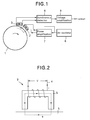
- Fig. 1 is a schematic view for explaining a detecting circuit of a magnetostrictive torque sensor.
- Fig. 2 is another schematic view for explaining a detecting coil installed in the detecting circuit.
- Fig. 3 is a graph showing an effect of electric resistivity on magnetic induction of a Fe-Cr soft magnetic material.
- Fig. 4 is a graph showing an effect of a ratio of martensite grains on magnetic induction of a Fe-Cr soft magnetic material.
- Fig. 5 is a graph showing an effect of a number of fine precipitates on magnetic induction of a Fe-Cr soft magnetic material.
- Hysteresis loss which is one of energy losses, is derived from suppression of movement of ferromagnetic domain walls due to interaction between the ferromagnetic domain walls and precipitates or lattice defects. In this sense, the hysteresis loss is reduced as decrease of precipitates and lattice defects. As for a Fe-Cr alloy, it is practically important to inhibit generation of fine precipitates and martensite grains.
- Eddy current loss is also one of disadvantageous energy.
- the eddy current i.e. a secondary current induced by change of magnetic intensity due to conductivity of the soft magnetic metal material, means energy loss caused by resistive loss.
- electric resistivity of the soft magnetic material shall be necessarily made greater so as to impede the eddy current.
- a magnetostrictive torque sensor one of magnetic sensors, has a detecting circuit shown in Fig. 1 .
- a rotary shaft 1 is held at a position facing to an exciting coil 2 and a detecting coil 3 .
- the detecting coil 3 has a magnetic circuit equipped with a soft magnetic part 5 on which a lead wire 4 is wound, as shown in Fig, 2 .
- V When a predetermined voltage V is charged between terminals to produce an electric current i , a magnetic flux line ⁇ is generated between the soft magnetic part 5 and a measuring object S .
- a change of magnetostriction caused by strain due to a torque is detected by the detecting coil 3 as variation of output voltage induced by the magnetic flux ⁇ generated by the exciting coil 2 driven by the oscillator 6 and power amplifier 7 .
- a detection result is outputted through a synchronous detector 8 and an amplifier 9 .
- a soft magnetic part such as a core installed in the detecting circuit is manufactured by mechanically working a soft magnetic steel sheet or the like to a predetermined shape.
- the as-worked soft magnetic material is poor of magnetic permeability due to remaining of strains introduced by the mechanical working, resulting in poor magnetic induction. Such harmful influences of strains are eliminated by heat-treatment for release of strains.
- Fe-Cr soft magnetic steels different from each other in electric resistivity are mechanically worked to an annular shape, annealed under various conditions and then offered to measurement of magnetic flux density.
- Magnetic flux density is measured by a B-H analyzer in an exciting low-magnetic field with oscillation frequency of 1 kHz and magnetic intensity of 1 Oe.
- soft magnetic parts made of the same Fe-Cr alloy have the feature that magnetic induction is significantly deviated in response to annealing conditions, for use in a magnetic circuit operated in a low-magnetic field of 1 Oe or so.
- the inventors have investigated effects of metallurgical structures on magnetic induction for elucidation of causes leading to deviation of magnetic induction, by observing the metallurgical structure of an annealed soft magnetic material. As a result, the inventors have discovered that the metallurgical structure, which involves martensite grains or fine precipitates in a ferrite single phase free from martensite grains, is very poor of magnetic induction (i.e. poor sensor property), even if the soft magnetic part is made of the same Fe-Cr alloy.
- a Fe-Cr alloy which is useful as a soft magnetic part installed in a magnetic circuit such as a magnetic sensor operated in a high-frequency exciting field, shall have electric resistivity not less than 50 ⁇ •cm and an as-annealed metallurgical structure involving martensite grains not more than 5 vol.% with precipitates of 1 ⁇ m or less in particle size at a ratio not more than 6 ⁇ 10 5 /mm 2 .
- Fine precipitates of 1 ⁇ m or less in particle size can be remarkably reduced by heating a Fe-Cr alloy at a temperature higher than 900 °C.
- the effect of heat-treatment on decrease of fine precipitates is distinctly noted by soaking the Fe-Cr alloy preferably for 30 minutes or longer.
- an excessively high soaking temperature means over-heating of the Fe-Cr alloy in a ⁇ -zone, resulting in generation of martensite grains during cooling.
- Such a kind of steel which causes ⁇ -phase at a heating temperature below 900 °C, cannot be reformed to a metallurgical structure composed of a ferrite single phase effective for improvement of magnetic induction with suppression of fine precipitates.
- a temperature range of heat-treatment for generation of a single-ferrite matrix involving less fine precipitates without martensite grains shall have allowance of at least ⁇ 20 °C (ideally ⁇ 50 °C) with respect to a predetermined temperature.
- An initiating temperature T (°C) for generation of ⁇ -phase is represented by the above-mentioned formula (3) according to the inventors' researches on effects of alloying elements.
- the initiating temperature T shall be not lower than 900 °C for inhibiting generation both of martensite grains and fine precipitates with allowance of at least ⁇ 20 °C accounting accuracy of temperature control in a conventional oven.
- the initiating temperature T (°C) is determined at a temperature not lower than 940 °C.
- the above-mentioned formula (2) is obtained by inserting the formula (3) to the relationship of T ⁇ 940 °C.
- a temperature for heat-treatment is preferably adjusted to 940 °C or higher in order to promote growth of crystal grains without generation of martensite phase for improvement of magnetic property.
- An ideal temperature T is 980 °C at lowest.
- a metallurgical structure composed of a single-ferrite phase is promoted by adding a ferrite-stabilizing element(s) such as Si to a Fe-Cr alloy for rising of an initiating temperature T .
- a ferrite-stabilizing element(s) such as Si
- excessive addition of the ferrite-stabilizing element(s) causes degradation of rollability and press-workability as well as occurrence of surface defects.
- Reduction of martensite grains is attained by enlarging a difference between a ferritizing intensity (represented by 11.5 ⁇ %Si+11.5 ⁇ %Cr+49 ⁇ %Ti+12 ⁇ %Mo + 52 ⁇ %Al) and an austenitizing intensity (represented by 420 ⁇ %C+470 ⁇ %N+7 ⁇ %Mn+23 ⁇ %Ni).
- Such difference more than 124 makes it possible to absolutely suppress generation of martensite grains, since a Fe-Cr alloy can be heated up to 1030 °C or so without generation of ⁇ -phase.
- the initiating temperature T for generation of ⁇ -phase is higher as increase of a difference between the ferritizing and austenitizing intensities, so as to promote production of a metallurgical structure composed of a single-ferrite phase.
- increase of the difference requires a lot of ferritizing elements added to the Fe-Cr alloy, resulting in degradation of rollability and press-workability as well as occurrence of surface defects.
- the composition of the newly proposed Fe-Cr alloy is preferably determined as follows:
- Fe-Cr alloys having compositions shown in Table 1 were melted in a 30kg high-frequency furnace in a vacuum atmosphere.
- a Fe-Cr soft magnetic alloy sheet of 2.0mm in thickness was manufactured from each alloy by casting, forging, hot-rolling, cold-rolling, finish-annealing and then pickling.
- Test pieces were cut off each Fe-Cr soft magnetic alloy sheet.
- HF fluoronitric acid-glycerin liquor
- test piece was etched by a SPEED (Selective Potentiostatic Etching by Electrolytic Dissolution) method and then observed by a scanning microscope. Number of fine precipitates of 1 ⁇ m or less in particle size, displayed on a monitor screen, was counted to calculate a number of fine precipitates per 1mm 2 . Furthermore, a test piece of 5mm in width and 150mm in length was subjected to Wheatstone bridge method to measure its electric resistivity.
- SPEED Selective Potentiostatic Etching by Electrolytic Dissolution
- the soft magnetic Fe-Cr alloy sheet was press-worked to cores of exciting and detecting coils, and then annealed under the same conditions as the annular magnet.
- the cores were inspected to detect presence or absence of cracks. Press-workability of the Fe-Cr alloy sheet was evaluated in response to occurrence of cracking.
- Each core was installed in a magnetostrictive torque sensor (shown in Fig. 1 ).
- An output voltage of a detecting coil corresponding to an input torque was measured in a magnetic field of 1 Oe with oscillation frequency of 1 kHz applied to an exciting coil.
- the measured voltage was compared with a standard value (100) representing an output voltage necessary for a sensor, and sensor property was evaluated as good ( ⁇ ) at a value not less than 100, as a little defective ( ⁇ ) at a value 100-80 or as defective ( ⁇ ) at a value less than 80.
- Test results are shown together with annealing conditions in Table 2 .
- test pieces Nos. 1-9 whose electric resistivity, a ratio of martensite and a number of fine precipitates were controlled according to the present invention, produced magnetic flux density not less than 500 G and higher output voltage. Therefore, the Fe-Cr alloy sheets Nos. 1-9 are useful as cores of a torque sensor improved in sensor property.
- the Fe-Cr alloy sheet No. B1 had magnetic induction significantly worsened due to its metallurgical structure wherein fine precipitates of 1 ⁇ m or less in particle size are excessively distributed at a ratio above 6 ⁇ 10 5 /mm 2 in number. As a result, a core made of the alloy sheet No. B1 was inferior of sensor property.
- the test piece No. 11 which was made of the Fe-Cr alloy sheet having the same composition but annealed at a lower temperature in a magnetic field, had magnetic induction significantly worsened due to its metallurgical structure excessively distributing fine precipitates of 1 ⁇ m or less in particle size therein. A core made of the alloy sheet No. 11 was also inferior of sensor property due to such degradation of magnetic induction.
- the test piece No. 12 which was annealed at an excessively high temperature on the contrary, involves a lot of martensite grains in an annealed state. Therefore, the core made of the alloy sheet No. 12 had magnetic induction significantly worsened due to generation of martensite, resulting in poor sensor property.
- the soft magnetic material according to the present invention as above-mentioned is made of a Fe-Cr alloy having electric resistivity not less than 50 ⁇ •cm and a metallurgical structure which involves less martensite grains and suppresses distribution of fine precipitates. Due to the high resistivity and the specified metallurgical structure, the soft magnetic material produces great magnetic induction, resulting in excellent sensor property, even in a low-magnetic field excited with high frequency. As a result, a sensor good of measurement accuracy is offered by installing the soft magnetic material as a core or yoke in a magnetic circuit such as an electromagnetic induction sensor or a mechanical quantity sensor.
Landscapes
- Chemical & Material Sciences (AREA)
- Engineering & Computer Science (AREA)
- Mechanical Engineering (AREA)
- Organic Chemistry (AREA)
- Physics & Mathematics (AREA)
- Metallurgy (AREA)
- Materials Engineering (AREA)
- Power Engineering (AREA)
- Dispersion Chemistry (AREA)
- Crystallography & Structural Chemistry (AREA)
- Thermal Sciences (AREA)
- Electromagnetism (AREA)
- Soft Magnetic Materials (AREA)
Applications Claiming Priority (4)
| Application Number | Priority Date | Filing Date | Title |
|---|---|---|---|
| JP2000365793 | 2000-11-30 | ||
| JP2000365793 | 2000-11-30 | ||
| JP2001172892A JP2002226954A (ja) | 2000-11-30 | 2001-06-07 | Fe−Cr系軟磁性材料及び製造方法 |
| JP2001172892 | 2001-06-07 |
Publications (2)
| Publication Number | Publication Date |
|---|---|
| EP1211331A1 true EP1211331A1 (de) | 2002-06-05 |
| EP1211331B1 EP1211331B1 (de) | 2006-11-08 |
Family
ID=26604994
Family Applications (1)
| Application Number | Title | Priority Date | Filing Date |
|---|---|---|---|
| EP01127435A Expired - Lifetime EP1211331B1 (de) | 2000-11-30 | 2001-11-26 | Weichmagnetischer Werkstoff aus Fe-Cr-Legierung und Verfahren zu dessen Herstellung |
Country Status (6)
| Country | Link |
|---|---|
| US (1) | US6599376B2 (de) |
| EP (1) | EP1211331B1 (de) |
| JP (1) | JP2002226954A (de) |
| KR (1) | KR100859737B1 (de) |
| DE (1) | DE60124368T2 (de) |
| ES (1) | ES2274846T3 (de) |
Cited By (1)
| Publication number | Priority date | Publication date | Assignee | Title |
|---|---|---|---|---|
| CN109983550A (zh) * | 2016-11-24 | 2019-07-05 | 山阳特殊制钢株式会社 | 高频下使用的磁性粉末和含有其的磁性树脂组合物 |
Families Citing this family (22)
| Publication number | Priority date | Publication date | Assignee | Title |
|---|---|---|---|---|
| JP2003041349A (ja) * | 2001-08-01 | 2003-02-13 | Nisshin Steel Co Ltd | 電気抵抗材料 |
| US20030112758A1 (en) * | 2001-12-03 | 2003-06-19 | Pang Jon Laurent | Methods and systems for managing variable delays in packet transmission |
| US7566508B2 (en) * | 2005-03-02 | 2009-07-28 | Seagate Technology Llc | Perpendicular media with Cr-doped Fe-alloy-containing soft underlayer (SUL) for improved corrosion performance |
| US20070204703A1 (en) * | 2006-03-06 | 2007-09-06 | Siemens Vdo Automotive Corporation | Material for magneto-elastic transducer |
| ATE508854T1 (de) * | 2006-11-21 | 2011-05-15 | Thermal Cyclic Technologies Tctech I Stockholm Ab | Spritzgiessform mit induktionsheizung sowie spritzgiessverfahren |
| US20090011283A1 (en) * | 2007-03-01 | 2009-01-08 | Seagate Technology Llc | Hcp soft underlayer |
| JP5207514B2 (ja) * | 2007-08-02 | 2013-06-12 | 日新製鋼株式会社 | ヒステリシスモータ |
| US7822833B2 (en) * | 2008-04-30 | 2010-10-26 | Honeywell International Inc. | System for creating and validating configurations of offline field devices in a process control system |
| US8731895B2 (en) * | 2008-05-20 | 2014-05-20 | Honeywell International Inc. | System and method for accessing and configuring field devices in a process control system |
| US8108200B2 (en) * | 2008-05-20 | 2012-01-31 | Honeywell International Inc. | System and method for accessing and configuring field devices in a process control system using distributed control components |
| US7983892B2 (en) * | 2008-05-20 | 2011-07-19 | Honeywell International Inc. | System and method for accessing and presenting health information for field devices in a process control system |
| CN101777803A (zh) * | 2009-01-13 | 2010-07-14 | 日新制钢株式会社 | 磁滞式电动机以及磁滞式电动机用定子磁轭的制造方法 |
| JP5742446B2 (ja) * | 2011-05-09 | 2015-07-01 | 大同特殊鋼株式会社 | 電磁ステンレス鋼 |
| WO2013002703A1 (en) | 2011-06-28 | 2013-01-03 | Tctech Sweden Ab | Device and method for heating a mould or tool |
| CN103236762B (zh) * | 2013-04-18 | 2015-08-19 | 台州市金宇机电有限公司 | 电动车用无刷直流轮毂电机及其控制系统 |
| JP6249912B2 (ja) * | 2013-11-01 | 2017-12-20 | 住友重機械工業株式会社 | 解析装置 |
| CN104451350B (zh) * | 2014-12-18 | 2017-02-22 | 重庆材料研究院有限公司 | 耐海水腐蚀高饱和磁感应强度软磁合金的制备方法 |
| KR20170053480A (ko) * | 2015-11-06 | 2017-05-16 | 엘지이노텍 주식회사 | 연자성 합금 |
| CN106636950A (zh) * | 2016-12-28 | 2017-05-10 | 南京南大波平电子信息有限公司 | 一种耐湿耐氧化电磁波吸收剂 |
| US11714394B2 (en) * | 2018-09-28 | 2023-08-01 | Fisher-Rosemount Systems, Inc | Bulk commissioning of field devices within a process plant |
| KR20220040882A (ko) | 2020-09-24 | 2022-03-31 | 현대자동차주식회사 | Mn-Zn계 페라이트 시료의 성분 평가용 표준물질, 이의 제조방법 및 이를 이용한 시료의 성분 평가 방법 |
| CN119464959A (zh) * | 2024-11-14 | 2025-02-18 | 西安钢研功能材料股份有限公司 | 一种高铬高塑性耐蚀软磁合金及其棒材的制备方法 |
Citations (6)
| Publication number | Priority date | Publication date | Assignee | Title |
|---|---|---|---|---|
| JPH0847235A (ja) * | 1994-08-01 | 1996-02-16 | Fuji Elelctrochem Co Ltd | ステッピングモータ及びそれに用いられるヨークの製造方法 |
| EP0758685A1 (de) * | 1995-08-14 | 1997-02-19 | Kawasaki Steel Corporation | Eisen-Chromlegierung mit gute Beständigkeit gegen Rillenformung und mit glatten Oberflache |
| US5648692A (en) * | 1994-06-24 | 1997-07-15 | Fdk Corporation | Stator yoke and method of producing same |
| EP0915179A2 (de) * | 1997-11-04 | 1999-05-12 | Kawasaki Steel Corporation | Stahlblech mit besonderen elektromagnetischen Eigenschaften bei höherer Frequenz und Verfahren zu seiner Herstellung |
| US5983951A (en) * | 1996-08-12 | 1999-11-16 | Kabushiki Kaisha Toshiba | Wear resistant loom part and loom comprising the same |
| JP2001056242A (ja) * | 1999-08-19 | 2001-02-27 | Nisshin Steel Co Ltd | 測定精度の高い電磁流量計およびその使用方法 |
Family Cites Families (5)
| Publication number | Priority date | Publication date | Assignee | Title |
|---|---|---|---|---|
| JPS59190349A (ja) * | 1983-04-08 | 1984-10-29 | Hitachi Ltd | 高電気抵抗・高磁束密度及び高切削性磁性合金 |
| US5091024A (en) * | 1989-07-13 | 1992-02-25 | Carpenter Technology Corporation | Corrosion resistant, magnetic alloy article |
| JP2627026B2 (ja) * | 1991-06-06 | 1997-07-02 | 愛知製鋼株式会社 | 歯科アタッチメント用軟磁性ステンレス鋼 |
| JPH05255817A (ja) * | 1992-03-12 | 1993-10-05 | Nisshin Steel Co Ltd | 耐食性軟磁性材料 |
| JPH08120420A (ja) * | 1994-10-14 | 1996-05-14 | Nisshin Steel Co Ltd | 耐食性軟磁性鋼 |
-
2001
- 2001-06-07 JP JP2001172892A patent/JP2002226954A/ja active Pending
- 2001-11-26 EP EP01127435A patent/EP1211331B1/de not_active Expired - Lifetime
- 2001-11-26 ES ES01127435T patent/ES2274846T3/es not_active Expired - Lifetime
- 2001-11-26 DE DE60124368T patent/DE60124368T2/de not_active Expired - Lifetime
- 2001-11-29 US US09/997,386 patent/US6599376B2/en not_active Expired - Lifetime
- 2001-11-30 KR KR1020010075382A patent/KR100859737B1/ko not_active Expired - Lifetime
Patent Citations (7)
| Publication number | Priority date | Publication date | Assignee | Title |
|---|---|---|---|---|
| US5648692A (en) * | 1994-06-24 | 1997-07-15 | Fdk Corporation | Stator yoke and method of producing same |
| JPH0847235A (ja) * | 1994-08-01 | 1996-02-16 | Fuji Elelctrochem Co Ltd | ステッピングモータ及びそれに用いられるヨークの製造方法 |
| US6222286B1 (en) * | 1994-08-01 | 2001-04-24 | Nisshin Steel Co., Ltd. | Stepping motor with rust inhibiting and eddy current minimizing characteristics |
| EP0758685A1 (de) * | 1995-08-14 | 1997-02-19 | Kawasaki Steel Corporation | Eisen-Chromlegierung mit gute Beständigkeit gegen Rillenformung und mit glatten Oberflache |
| US5983951A (en) * | 1996-08-12 | 1999-11-16 | Kabushiki Kaisha Toshiba | Wear resistant loom part and loom comprising the same |
| EP0915179A2 (de) * | 1997-11-04 | 1999-05-12 | Kawasaki Steel Corporation | Stahlblech mit besonderen elektromagnetischen Eigenschaften bei höherer Frequenz und Verfahren zu seiner Herstellung |
| JP2001056242A (ja) * | 1999-08-19 | 2001-02-27 | Nisshin Steel Co Ltd | 測定精度の高い電磁流量計およびその使用方法 |
Non-Patent Citations (2)
| Title |
|---|
| PATENT ABSTRACTS OF JAPAN vol. 1996, no. 06 28 June 1996 (1996-06-28) * |
| PATENT ABSTRACTS OF JAPAN vol. 2000, no. 19 5 June 2001 (2001-06-05) * |
Cited By (2)
| Publication number | Priority date | Publication date | Assignee | Title |
|---|---|---|---|---|
| CN109983550A (zh) * | 2016-11-24 | 2019-07-05 | 山阳特殊制钢株式会社 | 高频下使用的磁性粉末和含有其的磁性树脂组合物 |
| CN109983550B (zh) * | 2016-11-24 | 2021-09-03 | 山阳特殊制钢株式会社 | 高频下使用的磁性粉末和含有其的磁性树脂组合物 |
Also Published As
| Publication number | Publication date |
|---|---|
| US6599376B2 (en) | 2003-07-29 |
| EP1211331B1 (de) | 2006-11-08 |
| US20020104586A1 (en) | 2002-08-08 |
| KR20020042517A (ko) | 2002-06-05 |
| KR100859737B1 (ko) | 2008-09-24 |
| JP2002226954A (ja) | 2002-08-14 |
| ES2274846T3 (es) | 2007-06-01 |
| DE60124368D1 (de) | 2006-12-21 |
| DE60124368T2 (de) | 2007-10-11 |
Similar Documents
| Publication | Publication Date | Title |
|---|---|---|
| EP1211331B1 (de) | Weichmagnetischer Werkstoff aus Fe-Cr-Legierung und Verfahren zu dessen Herstellung | |
| Petrovic | Non-oriented electrical steel sheets | |
| CN111418035B (zh) | 高磁导率软磁合金和制造高磁导率软磁合金的方法 | |
| US6656419B2 (en) | Fe-Ni based permalloy and method of producing the same and cast slab | |
| KR101173334B1 (ko) | 철손 특성이 우수한 일방향성 전자기 강판 | |
| JP6262599B2 (ja) | 軟磁性鋼材及びその製造方法、並びに軟磁性鋼材から得られる軟磁性部品 | |
| JP7173286B2 (ja) | 無方向性電磁鋼板 | |
| KR102759045B1 (ko) | 스테이터 코어, 회전 전기 기기, 스테이터 코어의 설계 방법 | |
| KR102372003B1 (ko) | 방향성 전자 강판 및 이것을 이용하여 이루어지는 변압기의 적철심과 적철심의 제조 방법 | |
| JP4210495B2 (ja) | 高強度軟磁性ステンレス鋼およびその製造方法 | |
| JP2005520931A (ja) | 直線的なbhループを有する鉄系アモルファス合金 | |
| JP5207514B2 (ja) | ヒステリシスモータ | |
| KR20130018544A (ko) | 전자 스테인리스강 및 그의 제조방법 | |
| JP7679186B2 (ja) | フェライト系ステンレス鋼 | |
| KR20240065120A (ko) | 회전 전기 기기, 무방향성 전자 강판 및 적층 코어, 그리고, 회전 전기 기기의 제조 방법 및 적층 코어의 제조 방법 | |
| JPH08120420A (ja) | 耐食性軟磁性鋼 | |
| JP4192403B2 (ja) | 直流偏磁下で使用される電磁鋼板 | |
| JP2000064000A (ja) | 軟磁性ステンレス鋼板およびその製造方法 | |
| JP3676477B2 (ja) | 複合磁性部材およびその製造方法 | |
| JP2004143585A (ja) | 複合磁性部材用素材、並びに該素材を用いて成る複合磁性部材、並びに該部材の製造方法、並びに該部材を用いて成るモータ | |
| JP2004091842A (ja) | 複合磁性部材用素材、並びに該素材を用いて成る複合磁性部材、並びに該部材の製造方法、並びに該部材を用いて成るモータ | |
| Mehr | Fe-Si-Al Electrical Steels for High-efficiency Electric Machines: A Study of Ductility and Magnetic Properties | |
| JPH0772302B2 (ja) | 磁気目盛用鋼棒の製造方法 | |
| JP2008045182A (ja) | 軟磁性鋼材、並びに軟磁性部品およびその製造方法 | |
| JP2001056242A (ja) | 測定精度の高い電磁流量計およびその使用方法 |
Legal Events
| Date | Code | Title | Description |
|---|---|---|---|
| PUAI | Public reference made under article 153(3) epc to a published international application that has entered the european phase |
Free format text: ORIGINAL CODE: 0009012 |
|
| AK | Designated contracting states |
Kind code of ref document: A1 Designated state(s): AT BE CH CY DE DK ES FI FR GB GR IE IT LI LU MC NL PT SE TR |
|
| AX | Request for extension of the european patent |
Free format text: AL;LT;LV;MK;RO;SI |
|
| 17P | Request for examination filed |
Effective date: 20020627 |
|
| AKX | Designation fees paid |
Designated state(s): DE ES FR GB |
|
| GRAP | Despatch of communication of intention to grant a patent |
Free format text: ORIGINAL CODE: EPIDOSNIGR1 |
|
| GRAS | Grant fee paid |
Free format text: ORIGINAL CODE: EPIDOSNIGR3 |
|
| GRAA | (expected) grant |
Free format text: ORIGINAL CODE: 0009210 |
|
| AK | Designated contracting states |
Kind code of ref document: B1 Designated state(s): DE ES FR GB |
|
| REG | Reference to a national code |
Ref country code: GB Ref legal event code: FG4D |
|
| REF | Corresponds to: |
Ref document number: 60124368 Country of ref document: DE Date of ref document: 20061221 Kind code of ref document: P |
|
| ET | Fr: translation filed | ||
| REG | Reference to a national code |
Ref country code: ES Ref legal event code: FG2A Ref document number: 2274846 Country of ref document: ES Kind code of ref document: T3 |
|
| PLBE | No opposition filed within time limit |
Free format text: ORIGINAL CODE: 0009261 |
|
| STAA | Information on the status of an ep patent application or granted ep patent |
Free format text: STATUS: NO OPPOSITION FILED WITHIN TIME LIMIT |
|
| 26N | No opposition filed |
Effective date: 20070809 |
|
| REG | Reference to a national code |
Ref country code: FR Ref legal event code: PLFP Year of fee payment: 15 |
|
| REG | Reference to a national code |
Ref country code: FR Ref legal event code: PLFP Year of fee payment: 16 |
|
| REG | Reference to a national code |
Ref country code: FR Ref legal event code: PLFP Year of fee payment: 17 |
|
| PGFP | Annual fee paid to national office [announced via postgrant information from national office to epo] |
Ref country code: FR Payment date: 20201120 Year of fee payment: 20 Ref country code: GB Payment date: 20201120 Year of fee payment: 20 Ref country code: DE Payment date: 20201119 Year of fee payment: 20 |
|
| PGFP | Annual fee paid to national office [announced via postgrant information from national office to epo] |
Ref country code: ES Payment date: 20210122 Year of fee payment: 20 |
|
| REG | Reference to a national code |
Ref country code: DE Ref legal event code: R071 Ref document number: 60124368 Country of ref document: DE |
|
| REG | Reference to a national code |
Ref country code: GB Ref legal event code: PE20 Expiry date: 20211125 |
|
| PG25 | Lapsed in a contracting state [announced via postgrant information from national office to epo] |
Ref country code: GB Free format text: LAPSE BECAUSE OF EXPIRATION OF PROTECTION Effective date: 20211125 |
|
| REG | Reference to a national code |
Ref country code: ES Ref legal event code: FD2A Effective date: 20220405 |
|
| PG25 | Lapsed in a contracting state [announced via postgrant information from national office to epo] |
Ref country code: ES Free format text: LAPSE BECAUSE OF EXPIRATION OF PROTECTION Effective date: 20211127 |