EP1213697A2 - Verfahren und Vorrichtung zur Herstellung von Klebeetiketten oder Klebetapeten - Google Patents
Verfahren und Vorrichtung zur Herstellung von Klebeetiketten oder Klebetapeten Download PDFInfo
- Publication number
- EP1213697A2 EP1213697A2 EP01124068A EP01124068A EP1213697A2 EP 1213697 A2 EP1213697 A2 EP 1213697A2 EP 01124068 A EP01124068 A EP 01124068A EP 01124068 A EP01124068 A EP 01124068A EP 1213697 A2 EP1213697 A2 EP 1213697A2
- Authority
- EP
- European Patent Office
- Prior art keywords
- substrate
- adhesive
- agent
- splitting agent
- blanks
- Prior art date
- Legal status (The legal status is an assumption and is not a legal conclusion. Google has not performed a legal analysis and makes no representation as to the accuracy of the status listed.)
- Granted
Links
Images


Classifications
-
- G—PHYSICS
- G09—EDUCATION; CRYPTOGRAPHY; DISPLAY; ADVERTISING; SEALS
- G09F—DISPLAYING; ADVERTISING; SIGNS; LABELS OR NAME-PLATES; SEALS
- G09F3/00—Labels, tag tickets, or similar identification or indication means; Seals; Postage or like stamps
- G09F3/02—Forms or constructions
-
- B—PERFORMING OPERATIONS; TRANSPORTING
- B32—LAYERED PRODUCTS
- B32B—LAYERED PRODUCTS, i.e. PRODUCTS BUILT-UP OF STRATA OF FLAT OR NON-FLAT, e.g. CELLULAR OR HONEYCOMB, FORM
- B32B7/00—Layered products characterised by the relation between layers; Layered products characterised by the relative orientation of features between layers, or by the relative values of a measurable parameter between layers, i.e. products comprising layers having different physical, chemical or physicochemical properties; Layered products characterised by the interconnection of layers
- B32B7/04—Interconnection of layers
- B32B7/06—Interconnection of layers permitting easy separation
-
- G—PHYSICS
- G09—EDUCATION; CRYPTOGRAPHY; DISPLAY; ADVERTISING; SEALS
- G09F—DISPLAYING; ADVERTISING; SIGNS; LABELS OR NAME-PLATES; SEALS
- G09F3/00—Labels, tag tickets, or similar identification or indication means; Seals; Postage or like stamps
- G09F3/08—Fastening or securing by means not forming part of the material of the label itself
- G09F3/10—Fastening or securing by means not forming part of the material of the label itself by an adhesive layer
Definitions
- the invention relates to a method and an apparatus for Production of adhesive labels, adhesive wallpapers or the like Cut from a sheet or sheet material as well as a method for gluing the blanks onto a Underground or to remove the blanks from the underground.
- the invention further relates to a means for application to the Back of a layer material for the production of Adhesive labels, adhesive wallpapers or the like to stick on cut to a background, which is a later one Removing the blanks from the surface should facilitate, as well one intended for sticking to a surface Layer material cut, in particular an adhesive label or an adhesive wallpaper with one on the back, to facilitate the detachment of the cut from the substrate Medium.
- bottle labels such as those on the Back of juice bottles from Becker's best used were. With these labels, the one facing the bottle was Back of label with collection points for cutting and Send printed to the manufacturer after a Removing the labels were visible to a customer.
- the adhesive label on his Back is printed with a price puzzle, after removing the label from the egg carton by the customer filled in and sent back to the egg producer can be.
- the barrier lacquer must be like this be matched to the glue used that its Adhesion to the adhesive is smaller than the adhesion of the adhesive to Object and less than the adhesion of the barrier lacquer to the Back of the label so that the labels are peeled off at the interface between the barrier lacquer and the adhesive dated Detach item.
- price labels from retailers be glued to the surface of consumer goods.
- price labels should be effortless for sales staff and without damaging the surfaces of the consumer goods can be deducted, for example, by another Stick on price label or to pre-present them with gifts to remove the packaging in wrapping paper.
- price labels are already known, at least on smooth surfaces together with that on their back Let the applied adhesive peel off.
- DE 40 079 58 already a device for removing adhesive labels from Proposed bottles or other containers in which the Labels by a fluid jet from the rotating Containers removed and carried radially outwards.
- the Removing the labels can be made easier when on there is a release agent on the back of the label low adhesion causes it as an anti-adhesive or Solvent is used.
- an anti-adhesive on labels before sticking them on the bottles DE 35 08 150 A1 is called there.
- this also occurs the previously mentioned problems with a coating Barrier lacquer on.
- the invention is based on the object the subject matter of the invention mentioned above improve that there are adhesive labels, adhesive wallpapers or others for sticking to a surface and for later removal layer material cuts specific to the substrate from the surface and regardless of which to stick on used adhesive with a defined peel force have it completely removed.
- the features according to the invention can be used Cuts, for example from the floor to the ceiling of a room Reaching wallpaper strips or individual adhesive labels, completely subtracted from the surface, that is, without that scraps or parts of the substrate stick to the surface stay.
- the liability of the blanks to the substrate can also be or the pulling force required to pull off the blanks can be set to a defined value that is only determined by the cohesive properties of the cleaving agent while using both the adhesive used and from the surface properties of the back of the Layer material is independent, provided that Adhesive forces between the adhesive and the splitting agent or the surface as well as the adhesive forces between the Exceed the back of the layer material and the splitting agent when removing or detaching the blanks according to the invention internal cohesive forces of the splitting agent.
- a layer material is used material consisting of several thin layers of material referred to, in addition to a printable substrate for Example of a single or multi-layer paper or Foil material in the form of sheets or sheets, at least one another layer of one on the back or adhesive side of the Has substrate applied splitting agent, but above usually other layers of printing ink, varnish or the like on the front and possibly between the Substrate and the barrier lacquer can include.
- Printing on the Substrate is usually done before the layer material could be tailored, however, in principle also afterwards respectively.
- the splitting agent is preferably in the course of Printing on the back of the substrate, however, there is always an order for the finished one Cuts possible before they are glued to the surface become.
- Designated composition with which the back of the Substrate or the blanks is coated or coated is, if necessary after the application of additional layers, and whose internal cohesion is less than when in use their adhesion to the back of the substrate or the Blanks and is smaller than their adhesion to one at a time Glue the layer material blanks used glue, so that if the blanks are pulled off later Splits the substrate into two layers due to cohesive failure, one of which is on the back of the sheet material and one sticks to the adhesive.
- the back of price labels can be used when removing the Price labels damage the surface of a labeled object can be prevented safely because of the Glue and part of the splitting agent on the labeled Object left.
- too Manipulations by sticking the removed price labels prevent on other goods because the labels according to their Peel no longer stick.
- the splitting agent preferably consists of a homogeneous Mixture of a polymer and a metal soap in the finest distributed form, which is in the form of a dispersion on the Printed on the back of the substrate or layer material, is painted or possibly sprayed on and after the Then dry a thin, tack-free paint or forms waxy coating.
- the order is preferably placed immediately after printing and with labels or other cuts printed front side preferably in the course of printing.
- the splitting agent exists according to one preferred embodiment of the invention essentially from a mixture of two components, one modified "Soft" styrene-acrylate copolymer, which is in dried Condition has water-repellent properties and therefore a Penetration of water-containing adhesive through the splitting agent to the back of the substrate, as well as calcium stearate, with which the internal cohesion of the splitting agent affects one Lets you set a value that makes it easy to pull off the Cuts due to a break in cohesion within the Splitting middle layer allowed.
- the mixture is applied preferably in the form of an aqueous dispersion in which the Mixing ratio of the two components is preferred between 40:60 and 60:40 parts by weight per 100 parts by weight Solids content.
- splitting agent mentioned in one Use on labels in that after peeling off the Labels on the back of the cleaving agent layer sticking to one has sufficient transparency so that a below, lettering printed on the back of the label is easy to read, and that the split agent layer to the other with a felt pen, pencil and ballpoint pen can be labeled, for example one below it on the Back of the printed label or Fill out price puzzles.
- the main ones are when used on wallpapers Advantages in that the on the back with the Cleaving agent coated wallpaper well with common ones Wallpaper paste based on starch on plastered Have walls or ceilings or other substrates glued on, that soaking is no longer required to peel off the wallpaper is that the wallpapers move in full lanes from Allow the surface to be removed and that after removal the wallpaper together with the wallpaper paste on the
- the cleaving agent layer adhering to the surface is good again Suitable for attaching a new wallpaper.
- the splitting agent can contain additives to prevent foaming in the processing state, to improve the running properties in a printing press and / or to improve the wetting of wet printing inks.
- the blanks coated on the back with cleaving agent are produced from layer materials which are usually used for the production of adhesive labels or wallpapers, in particular from various types of paper, but also from plastic or metal foils or laminated composite layer materials in the form of sheets or sheets, which are produced by a customary printing process printed on the front and possibly on the back and preferably coated with the splitting agent in the same machine.
- the coating is expediently carried out by printing or brushing on as an aqueous dispersion in an amount of between 5 and 10 g / m 2 on the unprinted or printed or in some other way pre-coated back of the substrate and by subsequent drying of the layer material. Since the dried wax or lacquer-like splitting agent has no adhesive properties, the layer material can be wound up on rolls or stacked in sheets as usual after drying and before any further processing, for example by punching out labels or by dividing them into commercially available wallpaper strips.
- one comprises Device for the production of splitting agent on the back coated sheet or sheet material Devices for applying the splitting agent, these Means preferably in the for printing on the labels used printing machine are integrated and preferably one pressure from a container with liquid splitting agent or anilox roller.
- a still further aspect of the invention is its Also intended for self-adhesive labels that usually coated on the back with the glue and are releasably glued to a carrier substrate from which they are in front sticking it to an object or another Be subtracted.
- a between the adhesive and the back of the label inventive cleaving agent used its cohesion is greater than the adhesion of the adhesive to the carrier substrate, so that the labels along with the splitting agent and the glue peeled off the carrier substrate and glued to the substrate can be.
- you later remove the labels from the The subsurface is split again Splitting agent due to cohesive break in two Gap layers, one on the back of the label and one sticks to the glue, as before, for not described self-adhesive labels.
- the splitting agent does not only allow manual Pulling off the layer material blanks, but allows it for the first time also, a working automatable Process for removing labels from bottles or to provide the same with which the problems in Avoid peeling off labels in caustic baths.
- the separation process according to the invention by splitting the Gap layer between the back of the label and the Fluid jet glue ensures complete non-destructive detachment of the label material and is from the composition of the surface, the labels and the Adhesive independently.
- the method according to the invention can therefore to replace all types of labels on almost all Substrates are used, provided the labels are on theirs before sticking them on the surface The back has been coated with the splitting agent.
- the Cohesive fracture in the gap layer gradually in Advances towards an opposite edge, and indeed along a path running transversely to this direction linear slit front.
- the one for advancing the Forces required at the slit front are proportional low, so the velocity of the fluid jet is not must be very large, while conversely the surface adhesion relatively good between the labels and the surface so that unwanted self-detachment is avoided.
- the label width remains unchanged for a continuation of the cohesion break from the fluid jet forces to be applied during the entire detachment of the Labels essentially the same.
- This allows a particularly low energy detachment when the impact speed and the The impact force of the fluid jet per unit area is the same remain, which can preferably be achieved in that the fluid jet tracks the dividing line, for example by a relative movement between an outlet opening of the Fluid jet and the surface to which the labels stick.
- both can be used to remove the labels liquid as well as a gaseous fluid jet used are, wherein a gaseous fluid is preferred because in in this case the labels without subsequent drying can be disposed of or sent for waste paper recycling.
- commercially available air knife devices can then be used used as they are already used to remove banderoles of bottles can be used.
- the generated Gas flow used to remove the detached labels become.
- Another embodiment of the invention provides that Water to the edges of the Glue is fed to the glue under the splitting agent dissolve, for example, by bottles in a Cleaning bath can be immersed.
- a Cleaning bath can be immersed.
- the glue and the remaining splitting agent detached from the bottle surfaces very quickly. at could use less aggressive cleaning fluids however, if necessary, before wetting the bottles
- the water-insoluble splitting agent mechanically, for example using brushes, whole or to be partially removed from the surface of the adhesive to accelerate its dissolution in the cleaning liquid.
- Stickers on the top of coffee containing Vacuum packaging which is applied with a heat seal adhesive inside folded edge parts of the packaging are glued to to hold them on the front.
- stickers can before coating with the heat seal adhesive with the cleavage agents according to the invention are coated, in less tearproof paper stickers a tear the Avoid stickers when peeling off.
- foil closures which under a screw cap on an upper peripheral edge of Glued on glass containers for instant soups or the like are to prevent the ingress of moisture Preserve aroma and the integrity of the closure Document first opening.
- This also by means of Heat seal adhesive attached foil closures can be due to the good adhesion of the adhesive to the glass and the Often remove the film incompletely.
- a gap layer between the adhesive and the film be provided which is a complete and simple Removing the film allowed.
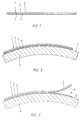
- Label 1 essentially consists of a substrate 2 in the form a cut from paper or another web or arcuate layer material, such as plastic or metal foil, the one face or front 3 and one opposite adhesive or backing 4, and on the adhesive or reverse side 4 all over with one Gap varnish 5 is coated to remove the label 1 from an object such as one in Fig. 2 in part illustrated bottle 6 to facilitate.
- Both the visual or Front 3 as well as the adhesive or back 4 of the Labels 1 have information printed on them (not shown).
- the information on the adhesive or Back 4 are printed directly on the substrate 2 and are coated with the transparent gap varnish 5, so that they are easy to read through the gap varnish 5.
- Fig. 2 shows the label 1 after sticking on a rounded peripheral surface 7 of the bottle 6 by means of an adhesive 8 water-based.
- Such dispersion adhesive 8 are on the Field of labeling bottles 6, egg cartons or other consumer goods with non-removable adhesive labels 1 known and commonly used there when good Adhesive properties, i.e. great adhesive forces between the Label 1 and the surface 7 are desired.
- the gap varnish 5 essentially consists of two components, the first of which is a soft modified styrene-acrylate copolymer with water-repellent properties when glued the label 1 a contact of the aqueous adhesive 8 with the Should prevent substrate 2, and of which the second, Calcium stearate, serves to the gap lacquer 5 a to impart relatively low internal cohesion to the is less than the adhesion of the adhesive 8 to the surface 7, less than the adhesion of the adhesive 8 to the gap lacquer 5 and less than the adhesion of the gap varnish 5 to the Label back 4, so that when removing the label 1 from the surface 7 does not separate or detach as in the state technology at an interface between two different ones Substances are made, but by cohesive failure within the Split lacquer 5.
- the two gap lacquer layers 9 and 10 each have one Layer thickness, which is about half of the original Layer thickness of the gap varnish 5 is.
- the coating with the gap varnish 5 takes place in the course of Label production after printing on the back 4 of the sheet or sheet-shaped layer material from which the later Label 1 is punched out.
- the coating is useful with the gap varnish 5 immediately after printing on the Substrate 2 in the printing machine used for printing made where the gap varnish 5 on the still pressurized Printing ink is applied.
- the gap varnish 5 is processed in the printing press in the form of an aqueous dispersion of the styrene-acrylate polymer and the admixed calcium stearate with a solids content of between 35 and 60% by weight, preferably between 46 and 50% by weight, based on the dispersion, a pH value between 7, 8 and 8.5, preferably between 8.0 and 8.3, a density of about 1.04 g / cm 3 and a flow viscosity between 20 and 60 sec, preferably between 30 and 40 sec ( 20 ° C / DIN 4 mm cup).
- the proportion by weight of the styrene-acrylate polymer, based on the total weight of the solids in the dispersion, is approximately 40 to 60% by weight, that of the calcium stearate correspondingly 60 to 40% by weight.
- Such a dispersion will be available after the priority date of this patent application under the name Aquaprint AH 571 from Aquaprint GmbH, 27367 Reessum, DE and is preferably applied to the wet printing ink in an amount of 5 to 10 g / m 2 .
- the dispersion can be applied with all Common printing processes take place, such as in Offset, flexographic or gravure printing, preferably wet in done wet in one pass with the printing process.
- the Aquaprint AH 571 lacquer dispersion additionally equipped with some additives, which the Wetting of the wet inks and the running properties in the press.
- the latter can be applied the dispersion either with an additional, from a Containers with application-fed or anilox roller fed with dispersion be provided or alternatively one of the printing units downstream, sprayed with dispersion or Include coating unit.
- the adhesive 8 is applied normally at the producer of the bottles 6 to be labeled or other objects immediately before sticking the previously punched out labels 1.
- the adhesive 8 can optionally on the surface 7 of the bottles 6 or others Objects or on the coated with the gap varnish 5 Label back 4 are applied before the label 1 is glued by pressing against the surface 7.
- the adhesive 8 is always on the coated with the gap varnish 5 back 4 of the Layer material applied before this on a commercially available carrier substrate (not shown) glued on from which it can be easily detached again.
- a commercially available carrier substrate not shown
- the adhesion of the adhesive 8 to the surface of the Carrier substrate less than the internal cohesion of the Gap varnish 5.
- the varnish 5 is preferably in the course of printing all over on the back of an endless Wallpaper roll applied as in connection with labels described.
- the split lacquer preferably in the manufacture of the wallpaper in wet condition before the coated endless Wallpaper roll dried and in commercially available pieces is cut, which is then rolled up and packaged become.
- the adhesive used is preferably a Starch-based paste mixed with water, on the above in connection with labels called water-repellent Gap varnish 5 on the back of a cut Spread the wallpaper web and then the wallpaper web glued the existing surface. Because of the water-repellent properties of the gap varnish 5 are included no waiting times required.
- the substrate 2 Appropriately at a corner or on an edge with the Removed fingernail or the like something from the base 6 to take it off. Then the Peeled off labels 1 or strips of wallpaper, the latter preferably in their longitudinal direction, the gap varnish 5 due to cohesive fracture in two split lacquer layers 9, 10 separates, one of which is used on the subsurface 6 or Glue or paste 8 sticks while the other is on the back 4 of the labels 1 or wallpaper webs remains and subtracted with them.
- the gap varnish used for wallpaper strips can be similar Cohesive forces between 0.1 N per cm web width and 0.4 N per cm web width, because on the one hand these values even with heavy wallpapers ensure adequate adhesion and a Prevent unwanted peeling of the wallpaper and on the other hand are considerably lower than the tear strength more commercially available Wallpaper in a dry state so that even if they are slightly torn at the edges, still in Can essentially be deducted in one piece.
- the gap varnish 5 according to the invention can also be used for coating the backs of ordinary adhesive labels 1 used that are not labeled on the back 4. In in this case it is possible to dry the labels 1 and completely detach from the surface without leaving residues of the Substrate 2 remain on the substrate.
- FIG illustrated label detaching station 11 essentially consists of two parallel ones Bottle conveyors 15, 16 for transporting bottles 6 and 6 several in a row between the two bottle conveyors 15, 16 arranged label detachment devices 17.
- the construction of the bottle conveyor 15, 16 corresponds to Essentially that of conventional bottle conveyors on which a single row of bottles 6 between two side Limits 18, 19 is moved upright standing.
- the Conveyors 15, 16 can, for example, as a roller conveyor with a A plurality of driven rollers can be formed.
- each of the label peeling devices 17 points the first conveyor 15 each have a bottle switch 20 (in Fig. 4 shown in different positions), with the individual bottles 6 from the conveyed bottle flow into the respective label detaching devices 17 discharged can be just before a bottle 6 located there the removal of your label 1 or your labels to the conveyor 16 is transported further.
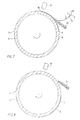
- the label peeling devices 17 essentially exist from a turntable 22 and a vertically movable Hold-down device (not shown), between each one Bottle 6 rotatable about its vertical longitudinal central axis can be held, a drive (not shown) to turn the turntable 22, the hold-down and one bottle 6 held in between, one with compressed air actable air knife 24 with a vertical aligned slot-shaped air outlet opening 25 (cf. Fig. 6), which are at a predetermined distance from the Circumferential surface 7 between turntable 22 and hold-down device held bottle 6 over the entire amount of each Label 1 extends, and one in the direction of rotation of the bottles 6 in front of the air knife 24 arranged label sensor 26, the serves to control the air supply to the air knife 24.
- the air knife 24 has a structure known per se, its air outlet opening 25 is arranged such that in the cross-sectional view of Figures 5 to 8 from the Air outlet opening 25 in the direction of the bottle peripheral surface 7 emitted air jet L at its point of impact A on the Circumferential surface 7 an angle ⁇ of about 10 degrees with the Includes tangent T at point of impact A (see Fig. 5).
- the air knife 24 is from a compressed air source (not shown) fed with compressed air if a between the Compressed air source and the respective air knife 24 arranged Valve 27 opened by a signal from label sensor 26 becomes.
- the label sensor 26 can be an optical sensor, for example be, of which a beam of light radially towards the Bottle peripheral surfaces 7 steered and the intensity of reflected light is measured.
- the different reflectance of the labels 1 and Bottle surface 7 exploited to the point in time determine in which a front edge in the direction of rotation 29 the label 1 moves in front of the sensor 26.
- Label 1 becomes adhesive 8 in the case of FIGS. 9 and 10 not shown labels 1 when sticking the labels 1 over the entire surface but in the form of parallel adhesive beads 34 the backs 4 of the labels 1 applied.
- the adhesive beads 34 are aligned in the circumferential direction of the bottles 6, so that they run parallel to the direction of rotation when the Circumferential surfaces 7 of the bottles 6 on the turntable 22 on Air knife 24 are moved past.
- labels 1 In contrast to the manual peeling described above of labels 1 are those for peeling off the labels required tensile or shear forces here by the from the Air outlet opening 25 exiting air jet L. Due to the orientation of the air outlet opening 25 Air jet L between the labels 1 and the peripheral surface 7 the bottles 6 directed onto the gap varnish 5 to this split and by this splitting the labels 1 of the Detach bottles 6.
- Adhesive beads 34 make it easier to split the Split lacquer layer 5 on the front edge 29 of the labels 1 to initiate without the liability of the labels 1 on the Circumferential surface 7 in the area of this edge 29 affect. If the air jet L under one flat angle just before the front edge 29 of the labels 1 strikes the peripheral surface 7 of the bottles 6 (FIG. 6), part of the air along the peripheral surface 7 becomes the edge 29 deflected there and penetrates into the spaces 36 between two adjacent adhesive beads 34, in which the gap lacquer layer 5 does not adhere to the adhesive 8, between the Gap lacquer 5 and the peripheral surface 7 of the bottles 6.
- the gap front 38 steps with the same Speed continues through the gap lacquer layer 5, the Labels 1 detached from bottles 6 over their entire height become.
- the front edge 29 of the label 1 is thereby the air jet L away from the peripheral surface 7 bent over, as shown in Fig. 7. If the slit front 38 reaches the rear edge 28 of the labels 1, the Torn labels 1 from the air jet L before shortly thereafter the air supply to the air knife 24 is interrupted.
- Adhesive beads 34 on the gap lacquer layer 5 when the Label 1 is also a point application of the adhesive 8 in the form of grid-like small adhesive spots possible, between which also air under the gap varnish 5 can penetrate.
Landscapes
- Physics & Mathematics (AREA)
- General Physics & Mathematics (AREA)
- Engineering & Computer Science (AREA)
- Theoretical Computer Science (AREA)
- Adhesive Tapes (AREA)
- Application Of Or Painting With Fluid Materials (AREA)
Abstract
Description
Es zeigen:
Claims (21)
- Verfahren zur Herstellung von Zuschnitten aus einem Schichtmaterial, umfassend ein bedruckbares Substrat, zum Aufkleben auf einen Untergrund, insbesondere zur Herstellung von Klebeetiketten oder Klebetapeten, dadurch gekennzeichnet, dass auf eine dem Untergrund (6) zugewandte Rückseite (4) des Substrats (2) ein Spaltmittel (5) aufgetragen wird, das sich bei einem späteren Ablösen der aufgeklebten Schichtmaterialzuschnitte (1) vom Untergrund (6) durch Kohäsionsbruch aufspaltet, wobei auf dem Untergrund (6) ein zum Aufkleben der Zuschnitte (1) verwendeter, von einer Schicht (9) des Spaltmittels (5) bedeckter Kleber (8) zurückbleibt, während sich das Substrat (2) mit dem Rest (10) des Spaltmittels (10) vollständig vom Untergrund (6) löst.
- Verfahren nach Anspruch 1, dadurch gekennzeichnet, dass das Substrat (2) auf der gesamten Rückseite (4) der Zuschnitte (1) mit dem Spaltmittel (5) beschichtet wird, um einen direkten Kontakt zwischen dem Kleber (8) und den Zuschnitten (1) zu verhindern.
- Verfahren nach Anspruch 1 oder 2, dadurch gekennzeichnet, dass das Spaltmittel (5) als wässrige Dispersion auf die Rückseite (4) des Substrats (2) aufgebracht und anschließend zusammen mit diesem getrocknet wird.
- Verfahren nach einem der Ansprüche 1 bis 3, insbesondere zur Herstellung von Selbstklebeetiketten, dadurch gekennzeichnet, dass der Kleber (8) auf das Spaltmittel (5) aufgebracht wird und dass das Schichtmaterial oder die Schichtmaterialzuschnitte (1) anschließend auf einen Träger aufgeklebt werden, dessen Adhäsion am Kleber (8) geringer als die Kohäsion des Spaltmittels (5) ist, so dass sich die Schichtmaterialzuschnitte vor dem Aufkleben auf den Untergrund (6) zusammen mit dem Spaltmittel (5) und dem Kleber (8) vom Träger abnehmen lassen.
- Verfahren zum Aufkleben von Zuschnitten aus einem Schichtmaterial, umfassend ein bedruckbares Substrat, auf einen Untergrund, insbesondere zum Aufkleben von Klebeetiketten oder Klebetapeten, dadurch gekennzeichnet, dass Schichtmaterialzuschnitte (1) aufgeklebt werden, deren Substrat (2) auf seiner dem Untergrund (6) zugewandten Rückseite (4) mit einem Spaltmittel (5) beschichtet ist, das sich bei einem späteren Ablösen der Zuschnitte (1) vom Untergrund (6) durch Kohäsionsbruch aufspaltet, wobei auf dem Untergrund (6) ein zum Aufkleben der Zuschnitte (1) verwendeter, von einer Schicht (9) des Spaltmittels (5) bedeckter Kleber (8) zurückbleibt, während sich das Substrat (2) mit dem Rest (10) des Spaltmittels (10) vollständig vom Untergrund (6) löst.
- Verfahren nach Anspruch 5, dadurch gekennzeichnet, dass die Schichtmaterialzuschnitte (1) mit einem wasserhaltigen Kleber (8) aufgeklebt werden, und dass die Rückseite (4) des Substrats (2) mit einem wasserabweisenden oder feuchtigkeitsbeständigen Spaltmittel (5) beschichtet ist, um ein Vordringen des Klebers (8) durch das Spaltmittel (5) bis zum Schichtmaterial zu verhindern.
- Verfahren nach Anspruch 5 oder 6, insbesondere zum Etikettieren von Gegenständen mit Selbstklebeetiketten, dadurch gekennzeichnet, dass die Schichtmaterialzuschnitte von einem Träger abgenommen werden, auf den sie zuvor mittels des auf das Spaltmittel (5) aufgebrachten Klebers (8) aufgeklebt werden, wobei die Adhäsion des Klebers (8) am Träger geringer ist als die Kohäsion des Spaltmittels (5), so dass die Schichtmaterialzuschnitte (1) zusammen mit dem Spaltmittel (5) und dem Kleber (8) vom Träger abgezogen werden.
- Verfahren zum Ablösen von Zuschnitten aus einem Schichtmaterial, umfassend ein bedruckbares Substrat, von einem Untergrund, insbesondere zum Ablösen von aufgeklebten Klebeetiketten, bei dem die Schichtmaterialzuschnitte (1) durch einen Fluidstrahl (L) abgelöst werden, dadurch gekennzeichnet, dass der Fluidstrahl (L) auf ein Spaltmittel (5) zwischen einer Rückseite (4) der Zuschnitte (1) und einem die Haftung der Zuschnitte (1) am Untergrund (6) bewirkenden Kleber (8) gelenkt wird, um das Spaltmittel (5) durch Kohäsionsbruch zu spalten, so dass auf dem Untergrund (6) der von einem Teil (9) des Spaltmittels (5) bedeckte Kleber (8) zurückbleibt, während sich das Substrat (2) mit dem Rest (10) des Spaltmittels (5) vollständig vom Untergrund (6) löst.
- Verfahren nach Anspruch 8, bei dem mindestens ein Teil des Fluidstrahls (L) auf Bereiche des Spaltmittels (5) gelenkt wird, wo kein Kleber (8) zwischen dem Spaltmittel (5) und dem Untergrund (6) vorhanden ist.
- Vorrichtung zur Herstellung von Zuschnitten aus einem Schichtmaterial, umfassend ein bedruckbares Substrat, zum Aufkleben auf einen Untergrund, insbesondere zur Herstellung von abziehbaren Klebeetiketten oder Klebetapeten, gekennzeichnet durch Einrichtungen zum Auftragen eines Spaltmittels (5) auf eine dem Untergrund (6) zugewandte Rückseite (4) des Substrats (2), welches Spaltmittel (5) sich bei einem späteren Ablösen der aufgeklebten Zuschnitte (1) vom Untergrund (6) durch Kohäsionsbruch aufspaltet, wobei auf dem Untergrund (6) ein zum Aufkleben der Zuschnitte (1) verwendeter, von einer Schicht (9) des Spaltmittels (5) bedeckter Kleber (8) zurückbleibt, während sich das Substrat (2) mit dem Rest (10) des Spaltmittels (10) vollständig vom Untergrund (6) löst.
- Mittel zur Beschichtung der Rückseite von Schichtmaterial, das ein bedruckbares Substrat umfasst und in Form von Schichtmaterialzuschnitten mittels eines Klebers auf einen Untergrund aufgeklebt und ggf. später vom Untergrund abgezogen werden soll, insbesondere zur Rückseitenbeschichtung von Klebeetiketten oder Klebetapeten, dadurch gekennzeichnet, dass das Mittel ein Spaltmittel (5) ist, dessen innere Kohäsion im Verwendungszustand kleiner ist als eine Adhäsion des Spaltmittels (5) an der Rückseite (4) des Schichtmaterials (2) und kleiner als eine Adhäsion des Spaltmittels (5) an einem zum Aufkleben der Zuschnitte (1) verwendeten Kleber (8), so dass sich bei einem späteren Ablösen der Zuschnitte (1) vom Untergrund (6) das Spaltmittel (5) durch Kohäsionsbruch aufspaltet, wobei auf dem Untergrund (6) der von einer Schicht (9) des Spaltmittels (5) bedeckte Kleber (8) zurückbleibt, während sich das Substrat (2) mit dem Rest (10) des Spaltmittels (10) vollständig vom Untergrund (6) löst.
- Mittel nach Anspruch 11, insbesondere zur Verwendung bei der Herstellung von Selbstklebeetiketten, die mittels des Klebers (8) auf ein Trägersubstrat aufgeklebt werden, von dem sie vor dem Aufkleben auf den Untergrund (6) wieder abgenommen werden, dadurch gekennzeichnet, dass die Kohäsion des Spaltmittels (5) größer ist als eine Adhäsion des Klebers (8) am Trägersubstrat, so dass sich der Kleber (8) beim Abnehmen der Zuschnitte (1) vom Trägersubstrat vollständig von diesem löst.
- Mittel zur Beschichtung der Rückseite von Schichtmaterial, das in Form von Schichtmaterialzuschnitten mittels eines Klebers auf einen Untergrund aufgeklebt und ggf. später vom Untergrund abgelöst werden soll, insbesondere zur Rückseitenbeschichtung von Klebeetiketten oder Klebetapeten und insbesondere nach einem der Ansprüche 11 und 12, dadurch gekennzeichnet, dass das Mittel (5) als eine erste Komponente eine Polymerdispersion und als eine zweite Komponente einen anionischen Emulgator umfasst.
- Mittel nach Anspruch 13, dadurch gekennzeichnet, dass die Polymerdispersion eine wässrige Dispersion eines modifizierten Styrol-Acrylat-Copolymers ist, das in getrocknetem Zustand wasserabweisende Eigenschaften aufweist.
- Mittel nach Anspruch 13 oder 14, dadurch gekennzeichnet, dass der anionische Emulgator eine Metallseife ist.
- Mittel nach Anspruch 15, dadurch gekennzeichnet, dass die Metallseife Calciumstearat ist.
- Mittel nach einem der Ansprüche 13 bis 16, dadurch gekennzeichnet, dass der Gewichtsanteil der Polymerdispersion zwischen 40 und 60 Gew.-% und der Gewichtsanteil der Metallseife zwischen 60 und 40 Gew.-% beträgt, bezogen auf das Gesamtgewicht der Feststoffe.
- Mittel nach einem der Ansprüche 11 bis 17, dadurch gekennzeichnet, dass eine Abziehkraft zum Ablösen der aufgeklebten Schichtmaterialzuschnitte (1) unter Aufspaltung des Spaltmittels (5) durch Kohäsionsbruch in eine am Kleber haftende Spaltmittelschicht (9) und eine am Zuschnitt (1) haftende Spaltmittelschicht (10) von 0,05 N bis 5 N pro cm Schichtmaterialbreite und vorzugsweise von 0,1 bis 1 N pro cm Schichtmaterialbreite beträgt.
- Schichtmaterialzuschnitt zum Aufkleben auf einen Untergrund, insbesondere in Form eines Klebeetiketts oder einer Klebetapete, umfassend ein bedruckbares Substrat (2) und ein auf dessen Rückseite aufgebrachtes Mittel zur Erleichterung eines späteren Ablösens vom Untergrund, dadurch gekennzeichnet, dass das Mittel ein Spaltmittel (5) ist, das im Verwendungszustand eine innere Kohäsion aufweist, die kleiner ist als eine Adhäsion des Spaltmittels (5) an der Rückseite (4) des Substrats (2) und kleiner als eine Adhäsion des Spaltmittels (5) an einem zum Aufkleben des Zuschnitts (1) verwendeten Kleber (8), so dass sich beim Ablösen des Zuschnitts (1) vom Untergrund (6) das Spaltmittel (5) durch Kohäsionsbruch aufspaltet, wobei auf dem Untergrund (6) der von einer Schicht (9) des Spaltmittels (5) bedeckte Kleber (8) zurückbleibt, während sich das Substrat (2) mit dem Rest (10) des Spaltmittels (10) vollständig vom Untergrund (6) löst.
- Gegenstand mit mindestens einem aufgeklebten Schichtmaterialzuschnitt nach Anspruch 19.
- Vorprodukt zur Herstellung von Schichtmaterialzuschnitten zum Aufkleben auf einen Untergrund, bestehend aus einem Schichtmaterial, das ein bedruckbares Substrat in Bahn- oder Bogenform umfasst, und einem auf die Rückseite des Substrats aufgebrachten Mittel zur Erleichterung eines Abziehens der Schichtmaterialzuschnitte vom Untergrund, dadurch gekennzeichnet, dass das Mittel ein Spaltmittel (5) ist, das im Verwendungszustand eine innere Kohäsion aufweist, die kleiner ist als eine Adhäsion des Spaltmittels (5) an der Rückseite (4) des Substrats (2) und kleiner als eine Adhäsion des Spaltmittels (5) an einem zum Aufkleben der Schichtmaterialzuschnitte (1) verwendeten Kleber (8), so dass sich beim Ablösen des Zuschnitts (1) vom Untergrund (6) das Spaltmittel (5) durch Kohäsionsbruch aufspaltet, wobei auf dem Untergrund (6) der von einer Schicht (9) des Spaltmittels (5) bedeckte Kleber (8) zurückbleibt, während sich das Substrat (2) mit dem Rest (10) des Spaltmittels (10) vollständig vom Untergrund (6) löst.
Applications Claiming Priority (4)
| Application Number | Priority Date | Filing Date | Title |
|---|---|---|---|
| DE2000150472 DE10050472A1 (de) | 2000-10-12 | 2000-10-12 | Abziehbare Klebe-Schichtmaterialzuschnitte sowie Verfahren und Vorrichtung zu ihrer Herstellung und Rückseitenbeschichtungsmittel |
| DE10050472 | 2000-10-12 | ||
| DE2001130747 DE10130747B4 (de) | 2001-06-26 | 2001-06-26 | Verfahren zum Ablösen von Klebeetiketten |
| DE10130747 | 2001-06-26 |
Publications (3)
| Publication Number | Publication Date |
|---|---|
| EP1213697A2 true EP1213697A2 (de) | 2002-06-12 |
| EP1213697A3 EP1213697A3 (de) | 2004-05-06 |
| EP1213697B1 EP1213697B1 (de) | 2010-09-15 |
Family
ID=26007333
Family Applications (1)
| Application Number | Title | Priority Date | Filing Date |
|---|---|---|---|
| EP01124068A Expired - Lifetime EP1213697B1 (de) | 2000-10-12 | 2001-10-10 | Verfahren und Vorrichtung zur Herstellung von Klebeetiketten oder Klebetapeten |
Country Status (3)
| Country | Link |
|---|---|
| EP (1) | EP1213697B1 (de) |
| AT (1) | ATE481703T1 (de) |
| DE (1) | DE50115629D1 (de) |
Cited By (2)
| Publication number | Priority date | Publication date | Assignee | Title |
|---|---|---|---|---|
| DE102005006582B4 (de) * | 2005-02-14 | 2008-09-11 | Drukkerij Zwart Bv | Etikett, Verpackung mit einem Etikett und Verfahren zur Herstellung eines Etiketts |
| CN108356055A (zh) * | 2018-02-11 | 2018-08-03 | 深圳市联铭发科技有限公司 | 保护盖板的回收方法 |
Family Cites Families (5)
| Publication number | Priority date | Publication date | Assignee | Title |
|---|---|---|---|---|
| US4872707A (en) * | 1984-03-09 | 1989-10-10 | Grand Rapids Label Company | Label or ticket |
| US4931327A (en) * | 1989-06-14 | 1990-06-05 | Mobil Oil Corporation | White opaque opp film for tamper evident package |
| GB2296466B (en) * | 1994-12-23 | 1998-02-04 | Courtaulds Films | Polymeric films |
| US5672231A (en) * | 1995-03-22 | 1997-09-30 | Brandt Technologies, Inc. | Method and apparatus for removing label from a container |
| US6099943A (en) * | 1998-04-21 | 2000-08-08 | Moore U.S.A., Inc. | Pressure sensitive linerless label assemblies with dry release |
-
2001
- 2001-10-10 DE DE50115629T patent/DE50115629D1/de not_active Expired - Lifetime
- 2001-10-10 AT AT01124068T patent/ATE481703T1/de not_active IP Right Cessation
- 2001-10-10 EP EP01124068A patent/EP1213697B1/de not_active Expired - Lifetime
Cited By (2)
| Publication number | Priority date | Publication date | Assignee | Title |
|---|---|---|---|---|
| DE102005006582B4 (de) * | 2005-02-14 | 2008-09-11 | Drukkerij Zwart Bv | Etikett, Verpackung mit einem Etikett und Verfahren zur Herstellung eines Etiketts |
| CN108356055A (zh) * | 2018-02-11 | 2018-08-03 | 深圳市联铭发科技有限公司 | 保护盖板的回收方法 |
Also Published As
| Publication number | Publication date |
|---|---|
| EP1213697A3 (de) | 2004-05-06 |
| EP1213697B1 (de) | 2010-09-15 |
| ATE481703T1 (de) | 2010-10-15 |
| DE50115629D1 (de) | 2010-10-28 |
Similar Documents
| Publication | Publication Date | Title |
|---|---|---|
| DE69218332T2 (de) | Verfahren zur Herstellung von Zeichen, das eine durch Waschen entfernbare Antiklebschicht verwendet und Vorrichtung hierfür | |
| DE69918043T2 (de) | Verbundfolie mit Aufkleber für Verpackungsbeutel | |
| EP0836953B1 (de) | Trägermaterial für ein Formular mit heraustrennbarer Karte | |
| EP0093370B1 (de) | Klebeband | |
| EP0441935B1 (de) | Selbstklebendes anreibebild sowie die verfahren zu seiner herstellung und zu seiner anwendung | |
| DE3345031A1 (de) | Farbmusterkarte und verfahren zu ihrer herstellung | |
| DE29723325U1 (de) | Formular mit heraustrennbarer Karte, Trägermaterial dafür sowie Mehrschichtmaterial | |
| DE29806781U1 (de) | Leicht entfernbares Etikett für Mehrwegbehälter | |
| DE102007033702A1 (de) | Sicherheitsklebeband und Verfahren zu dessen Herstellung | |
| WO2006084567A1 (de) | Etikett mit flüssigkeitssensitiver kleberbeschichtung, verwendung eines solchen etiketts, verfahren zum automatischen aufbringen eines etiketts mit flüssigkeitssensitiver kleberbeschichtung sowie verfahren zur herstellung eines etikettenpapiers | |
| EP1522568A2 (de) | Klebstoff und seine Verwendung | |
| EP2728569B1 (de) | Folienetikett für Mehrwegbehälter | |
| DE4211510A1 (de) | Recycling-fähiges bedruckbares Verpackungsklebebandpapier | |
| DE29708409U1 (de) | Aufklebbarer Etikettenabschnitt | |
| DE3036854A1 (de) | Verfahren zur herstellung laminierter kartonagen mit einem in der aeusseren lage angeordneten abtrennbaren abschnitt | |
| EP1213697B1 (de) | Verfahren und Vorrichtung zur Herstellung von Klebeetiketten oder Klebetapeten | |
| EP0825298B1 (de) | Verfahren zur gleichzeitigen Beaufschlagung der Oberseite und der Unterseite einer Papierträgerbahn | |
| DE10130747B4 (de) | Verfahren zum Ablösen von Klebeetiketten | |
| DE10050472A1 (de) | Abziehbare Klebe-Schichtmaterialzuschnitte sowie Verfahren und Vorrichtung zu ihrer Herstellung und Rückseitenbeschichtungsmittel | |
| DE10351252A1 (de) | Wässriger Kleber mit Spaltmittelzusatz | |
| DE2239652A1 (de) | Klebverschluss und klebband | |
| DE2825667A1 (de) | Klebe- und abloesefaehiges etikett, insbesondere fuer mehrwegflaschen | |
| DE1930517A1 (de) | Selbstklebeetikett und Verfahren zu dessen Herstellung | |
| DE2800719A1 (de) | Kombinationsbahn selbstklebender etikette und verfahren zu deren herstellung und anwendung | |
| DE19634022C2 (de) | Verwendung von wasseraktivierbaren Klebstoffen zur Etikettierung von Kunststoff-Behältern, sowie Verfahren zu ihrer Etikettierung |
Legal Events
| Date | Code | Title | Description |
|---|---|---|---|
| PUAI | Public reference made under article 153(3) epc to a published international application that has entered the european phase |
Free format text: ORIGINAL CODE: 0009012 |
|
| AK | Designated contracting states |
Kind code of ref document: A2 Designated state(s): AT BE CH CY DE DK ES FI FR GB GR IE IT LI LU MC NL PT SE TR |
|
| AX | Request for extension of the european patent |
Free format text: AL;LT;LV;MK;RO;SI |
|
| PUAL | Search report despatched |
Free format text: ORIGINAL CODE: 0009013 |
|
| AK | Designated contracting states |
Kind code of ref document: A3 Designated state(s): AT BE CH CY DE DK ES FI FR GB GR IE IT LI LU MC NL PT SE TR |
|
| AX | Request for extension of the european patent |
Extension state: AL LT LV MK RO SI |
|
| RIC1 | Information provided on ipc code assigned before grant |
Ipc: 7G 09F 3/02 A Ipc: 7G 09F 3/10 B |
|
| 17P | Request for examination filed |
Effective date: 20041015 |
|
| 17Q | First examination report despatched |
Effective date: 20041119 |
|
| AKX | Designation fees paid |
Designated state(s): AT BE CH CY DE DK ES FI FR GB GR IE IT LI LU MC NL PT SE TR |
|
| GRAP | Despatch of communication of intention to grant a patent |
Free format text: ORIGINAL CODE: EPIDOSNIGR1 |
|
| RAP1 | Party data changed (applicant data changed or rights of an application transferred) |
Owner name: CGH CONSULTANTS |
|
| GRAS | Grant fee paid |
Free format text: ORIGINAL CODE: EPIDOSNIGR3 |
|
| GRAA | (expected) grant |
Free format text: ORIGINAL CODE: 0009210 |
|
| AK | Designated contracting states |
Kind code of ref document: B1 Designated state(s): AT BE CH CY DE DK ES FI FR GB GR IE IT LI LU MC NL PT SE TR |
|
| REG | Reference to a national code |
Ref country code: GB Ref legal event code: FG4D Free format text: NOT ENGLISH Ref country code: CH Ref legal event code: EP |
|
| REG | Reference to a national code |
Ref country code: IE Ref legal event code: FG4D Free format text: LANGUAGE OF EP DOCUMENT: GERMAN |
|
| REF | Corresponds to: |
Ref document number: 50115629 Country of ref document: DE Date of ref document: 20101028 Kind code of ref document: P |
|
| REG | Reference to a national code |
Ref country code: NL Ref legal event code: VDEP Effective date: 20100915 |
|
| PG25 | Lapsed in a contracting state [announced via postgrant information from national office to epo] |
Ref country code: FI Free format text: LAPSE BECAUSE OF FAILURE TO SUBMIT A TRANSLATION OF THE DESCRIPTION OR TO PAY THE FEE WITHIN THE PRESCRIBED TIME-LIMIT Effective date: 20100915 |
|
| PG25 | Lapsed in a contracting state [announced via postgrant information from national office to epo] |
Ref country code: CY Free format text: LAPSE BECAUSE OF FAILURE TO SUBMIT A TRANSLATION OF THE DESCRIPTION OR TO PAY THE FEE WITHIN THE PRESCRIBED TIME-LIMIT Effective date: 20100915 |
|
| PG25 | Lapsed in a contracting state [announced via postgrant information from national office to epo] |
Ref country code: SE Free format text: LAPSE BECAUSE OF FAILURE TO SUBMIT A TRANSLATION OF THE DESCRIPTION OR TO PAY THE FEE WITHIN THE PRESCRIBED TIME-LIMIT Effective date: 20100915 Ref country code: GR Free format text: LAPSE BECAUSE OF FAILURE TO SUBMIT A TRANSLATION OF THE DESCRIPTION OR TO PAY THE FEE WITHIN THE PRESCRIBED TIME-LIMIT Effective date: 20101216 |
|
| REG | Reference to a national code |
Ref country code: IE Ref legal event code: FD4D |
|
| PG25 | Lapsed in a contracting state [announced via postgrant information from national office to epo] |
Ref country code: IE Free format text: LAPSE BECAUSE OF FAILURE TO SUBMIT A TRANSLATION OF THE DESCRIPTION OR TO PAY THE FEE WITHIN THE PRESCRIBED TIME-LIMIT Effective date: 20100915 |
|
| BERE | Be: lapsed |
Owner name: CGH CONSULTANTS Effective date: 20101031 |
|
| PG25 | Lapsed in a contracting state [announced via postgrant information from national office to epo] |
Ref country code: PT Free format text: LAPSE BECAUSE OF FAILURE TO SUBMIT A TRANSLATION OF THE DESCRIPTION OR TO PAY THE FEE WITHIN THE PRESCRIBED TIME-LIMIT Effective date: 20110117 Ref country code: IT Free format text: LAPSE BECAUSE OF FAILURE TO SUBMIT A TRANSLATION OF THE DESCRIPTION OR TO PAY THE FEE WITHIN THE PRESCRIBED TIME-LIMIT Effective date: 20100915 Ref country code: NL Free format text: LAPSE BECAUSE OF FAILURE TO SUBMIT A TRANSLATION OF THE DESCRIPTION OR TO PAY THE FEE WITHIN THE PRESCRIBED TIME-LIMIT Effective date: 20100915 Ref country code: MC Free format text: LAPSE BECAUSE OF NON-PAYMENT OF DUE FEES Effective date: 20101031 |
|
| REG | Reference to a national code |
Ref country code: CH Ref legal event code: PL |
|
| PG25 | Lapsed in a contracting state [announced via postgrant information from national office to epo] |
Ref country code: ES Free format text: LAPSE BECAUSE OF FAILURE TO SUBMIT A TRANSLATION OF THE DESCRIPTION OR TO PAY THE FEE WITHIN THE PRESCRIBED TIME-LIMIT Effective date: 20101226 |
|
| PLBE | No opposition filed within time limit |
Free format text: ORIGINAL CODE: 0009261 |
|
| STAA | Information on the status of an ep patent application or granted ep patent |
Free format text: STATUS: NO OPPOSITION FILED WITHIN TIME LIMIT |
|
| PG25 | Lapsed in a contracting state [announced via postgrant information from national office to epo] |
Ref country code: FR Free format text: LAPSE BECAUSE OF NON-PAYMENT OF DUE FEES Effective date: 20101115 Ref country code: CH Free format text: LAPSE BECAUSE OF NON-PAYMENT OF DUE FEES Effective date: 20101031 Ref country code: LI Free format text: LAPSE BECAUSE OF NON-PAYMENT OF DUE FEES Effective date: 20101031 |
|
| REG | Reference to a national code |
Ref country code: FR Ref legal event code: ST Effective date: 20110630 |
|
| 26N | No opposition filed |
Effective date: 20110616 |
|
| GBPC | Gb: european patent ceased through non-payment of renewal fee |
Effective date: 20101215 |
|
| PG25 | Lapsed in a contracting state [announced via postgrant information from national office to epo] |
Ref country code: DK Free format text: LAPSE BECAUSE OF FAILURE TO SUBMIT A TRANSLATION OF THE DESCRIPTION OR TO PAY THE FEE WITHIN THE PRESCRIBED TIME-LIMIT Effective date: 20100915 Ref country code: BE Free format text: LAPSE BECAUSE OF NON-PAYMENT OF DUE FEES Effective date: 20101031 |
|
| REG | Reference to a national code |
Ref country code: DE Ref legal event code: R097 Ref document number: 50115629 Country of ref document: DE Effective date: 20110616 |
|
| PG25 | Lapsed in a contracting state [announced via postgrant information from national office to epo] |
Ref country code: GB Free format text: LAPSE BECAUSE OF NON-PAYMENT OF DUE FEES Effective date: 20101215 |
|
| REG | Reference to a national code |
Ref country code: AT Ref legal event code: MM01 Ref document number: 481703 Country of ref document: AT Kind code of ref document: T Effective date: 20101010 |
|
| PG25 | Lapsed in a contracting state [announced via postgrant information from national office to epo] |
Ref country code: AT Free format text: LAPSE BECAUSE OF NON-PAYMENT OF DUE FEES Effective date: 20101010 |
|
| REG | Reference to a national code |
Ref country code: DE Ref legal event code: R082 Ref document number: 50115629 Country of ref document: DE |
|
| PG25 | Lapsed in a contracting state [announced via postgrant information from national office to epo] |
Ref country code: LU Free format text: LAPSE BECAUSE OF NON-PAYMENT OF DUE FEES Effective date: 20101010 |
|
| PG25 | Lapsed in a contracting state [announced via postgrant information from national office to epo] |
Ref country code: TR Free format text: LAPSE BECAUSE OF FAILURE TO SUBMIT A TRANSLATION OF THE DESCRIPTION OR TO PAY THE FEE WITHIN THE PRESCRIBED TIME-LIMIT Effective date: 20100915 |
|
| PGFP | Annual fee paid to national office [announced via postgrant information from national office to epo] |
Ref country code: DE Payment date: 20200619 Year of fee payment: 20 |
|
| REG | Reference to a national code |
Ref country code: DE Ref legal event code: R071 Ref document number: 50115629 Country of ref document: DE |