EP1213868A1 - Procede pour la selection du debit de donnees dans un systeme de communication sans fil - Google Patents
Procede pour la selection du debit de donnees dans un systeme de communication sans fil Download PDFInfo
- Publication number
- EP1213868A1 EP1213868A1 EP01305279A EP01305279A EP1213868A1 EP 1213868 A1 EP1213868 A1 EP 1213868A1 EP 01305279 A EP01305279 A EP 01305279A EP 01305279 A EP01305279 A EP 01305279A EP 1213868 A1 EP1213868 A1 EP 1213868A1
- Authority
- EP
- European Patent Office
- Prior art keywords
- rate
- code
- cell
- available
- power
- Prior art date
- Legal status (The legal status is an assumption and is not a legal conclusion. Google has not performed a legal analysis and makes no representation as to the accuracy of the status listed.)
- Granted
Links
- 238000000034 method Methods 0.000 title claims abstract description 15
- 238000004891 communication Methods 0.000 title claims description 23
- 238000013459 approach Methods 0.000 abstract description 3
- 108091006146 Channels Proteins 0.000 description 64
- 239000011159 matrix material Substances 0.000 description 14
- 230000005540 biological transmission Effects 0.000 description 12
- 238000005259 measurement Methods 0.000 description 10
- 230000000694 effects Effects 0.000 description 8
- 230000011664 signaling Effects 0.000 description 8
- 230000007480 spreading Effects 0.000 description 8
- 238000004364 calculation method Methods 0.000 description 4
- 238000010586 diagram Methods 0.000 description 4
- 108010003272 Hyaluronate lyase Proteins 0.000 description 3
- 238000004422 calculation algorithm Methods 0.000 description 3
- 230000003044 adaptive effect Effects 0.000 description 2
- 239000000969 carrier Substances 0.000 description 2
- 238000006243 chemical reaction Methods 0.000 description 2
- 238000009795 derivation Methods 0.000 description 2
- 101100419874 Caenorhabditis elegans snr-2 gene Proteins 0.000 description 1
- 206010009691 Clubbing Diseases 0.000 description 1
- 230000006978 adaptation Effects 0.000 description 1
- 230000004931 aggregating effect Effects 0.000 description 1
- 230000008901 benefit Effects 0.000 description 1
- 230000008859 change Effects 0.000 description 1
- 230000001419 dependent effect Effects 0.000 description 1
- 238000013461 design Methods 0.000 description 1
- 230000007717 exclusion Effects 0.000 description 1
- 230000006872 improvement Effects 0.000 description 1
- 230000007246 mechanism Effects 0.000 description 1
- 238000012545 processing Methods 0.000 description 1
- 238000004088 simulation Methods 0.000 description 1
- 238000001228 spectrum Methods 0.000 description 1
Images


Classifications
-
- H—ELECTRICITY
- H04—ELECTRIC COMMUNICATION TECHNIQUE
- H04L—TRANSMISSION OF DIGITAL INFORMATION, e.g. TELEGRAPHIC COMMUNICATION
- H04L1/00—Arrangements for detecting or preventing errors in the information received
- H04L1/0001—Systems modifying transmission characteristics according to link quality, e.g. power backoff
- H04L1/0015—Systems modifying transmission characteristics according to link quality, e.g. power backoff characterised by the adaptation strategy
- H04L1/0022—Systems modifying transmission characteristics according to link quality, e.g. power backoff characterised by the adaptation strategy in which mode-switching is influenced by the user
-
- H—ELECTRICITY
- H04—ELECTRIC COMMUNICATION TECHNIQUE
- H04J—MULTIPLEX COMMUNICATION
- H04J13/00—Code division multiplex systems
- H04J13/0007—Code type
- H04J13/004—Orthogonal
- H04J13/0048—Walsh
-
- H—ELECTRICITY
- H04—ELECTRIC COMMUNICATION TECHNIQUE
- H04L—TRANSMISSION OF DIGITAL INFORMATION, e.g. TELEGRAPHIC COMMUNICATION
- H04L1/00—Arrangements for detecting or preventing errors in the information received
- H04L1/0001—Systems modifying transmission characteristics according to link quality, e.g. power backoff
- H04L1/0002—Systems modifying transmission characteristics according to link quality, e.g. power backoff by adapting the transmission rate
- H04L1/0003—Systems modifying transmission characteristics according to link quality, e.g. power backoff by adapting the transmission rate by switching between different modulation schemes
-
- H—ELECTRICITY
- H04—ELECTRIC COMMUNICATION TECHNIQUE
- H04L—TRANSMISSION OF DIGITAL INFORMATION, e.g. TELEGRAPHIC COMMUNICATION
- H04L1/00—Arrangements for detecting or preventing errors in the information received
- H04L1/0001—Systems modifying transmission characteristics according to link quality, e.g. power backoff
- H04L1/0009—Systems modifying transmission characteristics according to link quality, e.g. power backoff by adapting the channel coding
-
- H—ELECTRICITY
- H04—ELECTRIC COMMUNICATION TECHNIQUE
- H04L—TRANSMISSION OF DIGITAL INFORMATION, e.g. TELEGRAPHIC COMMUNICATION
- H04L1/00—Arrangements for detecting or preventing errors in the information received
- H04L1/0001—Systems modifying transmission characteristics according to link quality, e.g. power backoff
- H04L1/0023—Systems modifying transmission characteristics according to link quality, e.g. power backoff characterised by the signalling
- H04L1/0025—Transmission of mode-switching indication
-
- H—ELECTRICITY
- H04—ELECTRIC COMMUNICATION TECHNIQUE
- H04B—TRANSMISSION
- H04B2201/00—Indexing scheme relating to details of transmission systems not covered by a single group of H04B3/00 - H04B13/00
- H04B2201/69—Orthogonal indexing scheme relating to spread spectrum techniques in general
- H04B2201/707—Orthogonal indexing scheme relating to spread spectrum techniques in general relating to direct sequence modulation
- H04B2201/70703—Orthogonal indexing scheme relating to spread spectrum techniques in general relating to direct sequence modulation using multiple or variable rates
-
- H—ELECTRICITY
- H04—ELECTRIC COMMUNICATION TECHNIQUE
- H04W—WIRELESS COMMUNICATION NETWORKS
- H04W28/00—Network traffic management; Network resource management
- H04W28/16—Central resource management; Negotiation of resources or communication parameters, e.g. negotiating bandwidth or QoS [Quality of Service]
- H04W28/18—Negotiating wireless communication parameters
- H04W28/22—Negotiating communication rate
-
- H—ELECTRICITY
- H04—ELECTRIC COMMUNICATION TECHNIQUE
- H04W—WIRELESS COMMUNICATION NETWORKS
- H04W72/00—Local resource management
- H04W72/04—Wireless resource allocation
- H04W72/044—Wireless resource allocation based on the type of the allocated resource
- H04W72/0466—Wireless resource allocation based on the type of the allocated resource the resource being a scrambling code
-
- H—ELECTRICITY
- H04—ELECTRIC COMMUNICATION TECHNIQUE
- H04W—WIRELESS COMMUNICATION NETWORKS
- H04W72/00—Local resource management
- H04W72/20—Control channels or signalling for resource management
- H04W72/23—Control channels or signalling for resource management in the downlink direction of a wireless link, i.e. towards a terminal
Definitions
- the present invention relates to communications; more specifically, wireless communications.
- CDMA Code Division Multiple Access
- the number of users that are supportable by a base station is limited by resources such as available transmit power and a number of orthogonal codes that are used to distinguish channels.
- the orthogonal codes are derived from a set of 16 orthogonal Walsh codes.
- each voice user is provided with one orthogonal code and sufficient transmit power to maintain an acceptable signal to noise ratio or frame error rate.
- the remaining transmit power and orthogonal codes are provided to one data user at a time on a time shared basis. As a result, for a short period of time, each data user receives all the remaining transmit power and orthogonal codes that are available after satisfying the requirements of the voice users.
- a data rate provided to a data user is picked from a relatively large set of standardized data rates.
- the data rate provided to the data user is based on a signal quality measurement such as a carrier to interference ratio measured by the user's terminal. Since a relatively large set of standard rates are available, a relatively large number of overhead bits are required for the user's terminal to specify which of the standardized rates are to be used based on the carrier to interference ratio measured by the mobile unit. Using the large number of bits to specify the data rate is wasteful of limited signaling channel bandwidth.
- CDMA systems use carrier to interference ratios measured at a data user's mobile terminal to select base stations during handoff periods. Using carrier to interference ratios for base station selection during handoffs involving a data user may result in the user selecting a base station that does not provide the maximum overall data rate to that user.
- 3G-1x EVDO voice and data services are provided using separate frequency carriers. That is, the voice and data signals are transmitted over separate forward links defined by different frequency carriers. Data is transmitted over a time division multiplexed carrier at fixed data transmit powers but at variable data rates. To improve system throughput, the system allows the wireless unit with the best channel, and thereby the highest rate, to transmit ahead of wireless units with comparatively low channel quality.
- 3G-1x EVDO uses a fast rate adaptation mechanism whereby the wireless unit performs the rate calculation at every slot using measurements of a pilot signal broadcast from the base station and reports back the rate at which it is going to receive data from the base station at every slot.
- the measured signal to interference ratio (SIR) at the receiver is used to determine a data rate which can be supported by the receiver.
- the determined data rate corresponds to a maximum data rate at which a minimum level of quality of service can be achieved at the access terminal.
- SIR signal to interference ratio
- the simplified Forward Traffic Channel structure in a 3G-1x EVDO system is shown in FIG. 1.
- the sequences of modulation symbols after modulation repetition/puncturing is demultiplexed to form 16 pairs (in-phase and quadrature) of parallel streams.
- Each of the parallel streams is covered with a distinct 16-ary Walsh function at a chip rate to yield Walsh symbols at 76.8 ksps.
- the Walsh-coded symbols of all the streams are summed together to form a single in-phase stream and a single quadrature stream at chip rates of 1.2288 Mcps.
- the modulation, coding and the number of Walsh codes is fixed for a given data rate and is known by the access terminal and the base station.
- the data rate predictor in a 3G-1x EVDO system takes measured SIR, modulation and coding parameters for all the rates, and the frame error rate (FER) target as inputs and outputs the supportable data rate (see FIG. 2).
- 1xEV-DV Another evolution of the third generation CDMA standard called 1xEV-DV support circuit-switched voice and data as well as packet-switched high-speed data on the same 1.25 MHz spectrum.
- the support of packet-switched high speed data users is provided by means of a new, shared channel that serves one packet data user at a time in a time-multiplexed manner (similar to 1xEV-DO).
- the Walsh codes are dynamically shared between circuit-switched services and packet services. Therefore, the number of codes available for data change dynamically due to circuit switched call arrivals and call departures.
- the values of available transmit power as a fraction of the total and the available code space are broadcast on a newly defined channel enabling the UE to make a better estimate of the supportable rate (or C/I).
- FIG. 3 The simplified Forward Traffic Channel structure in a 3G-1x EVDV system is shown in FIG. 3.
- Each one of the parallel streams of the forward channel is covered with a distinct 16-ary/32-ary/64-ary/128-ary Walsh function at a chip rate to yield Walsh symbols at 76.8 ksps/38.4 ksps/19.2 ksps/9.6 ksps.
- the Walsh-coded symbols of all the streams are summed together to form a single in-phase stream and a single quadrature stream at chip rates of 1.2288 Mcps.
- the number of bits used to specify a standard data rate from a set of standardized data rates is reduced by using subsets of a larger set of standardized data rates.
- the subsets of standardized rates are based on the available transmit power available to a data user and/or the number of orthogonal codes available to a data user.
- the mobile data unit is informed of the available transmit power and the number of Walsh codes available by the base station using a forward link signaling channel.
- the mobile unit identifies a subset of standardized data rates using the available power and available Walsh code information received on the forward link.
- the mobile unit Based on a signal quality measurement such as carrier to interference ratio, the mobile unit selects a standardized data rate from the subset of standardized rates. The mobile then communicates its data rate selection using the reduced number of bits and thereby more efficiently uses the bandwidth of the reverse link signaling channel.
- a signal quality measurement such as carrier to interference ratio
- a data user's terminal When a data user's terminal is in a handoff situation, it selects a base station to receive the handoff based on the base station that provides the highest overall data rate.
- the mobile unit receives available transmit power and the number of available orthogonal codes from each of the candidate handoff base stations from the forward link signaling channels of each base station.
- the mobile unit also measures a signal quality such as a carrier to interference ratio associated with each candidate base station.
- the mobile unit identifies a subset or group of data rates associated with each candidate base station using the available power and available orthogonal code information, and then identifiers a standardized data rate within each subset or group for each candidate base station based on the measured carrier to interference ratios.
- the mobile unit then requests a handoff to the base station that will provide the highest overall data rate.
- the standardized data rates may be provided on a per orthogonal code or per channel basis.
- the mobile unit selects the base station that will provide the highest data rate using the rate identified within a subset multiplied by the number of orthogonal codes or channels that are available from the base station.
- the coding and modulation supportable in each active leg cell needs to be varied as the available power fraction and the number of available Walsh codes for data changes. This is to maximize the information transmission rate possible at the desired packet or frame error rate and subject to the orthogonality constraint that the symbol rate at the output of the Walsh summer is equal to the chip rate (e.g.1.2288 Mc/s).
- a rate determination algorithm that does not take into account the dynamically varying power fraction and number of Walsh codes available in each active leg cell will fail to reasonably compute the optimal data rate supportable per cell.
- algorithms that ignore the dynamically varying power fraction and number of Walsh codes that are available in each active leg cell will fail in helping the mobile select the best cell in the sense of obtaining maximum supportable multi-code rate.
- the present invention provides a method for data rate determination in a system where the available power fraction and available Walsh codes in each active leg are dynamically changing over time.
- This method adapts the rate (modulation and coding) based on the combined resource (power & code space) levels seen at each cell.
- the method results in maximization of the rate supportable by each cell given their resource constrained situation while meeting the constraints of target packet or frame error rate and orthogonality.
- improved fast cell selection by the mobile results due to this approach that is based on knowledge of combined resource (power & code space) levels across the cells in the active set.
- One of the names for this proposed solution is Resource Adaptive Modulation and Coding & Fast Cell Selection with the acronym RAMC/FCS.
- Walsh codes have the distinctive property that higher Walsh space codes can be derived from the lower Walsh space codes.
- FIG. 4 illustrates a Walsh matrix of order 1 and order 2, and a Walsh matrix of order 2n.
- the rows of the matrix are the Walsh codes composing the Walsh space.
- the relationship between a Walsh matrix of order n and order 2n is a recursive relationship and is used to easily produce larger order Walsh matrices.
- the Walsh matrix of order 2 is inserted into the upper left hand corner, the upper right hand corner, and the lower left hand comer of the Walsh matrix of order 4.
- the bar version of the Walsh matrix of order 2 is inserted into the lower right hand comer of the Walsh matrix of order 4.
- the bar version of the matrix is formed by taking the logical inverse of each element of the matrix.
- FIG. 5 illustrates a Walsh matrix of order 4.
- the maximum data rate with 2x2 BLAST is 2457.6 Kb/s.
- the maximum data rate possible reduces to 307.2 Kb/s that will be called as the maximum rate per code under these assumptions.
- the system has to use either higher order modulations (large m ) or higher coding rates (weaker codes) in order to achieve a given data rate.
- higher order modulations and weaker codes require larger values of E b /N o to achieve a given PER or FER target. Therefore, for a given FER target, the supportable data rate is not only a function of the available SNR but also the available Walsh codes. These factors combine to determine the modulation and coding parameters and thus the data rate.
- the available SNR can be expressed as a product of two terms, the first one being the pilot Ec/Nt referenced to a constant pilot fraction that is simply a function of the channel conditions.
- the second term is the available power fraction (more precisely the ratio of shared channel power to pilot power) which dynamically varies due to the dedicated power controlled (circuit voice) users' loading. Note that, for a given data rate, the number of chips per information bit (called the processing gain ) remains unchanged as the number of available Walsh codes varies. But the true performance is a function of the modulation, coding and spreading which have different performance tradeoffs.
- the mobiles in that cell experience different contexts i.e., relative level of limitation in the Power domain and Code domain (which in general is a nonlinear relationship).
- a selected rate (modulation and coding) per code wherein the parameters of spreading, modulation and coding (i.e. puncturing/repetition) is a function of the current available resource combination or context.
- the relative levels of the power and code space resource determine different contexts and for each context, an optimized set of rates per code (i.e. spreading, modulation and coding schemes) can be defined.
- an optimized set of rates per code i.e. spreading, modulation and coding schemes
- the code space (bandwidth) and power resources in the cell decrease in direct proportion to each other. For example, they could both have high values (16 W of power and 16 codes) or can both have low values (1 W of power and 1 code) or intermediate values (2W of power and 2 codes).
- the rate per code of a user with a certain fixed channel condition will nearly be a constant since the power available per code in both cases is unity.
- the net multi-code rate will be 16 times larger in the former case than in the latter.
- the rate per code of a user when the cell is in the linear region is determined mainly as a function of the channel conditions only (i.e. pilot Ec/Nt).
- scheduling is based on the rate per code from this new set reported by each user.
- the actual net rate of a certain user will be the product of the rate (modulation and coding scheme) per code and the number of codes available.
- This altered choice of the rate set (by altering the modulation and coding choices) provides sufficient granularity to distinguish between users while scheduling. In other words, it allows for efficient use of all the bits (eg. four) in reverse link rate (modulation and coding) per code feedback.
- the following table 2 summarizes the rate set contexts using the above example. In this particular example, a user with very good channel conditions is assumed. In all three contexts, the corresponding rate (per code) is signaled using the same highest rate message bits by the mobile (eg. 1111).
- RESOURCE COMBINATION 16-ary Codes 2 16-ary Codes 1 Power 2 W L (307.2 per code, 614.4 net) WL ( ⁇ 614.2 per code, ⁇ 614.4 net) Power 1 W PL (>153.6 per code, >307.2 net) L (307.2 per code, 307.2 net)
- the improved coding may recoup some or all of the rate loss that this user may have to suffer if he was forced to pick a modulation and coding rate from the original linear set.
- the user in this example gets away with 4800 bps rate with decent FER due to stronger coding as opposed to zero rate that the linear case would have forced.
- a second option can be considered when the two available W16s are not branches of a common W8 code.
- a 2400 bps lowest rate per code is defined for the PL case with rate k/2n coding and same 16-ary spreading factor as linear.
- the rate k/2n code is preferably designed as a stronger code or if that is not feasible, then block repetition of the output of the same rate k/n coder used in the linear case would suffice.
- a net rate of 4800 bps is then achieved via multi-coded transmission with two W 16 codes.
- the mobile selects the lowest rate configuration (eg. signaled as 0000 in the four bit field of a reverse rate message)
- the option selected viz. single 8-ary code vs. two 16-ary codes is implicitly communicated to the base without additional overhead. This is so because both the base and mobile are aware of the structure of the Walsh code space via bitmap signaling from base to mobile on the broadcast channel. In both options, the rate per code can be thought of as 2400 bps.
- scheduling is based on the rate per code selected from this new set for PL reported by each user.
- This altered choice of the rate set provides sufficient granularity to distinguish between users while scheduling. In other words, it allows for efficient use of all the bits (eg. four) in reverse link rate (modulation and coding) per code feedback.
- the new definitions of the rate (per code) sets for the PL or WL contexts that is contrasted against the linear rate (per code) set are all accomplished in a pre-determined manner based on pre-determined thresholds used to demarcate linear, WL and PL situations.
- the thresholds used were: greater than +3 dB transmit power per 16-ary Walsh code referenced to linear for WL and lesser than -3 dB transmit power per 16-ary Walsh code referenced to linear for PL.
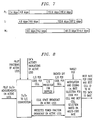
- FIG. 7 indicates and contrasts the different rate (per code) sets one could define for the different contexts of L, WL and PL:
- the block diagram of the proposed rate and best cell determination algorithm or method is shown in FIG. 8.
- the Ec/Io to C/I conversion block takes the measured pilot Ec/Io on all legs, their respective pilot fractions, power fractions, code spaces and data activity indicators of the present and near term to yield a time varying C/I per code for each cell (see section regarding Calculation of Effective C/I).
- the C/I predictor block (as in 1xEVDO system) smooths this time varying value and backs off to a conservative estimate to guarantee performance against Doppler variations over round trip delay plus transmission time.
- the main rate and best cell determining block examines this backed off C/l per code per cell together with the power fraction and code space available on all legs to compute the optimal rate (spreading, modulation and coding) per code per cell subject to meeting the FER target. It also decides that cell which maximizes the net multi-coded rate. The best rate per code and the corresponding best cell id are fed back by the mobile to the base in the allocated fields on the reverse link rate feedback channel.
- explicit feedback of the supportable rate (modulation and coding) from the mobile is preferred over sending Signal to Interference Ratio (SIR, C/I or pilot Ec/Io) measurements to the base station. It is preferable that the mobile compute the supportable rate (modulation and coding) for the following reasons:
- the broadcast channel for power fraction is recommended to be a physical code channel since the available power resource is expected to be fast changing.
- the downlink shared channel data activity indication bit is clubbed together with the power fraction information on the same channel broadcast at the same periodicity.
- the broadcast channel for code space can be either a physical code channel or an upper layer message passed to the mobile on an appropriate common control channel depending on how fast and periodically the available code space is changing.
- the mobile can just as well select the modulation and coding (rate) since it possesses all the necessary information for the task.
- This section describes the Ec/Io to C/I conversion block in the block diagram for rate determination (FIG. 8).
- the numerators of the two summed fractions are related to the energy expected to be collected in the future on the two taps of the RAKE.
- Each of the denominators express the sum of the future other cell interference and same cell interference (self + multiple access) due to loss of orthogonality.
- the other cell interference term in the denominator is the first term within ⁇ and further enclosed in [ ] prior to scaling. It is expressed as the difference between total interference energy collected and the usable energy and further subtracting the same cell (self + multiple access) interference. It is then scaled appropriately to reflect future loading.
- the second term added inside the ⁇ represents the same cell interference component.
- the corresponding RAI can be looked up from link level simulation result tables for AWGN following suitable backoffs for prediction error.
- the Gaussian assumption for the snapshot channel (quasi-static) holds if the channel fades sufficiently slowly for the channel coefficients to remain constant and stable during the time between measurement to prediction (if not the channel coefficients must be averaged over an appropriately weighted window).
- ⁇ j is the ratio of path losses to the mobile of neighbor cell j to serving cell 1. This is estimated as the ratio of the pilot energy of cell j to that of cell 1 assuming equal pilot power fractions.
Landscapes
- Engineering & Computer Science (AREA)
- Computer Networks & Wireless Communication (AREA)
- Signal Processing (AREA)
- Quality & Reliability (AREA)
- Mobile Radio Communication Systems (AREA)
Applications Claiming Priority (2)
| Application Number | Priority Date | Filing Date | Title |
|---|---|---|---|
| US09/730,637 US6930981B2 (en) | 2000-12-06 | 2000-12-06 | Method for data rate selection in a wireless communication system |
| US730637 | 2000-12-06 |
Publications (2)
| Publication Number | Publication Date |
|---|---|
| EP1213868A1 true EP1213868A1 (fr) | 2002-06-12 |
| EP1213868B1 EP1213868B1 (fr) | 2003-10-15 |
Family
ID=24936158
Family Applications (1)
| Application Number | Title | Priority Date | Filing Date |
|---|---|---|---|
| EP01305279A Expired - Lifetime EP1213868B1 (fr) | 2000-12-06 | 2001-06-18 | Procede pour la selection du debit de donnees dans un systeme de communication sans fil |
Country Status (3)
| Country | Link |
|---|---|
| US (1) | US6930981B2 (fr) |
| EP (1) | EP1213868B1 (fr) |
| DE (1) | DE60100981T2 (fr) |
Cited By (18)
| Publication number | Priority date | Publication date | Assignee | Title |
|---|---|---|---|---|
| WO2004014013A1 (fr) * | 2002-07-31 | 2004-02-12 | Mitsubishi Denki Kabushiki Kaisha | Procede, emetteur et systeme permettant d'emettre un flot de symboles de donnees dans un systeme de communication sans fil a entrees multiples/sorties multiples comprenant m paires d'antennes emettrices |
| WO2004077720A3 (fr) * | 2003-02-28 | 2004-11-04 | Mitsubishi Electric Corp | Procede d'attribution des ressources d'un reseau de communication sans fil au trafic a transmettre vers les equipements utilisateur par l'intermediaire d'une voie du reseau |
| EP1478113A1 (fr) * | 2003-05-12 | 2004-11-17 | Lucent Technologies Inc. | Procédé d'assignement adaptative de codes Walsh |
| WO2004114553A1 (fr) * | 2003-06-17 | 2004-12-29 | Telefonaktiebolaget L M Ericsson (Publ) | Espace etendu de codes walsh pour voie aller de paquets de donnees dans un systeme amdc |
| WO2005081442A1 (fr) * | 2004-02-25 | 2005-09-01 | Nokia Corporation | Selection de parametres de canal d'acheminement, systeme radio, unite de commande, materiel utilisateur et station de base |
| WO2006096887A1 (fr) * | 2005-03-08 | 2006-09-14 | Qualcomm Flarion Technologies, Inc. | Procedes et appareils d'adaptation de debit binaire |
| EP1550231A4 (fr) * | 2002-09-30 | 2009-04-01 | Motorola Inc | Procede de reduction du bruit d'acces dans un systeme de communication a spectre etale |
| US7885293B2 (en) | 2005-03-08 | 2011-02-08 | Qualcomm Incorporated | Methods and apparatus for implementing and using a maximum rate option indicator |
| US7894324B2 (en) | 2005-03-08 | 2011-02-22 | Qualcomm Incorporated | Methods and apparatus for signaling data rate option information |
| US8306541B2 (en) | 2005-03-08 | 2012-11-06 | Qualcomm Incorporated | Data rate methods and apparatus |
| US8315240B2 (en) | 2005-07-20 | 2012-11-20 | Qualcomm Incorporated | Enhanced uplink rate indicator |
| WO2013070729A1 (fr) * | 2011-11-07 | 2013-05-16 | Qualcomm Incorporated | Solutions de service vocal pour systèmes à largeur de bande flexibles |
| EP2434655A3 (fr) * | 2002-10-30 | 2013-12-18 | Motorola Mobility LLC | Procédé et dispositif pour planifier d'une transmission de liaison montante d'une station mobile |
| TWI426724B (zh) * | 2003-09-09 | 2014-02-11 | Qualcomm Inc | 用於在多入多出通信系統中發送遞增冗餘傳送之方法及設備 |
| US9001679B2 (en) | 2011-11-07 | 2015-04-07 | Qualcomm Incorporated | Supporting voice for flexible bandwidth systems |
| US9049633B2 (en) | 2011-12-09 | 2015-06-02 | Qualcomm Incorporated | Providing for mobility for flexible bandwidth carrier systems |
| US9220101B2 (en) | 2011-11-07 | 2015-12-22 | Qualcomm Incorporated | Signaling and traffic carrier splitting for wireless communications systems |
| US9516531B2 (en) | 2011-11-07 | 2016-12-06 | Qualcomm Incorporated | Assistance information for flexible bandwidth carrier mobility methods, systems, and devices |
Families Citing this family (67)
| Publication number | Priority date | Publication date | Assignee | Title |
|---|---|---|---|---|
| US7952511B1 (en) | 1999-04-07 | 2011-05-31 | Geer James L | Method and apparatus for the detection of objects using electromagnetic wave attenuation patterns |
| US6898192B2 (en) * | 2000-12-29 | 2005-05-24 | Nortel Networks Limited | Method and apparatus for improving fast forward link power control during variable rate operation of CDMA systems |
| KR100663524B1 (ko) * | 2001-01-17 | 2007-01-02 | 삼성전자주식회사 | 이동통신 시스템에서 월시 코드를 사용하여 패킷 데이터를전송하기 위한 장치 및 방법 |
| US7006483B2 (en) | 2001-02-23 | 2006-02-28 | Ipr Licensing, Inc. | Qualifying available reverse link coding rates from access channel power setting |
| KR100469701B1 (ko) * | 2001-03-10 | 2005-02-02 | 삼성전자주식회사 | 이동통신시스템에서 패킷 데이터 제어 채널 통신 장치 및방법 |
| US7346037B2 (en) * | 2001-03-26 | 2008-03-18 | Lg Electronics Inc. | Method of transmitting or receiving a data packet in packet data communication system using hybrid automatic repeat request |
| KR100800884B1 (ko) | 2001-03-29 | 2008-02-04 | 삼성전자주식회사 | 이동통신 시스템에서 역방향 링크의 송신 제어 방법 |
| TW565077U (en) * | 2001-04-16 | 2003-12-01 | Interdigital Tech Corp | A time division synchronous/code division multiple access (TDSCDMA) user equipment |
| GB0110125D0 (en) | 2001-04-25 | 2001-06-20 | Koninkl Philips Electronics Nv | Radio communication system |
| US6810236B2 (en) * | 2001-05-14 | 2004-10-26 | Interdigital Technology Corporation | Dynamic channel quality measurement procedure for adaptive modulation and coding techniques |
| EP3540980A1 (fr) | 2001-05-14 | 2019-09-18 | InterDigital Technology Corporation | Mesures de la qualité du canal pour l'affectation de ressources en liaison descendante |
| US7596082B2 (en) * | 2001-06-07 | 2009-09-29 | Qualcomm Incorporated | Method and apparatus for Walsh space assignment in a communication system |
| US7272110B2 (en) * | 2001-09-29 | 2007-09-18 | Lg Electronics Inc. | Method of allocating walsh code resource |
| US7116652B2 (en) * | 2001-10-18 | 2006-10-03 | Lucent Technologies Inc. | Rate control technique for layered architectures with multiple transmit and receive antennas |
| KR100800807B1 (ko) * | 2001-11-20 | 2008-02-01 | 삼성전자주식회사 | 재전송을 지원하는 통신시스템에서 재전송의 변조방식결정 방법 및 장치 |
| US6754169B2 (en) * | 2001-12-13 | 2004-06-22 | Motorola, Inc. | Method and system of operation for a variable transmission mode multi-carrier communication system |
| US7095710B2 (en) * | 2001-12-21 | 2006-08-22 | Qualcomm | Decoding using walsh space information |
| US8699505B2 (en) * | 2002-05-31 | 2014-04-15 | Qualcomm Incorporated | Dynamic channelization code allocation |
| JP3980029B2 (ja) * | 2002-06-13 | 2007-09-19 | ノキア コーポレイション | チャネル化コード及び電力の適応確保のための方法、システム、及びネットワークエンティティ |
| US7116708B2 (en) * | 2002-06-27 | 2006-10-03 | Nortel Networks Limited | Controlling the rate of data transfer over a wireless link |
| US8121536B2 (en) * | 2002-07-23 | 2012-02-21 | Qualcomm Incorporated | Noise compensation in satellite communications |
| US7031336B2 (en) * | 2002-08-26 | 2006-04-18 | Colubris Networks, Inc. | Space-time-power scheduling for wireless networks |
| US7957486B2 (en) * | 2002-09-30 | 2011-06-07 | Intel Corporation | Transmission link adaptation |
| GB2396275B (en) * | 2002-12-09 | 2006-03-15 | Ipwireless Inc | Support of plural chip rates in a CDMA system |
| US8254358B2 (en) | 2003-03-06 | 2012-08-28 | Ericsson Ab | Communicating a broadcast message to change data rates of mobile stations |
| US9078225B2 (en) * | 2003-06-16 | 2015-07-07 | Telefonaktiebolaget L M Ericsson (Publ) | Dynamic mobile power headroom threshold for determining rate increases in the reverse traffic channel of a CDMA network |
| US7933250B2 (en) * | 2003-06-23 | 2011-04-26 | Qualcomm Incorporated | Code channel management in a wireless communications system |
| US7535970B2 (en) * | 2003-08-23 | 2009-05-19 | Samsung Electronics Co., Ltd. | Wireless communication apparatus and method for multiple transmit and receive antenna system using multiple codes |
| US20050050427A1 (en) * | 2003-08-29 | 2005-03-03 | Gibong Jeong | Method of rate matching for link adaptation and code space management |
| US20050063344A1 (en) * | 2003-09-22 | 2005-03-24 | Telefonaktiebolaget Lm Ericsson (Publ) | Methods and apparatus for efficient decoding |
| US9226308B2 (en) | 2003-10-15 | 2015-12-29 | Qualcomm Incorporated | Method, apparatus, and system for medium access control |
| US8284752B2 (en) | 2003-10-15 | 2012-10-09 | Qualcomm Incorporated | Method, apparatus, and system for medium access control |
| US8483105B2 (en) | 2003-10-15 | 2013-07-09 | Qualcomm Incorporated | High speed media access control |
| US8472473B2 (en) | 2003-10-15 | 2013-06-25 | Qualcomm Incorporated | Wireless LAN protocol stack |
| US8462817B2 (en) | 2003-10-15 | 2013-06-11 | Qualcomm Incorporated | Method, apparatus, and system for multiplexing protocol data units |
| US8233462B2 (en) | 2003-10-15 | 2012-07-31 | Qualcomm Incorporated | High speed media access control and direct link protocol |
| US7616698B2 (en) | 2003-11-04 | 2009-11-10 | Atheros Communications, Inc. | Multiple-input multiple output system and method |
| US8072942B2 (en) * | 2003-11-26 | 2011-12-06 | Qualcomm Incorporated | Code channel management in a wireless communications system |
| US20050143027A1 (en) * | 2003-12-26 | 2005-06-30 | Hiddink Gerrit W. | Method and apparatus for automatic data rate control in a wireless communication system |
| US8903440B2 (en) | 2004-01-29 | 2014-12-02 | Qualcomm Incorporated | Distributed hierarchical scheduling in an ad hoc network |
| US7583750B2 (en) * | 2004-02-27 | 2009-09-01 | Alcatel-Lucent Usa Inc. | Method of data burst transmission |
| US8315271B2 (en) | 2004-03-26 | 2012-11-20 | Qualcomm Incorporated | Method and apparatus for an ad-hoc wireless communications system |
| US7564814B2 (en) | 2004-05-07 | 2009-07-21 | Qualcomm, Incorporated | Transmission mode and rate selection for a wireless communication system |
| US8401018B2 (en) * | 2004-06-02 | 2013-03-19 | Qualcomm Incorporated | Method and apparatus for scheduling in a wireless network |
| EP1605605B1 (fr) * | 2004-06-09 | 2019-02-27 | Samsung Electronics Co., Ltd. | Procédé et dispositif de transmission de données dans un système de télécommunication mobile supportant un service de transmission améliorée sur le trajet montant |
| US7801174B2 (en) | 2004-12-29 | 2010-09-21 | Alcatel-Lucent Usa Inc. | Techniques for efficient control of aggregating wireless voice communications |
| US20060140113A1 (en) * | 2004-12-29 | 2006-06-29 | Anderlind Erik E | Method for efficiently transmitting communications in a system supporting dedicated and shared communication channels |
| US8995547B2 (en) * | 2005-03-11 | 2015-03-31 | Qualcomm Incorporated | Systems and methods for reducing uplink resources to provide channel performance feedback for adjustment of downlink MIMO channel data rates |
| US8724740B2 (en) | 2005-03-11 | 2014-05-13 | Qualcomm Incorporated | Systems and methods for reducing uplink resources to provide channel performance feedback for adjustment of downlink MIMO channel data rates |
| US20060221847A1 (en) * | 2005-03-29 | 2006-10-05 | Dacosta Behram M | Method and apparatus for selecting transmission modulation rates in wireless devices for A/V streaming applications |
| US8600336B2 (en) | 2005-09-12 | 2013-12-03 | Qualcomm Incorporated | Scheduling with reverse direction grant in wireless communication systems |
| WO2007043459A1 (fr) * | 2005-10-07 | 2007-04-19 | Nec Corporation | Système de communication radio mimo et procédé utilisant une pluralité de stations de base et de stations mobiles |
| US20070091840A1 (en) * | 2005-10-20 | 2007-04-26 | Samsung Electronics Co., Ltd. | Decoupled MAC index for enhanced EVDO systems |
| US8218563B2 (en) * | 2005-11-04 | 2012-07-10 | Samsung Electronics Co., Ltd. | Method and system for providing adaptive modulation and coding in a multi-carrier wireless network |
| KR100946903B1 (ko) * | 2006-01-04 | 2010-03-09 | 삼성전자주식회사 | 통신 시스템에서 자원 할당 방법 및 시스템 |
| US8081686B2 (en) | 2006-05-16 | 2011-12-20 | Alcatel Lucent | Scalable spectrum CDMA communication systems and methods with dynamic orthogonal code allocation |
| RU2009134935A (ru) * | 2007-03-01 | 2011-04-10 | НТТ ДоСоМо, Инк. (JP) | Базовая станция и способ управления связью |
| EP2804330B1 (fr) * | 2007-06-20 | 2018-03-21 | Telefonaktiebolaget LM Ericsson (publ) | Système et appareil pour une suppression d'interférences utilisant la macrodiversité dans des réseaux sans fil mobiles |
| US8181079B2 (en) * | 2007-09-21 | 2012-05-15 | Qualcomm Incorporated | Data transmission with HARQ and interference mitigation |
| US8385216B1 (en) * | 2007-11-20 | 2013-02-26 | Spring Spectrum L.P. | Method and system for vertical handoff with target traffic channel setup conveyed via source channel |
| US8170606B2 (en) * | 2008-10-15 | 2012-05-01 | Apple Inc. | Dynamic thermal control for wireless transceivers |
| US8244296B2 (en) * | 2008-10-15 | 2012-08-14 | Apple Inc. | Dynamic thermal control for wireless transceivers |
| KR101548536B1 (ko) * | 2009-03-09 | 2015-09-01 | 삼성전자주식회사 | 복수의 단말에서 간섭 정렬 스킴에 따라 통신하는 타겟 단말을 선택하는 네트워크 장치 및 그 방법 |
| US8576737B1 (en) * | 2011-01-20 | 2013-11-05 | Sprint Spectrum L.P. | Intelligent specification of forward-link rate-control |
| US8526380B1 (en) | 2011-03-17 | 2013-09-03 | Sprint Communications Company L.P. | Dynamic transmission mode selection based on wireless communication device data rate capabilities |
| US8914686B2 (en) * | 2011-08-12 | 2014-12-16 | Telefonaktiebolaget L M Ericsson (Publ) | Throughput improvement in wireless systems |
| US9992714B1 (en) | 2012-10-24 | 2018-06-05 | Sprint Spectrum L.P. | Dynamic management of handoff based on detected network |
Citations (3)
| Publication number | Priority date | Publication date | Assignee | Title |
|---|---|---|---|---|
| WO1998035514A2 (fr) * | 1997-02-11 | 1998-08-13 | Qualcomm Incorporated | Procede et appareil destines a la programmation de liaisons aval |
| WO2000007401A1 (fr) * | 1998-07-25 | 2000-02-10 | Motorola Limited | Systeme et procede de communication |
| US6134230A (en) * | 1997-08-29 | 2000-10-17 | Telefonaktiebolaget Lm Ericsson | Method for selecting a link protocol for a transparent data service in a digital communications system |
Family Cites Families (15)
| Publication number | Priority date | Publication date | Assignee | Title |
|---|---|---|---|---|
| US5912907A (en) * | 1993-11-22 | 1999-06-15 | Thomson Consumer Electronics, Inc. | Satellite receiver code rate switching apparatus |
| DE19607207B4 (de) * | 1996-02-26 | 2004-12-09 | Deutsche Telekom Ag | Verfahren zum Aufteilen der Gesamtrate und der Gesamtsendeleistung eines Datenstroms auf mehrere Kanäle einer Kanalgruppe |
| US5920552A (en) * | 1996-05-30 | 1999-07-06 | Lucent Technologies, Inc. | Variable rate coding for wireless applications |
| US5914950A (en) * | 1997-04-08 | 1999-06-22 | Qualcomm Incorporated | Method and apparatus for reverse link rate scheduling |
| US6539050B1 (en) * | 1997-06-26 | 2003-03-25 | Hughes Electronics Corporation | Method for transmitting wideband signals via a communication system adapted for narrow-band signal transmission |
| US6147964A (en) * | 1998-05-07 | 2000-11-14 | Qualcomm Inc. | Method and apparatus for performing rate determination using orthogonal rate-dependent walsh covering codes |
| US6539205B1 (en) * | 1998-03-23 | 2003-03-25 | Skyworks Solutions, Inc. | Traffic channel quality estimation from a digital control channel |
| US6088578A (en) * | 1998-03-26 | 2000-07-11 | Nortel Networks Corporation | Burst request method and apparatus for CDMA high speed data |
| US6366779B1 (en) * | 1998-09-22 | 2002-04-02 | Qualcomm Incorporated | Method and apparatus for rapid assignment of a traffic channel in digital cellular communication systems |
| SE515837C2 (sv) * | 1999-01-22 | 2001-10-15 | Ericsson Telefon Ab L M | Adapterbar bandbredd |
| US6563810B1 (en) * | 1999-09-30 | 2003-05-13 | Qualcomm Incorporated | Closed loop resource allocation |
| US6763009B1 (en) * | 1999-12-03 | 2004-07-13 | Lucent Technologies Inc. | Down-link transmission scheduling in CDMA data networks |
| US6385462B1 (en) * | 2000-05-26 | 2002-05-07 | Motorola, Inc. | Method and system for criterion based adaptive power allocation in a communication system with selective determination of modulation and coding |
| US6859446B1 (en) * | 2000-09-11 | 2005-02-22 | Lucent Technologies Inc. | Integrating power-controlled and rate-controlled transmissions on a same frequency carrier |
| US6731618B1 (en) * | 2000-10-20 | 2004-05-04 | Airvana, Inc. | Coding for multi-user communication |
-
2000
- 2000-12-06 US US09/730,637 patent/US6930981B2/en not_active Expired - Lifetime
-
2001
- 2001-06-18 DE DE60100981T patent/DE60100981T2/de not_active Expired - Lifetime
- 2001-06-18 EP EP01305279A patent/EP1213868B1/fr not_active Expired - Lifetime
Patent Citations (3)
| Publication number | Priority date | Publication date | Assignee | Title |
|---|---|---|---|---|
| WO1998035514A2 (fr) * | 1997-02-11 | 1998-08-13 | Qualcomm Incorporated | Procede et appareil destines a la programmation de liaisons aval |
| US6134230A (en) * | 1997-08-29 | 2000-10-17 | Telefonaktiebolaget Lm Ericsson | Method for selecting a link protocol for a transparent data service in a digital communications system |
| WO2000007401A1 (fr) * | 1998-07-25 | 2000-02-10 | Motorola Limited | Systeme et procede de communication |
Cited By (31)
| Publication number | Priority date | Publication date | Assignee | Title |
|---|---|---|---|---|
| WO2004014013A1 (fr) * | 2002-07-31 | 2004-02-12 | Mitsubishi Denki Kabushiki Kaisha | Procede, emetteur et systeme permettant d'emettre un flot de symboles de donnees dans un systeme de communication sans fil a entrees multiples/sorties multiples comprenant m paires d'antennes emettrices |
| EP1550231A4 (fr) * | 2002-09-30 | 2009-04-01 | Motorola Inc | Procede de reduction du bruit d'acces dans un systeme de communication a spectre etale |
| EP2434655A3 (fr) * | 2002-10-30 | 2013-12-18 | Motorola Mobility LLC | Procédé et dispositif pour planifier d'une transmission de liaison montante d'une station mobile |
| WO2004077720A3 (fr) * | 2003-02-28 | 2004-11-04 | Mitsubishi Electric Corp | Procede d'attribution des ressources d'un reseau de communication sans fil au trafic a transmettre vers les equipements utilisateur par l'intermediaire d'une voie du reseau |
| US7330433B2 (en) | 2003-02-28 | 2008-02-12 | Mitsubishi Electric Research Laboratories, Inc. | Dynamic resource control for high-speed downlink packet access wireless channels |
| EP1478113A1 (fr) * | 2003-05-12 | 2004-11-17 | Lucent Technologies Inc. | Procédé d'assignement adaptative de codes Walsh |
| US7280581B2 (en) | 2003-05-12 | 2007-10-09 | Lucent Technologies Inc. | Method of adaptive Walsh code allocation |
| WO2004114553A1 (fr) * | 2003-06-17 | 2004-12-29 | Telefonaktiebolaget L M Ericsson (Publ) | Espace etendu de codes walsh pour voie aller de paquets de donnees dans un systeme amdc |
| US8908496B2 (en) | 2003-09-09 | 2014-12-09 | Qualcomm Incorporated | Incremental redundancy transmission in a MIMO communication system |
| TWI426724B (zh) * | 2003-09-09 | 2014-02-11 | Qualcomm Inc | 用於在多入多出通信系統中發送遞增冗餘傳送之方法及設備 |
| US7535885B2 (en) | 2004-02-25 | 2009-05-19 | Kari Horneman | Method of selecting transport channel parameters, radio system, controller, user equipment and base station |
| WO2005081442A1 (fr) * | 2004-02-25 | 2005-09-01 | Nokia Corporation | Selection de parametres de canal d'acheminement, systeme radio, unite de commande, materiel utilisateur et station de base |
| WO2006096887A1 (fr) * | 2005-03-08 | 2006-09-14 | Qualcomm Flarion Technologies, Inc. | Procedes et appareils d'adaptation de debit binaire |
| US7894324B2 (en) | 2005-03-08 | 2011-02-22 | Qualcomm Incorporated | Methods and apparatus for signaling data rate option information |
| JP2011259461A (ja) * | 2005-03-08 | 2011-12-22 | Qualcomm Incorporated | データレート適応方法及び装置 |
| CN101171784B (zh) * | 2005-03-08 | 2012-07-18 | 高通股份有限公司 | 用于数据速率适配的方法和装置 |
| US8306541B2 (en) | 2005-03-08 | 2012-11-06 | Qualcomm Incorporated | Data rate methods and apparatus |
| US7974253B2 (en) | 2005-03-08 | 2011-07-05 | Qualcomm Incorporated | Methods and apparatus for implementing and using a rate indicator |
| US7885293B2 (en) | 2005-03-08 | 2011-02-08 | Qualcomm Incorporated | Methods and apparatus for implementing and using a maximum rate option indicator |
| JP2008533871A (ja) * | 2005-03-08 | 2008-08-21 | クゥアルコム・フラリオン・テクノロジーズ、インコーポレイテッド | データレート適応方法及び装置 |
| US8315240B2 (en) | 2005-07-20 | 2012-11-20 | Qualcomm Incorporated | Enhanced uplink rate indicator |
| WO2013070729A1 (fr) * | 2011-11-07 | 2013-05-16 | Qualcomm Incorporated | Solutions de service vocal pour systèmes à largeur de bande flexibles |
| US9001679B2 (en) | 2011-11-07 | 2015-04-07 | Qualcomm Incorporated | Supporting voice for flexible bandwidth systems |
| US9220101B2 (en) | 2011-11-07 | 2015-12-22 | Qualcomm Incorporated | Signaling and traffic carrier splitting for wireless communications systems |
| US9516531B2 (en) | 2011-11-07 | 2016-12-06 | Qualcomm Incorporated | Assistance information for flexible bandwidth carrier mobility methods, systems, and devices |
| US9532251B2 (en) | 2011-11-07 | 2016-12-27 | Qualcomm Incorporated | Bandwidth information determination for flexible bandwidth carriers |
| US9848339B2 (en) | 2011-11-07 | 2017-12-19 | Qualcomm Incorporated | Voice service solutions for flexible bandwidth systems |
| US10111125B2 (en) | 2011-11-07 | 2018-10-23 | Qualcomm Incorporated | Bandwidth information determination for flexible bandwidth carriers |
| US10667162B2 (en) | 2011-11-07 | 2020-05-26 | Qualcomm Incorporated | Bandwidth information determination for flexible bandwidth carriers |
| US9049633B2 (en) | 2011-12-09 | 2015-06-02 | Qualcomm Incorporated | Providing for mobility for flexible bandwidth carrier systems |
| US9055496B2 (en) | 2011-12-09 | 2015-06-09 | Qualcomm Incorporated | Providing for mobility for flexible bandwidth carrier systems |
Also Published As
| Publication number | Publication date |
|---|---|
| DE60100981D1 (de) | 2003-11-20 |
| US6930981B2 (en) | 2005-08-16 |
| DE60100981T2 (de) | 2004-08-12 |
| US20020110101A1 (en) | 2002-08-15 |
| EP1213868B1 (fr) | 2003-10-15 |
Similar Documents
| Publication | Publication Date | Title |
|---|---|---|
| EP1213868B1 (fr) | Procede pour la selection du debit de donnees dans un systeme de communication sans fil | |
| US7313124B2 (en) | Adaptive downlink packet transmission method in multicarrier CDMA system | |
| KR100708291B1 (ko) | 무선 통신 장치 및 무선 통신 방법 | |
| EP1207635A1 (fr) | Structures de canaux montant et descendant pour système partageant un canal descendent | |
| US6700881B1 (en) | Rate control device and method for CDMA communication system | |
| ES2378225T3 (es) | Mediciones de la calidad de canal para la asignación de recursos de enlace descendente. | |
| US7554937B2 (en) | Adaptive packet transmission method for transmitting packets in multibeam satellite communication system | |
| US7421279B2 (en) | Method, system and apparatus for improving reception in multiple access communication systems | |
| US8553667B2 (en) | Setting maximum power at a mobile communication system base station having multiple antennas | |
| US8325593B2 (en) | Mobile communication system, base station, user device, and method | |
| US7623553B2 (en) | Method, apparatus, and system for data transmission and processing in a wireless communication environment | |
| US8315339B2 (en) | Channel estimation | |
| US20030086393A1 (en) | Method for allocating wireless communication resources | |
| EP2194658A2 (fr) | Procede et dispositif pour la commande de puissance directe dans un systeme de communication | |
| US7519028B2 (en) | Channel structure, method forming the same, radio base station, mobile station in mobile communication system | |
| EP2367331B1 (fr) | Appareil de communication AMRC | |
| US7339983B2 (en) | Apparatus and method for detecting a power ratio between a traffic channel and a pilot channel in a mobile communication system | |
| US20050105502A1 (en) | TFCI code word mapping in hard split mode | |
| CN100391305C (zh) | 高速下行分组接入的信道资源分配方法 | |
| REPETITION | ENCODER REPEHTION/8Q_P} § SKK//—> A R= 1/5 PUNCTURING ‘HM TB | |
| Kim et al. | Dynamic rate adaptation based on multidimensional multicode DS-CDMA in cellular wireless networks | |
| KR100616356B1 (ko) | 대역 확산 시스템의 고속 순방향 서플리멘털 채널에 대한데이터 전송 속도 결정 방법 | |
| Monogioudis | 0.667 ms SLOT j | |
| CN101248694A (zh) | 能够减少小区间干扰的无线电通信方法、系统及其移动台和基站 | |
| JP2006129397A (ja) | 通信装置、基地局装置及び送信方法 |
Legal Events
| Date | Code | Title | Description |
|---|---|---|---|
| PUAI | Public reference made under article 153(3) epc to a published international application that has entered the european phase |
Free format text: ORIGINAL CODE: 0009012 |
|
| 17P | Request for examination filed |
Effective date: 20010628 |
|
| AK | Designated contracting states |
Kind code of ref document: A1 Designated state(s): AT BE CH CY DE DK ES FI FR GB GR IE IT LI LU MC NL PT SE TR |
|
| AX | Request for extension of the european patent |
Free format text: AL;LT;LV;MK;RO;SI |
|
| AKX | Designation fees paid |
Designated state(s): DE FR GB IT |
|
| GRAH | Despatch of communication of intention to grant a patent |
Free format text: ORIGINAL CODE: EPIDOS IGRA |
|
| GRAS | Grant fee paid |
Free format text: ORIGINAL CODE: EPIDOSNIGR3 |
|
| GRAA | (expected) grant |
Free format text: ORIGINAL CODE: 0009210 |
|
| RIN1 | Information on inventor provided before grant (corrected) |
Inventor name: ULLAH KHAN, FAROOQ Inventor name: GOPALAKRISHNAN, NANDU Inventor name: SUNDARAM, GANAPATHY SUBRAMANIAN Inventor name: NANDA, SANJIV Inventor name: KADABA, SRINIVAS R. Inventor name: SUNAY, MEHMET OGUZ |
|
| AK | Designated contracting states |
Kind code of ref document: B1 Designated state(s): DE FR GB IT |
|
| PG25 | Lapsed in a contracting state [announced via postgrant information from national office to epo] |
Ref country code: IT Free format text: LAPSE BECAUSE OF FAILURE TO SUBMIT A TRANSLATION OF THE DESCRIPTION OR TO PAY THE FEE WITHIN THE PRESCRIBED TIME-LIMIT;WARNING: LAPSES OF ITALIAN PATENTS WITH EFFECTIVE DATE BEFORE 2007 MAY HAVE OCCURRED AT ANY TIME BEFORE 2007. THE CORRECT EFFECTIVE DATE MAY BE DIFFERENT FROM THE ONE RECORDED. Effective date: 20031015 |
|
| REG | Reference to a national code |
Ref country code: GB Ref legal event code: FG4D |
|
| REG | Reference to a national code |
Ref country code: IE Ref legal event code: FG4D |
|
| REF | Corresponds to: |
Ref document number: 60100981 Country of ref document: DE Date of ref document: 20031120 Kind code of ref document: P |
|
| ET | Fr: translation filed | ||
| PLBE | No opposition filed within time limit |
Free format text: ORIGINAL CODE: 0009261 |
|
| STAA | Information on the status of an ep patent application or granted ep patent |
Free format text: STATUS: NO OPPOSITION FILED WITHIN TIME LIMIT |
|
| 26N | No opposition filed |
Effective date: 20040716 |
|
| REG | Reference to a national code |
Ref country code: IE Ref legal event code: MM4A |
|
| REG | Reference to a national code |
Ref country code: GB Ref legal event code: 732E Free format text: REGISTERED BETWEEN 20131121 AND 20131127 |
|
| REG | Reference to a national code |
Ref country code: FR Ref legal event code: CD Owner name: ALCATEL-LUCENT USA INC. Effective date: 20131122 |
|
| REG | Reference to a national code |
Ref country code: FR Ref legal event code: GC Effective date: 20140410 |
|
| REG | Reference to a national code |
Ref country code: FR Ref legal event code: RG Effective date: 20141015 |
|
| REG | Reference to a national code |
Ref country code: FR Ref legal event code: PLFP Year of fee payment: 15 |
|
| REG | Reference to a national code |
Ref country code: DE Ref legal event code: R081 Ref document number: 60100981 Country of ref document: DE Owner name: GEMALTO SA, FR Free format text: FORMER OWNER: LUCENT TECHNOLOGIES INC., MURRAY HILL, N.J., US |
|
| REG | Reference to a national code |
Ref country code: FR Ref legal event code: TP Owner name: GEMALTO SA, FR Effective date: 20160125 |
|
| REG | Reference to a national code |
Ref country code: GB Ref legal event code: 732E Free format text: REGISTERED BETWEEN 20160225 AND 20160302 |
|
| REG | Reference to a national code |
Ref country code: FR Ref legal event code: PLFP Year of fee payment: 16 |
|
| REG | Reference to a national code |
Ref country code: GB Ref legal event code: 732E Free format text: REGISTERED BETWEEN 20161208 AND 20161214 |
|
| REG | Reference to a national code |
Ref country code: FR Ref legal event code: PLFP Year of fee payment: 17 |
|
| REG | Reference to a national code |
Ref country code: FR Ref legal event code: PLFP Year of fee payment: 18 |
|
| PGFP | Annual fee paid to national office [announced via postgrant information from national office to epo] |
Ref country code: DE Payment date: 20200519 Year of fee payment: 20 Ref country code: FR Payment date: 20200520 Year of fee payment: 20 |
|
| PGFP | Annual fee paid to national office [announced via postgrant information from national office to epo] |
Ref country code: GB Payment date: 20200525 Year of fee payment: 20 |
|
| REG | Reference to a national code |
Ref country code: DE Ref legal event code: R071 Ref document number: 60100981 Country of ref document: DE |
|
| REG | Reference to a national code |
Ref country code: GB Ref legal event code: PE20 Expiry date: 20210617 |
|
| PG25 | Lapsed in a contracting state [announced via postgrant information from national office to epo] |
Ref country code: GB Free format text: LAPSE BECAUSE OF EXPIRATION OF PROTECTION Effective date: 20210617 |