EP1214331B1 - Composes de 2-azapurines et leur utilisation - Google Patents
Composes de 2-azapurines et leur utilisation Download PDFInfo
- Publication number
- EP1214331B1 EP1214331B1 EP00960534A EP00960534A EP1214331B1 EP 1214331 B1 EP1214331 B1 EP 1214331B1 EP 00960534 A EP00960534 A EP 00960534A EP 00960534 A EP00960534 A EP 00960534A EP 1214331 B1 EP1214331 B1 EP 1214331B1
- Authority
- EP
- European Patent Office
- Prior art keywords
- group
- alkyl
- nucleic acid
- compound
- formula
- Prior art date
- Legal status (The legal status is an assumption and is not a legal conclusion. Google has not performed a legal analysis and makes no representation as to the accuracy of the status listed.)
- Expired - Lifetime
Links
- 0 C[C@]12N=CN(*)[C@@]1(C)N=NN=C2N Chemical compound C[C@]12N=CN(*)[C@@]1(C)N=NN=C2N 0.000 description 9
- WLEIFFGLHYCMTD-UHFFFAOYSA-N CC(C(c1c(N2)[n](C)cn1)=NC2=O)=C Chemical compound CC(C(c1c(N2)[n](C)cn1)=NC2=O)=C WLEIFFGLHYCMTD-UHFFFAOYSA-N 0.000 description 1
- JCBAIUIMKSRNGX-RWBYNWAKSA-N CC(C1)[C@@H](CO)O[C@H]1[n]1c2ncnc(N)c2cc1 Chemical compound CC(C1)[C@@H](CO)O[C@H]1[n]1c2ncnc(N)c2cc1 JCBAIUIMKSRNGX-RWBYNWAKSA-N 0.000 description 1
- QEZONCARJSDUEZ-FHZGLPGMSA-N CC(c1c(/C(/N)=N\C=C)nc[n]1[C@@H](C1)O[C@H](CO)C1O)=C Chemical compound CC(c1c(/C(/N)=N\C=C)nc[n]1[C@@H](C1)O[C@H](CO)C1O)=C QEZONCARJSDUEZ-FHZGLPGMSA-N 0.000 description 1
- TUOMWSCHJJCTNH-UHFFFAOYSA-N C[n]1c2nnnc(N)c2nc1 Chemical compound C[n]1c2nnnc(N)c2nc1 TUOMWSCHJJCTNH-UHFFFAOYSA-N 0.000 description 1
- SHZNXPBXUGYEAG-SPDVFEMOSA-N Cc1c2nc[n]([C@@H](C3)O[C@H](CO)C3O)c2nnn1 Chemical compound Cc1c2nc[n]([C@@H](C3)O[C@H](CO)C3O)c2nnn1 SHZNXPBXUGYEAG-SPDVFEMOSA-N 0.000 description 1
Images


Classifications
-
- C—CHEMISTRY; METALLURGY
- C12—BIOCHEMISTRY; BEER; SPIRITS; WINE; VINEGAR; MICROBIOLOGY; ENZYMOLOGY; MUTATION OR GENETIC ENGINEERING
- C12N—MICROORGANISMS OR ENZYMES; COMPOSITIONS THEREOF; PROPAGATING, PRESERVING, OR MAINTAINING MICROORGANISMS; MUTATION OR GENETIC ENGINEERING; CULTURE MEDIA
- C12N15/00—Mutation or genetic engineering; DNA or RNA concerning genetic engineering, vectors, e.g. plasmids, or their isolation, preparation or purification; Use of hosts therefor
- C12N15/09—Recombinant DNA-technology
- C12N15/11—DNA or RNA fragments; Modified forms thereof; Non-coding nucleic acids having a biological activity
- C12N15/113—Non-coding nucleic acids modulating the expression of genes, e.g. antisense oligonucleotides; Antisense DNA or RNA; Triplex- forming oligonucleotides; Catalytic nucleic acids, e.g. ribozymes; Nucleic acids used in co-suppression or gene silencing
-
- C—CHEMISTRY; METALLURGY
- C07—ORGANIC CHEMISTRY
- C07H—SUGARS; DERIVATIVES THEREOF; NUCLEOSIDES; NUCLEOTIDES; NUCLEIC ACIDS
- C07H19/00—Compounds containing a hetero ring sharing one ring hetero atom with a saccharide radical; Nucleosides; Mononucleotides; Anhydro-derivatives thereof
- C07H19/02—Compounds containing a hetero ring sharing one ring hetero atom with a saccharide radical; Nucleosides; Mononucleotides; Anhydro-derivatives thereof sharing nitrogen
- C07H19/04—Heterocyclic radicals containing only nitrogen atoms as ring hetero atom
-
- C—CHEMISTRY; METALLURGY
- C07—ORGANIC CHEMISTRY
- C07H—SUGARS; DERIVATIVES THEREOF; NUCLEOSIDES; NUCLEOTIDES; NUCLEIC ACIDS
- C07H19/00—Compounds containing a hetero ring sharing one ring hetero atom with a saccharide radical; Nucleosides; Mononucleotides; Anhydro-derivatives thereof
- C07H19/02—Compounds containing a hetero ring sharing one ring hetero atom with a saccharide radical; Nucleosides; Mononucleotides; Anhydro-derivatives thereof sharing nitrogen
- C07H19/04—Heterocyclic radicals containing only nitrogen atoms as ring hetero atom
- C07H19/06—Pyrimidine radicals
- C07H19/10—Pyrimidine radicals with the saccharide radical esterified by phosphoric or polyphosphoric acids
-
- C—CHEMISTRY; METALLURGY
- C07—ORGANIC CHEMISTRY
- C07H—SUGARS; DERIVATIVES THEREOF; NUCLEOSIDES; NUCLEOTIDES; NUCLEIC ACIDS
- C07H19/00—Compounds containing a hetero ring sharing one ring hetero atom with a saccharide radical; Nucleosides; Mononucleotides; Anhydro-derivatives thereof
- C07H19/02—Compounds containing a hetero ring sharing one ring hetero atom with a saccharide radical; Nucleosides; Mononucleotides; Anhydro-derivatives thereof sharing nitrogen
- C07H19/04—Heterocyclic radicals containing only nitrogen atoms as ring hetero atom
- C07H19/16—Purine radicals
- C07H19/20—Purine radicals with the saccharide radical esterified by phosphoric or polyphosphoric acids
-
- C—CHEMISTRY; METALLURGY
- C07—ORGANIC CHEMISTRY
- C07H—SUGARS; DERIVATIVES THEREOF; NUCLEOSIDES; NUCLEOTIDES; NUCLEIC ACIDS
- C07H21/00—Compounds containing two or more mononucleotide units having separate phosphate or polyphosphate groups linked by saccharide radicals of nucleoside groups, e.g. nucleic acids
-
- C—CHEMISTRY; METALLURGY
- C12—BIOCHEMISTRY; BEER; SPIRITS; WINE; VINEGAR; MICROBIOLOGY; ENZYMOLOGY; MUTATION OR GENETIC ENGINEERING
- C12N—MICROORGANISMS OR ENZYMES; COMPOSITIONS THEREOF; PROPAGATING, PRESERVING, OR MAINTAINING MICROORGANISMS; MUTATION OR GENETIC ENGINEERING; CULTURE MEDIA
- C12N2310/00—Structure or type of the nucleic acid
- C12N2310/30—Chemical structure
- C12N2310/33—Chemical structure of the base
- C12N2310/333—Modified A
-
- C—CHEMISTRY; METALLURGY
- C12—BIOCHEMISTRY; BEER; SPIRITS; WINE; VINEGAR; MICROBIOLOGY; ENZYMOLOGY; MUTATION OR GENETIC ENGINEERING
- C12Q—MEASURING OR TESTING PROCESSES INVOLVING ENZYMES, NUCLEIC ACIDS OR MICROORGANISMS; COMPOSITIONS OR TEST PAPERS THEREFOR; PROCESSES OF PREPARING SUCH COMPOSITIONS; CONDITION-RESPONSIVE CONTROL IN MICROBIOLOGICAL OR ENZYMOLOGICAL PROCESSES
- C12Q1/00—Measuring or testing processes involving enzymes, nucleic acids or microorganisms; Compositions therefor; Processes of preparing such compositions
- C12Q1/68—Measuring or testing processes involving enzymes, nucleic acids or microorganisms; Compositions therefor; Processes of preparing such compositions involving nucleic acids
- C12Q1/6813—Hybridisation assays
Definitions
- the present invention is directed to a nucleic acid binding compound comprising 2-azapurines, a compound useful for the preparation of such compound, a binding product of this nucleic acid binding compound with a nucleic acid, a method for the determination of a nucleic acid using said compound, and several uses of 2-azapurine compounds.
- 2-azapurine compounds are known in the art. In Chemistry of Nucleosides and Nucleotides (Vol. 2, p. 288-297, and p. 319) there are shown some examples of 2-azapurine nucleosides. However, there is no disclosure on 7-deaza-2-azapurine nucleosides.
- Biochemical Pharmacology vol. 25, no. 5, 1976, pages 517-521, discloses nucleosides of 2-aza-purines and investigates the cytotoxicities and activities as substrates for enzymes metabolizing purine nucleosides but does not disclose oligonucleotides containing 2-aza-adenosine or compounds useful for the synthesis thereof or methods wherein these oligonucleotides could be used.
- Bioorganic & Medicinal Chem., vol. 4, no. 10, 1996, pages 1725-1731 discloses The synthesis and biological evaluation of imidazopyridazines and triazolopyridazines have been disclosed in Bioorganic & Medicinal Chem., vol. 4, no. 10, 1996, pages 1725-173, and in J. of Org. Chem., vol. 25, no. 4, 1960, pages 579-582,
- the present invention is particularly useful in nucleic acid determinations, for example in analytics, especially in the field of health care.
- Nucleic acids have been found to be useful analytes for the determination of the presence or absence of genes or microorganisms in human body fluids, food or environment.
- Nucleic acid analysis has found widespread use after the introduction of nucleic acid amplification, like the Polymerase Chain Reaction (PCR, see US-A-4,683,202). Thus, sufficient amounts of nucleic acids are available from each sample.
- the nucleic acids can be determined from this pretreated sample using a variety of different techniques, dependent from the particular purpose. Most assays require the use of a probe which is either immobilized or immobilizable or is labelled by attachment of one or more reporter groups.
- a reporter group has the characteristics to be itself capable to be determined or it can be reacted with reagents that make the probe determinable via said reporter group.
- probes that are labelled by reporter groups can be determined, as can be hybrids that contain the probe and a nucleic acid to be determined.
- the hybrid between the probe and the nucleic acid to be determined is determined at the solid phase to which the probe is bound.
- assays not only one nucleic acid having a specific sequence, but a large number of nucleic acids of different sequence is determined.
- the probes are immobilized in tiny spots in an array on a flat surface such as a glass chip (EP-A-0 476 014 and TIBTECH (1997), Vol. 15, 465-469).
- oligonucleotide arrays The basic principle of using oligonucleotide arrays was first proposed in the late 1980s when the concept of determining a DNA sequence by hybridization to a comprehensive set of oligonucleotides (SBH, s equencing b y h ybridization) was developed.
- SBH s equencing b y h ybridization
- Nucleic acid determinations generally suffer from the problem that the base pairing possibilities between the natural bases A and T and C and G have different stability. This can be attributed to the different capability of the bases to form hydrogen bonding.
- the dA-dT- base pair has two hydrogen bridges, while the dG-dC- base pair has 3 hydrogen bridges.
- Tm melting temperatures
- TMAC tetramethylammonium chloride
- Another proposal was directed to the use of different concentrations of each different (immobilized) probe in one assay. This was found to be technically complex if not impossible on a chip surface.
- FIG 1 shows how z 2 A d is capable of base pairing with a dG in another strand of a nucleic acid.
- FIG 2 there are shown different compounds of the invention, like 2-aza-2'-deoxyadenosine (2), the corresponding triphosphate (11), a phosphoramidite for the introduction of 2-aza-2'-deoxyadenosine into oligonucleotides during conventional chemical automated synthesis (10 b) and a H-phosphonate (12).
- FIG 3 shows compounds useful in the present invention.
- the purine numbering for compound 2 and the systematic numbering for compound 3 is given.
- FIG 4 shows a route for synthesis of 2-aza-2'-deoxy-adenosine.
- FIG 5 shows compounds of the invention.
- FIG 6 shows a comparison of the binding of z 2 A d with dG and dG with isoG d in antiparallel binding.
- FIG 7 shows that z 2 A d can also bind in a parallel mode to isoG d , can bind to dC in parallel mode when protonated, and to isoC d in antiparallel mode if protonated.
- the subject of the present invention is a nucleic acid binding compound comprising a backbone, said backbone having attached heterocyclic groups capable of base pairing to natural nucleobases at least one of said heterocyclic groups being one of the naturally occurring nucleobases characterized in that at least one other of said heterocyclic groups is a group of the general formula I wherein
- a nucleic acid binding compound In order to equalize Tm, in a nucleic acid binding compound one or more C in a strand complementary to a G in the nucleic acid to be determined could be replaced by a z 2 A d .
- the oligonucleotide would then bind specifically to the target sequence containing dG opposite to z 2 A d but with the stability of a dA-dT and not a dG-dC base pair.
- This general principle of course is not limited to z 2 A d , as bases showing the same characteristics in the 6-membered ring would be expected to have the same properties based on the above explanation due to their containing the 2-azapurine structure.
- Halogen means a fluoro, chloro, bromo or iodo group.
- the most preferred halogen groups are -Cl and -Br.
- Alkyl groups are preferably chosen from alkyl groups containing from 1 to 10 carbon atoms, either arranged in linear, branched or cyclic form. The actual length of the alkyl group will depend on the steric situation at the specific position where the alkyl group is located. If there are steric constraints, the alkyl group will generally be smaller, the methyl and ethyl group being most preferred. All alkyl, alkenyl and alkynyl groups can be either unsubstituted or substituted. Substitution by hetero atoms as outlined above, will help to increase solubility in aqueous solutions.
- Alkenyl groups are preferably selected from alkenyl groups containing from 2 to 10 carbon atoms. For the selections similar considerations apply as for alkyl groups. They also can be linear, branched and cyclic. The most preferred alkenyl group is the ethylene group.
- Alkynyl groups have preferably from 2 to 10 carbon atoms. Again, those carbon atoms can be arranged in linear, branched and cyclic manner. Further, there can be more than one triple bond in the alkynyl group. The most preferred alkynyl group is the 3-propargyl-group.
- Alkoxy groups preferably contain from 1 to 6 carbon atoms and are attached to the rest of the moiety via the oxygen atom.
- alkyl group contained in the alkoxy groups the same considerations apply as for alkyl groups.
- the most preferred alkoxy group is the methoxy group.
- Aryloxy groups preferably contain from 6 to 20 carbon atoms. Those carbon atoms may be contained in one or more aromatic rings and further in side chains (for example, alkyl chains) attached to the aromatic moiety. Preferred aryloxy group are the phenoxy and the benzoxy group.
- Preferred O-protecting groups in R 14 are the aroyl groups, the acyl groups and the silyl groups. Among these most preferred is the benzoyl group.
- Preferred silyl groups are the trialkylsilyl groups, like triethylsilyl.
- a phosphorous atom can either mean the regular 31 P or the radioactive 32 P or a mixture thereof.
- hydrogen H/D/T
- carbon C
- iodine Cl, Br, I
- nitrogen N
- Preferred group -NR 5 R 6 in the definition of R 3 and R 4 is the -NH 2 group.
- suitable amino protecting group are generally known to a man skilled in the art.
- any groups -OH, -SH and -NH 2 should be protected by suitable protecting groups. Further, during chemical synthesis, the compound will be attached for convenience to a solid phase. In these cases, the definitions of the substituents given above will be selected accordingly.
- a protecting group is a chemical group that is attached to a functional moiety (for example to the oxygen in a hydroxyl group, replacing the hydrogen) to protect the functional group from reacting in an undesired way.
- a protecting group is further defined by the fact that it can be removed without destroying the biological activity of the molecule formed, here the binding of the nucleic acid binding compound to a nucleic acid.
- Suitable protecting groups are known to a man skilled in the art.
- Especially preferred protecting groups for example for hydroxyl groups at the 5'-end of a nucleotide or oligonucleotide are selected from the trityl group, for example dimethoxytrityl.
- Preferred protecting groups at exocyclic amino groups in formula I are the acyl groups, most preferred the benzoyl group (Bz), phenoxyacetyl or acetyl or formyl, and the N,N-dialkylformamidine group, preferentially the dimethyl-, diisobutyl-, and the di-n-butylformamidine group.
- the nucleic acid binding compound according to the invention preferably has a length of less than 100 subunits, more preferably of from 10 to 30 subunits.
- the substituents should be chosen such that hydrogen bonds to heterocyclic groups at the nucleic acid to be bound are enabled, preferably by Watson Crick base pairing and/or in the way as disclosed in figure 1.
- Compounds in which the substituents do not enable such preferred hydrogen bonding can be useful as intermediates for the preparation of nucleic acid binding compounds.
- Preferred nucleic acid binding compounds of the invention are those which are chemically synthesized.
- any of the substituents are selected such as to contain a reporter group. While as many reporter groups can be attached as useful to label the nucleic acid compound sufficiently, it is preferred to attach only a limited number of reporter groups to a single subunit, such that recognition of nucleic acids, affinities to nucleic acids and solubility is not affected such that the probe would not be useful in hybridization assays. In a very preferred case, there will be only from 1 to 4, most preferably 1 or 2 or most preferred only one reporter group in each nucleic acid binding compound.
- nucleic acid determination There are formats for the nucleic acid determination which require more than one reporter group attached to the probe.
- An example for such formats is disclosed in WO92/02638.
- one of the reporter groups will be a fluorescence emitter, while the other is a fluorescence quencher.
- Reporter groups are generally groups that make the nucleic acid binding compound as well as any nucleic acids bound thereo distinguishable from the remainder of the liquid, i.e. the sample (nucleic acid binding compounds having attached a reporter group can also be termed labelled nucleic acid binding compounds, labelled probes or just probes). This distinction can be either effected by selecting the reporter group from the group of directly or indirectly detectable groups or from the groups of immobilized or immobilizable groups.
- Directly detectable groups are for example fluorescent compounds, like fluorescein and its derivatives, like hexachlorofluorescein and hexafluorofluorescein, rhodamines, psoralenes squaraines, porphyrines, fluorescent particles, bioluminescent compounds, like acridinium esters and luminol, or the cyanine dyes, like Cy-5. Examples of such compounds are disclosed in EP 0 680 969.
- spin labels like TEMPO electrochemically detectably groups
- ferrocene viologene
- heavy metal chelates like electrochemiluminescent labels, like ruthenium bispyridyl complexes, and naphthoquinones, quencherdyes, like dabcyl, and nuclease active complexes, for example of Fe and Cu
- Indirectly detectable groups are groups that can be recognized by another moiety which is directly or indirectly labelled. Examples of such indirect detectable groups are for example haptens, like digoxigenin or biotin. Digoxigenin for example can be recognized by antibodies against digoxigenin.
- Those anibodies may either be labelled directly or can be recognized by labelled antibodies directed against the (antidigoxigenin) antibodies. Formats based on the recognition of digoxigenin are disclosed in EP-B-0 324 474. Biotin can be recognized by avidin and similar compounds, like streptavidin and other biotin binding compounds. Again, those compounds can be labelled directly or indirectly.
- the reporter group can further be a nucleotide sequence which does not interfere with other nucleotide sequences in the sample.
- the sequence can therefore be specifically recognized by nucleotide containing a complementary sequence.
- This nucleotide sequence can be labelled directly or indirectly or can be immobilizable or immobilized.
- a reporter group can further be a solid phase. Attachment of the nucleic acid binding compound with solid phase can be either directly or indirectly as pointed out above for the detectable group.
- Direct labelling can be effected by covalent coupling of a nucleic acid binding compound to a reactive group on the solid phase, i.e. preferably via a linker.
- Indirect labelling can be made similar as disclosed above for the detectable groups.
- indirect attachment is non-covalently by biospecific interactions, for example those selected from the group of hapten-antibody, vitamin-receptor and nucleic acid-complementary nucleic acid. Again, those interactions and their use in nucleic acid assays is known to a man skilled in the art.
- Solid phases that are useful for immobilization of the probe according to the invention are preferably selected from the group of polystyrene, polyethylene, polypropylene, glass and TiO 2 .
- the formats of such solid phases can be selected according to the needs of the instrumentation and format of the assay.
- a solid phase may assume the form of a bead or a vessel.
- reporter group and the specific embodiments preferably include a linker which is used to connect the moiety intended to be used (the actual solid phase or the fluorophoric moiety, to the position of attachment as the reporter group.
- the linker will provide flexibility such that the nucleic acid binding compound can bind the nucleic acid sequence to be determined without major hindrance by the solid phase.
- Linkers especially those that are not hydrophobic, for example based on consecutive ethylenoxy units, for example as disclosed in DE 3943522 are known to a man skilled in the art.
- RNA ribonucleoside subunits
- DNA deoxyribonucleoside subunits
- PNA peptide nucleic acid subunits
- the backbone comprises sugar and phosphate moieties.
- the sugar configuration is selected from the group consisting of the ⁇ -D-, ⁇ -D-, ⁇ -L- and ⁇ -L-configurations, most preferred the compound contains at least one 2'-deoxy- ⁇ -D-erythro-pentofuranosyl moiety or one ⁇ -D-ribofuranosyl moiety.
- D is the glycosid C-1 of a sugar moiety of the compound according to the invention.
- Preferred compounds of formula VI are those wherein R 1 is NH 2 , W is N, Z is N, Y is C, X is N and R 14 is H.
- nucleic acid binding compounds contain at least one group of formula I, wherein R 1 is the group -NR 5 R 6 , which are either 2-aza-adenosine or derivatives thereof.
- R 1 is the group -NR 5 R 6 , which are either 2-aza-adenosine or derivatives thereof.
- 2-aza-adenine there are considered here compounds that provide hydrogen bonding via the same atoms as 2-aza-adenine to G and dG in a nucleic acid bound to the nucleic acid binding compound of the invention.
- the most preferred group of formula I is 2-aza-adenine, bound to the backbone via the N 9 atom. Those groups both discriminate clearly between the natural nucleobases and in addition provide a very similar stability as the A-T base pair.
- the nucleic acid binding compound will be constructed such that it contains a nucleobase sequence which is substantially complementary to the nucleic acid to be determined or the nucleic acid to which it is intended to be bound by base pairing.
- those nucleic acids will usually contain at least once any of the naturally occurring nucleobases Ade, Cyt, Gua and Thy or Ura
- the nucleic acid binding compound according to the invention will also contain any of those four bases.
- nucleic acid binding compound If there is more than one G in the sequence to which the nucleic acid binding compound is intended to be hybridized on the nucleic acid, preferably as many C's in the nucleic acid binding compound are chosen to be heterocyclic groups of formula I as necessary to provide the Tm as intended.
- the nucleic acid binding compounds of the invention display the same base pairing selectivity also versus other heterocyclic groups in the position located vis-à-vis the position of the nucleic acid binding compound at which the group of formula I is located, especially versus derivatives of G, for example c 7 G d , z 8 c 7 G d and z 8 G d .
- c 7 means that in the 7-position there will be a carbon atom
- z 8 will correspondingly mean that in the 8-position there will be a nitrogen atom.
- derivatives of G that can be recognized according to the invention, are nucleobases G which are labelled by the attachment of detectable groups, and iso G d .
- the nucleic acid can also contain a heterocyclic group of formula I itself.
- the corresponding base on the nucleic acid binding compound will preferably be selected such as to base pair with this group, for example to be dG.
- the nucleic acid can contain natural and/or non-natural bases, for example 7-deaza-dGTP.
- nucleic acid will be construed in the present invention very broadly. Nucleic acids having mixed base sequences being preferred.
- the nucleic acid binding compound according to the invention will bind to nucleic acids preferably in the antiparallel mode. However, by carefully selecting the nucleobases of a nucleic acid and/or of the nucleic binding compound, the binding can also be forced to be in the parallel mode. Parallel hybridization of nucleic acids containing iso-C and iso-G are for example disclosed in EP 0 624 161.
- Preferred nucleic acid binding compounds are those, wherein the backbone comprises one or more moieties of the general formula II wherein
- a preferred subject of the invention is therefore a nucleic acid binding compound as outlined above, wherein the backbone comprises one or more moieties of the general formula III wherein
- R 14 is hydrogen.
- Preferred definition of L is oxy.
- Preferred definition of U is -OH and -O-reporter group.
- Preferred definition of V is oxy.
- Preferred definition of c is an integer from 2 to 4, and of d an interger from 0 to 2.
- Compounds of formula II are especially suited to contain the heterocyclic moiety of the invention as an integrated part (preferably not at one of the termini) of the nucleic acid binding compound.
- the group NR 23 R 24 is preferably selected from the group consisting of dialkylamino groups. In case of this group together with the forming of 5- or 6-membered heterocyclic ring, it assumes preferably the definition of pyrrolidinyl or piperidinyl.
- Preferred aryl group is the phenyl or naphtyl moiety, either unsubstituted or substituted by one or more of amino, -aminoalkyl, -O-(C 1 -C 10 )-alkyl, -S-(C 1 -C 10 )-alkyl, -(C 1 -C 10 )-alkyl, sulfonyl, sulfenyl, sulfinyl, nitro and nitroso. Most preferred aryl group is the phenyl group.
- Preferred arylalkyl group is the benzyl group.
- the preferred alkylamino group is the ethylamino group.
- the preferred -COO(C 1 -C 4 ) alkyl group contains one or two carbon atoms in the alkyl moiety (methyl or ethyl esters).
- Nucleic acid binding compounds wherein the group of formula I is attached to submit, for example the nucleotide, at the 3'-terminus of the compound, are useful either as starting compound for longer compounds or/and as end-labelled probes. This group of compounds is especially preferred because the terminal position of probes generally is the most tolerant in view of attachment of chemical moieties.
- a preferred subject of the invention is a nucleic acid binding compound as outlined above comprising a backbone moiety of the formula V wherein
- a very preferred compound is a compound of formula V, wherein M is O, R 16 is H and R 14 is selected from the group consisting of hydrogen and hydroxyl.
- the backbone of the nucleic acid binding compound has the function to bear the base pairing heterocycles such that the compound can bind to a nucleic acid having a complementary sequence.
- the degree of complementarity in the naturally occurring bases will be in the range from 70 % up to 100 % in a stretch of bases in a region effecting binding, compared to the stretch of same length in the region of the nucleic acid to be bound. Deletions and insertions of subunits in each sequence will therefor, in this calculation, be counted as gaps until the next fitting base and thus reduce complementarity by as many bases as the gap contains.
- Preferred backbone contains sugar-phosphate moieties. From these, deoxy sugar containing backbones are further preferred.
- Each moiety in the backbone bearing a moiety capable of base pairing to a nucleic acid of complementary sequence, including the moieties of the invention, are termed a subunit.
- Compounds are known that have backbones mixed of different kinds of subunits. Recently, a new kind of non-natural nucleic acid binding compounds was described. They are termed Peptide Nucleic Acids (PNA), as they contain at least one peptide bond between the subunits (WO 92/20702).
- PNA Peptide Nucleic Acids
- the nucleic acid binding compound of the present invention can have any length. However, due to the convenience of chemical synthesis, compounds of a length of less than 100, more preferably from 10 to 30 subunits, for example nucleosides, are preferred.
- the nucleic acid binding compound of the present invention can be prepared analogous to known methods.
- the compounds are produced by chemical synthesis (multistep oligomerisation) using chemically activated derivatives of the subunits (monomers), at least one of them containing the modified base of the invention.
- reactive groups in the monomers that are not involved in the actual reaction step of the oligomerisation reaction are protected using an appropriate protecting group.
- protecting groups are well known in the art and there will be no major change in protection and synthesis strategy if the groups of the invention are used.
- An activated subunit is a subunit containing a substituent especially suited for chemical reaction with a predetermined substituent in another subunit, on the surface of a solid phase or in an oligomer formed of subunits.
- Such especially suited subunits are preferably selected from the group consisting of phosphoramidites, phosphonates (like methylphosphonates), phosphotriesters, phosphothioates, phosphodithioates, boranophosphates (see Chem. Commun. 1999, 1517-1518), phosphate methyl esters, phenylphosphonates and phosphate ethyl esters.
- the predetermined substituents are preferably selected from the group of -NH 2 , -SH and -OH.
- a further subject of the invention is therefore a method for the chemical synthesis of a compound of any of claims 1 to 13 using activated subunits, wherein said subunit contains at least one group of formula I.
- chemical synthesis there are several approaches known for the chemical synthesis, such as the phosphotriester method of Narang et al., Meth. Enzymol. 68, 90-99 (1979); the phosphodiester method of Brown et al., Meth. Enzymol. 68 , 109-151 (1979); the diethylphosphoramidite method of Beaucage et al., Tetrahedron Lett. 22 , 1859-1862 (1981); and the solid support method described in the U.S. Patent Specification No.
- the group of formula I in formula VII contains at least one reporter group. Most preferable, the group of formula I contains exactly one reporter group.
- R 5 and R 6 are a protecting group.
- a further subject of the invention are compounds of general formula X wherein
- the oligomers are produced enzymatically.
- a starting oligomer is reacted with a polymerase and a triphosphate or modified triphosphate such that a monophoshate or a modified monophosphate is attached to a terminus of the oligomer, thus elongating the oligomer.
- the man skilled in the art will know several possible formates, like the nick-translation approach, or the simple primer extension (J. Sambrook. E.F. Fritsch, T. Maniatis, Molecular Cloning - A laboratory Manual, Cold Spring Harbor Laboratory Press 1989).
- incorporation of z 2 A d into a DNA sequence can be performed via conventional methods, e.g. by polymerase-catalyzed incorporation of z 2 A d -5'-triphosphate (11).
- a further subject of the invention is therefore a method for the enzymatic synthesis of a nucleic acid binding compound according to the invention comprising reacting a triphosphate subunit with a primer using a nucleic acid as a template for the elongation of the primer, wherein the triphosphate subunit contains a heterocyclic group of formula I.
- the triphosphate subunit has the formula VI.
- -MR 16 is a triphosphate group and -MR 15 is OH.
- the most preferred compound is the one in which R 14 is -OH.
- Those compounds are especially the compounds, wherein the heterocyclic moiety of the invention is contained not at the terminal position of the nucleic acid binding compound.
- Preferred compounds are those, wherein M is oxy or sulfanediyl, R 16 is a compound of formula IV wherein U is -OH, T is oxo or thioxo, R 29 is -OR 30 and R 30 is a disphosphate group and the salts thereof.
- the group of formula I in compounds of formula VII is selected from the group consisting of groups of formula I, wherein either
- a further subject of the invention is a method for the enzymatic synthesis of a nucleic acid binding compound of the invention comprising reacting a triphosphate subunit with a primer using a nucleic acid template for the elongation of the primer, wherein the triphosphate subunit contains a heterocyclic group of formula I.
- this method uses as a triphosphate subunit a compound of formula VIII as defined above.
- the compounds of general formulae VI, VII and VIII can be prepared from compounds readily available.
- the compounds of formula VI characterized by the fact that the atom in the 2-position (purine numbering) are prepared by chosing the corresponding compound having a carbon atom in this position (preferably wherein MR 15 is OH and M'R 16 is OH and R 1 is NH 2 , reacting it with 2-chloroacetaldehyde, cleaving the pyrimidine ring using alkaline conditions and again closing the ring using sodium nitrite and thereafter hydrolyzing the imidazole ring introduced by the aldehyde.
- This reaction yields a replacement of the carbon atom of the 2-position by a nitrogen atom.
- This compound can then be reacted with reagents to attach protecting groups or/and activating groups, like phosphoramidites or phosphates, to the hydroxyl groups intended to be used in oligomerization.
- protecting groups or/and activating groups like phosphoramidites or phosphates
- Methods for attaching protecting groups, like the dimethoxytrityl group are generally known to a man skilled in the art. Also the attachment of mono-, di- and triphosphate groups are known in the art.
- the method for the preparation of a compound of formula VII, wherein R 1 is a protected amino group, M'R 31 is O-protecting group and MPR 18 NR 32 R 17 is O-phosphoramidite group, a compound of formula VI, wherein M'R 16 and MR 15 are each OH and R 1 is NH 2 is subjected to conditions to protect the amino group, preferably by the protecting group dialkylaminomethylidene, then reacted with reagents to protect the 5'-hydroxyl group and then reacted with an activated phosphane to produce the phosphoramidite.
- the resulting compound of formula VII can be used in the chemical synthesis for the introduction of the 2-aza-purine directly.
- the protecting group at R 1 will be removed during the chemical synthesis.
- a further subject of the invention is a method for the determination of a nucleic acid comprising the steps
- nucleic acid binding compound will be bound to the nucleic acid in solution, as the reaction is faster than on a solid phase. It is apparent to a man skilled in the art how to determine the Tm of the hybrid of the nucleic acid to be determined and the probe prior to the construction of an assay and its general outset. If determined once, it should be clear to the man that he should choose similar conditions in each assay using the same analyte nucleic acid.
- Such determination will start with providing a sample which is suspected to contain the nucleic acid to be determined.
- the sample may have been subject to steps for bringing the nucleic acids in an appropriate form, for example by lysing any cells, in which the nucleic acids may be contained and would otherwise not be possible to be determined.
- any steps to provide the sample could contain steps to purify the nucleic acids to be determined from components of an original sample that could affect the determination.
- Such components could be enzymes that would, if a nucleic acid is set free from cells, would digest or degrade the nucleic acid, for example RNases. It is further preferred to also remove from the nucleic acids components of the original sample that could affect amplification of the nucleic acids.
- the nucleic acid binding compound is used as a detectable probe.
- the nucleic acid binding compound will contain a detectable reporter group. Any hybrids formed from the nucleic acid binding compound and a nucleic acid can then be determined via the detectable reporter group.
- This group of assays can further be devided into two groups, one being the group of homogeneous assays and the other being the heterogeneous assays. In heterogeneous assays, preferably the hybrid (binding product) will be determined when bound to a solid phase.
- This embodiment has the advantage that any excess of probe and other components can be removed easily from the hybrid, thus make the determination easier.
- the hybrid formed can be captured to a solid phase either covalently, noncovalently, specifically or unspecifically.
- the hybrid formed will not be bound to a solid phase, but will be determined either directly or indirectly in solution.
- a preferred example of such assays is disclosed in EP 0 543 942.
- the nucleic acid binding compound of the invention is especially useful as a probe in this assay.
- the assay disclosed therein may need fine tuning of melting temperatures of the primers and probes used in these assays, the present invention using the modulation of a melting temperature of the hybrid formed by the nucleic acid to be determined or the amplificates thereof and the probe is especially useful. This is especially useful since selectivity could be preserved, as the Tm is reduced by choosing a(n-x)-mer oligonucleotide instead of an n-mer oligonucleotide.
- a further subject of the invention is a method for the determination of the presence, absence or amount of a nucleic acid in a sample comprising the steps:
- the nucleic acid binding compound of the invention can be used as a immobilizable or immobilized probe for binding any nucleic acids to a solid phase.
- Modes to immobilize the compound are disclosed above.
- the nucleic acid to be determined will be bound to the solid phase and preferably, any substituents of the sample not to be determined may be washed away from the solid phase, while the compounds and the nucleic acid will remain bound.
- the hybrid bound to the solid phase can be determined by known methods, for example by using detectably labelled probe as outlined above or by direct determination of the hybrid, for example by contacting the hybrid with the intercallating dyes and measuring the change on the solid phase.
- the immobilized probe is used to isolate or purify a nucleic acid.
- nucleic acid binding compound which is both bound to a solid phase and labelled by a detectable reporter group.
- the label in this case preferably is a group the detectable properties of which will change when the nucleic acid to be determined will bind to the probe.
- those compounds are known in the art.
- nucleic acid binding compound The man skilled in the art will be in the position to design the sequence of a nucleic acid binding compound when knowing the sequence of the nucleic acid to which the nucleic acid binding compound is intended to be bound.
- the nucleic acid will have a sequence containing all four natural nucleic bases.
- it is preferable to choose all bases that when bound to the particulars stretch of the nucleic acid are located at positions capable of base pairing to C, A and T of the nucleic acid to be G, T and A respectively.
- these bases can be replaced by equivalent bases base pairing to the mentioned bases in the nucleic acid.
- the base being at the position capable of base pairing to G in the nucleic acid will now be replaced one or more time in the nucleic acid binding compound by a group of I.
- the group of I can also base pair to other moieties, for example to force the orientation of binding from the antiparallel (regular) mode to the parallel (non-natural) orientation.
- a further subject of the present invention is the use of 2-azapurine of formula I in a nucleic acid binding compound as a substitute for cytosine, especially for the binding of nucleic acids the bases of which are not only consisting of G.
- a further subject of the present invention is the use of 2-azapurine of formula I in hybridization reactions of probes with the nucleic acid as a base at the position of the probe base pairing at G in the nucleic acid.
- binding product of at least one nucleic acid binding compound of the invention and a nucleic acid, the nucleic acid binding compound and the nucleic acid being bound to each other by base pairing in parallel or antiparallel orientation.
- the binding product can contain one molecule of the nucleic acid and one molecule of the nucleic acid binding compound, which form a duplex, or the binding product can contain three strands, thus being a triplex.
- the triplex can contain either two molecules of the nucleic acid binding compound and one strand of the nucleic acid, or can contain one nucleic acid binding compound and two molecules of the nucleic acid. Which kind of triplex is formed, is dependent upon the concentration and the complementarity of the nucleic acid binding compound and the nucleic acid.
- the present invention provides for the possibility to choose similar Tms for a number of probes with different sequence.
- a particular subject of the invention are methods, wherein nucleic acids of different sequences are to be isolated or determined simultaneously.
- this method is a so-called multiplex method for the isolation or determination of nucleic acids.
- probes each containing a sequence complementary to a sequence of one of the nucleic acids for example, nucleic acids from different viruses, like HCV, HIV and HBV
- T m adapted according to the invention one or more probes containing a group of formula I
- the different nucleic acids can be determined via the hybrids formed with the probes either as a sum or independently.
- a second embodiment is based on arrays of probes.
- a subject of the invention is a method for the determination of the presence or absence of nucleic acids each comprising a particular sequence in a sample comprising the steps
- nucleic acid binding compounds of the invention are particularly useful in such kind of assays, as the melting temperature can be adjusted to be very similar for nucleic acid binding compounds of difference sequence or/and length.
- the T m may decrease by between 3 and 6 °C, preferably by between 4 and 5 °C.
- the man skilled in the art will, compared to the chip technology presently known, has much more flexibility to select the particular sequences used for binding the different nucleic acids.
- Assays using array technology are generally known to a man skilled in the art, for example, from EP-A-0 476 014. Those solid phases are preferably flat carriers. On their surface, separated by pure surface, arrays, each of the arrays having bound a probe of different sequence directed to a specific particular sequence in a nucleic acid. Depending upon the needs of the actual assay, the sequence of the probe will be essentially complementary to one (or more) of the particular sequences contained in said nucleic acid to be determined. During the assay, each nucleic acid will find the probe on the surface to which it can bind.
- the determination of the formation of hybrids in each array on the solid phase allows the determination of the presence or absence of nucleic acids containing the particular sequence based on the change of a property in this specific array.
- the evaluation of these changes will be made assisted by a computer programme, which knows in which array which particular sequence is present.
- One chip can contain from 2 to thousands, or even millions of arrays, each having bound a nucleic acid binding compound having a specific sequence which may be unique.
- nucleic acid binding compound being either relatively unspecific and thus binding different sequences, or by selecting the sequence of the nucleic acid binding compounds such that it is directed to a sequence which is present on different nucleic acids.
- such arrays can be used to determine the sequence of a nucleic acid by following the so-called “sequencing by hybridization” approach.
- the sample preferably will contain mostly nucleic acids of the same sequence. This can be achieved by isolating the sequence from a mixture in which they were contained or by enriching them in-vitro or in-vivo amplification.
- the sequence of the nucleic acid binding compounds bound to the solid phase will be selected such that they altogether contain a sequence covering the sequence to be determined in the nucleic acid. Within this sequence, the sequences of each nucleic acid binding compound will overlap by one or more bases.
- the determination step of this method it will be detected to which of these partial sequences the nucleic acid will bind, which will only occur (ideally), if a sequence complementary to the partial sequence is contained on a nucleic acid to be determined.
- the evaluation of the result of the assay will be made by a computer.
- the computer will thus determine from the partial sequences that are apparently contained in the sequence to be determined, in which series they must have been arranged in the whole nucleic acid.
- the present invention is very helpful, as this approach needs a high number of nucleic acid binding compounds to be fixed on the surface, which can not always take into account the problems occuring with high G-C content. In the present invention, it is therefore possible to sequence even nucleic acids having sequences of low and of high G-C content simultaneously.
- any compound as disclosed herein can to some extent be present as tautomers and salts.
- tautomers and salts preferably the alkali salts, most preferred the sodium salts, are within the definition of the formulae and subject to the present invention.
- FC Flash chromatography
- Solvent systems for FC and TLC CH 2 Cl 2 -MeOH 85:15 (A), EtOAc-MeOH 3:1 (B), CH 2 Cl 2 -MeOH 80:20 (C), CH 2 Cl 2 -HOAc-MeOH 17:1:3 (D), CH 2 Cl 2 -MeOH 9:1 (E), CH 2 Cl 2 -acetone 85:15 (F).
- Samples were collected with an UltroRac II fractions collector (LKB Instruments, Sweden). Melting points: Büchi SMP-20 apparatus (Büchi, Switzerland).
- UV spectra U-3200 spectrophotometer (Hitachi, Japan).
- NMR spectra AC-250 and AMX-500 spectrometers (Bruker, Germany); ⁇ values are relative to internal Me 4 Si or external H 3 PO 4 .
- Fluorescence spectra were recorded in H 2 O on a F-4500 fluorescence spectrophotometer (Hitachi, Japan). Microanalyses were performed by Mikroanalyticians Laboratorium Beller (Göttingen, Germany).
- Oligonucleotides were synthesized with a ABI 392 DNA synthesizer (Applied Biosystems, Germany) according to the standard protocol using the "trityl-off" mode, except for the unmodified oligodeoxynucleotides which were synthesized using the "trityl-on” mode.
- the coupling yields of modified phosphoramidites were generally 95% on average (trityl conductivity monitoring).
- the detritylated modified oligomers were purified by ion-exchange chromatography on a Dionex Nucleopac PA-100 HPLC column (4 x 250 mm, P/N 043010, Dionex GmbH, Idstein, Germany) using the following gradient: 5 min 5% 0.01 M NaOH/1.5 M aq. LiCl (X) in 0.01 M NaOH (Y); 25 min 5 - 30% Y in X; 10 min 30 - 5% Y in X; 5 min 5% Y in X.
- Ion-exchange HPLC apparatus L-4250 UV/VIS detector, L-6250 Intelligent pump and D-2500 integrator (Merck-Hitachi, Germany).
- the tritylated unmodified oligonucleotides were purified by RP-18 HPLC using the following apparatus and procedure: 250 x 4 mm RP-18 column (Merck, Germany); Merck-Hitachi HPLC apparatus consisting of a 655 A-12 liquid chromatograph with a 655 A variable wavelength UV monitor and a D-2000 Chromato-Integrator (Merck-Hitachi, Darmstadt, Germany); gradients of O.1 M (Et 3 NH)OAc (pH 7.0)/MeCN 95:5 (U) and MeCN (V); gradient 1: 0 - 50 min 0 - 50% V in U, flow rate 1 mL/min; gradient II: 0 - 20 min 0 - 20% V in U; 20 - 40 min 20 - 40% V in U, flow rate 1 mL/min.
- Detritylation was performed by treating the purified oligomers with a 2.5% dichloroacetic acid solution in CH 2 Cl 2 (1 mL) for 5 min. After neutralization with Et 3 N, evaporation to dryness, followed by co-evaporation with MeOH, the oligomers were again purified by RP-18 HPLC using the above-mentioned device. Gradient: 0 - 30 min 0 - 20 % V in U, 30 - 35 min 20% V in U, 35 - 40 min 20 - 0% V in U, 40 - 45 min 0% V in U. Subsequent desalting for all oligonucleotides was performed on an RP-19 HPLC column (4 x 100 mm) using the apparatus as described above.
- the enzymatic hydrolysis of the oligomers was performed as described in Helv. Chim. Acta 1998, 81, 1139-1155, but using a flow rate of 0.6 mL/min. Quantification of the constituents was made on the basis of the peak areas, which were divided by the extinction coefficients of the nucleoside ( ⁇ 260 values: dA 15400, dC 7300, dG 11400, dT 8800, z 2 A d 8200).
- Snake venom phosphodiesterase EC 3.1.15.1, Crotallus durissus) and alkaline phosphatase (EC 3.1.3.1, E. coli) used for the enzymatic hydrolysis of oligonucleotides were from Roche Diagnostics GmbH.
- reaction mixture was cooled in an ice-water bath, and H 2 O (1 mL) was added. After 10 min the reaction mixture was treated with aqueous conc. NH 3 (0.8 mL) and left for additional 30 min. The mixture was then evaporated to dryness, treated with H 2 O, and extracted with EtOAc (3 X 20 mL). The combined extracts were dried (Na 2 SO 4 ) and applied onto a silica gel column (3 X 15 cm). Elution was performed with CH 2 Cl 2 (150 mL), followed by CH 2 Cl 2 -MeOH (9 : 1).
- N,N -diisopropylethylamine 145 ⁇ L, 0.88 mmol
- chloro-(2-cyanoethoxy)- N,N -diisopropylaminophosphine 143 ⁇ L, 0.62 mmol
- a 5% aq. NaHCO 3 solution 15 mL was added and the mixture was extracted with CH 2 Cl 2 (2 x 30 mL). The organic layer was dried (Na 2 SO 4 ), filtered and evaporated.
- the two oligonucleotides 5'-d(TAGGTCAATACT) and 5'-d(AGTATTGACCTA) were constructed to form a stable hybrid with a T m value of 47°C.
- This duplex is used as a standard to study the influence of modified bases on the duplex structure and stability. As can be seen from Table 1 the replacement of one central dA - dT by a z 2 A d - dT base pair reduces the T m of the duplex by 5°; the exchange of two base pairs reveals a decrease of the T m by 10°.
- duplex stability is obviously independent from the position of base pair replacement: the duplex having two consecutive z 2 A d - dT pairs, exhibits the same T m as the duplex in which the modified base pairs are separated by three regular ones.
- Duplex stability is linearly decreased further when the number of z 2 A d - dT base pairs is increased; the oligonucleotide containing four modified pairs exhibits a T m of only 28°C. This result is in striking contrast to findings on oligonucleotides in which dA residues are replaced by 8-aza-2'-deoxyadenosine; here, the introduction of even four z 8 A d residues instead of dA does not exert any influence on the duplex stability.
- the TM of an oligonucleotide having at position 7 a G-C base pair (last line in table 1) has a TM of 54 °C. Replacement of two C's in these base pairs by 2-azaadenine yields a TM of 46 °C (7 duplex). The same TM is present when these artificial base pairs are replaced by the natural base pair A-T (first duplex). Moreover, the duplex is having mixed 2-azaadenine/G and A-T base pair (third duplex). From table 1 it can be learned that replacement of one G-C base pair by an artificial base pair of the present invention reduces the TM by between 3 and 5°C, preferably 4 °C.
- one duplex is given in Table 1.
- two dA - dT base pairs are replaced by z 2 A d -dT, a reduction of the T m value by 10° is determined which is identical with the results for corresponding antiparallel oligonucleotide duplexes.
- the T m data listed in Table 1 display another interesting feature of the base pairing properties of z 2 A d (2). Stimulated by the finding that replacement of a destabilizing central z 2 A d - dT base pair by z 2 A d - dG enhances the T m value of the oligomer back to the value of the unmodified duplex (T m 46°C), we investigated the duplex stabilities of oligomers containing mismatches.
- oligodeoxynucleotides were synthesized in which two central z 2 A d residues are placed opposite to either two dT, dA, dC or dG residues.
- the T m value is significantly decreased - most pronounced for the oligomer with two z 2 A d - dC pairs.
- This oligonucleotide exhibits almost the same value as the unmodified duplex. This prompted us to propose a z 2 A d - dG base pair as shown in FIG 1 and FIG 6 (motif I).
- the present invention can also be used in assays where nucleic acids should be discriminated using mismatches.
Landscapes
- Chemical & Material Sciences (AREA)
- Organic Chemistry (AREA)
- Life Sciences & Earth Sciences (AREA)
- Health & Medical Sciences (AREA)
- Engineering & Computer Science (AREA)
- Genetics & Genomics (AREA)
- Molecular Biology (AREA)
- Biochemistry (AREA)
- Biotechnology (AREA)
- General Health & Medical Sciences (AREA)
- Biomedical Technology (AREA)
- General Engineering & Computer Science (AREA)
- Bioinformatics & Cheminformatics (AREA)
- Wood Science & Technology (AREA)
- Zoology (AREA)
- Physics & Mathematics (AREA)
- Biophysics (AREA)
- Microbiology (AREA)
- Plant Pathology (AREA)
- Saccharide Compounds (AREA)
- Measuring Or Testing Involving Enzymes Or Micro-Organisms (AREA)
- Preparation Of Compounds By Using Micro-Organisms (AREA)
- Nitrogen Condensed Heterocyclic Rings (AREA)
Claims (29)
- Composé de liaison d'acide nucléique comprenant un squelette, ledit squelette ayant des groupes hétérocycliques attachés capables d'appariement à des nucléobases naturelles, au moins un desdits groupes hétérocycliques étant une des nucléobases d'origine naturelle,
caractérisé en ce qu'au moins un autre desdits groupes hétérocycliques est un groupe de formule générale I W est N,Z est choisi dans le groupe constitué par N et C à condition queledit alkyle, alcényle et alcynyle étant non substitués ou substitués par un ou plusieurs fragments choisis dans le groupe constitué par -halogène, -SH, -S-(C1-C6)-alkyle, -(C1-C6)-alcoxy, -OH, -NR5R6; -COR11, -NH-CONR5R6, -NH-CSNR5R6 et -[O-(CH2)r]s-NR5R6.- si Z est N, alorsX indépendamment de Y est choisi dans le groupe constitué par N et CR3, etY indépendamment de X est choisi dans le groupe constitué par N et CR4,et la liaison entre X et Y est une double liaison et la liaison entre Y et Z est une simple liaison, et- si Z est C, alorsdans laquelleX est NR33, etY est choisi dans le groupe constitué par N et CR4 et la liaisonentre Z et Y est une double liaison et la liaison entre X et Y est une simple liaison,R1 est NR5R6,R3 et R4 sont choisis indépendamment dans le groupe constitué par -H, -halogène, -OR13, -SR19, -(C1-C10)-alkyle, -(C2-C10)-alcényle, -(C2-C10)-alcynyle, -NO2, -NR5R6, -cyano, et -C(=O)R11,R11 est choisi dans le groupe constitué par -OH, -(C1-C6)-alcoxy, -(C6-C22)-aryloxy, et NHR12,R5, R6, R12, R13, R19 et R33 sont choisis indépendamment dans le groupe constitué par -H, -(C1-C10)-alkyle, -(C2-C10)-alcényle, -(C2-C10)-alcynyle, -(C6-C22)-aryle, un groupe de protection et un groupe reporter,r et s sont indépendamment l'un de l'autre un entier de 1 à 18,D est la position d'attachement du groupe au reste du composé de liaison d'acide nucléique, et
 - Composé de liaison d'acide nucléique selon la revendication 1, dans lequel le squelette comprend des fragments de sucre et de phosphate.
- Composé de liaison d'acide nucléique selon la revendication 2, dans lequel la configuration du sucre est choisie dans le groupe constitué par les configurations α-D-, β-D-, α-L- et β-L-.
- Composé de liaison d'acide nucléique selon la revendication 3, dans lequel le fragment de sucre est un fragment de 2'-désoxy-β-D-érythropentofuranosyle.
- Composé de liaison d'acide nucléique selon l'une quelconque des revendications 1 à 4, dans lequel le squelette comprend un ou plusieurs fragments de la formule générale II
 A est choisi dans le groupe constitué par O, S et N-(C1-C10)-alkyle,L est choisi dans le groupe constitué par un groupe oxy, sulfanediyle et -NR22-,T est choisi dans le groupe constitué par un groupe oxo, thioxo et sélénoxo,U est choisi dans le groupe constitué par -OH, -O-groupe reporter, -SH, -S-groupe reporter -SeH, -(C1-C10)-alcoxy, (C1-C10)-alkyle, -(C6-C22)-aryle, -(C6-C14)-aryl-(C1-C10)-alkyle, -NR23R24, et
-O-(C1-C10)-alkyl-O-(C1-C10)-alkyl-R25, ou dans laquelle -NR23R24 peut conjointement à N être un cycle hétérocyclique ayant 5 à 6 chaînons,V est choisi dans le groupe constitué par un groupe oxy, sulfanediyle ou -NR22-,R14 est choisi dans le groupe constitué par -H, -OH, -(C1-C10)-alcoxy, -(C2-C10)-alcényloxy, -halogène, -azido, -O-allyle, -O-alcynyle, et -NH2,R22 est choisi indépendamment dans le groupe comprenant -H et -(C1-C10)-alkyle,R23 et R24 sont choisis indépendamment dans le groupe constitué par -(C1-C10)-alkyle, -(C1-C20)-aryle, -(C6-C14)-aryl-(C1-C10)-alkyle, -(C1-C6)-alkyl-[NH(CH2)c]d-NR26R27 et un groupe reporter,R25 est choisi dans le groupe constitué par -H, -OH, -halogène, -amino, -(C1-C18)-alkylamino, -COOH, -CONH2 et -COO(C1-C4)-alkyle et un groupe reporter,R26 et R27 sont choisis indépendamment dans le groupe constitué par -H, -(C1-C6)-alkyle, et -(C1-C4)-alcoxy-(C1-C6)-alkyle et un groupe reporter,c est un entier de 2 à 6,d est un entier de 0 à 6, etB est un fragment de formule I,dans laquelle tout alkyle, alcényle et alcynyle peut être substitué ou non substitué. - Composé de liaison d'acide nucléique selon la revendication 1, dans lequel R1 est -NH2.
- Composé d'acide nucléique selon la revendication 1 contenant au moins un groupe reporter.
- Composé de liaison d'acide nucléique selon la revendication 1, dans lequel le squelette comprend un fragment de la formule générale III
 A est choisi dans le groupe constitué par O, S et N-(C1-C6)-alkyle,M est choisi dans le groupe constitué par un groupe oxy, sulfanediyle, -NR22-, -(C1-C10)-alkyle-, ou -O-(C1-C10)-alkyl-O-, et -S-(C1-C10)-alkyl-O- et -NR22-(C1-C6)-alkyl-O-,R22 est choisi dans le groupe comprenant -H, -(C1-C10)-alkyle, un groupe de protection et un groupe reporter,R14 est choisi dans le groupe constitué par -H, -OH, -(C1-C10)-alcoxy, -(C2-C10)-alcényloxy, -(C2-C10)-alcynyloxy, -halogène, -azido, SH, -(C1-C10)-alkylmercapto et -NH2,R15 est choisi dans le groupe constitué par -H, -(C1-C6)-alkyle, -(C2-C10)-alcényle, -(C2-C10)-alcynyle, -(C2-C10)-alkyl-carbonyle, -(C3-C19)-alcényl-carbonyle, -(C3-C19)-alcynyl-carbonyle, -(C6-C14)-aryl-(C1-C10)-alkyle, une phase solide et un groupe de formule IV
 T est choisi dans le groupe constitué par un groupe oxo, thioxo et sélénoxo, etU est choisi dans le groupe constitué par -OH, -O-groupe reporter, -SH, -SeH, -(C1-C10)-alcoxy, -(C1-C10)-alkyle, -(C6-C22)-aryle, -(C6-C14)-aryl-(C1-C10)-alkyle, -NR23R24, et -O-(C1-C10)-alkyl-O-(C1-C10)-alkyl-R25, ou dans laquelle NR23R24 peut conjointement à N être un cycle hétérocyclique ayant 5 à 6 chaînons,R23 et R24 sont choisis indépendamment dans le groupe constitué par -(C1-C10)-alkyle, -(C1-C20)-aryle, -(C6-C14)-aryl-(C1-C10)-alkyle, -(C1-C6)-alkyl-[NH(CH2)c]d-NR26R27,R25 est choisi dans le groupe constitué par -H, -OH, -halogène, -amino, -(C1-C18)-alkylamino, -COOH, -CONH2 et -COO(C1-C4)-alkyle,R26 et R27 sont choisis indépendamment dans le groupe constitué par -H, -(C1-C6)-alkyle et -(C1-C4)-alcoxy-(C1-C6)-alkyleR29 est choisi dans le groupe constitué par -OR30 et -SR30,R30 est choisi dans le groupe constitué par -H, -(C1-C10)-alkyle, -(C2-C10)-alcényle, -(C6-C22)-aryle, un groupe de protection, une phase solide et un groupe reporter,B est la liaison à un fragment de la formule 1,dans laquelle tout alkyle, alcényle et alcynyle peut être substitué ou non substitué.
 - Composé de liaison d'acide nucléique selon l'une quelconque des revendications 1, 5 et 6, dans lequel ledit squelette comprend un fragment de la formule V
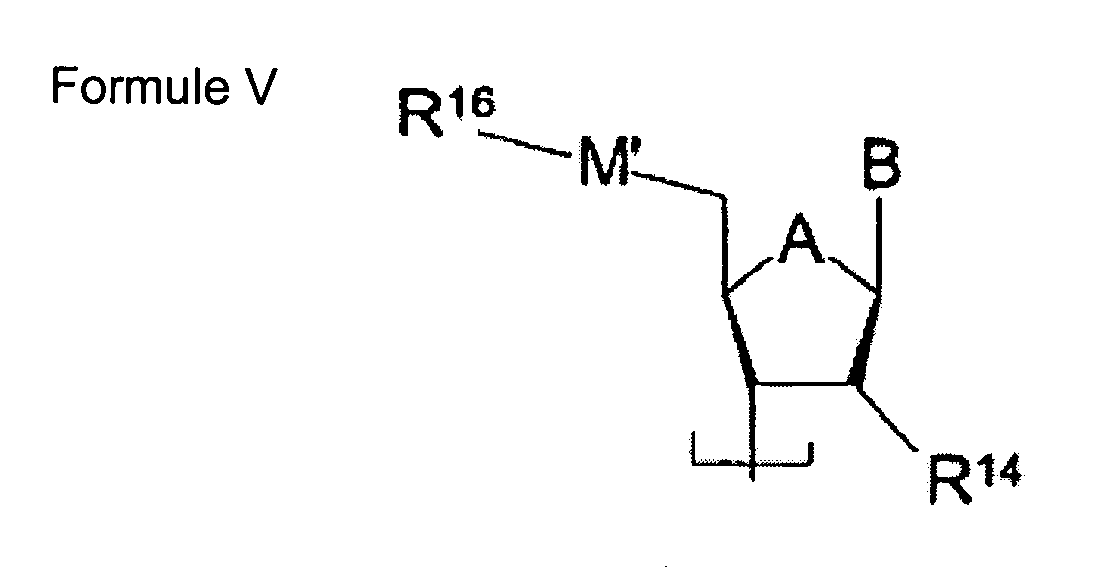 A est choisi dans le groupe constitué par O, S et N-(C1-C6)-alkyle,M' est choisi dans le groupe constitué par un groupe oxy, sulfanediyle, -NR22-, -(C1-C10)-alkyle, ou -O-(C1-C10)-alkyl-O-, et -S-(C1-C10)-alkyl-O- et -NR22-(C1-C6)-alkyl-O-,R22 est choisi dans le groupe comprenant -H, un groupe de protection, un groupe reporter et (C1-C10)-alkyle,R14 est choisi dans le groupe constitué par -H, -OH, -(C1-C10)-alcoxy, -(C2-C10)-alcényloxy, -(C2-C10)-alcynyloxy, -halogène, azido, -SH, -S-(C1-C6)-alkylmercapto et NH2,R16 est choisi dans le groupe constitué par -H, -(C1-C8)-alkyle, -(C2-C18)-alcényle, (C2-C18)-alcynyle, -(C2-C18)-alkyl-carbonyle, -(C3-C19)-alcényl-carbonyle, -(C3-C19)-alcynyl-carbonyle, -(C6-C14)-aryl-(C1-C8)-alkyle, un groupe de protection ou un composé de formule IVdans laquelle
 T est choisi dans le groupe constitué par un groupe oxo, thioxo et sélénoxo,U est choisi dans le groupe constitué par -OH, -SH, -SeH, -(C1-C10)-alcoxy, -(C1-C10)-alkyle, -(C6-C22)-aryle, -(C6-C14)-aryl-(C1-C10)-alkyle, -NR23R24, et -O-(C1-C10)-alkyl-O-(C1-C10)-alkyl-R25, où NR23R24 peut conjointement à N être un cycle hétérocyclique ayant 5 à 6 chaînons,R23 et R24 sont choisis indépendamment dans le groupe constitué par -(C1-C10)-alkyle, -(C1-C20)-aryle, -(C6-C14)-aryl-(C1-C10)-alkyle, -(C1-C6)-alkyl-[NH(CH2)c]d-NR26R27R25 est choisi dans le groupe constitué par -H, -OH, -halogène, -amino, -(C1-C18)-alkylamino, -COOH, -CONH2 et -COO(C1-C4)-alkyle,R26 et R27 sont choisis indépendamment dans le groupe constitué par -H, -(C1-C6)-alkyle et -(C1-C4)-alcoxy-(C1-C6)-alkyleR29 est choisi dans le groupe constitué par -OR30 et -SR30,R30 est choisi dans le groupe constitué par -H, -(C1-C10)-alkyle, -(C2-C10)-alcényle, -(C6-C22)-aryle, un groupe de protection, une phase solide et un groupe reporter,B est la liaison à un fragment de la formule I,dans laquelle tout alkyle, alcényle et alcynyle peut être substitué ou non substitué.
 - Composé selon la revendication 9, dans laquelle M' est O, R16 est H et R14 est choisi dans le groupe constitué par -H et -OH.
- Composé de la formule VII
 A est choisi dans le groupe constitué par O, S et N-(C1-C6)-alkyle,M et M' sont choisis indépendamment dans le groupe constitué par un groupe oxy, sulfanediyle, -NR22, -(C1-C10)-alkyle, ou -O-(C1-C10)-alkyl-O-, et -S-(C1-C10)-alkyl-O- et -NR22-(C1-C6)-alkyl-O-,R22 est choisi dans le groupe comprenant -H et -(C1-C10)-alkyle,R14 est choisi dans le groupe constitué par -H, -OR31, -(C1-C10)-alcoxy, -(C2-C10)-alcényloxy, (C2-C10)-alcynyloxy, - halogène, -azido N HR31, SR31 et NH2,R31 est un groupe de protection ou un groupe reporter,R32 et R17 sont indépendamment choisis dans le groupe constitué par -H, -(C1-C10)-alkyle, -(C2-C10)-alcényle et -(C6-C22)-aryle,R18 est choisi dans le groupe constitué par -(C1-C6)-alkyle substitué ou non substitué, -(C1-C6)-alcoxy non substitué ou -(C1-C6)-alcoxy substitué une ou plusieurs fois par un groupe choisi dans le groupe constitué par -halogène, p-nitroaryloxy et -cyano, etB est un groupe de formule Idans laquelle
 W est N,Z est choisi dans le groupe constitué par N et C à condition que- si Z est N, alorsX indépendamment de Y est choisi dans le groupe constitué par N et CR3, etY indépendamment de X est choisi dans le groupe constitué par N et CR4,et la liaison entre X et Y est une double liaison et la liaison entre Y et Z est une simple liaison, et- si Z est C, alorsdans laquelleX est NR33, etY est choisi dans le groupe constitué par N et CR4 etla liaison entre Z et Y est une double liaison et la liaison entre X et Y est une liaison simple,R1 est NR5R6,R3 et R4 sont indépendamment choisis dans le groupe constitué par -H, -halogène, -OR13, -SR19, -(C1-C10)-alkyle, -(C2-C10)-alcényle, -(C2-C10)-alcynyle, -NO2, -NR5R6, -cyano, et -C(=O)R11,R11 est choisi dans le groupe constitué par -OH, -(C1-C6)-alcoxy, -(C6-C22)-aryloxy, et NHR12,R5, R6, R12, R13, R19 et R33 sont choisis indépendamment dans le groupe constitué par -H, -(C1-C10)-alkyle, -(C2-C10)-alcényle, -(C2-C10)-alcynyle, -(C6-C22)-aryle, un groupe de protection et un groupe reporter,r et s sont indépendamment l'un de l'autre un entier de 1 à 18,D est la position d'attachement du groupe au reste du composé de liaison d'acide nucléique, etun alkyle, un alcényle et un alcynyle étant non substitués ou substitués par un ou plusieurs fragments choisis dans le groupe constitué par -halogène, -S-(C1-C6)-alkyle, -(C1-C6)-alcoxy, -NR5R6, -CO-R11, -NH-CO-NR5R6, -NH-CSNR5R6 et -[O-(CH2)t)s-NR5R6, à condition qu'au moins un de R5 et R6 de -NR5R6 soit un groupe de protection.
 - Composé selon la revendication 11, dans lequel ledit groupe de formule I comprend au moins un groupe reporter.
- Composé selon la revendication 11, dans lequel ledit groupe de formule I est choisi dans le groupe constitué par des groupes de formule I, où soit- W est N, Z est N, Y est N et X est CR3, soit- W est N, Z est C, Y est N et X est CR3, soit- W est N, Z est N, Y est N et X est N.
- Produit de liaison d'au moins un composé de liaison d'acide nucléique selon l'une quelconque des revendications 1 à 9 et d'un acide nucléique, le composé de liaison d'acide nucléique et l'acide nucléique étant liés entre eux par un appariement des bases selon une orientation parallèle ou anti-parallèle.
- Procédé pour la détermination d'un acide nucléique comprenant les étapes :- la fourniture d'un échantillon suspecté de contenir ledit acide nucléique,- la fourniture d'un composé de liaison d'acide nucléique selon la revendication 1, qui est essentiellement complémentaire à u ne partie ou à la totalité dudit acide nucléique,- la mise en contact dudit échantillon avec ledit composé de liaison d'acide nucléique dans des conditions permettant de lier ledit composé de liaison d'acide nucléique audit acide nucléique,- la détermination du produit de liaison formé à partir dudit acide nucléique et dudit composé de liaison d'acide nucléique en tant que mesure de la présence dudit acide nucléique.
- Procédé selon la revendication 15, dans lequel un quelconque groupe de formule I dans ledit composé de liaison d'acide nucléique selon la revendication 1 est situé dans ledit composé de façon à s'apparier à un fragment G dans ledit acide nucléique.
- Utilisation d'une 2-azapurine de formule I selon la revendication 1, dans un composé de liaison d'acide nucléique en tant que produit de remplacement de la cytosine.
- Utilisation d'une 2-azapurine de formule I selon la revendication 1, dans des réactions d'hybridation de sondes avec des acides nucléiques en tant que base à une position la sonde s'appariant avec G dans l'acide nucléique.
- Procédé pour la synthèse chimique d'un composé selon l'une quelconque des revendications 1 à 10 utilisant des sous-unités activées, dans lequel ladite sous-unité contient au moins un groupe de formule I.
- Procédé selon la revendication 19, dans lequel au moins une sous-unité est un composé selon l'une quelconque des revendications 11 à 13.
- Procédé pour la synthèse enzymatique d'un composé selon l'une quelconque des revendications 1 à 10, comprenant la réaction d'une sous-unité triphosphate avec une amorce en utilisant un acide nucléique comme modèle pour l'élongation de l'amorce, dans lequel la sous-unité triphosphate contient un groupe hétérocyclique de formule I.
- Procédé selon la revendication 21, dans lequel ladite sous-unité triphosphate a la formule VIII
 PPP est un groupe triphosphate,R14 est choisi dans le groupe constitué par -H, -OH, -(C1-C10)-alcoxy, -(C2-C10)-alcényloxy, -(C2-C10)-alcynyloxy halogène, -azido et NH2, etB est un groupe de formule I, dans laquelle W est N, et dans laquelle R1 est NR5R6, où R5 et R6 sont des fragments tels que définis dans la revendication 1.
 - Procédé de détermination de la présence ou de l'absence d'acides nucléiques chacun comprenant une séquence particulière dans un échantillon comprenant les étapes :- la mise en contact dudit échantillon avec une phase solide à la surface de laquelle sont immobilisés des composés de liaison d'acide nucléique contenant chacun une séquence complémentaire à l'une des dites séquences particulières desdits acides nucléiques,- la détermination sur ladite phase solide de la formation d'hybrides contenant un acide nucléique avec une séquence particulière et le composé de liaison d'acide nucléique contenant la séquence complémentairecaractérisé en ce que ledit au moins un desdits composés de liaison d'acide nucléique est un composé selon l'une quelconque des revendications 1 à 10.
- Procédé de détermination de la présence, de l'absence ou d'une quantité d'un acide nucléique dans un échantillon comprenant les étapes :- la fourniture d'amorces, une première amorce étant essentiellement complémentaire à une première séquence de liaison dudit acide nucléique, et la deuxième amorce étant essentiellement complémentaire à une séquence de liaison d'un complément de cet acide nucléique, et une sonde étant complémentaire à l'acide nucléique ou le complément de celui-ci entre les séquences de liaison desdites amorces, ladite sonde étant marquée au niveau de différentes sous-unités par au moins deux groupes reporters différents,- la soumission de l'échantillon avec lesdites amorces et ladite sonde dans des conditions favorisant l'extension desdites amorces et la séparation desdits groupes reporters les uns des autres en désintégrant la sonde, et- la détermination de l'étendue de la désintégration de la sonde par le biais d'au moins un desdits groupes reporters,caractérisé en ce qu'au moins une de ladite amorce ou/et sonde sont un composé de liaison d'acide nucléique selon l'une quelconque des revendications 1 à 10.
- Composé de la formule générale VIII
 PPP est un groupe triphosphate,R14 est choisi dans le groupe constitué par -H, -OH, -(C1-C10)-alcoxy, -(C2-C10)-alcényloxy, -(C2-C10)-alcynyloxy halogène, -azido et NH2, etB est un groupe de formule I, dans laquelle W est N, et dans laquelle R1 est NR5R6,où R5 et R6 sont des fragments tels que définis dans la revendication 1.
 - Composé selon la revendication 25, dans lequel -M-R16 est un groupe triphosphate et -M-R15 est -OH.
- Composé selon la revendication 26, dans lequel R14 est -OH.
- Composé selon la revendication 25, dans lequel R14 est -H et R1 n'est pas OH.
- Composé de formule générale IX
 A est choisi dans le groupe constitué par O, S et N-(C1-C6)-alkyle,M et M' sont choisis indépendamment dans le groupe constitué par un groupe oxy, sulfanediyle, -NR22, -(C1-C10)-alkyle, ou -O-(C1-C10)-alkyl-O-, et -S-(C1-C10)-alkyl-O- et -NR22-(C1-C6)-alkyl-O-,R22 est choisi dans le groupe comprenant -H et -(C1-C10)-alkyle,R14 est choisi dans le groupe constitué par -H, -OR31, -(C1-C10)-alcoxy, -(C2-C10)-alcényloxy, -(C2-C10)-alcynyloxy, -halogène, -azido NHR31, SR31 et -NH2,R31 est un groupe de protection ou un groupe reporter,R32 et R17 sont choisis indépendamment dans le groupe constitué par -H, -(C1-C10)-alkyle, -(C2-C10)-alcényle et -(C6-C22)-aryle,R18 est choisi dans le groupe constitué par -(C1-C6)-alkyle substitué ou non substitué, -(C1-C6)-alcoxy non substitué ou -(C1-C6)-alcoxy substitué une ou plusieurs fois par un groupe choisi dans le groupe constitué par -halogène, p-nitroaryloxy et -cyano, etB est un groupe de la formule Idans laquelle
 W est N,Z est choisi dans le groupe constitué par N et C à condition que- si Z est N, alorsX indépendamment de Y est choisi dans le groupe constitué par N et CR3, etY indépendamment de X est choisi dans le groupe constitué par N et CR4,et la liaison entre X et Y est une double liaison et la liaison entre Y et Z est une simple liaison, et- si Z est C, alorsun alkyle, un alcényle et un alcynyle étant non substitués ou substitués par un ou plusieurs fragments choisis dans le groupe constitué par -halogène, -S-(C1-C6)-alkyle, -(C1-C6)-alcoxy, -NR5R6; -COR11, -NH-CONR5R6, -NH-CSNR5R6 et - [O-(CH2)r]s-NR5R6, à condition qu'au moins un de R5 et R6 de -NR5R6 soit un groupe de protection.X est NR33, etY est choisi dans le groupe constitué par N et CR4 et la liaison entre Z et Y est une double liaison et la liaison entre X et Y est une simple liaison,dans laquelleR1 est NR5R6,R3 et R4 sont choisis indépendamment dans le groupe constitué par -H, -halogène, -OR13, -SR19, -(C1-C10)-alkyle, -(C2-C10)-alcényle, -(C2-C10)-alcynyle, -NO2, -NR5R6, -cyano, et -C(=O)R11,R11 est choisi dans le groupe constitué par -OH, -(C1-C6)-alcoxy, -(C6-C22)-aryloxy, et NHR12,R5, R6, R12, R13 , R19 et R33 sont choisis indépendamment dans le groupe constitué par -H, -(C1-C10)-alkyle, -(C2-C10)-alcényle, -(C2-C10)-alcynyle, -(C6-C22)-aryle, un groupe de protection et un groupe reporter,r et s sont indépendamment l'un de l'autre un entier de 1 à 18,D est la position d'attachement du groupe au reste du composé de liaison d'acide nucléique, et
Priority Applications (1)
| Application Number | Priority Date | Filing Date | Title |
|---|---|---|---|
| EP00960534A EP1214331B1 (fr) | 1999-08-30 | 2000-08-28 | Composes de 2-azapurines et leur utilisation |
Applications Claiming Priority (4)
| Application Number | Priority Date | Filing Date | Title |
|---|---|---|---|
| EP99116767 | 1999-08-30 | ||
| EP99116767 | 1999-08-30 | ||
| PCT/EP2000/008371 WO2001016149A2 (fr) | 1999-08-30 | 2000-08-28 | Composes de 2-azapurines et leur utilisation |
| EP00960534A EP1214331B1 (fr) | 1999-08-30 | 2000-08-28 | Composes de 2-azapurines et leur utilisation |
Publications (2)
| Publication Number | Publication Date |
|---|---|
| EP1214331A2 EP1214331A2 (fr) | 2002-06-19 |
| EP1214331B1 true EP1214331B1 (fr) | 2006-10-11 |
Family
ID=8238861
Family Applications (1)
| Application Number | Title | Priority Date | Filing Date |
|---|---|---|---|
| EP00960534A Expired - Lifetime EP1214331B1 (fr) | 1999-08-30 | 2000-08-28 | Composes de 2-azapurines et leur utilisation |
Country Status (8)
| Country | Link |
|---|---|
| US (3) | US7169553B1 (fr) |
| EP (1) | EP1214331B1 (fr) |
| JP (1) | JP4202646B2 (fr) |
| AT (1) | ATE342271T1 (fr) |
| CA (1) | CA2384407C (fr) |
| DE (1) | DE60031282T2 (fr) |
| ES (1) | ES2272322T3 (fr) |
| WO (1) | WO2001016149A2 (fr) |
Families Citing this family (16)
| Publication number | Priority date | Publication date | Assignee | Title |
|---|---|---|---|---|
| WO2001016149A2 (fr) | 1999-08-30 | 2001-03-08 | Roche Diagnostics Gmbh | Composes de 2-azapurines et leur utilisation |
| EP1706826A4 (fr) | 2002-01-25 | 2008-01-30 | Applera Corp | Procedes permettant de placer, d'accepter et de classer des commandes relatives a des produits et des services |
| WO2004007713A1 (fr) * | 2002-07-17 | 2004-01-22 | Riken | Nucleoside ou nucleotide ayant une nouvelle base non naturelle et son utilisation |
| US20050075309A1 (en) | 2003-07-25 | 2005-04-07 | Richard Storer | Purine nucleoside analogues for treating Flaviviridae including hepatitis C |
| US9677123B2 (en) | 2006-03-15 | 2017-06-13 | Siemens Healthcare Diagnostics Inc. | Degenerate nucleobase analogs |
| EP2097436B1 (fr) | 2006-12-26 | 2012-02-01 | Siemens Healthcare Diagnostics Inc. | Doubles hélices de polynucléotides hétérogènes à appariement de formant une paire de bases de purine-purine |
| EP2432796B1 (fr) | 2009-05-21 | 2016-08-17 | Siemens Healthcare Diagnostics Inc. | Tags universelles dotées de nucléobases non-naturelles |
| WO2014015098A1 (fr) | 2012-07-18 | 2014-01-23 | Siemens Healthcare Diagnostics Inc. | Procédé de normalisation d'échantillons biologiques |
| WO2014048969A1 (fr) * | 2012-09-28 | 2014-04-03 | Ionovation Gmbh | Blocs de construction nucléosidiques réactifs, lipophiles, pour la synthèse d'acides nucléiques hydrophobes |
| BR112015022505A2 (pt) | 2013-03-14 | 2017-10-24 | Shire Human Genetic Therapies | avaliação quantitativa para eficiência do cap de rna mensageiro |
| ES2708562T3 (es) | 2013-03-14 | 2019-04-10 | Translate Bio Inc | Evaluación cuantitativa de la eficacidad de tapa de ARN mensajero |
| CA3033867A1 (fr) | 2016-08-17 | 2018-02-22 | Solstice Biologics, Ltd. | Constructions polynucleotidiques |
| US11597744B2 (en) | 2017-06-30 | 2023-03-07 | Sirius Therapeutics, Inc. | Chiral phosphoramidite auxiliaries and methods of their use |
| KR20240017865A (ko) | 2021-06-04 | 2024-02-08 | 트랜슬레이트 바이오 인코포레이티드 | Mrna 캡핑 효율의 정량적 평가를 위한 분석 |
| JP2025539043A (ja) | 2022-11-14 | 2025-12-03 | バイオンテック・エスイー | Rnaキャッピング効率アッセイ |
| AU2024304484A1 (en) | 2023-06-14 | 2026-02-05 | Sanofi Pasteur Inc. | Methods of simultaneously identifying or quantifying capping and tailing modifications of messenger rna |
Family Cites Families (11)
| Publication number | Priority date | Publication date | Assignee | Title |
|---|---|---|---|---|
| US4458066A (en) | 1980-02-29 | 1984-07-03 | University Patents, Inc. | Process for preparing polynucleotides |
| US4683202A (en) | 1985-03-28 | 1987-07-28 | Cetus Corporation | Process for amplifying nucleic acid sequences |
| DE3739366A1 (de) | 1987-04-10 | 1988-10-27 | Boehringer Mannheim Gmbh | Desaza-purin-nucleosid-derivate, verfahren zu deren herstellung sowie deren verwendung bei der nucleinsaeure-sequenzierung sowie als antivirale mittel |
| DE3813278A1 (de) | 1988-01-12 | 1989-07-20 | Boehringer Mannheim Gmbh | Verfahren zum nachweis von nukleinsaeuren |
| US5143854A (en) | 1989-06-07 | 1992-09-01 | Affymax Technologies N.V. | Large scale photolithographic solid phase synthesis of polypeptides and receptor binding screening thereof |
| DE3943522A1 (de) | 1989-07-26 | 1991-02-07 | Boehringer Mannheim Gmbh | Heterobifunktionelle verbindungen |
| US5210015A (en) | 1990-08-06 | 1993-05-11 | Hoffman-La Roche Inc. | Homogeneous assay system using the nuclease activity of a nucleic acid polymerase |
| DK51092D0 (da) | 1991-05-24 | 1992-04-15 | Ole Buchardt | Oligonucleotid-analoge betegnet pna, monomere synthoner og fremgangsmaade til fremstilling deraf samt anvendelser deraf |
| DE4140463A1 (de) | 1991-12-09 | 1993-06-17 | Boehringer Mannheim Gmbh | 2'-desoxy-isoguanosin, dessen isostere analoge sowie anwendung derselben |
| DE4415370A1 (de) | 1994-05-02 | 1995-11-09 | Hoechst Ag | Modifizierte Oligonukleotide, deren Herstellung sowie deren Verwendung |
| WO2001016149A2 (fr) | 1999-08-30 | 2001-03-08 | Roche Diagnostics Gmbh | Composes de 2-azapurines et leur utilisation |
-
2000
- 2000-08-28 WO PCT/EP2000/008371 patent/WO2001016149A2/fr not_active Ceased
- 2000-08-28 EP EP00960534A patent/EP1214331B1/fr not_active Expired - Lifetime
- 2000-08-28 ES ES00960534T patent/ES2272322T3/es not_active Expired - Lifetime
- 2000-08-28 US US10/070,340 patent/US7169553B1/en not_active Expired - Lifetime
- 2000-08-28 JP JP2001519712A patent/JP4202646B2/ja not_active Expired - Lifetime
- 2000-08-28 CA CA002384407A patent/CA2384407C/fr not_active Expired - Lifetime
- 2000-08-28 AT AT00960534T patent/ATE342271T1/de active
- 2000-08-28 DE DE60031282T patent/DE60031282T2/de not_active Expired - Lifetime
-
2006
- 2006-05-25 US US11/441,755 patent/US7612187B2/en not_active Expired - Fee Related
-
2009
- 2009-08-13 US US12/540,660 patent/US7847075B2/en not_active Expired - Fee Related
Also Published As
| Publication number | Publication date |
|---|---|
| ES2272322T3 (es) | 2007-05-01 |
| JP2003508405A (ja) | 2003-03-04 |
| US7169553B1 (en) | 2007-01-30 |
| CA2384407A1 (fr) | 2001-03-08 |
| US7847075B2 (en) | 2010-12-07 |
| ATE342271T1 (de) | 2006-11-15 |
| JP4202646B2 (ja) | 2008-12-24 |
| US7612187B2 (en) | 2009-11-03 |
| DE60031282T2 (de) | 2007-05-03 |
| US20090306360A1 (en) | 2009-12-10 |
| WO2001016149A2 (fr) | 2001-03-08 |
| DE60031282D1 (de) | 2006-11-23 |
| EP1214331A2 (fr) | 2002-06-19 |
| WO2001016149A3 (fr) | 2001-08-02 |
| CA2384407C (fr) | 2009-10-20 |
| US20070015725A1 (en) | 2007-01-18 |
Similar Documents
| Publication | Publication Date | Title |
|---|---|---|
| US7847075B2 (en) | 2-Azapurine compounds and their use | |
| EP1307469B1 (fr) | Composes de fixation d'acides nucleiques contenant des analogues pyrazolo¬3,4-d pyrimidine de purine 2,6-diamine et leurs utilisations | |
| CA2459347C (fr) | Compositions d'acides nucleiques bloques et leurs utilisations | |
| US6066720A (en) | Modified oligonucleotides, their preparation and their use | |
| JP5342881B2 (ja) | 6−修飾された二環式核酸類似体 | |
| JP5231032B2 (ja) | オリゴヌクレオチド・ハイブリダイゼーションにユニバーサル・ヌクレオシドとして使用されるn8−及びc8−連結プリン塩基、並びに構造的に関連したヘテロ環 | |
| WO2003039523A2 (fr) | Oligonucleotides modifies a l'aide de nouveaux analogues d'arn-l-alpha | |
| IL185569A (en) | Cyclic acid and analogues of nucleotide nucleotides and oligonucleotides | |
| JPH0813274B2 (ja) | 遺伝子発現を検出及び変調する糖修飾されたオリゴヌクレオチド | |
| Sørensen et al. | Functionalized LNA (locked nucleic acid): high-affinity hybridization of oligonucleotides containing N-acylated and N-alkylated 2′-amino-LNA monomers | |
| US20050004078A1 (en) | Nucleotide analogs with six-membered rings | |
| JP3119871B2 (ja) | オリゴデオキシリボヌクレオチド類 | |
| EP1138688A1 (fr) | Bases puriniques liées en position N8- ou C8- comme nucléosides universelles utilisées pour hybridization avec oligonucléotides | |
| CA2569615A1 (fr) | Composes de fixation d'acides nucleiques contenant des analogues pyrazolo[3,4-d]pyrimidine de purine 2,6-diamine et leurs utilisations |
Legal Events
| Date | Code | Title | Description |
|---|---|---|---|
| PUAI | Public reference made under article 153(3) epc to a published international application that has entered the european phase |
Free format text: ORIGINAL CODE: 0009012 |
|
| 17P | Request for examination filed |
Effective date: 20020402 |
|
| AK | Designated contracting states |
Kind code of ref document: A2 Designated state(s): AT BE CH CY DE DK ES FI FR GB GR IE IT LI LU MC NL PT SE |
|
| 17Q | First examination report despatched |
Effective date: 20020805 |
|
| GRAP | Despatch of communication of intention to grant a patent |
Free format text: ORIGINAL CODE: EPIDOSNIGR1 |
|
| GRAS | Grant fee paid |
Free format text: ORIGINAL CODE: EPIDOSNIGR3 |
|
| GRAA | (expected) grant |
Free format text: ORIGINAL CODE: 0009210 |
|
| AK | Designated contracting states |
Kind code of ref document: B1 Designated state(s): AT BE CH CY DE DK ES FI FR GB GR IE IT LI LU MC NL PT SE |
|
| PG25 | Lapsed in a contracting state [announced via postgrant information from national office to epo] |
Ref country code: FI Free format text: LAPSE BECAUSE OF FAILURE TO SUBMIT A TRANSLATION OF THE DESCRIPTION OR TO PAY THE FEE WITHIN THE PRESCRIBED TIME-LIMIT Effective date: 20061011 Ref country code: BE Free format text: LAPSE BECAUSE OF FAILURE TO SUBMIT A TRANSLATION OF THE DESCRIPTION OR TO PAY THE FEE WITHIN THE PRESCRIBED TIME-LIMIT Effective date: 20061011 Ref country code: NL Free format text: LAPSE BECAUSE OF FAILURE TO SUBMIT A TRANSLATION OF THE DESCRIPTION OR TO PAY THE FEE WITHIN THE PRESCRIBED TIME-LIMIT Effective date: 20061011 |
|
| REG | Reference to a national code |
Ref country code: GB Ref legal event code: FG4D |
|
| REG | Reference to a national code |
Ref country code: CH Ref legal event code: EP |
|
| REG | Reference to a national code |
Ref country code: IE Ref legal event code: FG4D |
|
| REF | Corresponds to: |
Ref document number: 60031282 Country of ref document: DE Date of ref document: 20061123 Kind code of ref document: P |
|
| PG25 | Lapsed in a contracting state [announced via postgrant information from national office to epo] |
Ref country code: SE Free format text: LAPSE BECAUSE OF FAILURE TO SUBMIT A TRANSLATION OF THE DESCRIPTION OR TO PAY THE FEE WITHIN THE PRESCRIBED TIME-LIMIT Effective date: 20070111 Ref country code: DK Free format text: LAPSE BECAUSE OF FAILURE TO SUBMIT A TRANSLATION OF THE DESCRIPTION OR TO PAY THE FEE WITHIN THE PRESCRIBED TIME-LIMIT Effective date: 20070111 |
|
| REG | Reference to a national code |
Ref country code: CH Ref legal event code: NV Representative=s name: F. HOFFMANN-LA ROCHE AG |
|
| PG25 | Lapsed in a contracting state [announced via postgrant information from national office to epo] |
Ref country code: PT Free format text: LAPSE BECAUSE OF FAILURE TO SUBMIT A TRANSLATION OF THE DESCRIPTION OR TO PAY THE FEE WITHIN THE PRESCRIBED TIME-LIMIT Effective date: 20070319 |
|
| NLV1 | Nl: lapsed or annulled due to failure to fulfill the requirements of art. 29p and 29m of the patents act | ||
| ET | Fr: translation filed | ||
| REG | Reference to a national code |
Ref country code: ES Ref legal event code: FG2A Ref document number: 2272322 Country of ref document: ES Kind code of ref document: T3 |
|
| PLBE | No opposition filed within time limit |
Free format text: ORIGINAL CODE: 0009261 |
|
| STAA | Information on the status of an ep patent application or granted ep patent |
Free format text: STATUS: NO OPPOSITION FILED WITHIN TIME LIMIT |
|
| 26N | No opposition filed |
Effective date: 20070712 |
|
| PG25 | Lapsed in a contracting state [announced via postgrant information from national office to epo] |
Ref country code: MC Free format text: LAPSE BECAUSE OF NON-PAYMENT OF DUE FEES Effective date: 20070831 Ref country code: GR Free format text: LAPSE BECAUSE OF FAILURE TO SUBMIT A TRANSLATION OF THE DESCRIPTION OR TO PAY THE FEE WITHIN THE PRESCRIBED TIME-LIMIT Effective date: 20070112 |
|
| PG25 | Lapsed in a contracting state [announced via postgrant information from national office to epo] |
Ref country code: IE Free format text: LAPSE BECAUSE OF NON-PAYMENT OF DUE FEES Effective date: 20070828 |
|
| PG25 | Lapsed in a contracting state [announced via postgrant information from national office to epo] |
Ref country code: CY Free format text: LAPSE BECAUSE OF FAILURE TO SUBMIT A TRANSLATION OF THE DESCRIPTION OR TO PAY THE FEE WITHIN THE PRESCRIBED TIME-LIMIT Effective date: 20061011 Ref country code: LU Free format text: LAPSE BECAUSE OF NON-PAYMENT OF DUE FEES Effective date: 20070828 |
|
| REG | Reference to a national code |
Ref country code: FR Ref legal event code: PLFP Year of fee payment: 17 |
|
| REG | Reference to a national code |
Ref country code: FR Ref legal event code: PLFP Year of fee payment: 18 |
|
| REG | Reference to a national code |
Ref country code: FR Ref legal event code: PLFP Year of fee payment: 19 |
|
| PGFP | Annual fee paid to national office [announced via postgrant information from national office to epo] |
Ref country code: DE Payment date: 20190715 Year of fee payment: 20 Ref country code: ES Payment date: 20190902 Year of fee payment: 20 Ref country code: FR Payment date: 20190717 Year of fee payment: 20 Ref country code: IT Payment date: 20190823 Year of fee payment: 20 |
|
| PGFP | Annual fee paid to national office [announced via postgrant information from national office to epo] |
Ref country code: GB Payment date: 20190728 Year of fee payment: 20 Ref country code: AT Payment date: 20190726 Year of fee payment: 20 |
|
| PGFP | Annual fee paid to national office [announced via postgrant information from national office to epo] |
Ref country code: CH Payment date: 20190725 Year of fee payment: 20 |
|
| REG | Reference to a national code |
Ref country code: DE Ref legal event code: R071 Ref document number: 60031282 Country of ref document: DE |
|
| REG | Reference to a national code |
Ref country code: CH Ref legal event code: PL |
|
| REG | Reference to a national code |
Ref country code: GB Ref legal event code: PE20 Expiry date: 20200827 |
|
| REG | Reference to a national code |
Ref country code: AT Ref legal event code: MK07 Ref document number: 342271 Country of ref document: AT Kind code of ref document: T Effective date: 20200828 |
|
| PG25 | Lapsed in a contracting state [announced via postgrant information from national office to epo] |
Ref country code: GB Free format text: LAPSE BECAUSE OF EXPIRATION OF PROTECTION Effective date: 20200827 |
|
| REG | Reference to a national code |
Ref country code: ES Ref legal event code: FD2A Effective date: 20201204 |
|
| PG25 | Lapsed in a contracting state [announced via postgrant information from national office to epo] |
Ref country code: ES Free format text: LAPSE BECAUSE OF EXPIRATION OF PROTECTION Effective date: 20200829 |