EP1214922A2 - Absorbierender Artikel mit einer Deckschicht aus Endlosfäden - Google Patents
Absorbierender Artikel mit einer Deckschicht aus Endlosfäden Download PDFInfo
- Publication number
- EP1214922A2 EP1214922A2 EP01310339A EP01310339A EP1214922A2 EP 1214922 A2 EP1214922 A2 EP 1214922A2 EP 01310339 A EP01310339 A EP 01310339A EP 01310339 A EP01310339 A EP 01310339A EP 1214922 A2 EP1214922 A2 EP 1214922A2
- Authority
- EP
- European Patent Office
- Prior art keywords
- continuous filaments
- surface member
- absorbent article
- portions
- liquid
- Prior art date
- Legal status (The legal status is an assumption and is not a legal conclusion. Google has not performed a legal analysis and makes no representation as to the accuracy of the status listed.)
- Granted
Links
Images

Classifications
-
- A—HUMAN NECESSITIES
- A61—MEDICAL OR VETERINARY SCIENCE; HYGIENE
- A61F—FILTERS IMPLANTABLE INTO BLOOD VESSELS; PROSTHESES; DEVICES PROVIDING PATENCY TO, OR PREVENTING COLLAPSING OF, TUBULAR STRUCTURES OF THE BODY, e.g. STENTS; ORTHOPAEDIC, NURSING OR CONTRACEPTIVE DEVICES; FOMENTATION; TREATMENT OR PROTECTION OF EYES OR EARS; BANDAGES, DRESSINGS OR ABSORBENT PADS; FIRST-AID KITS
- A61F13/00—Bandages or dressings; Absorbent pads
- A61F13/15—Absorbent pads, e.g. sanitary towels, swabs or tampons for external or internal application to the body; Supporting or fastening means therefor; Tampon applicators
- A61F13/51—Absorbent pads, e.g. sanitary towels, swabs or tampons for external or internal application to the body; Supporting or fastening means therefor; Tampon applicators characterised by the outer layers of the pads
- A61F13/511—Topsheet, i.e. the permeable cover or layer facing the skin
- A61F13/513—Topsheet, i.e. the permeable cover or layer facing the skin characterised by its function or properties, e.g. stretchability, breathability, rewet, visual effect; having areas of different permeability
- A61F13/51305—Topsheet, i.e. the permeable cover or layer facing the skin characterised by its function or properties, e.g. stretchability, breathability, rewet, visual effect; having areas of different permeability having areas of different permeability
Definitions
- the present invention relates to an absorbent article such as sanitary napkin, disposable diaper, incontinence pad, or the like, which is provided with a surface member excellent in moisture-absorbency and liquid-permeability.
- Absorbent articles such as sanitary napkin, disposable diaper, or the like are typically constructed to include: a liquid-impermeable backsheet on its garment-facing side, a liquid-permeable surface member on its wearer-facing side, and an absorbent core disposed between the backsheet and the surface member.
- Characteristics required for the surface member of the absorbent article are as follows:
- Japanese Unexamined Patent Publication Nos. 1998-219568 and 1994-218007 disclose absorbent articles having surface members in which both liquid-permeability and moisture-absorbency are improved.
- water-absorbency or moisture-absorbency is improved by adhering hydrophilic powder to the surface of a nonwoven fabric treated to be water repellent.
- moisture-absorbency is improved by fixing a moisture-absorbent material to an absorbent article or by mixing a moisture-absorbent material in a surface member.
- the hydrophilic powder disclosed in Japanese Unexamined Patent Publication No. 1998-219568 is apt to drop off from the surface of the nonwoven fabric, so that there is a difficulty in maintaining absorbency.
- powder material and powder coating are required, production cost becomes relatively expensive.
- the moisture-absorbent material disclosed in Japanese Unexamined Patent Publication No. 1994-218007 which is aimed solely at absorbing moisture, has difficulties in fixing it inside of the absorbent article.
- the absorbent article is liable to give wet feel to the wearer's skin as a whole. This is because moisture-absorbing capacity is decreased in the surface member as located farther from the moisture-absorbent material, although moisture-absorbency is improved in the vicinity of the moisture-absorbent material.
- fixing of the moisture-absorbent material is typically carried out by hydroentangling method. Therefore, a hydrophilic agent applied to the synthetic resin flows out due to water flow, thereby lowering the water-absorbing capacity.
- the present invention has been worked out in view of the shortcoming in the prior art set forth above. It is therefore an object of the present invention to provide an absorbent article with a surface member excellent in both liquid-permeability and moisture-absorbency.
- an absorbent article comprising a liquid-permeable surface member, a backsheet and an absorbent core positioned between the surface member and the backsheet, the surface member being a sheet comprising: first continuous filaments made of hydrophobic synthetic resin and individually extending over the entire length of the surface member; and second continuous filaments made of cellulose acetate and individually extending over the entire length of the surface member.
- the first continuous filaments of hydrophobic synthetic resin allow a liquid to pass through the surface member and also exhibit a function to prevent flow back of the liquid from the absorbent core to the surface of the surface member.
- the second continuous filaments of cellulose acetate can effectively absorb moisture. Therefore, the surface of the absorbent article is always kept dry, and hardly gives stuffy feel to a wearer.
- the surface member has excellent cushioning properties because it is formed from the continuous filaments, providing softness when in contact with the wearer's skin. Accordingly, the absorbent article of the present invention prevents skin roughness of a wearer.
- the first continuous filaments are treated to be hydrophilic, and hydrophilicity of the second continuous filaments is higher than hydrophilicity of the first continuous filaments.
- the surface member comprises: first portions formed from the first continuous filaments; and second portions formed from the second continuous filaments, the first portions alternating with the second portions.
- the first continuous filaments and the second continuous filaments are mixed with each other in the surface member.
- the surface member may further comprise a liquid-permeable substrate sheet underlying the first and second continuous filaments, and the first and second continuous filaments may be at least partly fixed to the substrate sheet. Alternatively, the first and second continuous filaments may be at least partly fixed to each other.
- the surface member of the present invention can be readily manufactured by fixing the first and second continuous filaments into the form of sheet.
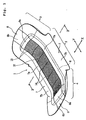
- Fig. 1 is a perspective view showing an absorbent article 1 according to a first embodiment of the invention
- Fig. 2 is a cross-sectional view taken along line II-II of Fig. 1
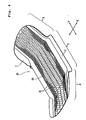
- Fig. 3 is a perspective view showing a surface member employed for the absorbent article 1 according to the first embodiment.
- the absorbent article 1 shown in Fig. 1 is a sanitary napkin, in which X-direction indicates a width direction (lateral direction) of the article 1, and Y-direction indicates a longitudinal direction of the article 1.
- the absorbent article 1 has an intermediate portion 2 between a front portion 3 and a rear portion 4.
- the absorbent article 1 is constructed to mainly include: a liquid-impermeable backsheet 5; an absorbent core (absorbent layer) 8 laid on the backsheet 5; and a liquid-permeable and moisture-absorbent surface member 10 laid on the absorbent core 8.
- a liquid-impermeable backsheet 5 As shown in the cross-sectional view of Fig. 2, the absorbent article 1 is constructed to mainly include: a liquid-impermeable backsheet 5; an absorbent core (absorbent layer) 8 laid on the backsheet 5; and a liquid-permeable and moisture-absorbent surface member 10 laid on the absorbent core 8.
- the absorbent article 1 is also provided with liquid-impermeable side sheets 7 covering the left and right side portions thereof and liquid-impermeable end sheets 6 covering the front and rear end portions thereof.
- the side sheets 7 are bonded at the portions 7a to the surface of the left and right side portions of the surface member 10; and are bonded at the remaining portions 7b to the surface of the backsheet 5, in both left and right flap portions.
- the end sheets 6 are bonded at the portions 6a to the surface of the surface member 10; and are bonded at the remaining portions 6b to the surface of the backsheet 5, in both front and rear flap portions.
- the absorbent core 8 is disposed to extend over the intermediate portion 2 and parts of the front and rear portions 3 and 4 of the absorbent article 1.
- the backsheet 5 is bonded with a hot melt adhesive or fusion-bonded with heat embossing to the portions 7b of the side sheets 7 and the portions 6b of the end sheets 6.
- the liquid-impermeable backsheet 5 is formed from a moisture-permeable resin film, a nonwoven fabric or a laminate of a resin film and a nonwoven fabric.
- the absorbent core 8 is formed from a mixture of crushed pulp and SAP (superabsorbent polymer) wrapped in liquid permeable paper, air laid pulp formed into a sheet form by binder process, absorbent paper, a nonwoven fabric comprising mainly hydrophilic fibers, or the like.
- the side sheets 7 and the end sheets 6 are formed from a nonwoven fabric, such as through-air bonded nonwoven fabric, point bonded nonwoven fabric, spunbonded nonwoven fabric, spunlaced nonwoven fabric, meltblown nonwoven fabric or air-laid nonwoven fabric, and are preferably hydrophobic or water-repellent.
- a nonwoven fabric such as through-air bonded nonwoven fabric, point bonded nonwoven fabric, spunbonded nonwoven fabric, spunlaced nonwoven fabric, meltblown nonwoven fabric or air-laid nonwoven fabric, and are preferably hydrophobic or water-repellent.
- the surface member 10 comprises a continuous filament layer 13 and a liquid-permeable substrate sheet underlying the continuous filament layer 13.
- the substrate sheet 12 is formed from a resin film of the polyolefin family, which is formed with apertures or cuts for passage of liquid.
- the substrate sheet 12 may be formed from a nonwoven fabric made of hydrophilic fibers only or made of hydrophilic fibers in combination with hydrophobic fibers.
- the nonwoven fabric is formed with a large number of apertures.
- the continuous filament layer 13 comprises first portions 13a and second portions 13b, which are combined to alternate with each other in the width direction (X-direction) of the absorbent article 1.
- Each first portion 13a has a predetermined width and is formed from first continuous filaments which are made of hydrophobic synthetic resin and individually extend over the entire length of the layer 13 without interruption.
- each second portion 13b has a predetermined width but is formed from second continuous filaments which are made of cellulose acetate and individually extend over the entire length of the layer 13 without interruption.
- Weight ratio of the first continuous filaments forming the first portions 13a to the second continuous filaments forming the second portions 13b may be appropriately selected in a range of from 1:9 to 9:1.
- the first and second continuous filaments are first prepared in the form of tow, respectively, in which continuous filaments are bundled in a crimped condition. Then, the tow of first continuous filaments and the tow of second continuous filaments are opened to form the first portions 13a and the second portions 13b, respectively.
- the first continuous filaments forming the first portions 13a are made of heat-fusible hydrophobic synthetic resin.
- the first continuous filament include: monocomponent fibers such as those of PE (polyethylene), PP (polypropylene) or PET (polyethylene terephthalate); sheath/core structure bicomponent fibers such as those of PE/PET or PE/PP; and side-by-side structure bicomponent fibers such as those of PE/PET or PE/PP.
- the first continuous filaments are treated to be hydrophilic for use by applying a hydrophilic agent to their surfaces.
- the first continuous filaments may be made hydrophilic by blending a hydrophilic agent with the resin.
- the second continuous filaments forming the second portions 13b are regenerated cellulose fibers made of cellulose acetate such as di- or tricellulose acetate.
- the second continuous filaments are prepared by extruding heated spinning solution through a series of small diameter nozzles into a hot air.
- Both the first and second continuous filaments may contain 0.5 to 10 % by weight of inorganic filler such as titanium oxide. With the inorganic filler, the filaments are made opaque so that menstrual blood absorbed by the absorbent core 8 can be easily concealed from external view.
- the first and second continuous filaments may be of a circular or modified cross-section.
- the first and second continuous filaments after opened from the tows are both in a crimped condition.
- Crimp is provided upon production of the continuous filaments by means of crimper, and crimp frequency (i.e., number of crimp) is increased by pre-heating calender or hot air treatment.
- pre-heating calender drawing and relaxing are repeated to cause strain in orientation of resin forming continuous filaments to cause crimp in coil form.
- Opening of a tow (or bundle) of crimped continuous filaments can be performed as follows. While the tow is transported between transporting rolls, tension force is applied in the direction along which the filaments extend, and then the tension force is released. These processes are repeated to separate individual continuous filaments from each other for opening.
- the tow transported between transporting rolls is slidingly contacted with the sliding plates, and individual filaments are separated from each other by sliding contact force for opening.
- the latter method employing the sliding plates has been disclosed in commonly owned co-pending U.S. Patent Application No. 09/935,407.
- the disclosure of the above-identified commonly owned co-pending U.S. Patent Application is herein incorporated by reference.
- the opened tow has a smaller filament density and a larger apparent width.
- the first continuous filaments and the second continuous filaments are debundlized (or separated) from each other, respectively, so that the tows are spread (widened) in the width direction thereof to have a uniform bulkiness. Thereafter, each tow is separated into a plurality of narrow portions having a predetermined width. That is, the tow of first continuous filaments is separated into the first portions 13a; and the tow of second continuous filaments is separated into the second portions 13b.
- the first portions 13a and the second portions 13b are then fed onto the substrate sheet 12 while being combined to alternate with each other in the width direction of the absorbent article 1.
- the continuous filaments of the first and second portions 13a and 13b are fixed (or joined) to the substrate sheet 12 on a plurality of fixing lines 14 spaced apart in the longitudinal direction of the absorbent article 1, thereby forming the surface member 10 in the form of sheet.
- the continuous filament layer 13 consisting of the first portions 13a and the second portions 13b has a basis weight of 10 to 100 g/m 2 .
- Fixing of the first and second continuous filaments to the substrate sheet 12 on the fixing lines 14 is performed such that a hot melt type adhesive is applied to the substrate sheet 12 in a striped pattern and then individual continuous filaments are pressed against the substrate sheet 12.
- the continuous filaments may also be fixed to the substrate sheet 12 with use of a hardening agent such as triacetin (glycerol acetate).
- the surface member 10 consists essentially of the first and second continuous filaments, without providing the substrate sheet 12.
- the individual continuous filaments forming the continuous filament layer 13 are fixed to each other on fixing lines into the form of a sheet.
- the absorbent article 1 when a large amount of liquid such as menstrual blood is given to the surface member 10, most of the liquid passes through the first portions 13a of the first continuous filaments, which are made of hydrophobic synthetic resin and treated to be hydrophilic, and then, passes through the substrate sheet 12 to be absorbed by the absorbent core 8 due to capillary action of the absorbent core 8. Part of the liquid, on the other hand, passes through the second portions 13b of the second continuous filaments, which are made of cellulose acetate, to be absorbed by the absorbent core 8.
- hydrophilicity of the cellulose acetate is set higher than that of the hydrophobic synthetic resin treated to be hydrophilic, a small amount of residual liquid, sweat or the like is effectively absorbed by the cellulose acetate.
- a hydrophilic agent applied to the surface of the first continuous filaments flows out to lower the hydrophilicity of the first continuous filaments.
- the hydrophilicity of the cellulose acetate is not lowered. Therefore, a small amount of residual liquid, sweat or the like adhered to the first continuous filaments having its hydrophilicity lowered, can be effectively adsorbed on the cellulose acetate.
- the surface of the surface member 10 is always kept dry.
- the surface member 10 has excellent cushioning properties because its surface is formed from the continuous filament layer 13, providing softness when in contact with the wearer's skin. Therefore, the absorbent article hardly gives stuffy and wet feel to the wearer, thereby preventing skin roughness.
- Fig. 4 is a perspective view showing an absorbent article (sanitary napkin) 20 according to a second embodiment of the invention
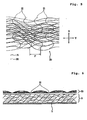
- Fig. 5 is a plan view schematically showing a portion of a surface member employed for the absorbent article 20
- Fig. 6 is a cross-sectional view of a portion of the absorbent article 20.
- the absorbent article 20 shown in Figs. 4 to 6 has a surface member 30 extending over the entire length of the article 20, i.e., from the front portion 3, through the intermediate portion 2 to the rear portion 4.
- the side sheets 7 are bonded to both side portions of the surface member 30, respectively.
- the absorbent core 8 is interposed between the surface member 30 and the backsheet 5.
- the surface member 30 is a layer of continuous filaments individually extending over the entire length of the surface member 30 without interruption.
- the continuous filaments comprise the first continuous filaments of hydrophobic synthetic resin treated to be hydrophilic and the second continuous filaments of cellulose acetate.
- the first and second continuous filaments are uniformly mixed, unlike those in the surface member 10 of the first embodiment.
- the first and second continuous filaments thus mixed are partly fixed to each other with use of a hot melt adhesive or triacetin.
- the first and second continuous filaments may be fixed to each other by thermally bonding the first continuous filaments to each other so that second continuous filaments of cellulose acetate are held between adjacent first continuous filaments thus thermally bonded.
- the sheet formed only from the first and second continuous filaments has a basis weight of 10 to 100 g/m 2 . It is, of course, possible to stack the mixed first and second continuous filaments on a substrate sheet and partly fix the filaments to the substrate sheet into the form of sheet, as in the first embodiment shown in Figs. 1 to 3.
- the first continuous filaments are indicated at 21; the second continuous filaments are indicated at 22.
- the fixing lines on which the first and second continuous filaments are fixed to each other are indicated at 31.
- the individual fixing lines 31 extend across the surface member 30 in the X-direction in the form of continuous line approximated to trigonometric curve.
- the fixing lines 31 are spaced apart from each other in the Y-direction.
- the first continuous filaments 21 and the second continuous filaments 22 are initially prepared in the form of tow, respectively.
- the first continuous filaments 21 and the second continuous filaments 22 can be uniformly dispersed in the surface member 30 such that the opened tow of first continuous filaments 21 and the opened tow of second continuous filaments 22 are stacked or preliminarily mixed and are then given a dispersing or mixing force in accordance with hydroentangling method.
- a hydrophilic agent having been applied to the first continuous filaments 21 of hydrophobic synthetic resin flows out to lower the hydrophilicity thereof. Even in this case, however, the hydrophilicity of the second continuous filaments 22 of cellulose acetate is never lowered. Therefore, the surface member 30 has an appropriate hydrophilicity as a whole.
- weight ratio of the first continuous filaments 21 to the second continuous filaments 22 may be appropriately selected in a range of from 9:1 to 1:9.
- a large amount of liquid given to the surface member 30 readily passes through it due to the presence of the first continuous filaments 21 of hydrophobic synthetic resin, and is then drawn and absorbed by the underlying absorbent core 8 due to capillary action thereof.
- a small amount of liquid on the surface of the surface member 30 or vapor can be adsorbed due to water- and moisture-absorbency of cellulose acetate, thereby preventing the surface of the surface member 30 from staying in a wet condition.
- the absorbent article of the invention is exemplified in the form of sanitary napkin, but is also applicable for disposable diapers, incontinence pads, panti-liners or the like.
- the surface member of the present invention comprises the first continuous filaments of hydrophobic synthetic resin and the second continuous filaments of cellulose acetate, the surface member provides good liquid-permeability and moisture-absorbency, thereby preventing stuffy and wet feel on the surface thereof.
Landscapes
- Health & Medical Sciences (AREA)
- Epidemiology (AREA)
- Engineering & Computer Science (AREA)
- Biomedical Technology (AREA)
- Heart & Thoracic Surgery (AREA)
- Vascular Medicine (AREA)
- Life Sciences & Earth Sciences (AREA)
- Animal Behavior & Ethology (AREA)
- General Health & Medical Sciences (AREA)
- Public Health (AREA)
- Veterinary Medicine (AREA)
- Absorbent Articles And Supports Therefor (AREA)
- Orthopedics, Nursing, And Contraception (AREA)
- Laminated Bodies (AREA)
- Treatments For Attaching Organic Compounds To Fibrous Goods (AREA)
Applications Claiming Priority (2)
| Application Number | Priority Date | Filing Date | Title |
|---|---|---|---|
| JP2000377018A JP3875018B2 (ja) | 2000-12-12 | 2000-12-12 | 連続フィラメントの表面材を用いた吸収性物品 |
| JP2000377018 | 2000-12-12 |
Publications (3)
| Publication Number | Publication Date |
|---|---|
| EP1214922A2 true EP1214922A2 (de) | 2002-06-19 |
| EP1214922A3 EP1214922A3 (de) | 2005-02-09 |
| EP1214922B1 EP1214922B1 (de) | 2009-03-04 |
Family
ID=18845797
Family Applications (1)
| Application Number | Title | Priority Date | Filing Date |
|---|---|---|---|
| EP01310339A Expired - Lifetime EP1214922B1 (de) | 2000-12-12 | 2001-12-11 | Absorbierender Artikel mit einer Deckschicht aus Endlosfäden |
Country Status (5)
| Country | Link |
|---|---|
| US (1) | US6770796B2 (de) |
| EP (1) | EP1214922B1 (de) |
| JP (1) | JP3875018B2 (de) |
| AT (1) | ATE424173T1 (de) |
| DE (1) | DE60137825D1 (de) |
Cited By (3)
| Publication number | Priority date | Publication date | Assignee | Title |
|---|---|---|---|---|
| WO2013112497A1 (en) * | 2012-01-27 | 2013-08-01 | Celanese Acetate Llc | Substituted cellulose acetates and uses thereof |
| US9090045B2 (en) | 2012-09-24 | 2015-07-28 | Celanese Acetate Llc | Engineered wood produced with substituted cellulose ester adhesives and methods relating thereto |
| US9138967B2 (en) | 2012-09-24 | 2015-09-22 | Celanese Acetate Llc | Wood laminate articles comprising substituted cellulose ester adhesives and methods relating thereto |
Families Citing this family (11)
| Publication number | Priority date | Publication date | Assignee | Title |
|---|---|---|---|---|
| JP4549168B2 (ja) * | 2004-11-25 | 2010-09-22 | 大王製紙株式会社 | 体液吸収性物品の吸収体の製造設備 |
| EP1782783B1 (de) | 2004-06-28 | 2014-03-12 | Daio Paper Corporation | Saugfähiges material |
| EP1774940B1 (de) | 2004-06-30 | 2013-09-11 | Daio Paper Corporation | Humor-aufsaugender gegenstand |
| EP1787611B1 (de) | 2004-06-30 | 2011-09-07 | Daio Paper Corporation | Humor-aufsaugender artikel und verfahren zu seiner herstellung |
| JP4694798B2 (ja) * | 2004-06-30 | 2011-06-08 | 大王製紙株式会社 | 紙おむつ |
| JP2006110329A (ja) * | 2004-08-20 | 2006-04-27 | Kao Corp | 吸収性物品 |
| JP4533076B2 (ja) * | 2004-09-30 | 2010-08-25 | 大王製紙株式会社 | 紙おむつ |
| KR101302740B1 (ko) * | 2005-06-16 | 2013-08-30 | 다이오 페이퍼 코퍼레이션 | 흡수성 물품 |
| JP5054962B2 (ja) * | 2006-11-06 | 2012-10-24 | ユニ・チャーム株式会社 | 吸収性物品 |
| JP2013042775A (ja) * | 2011-08-22 | 2013-03-04 | Kyocera Medical Corp | 人工歯根及び人工歯根ユニット |
| JP6426957B2 (ja) * | 2014-09-22 | 2018-11-21 | 株式会社リブドゥコーポレーション | 補助シート |
Family Cites Families (15)
| Publication number | Priority date | Publication date | Assignee | Title |
|---|---|---|---|---|
| US3727615A (en) * | 1971-11-26 | 1973-04-17 | Kimberly Clark Co | Soft, drapable nonwoven material |
| JPS56106710U (de) * | 1980-01-17 | 1981-08-19 | ||
| US4685914A (en) * | 1983-09-23 | 1987-08-11 | Personal Products Company | Disposable urinary pad |
| JPS61186505A (ja) * | 1985-02-14 | 1986-08-20 | 西野 鉄也 | 紙おむつ |
| US4910064A (en) * | 1988-05-25 | 1990-03-20 | Sabee Reinhardt N | Stabilized continuous filament web |
| US5669895A (en) * | 1991-11-11 | 1997-09-23 | The Procter & Gamble Company | Absorbent article having rapid distribution strip |
| US5342336A (en) * | 1991-12-19 | 1994-08-30 | Kimberly-Clark Corporation | Absorbent structure for masking and distributing a liquid |
| US5806154A (en) * | 1993-08-27 | 1998-09-15 | Springs Industries, Inc. | Method of making textile laminate |
| CA2129210A1 (en) * | 1994-03-31 | 1995-10-01 | Debra Jean Mcdowall | Liquid distribution layer for absorbent articles |
| JP3012475B2 (ja) * | 1995-01-26 | 2000-02-21 | ユニ・チャーム株式会社 | 体液吸収性物品用の透液性複合不織布 |
| MY117643A (en) * | 1996-02-29 | 2004-07-31 | Uni Charm Corp | Liquid-permeable topsheet for body exudates absorbent article, apparatus and method for manufacturing same |
| SE514391C2 (sv) * | 1997-12-03 | 2001-02-19 | Sca Hygiene Prod Ab | Absorberande alster |
| SE516777C2 (sv) * | 1997-12-03 | 2002-02-26 | Sca Hygiene Prod Ab | Absorberande alster med skikt av kontinuerliga fibrer |
| EP0953323A1 (de) * | 1998-05-02 | 1999-11-03 | The Procter & Gamble Company | Absorbierender Wegwerfartikel mit verbesserter, oberer Lage |
| JP4162368B2 (ja) * | 2000-09-01 | 2008-10-08 | ユニ・チャーム株式会社 | 連続フィラメントの表面構造体を用いた吸収性物品 |
-
2000
- 2000-12-12 JP JP2000377018A patent/JP3875018B2/ja not_active Expired - Fee Related
-
2001
- 2001-12-03 US US10/004,754 patent/US6770796B2/en not_active Expired - Fee Related
- 2001-12-11 EP EP01310339A patent/EP1214922B1/de not_active Expired - Lifetime
- 2001-12-11 DE DE60137825T patent/DE60137825D1/de not_active Expired - Lifetime
- 2001-12-11 AT AT01310339T patent/ATE424173T1/de not_active IP Right Cessation
Cited By (3)
| Publication number | Priority date | Publication date | Assignee | Title |
|---|---|---|---|---|
| WO2013112497A1 (en) * | 2012-01-27 | 2013-08-01 | Celanese Acetate Llc | Substituted cellulose acetates and uses thereof |
| US9090045B2 (en) | 2012-09-24 | 2015-07-28 | Celanese Acetate Llc | Engineered wood produced with substituted cellulose ester adhesives and methods relating thereto |
| US9138967B2 (en) | 2012-09-24 | 2015-09-22 | Celanese Acetate Llc | Wood laminate articles comprising substituted cellulose ester adhesives and methods relating thereto |
Also Published As
| Publication number | Publication date |
|---|---|
| US6770796B2 (en) | 2004-08-03 |
| JP3875018B2 (ja) | 2007-01-31 |
| JP2002177330A (ja) | 2002-06-25 |
| US20020072724A1 (en) | 2002-06-13 |
| ATE424173T1 (de) | 2009-03-15 |
| EP1214922B1 (de) | 2009-03-04 |
| EP1214922A3 (de) | 2005-02-09 |
| DE60137825D1 (de) | 2009-04-16 |
Similar Documents
| Publication | Publication Date | Title |
|---|---|---|
| US6646178B2 (en) | Absorbent article with surface member of continuous filaments | |
| EP2996654B1 (de) | Wasservernadelte faserstrukturen | |
| US6649807B2 (en) | Absorbent article | |
| US6762340B2 (en) | Absorbent article with surface structural body of continuous filaments | |
| CA2602911C (en) | End seal for an absorbent core | |
| KR101697384B1 (ko) | 흡수성 물품 | |
| CA2593642C (en) | Sealed core for an absorbent article | |
| US6770796B2 (en) | Absorbent article with surface member of continuous filaments | |
| US20030187417A1 (en) | Absorbent article and manufacturing method thereof | |
| EP1990033A1 (de) | Damenbinde mit körperseitigen Vorsprüngen zur Verhinderung von seitlichem Auslaufen und schräg angeordneten eingeprägten Kanälen | |
| RU2215508C2 (ru) | Абсорбирующее изделие | |
| WO2012053482A1 (ja) | 吸収性物品 | |
| JPH08164159A (ja) | 体液吸収性物品 | |
| KR20040101392A (ko) | 바이패스 채널 부재를 구비한 흡수체 및 이를 사용한흡수체 제품 | |
| WO2006101061A1 (ja) | 吸収性物品 | |
| JP6580171B2 (ja) | 吸収体及びその製造方法並びに吸収性物品 | |
| JP3980043B2 (ja) | 吸収性物品 | |
| JP2007222673A (ja) | 吸収性物品 | |
| JP3871698B2 (ja) | 吸収性物品 | |
| JP4570153B2 (ja) | 吸収体の製造方法 | |
| JP2023092394A (ja) | 吸収性物品 | |
| JP2020137764A (ja) | 吸収性物品 | |
| JP2021119879A (ja) | 吸収性物品 | |
| JP2020081536A (ja) | 吸収性物品 | |
| JP2021019785A (ja) | 吸収性物品 |
Legal Events
| Date | Code | Title | Description |
|---|---|---|---|
| PUAI | Public reference made under article 153(3) epc to a published international application that has entered the european phase |
Free format text: ORIGINAL CODE: 0009012 |
|
| AK | Designated contracting states |
Kind code of ref document: A2 Designated state(s): AT BE CH CY DE DK ES FI FR GB GR IE IT LI LU MC NL PT SE TR |
|
| AX | Request for extension of the european patent |
Free format text: AL;LT;LV;MK;RO;SI |
|
| RAP1 | Party data changed (applicant data changed or rights of an application transferred) |
Owner name: UNI-CHARM CORPORATION |
|
| PUAL | Search report despatched |
Free format text: ORIGINAL CODE: 0009013 |
|
| AK | Designated contracting states |
Kind code of ref document: A3 Designated state(s): AT BE CH CY DE DK ES FI FR GB GR IE IT LI LU MC NL PT SE TR |
|
| AX | Request for extension of the european patent |
Extension state: AL LT LV MK RO SI |
|
| RIC1 | Information provided on ipc code assigned before grant |
Ipc: 7A 61F 13/15 B Ipc: 7D 04H 3/04 B Ipc: 7A 61F 13/511 A |
|
| 17P | Request for examination filed |
Effective date: 20050617 |
|
| AKX | Designation fees paid |
Designated state(s): DE FR GB NL SE |
|
| RBV | Designated contracting states (corrected) |
Designated state(s): AT BE CH CY DE DK ES FI FR GB GR IE IT LI LU MC NL PT SE TR |
|
| GRAP | Despatch of communication of intention to grant a patent |
Free format text: ORIGINAL CODE: EPIDOSNIGR1 |
|
| GRAS | Grant fee paid |
Free format text: ORIGINAL CODE: EPIDOSNIGR3 |
|
| GRAA | (expected) grant |
Free format text: ORIGINAL CODE: 0009210 |
|
| AK | Designated contracting states |
Kind code of ref document: B1 Designated state(s): AT BE CH CY DE DK ES FI FR GB GR IE IT LI LU MC NL PT SE TR |
|
| REG | Reference to a national code |
Ref country code: GB Ref legal event code: FG4D |
|
| REG | Reference to a national code |
Ref country code: CH Ref legal event code: EP |
|
| REG | Reference to a national code |
Ref country code: IE Ref legal event code: FG4D |
|
| REF | Corresponds to: |
Ref document number: 60137825 Country of ref document: DE Date of ref document: 20090416 Kind code of ref document: P |
|
| REG | Reference to a national code |
Ref country code: SE Ref legal event code: TRGR |
|
| PG25 | Lapsed in a contracting state [announced via postgrant information from national office to epo] |
Ref country code: FI Free format text: LAPSE BECAUSE OF FAILURE TO SUBMIT A TRANSLATION OF THE DESCRIPTION OR TO PAY THE FEE WITHIN THE PRESCRIBED TIME-LIMIT Effective date: 20090304 |
|
| PG25 | Lapsed in a contracting state [announced via postgrant information from national office to epo] |
Ref country code: AT Free format text: LAPSE BECAUSE OF FAILURE TO SUBMIT A TRANSLATION OF THE DESCRIPTION OR TO PAY THE FEE WITHIN THE PRESCRIBED TIME-LIMIT Effective date: 20090304 |
|
| PG25 | Lapsed in a contracting state [announced via postgrant information from national office to epo] |
Ref country code: BE Free format text: LAPSE BECAUSE OF FAILURE TO SUBMIT A TRANSLATION OF THE DESCRIPTION OR TO PAY THE FEE WITHIN THE PRESCRIBED TIME-LIMIT Effective date: 20090304 |
|
| PG25 | Lapsed in a contracting state [announced via postgrant information from national office to epo] |
Ref country code: ES Free format text: LAPSE BECAUSE OF FAILURE TO SUBMIT A TRANSLATION OF THE DESCRIPTION OR TO PAY THE FEE WITHIN THE PRESCRIBED TIME-LIMIT Effective date: 20090615 Ref country code: PT Free format text: LAPSE BECAUSE OF FAILURE TO SUBMIT A TRANSLATION OF THE DESCRIPTION OR TO PAY THE FEE WITHIN THE PRESCRIBED TIME-LIMIT Effective date: 20090818 |
|
| PLBE | No opposition filed within time limit |
Free format text: ORIGINAL CODE: 0009261 |
|
| STAA | Information on the status of an ep patent application or granted ep patent |
Free format text: STATUS: NO OPPOSITION FILED WITHIN TIME LIMIT |
|
| PG25 | Lapsed in a contracting state [announced via postgrant information from national office to epo] |
Ref country code: DK Free format text: LAPSE BECAUSE OF FAILURE TO SUBMIT A TRANSLATION OF THE DESCRIPTION OR TO PAY THE FEE WITHIN THE PRESCRIBED TIME-LIMIT Effective date: 20090304 |
|
| 26N | No opposition filed |
Effective date: 20091207 |
|
| PG25 | Lapsed in a contracting state [announced via postgrant information from national office to epo] |
Ref country code: MC Free format text: LAPSE BECAUSE OF NON-PAYMENT OF DUE FEES Effective date: 20100701 |
|
| REG | Reference to a national code |
Ref country code: CH Ref legal event code: PL |
|
| REG | Reference to a national code |
Ref country code: IE Ref legal event code: MM4A |
|
| PG25 | Lapsed in a contracting state [announced via postgrant information from national office to epo] |
Ref country code: LI Free format text: LAPSE BECAUSE OF NON-PAYMENT OF DUE FEES Effective date: 20091231 Ref country code: CH Free format text: LAPSE BECAUSE OF NON-PAYMENT OF DUE FEES Effective date: 20091231 Ref country code: GR Free format text: LAPSE BECAUSE OF FAILURE TO SUBMIT A TRANSLATION OF THE DESCRIPTION OR TO PAY THE FEE WITHIN THE PRESCRIBED TIME-LIMIT Effective date: 20090605 Ref country code: IE Free format text: LAPSE BECAUSE OF NON-PAYMENT OF DUE FEES Effective date: 20091211 |
|
| PG25 | Lapsed in a contracting state [announced via postgrant information from national office to epo] |
Ref country code: IT Free format text: LAPSE BECAUSE OF FAILURE TO SUBMIT A TRANSLATION OF THE DESCRIPTION OR TO PAY THE FEE WITHIN THE PRESCRIBED TIME-LIMIT Effective date: 20090304 |
|
| PG25 | Lapsed in a contracting state [announced via postgrant information from national office to epo] |
Ref country code: LU Free format text: LAPSE BECAUSE OF NON-PAYMENT OF DUE FEES Effective date: 20091211 |
|
| PG25 | Lapsed in a contracting state [announced via postgrant information from national office to epo] |
Ref country code: CY Free format text: LAPSE BECAUSE OF FAILURE TO SUBMIT A TRANSLATION OF THE DESCRIPTION OR TO PAY THE FEE WITHIN THE PRESCRIBED TIME-LIMIT Effective date: 20090304 |
|
| PGFP | Annual fee paid to national office [announced via postgrant information from national office to epo] |
Ref country code: DE Payment date: 20121205 Year of fee payment: 12 |
|
| PGFP | Annual fee paid to national office [announced via postgrant information from national office to epo] |
Ref country code: SE Payment date: 20121217 Year of fee payment: 12 Ref country code: TR Payment date: 20121120 Year of fee payment: 12 Ref country code: GB Payment date: 20121205 Year of fee payment: 12 |
|
| PGFP | Annual fee paid to national office [announced via postgrant information from national office to epo] |
Ref country code: FR Payment date: 20130107 Year of fee payment: 12 Ref country code: NL Payment date: 20121215 Year of fee payment: 12 |
|
| REG | Reference to a national code |
Ref country code: DE Ref legal event code: R119 Ref document number: 60137825 Country of ref document: DE |
|
| REG | Reference to a national code |
Ref country code: NL Ref legal event code: V1 Effective date: 20140701 |
|
| REG | Reference to a national code |
Ref country code: SE Ref legal event code: EUG |
|
| GBPC | Gb: european patent ceased through non-payment of renewal fee |
Effective date: 20131211 |
|
| PG25 | Lapsed in a contracting state [announced via postgrant information from national office to epo] |
Ref country code: SE Free format text: LAPSE BECAUSE OF NON-PAYMENT OF DUE FEES Effective date: 20131212 |
|
| REG | Reference to a national code |
Ref country code: FR Ref legal event code: ST Effective date: 20140829 |
|
| REG | Reference to a national code |
Ref country code: DE Ref legal event code: R119 Ref document number: 60137825 Country of ref document: DE Effective date: 20140701 |
|
| PG25 | Lapsed in a contracting state [announced via postgrant information from national office to epo] |
Ref country code: DE Free format text: LAPSE BECAUSE OF NON-PAYMENT OF DUE FEES Effective date: 20140701 Ref country code: NL Free format text: LAPSE BECAUSE OF NON-PAYMENT OF DUE FEES Effective date: 20140701 |
|
| PG25 | Lapsed in a contracting state [announced via postgrant information from national office to epo] |
Ref country code: FR Free format text: LAPSE BECAUSE OF NON-PAYMENT OF DUE FEES Effective date: 20131231 Ref country code: GB Free format text: LAPSE BECAUSE OF NON-PAYMENT OF DUE FEES Effective date: 20131211 |
|
| PG25 | Lapsed in a contracting state [announced via postgrant information from national office to epo] |
Ref country code: TR Free format text: LAPSE BECAUSE OF NON-PAYMENT OF DUE FEES Effective date: 20131211 |