EP1214932A2 - Composition for decontamination of thickened toxic agents - Google Patents
Composition for decontamination of thickened toxic agents Download PDFInfo
- Publication number
- EP1214932A2 EP1214932A2 EP01403191A EP01403191A EP1214932A2 EP 1214932 A2 EP1214932 A2 EP 1214932A2 EP 01403191 A EP01403191 A EP 01403191A EP 01403191 A EP01403191 A EP 01403191A EP 1214932 A2 EP1214932 A2 EP 1214932A2
- Authority
- EP
- European Patent Office
- Prior art keywords
- decontaminating
- agent
- formulation according
- composition
- solvent
- Prior art date
- Legal status (The legal status is an assumption and is not a legal conclusion. Google has not performed a legal analysis and makes no representation as to the accuracy of the status listed.)
- Withdrawn
Links
Classifications
-
- A—HUMAN NECESSITIES
- A62—LIFE-SAVING; FIRE-FIGHTING
- A62D—CHEMICAL MEANS FOR EXTINGUISHING FIRES OR FOR COMBATING OR PROTECTING AGAINST HARMFUL CHEMICAL AGENTS; CHEMICAL MATERIALS FOR USE IN BREATHING APPARATUS
- A62D3/00—Processes for making harmful chemical substances harmless or less harmful, by effecting a chemical change in the substances
- A62D3/30—Processes for making harmful chemical substances harmless or less harmful, by effecting a chemical change in the substances by reacting with chemical agents
-
- A—HUMAN NECESSITIES
- A61—MEDICAL OR VETERINARY SCIENCE; HYGIENE
- A61K—PREPARATIONS FOR MEDICAL, DENTAL OR TOILETRY PURPOSES
- A61K8/00—Cosmetics or similar toiletry preparations
- A61K8/18—Cosmetics or similar toiletry preparations characterised by the composition
- A61K8/30—Cosmetics or similar toiletry preparations characterised by the composition containing organic compounds
- A61K8/33—Cosmetics or similar toiletry preparations characterised by the composition containing organic compounds containing oxygen
- A61K8/34—Alcohols
-
- A—HUMAN NECESSITIES
- A61—MEDICAL OR VETERINARY SCIENCE; HYGIENE
- A61K—PREPARATIONS FOR MEDICAL, DENTAL OR TOILETRY PURPOSES
- A61K8/00—Cosmetics or similar toiletry preparations
- A61K8/18—Cosmetics or similar toiletry preparations characterised by the composition
- A61K8/30—Cosmetics or similar toiletry preparations characterised by the composition containing organic compounds
- A61K8/33—Cosmetics or similar toiletry preparations characterised by the composition containing organic compounds containing oxygen
- A61K8/39—Derivatives containing from 2 to 10 oxyalkylene groups
-
- A—HUMAN NECESSITIES
- A61—MEDICAL OR VETERINARY SCIENCE; HYGIENE
- A61Q—SPECIFIC USE OF COSMETICS OR SIMILAR TOILETRY PREPARATIONS
- A61Q17/00—Barrier preparations; Preparations brought into direct contact with the skin for affording protection against external influences, e.g. sunlight, X-rays or other harmful rays, corrosive materials, bacteria or insect stings
-
- A—HUMAN NECESSITIES
- A61—MEDICAL OR VETERINARY SCIENCE; HYGIENE
- A61Q—SPECIFIC USE OF COSMETICS OR SIMILAR TOILETRY PREPARATIONS
- A61Q19/00—Preparations for care of the skin
-
- A—HUMAN NECESSITIES
- A62—LIFE-SAVING; FIRE-FIGHTING
- A62D—CHEMICAL MEANS FOR EXTINGUISHING FIRES OR FOR COMBATING OR PROTECTING AGAINST HARMFUL CHEMICAL AGENTS; CHEMICAL MATERIALS FOR USE IN BREATHING APPARATUS
- A62D2101/00—Harmful chemical substances made harmless, or less harmful, by effecting chemical change
- A62D2101/02—Chemical warfare substances, e.g. cholinesterase inhibitors
Definitions
- the invention relates to non-aggressive decontaminating formulations. usable for the decontamination of toxic organophosphorus agents or organosulfur, in particular for the decontamination of thickened toxic agents and / or adsorbed on porous uncured surfaces, in particular in the chemical warfare agents.
- organophosphorus esters derived from phosphoric and phosphonic acids used as chemical warfare agents such as Tabun, Sarin or Soman.
- organosulfurous toxic products such as war agents of the vesicants family, in particular mustard.
- the toxicity of toxic organophosphorus agents or organosulfur is further enhanced when used in admixture with a thickening polymer which increases their adhesion to the treated surface, in particular when the thickened toxic agent is contacted with water for rinsing.
- a thickening polymer is a polymethacrylate marketed under the name "Paralo ⁇ d K 125" (Röhm & Haas).
- the decontamination of surfaces is also made particularly difficult in the case of porous uncured surfaces: the toxic agent is in this case not very accessible to the decontaminating agent.
- decontaminating formulations according to the invention make it possible to resolve the problem of the difficulty of decontamination due to the nature and / or accessibility of the toxic agent by the use of a decontaminating agent and a solvent which, on the one hand, dissolves both said decontaminating and thickening agent and, on the other hand part, either miscible with water.
- the invention therefore relates, according to a first aspect, to a formulation decontaminant comprising at least one decontaminating agent and a solvent such as defined above.
- said solvent also solubilizes the toxic agent.
- Decontaminating agent means an agent capable of destroying the structure of the toxic agent.
- said decontaminating formulation has a pH greater than 7, preferably from 8.5 to 12, when it is used in the aqueous phase at a concentration from 2 to 50% by weight.
- said solvent is little or not flammable, and has preferably a flash point in closed section greater than or equal to 50 ° C.
- the flash point corresponds to the temperature at which a product which found in closed enclosure and at atmospheric pressure ignites when approach a flame, after gradual increase in temperature.
- the measurements are carried out using a Sétaflash ® device.
- the decontaminating agent (s) is (are) included in a decontaminating composition.
- the decontaminating compositions which can be used according to the invention are of preferably used in the aqueous phase in the form of a solution, dispersion, emulsion, microemulsion or suspension in water at a concentration of 2 to 50%, preferably 8 to 25% by weight, said phase aqueous having a pH greater than 7, preferably between 8.5 and 12.
- the solvent as defined above is in this case present in the decontaminating formulation according to the invention in an amount of 3 to 60% by weight of the decontaminating composition in aqueous phase.
- decontaminating formulation is meant both a formulation comprising mixing the decontaminating composition and the solvent in a same conditioning, as the association of the decontaminating composition in aqueous phase and solvent in separate packages.
- the decontaminating composition comprises at least one agent decontaminant and, optionally, at least one cationic surfactant and / or at least one nonionic surfactant.
- Other optional components can be chosen from an alkaline buffer, a hydrotropic agent, an agent sequestering stabilizer and an anti-foaming agent.
- the decontaminating agent according to the invention can be a peroxidizing agent organic or mineral.
- a peroxidizing agent is meant in the following description both a single peroxidizing agent and a mixture of peroxidizing agents.
- the peroxidizing agent is a peroxidizing agent organic such as a peracid or a peroxide, for example monoperoxyphthalate magnesium hexahydrate (MPPM); diperoxydodecanedioic acid (DPDA); perbenzoic acid, perphthalic acid, perlauric acid, perazelaic acid, persalicylic acid, diperadipic acid, peracetic acid, performic acid, diperoxytererephthalic acid and their salts; dicumyl peroxide, peroxide tert-butylcumyle and diphtaloyl peroxide.
- MPPM is an agent particularly advantageous decontaminant.
- an inorganic peroxidizing agent will be used in the presence of an oxidation activator, that is to say a molecule capable of generating a peracid in situ .
- activators with interfacial properties such as than nonanoyloxybenzenesulfonate (NOBS), which generates pernonanoic acid or isononanoyloxybenzenesulfonate (ISONOBS), which generates acid perisononano ⁇ que.
- NOBS nonanoyloxybenzenesulfonate
- ISONOBS isononanoyloxybenzenesulfonate
- a preferred combination is sodium percarbonate or perurea as mineral peroxidants and TAED as an activator peroxidation.
- the decontaminating agent can also be chosen from agents for halogenated bleaches or the precursors of halogenated bleaches, such as than sodium, potassium or calcium hypochlorite, dichloroisocyanurate sodium or calcium, sodium trichloroisocyanurate, etc.
- cationic surfactant which the composition may include decontaminant defined above, we mean in the following description also just one type of cationic surfactant than a mixture of surfactants Cationic.
- cationic surfactant for example, cocoyltrimethylammonium chloride or bromide, chloride didecyldimethylammonium, benzalkonium chloride, chloride mixtures benzalkonium and alkyldimethylethylbenzylammonium chlorides, and surfactants derived from quaternary or polyquaternary ammonium, possibly partially ethoxylated or of which the alkyl chain is optionally interrupted by an ester or amide group, as well as their mixtures.
- Preferred nonionic surfactants are oxide of lauryldimethylamine and octylpyrrolidone.
- the decontaminating composition included in the formulation decontaminant according to the invention can comprise an alkaline buffer.
- an alkaline buffer is meant in the following description also just one alkaline buffer than a mixture of alkaline buffers.
- An advantageous alkaline buffer in the compositions used according to the invention is for example a carbonate or an alkali silicate, in particular the sodium carbonate.
- the solutions containing the compositions according to the invention have a pH greater than 7, preferably between 8.5 and 12, especially between 9 and 11. If necessary, the pH can be adjusted using an agent basifying such as sodium, potassium, ammonium hydroxide; silicates or sodium, potassium, ammonium borates etc ...
- the decontaminating composition included in the formulation decontaminant according to the invention can comprise a hydrotropic agent.
- hydrotropic agent in the following description both a single type of hydrotropic agent and a mixture of hydrotropic agents.
- hydrotropic agent it is possible to use, for example, urea, cumenesulfonates, toluenesulfonates or xylenesulfonates of sodium, potassium or ammonium.
- the decontaminating composition included in the formulation decontaminant according to the invention can comprise a stabilizing sequestering agent.
- a stabilizing sequestering agent which may include the decontaminating composition defined above, is understood in the following of the description of a single type of stabilizing sequestering agent as well as a mixture stabilizing sequestering agents.
- the stabilizing sequestering agent is advantageously chosen from sodium gluconate, sodium citrate, diethylenetriaminepentamethylene phosphonate sodium (DETPM), ethylenediaminetetramethylenephosphonate sodium (EDTMP), sodium hydroxyethyldiethylphosphonate (HEDP), aminopolycarboxylates such as sodium nitrilotriacetate (NTA), sodium diethylenetriaminepenta acetate (DTPA), etc.
- an anti-foaming agent which can be used in the composition decontaminant included in the decontaminant formulation according to the invention, it is may for example cite a polydimethylsiloxane.
- aqueous phase decontaminating compositions as defined above may also contain antifreeze agents, at 5 to 40%, preferably 15 to 25%, such as for example propylene glycol, ethylene glycol or diethylene glycol.
- the components of the final formulation are in liquid form at room temperature can be either sprayed on the powder constituting the rest of the formulation, either incorporated separately in liquid form in the decontaminating solution.
- Decontaminating formulations can be used in a way manual or mechanical by sprinkling, whitewash, spraying, soaking, impregnation or any other operation allowing the contact of said compositions with contaminated equipment or people.
- the invention also relates to the use decontaminating formulations as defined above for the decontamination of thickened and / or adsorbed toxic agents on surfaces porous uncured.
- the stability of the solutions is measured by assaying the active oxygen after a given storage period (1h30) at room temperature or 40 ° C, depending on the nature of the oxidizing agent.
- Decontaminating efficacy measurements are carried out by analysis of the residual toxic by gas chromatography.
- the measurement of the decontaminating effectiveness was carried out on the semi-yperite (2-hydroxyethyl 2-phenylethyl sulfide) thickened with 3% Paraloid K 125.
- the tests are carried out at a concentration of 200 mg of toxic substance / 55 ml of decontaminating formulation 90 min after dissolving and with a contact time of the decontaminating formulation and the toxic substance of 30 min.
- the thickened toxic is deposited on metal plates covered with glycerophthalic paints.
- the measure of the decontaminating efficiency is given by the extraction of the toxic, on the one hand on the plate (plate decontamination) and on the other hand in the solution (global decontamination), with an organic solvent.
- the organic phases are percolated before being injected with CPG, in order to block the thickener.
- active oxygen is measured after 15 min and 90 min (stability measurement).
- the decontaminating formulation is prepared in a conventional manner; the powders are dissolved in the water + solvent mixture at room temperature (for MPPM-based decontaminants) or at 40 ° C (for powders based on PC-DAT). The decontaminating solution is then left to stand for 90 min.
- the toxic thickened is deposited using an automatic pipette on a metal plate covered with glycerophthalic paint. It is important at this level to know the exact mass of toxic deposited.
- the decontaminant is then transferred to the decontamination box.
- the plate (on which the toxic was deposited) is then placed in the solution for 30 min.
- a mini-column is prepared per sample (a little cotton, 15 mm of silica and 2 mm of sand Fontainebleau in a Pasteur pipette, humidification with the usual eluent), then 1 ml of each sample is taken and poured into a mini-column in order to percolate them. Add a known amount of dodecanol to each sample percolated, then injected with CPG.
- the percentage of decomposition of the toxic is given by the formula (1 - mass of residual toxic (mg) mass of starting toxicant (mg) ) x 100
Landscapes
- Health & Medical Sciences (AREA)
- Life Sciences & Earth Sciences (AREA)
- General Health & Medical Sciences (AREA)
- Veterinary Medicine (AREA)
- Animal Behavior & Ethology (AREA)
- Public Health (AREA)
- Birds (AREA)
- Emergency Medicine (AREA)
- Dermatology (AREA)
- Epidemiology (AREA)
- Toxicology (AREA)
- Chemical & Material Sciences (AREA)
- Chemical Kinetics & Catalysis (AREA)
- General Chemical & Material Sciences (AREA)
- Business, Economics & Management (AREA)
- Emergency Management (AREA)
- Detergent Compositions (AREA)
Abstract
L'invention concerne une formulation décontaminante comprenant au
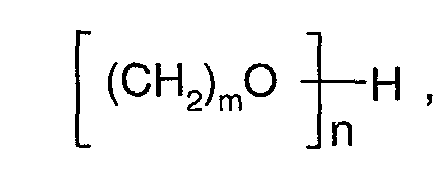
moins un agent décontaminant et un solvant de formule générale (I)
- R1 est un (C1-C8) alkyle, linéaire ou ramifié, un phényle ou un benzyle, non substitués ou substitués une ou plusieurs fois par un (C1-C8)alkyle, linéaire ou ramifié ;
- R2 est l'hydrogène ou un (C1-C4)alkyle, linéaire ou ramifié ;
- n est un nombre entier de 2 à 6 ;
- m est un nombre entier de 1 à 4,
- R 1 is a linear or branched (C 1 -C 8 ) alkyl, phenyl or benzyl, unsubstituted or substituted one or more times with a linear or branched (C 1 -C 8 ) alkyl;
- R 2 is hydrogen or a (C 1 -C 4 ) alkyl, linear or branched;
- n is an integer from 2 to 6;
- m is an integer from 1 to 4,
Description
L'invention concerne des formulations décontaminantes non agressives utilisables pour la décontamination d'agents toxiques organophosphorés ou organosoufrés en particulier pour la décontamination d'agents toxiques épaissis et/ou adsorbés sur des surfaces poreuses non durcies, notamment dans le domaine des agents de guerre chimique.The invention relates to non-aggressive decontaminating formulations. usable for the decontamination of toxic organophosphorus agents or organosulfur, in particular for the decontamination of thickened toxic agents and / or adsorbed on porous uncured surfaces, in particular in the chemical warfare agents.
Il existe actuellement de nombreux esters organophosphorés dérivés des acides phosphoriques et phosphoniques, utilisés comme agents de guerre chimique tels que le Tabun, le Sarin ou le Soman.There are currently many organophosphorus esters derived from phosphoric and phosphonic acids, used as chemical warfare agents such as Tabun, Sarin or Soman.
Ces composés présentent une importante neurotoxicité du fait de leur pouvoir phosphorylant vis-à-vis des cholinestérases dont l'inhibition entraíne la mort par accumulation d'acétylcholine dans l'organisme.These compounds exhibit significant neurotoxicity due to their phosphorylating power vis-à-vis cholinesterases whose inhibition results in the death by accumulation of acetylcholine in the body.
Par ailleurs, il existe également des produits toxiques organosoufrés tels que les agents de guerre de la famille des vésicants, notamment l'ypérite.In addition, there are also organosulfurous toxic products such than war agents of the vesicants family, in particular mustard.
Des compositions décontaminantes contenant du monoperoxyphtalate de magnésium (MPPM) et un agent tensioactif, de préférence cationique, sont décrites dans le brevet FR2 676 368. Différents procédés de décontamination, dont certains font appel aux peroxydes ou au MPPM, combinés à des agents tensioactifs cationiques, sont décrits dans la publication B. Séguès et al., Bull. Soc. Chim. 1996, 133, 925-937. La publication de S. Batthacharya, J. Org. Chem. 1997, 62, 2198-2204 rapporte une réaction de catalyse micellaire de décomposition de dérivés phosphorés par l'intermédiaire de microémulsions de MPPM en présence d'un agent tensioactif cationique. Différentes publications de C. Lion et al. (par exemple Bull. Soc. Chim., Belg., 1991, 100, 555) concernent l'efficacité décontaminante de combinaisons de différents peracides et de tensioactifs cationiques.Decontaminating compositions containing monoperoxyphthalate magnesium (MPPM) and a surfactant, preferably cationic, are described in patent FR2 676 368. Different decontamination processes, some of which use peroxides or MPPM, combined with surfactants cationic, are described in the publication B. Séguès et al., Bull. Soc. Chim. 1996 133, 925-937. The publication by S. Batthacharya, J. Org. Chem. 1997, 62, 2198-2204 reports a micellar catalysis reaction of decomposition of derivatives phosphorus via MPPM microemulsions in the presence of a cationic surfactant. Various publications by C. Lion et al. (for example Bull. Soc. Chim., Belg., 1991, 100, 555) concern the decontaminating efficacy of combinations of different peracids and cationic surfactants.
Toutefois, l'efficacité de telles compositions est fortement inhibée par la présence d'épaississants dans les agents toxiques.However, the effectiveness of such compositions is strongly inhibited by the presence of thickeners in toxic agents.
En effet, la toxicité des agents toxiques organophosphorés ou organosoufrés est encore renforcée lorsqu'ils sont utilisés en mélange avec un polymère épaississant qui accroít leur adhérence sur la surface traitée, notamment lorsque l'agent toxique épaissi est mis en contact avec de l'eau en vue d'un rinçage.Indeed, the toxicity of toxic organophosphorus agents or organosulfur is further enhanced when used in admixture with a thickening polymer which increases their adhesion to the treated surface, in particular when the thickened toxic agent is contacted with water for rinsing.
Un exemple de polymère épaississant est un polyméthacrylate commercialisé sous la dénomination « Paraloïd K 125 » (Röhm & Haas). An example of a thickening polymer is a polymethacrylate marketed under the name "Paraloïd K 125" (Röhm & Haas).
La décontamination des surfaces est également rendue particulièrement difficile lorsqu'il s'agit de surfaces poreuses non durcies : l'agent toxique est dans ce cas peu accessible à l'agent décontaminant.The decontamination of surfaces is also made particularly difficult in the case of porous uncured surfaces: the toxic agent is in this case not very accessible to the decontaminating agent.
Les formulations décontaminantes selon l'invention permettent de résoudre le problème de la difficulté de la décontamination dû à la nature et/ou l'accessibilité de l'agent toxique par l'utilisation d'un agent décontaminant et d'un solvant qui, d'une part, solubilise à la fois ledit agent décontaminant et l'épaississant et, d'autre part, soit miscible à l'eau.The decontaminating formulations according to the invention make it possible to resolve the problem of the difficulty of decontamination due to the nature and / or accessibility of the toxic agent by the use of a decontaminating agent and a solvent which, on the one hand, dissolves both said decontaminating and thickening agent and, on the other hand part, either miscible with water.
L'invention concerne donc, selon un premier aspect, une formulation décontaminante comprenant au moins un agent décontaminant et un solvant tel que défini ci-dessus.The invention therefore relates, according to a first aspect, to a formulation decontaminant comprising at least one decontaminating agent and a solvent such as defined above.
De préférence, ledit solvant solubilise également l'agent toxique.Preferably, said solvent also solubilizes the toxic agent.
Par « agent décontaminant », on entend un agent capable de détruire la structure de l'agent toxique."Decontaminating agent" means an agent capable of destroying the structure of the toxic agent.
Avantageusement, l'invention concerne une formulation décontaminante
comprenant au moins un agent décontaminant et un solvant de formule générale (I)
- R1 est un (C1-C8) alkyle, linéaire ou ramifié, un phényle ou un benzyle, non substitués ou substitués une ou plusieurs fois par un (C1-C8)alkyle, linéaire ou ramifié ;
- R2 est l'hydrogène ou un (C1-C4)alkyle, linéaire ou ramifié ;
- n est un nombre entier de 2 à 6 ;
- m est un nombre entier de 1 à 4.
- R 1 is a linear or branched (C 1 -C 8 ) alkyl, phenyl or benzyl, unsubstituted or substituted one or more times with a linear or branched (C 1 -C 8 ) alkyl;
- R 2 is hydrogen or a (C 1 -C 4 ) alkyl, linear or branched;
- n is an integer from 2 to 6;
- m is an integer from 1 to 4.
De préférence, ladite formulation décontaminante a un pH supérieur à 7, de préférence de 8,5 à 12, lorsqu'elle est mise en oeuvre en phase aqueuse à une concentration de 2 à 50% en poids.Preferably, said decontaminating formulation has a pH greater than 7, preferably from 8.5 to 12, when it is used in the aqueous phase at a concentration from 2 to 50% by weight.
Avantageusement, ledit solvant est peu ou pas inflammable, et présente de préférence un point éclair en coupe fermée supérieur ou égal à 50°C.Advantageously, said solvent is little or not flammable, and has preferably a flash point in closed section greater than or equal to 50 ° C.
Le point éclair correspond à la température à laquelle un produit qui se trouve en enceinte fermée et à pression atmosphérique s'enflamme lorsqu'on en approche une flamme, après augmentation progressive de la température. Les mesures sont effectuées à l'aide d'un appareil Sétaflash ®. The flash point corresponds to the temperature at which a product which found in closed enclosure and at atmospheric pressure ignites when approach a flame, after gradual increase in temperature. The measurements are carried out using a Sétaflash ® device.
Des solvants préférés sont par exemple :
- l'éther monopropylique du propylèneglycol (Dowanol PnP),
- l'éther monopropylique du dipropylèneglycol (Dowanol DPnP),
- l'éther diméthylique du dipropylèneglycol (Proglyde DMM),
- l'éther monobenzylique du tétraéthylèneglycol (phénol éthoxylé à environ 4 oxydes d'éthylène tel que l'Ethylan HB4 ® commercialisé par Akzo Nobel), et
- l'éther monobutylique du diéthylèneglycol (butyldiglycol).
- propylene glycol monopropyl ether (Dowanol PnP),
- dipropylene glycol monopropyl ether (Dowanol DPnP),
- dipropylene glycol dimethyl ether (Proglyde DMM),
- monobenzyl ether of tetraethylene glycol (phenol ethoxylated with approximately 4 ethylene oxides such as Ethylan HB4® marketed by Akzo Nobel), and
- diethylene glycol monobutyl ether (butyldiglycol).
Selon un aspect avantageux, le ou les agent(s) décontaminant(s) est (sont) compris dans une composition décontaminante.According to an advantageous aspect, the decontaminating agent (s) is (are) included in a decontaminating composition.
Selon un aspect préféré, les formulations décontaminantes selon l'invention comprennent ainsi :
- une composition décontaminante constituée d'une composition sous forme de poudre comprenant au moins un agent décontaminant, ladite composition étant le cas échéant mise en solution, en dispersion, en émulsion, en microémulsion ou en suspension dans l'eau à raison de 2 à 50% en poids de poudre dans l'eau, et
- un solvant tel que défini plus haut.
- a decontaminating composition consisting of a composition in the form of powder comprising at least one decontaminating agent, said composition being optionally dissolved, dispersed, emulsified, microemulsified or suspended in water at a rate of 2 to 50 % by weight of powder in water, and
- a solvent as defined above.
Les compositions décontaminantes utilisables selon l'invention sont de préférence mises en oeuvre en phase aqueuse sous forme de solution, de dispersion, d'émulsion, de microémulsion ou de suspension dans l'eau à une concentration de 2 à 50 %, de préférence de 8 à 25 % en poids, ladite phase aqueuse ayant un pH supérieur à 7, de préférence compris entre 8,5 et 12.The decontaminating compositions which can be used according to the invention are of preferably used in the aqueous phase in the form of a solution, dispersion, emulsion, microemulsion or suspension in water at a concentration of 2 to 50%, preferably 8 to 25% by weight, said phase aqueous having a pH greater than 7, preferably between 8.5 and 12.
Le solvant tel que défini plus haut est dans ce cas présent dans la formulation décontaminante selon l'invention à raison de 3 à 60 % en poids de la composition décontaminante en phase aqueuse.The solvent as defined above is in this case present in the decontaminating formulation according to the invention in an amount of 3 to 60% by weight of the decontaminating composition in aqueous phase.
Par « formulation décontaminante », on entend aussi bien une formulation comprenant le mélange de la composition décontaminante et du solvant dans un même conditionnement, que l'association de la composition décontaminante en phase aqueuse et du solvant dans des conditionnements séparés.By "decontaminating formulation" is meant both a formulation comprising mixing the decontaminating composition and the solvent in a same conditioning, as the association of the decontaminating composition in aqueous phase and solvent in separate packages.
La composition décontaminante comprend au moins un agent décontaminant et, de manière optionnelle, au moins un agent tensioactif cationique et/ou au moins un agent tensioactif non ionique. D'autres composants optionnels peuvent être choisis parmi un tampon alcalin, un agent hydrotrope, un agent séquestrant stabilisant et un agent antimousse. The decontaminating composition comprises at least one agent decontaminant and, optionally, at least one cationic surfactant and / or at least one nonionic surfactant. Other optional components can be chosen from an alkaline buffer, a hydrotropic agent, an agent sequestering stabilizer and an anti-foaming agent.
Les différents composants de la composition décontaminante sont détaillés ci-dessous :The various components of the decontaminating composition are detailed below :
L'agent décontaminant selon l'invention peut être un agent peroxydant organique ou minéral.The decontaminating agent according to the invention can be a peroxidizing agent organic or mineral.
Par « un agent peroxydant », on entend dans la suite de la description aussi bien un seul agent peroxydant qu'un mélange d'agents peroxydants.By "a peroxidizing agent" is meant in the following description both a single peroxidizing agent and a mixture of peroxidizing agents.
Dans un aspect avantageux, l'agent peroxydant est un agent peroxydant organique tel qu'un peracide ou un peroxyde, par exemple le monoperoxyphtalate de magnésium hexahydraté (MPPM) ; l'acide diperoxydodécanedioïque (DPDA) ; l'acide perbenzoïque, l'acide perphtalique, l'acide perlaurique, l'acide perazélaïque, l'acide persalicylique, l'acide diperadipique, l'acide peracétique, l'acide performique, l'acide diperoxytéréphtalique et leurs sels ; le peroxyde de dicumyle, le peroxyde de tert-butylcumyle et le peroxyde de diphtaloyle. Le MPPM est un agent décontaminant particulièrement avantageux.In an advantageous aspect, the peroxidizing agent is a peroxidizing agent organic such as a peracid or a peroxide, for example monoperoxyphthalate magnesium hexahydrate (MPPM); diperoxydodecanedioic acid (DPDA); perbenzoic acid, perphthalic acid, perlauric acid, perazelaic acid, persalicylic acid, diperadipic acid, peracetic acid, performic acid, diperoxytererephthalic acid and their salts; dicumyl peroxide, peroxide tert-butylcumyle and diphtaloyl peroxide. MPPM is an agent particularly advantageous decontaminant.
On peut également utiliser le peroxyde d'hydrogène (H2O2) ou un agent peroxydant minéral tel que :
- les adduits de H2O2 tels que les percarbonates, en particulier le percarbonate de sodium ; le 1,4-diazabicyclo[2.2.2]octane(H2O2)2 ; les peroxyhydrates de phosphates tel que le peroxypyrophosphate de sodium ; la perurée ;
- les persels tels que le perborate de sodium tétrahydraté ou monohydraté ; le monopersulfate de potassium, le Curox ® et les sels d'acide de Caro, le persulfate d'ammonium, le persulfate de sodium ou le persulfate de potassium ; le permanganate de potassium ; les peroxymonophosphates ; les peroxydiphosphates ;
- les peroxydes alcalins ou alcalino-terreux tels que le peroxyde de sodium ou de magnésium.
- H 2 O 2 adducts such as percarbonates, in particular sodium percarbonate; 1,4-diazabicyclo [2.2.2] octane (H 2 O 2 ) 2 ; phosphate peroxyhydrates such as sodium peroxypyrophosphate; the peruré;
- persalts such as sodium perborate tetrahydrate or monohydrate; potassium monopersulfate, Curox ® and Caro acid salts, ammonium persulfate, sodium persulfate or potassium persulfate; potassium permanganate; peroxymonophosphates; peroxydiphosphates;
- alkaline or alkaline earth peroxides such as sodium or magnesium peroxide.
Dans un aspect avantageux, on mettra en oeuvre un agent peroxydant minéral en présence d'un activateur d'oxydation, c'est-à-dire une molécule capable de générer in situ un peracide.In an advantageous aspect, an inorganic peroxidizing agent will be used in the presence of an oxidation activator, that is to say a molecule capable of generating a peracid in situ .
Dans ce cas, on peut utiliser notamment un activateur sans propriétés interfaciales tels que ceux qui génèrent :
- l'acide peracétique, par exemple la tétraacétyléthylènediamine (TAED), le pentaacétylglucose (PAG), le tétraacétylglucoluryl (TAGU), l'acide tétraacétylcyanurique (TACA), l'α-acétoxy-α-méthyl N-N'(diacétyl)malonamide, l'acide acétylsalicylique (ASA), le paraacétoxybenzènesulfonate de sodium (AOBS), la diacétyldiméthylglyoxine (DDG) et l'éthylidène benzoateacétate (EBA) ;
- l'acide perphtalique tel que l'anhydride phtalique (PAN) ; ou
- l'acide perbenzoïque tel que le benzoylimidazole (BID), le parabenzoxybenzènesulfonate de sodium (BOBS).
- peracetic acid, for example tetraacetylethylenediamine (TAED), pentaacetylglucose (PAG), tetraacetylglucoluryl (TAGU), tetraacetylcyanuric acid (TACA), α-acetoxy-α-methyl N-N '(diacetyl) malonamide , acetylsalicylic acid (ASA), sodium paraacetoxybenzenesulfonate (AOBS), diacetyldimethylglyoxin (DDG) and ethylidene benzoateacetate (EBA);
- perphthalic acid such as phthalic anhydride (PAN); or
- perbenzoic acid such as benzoylimidazole (BID), sodium parabenzoxybenzenesulfonate (BOBS).
On peut également utiliser des activateurs avec propriétés interfaciales tels que le nonanoyloxybenzènesulfonate (NOBS), qui génère de l'acide pernonanoïque ou de l'isononanoyloxybenzènesulfonate (ISONOBS), qui génère de l'acide perisononanoïque.It is also possible to use activators with interfacial properties such as than nonanoyloxybenzenesulfonate (NOBS), which generates pernonanoic acid or isononanoyloxybenzenesulfonate (ISONOBS), which generates acid perisononanoïque.
Une association préférée est constituée par le percarbonate de sodium ou la perurée en tant qu'agents peroxydants minéraux et la TAED en tant qu'activateur de peroxydation.A preferred combination is sodium percarbonate or perurea as mineral peroxidants and TAED as an activator peroxidation.
L'agent décontaminant peut également être choisi parmi les agents de blanchiment halogénés ou les précurseurs d'agents de blanchiment halogénés, tels que l'hypochlorite de sodium, de potassium ou de calcium, le dichloroisocyanurate de sodium ou de calcium, le trichloroisocyanurate de sodium, etc.The decontaminating agent can also be chosen from agents for halogenated bleaches or the precursors of halogenated bleaches, such as than sodium, potassium or calcium hypochlorite, dichloroisocyanurate sodium or calcium, sodium trichloroisocyanurate, etc.
Par « agent tensioactif cationique » que peut comprendre la composition décontaminante définie plus haut, on entend dans la suite de la description aussi bien un seul type d'agent tensioactif cationique qu'un mélange d'agents tensioactifs cationiques.By “cationic surfactant” which the composition may include decontaminant defined above, we mean in the following description also just one type of cationic surfactant than a mixture of surfactants Cationic.
En tant qu'agent tensioactif cationique, on peut utiliser par exemple le chlorure ou le bromure de cocoyltriméthylammonium, le chlorure de didécyldiméthylammonium, le chlorure de benzalkonium, les mélanges de chlorures de benzalkonium et de chlorures d'alkyldiméthyléthylbenzylammonium, et les agents tensioactifs dérivés d'ammonium quaternaires ou polyquaternaires, éventuellement partiellement éthoxylés ou dont la chaíne alkyle est éventuellement interrompue par un groupement ester ou amide, ainsi que leurs mélanges.As cationic surfactant, for example, cocoyltrimethylammonium chloride or bromide, chloride didecyldimethylammonium, benzalkonium chloride, chloride mixtures benzalkonium and alkyldimethylethylbenzylammonium chlorides, and surfactants derived from quaternary or polyquaternary ammonium, possibly partially ethoxylated or of which the alkyl chain is optionally interrupted by an ester or amide group, as well as their mixtures.
D'une manière générale, on peut utiliser des agents tensioactifs
cationiques représentés par les formules

- R est un alkyle ou un alcényle en C8-C22
- R' et R", indépendamment, représentent un alkyle ou un alcényle en C8-C22
- C est

- A, B et B' représentent indépendamment CH3, CH2CH3, C(CH3)3 ou
m étant 2 ou 3 et n étant un nombre entier de 1 à 3,
- X⊖ représente un halogène ou un groupe méthosulfate. On peut utiliser également des agents tensioactifs polycationiques tels que le dichlorure de N,N,N',N',N'-pentaméthyl-N-suif-1,3-propane diammonium et le trichlorure de N,N,N',N',N',N",N"-heptaméthyl-N-suif-dipropylène triammonium.Par « un agent tensioactif non ionique », on entend dans la suite de la description aussi bien un seul type d'agent tensioactif non ionique qu'un mélange d'agents tensioactifs non ioniques.En tant qu'agent tensioactif non ionique utilisable de manière optionnelle, notamment à raison de 0 à 25%, de préférence 5 à 20%, on peut citer par exemple
- les alcools gras alcoxylés de formule
- les alkylpolyglucosides de formule R'''-[glucose]n- dans laquelle R''' est un alkyle en C8-C16 et n est un nombre entier de 1 à 3;
- les esters de sucres réduits, les esters de polyols et leurs dérivés éthoxylés, tels que par exemple le monostéarate de sorbitan, de glycérol ou d'éthylèneglycol, ou le monostéarate de sorbitan éthoxylé à 20 oxydes d'éthylène ;
- les alkylamides éthoxylés de formule :
où R est tel que défini ci-dessus et r et s sont des nombres entiers de 0 à 15, dont la somme r + s > 1 ;
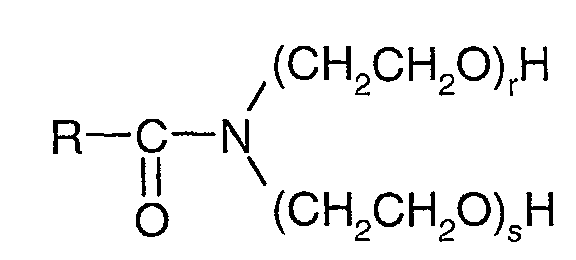
- les alkylpyrrolidones, dont le groupement alkyle est en C6-C20 ;
- et leurs mélanges.
- R is C 8 -C 22 alkyl or alkenyl
- R 'and R ", independently, represent a C 8 -C 22 alkyl or alkenyl
- It is
- A, B and B 'independently represent CH 3 , CH 2 CH 3 , C (CH 3 ) 3 or m being 2 or 3 and n being an integer from 1 to 3,
- X ⊖ represents a halogen or a methosulfate group. Polycationic surfactants such as N, N, N 'N', N ', N'-pentamethyl-N-tallow-1,3-propane diammonium dichloride and N, N, N', N trichloride can also be used. ', N', N ", N" -heptamethyl-N-tallow-dipropylene triammonium. By "a nonionic surfactant" is meant in the following description both a single type of nonionic surfactant as a mixture of nonionic surfactants. As a nonionic surfactant which can be used optionally, in particular at a rate of 0 to 25%, preferably 5 to 20%, mention may be made for example
- the alkoxylated fatty alcohols of formula
- alkylpolyglucosides of formula R '''- [glucose] n - in which R''' is C 8 -C 16 alkyl and n is an integer from 1 to 3;
- reduced sugar esters, polyol esters and their ethoxylated derivatives, such as, for example, sorbitan, glycerol or ethylene glycol monostearate, or sorbitan monostearate ethoxylated with ethylene oxides;
- ethoxylated alkylamides of formula: where R is as defined above and r and s are integers from 0 to 15, the sum of which r + s>1;
- alkylpyrrolidones, the alkyl group of which is C 6 -C 20 ;
- and their mixtures.
Des agents tensioactifs non ioniques préférés sont l'oxyde de lauryldiméthylamine et l'octylpyrrolidone.Preferred nonionic surfactants are oxide of lauryldimethylamine and octylpyrrolidone.
La composition décontaminante comprise dans la formulation décontaminante selon l'invention peut comprendre un tampon alcalin.The decontaminating composition included in the formulation decontaminant according to the invention can comprise an alkaline buffer.
Par « un tampon alcalin », on entend dans la suite de la description aussi bien un seul tampon alcalin qu'un mélange de tampons alcalins.By "an alkaline buffer" is meant in the following description also just one alkaline buffer than a mixture of alkaline buffers.
Un tampon alcalin avantageux dans les compositions utilisées selon l'invention est par exemple un carbonate ou un silicate alcalin, notamment le carbonate de sodium. Avantageusement, les solutions contenant les compositions selon l'invention ont un pH supérieur à 7, de préférence compris entre 8,5 et 12, notamment entre 9 et 11. Si nécessaire, le pH peut être ajusté à l'aide d'un agent alcalinisant tel que l'hydroxyde de sodium, de potassium, d'ammonium ; les silicates ou les borates de sodium, de potassium, d'ammonium etc ...An advantageous alkaline buffer in the compositions used according to the invention is for example a carbonate or an alkali silicate, in particular the sodium carbonate. Advantageously, the solutions containing the compositions according to the invention have a pH greater than 7, preferably between 8.5 and 12, especially between 9 and 11. If necessary, the pH can be adjusted using an agent basifying such as sodium, potassium, ammonium hydroxide; silicates or sodium, potassium, ammonium borates etc ...
La composition décontaminante comprise dans la formulation décontaminante selon l'invention peut comprendre un agent hydrotrope.The decontaminating composition included in the formulation decontaminant according to the invention can comprise a hydrotropic agent.
Par « un agent hydrotrope », on entend dans la suite de la description aussi bien un seul type d'agent hydrotrope qu'un mélange d'agents hydrotropes.By "a hydrotropic agent" is meant in the following description both a single type of hydrotropic agent and a mixture of hydrotropic agents.
En tant qu'agent hydrotrope, on peut utiliser par exemple l'urée, les cumènesulfonates, toluènesulfonates ou xylènesulfonates de sodium, potassium ou ammonium.As hydrotropic agent, it is possible to use, for example, urea, cumenesulfonates, toluenesulfonates or xylenesulfonates of sodium, potassium or ammonium.
La composition décontaminante comprise dans la formulation décontaminante selon l'invention peut comprendre un agent séquestrant stabilisant.The decontaminating composition included in the formulation decontaminant according to the invention can comprise a stabilizing sequestering agent.
Par « un agent séquestrant stabilisant » que peut comprendre la composition décontaminante définie plus haut, on entend dans la suite de la description aussi bien un seul type d'agent séquestrant stabilisant qu'un mélange d'agents séquestrants stabilisants.By "a stabilizing sequestering agent" which may include the decontaminating composition defined above, is understood in the following of the description of a single type of stabilizing sequestering agent as well as a mixture stabilizing sequestering agents.
L'agent séquestrant stabilisant est avantageusement choisi parmi le gluconate de sodium, le citrate de sodium, le diéthylènetriaminepentaméthylènephosphonate de sodium (DETPM), l'éthylènediaminetétraméthylènephosphonate de sodium (EDTMP), l'hydroxyéthyldiéthylphosphonate de sodium (HEDP), les aminopolycarboxylates tels que le nitrilotriacétate de sodium (NTA), la diéthylènetriaminepentaacétate de sodium (DTPA), etc.The stabilizing sequestering agent is advantageously chosen from sodium gluconate, sodium citrate, diethylenetriaminepentamethylene phosphonate sodium (DETPM), ethylenediaminetetramethylenephosphonate sodium (EDTMP), sodium hydroxyethyldiethylphosphonate (HEDP), aminopolycarboxylates such as sodium nitrilotriacetate (NTA), sodium diethylenetriaminepenta acetate (DTPA), etc.
En tant qu'agent antimousse pouvant être utilisé dans la composition décontaminante comprise dans la formulation décontaminante selon l'invention, on peut citer par exemple un polydiméthylsiloxane.As an anti-foaming agent which can be used in the composition decontaminant included in the decontaminant formulation according to the invention, it is may for example cite a polydimethylsiloxane.
Dans la suite de la description, les pourcentages sont exprimés en pourcentages pondéraux.In the following description, the percentages are expressed in weight percentages.
Les compositions décontaminantes en phase aqueuse telles que définies plus haut peuvent également contenir des agents antigels, à raison de 5 à 40 %, de préférence de 15 à 25 %, tels que par exemple le propylèneglycol, l'éthylèneglycol ou le diéthylèneglycol.The aqueous phase decontaminating compositions as defined above may also contain antifreeze agents, at 5 to 40%, preferably 15 to 25%, such as for example propylene glycol, ethylene glycol or diethylene glycol.
Selon un aspect préféré, l'invention concerne une formulation décontaminante comprenant :
- une composition décontaminante en phase aqueuse comprenant, en
pourcentages pondéraux,
- 1 à 98,5 %, de préférence 10 à 70 %, d'un agent peroxydant,
- 0 à 25 %, de préférence 5 à 15 %, d'un agent activateur de peroxydation,
- 0,5 à 90 %, de préférence 2 à 30 %, d'un tampon alcalin,
- 0 à 30 %, de préférence 1 à 20 %, d'un agent tensioactif cationique et/ou non ionique,
- 0 à 50 %, de préférence 2 à 30 %, d'un agent hydrotrope,
- 0 à 35 %, de préférence 15 à 20 %, d'un agent séquestrant stabilisant,
- 0 à 5 %, de préférence 0,005 à 1 %, d'antimousse,
- un solvant de formule (I)
- R1 est un (C1-C8) alkyle, linéaire ou ramifié, un phényle ou un benzyle, non substitués ou substitués une ou plusieurs fois par un (C1-C8)alkyle, linéaire ou ramifié ;
- R2 est l'hydrogène ou un (C1-C4)alkyle, linéaire ou ramifié ;
- n est un nombre entier de 2 à 6 ;
- m est un nombre entier de 1 à 4,
- an aqueous phase decontaminating composition comprising, in weight percentages,
- 1 to 98.5%, preferably 10 to 70%, of a peroxidizing agent,
- 0 to 25%, preferably 5 to 15%, of a peroxidation activating agent,
- 0.5 to 90%, preferably 2 to 30%, of an alkaline buffer,
- 0 to 30%, preferably 1 to 20%, of a cationic and / or nonionic surfactant,
- 0 to 50%, preferably 2 to 30%, of a hydrotropic agent,
- 0 to 35%, preferably 15 to 20%, of a stabilizing sequestering agent,
- 0 to 5%, preferably 0.005 to 1%, of antifoam,
- a solvent of formula (I)
- R 1 is a linear or branched (C 1 -C 8 ) alkyl, phenyl or benzyl, unsubstituted or substituted one or more times with a linear or branched (C 1 -C 8 ) alkyl;
- R 2 is hydrogen or a (C 1 -C 4 ) alkyl, linear or branched;
- n is an integer from 2 to 6;
- m is an integer from 1 to 4,
Avantageusement, ladite composition décontaminante comprend, en pourcentages pondéraux :
- 10 à 78 % d'un agent peroxydant,
- 0 à 15 % d'un agent activateur de peroxydation,
- 2 à 30 % d'un tampon alcalin,
- 5 à 20 % d'un agent tensioactif cationique,
- 0 à 20 % d'un agent tensioactif non ionique,
- 0 à 30 % d'un agent hydrotrope,
- 15 à 20 % d'un agent séquestrant stabilisant, et
- 0 à 1 %, d'antimousse,
- 10 to 78% of a peroxidizing agent,
- 0 to 15% of a peroxidation activating agent,
- 2 to 30% of an alkaline buffer,
- 5 to 20% of a cationic surfactant,
- 0 to 20% of a nonionic surfactant,
- 0 to 30% of a hydrotropic agent,
- 15 to 20% of a stabilizing sequestering agent, and
- 0 to 1%, antifoam,
Une composition décontaminante préférée aux fins de l'invention comprend, en pourcentages pondéraux :
- 30 à 70 % de MPPM,
- 10 à 30 % de gluconate de sodium ou de citrate de sodium,
- 10 à 30 % de carbonate de sodium,
- 0 à 5 % d'hydroxyde de sodium,
- 5 à 10 % de chlorure de benzalkonium,
- 0 à 1 % d'antimousse,
- 30 to 70% of MPPM,
- 10 to 30% sodium gluconate or sodium citrate,
- 10 to 30% sodium carbonate,
- 0 to 5% sodium hydroxide,
- 5 to 10% benzalkonium chloride,
- 0 to 1% antifoam,
Une autre composition décontaminante avantageuse aux fins de l'invention comprend, en pourcentages pondéraux :
- 10 à 40 % de percarbonate de sodium,
- 5 à 15 % de TAED,
- 2 à 20 % de carbonate de sodium,
- 10 à 30 % de mélange de chlorures de benzalkonium,
- 0 à 30 % d'urée,
- 2 à 20 % de DETPM ou de gluconate de sodium, et
- 0 à 1 % d'antimousse,
- 10 to 40% sodium percarbonate,
- 5 to 15% of TAED,
- 2 to 20% sodium carbonate,
- 10 to 30% mixture of benzalkonium chlorides,
- 0 to 30% urea,
- 2 to 20% DETPM or sodium gluconate, and
- 0 to 1% antifoam,
Des formulations décontaminantes particulièrement préférées comprennent une composition décontaminante telle que définie ci-dessus et un solvant choisi parmi :
- l'éther monopropylique du propylèneglycol (Dowanol PnP),
- l'éther monopropylique du dipropylèneglycol (Dowanol DPnP),
- l'éther diméthylique du dipropylèneglycol (Proglyde DMM),
- l'éther monobenzylique du tétraéthylèneglycol (phénol éthoxylé à environ 4 oxydes d'éthyle tel que l'Ethylan HB4 ® commercialisé par Akzo Nobel), et
- l'éther monobutylique du diéthylèneglycol (butyldiglycol).
- propylene glycol monopropyl ether (Dowanol PnP),
- dipropylene glycol monopropyl ether (Dowanol DPnP),
- dipropylene glycol dimethyl ether (Proglyde DMM),
- monobenzyl ether of tetraethylene glycol (phenol ethoxylated with approximately 4 ethyl oxides such as Ethylan HB4® sold by Akzo Nobel), and
- diethylene glycol monobutyl ether (butyldiglycol).
Les composants de la formulation finale se présentant sous forme liquide à température ambiante peuvent être, soit pulvérisés sur la poudre constituant le reste de la formulation, soit incorporés séparément sous forme liquide dans la solution décontaminante.The components of the final formulation are in liquid form at room temperature can be either sprayed on the powder constituting the rest of the formulation, either incorporated separately in liquid form in the decontaminating solution.
Les formulations décontaminantes peuvent être utilisées de manière manuelle ou mécanique par aspersion, badigeon, pulvérisation, trempage, imprégnation ou toute autre opération permettant le contact desdites compositions avec du matériel ou des personnes contaminés.Decontaminating formulations can be used in a way manual or mechanical by sprinkling, whitewash, spraying, soaking, impregnation or any other operation allowing the contact of said compositions with contaminated equipment or people.
Selon un aspect avantageux, l'invention concerne également l'utilisation des formulations décontaminantes telles que définies ci-dessus pour la décontamination d'agents toxiques épaissis et/ou adsorbés sur des surfaces poreuses non durcies.According to an advantageous aspect, the invention also relates to the use decontaminating formulations as defined above for the decontamination of thickened and / or adsorbed toxic agents on surfaces porous uncured.
La stabilité des solutions est mesurée par dosage de l'oxygène actif après une durée de stockage donnée (1h30) à température ambiante ou à 40°C, selon la nature de l'agent oxydant.The stability of the solutions is measured by assaying the active oxygen after a given storage period (1h30) at room temperature or 40 ° C, depending on the nature of the oxidizing agent.
Les mesures d'efficacité décontaminante sont effectuées par analyse du toxique résiduel par chromatographie en phase gazeuse.Decontaminating efficacy measurements are carried out by analysis of the residual toxic by gas chromatography.
L'invention est illustrée par les exemples ci-après :The invention is illustrated by the following examples:
Différentes formulations selon l'invention sont rapportées dans le tableau 1
ci-dessous. Les quantités sont exprimées en pourcentages pondéraux.


L'efficacité des solutions décontaminantes contenant des compositions du tableau 1 ci-dessus a été mesurée par analyse du toxique résiduel par chromatographie en phase gazeuse (CPG).The effectiveness of decontaminating solutions containing compositions of Table 1 above was measured by analysis of the residual toxic by gas chromatography (GC).
La mesure de l'efficacité décontaminante a été effectuée sur la demi-ypérite (2-hydroxyéthyl 2-phényléthyl sulfure) épaissie avec 3 % de Paraloïd K 125. Les essais sont effectués à une concentration de 200 mg de substance toxique /55 ml de formulation décontaminante 90 min après la mise en solution et avec un temps de contact de la formulation décontaminante et de la substance toxique de 30 min.The measurement of the decontaminating effectiveness was carried out on the semi-yperite (2-hydroxyethyl 2-phenylethyl sulfide) thickened with 3% Paraloid K 125. The tests are carried out at a concentration of 200 mg of toxic substance / 55 ml of decontaminating formulation 90 min after dissolving and with a contact time of the decontaminating formulation and the toxic substance of 30 min.
Le toxique épaissi est déposé sur des plaques métalliques recouvertes de peintures glycérophtaliques. La mesure de l'efficacité décontaminante est donnée par l'extraction du toxique, d'une part sur la plaque (décontamination plaque) et d'autre part dans la solution (décontamination globale), par un solvant organique. Les phases organiques sont percolées avant d'être injectées en CPG, afin de bloquer l'épaississant.The thickened toxic is deposited on metal plates covered with glycerophthalic paints. The measure of the decontaminating efficiency is given by the extraction of the toxic, on the one hand on the plate (plate decontamination) and on the other hand in the solution (global decontamination), with an organic solvent. The organic phases are percolated before being injected with CPG, in order to block the thickener.
Parallèlement à cette mesure d'efficacité, on mesure l'oxygène actif après 15 min et 90 min (mesure de stabilité).In addition to this efficiency measure, active oxygen is measured after 15 min and 90 min (stability measurement).
Les essais ont été réalisés selon la méthode suivante :The tests were carried out according to the following method:
La formulation décontaminante est préparée de façon classique ; les poudres sont solubilisées dans le mélange eau + solvant à température ambiante (pour les décontaminants à base de MPPM) ou à 40°C (pour les poudres à base de PC-TAED). La solution décontaminante est ensuite laissée à reposer 90 min.The decontaminating formulation is prepared in a conventional manner; the powders are dissolved in the water + solvent mixture at room temperature (for MPPM-based decontaminants) or at 40 ° C (for powders based on PC-DAT). The decontaminating solution is then left to stand for 90 min.
60 min après la préparation de la formulation décontaminante, le toxique épaissi est déposé à l'aide d'une pipette automatique sur une plaque métallique recouverte de peinture glycérophtalique. Il est important à ce niveau de connaítre la masse exacte de toxique déposé.60 min after the preparation of the decontaminating formulation, the toxic thickened is deposited using an automatic pipette on a metal plate covered with glycerophthalic paint. It is important at this level to know the exact mass of toxic deposited.
Le décontaminant est alors transféré dans la boíte de décontamination. La plaque (sur laquelle a été déposé le toxique) est ensuite placée dans la solution pour 30 min.The decontaminant is then transferred to the decontamination box. The plate (on which the toxic was deposited) is then placed in the solution for 30 min.
Lorsque les 30 min sont écoulées, on verse dans la boíte 3 ml d'une solution saturée en thiosulfate de sodium pour arrêter la décontamination. On verse ensuite la phase aqueuse dans une ampoule à décanter et on réalise les extractions classiques (deux extractions successives par 5 ml de mélange acétate d'éthyle - cyclohexane). Le volume de phase organique récoltée est mesuré. On replace la plaque dans la boíte et on verse 20 ml de mélange acétate d'éthylecyclohexane sur les parois de la plaque et de la boíte afin de solubiliser la demi-ypérite épaissie. On laisse ensuite tremper environ 30 min, puis on récupère la phase organique (il reste probablement un peu de phase aqueuse au fond de la boíte).When the 30 min are over, pour into the box 3 ml of a saturated sodium thiosulfate solution to stop decontamination. We pour then the aqueous phase in a separatory funnel and the conventional extractions (two successive extractions with 5 ml of acetate mixture ethyl - cyclohexane). The volume of organic phase harvested is measured. We replace the plate in the box and pour 20 ml of ethyl acetate cyclohexane mixture on the walls of the plate and the box to dissolve the demi-yperite thickened. Then leave to soak for about 30 min, then recover the organic phase (there is probably a little aqueous phase at the bottom of the box).
Lorsque toutes les extractions ont été effectuées, on prépare une mini-colonne par échantillon (un peu de coton, 15 mm de silice et 2 mm de sable de Fontainebleau dans une pipette Pasteur, humidification par l'éluant habituel), puis on prélève 1 ml de chaque échantillon et on le verse dans une mini-colonne afin de les percoler. On ajoute une quantité connue de dodécanol dans chaque échantillon percolé, puis on les injecte en CPG.When all the extractions have been carried out, a mini-column is prepared per sample (a little cotton, 15 mm of silica and 2 mm of sand Fontainebleau in a Pasteur pipette, humidification with the usual eluent), then 1 ml of each sample is taken and poured into a mini-column in order to percolate them. Add a known amount of dodecanol to each sample percolated, then injected with CPG.
Le pourcentage de décomposition du toxique est donné par la formule
Les résultats sont rapportés dans le tableau 2 ci-après :
Les résultats montrent que les formulations décontaminantes selon l'invention présentent une efficacité décontaminante significativement supérieure à celle d'une formulation ne contenant pas de solvant.The results show that the decontaminating formulations according to the invention have a decontaminating efficacy significantly greater than that of a formulation containing no solvent.
Claims (13)
Applications Claiming Priority (2)
| Application Number | Priority Date | Filing Date | Title |
|---|---|---|---|
| FR0016126A FR2817761B1 (en) | 2000-12-12 | 2000-12-12 | DECONTAMINANT FORMULATION FOR DECONTAMINATION OF THICKENED TOXIC AGENTS |
| FR0016126 | 2000-12-12 |
Publications (2)
| Publication Number | Publication Date |
|---|---|
| EP1214932A2 true EP1214932A2 (en) | 2002-06-19 |
| EP1214932A3 EP1214932A3 (en) | 2005-05-25 |
Family
ID=8857526
Family Applications (1)
| Application Number | Title | Priority Date | Filing Date |
|---|---|---|---|
| EP01403191A Withdrawn EP1214932A3 (en) | 2000-12-12 | 2001-12-11 | Composition for decontamination of thickened toxic agents |
Country Status (2)
| Country | Link |
|---|---|
| EP (1) | EP1214932A3 (en) |
| FR (1) | FR2817761B1 (en) |
Cited By (1)
| Publication number | Priority date | Publication date | Assignee | Title |
|---|---|---|---|---|
| WO2002085322A1 (en) * | 2001-04-25 | 2002-10-31 | State Of Israel Prime Minister's Office Israel Institute For Biological Research | Skin-protective compositions effective against vesicants and percutaneous chemical agents |
Families Citing this family (1)
| Publication number | Priority date | Publication date | Assignee | Title |
|---|---|---|---|---|
| CN114504758B (en) * | 2020-11-16 | 2023-06-30 | 中国石油化工股份有限公司 | Fluorine-free foam extinguishing agent and preparation method thereof |
Family Cites Families (5)
| Publication number | Priority date | Publication date | Assignee | Title |
|---|---|---|---|---|
| JPS5838800A (en) * | 1981-09-01 | 1983-03-07 | 三菱瓦斯化学株式会社 | Liquid detergent |
| FR2676368B1 (en) * | 1991-05-15 | 1994-10-28 | France Etat Armement | DECONTAMINATION COMPOSITION BASED ON MAGNESIUM MONOPEROXYPHTHALATE AND METHOD FOR DECONTAMINATION OF CONTAMINATED MATERIALS WITH TOXIC AGENTS USING THE SAME. |
| US6113654A (en) * | 1996-09-12 | 2000-09-05 | Peterson; David | Carpet cleaning composition |
| GB2319179A (en) * | 1996-11-12 | 1998-05-20 | Reckitt & Colman Inc | Cleaning and disinfecting compositions |
| FR2761080B1 (en) * | 1997-03-21 | 2002-07-19 | Quadrimex | COMPOSITION BASED ON PERACIDS FOR THE CLEANING, DISINFECTION AND DECONTAMINATION OF SURFACES STAINED BY TOXIC AGENTS |
-
2000
- 2000-12-12 FR FR0016126A patent/FR2817761B1/en not_active Expired - Fee Related
-
2001
- 2001-12-11 EP EP01403191A patent/EP1214932A3/en not_active Withdrawn
Cited By (2)
| Publication number | Priority date | Publication date | Assignee | Title |
|---|---|---|---|---|
| WO2002085322A1 (en) * | 2001-04-25 | 2002-10-31 | State Of Israel Prime Minister's Office Israel Institute For Biological Research | Skin-protective compositions effective against vesicants and percutaneous chemical agents |
| US7618616B2 (en) | 2001-04-25 | 2009-11-17 | State of Israel Prime Minister's Office-Israel Institute of Biological Research | Skin-protective compositions effective against vesicants and percutaneous chemical agents |
Also Published As
| Publication number | Publication date |
|---|---|
| EP1214932A3 (en) | 2005-05-25 |
| FR2817761B1 (en) | 2003-03-14 |
| FR2817761A1 (en) | 2002-06-14 |
Similar Documents
| Publication | Publication Date | Title |
|---|---|---|
| EP2271410B1 (en) | Composition and process for the destruction of organophosphorus and/or organosulphur pollutants | |
| EP2643339B1 (en) | Novel hydrotropic agent, use thereof to make non-ionic surfactants soluble, and compositions containing same | |
| US6369288B1 (en) | Chemical and biological warfare decontaminating solution using bleach activators | |
| FR2766724A1 (en) | Compositions for decontamination of organo-phosphorus and organo-sulphur insecticides and chemical warfare agents | |
| EP0267046B1 (en) | Bleaching compositions comprising peracid precursors | |
| FR2766725A1 (en) | STABILIZED DECONTAMINANT COMPOSITIONS | |
| CA2725293C (en) | Foaming decontaminating aqueous solution | |
| US5045222A (en) | Use of triacylated ethanolamines as liquid, water-miscible peroxide activators | |
| FR2817761A1 (en) | Composition, useful for decontaminating chemical warfare agents, comprises decontamination agent and (oligo)alkylene glycol ether solvent | |
| FR2761080A1 (en) | New cleaning, disinfecting and decontaminating composition | |
| FR2676368A1 (en) | Decontamination composition based on magnesium monoperoxyphthalate and process for the decontamination of materials contaminated by toxic agents using this composition | |
| US20030045767A1 (en) | Chemical and biological warfare decontaminating solution using bleach activators | |
| PT99511A (en) | Process for the preparation of a bleach or granular detergent composition comprising a amidoparoxyacidic bleach and perfum | |
| EP0848628B1 (en) | Process using a peracid composition for decontaminating materials contaminated with toxic agents | |
| EP1237628B1 (en) | Composition and method for destroying organophosphorous and/or organosulphurous pollutants | |
| EP3592753B1 (en) | Novel composition of 7,9-dodecadienyl-1-acetate isomers and process for production thereof | |
| FR3072391A1 (en) | EXTENDED COMPOSITION COMPRISING A MIXTURE OF TWO PRODUCTS FOR THE DESTRUCTION OF ORGANOPHOSPHORUS AND / OR ORGANOSOUFRES POLLUTANTS | |
| RU2484869C2 (en) | Decontaminating and foaming aqueous solution | |
| EP2271623B1 (en) | Perpropionic acid composition that is stable in a basic medium | |
| WO2014041010A1 (en) | Stabilization of paint stripper formulations | |
| FR2720074A1 (en) | Powdered detergent composition based on percarbonate stabilized by addition of silicate / carbonate cogranules. | |
| WO1996001309A1 (en) | Bleaching compositions |
Legal Events
| Date | Code | Title | Description |
|---|---|---|---|
| PUAI | Public reference made under article 153(3) epc to a published international application that has entered the european phase |
Free format text: ORIGINAL CODE: 0009012 |
|
| AK | Designated contracting states |
Kind code of ref document: A2 Designated state(s): AT BE CH CY DE DK ES FI FR GB GR IE IT LI LU MC NL PT SE TR |
|
| AX | Request for extension of the european patent |
Free format text: AL;LT;LV;MK;RO;SI |
|
| PUAL | Search report despatched |
Free format text: ORIGINAL CODE: 0009013 |
|
| AK | Designated contracting states |
Kind code of ref document: A3 Designated state(s): AT BE CH CY DE DK ES FI FR GB GR IE IT LI LU MC NL PT SE TR |
|
| AX | Request for extension of the european patent |
Extension state: AL LT LV MK RO SI |
|
| RIC1 | Information provided on ipc code assigned before grant |
Ipc: 7A 61K 7/48 B Ipc: 7A 62D 3/00 A |
|
| AKX | Designation fees paid | ||
| REG | Reference to a national code |
Ref country code: DE Ref legal event code: 8566 |
|
| STAA | Information on the status of an ep patent application or granted ep patent |
Free format text: STATUS: THE APPLICATION IS DEEMED TO BE WITHDRAWN |
|
| 18D | Application deemed to be withdrawn |
Effective date: 20051126 |