EP1215500B1 - Tumormarker für frühes krebsstadium - Google Patents
Tumormarker für frühes krebsstadium Download PDFInfo
- Publication number
- EP1215500B1 EP1215500B1 EP00957049A EP00957049A EP1215500B1 EP 1215500 B1 EP1215500 B1 EP 1215500B1 EP 00957049 A EP00957049 A EP 00957049A EP 00957049 A EP00957049 A EP 00957049A EP 1215500 B1 EP1215500 B1 EP 1215500B1
- Authority
- EP
- European Patent Office
- Prior art keywords
- cancer
- patients
- stage
- antibody
- serum
- Prior art date
- Legal status (The legal status is an assumption and is not a legal conclusion. Google has not performed a legal analysis and makes no representation as to the accuracy of the status listed.)
- Expired - Lifetime
Links
Images




Classifications
-
- G—PHYSICS
- G01—MEASURING; TESTING
- G01N—INVESTIGATING OR ANALYSING MATERIALS BY DETERMINING THEIR CHEMICAL OR PHYSICAL PROPERTIES
- G01N33/00—Investigating or analysing materials by specific methods not covered by groups G01N1/00 - G01N31/00
- G01N33/48—Biological material, e.g. blood, urine; Haemocytometers
- G01N33/50—Chemical analysis of biological material, e.g. blood, urine; Testing involving biospecific ligand binding methods; Immunological testing
- G01N33/53—Immunoassay; Biospecific binding assay; Materials therefor
- G01N33/575—Immunoassay; Biospecific binding assay; Materials therefor for cancer
- G01N33/5758—Immunoassay; Biospecific binding assay; Materials therefor for cancer involving compounds serving as markers for tumours, cancers or neoplasias, e.g. cellular determinants, receptors, heat shock/stress proteins, A-protein, oligosaccharides or metabolites
-
- G—PHYSICS
- G01—MEASURING; TESTING
- G01N—INVESTIGATING OR ANALYSING MATERIALS BY DETERMINING THEIR CHEMICAL OR PHYSICAL PROPERTIES
- G01N33/00—Investigating or analysing materials by specific methods not covered by groups G01N1/00 - G01N31/00
- G01N33/48—Biological material, e.g. blood, urine; Haemocytometers
- G01N33/50—Chemical analysis of biological material, e.g. blood, urine; Testing involving biospecific ligand binding methods; Immunological testing
- G01N33/53—Immunoassay; Biospecific binding assay; Materials therefor
- G01N33/575—Immunoassay; Biospecific binding assay; Materials therefor for cancer
-
- G—PHYSICS
- G01—MEASURING; TESTING
- G01N—INVESTIGATING OR ANALYSING MATERIALS BY DETERMINING THEIR CHEMICAL OR PHYSICAL PROPERTIES
- G01N2333/00—Assays involving biological materials from specific organisms or of a specific nature
- G01N2333/435—Assays involving biological materials from specific organisms or of a specific nature from animals; from humans
- G01N2333/475—Assays involving growth factors
Definitions
- This invention relates to a tumor marker for detecting early cancers.
- the degree of cancer progression or enlargement is described as early cancer, advanced cancer, and terminal cancer.
- early cancer is generally considered as "a degree of cancer progression in which the tumor is small, shows few metastases, and can be cured permanently or the cancer can be subdued for a long time through treatment".
- MK Midkine
- retinoic acid-responsive gene product is a proliferation and differentiation factor that was discovered as a retinoic acid-responsive gene product, and is a 13-kDa polypeptide rich in basic amino acids and cysteines ( Kadomatsu, K. et al.: Biochem. Biophys. Res. Commun., 151: 1312-1318 ; Tomomura, M. et al.: J. Biol. Chem., 265: 10765-10770, 1990 ).
- the fact that the MK level is elevated in various malignant tumors compared to the surrounding normal tissues, suggests that MK plays an important role in carcinogenesis.
- An objective of the present invention is to provide a novel polypeptide useful as an early cancer marker.
- another objective of the present invention is to provide a method for detecting early cancer using this polypeptide as an index.
- another objective of the present invention is to provide an external diagnostic agent for early cancer that can detect this polypeptide.
- MK levels detected by anti-MK antibodies in hepatocellular carcinoma patients were significantly enhanced at the early stage of hepatocellular carcinoma, not only in hepatocellular carcinoma tissues, but also in the blood and urine compared to healthy subjects or hepatitis patients.
- MK levels in the blood and urine were found to be significantly elevated at the early stage, similar to hepatic cancer.
- many types of cancers such as esophageal, duodenal, colon, bile duct and gallbladder, pancreatic, thyroid, and breast cancers, significant elevation of serum MK levels was observed in their early stages. This indicates that MK has an extremely wide spectrum of specificity that is not seen in well-known tumor markers for detecting unspecified cancers.
- EIA enzyme immuno assay
- the present invention relates to a method for detecting early cancer, or a method for diagnosing early cancer, and a diagnostic agent and kit for these methods as follows:
- “Early cancer” refers to tumors confined to the site of development (intramucosal) that have not invaded surrounding tissues, or those that have invaded, but the range of invasion is confined to a local area. Especially, tumors showing no invasion are important detection targets in the present invention since they have been difficult to detect by well-known tumor markers. This definition is applicable to almost all cancers such as those of the skin, oral cavity, respiratory tract, gastrointestinal tract, uterine cervix, ovary, gallbladder, bladder, and such. Early cancer includes stage 0 (carcinoma in situ) and stage I according to the TNM classification. In these cancer stages, there are no intravascular invasions or distant metastases, and local tumor ablation alone will lead to complete recovery.
- tumor marker is defined as a substance produced by tumor cells or cells reacting to tumor cells, which is found in tissues, body fluids, excrements, and such, that can indicate some feature of the tumor, such as its existence, character, or expansion.
- MK includes a full-length MK protein, and a fragment comprising an amino acid sequence of an arbitrary length having the biological activity of MK. Also included are mutant MK, such as a mutant MK lacking the N-domain that is expressed cancer-specifically ( Kaname T. et al.: Biochem. Biophys. Res. Commun., 219: 256-260, 1996 . MK produced by genetic engineering technology, and chemically synthesized MK are used interchangeably in this description. A DNA sequence encoding the human full-length MK is well known ( U.S. Patent No: 5,461,029 ). Biological activities of MK not only include the physiological action of MK on cells, but also immunological reactivity with an anti-MK antibody.
- Sensitivity is the ratio of positive measurements in a tumor-existing group, and is also called positivity ratio.
- Specificity is the ratio of negative measurements in a tumor-non-existing group, and is also called negativity ratio.
- Biological sample means a sample that can be obtained from an organism. More specifically, it is, for example, blood, serum, urine, other secretions, and such. Among these biological samples, urine is useful as a sample with low invasiveness. Since urine volume changes considerably, urine volume correction is desirable for a more accurate comparison of urine component concentrations. Creatinine correction and such are well known methods for correcting urine volume.
- Stage classification is generally, classification of cancer by progression observable by the naked eye, and TNM classification (tumor-node-metastasis staging) is widely used internationally.
- the "stage classification” used in the present invention corresponds to the TNM classification ("Rinsho, Byori, Genpatsusei Kangan Toriatsukaikiyaku (Clinical and Pathological Codes for Handling Primary Liver Cancer)”: 22p. Nihon Kangangaku Kenkyukai (Liver Cancer Study Group of Japan) edition (3rd revised edition), Kanehara Shuppan, 1992 ).
- detection of cancer means judging that cancer exists in a subject's body with a high probability.
- screening is a term indicating tests that especially target an arbitrary group, and intends to narrow down subjects with a strong possibility of having a cancer.
- the detection of cancer targeting a particular subject is called diagnosis, whereas screening targets arbitrary groups.
- screening and diagnosis differ only in their targets, and the cancer detection method of the present invention comprises both.
- MK is highly expressed at the mRNA and protein levels in pre-cancerous stages of colorectal cancer ( Ye C. et al.: Br. J Cancer., 79: 179-183, 1999 )
- blood MK levels of patients with various types of cancers were investigated by the present inventors who found that blood MK level was significantly elevated in most patients (87%) compared to healthy subjects. Eighty-seven percent is an extremely high value compared to existing tumor markers.
- MK expressed in cancer tissues is probably secreted into the bloodstream, and is thought to lead to an increase in blood MK levels. In hepatocellular carcinoma, gastric cancer, and such, blood MK levels rose in the early stages of cancer.
- stage I blood MK levels in hepatocellular carcinomas were already significantly elevated compared to standard values in blood of healthy subjects, and continued to elevate through stages II to IV.
- stage I gastric cancer patients the levels were significantly elevated compared to the standard value in healthy subjects, but from stage II and beyond, regardless of the stage, the MK level remained almost the same. Therefore, this showed that detection of early cancer categorized into stage I is possible through measurement of MK in a wide variety of cancers including hepatocellular carcinoma, or gastric cancer.
- MK measurement allows detection of not only early cancer, but also cancer at various stages, irrespective of cancer expansion and MK accumulation. This feature is important for tumor markers, because tumor makers found only during early cancer will lead to the risk of overlooking progressed cancer.
- tumor markers are generally evaluated by their "sensitivity” that determines whether a cancer patient is positive, and by their “specificity” that determines whether a non-cancer patient is negative.
- sensitivity that determines whether a cancer patient is positive
- specificity that determines whether a non-cancer patient is negative.
- each of the well-known tumor markers has limitations in sensitivity and selectivity.
- MK With MK, its level in blood and urine rises at an early stage compared to the standard level in healthy subjects of various unspecified types of cancers as described in the Examples. This may mean that MK has a wide spectrum of specificity in unspecified types of cancers, and has a high sensitivity. For broad screening of early cancer regardless of the type of organ, high detection sensitivity and specificity towards a specified type of cancer, as well as a wide spectrum of specificity in the detection of unspecified types of cancers are desired. MK is considered to be equipped with such a sensitivity and specificity necessary for screening.
- the early cancer detection method based on the present invention augments the limitations in sensitivity and specificity of known tumor markers. It is known that combinations of multiple tumor markers may enable elevation of sensitivity while maintaining invariable specificity.
- a screening method, that combines multiple tumor markers leading to improved sensitivity and specificity is generally called a combination assay.
- early stage detection of the presence of various types of malignant tumors can be detected by measuring MK levels in blood and urine of subjects by EIA and such, through screenings performed on symptomless subjects. Furthermore, sensitivity and specificity may be raised by combining measurements of other tumor markers.
- the first point concerns the selection of a tumor marker combination. Once the tumor marker combination is decided, the next consideration concerns how to set its cut-off value.
- the essence of tumor marker selection is selecting a combination having the lowest possible correlation to each other.
- AFP and PIVKA-II which are liver tumor markers
- have a low correlation and by taking the PIVKA-II cut-off value at 0.1 Au/ml, they exhibit nearly 100% specificity.
- the combination of CA19-9 and CA-50 which are pancreatic cancer markers, yields a combination in which true-positive cases are identical, and false-positive cases do not overlap, making it an inefficient combination.
- Cut-off value is an important factor influencing sensitivity and specificity. Generally, sensitivity and specificity of tumor markers are in a trade-off relationship, but those skilled in the art can set an appropriate cut-off value following references (for example, Kawamura, T.: Tumor Marker. Nippon Rinsho 54: 1649-1653, 1996 ).
- the cut-off value is the mean value of signals obtained when samples from patients without cancer are incubated with solid phase antibodies. Normally, a sample that generates a three-fold signal than the standard deviation of a predetermined cut-off value is considered to be positive for cancer. Often, the upper and lower limits of the 95% confidence interval (standard range) in the distribution of measured levels for healthy subjects are used as the cut-off values. However, standard ranges are set without any consideration of the distribution of the disease state.
- the cut-off values are preferably determined by clearly defining the disease state to be distinguished by the test, then gathering a constant number of a disease group and non-disease group, testing them, and considering the prevalence rate (the situation where testing is applied) and degree of separation (seperability of the test) of the measurements from the two groups. Samples yielding signals with values higher than the cut-off value determined by this method are considered positive for cancer.
- MK is useful not only for diagnosis of cancer, but also as an indicator for monitoring the course of the disease, as a prognostic factor, or for monitoring relapse.
- Prognosis means the response of a patient towards a treatment. Therefore, if a decrease in the MK value is measured before and after tumor treatment, and a decrease in the value is confirmed, one can speculate that the treatment being performed is effective. Furthermore, if the measured MK value decreases to that of a healthy subject, one can speculate that tumor treatment has been successful. Tumor treatment includes radiation therapy, immunotherapy, chemotherapy, and such, besides surgical removal.
- MK can be used as a marker for certain types of cancers, such as hepatocellular carcinoma.
- Blood MK level rises with the advancement of the stage of hepatocellular carcinoma.
- the assay described above is performed multiple times sequentially (over time), and the change in MK level is evaluated. For example, this assay is performed over six months to a year, every twenty-four to seventy-two hours, and is performed thereafter as necessary.
- cancer is progressing in patients whose MK value, as detected by antibodies, is increasing sequentially over time.
- MK levels within biological samples can be measured by latex agglutination, EIA or RIA method using specific polyclonal or monoclonal antibodies against MK, FIA, chemiluminescence immunoassay, or ECLIA method, and such.
- EIA is preferable as an assay for measuring MK in the present invention. Since EIA uses enzymes as labels, EIA can be readily performed compared to RIA that accompanies the problems of half-life and radioactive waste. Further, theoretically, sensitivity of EIA can be enhanced more compared to RIA.
- EIA various assay systems are known to those skilled in the art (for example, see Harlow and Lane, Antibodies: A Laboratory Manual, Cold Spring Harbor Laboratory, 1988 ). Particularly, an excellent EIA method has been developed ( JP-A Hei 10-160735 ) for MK measurement, and one skilled in the art can improve this well-known method according to detection purposes as necessary.
- assays can be performed by using flow-through or strip test type assay in which an antibody is fixed on to a solid membrane such as nitrocellulose.
- MK in a sample binds to a solid phased antibody as the sample passes through the membrane.
- the labeled second antibody binds to the antibody-polypeptide complex.
- the bound second antibody is detected as described above.
- the strip test type one end of a membrane with a bound antibody is immersed in a solution containing a sample. The sample shifts through the membrane so as to pass through the region containing the second antibody, and then shifts toward the area of the solid phased antibody.
- Concentration of the second antibody in the solid phased antibody area indicates the presence of cancer.
- concentration of the second antibody in that region causes a pattern such as a line that can be read visually. Absence of such a pattern indicates a negative result.
- the amount of antibody fixed onto a solid membrane is selected so as to generate a visually distinguishable pattern. In these cases, the MK level in the biological sample is sufficient to cause a positive signal in a two antibody sandwich assay.
- the amount of an antibody fixed onto a solid membrane is preferably about 25 ng to 1 ⁇ g, and more preferably about 50 ng to 500 ng. Such tests are normally performed with extremely small amounts of biological samples.
- sensitivity can be adjusted so that a positive result occurs only when MK is present in a certain concentration or more. Through sensitivity adjustment, positive results can be determined visually without using a special device.
- the method of adjusting the sensitivity in such types of assay formats is a technology well known to one skilled in the art. For example, sensitivity can be altered by adjusting the amount of antibodies used.
- MK antibodies necessary for each type of assay protocol described above, and MK used as standard samples are useful as an early cancer detection kit.
- An early cancer detection kit according to the present invention comprises at least an anti-MK antibody, and MK used as a standard sample.
- the detection kit of the present invention can be combined with an enzyme substrate, negative control, and instructions, and such, necessary for the detection of standard components.
- the aforementioned anti-MK antibody can be bound to a solid support beforehand.
- a reaction vessel, beads, or magnetic particles, and such are generally used as the solid phase.
- the anti-MK antibody used in the above-mentioned method can be produced by various techniques well known to one skilled in the art (for example, see Harlow and Lane, Antibodies: A Laboratory Manual, Cold Spring Harbor Laboratory, 1988 ).
- Anti-MK antibodies may be polyclonal or monoclonal antibodies.
- monoclonal antibodies specifically recognizing MK such as those according to Japanese Patent Application No. 2000-272199 (applied on September 7, 2000 ) by the present applicants may be utilized for the present invention.
- An antibody fragment containing the antigen-binding site may also be used as an anti-MK antibody..
- the antibody may be single stranded, chimerized, CDR-grafted, or humanized antibody.
- the antibody may be produced by the method described herein, or by other methods well known to one skilled in the art.
- MK is used as an immunogen for the production of anti-MK antibodies of the present invention, or as standards.
- MK used for these purposes include biologically derived MK, recombinant MK, or chemosynthetic MK, and furthermore, fragments having biological activity of MK.
- the method to obtain MK as a recombinant is well known ( JP-A Hei 9-95454 ).
- MK protein used for immunization and recombinant MK protein used as standard material were produced according to the method described in Example 1 of JP-A Hei 9-95454 .
- a cDNA covering the ORF of human MK was introduced into pHIL-D4 expression vector having Pichia yeast as its host.
- This MK expression vector was transfected into Pichia yeast G115 (Pichia pastoris G115; Research Corporation Technologies).
- An MK expressing clone was obtained by histidine and G418 selection.
- MK was purified by ion exchange chromatography and affinity chromatography on a heparin column. The neurotrophic activity of purified MK protein was comparable to that of mouse MK produced by recombinant L-cells.
- Immunization injections to rabbits and chickens were carried out every two weeks for six times for rabbits, and every two weeks for 8 times for chickens.
- Anti-sera obtained from rabbits were precipitated with ammonium sulfate, then IgG was isolated using a protein A column, and furthermore, this was affinity purified using an MK affinity column in which MK has been immobilized onto Affigel-10 TM (BioRad), to yield purified rabbit anti-human MK-specific antibodies.
- anti-sera obtained from chickens were precipitated with ammonium sulfate, and then affinity purified using an MK affinity column to yield purified chicken anti-human MK-specific antibodies. These antibodies were used for detecting human MK specifically in Western blot analysis.
- the Sera were immediately frozen, and were stored at -20°C until MK measurements.
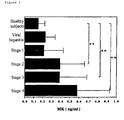
- Serum MK levels in each HCC patient, viral hepatitis patient, and 135 healthy subjects were measured by the method according to (1) in Example 2 ( Figure 1 ).
- the bar in the figure indicates standard deviation.
- Serum MK levels of HCC patients were confirmed to become significantly higher from stage II compared to those of healthy subjects.
- Serum MK levels in each of the above-mentioned HCC patients, viral hepatitis patients, and 376 healthy subjects were measured using the one-step sandwich method according to (2) of Example 2, in which sensitivity of EIA was enhanced ( Figure 2 ).
- the bar in the figure indicates standard deviation.
- Serum MK levels in HCC patients at stage I was 0.22 ng/ml (mean value), a significantly higher value (**p ⁇ 0.01; Mann-Whitney test) compared to 0.02 ng/ml (mean value) obtained for healthy subjects. Therefore, MK was found to be extremely useful as a serum tumor marker for early stage HCC.
- PIVKA-II and AFP are used widely as HCC tumor markers.
- PIVKA-II and AFP are complementary, and combination of PIVKA-II and AFP raises the rate of diagnosis. Therefore, AFP and PIVKA-II were used as comparative control tumor markers.
- Serum PIVKA-II was measured using Eitest PIVKA-II (Sanko Junyaku Co., Ltd.) ( Figure 3 ). The assay was EIA. The possibility that HCC is positive from stage III was suggested.
- Serum AFP level was measured using ⁇ -feto RIA beads (Dainabot) ( Figure 4 ).
- the assay was immunoradiometric assay (IRMA). AFP was not detected in HCC at stage I, and detection was suggested to be possible from stage II.
- Serum MK levels in each stage (1-7) of gastric cancer and those of 135 healthy subjects are shown in Figure 5 (the bar in the figure indicates standard deviation), and those of 376 healthy subjects are shown in Figure 6 (**p ⁇ 0.01; Mann-Whitney U-test; the bar in the graph indicates standard deviation), individually.
- Figure 6 confirmed that serum MK levels in gastric cancer patients are significantly higher than those of healthy subjects from stage 1. That is, MK was found to be useful as a tumor marker for early diagnosis of gastric cancer.
- CEA and CA19-9 were selected as comparative control tumor markers. Serum CEA levels have been found to rise in various cancers of the digestive organs, as well as in various other cancers, and thus are being widely applied clinically. On the other hand, CA19-9 has been found to indicate highly positive values in cancers of pancreas and biliary system. Currently, CA19-9 along with CEA are the most widely used tumor markers for cancers of digestive organs in routine clinical applications.
- Serum MK levels were measured in gastric cancer patients using CEA RIA beads (Dainabot) for serum CEA ( Figure 7 ; the bar in the figure indicates standard deviation).
- the assay used was IRMA.
- CEA may be determined as positive from stage 7 , significant differences between stages could not be confirmed because of large standard deviations between each of the stages.
- Serum CA19-9 was measured using Centocor CA19-9 RIA kit (Centocor; normal value: 37 U/ml or less) ( Figure 8 ; the bar in the figure indicates standard error).
- the assay used was IRMA.
- MK was found to be useful as a serum tumor marker for early gastric cancer.
- MK levels of 72 urine samples of cancer patients gastric cancer: 24 patients; hepatocellular carcinoma: 24 patients; and colon cancer: 24 patients
- 50 morning urine samples of of healthy subjects taken during health checks were measured by the method in (2) of Example 2.
- creatinine values were measured in the same urine, and then MK values were corrected with the creatinine values.
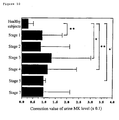
- the results are indicated in Figure 9 .
- a significant difference (p ⁇ 0.01; using Mann-Whitney U-test) was confirmed between urine MK values of healthy subjects and cancer patients.
- stage categorizations were made on a total of 65 patients comprising 3 bile duct cancer patients, 3 breast cancer patients, 6 colon cancer patients, 3 esophageal cancer patients, 1 gallbladder cancer patient, 10 hepatocellular carcinoma patients, 3 pancreatic cancer patients, 7 rectal cancer patients, 28 gastric cancer patients, and 1 thyroid cancer patient.
- urine MK levels were measured. MK levels at each stage are shown in Figure 10 as corrected values of urine MK (*p ⁇ 0.05, **p ⁇ 0.01; Mann-Whitney U-test).
- Urine MK levels were found to rise significantly in stage I of cancer compared to healthy subjects. To date, tumor markers in urine that increase during the early stages of cancer have not been reported. That is, urine MK level is useful for early screening of various cancers.
- Table 2 itemizes the stages of a total of 150 cancer patients comprising 18 esophageal cancer patients, 30 gastric cancer patients, 2 duodenal cancer patients, 25 colorectal cancer patients, 25 hepatocellular carcinoma patients, 12 bile duct cancer and gallbladder cancer patients, 9 pancreatic cancer patients, 5 thyroid cancer patients, 19 lung cancer patients (for illustration), and 5 breast cancer patients.
- the result of measuring the serum MK levels of these 150 cancer patients by EIA is indicated in Figure 12 .
- Serum MK levels of 150 cancer patients indicated significant difference to those of healthy subjects (p ⁇ 0.001, Mann-Whitney U-test). Serum MK levels larger than the 0.5 ng/ml cut-off value was seen in 87% of the patients.
- This invention provides a tumor marker useful for diagnosing early cancer.
- the tumor marker is useful for screening early cancer, estimating the stage and prognosis of certain types of cancers, and for monitoring the course of treatment.
Landscapes
- Health & Medical Sciences (AREA)
- Life Sciences & Earth Sciences (AREA)
- Immunology (AREA)
- Engineering & Computer Science (AREA)
- Molecular Biology (AREA)
- Biomedical Technology (AREA)
- Chemical & Material Sciences (AREA)
- Hematology (AREA)
- Urology & Nephrology (AREA)
- Food Science & Technology (AREA)
- Biochemistry (AREA)
- Cell Biology (AREA)
- Biotechnology (AREA)
- Medicinal Chemistry (AREA)
- Physics & Mathematics (AREA)
- Analytical Chemistry (AREA)
- Microbiology (AREA)
- General Health & Medical Sciences (AREA)
- General Physics & Mathematics (AREA)
- Pathology (AREA)
- Investigating Or Analysing Biological Materials (AREA)
- Medicines Containing Material From Animals Or Micro-Organisms (AREA)
- Medicines That Contain Protein Lipid Enzymes And Other Medicines (AREA)
- Medicines Containing Antibodies Or Antigens For Use As Internal Diagnostic Agents (AREA)
Claims (12)
- Ein Verfahren zum Screenen für frühen Krebs, welches folgende Schritte umfasst:a) Messen von Midkine und/oder einem Fragment davon in einer Körperflüssigkeit, erhalten von einem Patienten, undb) Vergleich des gemessenen Wertes erhalten in Schritt a) mit einem gemessenen Wert eines gesunden Subjektes.
- Ein Verfahren entsprechend Anspruch 1, wobei der frühe Krebs Magenkrebs ist.
- Ein Verfahren entsprechend Anspruch 2, wobei der Magenkrebs sich Stadium I befindet.
- Ein Verfahren entsprechend Anspruch 1, wobei der frühe Krebs ein Leberkarzinom ist.
- Ein Verfahren entsprechend Anspruch 4, wobei das Leberkarzinom sich im Stadium I befindet.
- Ein Verfahren entsprechend Anspruch 1, wobei die Körperflüssigkeit Serum oder Urin ist.
- Ein Verfahren entsprechend irgendeinem der Ansprüche 1 bis 6, wobei Midkine gemessen wird unter Verwendung eines einschrittigen Sandwich-Enzym-Immunoassays.
- Ein Verfahren entsprechend Anspruch 7, wobei der Immunoassay einen Huhn-anti-human-Midkine-Antikörper einschließt.
- Verwendung eines Antikörpers, der Midkine erkennt, und/oder eines Fragmentes davon zum Screenen nach frühem Krebs in einer Körperflüssigkeit, die von einem Patienten erhalten wurde.
- Die Verwendung eines Kits zum Screenen nach frühem Krebs in einer Körperflüssigkeit durch irgendeines der Verfahren der Ansprüche 1 bis 8, wobei der Kit (a) einen Container umfasst, der einen Antikörper enthält, der spezifisch an zumindest ein Epitop von Midkine bindet und/oder ein Fragment davon, und (b) das Vorliegen von Midkine und/oder eines Fragmentes davon in der Körperflüssigkeit bestimmt.
- Die Verwendung entsprechend Anspruch 10, wobei der Antikörper auf einer Festphase adsorbiert ist.
- Die Verwendung eines Antikörpers gegen Midkine oder eines Fragmentes davon in der Herstellung eines Screening-Agens zum Screenen nach frühem Krebs unter Verwendung von Körperflüssigkeitsproben.
Applications Claiming Priority (7)
| Application Number | Priority Date | Filing Date | Title |
|---|---|---|---|
| JP25667899 | 1999-09-10 | ||
| JP25667899 | 1999-09-10 | ||
| JP34540499 | 1999-12-03 | ||
| JP34540499 | 1999-12-03 | ||
| JP2000033168 | 2000-02-10 | ||
| JP2000033168 | 2000-02-10 | ||
| PCT/JP2000/006147 WO2001020333A1 (en) | 1999-09-10 | 2000-09-08 | Early cancer tumor marker |
Publications (3)
| Publication Number | Publication Date |
|---|---|
| EP1215500A1 EP1215500A1 (de) | 2002-06-19 |
| EP1215500A4 EP1215500A4 (de) | 2004-12-08 |
| EP1215500B1 true EP1215500B1 (de) | 2008-07-09 |
Family
ID=27334550
Family Applications (1)
| Application Number | Title | Priority Date | Filing Date |
|---|---|---|---|
| EP00957049A Expired - Lifetime EP1215500B1 (de) | 1999-09-10 | 2000-09-08 | Tumormarker für frühes krebsstadium |
Country Status (9)
| Country | Link |
|---|---|
| US (1) | US7090983B1 (de) |
| EP (1) | EP1215500B1 (de) |
| KR (1) | KR100768985B1 (de) |
| CN (1) | CN1232826C (de) |
| AT (1) | ATE400813T1 (de) |
| AU (1) | AU780957B2 (de) |
| CA (1) | CA2384579C (de) |
| DE (1) | DE60039441D1 (de) |
| WO (1) | WO2001020333A1 (de) |
Families Citing this family (54)
| Publication number | Priority date | Publication date | Assignee | Title |
|---|---|---|---|---|
| US20050214292A1 (en) * | 2002-10-18 | 2005-09-29 | Wyeth | Compositions and methods for diagnosing and treating autoimmune disease |
| GB0307403D0 (en) | 2003-03-31 | 2003-05-07 | Medical Res Council | Selection by compartmentalised screening |
| GB0307428D0 (en) | 2003-03-31 | 2003-05-07 | Medical Res Council | Compartmentalised combinatorial chemistry |
| US20060078893A1 (en) | 2004-10-12 | 2006-04-13 | Medical Research Council | Compartmentalised combinatorial chemistry by microfluidic control |
| WO2004092992A1 (ja) * | 2003-04-15 | 2004-10-28 | Cell Signals Inc. | 健康情報の提供システムおよび健康情報の提供方法 |
| US20050221339A1 (en) | 2004-03-31 | 2005-10-06 | Medical Research Council Harvard University | Compartmentalised screening by microfluidic control |
| US7968287B2 (en) | 2004-10-08 | 2011-06-28 | Medical Research Council Harvard University | In vitro evolution in microfluidic systems |
| WO2007053659A2 (en) * | 2005-11-01 | 2007-05-10 | Government Of The United States Of America, Represented By The Secretary, Department Of Health And Human Services | Method of screening for hepatocellular carcinoma |
| WO2007081385A2 (en) | 2006-01-11 | 2007-07-19 | Raindance Technologies, Inc. | Microfluidic devices and methods of use in the formation and control of nanoreactors |
| KR100777088B1 (ko) | 2006-04-04 | 2007-11-28 | 재단법인 한국원자력의학원 | 간암을 진단하기 위한 마커인 lcn2, midkine 및tfpi, 그를 포함하는 키트 및 상기 마커를 이용한 간암예측 방법 |
| EP2530167A1 (de) | 2006-05-11 | 2012-12-05 | Raindance Technologies, Inc. | Mikrofluidische Vorrichtungen |
| US9562837B2 (en) | 2006-05-11 | 2017-02-07 | Raindance Technologies, Inc. | Systems for handling microfludic droplets |
| EP2077912B1 (de) | 2006-08-07 | 2019-03-27 | The President and Fellows of Harvard College | Fluorkohlenstoffemulsionsstabilisierende tenside |
| WO2008097559A2 (en) | 2007-02-06 | 2008-08-14 | Brandeis University | Manipulation of fluids and reactions in microfluidic systems |
| US8592221B2 (en) | 2007-04-19 | 2013-11-26 | Brandeis University | Manipulation of fluids, fluid components and reactions in microfluidic systems |
| WO2009025094A1 (ja) * | 2007-08-20 | 2009-02-26 | Tsuneya Ohno | 哺乳動物の癌の診断方法 |
| EP3115469B1 (de) * | 2007-11-19 | 2020-04-29 | Celera Corporation | Lungenkrebsmarker und verwendungen davon |
| CA2716854A1 (en) * | 2008-02-29 | 2009-09-03 | National University Corporation Nagoya University | Biomarker for the estimation of acute renal disorder and prognosis of the disorder, and use of the biomarker |
| US12038438B2 (en) | 2008-07-18 | 2024-07-16 | Bio-Rad Laboratories, Inc. | Enzyme quantification |
| EP4047367A1 (de) | 2008-07-18 | 2022-08-24 | Bio-Rad Laboratories, Inc. | Verfahren zum nachweis von zielanalyten unter verwendung von tropfenbibliotheken |
| US10359425B2 (en) * | 2008-09-09 | 2019-07-23 | Somalogic, Inc. | Lung cancer biomarkers and uses thereof |
| US20100221752A2 (en) * | 2008-10-06 | 2010-09-02 | Somalogic, Inc. | Ovarian Cancer Biomarkers and Uses Thereof |
| JP2010139293A (ja) * | 2008-12-10 | 2010-06-24 | Medical Therapies Ltd | 早期癌腫瘍マーカー |
| WO2010111231A1 (en) | 2009-03-23 | 2010-09-30 | Raindance Technologies, Inc. | Manipulation of microfluidic droplets |
| EP2442106B1 (de) * | 2009-06-10 | 2015-08-19 | Masanori Hara | Testverfahren auf diabetes-nephropathie |
| US10520500B2 (en) | 2009-10-09 | 2019-12-31 | Abdeslam El Harrak | Labelled silica-based nanomaterial with enhanced properties and uses thereof |
| US10837883B2 (en) | 2009-12-23 | 2020-11-17 | Bio-Rad Laboratories, Inc. | Microfluidic systems and methods for reducing the exchange of molecules between droplets |
| US9366632B2 (en) | 2010-02-12 | 2016-06-14 | Raindance Technologies, Inc. | Digital analyte analysis |
| US10351905B2 (en) | 2010-02-12 | 2019-07-16 | Bio-Rad Laboratories, Inc. | Digital analyte analysis |
| EP4484577A3 (de) | 2010-02-12 | 2025-03-26 | Bio-Rad Laboratories, Inc. | Digitale analytanalyse |
| US9399797B2 (en) | 2010-02-12 | 2016-07-26 | Raindance Technologies, Inc. | Digital analyte analysis |
| SG186953A1 (en) | 2010-07-09 | 2013-02-28 | Somalogic Inc | Lung cancer biomarkers and uses thereof |
| CN103415624B (zh) | 2010-08-13 | 2017-03-01 | 私募蛋白质体公司 | 胰腺癌生物标记及其用途 |
| US9562897B2 (en) | 2010-09-30 | 2017-02-07 | Raindance Technologies, Inc. | Sandwich assays in droplets |
| NZ589251A (en) * | 2010-11-12 | 2014-07-25 | Pacific Edge Ltd | Novel marker for detection of bladder cancer |
| EP3412778A1 (de) | 2011-02-11 | 2018-12-12 | Raindance Technologies, Inc. | Verfahren zur bildung gemischter tröpfchen |
| WO2012112804A1 (en) | 2011-02-18 | 2012-08-23 | Raindance Technoligies, Inc. | Compositions and methods for molecular labeling |
| US8841071B2 (en) | 2011-06-02 | 2014-09-23 | Raindance Technologies, Inc. | Sample multiplexing |
| EP3216872B1 (de) | 2011-06-02 | 2020-04-01 | Bio-Rad Laboratories, Inc. | Enzymquantifizierung |
| US8658430B2 (en) | 2011-07-20 | 2014-02-25 | Raindance Technologies, Inc. | Manipulating droplet size |
| WO2013120089A1 (en) | 2012-02-10 | 2013-08-15 | Raindance Technologies, Inc. | Molecular diagnostic screening assay |
| EP2844768B1 (de) | 2012-04-30 | 2019-03-13 | Raindance Technologies, Inc. | Digitale analyse von analyten |
| US9946887B2 (en) | 2012-06-04 | 2018-04-17 | Nokia Technologies Oy | Method and apparatus for determining privacy policy based on data and associated values |
| WO2014081633A1 (en) | 2012-11-20 | 2014-05-30 | The United States Of America, As Represented By The Secretary, Department Of Health And Human Services | Assay to measure midkine or pleiotrophin level for diagnosing a growth |
| US20140271453A1 (en) * | 2013-03-14 | 2014-09-18 | Abbott Laboratories | Methods for the early detection of lung cancer |
| WO2014172288A2 (en) | 2013-04-19 | 2014-10-23 | Raindance Technologies, Inc. | Digital analyte analysis |
| US11901041B2 (en) | 2013-10-04 | 2024-02-13 | Bio-Rad Laboratories, Inc. | Digital analysis of nucleic acid modification |
| US9944977B2 (en) | 2013-12-12 | 2018-04-17 | Raindance Technologies, Inc. | Distinguishing rare variations in a nucleic acid sequence from a sample |
| WO2015103367A1 (en) | 2013-12-31 | 2015-07-09 | Raindance Technologies, Inc. | System and method for detection of rna species |
| WO2015182218A1 (ja) * | 2014-05-26 | 2015-12-03 | オリンパス株式会社 | 膵癌判定方法 |
| US10647981B1 (en) | 2015-09-08 | 2020-05-12 | Bio-Rad Laboratories, Inc. | Nucleic acid library generation methods and compositions |
| US10998178B2 (en) | 2017-08-28 | 2021-05-04 | Purdue Research Foundation | Systems and methods for sample analysis using swabs |
| CN109387635A (zh) * | 2018-11-07 | 2019-02-26 | 国家纳米科学中心 | 基于热泳细胞外囊泡检测的胃癌检测系统及方法 |
| KR20220000082U (ko) | 2020-07-01 | 2022-01-10 | 박세현 | 곽 휴지 형 그림책 |
Family Cites Families (3)
| Publication number | Priority date | Publication date | Assignee | Title |
|---|---|---|---|---|
| JP3842304B2 (ja) * | 1992-10-08 | 2006-11-08 | 喬 村松 | 癌の診断、治療薬 |
| JP3418416B2 (ja) | 1992-10-08 | 2003-06-23 | 喬 村松 | 核酸診断法 |
| WO2000031541A2 (en) | 1998-11-20 | 2000-06-02 | Georgetown University | Method of detecting neurofibromatosis type 1 |
-
2000
- 2000-09-08 DE DE60039441T patent/DE60039441D1/de not_active Expired - Lifetime
- 2000-09-08 CA CA2384579A patent/CA2384579C/en not_active Expired - Lifetime
- 2000-09-08 AT AT00957049T patent/ATE400813T1/de not_active IP Right Cessation
- 2000-09-08 WO PCT/JP2000/006147 patent/WO2001020333A1/ja not_active Ceased
- 2000-09-08 EP EP00957049A patent/EP1215500B1/de not_active Expired - Lifetime
- 2000-09-08 CN CNB008155534A patent/CN1232826C/zh not_active Expired - Lifetime
- 2000-09-08 KR KR1020027003012A patent/KR100768985B1/ko not_active Expired - Lifetime
- 2000-09-08 US US10/070,569 patent/US7090983B1/en not_active Expired - Lifetime
- 2000-09-08 AU AU68760/00A patent/AU780957B2/en not_active Expired
Non-Patent Citations (2)
| Title |
|---|
| E-mail November 17 2004 * |
| Letter J. Maidment dated 1 November 2007 * |
Also Published As
| Publication number | Publication date |
|---|---|
| EP1215500A4 (de) | 2004-12-08 |
| ATE400813T1 (de) | 2008-07-15 |
| CN1390304A (zh) | 2003-01-08 |
| CA2384579A1 (en) | 2001-03-22 |
| CN1232826C (zh) | 2005-12-21 |
| WO2001020333A1 (en) | 2001-03-22 |
| KR100768985B1 (ko) | 2007-10-22 |
| DE60039441D1 (de) | 2008-08-21 |
| AU780957B2 (en) | 2005-04-28 |
| KR20020043577A (ko) | 2002-06-10 |
| AU6876000A (en) | 2001-04-17 |
| CA2384579C (en) | 2010-12-07 |
| US7090983B1 (en) | 2006-08-15 |
| EP1215500A1 (de) | 2002-06-19 |
Similar Documents
| Publication | Publication Date | Title |
|---|---|---|
| EP1215500B1 (de) | Tumormarker für frühes krebsstadium | |
| EP1137943B1 (de) | Krebsnachweisverfahren und reagenzien | |
| CN112345755A (zh) | 乳腺癌的生物标志物及其应用 | |
| KR20190088510A (ko) | 항체 에세이 | |
| US20100216654A1 (en) | Biomarkers of prostate cancer and uses thereof | |
| KR20050114604A (ko) | 대장암에 대한 마커로서의 니코틴아미드n―메틸트랜스퍼라아제의 용도 | |
| JP5670422B2 (ja) | 胃癌検出用マーカー及び胃癌検出方法 | |
| JP5773979B2 (ja) | 胃癌検出用マーカー及び胃癌検出方法 | |
| US20060177880A1 (en) | Use of PRN3/ILEU as a marker for colorectal cancer | |
| JP2011038952A (ja) | 特定の糖鎖構造を有する糖タンパク質を検出することにより癌を検出する方法 | |
| JP7709703B2 (ja) | 膵臓がんの検出方法及び検出試薬 | |
| US20100221742A1 (en) | Novel cancer associated antibodies and their use in cancer diagnosis | |
| CN1752104B (zh) | 突触蛋白γ的单克隆抗体及其应用 | |
| JP2004198313A (ja) | 甲状腺腫瘍の診断用キット | |
| JP2010139293A (ja) | 早期癌腫瘍マーカー | |
| US20230375550A1 (en) | Method for diagnosing breast cancer by using biomarker | |
| KR101225846B1 (ko) | 인간 오로트산 포스포리보실 트랜스퍼라아제 단백질의측정법 | |
| WO2018034332A1 (ja) | EphA2 N末端フラグメント抗体 | |
| JPWO2001020333A1 (ja) | 早期癌腫瘍マーカー | |
| JP2000227432A (ja) | 肺癌の予後検査方法 |
Legal Events
| Date | Code | Title | Description |
|---|---|---|---|
| PUAI | Public reference made under article 153(3) epc to a published international application that has entered the european phase |
Free format text: ORIGINAL CODE: 0009012 |
|
| 17P | Request for examination filed |
Effective date: 20020404 |
|
| AK | Designated contracting states |
Kind code of ref document: A1 Designated state(s): AT BE CH CY DE DK ES FI FR GB GR IE IT LI LU MC NL PT SE |
|
| RIN1 | Information on inventor provided before grant (corrected) |
Inventor name: KUMAI, HIDESHI Inventor name: OKAMOTO, KOHJI Inventor name: SAKUMA, SADATOSHI Inventor name: MURAMATSU, TAKASHI Inventor name: IKEMATSU, SHINYA Inventor name: ODA, MUNEHIRO |
|
| A4 | Supplementary search report drawn up and despatched |
Effective date: 20041027 |
|
| 17Q | First examination report despatched |
Effective date: 20050502 |
|
| GRAP | Despatch of communication of intention to grant a patent |
Free format text: ORIGINAL CODE: EPIDOSNIGR1 |
|
| GRAS | Grant fee paid |
Free format text: ORIGINAL CODE: EPIDOSNIGR3 |
|
| GRAA | (expected) grant |
Free format text: ORIGINAL CODE: 0009210 |
|
| AK | Designated contracting states |
Kind code of ref document: B1 Designated state(s): AT BE CH CY DE DK ES FI FR GB GR IE IT LI LU MC NL PT SE |
|
| REG | Reference to a national code |
Ref country code: GB Ref legal event code: FG4D |
|
| REG | Reference to a national code |
Ref country code: CH Ref legal event code: EP Ref country code: CH Ref legal event code: NV Representative=s name: PATENTANWALTSBUERO JEAN HUNZIKER AG |
|
| REF | Corresponds to: |
Ref document number: 60039441 Country of ref document: DE Date of ref document: 20080821 Kind code of ref document: P |
|
| REG | Reference to a national code |
Ref country code: IE Ref legal event code: FG4D |
|
| NLV1 | Nl: lapsed or annulled due to failure to fulfill the requirements of art. 29p and 29m of the patents act | ||
| RAP2 | Party data changed (patent owner data changed or rights of a patent transferred) |
Owner name: MEDICAL THERAPIES LIMITED |
|
| PG25 | Lapsed in a contracting state [announced via postgrant information from national office to epo] |
Ref country code: PT Free format text: LAPSE BECAUSE OF FAILURE TO SUBMIT A TRANSLATION OF THE DESCRIPTION OR TO PAY THE FEE WITHIN THE PRESCRIBED TIME-LIMIT Effective date: 20081209 Ref country code: NL Free format text: LAPSE BECAUSE OF FAILURE TO SUBMIT A TRANSLATION OF THE DESCRIPTION OR TO PAY THE FEE WITHIN THE PRESCRIBED TIME-LIMIT Effective date: 20080709 Ref country code: ES Free format text: LAPSE BECAUSE OF FAILURE TO SUBMIT A TRANSLATION OF THE DESCRIPTION OR TO PAY THE FEE WITHIN THE PRESCRIBED TIME-LIMIT Effective date: 20081020 |
|
| PG25 | Lapsed in a contracting state [announced via postgrant information from national office to epo] |
Ref country code: AT Free format text: LAPSE BECAUSE OF FAILURE TO SUBMIT A TRANSLATION OF THE DESCRIPTION OR TO PAY THE FEE WITHIN THE PRESCRIBED TIME-LIMIT Effective date: 20080709 Ref country code: FI Free format text: LAPSE BECAUSE OF FAILURE TO SUBMIT A TRANSLATION OF THE DESCRIPTION OR TO PAY THE FEE WITHIN THE PRESCRIBED TIME-LIMIT Effective date: 20080709 |
|
| REG | Reference to a national code |
Ref country code: GB Ref legal event code: 732E Free format text: REGISTERED BETWEEN 20090402 AND 20090408 |
|
| PG25 | Lapsed in a contracting state [announced via postgrant information from national office to epo] |
Ref country code: MC Free format text: LAPSE BECAUSE OF NON-PAYMENT OF DUE FEES Effective date: 20080930 Ref country code: DK Free format text: LAPSE BECAUSE OF FAILURE TO SUBMIT A TRANSLATION OF THE DESCRIPTION OR TO PAY THE FEE WITHIN THE PRESCRIBED TIME-LIMIT Effective date: 20080709 |
|
| PLBE | No opposition filed within time limit |
Free format text: ORIGINAL CODE: 0009261 |
|
| STAA | Information on the status of an ep patent application or granted ep patent |
Free format text: STATUS: NO OPPOSITION FILED WITHIN TIME LIMIT |
|
| 26N | No opposition filed |
Effective date: 20090414 |
|
| REG | Reference to a national code |
Ref country code: FR Ref legal event code: TP |
|
| PG25 | Lapsed in a contracting state [announced via postgrant information from national office to epo] |
Ref country code: IE Free format text: LAPSE BECAUSE OF NON-PAYMENT OF DUE FEES Effective date: 20080908 |
|
| REG | Reference to a national code |
Ref country code: CH Ref legal event code: PUE Owner name: MEDICAL THERAPIES LIMITED Free format text: MURAMATSU, TAKASHI#2845-161, AZA KUROISHI, OAZA HIRABARI, TENPAKU-CHO, TENPAKU-KU#NAGOYA-SHI, AICHI 468-0021 (JP) -TRANSFER TO- MEDICAL THERAPIES LIMITED#LEVEL 6 40 KING STREET#SYDNEY, NSW 2000 (AU) |
|
| PG25 | Lapsed in a contracting state [announced via postgrant information from national office to epo] |
Ref country code: SE Free format text: LAPSE BECAUSE OF FAILURE TO SUBMIT A TRANSLATION OF THE DESCRIPTION OR TO PAY THE FEE WITHIN THE PRESCRIBED TIME-LIMIT Effective date: 20081009 |
|
| PG25 | Lapsed in a contracting state [announced via postgrant information from national office to epo] |
Ref country code: CY Free format text: LAPSE BECAUSE OF FAILURE TO SUBMIT A TRANSLATION OF THE DESCRIPTION OR TO PAY THE FEE WITHIN THE PRESCRIBED TIME-LIMIT Effective date: 20080709 Ref country code: LU Free format text: LAPSE BECAUSE OF NON-PAYMENT OF DUE FEES Effective date: 20080908 |
|
| PG25 | Lapsed in a contracting state [announced via postgrant information from national office to epo] |
Ref country code: GR Free format text: LAPSE BECAUSE OF FAILURE TO SUBMIT A TRANSLATION OF THE DESCRIPTION OR TO PAY THE FEE WITHIN THE PRESCRIBED TIME-LIMIT Effective date: 20081010 |
|
| REG | Reference to a national code |
Ref country code: FR Ref legal event code: PLFP Year of fee payment: 17 |
|
| REG | Reference to a national code |
Ref country code: FR Ref legal event code: PLFP Year of fee payment: 18 |
|
| REG | Reference to a national code |
Ref country code: FR Ref legal event code: PLFP Year of fee payment: 19 |
|
| PGFP | Annual fee paid to national office [announced via postgrant information from national office to epo] |
Ref country code: FR Payment date: 20190923 Year of fee payment: 20 Ref country code: DE Payment date: 20190919 Year of fee payment: 20 |
|
| PGFP | Annual fee paid to national office [announced via postgrant information from national office to epo] |
Ref country code: BE Payment date: 20190918 Year of fee payment: 20 |
|
| PGFP | Annual fee paid to national office [announced via postgrant information from national office to epo] |
Ref country code: GB Payment date: 20190918 Year of fee payment: 20 |
|
| PGFP | Annual fee paid to national office [announced via postgrant information from national office to epo] |
Ref country code: CH Payment date: 20190926 Year of fee payment: 20 |
|
| PGFP | Annual fee paid to national office [announced via postgrant information from national office to epo] |
Ref country code: IT Payment date: 20190927 Year of fee payment: 20 |
|
| REG | Reference to a national code |
Ref country code: DE Ref legal event code: R071 Ref document number: 60039441 Country of ref document: DE |
|
| REG | Reference to a national code |
Ref country code: CH Ref legal event code: PL |
|
| REG | Reference to a national code |
Ref country code: GB Ref legal event code: PE20 Expiry date: 20200907 |
|
| REG | Reference to a national code |
Ref country code: BE Ref legal event code: MK Effective date: 20200908 |
|
| PG25 | Lapsed in a contracting state [announced via postgrant information from national office to epo] |
Ref country code: GB Free format text: LAPSE BECAUSE OF EXPIRATION OF PROTECTION Effective date: 20200907 |