EP1217551A2 - Verwalten eines geschichteten hierarchischen Datensatzes - Google Patents
Verwalten eines geschichteten hierarchischen Datensatzes Download PDFInfo
- Publication number
- EP1217551A2 EP1217551A2 EP01130822A EP01130822A EP1217551A2 EP 1217551 A2 EP1217551 A2 EP 1217551A2 EP 01130822 A EP01130822 A EP 01130822A EP 01130822 A EP01130822 A EP 01130822A EP 1217551 A2 EP1217551 A2 EP 1217551A2
- Authority
- EP
- European Patent Office
- Prior art keywords
- nodes
- data
- computer
- state attributes
- data element
- Prior art date
- Legal status (The legal status is an assumption and is not a legal conclusion. Google has not performed a legal analysis and makes no representation as to the accuracy of the status listed.)
- Withdrawn
Links
Images



Classifications
-
- G—PHYSICS
- G06—COMPUTING OR CALCULATING; COUNTING
- G06F—ELECTRIC DIGITAL DATA PROCESSING
- G06F16/00—Information retrieval; Database structures therefor; File system structures therefor
- G06F16/20—Information retrieval; Database structures therefor; File system structures therefor of structured data, e.g. relational data
- G06F16/28—Databases characterised by their database models, e.g. relational or object models
- G06F16/282—Hierarchical databases, e.g. IMS, LDAP data stores or Lotus Notes
Definitions
- the present invention relates to a managing of layered hierarchical data.
- Configured data may be categorized under system policies, application profiles, and user profiles.
- Data that describes the overall organizational system policies and configurations is functionally hierarchical. Typical kinds of data under this category may include an employee's role within the enterprise, privileges assigned to and system resources available to employees based on their roles, applications (or components thereof) available to employees based on their roles, platform related resources and limitations, and domain based network and server settings (for example, proxy server, Internet message access protocol (IMAP) server, calendar server, news server, etc.).
- IMAP Internet message access protocol
- This data is usually modified by an administrator or administrator class, and can often only be accessed by other employees in a read only format. This data is neither user nor application specific, but rather it is data that describes the policies and configuration of the entire enterprise.
- This kind of data describes an application environment and components (startup information, user interface (UI) components, libraries, resources needed, etc.)
- System default data is defined before the application is deployed.
- UI user interface
- a domain or group administrator may override the system defaults and set data values for their sub-organization.
- a user then may decide to override these default values with his/her own values.
- Each category of data may consist of one or more such layers.
- Usually these kinds of data are stored on external secure storage mediums like a relational database management system (RDBMS) or a lightweight directory access protocol (LDAP).
- RDBMS relational database management system
- LDAP lightweight directory access protocol
- User profiles are data typically specific to the domain to which users belong to and is not application specific. It defines the identity of the user within an organization. Initially set by an administrator or administrator class, it may be partially accessible to the employee that it describes. This data may be partially read only, and may typically be modified by user, group administrator or system administrator.
- Typical kinds of data under this category for each user may include, for instance, login information, passwords/certificates for certain applications, user environment which includes hardware/software settings, printer settings, language preference, etc., network and server settings which include name server, IMAP server, and calendar server to use, Internet Service Provider (ISP), point-to-point protocol (PPP), domain name system (DNS), and dynamic host configuration protocol (DHCP) settings to use, user policies regarding personal data and resources, including who can access personal data, what kind of access, personal settings like bookmarks for a web browser, alias definitions, and user application preferences from a group of similar types of available applications (for example, Outlook Express rather than Netscape Messenger to read email).
- ISP Internet Service Provider
- PPP point-to-point protocol
- DNS domain name system
- DHCP dynamic host configuration protocol
- these categories of data are typically spread among the different organizational layers dictated by the system policies.
- these layers may be system default layer, domain default layer, group default layer, user layer, etc.
- the administrator may define different groups according to the responsibilities and roles of its employees. For example, a software company may have groups like engineering, quality assurance, release engineering, and administrative staff. Depending on the needs of the employees in a group, a group administrator may decide to set default values or add new ones by setting them to appropriate values for the users of the group. These new values override the system default values mentioned earlier.
- data relating to the users preferences may be hierarchically stored. This might include, for instance, the user's preferred printer or the fonts the user prefers.
- the data should follow the organizational layout and also be defined in different layers that may override each other.
- applications may come installed with system default data.
- the administrator for a division/domain or department may decide to override this default data and set preference data for the users depending on their roles and responsibilities.
- the users may further override the data set by the administrator with their own data.
- a user or client application changes this data, the user does not necessarily know which layer the data is coming from nor is it preferable to know what layer the data is coming from. For instance, if a user has a mailbox that is set in a group layer as a default called "my documents", and the user wishes to change the location of the mailbox to a new location which is also called "my documents" then, the server must remember that the user's layer only replaces the mailbox location while the group layer's default location for other users remains the same. This means that two versions remain. The data in the group location has not changed. This can lead to improper operations due to the data conflict.
- One scheme comprises a client side analysis of all nodes in the hierarchy to determine what defaults have been overridden each time data in the hierarchy is accessed. This scheme, however, adds tremendous complexity to the client side and adds additional latency because each time a user accesses the hierarchical data, a complete analysis of the entire hierarchy is performed.
- This object of the invention is solved by a method for managing a plurality of nodes in a hierarchically organized database stored in a server on a computer network comprising: accessing a subset of said nodes in response to a client request; using said subset wherein one or more state attributes associated with said nodes are modified in response to said client request; and managing said nodes using said state attributes.
- state attributes may indicate that a corresponding data element should be updated and/or deleted and/or added.
- nodes may be organized using a Document Object Model format.
- a manager for one or more nodes in a hierarchically organized database stored in a server on a computer network comprising: a subset of said nodes configured to be accessed in response to a user request; one or more state attributes associated with said nodes configured to be modified in response to said client request when said subset is used; and a manager configured to manage said nodes using said state attributes.
- a computer program product comprising: a computer usable medium having computer readable program code embodied therein configured to manage a plurality of nodes in a hierarchically organized database stored in a server on a computer network computer readable code configured to cause a computer to access a subset of said nodes in response to a client request; computer readable code configured to cause a computer to use said subset wherein one or more state attributes associated with said nodes are modified in response to said client request; and computer readable code configured to cause a computer to manage said nodes using said state attributes.
- an apparatus comprising: a subset of one or more nodes configured to be accessed in response to a client request wherein said subset is used wherein one or more state attributes associated with said nodes are modified in response to said client request; and a manager configured to manage said nodes using said state attributes.
- the present invention relates to managing a layered hierarchical data set.
- a hierarchical set of nodes has a state attribute associated with each data element in the node.
- a subset of the hierarchical data is presented to the user.
- the state attribute associated with the data element is updated.
- the entire hierarchical data set is managed so that when a user accesses the data again, it is presented correctly.
- a function called “updateNode” manages the data coming from any layer in the hierarchical set via a state attribute which describes the last action taken on the data element, including for instance added, deleted, modified, or replaced.
- the updateNode function is independent of the number of layers of data defined by the administrator, and is also independent of the configuration data layout or hierarchy. As a result, it can support any arbitrary configuration of data that is organized hierarchically.
- the updateNode function accomplishes a variety of changes, including overriding default values from the administrator's tree, resetting the overridden value back to the default, updating the default value in the administrator's tree, adding a new data or nodes to the user's sub-tree, and updating values of pre-existing nodes.
- all profile and configuration (including system policies and user profiles) files are in eXtensible Markup Language (XML) format. These files may be either provided by the vendors in XML format, or may be created, for instance, through an import utility.
- system policies and user profile information may be external for users of an enterprise environment, and may be already available on secure storage mediums like RDBMS or LDAP. The present algorithm is able to integrate use of this pre-existing information with minimum difficulty. This pre-existing information may be modified by other applications not on the server, and therefore is refreshed in the cache of the enterprise environment.
- another embodiment of the present invention has the data as a single Document Object Model (DOM) tree.
- DOM Document Object Model
- the server has the responsibility of converging data into a merged tree, and converting the merged tree transactions to the actual tree on the server. This is accomplished by examining the data elements in the hierarchy where the associated state attribute is no longer in a default state and presenting the data elements associated with the non-default state attribute and their parent nodes, continuing up to the root of the tree. Then, merging any changes made on the sub-tree back to the complete tree by updating the state elements.
- DOM Document Object Model
- Embodiments of the invention are for managing a layered hierarchical data set.
- numerous specific details are set forth to provide a more thorough description of embodiments of the invention. It will be apparent, however, to one skilled in the art, that the invention may be practiced without these specific details. In other instances, well known features have not been described in detail so as not to obscure the invention.
- a hierarchical data set has state attributes associated with data elements in each node.
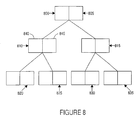
- An example of a tree where state attributes are associated with data elements is shown in Figure 8.
- the tree 800 has multiple nodes labeled 805, 810, 815, 820, 825, 830, and 835. Each node is divided into a data element and a state attribute. Node 810 for instance, comprises data element 840 and state attribute 845.
- a user accesses data in the hierarchical data set.
- a subset of the hierarchical data set i.e., a sub-tree
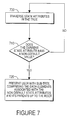
- one embodiment of the present invention shown in Figure 7 presents it to the user in the following manner.
- the state attributes in the tree are traversed so that the appropriate information (i.e., nodes) may be presented to the user.
- the present state attribute has a default value. If the state attribute does in fact have a default value then it has not been changed. Thus, the process repeats and other state attribute are examined at operations 700 and 710 to find one that is non-default.
- the user When a non-default state attribute is encountered, the user is presented with a sub-tree at operation 720 where the data element associated with the non-default state attribute and all of its parents up to the root are presented as a sub-tree. If the user again changes a data element, then the process repeats where the associated state attribute is updated and such an update is propagated to the complete tree residing on the server.
- non-leaf and leaf nodes both of which can be one of the following types:
- a non-leaf node is one which has a branch of nodes (dependencies) under it, while a leaf node is one which has no dependencies. Only leaf nodes have values or a list of values, while, on the other hand, non-leaf nodes may be explicitly defined, for instance via a XML schema or can be derived from a XML schema template. All nodes can have one or more attribute, but each non-leaf node may have specific kinds of attributes, which include for instance, cfg:type, cfg:element_type, etc.
- state attributes are added to each node in the hierarchy, for instance in the manner shown in Figure 8.
- the state attribute has information relating to the last operation that was performed on its corresponding data element.
- Possible values of the state attribute include:
- Figure 2 shows data cached in a server as a DOM tree. For simplicity, the complete tree is not shown. Root 200 is a non-leaf node, while Size 205 is a leaf node.
- the DOM tree has non-leaf nodes, such as the categories that include Templates 220, System policies 221, User Profile 206, and ApplProfile 223, which are in the second topmost layer of this DOM tree (Root is the topmost layer).
- User profile 206 and ApplProfile 223 are further subcategorized into 4 layers: System 224, Domain 225, Group 208, and User 207, which are in turn broken down into other layers, for instance default layer 203.
- this DOM tree is but one example of a hierarchical layout, embodiments of the present invention are equally applicable to other hierarchies as well, including relational databases, binary trees, directed acyclical graphs, or any other hierarchical arrangement of data having any number of layers.
- Figure 3 is a merged view of the tree in Figure 2 which is what a user would operate on when they access Star application 250.
- Figure 3 is designed to show how a user might wish to change a preference in their layer and how this change should override the value in a node in the group or system layer.
- system layer 202, and default layer 203 under ApplProfile layer 201 are missing from the merged view of the tree of Figure 2.
- the general node 294 for the system 202 indicates that the printer 290 should be HP.
- the printer 310 has changed from HP-4P 290 in Figure 2 to Cannon 320 in Figure 3 since the user has changed printer 293 in their user layer 294 and this category is supposed to override the system layer.
- background color (BG) 300 under the Color layer 305 has changed from white in Figure 2 to black in Figure 3.
- updateNode which may reside on a server, such as a Registry server.
- This function performs a variety of operations on the client side. These operations include, for instance:
- Figure 4 is a partial view of the DOM tree of Figures 2 and 3 where updateNode function has been used to change the Font layer 400 from Times 292 (in both Figures 2 and 3) to Arial 405, and the Size node 410 under Lines 415 has been changed from 12 in Figure 2 to 10 in Figure 3 to 14 in Figure 4.
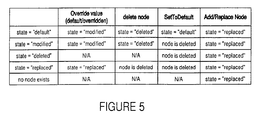
- Figure 5 shows a table of how these operations are accomplished.
- the first column shows the state value for a node before the updateNode operation, while the first row shows the client actions taken.
- the other rows show the final state value of the node after the updateNode operation is successfully completed.
- the server when each node undergoes an updateNode operation the server has to update the information in the cache, and has to relay the same information to the external storage media.
- the node is deleted from the user's sub-tree. If the state is modified on the server and if the node already exists in the user's sub-tree, then its value is modified. On the other hand, if the node does not exists, it is added to the user's sub-tree. If the state is deleted on the server, then if the node already exists and the state was "replaced", then the node is deleted. If the state of the node is "modified”, then state is changed to "deleted”.
- the node does not exist (user was using the default value up to now), it is deleted using the addNode operation with the node's state attribute value set to "deleted". If the state is replaced on the server and if the node already exists, then it is replaced by the new node. On the other hand, if the node does not exist, it is added to the user's sub-tree.
- the updateNode makes use of certain parameters to accomplish the various operations mentioned above. These are:
- the above mentioned operations have a return value based on the result of the operation.
- "status” is a string that returns the success or failure of an operation
- "subNode” is a node that gives the current value of the given sub-node if the result of the operation is a failure, otherwise its value is zero (if the result of the operation is a success).
- the execution of these operations using the above mentioned parameters is accomplished using an input like nodeId, and an output like status.
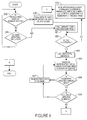
- FIG. 6 is a flowchart that illustrates an example where updateNode is used when an administrator or user asks for data belonging to a different user (the username parameter is known by the administrator).
- the updateNode ensures that the user asking for the request is an administrator. If the user is the administrator then at operation 698 updateNode is called on the sub-tree that represents the data the administrator needs on any layer. If the user is not an administrator, it is determined at step 699 whether is is a user. If not, the process repeats at step 600. Otherwise, at step 601, updateNode is called on a given sub-tree.
- the call to the sub-tree is checked for success. If the call is a failure, then at operation 603 an appropriate error message is sent back (and optionally logged in an error log) along with the current value of the node for the nodePath in the DOM tree.
- an appropriate success message is given at operation 604 after which, at operation 605, sessions that need to be notified about the changes are checked in a notificationTable.
- the nodePath updated is the target node (i.e., the node representing the data the administrator wants), then at operation 607 the notification is sent. If on the other hand, the nodePath is not the target node, then at operation 608, it is checked to see if the nodePath updated is a sub-node of the nodePath in the notificationTable. If it is, then notification is given at operation 607. Otherwise, the process terminates.
- all profile and configuration files (including all files in system policies), and user profiles are in XML format. These files may be either provided directly by the vendor of the application, or may be created, for instance, using an import utility.
- An embodiment of the invention can be implemented as computer software in the form of computer readable program code executed in a general purpose computing environment such as environment 900 illustrated in Figure 9, or in the form of bytecode class files executable within a JavaTM run time environment running in such an environment, or in the form of bytecodes running on a processor (or devices enabled to process bytecodes) existing in a distributed environment (e.g., one or more processors on a network).
- a keyboard 910 and mouse 911 are coupled to a system bus 918. The keyboard and mouse are for introducing user input to the computer system and communicating that user input to central processing unit (CPU) 913. Other suitable input devices may be used in addition to, or in place of, the mouse 911 and keyboard 910.
- I/O (input/output) unit 919 coupled to bi-directional system bus 918 represents such I/O elements as a printer, A/V (audio/video) I/O, etc.
- Computer 901 may include a communication interface 920 coupled to bus 918.
- Communication interface 920 provides a two-way data communication coupling via a network link 921 to a local network 922.
- ISDN integrated services digital network
- communication interface 920 provides a data communication connection to the corresponding type of telephone line, which comprises part of network link 921.
- LAN local area network
- communication interface 920 provides a data communication connection via network link 921 to a compatible LAN.
- Wireless links are also possible.
- communication interface 920 sends and receives electrical, electromagnetic or optical signals which carry digital data streams representing various types of information.
- Network link 921 typically provides data communication through one or more networks to other data devices.
- network link 921 may provide a connection through local network 922 to local server computer 923 or to data equipment operated by ISP 924.
- ISP 924 in turn provides data communication services through the world wide packet data communication network now commonly referred to as the "Internet" 925.
- Internet 925 uses electrical, electromagnetic or optical signals which carry digital data streams.
- the signals through the various networks and the signals on network link 921 and through communication interface 920, which carry the digital data to and from computer 900, are exemplary forms of carrier waves transporting the information.
- Processor 913 may reside wholly on client computer 901 or wholly on server 926 or processor 913 may have its computational power distributed between computer 901 and server 926.
- Server 926 symbolically is represented in Figure 9 as one unit, but server 926 can also be distributed between multiple "tiers".
- server 926 comprises a middle and back tier where application logic executes in the middle tier and persistent data is obtained in the back tier.
- hierarchically organized information 950 typically resides in the back tier in a database 955, while the data is typically accessed by client computer 901.
- client computer 901 makes a request 960, to the database 955 for the hierarchically organized information 950.
- the request 960 is then used to present the user with an appropriate tree by accessing the database 955 and locating the proper nodes in the hierarchical information 960 to re-create a sub-tree 965 on the client computer 901.
- Computer 901 includes a video memory 914, main memory 915 and mass storage 912, all coupled to bi-directional system bus 918 along with keyboard 910, mouse 911 and processor 913.
- main memory 915 and mass storage 912 can reside wholly on server 926 or computer 901, or they may be distributed between the two. Examples of systems where processor 913, main memory 915, and mass storage 912 are distributed between computer 901 and server 926 include the thin-client computing architecture developed by Sun Microsystems, Inc., the palm pilot computing device and other personal digital assistants, Internet ready cellular phones and other Internet computing devices, and in platform independent computing environments, such as those which utilize the Java technologies also developed by Sun Microsystems, Inc.
- the mass storage 912 may include both fixed and removable media, such as magnetic, optical or magnetic optical storage systems or any other available mass storage technology.
- Bus 918 may contain, for example, thirty-two address lines for addressing video memory 914 or main memory 915.
- the system bus 918 also includes, for example, a 32-bit data bus for transferring data between and among the components, such as processor 913, main memory 915, video memory 914 and mass storage 912. Alternatively, multiplex data/address lines may be used instead of separate data and address lines.
- the processor 913 is a microprocessor manufactured by Motorola, such as the 680X0 processor or a microprocessor manufactured by Intel, such as the 80X86, or Pentium processor, or a SPARC microprocessor from Sun Microsystems, Inc. However, any other suitable microprocessor or microcomputer may be utilized.
- Main memory 915 is comprised of dynamic random access memory (DRAM).
- Video memory 914 is a dual-ported video random access memory. One port of the video memory 914 is coupled to video amplifier 916.
- the video amplifier 916 is used to drive the cathode ray tube (CRT) raster monitor 917.
- Video amplifier 916 is well known in the art and may be implemented by any suitable apparatus. This circuitry converts pixel data stored in video memory 914 to a raster signal suitable for use by monitor 917.
- Monitor 917 is a type of monitor suitable for displaying graphic images.
- Computer 901 can send messages and receive data, including program code, through the network(s), network link 921, and communication interface 920.
- remote server computer 926 might transmit a requested code for an application program through Internet 925, ISP 924, local network 922 and communication interface 920.
- the received code may be executed by processor 913 as it is received, and/or stored in mass storage 912, or other non-volatile storage for later execution.
- computer 900 may obtain application code in the form of a carrier wave.
- remote server computer 926 may execute applications using processor 913, and utilize mass storage 912, and/or video memory 915.
- the results of the execution at server 926 are then transmitted through Internet 925, ISP 924, local network 922 and communication interface 920.
- computer 901 performs only input and output functions.
- Application code may be embodied in any form of computer program product.
- a computer program product comprises a medium configured to store or transport computer readable code, or in which computer readable code may be embedded.
- Some examples of computer program products are CD-ROM disks, ROM cards, floppy disks, magnetic tapes, computer hard drives, servers on a network, and carrier waves.
- the computer systems described above are for purposes of example only.
- An embodiment of the invention may be implemented in any type of computer system or programming or processing environment.
- a computer-readable medium may be provided having a program embodied thereon, where the program is to make a computer or a system of data processing devices to execute functions or operations of the features and elements of the above described examples.
- a computer-readable medium can be a magnetic or optical or other tangible medium on which a program is recorded, but can also be a signal, e.g. analog or digital, electronic, magnetic or optical, in which the program is embodied for transmission.
- a computer program product may be provided comprising the computer-readable medium.
Landscapes
- Engineering & Computer Science (AREA)
- Databases & Information Systems (AREA)
- Theoretical Computer Science (AREA)
- Data Mining & Analysis (AREA)
- Physics & Mathematics (AREA)
- General Engineering & Computer Science (AREA)
- General Physics & Mathematics (AREA)
- Information Retrieval, Db Structures And Fs Structures Therefor (AREA)
Applications Claiming Priority (2)
| Application Number | Priority Date | Filing Date | Title |
|---|---|---|---|
| US747428 | 2000-12-22 | ||
| US09/747,428 US20020083073A1 (en) | 2000-12-22 | 2000-12-22 | Managing a layered hierarchical data set |
Publications (2)
| Publication Number | Publication Date |
|---|---|
| EP1217551A2 true EP1217551A2 (de) | 2002-06-26 |
| EP1217551A3 EP1217551A3 (de) | 2005-02-09 |
Family
ID=25005018
Family Applications (1)
| Application Number | Title | Priority Date | Filing Date |
|---|---|---|---|
| EP01130822A Withdrawn EP1217551A3 (de) | 2000-12-22 | 2001-12-24 | Verwalten eines geschichteten hierarchischen Datensatzes |
Country Status (2)
| Country | Link |
|---|---|
| US (1) | US20020083073A1 (de) |
| EP (1) | EP1217551A3 (de) |
Cited By (35)
| Publication number | Priority date | Publication date | Assignee | Title |
|---|---|---|---|---|
| US7370270B2 (en) | 2002-10-23 | 2008-05-06 | Aol Llc A Delaware Limited Liability Company | XML schema evolution |
| US20130031050A1 (en) * | 2008-08-07 | 2013-01-31 | Armanta, Inc. | System, Method, and Computer Program Product for Accessing Manipulating Remote Datasets |
| US20160371296A1 (en) * | 2015-01-12 | 2016-12-22 | Qumulo, Inc. | Filesystem hierarchical capacity quantity and aggregate metrics |
| US10877942B2 (en) | 2015-06-17 | 2020-12-29 | Qumulo, Inc. | Filesystem capacity and performance metrics and visualizations |
| US10936538B1 (en) | 2020-03-30 | 2021-03-02 | Qumulo, Inc. | Fair sampling of alternate data stream metrics for file systems |
| US10936551B1 (en) | 2020-03-30 | 2021-03-02 | Qumulo, Inc. | Aggregating alternate data stream metrics for file systems |
| US11132126B1 (en) | 2021-03-16 | 2021-09-28 | Qumulo, Inc. | Backup services for distributed file systems in cloud computing environments |
| US11151001B2 (en) | 2020-01-28 | 2021-10-19 | Qumulo, Inc. | Recovery checkpoints for distributed file systems |
| US11151092B2 (en) | 2019-01-30 | 2021-10-19 | Qumulo, Inc. | Data replication in distributed file systems |
| US11157458B1 (en) | 2021-01-28 | 2021-10-26 | Qumulo, Inc. | Replicating files in distributed file systems using object-based data storage |
| US11256682B2 (en) | 2016-12-09 | 2022-02-22 | Qumulo, Inc. | Managing storage quotas in a shared storage system |
| US11294604B1 (en) | 2021-10-22 | 2022-04-05 | Qumulo, Inc. | Serverless disk drives based on cloud storage |
| US11294718B2 (en) | 2020-01-24 | 2022-04-05 | Qumulo, Inc. | Managing throughput fairness and quality of service in file systems |
| US11347699B2 (en) | 2018-12-20 | 2022-05-31 | Qumulo, Inc. | File system cache tiers |
| US11354273B1 (en) | 2021-11-18 | 2022-06-07 | Qumulo, Inc. | Managing usable storage space in distributed file systems |
| US11360936B2 (en) | 2018-06-08 | 2022-06-14 | Qumulo, Inc. | Managing per object snapshot coverage in filesystems |
| US11461241B2 (en) | 2021-03-03 | 2022-10-04 | Qumulo, Inc. | Storage tier management for file systems |
| US11461286B2 (en) | 2014-04-23 | 2022-10-04 | Qumulo, Inc. | Fair sampling in a hierarchical filesystem |
| US11567660B2 (en) | 2021-03-16 | 2023-01-31 | Qumulo, Inc. | Managing cloud storage for distributed file systems |
| US11599508B1 (en) | 2022-01-31 | 2023-03-07 | Qumulo, Inc. | Integrating distributed file systems with object stores |
| US11669255B2 (en) | 2021-06-30 | 2023-06-06 | Qumulo, Inc. | Distributed resource caching by reallocation of storage caching using tokens and agents with non-depleted cache allocations |
| US11722150B1 (en) | 2022-09-28 | 2023-08-08 | Qumulo, Inc. | Error resistant write-ahead log |
| US11729269B1 (en) | 2022-10-26 | 2023-08-15 | Qumulo, Inc. | Bandwidth management in distributed file systems |
| US11734147B2 (en) | 2020-01-24 | 2023-08-22 | Qumulo Inc. | Predictive performance analysis for file systems |
| US11775481B2 (en) | 2020-09-30 | 2023-10-03 | Qumulo, Inc. | User interfaces for managing distributed file systems |
| US11921677B1 (en) | 2023-11-07 | 2024-03-05 | Qumulo, Inc. | Sharing namespaces across file system clusters |
| US11934660B1 (en) | 2023-11-07 | 2024-03-19 | Qumulo, Inc. | Tiered data storage with ephemeral and persistent tiers |
| US11966592B1 (en) | 2022-11-29 | 2024-04-23 | Qumulo, Inc. | In-place erasure code transcoding for distributed file systems |
| US12222903B1 (en) | 2024-08-09 | 2025-02-11 | Qumulo, Inc. | Global namespaces for distributed file systems |
| US12292853B1 (en) | 2023-11-06 | 2025-05-06 | Qumulo, Inc. | Object-based storage with garbage collection and data consolidation |
| US12346290B2 (en) | 2022-07-13 | 2025-07-01 | Qumulo, Inc. | Workload allocation for file system maintenance |
| US12443568B1 (en) | 2024-11-12 | 2025-10-14 | Qumulo, Inc. | Verifying performance characteristics of network infrastructure for file systems |
| US12481625B1 (en) | 2024-11-12 | 2025-11-25 | Qumulo, Inc. | Integrating file system operations with network infrastructure |
| US12585563B1 (en) | 2025-12-01 | 2026-03-24 | Qumulo, Inc. | Caching for object stores |
| US12619582B1 (en) | 2025-12-02 | 2026-05-05 | Qumulo, Inc. | Managing file system transaction dependencies |
Families Citing this family (34)
| Publication number | Priority date | Publication date | Assignee | Title |
|---|---|---|---|---|
| US6745332B1 (en) | 1999-06-29 | 2004-06-01 | Oracle International Corporation | Method and apparatus for enabling database privileges |
| US7440962B1 (en) | 2001-02-28 | 2008-10-21 | Oracle International Corporation | Method and system for management of access information |
| US7062563B1 (en) | 2001-02-28 | 2006-06-13 | Oracle International Corporation | Method and system for implementing current user links |
| US7171411B1 (en) | 2001-02-28 | 2007-01-30 | Oracle International Corporation | Method and system for implementing shared schemas for users in a distributed computing system |
| US7024662B2 (en) | 2001-03-14 | 2006-04-04 | Microsoft Corporation | Executing dynamically assigned functions while providing services |
| US7302634B2 (en) | 2001-03-14 | 2007-11-27 | Microsoft Corporation | Schema-based services for identity-based data access |
| US7117216B2 (en) * | 2001-06-07 | 2006-10-03 | Sun Microsystems, Inc. | Method and apparatus for runtime merging of hierarchical trees |
| US9886309B2 (en) | 2002-06-28 | 2018-02-06 | Microsoft Technology Licensing, Llc | Identity-based distributed computing for device resources |
| US8028077B1 (en) * | 2002-07-12 | 2011-09-27 | Apple Inc. | Managing distributed computers |
| EP1406183A3 (de) * | 2002-10-01 | 2004-04-14 | Sap Ag | Verfahren und System zur Auffrischung von Browserseiten |
| US20040158585A1 (en) * | 2003-02-06 | 2004-08-12 | Bea Systems, Inc. | System and method for manipulating enterprise application deployment descriptors |
| US7290278B2 (en) | 2003-10-02 | 2007-10-30 | Aol Llc, A Delaware Limited Liability Company | Identity based service system |
| US8122354B1 (en) | 2005-02-25 | 2012-02-21 | The Mathworks, Inc. | Systems and methods for providing an indicator of detection of input related to an element of a user interface |
| US7774826B1 (en) * | 2005-03-18 | 2010-08-10 | Novell, Inc. | System and method for determining effective policy profiles in a client-server architecture |
| US7761432B2 (en) * | 2005-11-04 | 2010-07-20 | Oracle America, Inc. | Inheritable file system properties |
| US8185819B2 (en) | 2005-12-12 | 2012-05-22 | Google Inc. | Module specification for a module to be incorporated into a container document |
| US20070162506A1 (en) * | 2006-01-12 | 2007-07-12 | International Business Machines Corporation | Method and system for performing a redistribute transparently in a multi-node system |
| AU2007209771B2 (en) * | 2006-01-30 | 2012-09-27 | Infosys Limited | A selection system |
| US7660329B2 (en) * | 2006-08-03 | 2010-02-09 | Sun Microsystems, Inc. | Managing protocol information used in exchanging communications |
| US8185830B2 (en) * | 2006-08-07 | 2012-05-22 | Google Inc. | Configuring a content document for users and user groups |
| US8825700B2 (en) * | 2008-05-26 | 2014-09-02 | Microsoft Corporation | Paging hierarchical data |
| JP5998667B2 (ja) * | 2012-06-15 | 2016-09-28 | 富士通株式会社 | 情報提供プログラム、情報提供方法および情報提供装置 |
| US11075806B1 (en) | 2016-06-30 | 2021-07-27 | Juniper Networks, Inc. | Hierarchical naming scheme for state propagation within network devices |
| CN106778227A (zh) * | 2016-11-24 | 2017-05-31 | 四川无声信息技术有限公司 | 应用程序处理方法、应用程序启动方法及装置 |
| US10887173B2 (en) | 2016-12-21 | 2021-01-05 | Juniper Networks, Inc. | Communicating state information in distributed operating systems |
| US11316775B2 (en) | 2016-12-21 | 2022-04-26 | Juniper Networks, Inc. | Maintaining coherency in distributed operating systems for network devices |
| US11316744B2 (en) | 2016-12-21 | 2022-04-26 | Juniper Networks, Inc. | Organizing execution of distributed operating systems for network devices |
| US10318401B2 (en) | 2017-04-20 | 2019-06-11 | Qumulo, Inc. | Triggering the increased collection and distribution of monitoring information in a distributed processing system |
| US10614033B1 (en) | 2019-01-30 | 2020-04-07 | Qumulo, Inc. | Client aware pre-fetch policy scoring system |
| US11095742B2 (en) | 2019-03-27 | 2021-08-17 | Juniper Networks, Inc. | Query proxy for delivery of dynamic system state |
| US10725977B1 (en) | 2019-10-21 | 2020-07-28 | Qumulo, Inc. | Managing file system state during replication jobs |
| US10860414B1 (en) | 2020-01-31 | 2020-12-08 | Qumulo, Inc. | Change notification in distributed file systems |
| US12499290B2 (en) * | 2020-06-22 | 2025-12-16 | Honeywell International Inc. | System for dynamic configuration of devices/equipment using templates |
| CN115269554A (zh) * | 2022-07-29 | 2022-11-01 | 招商局金融科技有限公司 | 基于多业务场景的树形数据管理方法、装置、设备及介质 |
Family Cites Families (9)
| Publication number | Priority date | Publication date | Assignee | Title |
|---|---|---|---|---|
| US5010478A (en) * | 1986-04-11 | 1991-04-23 | Deran Roger L | Entity-attribute value database system with inverse attribute for selectively relating two different entities |
| EP0675451A3 (de) * | 1994-03-30 | 1996-12-04 | Siemens Stromberg Carlson | Architektur einer verteilten Datenbank und System zum Verwalten einer verteilten Datenbank für die Entwicklung in einem offenen Netzwerk. |
| US5970490A (en) * | 1996-11-05 | 1999-10-19 | Xerox Corporation | Integration platform for heterogeneous databases |
| US6119122A (en) * | 1997-09-17 | 2000-09-12 | Novell, Inc. | Method and apparatus for generically viewing and editing objects |
| US6201996B1 (en) * | 1998-05-29 | 2001-03-13 | Control Technology Corporationa | Object-oriented programmable industrial controller with distributed interface architecture |
| US6635089B1 (en) * | 1999-01-13 | 2003-10-21 | International Business Machines Corporation | Method for producing composite XML document object model trees using dynamic data retrievals |
| US6757720B1 (en) * | 1999-05-19 | 2004-06-29 | Sun Microsystems, Inc. | Profile service architecture |
| US7072896B2 (en) * | 2000-02-16 | 2006-07-04 | Verizon Laboratories Inc. | System and method for automatic loading of an XML document defined by a document-type definition into a relational database including the generation of a relational schema therefor |
| US6772408B1 (en) * | 2000-11-22 | 2004-08-03 | Hyperion Solutions Corporation | Event model using fixed-format text strings to express event actions |
-
2000
- 2000-12-22 US US09/747,428 patent/US20020083073A1/en not_active Abandoned
-
2001
- 2001-12-24 EP EP01130822A patent/EP1217551A3/de not_active Withdrawn
Cited By (43)
| Publication number | Priority date | Publication date | Assignee | Title |
|---|---|---|---|---|
| US7370270B2 (en) | 2002-10-23 | 2008-05-06 | Aol Llc A Delaware Limited Liability Company | XML schema evolution |
| US20130031050A1 (en) * | 2008-08-07 | 2013-01-31 | Armanta, Inc. | System, Method, and Computer Program Product for Accessing Manipulating Remote Datasets |
| US8655920B2 (en) * | 2008-08-07 | 2014-02-18 | Armanta, Inc. | Report updating based on a restructured report slice |
| US11461286B2 (en) | 2014-04-23 | 2022-10-04 | Qumulo, Inc. | Fair sampling in a hierarchical filesystem |
| US20160371296A1 (en) * | 2015-01-12 | 2016-12-22 | Qumulo, Inc. | Filesystem hierarchical capacity quantity and aggregate metrics |
| US11132336B2 (en) * | 2015-01-12 | 2021-09-28 | Qumulo, Inc. | Filesystem hierarchical capacity quantity and aggregate metrics |
| US10877942B2 (en) | 2015-06-17 | 2020-12-29 | Qumulo, Inc. | Filesystem capacity and performance metrics and visualizations |
| US11256682B2 (en) | 2016-12-09 | 2022-02-22 | Qumulo, Inc. | Managing storage quotas in a shared storage system |
| US11360936B2 (en) | 2018-06-08 | 2022-06-14 | Qumulo, Inc. | Managing per object snapshot coverage in filesystems |
| US11347699B2 (en) | 2018-12-20 | 2022-05-31 | Qumulo, Inc. | File system cache tiers |
| US11151092B2 (en) | 2019-01-30 | 2021-10-19 | Qumulo, Inc. | Data replication in distributed file systems |
| US11734147B2 (en) | 2020-01-24 | 2023-08-22 | Qumulo Inc. | Predictive performance analysis for file systems |
| US11294718B2 (en) | 2020-01-24 | 2022-04-05 | Qumulo, Inc. | Managing throughput fairness and quality of service in file systems |
| US11151001B2 (en) | 2020-01-28 | 2021-10-19 | Qumulo, Inc. | Recovery checkpoints for distributed file systems |
| US11372735B2 (en) | 2020-01-28 | 2022-06-28 | Qumulo, Inc. | Recovery checkpoints for distributed file systems |
| US10936551B1 (en) | 2020-03-30 | 2021-03-02 | Qumulo, Inc. | Aggregating alternate data stream metrics for file systems |
| US10936538B1 (en) | 2020-03-30 | 2021-03-02 | Qumulo, Inc. | Fair sampling of alternate data stream metrics for file systems |
| US11775481B2 (en) | 2020-09-30 | 2023-10-03 | Qumulo, Inc. | User interfaces for managing distributed file systems |
| US11157458B1 (en) | 2021-01-28 | 2021-10-26 | Qumulo, Inc. | Replicating files in distributed file systems using object-based data storage |
| US11372819B1 (en) | 2021-01-28 | 2022-06-28 | Qumulo, Inc. | Replicating files in distributed file systems using object-based data storage |
| US11461241B2 (en) | 2021-03-03 | 2022-10-04 | Qumulo, Inc. | Storage tier management for file systems |
| US11435901B1 (en) | 2021-03-16 | 2022-09-06 | Qumulo, Inc. | Backup services for distributed file systems in cloud computing environments |
| US11567660B2 (en) | 2021-03-16 | 2023-01-31 | Qumulo, Inc. | Managing cloud storage for distributed file systems |
| US11132126B1 (en) | 2021-03-16 | 2021-09-28 | Qumulo, Inc. | Backup services for distributed file systems in cloud computing environments |
| US11669255B2 (en) | 2021-06-30 | 2023-06-06 | Qumulo, Inc. | Distributed resource caching by reallocation of storage caching using tokens and agents with non-depleted cache allocations |
| US11294604B1 (en) | 2021-10-22 | 2022-04-05 | Qumulo, Inc. | Serverless disk drives based on cloud storage |
| US11354273B1 (en) | 2021-11-18 | 2022-06-07 | Qumulo, Inc. | Managing usable storage space in distributed file systems |
| US11599508B1 (en) | 2022-01-31 | 2023-03-07 | Qumulo, Inc. | Integrating distributed file systems with object stores |
| US12346290B2 (en) | 2022-07-13 | 2025-07-01 | Qumulo, Inc. | Workload allocation for file system maintenance |
| US11722150B1 (en) | 2022-09-28 | 2023-08-08 | Qumulo, Inc. | Error resistant write-ahead log |
| US11729269B1 (en) | 2022-10-26 | 2023-08-15 | Qumulo, Inc. | Bandwidth management in distributed file systems |
| US11966592B1 (en) | 2022-11-29 | 2024-04-23 | Qumulo, Inc. | In-place erasure code transcoding for distributed file systems |
| US12292853B1 (en) | 2023-11-06 | 2025-05-06 | Qumulo, Inc. | Object-based storage with garbage collection and data consolidation |
| US12443559B2 (en) | 2023-11-06 | 2025-10-14 | Qumulo, Inc. | Object-based storage with garbage collection and data consolidation |
| US11934660B1 (en) | 2023-11-07 | 2024-03-19 | Qumulo, Inc. | Tiered data storage with ephemeral and persistent tiers |
| US12019875B1 (en) | 2023-11-07 | 2024-06-25 | Qumulo, Inc. | Tiered data storage with ephemeral and persistent tiers |
| US12038877B1 (en) | 2023-11-07 | 2024-07-16 | Qumulo, Inc. | Sharing namespaces across file system clusters |
| US11921677B1 (en) | 2023-11-07 | 2024-03-05 | Qumulo, Inc. | Sharing namespaces across file system clusters |
| US12222903B1 (en) | 2024-08-09 | 2025-02-11 | Qumulo, Inc. | Global namespaces for distributed file systems |
| US12443568B1 (en) | 2024-11-12 | 2025-10-14 | Qumulo, Inc. | Verifying performance characteristics of network infrastructure for file systems |
| US12481625B1 (en) | 2024-11-12 | 2025-11-25 | Qumulo, Inc. | Integrating file system operations with network infrastructure |
| US12585563B1 (en) | 2025-12-01 | 2026-03-24 | Qumulo, Inc. | Caching for object stores |
| US12619582B1 (en) | 2025-12-02 | 2026-05-05 | Qumulo, Inc. | Managing file system transaction dependencies |
Also Published As
| Publication number | Publication date |
|---|---|
| US20020083073A1 (en) | 2002-06-27 |
| EP1217551A3 (de) | 2005-02-09 |
Similar Documents
| Publication | Publication Date | Title |
|---|---|---|
| EP1217551A2 (de) | Verwalten eines geschichteten hierarchischen Datensatzes | |
| US6895586B1 (en) | Enterprise management system and method which includes a common enterprise-wide namespace and prototype-based hierarchical inheritance | |
| US9129000B2 (en) | Method and system for centralized control of database applications | |
| US6829639B1 (en) | Method and system for intelligent global event notification and control within a distributed computing environment | |
| US6192405B1 (en) | Method and apparatus for acquiring authorized access to resources in a distributed system | |
| US6886017B1 (en) | System and method for managing distribution of content to a device | |
| US7536686B2 (en) | Techniques for automatically installing and configuring database applications | |
| US6161125A (en) | Generic schema for storing configuration information on a client computer | |
| US7454516B1 (en) | Scalable virtual partitioning of resources | |
| US6052720A (en) | Generic schema for storing configuration information on a server computer | |
| US7016959B2 (en) | Self service single sign on management system allowing user to amend user directory to include user chosen resource name and resource security data | |
| US7165182B2 (en) | Multiple password policies in a directory server system | |
| US20040064480A1 (en) | System and method for utilizing profile information | |
| US20030014386A1 (en) | Account management module database interface | |
| US8185630B2 (en) | Method for creating global distributed namespace | |
| US20070162420A1 (en) | Techniques for automatically discovering a database device on a network | |
| EP0957616A2 (de) | Protokoll zum Austausch von Konfigurationsdaten in einem Computernetzwerk | |
| US7519908B2 (en) | Application server configuration tool | |
| US20030135611A1 (en) | Self-monitoring service system with improved user administration and user access control | |
| US20080275976A1 (en) | Information gathering tool for systems administration | |
| JP2012522319A (ja) | 外部データに対する連携能力の拡大 | |
| US7194472B2 (en) | Extending role scope in a directory server system | |
| US20040122946A1 (en) | Delegation of administrative operations in user enrollment tasks | |
| US7363211B1 (en) | Method and apparatus for modeling topology objects | |
| EP1559006A2 (de) | Verfahren zur unterstützung applikationspezifischer zugriffskontrolle mit einem separaten server. |
Legal Events
| Date | Code | Title | Description |
|---|---|---|---|
| PUAI | Public reference made under article 153(3) epc to a published international application that has entered the european phase |
Free format text: ORIGINAL CODE: 0009012 |
|
| AK | Designated contracting states |
Kind code of ref document: A2 Designated state(s): AT BE CH CY DE DK ES FI FR GB GR IE IT LI LU MC NL PT SE TR |
|
| AX | Request for extension of the european patent |
Free format text: AL;LT;LV;MK;RO;SI |
|
| PUAL | Search report despatched |
Free format text: ORIGINAL CODE: 0009013 |
|
| AK | Designated contracting states |
Kind code of ref document: A3 Designated state(s): AT BE CH CY DE DK ES FI FR GB GR IE IT LI LU MC NL PT SE TR |
|
| AX | Request for extension of the european patent |
Extension state: AL LT LV MK RO SI |
|
| AKX | Designation fees paid | ||
| REG | Reference to a national code |
Ref country code: DE Ref legal event code: 8566 |
|
| STAA | Information on the status of an ep patent application or granted ep patent |
Free format text: STATUS: THE APPLICATION IS DEEMED TO BE WITHDRAWN |
|
| 18D | Application deemed to be withdrawn |
Effective date: 20050701 |