EP1217752A2 - Iteratives Dekodierungsverfahren für alle Verkettungen einer vorbestimmten Anzahl von Blockkoden oder ähnlichen Koden - Google Patents
Iteratives Dekodierungsverfahren für alle Verkettungen einer vorbestimmten Anzahl von Blockkoden oder ähnlichen Koden Download PDFInfo
- Publication number
- EP1217752A2 EP1217752A2 EP01460059A EP01460059A EP1217752A2 EP 1217752 A2 EP1217752 A2 EP 1217752A2 EP 01460059 A EP01460059 A EP 01460059A EP 01460059 A EP01460059 A EP 01460059A EP 1217752 A2 EP1217752 A2 EP 1217752A2
- Authority
- EP
- European Patent Office
- Prior art keywords
- values
- code
- words
- symbols
- word
- Prior art date
- Legal status (The legal status is an assumption and is not a legal conclusion. Google has not performed a legal analysis and makes no representation as to the accuracy of the status listed.)
- Withdrawn
Links
Images


Classifications
-
- H—ELECTRICITY
- H03—ELECTRONIC CIRCUITRY
- H03M—CODING; DECODING; CODE CONVERSION IN GENERAL
- H03M13/00—Coding, decoding or code conversion, for error detection or error correction; Coding theory basic assumptions; Coding bounds; Error probability evaluation methods; Channel models; Simulation or testing of codes
- H03M13/29—Coding, decoding or code conversion, for error detection or error correction; Coding theory basic assumptions; Coding bounds; Error probability evaluation methods; Channel models; Simulation or testing of codes combining two or more codes or code structures, e.g. product codes, generalised product codes, concatenated codes, inner and outer codes
- H03M13/2957—Turbo codes and decoding
- H03M13/296—Particular turbo code structure
- H03M13/2963—Turbo-block codes, i.e. turbo codes based on block codes, e.g. turbo decoding of product codes
-
- H—ELECTRICITY
- H03—ELECTRONIC CIRCUITRY
- H03M—CODING; DECODING; CODE CONVERSION IN GENERAL
- H03M13/00—Coding, decoding or code conversion, for error detection or error correction; Coding theory basic assumptions; Coding bounds; Error probability evaluation methods; Channel models; Simulation or testing of codes
- H03M13/29—Coding, decoding or code conversion, for error detection or error correction; Coding theory basic assumptions; Coding bounds; Error probability evaluation methods; Channel models; Simulation or testing of codes combining two or more codes or code structures, e.g. product codes, generalised product codes, concatenated codes, inner and outer codes
- H03M13/2906—Coding, decoding or code conversion, for error detection or error correction; Coding theory basic assumptions; Coding bounds; Error probability evaluation methods; Channel models; Simulation or testing of codes combining two or more codes or code structures, e.g. product codes, generalised product codes, concatenated codes, inner and outer codes using block codes
-
- H—ELECTRICITY
- H03—ELECTRONIC CIRCUITRY
- H03M—CODING; DECODING; CODE CONVERSION IN GENERAL
- H03M13/00—Coding, decoding or code conversion, for error detection or error correction; Coding theory basic assumptions; Coding bounds; Error probability evaluation methods; Channel models; Simulation or testing of codes
- H03M13/37—Decoding methods or techniques, not specific to the particular type of coding provided for in groups H03M13/03 - H03M13/35
- H03M13/45—Soft decoding, i.e. using symbol reliability information
- H03M13/451—Soft decoding, i.e. using symbol reliability information using a set of candidate code words, e.g. ordered statistics decoding [OSD]
-
- H—ELECTRICITY
- H03—ELECTRONIC CIRCUITRY
- H03M—CODING; DECODING; CODE CONVERSION IN GENERAL
- H03M13/00—Coding, decoding or code conversion, for error detection or error correction; Coding theory basic assumptions; Coding bounds; Error probability evaluation methods; Channel models; Simulation or testing of codes
- H03M13/61—Aspects and characteristics of methods and arrangements for error correction or error detection, not provided for otherwise
- H03M13/615—Use of computational or mathematical techniques
- H03M13/616—Matrix operations, especially for generator matrices or check matrices, e.g. column or row permutations
Definitions
- the present invention relates to a decoding method Iterative associated with all concatenations of a determined number P of codes in blocks or similar, binary or writing binary.
- a simplified diagram of a transmission system digital radio can be seen as involving a binary source, a channel coding device and a modulator. Symmetrically, the receiver is made up a demodulator and a decoder. Channel coding intervenes in transmission protection thus allowing either to decrease the bit error rate, either limit the transmission power or both. It is important to establish a good compromise between these two constraints. However, advances in technology allow very sophisticated encoders to be installed and to obtain very good compromises.
- the most used diagrams are 2 or 3 dimensional product codes which consist of a concatenation in series (or sometimes in parallel) of 2 or 3 block codes. It is then a question of representing the information as a matrix of size k 2 ⁇ k 1 .
- the k 2 lines are then encoded by the code C 1 ( n 1 , k 1 ) then the n 1 resulting columns by the code C 2 ( n 2 , k 2 ).
- the final word always in matrix form, is of size n 2 ⁇ n 1 .
- the initial size is k 3 ⁇ k 2 ⁇ k 1 and the k 3 ⁇ k 2 lines are coded by C 1 ( n 1 , k 1 ), the k 3 ⁇ n 1 resulting columns by C 2 ( n 2, k 2 ) and finally the n 2 ⁇ n 1 transverse lines by C 3 ( n 3 , k 3 ) to form a total word of size n 3 ⁇ n 2 ⁇ n 1 .
- the interleaving is the transposed and thus their main property is that the coding of the redundancy of the code C 1 by the code C j is equal to the coding of the redundancy of the code C i by the code C i , with 1 ⁇ i ⁇ j ⁇ 3. This property enhances the efficiency of the coding scheme.
- the present invention proposes a generic decoding for all concatenations of p block codes.
- This decoding is an iterative decoding of reasonable complexity with more good properties for efficient implementation. It is suitable for transmissions that require low bit error rates and low transmit power. It is also suitable for the transmission of short and independent data packets.
- the oldest solution for decoding concatenations consists in exploiting the threshold decision at the output of the demodulator. Indeed, from this decision, a firm value is assigned to each symbol received and an algebraic decoding is applied to each elementary word relating to C 1 . Not only does this solution depend on the algebraic structure of each code used via its decoder, but it also has the great disadvantage of reducing the coding gain by exploiting only part of the information available at the output of the demodulator. It is therefore very difficult to deduce an iterative system.
- the object of the invention is to overcome the aforementioned drawbacks by proposing an implementation of the flexible input decoding technique known as re-scheduling and reprocessing, of the type described by MM Fossorier and Lin, in the journal IEEE Trans on Information Theory, 41 (5), 1995 entitled: Soft decision decoding of linear block codes based on ordered statistics. within an iterative and generic decoding for any type of concatenation.
- re-scheduling and reprocessing of the type described by MM Fossorier and Lin
- the decoding carried out according to the invention is really generic in the sense that the iterative decoding method which is implemented can be applied to all concatenations of a determined number of P codes in block whatever the types of codes that make up a concatenation. It should be noted that a convolutional code can be seen as a block code when it is reduced to words of given length n .
- a simplified diagram of a transmission system digital over the air can be seen to include the way shown in Figure 1, a binary source 1, a channel coding device 2 and a modulator 3 connected in this serial order.
- the receiver is consisting of a demodulator 5 followed by a decoder 6.
- the transmission channel referenced 4 is located between the output of modulator 3 and the input of demodulator 5.
- the bits or symbols of information A supplied by binary source 1 are transformed into bits or symbols B coded by coding device 2 to be then modulated into bits or symbols C by the modulator 3.
- the values received D are demodulated in values E by the demodulator 5 to be then decoded in bits or symbols F by the decoder 6.
- the output of the demodulator 5 provides reliability information on the value of the transmitted symbol which takes the form of a likelihood ratio.
- the channel is Gaussian and that the signal supplied by the modulator 3 is assumed to be a signal modulated according to the modulation known by the English abbreviation BPSK for "Binary Phase Shift Keying".
- BPSK Binary Phase Shift Keying
- the method according to the invention can however be applied to other forms of modulation as well as to other forms of channel modeling.
- BPSK modulation each binary state (0,1) of an information symbol is transmitted according to a signal with two symmetrical states respectively (1, -1).
- the reliability is proportional to the flexible value of the signal obtained at the output of the demodulator 5.
- the general principle of an iterative decoding is illustrated by FIG. 3. From a reliability known a priori on the transmitted bits, the goal is to calculate values of a posteriori reliability which will confirm or invalidate the initial reliability. Thus, for the following iteration, the posterior values will become a priori reliability initializing the iterative process.
- the posteriori reliability values are determined by means of additional information called the extrinsic value which must be independent of that carried directly by the bit. This extrinsic value comes from a decoding which takes account of all the information available on the symbol at position i except that coming from the received value which is associated with it. It is chosen as the definition of the extrinsic value of the position i the reliability or denotes the suppression of the component i of the vector X. As all the values are proportional to 2 / ⁇ 2 this coefficient can be omitted in the following calculations.
- the algorithm by re-scheduling and reprocessing of MM Fossorier and LIN used for the implementation of the method according to the invention is a decoding with flexible input and firm output.
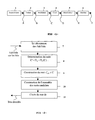
- An embodiment of the decoding algorithm by reordering and reprocessing of MM Fossorier and LIN is represented by the steps referenced from 7 to 11 in FIG. 2.
- this description designates the block code used for the parameter ( n , k ) and y denotes the vector of the reliability values at the input of the decoder. Thereafter, the letter F will be used to designate this process or F () to specify which code it applies to.
- the n - d ⁇ / H +1 smaller input values are sorted in descending order of their absolute value. This sort generates a first permutation ⁇ 1 of length n . It is also possible to sort all the values received when, for example, the distance d ⁇ / H is not known.
- a code C equivalent to the initial code is determined.
- the parity matrix whose columns have been swapped by ⁇ 1 is put in systematic form from right to left according to the convention adopted by the relation (4).
- the new redundancy positions of the code C '' correspond to the values received there ⁇ 2 ⁇ 1 ( i ) k + 1 ⁇ i ⁇ n such that there ⁇ 2 ⁇ 1 ( k +1) ⁇ there ⁇ 2 ⁇ 1 ( k +2) ⁇ ...
- the third step referenced 9 consists in defining, from the firm decision, the reliability relating to the new useful symbols, a word C (0) belonging to the code C. It is defined by correcting the new redundancy symbols via the firm decision syndrome above.
- this word C (0) is a candidate word whose Euclidean distance with the flexible input word permuted by ⁇ 2 ⁇ 1 is determined.
- error patterns are applied in order to define a set of words C ( i ) belonging to the code C.
- This construction is also carried out by modification of the new redundancy via the syndrome.
- Their Euclidean distance with the flexible input word swapped by ⁇ 2 ⁇ 1 is also determined.
- the last step referenced 11 retains the word C ( l ) belonging to which realizes the smallest Euclidean distance to the flexible word received permuted by ⁇ 2 ⁇ 1 .
- the decoded firm word is ( ⁇ 2 ⁇ 1 ) -1 ( C ( l ) ).
- the firm output of the process F will be noted C ( F ) in the following descriptions.
- the first three stages constitute decoding by reordering and the last two stages constitute decoding by reprocessing.
- the reprocessing is said to be of order i .
- ⁇ Y , Y * ⁇ Being constant, the metric chosen and which must be minimized, is that given by the relation:
- the invention proposes to use the general principle of iterative decoding described above from a SISO decoder which uses the method F to calculate the extrinsic values.
- a SISO decoder which uses the method F to calculate the extrinsic values.
- the result of the concatenation is represented by the set ( U 1 , ⁇ , U p ) where U i represents the set of words transmitted relating to the code C i .
- U i represents the set of words transmitted relating to the code C i .
- the concatenation is described by two sets U 1 and U 2 which respectively represent the rows and the columns of the matrix. Thereafter the following notations are adopted.
- U i is the set relative to the p i code words C i ( n i , k i ), ( u il ) 1 ⁇ l ⁇ p i denote the words emitted, ( y il ) 1 ⁇ l ⁇ p i designate the words received, ( ap ( j ) / il ) 1 ⁇ l ⁇ p i denote the vectors of the a priori values of the iteration j , ( ext ( j ) / il ) il ) 1 ⁇ l ⁇ p i denote the vectors of the extrinsic values calculated in the iteration j and ( app ( j ) / il ) 1 ⁇ l ⁇ p i denote the vectors of the posterior values calculated at iteration j.
- the decoding consists in successively decoding the words of each set U i . This process is carried out according to the steps referenced from 12 to 16 in FIG. 4.
- Step 12 is a preliminary step to the iterations which makes it possible to define the order of processing of the elementary words belonging to the sets U i .
- these sets U i are firstly ordered as a function of the maximum dependence between the words of U i and all the values received and then as a function of the correction capacities of the codes C i .
- the set U 1 relating to the internal code C 1 is processed before the set U 2 representing the words of the external code C 2 .
- the set relating to the code which has the best correction capacity is processed first.
- an iteration is defined as the processing of all the words of U i relating to the code C i .
- Step 13 consists in calculating the extrinsic values of all the symbols represented in U i by SISO decoding of all the elementary words of the code C i which have been transmitted.
- step 14 the posterior values are calculated.
- the posterior values are represented as the sum of the values received and the extrinsic values weighted not by experimental values but by an algorithmic value.
- Step 15 makes it possible to stop the iterations as a function of the calculation of the posterior values . Indeed without stopping criteria the number of iterations L cannot vary and must be fixed small enough for reasons of complexity.
- the invention recommends the use of two stopping criteria which make it possible to increase L since, on average, most of the decoding during transmission will be stopped before these L iterations.
- Step 16 makes it possible to calculate the values a priori if the stopping criterion is not verified.
- a calculation of the a priori values ( ap ( j +1) / i'l ) 1 ⁇ i ' ⁇ p ' i relative to the set U i ' which follows U i is executed.
- the process here is simple since for any symbol not belonging to the intersection of U i and U i ' the a priori value is unchanged if not the a posteriori value calculated at iteration j becomes the a priori value of the iteration j +1.
- step 13 A detailed embodiment of step 13 is shown in FIG. 5. Its embodiment allows the method to guarantee the existence of an extrinsic value without the use of any experimental coefficient. For this, the method of MM Fossorier and LIN described in FIG. 2 is advantageously used and in particular the assembly which it constructs and which makes it possible to determine the extrinsic values.
- the execution method of step 13 comprises six main processing steps referenced from 17 to 22 in FIG. 5. This step, if j designates the iteration, is broken down by elementary word represented by y il and ap ( j ) / he in the following way.
- the syndrome relating to firm decisions of the a priori values ap ( j ) / it is calculated as the product of these firm decisions and the transposed parity matrix.
- step 18 if the syndrome is not zero, the method F ( C i ) of FIG. 2 is applied with a reprocessing including a reprocessing of order 1 total from the a priori values ap ( j ) / il .
- Systematic formatting can be carried out by implementing the known algorithm of the Gauss pivot applied to the parity matrix whose columns have been permuted according to the sort induced by the permutation ⁇ 1 and this from right to left.
- any vector linearly dependent on the precedents is rejected from the identity part so as to ensure that the reliability of the new useful symbols contains the greatest number of the k i greatest a priori reliability in absolute value.
- a variant of this method can consist in applying the method F (C (j) / il) where C (j) / il is the code equivalent to C i resulting from the systematic shaping carried out during the previous processing of the word u il .
- the permutation ⁇ from the previous processing is applied to the vector of the a priori values at the input of the SISO decoder.
- the new permutation ⁇ 1 is determined as well as the systematic shaping of the parity matrix resulting from the previous processing of the word u il .
- This process is significant for reducing the complexity of the Gaussian pivot when the set of positions considered to be the most reliable are little modified between two iterations because the last nk vectors of the parity matrix contain many vectors of weight 1 prior to the pivot of Gauss ( ⁇ 1 calculated here is very close to identity).
- the words C (0) / m and C (1) / m are called the respective competing words at position m . They are all the closer to the words C (0) and C (1) defined by the relation (3) that the order of reprocessing is large and
- the invention makes it possible to vary the orders of reprocessing during iterations. From a more significant reprocessing for the first iterations, then limited to an order 1 thereafter, the relation (7) is a good definition of extrinsic value.
- step 20 defines for each new redundancy symbol, the value extrinsic from those of the useful symbols.
- each redundancy symbol is therefore linked to the useful symbols by a so-called parity equation such that:
- the extrinsic value relative to the redundancy symbol in position m in the new base can also be defined at from relation (7) or (8). But in all cases if the reprocessing is sufficient, therefore if it includes a reprocessing order of order 1, the existence of an extrinsic value for all the symbols of the elementary word processed is guaranteed.
- Step 21 indicates if the syndrome is zero, that the decision closes a priori values ap ( j ) / it is a code word C i and contains no error.
- Extrinsic values can simply be set to 0.
- they can be calculated in step 22 by applying a reprocessing including a total order 1 on this firm decision in order to define a set which induces the calculation of the extrinsic values according to the relations (7) and / or (8) and / or (9) without modification of the parity matrix
- the reprocessing can vary according to the iteration.
- the reprocessing can be chosen high for the first iterations but must always contain a reprocessing of order 1 and for the following iterations, it can be reduced to the minimum of the reprocessing of order 1.
- the posterior values are represented as the sum of the values received and of the extrinsic values weighted not by experimental values but by an algorithmic value. This makes it possible to be completely independent of the component code, of the iteration and of the signal to noise ratio and induces an iterative decoding proposed by the invention which is absolutely generic.
- the function f 1 is a function which can be nonlinear but which must depend on the number eil.
- this function can take the form where N is the set of natural numbers.
- the report is called the correction rate of the word u il of the current iteration.
- the posterior values depend on the total processing of the set U i and the function f 2 is a function which can be non-linear but which must depend on the number E.
- this function can take the form
- the report is called the correction rate of the set of words of U i of the current iteration.
- the invention proposes to calculate the values a posteriori from the a priori values in the following two ways.
- the operation * -1 designates the inverse of the modulation and t ( j ) / 3 is always an experimental coefficient which depends on the iteration, on the signal to noise ratio and also on the code.
- step 15 if during the processing of U i , all the syndromes relating to the firm decisions of ( ap ( j ) / il ) 1 ⁇ i ⁇ p i are zero, the words ( u il ) 1 ⁇ i ⁇ p i no longer have a detectable error. The following iterations will no longer provide information likely to modify the decision.
- the firm decision of the posterior values is the final decoding.
- This form differs from the first one only when decoding has failed.
- This criterion includes the first embodiment of step 15 and is therefore more general in the sense that it allows for critical cases to reduce unnecessary iterations when the system has converged.
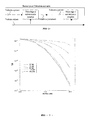
- FIG. 7 illustrates the performances obtained by the two-dimensional product code constructed from the extended BCH code of parameters (32,21).
- the P1 process is used in its completely generic version. Extrinsic values are guaranteed with non-zero at the first iteration order of reprocessing 2 for all words u there even when the syndrome is zero then a restatement of order 1 for the next iteration.
- the posterior values are defined by the relation (12) and the maximum number of iterations is 20. For example at 2dB 74% of the transmitted sequences require a decoding on 4 iterations (which represents two decodings of all the lines then of all columns) and 25% require 6 iterations.
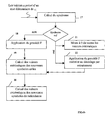
- the method according to the invention takes place according to the steps referenced from 23 to 28 in FIG. 6.
- the method performs an iterative decoding applied to a concatenation of p codes according to an order of variable elementary decodings during iterations and alternating decodings within each set U i .
- the words of each set U i are ordered in levels. Each level is made up of all the words in the sets U i whose reliability is of the same order. The reliability associated with the word depends on the transmission scheme which must be more precisely known. It can therefore be given by demodulation or by information supplied by the transmission system external to the decoder.
- the elementary decodings are then also ordered by level. All the words belonging to the most reliable level are processed within each set U i themselves ordered according to the first step of the method P1. Then the decodings are always done by levels in decreasing order of the order of the associated reliability. If the system does not make it possible to order the words in decreasing order of their reliability, it is always possible to use the ordering of the sets U i according to the method already described in step 12 of the first embodiment.
- an iteration is defined as the set of decodings of all the words of the sets U i all levels combined.
- the iterative decoding which follows is based on this ordering of the elementary decodings.
- the method calculates the extrinsic values of all the symbols per elementary word belonging to a level and to a set U i .
- the elementary SISO decoding which follows is carried out in a similar manner to the method P1 already described concerning the first embodiment of the invention.
- the method F is used according to the two variants F (C 1 ) or F (C ( j ) / il ) to construct the set.
- the extrinsic values for the new useful symbols are then determined by the relation (7) or in a more complex embodiment by the relation (8).
- their reliability is also determined by relations (7) or (8) if the set contains at least the words C (0) / m and C (1) / m or by relation (9) in a preferred embodiment of the invention.
- the calculation of the posterior values is carried out during a third step 25.
- the totality of the information of the words of U i is not taken into account because all the words of U i do not belong to a same level.
- the function f 3 is a function which can be non-linear but which must depend on the number E il . She can take the form
- the report is called the correction rate of the set of words belonging to the intersection of the level processed and of the set U i .
- the invention always advocates guaranteeing values non-zero extrinsics according to step 22. However in the otherwise, the invention proposes to define the values a posteriori according to relations (12) or (13).
- the fourth step 26 aims to stop the iterations.
- An iteration designates the processing of all the sets U i . Decoding is stopped when the last level is reached. At this stage during the processing of each set U i, it is possible to stop the decoding in accordance with step 15. If all the syndromes relating to firm decisions are zero, the following iterations will no longer provide information capable of to modify the decision, it is useless to continue and decoding is the firm decision of the values a posteriori.
- the invention recommends using the second variant of step 15 as a stopping criterion.
- the number of iterations is found to be less reduced than in the first since it is necessary to wait for the last level to carry out a stop test. However if word scheduling has been done correctly, iteration is all the more effective.
- the fifth step 27 consists in determining the a priori values for the new set U i ' which will be processed within the current iteration for an identical or higher level.
- the method simply consists in transferring the values a posteriori into the values a priori if the symbol is common to the set U i and U i ' .
- the a priori values can come from several successive decodings and therefore have very heterogeneous values, hence the all the more important influence of the scheduling and its efficiency. .
- a final step 28 this is when a complete iteration has been completed and the stop criterion is not valid, to redefine the new levels.
- This can be obtained either by resuming the calculation of reliability per word induced by a system external to the decoder if it exists, either by defining the reliability given to a word according to the number of corrections that the previous iteration has given him made. The higher the number, the less the word can be considered reliable which makes it possible to define these levels of reliability, and elementary decoding by levels in the decreasing order of reliability is taken over.
Landscapes
- Physics & Mathematics (AREA)
- Engineering & Computer Science (AREA)
- Probability & Statistics with Applications (AREA)
- Theoretical Computer Science (AREA)
- Mathematical Analysis (AREA)
- General Physics & Mathematics (AREA)
- Computational Mathematics (AREA)
- Mathematical Optimization (AREA)
- Mathematical Physics (AREA)
- Pure & Applied Mathematics (AREA)
- Algebra (AREA)
- Computing Systems (AREA)
- Error Detection And Correction (AREA)
Applications Claiming Priority (2)
| Application Number | Priority Date | Filing Date | Title |
|---|---|---|---|
| FR0012501A FR2814871A1 (fr) | 2000-10-02 | 2000-10-02 | Procede de decodage iteratif associe a toutes concatenations d'un nombre determine de codes en blocs, ou assimiles |
| FR0012501 | 2000-10-02 |
Publications (2)
| Publication Number | Publication Date |
|---|---|
| EP1217752A2 true EP1217752A2 (de) | 2002-06-26 |
| EP1217752A3 EP1217752A3 (de) | 2002-10-09 |
Family
ID=8854872
Family Applications (1)
| Application Number | Title | Priority Date | Filing Date |
|---|---|---|---|
| EP01460059A Withdrawn EP1217752A3 (de) | 2000-10-02 | 2001-09-28 | Iteratives Dekodierungsverfahren für alle Verkettungen einer vorbestimmten Anzahl von Blockkoden oder ähnlichen Koden |
Country Status (2)
| Country | Link |
|---|---|
| EP (1) | EP1217752A3 (de) |
| FR (1) | FR2814871A1 (de) |
Cited By (1)
| Publication number | Priority date | Publication date | Assignee | Title |
|---|---|---|---|---|
| CN1538700B (zh) * | 2003-02-28 | 2010-04-28 | 美国日本电气实验室公司 | 用于解调和接收来自信道的数据的方法和装置 |
Families Citing this family (1)
| Publication number | Priority date | Publication date | Assignee | Title |
|---|---|---|---|---|
| RU2444127C1 (ru) * | 2010-08-24 | 2012-02-27 | Государственное образовательное учреждение высшего профессионального образования "Ульяновский государственный технический университет" | Способ мягкого декодирования систематических блоковых кодов |
Family Cites Families (2)
| Publication number | Priority date | Publication date | Assignee | Title |
|---|---|---|---|---|
| FR2778289B1 (fr) * | 1998-05-04 | 2000-06-09 | Alsthom Cge Alcatel | Decodage iteratif de codes produits |
| WO2000048325A1 (de) * | 1999-02-11 | 2000-08-17 | Siemens Aktiengesellschaft | Verfahren und anordnung zur decodierung eines vorgegebenen codeworts |
-
2000
- 2000-10-02 FR FR0012501A patent/FR2814871A1/fr not_active Withdrawn
-
2001
- 2001-09-28 EP EP01460059A patent/EP1217752A3/de not_active Withdrawn
Cited By (1)
| Publication number | Priority date | Publication date | Assignee | Title |
|---|---|---|---|---|
| CN1538700B (zh) * | 2003-02-28 | 2010-04-28 | 美国日本电气实验室公司 | 用于解调和接收来自信道的数据的方法和装置 |
Also Published As
| Publication number | Publication date |
|---|---|
| EP1217752A3 (de) | 2002-10-09 |
| FR2814871A1 (fr) | 2002-04-05 |
Similar Documents
| Publication | Publication Date | Title |
|---|---|---|
| EP0654910B1 (de) | Iteratives Dekodierverfahren verketteter Blockkodes | |
| EP0891656B1 (de) | Verfahren und vorrichtung zur faltungskodierung und -dekodierung von datenblöcken | |
| EP0827284B1 (de) | Informationsbits-Übertragungsverfahren mit Fehlerkorrektur-Kodierung, Kodier- und Dekodiervorrichtung dafür | |
| EP3443678B1 (de) | Verfahren zur dekodierung eines polarcodes mit umkehrung von bits mit niedriger zuverlässigkeit | |
| EP0995272B1 (de) | Iterative dekodierung von produktkoden | |
| EP0827285A1 (de) | Informationsbits-Übertragungsverfahren mit Fehlerkorrektur-Kodierung, Kodier- und Dekodiervorrichtung dafür | |
| FR2905210A1 (fr) | Procede et dispositif de decodage par couches d'une succession de blocs encodes avec un code ldpc | |
| WO1996024999A1 (fr) | Dispositif de reception de signaux numeriques a structure iterative, module et procede correspondants | |
| FR2950209A1 (fr) | Procede de mise a jour elementaire d'un noeud de controle lors d'un decodage d'un bloc encode avec un code ldpc non binaire, et decodeur correspondant. | |
| EP2833555B1 (de) | Verbessertes Verfahren zur Decodierung eines Korrekturcodes mit Message Passing, insbesondere für die Decodierung von Low-Density-Parity-Check-Codes oder Turbo-Codes | |
| FR2741215A1 (fr) | Procede de transmission d'une sequence de bits d'information avec protection selective contre les erreurs de transmission, procedes de codage et de correction pouvant etre mis en oeuvre dans un tel procede de transmission | |
| EP1217752A2 (de) | Iteratives Dekodierungsverfahren für alle Verkettungen einer vorbestimmten Anzahl von Blockkoden oder ähnlichen Koden | |
| EP1128588A1 (de) | Verfahren zur fehlerkorrekturcodierungsartiger digitaler Übertragung unter Verwendung einer Selektion von Punktierungsschema | |
| WO2002043250A2 (fr) | Procede de decodage d'un bloc de symboles et dispositif mettant en oeuvre un tel procede | |
| EP1471647A2 (de) | Codierung und Decodierung von Trellis-Codes mit Trellis Sektionen basierend auf Blockcodes mit guten Distanzeigenschaften | |
| WO2006108768A1 (fr) | Procédé et dispositif de décodage d'un code à longueur variable prenant en compte une information de probabilité a priori | |
| FR2882480A1 (fr) | Procede et dispositif de synchronisation trame | |
| EP2262116B1 (de) | Viterbi Dekoder mit zwei Speichern angepasst für GNSS Signale | |
| FR2830384A1 (fr) | Procede de dispositif de codage et de decodage convolutifs | |
| FR2944167A1 (fr) | Procede de decodage par re-encodage, dispositif et programme d'ordinateur correspondants | |
| WO2015079168A1 (fr) | Codage de paquets de données par codes convolutifs et recouvrement de paquets effacés | |
| FR2801744A1 (fr) | Amelioration du decodage iteratif des codes produits par adjonction d'informations a priori | |
| FR2829636A1 (fr) | Procede de qualification de codes correcteurs d'erreurs, procede d'optimisation, codeur, decodeur et application correspondants | |
| WO2013079540A1 (fr) | Decodeur de faible complexite pour codage convolutif | |
| WO2016198801A1 (fr) | Décodage sur une pluralité de treillis à sections auto-complémentaires a 4 états |
Legal Events
| Date | Code | Title | Description |
|---|---|---|---|
| PUAI | Public reference made under article 153(3) epc to a published international application that has entered the european phase |
Free format text: ORIGINAL CODE: 0009012 |
|
| AK | Designated contracting states |
Kind code of ref document: A2 Designated state(s): AT BE CH CY DE DK ES FI FR GB GR IE IT LI LU MC NL PT SE TR |
|
| AX | Request for extension of the european patent |
Free format text: AL;LT;LV;MK;RO;SI |
|
| PUAL | Search report despatched |
Free format text: ORIGINAL CODE: 0009013 |
|
| AK | Designated contracting states |
Kind code of ref document: A3 Designated state(s): AT BE CH CY DE DK ES FI FR GB GR IE IT LI LU MC NL PT SE TR |
|
| AX | Request for extension of the european patent |
Free format text: AL;LT;LV;MK;RO;SI |
|
| AKX | Designation fees paid | ||
| REG | Reference to a national code |
Ref country code: DE Ref legal event code: 8566 |
|
| STAA | Information on the status of an ep patent application or granted ep patent |
Free format text: STATUS: THE APPLICATION IS DEEMED TO BE WITHDRAWN |
|
| 18D | Application deemed to be withdrawn |
Effective date: 20030410 |