EP1217816A1 - Support de services vocaux centrales éxistants dans un réseau IP multimedia - Google Patents
Support de services vocaux centrales éxistants dans un réseau IP multimedia Download PDFInfo
- Publication number
- EP1217816A1 EP1217816A1 EP00311664A EP00311664A EP1217816A1 EP 1217816 A1 EP1217816 A1 EP 1217816A1 EP 00311664 A EP00311664 A EP 00311664A EP 00311664 A EP00311664 A EP 00311664A EP 1217816 A1 EP1217816 A1 EP 1217816A1
- Authority
- EP
- European Patent Office
- Prior art keywords
- domain
- network
- service
- osa
- legacy
- Prior art date
- Legal status (The legal status is an assumption and is not a legal conclusion. Google has not performed a legal analysis and makes no representation as to the accuracy of the status listed.)
- Withdrawn
Links
- 238000000034 method Methods 0.000 claims description 14
- 238000013507 mapping Methods 0.000 claims description 8
- 230000011664 signaling Effects 0.000 claims description 4
- 238000013519 translation Methods 0.000 claims description 3
- 239000008186 active pharmaceutical agent Substances 0.000 claims 5
- 241000282836 Camelus dromedarius Species 0.000 claims 4
- 102100026009 NF-kappa-B inhibitor zeta Human genes 0.000 claims 2
- 101710115530 NF-kappa-B inhibitor zeta Proteins 0.000 claims 2
- 230000007246 mechanism Effects 0.000 description 7
- 238000012384 transportation and delivery Methods 0.000 description 6
- 230000000694 effects Effects 0.000 description 2
- 230000003993 interaction Effects 0.000 description 2
- 238000007726 management method Methods 0.000 description 2
- 238000013459 approach Methods 0.000 description 1
- 238000013475 authorization Methods 0.000 description 1
- 238000004891 communication Methods 0.000 description 1
- 238000013523 data management Methods 0.000 description 1
- 238000001514 detection method Methods 0.000 description 1
- GVVPGTZRZFNKDS-JXMROGBWSA-N geranyl diphosphate Chemical compound CC(C)=CCC\C(C)=C\CO[P@](O)(=O)OP(O)(O)=O GVVPGTZRZFNKDS-JXMROGBWSA-N 0.000 description 1
- 238000012545 processing Methods 0.000 description 1
Images



Classifications
-
- H—ELECTRICITY
- H04—ELECTRIC COMMUNICATION TECHNIQUE
- H04Q—SELECTING
- H04Q3/00—Selecting arrangements
- H04Q3/0016—Arrangements providing connection between exchanges
- H04Q3/0029—Provisions for intelligent networking
- H04Q3/0045—Provisions for intelligent networking involving hybrid, i.e. a mixture of public and private, or multi-vendor systems
-
- H—ELECTRICITY
- H04—ELECTRIC COMMUNICATION TECHNIQUE
- H04M—TELEPHONIC COMMUNICATION
- H04M7/00—Arrangements for interconnection between switching centres
- H04M7/12—Arrangements for interconnection between switching centres for working between exchanges having different types of switching equipment, e.g. power-driven and step by step or decimal and non-decimal
- H04M7/1205—Arrangements for interconnection between switching centres for working between exchanges having different types of switching equipment, e.g. power-driven and step by step or decimal and non-decimal where the types of switching equipement comprises PSTN/ISDN equipment and switching equipment of networks other than PSTN/ISDN, e.g. Internet Protocol networks
- H04M7/1225—Details of core network interconnection arrangements
- H04M7/123—Details of core network interconnection arrangements where the packet-switched network is an Internet Protocol Multimedia System-type network
Definitions
- This invention relates to a mechanism for supporting legacy voice centric services in an IP multimedia network, particularly to networks to which a user connects via a mobile terminal.
- a great deal of value added services which are available presently in circuit voiced switched mobile networks are equally applicable to voice traffic carried over IP multimedia networks.
- Examples of such services include, but are not limited to Virtual Private Networks (VPN), call routing, prepay services, number translation services (eg 1-800 services), number portability, short number dialling, location sensitive billing and time based call redirection.
- IP multimedia networks There is currently a great deal of effort put into developing IP multimedia networks.
- the value added service delivery mechanisms in present day circuit switch mobile networks are generally based on intelligent network (IN) techniques
- IN type services are also available to subscribers that roam outside their home network by the use of a standards known as CAMEL (Customised Application for Mobile Network Enhanced Logic).
- CAMEL Customised Application for Mobile Network Enhanced Logic
- the service delivery mechanisms that are envisaged for IP multimedia networks are expected to be based on Application Programming Interfaces (APIs) such as OSA (Open Services Architecture), Parlay or JAIN.
- APIs Application Programming Interfaces
- a basic problem is to allow a service, probably stored on an application server, to be accessible both in the circuit switch Domain (CS) 2 and the IP Multimedia Domain (IMS) 3.
- CS circuit switch Domain
- IMS IP Multimedia Domain
- a single mobile terminal may be able to access both the CS and IM Domain and the user preferably needs to be able to use voice over the circuit switch or IMS (Packet Switch) Domains transparently.
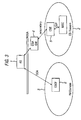
- FIG. 3 shows the current third generation view of how OSA services are delivered to Circuit Switch (CS) subscribers.
- OSA APIs are mapped by an OSA gateway 4 to an internal protocol, that is a proprietary protocol, to a CSE (CAMEL Service Environment) 5 within the circuit switch Domain.
- the CSE then translates this to CAMEL application protocol CAP and/or MAP to an appropriate entity, which will generally either an MSC/VLR (Visiting Location Register) for a roaming network, or an HLR (Home Location Register) for a home network.
- the OSA API is used to deliver services from the application server 1 to a CAMEL service control function 6 within the IM Domain 3.
- the newly deployed OSA API based services can be delivered using legacy service delivery protocols in the CS Domain, while using the OSA API to deliver services in the IM Domain.
- MAP and CAP are so-called SS7 protocols.
- the MAP protocol is an interface used in GSM and UMTS between various network nodes and exists between a gsmSCF (Service Control Function) and HLR, whereas the CAP protocol is an interface between the gsmSCF and the MSC/gsmSSF.
- MAP is used for mobility management and subscriber data management
- CAP is used for call control and service management.
- both protocols are hierarchically on the same level, but functionally different.
- the CSCF In order to use the CAP protocol, the CSCF needs a CAP interface and the necessary CAMEL functionality embodied in the GSM Service Switching Function (gsmSSF) as described in the 3GPP standards document 3G TS 23.078.
- GSM Service Switching Function gsmSSF
- CAP interfaces are seen as being complex and too much of a legacy item; there is a resistance to using this.
- the present invention arose in an attempt to provide an improved mechanism for supporting legacy voice centric services in an IP multimedia network, without the need for the CSCF to support a CAP interface or CAMEL functionality.
- a method for supporting legacy voice centric services in an IP Multimedia (IM) network comprising providing an emulator causing said legacy services to appear to be an API based service as far as the IM system is concerned.
- IM IP Multimedia
- the emulator is a gateway providing mapping from CAMEL request and CAP or other Intelligent Network applications onto OSA APIs.
- the method comprises running a legacy voice service in the Circuit Switched Domain (CS), whereby after a user registers with the IM Domain, messages relevant to the service are directed to and from the IM Domain to the emulator, via OSA protocols, mapped from OSA to relevant INAP protocols and directed to and from the emulator as CAP messages to the CS Domain.
- CS Circuit Switched Domain
- a multimedia network comprising a node providing mapping between CAMEL information and OSA APIs.
- the network comprises a legacy voice service provided in the CS Domain, wherein the node is adapted to receive and send messages relevant to the service, via OSA protocols to and from the IM Domain, map the OSA to relevant INAP protocols and receive the messages to and from the CS Domain as CAP messages.
- a node for an IP Multimedia network functioning to map OSA API messages to CAP signalling messages.
- the invention further provides an interface between a CS Domain and an IM Domain, in a multimedia network, for enabling legacy services in the CS Domain to be supported in the IM Domain, said interface acting as a gsmSSF to the CS Domain and as an Application Server (AS) to the IM Domain.
- AS Application Server
- FIG 4 a mechanism for supporting legacy services is shown schematically. Similarly to Figure 3 (described above), the figure shows generally the CS Domain 2 with a CSE 5 and MSC 7. Also, the IP Multimedia Domain (IM) 3 provides a Call State Control Function CSCF 6. Note that MS in the circuit switch Domain 7 may also be a gsmSSF (GSM Service Switching Function).
- IM IP Multimedia Domain
- LEM Legacy Emulator Module
- CSI CAMEL Subscription Information
- the CSI comprises data that is sent to an MSC when a user registers and is in effect a set of triggering criteria that have to be satisfied and may also include address details, identification of service logic and so on.
- the CSI may take various forms such as O-CSI (Originating CSI for CAMEL services for mobile originating calls), T-CSI (Terminating CSI for CAMEL services for mobile terminating calls in a Gateway MSC), VT-CSI (Visited Terminating CSI for CAMEL services for mobile terminating calls in a Visited MSC), SMS-CSI (for short messaging), and so on.
- O-CSI Olinating CSI for CAMEL services for mobile originating calls
- T-CSI Terminating CSI for CAMEL services for mobile terminating calls in a Gateway MSC
- VT-CSI Vehicle Terminating CSI for CAMEL services for mobile terminating calls in a Visited MSC
- SMS-CSI for short messaging
- the LEM 8 When a subscriber registers with the IM Domain, the LEM 8 is arranged to send a request to the CSCF 6 (being the CSCF with which the subscriber is registered), asking the CSCF to notify the LEM when particular call event criteria are met, depending upon the type of service available or required. Subsequently, when the CSCF receives a call set up request for a subscriber that has certain service triggers, the CSCF interrupts call processing and notifies the LEM that the required call triggers have been reached. The LEM contacts the CSE and invokes the service logic in the CSE via the usual legacy protocol, indicating that a call has been attempted by the subscriber. The service logic in the CSE then instructs the LEM as to how the call is to proceed. Note that this communication between the LEM and CSE is done via CAP and thus that a proprietary interface is not required.
- the LEM After the service logic in the CSE instructs the LEM as to how the call is to proceed, the LEM then translates these to OSA service requests and indicates to the CSCF how the call is to proceed. Further call events are reported to the LEM by the CSCF depending on the outcome of the call. The LEM translates these events to CAP and MAP messages and the service logic sends appropriate instructions. This can then continue for further events depending on the service logic.
- the LEM is so arranged that it behaves as a gsmSSF to legacy services in the CSE (using CAP) but also behaves as if it is an 'OSA client' residing on an Application Server (AS) as far as the CSCF 6 in the IM Domain is concerned.
- AS Application Server
- an application server 1 may not necessarily be part of the network operator's domain.
- the LEM is a new gateway which fools the 'legacy' service logic in the CSE that it is communicating with a gsmSSF and at the same the CSCF thinks it is communicating with an Application Server (AS).
- AS Application Server
- CSCF will, by third Generation (3G) standards such as standard number 3G TS 23.228 already have CAMEL, OSA and SIP interfaces.
- 3G third Generation
- the LEM proxies requests between the CSCF and the legacy service in the CS and maps OSA API messages from the CSCF to CAP signalling message for the CSE.
- CAP parameters cannot be extracted from API methods. Accordingly, in some embodiments of the invention, in order to intelligently populate CAP parameters that cannot be extracted from the API methods, it is necessary to have an interface from the LEM to the HLR (MSC) to obtain any information relating to the status of the subscriber.
- MSC HLR
- CAMEL subscription information CS is still used in the CS Domain.
- the LEM accordingly will in general need to be able to know the CSI associated with each subscriber. This can be achieved by the HLR sending all the required CSI to the LEM when a user registers in the IM Domain.
- Figure 5 shows an example of information flow in a system according to the present invention. It shows one possible situation where the OSA is OSA release 4/5.
- the signal flows are between a CSA 5, an HLR 7, LEM 8 and CSCF 6.
- signals between the HLR and LEM will generally be by CAP and/or MAP protocols and signals between the LEM and the CSCF will be by OSA.
- Signals between the CSE and the LEM will be based on CAP.
- an initial registration phase when a user first registers, there is some initial signalling when the user registers at the HLR and the setting up of CAMEL phase support.
- the set trigger service is deployed and an AnyTimeModification signal S1 passes from the CSE to the HLR.
- an Insert Subscriber Data (which contains the relevant CSIs for the subscriber) message S2 is sent from the HLR to the LEM. This identifies the CSE.
- the LEM then, assuming it has already performed authorisation, discovery and other functions, issues an enable call notification signal S3 to the CSCF. The user would have all the necessary service triggers set to handle service interaction for originating and terminating calls.
- an SIP invite signal S4 is received at the CSCF from a mobile terminal (not shown). This then issues a call event notify signal, using OSA, to the LEM 8.
- the LEM using CAP or MAP for example, issues an Initial DP (Detection Point) signal through the CSE.
- the CAMEL Subscription Information contains address of the CSE and a reference to the service logic that should be invoked to allow the LEM to route messages to it.
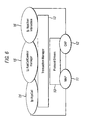
- Figure 6 shows a possible architecture for an LEM, which it will be recalled acts as a gateway.
- the functionality of the entity may include protocol drivers 10, with MAP and CAP interfaces 11, 12 respectively.
- a transaction manager 13 controls and interfaces with further functionality, including Ip App Cad 14, Ip App Call Control Manager 15 and Ip App User Interaction, for messaging to and from the IM Domain.
- Ip App Cad 14 Ip App Call Control Manager 15
- Ip App User Interaction Ip App User Interaction
- the LEM gateway is in effect acting as a switch.
- Embodiments of the present invention accordingly allow CAMEL, or other INAP based services, generally from the Circuit Switch (CS) Domain to be applied to networks which only support APIs.
- the invention has a benefit that it is considered to be cheaper than developing a 'legacy' protocol interface on each CSCF which would need to be proprietary.
- the mechanism can also serve as an overlay solution over standardised IM core networks and has no impact on existing entities in the IP multimedia network.
- the present CAMEL standard is defined in the documents 3G TS22.078, TS 23.078 V3.6.0 (2000-09) and TS29.078 V3.6.0 (2000-09), published by 3GPP (3 rd Generation Partnership Project). 650 Route des Lucioles, Sophia Astipolis, Valbonne, France; http://www.3gpp.org. A further document 3G TS 23.228 gives an over view of the network architecture of the IM Domain. Document 3G TS 29.998 describes a mapping between OSA APIs and network protocols.
Landscapes
- Engineering & Computer Science (AREA)
- Computer Networks & Wireless Communication (AREA)
- Multimedia (AREA)
- Signal Processing (AREA)
- Mobile Radio Communication Systems (AREA)
Priority Applications (1)
| Application Number | Priority Date | Filing Date | Title |
|---|---|---|---|
| EP00311664A EP1217816A1 (fr) | 2000-12-22 | 2000-12-22 | Support de services vocaux centrales éxistants dans un réseau IP multimedia |
Applications Claiming Priority (1)
| Application Number | Priority Date | Filing Date | Title |
|---|---|---|---|
| EP00311664A EP1217816A1 (fr) | 2000-12-22 | 2000-12-22 | Support de services vocaux centrales éxistants dans un réseau IP multimedia |
Publications (1)
| Publication Number | Publication Date |
|---|---|
| EP1217816A1 true EP1217816A1 (fr) | 2002-06-26 |
Family
ID=8173486
Family Applications (1)
| Application Number | Title | Priority Date | Filing Date |
|---|---|---|---|
| EP00311664A Withdrawn EP1217816A1 (fr) | 2000-12-22 | 2000-12-22 | Support de services vocaux centrales éxistants dans un réseau IP multimedia |
Country Status (1)
| Country | Link |
|---|---|
| EP (1) | EP1217816A1 (fr) |
Cited By (11)
| Publication number | Priority date | Publication date | Assignee | Title |
|---|---|---|---|---|
| WO2006102339A2 (fr) | 2005-03-21 | 2006-09-28 | Tekelec | Procedes, systemes et programmes informatiques servant a fournir des services de telecommunications entre un reseau a protocole d'ouverture de session (sip) et un reseau a systeme de signalisation 7 (ss7) |
| GB2440987A (en) * | 2006-08-18 | 2008-02-20 | Samsung Electronics Co Ltd | Synchronising network services between CS and IMS domains |
| WO2008040171A1 (fr) * | 2006-09-25 | 2008-04-10 | Huawei Technologies Co., Ltd. | Procédé, système de domaine de commutation de circuits apercevant des informations de sessions multimédia du domaine ims |
| EP1931094A4 (fr) * | 2005-08-31 | 2008-08-13 | Huawei Tech Co Ltd | Systeme de terminaison d'appel de domaine cs, procede et reseau |
| WO2010060452A1 (fr) * | 2008-11-03 | 2010-06-03 | Nokia Siemens Networks Oy | Procede, appareil et programme informatique servant a relayer des messages camel dans un reseau de telecommunications |
| US8050253B2 (en) | 2006-01-09 | 2011-11-01 | Tekelec | Methods, systems, and computer program products for decentralized processing of signaling messages in a multi-application processing environment |
| US8059667B2 (en) | 2007-01-31 | 2011-11-15 | Tekelec | Methods, systems, and computer program products for applying multiple communications services to a call |
| EP2011347A4 (fr) * | 2006-04-13 | 2012-04-18 | Tekelec Us | Procedes, systemes et produits de programme d'ordinateur permettant d'assurer des services d'enregistrement de sous-systemes multimedia de protocoles internet (ims) pour des dispositifs non ims. |
| US8499082B2 (en) | 2007-09-06 | 2013-07-30 | Tekelec, Inc. | Methods, systems, and computer readable media for providing services in a telecommunications network using interoperability specification/session initiation protocol (IOS/SIP) adapter |
| US8600007B2 (en) | 2008-11-24 | 2013-12-03 | Tekelec Global, Inc. | Systems, methods, and computer readable media for providing toll-free service in a telecommunications network |
| US9712341B2 (en) | 2009-01-16 | 2017-07-18 | Tekelec, Inc. | Methods, systems, and computer readable media for providing E.164 number mapping (ENUM) translation at a bearer independent call control (BICC) and/or session intiation protocol (SIP) router |
Citations (1)
| Publication number | Priority date | Publication date | Assignee | Title |
|---|---|---|---|---|
| WO2000042760A1 (fr) * | 1999-01-15 | 2000-07-20 | Telefonaktiebolaget Lm Ericsson (Publ) | Systeme et procede permettant d'acceder a des noeuds de service par des entites situees dans un reseau de telecommunications integre |
-
2000
- 2000-12-22 EP EP00311664A patent/EP1217816A1/fr not_active Withdrawn
Patent Citations (1)
| Publication number | Priority date | Publication date | Assignee | Title |
|---|---|---|---|---|
| WO2000042760A1 (fr) * | 1999-01-15 | 2000-07-20 | Telefonaktiebolaget Lm Ericsson (Publ) | Systeme et procede permettant d'acceder a des noeuds de service par des entites situees dans un reseau de telecommunications integre |
Non-Patent Citations (6)
| Title |
|---|
| ETSI 3RD GENERATION PARTNERSHIP PROJECT: "Universal Mobile Telecommunication System (UMTS); Virtual Home Environment/Open Service Architecture (3GPP TS 23.127 version 3.2.0 Release 1999)", ETSI TECHNICAL SPECIFICATION 123 127 V3.2.0, November 2000 (2000-11-01), XP002170960 * |
| ETSI 3RD GENERATION PARTNERSHIP PROJECT: "Universal Mobile Telecommunications System (UMTS); Open Services Architecture Application Programming Interface- Part 2 (3GPP TR 29.998 version 3.1.0 Release 1999)", ETSI TECHNICAL REPORT 129 998 V3.1.0, September 2000 (2000-09-01), XP002170961 * |
| GRECH M L F, MCKINNEY R D, SHARMA S, STANAWAY J J JR, VARNEY D W, VEMURI K V: "Delivering Seamless Services in open Networks Using Intelligent Service Mediation", BELL LABS TECHNICAL JOURNAL, vol. 5, no. 3, July 2000 (2000-07-01) - September 2000 (2000-09-01), pages 186 - 202, XP001005686 * |
| GRECH M L F: "Providing Seamless Services for VoIP Mobile Data Networks Using CAMEL/IN Concepts", 1ST INTERNATIONAL CONFERENCE ON '3G MOBILE COMMUNICATION TECHNOLOGIES', no. 471, March 2000 (2000-03-01), Stevenage, England, pages 133 - 137, XP000999315 * |
| RIZZETTO D ET AL: "A VOICE OVER IP SERVICE ARCHITECTURE FOR INTEGRATED COMMUNICATIONS", IEEE NETWORK,IEEE INC. NEW YORK,US, vol. 13, no. 3, May 1999 (1999-05-01), pages 34 - 40, XP000870629, ISSN: 0890-8044 * |
| TAKEUCHI R ET AL: "INTERFACES FOR INTERWORKING AMONG INTELLIGENT NETWORKS, COMPUTER TELEPHONY, AND VOICE OVER IP SYSTEMS", GLOBECOM. IEEE GLOBAL TELECOMMUNICATIONS CONFERENCE AND EXHIBITION,NEW YORK, NY,US, vol. 3, 1999, pages 1916 - 1920, XP002900977 * |
Cited By (18)
| Publication number | Priority date | Publication date | Assignee | Title |
|---|---|---|---|---|
| US9001990B2 (en) | 2005-03-21 | 2015-04-07 | Tekelec, Inc. | Methods, systems, and computer program products for providing telecommunications services between a session initiation protocol (SIP) network and a signaling system 7 (SS7) network |
| WO2006102339A2 (fr) | 2005-03-21 | 2006-09-28 | Tekelec | Procedes, systemes et programmes informatiques servant a fournir des services de telecommunications entre un reseau a protocole d'ouverture de session (sip) et un reseau a systeme de signalisation 7 (ss7) |
| US8520828B2 (en) | 2005-03-21 | 2013-08-27 | Tekelec, Inc. | Methods, systems, and computer program products for providing telecommunications services between a session initiation protocol (SIP) network and a signaling system 7 (SS7) network |
| EP1867115A4 (fr) * | 2005-03-21 | 2010-10-06 | Tekelec Us | Procedes, systemes et programmes informatiques servant a fournir des services de telecommunications entre un reseau a protocole d'ouverture de session (sip) et un reseau a systeme de signalisation 7 (ss7) |
| EP2244431A1 (fr) * | 2005-08-31 | 2010-10-27 | Huawei Technologies Co., Ltd. | Systeme de terminaison d'appel de domaine cs, procédé et réseau |
| EP1931094A4 (fr) * | 2005-08-31 | 2008-08-13 | Huawei Tech Co Ltd | Systeme de terminaison d'appel de domaine cs, procede et reseau |
| US8380211B2 (en) | 2005-08-31 | 2013-02-19 | Huawei Technologies Co., Ltd. | CS domain call terminating system, method and network device |
| US8050253B2 (en) | 2006-01-09 | 2011-11-01 | Tekelec | Methods, systems, and computer program products for decentralized processing of signaling messages in a multi-application processing environment |
| EP2011347A4 (fr) * | 2006-04-13 | 2012-04-18 | Tekelec Us | Procedes, systemes et produits de programme d'ordinateur permettant d'assurer des services d'enregistrement de sous-systemes multimedia de protocoles internet (ims) pour des dispositifs non ims. |
| US8346944B2 (en) | 2006-04-13 | 2013-01-01 | Tekelec, Inc. | Methods, systems, and computer program products for providing internet protocol multimedia subsystem (IMS) registration services for non-IMS devices |
| GB2440987A (en) * | 2006-08-18 | 2008-02-20 | Samsung Electronics Co Ltd | Synchronising network services between CS and IMS domains |
| WO2008040171A1 (fr) * | 2006-09-25 | 2008-04-10 | Huawei Technologies Co., Ltd. | Procédé, système de domaine de commutation de circuits apercevant des informations de sessions multimédia du domaine ims |
| US8059667B2 (en) | 2007-01-31 | 2011-11-15 | Tekelec | Methods, systems, and computer program products for applying multiple communications services to a call |
| US8499082B2 (en) | 2007-09-06 | 2013-07-30 | Tekelec, Inc. | Methods, systems, and computer readable media for providing services in a telecommunications network using interoperability specification/session initiation protocol (IOS/SIP) adapter |
| US8811981B2 (en) | 2008-11-03 | 2014-08-19 | Nokia Siemens Networks Oy | Method, apparatus and computer program product for relaying CAMEL related messages in a telecommunications network |
| WO2010060452A1 (fr) * | 2008-11-03 | 2010-06-03 | Nokia Siemens Networks Oy | Procede, appareil et programme informatique servant a relayer des messages camel dans un reseau de telecommunications |
| US8600007B2 (en) | 2008-11-24 | 2013-12-03 | Tekelec Global, Inc. | Systems, methods, and computer readable media for providing toll-free service in a telecommunications network |
| US9712341B2 (en) | 2009-01-16 | 2017-07-18 | Tekelec, Inc. | Methods, systems, and computer readable media for providing E.164 number mapping (ENUM) translation at a bearer independent call control (BICC) and/or session intiation protocol (SIP) router |
Similar Documents
| Publication | Publication Date | Title |
|---|---|---|
| JP4819904B2 (ja) | 回線交換型アクセスを介するIMSサービスのプロビジョン(provision:提供) | |
| US8078166B2 (en) | Device for controlling access of subscriber terminals of a CS domain to services of an IMS communication network | |
| US8392582B2 (en) | Method and apparatuses for making use of virtual IMS subscriptions coupled with the identity of a non SIP compliant terminal for non-registered subscribers | |
| EP1892897B1 (fr) | Commande de routage interdomaine | |
| US8493997B2 (en) | Providing a network node with service reference information | |
| US20040184435A1 (en) | System, device and method for providing call forwarding in dual subscription mode | |
| FI108195B (fi) | Mekanismi verkon aloittamaa informaation siirtoa varten | |
| US7844261B2 (en) | Number portability and services utilizing number range owner information | |
| CN101127613A (zh) | Ip多媒体子系统应用获取电路域信息的方法及其应用 | |
| US8380211B2 (en) | CS domain call terminating system, method and network device | |
| US20020058496A1 (en) | Charging arrangement for a multimedia communication system | |
| JP4357835B2 (ja) | 加入者へなされたコールのルーティング | |
| EP2116003B1 (fr) | Gestion de données d'abonné dans des réseaux de communication | |
| EP2716001B1 (fr) | Acheminement d'appels dans des réseaux de services centralisés de sous-système multimédia ip | |
| CA2637217C (fr) | Procede et appareil pour offrir des services ims destines a des bornes a commutation de circuits | |
| WO2008040205A1 (fr) | Procédé d'acquisition d'informations utilisateur du domaine ims dans le réseau de domaine de circuits, et système associé | |
| US8326298B2 (en) | Technique for service domain selection | |
| JP2001103541A (ja) | 無線電気通信システムにおいて無線呼出しに対するサービス機能をサポートするためのアーキテクチャ | |
| WO2007041929A1 (fr) | Système et méthode de fourniture au réseau cs de service du réseau ims | |
| Grech | Providing seamless services for VoIP mobile data networks using CAMEL/IN concepts |
Legal Events
| Date | Code | Title | Description |
|---|---|---|---|
| PUAI | Public reference made under article 153(3) epc to a published international application that has entered the european phase |
Free format text: ORIGINAL CODE: 0009012 |
|
| AK | Designated contracting states |
Kind code of ref document: A1 Designated state(s): AT BE CH CY DE DK ES FI FR GB GR IE IT LI LU MC NL PT SE TR |
|
| AX | Request for extension of the european patent |
Free format text: AL;LT;LV;MK;RO;SI |
|
| 17P | Request for examination filed |
Effective date: 20021216 |
|
| AKX | Designation fees paid |
Designated state(s): DE FR GB |
|
| 17Q | First examination report despatched |
Effective date: 20031023 |
|
| STAA | Information on the status of an ep patent application or granted ep patent |
Free format text: STATUS: THE APPLICATION IS DEEMED TO BE WITHDRAWN |
|
| 18D | Application deemed to be withdrawn |
Effective date: 20050330 |