EP1218227B1 - Sicherheitssystem - Google Patents
Sicherheitssystem Download PDFInfo
- Publication number
- EP1218227B1 EP1218227B1 EP00972425A EP00972425A EP1218227B1 EP 1218227 B1 EP1218227 B1 EP 1218227B1 EP 00972425 A EP00972425 A EP 00972425A EP 00972425 A EP00972425 A EP 00972425A EP 1218227 B1 EP1218227 B1 EP 1218227B1
- Authority
- EP
- European Patent Office
- Prior art keywords
- security system
- vehicle
- signal
- response signal
- trigger signal
- Prior art date
- Legal status (The legal status is an assumption and is not a legal conclusion. Google has not performed a legal analysis and makes no representation as to the accuracy of the status listed.)
- Expired - Lifetime
Links
- 230000004044 response Effects 0.000 claims abstract description 41
- 230000005540 biological transmission Effects 0.000 claims description 6
- 238000000034 method Methods 0.000 claims description 3
- 238000004891 communication Methods 0.000 description 5
- 230000002452 interceptive effect Effects 0.000 description 3
- 230000004913 activation Effects 0.000 description 2
- 238000013475 authorization Methods 0.000 description 1
- 230000008901 benefit Effects 0.000 description 1
- 238000004364 calculation method Methods 0.000 description 1
- 238000010586 diagram Methods 0.000 description 1
- 230000000694 effects Effects 0.000 description 1
- 238000012423 maintenance Methods 0.000 description 1
- 230000000873 masking effect Effects 0.000 description 1
- 230000007246 mechanism Effects 0.000 description 1
- 238000012544 monitoring process Methods 0.000 description 1
- 230000008569 process Effects 0.000 description 1
- 230000007420 reactivation Effects 0.000 description 1
- 230000008054 signal transmission Effects 0.000 description 1
- 230000011664 signaling Effects 0.000 description 1
Images
Classifications
-
- B—PERFORMING OPERATIONS; TRANSPORTING
- B60—VEHICLES IN GENERAL
- B60R—VEHICLES, VEHICLE FITTINGS, OR VEHICLE PARTS, NOT OTHERWISE PROVIDED FOR
- B60R25/00—Fittings or systems for preventing or indicating unauthorised use or theft of vehicles
- B60R25/20—Means to switch the anti-theft system on or off
- B60R25/24—Means to switch the anti-theft system on or off using electronic identifiers containing a code not memorised by the user
- B60R25/246—Means to switch the anti-theft system on or off using electronic identifiers containing a code not memorised by the user characterised by the challenge triggering
Definitions
- This invention relates to an improved security system and relates particularly to a security system which permits authorised keyless actuation of a locking system, a control system, or the like, to permit entry through or past a closure, such as a door, into a building, secure area or motor vehicle, or actuation of control circuits permitting operation of a motor vehicle or the like.
- the vehicle transmission may also contain a random number. If the vehicle identification code is correct, the random number is manipulated by the electronic identification device according to an algorithm. The result of the manipulation is then transmitted to the vehicle which compares the response to an expected response. If the transmitted response and expected response match, the vehicle is unlocked.
- the system may also include vehicle operation authentication whereby a similar process is repeated when the vehicle operator attempts to start the vehicle.
- the system it is desirable for the system to be able to determine whether or not the identification device is inside the vehicle. Therefore, typically, the vehicle's signal transmission is controlled so that it is unlikely that the identification device could detect the signal from outside the vehicle.
- the known passive access system described above provides a remote keyless entry system which allows authorised entry to and operation of a vehicle by an authorised person, carrying the electronic identification device, simply walking up to the vehicle, opening the door and driving off.
- the system is vulnerable to an unauthorised person obtaining access to the vehicle.
- An attack on the security takes advantage of the contactless operation of the electronic identification device and the ability to activate that device remotely without the knowledge of the authorised owner. The attack works as follows:
- a security system having transponder means adapted to be actuated to generate and transmit an electromagnetic trigger signal, and a portable electronic device adapted to receive and respond to said trigger signal by transmitting a response signal, the receipt and authentication of which by the transponder means gives rise to a predetermined event, said response signal comprising one or more radio frequency signals of a frequency and duration determined by an algorithm together with a unique stored number with reference to a random number contained in the trigger signal.
- the transponder means is adapted to be actuated either by a proximity sensor or by a person touching the vehicle, lifting a door handle or otherwise signalling the transponder means.
- an authenticated response signal is received by the transponder means, it causes the vehicle door or doors to become unlocked, in a known manner.
- the present invention seeks to avoid unauthorised defeat by varying the communications between the transponder means and the portable electronic device.
- the communication transmissions are of fixed frequencies and in relatively narrow bandwidths.
- the communication signals can be throughout a relatively broad spectrum of frequencies, such as from 200 MHz to 400 MHz, or even broader. With such a possible bandwidth, it is virtually impossible for a person with a transceiver or similar device to monitor, detect and retransmit the response signal. A person attempting to defeat the system would need to relay the entire 200 MHz band to an accomplice, but the wide bandwidth coupled with the low level of the target signal make implementation extremely unlikely.
- the use of an algorithm with a unique stored number to manipulate the random number contained in the trigger signal means that both the frequency of the response signal and the number and length of transmitted pulse trains can be varied.
- the transponder means is able to tune its receiver to the frequencies of the expected response signal.
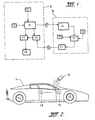
- a proximity sensor 12 is located in a vehicle 14 and senses, in a known manner, the presence of a person adjacent the vehicle 14.
- the proximity sensor 12 may sense a person touching a vehicle door handle, or sense an attempt to actuate a door handle which activates a switch.
- the sensor 12 may comprise a short range proximity sensor located in the vehicle using, for example, capacitive monitoring to sense the presence of a person adjacent the vehicle.
- the proximity sensor 12 When the proximity sensor 12 is activated, it causes a vehicle transponder 16 in the vehicle 14 to transmit a radio frequency trigger signal at a predetermined, fixed carrier frequency.
- This trigger signal includes a random number generated by random number generator 17 associated with the transponder 16.
- the trigger signal also incorporates coded vehicle identification information that uniquely identifies the vehicle 14.
- the trigger signal may be transmitted a predetermined number of times, or over a predetermined period, following activation of the proximity sensor. Alternatively, one trigger signal may be transmitted for each proximity sensor activation.
- the random number generated by the generator 17 is used to establish one or more frequencies to which the transponder receiver 26 in the vehicle is to be tuned to receive a response to the transmitted trigger signal.
- the RF frequencies may vary between 200 MHz and 400MHz, although it will be appreciated that a broader or different bandwidth may be used.
- At least one electronic identification device 18 is associated with the vehicle transponder 16.
- the device 18 has receiver and decoder circuitry 19 to receive and decode a received signal, a processor 21 and a transmitter 24.
- a unique identification number together with vehicle identification information is held in a store 23, and the processor is programmed to conduct calculations in accordance with an algorithm 22.
- the device receives the trigger signal in the receiver and decoder circuitry 19 and determines if the transmitted coded vehicle identification information matches the stored vehicle information in the device. If the received and stored information matches, the random number included with the trigger signal is manipulated in processor 21 using an algorithm 22 and the stored unique number in the store 23. The processor thereby generates a resulting response signal that comprises one or more bursts of RF energy of given duration and at one or more frequencies, the three variables (number of pulses generated, their duration and the RF frequencies of the pulses) being determined by the algorithm working with the unique stored number in conjunction with the random number transmitted from the vehicle 14. The response signal is transmitted by the transmitter 24 and received by a receiver 26 associated with the transponder 16 in the vehicle 14.
- the receiver 26 in the vehicle is tuned to the frequencies of the expected response signal in accordance with the transmitted random number.
- a comparator 27 compares the response signal with the expected signal, it being understood that the transponder stores the unique identification number of the device and is able to use the same algorithm to calculate the expected response. If the received response signal matches the expected response, a signal is sent to a door lock actuator 28 to unlock the vehicle door(s).
- the system determines if the identification device 18 is inside the vehicle 14. Accordingly, the power of the trigger signal transmitted by the transponder for this function is controlled so that it is unlikely that the identification device 18 could detect the signal from outside the vehicle. This ensures that the vehicle cannot be operated unless the identification device is within the vehicle. If desired, the system may be designed such that the identification device must be mounted in an appropriate receptacle in the vehicle before the vehicle is able to be started.
- the security system of the described embodiment is more secure than the previous systems of a similar type as described herein by reason of the use of a variable signal frequency within a wide bandwidth for the response signal. Further, by using an algorithm together with an unique identification number to manipulate the transmitted random number and generate a response signal having at least three variables, vis, the number of pulses, the duration of the pulses and the RF frequencies of the individual pulses, it will be very difficult to attack the system by the use of normal, portable transceivers.
- the response signal may also include other variables, such as a polling identification number, the polling of which is determined by the random number.
- a security system of the invention may be made substantially more immune to interfering external RF sources than currently known systems by the use of the variable frequency of the response signal. If access to a vehicle is blocked because of an interfering RF signal source, re-activation of the trigger signal will generally give rise to a response signal having a frequency that is not interfered with by the RF source. However, some redundancy should be made in the identification device's response coding to allow for masking which may occur due to interfering external signals at spot frequencies.
- the principals of this invention may be used in a large number of different applications, such as security access associated with buildings, including external doors, internal doors, lifts, maintenance areas and the like.
- the principals may also be used to provide authorisation for activities other than access.
- the system may be designed to permit only authorised use of equipment
Landscapes
- Engineering & Computer Science (AREA)
- Mechanical Engineering (AREA)
- Lock And Its Accessories (AREA)
- Burglar Alarm Systems (AREA)
- Air Bags (AREA)
- Alarm Systems (AREA)
Claims (17)
- Sicherheitssystem mit Transpondermitteln, die ausgebildet sind, um betätigt zu werden für die Erzeugung und Übertragung eines elektromagnetischen Triggersignals, und einer tragbaren elektronischen Vorrichtung, die ausgebildet ist für das Empfangen und Antworten auf das Triggersignal durch Übertragen eines Antwortsignals, wobei der Empfang und die Beglaubigung von diesem durch die Transpondermittel ein vorbestimmtes Ereignis verursachen, welches Antwortsignal ein oder mehr Hochfrequenzsignale mit einer Frequenz und einer Dauer aufweist, die bestimmt sind durch einen Algorithmus zusammen mit einer eindeutigen Zahl, die in der Vorrichtung gespeichert sind, und mit Bezug auf eine in dem Triggersignal enthaltene zufällige Zahl.
- Sicherheitssystem nach Anspruch 1, bei dem das Antwortsignal drei Variablen enthält, die die Anzahl von Impulsen in dem Hochfrequenzsignal, die Frequenz der Impulse und die Impulsdauer aufweisen.
- Sicherheitssystem nach Anspruch 1 oder Anspruch 2, bei dem die Transpondermittel einen Empfänger enthalten, der auf die erwartete Frequenz des Antwortsignals in Übereinstimmung mit der in dem Triggersignal enthaltenen zufälligen Zahl eingestellt ist.
- Sicherheitssystem nach einem der Ansprüche 1 bis 3, bei dem die Transpondermittel durch einen Annäherungssensor betätigt werden.
- Sicherheitssystem nach einem der Ansprüche 1 bis 3, bei dem die Transpondermittel durch einen Schalter betätigt werden.
- Sicherheitssystem nach einem der vorhergehenden Ansprüche, bei dem das vorbestimmte Ereignis die Betätigung einer Türverriegelung oder die Freigabe eines Steuersystems ist.
- Sicherheitssystem nach einem der vorhergehenden Ansprüche, bei dem ein Zufallszahlgenerator mit den Transpondermitteln assoziiert ist und eine neue zufällige Zahl bei jeder Betätigung der Transpondermittel erzeugt.
- Sicherheitssystem nach einem der vorhergehenden Ansprüche, bei dem die Transpondermittel das Triggersignal während einer vorbestimmten Periode folgend der Betätigung oder bis zum Empfang eines beglaubigten Antwortsignals übertragen.
- Sicherheitssystem nach einem der vorhergehenden Ansprüche, bei dem das Triggersignal codierte Identifikationsinformationen, die die Transpondermittel eindeutig identifizieren, enthält.
- Sicherheitssystem nach Anspruch 9, bei dem die Vorrichtung Identifikationsinformationen speichert und bei Empfang eines Triggersignals bestimmt, ob die übertragenen codierten Identifikationsinformationen den gespeicherten Informationen angepasst sind, und ein Antwortsignal nur dann erzeugt, wenn die Informationen angepasst sind.
- Sicherheitssystem nach einem der vorhergehenden Ansprüche, bei dem die Frequenz des Antwortsignals mit jeder Übertragung innerhalb des Bereichs von 200 MHz und 400 MHz variiert.
- Sicherheitssystem nach einem der vorhergehenden Ansprüche, bei dem die Frequenz von individuellen Impulsen des Antwortsignals innerhalb eines vorbestimmten Bereichs variiert.
- Sicherheitssystem nach einem der vorhergehenden Ansprüche, bei dem die Transpondermittel in einem Motorfahrzeug befestigt sind und durch einen Annäherungssensor oder einen mit einem Fahrzeugtür-Handgriff assoziierten Schalter betätigt werden.
- Sicherheitssystem nach Anspruch 13, bei dem die oder zweite Transpondermittel mit elektrischen Schaltungen des Fahrzeugs assoziiert sind, die bei Empfang eines beglaubigten Antwortsignals folgend der Übertragung eines durch Fahrzeugstartvorgänge initiierten codierten Triggersignals freigegeben werden.
- Sicherheitssystem nach Anspruch 14, bei dem die Signalstärke des bei Betätigung von Fahrzeugstartvorgängen übertragenen codierten Triggersignals derart ist, dass das Signal nicht in der Lage ist, durch die Vorrichtung außerhalb des Fahrzeugs erfasst zu werden.
- Sicherheitssystem nach einem der Ansprüche 13 bis 15, bei dem das Fahrzeug eine Aufnahmevorrichtung enthält, mit der die Vorrichtung in Eingriff treten muss, bevor elektrische Systeme des Fahrzeugs freigebbar sind.
- Sicherheitssystem, im Wesentlichen wie vorstehend mit Bezug auf die begleitenden Zeichnungen beschrieben.
Applications Claiming Priority (4)
| Application Number | Priority Date | Filing Date | Title |
|---|---|---|---|
| AUPP312399 | 1999-09-28 | ||
| AUPQ312399 | 1999-09-28 | ||
| AUPQ3123A AUPQ312399A0 (en) | 1999-09-28 | 1999-09-28 | Improved security system |
| PCT/AU2000/001186 WO2001023227A1 (en) | 1999-09-28 | 2000-09-28 | Improved security system |
Publications (3)
| Publication Number | Publication Date |
|---|---|
| EP1218227A1 EP1218227A1 (de) | 2002-07-03 |
| EP1218227A4 EP1218227A4 (de) | 2004-11-17 |
| EP1218227B1 true EP1218227B1 (de) | 2005-12-14 |
Family
ID=3817287
Family Applications (1)
| Application Number | Title | Priority Date | Filing Date |
|---|---|---|---|
| EP00972425A Expired - Lifetime EP1218227B1 (de) | 1999-09-28 | 2000-09-28 | Sicherheitssystem |
Country Status (5)
| Country | Link |
|---|---|
| EP (1) | EP1218227B1 (de) |
| AT (1) | ATE312734T1 (de) |
| AU (1) | AUPQ312399A0 (de) |
| DE (1) | DE60024844T2 (de) |
| WO (1) | WO2001023227A1 (de) |
Families Citing this family (6)
| Publication number | Priority date | Publication date | Assignee | Title |
|---|---|---|---|---|
| DE102005035263A1 (de) * | 2005-07-25 | 2007-02-01 | Huf Hülsbeck & Fürst Gmbh & Co. Kg | Verfahren zur Überprüfung einer Legitimation für einen Zugriff auf ein Kraftfahrzeug |
| DE102006032937A1 (de) * | 2006-07-15 | 2008-01-24 | Conti Temic Microelectronic Gmbh | Identifikationssystem |
| US8427278B2 (en) | 2008-10-17 | 2013-04-23 | Robert Bosch Gmbh | Automation and security system |
| US7973678B2 (en) | 2009-02-02 | 2011-07-05 | Robert Bosch Gmbh | Control of building systems based on the location and movement of a vehicle tracking device |
| FR3030850B1 (fr) * | 2014-12-23 | 2020-01-24 | Valeo Comfort And Driving Assistance | Procede de controle de l'acces a au moins une fonctionnalite d'un vehicule automobile |
| CN115139979B (zh) * | 2022-07-13 | 2023-05-26 | 东风汽车集团股份有限公司 | 无制动灯开关的无感启动方法、装置、设备及存储介质 |
Family Cites Families (6)
| Publication number | Priority date | Publication date | Assignee | Title |
|---|---|---|---|---|
| DE3536377A1 (de) * | 1985-10-11 | 1987-04-16 | Bayerische Motoren Werke Ag | Sicherheitseinrichtung fuer kraftfahrzeuge |
| FR2717327B1 (fr) * | 1994-03-14 | 1996-04-19 | Valeo Electronique | Procédé de communication entre un module d'interrogation et un transpondeur utilisé en particulier pour le déverrouillage des ouvrants et/ou des immobiliseurs d'un véhicule, et dispositif d'identification le mettant en Óoeuvre. |
| EP0730071A1 (de) * | 1995-03-03 | 1996-09-04 | Siemens Aktiengesellschaft | Diebstahlschutzsystem für ein Kraftfahrzeug |
| DE19637387C1 (de) * | 1996-09-13 | 1998-01-29 | Siemens Ag | Transponder für ein Diebstahlschutzsystem |
| US5790014A (en) * | 1997-04-21 | 1998-08-04 | Ford Motor Company | Charging a transponder in a security system |
| GB9816170D0 (en) * | 1997-12-20 | 1998-09-23 | Rover Group | A security system |
-
1999
- 1999-09-28 AU AUPQ3123A patent/AUPQ312399A0/en not_active Abandoned
-
2000
- 2000-09-28 EP EP00972425A patent/EP1218227B1/de not_active Expired - Lifetime
- 2000-09-28 AT AT00972425T patent/ATE312734T1/de not_active IP Right Cessation
- 2000-09-28 WO PCT/AU2000/001186 patent/WO2001023227A1/en not_active Ceased
- 2000-09-28 DE DE60024844T patent/DE60024844T2/de not_active Expired - Fee Related
Also Published As
| Publication number | Publication date |
|---|---|
| EP1218227A1 (de) | 2002-07-03 |
| AUPQ312399A0 (en) | 1999-10-21 |
| EP1218227A4 (de) | 2004-11-17 |
| ATE312734T1 (de) | 2005-12-15 |
| DE60024844D1 (de) | 2006-01-19 |
| WO2001023227A1 (en) | 2001-04-05 |
| DE60024844T2 (de) | 2006-06-29 |
Similar Documents
| Publication | Publication Date | Title |
|---|---|---|
| US6034617A (en) | Operator intent based passive keyless vehicle control system | |
| US7388466B2 (en) | Integrated passive entry and remote keyless entry system | |
| US6992568B2 (en) | Passive response communication system | |
| JP3828942B2 (ja) | キーレス形アクセス監視装置 | |
| US6144293A (en) | Procedure for operating a security system | |
| US5983347A (en) | Authentication device with electronic authentication communication | |
| EP1101887B1 (de) | Semi-passive schlüssellose Zugangsvorrichtung | |
| US20080024322A1 (en) | Method and Arrangements for Increasing the Security of Transponder Systems, Particularly for Access to Automobiles | |
| US20030025588A1 (en) | Method for enabling authenticated access of an individual to a security area and security system for implementing the method | |
| KR20040021550A (ko) | 차량, 특히 자동차용 키리스 로킹 시스템 | |
| US7944340B1 (en) | System and method for two-way remote activation with adaptive protocol | |
| US20110273268A1 (en) | Sparse coding systems for highly secure operations of garage doors, alarms and remote keyless entry | |
| EP1218227B1 (de) | Sicherheitssystem | |
| WO2004095189A2 (en) | System and method for securely activating a mechanism | |
| US7551066B1 (en) | Method and system for transmitting data for a security system of a motor vehicle | |
| AU775111B2 (en) | Improved security system | |
| US6580354B1 (en) | Control system and method for controlling motor vehicle functions | |
| GB2576133A (en) | Remote keyless system security device | |
| EP0886025B1 (de) | Verschlusssysteme für Kraftfahrzeug und Verfahren zu ihrer Kontrolle | |
| US6774763B2 (en) | Apparatus for activating and/or deactivating a security device | |
| US9262878B1 (en) | System and method for one-way remote activation with adaptive protocol | |
| US6834179B2 (en) | Method for operating an access control system, in particular for a motor vehicle, and access control system | |
| JP2004040803A (ja) | 個人的な携帯物を介して所定スペースへのアクセスを制御するための方法、及び該方法を実行するための携帯物 | |
| DE102010050230B4 (de) | Verfahren zum Fernbetätigen eines Fahrzeugtürschlosses | |
| US10762730B2 (en) | Method for secure access to a motor vehicle |
Legal Events
| Date | Code | Title | Description |
|---|---|---|---|
| PUAI | Public reference made under article 153(3) epc to a published international application that has entered the european phase |
Free format text: ORIGINAL CODE: 0009012 |
|
| 17P | Request for examination filed |
Effective date: 20020402 |
|
| AK | Designated contracting states |
Kind code of ref document: A1 Designated state(s): AT BE CH CY DE DK ES FI FR GB GR IE IT LI LU MC NL PT SE |
|
| AX | Request for extension of the european patent |
Free format text: AL;LT;LV;MK;RO;SI |
|
| RIN1 | Information on inventor provided before grant (corrected) |
Inventor name: KERRY, LEONARD, JOHN Inventor name: JAMES, CAMPBELL, RICHARD Inventor name: JANKOWSKI, DAVID, PAUL |
|
| A4 | Supplementary search report drawn up and despatched |
Effective date: 20040930 |
|
| RIC1 | Information provided on ipc code assigned before grant |
Ipc: 7G 07C 9/00 B Ipc: 7B 60R 25/00 A |
|
| GRAP | Despatch of communication of intention to grant a patent |
Free format text: ORIGINAL CODE: EPIDOSNIGR1 |
|
| GRAS | Grant fee paid |
Free format text: ORIGINAL CODE: EPIDOSNIGR3 |
|
| GRAA | (expected) grant |
Free format text: ORIGINAL CODE: 0009210 |
|
| AK | Designated contracting states |
Kind code of ref document: B1 Designated state(s): AT BE CH CY DE DK ES FI FR GB GR IE IT LI LU MC NL PT SE |
|
| PG25 | Lapsed in a contracting state [announced via postgrant information from national office to epo] |
Ref country code: BE Free format text: LAPSE BECAUSE OF FAILURE TO SUBMIT A TRANSLATION OF THE DESCRIPTION OR TO PAY THE FEE WITHIN THE PRESCRIBED TIME-LIMIT Effective date: 20051214 Ref country code: FI Free format text: LAPSE BECAUSE OF FAILURE TO SUBMIT A TRANSLATION OF THE DESCRIPTION OR TO PAY THE FEE WITHIN THE PRESCRIBED TIME-LIMIT Effective date: 20051214 Ref country code: NL Free format text: LAPSE BECAUSE OF FAILURE TO SUBMIT A TRANSLATION OF THE DESCRIPTION OR TO PAY THE FEE WITHIN THE PRESCRIBED TIME-LIMIT Effective date: 20051214 Ref country code: AT Free format text: LAPSE BECAUSE OF FAILURE TO SUBMIT A TRANSLATION OF THE DESCRIPTION OR TO PAY THE FEE WITHIN THE PRESCRIBED TIME-LIMIT Effective date: 20051214 Ref country code: LI Free format text: LAPSE BECAUSE OF FAILURE TO SUBMIT A TRANSLATION OF THE DESCRIPTION OR TO PAY THE FEE WITHIN THE PRESCRIBED TIME-LIMIT Effective date: 20051214 Ref country code: CH Free format text: LAPSE BECAUSE OF FAILURE TO SUBMIT A TRANSLATION OF THE DESCRIPTION OR TO PAY THE FEE WITHIN THE PRESCRIBED TIME-LIMIT Effective date: 20051214 |
|
| REG | Reference to a national code |
Ref country code: GB Ref legal event code: FG4D |
|
| REG | Reference to a national code |
Ref country code: CH Ref legal event code: EP |
|
| REG | Reference to a national code |
Ref country code: SE Ref legal event code: TRGR |
|
| REG | Reference to a national code |
Ref country code: IE Ref legal event code: FG4D |
|
| REF | Corresponds to: |
Ref document number: 60024844 Country of ref document: DE Date of ref document: 20060119 Kind code of ref document: P |
|
| PG25 | Lapsed in a contracting state [announced via postgrant information from national office to epo] |
Ref country code: DK Free format text: LAPSE BECAUSE OF FAILURE TO SUBMIT A TRANSLATION OF THE DESCRIPTION OR TO PAY THE FEE WITHIN THE PRESCRIBED TIME-LIMIT Effective date: 20060314 Ref country code: GR Free format text: LAPSE BECAUSE OF FAILURE TO SUBMIT A TRANSLATION OF THE DESCRIPTION OR TO PAY THE FEE WITHIN THE PRESCRIBED TIME-LIMIT Effective date: 20060314 |
|
| PG25 | Lapsed in a contracting state [announced via postgrant information from national office to epo] |
Ref country code: ES Free format text: LAPSE BECAUSE OF FAILURE TO SUBMIT A TRANSLATION OF THE DESCRIPTION OR TO PAY THE FEE WITHIN THE PRESCRIBED TIME-LIMIT Effective date: 20060325 |
|
| PG25 | Lapsed in a contracting state [announced via postgrant information from national office to epo] |
Ref country code: PT Free format text: LAPSE BECAUSE OF FAILURE TO SUBMIT A TRANSLATION OF THE DESCRIPTION OR TO PAY THE FEE WITHIN THE PRESCRIBED TIME-LIMIT Effective date: 20060515 |
|
| NLV1 | Nl: lapsed or annulled due to failure to fulfill the requirements of art. 29p and 29m of the patents act | ||
| ET | Fr: translation filed | ||
| REG | Reference to a national code |
Ref country code: CH Ref legal event code: PL |
|
| PG25 | Lapsed in a contracting state [announced via postgrant information from national office to epo] |
Ref country code: IE Free format text: LAPSE BECAUSE OF NON-PAYMENT OF DUE FEES Effective date: 20060928 |
|
| PG25 | Lapsed in a contracting state [announced via postgrant information from national office to epo] |
Ref country code: MC Free format text: LAPSE BECAUSE OF NON-PAYMENT OF DUE FEES Effective date: 20060930 |
|
| PLBE | No opposition filed within time limit |
Free format text: ORIGINAL CODE: 0009261 |
|
| STAA | Information on the status of an ep patent application or granted ep patent |
Free format text: STATUS: NO OPPOSITION FILED WITHIN TIME LIMIT |
|
| 26N | No opposition filed |
Effective date: 20060915 |
|
| REG | Reference to a national code |
Ref country code: IE Ref legal event code: MM4A |
|
| PGFP | Annual fee paid to national office [announced via postgrant information from national office to epo] |
Ref country code: DE Payment date: 20070920 Year of fee payment: 8 |
|
| PGFP | Annual fee paid to national office [announced via postgrant information from national office to epo] |
Ref country code: GB Payment date: 20070926 Year of fee payment: 8 |
|
| PGFP | Annual fee paid to national office [announced via postgrant information from national office to epo] |
Ref country code: IT Payment date: 20070928 Year of fee payment: 8 Ref country code: SE Payment date: 20070905 Year of fee payment: 8 |
|
| PGFP | Annual fee paid to national office [announced via postgrant information from national office to epo] |
Ref country code: FR Payment date: 20070914 Year of fee payment: 8 |
|
| PG25 | Lapsed in a contracting state [announced via postgrant information from national office to epo] |
Ref country code: LU Free format text: LAPSE BECAUSE OF NON-PAYMENT OF DUE FEES Effective date: 20060928 |
|
| PG25 | Lapsed in a contracting state [announced via postgrant information from national office to epo] |
Ref country code: CY Free format text: LAPSE BECAUSE OF FAILURE TO SUBMIT A TRANSLATION OF THE DESCRIPTION OR TO PAY THE FEE WITHIN THE PRESCRIBED TIME-LIMIT Effective date: 20051214 |
|
| GBPC | Gb: european patent ceased through non-payment of renewal fee |
Effective date: 20080928 |
|
| REG | Reference to a national code |
Ref country code: FR Ref legal event code: ST Effective date: 20090529 |
|
| PG25 | Lapsed in a contracting state [announced via postgrant information from national office to epo] |
Ref country code: IT Free format text: LAPSE BECAUSE OF NON-PAYMENT OF DUE FEES Effective date: 20080928 Ref country code: DE Free format text: LAPSE BECAUSE OF NON-PAYMENT OF DUE FEES Effective date: 20090401 |
|
| PG25 | Lapsed in a contracting state [announced via postgrant information from national office to epo] |
Ref country code: FR Free format text: LAPSE BECAUSE OF NON-PAYMENT OF DUE FEES Effective date: 20080930 |
|
| PG25 | Lapsed in a contracting state [announced via postgrant information from national office to epo] |
Ref country code: GB Free format text: LAPSE BECAUSE OF NON-PAYMENT OF DUE FEES Effective date: 20080928 |
|
| PG25 | Lapsed in a contracting state [announced via postgrant information from national office to epo] |
Ref country code: SE Free format text: LAPSE BECAUSE OF NON-PAYMENT OF DUE FEES Effective date: 20080929 |